





Introduction
During the Late Pleistocene, human occupation of Central Europe was strongly conditioned by climatic fluctuations and associated environmental changes. Dispersals into regions north of 45°N occurred primarily during phases of climatic amelioration, whereas colder periods led to demographic contraction and reduced regional occupation (Hublin and Roebroeks Reference Hublin and Roebroeks2009; Picin Reference Picin2025; Stewart and Stringer Reference Stewart and Stringer2012; Wragg Sykes Reference Wragg Sykes2017). Timing these movements into higher latitudes is crucial for understanding which climatic settings allowed the exploitation of certain environments and the adaptability of prehistoric hunter-gatherers to varied ecological contexts. Thus far, Homo sapiens in their dispersal out of Africa has demonstrated to be able to adapt and exploit a broad range of ecological niches (Picin et al. Reference Picin, Wedage, Blinkhorn, Amano, Deraniyagala, Boivin, Roberts and Petraglia2022; Roberts and Stewart Reference Roberts and Stewart2018) whereas Neanderthals appear to have occupied a more restricted set of environments in Eurasia, with a preference for woodland–shrubland mosaics and temperate to boreal forest settings (Carrión et al. Reference Carrión, Amorós, Amorós and Marín-Arroyo2026; Trájer Reference Trájer2023).
Within this broader framework, southern Poland should not be viewed as an isolated region, but rather as a dynamic frontier zone, interpreted as a satellite zone within broader hunter-gatherer settlement systems (Picin et al. Reference Picin, Stefański, Cieśla and Valde-Nowak2023; Schmidt and Zimmermann Reference Schmidt and Zimmermann2019). Archaeological evidence suggests that cyclical occupations were closely linked to the exploitation of seasonal resources during climatic windows (Picin et al. Reference Picin, Hajdinjak, Nowaczewska, Benazzi, Urbanowski, Marciszak, Fewlass, Bosch, Socha, Stefaniak, Żarski, Wiśniewski, Hublin, Nadachowski and Talamo2020; Talamo et al. Reference Talamo, Nowaczewska, Picin, Vazzana, Binkowski, Bosch, Cercatillo, Diakowski, Fewlass, Marciszak, Paleček, Richards, Ryder, Sinet-Mathiot, Smith, Socha, Sponheimer, Stefaniak, Welker, Winter, Wiśniewski, Żarski, Benazzi, Nadachowski and Hublin2021b, 2025).
The Kraków area has long been recognized as a key region for Paleolithic research in southern Poland. Since the late 19th century, intensive archaeological investigations have led to the identification of several Middle and Upper Paleolithic sites, both open-air and cave contexts in the Kraków–Częstochowa Upland, many of which are located within a few tens of kilometers of Piekary III and form part of the same regional settlement framework (Chmielewski et al. Reference Chmielewski, Konecka-Betley and Madeyska1977; Krukowski Reference Krukowski, Krukowski and Kostrzewski1939; Sachse-Kozłowska and Kozlowski Reference Sachse-Kozłowska and Kozlowski2004; Sawicki Reference Sawicki1957; Sitlivy et al. Reference Sitlivy, Zieba and Sobczyk2008, Reference Sitlivy, Zieba and Sobczyk2009). Among these, the Piekary complex, located on the left bank of the Vistula River at the eastern narrow passage of the Kraków Gate, approximately 12 km upstream from Kraków, stands at a strategic position within the regional settlement network. The complex includes several sites with repeated evidence of Paleolithic occupations, such as Piekary I (Jama Cave), Piekary II and IIa, Piekary III, Piekary IV (Na Gołąbcu Cave), and Piekary V (Sachse-Kozłowska and Kozlowski Reference Sachse-Kozłowska and Kozlowski2004).
Within this context, the open-air site of Piekary III is of particular importance due to its extensive archaeological sequence and the richness of its lithic assemblages (Krukowski Reference Krukowski, Krukowski and Kostrzewski1939; Tomaszewski Reference Tomaszewski, Sachse-Kozłowska and Kozłowski2004). Despite its long-standing role as a reference locality, especially for the Central Eastern European Micoquian (CEEM), detailed and up-to-date analytical information on the site remains surprisingly limited, and much of the material has never been systematically re-evaluated using modern methodological frameworks. At the same time, Piekary III provides a clear example of a broader set of challenges commonly encountered at Paleolithic sites excavated during the early and mid-twentieth century, when excavation and recording practices often differed from current methodological standards. Comparable issues related to stratigraphic resolution, artifact association, and the retrospective interpretation of old assemblages have been documented at other well-known sites, highlighting the long-term consequences of early excavation strategies and archival fragmentation (MacFarland and Vokes Reference MacFarland and Vokes2016; Ryan et al. Reference Ryan, Starnini, Serradimigni, Rossoni-Notter, Notter, Zerboni, Negrino, Grimaldi, Vacchi, Ragaini, Rovere, Perego, Muttoni, Santaniello, Moussous and Pappalardo2024). Consequently, substantial portions of the archaeological record from such sites remain unknown and unstudied.
Recent advances in chronometric and biomolecular methods provide new opportunities to revisit old collections and to extract information that was previously inaccessible, particularly concerning the timing and duration of human occupations (Fewlass et al. Reference Fewlass, Talamo, Wacker, Kromer, Tuna, Fagault, Bard, McPherron, Aldeias, Maria, Martisius, Paskulin, Rezek, Sinet-Mathiot, Sirakova, Smith, Spasov, Welker, Sirakov, Tsanova and Hublin2020; Talamo et al. Reference Talamo, Fewlass, Maria and Jaouen2021a, Reference Talamo, Kromer, Richards and Wacker2023). At the same time, the reanalysis of materials recovered during early excavation campaigns requires a cautious and critical approach; especially when dealing with archaeological specimens held in museum collections and excavation records that are often incomplete or fragmentary. Careful evaluation of sample conditions (e.g. avoiding glues, consolidants, fumigants, etc.) and stratigraphic attribution is therefore essential (Crann and Grant Reference Crann and Grant2019, Talamo et al. Reference Talamo, Fewlass, Maria and Jaouen2021a, Reference Talamo, Kromer, Richards and Wacker2023, Reference Talamo, Casaccia, Richards, Wacker, Tassoni, Nadachowski, Kraszewska, Kowal, Skłucki, Barrington, Kelly, Tait, Williams, Figus, Vazzana, Di Bernardo, Romandini, Di Domenico, Benazzi, Malegori, Sciutto, Oliveri, Hublin, Hajdinjak, Skoglund, Picin and Valde‑Nowak2025). If performed within a solid methodological framework, the re-evaluation of old archaeological assemblages such as Piekary III has the potential to significantly update regional chronology and to improve our understanding of Late Pleistocene human settlement dynamics in Central Europe.
In this paper, we present an integrated reassessment of Piekary III based on a technological analysis of the complete lithic core assemblage and a dedicated radiocarbon dating program on faunal remains recovered at the site. By combining lithic technology and chronometric data, we aim to refine the occupational sequence of Piekary III and to place the site within the broader framework of Late Pleistocene human settlement dynamics in southern Poland.
Materials and methods
The open-air site of Piekary III
Piekary III is a Middle Paleolithic open-air site located in southern Poland, on the northern margin of the Vistula River valley, within the Kraków region (Figure 1). The site is situated at the foot of a limestone rock wall, which locally forms a small rock overhang approximately 3 m high and about 1 m deep. The site was initially tested by two small trial trenches in 1927 and large-scale excavations were carried out in 1936 (Krukowski Reference Krukowski, Krukowski and Kostrzewski1939). The excavation covered an area exceeding 360 m2, with trenches reaching depths of up to 7.5 m in some sectors. Krukowski (Reference Krukowski, Krukowski and Kostrzewski1939) described the stratigraphy of Piekary III as a complex sedimentary sequence resting on a karstified limestone bedrock that slopes gently toward the southwest and more steeply toward the Vistula River valley. Sediments accumulated in a shallow basin adjacent to a limestone rock wall and were repeatedly affected by slope processes and erosion associated with a ravine cutting the western part of the site. The basal deposits (Layer 9) consist of coarse clayey sands with limestone debris resting directly on bedrock and contain no securely attributable archaeological material. Above, Layer 8 is represented by loess and reddish to greenish bedded sands or, locally, by dark gray clay; it yielded only sparse lithic remains of uncertain cultural attribution. The main archaeological horizon is Layer 7, commonly referred to as the Piekary cultural layer. It is composed of horizontally bedded loess and sands with marked redox color variations, filling a shallow depression above the bedrock. In the northern sector, close to the rock wall, this unit is enriched in limestone clasts and gravels, while southward it grades into finely bedded loess–sand alternations. Layer 7 yielded abundant Middle Paleolithic artifacts, including a well-developed Micoquian assemblage. Layer 6 overlies Layer 7 and consists of a complex unit of loess, bedded sands, gravels, and large limestone blocks, reflecting alternating phases of slope wash, solifluction, and limited alluvial input. Although this unit locally deformed the upper part of Layer 7, it also sealed and protected the archaeological deposits. Above Layer 6, Layer 5 corresponds to a typical subaerial loess deposit (recent loess II). Along the ravine slopes, colluvial deposits derived from the erosion and redeposition of materials from Layers 5 and 6 are locally present. The upper part of the sequence includes locally preserved transitional deposits (Layers 4 and 4–5), fossil soils (Layers 3 and 2), and historical and modern surface deposits (Layer 1) (Tomaszewski Reference Tomaszewski, Sachse-Kozłowska and Kozłowski2004).
A. Geographical location of Piekary III in the Krakow region; inset shows Kraków within Poland. B. Approximate extent of the area excavated by Krukowski.

Preliminary results were published by Krukowski (Reference Krukowski, Krukowski and Kostrzewski1939) in his synthesis of the Polish prehistory and by Tomaszewski (Reference Tomaszewski, Sachse-Kozłowska and Kozłowski2004) in his analysis of the lithic assemblage of Layer 7. In these studies, Piekary III was identified as one of the key Middle Paleolithic sites in the region, particularly for its Micoquian assemblage.
Lithic technology
The data presented here are based on the examination of the entire assemblage of lithic cores excavated by Krukowski (Reference Krukowski, Krukowski and Kostrzewski1939) and housed at the State Archaeological Museum in Warsaw. Because the excavation was conducted using outdated methodologies and the stratigraphic context of many lithic artifacts is poorly documented or unknown, the core assemblage was analyzed as a whole. This approach was adopted to assess whether Piekary III was occupied during periods other than the well-documented Micoquian phase. Lithic cores are among the most informative artifacts for investigating prehistoric technological behaviors, as they allow discrimination between knapping systems characteristic of different cultural and chronological phases (e.g. Middle Paleolithic, Aurignacian, Gravettian).
The lithic material was analyzed following the chaîne opératoire concept, a methodological framework that defines the reconstruction of the various processes of flake production from the procurement of raw materials through the phases of manufacture and utilization until final discard (Inizian et al. Reference Inizian, Roche and Tixier1992; Pelegrin et al. Reference Pelegrin, Karlin and Bodu1988).
In this study, Levallois and discoid cores were analyzed following the criteria proposed by Boëda’s (1993, 1994); hierarchized cores were examined according to Picin (Reference Picin2018, Reference Picin2025); and laminar and lamellar cores were studied following Pelegrin (Reference Pelegrin1995, Reference Pelegrin, Valentin, Bodu and Christensen2000), Chiotti (Reference Chiotti2005) and Teyssandier (Reference Teyssandier2008).
Radiocarbon dating
Bone fragments (∼500 mg) were sampled from 20 bone specimens and were pretreated following the protocol outlined by Talamo et al. (Reference Talamo, Fewlass, Maria and Jaouen2021a) (Method 2). The specimens were preferentially selected from long-bone portions. Most of them, including BRA-6139, BRA-6141, BRA-6143, BRA-6146–BRA-6150, and BRA-6156, show fresh-bone fracture features consistent with possible marrow extraction. In general, the samples underwent an ‘acid-base-acid’ (ABA) sequence designed to achieve decalcification, decontamination, and gelatinization of the bone fragments. Initially, hydrochloric acid (HCl 0.5 M, 4 °C) was used to dissolve mineral components and certain organic impurities.
Once the CO2 effervescence ceased, the demineralized samples were rinsed once with ultrapure Milli-Q water. Subsequently, they were treated with NaOH 0.1 M for 30 minutes at room temperature, followed by another rinsing step with ultrapure Milli-Q® water. Finally, the water in glass tubes was replaced with HCl 0.5M, effectively re-acidifying the bones for an additional 15 minutes at room temperature. Using a heater block, the resultant collagen was dissolved, turning into gelatin in acidic water (HCl pH 3) at 70 °C for a duration of 20 hours. The gelatin obtained was filtered using Ezee-filter™ separators (Elkay Laboratory, UK) to remove particles smaller than 80μm. Ultrafiltration was then performed to effectively separate low molecular weight contaminants and degraded proteins (<30 kDa) from the larger molecules (>30 kDa) using Sartorius VivaSpin® Turbo 15 filters. To avoid contamination risks associated with the filter membranes, the Ezee-filters and ultrafilters were rigorously pre-cleaned. After the ultrafiltration process, only the fractions with a molecular weight above 30 kDa were frozen for 24 hours and subsequently freeze-dried for 48 hours.
The collagen obtained was then subjected to graphitization at the BRAVHO lab (Tassoni et al. Reference Tassoni, Kromer, Friedrich, Wacker, Cattani, Friedrich, Paleček, Pelloni, Peng, Thomas and Talamo2024) using the Elemental vario ISOTOPE select (CN mode) coupled to the AGE 3 (Automated Graphitization Equipment, IonPlusAG, Switzerland) (Wacker et al. Reference Wacker, Němec and Bourquin2010b). Oxalic Acid II (NIST 4990C) and phthalic acid standards were graphitized alongside the collagen samples. The resulting graphite targets were sent to the Curt-Engelhorn-Center for Archaeometry in Mannheim, Germany (CEZA, lab code: MAMS), where they were measured on a MICADAS AMS (Kromer et al. Reference Kromer, Lindauer, Synal and Wacker2013) in two separate magazines.
For quality control, an aliquot of a background bone sample (with a radiocarbon age >50,000 BP) was subjected to pretreatment and dating procedures in conjunction with the archaeological samples from Piekary III. The resulting background measurements served to monitor potential laboratory contamination and were included in the data reduction using BATS software (Wacker et al. Reference Wacker, Christl and Synal2010a) to obtain background-corrected radiocarbon results. The reported uncertainties account for this correction. A sample scatter term of 0.1% was included in the final uncertainty calculation, corresponding to the external uncertainty term discussed by Wacker et al. (Reference Wacker, Christl and Synal2010a). Radiocarbon dates (reported as 14C years before present, BP) are presented with their associated ±1σ errors and are calibrated using OxCal 4.4 (Bronk Ramsey Reference Bronk Ramsey2009) with the IntCal20 calibration curve (Reimer et al. Reference Reimer, Austin, Bard, Bayliss, Blackwell, Bronk Ramsey, Butzin, Cheng, Edwards, Friedrich, Grootes, Guilderson, Hajdas, Heaton, Hogg, Hughen, Kromer, Manning, Muscheler, Palmer, Pearson, van der Plicht, Reimer, Richards, Scott, Southon, Turney, Wacker, Adolphi, Büntgen, Capano, Fahrni, Fogtmann-Schulz, Friedrich, Köhler, Kudsk, Miyake, Olsen, Reinig, Sakamoto, Sookdeo and Talamo2020). The calibrated ranges (calibrated years before present, cal BP) are reported at ±1σ and ±2σ ranges, corresponding to a 68.3% and 95.4% probability level respectively.
Zooarchaeology by mass spectrometry (ZooMS)
The collagen samples extracted at the BRAVHO lab, at the Department of Chemistry G. Ciamician, University of Bologna (see the section below on Radiocarbon) were sent to BioArCh, Dept of Archaeology Department of Chemistry, Environment Building University of York (UK) for the ZooMS analysis for the identification of animal species. Approximately 1 mg of freeze-dried collagen was transferred to a labeled microfuge tube and 100 µl 50 mM ammonium bicarbonate (AmBic) was added to resuspend the collagen into solution. The collagen extracts were digested overnight (∼18 hours) with the enzyme trypsin at 37 °C and the digestion was stopped with the addition of 5% v/v trifluoroacetic acid (TFA). The resulting peptides were purified using C18 ZipTip pipette tips and eluted in 100 µl of conditioning solution (0.1% TFA in 50:50 ACN: Water). 1 µl of sample was spotted on to a Bruker ground steel target plate and mixed with 1 µl of matrix (alpha-cyano-4-hydroxycinnamic acid). Each sample was spotted in triplicate alongside calibration standards, and the plate was run on a Bruker UltrafleXtreme MALDI ToF MS, situated in the Centre of Excellence in Mass Spectrometry, University of York.
The spectra were analyzed using mMass, an open-source mass spectrometry tool (Strohalm et al. Reference Strohalm, Kavan, Novák, Volný and Havlícek2010). The three replicates were averaged, and the resulting averaged spectrum was cropped to 800–3500 m/z and peak picked using a signal/noise of 6–10. The peak list was compared to a list of published markers allowing for species identification (Welker et al. Reference Welker, Hajdinjak, Talamo, Jaouen, Dannemann, David, Julien, Meyer, Kelso, Barnes, Brace, Kamminga, Fischer, Kessler, Stewart, Pääbo, Collins and Hublin2016; Buckley et al. Reference Buckley, Collins, Thomas-Oates and Wilson2009, Reference Buckley, Harvey and Chamberlain2017). The application of ZooMS not only aids in taxonomic identification but also enhances our understanding of historical animal use and biodiversity in the region (Buckley et al. Reference Buckley, Collins, Thomas-Oates and Wilson2009; Brandt et al. Reference Brandt, Haase and Collins2018; Richter et al. Reference Richter, Codlin, Seabrook and Warinner2022).
Results
Lithic assemblage
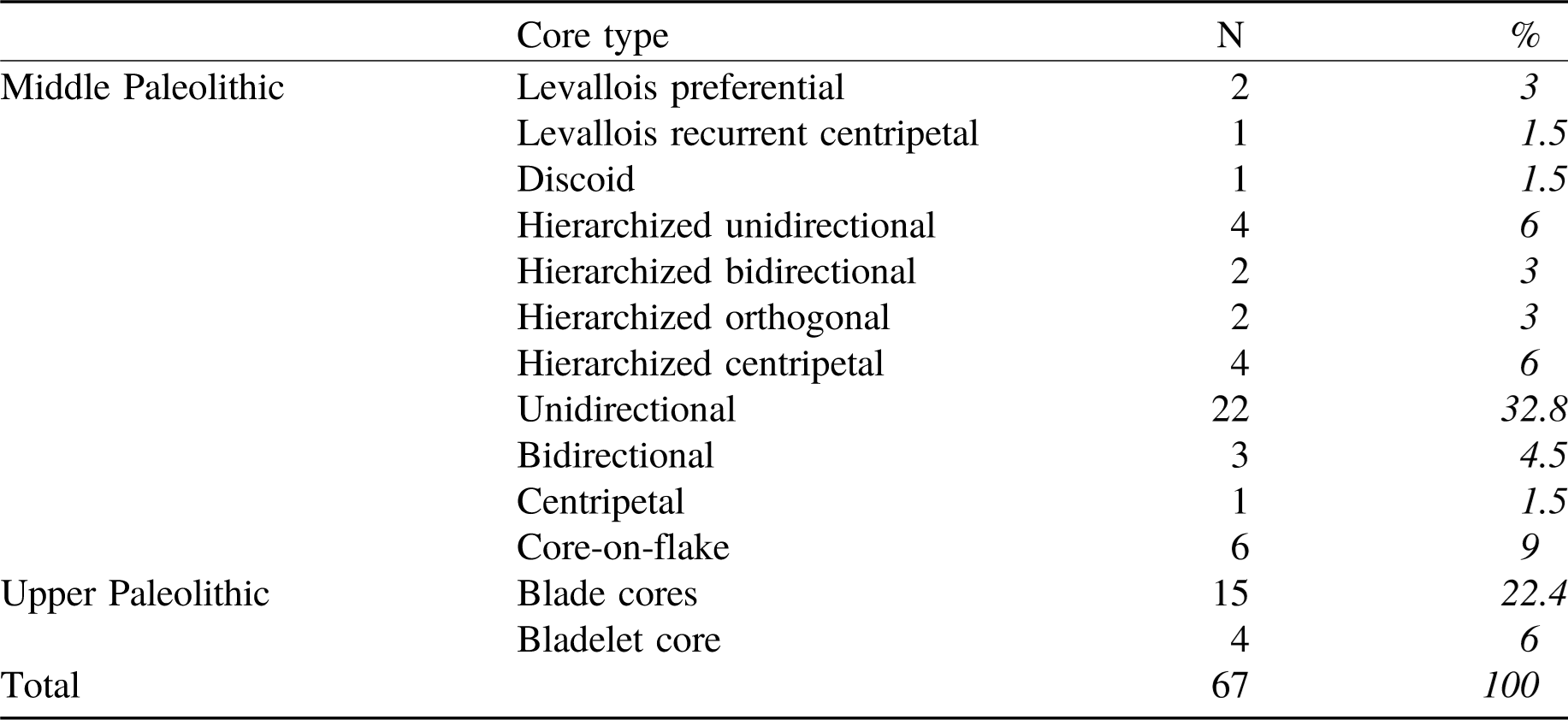
The core assemblage from Piekary III consists of 67 cores (Table 1) and 11 core fragments. The raw material is a local chert, widely available in the southern part of the Kraków–Częstochowa Upland (Kochman et al. Reference Kochman, Matyszkiewicz and Wasilewski2020). A total of 48 cores displays knapping strategies characteristic of Micoquian contexts (Table 1). Levallois cores are rare and include two preferential examples and one recurrent centripetal core (Table 1; Figure 2). Only one discoid core was identified, whereas three additional discoid cores were subsequently converted into unidirectional cores following the removal of part of the striking platform. Most prepared cores are hierarchized artifacts exploited using unidirectional, bidirectional, orthogonal, and centripetal reduction modalities (Table 1). The largest portion of the assemblage, however, is represented by simple cores with unidirectional, bidirectional, or centripetal reduction patterns, as well as cores on flakes (Table 1). It is worth noting that the most of the cores are not fully exploited. A Kruskal-Wallis test on the length of Levallois, hierarchized, discoid and simple cores indicates no significant difference between the sample medians (χ2 = 3.517, p = 0.3185).
Total number and percentages of the core assemblage of Piekary III.

Table 1. Long description
The table presents the types and percentages of cores from the Middle and Upper Paleolithic periods. It has 15 rows and 3 columns. The columns are labeled ‘Core type’, ‘N’, and ‘%’. The ‘Core type’ column lists different types of cores, the ‘N’ column shows the count of each core type, and the ‘%’ column shows the percentage of each core type. The table is divided into two main sections: Middle Paleolithic and Upper Paleolithic. The Middle Paleolithic section includes various core types such as Levallois preferential, Levallois recurrent centripetal, Discoid, Hierarchized unidirectional, Hierarchized bidirectional, Hierarchized orthogonal, Hierarchized centripetal, Unidirectional, Bidirectional, Centripetal, and Core-on-flake. The Upper Paleolithic section includes Blade cores and Bladelet core. The total number of cores is 67, with percentages summing up to 100%.
Lithic cores from Piekary III: 1. Levallois recurrent centripetal core; 2. Discoid core; 3. Aurignacian semi-rotating blade core; 4-5. Aurignacian carinated cores; 6 and 8. Gravettian bladelet cores; 7 Gravettian blade core.

The assemblage also includes a small number of blade and bladelet cores attributable to the Upper Paleolithic (Table 1; Figure 2). Diagnostic Aurignacian artifacts comprise 11 semi-rotating unidirectional cores, one carinated scraper core, and one nosed scraper core. Artifacts most likely associated with the Gravettian include three semi-rotating unidirectional cores, two bidirectional semi-rotating cores, and one bladelet core.
Radiocarbon dates
Twenty faunal bone samples were selected for radiocarbon dating at the BRAVHO lab; 15 specimens yield enough amount of collagen to allow graphitization and AMS measurements. Among these, 14 collagen samples were analyzed by ZooMS for taxonomic identification; BRA-6154 was excluded because insufficient collagen was available for this analysis. The identified taxa are all herbivores and include Elephantidae, Equus sp., Cervidae, Reindeer, Bison, and Rhinocerotidae. The taxonomic identification, skeletal portions, collagen extraction yields and uncalibrated radiocarbon ages are reported in Table 2.
Summary of sample information, collagen extraction, graphitization, and AMS radiocarbon results for faunal remains from Piekary III. The table reports BRAVHO laboratory codes, excavation square and stratigraphic layer, sample preparation weight, collagen yield, and graphitization details (graphite code, elemental composition, and C:N atomic ratio), followed by AMS laboratory codes, conventional radiocarbon ages (14C BP) with 1σ analytical uncertainty, δ13C values, and corresponding fraction modern carbon (F14C ± 1σ). All samples were pretreated and graphitized at the BRAVHO Radiocarbon Laboratory (University of Bologna), and AMS measurements were performed at the Curt-Engelhorn Centre for Archaeometry (CEZA, Mannheim, Germany; MICADAS system).

Table 2. Long description
The table contains 15 rows and 18 columns. Column headers include BRAVHO code, Square, Layer, Skeletal element, Taxonomic identification, Sample prep. weight, Collagen yield, Graphite code, N, C, C:N, AMS lab code, 14C age BP, ±, δ13C, and F14C. Row labels include specific sample codes and details. The table provides data on the taxonomic identification, skeletal portions, collagen extraction yields, and uncalibrated radiocarbon ages of faunal remains. Each row lists specific values for each column, detailing the sample information, collagen extraction, graphitization, and AMS radiocarbon results.
All samples yield atomic C:N ratios ranging between 3.24 and 3.33, well within the accepted range for well-preserved collagen (2.9–3.6; van Klinken Reference van Klinken1999), confirming the good preservation state of the extracted material and supporting the reliability of the radiocarbon results.
The radiocarbon dates cover a broad chronological range, from ca. 48 kBP to ca. 21.8 kBP, with most of the samples clustering between ∼45 and 37 kBP. Dates derive primarily from stratigraphic layers 5, 6, and 7, as well as from transitional interfaces (layers 5/6 and 6/7). Layer 5 yielded two closely consistent dates of 39 630 ± 240 BP and 39 270 ± 230 BP, while samples from the 5/6 interface produced ages ranging between ∼46.3 kBP and ∼37.6 kBP. Layer 6 provided the largest number of dated specimens, with most results falling between ∼44.7 kBP and ∼37.0 kBP. Samples from layers 6/7 and 7 consistently produced ages between ∼48 kBP and ∼41.6 kBP, consistent with an overall Middle to early Upper Paleolithic chronological framework for the sequence.
Calibrated age ranges at 68.3% and 95.4% probability are reported in Table 3, while unmodelled calibrated probability distributions for all AMS determinations are shown in Figure 3. When grouped according to techno-complex attribution based on lithic analysis, the unmodelled dates show a broad chronological separation between the Micoquian, Aurignacian, and Gravettian components, although partial overlap is present, particularly among the older determinations.
Unmodelled calibrated age ranges (IntCal20) for radiocarbon determinations from Piekary III. grouped according to techno-complex attribution based on lithic analysis (Gravettian, Aurignacian, and Micoquian). For each AMS measurement, the table reports the 68.3% and 95.4% calibrated probability intervals (cal BP), derived from conventional radiocarbon ages (14C BP ± 1σ) without Bayesian modelling.

Table 3. Long description
A table comparing calibrated age ranges for radiocarbon determinations from Piekary III, grouped by techno-complex attribution. The table has 16 rows and 5 columns. Column headers are ‘from’, ‘to’, ‘from’, and ‘to’ under ‘Calibrated ranges (cal BP)’ with percentages 68.3% and 95.4%. Row labels include AMS measurements with dates and standard deviations. Row 1: MAMS-72875 R_Date(21820;60), 26230, 25919, 26295, 25895. Row 2: MAMS-83054 R_Date(37050;150), 42026, 41771, 42112, 41557. Row 3: MAMS-72878 R_Date(37600;180), 42230, 42045, 42310, 41941. Row 4: MAMS-72876 R_Date(38450;210), 42510, 42326, 42619, 42238. Row 5: MAMS-72879 R_Date(39270;230), 42855, 42616, 42979, 42501. Row 6: MAMS-72880 R_Date(39630;240), 43029, 42757, 43217, 42618. Row 7: MAMS-83052 R_Date(40680;210), 44035, 43371, 44275, 43183. Row 8: MAMS-72877 R_Date(41440;300), 44618, 44190, 44920, 43502. Row 9: MAMS-72873 R_Date(41640;310), 44725, 44309, 45014, 44042. Row 10: MAMS-72874 R_Date(42060;300), 44976, 44526, 45315, 44370. Row 11: MAMS-83050 R_Date(44340;300), 46916, 46120, 47595, 45942. Row 12: MAMS-83053 R_Date(44670;330), 47449, 46402, 47903, 46092. Row 13: MAMS-83049 R_Date(45010;330), 47800, 46866, 48219, 46345. Row 14: MAMS-83055 R_Date(46250;370), 49054, 47979, 49851, 47642. Row 15: MAMS-83051 R_Date(47910;460), 51729, 49897, 54615, 48842. The table is grouped into Gravettian, Aurignacian, and Micoquian techno-complexes.
Unmodelled calibrated radiocarbon probability distributions (IntCal20) for all AMS determinations from Piekary III, grouped according to techno-complex attribution based on lithic analysis (Gravettian, Aurignacian, and Micoquian). The figure illustrates the chronological separation between the Gravettian, Aurignacian, and Micoquian components at the site.

Discussion
The reanalysis of the archaeological record from Piekary III reveals a more complex pattern of human occupation than previously recognized. The study of the core assemblage shows that the majority of artifacts conform to the technical behaviors’ characteristic of the CEEM, with a limited presence of Levallois technology and a greater reliance on hierarchized and simple knapping strategies (Cyrek et al. Reference Cyrek, Sudoł, Czyżewski, Osipowicz and Grelowska2014; Frick, Schürch and Çep Reference Frick, Schürch and Çep2022; Kozłowski Reference Kozłowski2006; Neruda and Valoch Reference Neruda and Valoch2007; Picin Reference Picin2016, Reference Picin, Dobrescu, Boroneanţ and Doboş2021; Picin et al. Reference Picin, Hajdinjak, Nowaczewska, Benazzi, Urbanowski, Marciszak, Fewlass, Bosch, Socha, Stefaniak, Żarski, Wiśniewski, Hublin, Nadachowski and Talamo2020; Valde-Nowak et al. Reference Valde-Nowak, Alex, Ginter, Krajcarz, Madeyska, Miękina, Sobczyk, Stefański, Wojtal, Zając and Zarzecka-Szubińska2014). Several authors have suggested that Levallois technology was preferentially applied to high-quality raw materials, where greater investment in core preparation maximized the production of standardized blanks, whereas discoid and more expedient reduction methods were more commonly used on lower-quality nodules (Delagnes and Rendu Reference Delagnes and Rendu2011; Picin Reference Picin, Cascalheira and Picin2020; Picin and Carbonell Reference Picin and Carbonell2016; Wallace and Shea Reference Wallace and Shea2006). At Piekary III, instead, chert nodules of good quality were readily available in the immediate vicinity of the site (Kochman et al. Reference Kochman, Matyszkiewicz and Wasilewski2020), a situation that promoted the frequent discard of only minimally exploited artifacts. In this context of high raw material availability, low-investment knapping strategies would have been highly efficient, providing adequate cutting edges for a range of domestic activities without the need for extensive core preparation while asymmetric bifacial knives (or Keilmesser) were the versatile artifacts used during the residential mobility. This technological emphasis on flexible and versatile reduction strategies, rather than on a strong investment in Levallois modalities, was likely advantageous for Neanderthal groups foraging in the periglacial environments of southern Poland and is consistent with patterns documented at other CEEM sites in the Kraków–Częstochowa Upland (Cyrek et al. Reference Cyrek, Sudoł, Czyżewski, Osipowicz and Grelowska2014; Kozłowski Reference Kozłowski2006; Picin et al. Reference Picin, Hajdinjak, Nowaczewska, Benazzi, Urbanowski, Marciszak, Fewlass, Bosch, Socha, Stefaniak, Żarski, Wiśniewski, Hublin, Nadachowski and Talamo2020; Valde-Nowak et al. Reference Valde-Nowak, Alex, Ginter, Krajcarz, Madeyska, Miękina, Sobczyk, Stefański, Wojtal, Zając and Zarzecka-Szubińska2016; Valde-Nowak and Nadachowski Reference Valde-Nowak and Nadachowski2014).
This study has also documented the presence of artifacts characteristic of the Upper Paleolithic within the Piekary III assemblage. The unidirectional semi-rotating cores correspond to prismatic blade cores with low-standardized volumes and plain striking platforms, occasionally prepared by the detachment of only a few removals. These blade cores show strong morphological and technological similarities to Early Aurignacian assemblages documented at the nearby open-air site of Kraków–Zwierzyniec I, where comparable technical solutions were employed in the configuration and maintenance of core convexities (Picin et al. Reference Picin, Stefański, Cieśla and Valde-Nowak2023). In addition, two carinated scraper cores, widely regarded as fossiles directeurs of the Aurignacian (Le Brun-Ricalens et al. Reference Le Brun-Ricalens, Bordes and Bon2005), were identified and are fully consistent with the blade-production strategies observed.
Other Upper Paleolithic artifacts include cylindrical unidirectional and bidirectional blade cores, as well as bladelet cores commonly associated with the Gravettian in southern Poland, such as those documented at the nearby open-air sites of Kraków Spadzista and Jaksice II (Wilczyński Reference Wilczyński2016), and in Central Europe (Moreau Reference Moreau2010; Polanská et al. Reference Polanská, Hromadová and Sázelová2021; Taller and Conard Reference Taller and Conard2016). As observed for the CEEM, Upper Paleolithic cores at Piekary III are generally not intensively reduced. This pattern suggests a convergence in technological behavior likely driven by the local abundance of chert nodules, which reduced the need for prolonged core exploitation and favored efficient reduction strategies across different cultural phases.
From a chronological perspective, the radiocarbon dataset supports the interpretation of Piekary III as a multi-phase open-air site with palimpsests occurring during different periods. The distribution of radiocarbon ages indicates repeated episodes of human presence spanning the late Middle Paleolithic and the Upper Paleolithic (Tables 3, Figure 3). The oldest determinations, whose interpretation takes into account their proximity to the measured background level, are compatible with CEEM occupations. Progressively younger age ranges correspond to Aurignacian and Gravettian artifacts identified in the lithic assemblage. Although the radiocarbon ages attributed to the CEEM and Aurignacian partially overlap, the technological evidence supports their interpretation as successive occupational phases. The concentration of dates within the late CEEM to Aurignacian interval suggests that this period represents the main phase of site use, while a later, more ephemeral occupation is documented by the Gravettian component.
Although minor stratigraphic inversions are present, most likely reflecting post-depositional disturbance and the low-resolution excavation methods employed during the original fieldwork, the overall chronological pattern remains internally coherent when evaluated in conjunction with the technological data. When radiocarbon ages are considered according to techno-complex attribution, a broad temporal structuring emerges, with CEEM, Aurignacian, and Gravettian occupations falling within distinguishable chronological windows.
At present, the chronometric resolution of Late Pleistocene sites in Poland remains limited, largely due to the small number of radiocarbon determinations available for individual stratigraphic units and the often-large associated error ranges. In general, the end of the CEEM is set between 50-45 cal kBP, as documented at Ciemna Cave (Alex et al. Reference Alex, Valde-Nowak, Regev and Boaretto2017), Koziarnia Cave (Kot et al. Reference Kot, Krajcarz, Hoyo, Gryczewska, Wojenka, Pyżewicz, Sinet-Mathiot, Diakowski, Fedorowicz, Gąsiorowski, Marciszak, Lipecki and Mackiewicz2021) and Nietoperzowa Cave (Krajcarz et al. Reference Krajcarz, Krajcarz, Ginter, Goslar and Wojtal2018).
Similarly, the chronological resolution of early Aurignacian occupations remains coarse. At Kraków–Spadzista Street, a combination of radiocarbon and thermoluminescence dating places the formation of Aurignacian Layer 7 between approximately 38 and 31 cal kBP (Kozłowski and Kozłowski Reference Kozłowski and Kozłowski1996), while at Piekary II at least two distinct Aurignacian occupation phases have been identified, dated to ca. 36–34 cal kBP and 33–28 cal kBP (Sitlivy et al. Reference Sitlivy, Zieba and Sobczyk2008). At Mamutowa Cave, the presence of Homo sapiens between 39 and 36 cal kBP is supported by direct radiocarbon dating of two Mladeč-type points (Davies et al. Reference Davies, White, Lewis and Stringer2015).
More recently, higher-resolution chronometric frameworks have begun to refine this picture and suggest an earlier arrival of Homo sapiens in the region. A chronological reassessment of Layer VIII at Obłazowa Cave placed the CEEM between 50 and 43 cal kBP, while Bayesian modeling situates the Aurignacian occupation phase between 42.8 and 38.5 cal kBP (95.4% probability) (Talamo et al. Reference Talamo, Casaccia, Richards, Wacker, Tassoni, Nadachowski, Kraszewska, Kowal, Skłucki, Barrington, Kelly, Tait, Williams, Figus, Vazzana, Di Bernardo, Romandini, Di Domenico, Benazzi, Malegori, Sciutto, Oliveri, Hublin, Hajdinjak, Skoglund, Picin and Valde‑Nowak2025). At Stajnia Cave, although the complex stratigraphic sequence hampers precise definition of the CEEM-Upper Paleolithic transition, direct radiocarbon dating of a bone awl and an ivory pendant, artifacts typical of the Early Aurignacian, yielded ages of 42.3–41.9 cal kBP and 41.9–41.2 cal kBP, respectively (95.4% probability) (Talamo et al. Reference Talamo, Nowaczewska, Picin, Vazzana, Binkowski, Bosch, Cercatillo, Diakowski, Fewlass, Marciszak, Paleček, Richards, Ryder, Sinet-Mathiot, Smith, Socha, Sponheimer, Stefaniak, Welker, Winter, Wiśniewski, Żarski, Benazzi, Nadachowski and Hublin2021b).
In addition, Late Gravettian occupations in southern Poland are documented at Kraków–Spadzista layer 6 (Wilczyński et al. Reference Wilczyński, Goslar, Wojtal, Oliva, Göhlich, Antl-Weiser, Šída, Verpoorte and Lengyel2020) and Jaksice II (Wilczyński et al. Reference Wilczyński, Wojtal, Łanczont, Mroczek, Sobieraj and Fedorowicz2015) spanning the interval between ca. 29 and 24 cal kBP.
The technological and chronometric analyzes of the archaeological record from Piekary III are fully consistent with this regional framework, placing the end of the CEEM at ca. 43 cal kBP, supporting the presence of Homo sapiens in southern Poland by at least ∼42 cal kBP, and indicating a Late Gravettian occupation dated to ca. 26–25 cal kBP.
Conclusion
This study demonstrates that archeological museum collections, even when derived from excavations conducted using outdated field methodologies, can yield robust and informative results when investigated through integrated analytical approaches. At Piekary III, the combined analysis of the entire core assemblage and a radiocarbon dataset (15 determinations) provides a coherent technological and chronological framework that refines the occupational history of the site. Lithic technological evidence identifies successive CEEM, Aurignacian, and Gravettian components, and the radiocarbon chronology is consistent with this multi-phase pattern interpretation when evaluated together with the technological data. Importantly, the recognition of Aurignacian and Gravettian technological components supported by radiocarbon determinations consistent with these phases, indicates that Piekary III cannot be interpreted solely as a CEEM locality, as traditionally assumed. Instead, the combined lithic and chronological evidence suggests that Piekary III represents a palimpsest formed by recurrent human occupations spanning the late Middle Paleolithic and different phases of the Upper Paleolithic. These results highlight the potential of museum-based assemblages to contribute significantly to broader discussions of settlement dynamics and population history during the Middle and Upper Paleolithic, particularly when lithic technological analyses and radiocarbon dating are combined within a single interpretative framework.
Acknowledgments
This research has been supported by the Italian Ministry of University and Research (D.D. No. 1236 of 01.08.2023 – FIS 2 Call”) - project FIS-2023-01196 POOL - Investigating cultural and biological scenarios of late Neanderthals and Homo sapiens in Poland (P.I. Andrea Picin – CUP J53C24004280001). L.T.’s PhD is funded by the same project. S.T. received funding from the European Research Council under the European Union’s Horizon 2020 Research and Innovation Programme (grant agreement No. 803147, RESOLUTION, awarded to S.T.), from PRIN – Research Projects of Major National Interest (grant agreement code 20209LLK8S_001, DYNASTY), and from FARE (Framework per l’attrazione ed il rafforzamento delle eccellenze per la Ricerca in Italia – III edizione), Evaluate the precision of time in Human Evolution adopting spectrometric methods for archaeological bones – EURHOPE (Prot. R20L4N7MS5, CUP J53C2200374000). We are grateful to Ronny Friedrich and the staff of the Curt-Engelhorn-Center for Archaeometry in Mannheim, Germany, for AMS measurements and for their helpful clarification and advice regarding the radiocarbon data reduction. We also thank the editor and the reviewers for their careful reading of the manuscript and for their constructive comments, which helped improve the clarity and accuracy of the paper.



 Open access

