Introduction
Loneliness is widespread among older adults, increases with advanced age, and negatively affects various aspects of their lives, especially their overall well-being (Victor et al., Reference Victor, Scamler, Shah, Cook, Harris and Wilde2002). According to data from Europe and the USA, approximately 40% of older persons experience some form of loneliness (Savikko et al., Reference Savikko, Routasalo, Tilvis, Strandberg and Pitkälä2005). The SHARE comparative study (Sundstrom et al., Reference Sundstrom, Fransson, Malmberg and Davey2009), which covered 12 European countries including Israel, examined loneliness among older adults and found that loneliness varied by country ranging from 25% in Denmark to 60% in Greece, with higher rates of loneliness in countries characterized by more familism such as Greece, Italy, and Israel.
The root cause of loneliness is a subjective experience that derives from some form of deficit in meaningful and close social relationships. Studies showed that social support was correlated inversely with loneliness and that lack of close relations, absence of friends, spousal loss, limited social support networks, and poor quality of relationships were major factors related to increased loneliness (Cacioppo et al., Reference Cacioppo, Hughes, Waite, Hawkey and Thisted2006; Cohen-Mansfield and Parpura-Gill, Reference Cohen-Mansfield and Parpura-Gill2007; Routasalo et al., Reference Routasalo, Savikko, Tilvis, Strandberg and Pitkala2006; Yildirim and Kocabiyik, Reference Yildirim and Kocabiyik2010).
Studies also found that loneliness varied according to multiple factors such as network type, health, household composition (Penninx et al., Reference Penninx, Van-Tilburg, Kriegsman and Boeke1999; Tomaka et al., Reference Tomaka, Thompson and Palacios2006), living arrangements (De Jong Gierveld, Reference de Jong Gierveld1995), and economic status (Mullins et al., Reference Mullins, Smith, Colquitt and Mushel1996). For example, widowed and divorced persons were found to feel lonelier than married persons (Shiovitz-Ezra, Reference Shiovitz-Ezra2010). Various studies (Hawkley et al., Reference Hawkley, Masi, Berry and Cacioppo2006; Theeke, Reference Theeke2007) found that health and functional status were significantly connected with increased loneliness and that loneliness can hinder well-being (Cacioppo et al., Reference Cacioppo, Hughes, Waite, Hawkey and Thisted2006).
Various interventions have been suggested to address loneliness, one of them being networking and group interventions that aim to provide social support and service provision (Cattan et al., Reference Cattan, White, Bond and Learmouth2005). Day care centers are one of the core community-based services aimed at enhancing the well-being of frail older adults who lack social contact and social support. Therefore, the purpose of this study was to examine differences in loneliness levels between users of day care centers for frail older adults compared to their counterparts who do not attend day care centers. In addition, the study aimed to examine the impact on levels of loneliness of the length of time that users had been attending day care centers (i.e. months or years) and the frequency of their visits.
Impact of use of day care centers on loneliness
Based on the social needs theory (Marangoni and Ickes, Reference Marangoni and Ickes1989), loneliness derives from lack of attachment, social integration, guidance, and opportunity for nurturance. Furthermore, based on the behavioral model of Andersen and colleagues (Aday and Andersen, Reference Aday and Andersen1974; Andersen, Reference Andersen1995), three groups of factors were found to affect utilization of social services (Toseland et al., Reference Toseland, McCallion, Gerber and Banks2002): (1) predisposing variables, which reflect the natural inclination of people to use services, including sociodemographics such as gender and education (Bazargan et al., Reference Bazargan, Bazargan and Baker1998; Dunlop et al., Reference Dunlop, Manheim, Song and Chang2002; Koziol et al., Reference Koziol, Zuraw and Christiansen2002); (2) enabling variables, which include social, community, and family resources that enable and facilitate the utilization of the existing services (Penning, Reference Penning1995); and (3) “need” characteristics that include functional incapability, health problems, or loneliness. Adult day care centers are a type of social service and therefore their utilization should be related to the same factors. Of all these variables, need characteristics were found to be most significant in explaining utilization of various services among older adults (Bazargan et al., Reference Bazargan, Bazargan and Baker1998; Walsh et al., Reference Walsh, Wu, Mitchell and Berkmann2003). Based on this theoretical approach it is hypothesized that, since loneliness is very common among frail older persons, they will use day care centers as a means to alleviate feelings of loneliness. In other words, day care center attendance can help in satisfying some emotional and social needs, particularly for those who are housebound due to mobility difficulties, and may play a key role in reducing feelings of loneliness among frail older adults.
However, the study of the psychosocial benefits of adult day services to participants has been neglected and there is a paucity of studies that examine the effect of day care attendance on visitors’ well-being (Dabelko and Zimmerman, Reference Dabelko and Zimmerman2008). Further, studies that examined the effects of day care center use yielded inconsistent findings. Baumgarten et al. (Reference Baumgarten, Lebel, Laprise, Leclerc and Quinn2002), for example, found no evidence of any effect of day center attendance on the client's anxiety, depression, or functional status, while other studies (e.g. Schmitt et al., Reference Schmitt, Sands, Weiss, Dowling and Covinsky2010) found that attendance in day care centers was positively associated with health-related quality of life and alleviated depression and stress (Valadez et al., Reference Valadezname, Christine Lumadue, Gutierrez and de Vries-Kell2006). This suggests that users of day care centers enjoy a better quality of life compared to their counterparts who are non-users. Another study (Hashizume and Kanagawa, Reference Hashizume and Kanagawa1996) found that use of day care centers had a positive effect on female users but no correlation was found between day care use and quality of life among male users.
Therefore, there is need for more research in order to learn about the use of day care centers and the well-being of their users. Of particular interest is the relationship between day care attendance and feelings of loneliness among frail older adults, an issue that has been barely examined.
Day care centers in Israel
Day care centers are a core community-based service for frail older persons that were developed in Israel in the early 1980s. After the enactment of the Long-Term Care Insurance (LTCI) law in 1986 many new day care centers were established, aimed at enabling disabled elderly persons to age in place. To date there are approximately 180 day care centers serving approximately 16,000 people (Brodsky et al., 2010), with most of them operating according to a social model (Dabelko and Zimmerman, Reference Dabelko and Zimmerman2008) and focusing on providing social and personal services.
Most of the centers operate five days a week, 5–6 hours a day, but there are also a few day care centers that operate six days a week and are open 8 hours a day. The day care centers in Israel are heterogeneous in terms of their physical size, number of participants, the characteristics of the participants, variety of services, auspices, and operators. Most of the expenses are covered by the long-term care benefits to which disabled older persons are entitled under the LTCI law. Those who are entitled to receive LTCI can choose between care at home provided by a homecare worker and visits to an adult day care center. In other words, older people can replace 2–3 hours of homecare services per day with a full day (5–6 hours) visit to a day care center. Thus, people who are entitled to receive 10–15 weekly hours of homecare can replace it with day care visits five days a week. The centers provide transportation and two meals a day (breakfast and lunch) for which the participants pay about $5 a day. For each participant, an individual care plan is prepared and provided by a multidisciplinary team. The core services provided at the day care centers include personal care, social activities, health promotion, meals, physical activities, and laundry (Iecovich and Carmel, Reference Iecovich and Carmel2011).
In Israel the main purpose of day care centers is to provide group supportive services to frail older people who are housebound, lonely, and lack social activity, and to enable disabled older persons to age in place. A study by Korazim and Tranjtenberg-Ovadia (Reference Korazim, Tranjtenberg-Ovadia and Korazim1994) examined how participants and managers of day care centers perceive the functions of the day care centers in Israel. They found that both groups of respondents perceived it as a place for social meetings and a place that was aimed at helping to decrease feelings of loneliness. A minority mentioned that the visits to the day care center also helped the families of the participants. In light of these goals of day care centers, it is important to evaluate the extent to which they indeed achieve and fulfill their goals and to what extent use of this service is related to a perception of reduced loneliness, compared to non-users. A further questions centers on the extent to which length and frequency of day care center use are related to the level of loneliness.
Methods
Sample
The sample included 417 users of day care centers for frail older adults and 400 matched non-users who could be day care users. The sample of users was recruited through 13 day care centers in the southern region of Israel whih serve about 1,000 older persons who are physically frail older adults but cognitively intact. Inclusion criteria were: age over 60; able to speak Hebrew or Russian (about a third of the respondents were immigrants from former Soviet Union countries who immigrated to Israel after the collapse of the Soviet regime in 1989); frail in terms of having physical difficulties in performing activities of daily living (ADL); cognitively intact; and members of Clalit Health Services, which is the largest Health Maintenance Organization (HMO) in Israel. There are four HMOs in Israel, which operate under the national health insurance law enacted in 1994, and provide universal health care services to all its citizens. The Clalit HMO provides health care services to more than half of the population in Israel and the vast majority of older adults are insured with this organization (Bendelac, Reference Bendelac2010).
Only those who met the inclusion criteria and gave their consent to be interviewed were included in the study. Thus among the users of day care centers 417 were interviewed, 165 refused, 75 were not members of the Clalit HMO, and the remainder were unable to be interviewed due to language barriers, or due to cognitive impairments, or were unavailable. The 400 non-users comprised the comparison group and were matched with users by gender, age (within five years difference between user and non-user), functional status, and same family physician to control for treatment approaches of the family physician. Based on the matching criteria the family physician was asked to provide a cognitively intact non-user for each user of a day care center. In case the non-user was unavailable or reluctant to participate in the study, the physician was asked to provide another name that met the same criteria. Thus, 400 non-users were interviewed, 111 refused, 65 were unavailable, 91 were unable to be interviewed, and 7 died. For 17 users no matched non-users were found because the family physicians reported they could not provide names of patients that met the inclusion criteria and matched the characteristics of the relevant users.
Data collection
In the first stage, a letter was posted to managers of the day care centers explaining the goals of the study and asking their permission to enable the reviewers to present the research goals to the users of the day care center. In the second stage, day care center users were approached by interviewers and invited to be interviewed. Those respondents who gave their consent and were Clalit HMO members underwent a mini-mental test that included 13 questions relating to memory and orientation to ensure that there were no cognitively impaired participants; if they gave three or more incorrect answers (e.g. date of birth, age, what day is it today, who is the current prime minister, who was the former prime minister) the interview was stopped. After completing the mini-mental test the respondents were given explanations of the research goals, and if they agreed to be interviewed they were asked to sign a consent form. Interviews were conducted in one of the rooms at the day care center to assure confidentiality. After terminating the data collection at each day care center, an application was made to the family physicians of the respondents and they were asked to prepare lists of patients who matched the characteristics of the respondents interviewed at the day care center that met the above mentioned criteria (age, gender, and functional status).
After receiving lists from each physician, a pre-notification letter was sent to the patients explaining the goals of the study, asking their consent to be interviewed, assuring them of confidentiality, and notifying them that an interviewer would contact them the next week via telephone. A week later interviewers telephoned the older persons and asked their consent to be interviewed. Once they agreed, appointments were made at the homes of the participants. Data were collected during 2009 and 2010 by face-to-face interviews, using a structured questionnaire. All interviewers were trained to interview older people and to administer the specific questionnaire. All respondents underwent a Mini-Mental State Examination (Folstein et al., Reference Folstein, Folstein and McHugh1975) at the beginning of the interview and only those who were cognitively intact were interviewed.
The study was reviewed by an institutional review board and approved by the ethics committees of the Clalit HMO and the University Medical Center. Informed consent was obtained from all subjects.
Measures
Outcome variable
Loneliness. The de Jong Gierveld Loneliness Scale, which includes 11 items, was used. The measure was shown to be valid and reliable for overall, emotional, and social loneliness (de Jong Gierveld and van Tilburg, Reference de Jong Gierveld and van Tilburg1999) with scores ranging from 1 (yes) to 5 (no) for each item. The measure consists of five positive and six negative items. The positive items assess feelings of belongingness, while the negative items assess feelings of social loss or disappointment. After reversing the negative items into positive, the loneliness scale has a range of 11 (extremely lonely) to 55 (not lonely at all). The scale has been used in several surveys and has proved to be a reliable and valid instrument (Pinquart and Sörensen, Reference Pinquart and Sörensen2001). The internal consistency Cronbach's α in this study was 0.84. Scores for each item were recoded as 0 = lonely and 1 = not lonely.
Independent variables
Instrumental Activities of Daily Living (IADLs). Fillenbaum's (Reference Fillenbaum1985) measure was used to examine the ability to perform instrumental activities of daily living (IADLs). The measure includes eight items relating to home chores, laundry, cooking, etc. Scores for each item ranged from 1 (no difficulty at all) to 5 (great difficulty). The final index was based on the sum of scores, ranging from 8 to 40. The internal consistency Cronbach's α was 0.94.
Activities of Daily Living (ADLs). ADLs were measured following Katz et al. (Reference Katz, Downs, Cash and Grotz1970) who developed an instrument that includes eight items (washing, dressing, toileting, indoor mobility, eating, etc.), with scores for each item ranging from 1 (no difficulty at all) to 5 (great difficulty). The sum of scores produced an index ranging from 8 to 40. The internal consistency Cronbach's α was 0.91.
Self-rated health. The respondents were asked to rate their present health status with scores ranging from 1 (excellent) to 6 (very poor).
Comorbidity. Based on the CALAS study (Modan et al., Reference Modan2002), comorbidity was measured by the number of self-reported chronic health conditions revealed by asking the question: “Do you suffer from or has a physician ever told you that you suffer from . . .” followed by a list of 14 major medical conditions: cancer, diabetes, high blood pressure, heart attack, other heart disease, cardiovascular accident, circulatory disease, respiratory disease, gastrointestinal disease, osteoporosis, Parkinson's disease, thyroid disease, rheumatic disease, and kidney disease. Score for each condition was 1 = yes and 0 = no. Scores were summed with higher scores indicating more comorbidity.
Day care use. Respondents were divided into two groups: those who visited day care centers (= 1) and those who did not (= 0). Those who visited day care centers were asked how many times a week they visited the day care centers, with answers ranging from 1 (= once a week) to 6 (= six times a week), and the length of time they had been using the centers (in months).
Economic status. The respondents were presented with seven categories of income and asked to choose the category that was relevant to them. Thus, 1 indicated the lowest monthly income (the poverty line in Israel), while 7 indicated the highest level of income. In addition, respondents were asked to rate their perceived economic status with scores ranging from 1 (= very good) to 5 (= very poor).
Covariates
The covariates included age, gender, education (seven categories ranging from 1 = partial elementary school to 7 = graduate degree and over), ethnicity (coded as 1 = Europe-America, 2 = Asia-Africa, and 3 = born in Israel), marital status (coded 1 = married and 0 = unmarried), living arrangements (coded 1 = live alone, 2 = otherwise), number of children, number of children living in proximity, household size, and length of time living in Israel.
Analyses
A range of descriptive analyses (percentages, means, and standard deviations) were initially performed to present the characteristics of the respondents and the dependent and independent variables. T-test and χ2 tests were carried out to examine the associations between the dependent and independent variables, respectively. To test the research hypotheses and examine the extent to which utilization of day care centers was significant in explaining loneliness, two linear regressions were run: one included users and non-users of the day care centers and the second included only users of the day care centers. The second equation included frequency of weekly visits and length of use of the day care centers. Both regression analyses included respondents’ sociodemographic characteristics, health status (self-rated health and comorbidity), functional (ADL and IADL) status, and economic status (perceived economic status and monthly income). In addition, the first regression included the entire sample and therefore the variable of use/non-use of a day care center was included. The second regression analysis included only the sample of users of day care centers. For each regression analysis, data storage and analysis were performed using SPSS package version 17.
Results
Participants’ characteristics
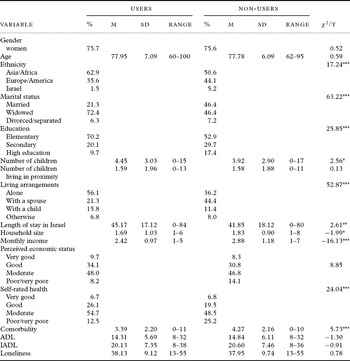
Respondents’ characteristics by day care utilization are presented in Table 1. The findings show that the vast majority (about 76%) were women with an average age of about 78 years. No significant differences were found between users and non-users of day care centers in their functional status in terms of ability to perform ADL (activities of daily living) and IADL (instrumental activities of daily living) tasks. Also, no significant differences were found between the two groups of respondents in number of children living in near proximity, perceived economic status, and level of loneliness. Further, the vast majorities of both groups (71.3% and 72.1%, respectively) reported moderate to severe levels of loneliness (scores from 11 to 44), with those who visited day care centers reporting even slightly more loneliness, although the differences between the two groups were statistically insignificant. However, significant differences were found between the two groups of respondents in ethnicity, marital status, level of education, number of children, living arrangements, household size, length of stay in Israel, monthly income, and health status (self-rated health and co-morbidity).
Characteristics of users and non-users of day care centers

*p < 0.05, **p < 0.01, ***p < 0.001
Among those who attended day care centers there were significantly more widowed persons, with lower levels of education, born in Asian/African countries, living alone with good to moderate levels of self-rated health, compared to their counterparts in the control group who were married, highly educated, lived with somebody, born in European/American countries but rated their health status as poorer. In addition, users of day care centers had significantly more children, had lived longer in Israel, and lived in smaller households; their monthly income was lower, and they reported less comorbidity compared to their peers in the control group. Among those who attended day care centers the average length of time they had been attending the day care center was 49.17 months (SD = 50.35) and the average number of weekly visits was 3.83 (SD = 1.23).
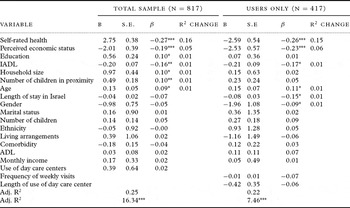
Table 2 presents the linear regression analyses of variables explaining loneliness of users and non-users of day care centers and among users only. The findings show that for the entire sample several variables were significant in explaining loneliness: health status (self-rated health), functional status (IADL), socioeconomic status (perceived economic status and education), characteristics of the respondents’ families (number of children and household size), age, and length of stay in Israel. This suggests that poorer health, functional and economic status, having fewer children, living in smaller households, living fewer years in Israel, and being older were significantly connected with higher levels of loneliness. However, attendance at day care centers had no significant association with loneliness. All the variables included in the equation explained 25% of the variance in loneliness. Yet, self-rated health and economic status were the most significant variables that together explained 21% of the variance in loneliness. The other significant variables included in the regression equation each explained only 1% of the outcome variable. In addition, regressions analyses were performed (not shown here) for specific groups of respondents, such as women, those who were unmarried, or those who lived alone. No significant differences were found between users and non-users among these subgroups.
Variables explaining loneliness among users and non-users of day care centers

Note: Higher scores for loneliness index indicate less loneliness. Higher scores for perceived health and economic status indicate better self-rated health and economic status. Lower scores for ADL and IADL indicate functional independence.
*p < 0.05, **p < 0.01, ***p < 0.001
Among those who attended day care centers the findings show that age, length of stay in Israel, perceived economic status, and self-rated health were significant in explaining loneliness: fewer years in Israel, poorer self-rated health and functional status in terms of IADL, poorer perceived economic status, and advanced age were connected with increased loneliness among users of day care centers. However, the number of weekly visits at the day care center, as well as length of attendance, was found to be insignificant in explaining loneliness. All the variables included in the equation explained 22% of the variance in loneliness. Yet, perceived health and economic status were the most significant variables that together explained 21% of the variance in loneliness. The other significant variables included in the regression equation each explained only 1% of the outcome variable.
In addition, regressions analyses were performed (not shown here) by specific groups of respondents such as women, those who were unmarried, and those who lived alone. The findings indicate that among women and among those who were unmarried, length of day care use was found to be a significant factor explaining loneliness (β = −0.13, p<0.05 and β = −0.12, p<0.05, respectively) in addition to perceived economic status and self-rated health, while frequency of use was found not to be significant in explaining loneliness. Among those who lived alone, there was no significant correlation between length and frequency of use of day care centers and loneliness.
Discussion
In brief, the findings show that loneliness was moderate to high and that the vast majority of respondents reported they experienced loneliness, suggesting that loneliness is significantly widespread and prevalent among frail older adults compared to their counterparts who are in better health. For example, previous studies conducted in Israel and in other European countries (Victor et al., Reference Victor, Scamler, Shah, Cook, Harris and Wilde2002; Sundstrom et al., Reference Sundstrom, Fransson, Malmberg and Davey2009) found that among those aged 65 years and over the prevalence of loneliness captured between 25% to 60% of the older population. In Israel, for example, the rate of loneliness reached 48% of those over the age of 65. This study shows that loneliness among frail older adults is significantly higher than is found in the general older population and encompasses more than 75% of this group of older adults, suggesting that frailty is significantly positively connected with loneliness.
It was hypothesized that users of adult day care centers that aim to serve frail older adults and provide social activities and programs will report reduced loneliness compared to their counterparts who are non-users. However, the present study shows that utilization of day care centers had no significant influence on levels of loneliness. In addition, among those who attended day care centers, length of use and frequency of weekly visits had no significant bearing on loneliness, suggesting that day care centers do not play a significant role in alleviating feelings of loneliness among frequent users of this type of service. In other words, it was expected that adult day care centers would substitute for and compensate for lack of meaningful social contacts, but the findings refute our hypothesis that utilization of a day care center is indeed connected with reduced loneliness.
Yet, the findings indicate that perceived economic status as well as self-rated health and characteristics of the social support networks (number of children living in proximity and household size) were significant in explaining loneliness. Several explanations can be given to understand these results; first, it might be that loneliness is a constant feeling that accompanies older people for many years. This explanation is supported by previous longitudinal studies (Gerstorf et al., Reference Gerstorf, Smith and Baltes2006; Iecovich et al., Reference Iecovich, Jacobs and Stessman2011) conducted in Germany (the Berlin Longitudinal Study) and in Israel (the Jerusalem Longitudinal Study), which examined various psychological measures including social and emotional loneliness and found that, for about two-thirds of the respondents, loneliness did not change over time. These studies showed that loneliness may stem from a predisposing personality characteristic as well as from negative personal circumstances such as poor perceived health and economic status.
Second, based on Andersen's (Reference Andersen1995) behavioral model it might be that those in greater need of alleviating loneliness and who used day care centers would feel even lonelier if they had not attended a day care center. In other words, the findings support the behavioral model and suggest that users of day care centers differ from non-users in a combination of predisposing (e.g. ethnicity, education) and enabling (e.g. economic status) factors, and need (e.g. loneliness, solitude – living alone), which may motivate them to attend day care centers to try to alleviate their severe feelings of loneliness. Thus, it might be that those who actually visited day care centers were, a priori, lonelier than their peers who were married, lived with somebody, and perceived their health and economic status as better, and therefore had chosen to use this service. Thus, it might be that day care users are predominantly at greater risk of feeling severely lonely and that attendance at day care centers may moderate their level of loneliness. Therefore no significant differences were found between users and non-users in terms of loneliness. Following this argument, it can be concluded that day care centers may have a positive effect on the level of loneliness among users of this service. However, this issue merits further investigation to find the causal association between these two variables. Cohort studies of before and after research designs are necessary to probe this causal relationship.
Relating to the group of users, the findings indicate that frequency of day care center use and length of use had no significant connection with loneliness, although it might have been expected that frequent and longer use would be connected with decreased loneliness. As noted above, this can be because loneliness is a long-lasting feeling that does not change over time and that use of day care centers has no apparent effect. It might also be that the social programs and activities provided in the day care centers are inadequate to meet the needs of the users for establishing meaningful social relationships that can reduce loneliness. However, more in-depth studies are necessary to detect weaknesses in the current programs of day care centers in order to make them more effective in achieving the goal of reducing loneliness among frail older adults.
It is possible that professional group and therapeutic interventions that specifically target loneliness by enabling participants to acquire appropriate coping skills may help in achieving this goal. For example, interventions aimed at facilitating social bonding, shyness groups, support groups for coping with various losses and bereavements, as well as prevention (Andersson, Reference Andersson1998) can be more effective in combating loneliness among frail older adults who visit adult day care centers. In addition, the findings show that the variables mostly explaining loneliness were subjective (self-rated health and perceived economic status) rather than objective factors (e.g. morbidity, monthly income). This suggests that interventions that seek to change attitudes and to address subjective feelings should be offered to day care users in order to help them alleviate loneliness.
Limitations
There are several limitations to this study. First, the study is cross-sectional, and thus establishing a causal relationship between loneliness and utilization of day care centers is not possible. Further investigation and evaluation studies – including longitudinal as well as quasi-experimental designs – to examine differences in levels and prevalence of loneliness before and after attending day care centers are needed to throw light on this issue. Such approaches would enable better understanding of the association between these variables and identify factors that can make day care centers more effective in reducing loneliness. Second, generalization of the findings is limited because the sample and the sampling procedure do not guarantee representativeness of all visitors in day care centers on a national level. This is because the sample was not randomly selected and included only day care centers in the southern region of Israel. Despite these limitations, the study adds to our knowledge of understanding loneliness among frail older adults and points to the need for further research in order to understand how adult day care centers can be more effective in achieving their goal of reducing loneliness and promoting the well-being of frail older people.
Conflict of interest
None.
Description of authors’ roles
E. Iecovich and A. Biderman designed the study and supervised the data collection. E. Iecovich was responsible for carrying out the statistical analysis and wrote the paper. A. Biderman assisted with writing the paper.
Acknowledgment
The authors are grateful to the Israel National Institute for Health Policy Research, which funded this study.