INTRODUCTION
In December 2011 specimens of Pseudodiaptomus marinus Sato, 1913 were identified during analysis of a sample taken in the German Bight during monitoring of the German exclusive economic zone (EEZ) in November 2011. Independently, in January 2012, the species was found in a sample taken in the Continuous Plankton Recorder (CPR) survey in the southern North Sea in October 2011 and further records have been added subsequently.
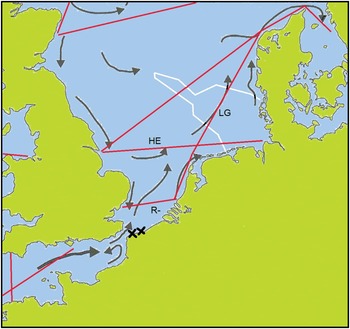
Pseudodiaptomus marinus was described from the North Pacific area where it is hyperbenthic, rising into the plankton by night in inshore and estuarine habitats (Walter, Reference Walter1986). The spread of the species into many other locations in the Indo-Pacific region including the west coast of North America and recently to European waters is summarized by Olazabal & Tirelli (Reference Olazabal and Tirelli2011) and Brylinski et al. (Reference Brylinski, Antajan, Raud and Vincent2012). The latter, published while the first version of this paper was being prepared, recorded the species in Calais harbour in January and October 2010, April 2011 and in coastal waters off Gravelines in January, February and September 2011. The location of these records is shown in Figure 1. The present records extend the known distribution of P. marinus in the North Sea.
Continuous Plankton Recorder (CPR) routes in the North Sea and English Channel in 2011 (straight lines), boundary of the German exclusive economic zone (white) and main flows in the North Sea, Atlantic inflow omitted, modified from Makinson & Daskalov (Reference Makinson and Daskalov2007), after OSPAR Commission (2000) (black arrows). The CPR routes mentioned in the text are labelled (HE, LG and R-). The positions of the first records of Pseudodiaptomus marinus in the North Sea (Brylinski et al., Reference Brylinski, Antajan, Raud and Vincent2012) are indicated by black crosses.

MATERIALS AND METHODS
The net hauls for monitoring the German EEZ of the North Sea (Figure 1) were taken using a WP2 net with 200 µm mesh hauled at 0.5 knots from 4 m above the sea bed to the surface. Stations sampled in January, March, May, September and November 2011 were mainly between 54°10′N and 55°N and east of 5°30′E except for outliers at 55°N04°E and at 53°40.5′N 6°30′E.
The CPRs are towed at a depth of <10 m, by ships-of-opportunity on regular routes at monthly intervals, collecting plankton on a moving band of silk gauze. The band is cut into sections each representing 10 nautical miles (~18 km) of tow during which 3 m3 of water are filtered. The position of the mid-point and the time at which each sample was taken are calculated. The survey was initiated in the southern North Sea in 1931 and has expanded to cover the northern North Atlantic and adjacent seas and other areas including the northern North Pacific. The methods of analysis have been described by Batten et al. (Reference Batten, Clark, Flinkman, Hays, John, John, Jonas, Lindley, Stevens and Walne2003), but it should be noted that calanoid copepods are mostly identified to species or genus, so occurrences of Pseudodiaptomus are unlikely to have been overlooked. The CPR routes towed in the central and southern North Sea and the English Channel in 2011 are shown in Figure 1. Samples in the southern North Sea are taken by tows on the ‘R-', ‘LG' and ‘HE' routes labelled in Figure 1. Samples on the ‘R-' route, on which P. marinus was first recorded, taken from August 2011 onwards were re-examined as were samples on the LG and HE routes selected on the basis of proximity in date and position to other records of the species. Samples taken on the ‘R-' route and in September to November 2010 were also re-examined. The vessel which towed the ‘R-' route in 2011 was on a regular schedule and all samples were taken between 14:00 and 21:00 current local time (UTC).
RESULTS
The record of Pseudodiaptomus marinus from the German EEZ monitoring was taken at Station ES1 (53°40′27.6″N 06°29′56.4″E) on 6 November 2011 at 15:37 UTC, just before sunset. Sixty-seven specimens of P. marinus were taken: 15 males, 10 females and 42 copepodites, representing abundances of 0.05, 0.03 and 0.13 ind m−3.
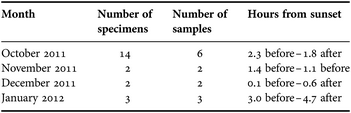
The first record of P. marinus in the CPR survey was from a sample taken on 8 October 2011, mid-point 52°0.3′N 2°56′E at 16:36 UTC, about 35 minutes before sunset. Nine specimens were found in that sample, equal to 3 ind m−3. In subsequent analyses 21 specimens were identified in samples from October 2011 to January 2012, all from the ‘R-' route and in each of these samples only one specimen was found, representing an abundance of 0.3 specimens m−3. The numbers of specimens taken in each month and the numbers of samples in which P. marinus occurred are listed in Table 1. No specimens were found on the samples from the LG or HE routes in 2011 or January 2012.
Pseudodiaptomus marinus: numbers of specimens taken in the Continuous Plankton Recorder survey, October 2011–January 2012, the number of samples in which the species occurred and the time of sampling in relation to sunset.

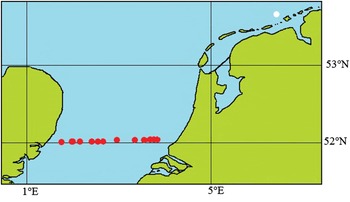
The positions of the records described here from October 2011–January 2012 are shown in Figure 2. An additional occurrence on the CPR LG route in October 2012 was at 52°33′N 3°58′E, further north than the CPR records from autumn–winter 2011–2012 and further specimens have been found on the ‘R-' route. Analysis of samples from autumn 2012 and winter 2012–3013 are ongoing at the time of submission.
Pseudodiaptomus marinus: positions of records in the Continuous Plankton Recorder survey (black) and German exclusive economic zone monitoring (white), October 2011–January 2012.

DISCUSSION
Pseudodiaptomus species are reported to remain in, on or near the sea bed during daylight hours (Walter, Reference Walter1986; Jacoby & Greenwood, Reference Jacoby and Greenwood1991) migrating upwards at dusk. The present records are up to 2.3 hours before sunset, but at 52°N in October this may qualify as ‘dusk'. Brylinsky et al. (2012) suggested that strong tidal currents at Gravelines and frequent ferry traffic may lead to resuspension of hyperbenthic species such as P. marinus. The Southern Bight of the North Sea is subject to strong tidal mixing, sufficient to prevent seasonal development of a thermocline (Pingree & Griffiths, Reference Pingree and Griffiths1978) which may also bring such species into the water column during the day.
Brylinski et al. (Reference Brylinski, Antajan, Raud and Vincent2012) suggested that P. marinus may have been introduced in ballast water from cable ships to Calais harbour. A population established in that area would be distributed northward in the North Sea circulation along the coasts of Belgium, The Netherlands and Germany (Figure 2). The stomatopod Rissoides desmaresti (Risso, 1816), which has planktonic larval stages, has become established in the North Sea (Griffin et al., Reference Griffin, Herbert and Pearce2011; Vansteenbrugge et al., Reference Vansteenbrugge, Van Ginderdeuren, Van Regenmortel, Hostens and Vincx2012) presumably along the currents flowing into the Southern Bight through the Strait of Dover and is now widespread off the east coast of England south of 53°N. Therefore, the new records of P. marinus described here could have originated from a population established off the coast near Calais. If the population thrives then distribution further north in the North Sea and into the Baltic through coastal currents, or the Kiel Canal can be expected. Spread in the western North Sea may be more dependent on ballast water or exceptional circulation patterns. Distribution westwards in the English Channel from the Calais region is also possible, but would be against the normal currents and any dispersal is more likely to be in ballast water.
The distribution of P. marinus from tropical to northern Japanese and Russian waters and from a wide range of salinities (Brylinski, 2012) indicates that it is euryhaline and eurythermal and there would appear to be no limitation to its potential spread in the shallow waters of the North Sea or the main body of the Baltic.
ACKNOWLEDGEMENTS
We thank all involved in maintaining the CPR survey, particularly the owners, master and crew of the Ro-Ro ‘Flandria Seaways' which tows CPRs on the ‘R-' route. The survey is supported by an international consortium of agencies. We also thank all responsible for the German EEZ monitoring programme which was funded by the German Federal Maritime and Hydrographic Agency (BSH). We also thank Dr Chad Walter (Smithsonian Institution) for confirming the identity of specimens from the German Bight sample.