Clostridium difficile is common, accounting for 12.1% of all healthcare-associated infections.Reference Magill, Hellinger and Cohen 1 In recent decades, the rate of C. difficile infections has risen coinciding with increasing use of antibiotics in some populations.Reference Lee, Reveles and Attridge 2 The rate of C. difficile infections in US hospitals doubled from 1996 to 2003, increasing from 31 to 61 infections per 100,000 patients.Reference McDonald, Owings and Jernigan 3 In 2008, C. difficile infections in acute-care settings cost between $1 billion and $4.8 billion.Reference Dubberke and Olsen 4 The 30-day mortality rate following C. difficile infection was recently estimated to be 9.3% in patients with healthcare-onset C. difficile.Reference Lessa, Mu and Bamberg 5
Research is increasingly focusing on asymptomatic carriage of C. difficile. Studies looking at rates of asymptomatic carriage of toxigenic C. difficile in hospitalized patients have found rates ranging between 9% and 15%.Reference Alasmari, Seiler, Hink, Burnham and Dubberke 6 – Reference Leekha, Aronhalt, Sloan, Patel and Orenstein 8 Patients who are asymptomatic carriers may be misdiagnosed as having C. difficile infections if they undergo testing that is not clinically indicated. One such example is C. difficile testing in patients who experience diarrhea resulting from other causes such as the use of laxatives rather than infection. A study of hospital-onset C. difficile infections at an academic tertiary-care hospital found that 14.8% of patients with a positive C. difficile test did not meet an indication for testing.Reference Kelly, Yarrington and Zembower 9 Treatment of asymptomatic carriers increases the risk of side effects and costs of care.
We hypothesized that a computerized clinical decision support (CCDS) tool could reduce inappropriate testing for C. difficile among patients receiving concurrent laxative therapy. In this study, we examined the impact of such a CCDS tool integrated into a commercial electronic health record system across inpatient settings in a multihospital academic health system.
METHODS
The Intervention
We defined an inappropriate C. difficile test as a stool specimen tested for C. difficile from a patient who received laxatives in the 36 hours prior to the ordering of the test. All other C. difficile tests were considered appropriate. We created a computerized clinical decision support (CCDS) tool in the form of a C. difficile order set in the inpatient electronic health record. Providers were required to use the order set to order testing for C. difficile in all inpatient settings. The order set automatically identified patients receiving laxatives within the previous 36 hours and displayed the following message: “In patients who do not have severe illness, stop laxatives and reassess diarrhea in 24 hours before sending a C. difficile test.” In such cases, the names, doses, frequency, and route of each laxative administered to the patient in the previous 36 hours were displayed, along with the last date and time of administration. Users had the following options: (1) discontinue the laxatives directly from the order set without ordering C. difficile testing, (2) discontinue the laxatives and proceed with ordering C. difficile testing, or (3) proceed with ordering C. difficile testing without discontinuing any laxatives (Supplement Figure 1). If a patient received a laxative within the previous 36 hours, the order set defaulted to option 1. If a patient did not receive laxatives within the previous 36 hours, then the order set only displayed the C. difficile test order (Supplement Figure 2). The order set went live on March 11, 2014.
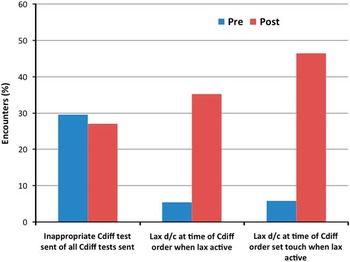
Pre-post Analysis of Impact of Tool on Process Measures NOTE: Cdiff, C. difficile; D/c, discontinue; Lax, laxative; Pre, 12-month preintervention period; Post, 12-month postintervention period.

Clostridium difficile Testing
Our C. difficile testing algorithm includes enzyme immunoassay (EIA) for glutamate dehydrogenase and toxins A/B (Techlab C. Diff Chek Complete; Alere, Orlando, FL), followed by a nucleic acid amplification test (NAAT) (Illumigene, Meridian Bioscience, Cincinnati, OH; changed to BD Max, Becton-Dickinson, Sparks, MD, in August 2013) for discordant EIA results (glutamate dehydrogenase positive but toxin A/B negative).Reference Bartsch, Umscheid, Nachamkin, Hamilton and Lee 10 Clostridium difficile testing is restricted to stool specimens that are semiformed to liquid (Bristol score of ≥5), and testing cannot be repeated for 9 days to reduce inappropriate C. difficile testing.
Cases of C. difficile were documented in the surveillance program Theradoc (Hospira, Salt Lake City, UT), as well as Centers for Disease Control and Prevention (CDC) National Healthcare Safety Network (NHSN) database for mandatory state public reporting requirements. For positive C. difficile assays sent ≥48 h after hospital admission and from patients readmitted within 14 days of a previous discharge, we determined whether NHSN criteria were met for each event. 11 Adjudicated C. difficile infections (CDI) were classified as complicated if associated with ICU transfer, colectomy, or death attributed to CDI within 30 days. 12
Setting
The CCDS intervention was developed, implemented, and evaluated in an academic healthcare system comprised of 3 acute-care teaching hospitals—Hospital of the University of Pennsylvania (HUP), Penn Presbyterian Medical Center (PPMC) and Pennsylvania Hospital (PAH)—with a combined capacity of more than 1,500 beds and 70,000 annual admissions. In the preintervention period, 224 encounters with hospital-acquired CDI and 407 encounters with non–hospital-acquired CDI occurred, for a total baseline CDI rate of 0.91% (631 of 69,362 encounters). The tool was used across all adult inpatient units, where resident physicians are responsible for most orders placed. All hospitals within the healthcare system used Sunrise Clinical Manager version 5.5 (Allscripts, Chicago, IL) as the inpatient EHR for order entry. An e-mail message communicating the implementation of the tool was distributed to all faculty and staff across the healthcare system, including attendings, trainees, nurses, and administrators. In addition, broadcast screensavers communicating the implementation of the tool were displayed on all computer workstations on all units across the healthcare system, excluding patient rooms.
Study Population
The study population included all adult patients who were hospitalized at the 3 health system hospitals during the study period. The preintervention period spanned 12 months prior to implementation of the CCDS tool (March 1, 2013–February 28, 2014). The postintervention period spanned a 12-month period after the implementation of the CCDS tool (April 1, 2014–March 31, 2015). Patients hospitalized between March 1, 2014, and April 1, 2014, were excluded to allow for a wash-in period.
Primary and Secondary Outcomes Measures
The primary outcome measure of this study was the change in proportion of inappropriate C. difficile tests sent, defined as any C. difficile stool assay ordered on a patient receiving laxatives in the preceding 36 hours. Additional outcome measures included the number of patients who had laxatives discontinued within 15 minutes from the time the order was placed, and proportion of patients with C. difficile tests sent, positive C. difficile tests, positive tests in patients receiving laxatives (which we classified as false-positive C. difficile tests), and C. difficile related complications (ICU transfer, colectomy, or CDI-related death) for those with adjudicated hospital-acquired infections. For those with complications associated with hospital-acquired CDI, we also examined whether C. difficile testing was “delayed” more than 24 hours as a result of the CCDS tool (ie, C. difficile testing was delayed because the patient was receiving a laxative). The delay duration was measured as the difference between the first instance of a C. difficile order placed but not performed because of active laxative use and the first instance where the C. difficile order was placed and performed.
Statistical Methods
Data were analyzed using χ2 and t-test statistics to compare dichotomous and continuous outcomes, respectively, before and after the CCDS intervention was implemented. Table 1 was generated using χ2 analysis for categorical data and Mann-Whitney U for continuous variables. All analyses were performed with the use of Stata 12.1 software (Stata Corp, College Station, Texas, USA). The study received expedited approval and a Health Insurance Portability and Accountability Act waiver from our institutional review board.
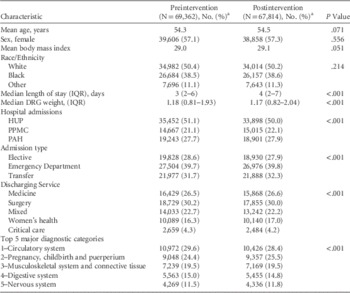
Characteristics of Patients in the Two Study Periods

NOTE: IQR, interquartile range; DRG; diagnosis-related group; HUP, Hospital of the University of Pennsylvania; PPMC, Penn Presbyterian Medical Center; PAH, Pennsylvania Hospital.
a Unless otherwise specified.
RESULTS
In total, 69,362 hospital admissions occurred and 4,498 C. difficile tests were ordered in the preintervention period and 67,814 hospital admissions occurred and 4,396 tests were ordered in the postintervention period. Compared to the preintervention period, small but statistically significant differences were observed in the distributions of admissions between hospitals, discharging service, and major diagnostic categories. The median length of stay was longer during the intervention period (Table 1).
The C. difficile CCDS tool was associated with a decrease in the proportion of inappropriate C. difficile testing sent (preintervention vs postintervention: 29.6% vs 27.3%; P=.02) (Figure 1). In 2 of the hospitals, HUP and PAH, the proportion of inappropriate testing decreased (32.5% vs 29.9%; P=.03; 26.1% vs 22.6%; P=.11), while in PPMC, a nonsignificant increase was observed (21.1% vs 21.7%; P=.8).
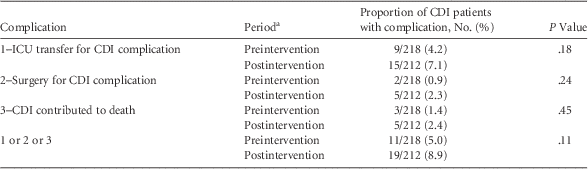
We observed increases in the proportion of instances in which patients had their laxatives discontinued at the time of an intended C. difficile order with no testing sent during that order (preintervention vs postintervention: 5.8% vs 46.4%; P<.01) and where patients had their laxatives discontinued with C. difficile testing sent during that order (5.4% vs 35.2%; P<.01) (Table 2). There were no significant changes in the overall proportion of patients with C. difficile testing (6.5% vs 6.5%; P=.99), positive C. difficile tests (14.0% of tests vs 13.7%; P=.67), and false-positive C. difficile tests (27.6% of positive C. difficile tests vs 26.2%; P=.62). In addition, for those with hospital-acquired C. difficile, we observed a nonsignificant increase in the proportion of patients with C. difficile related complications between the preintervention and postintervention periods (5.0% vs 8.9%; P=.11) (Table 2). Among those with complications associated with hospital-acquired CDI in the post period, we observed only 1 case in which C. difficile testing was “delayed” more than 24 hours because of the CCDS tool.
Complications of Patients with Hospital-Acquired Clostridium difficile Infection (CDI) in the Two Study Periods

NOTE: ICU, intensive care unit.
a Preintervention and postintervention periods each spanned 12 months.
DISCUSSION
In this large quality-improvement study, we examined the impact of a CCDS tool on the testing of Clostridium difficile across a heterogeneous patient population in diverse inpatient clinical settings. This intervention resulted in a statistically significant decrease in inappropriate C. difficile testing.
The CCDS tool led to a substantial increase in discontinuation of laxatives both in patients with diarrhea who had C. difficile testing sent and in patients with diarrhea who did not have C. difficile testing sent. As a result, patients with diarrhea were less likely to continue receiving laxatives, potentially preventing patient discomfort and dissatisfaction. Additionally, the proportion of patients who had C. difficile testing was identical during the 2 study periods, suggesting that overall the tool did not discourage appropriate and timely testing. Notably, we observed a small but nonsignificant increase in the overall proportion of patients who experienced a C. difficile–related complication (eg, ICU transfer, colectomy, or death) for those with hospital-acquired C. difficile in the postintervention period. Possible explanations for this increase include an increase in virulent strains of C. difficile or improved documentation of complications by infection preventionists responsible for C. difficile surveillance activities. The order set seems to be a less likely cause, as only 1 of the cases with complications had C. difficile testing delayed more than 24 hours.
The strengths of this study include the size and diversity of the patient population included. Many examinations of quality-improvement initiatives are limited to single units or service lines and by study population and duration. These restrictions can limit generalizability. By contrast, this study population was comprised of all inpatients hospitalized across a multientity academic hospital system over a multiyear period.
Nonetheless, this study has several limitations. First, our pre- and postintervention design does not control for cultural changes in testing and does not employ a control group. Second, we were not able to capture providers who viewed the order set and as a result did not order testing but did, in viewing the order set, benefit from the decision support provided. Third, we were unable to separate patients who received laxatives and had C. difficile testing ordered but also met other clinical criteria concerning for C. difficile infections and would thus be considered high-risk patients. Fourth, other inappropriate indications for C. difficile testing could theoretically be addressed by a CCDS tool that our current tool did not address, including repeated testing for C. difficile within a limited period and testing for cure. Adding such features could increase the impact of a CCDS tool on inappropriate testing for C. difficile.
Future studies should explore the generalizability of this intervention to nonacademic centers. A similar tool could also have an impact in long-term-care facilities where asymptomatic carriage is estimated to be 14.8% and as high as 30% in facilities with a prior C. difficile outbreak.Reference Ziakas, Zacharioudakis, Zervou, Grigora, Pliakos and Mylonakis 13 A prospective, randomized study could help determine the impact of similar tools on C. difficile–related complications.
In conclusion, this study suggests that a CCDS tool targeting inappropriate C. difficile testing in patients receiving laxatives can decrease inappropriate C. difficile testing and can improve the timely discontinuation of laxatives, but such a tool may not influence the overall rate of C. difficile orders or positive C. difficile tests.
ACKNOWLEDGMENTS
The authors thank Mika Epps, MSN, RN, Irving Nachamkin, DrPH, MPH, Joanne Resnic MBA, BSN, RN, and Raymond R. Sutter for their contributions to the design, testing, and implementation of the clinical decision support intervention examined in this manuscript. The content of this article is solely the responsibility of the authors and does not necessarily represent the official views of the National Institutes of Health.
Financial support: Dr. Umscheid’s contribution to this project was supported in part by the National Center for Research Resources (grant no. UL1RR024134), which is now at the National Center for Advancing Translational Sciences (grant no. UL1TR000003).
Potential conflicts of interest: D.P. reports having consulted for Seres Pharmaceuticals in his role as Chair of a Data Safety Monitoring Board. All other authors report no potential conflicts of interest relevant to this article.
SUPPLEMENTARY MATERIAL
To view supplementary material for this article, please visit https://doi.org/0.1017/ice.2017.161.