When Europeans first began to explore Canada, and what would later become Quebec City, their first impressions were formed by the landscapes they encountered. As time passed, the natural features of the land, whether praised or scorned, remained central to the way these regions were depicted, experienced, and valued. Today, the richness and diversity of the environment, its long winters, and wilderness are still frequently used to promote these territories to the rest of the world. These features were, however, not always praised, as the comments of Voltaire (Reference Voltaire1756:42) remind us: “a country covered with snows and ices eight months of the year, inhabited by barbarians, bears and beavers.” This article explores changing perceptions of wilderness in the Quebec City area between A.D. 1535 and 1900 as reflected in the consumption of wild indigenous plants. It highlights the gaps between historical discourse and realities of daily life by contrasting historical documents and archaeobotanical evidence. In this process, wilderness is defined as a type of socially constructed landscape that is perceived as largely uncontrolled.
By the time the Quebec City area was first explored by Europeans, depicting a territory in a specific manner on maps could demonstrate its ownership (Brückner Reference Brückner2006:4); its “wild” and “disordered” state was a call for religious improvement (Mrozowski Reference Mrozowski1999:154) and its “improper” use was a valid justification for conquest (Lilley Reference Lilley2000:517). Displaying power over distant geographies was becoming a subtle art for which the accumulation, exhibition, and control of intelligence was key (Blanton Reference Blanton, Rockman and Steele2003; Sandman Reference Sandman, Delbourgo and Dew2008). These principles shaped metropolitan policies and, along with an endless search for riches and the will to reproduce the motherland, they were the driving forces in the transformation of North American landscapes (Crosby Reference Crosby1986; Mrozowski Reference Mrozowski, Hall and Silliman2006; Oslund Reference Oslund, Folke Ax, Brimnes, Thode Jensen and Oslund2011; Weiskel Reference Weiskel1987:277). Conversely, the encounters and sustained interactions with these environments are believed to have fostered unique and distinct lifeways in the overseas colonies (Deagan Reference Deagan, Reitz, Scarry and Scudder2008:29; Hardesty Reference Hardesty, Majewski and Gaimster2009:68) that eventually led to power shifts and the creation of independent states. While the relationship between European powers and American environments is widely acknowledged as recursive, few studies address this specific issue (Clark Reference Clark2014:583; Sluyter Reference Sluyter2001:412). The interplay between rhetoric, daily life, and individual agency in these interactions tends to be lost between environmental conditions and political decrees. Finding a balance between these poles is a tricky task, for it requires an understanding of biological data and an appropriate assessment of historical documentation, as well as the need to engage with social theories.
I argue that archaeology, and more specifically archaeobotany, can help meet this challenge by shedding light on aspects of the interplay of colonialism, nationalism, food, and landscape through time. This paper investigates how these concerns were articulated at dinnertime, as food is closely intertwined with perceptions of territories and displays of power. Indeed, while remaining sensitive to the rise of capitalism and industrialization (Mintz Reference Mintz and Wilk2006:4), food used to be laden with its specific provenance in the colonial world, a meaning that was incorporated through the act of consumption (Bell and Valentine Reference Bell and Valentine1997:48). This appropriation became key to national discourses with the development of European states as displayed in early cookbooks (Appadurai Reference Appadurai1988:3) that were central to the process of “civilization” of the New World (Saffitz Reference Saffitz2013; Snell Reference Snell2014). At the individual level, eating was a form of empowerment over space but also of resistance to social and political forces (Charron and Desjardins Reference Charron and Desjardins2011; Smith Reference Smith2006:480; Twiss Reference Twiss2012:372; Wilk Reference Wilk, Nützenadel and Trentmann2008:100). From this perspective, the choice of food is strongly permeated by the clashes of power between states, individuals, and nature.
Historical Background
Quebec City is located at the narrowest width of the St. Lawrence River, which crosses the Canadian province of the same name from east to west. It is believed that the river was first explored upstream by Captain Jacques Cartier, who took hold of the Quebec region for the French crown in 1535. By then, the vicinity was being cultivated by descendants of the Native populations who had migrated into the region around 6000–7000 B.C. (Moussette Reference Moussette, De Waele and Pâquet2008). However, those groups vanished and were replaced by nomadic hunter-gatherers within the 70 years that elapsed before the establishment of a permanent European colony in 1608 (Moss Reference Moss2009:1). The Quebec City outpost was the political, military, trade, and administrative center of French holdings in North America, covering at their maximum expansion a vast territory from the Atlantic to the Great Lakes down to the Gulf of Mexico.
Initially oriented toward the fur industry, the scantly populated colony was slow to develop self-sufficient agriculture, and hunger remained a common issue due to the uncertainty of the Atlantic crossings, the river freezing for half of the year, and frequent squabbles with British troops (Bougainville Reference Bougainville2003:45; L'Incarnation Reference L'Incarnation1934:201). The British crown finally took Quebec in 1759, a conquest that was sanctioned by the Treaty of Paris in 1763. This shift of power brought many English-speaking migrants, creating some tensions with the French descendant majority. In the course of the nineteenth century, Quebec lost its centrality to the west and turned to the timber industry, while undergoing a slow industrialization (Fyson Reference Fyson, De Waele and Pâquet2008). After the conquest and well beyond the confederation in 1867, the area became a tourist destination for its natural scenery and its European appearance (Crowley Reference Crowley2005; Little Reference Little2012), a heritage that is depicted, recognized, and protected to various degrees by provincial and national bodies (Saint-Pierre Reference Saint-Pierre2007).
The celebration of the wilderness in songs and myths has played an important role in the construction of Canadian national and provincial identities (Brisson Reference Brisson2006:169). Yet the environmental history of these political entities is rarely unfolded (Castonguay Reference Castonguay2006:23; Clark Reference Clark2014:574), with the exception of a few studies on early botany (Boivin Reference Boivin1977; Mathieu Reference Mathieu1998; Warkentin Reference Warkentin2010) and the depictions of the territory by artists, tourists, and the church (Chaffray Reference Chaffray2005; Crowley Reference Crowley2005; Little Reference Little2012; MacKay Reference MacKay2011). Otherwise, the wild either stands as a commodity, as a limitation, or as the stable and mute background to social action (Sluyter Reference Sluyter2001:416). In contrast, historical foodways have been more intensively investigated (Coulombe Reference Coulombe2005:510) and generally recognized as sensitive to political shifts (Bergeron Reference Bergeron, Peltre and Thouvenot1987; Lafrance and Desloges Reference Lafrance and Desloges1989:18). Nonetheless, these studies see wilderness as both a potential source of supply and as the obstacle preventing the reproduction of metropolitan lifeways (Armstrong Reference Armstrong, Ducan and Lockwood1989:114). A closer look at the indigenous plants integrated into the menu might bridge these gaps, for those plants are the matrix of wilderness, closely dependent on its nature, and upon them rested the distinction between “civilized” and “savage.”
Methodology
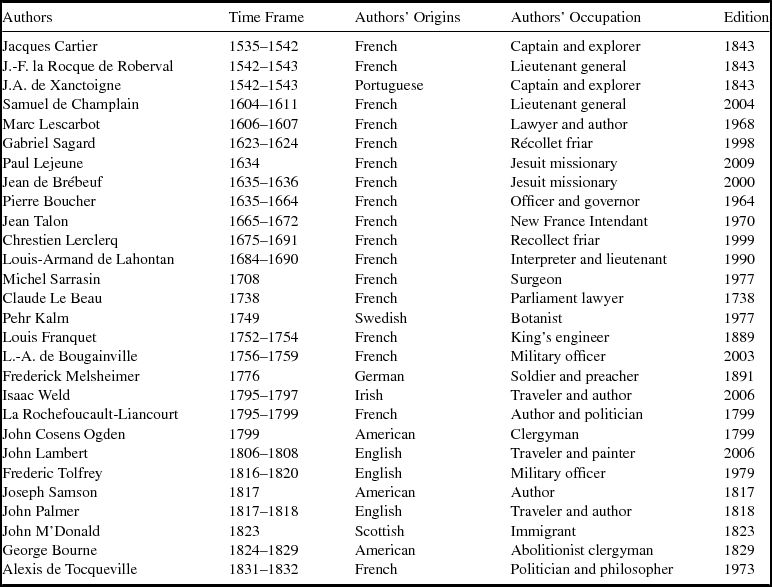
Occidental principles shaping the relationship between power and land are likely to have permeated the travel literature addressing Quebec City during the period under study. Encompassing letters, journals, and simple narratives, this body of historical evidence is grounded in personal experiences that are translated through images of the familiar for an audience foreign to the topic (Adams Reference Adams1983:43–44). As such, these writings tend to include as much information about the visited places as about the culture of the author (Duncan and Gregory Reference Duncan, Gregory, Ducan and Gregory1999:3–5), both of which intersect when they address the recurrent topics of food and landscape. These different levels of meaning and intentionality are examined in 27 examples (Table 1) to isolate relevant comments and observations. The selection of these documents relied heavily on the availability of electronic copies in open archives. It should be noted that their authors are men from the upper strata of society and, as such, their viewpoints cannot be considered fully representative of the population. They nonetheless provide clues as to the way wild food and wilderness were perceived among those who could afford avoiding them all together.
Selected Travel Literature.

On the other hand, archaeological plant macroremains such as preserved seeds and fruits can provide evidence as to how wilderness was experienced on a daily basis by all the social strata of a society. The archaeobotanical material I obtained from five archaeological sites using a systematic sampling strategy (Figure 1) is discussed here. These are the Cartier-Roberval site (CeEu-4), occupied temporarily by the explorers of the same name in 1541–1543 (Fiset and Samson Reference Fiset and Samson2009); Champlain's Farm (85G), an agricultural complex burned down during an English attack in 1628 (Guimont Reference Guimont1996); a two-roomed house destroyed by fire at the end of the seventeenth century at the Brave's Park site (CeEt-617); the Intendant's Palace site (CeEt-30), which has been continuously settled since the end of the seventeenth century and where remains related to domestic occupations, a naval shipyard, two breweries, two palaces, and a royal storehouse were excavated (Moussette Reference Moussette1994; Simoneau Reference Simoneau2009); and, finally, contexts from the late eighteenth to the mid-nineteenth century associated with buildings used as the governor's residence and administrative quarters of the St. Louis Forts and Castles site (38G; Cloutier and L'Anglais Reference Cloutier and L'Anglais2009; Goyette Reference Goyette2009).
Location of the sampled sites. Based on Geogratis, Natural Resources Canada.

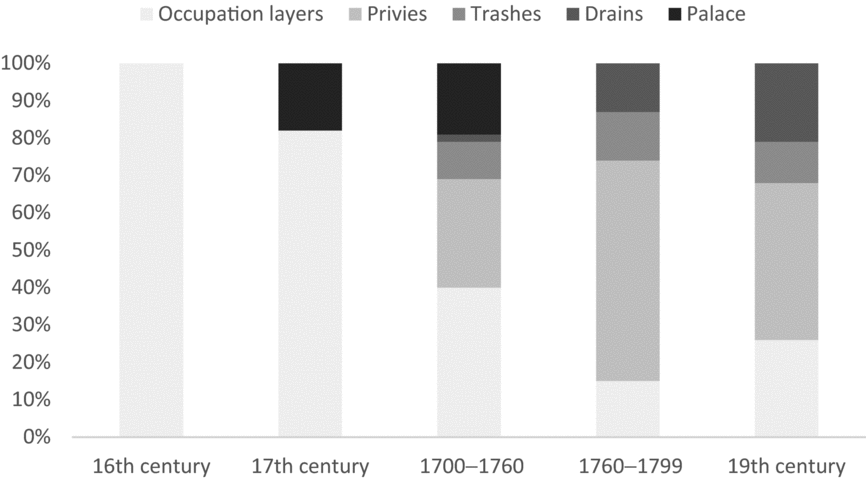
A blanket sampling strategy (Hastorf Reference Hastorf and Pearsall2008:1791) was used to collect samples of a volume estimated to provide about 500 remains (van der Veen and Fieller Reference van der Veen and Fieller1982). I floated samples manually when their volume was roughly under 5 liters and mechanically, with the aid of a modified York type machine, when they were larger. I then identified the remains and quantified them using a Minimal Number of Individuals (MNI) rationale (Jones Reference Jones, van Zeist, Wasylikowa and Behre1991:64). For the purposes of this study, I emphasized indigenous plant finds, excluding any remains not identified precisely enough to determine their origin. Based on the results of contemporary studies summarized in the Database of Vascular Plants of Canada (Brouillet et al. Reference Brouillet, Desmet, Coursol, Meades, Favreau, Anions, Bélisle, Gendreau and Shorthouse2010), every taxon's ecological preference and geographical provenance was determined (Baillargeon Reference Baillargeon1981; Victorin Reference Victorin2002). I assigned each taxon to Quebec City's closest possible location of acquisition, an approach that might have obscured the regional and international trade of species available locally or regionally. The results were divided according to chronological time periods that are not necessarily represented by the same amount and variety of historical sources, the same quantity and volume of samples, the same type of contexts (Figure 2), or preservation means (Figure 3). The potential impact of these factors on the dataset were nonetheless assessed using multivariate statistics, and the results suggested that the presence of wild plant remains was not affected by differential sample sizes, preservation, or context types, although they tended to be found in greater densities in waterlogged assemblages (Bouchard-Perron Reference Bouchard-Perron2017). Thus, preservation conditions are accounted for in the discussion below.
Proportions of the samples taken in each context type by period.

Proportions of carbonized and waterlogged assemblages analyzed.

Sixteenth Century
The first Europeans to describe Quebec City landscapes were the leaders of the French expeditions who discovered and settled the region in 1535–1536 and 1541–1543 and left travel journals as testimony of their adventures (Table 1). Complying with the fashion of their time, their narratives used the vocabulary of exoticism, marvel, and wonder to describe a territory that, in fact, had much in common with France (Dickenson Reference Dickenson2008:33, Reference Dickenson and Cooke2009:25):
pleines d'aussi beaux et puissants arbres que l'on puisse voir au monde, et de diverses sortes, qui ont plus de dix brasses plus haut que les autres; et il y a une espèce d'arbre . . . lequel a plus excellente vertu de tous les arbres du monde [Cartier et al. Reference Cartier, Roberval and Xanctoine1843:73].
Cartier and his companions (Reference Cartier, Roberval and Xanctoine1843:34–35, 39, 74, 86) emphasized the size of the trees and the abundance of wild fruits. They also praised how European plants, whose cultivation required intensive labor back in France, were growing effortlessly in this New World, where planted seeds began to grow in a matter of days. Further, they tended to describe wild meadows as natural hemp, wheat, or pea fields, even if those European staples were exotic to the region. For people who saw land cultivation as a duty to God (Lescarbot Reference Lescarbot1968:67), these sights suggested that the place was blessed, an impression strengthened by the presence of wild grape, as wine was central to various religious celebrations. From this perspective, comments highlighting the agrarian potential of the colony, such as by those by Cartier et al. (Reference Cartier, Roberval and Xanctoine1843:54, 73–74), took on a mystic sense, especially when they pointed out how the landscape could be improved (Cartier et al. Reference Cartier, Roberval and Xanctoine1843:86), an argument further justifying French appropriation of the land. In addition to crosses and maps, plant samples carefully brought back to the metropolis to be displayed in Paris's botanical gardens demonstrated and reinforced the ownership of this distant geography (Dickenson Reference Dickenson2008:36–37; Mathieu Reference Mathieu1998:189). Together, these references give the impression that Quebec was an easily manageable and arguably controllable land of plenty, with potential for economic and mystical enrichment.
The excavation of a portion of these early European explorers’ quarters at the Cartier-Roberval site (CeEu-4) revealed that fire had destroyed the site (Fised and Samson Reference Fiset and Samson2009:37). Of the 192 samples collected from the conflagration debris and the occupation layers, only 26 percent contained indigenous edible plant remains (Bouchard-Perron and Bain Reference Bouchard-Perron and Bain2009). Those represented about 1 percent of the assemblages analyzed and included raspberry/blackberry (Rubus sp.), strawberry (Fragaria sp.), wild red cherry (Prunus pensylvanica), choke cherry (Prunus virginiana), common elderberry (Sambucus canadensis) and red elderberry (Sambucus pubens). Cartier only mentioned the first two in his journals (Cartier et al. Reference Cartier, Roberval and Xanctoine1843:16, 83, 87), but based on its description, the environment around the fort could provide all of the others (Cartier et al. Reference Cartier, Roberval and Xanctoine1843:73–74). Their ecological preferences are also similar to those of the inedible local plants found in the floated samples (i.e., Canada yew or Taxus canadensis, and dwarf cornel or Cornus canadensis). The fruits of these plants would have ripened during Cartier's voyage and during Roberval's visit to the area. Most of them also closely resembled ones that were consumed in France (Ruas Reference Ruas1992a:306–307, Reference Ruas1998:199; Ruas and Dietsch-Sellami Reference Ruas, Dietsch-Sellami and Coste2006:47). Yet the random distribution of their remains across the site, their near absence in occupation layers, and their low numbers among stored European staples suggest that their presence was fortuitous, representing plants naturally growing in the vicinity of the fort (Bouchard-Perron and Bain Reference Bouchard-Perron and Bain2009). Unless these wild plants were stored and consumed elsewhere in the camp, which seems unlikely, the current archaeobotanical evidence suggests that Cartier's group did not consume these wild indigenous plants. The same, however, does not apply to locally cultivated produce as attested by the presence of a few maize and bean finds, two taxa known in France by the sixteenth century (Dickenson Reference Dickenson2008:35) but that could not reproduce in Quebec unless cultivated by Native populations. Hence, it seems that early French settlers favored locally available cultivated foodstuffs over indigenous wild plant foods.
The archaeobotanical analysis allows us to scrutinize the early explorers’ narratives. Cartier et al. (Reference Cartier, Roberval and Xanctoine1843:75) discussed the importance of securing the supplies they brought with them, which plants they attempted to grow (Cartier et al. Reference Cartier, Roberval and Xanctoine1843:74, 87), when supplies needed to be rationed (Cartier et al.:Reference Cartier, Roberval and Xanctoine1843:94), and the requests sent back for more provisions shortly after their arrival (Cartier et al. Reference Cartier, Roberval and Xanctoine1843:93, 96). These elements suggest that they intended to live off familiar food or at least cultivated Native ones when their supplies ran short, as stated by Roberval (Cartier et al. Reference Cartier, Roberval and Xanctoine1843:94), a ranking confirmed by the archaeobotanical record. Both lines of evidence thus suggest that cultivated products were privileged over wild ones. This may reflect the strong association between barbarity and wilderness in Europe, as well as a growing fear of becoming “wild” by eating savage food (Lazaro Reference Lazaro, Tomasik and Turnhout2007:17). Not all wild food seems to have been granted the same standing. For instance, only trees and their produce highly valued in Europe are mentioned and praised along with a few tall plants, whose height enabled them to be closer to the sky and God (Grieco Reference Grieco1991). More appropriate in the description of a blessed land, their godliness and familiarity seems to have been insufficient to grant them a place at the table, while local herbs (i.e., Canadian wild ginger, wild leek) and vegetables (i.e., American groundnut, broad-leaved arrowhead) were not even worthy of attention. Interestingly, more than a simple literary strategy to depict the colony in the best light, European principles shaping their relationship to the territory seem to have forged daily life during the expedition as demonstrated by the archaeobotanical record.
Seventeenth Century
With the establishment of a permanent colony in Quebec in 1608, French administrators, military officers, and religious missionaries increasingly traveled across the region. The chronicles written by 10 of them are discussed here (Table 1). These accounts all pay homage to the territory's fertility and prodigality (Lahontan Reference Lahontan1990:69; Talon Reference Talon1970:22). The land they depict is, however, slowly being “improved” by agriculture and alienated from its first occupants, whose habits are now described as barbarian (Champlain Reference Champlain2004:38–39, 141; Leclercq Reference Leclercq1999:282, 285, 304) and as savage as their foodstuffs (Lejeune Reference Lejeune2009:91; Sagard Reference Sagard1998:196). As Mère Marie de l'Incarnation (Reference L'Incarnation1934:201) maintains, one could count on the civilizing and legitimizing power of agriculture to “cultivate good Christians” out of these populations. Botany was also becoming a profitable tool in the appropriation of the land, and specimens were routinely sent to Paris to be named and classified (Dickenson Reference Dickenson2008:43; Warkentin Reference Warkentin2010:96). Through this process, France and occidental science held their grip over the colony's wilderness by accumulating knowledge about it and by controlling its official labeling. Simultaneously, the emerging science channeled a search for wonder apparent in the first botanical treatise about the region (Cornuti Reference Cornuti1635). Written from abroad, the booklet displayed species not so much for their provenance—a few of them are ironically exotic to Canada—as for their unique character and medicinal properties (Mathieu Reference Mathieu1998:123). The new interest in indigenous plants was paralleled by an expansion of the range of wild edible resources mentioned in travel accounts. This opening was nevertheless restricted to taxa that could be designated by the French names of their close European counterparts with which they were frequently compared (Brébeuf Reference Brébeuf2000:97; Champlain Reference Champlain2004:172; Sagard Reference Sagard1998:146). For example, “Le Cerfeuil a la feuille plus large que celuy de France, a la tige beaucoup plus groffe, et eft d'auffi bon gouft” (Boucher Reference Boucher and de Boucherville1964:85). In times of scarcity, those plants seem to have offered acceptable and sometimes even tasty (Boucher Reference Boucher and de Boucherville1964:54, 85–86; Sagard Reference Sagard1998:146) alternatives to expensive imports or to the fruit of still irregular harvests (Lahontan Reference Lahontan1990:265; Talon Reference Talon1970:29), as long as they came with Old World references.
The idea that a familiar look favored the consumption of indigenous plants through the seventeenth century is reinforced by the early archaeobotanical finds in the region. Extracted from a farm storage room that was burned down in July 1628, these edible remains were present in densities comparable to those of Old World cereals, pulses, and fruits (Bouchard-Perron Reference Bouchard-Perron2017). They belonged to riverbank grape (Vitis riparia) and common elderberry, both still flowering when the fire erupted. These plants have close counterparts figuring on the French metropolitan menu at the time (Bouby et al. Reference Bouby, Ruas, Terral, de Beaune and Francfort2012:84; Ruas Reference Ruas, Ferrand and Lavaud1992b:14; Ruas and Dietsch-Sellami Reference Ruas, Dietsch-Sellami and Coste2006:44) and this likeliness might have favored their consumption. Looks might not have counted for everything, though, as both are generally found growing in open areas along rivers, and those were the main means of exploration, communication, and transportation in the colony (Lasserre Reference Lasserre1980). While the texts make no mention of common elderberry prior to the eighteenth century, riverbank grape was praised for its abundance and scorned for its poor gustative and wine-making qualities (e.g., Boucher Reference Boucher and de Boucherville1964:55). From this perspective, its presence may denote a propensity among colonists toward relatively familiar wild edible plants regardless of their taste and properties, a tendency also noted in other settings (Dickenson Reference Dickenson and Cooke2009:44, 46; Williamson Reference Williamson2004:19). A bite does not constitute a meal, however, and together these taxa represented less than 3 percent of the edible remains identified.
By the end of the seventeenth century, local plants seem to have figured more prominently on dinner tables, as they were identified in 60 percent of the samples and represent on average 20 percent of the assemblages analyzed. When present, indigenous remains were generally identified in occupation layers including either imports, species ephemeral in the region or exclusively edible taxa elements suggesting they were intended for consumption. These contexts contained an expanded range of indigenous plant remains belonging to three distinct groups. The first includes plants found in open landscapes, favored by disruption, having a close equivalent in France and frequently mentioned in historical accounts: strawberry, raspberry/blackberry, and wild red cherry. It is likely their natural tendency to grow in abundance in intensively occupied or abandoned settings has favored their consumption and valorization as belonging more to the realm of “civilization” than to the one of “savageness.” The second group, absent from contemporary historical documents, included vervain (Verbena sp.) as well as red and common elderberry. With the exception of the latter, their resemblance to Old World species is less striking, but they all share a preference for open spaces alongside rivers, an environment familiar to the colonists. The third category is very different from the others and includes only wild sarsaparilla (Aralia nudicaulis), a plant growing in woody areas with no known equivalent in Europe. Indeed, if its appearance has little to do with the one of the Old World Smilax sp., they were believed to share very similar medicinal properties during the colonial era (Boivin Reference Boivin1977:239). It seems plausible that colonists became more adventurous when indigenous plants had a medicinal potential for which they were ready to brave the wilderness, a tendency also noted in other comparable settings (Dickenson Reference Dickenson2008:35). Otherwise, they seem to have been keener to incorporate plants with recognizable looks growing in frequently encountered habitats at the edges of wild forested landscapes into their diet than to turn to less common ones found in the same settings.
Eighteenth-Century French Rule: 1700–1760s
During the eighteenth-century French Regime, European travelers of different origins visited Quebec City and the accounts left by five of them are consulted here (Table 1). In these, the region's fertility and the abundance of its resources are still praised, even though these particularities do not appear as intertwined as before (i.e., Franquet Reference Franquet1889:179). Authors now attributed the region's fertility to the incorporation of the landscape into the realm of civilization, relating it to known colonial accomplishments. Pushing back the limit of the wild by establishing well-ordered villages and fields became concrete evidence of the French crown's control and legitimacy and hence fostered pride: “Il faut avouër qu'il faut être auffi laborieux que le font les François, pour pouvoir faire quelque chofe de bon d'une pareille Contrée” (Le Beau Reference Le Beau1738:78–79).
The resource abundance conversely evoked wilderness and a world full of promises. These possibilities led foreign kingdoms (Britain, Germany, and Sweden) to send botanists to record the richness of the territory (Boivin Reference Boivin1977:289) and a few to formulate pleas for a greater exploitation of its vegetal resources (Boivin Reference Boivin1977; Lafitau Reference Lafitau1718). Even if the discipline enabled France to strengthen its grip over the colony and the local nobility to affirm its status (Wien Reference Wien, Bardet and Durocher1999:78), outside the realm of science, wilderness was depicted as an obstacle to proper and independent agricultural production and was blamed for frequent hunger as well as for driving colonists away from their duties (Bougainville Reference Bougainville2003:41; Franquet Reference Franquet1889:179). Its produce, such as northern maidenhair fern or ginseng, grew in low quantities and variety, and the local populations knew little about them according to Bougainville (Reference Bougainville2003:80) and Franquet (Reference Franquet1889:153–154). Given their general absence in probate inventories that routinely included references to European staples, wild plant foods seem to have been less valued (Lafrance and Desloges Reference Lafrance and Desloges1989:25). Local produce rarely appeared on plates served at the table, following Pehr Kalm (Rousseau and Bétune Reference Rousseau and Bétune1977:188, 244, 290), who only occasionally listed indigenous fruits served after the main course: “Après le diner vint le dessert qui comprend une grande variété de fruits: des noix de France ou du Canada au naturel ou confites” (Rousseau and Bétune Reference Rousseau and Bétune1977:139). Rather peripheral to the meal but bringing variety to it, the consumption of wild plants appears far from glamorous, even if knowing about them was fashionable and a source of power and high aspirations.
The archaeobotanical assemblages dating to the early to mid-eighteenth century were preserved by carbonization (24 percent) and waterlogging (76 percent) and came from a wide variety of contexts, including a significant proportion of privies (30 percent). While privies fostered the rarities discussed below, most context types included the full range of indigenous species identified in the seventeenth-century samples, with the exception of vervain (Bouchard-Perron Reference Bouchard-Perron2017). All were found in circumstances suggesting that they were consumed or intended for consumption; their recurrent presence indicates that, once integrated into the diet, wild species came with a historicity of interactions that favored their continuous exploitation. Further, their increasing frequency in the deposits also implies that they were becoming more popular on colonial menus, as attested to by the occasional integration of blueberries/cranberries (Vaccinium sp.) as well as American wild mint (Mentha canadensis) into the meals. While the latter had an equivalent in the Old World, the former was far less common in Western Europe and grew solely in forested peatland in Quebec.
In addition to those wild plants, scanned subsamples enabled the identification of rarities such as viburnum (Viburnum sp.), red juniper (Juniperus virginiana), butternut (Juglans cinerea), and shag-bark hickory (Carya ovata). The first is found growing in forested cover along riverbanks, and its presence along with blueberries/cranberries suggests an expansion of the range of habitats exploited for food and their greater degree of incorporation in the colonial realm. The others, even if indigenous to the province, can be found only several miles south and west of Quebec City (Victorin Reference Victorin2002). Their presence is thus a testimony to the existence of exchange or trade networks for local plant resources and that at least some of them were valued. This idea is strengthened by their strict association with higher status contexts in the archaeological record and by the few occasions, in historical documentation, where they appear among the delicacies served to prestigious guests. For instance, the Swedish botanist Pehr Kalm would recount how nuns, in an attempt to impress him, served sweet butternut jelly at the end of his large meal, along with imports such as citron and lemon (Rousseau and Bétune Reference Rousseau and Bétune1977:244). Thus, while the range of indigenous plants consumed expanded and the specifics of their origins broadened, the distance crossed to obtain them seems to have become a source of social value. From the edge of wilderness, the control over the colony had expanded to its forested and “savage” center whose produces were increasingly consumed, an act that in turn fostered a sense of belonging into a long tradition of “savageness tamers.”
Eighteenth-Century English Rule: 1760s–1799
In 1759, a battle in Quebec City sealed the destiny of the French colony, which officially fell into British hands in 1763. Following this shift of power, the origins and occupations of the area's visitors broadened as reflected by the four narratives selected for this period (Table 1). Despite this relative heterogeneity, they tended to portray the political takeover as naturally rightful: “Nature had thus prepared a landing place and a pass from the beach, which was covered from the view of the besieged and gave an opportunity to surprize [sic] the enemy within the walls” (Ogden Reference Ogden1799:19–20).
The recognizably fertile region also called for improvement according to the four travelers who lamented over its improper agrarian exploitation by colonists of French descent (La Rochefoucauld-Liancourt 1799:324; Weld Reference Weld2006:251). Indeed, if their comments are contradictory about how well Quebec markets were provisioned (La Rochefoucauld-Liancourt 1799:321; Weld Reference Weld2006:235), all of them report scarcities, especially in terms of local fruits, and these are in turn blamed on local farmers’ laziness or on the low cost of local produce that left little hope of profit (Melsheimer Reference Melsheimer1891:155, 163). Likewise, they also attribute the poor agricultural yield to the conquered colonists’ dependence on the fur trade, an activity apparently celebrated among them (Melsheimer Reference Melsheimer1891:162; Weld Reference Weld2006:211). Conversely, they still depicted wilderness as a significant source of potential income for the crown in terms of timber and miracle cures (Melsheimer Reference Melsheimer1891:164–165). Matters of prices and profits recur in these writings, notably highlighting how the conquest impacted international trade networks, as all imports reaching Quebec now went through England (La Rochefoucauld-Liancourt, 1799:316; Williamson Reference Williamson2004:18). However, capitalist concerns did not prevent them from displaying a certain amount of romanticism (Sluyter Reference Sluyter2001:412) toward pristine landscapes and traditional ways of life (Crowley Reference Crowley2005):
Among the most prominent sights of Quebec is unquestionably the waterfall of Montmorency. . . . Indeed, no more beautiful sight can be imagined than when, on a clear day, the rays of the sun fall directly upon this waterfall, thereby forming most beautiful rainbows [Melsheimer Reference Melsheimer1891:168].
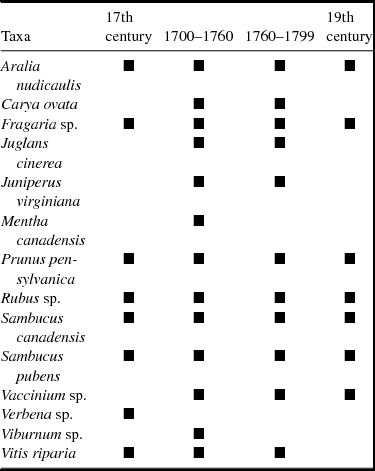
Of the 39 analyzed archaeobotanical assemblages dating to the late eighteenth century, 28 percent were carbonized, while the others were waterlogged. Associated with contexts similar to those investigated for the beginning of the century, they included a higher proportion of samples from privies (Bouchard-Perron Reference Bouchard-Perron2017). Despite those divergences, the results were quite close to those obtained for the 1700–1760 interval, even though they were lacking mint and viburnum, probably attributable to the lower number of samples and volume of soil analyzed. While the density and frequency of indigenous remains, such as raspberry and strawberry, do increase, they do not do so in a drastic manner (Figure 4). Thus, contrary to what Armstrong (Reference Armstrong, Ducan and Lockwood1989) and Desloges (Reference Desloges2011) have suggested, there seems to be a high degree of continuity rather than disruption in foodways through the century, at least where local plant resources are concerned. Furthermore, regional trade seems to have continued despite the political shift, as attested by the presence of butternut, red juniper, and shag-bark hickory. However, as these foods are now found in nonelite settings, and as there is no mention of their use in special events, it seems likely that their consumption was not as glamorous as it was in the past. Along with broadening access to local plants, the primary change observed is that the range of wild species consumed stabilizes and, from this point on, no more additions to the menu are recorded (Table 2). This marks the end of a period of discovery and experimentation that had prevailed since the establishment of a permanent colony in the area, and the beginning of one of consolidation characterized by a greater reliance on known species.
Frequency and density of edible indigenous plant remains by period.

Edible Indigenous Taxa Identified for Each Temporal Period.

By 1760, the Quebec City landscapes and their produce were known in England thanks to its involvement in North America and to the translation of French journals and botanical treatises. The “alien” wilderness first encountered by the French rivals had been “tamed” by their descendants, who still occupied the territory. Their activities had not only pushed back the limit of “savageness,” but they also had favored some local species over others, such as raspberry/blackberry, strawberry, and wild red cherry. The urbanization of Quebec had also led to a shift in the density, diversity, and frequency of European-introduced weed macroremains, which for the first time surpass those of their indigenous counterparts (Figure 5). Their preponderance might have helped create a feeling of familiarity among newcomers and eased their establishment. At the same time, traditional knowledge accumulated by the colonists with regard to the localization and seasonality of resources might have helped the continuous consumption of species found in less reputable settings, such as peatlands (blueberry/cranberry) and shady forested covers (wild sarsaparilla). A reliance on the colonial past of the region is also manifested in the lack of clear distinction, in English visitors’ writings, between cultivated, introduced, and indigenous fruits. For instance, Melsheimer (Reference Melsheimer1891:163) listed mulberry, an introduced taxon, among the resources from the wild, and another classified strawberry from the woods among European fruits (Weld Reference Weld2006:252). The recurrence of Old World–looking plants in the landscape might have contributed to its romantic and positive appraisal, but conversely, it also rendered tributes to the pristine environment of the colony somehow undeserved, despite those eulogies becoming even more central to discourses by the nineteenth century.
Density of indigenous and introduced weed remains by period.

Nineteenth Century
By the 1800s, the English ownership of Quebec was seldom disputed and a profound shift in the way questions of power and landscape were addressed is evident in the six travel accounts consulted (Table 1). These generally discuss the city by glorifying the way British troops took it (e.g., Samson Reference Samson1817:71), but they also valorize the manner in which local populations regardless of their origins had transformed its territory. Cleared land, green fields, and nice houses fostered pride among British visitors but also provided hope for new settlers (M'Donald Reference M'Donald1823:28) who were formally requested to recreate such landscapes in order to be granted their lot of wilderness (Palmer Reference Palmer1818:232). The improvement, urbanization, and industrialization of the region are further highlighted in the narratives (e.g., Lambert Reference Lambert2006:49; Palmer Reference Palmer1818:229): “The city is improving, three large steam boats ply up and down the St. Lawrence, between it and Montreal and one is established as a ferry across to Point Levy” (Palmer Reference Palmer1818:229).
All this activity, however, was not without its filthiness, as stressed in some narratives (Samson Reference Samson1817:66; Tocqueville 1973:88), and which reinforced a previously nascent romanticism. Accordingly, the picturesque value of Quebec was highly praised even as it took on different meanings for Europeans, who were looking for pristine nature, and Americans, who were in search of traditions (Bourne Reference Bourne1829:31, 42–43; Chaffray Reference Chaffray2005:12; Little Reference Little2012:23; Tocqueville 1973:88). Palmer (Reference Palmer1818:222) writes, “There had been several frosty nights, and an Englishman can have no conception of the exquisite beauty the first frosts give to the foliage of an American forest.”
The beautiful and evolving character of the land, nevertheless, was not sufficient for some to justify the motherland's involvement and investment (Samson Reference Samson1817:71). In contrast, at a local and daily scale, the control of the territory as displayed in foodways had never seemed so great. There is still doubt as to whether markets were well provisioned (Bourne Reference Bourne1829:115; Lambert Reference Lambert2006:73; Palmer Reference Palmer1818:225), but all agree that foodstuffs were comparatively cheap for those who did not wish to live off of imports (M'Donald Reference M'Donald1823:27; Tolfrey Reference Tolfrey1979:119). When listed, the products they offered are generally associated with geographic markers and are equally mentioned among prized produce from Europe and the United States (Lambert Reference Lambert2006:38, 74, 82, 95, 171; Tolfrey Reference Tolfrey1979:132), suggesting a growing valorization of local and regional production. Likewise, the accounts of Samson (Reference Samson1817:117) and Lambert (Reference Lambert2006:282) imply that vegetal wild produce, such as wild strawberries and sunflower seeds, was served and appreciated by clients at inns. Thus, while wild resources were admired, they did not prove as profitable to the European economy but became locally appreciated at the table.
The 19 archaeobotanical samples analyzed for the early to mid-nineteenth century, of which only seven included carbonized material, came from privies, drains, middens, and occupation layers. The assemblages from these contexts contained on average 96 percent of edible remains. Their contents did not include any carbonized wild remains and a very limited range of waterlogged ones. This disparity is mostly due to the disappearance of large-seeded indigenous plants, such as red juniper and shag-bark hickory, from the record. Their absence can be attributed to a change in refuse management habits consistent with the increased rate of urbanization and industrialization of the area. According to Lambert (Reference Lambert2006:84), nuts, and especially local ones, had become quite rare both in the markets and at the table. This change in culinary habits is not the only one identified in the archaeobotanical record, for the results are especially homogeneous. This last change seems to contribute to a coherent pattern in a diachronic perspective (Table 2; Figure 6). Indeed, following conquest by the English the range of wild plants consumed was unchanged, but between the 1800s and the twentieth century, it became considerably smaller, while the environment of the city was losing its indigenous character. Such a transformation occurred at a time where an improvement of agricultural techniques (Courville Reference Courville1988:238) as well as a greater knowledge and experience of the land along with the development of transportation (i.e., steam boats and trains; Williamson Reference Williamson2004:19) and conservation means (i.e., hermetical conservation; Coulombe Reference Coulombe2005:523), should have promoted diversity. Yet new discourses and circumstances prompting the exact opposite were now rising in the colony.
Proportions of samples entailing indigenous plant remains by period.

Homogeneity was favored at the table by the second third of the nineteenth century, by the publication of the first local cookbook, La Cuisinière Canadienne (Anonymous 1840). Among the 220 recipes proposed, only seven clearly called for vegetal ingredients indigenous to the region, and this number decreased in the later Directives the la Mère Caron (Caron Reference Caron1878), where their uses were limited to desserts and drinks. Both works had a tremendous influence on local foodways (Desloges Reference Desloges2011; Williamson Reference Williamson2004:23), for they were amply used in the expanding schools for the education of housewives (Armstrong Reference Armstrong, Ducan and Lockwood1989:119; Coulombe Reference Coulombe2005:511). The uniform foodways they promoted were further encouraged by the Catholic Church, which had long associated agriculture with godliness and feared loss of its control over a French population (Little Reference Little2012:15). At the opposite end of this driving force, the confederation of the country in 1867 would promote a totally different attitude toward wilderness. Indeed, as in other former colonies emerging as a state, Canada turned to the natural landscape to find the source of its uniqueness (Dunlap Reference Dunlap1993:26). The government passed laws for the protection of patrimony and environment (Saint-Pierre Reference Saint-Pierre2007) and created parks for the preservation of nature (Mortimer-Sandilands Reference Mortimer-Sandilands2009:163–169). The twentieth century was the golden age of natural history museums and regional literary societies, both of which fostered knowledge about the territory's resources for and by citizens (Connor Reference Connor1986:5; Duchesne and Carle Reference Duchesne and Carle1990). At a popular level, myth, songs, and legend proliferated and alternatively presented the wild in opposition to a proper life as well as a land of adventure conquered by heroic figures (Brisson Reference Brisson2006:165). This ambiguity may reflect the conflicting positions of the state and the Catholic Church, the clash of a nationalism celebrating the conquest of this foreign wilderness and a religious fervor encouraging traditionalism (Audet Reference Audet1989:41). While not always pushing toward the same direction, nationalism and Catholicism both promoted homogeneity of practices and, appearing hesitant between these two poles of affiliation, colonists and citizens might have solved the problem at dinnertime by focusing on a low range of indigenous plants confined to special occasions and the end of the meal.
Conclusion
The relatively wealthy white Europeans who produced the travel accounts had different motives for communicating the details of their adventures in Quebec to Europe. Their writings nonetheless provide an overview of the prevailing ideas of Quebec City's wilderness among this social class through time. Those perspectives are contrasted with archaeobotanical data, which provide a glimpse of how the relationships between the city's inhabitants and the indigenous landscape developed through the consumption of wild food produce. This comparison allows a more nuanced picture of the relationships between Quebec City dwellers and their surrounding “wild” territory as mediated in daily life through foodways. Comparing rhetoric, depicted experience, and daily life in a diachronic perspective identifies significant recurrences and meaningful shifts. Intertwined at many levels, these recurrences and shifts correspond with changing religious, economic, and political concerns.
From the sixteenth to the end of the nineteenth century, attitudes toward the Quebec City wilderness were shaped by a religious ideology valorizing fertility, agriculture, and abundance while associating the wild with savageness. Compliance with this viewpoint can partly explain the reluctance to consume wild products during the first expeditions to the area. Later, the church blamed the wilderness for driving away good people from their sacred duties and for eroding traditional lifeways that eased its control over worshippers. This discourse as well as a fear of becoming barbarian probably played a role in making colonists initially prone to incorporate indigenous products into their diet. The origins of these foodstuffs broadened along with the mastery over new habitats that progressively made them more “civilized” and thus proper for consumption. Being accepted at the table does not seem, however, to have granted them value, unless they reached the markets from distant sources.
While menacing, wilderness was also profitable in many ways and notably because it belonged to the world of the unknown. Its vast potential gave travelers and colonists reasons to dream for centuries and to marvel at the endless possibilities offered by its abundant and oversized trees. Many of them, at least up to the late eighteenth century, explored this richness in the hopes of establishing their own status or finding valuable cures. By then, concerns for the landscape took a capitalist turn, and matters of prices and profits became preeminent. In this regard, except for lumbering, the Quebec landscape seems always to have proven disappointing. Although potential alternatives to expensive imports and irregular harvests, wild produce was given at best a peripheral role in the regional menu. Despite the growing industrialization of the region and the concomitant development of transportation, conservation, and agricultural techniques, their diversity on local menus decreased. Progress nonetheless went hand in hand with pollution, which paradoxically fostered romanticism among the ever-increasing number of tourists in the region. Their interests in “old” traditions as well as in a pristine nature became a source of richness even though the European presence had deeply transformed the environment that surrounded them.
Politically, it was always imperative to create bonds between the territory, its occupants, and the state to demonstrate rulers’ legitimacy. Accordingly, when ownership was disputed, previous occupants and their foodways tended to be depicted in a negative light to raise questions as to their ability to make proper use of the land. In this context, importance was given to the improvement of the territory and to the accumulation of knowledge about its yet untamed environments through botany. On a daily scale, the incorporation of wild produce from different habitats also acted as a symbolic appropriation of these areas. As the range of plants consumed expanded from decade to decade, it also seems that the historicity of interactions generally encouraged a continuous exploitation of a given taxon. Such customs of wild plant use, which prompted the development of a close link with wilderness, figured in nineteenth-century nationalist discourses. At that time, the wild provided a potent distinction between Canada and Europe, and thereby a source of unity and the historical roots of a nation. At the intersection of traditions, the need for unification, and a source of pride, daily menus seem to have kept some customs alive while definitely advocating a greater homogeneity in cooking habits.
Over time, the face of wilderness around Quebec City changed but its edible resources remained the same. While religious, economic, and political arguments sometimes diverged, they strongly shaped the selection of foods for discussion and consumption. More is still to be learned about how these forces impacted different social groups, rural populations, and distant outposts, a task to which archaeobotany can contribute.
Acknowledgments
I would like to thank the people who peer reviewed this article and helped to improve it. I am grateful to Alexandra Livarda, Chris King, Vasiliki Brouma, Elsa Fergadiotou, and Leslie Bode for their valuable comments and support in the process. The collection of the data discussed would not have been possible without the generosity of the Social Sciences and Humanities Research Council of Canada and the help of the Commission de la Capitale Nationale du Québec, the National Battlefields Commission, Parks Canada, the Ville de Quebec, and University Laval, as well as of all the excavation crews and laboratory assistants involved in the project. Finally, I would like to thank Craig Dicken for creating the map included in this article and Anni Bailey, who greatly contributed to making my English more understandable!
Data Availability Statement
All data used in this manuscript will be found in the author's 2017 dissertation.