INTRODUCTION
Staff working on psychiatric intensive care units (PICUs) are faced with the management of patients who display high levels of ‘challenging behaviour', including verbal, physical and sexual aggression. As a result, there is an inherent threat to their personal safety entailed in this work. Hatch-Maillette & Scalora (Reference Hatch-Maillette and Scalora2002) reviewed the literature around the impact of exposure to work-place violence in psychiatric settings. They listed the physical effects as: disturbed sleep, cardio-pulmonary problems, fatigue, hypertension, and increased susceptibility to illness. Psychological consequences include: depression, low self esteem, family conflict, cynicism, anger and impaired coping. At an organizational level, effects cited include: decreased worker productivity and morale, lost work days, legal liability costs, increased employee turnover and resources to rehire and retrain staff. Of note, the authors report that the threat of violence is as likely to cause psychological distress to staff and disruption to service delivery as actual physical or sexual assault.
Within the nursing profession, the negative impact of patient aggression on staff health is well documented (e.g. Cutcliffe, Reference Cutcliffe1999; Foster et al. Reference Foster, Bowers and Nijman2007; Wykes & Whittington, Reference Wykes and Whittington1998). The literature also details the knock-on-effect for patient care via staff increased reliance on punitive measures, physical restraint (Foster et al. Reference Foster, Bowers and Nijman2007) and decreased engagement (Currid, Reference Currid2008).
Zero tolerance to aggression is advocated in the National Health Service (NHS) with posters visible in many NHS settings threatening police involvement should staff be exposed to aggression from patients. Wand & Coulson (Reference Wand and Coulson2006) suggested that whilst zero tolerance policies give the right message to patients, they are of limited use to clinicians. Rossberg & Friis (Reference Rossberg and Friis2003) suggested that focusing on staff reactions may facilitate intervention and treatment planning.
Many factors are related to the perception of threat (Pedro et al. Reference Pedro, Corace, Endler and Calvo2003) and the subsequent impact of psychiatric work. A need for more research on psychiatric nurses’ coping has been emphasized (Jonker et al. Reference Jonker, Goossens, Steenhuis and Oud2008).
This piece of research aimed to answer the following questions:
1. How safe and supported do staff (across disciplines) working on PICU feel?
2. What factors are involved in nurses' sense of safety?
3. In what ways can nursing staff be supported to feel safe working on the PICU?
METHOD
This study took place on a PICU and utilized a mixed method design. Initially all staff working on the PICU were invited to complete a questionnaire, to get a baseline estimate of the degree to which staff felt safe and supported. A second phase involved semi-structured interviews with permanent members of the nursing team. The decision to interview nurses was based on the rationale that nursing staff were the most likely to encounter the effects of threats to their personal safety. Interviews were used as a method to gather in-depth information to study the factors involved in nurses feeling safe (Pistrang & Barker, Reference Pistrang, Barker, Barkham, Hardy and Mellor-Clark2010).
Recruitment
The ward manager was approached and the objectives of the study discussed. Participants were made aware of the project at ward meetings and an information sheet and a copy of a questionnaire was put in each multi-disciplinary team (MDT) member’s in-tray to be completed and posted into a sealed box. Participants were asked to sign a consent form and indicate their preferred method of contact. Recruitment for the second stage involved contacting the members of the nursing team who had participated in the first phase. They were given further information about the study and invited to take part in an interview. The interviews were conducted in a venue of the participant’s choice; all participants chose the ward.
Participants
Of the 20 members of PICU staff, 15 returned the questionnaire. Participants were from medical, nursing, occupational therapy and administrative backgrounds. Respondents were nine males and six females. Numbers were representative of the ward staff-mix in terms of gender and discipline. The mean length of NHS experience was 6.33 years (range: 4 months–15 years) and PICU experience 3.58 years (range: 2 days–12 years).
The five nurses who took part in stage one consented to being interviewed. All nurses were qualified, with the years since qualification ranging from 6 to 23. All had experience on acute and psychiatric wards ranging from 2 to 13 years. Two of the participants were female and three were male. The participants came from a variety of levels of seniority in terms of job positions within the nursing team. Participants were aged between 30 and 50 years.
Ethical considerations
Ethical approval was sought and gained from the relevant ethics committee. Information about the study was given to staff at each stage so as to permit informed consent which made explicit the participant’s right to withdraw.
Measures
A questionnaire was designed to be user friendly, utilizing questionnaire items from past research to allow comparison of the results. Privitera et al. (Reference Privitera, Weisman, Cerulli, Tu and Groman2005) asked nurses from a range of settings to rate how safe they felt on a seven- point Likert scale (1 = very unsafe – 7 = very safe) and Lepping et al. (Reference Lepping, Steinert, Needham, Abderhalden, Flammer and Schmid2009) asked psychiatric ward managers to rate the degree to which violence was a problem (0–100, where 0 = no problem and 100 = very big problem). These items were used with an additional question for perception of support (1–7; 1 = very unsupported and 7 = very supported) and a space for participant comments.
Semi-structured interviews were designed and conducted in accordance with guidance from Smith et al. (Reference Smith, Flowers and Larkin2009). An interview schedule was piloted with a nurse from a different setting and functioned as a prompt. Questions centered on personal experience of a situation where violence had to be managed, with exploration of the personal and professional impacts and the factors involved. Though the overall structure of the interviews was similar, the precise wording of the follow-up questions varied. This was important in building rapport with participants, to allow flexibility in the content of interviews to maximize the meaningfulness and detail of information gathered. Interviews lasted 34–45 minutes; they were tape recorded and transcribed.
Qualitative data analysis
The interview-transcripts were analyzed thematically (Barker et al. Reference Barker, Pistrang and Elliott2002; Boyatzis, Reference Boyatzis1998). The first stage involved reading each transcript several times, identifying the ideas and meanings being expressed, and gathering tentative labels to capture their essence. The second stage involved clustering similar ideas and themes across transcripts. The third stage involved grouping related themes into clusters, or domains, in order to provide an organizing structure for the themes. The analysis was guided by the aim of understanding the factors involved in nurses' sense of safety. The process of analysis was overseen and monitored by a supervising psychologist to enhance credibility (Yardley, Reference Yardley2000).
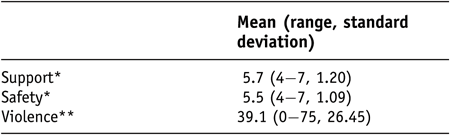
Mean scores from staff questionnaire on perceptions of support, safety and the degree to which violence is a problem
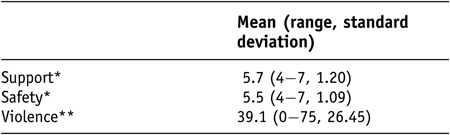
* Safety and support were measured on a scale 1–7, where 1 = very unsafe/unsupported and 7 = very safe/ supported
** The degree to which violence is a problem ranged from 0–100, where 0 = no problem and 100 = very big problem
RESULTS
Stage one: questionnaire
The results of the questionnaire are presented in Table 1. Four of the participants chose to make a comment on the questionnaire. Three of the comments reflected the view that generally they felt safe and supported. Appreciation for line managers and flexible working time was voiced. One person commented on the need for other teams to respond more rapidly to alarms, one wrote ‘I think nursing staff need to be listened to and offered support’ and indicated a need for this to be made available to senior staff (i.e. line managers).
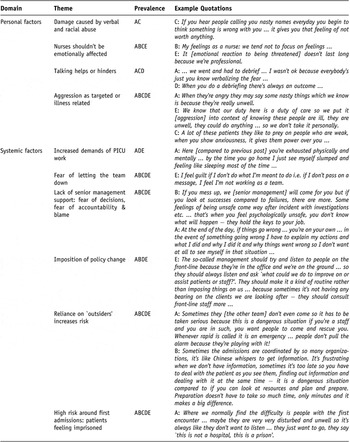
Domains, prevalence rates and example quotations from qualitative data analysis

Stage two: interviews
Analysis of the data identified 10 themes which were clustered into two broad domains evident across all interviews and implicated in the perception of threat. Participants are represented by alphabetic letter in Table 2; selected quotes are presented to illustrate the themes within each domain.
DISCUSSION
This study looked at staff perceptions of the level of safety and support on a PICU and the factors involved. The results from the questionnaire indicated that on average, the MDT staff on the PICU feel reasonably safe and supported. The degree to which violence is perceived to be a problem was similar to that reported by Lepping et al. (Reference Lepping, Steinert, Needham, Abderhalden, Flammer and Schmid2009, mean = 28.5; this study, mean = 39.1) as is the perception of safety (mean = 5.5) when compared to that reported by Privitera et al. in an inpatient setting (2005, mean = 6.1). Of note, perceiving violence to be a big problem did not necessarily relate to staff feeling unsafe. Importance of the role of support in perceptions of personal safety was highlighted in interviews, replicating past findings (e.g. Martin & Daffern, Reference Martin and Daffern2006; Benson et al. Reference Benson, Secker, Balfe, Lipsedge, Robinson and Walker2003; Currid, Reference Currid2008).
Interviews indicated that for nurses, perception of threat related to several factors at a personal and systemic level. Perceptions of support were conceptualized at the nursing team level, the MDT level and the senior management level. Whilst nurses reported feeling very supported by their colleagues and the MDT, there was a strong feeling that senior management needed to be more supportive. This was reflected in the majority of nurses feeling more threatened by issues around accountability than aggression per se. This is again in line with past research findings (e.g. Currid, Reference Currid2008). Apparent from interviews was the desire of nursing staff to help each other out, to cater for the needs of their patients and to go out of their way to do so. Carrying their colleagues and patients in mind means that their nursing role extends beyond shift hours. In many senses the nurses interviewed were happy to do this and talked about enjoying their jobs. However, in representing the system, there was a sense that the system should back up nurses and provide some ‘give and take’. The nurses interviewed voiced a desire to feel appreciated and valued by senior management.
As found in other studies (Duxbury & Whittington, 2004; Benson et al. Reference Benson, Secker, Balfe, Lipsedge, Robinson and Walker2003), the appraisal that ‘mental illness' causes patient aggression was prevalent, relating to perceptions of aggression being unintentional and patients not being responsible for their behaviour. This appeared directly related to nurses ability to manage the evoked emotions and reduce the impact at a ‘personal' level. Reminding themselves of their ‘duty of care’ and adopting a professional stance, alongside the psychological strategy of expecting the unexpected seemed to buffer nurses from the effects of patient aggression. This contrasts considerably to the stance advocated in zero tolerance policies which highlight patient responsibility and challenge the acceptance of aggression. The fact that incidents go unreported by nursing staff (Ferns, Reference Ferns2006) can perhaps be understood in the context of conflict between professional role identity and policy requirements. Indeed, Privitera et al. (Reference Privitera, Weisman, Cerulli, Tu and Groman2005) found the most frequently cited reason for assault not being reported to the police was nurses' belief that patients were not responsible. It seems important to routinely consult staff so as to examine factors involved in threat processing and to consider in more detail what policy and interventions will therefore be helpful.
The results of this study suggest nursing culture (with ideas around the acceptability of emotional expression) could represent a challenge to understanding, and perhaps therefore addressing, the psychological impact of PICU work. There is insufficient scope to discuss in full the nature of the NHS culture and the function of discourses from within it, suffice to say that the literature surrounding this topic (e.g. Menzies, Reference Menzies1960; Benson et al. Reference Benson, Secker, Balfe, Lipsedge, Robinson and Walker2003; Paterson et al. Reference Paterson, Leadbetter, Miller and Bowie2010) warns against assuming change will be perceived positively. Given that preparation and a sense of self efficacy are important both practically and emotionally in managing the impact of aggression (Pedro et al. Reference Pedro, Corace, Endler and Calvo2003), interventions to enhance nurses' autonomy are likely to be helpful. Currid (Reference Currid2008) discussed a need for nurses to be empowered in this manner. Hatch-Malliette & Scalora (Reference Hatch-Maillette and Scalora2002) suggested that the degree to which an organization is seen to be committed to workers impacts positively on employee morale, involvement, loyalty and job performance.
CONCLUSIONS
The management of aggression tends to be reactive. However, in order to prevent staff feeling threatened, attention to the service structure and systemic cultural beliefs relating to the cause and consequence of patient aggression is required. On the basis of the study results and other relevant literature the following recommendations could help to reduce PICU staffs' perception of threat:
• Increase management presence in the absence of incidents. This could help to decrease the fear around encounters and provide an opportunity for balanced feedback with respect to recognizing staff strengths and things going well in addition to noticing when things go wrong.
• Involve nurses in policy consultation on a more routine basis. In this study nurses suggested: having a more relaxed environment via a room for de-escalation, reviewing the ward layout, re-considering the use of the seclusion room by other wards and re-designing the alarm system so that Rapid Response comes via an alarm rather than phoning the switchboard.
• Use supervision to address individual differences amongst staff. Although limited by the sample size, it seems gender related to the types of abuse that were perceived as most threatening (something identified in the literature e.g. Hatch-Maillette & Scalora, Reference Hatch-Maillette and Scalora2002). In particular, this study and others (Chen et al. Reference Chen, Hwu and Williams2005; Flannery et al. Reference Flannery, Hanson and Penk1995) highlight the need for the effects of verbal and racial abuse to be discussed and taken seriously.
• Improve procedures to reduce risk at first admissions: consulting experienced service users on what they would have liked at admission could help identify ways to better prepare future patients. Ensuring referring agents provide detailed information about the circumstance precipitating admission could help nurses feel more prepared to manage risk.
• Provide a space for nurses to talk and reflect on the emotional impact of the work. Given the ambivalence about talking, ensure nurses are consulted on how to set this up. One nurse suggested that in addition to handover, reinstating a debriefing session would help staff to leave the shift feeling supported.
In this study, the reliance on self report and the use of a self selected sample places limits on the reliability of data. Without interviewing other professionals and other ward nurses, the transferability of the study findings is unknown. Future research could consider interviews with senior management and draw samples from acute wards to provide a comparison with the data presented in this study.
ACKNOWLEDGMENTS
The authors want to thank the PICU staff for their involvement.