Introduction
Alcoholism is a complex behavioral disorder, in which multiple genetic susceptibility factors interact with environmental exposure to produce the clinical condition (Goldman et al. Reference Goldman, Oroszi and Ducci2005). Twin studies estimate the heritability of alcoholism to be in the range 40–60%. Previously available data do not suggest that the degree of genetic vulnerability differs substantially between men and women, although the underlying genetic factors do not overlap completely (Heath et al. Reference Heath, Bucholz, Madden, Dinwiddie, Slutske, Bierut, Statham, Dunne, Whitfield and Martin1997). However, alcohol dependence is a heterogeneous condition. Defining more homogeneous alcoholism subtypes may help to identify etiological and pathophysiological factors, and facilitate the development of treatments tailored to the needs of the individual (Windle & Scheidt, Reference Windle and Scheidt2004).
Two major subtypes of alcoholism, types I and II, have been proposed, based on Swedish adoption studies (Cloninger et al. Reference Cloninger, Bohman and Sigvardsson1981; Sigvardsson et al. Reference Sigvardsson, Bohman and Cloninger1996). Type I is described as having a later onset compared to type II. Type II, characterized by an early onset, antisocial behavior and a higher degree of heritability, is furthermore described as ‘male limited’ (Bohman et al. Reference Bohman, Cloninger, Sigvardsson and von Knorring1987; Brienza & Stein, Reference Brienza and Stein2002). Although much is known about the heritability of alcohol dependence in men, less is known about the genetic influences in type I and type II alcoholism among females. Earlier studies indicated a preponderance of type I alcoholism in women (Cloninger et al. Reference Cloninger, Bohman and Sigvardsson1981; Gilligan et al. Reference Gilligan, Reich and Cloninger1988). More recently, however, we found that approximately 40% of treatment-seeking alcohol-dependent women fell into a category closely resembling that described as type II alcoholism (Magnusson et al. Reference Magnusson, Goransson and Heilig2005). These subjects had more severe alcohol problems and significantly higher rates of illicit drug use than female alcoholics classified as type I. In addition, although both groups presented with a family history of alcoholism more often than healthy controls, the density of family history was higher among type II than among type I women (Magnusson et al. Reference Magnusson, Goransson and Heilig2010). This observation indicates familial susceptibility factors but does not allow a quantification of genetic and early environmental factors. Furthermore, assessing the importance of genetic and environmental risk factors using self-selected samples of treatment-seeking individuals is fraught with important limitations. Specifically, type II/early onset alcoholism is typically accompanied by a greater severity of clinical symptoms (Magnusson et al. Reference Magnusson, Goransson and Heilig2010), and this alone is sufficient to result in a systematic selection bias.
Available heritability estimates leave a considerable component of the variance in risk for alcoholism that is likely to be accounted for by environmental factors. Accordingly, studies from both clinical and community-based samples have shown that severe childhood trauma, such as emotional, physical and sexual abuse, is associated with increased vulnerability to addiction (Kendler et al. Reference Kendler, Neale, Kessler, Heath and Eaves1993; McCauley et al. Reference McCauley, Kern, Kolodner, Dill, Schroeder, DeChant, Ryden, Derogatis and Bass1997; Wilsnack et al. Reference Wilsnack, Vogeltanz, Klassen and Harris1997; Simpson & Miller, Reference Simpson and Miller2002; Sartor et al. Reference Sartor, Lynskey, Bucholz, McCutcheon, Nelson, Waldron and Heath2007). Studies have also shown that the risk for alcoholism and illicit drug use is increased among individuals who begin to drink at an early age (Grant & Dawson, Reference Grant and Dawson1997). Twin studies suggest that this association is not primarily causal, but rather results from an earlier onset of substance use disorders in subjects with increased vulnerability to alcoholism due to genetic and shared environmental factors (Prescott & Kendler, Reference Prescott and Kendler1999; Hopfer et al. Reference Hopfer, Crowley and Hewitt2003). Different forms of neglect during childhood are also associated with lower age of onset of alcohol use and heavy drinking (Sartor et al. Reference Sartor, Lynskey, Bucholz, McCutcheon, Nelson, Waldron and Heath2007; Waldrop et al. Reference Waldrop, Ana, Saladin, McRae and Brady2007; Shin et al. Reference Shin, Edwards and Heeren2009), indicating a possible mechanism for the link between childhood abuse and dependence. The twin study by Sartor et al. (Reference Sartor, Lynskey, Bucholz, McCutcheon, Nelson, Waldron and Heath2007) supported this, by showing that childhood sexual abuse increased the likelihood of early alcohol use but not the rate of progression from initiation to alcohol dependence.
The current study used twin methodology in a large population-based sample to assess the role of heritable and environmental factors in alcoholism in women, and simultaneously estimating the same parameters in men. We also focused our analyses on the role of childhood trauma in female alcoholism.
We used the twin data to examine the validity of the early onset/type II and late onset/type I constructs in female alcoholics. More severe alcohol-related problems have been described in treatment-seeking alcohol-dependent women classified as type II (Magnusson et al. Reference Magnusson, Goransson and Heilig2010); the present study examined whether these findings can be replicated in a population-based twin sample. We also investigated whether exposure to childhood abuse differed between type II and type I subjects. Because available evidence suggests that alcohol-dependent women with a history of abuse present more problems across a variety of domains than other alcohol-dependent woman (Pirard et al. Reference Pirard, Sharon, Kang, Angarita and Gastfriend2005), we hypothesized that a higher incidence of childhood abuse would be found in the more severe type II category of alcohol dependence.
Method
Participants
The Swedish Twin Registry was established in the 1960s and is the largest population-based registry of twins in the world. It consists of several birth cohorts and contains data on 85 000 twin pairs born between 1886 and 2000. The current study is based on the cohort known as the Study of Twin Adults: Genes and Environment (STAGE). The sex distribution of the 42 582 eligible twins is approximately equal, with 21 369 eligible female subjects and 21 213 males from monozygotic (MZ) and same- and opposite-sex dizygotic (DZ) twins born in Sweden 1959–1985.
In 2005, all twins in the target group were contacted with an invitation letter containing information about the project and a personal login to the study web page with questions focused on a variety of symptoms and exposures. After three reminders, non-responders to the web-based questionnaire were contacted by telephone and were asked to participate in a computer-assisted telephone interview. The total response rate among the female twins was 66.0% (n=14 114) and among the male twins 53.2% (n=11 285). Of the subjects who agreed to participate, 73% did so over the web. The study population was restricted to subjects answering the questions on alcohol abuse and alcohol dependence: 63.6% (n=13 595) of the female twins and 49.6% (n=10 524) of the male twins. The study was approved by the research ethics committee of Karolinska Institutet (Dnr 03-224).
Assessment
Subjects' characteristics (age, marital status, number of children and education) were recorded from the original interview. The diagnosis of lifetime alcohol abuse or dependence was established with a standardized, computer-assisted SCID (First et al. Reference First, Spitzer, Gibbon and Williams1997), and classification into type I or type II alcoholism was based on revised Cloninger–Bohman criteria as described previously (e.g. von Knorring et al. Reference von Knorring, Bohman, von Knorring and Oreland1985). According to this algorithm, a subject is classified as type II if both of the following criteria are present: (1) onset of alcohol problems before age 25 years and/or seeking treatment before age 30 years; and (2) two or more social complications (such as drunk driving, loss of job, incarceration). All other subjects with alcohol dependence who answered the classification questions were classified as type I.
The items assessing childhood trauma (emotional neglect, physical and sexual trauma) were based on the revised form of the Life Stressor Checklist (LSC-R), which is a self-report measure that assesses traumatic or stressful life events over the course of the lifetime. The LSC-R has demonstrated good validity for predicting subsequent health problems (Kimerling et al. Reference Kimerling, Clum and Wolfe2000). Emotional neglect was assessed by the question ‘Have you ever been emotionally abused or neglected?’, physical trauma by ‘yes’ to either having ‘ever been physically neglected’ or ‘ever abused’ and sexual trauma by a ‘yes’ to having been ‘forced to touch or to be touched’ or ‘forced into oral, anal or genital sex’.
Statistical analysis
We quantified the proportion of phenotypic variance due to genetic and environmental factors in alcohol dependence and its subgroups, type I and type II. This was followed by analyses of the association between the environmental factor childhood trauma and alcohol dependence in the female population.
To quantify genetic and environmental effects we used the basic twin model, assuming that individual differences in liability to a trait originate from three sources: additive genetic effects (A), common shared environmental effects (C) and non-shared environmental effects (E). All genes as well as shared environments are shared by MZ twins. DZ twins share half of their segregating genes and all of the shared environmental influences. Thus, if MZ twins are more similar than DZ twins, genetic effects are indicated. By contrast, if MZ and DZ correlations are similar, shared environmental factors are of importance. Two more assumptions were included in the model: no assortative mating and the equal environment assumption (EEA), which states that environmental exposure is shared to the same extent by MZ and DZ twins, and which has been found to be largely correct for several psychiatric disorders including alcoholism (Kendler et al. Reference Kendler, Neale, Kessler, Heath and Eaves1993).
We used structural equation modeling, implemented in the Mx software package (Neale et al. Reference Neale, Boker, Xie and Maes2003), comparing the similarity of MZ and DZ same-sex male and female twin pairs and also opposite-sex pairs, to provide estimates of each source's contribution to the population variance in liability to the disorder. A five-group sex-limitation model with input of raw data allowed us to test for differences in variance estimates in men and women, and also deviations from 0.5 of the additive genetic correlation between opposite-sex DZ twins, an indication of whether genetic expression differs between men and women.
To investigate whether childhood trauma is associated with the development of alcohol dependence, we analyzed the material as a cohort, but restricted our analyses to females. Childhood trauma was specified as exposure to emotional neglect, physical or sexual trauma during childhood. Alcohol dependence, or membership in the respective subtype category, was the dependent variable. The analyses were adjusted for age. Generalized estimating equation (GEE) models with the logit link (SAS procedure genmod; SAS Institute Inc., USA) were implemented to correct for the twin structure of the data (within-pair correlations).
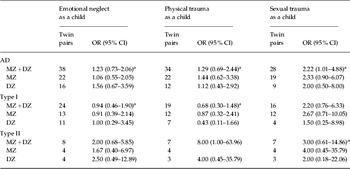
To examine whether the association between childhood trauma and alcohol dependence was confounded by familial factors, we performed a co-twin control analysis, using female MZ and DZ pairs. Twin pairs discordant for alcohol dependence were analyzed as a case–control study, where the healthy co-twin was used as a matched control for the affected twin. We performed a conditional logistic regression analysis, with the same variables as described in the cohort analysis. When odds ratios (ORs) from the co-twin analyses are lower than those resulting from the cohort analyses, familial influence on the associations between exposure and outcome is suggested, either from early environment or from genetics. If the OR remains significant in the within-pair analyses, an independent causal effect is indicated (Lichtenstein et al. Reference Lichtenstein, De Faire, Floderus, Svartengren, Svedberg and Pedersen2002). We also tested whether the results from the cohort and co-twin control analyses differed significantly, as in Wirdefeldt et al. (Reference Wirdefeldt, Gatz, Pawitan and Pedersen2005). Statistical analyses were performed using SAS version 9.2.
Results
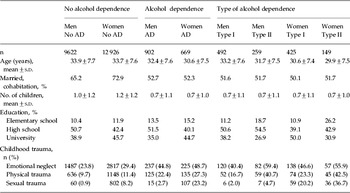
Demographic data for the study participants are given in Table 1. The total response rate was lower among male than among the female subjects (52.6% v. 65.8%).
Demographic characteristics of the study population (n=24 119, females=13 595, men=10 524)

AD, Alcohol dependence; s.d., standard deviation.
Significant differences in both males and females were found for age (t test), education, marital status and number of children (χ2 test) for No AD v. AD. Significant differences were also found in education (χ2 test) for both males and females and age for males between type I and type II.
The study population was restricted to subjects answering the questions on alcohol abuse and alcohol dependence. This yielded a population of 13 595 (63.6%) women and 10 524 (49.6%) men. A total of 943 failed to respond to the questions about alcohol abuse and 1365 to the questions about alcohol dependence. The non-responders to these questions were significantly younger, less likely to be married, and had a lower educational level than responders. Men generally responded less often to specific items than women.
Lifetime prevalence of alcohol dependence in the sample was 6.5% (n=1571): 4.9% in females and 8.6% in males.
Based on the criteria described in the Method section, 86% of the alcohol-dependent subjects (n=1325) could be classified as type I or type II. Of the alcohol-dependent subjects, 74.0% (n=425) of the women and 65.5% of the men (n=492) were categorized as type I, and 26.0% (n=149) of the women and 34.5% (n=259) of the men as type II alcoholics. Those for whom a classification was not possible differed from the study population in the following ways: they were slightly older (not significant), had a lower frequency of exposure to childhood trauma (physical trauma 26.2% v. 17.3%, p=0.01), and were more frequently married or cohabiting (60.5% v. 50.1%, p=0.008). There were also those who did not respond to the questions about childhood trauma. The greatest non-response was found for the items concerning ‘emotional neglect’ (non-response among alcohol dependence 37% and healthy subjects 30%, p<0.0001).
Importance of genetic variance for alcohol dependence in males and females
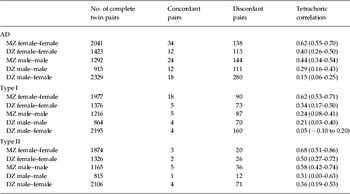
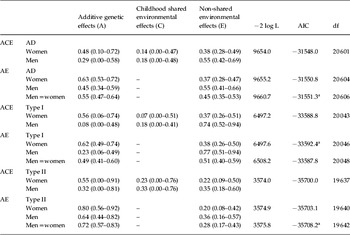
Table 2 displays the indicators of twin similarity in the five groups of twins: MZ male, MZ female, same-sex DZ male, same-sex DZ female and opposite-sex DZ pairs. The results of the model fitting are summarized in Table 3. The additive genetic correlation between opposite-sex DZ twins did not differ significantly from 0.5 for any of the indicators of alcohol dependence.
Indicators of twin similarity in alcohol dependence (AD) and its subtypes (type I and type II)

MZ, Monozygotic; DZ, dizygotic.
Structural equation models, presented as full model and best model of genetic and environmental susceptibility to alcohol dependence (AD) and its subtypes (type I and type II)

AIC, Akaike's Information Criteria; df, degrees of freedom.
95% Confidence intervals in parentheses.
a Best-fitting model by AIC criteria.
For alcohol dependence in general and type II, the best-fitting model had the same A and E estimates for men and women, whereas there was a significantly higher heritability among type I women. We did not have sufficient power to detect a significant shared environmental influence in the full model; however, there was a trend for higher C in type II women.
Childhood trauma and alcohol dependence among females
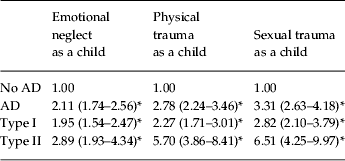
Associations between childhood trauma and the presence of alcohol dependence in the female cohort are shown in Table 4. Overall, there is a strong significant association between all three forms of childhood trauma and alcohol dependence. The highest associations of childhood trauma and alcoholism were observed in type II subjects compared to those with no alcohol dependence.
Association between childhood trauma in females (emotional neglect, physical and sexual trauma) and alcohol dependence (AD), with subjects without alcohol dependence (No AD) as reference versus subjects with AD, and type I and type II

Values given as odds ratio (OR) with 95% confidence interval (CI) in parentheses.
* p value (adjusted for age) <0.0001.
To examine whether the association between childhood trauma and alcohol dependence was confounded by familial factors, we performed a co-twin control analysis, presented in Table 5. Comparison between the cohort and co-twin analyses shows statistically significant differences in ORs for all types of childhood trauma for alcohol dependence overall (emotional neglect, p=0.001; physical trauma, p<0.0001; sexual trauma, p=0.06). For type I alcoholism, the contributions of emotional neglect (p=0.01) and physical trauma (p=0.0001) were statistically significant. This suggests that familial factors may partly explain the estimates in the cohort analyses (Lichtenstein et al. Reference Lichtenstein, De Faire, Floderus, Svartengren, Svedberg and Pedersen2002). For type II alcoholism, only the contribution of sexual trauma was statistically significant (p=0.02), indicating a role for this exposure as an independent individual-specific risk factor.
Co-twin control analyses in females. Odds ratio (OR) with 95% confidence interval (CI) by type of childhood trauma and number of discordant twin pairs in zygosity groups, associated with alcohol dependence (AD) and subtypes of alcoholism, type I and type II

MZ, Monozygotic; DZ, dizygotic.
a Significant difference between cohort and co-twin analysis.
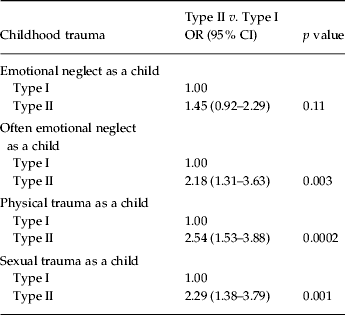
Table 6 displays differences in childhood trauma exposure between female type I and type II subjects. The differences are presented as ORs and 95% confidence intervals (CIs) with type I as the reference. In general, a history of trauma exposure was more common among type II than among type I subjects. This difference was significant for physical trauma, sexual trauma and emotional neglect when asked if this had happened ‘often’.
Association between type I and type II alcohol dependence and childhood trauma (emotional neglect, physical and sexual trauma) in females

OR, Odds ratio; CI, confidence interval.
Discussion
In a population-based cohort of twins, we found a lifetime prevalence of DSM-IV alcohol dependence of 6.5%, with a greater prevalence among men than women. In agreement with prior work (Goldman et al. Reference Goldman, Oroszi and Ducci2005), the risk for alcohol dependence had substantial heritability. In earlier studies, the heritability for developing alcohol dependence in women was estimated to be lower than for men, but more recent twin studies did not find significant sex differences (Prescott et al. Reference Prescott, Caldwell, Carey, Vogler, Trumbetta and Gottesman2005). Our findings were in line with these later studies. In fact, when it came to late-onset or type I alcoholism, the magnitude of genetic susceptibility was greater for women than for men.
To our knowledge, this is the first report of heritability of type I and type II alcoholism among women. In previous studies of male alcoholics (Cloninger et al. Reference Cloninger, Bohman and Sigvardsson1981), heritability estimates were greater for type II than for type I alcohol dependence. Corresponding data for female alcoholics have been lacking. In a recent case–control study of treatment-seeking alcohol-dependent women, we found that a family history of alcoholism was present with a higher density among type II than type I subjects. This finding could be compatible with a higher heritability in females with early-onset alcoholism, similar to that described in men, but cannot control for potential confounds of shared environment (Magnusson et al. Reference Magnusson, Goransson and Heilig2010). The current results support this hypothesis; we found a trend for higher heritability among type II than among type I women in the present study, although this did not reach significance, presumably due to lack of power.
Another non-mutually exclusive explanation for the higher density of family history of alcoholism could be related to a greater influence of familial background factors. Overall, shared environment has been concluded to play a limited role in alcoholism vulnerability (Goldman et al. Reference Goldman, Oroszi and Ducci2005), but may be important in certain subpopulations. In the present study, the contribution from shared environment in the full model was estimated to account for 23% of variation in alcoholism risk in female type II subjects, but had a negligible influence in type I women. Although this difference did not reach statistical significance, additional analyses discussed below support the notion that shared environmental factors contribute to the risk for developing type II alcoholism in women. These factors might also lead to a more severe disease, with earlier onset of clinical consequences that result in treatment seeking.
Twin studies have shown previously that childhood sexual abuse increases the risk of addiction later in life (Kendler et al. Reference Kendler, Bulik, Silberg, Hettema, Myers and Prescott2000; Bulik et al. Reference Bulik, Prescott and Kendler2001; Sartor et al. Reference Sartor, Agrawal, McCutcheon, Duncan and Lynskey2008). We replicated this finding, and also found that a higher frequency of emotional and physical neglect in addition to sexual abuse in childhood had a particularly strong association with type II alcoholism. A co-twin control analysis weakened this association, indicating that childhood trauma in general reflects familial factors important for alcohol dependence (Lichtenstein et al. Reference Lichtenstein, De Faire, Floderus, Svartengren, Svedberg and Pedersen2002). However, childhood sexual abuse seemed to be an independent and individual specific risk factor.
Genetic and environmental risks for alcoholism are correlated. Being raised in a family with parental dependence reflects increased genetic risk, but also increases the risk for exposure to abuse and neglect compared to children in the general population. Although childhood abuse and neglect have been linked to early onset of alcohol use, binge drinking and later alcohol dependence, determining the exact source of this association presents a challenge (Sheridan, Reference Sheridan1995; Sher et al. Reference Sher, Gershuny, Peterson and Raskin1997; Dube et al. Reference Dube, Miller, Brown, Giles, Felitti, Dong and Anda2006). In the present study, we found evidence for childhood trauma as a risk factor for women with type II alcoholism. In analyzing the role of this risk factor, the question arises whether childhood trauma exposure is merely a marker of an adverse shared familial environment, or whether such exposure is an individual specific risk factor per se, or both. In the present analysis, we were able to assess the importance of childhood trauma as an individual specific risk factor through the combined results from the structural equation modeling, the cohort analysis and the co-twin analysis. Because sexual abuse was a significant risk factor for alcohol dependence in the co-twin control analysis, we found evidence for a direct association between this form of childhood trauma and alcohol dependence, independent of other forms of shared childhood environment or genetic background factors. In summary, we conclude that childhood trauma is likely to be both a marker of familial susceptibility factors and, at least in the case of childhood sexual abuse, an individual specific risk factor per se. This is in agreement with prior analyses, in which childhood sexual abuse has largely been concluded to remain an independent predictor of later alcohol problems even when parental alcohol problems are taken into account (Dinwiddie et al. Reference Dinwiddie, Heath, Dunne, Bucholz, Madden, Slutske, Bierut, Statham and Martin2000; Kendler et al. Reference Kendler, Bulik, Silberg, Hettema, Myers and Prescott2000; Nelson et al. Reference Nelson, Heath, Madden, Cooper, Dinwiddie, Bucholz, Glowinski, McLaughlin, Dunne, Statham and Martin2002).
The different trajectories and clinical presentation of type I and type II alcoholism might also result from interactions between genetic susceptibility factors and environmental exposure (Hunter, Reference Hunter2005; Ducci et al. Reference Ducci, Enoch, Hodgkinson, Xu, Catena, Robin and Goldman2008). Monoamine oxidase (MAO) genes are of particular interest in this context. The MAOA and MAOB genes are located on the short arm of the X chromosome and encode the two human MAO isoforms, MAOA and MAOB. Both enzymes degrade dopamine, with MAOA also metabolizing serotonin, norepinephrine and epinephrine. Consistent with original findings in males (Kim-Cohen et al. Reference Kim-Cohen, Caspi, Taylor, Williams, Newcombe, Craig and Moffitt2006), MAOA variation in women was subsequently found to interact with childhood sexual abuse to mediate risk for antisocial alcoholism. Specifically, the low-activity MAOA allele was associated with alcoholism, and particularly with antisocial alcoholism, only among sexually abused subjects. Within this group, a gene–dose effect of the low-activity allele was found for both alcoholism and antisocial symptoms (Ducci & Goldman, Reference Ducci and Goldman2008). Of note, a haplotype at the neighboring MAOB locus was also associated with alcoholism, and to lesser degree antisocial alcoholism, independently of environmental exposure.
In summary, we report here evidence that heritability of DSM-IV alcohol dependence among women is very similar to that for men. We further find, using a population-based twin sample, a trend for higher heritability among type II (early onset) than type I (late onset) alcoholism. The data suggest a sex difference in genetic susceptibility to type I, but not type II, alcoholism, with a greater influence among women. Furthermore, we find evidence for a role of severe childhood abuse, both of sexual and physical nature, in susceptibility for early onset alcoholism among women. Although our study does not examine the role of specific genetic factors, our findings are consistent with an interaction between early life trauma and genetic risk to produce early onset, severe alcoholism.
Acknowledgements
The Swedish Twin Registry is supported by grants from the Swedish Department of Higher Education and the Swedish Research Council, and an unrestricted research grant from AstraZeneca. This work was also supported by funding from the County of Stockholm and the National Institute on Alcohol Abuse and Alcoholism intramural research funds.
Declaration of Interest
None.