Introduction
Although many psychiatric disorders are being increasingly recognized as syndromes that encompass heterogeneity across a range of levels of analysis, much research continues to assume both causal and phenotypic homogeneity (Hyman, Reference Hyman2010; Miller, Reference Miller2010). Such oversimplification is likely to impede both scientific and clinical progress. From a clinical perspective, improved understanding of the causal and clinical heterogeneity within specific patient populations has the potential to improve the targeting and individualization of treatments. From a basic laboratory perspective, refinement of understanding of the different aetiological pathways underpinning such disorders will facilitate novel treatment development and foster the generation of an aetiologically based system of diagnosis.
Attention deficit hyperactivity disorder (ADHD), one of the most common and costly neurodevelopmental disorders (Polanczyk et al. Reference Polanczyk, de Lima, Horta, Biederman and Rohde2007; Doshi et al. Reference Doshi, Hodgkins, Kahle, Sikirica, Cangelosi, Setyawan, Erder and Neumann2012), is an exemplar of a robust clinical neuropsychiatric syndrome with marked heterogeneity across multiple levels of analysis. In the past, causal models of ADHD have tended to posit a single core dysfunction (e.g. Barkley, Reference Barkley1997) and researchers have tended to focus on one particular aspect of functioning rather than explore potential alternative explanations (Coghill et al. Reference Coghill, Nigg, Rothenberger, Sonuga-Barke and Tannock2005). More recently, this assumption of homogeneity has been challenged in several theoretical papers (Castellanos & Tannock, Reference Castellanos and Tannock2002; Sonuga-Barke, Reference Sonuga-Barke2002, Reference Sonuga-Barke2005; Nigg et al. Reference Nigg, Willcutt, Doyle and Sonuga-Barke2005; Sonuga-Barke et al. Reference Sonuga-Barke, Sergeant, Nigg and Willcutt2008), some of which included secondary analyses of data demonstrating substantial distributional overlap between ADHD and control samples, and marked heterogeneity at the neuropsychological level, with only a small proportion of those categorized as having ADHD demonstrating a ‘deficit’ on any one particular task (Nigg et al. Reference Nigg, Willcutt, Doyle and Sonuga-Barke2005). Few studies have, however, formally explored neuropsychological heterogeneity within a single study. Solanto et al. (Reference Solanto, Abikoff, Sonuga-Barke, Schachar, Logan, Wigal, Hechtman, Hinshaw and Turkel2001) tested Sonuga-Barke's ‘dual pathway model’ and demonstrated that delay aversion and inhibition could be partitioned into separable pathways, with some ADHD subjects showing inhibition deficits whereas others were delay averse. Sonuga-Barke et al. (Reference Sonuga-Barke, Bitsakou and Thompson2010) also demonstrated, in preschool children with ADHD, that executive dysfunction and delay aversion each made significant independent contributions to predictions of ADHD symptoms. The same group developed this work further and demonstrated a ‘triple pathway’, whereby children with ADHD and healthy controls differed at a group level on temporal processing, inhibitory control and delay-related tasks, with each of these representing an independent neuropsychological component with co-localization no greater than would be predicted by chance. These findings were broadly consistent with those of Kuntsi et al. (Reference Kuntsi, Oosterlaan and Stevenson2001), who used three different neuropsychological tasks measuring response inhibition, working memory and delay aversion in a sample of pervasively hyperactive children identified from a general population sample of twin pairs. The hyperactive group performed worse than the control group on the delay aversion measure and on some aspects of the working memory tasks, although controlling for IQ eliminated the significant group differences on the working memory measures. No significant group differences were found on the inhibition variables. Our group has previously differentiated between high and low executive demand neuropsychological functioning in ADHD and demonstrated separable dysfunctions across these domains in both ADHD and oppositional defiant disorder (Coghill et al. Reference Coghill, Rhodes and Matthews2007; Rhodes et al. Reference Rhodes, Park, Seth and Coghill2012). Geurts et al. (Reference Geurts, van der Oord and Crone2006) investigated the relationship between ‘hot’ and ‘cold’ aspects of neuropsychological functioning using a test of inhibitory control and a decision-making task, but did not find group differences on either task. Although important, each of these studies only addressed a subset of those aspects of neuropsychological functioning implicated in ADHD (for review, see Castellanos & Tannock, Reference Castellanos and Tannock2002; Willcutt et al. Reference Willcutt, Doyle, Nigg, Faraone and Pennington2005). Only one group has previously extended this approach to a direct comparison across a broader range of cognitive processes. In a landmark study, Fair et al. (Reference Fair, Bathula, Nikolas and Nigg2012) demonstrated differences between children with ADHD and controls on a range of cognitive factors (inhibition, working memory, memory span, arousal/activation, response variability, temporal information processing and processing speed). They showed that typically developing (TYP) children can be classified into distinct neuropsychological subgroups with high precision and that some of the heterogeneity in individuals with ADHD might be ‘nested’ within this normal variation (Fair et al. Reference Fair, Bathula, Nikolas and Nigg2012). Despite the many strengths of this study, a weakness, shared by many of the above-mentioned studies, is that it included children with ADHD who had previously taken, or were currently receiving, stimulant medications. Even with a 24–48-h wash-out period, it is not possible to exclude the possibility of medication effects on neuropsychological performance.
The aim of the present study was to investigate neuropsychological functioning systematically across a broad range of neuropsychological domains, previously implicated in ADHD, in a group of boys who had never been exposed to either stimulant or non-stimulant ADHD medications. Based on existing literature, we proposed a model whereby ADHD is characterized by deficits in at least six relatively independent neuropsychological domains. Accordingly, we included measures covering those domains: memory (Rhodes et al. Reference Rhodes, Coghill and Matthews2005, Reference Rhodes, Coghill and Matthews2006; Coghill et al. Reference Coghill, Rhodes and Matthews2007), inhibitory control (Solanto et al. Reference Solanto, Abikoff, Sonuga-Barke, Schachar, Logan, Wigal, Hechtman, Hinshaw and Turkel2001; Bedard et al. Reference Bedard, Ickowicz, Logan, Hogg-Johnson, Schachar and Tannock2003; Crosbie et al. Reference Crosbie, Perusse, Barr and Schachar2008), delay aversion (Sonuga-Barke et al. Reference Sonuga-Barke, Taylor and Heptinstall1992a , Reference Sonuga-Barke, Taylor, Sembi and Smith b ), decision making (Garon et al. Reference Garon, Moore and Waschbusch2006; DeVito et al. Reference DeVito, Blackwell, Kent, Ersche, Clark, Salmond, Dezsery and Sahakian2008), timing (Toplak & Tannock, Reference Toplak and Tannock2005) and response variability (Kuntsi et al. Reference Kuntsi, Frazier-Wood, Banaschewski, Gill, Miranda, Oades, Roeyers, Rothenberger, Steinhausen, van der Meere, Faraone, Asherson and Rijsdijk2012). To avoid the use of an excessive number of redundant indicators in our analysis and to reduce measurement error, we adopted a confirmatory factor analysis (CFA) approach to test this model. Specifically, we predicted that, compared to TYP boys, boys with ADHD would, as a group, demonstrate poorer performance on each of these six aspects of neuropsychological functioning. However, we also predicted that each neuropsychological factor would demonstrate a degree of independence such that only a relatively small proportion of those with ADHD would demonstrate deficit on each factor.
Method
Participants
We tested two groups of boys aged between 6 and 12 years: ADHD boys and TYP healthy control boys. Exclusion criteria for both groups were: a history or current diagnosis of bipolar disorder, psychosis, major depressive disorder or post-traumatic stress disorder (PTSD), a diagnosis of pervasive developmental disorder, a history of any neurological disorder or seizure disorder (other than febrile seizures), intellectual impairment (IQ < 80), chronic physical illness, sensory or motor impairment, current or previous exposure to stimulant medication or anticonvulsants, and a history of past or current misuse of alcohol or illegal drugs. Informed written consent to participate in the study was obtained from each child's parent(s)/guardian and assent was obtained from the child. The study was approved by the East of Scotland Research Ethics Committee (Reference number 06/S1401/36).
ADHD group
Participants were 83 boys aged between 6 and 12 years newly diagnosed with ADHD and not yet treated with medication. The boys were recruited from consecutive referrals to the Developmental Disorders Team, a public sector, specialist out-patient service situated within the Tayside Child and Adolescent Mental Health Services. The study participants were highly representative and typical of boys referred to such services in the UK. All participants were interviewed by an experienced child and adolescent psychiatrist trained in the use of the Kiddie Schedule for Affective Disorders and Schizophrenia – Present and Lifetime Version (K-SADS-PL; Kaufman et al. Reference Kaufman, Birmaher, Brent, Ryan and Rao2000) and, where feasible (n = 52), the Child Attention-Deficit Hyperactivity Disorder Teacher Telephone Interview (CHATTI; Holmes et al. Reference Holmes, Lawson, Langley, Fitzpatrick, Trumper, Pay, Harrington and Thapar2004), a validated telephone interview tool for the diagnosis of ADHD. Where the CHATTI could not be used, a structured narrative report from school was obtained. Data were collected from standardized questionnaires: the revised 48-item Conners' Parent Rating Scale (CPRS-48) and the revised 28-item Conners' Teacher Rating Scale, short version (CTRS-28). All participants met diagnostic criteria for ADHD as defined by DSM-IV (APA, 1994) and all three subtypes (combined, inattentive and hyperactive/impulsive) were permitted. The presence of commonly co-morbid conditions (oppositional defiant disorder, conduct disorder and anxiety disorder) were noted but did not result in exclusion.
TYP healthy control group
The control group consisted of 66 healthy boys between 6 and 12 years of age who were attending school within Tayside. This group were screened using three validated questionnaires: the Strengths and Difficulties Questionnaire (SDQ; Goodman, Reference Goodman2001), the 26-item revised Conners' Parent Rating Scale, short version (CPRS-26; Conners et al. Reference Conners, Sitarenios, Parker and Epstein1998) and the CTRS-28. Symptom-free participants (within the normal range for all SDQ scales and a T score < 60 on all subscales of the CPRS-26 and CTRS-28) and their parents were interviewed by an experienced child and adolescent psychiatrist using the K-SADS-PL to confirm health. Exclusion criteria were identical to those for the ADHD group, except that a previous, or current, history of any psychiatric disorder led to exclusion.
Design
The British Picture Vocabulary Scale – Second Edition (BPVS-II; Dunn et al. Reference Dunn, Dunn, Whetton and Burley1997) was used to estimate verbal ability. The BPVS was chosen for its ease of administration and applicability to children aged between 3 and 15 years, and because it is less heavily confounded with executive functioning abilities than other measures of cognitive ability. Family socio-economic status was estimated using the Scottish Index of Multiple Deprivation (SIMD; Office of the Chief Statistician, 2009). The SIMD uses 37 indicators in seven domains to define relative socio-economic deprivation and to map this across geographical areas in Scotland. Overall deprivation ranks are identified by postcode and converted into SIMD deciles based on the health domain rank, with a decile score of 1 being the most deprived and 10 being the least deprived. All participants attended a single neuropsychological testing session. All participants were naive to stimulant medications at both clinical assessment and neuropsychological testing.
Neuropsychological assessment
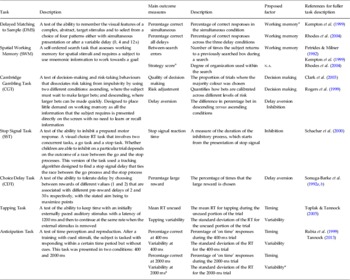
Participants were tested on a battery of seven tasks selected to represent the major neuropsychological domains previously identified to demonstrate group-level deficits in ADHD. All tasks had been extensively validated across a range of healthy and clinical populations. The tasks, apart from the Cambridge Gambling Task (CGT), have been used extensively in studies of ADHD populations. Three tasks [Delayed Matching to Sample (DMS), Spatial Working Memory (SWM) and the CGT] were selected from the Cambridge Neuropsychological Test Automated Battery (CANTAB; Morris et al. Reference Morris, Evendon, Sahakian, Robbins, Stahl, Iversen and Goodman1987). Additionally, we used the STOP task (Logan et al. Reference Logan, Cowan and Davis1984), the Choice Delay Task (CDT; Sonuga-Barke et al. Reference Sonuga-Barke, Taylor and Heptinstall1992a ,Reference Sonuga-Barke, Taylor, Sembi and Smith b ) and two tasks assessing aspects of timing, tapping (Toplak & Tannock, Reference Toplak and Tannock2005) and anticipation (Rubia et al. Reference Rubia, Taylor, Taylor and Sergeant1999; Tannock, Reference Tannock2013). Administration order was balanced across four task orders (CANTAB/non-CANTAB tasks and CGT ascending first/descending first). All tasks were presented on a high-resolution colour monitor with a touch-sensitive screen. A scheduled break of approximately 15 min was taken midway through the testing session and participants were informed that they could take further breaks as required. The tasks are described in Table 1.
Descriptions of neuropsychological tasks

RT, reaction time; n.a., not applicable.
a Variables excluded from the final complementary factor analysis (CFA) model as significantly improved fit.
Data analysis
Statistical analyses were conducted using SPSS for Windows version 21 (SPSS Inc., USA) and AMOS version 21 (SPSS Inc., USA).
For the task-level comparisons between the ADHD and TYP groups, data meeting assumptions of normality and homogeneity of variance were analysed using ANCOVA (Winer et al. Reference Winer, Brown and Michels1991). All other data were compared using appropriate non-parametric tests (e.g. the Mann–Whitney U test). Additional repeated-measures ANOVAs were conducted comparing groups on the SWM and DMS tasks across the various levels of difficulty. As ADHD boys tended to score lower on both the BPVS and the SIMD, these were used as covariates in the analyses.
A series of CFAs were performed to determine the best-fitting model for the different aspects of cognitive functioning (memory, delay aversion, decision making, timing, variability, inhibition). In addition to confirming the model, this approach has the added benefit that it reduces measurement error. All scores were transformed prior to CFA such that a positive score reflected superior performance. The maximum likelihood method was used. Fit of all models was evaluated using several indexes, including the χ 2 value, the Comparative Fit Index (CFI), Bollen's Incremental Fit Index (IFI) and the root mean square error of approximation (RMSEA). Smaller χ 2 and RMSEA values and larger CFI and IFI values indicate a better fit. In general, non-significant χ 2, RMSEA ⩽0.08 and CFI and IFI > 0.9 indicate a good fit (Browne & Cudeck, Reference Browne, Cudeck, Bollen and Long1993; Kline, Reference Kline2005). Several models were tested and the best model was determined by the best overall fit indices. For between-group analyses, factors were regressed for age and standardized across all participants to a mean of zero and a standard deviation of one. A series of ANOVAs were then conducted for each of these seven factors comparing the ADHD and TYP groups. Effect sizes were calculated using the methods of Cohen (Reference Cohen1988), with an effect size of 0.3 defined as small, 0.5 medium and 0.8 large. In keeping with previous analyses within the field, ‘deficit’ was defined as performance within the bottom 10% of the control group (e.g. Nigg et al. Reference Nigg, Willcutt, Doyle and Sonuga-Barke2005). Separate analyses regressed for age and BPVS and SIMD scores were conducted.
Results
Participant characteristics (Table 2)
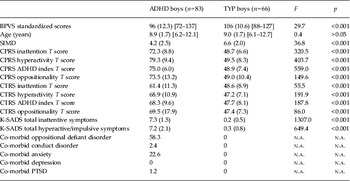
Eighty-three boys with ADHD and 66 TYP boys were recruited. There were no differences between the groups with respect to age profile, but there were significant differences on BPVS scores, with ADHD boys scoring lower than TYP boys. There were also differences with respect to estimates of socio-economic deprivation (SIMD), with the ADHD boys domiciled within areas of greater deprivation. Analyses were conducted with and without BPVS and SIMD as covariates. As the main findings for these analyses were very similar, only the non-covaried results are presented here. As expected, the two groups differed with respect to scores on clinical measures from both the CPRS-26 and the CTRS-28, and also in symptoms identified at interview with the K-SADS. Within the ADHD group, there were significant numbers of boys who met criteria for diagnoses of co-morbid oppositional defiant disorder and anxiety disorder. Analyses were conducted on both the task-level and factor-level data, comparing those boys with and without these co-morbidities. There were no group differences on any of the analyses (all p > 0.05) and these data are not reported further here.
Demographic and clinical characteristics

ADHD, Attention deficit hyperactivity disorder; TYP, typically developing; BPVS, British Picture Vocabulary Scale; SIMD, Scottish Index of Multiple Deprivation; CPRS, Conners' Parent Rating Scale; CTRS, Conners' Teacher Rating Scale; K-SADS-PL, Kiddie Schedule for Affective Disorders and Schizophrenia – Present and Lifetime Version; PTSD, post-traumatic stress disorder; n.a., not applicable.
Values given as mean (standard deviation) [range] or percentage.
Task-level analysis of neuropsychological data
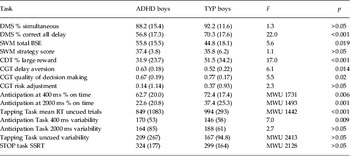
A summary of findings and means is presented in Table 3. Statistically significant group differences were found for DMS % correct all delays, SWM total between-search errors, CDT % large reward, CGT delay aversion and quality of decision making, Anticipation Task % on time at 400 and 2000 ms and variability at 400 m, and Tapping Task mean reaction time (RT) uncued trials. No group differences were found for DMS % correct at the simultaneous condition, SWM strategy score, CGT risk adjustment, Anticipation Task variability at 2000 ms, Tapping Task uncued variability or the STOP Task stop-signal reaction time (SSRT). The correlation matrix for the neuropsychological tasks included in the CFA is presented in Supplementary Table S1 online. Most tasks were moderately correlated apart from Tapping Task mean RT uncued trials and uncued variability, the Anticipation Task variability at 400 ms and the STOP Task SSRT, which showed significant correlations with only a proportion of the other tasks.
Task-level neuropsychological performance

ADHD, Attention deficit hyperactivity disorder; TYP, typically developing; DMS, Delayed Matching to Sample; SWM, Spatial Working Memory; BSE, between-search errors; CDT, Choice Delay Task; CGT, Cambridge Gambling Task; RT, reaction time; SSRT, stop-signal reaction time; MWU, Mann–Whitney U test.
Values given as mean (standard deviation).
CFA
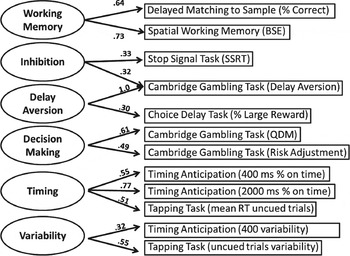
We conducted a CFA according to the conceptual model that had guided our work and informed our choice of tasks. The one-factor model did not fit the data adequately (χ 2 55 = 127, CFI = 0.71, IFI = 0.81, RMSEA = 0.094), justifying the building of a multifactorial model. The best-fitting six-factor model that conformed to our theoretical approach, with factors for memory, inhibition, delay aversion, decision making, timing and variability, is shown in Fig. 1. Fit was acceptable (χ 2 38 = 66, p < 0.001, CFI = 0.93, IFI = 0.93, RMSEA = 0.065) and was preferable to a model in which CGT delay aversion (which is described as an index of both impulsivity and delay aversion) was only associated with the delay aversion factor (χ 2 39 = 103, CFI = 0.83, IFI = 0.83, RMSEA = 0.174). Three of the neuropsychological variables (DMS % correct at simultaneous condition, SWM strategy score and Anticipation Task variability at 2000 ms) were excluded from the final six-factor model as their inclusion resulted in either inadmissible solutions or a poor fit. The model was also comparable to the best-fitting five-factor (χ 2 44 = 70, CFI = 0.93, IFI = 0.93, RMSEA = 0.063) and four-factor models (χ 2 48 = 81, CFI = 0.91, IFI = 0.91, RMSEA = 0.069). The relationship between the factors and variables for the four- and five-factor models is given in Supplementary Table S2. For our main analysis we present the results of the six-factor model as this is the most consistent with our conceptual and theoretical framework.
Data reduction for neuropsychological measures. Confirmatory factor analysis (CFA) was used to conduct rational reduction of the measures listed in Table 1. Shown is the conceptual model that depicts how we hypothesized that our measured variables relate to six latent factors and displays the factor loadings for this six-factor model. For ease of presentation, the figure does not display error terms, cross-loadings or correlations among latent factors. BSE, Between-search errors; QDM, quality of decision making; SSRT, stop signal reaction time.

The impact of ADHD on neuropsychological functioning
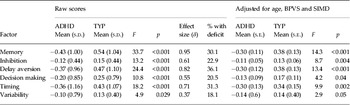
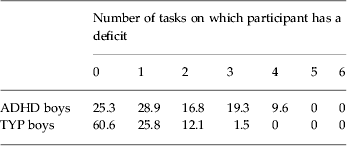
The results of the ANOVAs comparing ADHD and TYP boys on each of the neuropsychological factors are detailed in Table 4. Compared to TYP boys, ADHD boys performed poorly on all six of the neuropsychological factors. The effect sizes for the comparison between ADHD and TYP were large for delay aversion (0.82) and memory (0.95), medium for impulsivity (0.61), decision making (0.55) and timing (0.71), and small for variability (0.37). Separate analyses regressed for age and BPVS and SIMD scores resulted in similar findings (Table 4). Based on the raw data analyses, the proportion of ADHD boys with a deficit on each factor was moderate, ranging from 18% to 36%. A quarter of ADHD boys did not exhibit a deficit on any of the six factors, with almost all of those who did have at least one deficit having deficits on no more than three factors (65%) (Table 5). No participant showed a deficit on more than four factors. The correlations between the neuropsychological factors are detailed in Table S3. Although there were several significant correlations, these were all weak, apart from the correlation between inhibition and delay aversion, which was moderate (Dancey & Reidy, Reference Dancey and Reidy2004). To investigate the relative independence of these deficits, we further explored whether those ADHD boys who performed worse than the bottom 10% of controls on any one factor might significantly underperform with respect to the other factors, but might just miss the threshold for definition of a deficit. We conducted a series of 2 × 2 cross-tabulations comparing the proportions of boys with ADHD who scored above and below the 10th centile on one factor and between the 10th and 25th centiles on the other factors. Across all factors there were no differences in the proportion of boys performing between the 10th and 25th centiles dependent on whether or not they were in the bottom 10% on the index factor. This analysis supports the relative independence of the observed deficits and the contention of relatively distinct neuropsychological subgroups.
Comparison of ADHD and TYP boys across six domains of neuropsychological functioning

ADHD, Attention deficit hyperactivity disorder; TYP, typically developing; BPVS, British Picture Vocabulary Scale; SIMD, Scottish Index of Multiple Deprivation; s.d., standard deviation; s.e., standard error.
Number of neuropsychological factors on which a participant has a deficit

ADHD, Attention deficit hyperactivity disorder; TYP, typically developing.
Deficit is defined as performing in the bottom 10% of TYP boys.
Discussion
This is the first study to compare directly the performance of a large, carefully phenotyped, medication-naive cohort of boys with ADHD with that of a matched cohort of healthy boys on a broad battery of neuropsychological tasks that address six of the main domains of neuropsychological functioning implicated in ADHD. Based on previous studies, we addressed two main hypotheses. First, that boys with ADHD would perform less well than TYP boys with respect to visual memory, inhibition, delay aversion, decision making, timing and response variability. This hypothesis was fully supported by the data. Second, that despite group-level differences across all neuropsychological factors, there would be considerable overlap between the neuropsychological performance of the ADHD and TYP boys and that this would be reflected by only a minority of ADHD boys demonstrating deficits in each domain. This proposition was also fully supported by the data.
These findings should be viewed with several limitations in mind. Although each of the factors in the CFA was dependent upon more than one behavioural outcome measure, it would have been preferable to have gathered data from a larger number of tasks. Sonuga-Barke et al. (Reference Sonuga-Barke, Bitsakou and Thompson2010) included three tasks for each domain of functioning. However, three of the seven factors assessed in the seminal study of Fair et al. (Reference Fair, Bathula, Nikolas and Nigg2012) were dependent on a single outcome measure. The decision not to increase the number of tasks was a considered and pragmatic one. Although it would have been theoretically possible to have increased the number of tasks, this would have increased the testing burden on the boys and would probably have resulted in test fatigue and increased drop-outs with data loss. One measure, the delay aversion measure of the CGT, contributed to two factors (delay aversion and inhibition) and this may account for the moderate correlation between these factors. The sample size is moderate for the statistical approaches used. In addition, as this was a cross-sectional study with an untreated newly diagnosed sample, there was limited variance in ADHD symptoms scores (all of the ADHD boys had high levels of ADHD symptoms) and it was not practical to look at the relationship between symptoms and cognition. This was a referred clinical sample that was representative of those referred and diagnosed with ADHD in the UK. However, it is not possible to say whether these findings would generalize to a population-based sample. As we only included males, and in view of the well-documented gender differences in clinical presentation of various psychiatric disorders (including ADHD), normative developmental course and normative cognitive performance, these results may not apply equally to girls with ADHD. Although the presence of co-morbid oppositional defiant disorder or anxiety disorder does not seem to have impacted on these findings, we did not assess for either specific learning disorders (e.g. difficulties with reading, writing, spelling or arithmetic) or developmental coordination disorder and it is possible that these may have exerted some impact on task performance.
Mindful of the limitations noted above, however, these are important new data that support earlier conclusions from indirect analyses and studies with a more limited scope. From a conceptual perspective, the aspects of neuropsychological functioning shown here to be associated with ADHD are mediated by a much broader distribution of brain circuitry than has traditionally been associated with ADHD. Furthermore, the confirmation that these deficits coexist, although not necessarily within the same individuals, within this sample, supports the importance of taking a broader view of the pathophysiology of ADHD. Certainly the corticostriatal circuits involved in inhibition, working memory, decision making and other aspects of executive functioning seem integral to the pathophysiology of ADHD. However, tasks such as the DMS have been demonstrated to be dependent on intact medial temporal lobe and amygdalo/hippocampal functioning (Owen et al. Reference Owen, Sahakian, Semple, Polkey and Robbins1995), the timing tasks used here are dependent on intact cerebellar circuitry (Ivry & Spencer, Reference Ivry and Spencer2004), and Sonuga-Barke (Reference Sonuga-Barke2002) has proposed that the motivational aspects of ADHD are dependent on mesolimbic reward circuitry. These different aspects of functioning are also dependent on different neurotransmitter substrates. For example, the DMS task has been shown to be sensitive to changes in cholinergic functioning (Robbins et al. Reference Robbins, Semple, Kumar, Truman, Shorter, Ferraro, Fox, McKay and Matthews1997). It is therefore possible that the different neuropsychological profiles may predict differential responses to medications. This has yet to be tested, but may pave the way to an expanded rational pharmacology for ADHD.
From a clinical perspective, we see that, although ADHD is associated with a broad range of neuropsychological deficits, none of these are required (or necessary) for a diagnosis. Indeed, the finding that, even with such a broad battery of tasks and domain of functioning, a quarter of those with ADHD did not show deficit on any of the six neuropsychological factors is striking. This is not, of course, entirely unexpected and the proportion without a deficit is similar to that found in previous studies (Nigg et al. Reference Nigg, Willcutt, Doyle and Sonuga-Barke2005; Sonuga-Barke et al. Reference Sonuga-Barke, Bitsakou and Thompson2010). Nevertheless, it is not clear why increasing the breadth of neuropsychological functions assessed did not increase the proportion of individuals with a deficit in at least one domain.
Recent evidence suggests that the relationships between ADHD symptoms and cognitive performance are much more complex than originally thought. We have recently proposed that, although the symptoms of ADHD and the cognitive impairments often associated with ADHD are both likely to result in significant impairments, the traditional view that cognitive impairments lead directly to the symptoms of ADHD is not borne out by the data (Coghill et al. Reference Coghill, Hayward, Rhodes, Grimmer and Matthews2013). For example, although methylphenidate reduces symptoms and improves some aspects of cognitive functioning, the two processes do not seem to be linked, with some individuals improving symptomatically whereas other improve cognitively (Coghill et al. Reference Coghill, Rhodes and Matthews2007). Similarly, in a study investigating the impact of methylphenidate on driving and cognition, there was an apparent dissociation between the time course of effects of a dose of OROS methylphenidate. When given at 08:00 h, the effects on both cognition and driving performance lasted until 23:00 h whereas the effects on symptoms wore off (as expected) at around 20:00 h (Wilson et al. Reference Wilson, Cox, Merkel, Moore and Coghill2006). Of interest, similar effects were not seen for a long-acting amfetamine preparation in the same study, suggesting the possibility of differential medication effects on cognitive functioning and performance. Further evidence for this dissociation between symptoms and cognition comes from a recent longitudinal study conducted by our group. We again found evidence that changes in symptoms, this time over a 4-year period, were not associated with changes in cognitive performance (Coghill et al. Reference Coghill, Hayward, Rhodes, Grimmer and Matthews2013). These findings are supported by van Lieshout et al. (Reference van Lieshout, Luman, Buitelaar, Rommelse and Oosterlaan2013), who systematically reviewed the literature pertaining to cognitive predictors of persistence of ADHD. They concluded that, although cognitive impairments in early childhood seemed to predict the development of ADHD a few years later, they did not find evidence to support the hypothesis that changes in cognitive functioning predicted either persistence or remission of ADHD.
One conclusion from these studies could be that cognition is not important in ADHD. However, we consider this would be premature. The deficits associated with ADHD are neither mild nor transient. We previously demonstrated that the performance of boys with ADHD on the DMS task used in the current study was similar to that of elderly individuals with Alzheimer's dementia (Sahakian et al. Reference Sahakian, Morris, Evenden, Heald, Levy, Philpot and Robbins1988; Rhodes et al. Reference Rhodes, Coghill and Matthews2004). It is extremely unlikely that deficits of this magnitude do not result in significant ‘real-world’ behavioural impairments. The effect sizes reported here are in the moderate to large range, with only variability below 0.5. In themselves, these suggest a significant impact. However, as only a proportion of individuals had a deficit on any of the factors (range 18–36%), it seems likely that those individuals with a deficit will be very significantly impaired.
When trying to understand the relationship between the symptoms that define ADHD and associated cognitive impairments, it is important to remember that the definitions of disorders in the classification systems are designed to help differentiate between those with and those without a disorder, and also to differentiate between different disorders. By no means do they provide a complete experiential description of what it means to have a disorder. The symptoms of ADHD touch upon several of the cognitive domains investigated here, but do not necessarily address the depth of the difficulties that arise from them. For example, there are only two symptoms that address the notion of memory problems: ‘Loses things’ and ‘Is forgetful in daily activities’. It is not surprising that deficits identified during detailed assessments of memory functioning do not correlate with such crude measures of symptom change. More work is required to better understand these complex relationships between symptoms, cognition and impairment.
In conclusion, we have demonstrated for the first time that, although at a group level, medication-naive boys with ADHD demonstrate deficits in memory, inhibition, delay aversion, decision making, timing and response variability, these performance deficits exist relatively independently of each other. In addition, within each domain of functioning, the overall group differences are driven by poor performance by only a relatively small proportion of the whole group, with the performance of most ADHD boys overlapping with healthy TYP boys. These data reinforce the notion of causal heterogeneity in ADHD and highlight the importance of considering both cognitive and symptomatic aspects of ADHD in clinical practice.
Supplementary material
For supplementary material accompanying this paper, visit http://dx.doi.org/10.1017/S0033291713002547.
Acknowledgements
We thank the patients and investigators who took part in this study. This study was supported by a small programme support grant from the Chief Scientist Office of the Scottish Government's Health Department.
Declaration of Interest
The following authors have received compensation for serving as consultants or speakers, or they or the institutions they work for have received research support or royalties from the companies or organizations indicated: D. R. Coghill (Flynn, Janssen-Cilag, Lilly, Medice, Novartis, Otsuka, Oxford University Press, Pfizer, Schering-Plough, Shire and Vifor Pharma); S. Seth (Lilly, Shire Janssen-Cilag and Oxford University Press); K. Matthews (Bristol Myers Squibb, Cyberonics Inc,, GSK, Medtronic, Merck Serono, Reckitt Benckiser, Schering-Plough and St Jude Medical).