INTRODUCTION
Mediterranean ecosystems have characteristic climatic features: cold wet winters (monthly winter temperatures < 15 °C with 275–900 mm of annual precipitation) and hot dry summers (> 22 °C), and at least 65% of the precipitation occurs in the winter (Cody & Mooney Reference Cody and Mooney1978; Dallman Reference Dallman1998). Five regions in the world fit these characteristics and are located at latitudes between 32° and 40° in both hemispheres: the Mediterranean Basin, South Africa, coastal California, central Chile and southern and south-western Australia. The most evident plant adaptations to Mediterranean climate are the sclerophyllous woody plants. These are characterized as evergreen xerophyllous woody plants with increased stiffness and thick and leathery leaves, usually evergreen trees and shrubs, found in all five Mediterranean-type ecosystems (Cody & Mooney Reference Cody and Mooney1978; Dallman Reference Dallman1998). A gradient in Mediterranean plant communities can be observed, from arid zones where drought-resistant deciduous semi-shrub plant communities dominate, to more mesic zones where evergreen scrub communities, and eventually evergreen forests dominate (Cody & Mooney Reference Cody and Mooney1978; Dallman Reference Dallman1998).
Global assessments of the Mediterranean biomes’ conservation status indicate that three regions (Australia, South Africa and California) possess 9–11% of the area protected, two (Chile and the Mediterranean basin) have less than 1%, and that across all five biomes, only one physiognomic vegetation type, shrubland, exceeds on average a 10% protection level (Underwood et al. Reference Underwood, Klausmeyer, Cox, Busby, Morrison and Shaw2009a). Land conversion and land-use change in the world's Mediterranean biomes continue to threaten these landscapes (Underwood et al. Reference Underwood, Klausmeyer, Cox, Busby, Morrison and Shaw2009a; Reference Underwood, Viers, Klausmeyer, Cox and Shawb). These threats result from the cumulative effects of several factors, including urban development, climate, wildfire, agriculture, rural exodus and land abandonment, tourism and real estate speculation (Antrop Reference Antrop1993), many of which are driven by economic motives and result in the depletion of native species populations (Hobbs & Mooney Reference Hobbs and Mooney1998).
The debate over conservation implementation in Mediterranean ecosystems is particularly contentious, because of the question of whether conserving pristine ecosystems versus preserving ecosystems that incorporate intensive human activities, is more effective (Polasky et al. Reference Polasky, Nelson, Lonsdorf, Fackler and Starfield2005; Kalamandeen & Gillson Reference Kalamandeen and Gillson2007). Some Mediterranean ecosystems can be considered coupled human and natural ecosystems, namely those dependent on human management for persistence (Liu et al. Reference Liu, Dietz, Carpenter, Alberti, Folke, Moran, Pell, Deadman, Kratz, Lubchenco, Ostrom, Ouyang, Provencher, Redman, Schneider and Taylor2007). Despite human activities, these ecosystems still have among the highest biodiversity values, but imminent multiple threats classify them as at-risk native biodiversity hotspots (Olson & Dinerstein Reference Olson and Dinerstein1998; Myers et al. Reference Myers, Mittermeier, Mittermeier, da Fonseca and Kent2000). These threats include: agricultural conversion (Keeley Reference Keeley2006), desertification under global warming (Rundel et al. Reference Rundel, Montenegro and Jaksic1998; Hayhoe et al. Reference Hayhoe, Cayan, Field, Frumhoff, Maurer, Miller, Moser, Schneider, Cahill, Cleland, Dale, Drapek, Hanemann, Kalkstein, Lenihan, Lunch, Neilson, Sheridan and Verville2004; Kueppers et al. Reference Kueppers, Snyder, Sloan, Zavaleta and Fulfrost2005; Schröter et al. Reference Schröter, Cramer, Leemans, Prentice, Araújo, Arnell, Bondeau, Bugmann, Carter, Gracia, Vega-Leinert, Erhard, Ewert, Glendining, House, Kankaanpää, Klein, Lavorel, Lindner, Metzger, Meyer, Mitchell, Reginster, Rounsevell, Sabaté, Sitch, Smith, Smith, Smith, Sykes, Thonicke, Thuiller, Tuck, Zaehle and Zierl2005), human population growth, urban expansion and invasion by exotic plant species (Schwartz et al. Reference Schwartz, Thorne and Viers2006; Underwood et al. Reference Underwood, Klausmeyer, Cox, Busby, Morrison and Shaw2009a), and a newly emerging threat, namely the use of large areas for renewable energy (Rundel et al. Reference Rundel, Montenegro and Jaksic1998; Reid Reference Reid2006). Thus, assessment of the conservation requirements for these native habitat types and guidance on how to shape conservation policies to their unique biodiversity and cultural setting are needed.
It has been argued that conservation tools based on pristine environments are not sufficient to preserve Mediterranean ecosystems (Alagona Reference Alagona2008; Castro Reference Castro, Rigueiro-Rodriguez, McAdam and Mosquera-Losada2009), and that cultural arguments for their preservation are as important as socioeconomic and conservation measures (Pinto-Correia & Vos Reference Pinto-Correia, Vos and Jongman2004). To overcome the limitations in existing policies, transdisciplinary ecological planning efforts have been called for (Alagona Reference Alagona2008) that would combine a region's natural and cultural aspects using holistic and analytic approaches (Carmel & Naveh Reference Carmel and Naveh2002). One such framework involves the analysis of the socioecological systems (SES) (sensu Ostrom Reference Ostrom2007, Reference Ostrom2009), which contends that the sustainability of common resources is dependent upon and assessed through the analysis of a system's social, economic and political settings, resources and units, governance, users, its interactions and outcomes, and related ecosystems. All of these components are interacting and are composed of a nested suite of properties like mobility of resources, replacement rates, economic value, size and distinctive markings, which describe the resource units (sensu Ostrom Reference Ostrom2007; Reference Ostrom2009). The long-term sustainability of these SES is dependent on the users, the established rules and how the rules match the attributes of the resources, the units and the users. If the interaction between the governance system and the users is sustainable, resources will be perpetuated; if not, a tragedy of the commons may result (Ostrom Reference Ostrom2007).
This review paper focuses on oak (Quercus spp.) woodlands (as defined in Underwood et al. Reference Underwood, Klausmeyer, Cox, Busby, Morrison and Shaw2009a), an important component of the working landscapes in California (USA) and southern Portugal. Oak woodlands have been in use for many centuries, indicating that sustainability may be achieved provided management maintains ecosystem functions (Walter Reference Walter, Rundel, Montenegro and Jaksic1998; Blondel Reference Blondel2006). These working landscapes present an example where human and natural dynamics are integrated as reciprocal and complementary (Farina Reference Farina, Bissonette and Storch2003; Huntsinger et al. Reference Huntsinger, Sulak, Gwin, Plieninger, Schnabel and Ferreira2004; Liu et al. Reference Liu, Dietz, Carpenter, Alberti, Folke, Moran, Pell, Deadman, Kratz, Lubchenco, Ostrom, Ouyang, Provencher, Redman, Schneider and Taylor2007), and represent more than a simple biodiversity conservation opportunity. Traditional land-use methods (such as crop rotation, grazing or hand-clearing of shrubs) can create a patchwork of land cover types, which can in turn provide wildlife habitat, reduce off-site effects (erosion) and preserve cultural features, similarly to other agricultural systems (Vanslembrouck & Huylenbroeck Reference Vanslembrouck and Huylenbroeck2005). People have maintained these landscapes because of their economic and cultural benefits; however, the resulting diverse patchwork of land cover types promotes high biodiversity.
We aimed to discover whether conservation policy can be reshaped to conserve the uniqueness of Mediterranean oak woodland ecosystems with differing sociopolitical cultural contexts. We compared the two regions by (1) reviewing how landscape management takes place, by paired comparisons of each system's working landscape, cultural history, conservation tools and political context; (2) applying Ostrom's (Reference Ostrom2007; Reference Ostrom2009) SES framework to analyse the sustainability of resource management in each region; (3) assessing current biodiversity and how it is represented on conservation lands through a gap-like analysis; and (4) exploring potential improvements in practices that are cross-informed by the context of the two regions. We hypothesized that the interaction between the governance and resource systems may be threatening the persistence of these oak woodlands, and that policies which aim towards reconciling the different interest groups and their needs will help preserve these SES.
OAK WOODLANDS AS WORKING LANDSCAPES
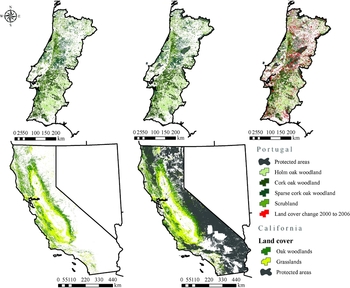
Our study area included the range of oak woodlands in Portugal and California (Fig. 1). In Portugal, evergreen forests are dominated by Quercus spp. (mainly cork oak Q. suber and holm oak Q. ilex), containing a relatively developed understorey of rock roses (Cistus spp.), heaths (Erica spp.) and other sclerophyllous and xerophyllous shrubs. Cork oak and holm oak have an almost allopatric distribution, with most of the cork oak located in the west of Portugal and holm oak occurring in the east (Fig. 1; Castro Reference Castro, Rigueiro-Rodriguez, McAdam and Mosquera-Losada2009). Cork oak is better adapted to higher humidity and oceanic influence than holm oak (Campos-Palacin et al. Reference Campos-Palacin, Huntsinger, Standiford, Martin-Barroso, Mariscal-Lorente, Starrs and Standiford2002), and cork oak woodlands are characterized by higher tree density, higher abundance of understorey vegetation (shrubs and grasses) and few natural pastures (Pinto-Correia & Mascarenhas Reference Pinto-Correia and Mascarenhas1999). The different combinations of plant structure and composition create multiple opportunities for wildlife habitat (Araújo Reference Araújo2003).
Oak woodlands in Portugal and California. The upper three figures represent the extent of oak woodland in green (left), protected areas in grey (centre) and amount of land cover change from 2000 to 2006 (right) in Portugal. Notice that the distribution of oak woodlands and that of protected areas is almost non-overlapping. Also notice that most of the land-cover change represents a conversion from either abandoned agriculture lands to shrublands, or to the encroachment of shrubland in forest areas. The lower two figures represent the extent of oak woodlands in green (left) and the protected areas in grey (right) in California. Also notice that the oak woodlands and the protected areas almost do not overlap.

Mediterranean climate in North America is confined to a region west of the Great Basin, the Mojave and Colorado deserts, from southern Oregon to northern Baja California, commonly designated as the California Floristic Province (Keeley Reference Keeley, Galley and Wilson2001). This area contains Mediterranean-type vegetation including grasslands, Quercus-dominated savannahs, woodlands and forests, chaparral and coastal scrub (Dallman Reference Dallman1998; Fig. 1). There are eight Quercus tree species in California, and many shrub and hybrid types, as well as tan oak (Lithocarpus densiflorus) (Hickman Reference Hickman1993). Oak-dominated woodlands intersperse with a wide range of conifers and with chaparral types, particularly in post-fire settings in which Quercus spp. stump-sprout, and can appear as additional species in the shrub-dominated chaparral (Sawyer & Keeler-Wolf Reference Sawyer and Keeler-Wolf1995).
Portugal
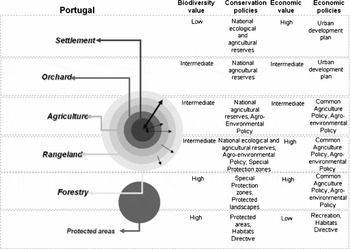
Oak woodlands permit two types of multiple land-use systems: agropastoral and montado (Blondel & Aronson Reference Blondel and Aronson1999; Joffre et al. Reference Joffre, Rambal and Ratte1999; Blondel Reference Blondel2008). The agropastoral system evolved through the creation of land parcels used for either agriculture or pasture, creating a landscape patchwork of agro-saltus-silva (agriculture-pasture-forest) patches. In montado areas, the same land space was used simultaneously for multiple purposes, mimicking natural ecosystem processes (Joffre et al. Reference Joffre, Rambal and Ratte1999; Blondel Reference Blondel2006). Both the agropastoral and the montado land-use systems result from the spatial integration of humans and nature (Fig. 2; Antrop Reference Antrop1993). Spatially, human settlements and individual farmhouses are at the centre of clusters of land uses, distributed increasingly distant from this centre are orchards, then agriculture, then rangeland and, finally, forestry practices (Fig. 2). From a functional perspective, this nested distribution of land uses represents the intensity of use/care that each of the land-use components requires; land uses that require greater attention, such as orchards and agriculture, are located closer to human settlements, while pastures and forestry uses requiring less intervention are located further away and can be viewed as a gradient of naturalness (Antrop Reference Antrop1993). Both the agropastoral and the montado systems promote the maintenance of plant species that provide agricultural, forestry and pastoral resources, such as olive trees (Olea europaea), quinces (Chaenomeles japonica), cork and holm oaks, loquats (Eryobotrya japonica) and multiple herbaceous plants. However, they have also resulted in decreased species richness of non-domesticated species, as non-commercial tree and shrub species have been consistently removed or replaced, and grassland composition has been controlled by grazing and human presence (Leiva et al. Reference Leiva, III and Ales1997). This is referred to as the frutalization of the oak woodlands (Antrop Reference Antrop1993; Castro Reference Castro, Rigueiro-Rodriguez, McAdam and Mosquera-Losada2009; Pinto-Correia & Fonseca Reference Pinto-Correia, Fonseca, Aronson, Pereira and Pausas2009).
Functional and spatial model of European Mediterranean systems (adapted from Antrop Reference Antrop1993). Circles of the gradient shades of grey represent a different land use type, from lighter to darker represent: forestry, rangeland, agriculture, orchard, settlement and protected areas.

Cork oak woodlands are managed to maximize economic return, as they are one of the main economic resources of the region (Pereira et al. Reference Pereira, Domingos, Vicente, Reid, Berkes, Wilbanks and Capistrano2006; Aronson et al. Reference Aronson, Pereira and Pausas2009). Cork oak has special protection (Portuguese law decree 172, 1988) and cannot be cut without a special permit. Standing dead and dying trees are cut and removed on a tree-by-tree basis (Barros & Sousa Reference Barros and Sousa2006), either by cutting and removal for firewood, or by filling the hollowed tree with fuel and slowly burning it (M. J. Santos, personal observation 2009), to allow saplings to recolonize the space. Livestock production (sheep, goats and cattle) is reduced in cork oak woodlands, although these areas historically produced the black Iberian pig, a traditional product certified for its high quality meat. Additional uses of this system include hunting (Pinto-Correia & Mascarenhas Reference Pinto-Correia and Mascarenhas1999), collecting mushrooms, wild fruits and berries and honey production (Pinto-Correia & Fonseca Reference Pinto-Correia, Fonseca, Aronson, Pereira and Pausas2009).
Holm oak woodlands are located in warmer and drier areas of interior Portugal Fig. 1; Castro Reference Castro, Rigueiro-Rodriguez, McAdam and Mosquera-Losada2009). These woodlands are characterized by lower tree density, lower understorey density, larger cultivated cereal plantations and less standing water (Pinto-Correia & Mascarenhas Reference Pinto-Correia and Mascarenhas1999). Livestock production is also very important, including sheep, goats, pigs and cattle. The acorns of holm oaks are a valuable food resource for livestock, especially the Iberian black pig (Huntsinger et al. Reference Huntsinger, Bartolome, Starrs and Standiford1991). Holm oak trees in many areas are managed through pruning to increase the area of their canopy and reduce their vertical growth. The resulting tree shape allows for wider spread of fallen acorns and greater shade for livestock during the summer (Huntsinger et al. Reference Huntsinger, Bartolome, Starrs and Standiford1991).
California
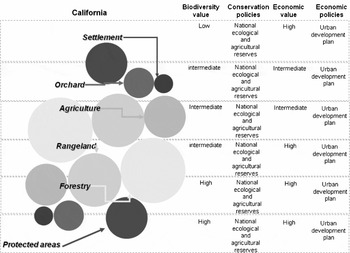
The functional and spatial arrangement of land use in California oak woodlands differs from Portuguese oak woodlands, and is driven mainly by its human use properties (Fig. 3). Spatially, the land may be highly subdivided, with each of the land parcels dedicated to a single use (Standiford & Howitt Reference Standiford and Howitt1993), including uses similar to those in Portugal (orchards, agriculture, rangeland and forestry; Huntsinger & Fortmann Reference Huntsinger and Fortmann1990). However, Californian spatial structure is not nested. Functionally, land-ownership dictates what management regimes occur in each parcel. Rangeland is the primary land use, where oak woodlands have been thinned to increase grazing land. A few scattered oaks may be left for erosion control, which limits the recruitment of several oak savannah species (Borchert et al. Reference Borchert, Davis, Michaelsen and Oyler1989). Intensive grazing occurs in these areas, further decreasing oak regeneration potential. Grasslands were mostly affected by the introduction of livestock and crop agriculture (Leiva et al. Reference Leiva, III and Ales1997), where valley bottom savannahs were cleared for cultivation limiting the distribution range of oak-dominated habitats to the foothills (Bartolome Reference Bartolome1989). Additionally, forestry activities occur at higher elevations (Fig. 1), where extraction of oaks for timber products further decreased their extent (Alagona Reference Alagona2008).
Functional and spatial model of California Mediterranean systems. Circles of the gradient shades of grey represent a different land use type, from lighter to darker represent: forestry, rangeland, agriculture, orchard, settlement and protected areas. The sizes of the circles do not represent the actual fraction of the landscape covered by each land-use type.

CULTURAL-HISTORICAL LEGACY
In Portugal, oak woodlands have been shaped by a complex ‘coevolution’ between their biota and continually evolving human land-use practices (Blondel Reference Blondel2006). Since the 7th century, oak woodland use has been production oriented (Joffre et al. Reference Joffre, Rambal and Ratte1999), with associated modifications of the ecosystem. The three main activities have been rural wood-gathering, livestock production and agriculture (Blondel & Aronson Reference Blondel and Aronson1999; Joffre et al. Reference Joffre, Rambal and Ratte1999). In Portugal, these land-use practices were only fully implemented in the 19th century and first half of the 20th century (Pinto-Correia & Vos Reference Pinto-Correia, Vos and Jongman2004). This interaction between humans and the physical environment has provided a cultural self-sustainable system for families and villages (Antrop Reference Antrop1993; Blondel Reference Blondel2006).
Human occupation in California oak woodlands dates back to c.12 000 BP, however the influence of early inhabitants on this system is difficult to quantify (Bartolome Reference Bartolome1989). Native peoples actively managed oak woodlands through manipulation of fire and plant species populations, to increase acorn production and improve wildlife habitat quality (Anderson Reference Anderson2007). Post-European settlement greatly impacted these landscapes (Bartolome Reference Bartolome1989). The arrival of Spanish shepherds in the 1500s, followed by mass immigration from the eastern USA in the 1840s, created the cultural roots for oak woodland exploitation and management (Bartolome Reference Bartolome1989). Early ranching was conducted on a rotating basis, with herds driven into the mountains in summer. However, by the 1880s, lands were fenced and the focus turned to maintenance of herds in situ, which led to oak cutting and, by 1947, government-sponsored clearing of oaks in woodlands for forage, resulting in ≥ 10% reduction in oak extent by 1973 (Alagona Reference Alagona2008). In California's Central Valley, only 10.4% of valley oak (Quercus lobata) stands remain (Huber Reference Huber2008). The current degraded condition of California's oak woodlands is owing to multiple historic and current factors: conversion to agriculture, introduction of exotic species (Cody & Mooney Reference Cody and Mooney1978; Bartolome Reference Bartolome1989), tree thinning as a source of land for grazing, logging as a source of fuel for cities and urban and exurban expansion into oak-dominated habitats (McCreary Reference McCreary2004b). However, by the 1990s, ecological research had started to inform the oak woodland conservation debate and a voluntary state programme, the Oak Woodlands Conservation Act, was passed in 2001 (CRA [California Resources Agency] 2001; Alagona Reference Alagona2008).
CURRENT SOCIOCULTURAL SETTING
In Portugal, major social changes have recently been impacting the cultural setting in which these landscapes evolved (Pinto-Correia & Fonseca Reference Pinto-Correia, Fonseca, Aronson, Pereira and Pausas2009). Social factors threaten the persistence of the montado agro-ecosystem (Pinto-Correia & Vos Reference Pinto-Correia, Vos and Jongman2004). In southern Portugal, in particular, the rural human population is decreasing as people move to the cities like Lisbon and Évora, leaving behind an ageing population (Barbero et al. Reference Barbero, Bonin, Loisel and Quezel1990; Pinto-Correia & Vos Reference Pinto-Correia, Vos and Jongman2004). Current population densities in southern Portuguese cities range from 10 individuals km−2 in Alcácer do Sal to 43.2 individuals km−2 in Évora (Surová & Pinto-Correia Reference Surová and Pinto-Correia2009). Traditional exploitation strategies are labour intensive and have been abandoned as people have moved away. Younger people do not find rural activities stimulating and there are no incentives for people to maintain current sustainable practices (Pinto-Correia & Vos Reference Pinto-Correia, Vos and Jongman2004; Castro Reference Castro, Rigueiro-Rodriguez, McAdam and Mosquera-Losada2009). ‘New’ activities reported to have increased in these landscapes include hiking, sightseeing and photography, however landowners inn these areas still prefer agriculture and other productive practices (Surová & Pinto-Correia Reference Surová and Pinto-Correia2009).
Oak woodlands in California are becoming highly fragmented. In the Central Valley, remaining valley oaks are scattered among agricultural fields, providing ecosystem services such as erosion prevention, increasing nutrients and water retention (Huntsinger et al. Reference Huntsinger, Bartolome, Starrs and Standiford1991; Campos-Palacin et al. Reference Campos-Palacin, Huntsinger, Standiford, Martin-Barroso, Mariscal-Lorente, Starrs and Standiford2002; Standiford et al. Reference Standiford, Huntsinger, Campos-Palacin, Martin-Barroso and Mariscal-Lorente2003; Perakis & Kellogg Reference Perakis and Kellogg2007). This fragmentation is the cumulative effect of several processes, including anthropogenic disturbances, climate, wildfire, agriculture and real-estate development (Bartolome Reference Bartolome1989; Huntsinger & Fortmann Reference Huntsinger and Fortmann1990; Gaman & Casey Reference Gaman, Casey and Standiford2002; Giusti & Merenlender Reference Giusti, Merenlender and Standiford2002). High real-estate values in California over the past decade have led to high levels of conversion of agricultural land to housing and development, especially due to migration to exurban oak woodlands (Huntsinger et al. Reference Huntsinger, Sulak, Gwin, Plieninger, Schnabel and Ferreira2004), which are predominantly on private lands. In addition to the urbanization of oak woodlands, the areal extent of vineyards in California doubled during the 1990s, principally carving out new fields in areas that were formerly privately-held oak woodlands (Alagona Reference Alagona2008). Climate change is predicted to affect oak species distributions, which will probably move upslope (Kueppers et al. Reference Kueppers, Snyder, Sloan, Zavaleta and Fulfrost2005). This may change the distribution of current plant communities, affecting their sorting and how they interact with human uses like agriculture and rangeland. Oak response to climate change presents a number of problems with current and future areas that oaks are expected to occupy. Niche space for the most widespread species (blue oak, Q. douglasii), may be unsuitable, as blue oak is widely reported to have very low recruitment, owing to grazing, interspecific competition and inability to use nurse plants (shrubs) to establish, as do other oak species (Tyler et al. Reference Tyler, Kuhn and Davis2006; Zavaleta et al. Reference Zavaleta, Hulvey and Fulfrost2007). Local climate and hydrologic conditions are relevant for several tree species, including the valley oak (Q. lobata), which needs groundwater, and the coast live oak (Q. agrifolia), which may require some coastal influence (Huntsinger & Bartolome Reference Huntsinger and Bartolome1992; Dallman Reference Dallman1998). Impacts from ongoing urban development may reduce the areal extent of future environmentally suitable areas.
ANALYSING THE SUSTAINABILITY OF OAK WOODLAND SES
Portuguese oak woodlands are unlikely to persist without human management, however new knowledge, visions and goals are being generated (Pinto-Correia & Vos Reference Pinto-Correia, Vos and Jongman2004; Pinto-Correia et al. Reference Pinto-Correia, Gustavsson and Pirnat2006). In California, presence of oaks increases land value and justifies the public financing of restoration (Standiford et al. Reference Standiford, Huntsinger, Campos-Palacin, Martin-Barroso and Mariscal-Lorente2003), nonetheless there is a moderate to low interest in oak regeneration (Huntsinger et al. Reference Huntsinger, Bartolome, Starrs and Standiford1991). It is clear that both Iberian and Californian landowners and ranchers are willing to withstand some opportunity costs to preserve their ‘way of life’ and what Campos-Palacin et al. (Reference Campos-Palacin, Huntsinger, Standiford, Martin-Barroso, Mariscal-Lorente, Starrs and Standiford2002) named existence and option values. In California, the Rangeland Resolution recognizes the benefits that private ranching, managed sustainably, may bring to oak woodland conservation (Alagona Reference Alagona2008). However, both woodlands are likely to be affected by climate change (Lavorel et al. Reference Lavorel, Canadell, Rambal and Terradas1998; Lavorel Reference Lavorel1999; Kueppers et al. Reference Kueppers, Snyder, Sloan, Zavaleta and Fulfrost2005), fire (Keeley Reference Keeley, Galley and Wilson2001) and drought frequency (Acacio et al. Reference Acácio, Holmgren, Rego, Moreira and Mohren2009), which may impact their persistence and the resources they produce (Huntsinger et al. Reference Huntsinger, Sulak, Gwin, Plieninger, Schnabel and Ferreira2004). This suggests the current sustainability of these SES may be highly threatened.
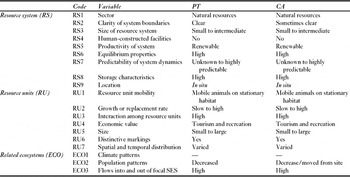
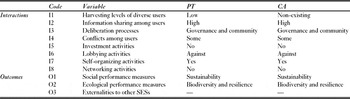
The current status of forestry, rangeland, agriculture and natural areas resources provided by oak woodlands are the result of their interaction with users and governance systems. We used Ostrom's (Reference Ostrom2007, Reference Ostrom2009) framework to assess the sustainability of the SES by describing the processes that led to the current status of the resources, identifying problematic points and examining options for how to proceed in the future. To analyse the SES, we classified the regions’ resources as either non-extractable (Tables 1, 2 and 3) or extractable (Appendix 1, see supplementary material at URL journals.cambridge.org/ENC).
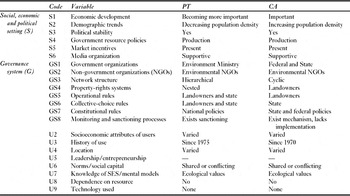
Socioecological systems (SES) for social, economic and political settings, governance systems and users of non-extractable natural resources in Portuguese (PT) and Californian (CA) Mediterranean oak woodlands.

Socioecological systems (SES) for resource systems, units and related ecosystems of non-extractable natural resources in Portuguese (PT) and Californian (CA) Mediterranean oak woodlands.

Interactions and outcomes of the non-extractable natural resources socioecological systems (SES) shared by Portuguese (PT) and Californian (CA) Mediterranean oak woodlands.

This method of classifying the Portuguese and Californian oak woodlands (Ostrom Reference Ostrom2007, Reference Ostrom2009) identified both systems’ users were capable of self organizing (Table 3, I7) and shared information (Table 3, I2); however, most users had yet to establish networks (Table 3, I8) and lobbying activities (Table 3, I6) that promoted the preservation of these natural systems. In each region, the rules were established differently. In Portugal, the operational (at the farm scale: Table 1, GS5), collective-choice (resource and national scales: Table 1, GS6) and constitutional rules (national and international scales: Table 1, GS7) are devised within a hierarchical structure and nested from landowners to state and to the European Union. Operational rules are overridden by common-choice rules, and constitutional rules override both of these. There were additional users of these resources who are not included in the governance system (Table 1, U1) and who are unrepresented by broad-scale policies, like those imposed at the state or federal level (Pinto-Correia et al. Reference Pinto-Correia, Gustavsson and Pirnat2006). In Portugal, new uses for oak woodlands, such as recreation, are being debated, but are not yet included in the rule set (Pinto-Correia & Vos Reference Pinto-Correia, Vos and Jongman2004). In California, landowners devise operational rules, but both landowner and the state government may share collective-choice rules. Constitutional rules are created by state or federal policies and these rules are not nested. In California, operational rules are most important and common-choice rules are voluntary. Oak species and woodlands lack common-choice and constitutional rules, as they are only listed in the Oak Woodland Conservation Act (CRA 2001; Alagona Reference Alagona2008). This may explain why the sustainability of the SES governing natural resources of oak woodlands is threatened.
Using Ostrom's (Reference Ostrom2007, Reference Ostrom2009) framework for extractable resources (forestry, rangeland and agriculture), it is evident that the capability of users to self organize is present, mostly as associations or cooperatives (Appendix 1, see supplementary material at URL journals.cambridge.org/ENC). Compared to the non-extractable resources, users of extractable resources SES share less information and network structures are generally present (Appendix 1, I2 and GS3, see supplementary material at URL journals.cambridge.org/ENC). However, governing systems of these SES are very similar to those of the non-extractable resources, with Portugal presenting a nested and hierarchical structure of property rights, which in California are mostly landowner driven (Campos-Palacin et al. Reference Campos-Palacin, Huntsinger, Standiford, Martin-Barroso, Mariscal-Lorente, Starrs and Standiford2002). This structure extends to the operational and collective choice rules in both systems, only changing at the constitutional rules scale. For the extractable resources provided by oak woodlands (Appendix 1, see supplementary material at URL journals.cambridge.org/ENC), the rule sets seem adequate for the users, especially as landowners are normally willing to withstand opportunity costs to preserve their property and ‘lifestyle’. Factors threatening the sustainability of the extractable SES are very different to those of the non-extractable natural resources. Threatening factors to SES of extractable resources may involve the replacement rate of the resource units (Appendix 1, RU2, see supplementary material at URL journals.cambridge.org/ENC) as those may be quickly and intensively extracted. In addition, it may involve the centuries of history of use (Appendix 1, U3, see supplementary material at URL journals.cambridge.org/ENC), externalities to other SES (Appendix 1, O3, see supplementary material at URL journals.cambridge.org/ENC), the feedbacks with the non-extractable resources and related ecosystems, such as their importance to carbon and nitrogen cycles, and methane production (Appendix 1, ECO, see supplementary material at URL journals.cambridge.org/ENC). All these factors acting together may make these resources less stable and limited in time, especially when affected by climate patterns.
The observed interdependence of SES results in a need to have efficient conservation planning and implementation to preserve both extractable (Appendix 1, see supplementary material at URL journals.cambridge.org/ENC) and non-extractable resources (Tables 1, 2 and 3).
IMPLEMENTATION OF CONSERVATION OBJECTIVES
Current biodiversity
Historically, Portuguese forests have had high α diversity (local diversity), and low and moderate β (within land covers) and γ diversities (regional diversity) (Blondel Reference Blondel2006). However, historical and current land-use practices have resulted in moderate to high α and γ diversities in agropastoral systems, and high α and γ and low β diversities in the montado system (Zavala & Burkey Reference Zavala and Burkey1997; Lavorel Reference Lavorel1999; Blondel Reference Blondel2006).
Prior to European settlement, California's oak woodlands and savannahs had an understorey dominated by bunch grasses and native annuals (Bartolome et al. Reference Bartolome, Klukkert and Barry1986; Bartolome Reference Bartolome1989). However, this ground cover is now largely converted to non-native annual grasslands (Corbin & D'Antonio Reference Corbin and D'Antonio2004) and the woodlands show reduction in the extent of overstorey trees. High fire frequency in California landscapes resulted in plant communities with more shrubs than trees (Cody & Mooney Reference Cody and Mooney1978; Bartolome Reference Bartolome1989; Keeley Reference Keeley, Galley and Wilson2001). The easy invasibility of these ecosystems by Mediterranean grasses (which can lead to increased fire frequency) has also been suggested as a major driver of change (Rundel et al. Reference Rundel, Montenegro and Jaksic1998), resulting in high α and γ diversity and low β diversity, and in conversion of chaparral and other habitats to grasslands (Keeley Reference Keeley2006).
Conservation tools and political context
Protected areas (a common conservation tool) have been designated for multiple purposes and span a gradient of ‘naturalness’. At one end of the spectrum, the wilderness model has been used to protect unique features that lack (or have minimal) human intervention (Kalamandeen & Gillson Reference Kalamandeen and Gillson2007). At the other extreme, the cultural-landscape model (Farina Reference Farina2000; Kalamandeen & Gillson Reference Kalamandeen and Gillson2007) aims to preserve ecosystems that have developed an equilibrium with humans (Pinto-Correia & Vos Reference Pinto-Correia, Vos and Jongman2004). Both the Californian and Portuguese oak woodlands have been shaped by continued land use and human presence (Huntsinger & Bartolome Reference Huntsinger and Bartolome1992), thus falling within the cultural-landscape conservation model. Conservation designs have been implemented using differing strategies in Europe and the USA. In Europe, conservation efforts are mainly restricted to parks and reserve networks, special habitat protection areas and conservation of species listed under the Convention on Biological Diversity. Such areas are mandated and implemented by each nation state, which is required to develop a management plan. In California, conservation lands covering an area of 198 295 km2 are held by over 850 federal, state and local agencies, with state and national parks managing the largest extent of completely protected lands and the US Forest Service, Bureau of Land Management and Park Service the largest holders of protected land (Greeninfo Network 2009).
Protected oak woodlands in Portugal
Oak woodlands occupy about 15% of Portugal (Fig. 1; DRGF [Direcção Geral dos Recursos Florestais] Reference Florestais2007), and overall parks and reserves protect 1 135 172 ha (12% of Portugal's land area), of which 177 247 ha (15.6%) is oak woodland (2% of Portugal's land area). Of these, c. 2.5% are cork oak, 10% are holm oak and the remaining 3% include all the other oak species, indicating a disproportionately low protection of oak woodlands within the protected areas network. This is particularly important, as oak woodlands are one of the few non-plantation forests remaining in Portugal, and thus require further protection. At a regional scale, Portugal contains c. 50% of the world's cork oak woodlands (Aronson et al. Reference Aronson, Pereira and Pausas2009), and their protection has been considered underrepresented in the protected areas network (Araújo Reference Araújo1999; Underwood et al. Reference Underwood, Viers, Klausmeyer, Cox and Shaw2009a), especially considering their rate of land conversion.
Oak woodlands have been protected as IUCN [World Conservation Union] Type III Natural Reserves, which ‘protect unique habitats, fauna and flora’ (IUCN 1994) or, in landscapes, listed as IUCN Type V Protected Landscape, namely ‘natural, semi-natural or humanized landscapes, with integration of human activities and natural areas, relevant by its aesthetical or natural value’ (IUCN 1994). The latter includes both agropastoral and montado systems and aims to conserve the cultural landscape. There are a few additional protected areas, such as the special protection areas of Castro Verde, which were created by a non-governmental organization (the Liga Para a Protecção da Natureza [LPN] or, in English, the Portuguese Nature Protection League) with the objective of preserving the rotation of the cereal plantations for the protection of steppe birds (c. 1500 ha or <1% Portuguese territory).
Protected oak woodlands in California
There are approximately 4 046 800 ha oak-dominated woodlands in California (about 10% of the state's area), of which > 80% are found on private lands and < 4% are currently protected (Fig. 1, CRA 2001; Underwood et al. Reference Underwood, Klausmeyer, Cox, Busby, Morrison and Shaw2009a). Between 1950 and 1980, 260 000 ha of valley foothill oak woodland was converted to development and agriculture (Hobbs & Mooney Reference Hobbs and Mooney1998).
Since each land parcel use is dictated by land ownership, different conservation strategies by ownership class may be required. On public lands, conservation focuses on set-aside lands exclusively, aiming at conserving natural values (for example National Parks, State Parks and Wilderness Areas). On private lands, conservation easements are the most common option, and are nested within the land-use practices. Spatially, however, this results in a patchwork of management strategies (Fig. 1) with extreme examples such as the checkerboard pattern of some US Forest Service lands, where every other square mile is either private or public land. On private lands, the amount of oak woodland dedicated to conservation easements or to forestry is quite reduced, often < 20% of the total (Huntsinger & Fortmann Reference Huntsinger and Fortmann1990; Huntsinger et al. Reference Huntsinger, Bartolome, Starrs and Standiford1991; Huntsinger et al. Reference Huntsinger, Sulak, Gwin, Plieninger, Schnabel and Ferreira2004).
Additional conservation tools
Other tools are also available for landscape protection. European Union agri-environmental measures (European Commission 2005) were created to help promote sustainable and environmentally conscious management actions in forests, agriculture and rangelands. They subsidize reforestation and attempt to reduce rates of land degradation and intensive use. In Portugal, laws and policies have been passed to promote the conservation of oak woodlands, including a law protecting cork oak trees (Portuguese law decree 172, 1988), and for protected areas (Portuguese law decree 19, 1993).
In California (and the USA generally), conservation lands include not only major federal land management entities, such as the US National Forest Service, the Bureau of Land Management and the National Park Service, but also lands conserved by land trusts, non-governmental organizations and conservation easements on private properties (Merenlender et al. Reference Merenlender, Huntsinger, Guthey and Fairfax2002). Biodiversity conservation efforts are driven at the federal level through a series of laws, the Endangered Species Act, Clean Air Act, and Clean Water Act, but there are only minimal legal tools for biodiversity and habitat preservation rather than species-level efforts. In California, deficiencies in oak woodland conservation have been partially addressed by state legislation, namely the Forest Practice Act and Environmental Quality Act (Giusti & Merenlender Reference Giusti, Merenlender and Standiford2002), which led to the development of the state Oak Woodland Conservation Act (CRA 2001) and the 2006 California Rangeland Resolution (Alagona Reference Alagona2008). The Oak Woodland Conservation Act encourages counties to develop oak conservation plans, where new proposed conservation or restoration efforts that address the needs identified in the county can be eligible for state funding. This system is voluntary. Giusti and Merenlender (Reference Giusti, Merenlender and Standiford2002) suggested that given the increased rate of decline, analyses conducted at both large and local scales are needed to provide the basis for protecting oak woodlands.
Existing instruments are failing to preserve oak woodlands, partially because they are based on pristine ecosystems (Pinto-Correia & Vos Reference Pinto-Correia, Vos and Jongman2004; Castro Reference Castro, Rigueiro-Rodriguez, McAdam and Mosquera-Losada2009). Mediterranean oak woodlands are working landscapes with multiple anthropogenic activities, which include a suite of social and ecological challenges (Allen Reference Allen2003) that cannot be ‘confined’ into solely a restrictive policy for natural areas, such as those prescribed by the Portuguese protected areas law (Portuguese law decree 19, 1993) or those included in the Endangered Species Act and California Environmental Quality Act (Giusti & Merenlender Reference Giusti, Merenlender and Standiford2002). Further, policies like the European Common Agriculture Policy, which promote the development of agricultural areas (Stoate et al. Reference Stoate, Baldi, Beja, Boatman, Herzon, van Doorn, de Snoo, Rakosy and Ramwell2009), or the US Forest Practice Act, which promotes forestry activities, may negatively affect multi-use Mediterranean systems (Diáz et al. Reference Diáz, Campos, Pulido, Pain and Pierkowski1997; Castro Reference Castro, Rigueiro-Rodriguez, McAdam and Mosquera-Losada2009).
RECOMMENDATIONS FOR THE FUTURE OF MEDITERRANEAN OAK WOODLANDS
Existing policies
The European Union Common Agricultural Policy disregards oak woodlands uniqueness and promotes intensive extraction regimes (Zavala & Burkey Reference Zavala and Burkey1997; Pinto-Correia & Vos Reference Pinto-Correia, Vos and Jongman2004; Pinto-Correia et al. Reference Pinto-Correia, Gustavsson and Pirnat2006; Stoate et al. Reference Stoate, Baldi, Beja, Boatman, Herzon, van Doorn, de Snoo, Rakosy and Ramwell2009). However, the Common Agricultural Policy can be replaced or combined with the application of agro-environmental incentives. Agro-environmental incentives have slowed the abandonment of agricultural lands and, despite the low value of the subsidy, prevented land conversion to intensive farming in Portugal (Pinto-Correia et al. Reference Pinto-Correia, Gustavsson and Pirnat2006). Such incentives may be only a temporary solution, because the provision of subsidies is not self-sustainable (Vanslembrouck & Huylenbroeck Reference Vanslembrouck and Huylenbroeck2005; Dobbs & Pretty Reference Dobbs and Pretty2008). The likelihood of a farmer to participate is linked to the type of policy (i.e. whether voluntary or a payment to the farmer), its duration, availability of information and on the farmer's age, education, dependency on farm income, farm size, tenure, rate of neighbour participation and attitude towards the environment (Vanslembrouck & Huylenbroeck Reference Vanslembrouck and Huylenbroeck2005). Extrapolating these results to oak woodlands, a farmer's tenure and legacy potentially creates bias in favour of agro-environmental conservation actions, however, illiteracy and the advanced age of many farmers may make it harder to implement as they will require more assistance. If the information and options provided to the farmer are appealing, agro-environmental measures may be successful.
In California, cattle subsidies greatly promoted oak woodland conversion to rangeland (McCreary Reference McCreary2001). This policy is unlikely to be altered, but current California environmental policies allow to combine these subsidies with conservation easements and sustainable land-use practices (Walter Reference Walter, Rundel, Montenegro and Jaksic1998). Planting trees on rangelands may help stabilize soil and prevent erosion (Manning et al. Reference Manning, Fischer and Lindenmayer2006), and promote higher levels of nutrients beneath oak canopies (Perakis & Kellogg Reference Perakis and Kellogg2007). Subsidies could potentially be designed to promote tree planting schemes to provide these ecosystem services, as well as promoting the restoration of rangelands to functioning oak woodlands. Opening rangeland to a multiple-use system would diversify its functionality. Preservation and agro-environmental measures can help restore these woodlands, as European counterparts have shown (Donald & Evans Reference Donald and Evans2006). Possible measures include reforestation, restoration of abandoned farmland, creation or restoration of connectivity between wildlands, rotation of crops, use of oaks in urban landscaping such as along highways, creation of a patchwork of land uses and identifying cultural and economical benefits that are commensurate with biodiversity conservation.
People migration
A major drawback to the protection of European Mediterranean-oak ecosystems is the exodus of people to the urban environment. The consequences are land abandonment and increased woodland fragmentation owing to suburban growth (Huntsinger et al. Reference Huntsinger, Sulak, Gwin, Plieninger, Schnabel and Ferreira2004). Land abandonment results in the interruption of the state transition from crop to fallow agricultural lands that occurs in these landscapes (Huntsinger & Bartolome Reference Huntsinger and Bartolome1992). This interruption of cycles leads to decreased biodiversity, especially for those species that depend on traditional patterns of land use (Zavala & Burkey Reference Zavala and Burkey1997), and associated effects such as increased soil erosion and nutrient run-off (Sluiter & Jong Reference Sluiter and Jong2007) and invasion by shrubs, which often belong to a different suite of species than those dominating the original woodlands (Holmgren & Scheffer Reference Holmgren and Scheffer2001). Increase in woody vegetation results in increased fire risk (Scarascia-Mugñozza et al. Reference Scarascia-Mugñozza, Oswald, Piussi and Radoglou2000). Abandoned land is often converted to other uses, including urban subdivision and development. If the trend of abandonment is to be reversed, it is necessary to convince local residents that their land is economically, aesthetically, ecologically and culturally valuable, and viable using traditional land management practices. Government incentives can be used to encourage people to not only maintain the land, but also to preserve its cultural identity.
In California, oak woodlands have been less intensively managed, but neither have they been neglected. Exploitative harvesting and overgrazing have led to depauperate rangelands, major erosion problems and the extensive spread of invasive plants. To avoid further deterioration of these rangelands, grazing schemes with reduced intensity are preferred so that more residual dry matter is retained, which in turn should reduce top-soil loss and the effects of erosion. Livestock could follow a seasonal upslope movement similar to the historical transhumanance found in northern Spain and originally practised in California (Alagona Reference Alagona2008). Water, salt and feed may be located distant from areas where oak recruitment is desired or occurring. Livestock can be excluded from sensitive areas (such as riparian vegetation and vernal pools) and managed to promote good quality wildlife habitat (35–40% canopy, dead and down woody debris and vertical and horizontal diversity), a practice that also should be standardized in Portugal. Cost-share programmes are currently unavailable, but using volunteers can aid ranchers, restorationists, land trusts and practitioners to achieve these goals. Some ranchers are already moving towards multi-use systems (for example, promoting hunting clubs). Nonetheless, careful and sensitive management plans are required. Effective management, prescribed forest burns and monitoring can avoid the build-up of woodfuel loads that created major issues in the 1970s (D. McCreary, personal communication 2009).
Climate change and fire
Despite the high resilience of oak woodlands owing to frequent fires (Lavorel et al. Reference Lavorel, Canadell, Rambal and Terradas1998; Lavorel Reference Lavorel1999; Lavorel & Richardson Reference Lavorel and Richardson1999), climate change may induce increased fire frequency in these ecosystems. The abandonment of oak woodlands, decrease in woodfuel use by humans and encroachment of shrubs on abandoned lands can increase fuel loads and the intensity of subsequent fires. Major efforts using remote sensing have been developed for early fire detection and monitoring (Vega-Garcia & Chuvieco Reference Vega-Garcia and Chuvieco2006). However, fire detection must be combined with effective ground management strategies, including prescribed fire, forest clearing and fire breaks. Furthermore, owing to the intertwined patchwork of humans and natural areas, human safety and fire prevention resources should be made available to those living in higher fire-risk areas. Some site-level practices from Portugal might also be beneficial, particularly the in situ burning of individual trees, which could potentially offer a way to reduce fire hazard in regions impacted by sudden oak death. Sudden oak death is a disease which has reached epidemic proportions in the USA, leading to a vast mortality in oak woodlands throughout California since 1995 (Rizzo & Garbelotto Reference Rizzo and Garbelotto2003).
Alternatively, oak woodlands may act as potential carbon stocks and carbon sink areas; this requires tree planting programmes, monitoring their development and ensuring their persistence. Such a campaign may be funded by subsidies from agro-environmental policies, and complemented by selling carbon stocks. These would meet regeneration and reforestation goals to prevent further land degradation.
Regeneration and restoration
Regeneration is a major issue in oak woodlands (Plieninger Reference Plieninger2007), with over-maturity of stands and regeneration failure being identified as the leading problems in holm oak woodlands (Plieninger Reference Plieninger2007), while cork oak woodland regeneration is limited mainly by wildfire and drought (Acácio et al. Reference Acácio, Holmgren, Jansen and Schrotter2007; Acácio et al. Reference Acácio, Holmgren, Rego, Moreira and Mohren2009). The average holm oak tree age has dramatically increased over the last 50 years (Plieninger et al. Reference Plieninger, Pulido and Konold2003; Plieninger et al. Reference Plieninger, Pulido and Schaich2004), their production of viable seeds is reduced and those that are produced are consumed by livestock further decreasing the available seed bank (Plieninger Reference Plieninger2007). In Portuguese cork oak woodlands, shrublands have expanded owing to a combination of land abandonment, wildfire and drought frequency (Acácio et al. Reference Acácio, Holmgren, Rego, Moreira and Mohren2009), while concomitantly cork oak seedling recruitment has been impeded by the presence of a developed shrub understorey (Acácio et al. Reference Acácio, Holmgren, Jansen and Schrotter2007). Similarly, in California, lack of oak recruitment, particularly for valley oak (Q. lobata) and blue oak (Q. douglasii), is a widely recognized problem without a clear understanding of its causes (McCreary Reference McCreary2001).
CONCLUSIONS
Oak woodlands have great potential for restoration (Valladares & Gianoli Reference Valladares and Gianoli2007). Increased precipitation associated with El Niño Southern Oscillation events can be used for oak plantings and promoting oak growth (Holmgren & Scheffer Reference Holmgren and Scheffer2001). Prescribed burns can aid in controlling undesirable shrub encroachment (Baeza & Vallejo Reference Baeza and Vallejo2008). However, restoration practices must include regeneration schemes that incorporate stand protection from grazing, rotation of livestock and creation of tree shelters (exclosures) during early regeneration stages (McCreary Reference McCreary2001).
ACKNOWLEDGEMENTS
This research was funded by the Fulbright Commission and Fundação Calouste Gulbenkian. We thank John A. Bissonette and Robert McCreary for helpful comments, and three anonymous reviewers for stimulating interesting analyses. We also thank Elinor Ostrom for guidance in the application of the SES framework.