Japanese stiltgrass [JSG; Microstegium vimineum (Trin.) A. Camus var. imberbe (Nees) Honda] is an invasive grass of the eastern United States, particularly in forested and natural areas. Distribution of JSG ranges as far west as the Mississippi River and Texas (U.S. Department of Agriculture, Natural Resources Conservation Service [USDA-NRCS] 2013). JSG occurs in a variety of habitats (Swearingen et al. Reference Swearingen, Slattery, Reshetiloff and Zwicker2010) but is mainly a pest along roadsides and in forested areas (Mortensen et al. Reference Mortensen, Rauschert, Nord and Jones2009). Population densities can reach monocultural proportions, which may affect ecosystems in a number of ways. For example, there is evidence that JSG suppresses native plant growth (Bauer and Flory Reference Bauer and Flory2011; Flory and Clay Reference Flory and Clay2010a), affects arthropod abundance (Simao et al. Reference Simao, Flory and Rudgers2010), and alters other ecological processes (Ehrenfeld Reference Ehrenfeld2003; Flory and Clay Reference Flory and Clay2010b; Lee et al. Reference Lee, Flory and Phillips2012). One effect is change in browsing by deer, which do not consume JSG, thus adding pressure to survival by native plants that are already crowded by JSG (Averill et al. Reference Averill, Mortensen, Smithwick and Post2016; Knight et al. Reference Knight, Dunn, Smith, Davis and Kalisz2009). Significant challenges to management result also from size and density of infestations, which often are large and occur in remote, inaccessible locations or near ecologically sensitive habitats.
Management Implications
Severe Japanese stiltgrass (JSG) leaf blight from Bipolaris disease, occasionally causing significant decline in local population density, has been reported sporadically in the field. Even so, much of the JSG in the mid-Atlantic is not diseased. Artificial inoculations of JSG accessions that were either “healthy” or severely damaged by B. microstegii in the field revealed a differential response in aggressiveness by two Bipolaris species. Aggressiveness of B. microstegii was highly variable and only damaged the known susceptible population of JSG from the field; representatives of five other populations were not diseased. Based on these results, B. microstegii is not likely to cause natural decline of many JSG populations, and the potential for effective biological control of JSG by this species is low. The potential for benefit would improve if a method to identify susceptible populations of JSG were developed. In contrast, B. drechsleri caused moderate disease on most of the JSG populations, but it was not as damaging as that of B. microstegii on the susceptible field population. It may be that B. drechsleri has greater potential for general biological control of JSG, but additional tests, including field studies, are needed to fully understand its capabilities. Such include the need to develop a protocol for inoculum increase and deployment. Results from these evaluations identify limited potential of these species of Bipolaris in natural suppression of JSG or for their use in biological control.
Leaf blight disease on JSG was first described by Kleczewski and Flory (Reference Kleczewski and Flory2010). Fungal isolates collected at Crummies Creek Tree Farm (CCTF) near Arnoldsburg, WV, were tested on an accession of JSG from Indiana University, Bloomington, IN. These West Virginia isolates have been named B. microstegii Minnis, Rossman, Kleczewski & S. L. Flory (Crous et al. Reference Crous2012); an isolate of B. microstegii from Maryland has also been characterized (Manamgoda et al. Reference Manamgoda, Rossman, Castlebury, Crous, Madrid, Chukeatirote and Hyde2014). Subsequent studies of leaf disease on JSG involved another isolate discovered at the Big Oaks National Wildlife Refuge (BONWR). Symptomatology on plants from BONWR was different from that occurring on plants from CCTF (Kleczewski and Flory Reference Kleczewski and Flory2010; Flory et al. Reference Flory, Kleczewski and Clay2011). The isolate from BONWR was subsequently named B. drechsleri Minnis & Manamgoda (Crous et al. Reference Crous2013). More recently, Stricker et al. (Reference Stricker, Harmon, Goss, Clay and Flory2016) reported isolation of four additional species of Bipolaris from JSG, i.e., B. cynodontis, “Bipolaris taxon megaspora,” B. oryzae, “B. oryzae-like,” and B. zeae.
Origin of the different Bipolaris species on JSG is unknown and has not been tested. It has been suggested that these species may have originated from native or cultivated relatives of JSG. It has also been suggested that JSG with Bipolaris leaf blight could serve as a source of Bipolaris inoculum on related crop and native species (Kleczewski and Flory Reference Kleczewski and Flory2010; Kleczewski et al. Reference Kleczewski, Flory and Clay2012; Stricker et al. Reference Stricker, Harmon, Goss, Clay and Flory2016).
Recently, B. microstegii discovered in Frederick, MD (Bruckart et al. Reference Bruckart, Eskandari and Lane2014), was tested in preliminary artificial inoculations, resulting in extremes of susceptibility to disease among populations of JSG from Maryland; plants in the various populations were either severely damaged or not diseased in these tests. The main objective of this study was to document and quantify differential responses within JSG to this isolate under controlled, greenhouse conditions. There was also an opportunity to compare isolates of B. drechsleri and B. microstegii provided by the USDA Agricultural Research Service (USDA-ARS) Systematic Mycology and Microbiology Laboratory (SMML) for aggressiveness on JSG accessions under controlled conditions. Finally, there is interest in further characterization of disease responses on selected non-target relatives of JSG to B. microstegii from Frederick, MD. Earlier reports by Flory et al. (Reference Flory, Kleczewski and Clay2011) and by Kleczewski et al. (Reference Kleczewski, Flory and Clay2012) indicated a number of related native and commercially important species as susceptible. This study, therefore, focuses on disease responses among JSG populations to two Bipolaris species and characterization of disease response from B. microstegii on corn (Zea mays L.), sorghum [Sorghum bicolor (L.) Moench subsp. bicolor], and native deertongue [Dichanthelium clandestinum (L.) Gould].
Materials and Methods
Acquisition and Maintenance of Isolates
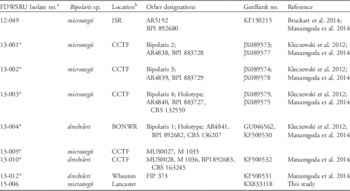
Nine isolates of Bipolaris sp. from JSG were assembled and compared (Table 1). Six isolates of B. microstegii from Maryland, West Virginia, or Pennsylvania and four isolates of B. drechsleri from Maryland, West Virginia, or Indiana were tested. Holotypes of each species were among the isolates. Collection sites represented habitats typically occupied by JSG that also had environmental conditions favorable for disease development, including wooded or grassy areas, i.e., parks or lawns.
Isolates of Bipolaris microstegii and B. drechsleri included in this study.

a Asterisk (*) denotes isolates provided by the USDA-ARS, Systematic Mycology and Microbiology Laboratory, Beltsville, MD.
b BONWR, Big Oaks National Wildlife Refuge, Indiana (38.978056°N, 85.427778°W); CCTF, Crummies Creek Tree Farm, Arnoldsburg, WV (38.77833°N, 81.073056°W); ISR, Indian Springs Road, Frederick, MD (39.46747°N, 77.46106°W); Lancaster, Lancaster County Central Park, PA (40.014764°N, 76.281306°W), collected by J. Ambler; Wheaton, Brookside Garden, Wheaton, MD (Nature Center: 39.059143°N, 77.032938°W).
Isolates were maintained on modified potato carrot agar (MPCA; 140 g each of potatoes and carrots and 20 g agar in 1 L water) or synthetischer nährstoffarmer agar (SNA; 1.0 g KH2PO4, 1.0 g KNO3, 0.5 g MgSO4.7H2O, 0.5 g KCl, 0.2 g glucose, 0.2 g saccharose, and 20 g agar in 1 L H2O). For inoculation, isolates were grown on SNA at 25 C with a 12-h photoperiod in a reach-in EGC growth chamber (Environmental Growth Chambers, Chagrin Falls, OH 44022). Spores were harvested after 1 to 2 wk by flooding plates with sterile water containing 0.125% polyoxyethylene (20) sorbitan monolaurate (Tween 20TM, Sigma Aldrich, St. Louis, MO) and brushing them into suspension. Spore concentration was adjusted to 104 conidia ml−1 in water plus 0.125% Tween 20TM for inoculation.
Test Plant Populations
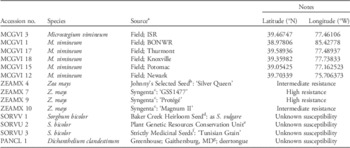
Six accessions of JSG were assembled for comparison (Table 2). These represented populations from four locations in Maryland and one location each in Indiana and Delaware. The standard, susceptible population was collected near Indian Springs Road (ISR) in Frederick, MD, and was very susceptible to isolate FDWSRU #12-049 (Bruckart et al. Reference Bruckart, Eskandari and Lane2014). Seeds of the Indiana population were collected from the same location as the holotype for B. drechsleri.
Populations of Japanese stiltgrass (Microstegium vimineum) and host range test species included in this study.

a ISR, Indian Springs Road, Frederick, MD 21702; BONWR, Big Oaks National Wildlife Refuge, IN 47250; Thurmont, ThorpeWood, 12805 Mink Farm Road, Thurmont, MD 21788; Knoxville, Camp Manidokan, 1600 Harpers Ferry Road, Knoxville, MD 21785; Geneva Day School, 11931 Seven Locks Road, Potomac, MD 20854; Newark, Judge Morris Estate, White Clay Creek Street Park, Newark, DE 19711.
b Johnny’s Selected Seeds, 955 Benton Avenue, Winslow, Maine 04901.
c Syngenta, 600 North Armstrong Place, Boise, ID 83704.
d Baker Creek Heirloom Seed, 2278 Baker Creek Road, Mansfield, MO 65704.
e Plant Genetic Resources Conservation Unit, 1109 Experiment Street, Griffin GA 30223.
f Strictly Medicinal Seeds, P.O. Box 299, Williams, OR 97544.
g Rockville Community Wildlife Habitat Program, Pope Farm Nursery, 7400 Airpark Road, Gaithersburg, MD 20879.
For the host range determination, four cultivars of corn, three cultivars of sorghum, and one accession of deertongue were tested (Table 2) following protocols as described in “Plant Growth and Inoculation.” Accessions of corn were selected with known levels of susceptibility to southern corn leaf blight, a disease caused by B. maydis (Nisikado & Miyake). Susceptibility of sorghum cultivars could not be determined, although resistance to the disease target spot, caused by B. cookei (Sacc.) Shoemaker, has been reported.
Plant Growth and Inoculation
All accessions of JSG were started from seed planted into vermiculite. Seeds of the susceptible ISR accession was generated in the greenhouse from plants that originated from infested soil in order to replenish the seed supply for experiments, which had been depleted. Soil from the site where diseased plants had been discovered (Bruckart et al. Reference Bruckart, Eskandari and Lane2014) was collected, because the site no longer had diseased plants; that niche had been filled by “healthy” JSG. An additional soil sample was collected from the Knoxville location, because that seed supply had also been depleted during the winter (off-season). Plants from the soil samples were allowed to seed, and these seeds, along with those of accessions from Delaware and Potomac, MD, were increased artificially in separate locations in a greenhouse and used for experiments. Chasmogamous and cleistogamous seeds were collected separately from these plants. Comparison was made in susceptibility to B. microstegii on the susceptible ISR population, and no difference was found in susceptibility of JSG grown from chasmogamous versus cleistogamous seed (unpublished data). For this reason, chasmogamous and cleistogamous seed from each accession were pooled for propagation.
Seedlings were transplanted at the cotyledonary stage into T.O. Plastics 16.1-cm2 deep plastic pots set into 32-count trays (item nos. 59-2011 and 59-4000, respectively, Griffin Greenhouse Supplies, Tewksbury, MA 01876) filled with a standard artificial growth medium of peat (41%), bark (11%), perlite (23%), vermiculite (23%), sand (2%), and Micromax® trace minerals (Scotts Miracle-Gro, Marysville, OH 43041). Plants were grown in a greenhouse under natural lighting supplemented, when necessary, with light from 1,000-W metal-halide lamps to maintain a 14-h photoperiod. Greenhouse temperatures ranged between 20 and 35 C. Peters All-Purpose Plant Food (United Industries, St. Louis, MO 63114) was applied once, 1 wk after transplanting.
Plants were inoculated when at least 4 wk old by spraying to run-off with a conidial suspension containing 104 spores ml−1 in water plus 0.125% Tween 20TM. Plants were given a 16-h dew treatment at 25 C in a dark dew chamber (model 136DL, Percival, Perry, IA 50220), i.e., standard conditions of time and temperature for fungal inoculations; spores require free moisture at a favorable temperature to germinate and invade plants. Following the dew treatment, plants were placed in a greenhouse at 20 to 25 C with natural lighting supplemented by metal-halide lamps to give a 14-h photoperiod. Plants were observed for symptom development until data were collected. These conditions resulted in high levels of disease on plants from the susceptible population (Figure 1) and facilitated comparison with disease response on the remaining test populations. This inoculation protocol provided a more severe test than would occur in nature.
Disease responses of Japanese stiltgrass (JSG): (A) a plant from the Indian Springs Road (ISR), Frederick, MD, population inoculated with Bipolaris microstegii isolate 12-049 from ISR; (B) a plant from Big Oaks National Wildlife Refuge (BONWR), Indiana, inoculated with B. drechsleri isolate 13-004 from the BONWR; and (C) differential response of two JSG accessions, asymptomatic BONWR (left) and ISR (right), to inoculation by isolate 12-049. Note, the healthy leaf of ISR was too young when inoculated to be susceptible.

Individual plants were rated for amount of disease 5 to 7 d after inoculation, a time frame sufficient for development of clear symptoms and prior to onset of severe damage to the susceptible accession. Plants of other accessions not diseased after 7 d did not develop symptoms, even when observed up to 1 mo after inoculation.
Two rating scales were employed. In the first series of tests, disease responses were recorded as a value from 0 and 5, where 0=no visible symptoms, 1=a few small spots, 2=moderate necrosis, 3=heavy necrosis, 4=dead leaves, and 5=dead plant. In subsequent tests, a rating value from 0 to 10 was recorded for each plant, where 0=no symptoms followed by intervals of 10% up to 10=100% disease. Also, for the latter set of experiments, the total number of inoculated leaves and the number of symptomatic leaves was recorded, and incidence, i.e., proportion of diseased leaves per plant, was calculated.
Data Analysis
Ratings and incidence data were analyzed using SAS v. 9.2 software (SAS, Cary, NC 27513). For rating results, means from each repetition were ranked using Proc Rank, “Ties=Low,” to create a data set that meets assumptions for analysis of variance. Mean incidence data from each repetition, where applicable, were also assembled for statistical analysis. Residuals of both ranked data and incidence were analyzed for normality using Proc Univariate. Transformations were not needed, because assumptions were satisfied according to this procedure. Data were analyzed by the general linear models procedure in SAS. LSMeans and probabilities of similarity (PDIFF option) were generated from data analyses, and means were considered significantly different when Pr>F≤0.05.
Experiments
There were two research objectives. The first was comparison of the two Bipolaris species for aggressiveness on different populations of JSG. The second involved characterizing disease response of selected, non-target test plants to the B. microstegii from Frederick, MD.
Comparison of Bipolaris species
The three experiments to compare Bipolaris species were slightly different in design, as follows:
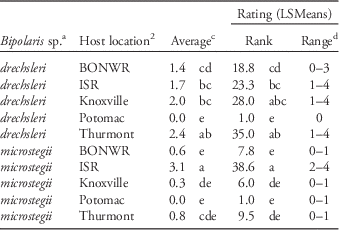
Experiment 1 compared both B. microstegii and B. drechsleri on selected JSG populations. Five isolates of Bipolaris, two representing B. microstegii and three representing B. drechsleri, were used to inoculate plant accessions from five populations of JSG. Data from six inoculations (repetitions) were used in the analysis. Only rating data were collected for this study. Mean rating and ranked rating data were analyzed; results are presented in Table 3.
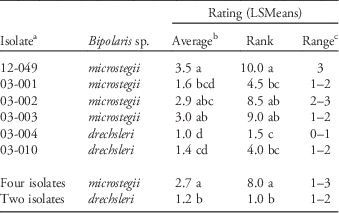
Experiment 2 compared four isolates of B. microstegii and two of B. drechsleri for aggressiveness on the susceptible ISR accession of JSG. Data were from two inoculations (repetitions), and only rating data were collected for this study. Mean rating and ranked rating data were analyzed; results are presented in Table 4.
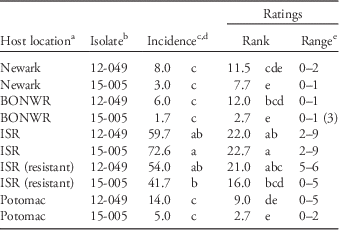
Experiment 3 compared two isolates of B. microstegii on JSG from five populations, including two from the ISR site, the susceptible accession (ISR) and an accession that was not damaged by disease in the field (“resistant,” designated ISRR). Plants were inoculated by isolates of B. microstegii, either from Frederick, MD (#12-049) or Lancaster, PA (#15-006) described in Table 1. Rating and incidence data from nine inoculations (repetitions) were analyzed in this study; results are shown in Table 5.
Comparison of Bipolaris microstegii and B. drechsleri for aggressiveness on five populations of Japanese stiltgrass.

a Isolates of B. microstegii: 12-049 and 13-009; isolates of B. drechsleri: 13004, 13010, and 13012; data for each species pooled.
b See Table 2 for location information.
c Numbers followed by the same letter are not significantly different (P≤0.05).
d Rating range: 0=no macroscopic symptoms; 1=a few small spots; 2=moderate necrosis; 3=heavy necrosis; 4=dead leaves; 5=dead plant. Numbers in parentheses represent rare, extreme values.
Comparison of four isolates of Bipolaris microstegii with two isolates of B. drechsleri for aggressiveness on the susceptible population of Japanese stiltgrass from Indian Springs Road, Frederick, MD.

a See Table 1 for isolate information.
b Numbers followed by the same letter are not significantly different (P≤0.05).
c Rating range: 0=no macroscopic symptoms; 1=a few small spots; 2=moderate necrosis; 3=heavy necrosis; 4=dead leaves; 5=dead plant.
Comparison of two isolates of Bipolaris microstegii for aggressiveness on five populations of Japanese stiltgrass.

a See Table 2 for host plant information.
b See Table 1 for isolate information.
c Incidence=proportion of diseased leaves (×100).
d Numbers followed by the same letter are not significantly different (P≤0.05).
e Rating range: 0 to 10, each value being equivalent to percent disease on the plant. Numbers in parentheses represent rare, extreme values.
Host Range Tests
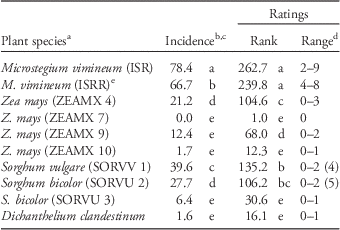
The second research objective was a limited host range determination involving only B. microstegii vs. selected, related, non-target species. Accessions of commercially important corn and grain sorghum were included, as described, along with the native deertongue that is sympatric with populations of diseased JSG. Ratings and incidence from six inoculations (repetitions) were analyzed in this study; results are shown in Table 6.
Tests of non-target corn, sorghum, and native deertongue for susceptibility to disease by Bipolaris microstegii compared with disease response on Japanese stiltgrass.

a See Table 2 for host plant information.
b Incidence=proportion of diseased leaves (×100).
c Numbers followed by the same letter are not significantly different (P≤0.05).
d Rating range: 0 to 10, each value being equivalent to percent disease on the plant. Numbers in parentheses represent rare, extreme values.
e Population of Japanese stiltgrass from Indian Springs Road, Frederick, MD, that was not symptomatic in the field.
Results and Discussion
The standard for this study was the severe disease interaction caused by B. microstegii on symptomatic JSG from the ISR site. Results from preliminary inoculations of JSG from other locations in Maryland have been confirmed, i.e., only JSG from the ISR location was damaged by B. microstegii under the artificial conditions of this study. This extreme difference in response among populations of JSG was not expected, but it occurred in every instance with bona fide B. microstegii on ISR populations and not on the others (Tables 3, 4, and 5).
Fortunately, there was opportunity to compare these results with outcomes from inoculations with B. drechsleri. Not only is symptomatology different for these two pathogens on JSG, but response to inoculation of the various JSG accessions differed (Figure 1; Tables 3 and 4). Based on these results there are implications for the potential role of these two species in natural suppression of JSG and potential for these candidates in weed biological control.
Comparison of Bipolaris species and JSG accessions
The first study, described as Experiment 1, was a test of the two Bipolaris species on five populations of JSG. The interaction between Bipolaris species and test plant population was highly significant. Comparison of the two species on JSG revealed that B. microstegii was most aggressive only on the susceptible ISR population, whereas B. drechsleri had less impact on four of the five populations. It is noteworthy that the population from Potomac, MD, was not affected by either in this test (Table 3).
Experiment 2 involved inoculations of the susceptible ISR population of JSG with several isolates of B. microstegii or B. drechsleri. Isolates of B. microstegii, whether from ISR or provided by the SMML, were significantly more aggressive on JSG from ISR than were two SMML isolates of B. drechsleri (Table 4). Low data values for disease caused by B. microstegii isolate 13-004 were inconsistent with results from preliminary inoculations in which this isolate was as aggressive as others of the same species.
Results in Experiment 3, which compared two isolates of B. microstegii for aggressiveness on five populations of JSG, indicated that only test plant population was highly significant and that neither isolate nor the interaction were significant factors. Tests with B. microstegii from Maryland and Pennsylvania revealed disease was significantly greater on two ISR JSG populations than that occurring on populations from Delaware, Indiana, or Potomac, MD (Table 5). These results support findings in the other experiments.
The high level of disease on the ISR population tested as “resistant,” i.e., ISRR, in Experiment 3 was unexpected. In the field, disease on this accession can be found only on older leaves deep within the canopy, but plants are not heavily damaged, and there is no evidence for reduction in population density as had been noted for the “susceptible” population. Apparently, under the artificial test conditions of the study, which are optimal for disease and not likely encountered in nature, a disease response similar to that of the “susceptible” accession resulted. Such was not evident for the other accessions under these test conditions.
This is the first study to test multiple populations of JSG for susceptibility to two species of Bipolaris from this weed. Some of the populations were not symptomatic under field conditions at the time of collection. In these experiments, it is clear that B. microstegii, regardless of source, is only aggressive on JSG from ISR. In contrast, isolates of B. microstegii were not aggressive on “healthy” JSG representing other populations from Maryland (Knoxville, Potomac, and Thurmont), or on JSG from Indiana or Delaware, the latter possibly having been symptomatic in the field. Disease response to isolates of B. drechsleri was different, in that there was significantly more disease on accessions from Indiana and other locations in Maryland, i.e., the Thurmont and Knoxville populations, than occurred on their counterparts inoculated by B. microstegii. Where tested, JSG from ISR was also diseased by B. drechsleri, but to a lesser degree (Tables 3 and 4). This indicates that B. drechsleri has a broader host spectrum among populations of JSG tested in this study. Additional variability was noted, in that a population of JSG from Potomac, MD, was not diseased by either species in these tests (Table 3). Similar to results from artificial inoculations, leaf spots or blights have not been noted to commonly occur on JSG in the field in the mid-Atlantic; in this study, plants from such “healthy” populations were not diseased by B. microstegii after artificial inoculation.
Evidence of some level of differential response to disease by JSG was reported by Kleczewski et al. (Reference Kleczewski, Flory and Clay2012), who found a population of JSG from BONWR had larger lesions after inoculation by B. drechsleri (isolate BP1, lesions >5 mm in length) than was caused by three isolates of B. microstegii (isolates BP 1, 2, and 3; lesions <1 to 5 mm in length). In the present study, the BONWR population was not susceptible to B. microstegii (Tables 3 and 5) and sustained only limited disease when inoculated by B. drechsleri (Table 3). Disease responses are relatively the same for the two species of Bipolaris on the BONWR population in this and the study by Kleczewski et al. (Reference Kleczewski, Flory and Clay2012).
Host Range
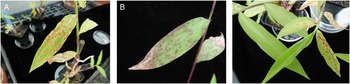
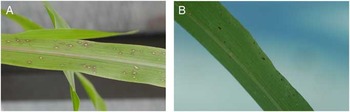
Tests with selected non-target relatives of JSG showed that B. microstegii from ISR only caused high levels of disease on ISR populations of JSG and not on four cultivars of corn, three accessions of sorghum, or on native deertongue (Table 6). Symptoms on corn appeared in 5 to 7 d, taking a much longer time than symptom development noted on JSG, which occurred within 16 h of inoculation. Symptoms on corn were also different from those on JSG, characterized by white flecks generally less than 5 mm in length that failed to expand, typical of hypersensitive disease responses in these cultivars (Figure 2A). There was no sporulation within the white, necrotic lesions on corn, but after 5 d, leaves in moist chambers became colonized by the fungus as a result of leaf senescence, thus becoming suitable for B. microstegii as a saprophyte. Similar symptoms were noted also in 5 to 7 d on one of the sorghum accessions, but another developed small melanized spots (Figure 2B). Germinated spores were seen on the leaf surface of the latter, with melanized tissue beneath appressoria, and there was no evidence of fungal development within the leaf tissue. No sporulation was observed on sorghum leaf tissue in moist chambers. Symptoms on corn and sorghum, once established, did not expand over time as they did on susceptible JSG, and plants were not damaged by the disease response.
Disease response of two crop species inoculated by Bipolaris microstegii isolate 12-049 from Indian Springs Road, Frederick, MD: (A) corn accession ZEAMX 4 showing hypersensitive flecking, and (B) sorghum accession SORVU 2 showing small, melanized spots.

Native deertongue was not susceptible in this study. Ten species of fungi have been reported from deertongue in the United States (Farr and Rossman Reference Farr and Rossman2016), but there is no report of Bipolaris among them.
Although the host range determination in this study only involved B. microstegii, Kleczewski et al. (Reference Kleczewski, Flory and Clay2012) present results from inoculation of 13 species and JSG with both B. drechsleri (BP1) and B. microstegii (BP 2, 3, and 4), reporting symptoms developing only on related grasses and not on any of the dicots. Flory et al. (Reference Flory, Kleczewski and Clay2011) tested seven native herbaceous species and report “susceptible” responses for a few of the pathogen–plant combinations. This is an area of study that requires further attention. Additional tests should include reciprocal inoculations with the various Bipolaris species from a collection of JSG sources, including representatives of “healthy” JSG populations, and various related plant species, particularly those of crops that have known resistance to various Bipolaris diseases. For example, it is known that both corn and sorghum have resistance to B. maydis and B. cookei, respectively, and all of the corn cultivars tested in this study were listed with some level of resistance to southern corn leaf blight. Although results herein did not necessarily correlate with reported levels of resistance in corn to southern corn leaf blight, it is also clear that B. microstegii was significantly less aggressive on these non-target species than it was on the susceptible JSG population.
Distinct differences between the two Bipolaris species studied herein has been substantiated and clarified in the present study. Recently, it was determined in a study of noncoding regions of the genome that there is relatively low genetic variation across West Virginia populations of JSG (Culley et al. Reference Culley, Huebner and Novy2016). Morphological distinctions were not evident on plants from the different populations in either the present study or the paper by Culley et al. (Reference Culley, Huebner and Novy2016), but important biological distinctions seem to exist based on results from this study. Artificial inoculations with the additional species of Bipolaris reported by Stricker et al. (Reference Stricker, Harmon, Goss, Clay and Flory2016) of plants representing symptomatic and “healthy” populations of JSG will only serve to clarify important biological variability within this invasive species. There were a number of sites where disease was not noted in the study by Stricker et al. (Reference Stricker, Harmon, Goss, Clay and Flory2016).
Potential of Bipolaris Species for Biological Control of JSG
Several facultative fungal plant pathogens have been developed for biological control of weeds, including a number of Bipolaris species (De Lima Nechet et al. Reference de Lima Nechet, Barreto and Mizubuti2006; Lakshmanan et al. Reference Lakshmanan, Jeyarajan and Vidhyasekaran1990; Winder and Van Dyke Reference Winder and Van Dyke1990; Yandoc and Charudattan Reference Yandoc and Charudattan2004). Because of the importance of JSG as an invasive weed, the challenges associated with JSG management, and the demonstrated potential for damage on JSG by species of Bipolaris, it has been suggested that these pathogens be used for biological control (Flory et al. Reference Flory, Kleczewski and Clay2011; Kleczewski and Flory Reference Kleczewski and Flory2010; Kleczewski et al. Reference Kleczewski, Flory and Clay2012). Results from this study suggest that there is limited potential for the two species tested herein to be useful in biological control.
Acknowledgments
Accessions of several test isolates of both B. microstegii and B. drechsleri, including their holotypes, were provided by A. Y. Rossman (retired), USDA-ARS, SMML, Beltsville, MD. Seeds from the BONWR population of JSG in Indiana were generously provided by S. L. Flory, University of Florida, Gainesville, FL. The JSG accession from Delaware was provided by J. Hough-Goldstein and S. Nestory, University of Delaware, Newark, DE. Seeds of deertongue were provided by Anne Goodman. The isolate of B. microstegii from Pennsylvania was provided by J. Ambler, Lancaster, PA. Consultation and advice concerning JSG leaf blight was generously provided by R. Richardson, and technical assistance was provided by W. A. Lane and S. J. Meyer. Mention of trade names or commercial products in this publication is solely for the purpose of providing specific information and does not imply recommendation or endorsement by the USDA. The USDA is an equal opportunity provider and employer.