I. INTRODUCTION
With increasing environmental problems and the energy crisis, photocatalytic degradation of organic pollutants or hydrogen production from water splitting over a semiconductor has attracted extensive attention. Reference Liu, Liu, Liu, Han, Zhang, Huang, Lifshitz, Lee, Zhong and Kang1–Reference Li, Yu, Low, Fang, Xiao and Chen5 Taking into account that a substantial fraction (∼48%) of the whole solar spectrum is visible light and the UV region accounts for only a small fraction (∼4%) of the solar spectrum, Reference Zhang, Li, Wang, Huang, Zeng and Xu6 the construction of suitable structures is of vital significance to extend absorption spectrum to visible light region. Therefore, many scientists devote their efforts to develop visible-light-responsive photocatalysts, and lots of semiconductor photocatalysts including WO3, CdS, graphene-based semiconductors have been reported.
Two-dimensional (2D) layered nanosheets (NS), such as graphene, MoS2, CeO2, g-C3N4, possessed the ultra high specific surface area and strong quantum confinement of electrons. Reference Geim and Grigorieva7–Reference Wang, Yuan, Sae Hong, Li and Cui10 These ultrathin 2D nanomaterials display special optical, chemical, and electronic properties, which cannot be achieved by their bulk counterparts. Reference Sun, Gao, Lei and Xie11 Graphitic carbon nitride (g-C3N4) has recently emerged as a novel photocatalyst in photodegradation of organic pollutants under visible light. Reference Niu, Zhang, Liu and Cheng12–Reference Wen, Li, Li, Ma, He, Xu, Fang, Liu and Gao14 However, the catalytic activity of bulk g-C3N4 is still limited due to its low specific surface area and lack of active sites. Reference Ding, Liu, Zhang, Liu, Zhao, Cheng, Zong and Dai15–Reference Bi, Wen, Li, Liu, Xie, Fang and Zhang17 Compared to bulk g-C3N4, 2D layered g-C3N4 NS exhibits highly improved electronic and optical features. Reference Niu, Zhang, Liu and Cheng12,Reference Zhang, Xie, Wang, Zhang, Pan and Xie18,Reference Du, Sanvito, Li, Wang, Jiao, Liao, Sun, Ng, Zhu, Amal and Smith19 These special properties make 2D layered g-C3N4 NS as a promising candidate for applications in solar photocatalysis for elimination of organic pollutants. Reference Du, Sanvito, Li, Wang, Jiao, Liao, Sun, Ng, Zhu, Amal and Smith19 Recently, many novel advanced photocatalysts have been designed on the basis of surface plasmon resonance (SPR) of metal nanoparticles such as Ag/AgBr, Reference Zhou, Hu, Hu, Peng and Qu20,Reference Wu21 Ag/AgI/BiOI, Reference Lin, Zhao, Wang, Cao and Chen22 Ag/g-C3N4, Reference Tian, Liu and Jiang23 and so on. Reference Dong, He, Li, Cai, Hu, Wang, Lin, Luo, Yi, Zhao, Weng and Wan24–Reference Li, He, Lin, Cai, Dong, Wang, Luo, Zhao, Yi and Weng26 The reason is that the noble metal Ag particles can strongly absorb visible light owing to their localized SPR, resulting in the fast generation of the photogenerated carriers on semiconductor. Then, these photogenerated carriers rapidly separate and transport at the interface of substrate and Ag. Reference Ge, Han, Liu and Li27,Reference El-Sayed28 Ag2O is also a highly efficient visible-light photocatalyst and has been widely used with other semiconductors forming heterojunction to enhance their photocatalytic activity, such as g-C3N4/Ag2O, Reference Xu, Han and Dong29 Ag2O/ZnO, Reference Wu, Yan, Zhao and Jiang30 Ag2O/BiWO6, Reference Yu, Liu, Wang, Wang and Yu31 and so forth. However, combining 2D layered g-C3N4 NS with Ag and Ag2O through a simple and green photodepositing method has not been reported.
In this work, visible-light responsive plasmonic shaped Ag2O/Ag/g-C3N4 NS photocatalysts were synthesized by photodepositing Ag and Ag2O particles on g-C3N4 NS for the first time. The morphologies, structures, optical properties, and photocatalytic performance of the synthesized composites were investigated in detail. The possible photocatalytic mechanism of Ag2O/Ag/g-C3N4 NS heterojunction photocatalysts was proposed based on photocatalytic activity, photoluminescence (PL) spectra and the active species trapping experiment.
II. EXPERIMENT SECTION
A. Materials
Melamine (C3H6N6, ≥99.0%), silver nitrate (AgNO3, ≥99.9%), silver oxide (Ag2O, ≥99.9%), ethanol (≥99.7%), 2-propanol (IPA, ≥99.7%), and 1,4-benzoquinone (BQ, ≥98.0%) were purchased from Shanghai Chemical Reagent Co. Ltd., China. Ethylenediamine tetraacetic acid (EDTA, ≥99.5%) was purchased from Tianjin Chemical Reagent Co. Ltd., China. All the reagents were used as received without further purification. Distilled water was used throughout the experiments.
B. Preparation of photocatalysts
The g-C3N4 NS were synthesized by a mixed-solvent exfoliation method which refers to the previous paper. Reference Lin, Li, Liang, Liu, Bi and Wu32 In detail, 8 g melamine in semiclosed alumina crucible with a cover was heated to 550 °C for 4 h at a heating rate of 2.3 °C/min. After the furnace cooled naturally to the room temperature, the obtained yellow products were collected and ground to obtain bulk g-C3N4. Then, 500 mg of the synthesized bulk g-C3N4 powder was added into 150 mL mixed solvents (V water:V ethanol = 3:1) to form suspension. The suspension was sonicated for 24 h and then centrifugated at 4000 rpm for 30 min to remove the residual unexfoliated g-C3N4. The as-prepared g-C3N4 NS were obtained by rotary evaporating the remaining suspension.
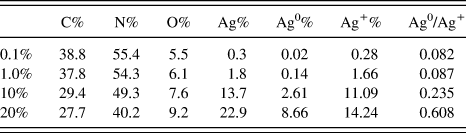
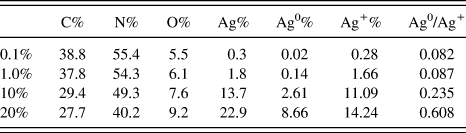
The synthesis procedure of the Ag2O/Ag/g-C3N4 NS heterojunction photocatalysts was as follows: 0.1 g g-C3N4 NS were dispersed in 100 mL distilled water by ultrasonic for 1 h. Then, different volumes of 0.1 mol/L AgNO3 solution was added into the suspension and stirred for 30 min. The resulting suspension was irradiated with a 350 W Xe lamp for 2 h. Finally, the product was dried at 50 °C overnight. The as-synthesized Ag2O/Ag/g-C3N4 NS were denoted as Ag(x)/g-C3N4, where x represents Ag of AgNO3 mass concentration (wt%) in the products. The real content of each element was shown in Table I.
The real content of each element of Ag2O/Ag/g-C3N4 NS composite.
C. Characterization
The Fourier transform infrared (FT-IR) spectra of all the catalysts were obtained on Nicolet NEXUS670 FT-IR spectrometer (Nicolet, Madison, Wisconsin) with a resolution 4 cm−1. The x-ray photoelectron spectroscopy (XPS) was performed on ESCLALAB 250Xi system with Al (Kα) radiation (Thermo Fisher Scientific, Waltham, Massachusetts) to analyze the chemical states and surface chemical composition of the photocatalysts. The C 1s signal was set to 284.8 eV for calibration. Transmission electron microscopy (TEM) images of samples were collected with a JEM-2010F electron microscope (JEOL Ltd., Tokyo, Japan) at an accelerating voltage of 200 kV. UV-vis diffuse reflectance spectra (DRS) were recorded on a UV-vis Spectrometer (Nicolet Evolution 500) in the range of 200–800 nm, where BaSO4 was used as a reference standard. The PL spectra were obtained on FLS-920 spectrometer (Edinburgh Instruments, Livingston, United Kingdom) with an excitation wave length at 389 nm. The thickness and size of the g-C3N4 NS material were determined by using atomic force microscopy (AFM; Bruker Multimode-8, Bruker Corporation, Karlsruhe, Germany) with tapping mode operating at a scanning rate of 2 Hz.
D. Photocatalytic activity test
The photocatalytic activities of Ag2O/Ag/g-C3N4 NS heterojunction photocatalysts were evaluated by the degradation of Rhodamine B (RhB) solution under visible light. A 350 W xenon lamp (AHD 350W, Shenzhen Co. Ltd., China) was used as the light source. In a typical experiment, 25 mg catalyst powder was added into RhB solution with an initial concentration of 1.0 × 10⁻⁵ mol/L. Prior to irradiation, the suspension was magnetically stirred for 1 h in the dark to reach an adsorption–desorption equilibrium between photocatalysts and the organic dye. Then, the suspension was irradiated with the xenon lamp. In the reaction process, 4 mL suspension was taken out as samples at the regular intervals and centrifuged at 4000 rpm for 30 min to remove the photocatalyst. The UV-vis absorption spectra were recorded on the TU-1810 spectrophotometer (Beijing Purkinje General Instruments, Beijing, China) in the range of 400–600 nm.
E. Active species trapping experiments
To elucidate the main active species in the RhB photodecomposition, the scavengers IPA, EDTA, and BQ were added into the RhB solution to detect hydroxyl radical (
 ${}^ \cdot {\rm{OH}}$
), hole (h+), and superoxide radical (
 ${}^ \cdot\! \mathop {{{\rm{O}}_{\rm{2}}}}\nolimits^ -$
), respectively. The experiment process was similar to the former photocatalytic activity test except the extra introduction of 1 mmol scavenger into the RhB solution prior to addition of the photocatalysts.
III. RESULTS AND DISCUSSION
A. Morphology
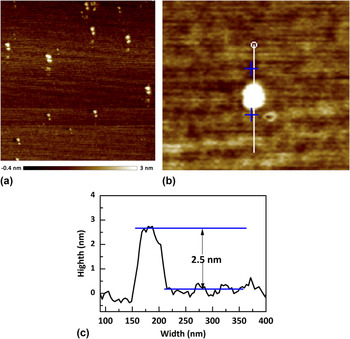
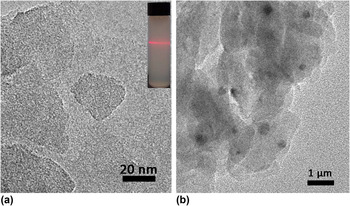
The morphology of the as-prepared pure g-C3N4 NS was characterized by AFM and TEM. The AFM image indicates that the diameter of the g-C3N4 NS is about 70 nm. The thickness is measured to be nearly 2.5 nm (Fig. 1), indicating that the exfoliated NS have about seven C–N layers. The TEM image further confirms the ultrathin thickness of the g-C3N4 NS. As shown in Fig. 2(a), pure g-C3N4 NS shows transparent feature, indicating that most of electron beam can pass through the g-C3N4 sheet due to its ultrathin thickness. Meanwhile, the result of AFM and TEM shows the effectiveness of the mixed-solvent exfoliation method. The Tyndall effect of the diluted dispersion of g-C3N4 NS in water is displayed in the inset of Fig. 2(a). It indicates the highly dispersal of g-C3N4 NS, which is beneficial for its photocatalytic reaction in water. Figure 2(b) shows the TEM image of Ag(10.0)/g-C3N4 NS. Some dark particles are observed on the g-C3N4 NS, indicating the successful deposition of Ag species and the hybrid structure of the composite.
(a and b) AFM image of the synthetic g-C3N4 NS; (c) the corresponding height image of the NS.

TEM images of prepared photocatalysts: (a) pure g-C3N4 NS, (b) Ag(10.0)/g-C3N4 NS.

B. Structure of Ag2O/Ag/g-C3N4 NS heterojunction photocatalysts
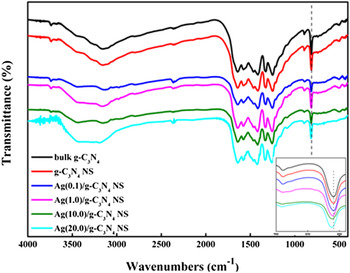
The FTIR spectra of the as-prepared Ag2O/Ag/g-C3N4 NS are presented in Fig. 3. For pure g-C3N4, three main absorption bands are in the region of 800–4000 cm−1. The strong band at 1200–1700 cm−1 is assigned to the stretching vibration of CN heterocycles. Reference Wang, Zhang, Lin, Nong, Wu, Wu and He33,Reference Sayama and Arakawa34 The broad peak at 3000–3300 cm−1 corresponds to the stretching vibration of N–H bonds, associated with uncondensed amino groups. Reference Yang, Guo, Liu, Yuan, Guo, Zhang, Guo and Huo35–Reference Niu, Liu and Cheng38 The peak at around 809 cm−1 belongs to the breathing mode of the triazine units of g-C3N4. Reference Ding, Liu, Zhang, Liu, Zhao, Cheng, Zong and Dai15,Reference Bojdys, Müller, Antonietti and Thomas39 It can be evidently shown that all of the main characteristic peaks of the pure g-C3N4 appeared in the curves of all Ag2O/Ag/g-C3N4 NS samples, indicating that the structure of g-C3N4 is not changed after photodeposition. No IR peaks corresponding to Ag species are observed. However, compared with pure g-C3N4 NS, the band at 809 cm−1 of Ag2O/Ag/g-C3N4 NS has a red shift (see Fig. 3 inset), which can be ascribed to the interaction of the deposited Ag species and g-C3N4 NS. Reference Zhang, Huang, Zhang, Yuan and Dong40
FT-IR spectra of different samples.

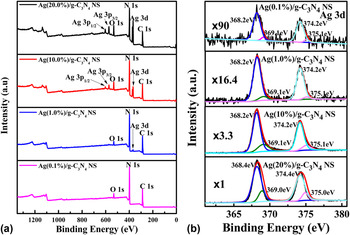
The XPS analysis further identifies the chemical composition and binding states elements in the as-prepared Ag2O/Ag/g-C3N4 NS sample. Global XPS survey indicates that all the samples contain Ag, C, N, and O, as shown in Fig. 4(a). The intensity of Ag 3d peaks increase with the increasing Ag loading amount. Based on the peak areas of the signals, the relative contents of Ag, C, N, and O are calculated. The result in Table I indicates that the Ag loading is close to the theoretical value. Figure 4(b) shows the high-resolution XPS spectrum of Ag 3d. The two peaks at approximately 368.3 and 374.3 eV can be attributed to the binding energies of the Ag 3d 5/2 and Ag 3d 3/2, respectively. The peak fitting further indicates that two Ag species exist. The peaks at 369.1 and 375.1 eV can be assigned to metallic Ag0, while the peaks at 368.2 and 374.2 eV originate from Ag+, which suggests the co-existence of Ag and Ag2O in the composite photocatalyst. Reference Xu, Han and Dong29,Reference Wang, Liu, Wang, Fan and Ding41 Meanwhile, the Ag0, Ag+ and Ag0/Ag+ ratio are also calculated and are shown in Table I. With the rising of the Ag loading amount, the Ag0/Ag+ ratio increases.
XPS spectra of Ag2O/Ag/g-C3N4 NS heterojunction photocatalyst: (a) survey XPS spectrum and (b) Ag 3d.

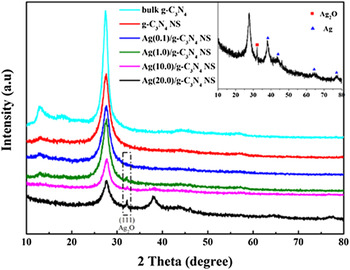
Figure 5 shows the XRD patterns of bulk g-C3N4, g-C3N4 NS, and Ag2O/Ag/g-C3N4 NS heterojunction photocatalysts. The characteristic peak of g-C3N4 around 27.5° could be indexed as (002) crystal plane, which is attributed to interlayer stacking of aromatic segments, while the peak at 13.1° corresponds to (100) crystal plane of tristriazine units. Reference Groenewolt and Antonietti42 Notably, the intensity of these two peaks is sharply reduced relative to that in the bulk g-C3N4 due to the few-layer structure and smaller planar size of the NS after exfoliation. There are four observable peaks at 2θ of 38.1, 44.3, 64.2, and 77.3°, which can be assigned to the crystal planes of the face-centered cubic structure of Ag (JCPDS 65–2871). The diffraction peak at 2θ = 32.8° corresponds to the (111) plane of well-crystallized cubic Ag2O (JCPDS 76–1393). This result suggests the coexistence of Ag and Ag2O in the g-C3N4 NS catalyst. In the mass ratio of Ag/Ag2O to g-C3N4 NS from 0.1% to 20%, the diffraction peaks of Ag and Ag2O become more distinct. In fact, this result was in accordance with the XPS data. In addition, the energy-dispersive x-ray spectroscopy was also used to measure the elemental composition of g-C3N4 NS and Ag(10.0)/g-C3N4 NS samples. The results presented in Figs. S1 and S2, clearly show that the Ag(10.0)/g-C3N4 NS contains C, N, O, and Ag elements, which can also be further proved by the mapping spectrum of Ag(10.0)/g-C3N4 NS (see Fig. S3). And the higher O content of Ag(10.0)/g-C3N4 NS than g-C3N4 NS confirm that the coexistence of Ag and Ag2O in the Ag(10.0)/g-C3N4 NS catalyst.
XRD patterns of the different samples.

C. Optical property of Ag2O/Ag/g-C3N4 NS photocatalysts
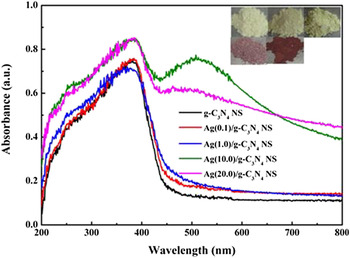
The optical property of the samples was determined by UV-vis diffuse reflectance spectroscopy. According to the DRS results in Fig. 6, the absorption of the pure g-C3N4 NS is at around 455 nm, corresponding to the band gap of 2.73 eV. The band-gap energy was calculated using the Eq. (1):
 $${\lambda _{\rm{g}}} = {{1239.8} \mathord{\left/ {\vphantom {{1239.8} {{E_{\rm{g}}}}}} \right. \kern-\nulldelimiterspace} {{E_{\rm{g}}}}}\quad ,$$
where λg is the band-gap wave length and E g is the band-gap energy. Reference He, Shi, Gao, Wen, Chen and Song43 For Ag2O/Ag/g-C3N4 NS composites, a new broad absorption appeared in visible-light region (450–800 nm), which is attributed to the SPR effect of the Ag nanoparticles formed on the surfaces of the g-C3N4 NS. With the increase of the Ag/Ag2O content from 0.1 to 10.0 wt%, the absorption intensity of the band is gradually strengthened. However, for the Ag(20.0)/g-C3N4 NS sample, a dampening and broadening surface plasmon band is observed. Considering that the SPR absorption is sensitive to particle sizes, shapes, the particle size distribution, and the surrounding medium, etc, this phenomenon could be ascribed to the increased size and wide size-distribution of silver nanoparticles. Reference Ren, Wang, Sun, Zhang and Chang44 The DRS features suggests that the visible light responses of the Ag2O/Ag/g-C3N4 NS samples are significantly improved by forming heterojunction structure, which may be beneficial for enhanced photoactivities compared with the pure g-C3N4 NS.
UV-vis DRS of the different samples.

D. Photocatalytic activity of the Ag2O/Ag/g-C3N4 NS photocatalysts
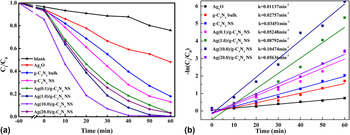
Photocatalytic performances of pure Ag2O, bulk g-C3N4, g-C3N4 NS, and the Ag2O/Ag/g-C3N4 NS heterojunctions were evaluated by the photodegradation of RhB dye (1.0 × 10⁻⁵ mol/L) under xenon lamp irradiation. As shown in Fig. 7(a), the blank test revealed that the degradation of RhB dye is neglectable in the absence of photocatalysts under visible light irradiation. All Ag2O/Ag/g-C3N4 NS samples show better photocatalytic efficiency than pure Ag2O, bulk g-C3N4 and g-C3N4 NS. For the Ag2O/Ag/g-C3N4 NS heterojunction photocatalysts with different mass ratios, it is found that the photocatalytic activity of the composites is increased with the rise in the amount of Ag0/Ag+ (Table I). In particular, the RhB photodegradation efficiency of Ag(10.0)/g-C3N4 NS composite is almost 100% in 40 min. These changes in the photocatalytic activity could be ascribed to the synergetic effect of light absorption and heterojunction structure of Ag2O/Ag/g-C3N4 NS. However, the RhB photodegradation efficiency of Ag(20.0)/g-C3N4 NS is lower than that of Ag(10.0)/g-C3N4 NS because large amount of Ag species behave as a recombination center or cover the active sites on the g-C3N4 surface. Reference Lü, Shen, Wu, Wang and Xie45
(a) Degradation rates of RhB under visible light irradiation without catalyst and in the presence of pure Ag2O, bulk g-C3N4, g-C3N4 NS, and Ag2O/Ag/g-C3N4 NS samples; (b) first-order kinetics data for the photodegradation of RhB over pure Ag2O, bulk g-C3N4, g-C3N4 NS, and Ag2O/Ag/g-C3N4 NS samples.

To further understand the reaction kinetics of RhB degradation process, the apparent pseudo-first-order model expressed by Eq. (2) was applied in the experiments:
 $$- \ln \left( {{{{C_t}} \mathord{\left/ {\vphantom {{{C_t}} {{C_0}}}} \right. \kern-\nulldelimiterspace} {{C_0}}}} \right) = kt\quad ,$$
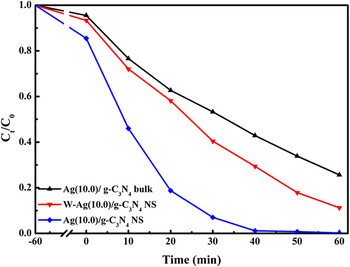
where k is the apparent pseudo-first-order rate constant (min−1), C 0 and C t are the concentrations of organic pollutant in solution at time t 0 and t, respectively. As can be seen from Fig. 7(b), the value of k increases with the increase in the Ag/Ag2O amount. The Ag(10.0)/g-C3N4 NS samples present the highest degradation rate of 0.10474 min−1, which is almost 3.8 and 3.0 times higher than those of pure bulk g-C3N4 (0.02757 min−1) and g-C3N4 NS (0.03451 min−1), respectively. This result clearly indicates that the formation of the Ag2O/Ag/g-C3N4 NS heterojunction can effectively enhance the photocatalytic activities of g-C3N4 NS. For the sake of comparison, we also fabricate Ag/g-C3N4 NS as reported. Reference Li, Wang, Zhu, Ma and Meng46 The as-synthesized sample was denoted as W-Ag(10.0)/g-C3N4 NS. As shown in Fig. 8, the Ag(10.0)/g-C3N4 NS sample exhibits much stronger photocatalytic activity than W-Ag(10.0)/g-C3N4 NS, which demonstrated that Ag2O also plays an important role in the photocatalytic performance.
Degradation rates of RhB under visible light irradiation in the presence of Ag(10.0)/g-C3N4 bulk, W-Ag(10.0)/g-C3N4 NS, and Ag(10.0)/g-C3N4 NS samples.

E. Stability of the Ag2O/Ag/g-C3N4 NS photocatalysts
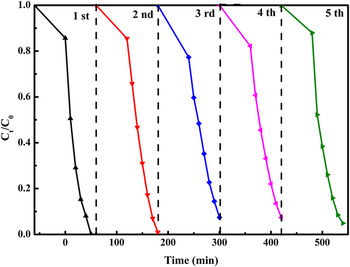
From the viewpoint of applications, the stability of photocatalysts are significantly important during photocatalytic reactions. The cycling runs for the photodegradation of RhB dye with the Ag(10.0)/g-C3N4 NS photocatalyst were performed to evaluate its photocatalytic stability, and the result is shown in Fig. 9. There is no significant decrease in photodegradation rate after five consecutive cycles, implying that the obtained Ag2O/Ag/g-C3N4 NS heterojunction photocatalyst has high stability, and no photocorrosion happens during the photodegradation of RhB. Therefore, the as-prepared Ag2O/Ag/g-C3N4 NS heterojunction photocatalyst can be used as a novel visible-light-driven photocatalyst with good stability.
Cyclic degradation curve for the Ag(10.0)/g-C3N4 NS heterojunction photocatalyst.

F. Photocatalytic mechanism of Ag2O/Ag/g-C3N4 NS photocatalysts
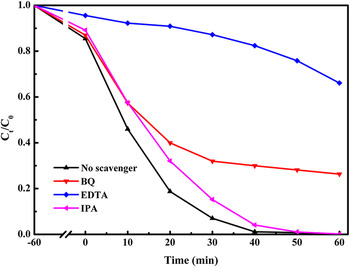
To investigate the photocatalytic mechanism of the Ag2O/Ag/g-C3N4 NS heterojunctions in more detail, the active species generated during the process of RhB photodegradation were identified by free radical and hole scavenging experiments. Figure 10 presented the influence of various scavengers on the visible light photocatalytic activity of Ag(10.0)/g-C3N4 NS samples toward the degradation of RhB. It is found that the photocatalytic degradation of RhB has a slight decrease by the addition of IPA, revealing that
 ${}^ \cdot {\rm{OH}}$
is not the main active species in the photochemical process. In contrast, the degradation of RhB was significantly suppressed after the injection of EDTA into the catalytic system, implying that radical h+ is crucial to the enhancement of the photocatalytic efficiency. The photocatalytic outcome is also influenced to some degree by adding BQ, certifying that
 ${}^ \cdot\! \mathop {{{\rm{O}}_{\rm{2}}}}\nolimits^ -$
also exerts important roles. Therefore,
 ${}^ \cdot\! \mathop {{{\rm{O}}_{\rm{2}}}}\nolimits^ -$
and h+ would play a dominant role in the visible-light-induced photocatalyst for the Ag(10.0)/g-C3N4 NS samples system.
Active species trapping experiments of Ag(10.0)/g-C3N4 NS heterojunction photocatalyst.

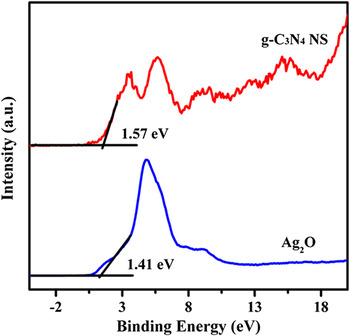
The valence band (VB) XPS spectra of g-C3N4 NS and Ag2O are shown in Fig. 11. The position of the VB edges of g-C3N4 NS and Ag2O are 1.57 and 1.41 eV. According to the DRS results, the band gap of g-C3N4 NS is 2.73 eV, so the conduction band (CB) is −1.16 eV. In addition, the band gap of Ag2O is reported to be 1.2 eV,
Reference Xu and Schoonen47
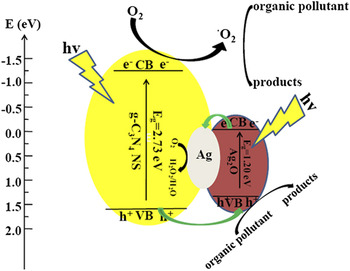
so the CB is 0.21 eV. A possible mechanism for the enhanced photocatalytic activity of Ag2O/Ag/g-C3N4 NS is thus proposed (Fig. 12). As we know, Ag2O and g-C3N4 is a p-type and n-type semiconductor, respectively. The inner electric field existed in the p–n junctions cause the photogenerated hole to flow to the Ag2O, and the photogenerated electrons are prone to move to g-C3N4, while the CB of g-C3N4 (−1.16 eV) is more negative than that of Ag2O (0.21 eV). As a result, the transfer of electrons from Ag2O (0.21 eV) to Ag (0.4 eV) is beneficial, and the photogenerated electrons of g-C3N4 even tend to react with O2 to form
 ${}^ \cdot\! \mathop {{{\rm{O}}_{\rm{2}}}}\nolimits^ -$
rather than move to Ag2O. Thus, photogenerated hole can accelerate to flow to the valence of Ag2O, and then react with the organic pollution. The electrons remained on Ag0 are available to react with the dissolved oxygen molecules and H+ for yielding H2O2. Based on the above discussions, it can be concluded that the as-prepared Ag2O/Ag/g-C3N4 NS composite can decrease the probability of the electron–hole recombination. Consequently, the Ag2O/Ag/g-C3N4 NS catalyst exhibits excellent photocatalytic activity.
VB XPS of g-C3N4 NS and Ag2O.

The proposed mechanism for the photodegradation of organic pollutant over the Ag2O/Ag/g-C3N4 NS heterojunction under visible light irradiation.

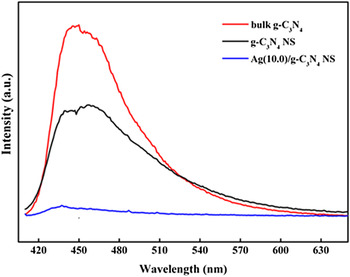
PL spectra are useful in investigating the transfer of the photogenerated electrons and holes to understand the separation and recombination of photogenerated charge carries. In general, lower PL intensity indicates a lower recombination of charge carries, leading to higher photocatalytic activity. Therefore, the PL spectra of the pure bulk g-C3N4, g-C3N4 NS, and Ag (10.0)/g-C3N4 NS were investigated to confirm the suggested mechanism, and the result is displayed in Fig. 13. It is clear that pure bulk g-C3N4 and g-C3N4 NS has a strong emission peak, while the PL intensity of Ag (10.0)/g-C3N4 NS heterojunction photocatalysts is greatly weakened. It means that the recombination of the charge carriers is significantly suppressed in Ag (10.0)/g-C3N4 NS heterojunction photocatalysts due to the synergetic effect of Ag2O/Ag and g-C3N4 NS, which is consistent with the result in Fig. 12.
PL spectra of bulk g-C3N4, pure g-C3N4 NS, and Ag(10.0)/g-C3N4 NS.

IV. CONCLUSIONS
In this paper, a series of Ag2O/Ag/g-C3N4 NS visible-light responsive plasmonic photocatalysts were successfully prepared by a simple and green photodeposition method. Under visible light irradiation, the Ag2O/Ag/g-C3N4 NS heterojunction photocatalysts exhibited enhanced photocatalytic activities for the degradation of RhB, mainly attributed to the high separation and easy transfer of photogenerated electron–hole pairs at the heterojunction interface. Especially, the Ag (10.0)/g-C3N4 NS composite shows the highest photocatalytic activities, which is about ∼3.8 and ∼3 times higher than those of bulk g-C3N4 and pure g-C3N4 NS, respectively. Finally, a possible photocatalytic mechanism was also proposed on the basis of active species trapping experiments.
Supplementary Material
To view supplementary material for this article, please visit http://dx.doi.org/10.1557/jmr.2016.234.
ACKNOWLEDGMENT
This work was supported by grants from the Nature Science Foundation of Zhejiang Province (LY16B030002).