Introduction
Psychosocial stress has been associated with poor health outcomes, such as metabolic syndrome (Bartoli et al., Reference Bartoli, Carrà, Crocamo, Carretta and Clerici2013), coronary heart disease (Richardson et al., Reference Richardson, Shaffer, Falzon, Krupka, Davidson and Edmondson2012), and even mortality (Russ et al., Reference Russ, Stamatakis, Hamer, Starr, Kivimäki and Batty2012). Therefore, such psychosocial stress, both early in life as well as more recent stress, is assumed to affect biological systems, such as the immune system (Segerstrom and Miller, Reference Segerstrom and Miller2004), autonomic nervous system, and hypothalamic–pituitary–adrenal (HPA) axis (Geenen et al., Reference Geenen, Middendorp and Bijlsma2006). These disrupted stress systems have been associated with increased levels of oxidative stress, which in turn may accelerate cellular aging (Wolkowitz et al., Reference Wolkowitz, Epel, Reus and Mellon2010). One widely used indicator of cellular aging is TL. Telomeres are DNA-protecting nucleic-acid protein complexes that cap the ends of chromosomes. The ends of telomeres cannot be fully replicated during each cell division, causing telomeres to gradually shorten over time. Telomeres eventually become critically short and lose their protective function, which may result in cell senescence and apoptosis (Blackburn, Reference Blackburn2001). TL has been suggested to reflect one's biological age since telomeres shorten over the lifespan, and shorter telomeres have shown to predict higher rates of morbidity (e.g. cardiovascular disease (Fitzpatrick et al., Reference Fitzpatrick2007) and cancer (Willeit et al., Reference Willeit2010)), and mortality (Willeit et al., Reference Willeit2010).
The relationship between psychosocial stress and TL has first been shown by Epel et al. (Reference Epel2004) in stressed caregivers, and has been confirmed by several studies in younger adults (18–65 years). For example, Puterman et al. (Reference Puterman, Lin, Krauss, Blackburn and Epel2015) and Verhoeven et al. (in press) showed that negative recent life events in the past year and past five years were negatively associated with TL, but also early life stress such as childhood abuse and childhood adverse events has been associated with shortened TL in younger adults (Kananen et al., Reference Kananen2010; Tyrka et al., Reference Tyrka, Price, Kao, Porton, Marsella and Carpenter2010). However, some other studies found no associations between early life stress and TL in younger adults (Glass et al., Reference Glass, Parts, Knowles, Aviv and Spector2010; Verhoeven et al. (in press)). Although various psychosocial stressors (such as loneliness (Wilson et al., Reference Wilson2007)) are highly prevalent in older adults, little is known about the impact of psychosocial stressors on TL in this population. Different associations with TL have been found previously between younger and older adults. For example, depression has been shown to be related to shortened TL in younger adults (Verhoeven et al., Reference Verhoeven, Révész, Epel, Lin, Wolkowitz and Penninx2014), but not in older adults (Schaakxs et al., Reference Schaakxs, Verhoeven, Comijs, Voshaar and Penninx2015). Thus, the way TL is impacted through psychosocial stress may be less visible in older adults compared to younger adults. In older adults, somatic problems or other TL-damaging factors may overrule the influence of psychosocial stress or psychopathology on TL. This way, the independent impact of a single stressor may be suppressed. Also, selective survival may occur, as adults whose TL has been affected the most may not reach an old age, leaving those with relatively longer TL included in studies among older adults. Because differences may exist in the association between psychosocial stress and TL between younger and older adults, it is important to examine whether psychosocial stressors are also related to TL in older adults.
Only a few studies have investigated the relationship between psychosocial stress and TL in older adults. Recent negative life events such as the loss of a family member, serious illness or work-related problems, have been examined only once and were found to be unrelated to TL (Surtees et al., Reference Surtees2011). The association between loneliness and TL has not been examined previously, however older adults with low social support have been shown to have shorter TL compared to older adults with high social support (Carroll et al., Reference Carroll, Roux, Fitzpatrick and Seeman2013). Early life stressors such as childhood abuse and childhood adverse events may also still have a negative impact in late life (Comijs et al., Reference Comijs, van Exel, van der Mast, Paauw, Oude Voshaar and Stek2013), suggesting an additive effect on telomere shortening during life. Thus far, childhood adverse events, but not childhood abuse, have been shown to be associated with TL in older adults (Kiecolt-Glaser et al., Reference Kiecolt-Glaser, Gouin, Weng, Malarkey, Beversdorf and Glaser2011; Savolainen et al., Reference Savolainen2014).
Psychosocial stressors are substantially correlated with depression, and having a depression diagnosis was previously shown to be unrelated to TL in older persons (Schaakxs et al., Reference Schaakxs, Verhoeven, Comijs, Voshaar and Penninx2015). However, several psychosocial stressors have been shown to be associated with adverse health outcomes independent from depression. For example, a significant association remained between loneliness and mortality after adjusting for mental health (Holt-Lunstad et al., Reference Holt-Lunstad, Smith, Baker, Harris and Stephenson2015), and this was also found for the association between childhood adversities and disability (Schüssler-Fiorenza Rose et al., Reference Schüssler-Fiorenza Rose, Xie and Stineman2014). Thus, the lack of an association between depression and TL does not rule out associations between psychosocial stressors and TL. Therefore, the aim of the current study was to examine the association between early (childhood abuse and childhood adverse events), and recent (recent negative life events and loneliness) psychosocial stressors and TL in older adults. We also explored different subtypes of childhood abuse, childhood adverse events and recent negative life events, because these subtypes may differ in severity and therefore associations with TL may also be different. Also, less severe subtypes of psychosocial stress may mask the visible impact of the more severe subtypes if not examined separately. We hypothesized an inverse association between stress and TL, so we expected psychosocial stressors to be associated with shortened TL.
Methods
Study sample
Data were derived from NESDO, an on-going, multi-center cohort study set up to investigate the natural course, determinants, and consequences of late-life depression (Comijs et al., Reference Comijs2011). The initial NESDO sample consisted of 510 older adults (60–93 years old) with either a DSM-IV (American Psychiatric Association, 2000) based depressive disorder (current MDD, minor depression or dysthymia (6-month recency)) or no lifetime diagnosis of depression, determined using the Composite International Diagnostic Interview (CIDI, World Health Organization version 2.1, lifetime; Wittchen, Reference Wittchen1994). Participants were recruited through outpatient and inpatient mental healthcare facilities and general practices. Exclusion criteria were as follows: (1) unable to provide written informed consent; (2) insufficient command of the Dutch language; (3) (clinician-suspected) dementia, or having a Mini-Mental State Examination (MMSE; Folstein et al., Reference Folstein, Folstein and McHugh1975) score below 18 (out of 30). In the current study, baseline data were used. Participants with missing data on TL (n = 14) were excluded, leaving 496 participants to be included (368 with a current depressive disorder, 128 with no lifetime diagnosis of depression). The assessments were conducted at participating centers between 2007 and 2010 after informed consent was obtained. All Ethical Review Boards of the participating centers approved NESDO.
Measures
Telomere length
Leukocyte TL was determined by Telomere Diagnostics, Inc. (TDx, Menlo Park, CA, USA) using fasting blood samples collected between 8:30 and 9:30 AM and stored at −80 °C. The telomere sequence copy number (T) in each patient's sample was compared to a single-copy gene copy number (S), relative to a reference sample, using quantitative polymerase chain reaction (qPCR), resulting in a T/S ratio proportional to mean TL. A detailed description of the method can be found elsewhere (Verhoeven et al., Reference Verhoeven, Révész, Epel, Lin, Wolkowitz and Penninx2014). In order to compare the T/S ratio to outcomes of TL derived from studies using Southern blot analysis (telomere restriction fragments, TRF), the T/S ratio was converted into base pairs (bp) using a formula by Lin et al. (Reference Lin2010): bp = 3274+2413*T/S based on comparison of T/S ratios and TRF analysis of a series of genomic DNA samples from the human fibroblast cell line IMR90. Comparison of the T/S ratios of eight quality control DNA samples from the TDx lab that were included on each PCR run, generated the following formula: T/S(Lin et al.) = (T/S(TDx)-0.0545)/1.16. This resulted in the final formula used to convert T/S ratios to bp: bp = 3274+2413x((T/S-0.0545)/1.16). The eight included quality control DNA samples on each PCR run illustrated a small intra-assay coefficient of variation (5.1%), and a sufficiently low inter-assay coefficient of variation (4.6%), showing adequate reliability of the assay.
Psychosocial stressors
Childhood abuse was measured according to the procedure used previously in the Netherlands Mental Health Survey and Incidence Study (NEMESIS), using the Childhood Trauma Inventory (De Graaf et al., Reference De Graaf, Bijl, Ten Have, Beekman and Vollebergh2004). Participants were asked whether they experienced any of the following four types of childhood abuse before age 16: emotional neglect (not being listened to or being ignored when speaking about experiences and problems, or insufficient parental support and attention), psychological abuse (being scolded, being unfairly punished, being subordinated to siblings, or being blackmailed), physical abuse (being kicked, hit with hands or another object, or other ways of physical harm), and sexual abuse (being sexually touched without giving consent, or being forced to touch someone else sexually). The frequency of these experiences was established as well, and answer categories were “never”, “once”, “sometimes”, “regularly”, “often”, or “very often”. These categories were recoded into three groups: “0 = never”, “1 = once or sometimes”, “2 = regularly, often, or very often”. The sum of the final frequency scores per type of abuse was used to create a childhood trauma index (range 0–8) to indicate the cumulative exposure to childhood abuse (Hovens et al., Reference Hovens2010). For each type of childhood abuse, a dichotomous variable was created as well (once or multiple times experienced vs. not experienced).
Childhood adverse events were measured by asking participants whether they were separated from their parents during childhood (due to being placed in a group home or foster care, having spent time in juvenile detention, or due to running away), whether their parents were divorced, and whether one of their parents had died, all before the age of 16. A dichotomous variable was created for having experienced any out of the three events, compared to having experienced none. For each type of event, a dichotomous variable was created as well (experienced vs. not experienced).
The number of recent negative life events in the past five years, such as the loss of a family member or close friend, was assessed using the 12-item List of Threatening Experiences (Brugha et al., Reference Brugha, Bebbington, Tennant and Hurry1985). Participants also had the opportunity to mention a thirteenth life event that was not included in the questionnaire. The total number of life events was calculated for the past year and the past five years. The twelve predefined events were also dichotomized separately (experienced vs. not experienced) for the past five years.
Finally, loneliness was measured using the Loneliness and Affiliation Scale (de Jong-Gierveld and Kamphuls, Reference De Jong-Gierveld and Kamphuls1985), an 11-item scale with a total score range of 0 (“no loneliness at all”) to 11 (“very severe loneliness”), which includes items such as “I miss having people around me” and “It makes me sad that I have no company around me”.
Statistical analysis
To examine which covariates were associated with TL, a multiple regression analysis was performed in which several potential covariates (i.e. age, sex, years of education, smoking (cigarette years), alcohol use, physical activity, BMI, and the number of chronic diseases) were added simultaneously as independent variables, and TL was the continuous dependent variable. In order to prevent confounding, all further analyses were adjusted for those covariates that were independently significantly (p < 0.05) associated with TL. We purposely did not assess depression diagnosis and depression severity as covariates, because our previous study pointed out that depression and TL were unrelated in older adults (Schaakxs et al., Reference Schaakxs, Verhoeven, Comijs, Voshaar and Penninx2015).
Multiple regression analyses were performed to assess the associations between early (childhood abuse and childhood adverse events) and recent (negative life events in the past five years and loneliness) life stressors, and TL. For each type of stressor, we performed; (1) an unadjusted model including the stressor as an independent variable and TL as the continuous dependent variable, (2) model 1 adjusted for covariates, (3) model 2 with the addition of an interaction term between the stressor and age, in order to see whether associations between psychosocial stressors and TL differed between the younger half (<69 years) and older half (≥69 years) of our sample. Model 1 and 2 were also analyzed for subtypes of childhood abuse, childhood adverse events, and separate recent negative life events. In addition, sensitivity analyses were performed using ages 65, 70, 75, and 80 as cut-off ages for the interaction term. Because the non-significant covariates may be related to the psychosocial stressors used in this study, we also ran all analyses including all potential covariates to see whether inclusion of these covariates changed parameters substantially. Missing values (0.2%– 6.5%) were imputed using multiple imputation in which all demographic, lifestyle and stress variables, and TL, were added to a linear regression model. All analyses were performed using SPSS version 20 for Windows (IBM SPSS Statistics, IBM Corporation, Armonk, New York).
Results
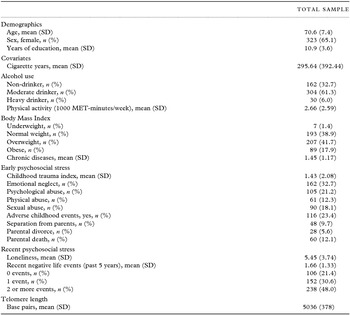
Baseline characteristics for the study sample are provided in Table 1. Mean age of the sample was 70.6 (standard deviation (SD) 7.4) years, and the majority was female (65.1%). With regard to early psychosocial stress, nearly half of the sample (44.2%) experienced childhood abuse at least once, whereas nearly a quarter of the sample (23.4%) reported one or more childhood adverse events. Looking at recent psychosocial stress, the mean loneliness score represented moderate loneliness, and the sample experienced a mean of 1.66 (SD 1.33) negative life events in the past five years. Mean TL was 5,036 (SD 378) bp. TL was normally distributed, and was significantly inversely associated with age (B = −14.51, t(484) = −6.23, p < 0.001) and chronic diseases (B = −34.61, t(484) = −2.34, p = 0.02), and females had longer TL compared to males (t(484) = 36.27, p = 0.02). None of the other potential covariates (years of education, smoking, alcohol use, physical activity, and BMI) were associated with TL. Consequently, all subsequent analyses were adjusted for age, sex, and chronic diseases.
Baseline characteristics of the total sample (n = 496)

Note: SD = standard deviation, MET = metabolic equivalent total.
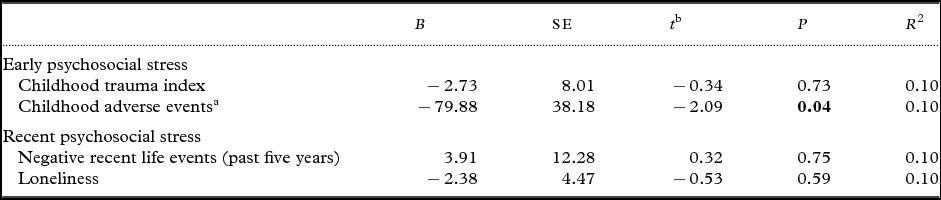
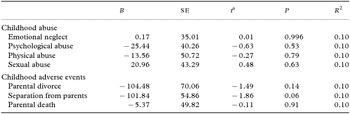
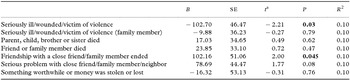
Results from the multiple regression analyses examining the association between early and recent psychosocial stress and TL, are displayed in Tables 2 and 3. The childhood trauma index was not associated with TL. Subtypes of childhood abuse (i.e. emotional neglect, psychological abuse, physical abuse, and sexual abuse) were also unrelated to TL. Having experienced any childhood adverse event was significantly associated with shorter TL (B = −79.88, t(491) = −2.09, p = 0.04), but none of the events (separation from parents, parental divorce, and parental death) were associated with TL separately. In addition, considering the number of statistical tests we did, this association would not pass multiple testing correction. Regarding recent psychosocial stress, the number of negative life events in the past five years was not associated with TL. Out of the twelve separate negative recent life events (Table 4), events that were experienced by at least 15 participants were analyzed separately. Out of these seven events, five events (seriously ill/wounded/victim of violence (family member); parent, child, brother, or sister died; friend or family member died; serious problem with a close friend/family member/neighbor; and something worthwhile or money was stolen or lost) were unrelated to TL. “Being seriously ill, wounded, or a victim of violence” was significantly associated with TL in the past five years, with those who were seriously ill, wounded, or a victim of violence having shorter TL compared to those who were not (B = −102.70, t(491) = −2.21, p = 0.03). “A friendship with a close friend/family member ended” was associated with longer TL (B = 102.16, t(491) = 2.00, p = 0.045). Loneliness was not associated with TL. Finally, none of the psychosocial stressors showed an interaction effect with age, indicating the associations between psychosocial stress and TL did not differ between the younger half and the older half of our sample (data not shown). Sensitivity analyses using ages 65, 70, 75, and 80 as cut-off ages did not yield different findings (data not shown). Also, when fully adjusting for all socio-demographic and lifestyle covariates, all associations remained unchanged (data not shown).
Multiple regression results showing the association between early and recent psychosocial stress and telomere length (n = 496)

Note: SE = standard error. Bold type indicates a statistically significant association. Adjusted for age, sex, and chronic diseases.
aAny childhood adverse event, reference group = no events at all.
bDegrees of freedom (df) = 491.
Multiple regression results showing the association between separate types of childhood abuse and childhood adverse events and telomere length (n = 496)

Note: SE = standard error. Adjusted for age, sex, and chronic diseases. Reference group = type of abuse or event not experienced before age 16.
aDegrees of freedom (df) = 491.
Multiple regression results showing the association between separate recent negative life events in the past five years and telomere length (n = 496)

Note: SE = standard error. Bold type indicates a statistically significant association. Adjusted for age, sex, and chronic diseases. Reference group = event not experienced in the past five years. The following events were not analyzed separately due to the low prevalence in the past five years: “separation of partner” (n = 9); “became unemployed” (n = 7); “got fired” (n = 10); “serious financial problems” (n = 13); and “contact with police or justice by misdemeanor” (n = 8).
aDegrees of freedom (df) = 491.
Discussion
This study assessed whether psychosocial stressors, early (childhood abuse, childhood adverse events) and recent in life (recent negative life events and loneliness), were associated with leukocyte TL in older adults. We hypothesized psychosocial stress to be associated with shortened TL, but, overall, our findings did not consistently confirm this hypothesis.
First, we found childhood adverse events, but not childhood abuse, to be associated with shortened TL. For childhood abuse and childhood adverse events, similar associations with TL were expected as both concepts have been associated with adverse health outcomes and late-life depression (e.g. Comijs et al., Reference Comijs, Beekman, Smit, Bremmer, van Tilburg and Deeg2007; Reference Comijs, van Exel, van der Mast, Paauw, Oude Voshaar and Stek2013; Lacey et al., Reference Lacey, Kumari and McMunn2013; Midei et al., Reference Midei, Matthews, Chang and Bromberger2013). Childhood abuse may even be expected to be a stronger stressor compared to childhood adverse events, as in younger adults childhood abuse but not childhood adverse events was associated with psychopathology (Hovens et al., Reference Hovens2010). However, in our study not even cumulative abuse or a severe type of childhood abuse such as sexual abuse were related to TL. The significant association for childhood adverse events and TL would not pass a stricter p value, which would be adjusted for multiple testing, and it is also striking that no significant associations with TL were found for any of the separate childhood adverse events.
Second, although two recent negative life events were significantly associated with TL, the direction in which they were associated with TL differed. Our findings indicated that only one event was associated with shortened TL, namely being seriously ill, wounded, or a victim of violence. Since this study was performed in older adults, this finding may be explained by underlying somatic factors of those who were seriously ill or wounded, and not by psychosocial stress, as shortened TL has been associated with negative health outcomes repeatedly (e.g. Fitzpatrick et al., Reference Fitzpatrick2007; Willeit et al., Reference Willeit2010). Against our expectations, ending a friendship with a friend, family member, or neighbor was associated with longer TL. Although we cannot rule out that TL may indeed lengthen under the influence of mild stress, this finding is difficult to explain and may have been due to chance as a result of multiple testing. Third, no association was found between loneliness and TL, which supports our notion that psychosocial stress in general may not be associated with TL in older adults. Finally, we demonstrated the widely established associations between TL and age, sex, and chronic diseases, which means that our measure used to determine TL was valid. It indicates that our non-significant findings are not attributable to telomere measurement and suggests that no association is present between psychosocial stress and TL in older adults.
Our findings are in line with our previous null findings for the association between depression and TL in older adults (Schaakxs et al., Reference Schaakxs, Verhoeven, Comijs, Voshaar and Penninx2015), indicating that psychological or psychosocial stress is not associated with TL in older adults. However, in younger adults such associations have been found previously (e.g. Kananen et al., Reference Kananen2010; Tyrka et al., Reference Tyrka, Price, Kao, Porton, Marsella and Carpenter2010; Verhoeven et al., Reference Verhoeven, Révész, Epel, Lin, Wolkowitz and Penninx2014; Puterman et al., Reference Puterman, Lin, Krauss, Blackburn and Epel2015). A possible explanation for these null findings in older adults may be that older adults have been exposed to numerous competing causes for shortened TL, such as somatic diseases or an unhealthy lifestyle over the life span. These other TL-damaging factors may suppress the independent impact of psychosocial stressors. Also, in a sample of older persons, those who did not experience psychosocial stressors may also have shorter TL due to lifetime exposure to a range of TL-damaging factors, thereby reducing differences in TL between persons with and without a history of psychosocial stress. Another explanation may be that a healthy survivor effect is present in this study. Those with the most damaged TL may also be those who could not participate in this study due to health problems or death. So, without those with the most affected TL, our findings may be an underestimation of the true associations between psychosocial stress and TL. Future longitudinal studies should try to demonstrate this healthy survivor effect, by examining to what extent persons who experienced psychosocial stress suffer from premature death and to see whether those who died prematurely were also the ones with shorter TL. An alternative way to examine healthy survivorship in future studies is to study mechanisms of protection against TL-shortening in older persons. Puterman et al. (Reference Puterman, Lin, Krauss, Blackburn and Epel2015) demonstrated telomere shortening over a period of one year for those who experienced negative life events during that year, but this association was moderated by lifestyle in the sense that a healthy lifestyle served as a protection against telomere shortening. Although lifestyle variables were not associated with TL in the current study, other protective factors or resiliency in our sample may have prevented us from finding significant associations between psychosocial stressors and TL. At the same time, the findings by Puterman et al. (Reference Puterman, Lin, Krauss, Blackburn and Epel2015) showed that the five-year period used in our study should be enough lag to demonstrate accelerated telomere shortening due to negative life events.
Strengths of our study include the extensive assessment of childhood abuse and recent negative life events and the use of multiple covariates to prevent confounding. However, some limitations should be noted as well. Data on early psychosocial stress were collected retrospectively. Although such reports are generally considered to be valid (Hardt and Rutter, Reference Hardt and Rutter2004), this may have caused an under- or overestimation of childhood abuse. Underestimation may occur alongside memory problems or when it is too painful to recall or report these traumatic events, whereas overestimation may be the result of negative mood (Comijs et al., Reference Comijs, Beekman, Smit, Bremmer, van Tilburg and Deeg2007). In our study, the high prevalence of childhood abuse might suggest the latter. It is unlikely that childhood abuse was overestimated due to the definition of childhood abuse used in our study. Persons who experienced any type of abuse only once were considered to have a history of abuse. Although this definition may be too lenient in the case of emotional neglect or psychological abuse, only three participants reported a single experience of emotional neglect or psychological abuse. Whereas several types of childhood abuse were included in our study, childhood adverse events were limited to separation from parents, parental divorce, and parental death. Previously, independent significant associations between TL and children's own serious illness and parental unemployment were found in younger adults (Kananen et al., Reference Kananen2010). Also, in older adults, Kiecolt-Glaser et al. (Reference Kiecolt-Glaser, Gouin, Weng, Malarkey, Beversdorf and Glaser2011) found those who experienced two or more childhood adverse events to have shorter TL compared to those who experienced one event or no events at all. We did not assess the number of childhood adverse events as a cumulative measure due to the low prevalence of childhood adverse events in our study. In order to gain more insight into the dynamics of TL, it would have been useful to include data on telomerase activity. Telomerase is an enzyme that stimulates telomere growth and decelerates cellular aging (Blackburn et al., Reference Blackburn, Greider and Szostak2006). Unfortunately, this was not available in NESDO. Finally, cellular aging was determined by obtaining leukocyte TL, which is a non-invasive and often used measure. However, TL is not limited to leukocytes and could be observed in other somatic tissues as well. Nevertheless, Daniali et al. (Reference Daniali2013) found leukocyte TL to be correlated with TL from skeletal muscle, skin, and subcutaneous fat, which suggests that our results are not limited to leukocyte TL.
In conclusion, our findings did not confirm our hypothesis that psychosocial stress is associated with shorter TL in older adults, which is possibly due to the lifelong exposure to a broad range of TL-damaging factors.
Conflicts of interest declaration
None.
Description of authors’ roles
R. Schaakxs formulated the research question, performed statistical analyses, wrote the manuscript and incorporated feedback from co-authors. I. Wielaard provided feedback in all drafts of the manuscript and performed a quality check on the execution of the analyses. J. Verhoeven provided feedback in all drafts of the manuscript. A. Beekman provided feedback in all drafts of the manuscript, and critically interpreted the results. B. Penninx reviewed and provided feedback for the research question, provided feedback in all drafts of the manuscript, and critically interpreted the results. H. Comijs reviewed and provided feedback for the research question, provided feedback in all drafts of the manuscript, critically interpreted the results, and is the principal investigator of the NESDO study. All authors edited and approved the final manuscript.
Acknowledgments
The infrastructure for the NESDO study (http://nesdo.amstad.nl) is funded through the Fonds NutsOhra (project 0701-065), Stichting tot Steun VCVGZ, NARSAD The Brain and Behaviour Research Fund (grant ID 41080), and the participating universities and mental healthcare organizations (VU University Medical Center, Leiden University Medical Center, University Medical Center Groningen, UMC St Radboud, and GGZ inGeest, GG Net, GGZ Nijmegen, GGZ Rivierduinen, Lentis, and Parnassia). Brenda W. J. H. Penninx, Josine E. Verhoeven, and TL assaying were supported through a NWO-VICI grant (number 91811602).