INTRODUCTION
The protozoan parasite Toxoplasma gondii is prevalent worldwide, infects a wide range of hosts and is generally found in high prevalence (Tenter et al. Reference Tenter, Heckeroth and Weiss2000). Amongst the Apicomplexa it is distinguished for its ability to readily infect almost any mammal, as well as birds, despite felids being the only definitive host (Dubey et al. Reference Dubey, Miller and Frenkel1970; Dubey, Reference Dubey2009a,b). Rodents, and in particular mice, are considered to be an important intermediate host as they are a potential prey species for cats (Tenter et al. Reference Tenter, Heckeroth and Weiss2000). They may play an important role in the completion of the life cycle of T. gondii by providing a source of infected meat for the cat which leads to subsequent infection of more secondary hosts. Despite this apparently important role, a number of serological studies have shown that T. gondii has a relatively low prevalence in mice (Franti et al. Reference Franti, Riemann, Behmeyer, Suther, Howarth and Ruppanner1976; Jackson et al. Reference Jackson, Hutchison and Siim1986; Webster, Reference Webster1994; Dubey et al. Reference Dubey, Weigel, Siegel, Thulliez, Kitron, Mitchell, Mannelli, Mateuspinillia, Shen, Kwok and Todd1995; Smith and Frenkel, Reference Smith and Frenkel1995) although some PCR-based studies of T. gondii in Mus domesticus, and other species of mice, have shown higher prevalences (Marshall et al. Reference Marshall, Hughes, Williams, Smith, Murphy and Hide2004; Zhang et al. Reference Zhang, Jiang, He, Pan, Zhu and Wei2004). Few studies have been conducted to date on the woodmouse, Apodemus sylvaticus. Prevalences of T. gondii of 14·3% have been reported, using PCR, in one study (Kijlstra et al. Reference Kijlstra, Meerburg, Cornelissen, De Craeye, Vereijken and Jongert2008) and seroprevalences of 1·49% and 7·4% were found in Apodemus agrarius in Korea (Jeon and Yong, Reference Jeon and Yong2000) and the Czech Republic (Hejlicek and Literak, Reference Hejlicek and Literak1998). The assumption is that these natural populations of wild mammals are infected through interaction with cats.
Infected cats release large quantities of oocysts (107–108 per cat) that are environmentally persistent and previous reports suggested that younger cats shed more frequently than older or previously exposed cats (Dubey, Reference Dubey1995). However, recent large-scale studies (Schares et al. Reference Schares, Vrhovec, Pantchev, Herrmann and Conraths2008; Herrmann et al. Reference Herrmann, Pantchev, Vrhovec, Barutzki, Wilking, Fröhlich, Lüder, Conraths and Schares2010) have demonstrated frequent shedding of oocysts by older cats. It is estimated that only a small proportion (1–2%) of domestic cats may be shedding oocysts at any one time (Dubey and Beattie, Reference Dubey and Beattie1988; Dubey and Jones, Reference Dubey and Jones2008) but this could be as low as 0·25% (Herrmann et al. Reference Herrmann, Pantchev, Vrhovec, Barutzki, Wilking, Fröhlich, Lüder, Conraths and Schares2010). Overall, these data imply that a higher prevalence of T. gondii would be found in intermediate hosts in an area with large cat populations.
T. gondii is transmitted via 3 routes; the ingestion of oocysts from the environment, ingestion of tissue cysts by the intermediate host, and congenitally through transplacental transmission from mother to foetus. The contribution of each of these routes to the overall prevalence of the T. gondii is currently a subject of debate (Hide et al. Reference Hide, Gerwash, Morley, Williams, Hughes, Thomasson, Elmahaishi, Elmahaishi, Terry and Smith2007, Reference Hide, Morley, Hughes, Gerwash, Elmahaishi, Elmahaishi, Thomasson, Wright, Williams, Murphy and Smith2009; Innes et al. Reference Innes, Bartley, Buxton and Katzer2009). There is considerable evidence now that the parasite might frequently engage in transmission cycles that bypass cats (Su et al. Reference Su, Evans, Cole, Kissinger, Ajioka and Sibley2003; Dubey et al. Reference Dubey, Hill, Jones, Hightower, Kirkland, Roberts, Marcet, Lehmann, Vianna, Miska, Sreekumar, Kwok, Shen and Gamble2005) but the relative importance of different transmission routes is still unclear. A number of studies have suggested that vertical transmission may be an important transmission route in natural populations of mammals such as sheep (Duncanson et al. Reference Duncanson, Terry, Smith and Hide2001; Williams et al. Reference Morley, Williams, Hughes, Terry, Duncanson, Smith and Hide2005; Morley et al. Reference Morley, Williams, Hughes, Terry, Duncanson, Smith and Hide2005, Reference Morley, Williams, Hughes, Thomasson, Terry, Duncanson, Smith and Hide2008) and perhaps humans (Hide et al. Reference Hide, Gerwash, Morley, Williams, Hughes, Thomasson, Elmahaishi, Elmahaishi, Terry and Smith2007, Reference Hide, Morley, Hughes, Gerwash, Elmahaishi, Elmahaishi, Thomasson, Wright, Williams, Murphy and Smith2009). Although congenital transmission of T. gondii has been studied in mice under laboratory conditions, few studies have looked at this phenomenon in naturally infected wild populations.
In a laboratory study, Owen and Trees (Reference Owen and Trees1998) looked at chronically infected house mice (Mus musculus) and wood mice (A. sylvaticus) using PCR. Vertical transmission was demonstrated in 82·7% of all pups and in 95% of all litters of A. sylvaticus showing that it is extremely efficient in this species and probably endures for the life of the breeding female. Another earlier study by Beverley (Reference Beverley1959) looked at congenital transmission of toxoplasmosis through successive generations of mice. Beverley (Reference Beverley1959) reported that 23 of the infected litters were born of mothers, themselves congenitally infected, and in one instance a congenitally infected mother produced congenitally infected offspring even in her fourth litter. In a field study, PCR testing of T. gondii in foetuses, collected from a natural population of wild M. domesticus, demonstrated that congenital transmission was occurring in 75% of mice and rose to 100% when only PCR positive mothers were considered (Marshall et al. Reference Marshall, Hughes, Williams, Smith, Murphy and Hide2004). However, most studies conducted using serological techniques have suggested lower rates of congenital transmission in rodents (Dubey et al. Reference Dubey, Weigel, Siegel, Thulliez, Kitron, Mitchell, Mannelli, Mateuspinillia, Shen, Kwok and Todd1995) although this may be due to sensitivity of the serological tests which often show that congenitally infected mice can test seronegative while harbouring parasites (Beverley, Reference Beverley1959; Jacobs, Reference Jacobs and Caorradetti1964; Dubey et al. Reference Dubey, Shen, Kwok and Thulliez1997; Owen and Trees, Reference Owen and Trees1998; Araujo et al. Reference Araujo, da Silva, Rosa, Mattie, da Silva, Richini-Pereira and Langoni2010).
The related parasite, Neospora caninum, undergoes frequent vertical transmission (Cole et al. Reference Cole, Lindsay, Blagburn and Dubey1995; Williams et al. Reference Williams, Hartley, Bjorkman and Trees2009) but little is known about its prevalence in natural populations of rodents nor the degree of co-infection with T. gondii. Studies using PCR detection of Neospora and Toxoplasma have demonstrated evidence of co-infection in sheep, mice, rats (Hughes et al. Reference Hughes, Williams, Morley, Cook, Terry, Murphy, Smith and Hide2006) and rabbits (Hughes et al. Reference Hughes, Thomasson, Craig, Georgin, Pickles and Hide2008) but no significant association between the two parasites.
In this paper we report the results of a study that investigates the prevalence of T. gondii and N. caninum in a wild population of A. sylvaticus. At the location of the sampling site there are few cats present locally – less than 2·5 cats per km2 (based on the data of Hughes et al. Reference Hughes, Thomasson, Craig, Georgin, Pickles and Hide2008). This offers the opportunity to compare directly, using an identical methodology, the prevalence of T. gondii in rodents in an area relatively free of cats with a previously published study on an area where there were more than 500 cats per km2 (based on the data of Murphy et al. Reference Murphy, Williams, Hughes, Hide, Ford and Oldbury2008). The objectives of this study are to investigate the prevalence and co-infection of T. gondii and N. caninum in A. sylvaticus and to compare the prevalence of T. gondii in rodents in areas with high and low cat densities.
MATERIALS AND METHODS
The woodmice (A. sylvaticus) were sampled, using Longworth Traps, from the surrounding area of Malham Tarn Field Centre, North Yorkshire. Mice weighing less than 14 g were considered juveniles (Higgs and Nowell, Reference Higgs and Nowell2000). They were euthanased, measured, weighed, sexed and the brains dissected out, using sterile technique, and transferred into sterile tubes containing 400 μl of lysis buffer (100 mm sodium chloride, 25 mm EDTA, 0·5% SDS, 20 mm Tris pH 8·0) and stored at −20°C. Instruments were sterilized between dissections and cross-contamination of samples was prevented at all stages by the use of disposable sterile equipment (e.g. tubes, tips), careful handling, labelling and sample processing during DNA extraction.
DNA was extracted using a phenol/chloroform procedure as previously described (Terry et al. Reference Duncanson, Terry, Smith and Hide2001). Uninfected and T. gondii (RH Strain)-infected mouse tissue (J.E. Smith, University of Leeds) were used as DNA-processing controls. The extracted DNA was tested to ensure viability for PCR using generic primers to mammalian α-tubulin as previously described (Duncanson et al. Reference Duncanson, Terry, Smith and Hide2001; Morley et al. Reference Morley, Williams, Hughes, Terry, Duncanson, Smith and Hide2005). The presence of T. gondii was detected using PCR amplification of the Surface Antigen Gene 1 (SAG1) gene and resolved by gel electrophoresis as previously described (Williams et al. Reference Morley, Williams, Hughes, Terry, Duncanson, Smith and Hide2005). Precautions were taken to avoid contamination during nested PCR reactions as follows: negative controls (sterile distilled water) were included as the first and last sample of any set of PCR reactions. Positive controls used were DNA extracted from T. gondii reference strains (typically RH) and a cloned SAG1 gene product which has been verified by DNA sequencing. Preparation of PCR reactions at different stages (e.g. addition of DNA and transfer of second-round products) was conducted in different rooms or in separate clean hoods. Due to unknown ratios of parasite to host DNA, all samples were tested 3 times at 1 μl, 2 μl and 1 μl 1:5 dilution of sample DNA. Further validation of the reliability of the SAG1 PCR system has been described by us previously (Williams et al. Reference Morley, Williams, Hughes, Terry, Duncanson, Smith and Hide2005).
A nested PCR was used to detect the SAG3. This method has been modified from the method described by Grigg et al. (Reference Grigg, Ganatra, Boothroyd and Margolis2001). Amplification was carried out in a final volume of 50 μl containing 5 μl of 10× HT PCR buffer (HT Biotechnologies) (100 mm Tris HCl (pH 9·0), 15 mm MgCl2, 500 mm KCl, 1% TritonX-100, 0·1% (w/v) stabilizer), 0·5 μl of dNTP mix (100 mm), 2·5 μl of (10 pM/μl) forward primer Fext (5′CAACTCTCACCATTCCACCC3′) and reverse primer Rext (5′GCGCGTTGTTAGACAAGACA3′) and 2·5 units Biotaq polymerase (Bioline). DNA-free water made the final volume to 50 μl. Due to unknown ratios of parasite to host DNA, all samples were tested 3 times at 1 μl, 2 μl and 1 μl 1:5 dilution of sample DNA. Amplification was carried out using a Stratagene Robocycler as follows: an initial denaturation step of 5 min at 94°C, was followed by 35 cycles of PCR performed for 40 sec at 94°C, 40 sec at 60°C and 60 sec at 72°C, with a final extension step of 10 min at 72°C. Second-round PCR was carried out using the same reaction and cycling conditions as the first round with the exception of the primers which were Fint (5′TCTTGTCGGGTGTTCACTCA3′) and Rint (5′CACAAGGAGACCGAGAAGGA3′). A volume of 2 μl of first-round product was added to act as a template. Amplification products (10 μl) were visualized by agarose gel electrophoresis on a 2% agarose gel containing Gelred or ethidium bromide. Positive PCR reactions were further analysed by restriction enzyme digestion with each of the enzymes Nci1 and AlwN1, 8·5 μl of PCR product, 1 μl of buffer 4 (NEB) and 0·5 μl of enzyme. These were incubated at 37°C for a minimum of 4 h. Products were visualized by gel electrophoresis on a 2·5% agarose gel. N. caninum was detected by PCR as previously described (Hughes et al. Reference Hughes, Williams, Morley, Cook, Terry, Murphy, Smith and Hide2006, Reference Hughes, Thomasson, Craig, Georgin, Pickles and Hide2008).
To confirm the sequence of PCR products, bands were excised from the agarose gel and cleaned using Geneclean® before sequencing. Fragments of DNA sequence from SAG1 and SAG3 PCR amplifications were sent to Lark Technologies for bidirectional sequencing using the primers DS 38 and DS 39 (SAG1) and Fint and Rint (SAG3). N. caninum fragments were sequenced as previously described (Hughes et al. Reference Hughes, Williams, Morley, Cook, Terry, Murphy, Smith and Hide2006, Reference Hughes, Thomasson, Craig, Georgin, Pickles and Hide2008). Sequence data were compared to previously published sequences using CLUSTAL W software available on the European Bioinformatics Institute website (www.ebi.ac.uk/clustalw/).
Statistical analysis of data was carried out using Chi-Squared tests (Microsoft, EXCEL) or 2×2 contingency tables using Fishers Exact Test (Graphpad Software: http://www.graphpad.com/).
RESULTS
DNA was extracted from brain tissue taken from 206 A. sylvaticus and DNA integrity checked using PCR amplification of the Apodemus tubulin gene. SAG1 PCR was used to detect the presence of T. gondii DNA in the DNA extracted from brain tissue. Positive amplifications in 84 of the 206 samples demonstrated the prevalence of Toxoplasma infection to be 40·78% (95% CI: 34·07%–47·79%) (Table 1). To confirm that the correct DNA sequence was being amplified, DNA sequencing was carried out on a sample of PCR amplified product from a PCR-positive A. sylvaticus (Accession no. JF412000). There was a 100% match to published SAG1 sequences.
Summary of the SAG 1 PCR detection of Toxoplasma gondii and Neospora caninum in A. sylvaticus and M. domesticus

A subset of 111 mice (42·3% PCR positive), which had an associated comprehensive data set on parameters such as sex, weight and length, was used to investigate the relationship with Toxoplasma infection. To determine whether there was a relationship of infection with sex of the mice, 54 females and 57 males were found to have 23 (42·6%) and 24 (42·1%) PCR-positive mice respectively. No significant difference between T. gondii infection and sex was found (χ 2=0·003, d.f.=1, P=0·957). As studies of Toxoplasma infection often show the presence of an age-dependent prevalence (i.e. higher prevalences are found in older cohorts), we tested this using these data. A total of 97 adults and 14 juveniles (those under 14 g) were observed in this cohort of 111 of which 44 (45·3%) and 5 (35·7%) were PCR positive for Toxoplasma respectively. No significant difference between infection of adults and juveniles was found (χ 2=0·153, d.f.=1, P=0·6953) showing that no age-dependent prevalence increase was evident in this study.
For this study, 2 pregnant A. sylvaticus dams were collected. One was found to be PCR positive for T. gondii and SAG1 PCR detected parasite DNA in the brain tissue of 2 out of the 6 foetuses within this pregnant dam.
To gain an insight into the diversity of T. gondii strains within the A. sylvaticus population, as many as possible of the SAG1-positive animals were tested for RFLP with the SAG3-PCR method (Grigg et al. Reference Grigg, Ganatra, Boothroyd and Margolis2001) to determine strain type. Considerable difficulty was experienced in successfully amplifying sufficient quantities of the SAG3 product from the DNA of these tissue samples. SAG3 genotypes were determined for 22 of the PCR-positive mice. Of the 22 mice, 12 were of SAG3 Type I, 9 of Type II and 1 Type III.
PCR was used to investigate the prevalence of N. caninum in this population of A. sylvaticus. Of the A. sylvaticus there were 118 tested for N. caninum of which only 4 were positive, giving a prevalence of 3·39% (95% CI: 0·12–6·66%) (Table 1).
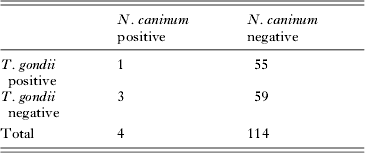
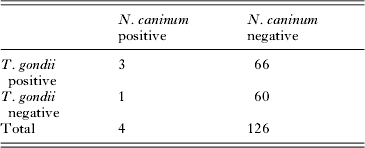
The question of co-infection between T. gondii and N. caninum has not been explored in A. sylvaticus to our knowledge although it has been investigated using a smaller sample of M. domesticus in a previous study (Hughes et al. Reference Hughes, Williams, Morley, Cook, Terry, Murphy, Smith and Hide2006). Tables 2 and 3, respectively, summarize the infection data for A. sylvaticus and the previously published M. domesticus data (Hughes et al. Reference Hughes, Williams, Morley, Cook, Terry, Murphy, Smith and Hide2006) augmented with additional samples new to this study. Co-infection was observed in both populations but no significant association was found between T. gondii and N. caninum infection in either A. sylvaticus (P=0·621) or M. domesticus (P=0·622).
Frequency of infection of Apodemus sylvaticus with Neospora caninum and Toxoplasma gondii

Frequency of infection of Mus domesticus with Neospora caninum and Toxoplasma gondii

DISCUSSION
In this study a sympatric collection of A. sylvaticus was tested for the presence of T. gondii and N. caninum with prevalences of 40·78% (95%CI: 34·1%–47·8%) and 3·39% (95%CI: 0·12%–6·66%) respectively being measured. To our knowledge only one other PCR study has been conducted on the prevalence of N. caninum in A. sylvaticus – a prevalence of 1·8% was seen in a sample set of 55 animals collected in Italy (Ferroglio et al. Reference Ferroglio, Pasino, Romano, Grande, Pregel and Trisciuogjio2007). This low prevalence was not significantly different from that seen with our larger collection (χ 2=0·412, d.f.=1, P=0·52). A comparison of N. caninum prevalences in this population of A. sylvaticus and an M. domesticus population collected from an urban area within Manchester, UK, showed a non-significantly different (χ 2=0·046, d.f.=1, P=0·83) prevalence of 3·08% (95%CI: 0·11%–6·05%) using identical collection and detection systems. It is unclear how this parasite is transmitted in both of these rodent species. The dog is known to be the definitive host (McAllister et al. Reference McAllister, Dubey, Lindsay, Jolley, Wills and McGuire1998) and vertical transmission is considered to be frequent in N. caninum (Williams et al. Reference Williams, Hartley, Bjorkman and Trees2009). Co-infection was observed but no significant association was seen between infection with N. caninum and T. gondii in either the Apodemus or Mus hosts. This is consistent with PCR-based studies on other mammalian species (Hughes et al. Reference Hughes, Williams, Morley, Cook, Terry, Murphy, Smith and Hide2006, Reference Hughes, Thomasson, Craig, Georgin, Pickles and Hide2008).
In the case of T. gondii, the cat clearly has a key role in the life cycle, raising the question as to how the prevalence of infection in rodents may differ in areas with high and low cat densities. The Apodemus in this study were collected from an area with an estimated cat density of less than 2·5 cats per km2 (based on re-calculation of data from Hughes et al. Reference Hughes, Thomasson, Craig, Georgin, Pickles and Hide2008). In other, previously published studies (Marshall et al. Reference Marshall, Hughes, Williams, Smith, Murphy and Hide2004; Murphy et al. Reference Murphy, Williams, Hughes, Hide, Ford and Oldbury2008) exactly the same techniques and approaches were used to measure the prevalence of T. gondii in an urban population of M. domesticus from an area of considerably higher cat density than the sampling site for A. sylvaticus. Details of the locations of cats within the study site were collated (Murphy et al. Reference Murphy, Williams, Hughes, Hide, Ford and Oldbury2008) and a cat density of more than 500 cats per km2 was calculated (based on the data presented by Murphy et al. Reference Murphy, Williams, Hughes, Hide, Ford and Oldbury2008). Two hundred M. domesticus collected from this urban population were found to have a prevalence of 59% using SAG1 PCR of brain tissue (Marshall et al. Reference Marshall, Hughes, Williams, Smith, Murphy and Hide2004). Compared with the 40·78% found in the A. sylvaticus samples, there was a higher prevalence (59%) in the M. domesticus samples (Table 1) suggesting that the presence of cats clearly contributes to the prevalence of T. gondii. However, despite the 200 times higher density of cats in the M. domesticus sample site, only a further 19% (95%CI: 11·2%–26·8%) increase in prevalence was seen. Clearly, therefore, high levels of infection in the Apodemus samples are being maintained in the relative absence of cats. We appreciate that other factors, such as the difference in species studied here (for example, in behaviour), may also influence the different prevalences although we found no evidence in the literature that might suggest differences in virulence towards Apodemus or Mus.
One possible transmission route that could maintain these relatively high prevalences is congenital transmission. Previous studies on the M. domesticus population showed the occurrence of high frequencies of congenital transmission (Marshall et al. Reference Marshall, Hughes, Williams, Smith, Murphy and Hide2004). In this study, 2 pregnant females (1 PCR positive) were found within the population of A. sylvaticus. Although only a very small sample size, the PCR-positive foetuses in one of them shows that congenital transmission is occurring in this A. sylvaticus population. This offers a possible explanation of how transmission might be occurring in the relative absence of cats. This hypothesis is further supported by the lack of an age prevalence effect when comparing the juvenile Apodemus with adult mice – a phenomenon which would be expected to be seen if the Apodemus acquired infection by ingestion of oocysts or carnivory.
Parasite multilocus genotyping might be one way of investigating whether frequent congenital transmission might be occurring. High degrees of similarity between genotypes might indicate the level of clonality expected to be associated with vertical transmission. In our studies, considerable difficulty was experienced in successfully amplifying sufficient quantities of the SAG3 product to directly genotype from these tissue samples, although all 3 main clonal genotypes were seen. The difficulty was probably due to a low parasite to host DNA ratio. The consequences of this difficulty were that we were unable to attempt multilocus genotyping which is now considered the norm for T. gondii genotyping. The range of SAG3 genotypes present in this Apodemus population may argue against congenital transmission occurring frequently.
The prevalence of T. gondii infection in both the Apodemus and Mus populations is high. This is in contrast to many serological studies that have reported relatively low Toxoplasma prevalence in mice (Franti et al. Reference Franti, Riemann, Behmeyer, Suther, Howarth and Ruppanner1976; Jackson et al. Reference Jackson, Hutchison and Siim1986; Webster, Reference Webster1994; Dubey et al. Reference Dubey, Weigel, Siegel, Thulliez, Kitron, Mitchell, Mannelli, Mateuspinillia, Shen, Kwok and Todd1995; Hejlicek et al. Reference Hejlicek, Literak and Nezval1997; Hejlicek and Literak, Reference Hejlicek and Literak1998). Few studies have been conducted to date on the woodmouse, A. sylvaticus. Prevalences of T. gondii of 14·3% have been reported, using real-time PCR, in one study (Kijlstra et al. Reference Kijlstra, Meerburg, Cornelissen, De Craeye, Vereijken and Jongert2008) and seroprevalences of 1·49% and 7·4% found in A. agrarius in Korea (Jeon and Yong, Reference Jeon and Yong2000) and the Czech republic (Hejlicek and Literak, Reference Hejlicek and Literak1998). A study of prevalence of T. gondii in another rodent species, the Deer Mouse, (Peromyscus maniculatus) reported a prevalence rate of 26% (Dabritz et al. Reference Dabritz, Miller, Gardner, Packham, Atwill and Conrad2008). Interestingly, recent research has shown that high levels of congenital transmission can be detected following experimental infection of this latter species (Rejmanek et al. Reference Rejmanek, Vanwormer, Mazet, Packham, Aguilar and Conrad2010).
The reasons behind the variability in prevalences of T. gondii in small rodents is unclear and especially the explanation for the high prevalences seen in our studies on UK species of Apodemus and Mus. Geographical variance, host species behaviour or methods of detection (e.g. serology vs PCR) could all be factors. There is a growing body of evidence that suggests that serological methods may not efficiently detect T. gondii infection in mice – especially if that infection is congenitally derived. This was first noticed by Beverley (Reference Beverley1959), where serological detection was inefficient despite high mortality in congenitally infected mice. This has also been reported subsequently (Dubey et al. Reference Dubey, Shen, Kwok and Thulliez1997; Owen and Trees, Reference Owen and Trees1998; Araujo et al. Reference Araujo, da Silva, Rosa, Mattie, da Silva, Richini-Pereira and Langoni2010; Rejmanek et al. Reference Rejmanek, Vanwormer, Mazet, Packham, Aguilar and Conrad2010).
The closely related parasite N. caninum is clearly capable of efficient vertical transmission and can be maintained in its hosts by endogenous transplacental transmission (Cole et al. Reference Cole, Lindsay, Blagburn and Dubey1995; Trees and Williams, Reference Trees and Williams2005; Williams et al. Reference Williams, Hartley, Bjorkman and Trees2009). Little is known about the mechanisms of endogenous transplacental transmission in T. gondii. One possibility is that the parasite is able to manipulate the host immune system during transplacental transmission such that it is either recognized as ‘self’ or not recognized at all. Further research in this area may be important if vertical transmission of T. gondii is relevant to natural populations of animals such as the woodmice in this study.
ACKNOWLEDGEMENTS
We would like to thank the University of Salford and the Libyan Embassy for funding. The University of Salford parasitology students, Manchester residents and the Manchester City Council for their help in the collection of the mice populations. Z.R.L.'s laboratory is supported by the grant from the National Basic Research Program of China (973 Program) (No. 2010CB530000).