


1. INTRODUCTION
Currently there is significant interest in intense short pulse laser propagation through plasmas with density ripple (Gill & Saini (Reference Gill and Saini2007). Some of those studies have been motivated by the need for resonant generation of third and higher harmonics. In a homogeneous plasma, the harmonic generation process is a non-resonant one as the nth harmonic wave number k n≠n k 1, where k 1 is the wave number of the fundamental laser. A density ripple of suitable wave number q = k n – nk 1, may turn the process into a resonant one. Hence, efforts have been made to create suitable density ripples in plasmas. This kind of density ripple may be observed in gas-jet plasma experiment. Lin et al. (Reference Lin, Chen, Pai, Kuo, Lee, Wang and Chen2006) have recently used a 10 TW, 45 fs, 810 nm, and 10 Hz Ti: sapphire laser, to accomplish this. The laser beam was split into two beams. One beam, moving along  , was a machining pulse for producing the periodic plasma density profile, and the other one, launched 10 ns later and propagating along
 was a probe pulse. The machining pulse, having periodic intensity variation in transverse direction
 , and intensity at the maxima exceeding the threshold for optical field ionization, was projected transversely on a neutral gas jet. In positions of intensity, maxima plasma was formed. After the passage of the pulse, the interlacing layers of high density neutral gas and low density plasma were formed. When a large amplitude probe pulse propagates along
 through such a structure, the front of the pulse ionizes the gas, and its subsequent portion encounters plasma with longitudinal density ripple.
Kuo et al. (Reference Kuo, Pai, Lin, Lee, Lin, Wang and Chen2007) have reported fascinating results on the efficiency enhancement of relativistic third harmonic generation from an optically preformed periodic plasma wave guide. They observe five times enhancement in the yield in third harmonic generation under conditions of quasi-phase matching. Parashar and Pandey (Reference Parashar and Pandey1992) had proposed such a scheme for resonant second harmonic generation of a laser pulse in plasma. They predicted an efficiency of 10% for the second harmonic generation at 1015 W/cm2 intensity by the 1 µm laser with a density ripple of a few percent. Bulanov et al. (Reference Bulano, Esirkepov, Naumova and Sokolov2003) have studied high harmonic generation of a high intensity short laser pulse in a thin hollow channel fiber due to relativistic effects.
A primary issue in developing a theoretical understanding of harmonic generation and other nonlinear phenomena, such as parametric instabilities, in plasma with deep density ripple, is the propagation of the main laser pulse itself. In case of plasmas without density ripple, extensive studies of laser pulse propagation have been carried out. Hafizi et al. (Reference Hafizi, Ting, Sprangle and Hubbard2000) have given an elegant review of self focusing in homogeneous hot/cold plasmas. It is shown that relativistic mass effect and ponderomotive nonlinearity can lead to significant self focusing of the beam. Tripathi et al. (Reference Tripathi, Taguchi and Liu2005) have studied the ion channel formation and ion Coulomb explosion in laser produced plasmas. They have also studied the relativistic self guided propagation of fast rising flat top laser pulse with Gaussian radial intensity distribution in a plasma and subsequent electron evacuation and Coulomb explosion of ions. Much work has also been reported on self focusing and harmonic generation in thin plasma slabs (Ren et al., Reference Ren, Duda, Hemker, Mori, Katsouleas, Anstonsen and Mora2001), density ramps (Gupta et al., Reference Gupta, Hur, Hwang, Suk and Sharma2007), inhomogeneous underdense plasmas (Brandi et al., Reference Brandi, Manus and Mainfray1993; Faure et al., Reference Faure, Malka, Marques, David, Amiranoff, Phuoc and Rousse2002; Liu & Tripathi, Reference Liu and Tripathi1994), Au thin target (Torrisi et al., Reference Torrisi, Margarone, Laska, Krasa, Velyhan, Pfeifer, Ullschmied and Rycl2008), and hollow channel fiber (Chessa et al., Reference Chessa, Mora and Anstonsen Thomas1998; Feit et al., Reference Feit, Komashko, Rubenchik and Turitsyn1998). It has more applications in generation of ions, X-rays and fast multi charged ions (Laska et al., Reference Laska, Badziak, Boody, Gammino, Jungwirth, Krasa, Krousky, Parys, Pfeifer, Rohlena, Ryc, Skala, Torrisi, Ullschmied and Wolowski2007a, Reference Laska, Badziak, Gammino, Jungwirth, Kasperczuk, Krasa, Krousky, Kubes, Parys, Pfeifer, Pisarczyk, Rohlena, Rosinski, Ryc, Skala, Torrisi, Velyhan and Wolowski2007b; Faenov et al., Reference Faenov, Magunov, Pikuz, Skobelev, Gasilov, Stagira, Calegari, Nisoli, Silvestri, Poletto, Villoresi and Andreev2007), excitation of an upper hybrid wave (Purohit et al., Reference Purohit, Chauhan and Sharma2008), laser ablation (Hafeez et al., Reference Hafeez, Shaikh and Baig2008), inertial confinement fusion (Hora, Reference Hora2007), and fast ignition scheme (Ghoranneviss et al., Reference Ghoranneviss, Malekynia, Hora, Miley and He2008).
In this paper, we study the self focusing of a Gaussian laser beam in plasma with periodic density ripple, n 0 = n 00 (1 + α2 cos qz). The increase arises through relativistic mass nonlinearity and ponderomotive force induced electron density depression. In regions of high plasma density n 0, the self focusing effect dominates over the diffraction effect and the beam converges. However, as the beam enters the low density regions, the diffraction effect prevail, and the beam tend to diverge. Thus one expects a periodic self focusing of the beam. What needs to be developed is a fundamental understanding based on analytic theory and models. The present paper wants to make a contribution in this direction.
In Section 2, we study the self focusing in the limit of quadratic nonlinearity and by modeling the ripple by periodic layers (of axially uniform density) of the plasma and the free space. In this case, the equation governing the beam width parameter offers analytical solutions, giving insight into the competing processes of self focusing and diffraction. In Section 3, we study the self focusing at higher intensities, taking the axial plasma density profile to be sinusoidal. In this case, the wave equation for the beam width parameter is solved numerically for relevant parameters. In Section 4, we discuss our results.
2. SELF FOCUSING WITH QUADRATIC NONLINEARITY
Consider singly ionized plasma with periodic layers of finite and zero electron density (c.f. Fig. 1b),


A Gaussian laser beam is launched into the plasma with

where


 , –e and m are the electron charge and rest mass. In this limit, the wave reflections at the interfaces of layers can be neglected. Following Liu and Tripathi (Reference Liu and Tripathi1994) we may write, for z > 0

where f is the beam width parameter.
Schematic of a plasma with sinusoidal density ripple (a) and rectangular density profile (b).

According to Upadhyay et al. (Reference Upadhyay, Tripath, Sharma and Pant2002), the laser imparts an oscillatory velocity to the electrons,

where

and we have assumed a 2 ≪ 1. The laser also exerts a ponderomotive force on the lectrons F p = e∇φp, where

Under this force, the electrons move radially outward creating an ion space charge field  . In the quasi-steady state, when ωpi−1 ≫ τ ≫ ωp−1 (where ωpi is the ion plasma frequency, and τ is the duration of the laser pulse), one may have φs ≅ −φp. Then the normalized electron density can be written as,
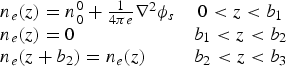
and the effective permittivity of the plasma can be written as

It may be mentioned that for shorter pulses, the longitudinal ponderomotive force is also important. However, we do not pursue this case. In the paraxial ray approximation we expand ɛ with respect to small values of r 2,

where ɛ0 ≅ 1,

For  one may neglect the ponderomotive force induced density modification to obtain the analytical solution. This is an approximation which has limited applicability. Φ simplifies to
 . Following Sodha et al. (Reference Sodha, Ghatak and Tripathi1974), equation governing the beam width parameter can be written as

where l = 0, 1, 2, … ,  is the Rayleigh diffraction length, and ξ = z/R d0. We can solve Eq. (9) analytically by choosing proper boundary conditions. For an initially plane wave front f = 1,
 at ξ = 0. In the plasma region, the beam would tend to focus (
 would decrease) when α > 1. In the plasma-free region
 would increase. In the region 0 < ξ< b′1, where b′1 = b/R d, multiplying Eq. (9) by
 and integrating we get,
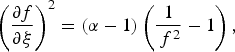
Eq. (10) can be integrated to obtain,

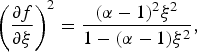
Thus the beam self focuses (f decreases) as it propagates. At the end of the first region,

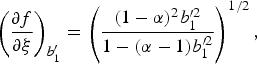
In the subsequent plasma free region b′1 < ξ < b′2 where b′2 = b 2/R d, we solve Eq. (9) with α = 0 following the same procedure, employing Eqs. (13) and (14) as the boundary conditions. In this region  would increase beyond
 , there may come a point (point of inflexion ξ = ξm) where
 . We divide the plasma-free region into two regions: b′1 < ξ< ξm and ξm < ξ< b′2. In the former region
 is negative and Eq. (9) with α = 0 on multiplying by
 and integrating gives,
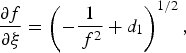

Eq. (15) integrates to give,

where d 2 is the constant of integration. Demanding f = f b′1, at ξ = b′1 we get


As the distance of propagation increases, then f decreases. At one point ξm, where  , beyond this point
 , so ξm = d 2. Beyond the ξ = ξm point, the laser starts to defocus hence
 is positive and the negative sign in Eq. (15) is replaced by a positive one. This new equation integrates to give,

The values of f and  at ξ = b′2 are
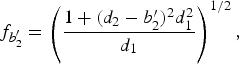

These values become the boundary conditions for solving Eq. (9) in the next plasma region, and so on. We have plotted in Figure 2a and 2b the variation of f with ξ for the following parameters:

For a 810 nm laser these parameters corresponds to a laser intensity I L = 2.1 × 10¹⁶ W/cm2, b 1 = 20 µm, b 2 = 60 µm. We have included in these figures the numerical results for the sinusoidal density ripple considered in the next section for competence. We choose the density modulation parameter α2 = 0.9 and n 00 is 2% of the critical density n cr. We note that for a 0 = 0.1 (Fig. 2a), the beam width parameter increases with ξ. At a 0 = 0.4 (Fig. 2b) f decreases with ξ up to a point, attains a minimum and then increases. This behavior is in contrast with a plasma without a density ripple where f, in the case of quadratic nonlinearity, monotonically decreases with ξ, attains a minimum and slightly increases. This behavior is caused by an alternate predominance of self focusing and diffraction effects. More self focusing is observed in sinusoidal density profile.
(Color online) (a) The variation of beam width parameter f with ξ for rectangular and sinusoidal density profiles based on analytical and numerical models. The parameters are ωp2/ω2 = 0.038,  , d = 50 and a 0 = 0.1. For the sinusoidal profile modulation index α2 = 0.9 is used, and n 00 is 0.02 times the critical density. (b) The variation of beam width parameter f with ξ for rectangular and sinusoidal density profiles based on analytical and numerical models. The parameters are ωp2/ω2 = 0.038,
 , d = 50 and a 0 = 0.4. For the sinusoidal profile modulation index α2 = 0.9 is used, and n 00 is 0.02 times the critical density.

3. SELF FOCUSING WITH ARBITRARY NONLINEARITY AND SINUSOIDAL RIPPLE
Let the equilibrium electron density n 0 be sinusoidal,

where  is the depth of modulation and q is the ripple wave number. A Gaussian laser beam propagates through the plasma along
 , with a field given by Eq. (2) and an intensity described by Eqs. (3) and (4). The electron response to the laser field is still given by Eq. (5), however, we will keep the normalized laser amplitude a as an arbitrary number. Hence the ponderomotive potential is, φp = −(mc 2/e)(γ − 1), Following Tripathi et al. (Reference Tripathi, Taguchi and Liu2005), the modified electron density can be written as,

 and one obtains in a underdense plasma ɛ0 ≅ 1,

where  is the ratio of plasma density to critical density.
The wave equation governing the laser field in the Wentzel-Kramers-Brillouin approximation is given by

Expressing A = A 0 (z, r) exp [ik 0s(z, r)], where A 0 and s are real, separating out the real and imaginary parts of the equation we obtain, two coupled equation for A 2 and s.
Expanding s in powers of r 2 as  with
 , one of these equations gives A2 given by Eq. (4). On equating the coefficients of r 2 on both sides in the other equation we obtain the equation governing the beam width parameter.
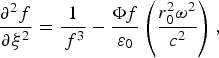
where 
 is the normalized ripple wave number. The first term on right-hand-side is due to diffraction while the second term is due to nonlinear self focusing. For an initially plane wave front the boundary conditions at ξ = 0 are: f = 1 and

We have solved Eq. (26) numerically. Figures 3 to 6 show the variation of the beam width parameter f as a function of normalized distance of propagation for different parameters. Figure 3 shows the variation for α1 = 0.02, α2 = 0.9, normalized ripple wave number d = 50 and normalized laser amplitude a 0 = 0.18−0.19. For a 0 ≤ 0.18 the beam slowly focuses and defocuses due to predominance of diffraction effects. At a 0 = 0.1815 the self focusing effect overall neutralizes the diffraction effect and the beam propagates in a mildly periodic manner, due to self focusing in the high density region and prevalence of diffraction in the low density region. Laser power corresponding to this value of critical power for self focusing may be treated as 
(Color online) Critical power at normalized laser amplitude a 0 = 0.18 –0.19, α1 = 0.02, α2 = 0.9, d = 50.

(Color online) Variation of f with ξ for normalized laser amplitude a 0 = 0.249 – 0.2515, where the critical power can be obtained at a 0 = 0.25, α1 = 0.01, α2 = 0.2 and d = 50.

(Color online) Comparison of beam width parameter at normalized laser amplitude a 0 = 0.249 – 0.5 at α1 = 0.01, α2 = 0.2, d = 50.

(Color online) Variation of beam width parameter f with distance of propagation ξ, for parameters α1 = 0.02, α2 = 0.9,  , d = 50 and d = 80, a 0 = 1.0.

Figures 4 to 5 show the behavior of self focusing for different values of a 0 = 0.249 – 0.5, while α1 = 0.01, α2 = 0.2,  , d = 50. At a 0 = 0.25, the self focusing effect overall neutralizes the diffraction effect and the beam propagates in periodic manner (Fig. 4), As we increase the value of normalized laser amplitude beyond the critical value, the laser undergoes self focusing in a periodic fashion. This corresponds to the critical power for self focusing at arbitrary values
 . At a 0 = 0.5, (Fig. 5) the beam width parameter monotonically decreases up to z = 0.55R d and beyond that monotonic increase in beam width parameter occurs. There is a strong focusing and the effect of density ripple is to overall increase the self focusing length.
Figure 6 shows the variation of beam width parameter and distance of propagation for a 0 = 1.0, α1 = 0.03,  , d = 59.65 experiment by Lin et al. (2006). Beam width parameter shows very different behavior at d = 59 and 65. At normalized ripple wave number d = 59, the beam width parameter decreases to minimun spot size to z = 0.15 R d and beyond it diffraction effects predominates. On increasing the ripple wave number to d = 65, the beam width parameter self focused and shows periodic focusing.
4. DISCUSSION
The presence of a density ripple in a plasma significantly modulates the phenomenon of self focusing. Uneven focusing/defocusing of the beam in the low and high density regions cause a ripple in the beam width parameter as a function of distance of propagation. The effect is more pronounced near the focus. For qR d = 65, α1 = 0.03, α2 = 0.9, r 0ω/c = 75, a 0 = 1.0 the beam width parameter shows periodic variation of f with ξ. However, for R d = 59 this behaviour is markedly different, the beam width parameter decreases with ξ, acquires a minimum and then rises again.
The minimum beam width parameter f min decreases with increasing laser intensity (a 02). The focusing length z min = ξminR d, at which f = f min, decreases with increasing a 02.
The present model is applicable to long pulses τ ≫ ωp−1, so that the electrons have enough time to move under the ponderomotive force. However, the pulse duration may be shorter than ωpi−1 otherwise ions will also follow the electrons, which we have ignored.
ACKNOWLEDGMENT
We thank Professor V. K. Tripathi for useful discussions.



