Introduction
Since coming to office in 1997, New Labour has introduced a plethora of initiatives aimed at preventing social exclusion among children, families and young people. Such mechanisms have been largely characteristic of the social investment state approach to policy, which includes investing in human and social capital, prioritising children as the citizen-workers of the future, being future-focused and redistributing opportunities as opposed to redistributing income (Lister, Reference Lister2003). Policies are seen as having an investment element in their tendency to encompass children, therefore acting to prevent future social exclusion (Jenson and Saint-Martin, Reference Jenson and Saint-Martin2003). The Teenage Pregnancy Strategy (TPS) is typical of such an approach, along with the New Deal for Young People and the Connexions Strategy. The importance of teenage motherhood as a policy issue for New Labour was confirmed by the publication of the Social Exclusion Unit (SEU) Teenage Pregnancy report of 1999. Targets for action centred on two themes: the prevention agenda and the support agenda. The former sought to halve the rate of teenage conceptions by 2010, while the latter aimed to get 60 per cent of young mothers into education, employment or training (EET) by 2010. It is the support agenda upon which this article focuses and, in so doing, questions whether EET is as important a consideration for teenage mothers as it appears for policy-makers concerning the use of support services.
The support agenda
The EET target was presented as a means of preventing the long-term social exclusion of teenage mothers, enabling them to raise their aspirations and ultimately become self-supporting. In addition, the EET target is seen not only as a way to improve current economic circumstances but also to prevent the children of teenage mothers becoming the citizen-claimants of the future. The Care to Learn (CtL) initiative is a key factor in progress towards the EET target, providing financial assistance to teenage mothers to assist with transport and childcare costs when engaging in further education (Dench and Casebourne, Reference Dench and Casebourne2004).
In 2001, the support agenda saw the introduction of the Sure Start Plus (SSP) pilot initiative, which ran in 20 existing Health Action Zones until March 2006. The programme targeted pregnant teenagers and teenaged parents aged up to 18 years and 11 months. At the outset, four main aims of SSP were established, which echoed the aims of the main Sure Start programme. These were to improve social and emotional wellbeing, learning and health, and to strengthen the families and communities of pregnant young women, young parents and their children. The organisational location of the service varied, with some advisers operating through institutions such as primary care trusts (PCTs) or social services departments, while others belonged to discrete units or multi-agency teams. July 2007 saw the publication of new guidance for local authorities and PCTs (Department for Children, Schools and Families, 2007). This continued many of the themes of SSP; the EET target remained prominent and CtL was to continue. The tone of the guidance also continued in a similar vein to previous initiatives, stating that teenage mothers ‘will not need to claim benefits in the long term as they will have the means to support themselves’ (Department for Children, Schools and Families, 2007: 56). A notable change in the support agenda is the channels through which it will be delivered. Support for teenage mothers will now be delivered through two mainstream channels: Children's Centres and Targeted Youth Support services. However, the commonality between these services is that a lead professional acts as a personal adviser, who also works in a brokerage capacity in referring teenage mothers to other services.
Throughout its operation, many concerns have been voiced as to the nature of the support agenda, particularly its apparent primary focus on EET (TPS Evaluation Team, 2005). It can be argued that the presence of an EET target for the teenage parent support arm of Children's Centres risks the initiative becoming target-led, as opposed to needs-led, and putting in jeopardy the involvement of teenage parents in developing the services they need. Duncan (Reference Duncan2007) has argued that the very nature of the support agenda is flawed due to the rationality mistake, whereby policy-makers assume that teenage motherhood is evidence of low expectations, whereas teenage mothers themselves see their motherhood as positive and rational, given the opportunities available to them. Many have criticised the NEET label (Not in Education, Employment or Training) insofar as it has negative connotations for those to whom it is applied (Yates and Payne, Reference Yates and Payne2006) and in its failure to capture the aspirations of young people (Shaw and Woolhead, Reference Shaw and Woolhead2006). However, it appears that the EET approach is not entirely at odds with the aspirations of young mothers. The evaluation of the TPS suggested that having a child provides motivation for young mothers to aspire to educational and employment goals that they previously may not have held. In addition, particularly among those in settled relationships with partners, the young women may wish to have a second or third child to complete their families prior to engaging in education, employment or training, which they will often postpone until their children are all at school (TPS Evaluation Team, 2005). Indeed, it has been noted that many women explicitly prioritise caring roles over any obligation they feel to participate in EET:
For a significant number of young working class women, identity and belonging are secured through informal rather than formal modes of participation. Critical here are not the paid worker identity and relationships with the labour market, but the unpaid carer identity and the mother child relationship. (Graham and McDermott, Reference Graham and McDermott2005: 33)
Supporting teenage mothers: the research evidence
Considering the ways in which support for teenage mothers is delivered, it can be argued that there are two mechanisms. First, support can be given on a one-to-one basis, in which teenage mothers are allocated a professional who will be their main point of contact with support services, much like the role of the SSP Personal Adviser outlined above. Secondly, support can be delivered on a group basis, in which teenage mothers receive support from a professional while with peers. It is noted that New Labour appears to favour the one-to-one method of supporting teenage mothers, while largely failing to acknowledge the value of the group mechanism (Kidger, Reference Kidger2004; McLeod et al., Reference McLeod, Baker and Black2006). McLeod et al.'s study investigated the nature of formal social support provision for young mothers in a city in the North of England and found that group support and activities were a largely underdeveloped area: ‘there were very few opportunities available for young parents to socially interact with one another to build support networks’ (Reference McLeod, Baker and Black2006: 461). It was argued that this was disappointing, given the potential of young parents to add to the social capital of communities. Further concerns to this end were voiced in the TPS evaluation: ‘there is still an unmet need for provision of real opportunities for young mothers to socialise and support one another and each other's children’ (TPS Evaluation Team, 2005: 82). It could be argued that this is part of a wider phenomenon of the personal adviser culture discussed by Garratt (Reference Garratt2002). Such mechanisms are evident in other initiatives to support young people, namely Connexions and the New Deal for Young People.
Turning to examine previous research that has evaluated the contribution of these two support mechanisms, the following points emerge. First, considering the one-to-one mode of support, it has been argued that this may be chosen as a means of building confidence prior to participating in group support (de Jonge, Reference de Jonge2001). However, the rationale behind the selection of one-to-one support does not appear to have been considered in any further detail, and this was echoed in studies examining group-based support. Regarding the functions of one- to-one support, the sole contribution in this area appears to be that of Wiggins et al. (Reference Wiggins, Rosato, Austerberry, Sawtell and Oliver2005) in their evaluation of SSP, in which they identified various factors pertaining to the provision of an intensive and comprehensive form of support, such as advisers being persistent with clients and acting as a gateway to other services. Literature on the group mechanism largely emanates from the USA, where support largely consists of programmes with a strong emphasis on parent education. However, it is argued that the group mechanism in itself acts to provide empathetic peer support (Censullo, Reference Censullo1994), increase general self-confidence (Weinman et al., Reference Weinman, Schreiber and Robinson1992; Censullo, Reference Censullo1994), increase confidence in parenting abilities (Letourneau et al., Reference Letourneau, Stewart and Barnfather2004), provide an opportunity to meet other teenage mothers and be free from the stigmatisation often experienced in general parents groups with older participants (de Jonge, Reference de Jonge2001). Lastly, there appears to have been no direct comparative study of one-to-one and group support modes carried out in the UK, and it can be argued that this is a significant gap in the literature, given the potential to establish the value of different modes of support to cater to a wide variety of support needs.
The study
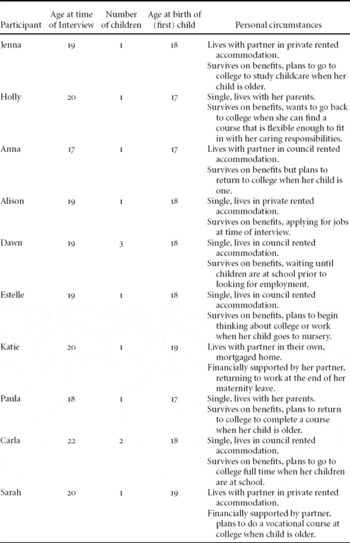
The findings are drawn from a wider PhD research project, of which experiences of formal support services were a key focus. There were a total of 20 participants, ten of whom used support that was delivered on a one-to-one basis and ten who used the group support mode. The participants came from the Midlands region and were recruited via the support services they used. Regarding the nature of these support services, the one-to-one support services closely followed the type of support advocated by the SSP initiative, whereby each teenage mother had a personal adviser. The group support services were similar to the more general mother and toddler groups popular among older mothers; they met once a week and any activities were planned in consultation with the participants. Each participant took part in a semi-structured interview, which was transcribed, coded and analysed through meaning condensation (Rubin and Rubin, Reference Rubin and Rubin2005), coding, context charts, and pattern coding (Miles and Huberman, Reference Miles and Huberman1994). Details of the backgrounds of the participants are included in Tables 1 and 2.
The participants from the one-to-one support service

The participants from the group support services

The interviews were structured around themes, which consisted of the following.
• The participant's individual circumstances, which included their experiences of motherhood, their informal support networks and their values and beliefs about education and work.
• The participants' experiences of stigma; how this manifested itself, their feelings about stigma and to what extent they felt affected by it.
• The participant's experiences of support services were investigated; why they had opted for a particular mode of support, what they had gained from participation and any criticisms.
Relevant comments made by the participants are included as extracts throughout the discussion of the findings within this article. The limitations of this study focus upon two points: participants were recruited on the grounds that they used formal support services, and thus the study excluded those who did not utilise these services. The inclusion of such individuals would have offered further insights into the reasons behind non-participation in formal support services. Following on from this, it might have been the case that those not engaging with formal support services might have drawn more extensively on informal modes of support, and it would have enhanced the study to be able to explore further the relationship between informal and formal support. The second point focuses upon the institutional context of the support services. All of the support services in this study were working through local PCTs, therefore only offering one institutional context for the research. Recruitment posters were displayed at support services of various institutional locations; however, the participants who came forward were those who used the services which worked through the PCTs. It would have been beneficial to the study to be able to consider whether the institutional location of the support service had an impact upon the participants' experiences of formal support. In particular, this would have enabled the observations made by Wiggins et al. (Reference Wiggins, Rosato, Austerberry, Sawtell and Oliver2005), that advisers based in Connexions prioritised the EET targets in their work, to be further investigated as to how this affected the support they were able to provide.
Selection of support services
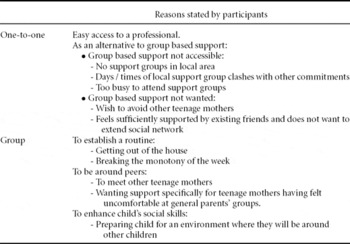
As had been established from examining the previous literature, little was known as to what factors were influential in an individual's selection of a mode of support: what made some more likely to opt for group support while others preferred one-to-one based support? The research aimed to contribute to the body of knowledge in this area by looking into the reasons stated by the participants for choosing a particular support mode and by examining the individual circumstances of those participating in one-to-one and group-based support. Table 3 provides a summary of the findings as to selection of a mode of support for the teenage mothers in this study.
Selecting a mode of support

Regarding the reasons stated by the participants for their choice of support mode, it can be observed that a key difference between the one-to-one and group support participants is that all of the group participants gave reasons that pertained to the choice of group support in itself, rather than as an alternative to other support modes. The latter was the case for some one-to-one support participants, who had chosen the one-to-one mode because they could not, or did not want to, access group support. Some one-to-one participants had selected this mode of support because group support was not available to them, while others stated that they wanted to avoid other teenage mothers, as they did not identify with them and, indeed, often made stigmatising comments towards other teenage mothers, which served to reinforce their beliefs that they were exceptions to commonly portrayed stereotypes. This contrasts sharply with the group support participants, all of whom stated at least one reason which related to a desire to be around their peers.
I used to mix with other young mums but I don't because, I don't know, . . . I feel a bit more mature. I don't do things like they do; they live with their mums and go out clubbing and things like that. I think I'm more independent than that and I want to be with my kids. [Danielle, one-to-one participant]
Another contrast appears when observing the second type of reason given by group support participants for choosing the group support mode, that of establishing a routine. It can be suggested that this reason relates to the fact that most of the group participants were postponing engagement in learning or work until their children were older. Therefore, they were unable to build a daily or weekly routine around the structure relating to college or employment experiences, and looked to the group support service, which ran on a particular day and time, as a means of establishing a regular routine. This diverges from the one-to-one support participants, some of whom were engaged in work and learning and subsequently had established routines around these activities; therefore they did not have such criteria in mind when selecting a mode of support. Indeed, wanting easy access to professional advice was stated as a reason for selecting one-to-one support. It could be argued that one-to-one support is a more practical mode for those mothers who cannot fit in around group support times.
It was just the same every day, stay at home, go to the shops, see my mates, not leave the estate. I wanted to just get away and do something to break up the week. [Paula, group participant]
Reasons pertaining to their children's social skills were stated by group participants but not one-to-one participants for choice of a mode of support. Examining this further, the following explanations for this difference can be suggested. First, the nature of group support was such that children would be interacting with other children, and may make development of the child's social skills a more explicit reason for choosing group support, compared to the nature of one-to-one support, which does not typically involve such interaction. A second explanation centres on the fact that some of the one-to-one participants were engaging in learning or work and had consequently enrolled their children in a nursery. Therefore, the development of their children's social skills was already being addressed by being in a nursery environment, so this was not of concern to the participants when selecting a mode of support.
I wanted to get him used to being around other kids because I'll be putting him in nursery soon. 'Cause he's the only one at home, yeah, it might have been a bit of a shock for him to realise that he's not the only baby in the world! I just want him to, you know, be nice to other kids and learn to share and stuff. [Katie, group participant]
Further insights can be gained through examining the backgrounds of the participants. Taking firstly their existing modes of informal support, group participants were likely to have substantial informal support networks, consisting of family and partners or friends. This was not the case for one-to-one participants, whose informal support networks were more limited. Therefore, for group support participants, involvement in a group of peers could be suggested as complementary to the informal support they already had, enabling them to establish additional friendships outside of their existing networks. However, the choice of one-to-one support could be interpreted, for some, to be an attempt to establish support that was regular and reliable, as informal support from their existing sources was sometimes changeable, if present at all. Therefore, while the choice of one-to-one support can be interpreted as a step to establish support, the choice of group support can be interpreted for some as a move to expand it.
In terms of the participants' views of motherhood, a notable difference was that some one-to-one participants stated that their motherhood had been a turning point away from negative behaviour, whereas none of the group participants stated this. It can be argued that these participants therefore believed themselves to be in need of the advice of a professional in the form of a personal adviser. Having previously engaged in negative behaviour, they may have wanted to ensure that they stayed on the right track and had access to advice that would help them cope better with motherhood. However, as the vast majority of participants from both the one-to-one and group support services stated that their view of motherhood was positive, one cannot conclude that view of motherhood influences the choice of support service any further than the point discussed here.
The findings also discovered relationships between the participants' values as to education and work and their choice of support service. Participants in the one-to-one support services were likely to have wanted to, or experienced pressure from others, to participate in EET as soon as was possible and believed that they could combine being a mother to a small child with work or learning. This contrasts with the group support participants, who were unlikely to want to engage in EET imminently. While the majority of group participants wanted to engage in EET in the future, they wished to postpone it in order to spend time with their children while they were babies and toddlers. This can be argued to have had an influence on the choice of support in the following ways. One-to-one support may be considered conducive to early participation in EET as the personal adviser may be envisaged by the participants as a first source of contact for enrolling in a college course or embarking upon an employment search. This is not a pressing concern for the group participants, who are postponing their engagement in EET, and therefore their choice of a support service would not have involved this type of concern, at least not initially.
Functions of support services
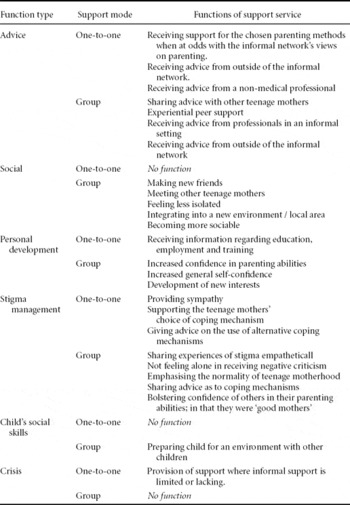
The second focus of this article is upon the functions of one-to-one and group support services, in what ways are they similar and how they differ? While previous literature has examined functions of support services, it has done so to a limited extent and lacks a comparative focus. This study identifies a wide range of functions being carried out by support services, which can be grouped into the following categories: advice, social, personal development, stigma management, child's social skills and crisis. These functions of the support service are laid out in Table 4.
Functions of support services compared

Advice
One-to-one support fulfils an advice function where participants receive advice from the advisers as to their parenting methods when requested and, in so doing, are able to access a source of advice outside of the informal support network and from a non-medical professional. However, the advice function of one-to-one support is limited to the advice that is provided by the professional adviser who, in the event of not having been a teenage mother herself, is unlikely to be able to provide the experiential advice that was provided by the group mode of support. The advice function of group support is wider than that of one-to-one support, in including advice from peers and being able to approach a professional for advice in an informal setting. Therefore, both support services include the provision of professional advice, but group support goes further than one-to-one support in including an experiential element.
You meet people in the same boat as you basically and you feel you're not going through it on your own; you're doing it with other people. It's like . . . you've got your experience of being a mum but you're sharing theirs as well, sometimes they have things that go wrong with them and then you're more aware of things. [Anna, group participant]
I think that somebody who's been through the situation has got a better outlook on things than someone who's read books and stuff . . . I don't think you can explain to anybody what it's like to have a baby when you're younger. [Kaitlin, one-to-one participant]
Social
The social functions of group support – for example, making new friends – are largely absent from the one-to-one support service. While the one-to-one participants may feel that they have made a friend in the adviser, some of them had actively chosen to avoid other teenage mothers, therefore excluding themselves from the benefits of social functions. Considering the one-to-one participants who had not explicitly stated a wish to avoid other teenage mothers and who would have participated in group support had it been available in their area, factors beyond their control had conspired to exclude them from participating in group support and hence benefiting from the social functions that group support includes.
I like it here basically because I haven't been here long, on the estate, and I get to meet like new mums and that my age . . . If this wasn't here I think I'd feel quite isolated. [Alison, group participant]
I've got my sisters and my friends but it's good to meet different people, we see each other outside the group as well so it's good to be able to socialise. [Carla, group participant]
Personal development
The personal development functions of group support – increased confidence in parenting abilities, increased general self-confidence and developing new interests – stem from the social functions of this mode of support. For example, making new friends and integrating into a new local area may lead the participants to become generally more self-confident and open to developing new interests. The advice received from both the professional running the group and other teenage mothers helps to develop confidence in parenting abilities. However, due to a lack of interaction with other teenage mothers, the one-to-one service does not provide solid social bases upon which personal development functions can be built and they are limited to individualistic ends, namely receiving information about education, employment and training.
I've got more confident too, some of the things we do here are great, like salsa dancing and stuff. [Estelle, group participant]
I was a bit, well, a bit quiet when I first come here. Not like I didn't speak to anybody but now like, I speak to them all . . . It's a relaxed atmosphere like, you don't have to do certain things, you just do it when you want. [Sarah, group participant]
Stigma management
All of the participants in the study had stated that, as teenage mothers, they felt stigmatised, and all reported negative experiences as a result of this, ranging from negative comments from the general public to experiences in their use of public services which led them to feel they were being discriminated against. Support services, it is suggested, could have a role to play in mitigating the effects of the stigmatising experiences reported by teenage mothers. From the findings of the study, it can be argued that group support services provide more functions than one-to-one support services in this area. The social function provides a base upon which to manage stigma's effects in providing access to peers with whom one can identify and discuss experiences of stigma.
People automatically assume that you have a baby to get a house and get on benefits. Some might but not in every case and we're all stereotyped . . . I just think, I'm not the one with the problem, they are. [Lynsey, one-to-one participant]
You get people like look at you in the street and stuff like that and old dears tutting at you . . . It doesn't really bother me . . . We all think it's a bit of a joke to be honest, we're all old enough to make babies so what's the problem with it? We all do a good job of it, we're mums and that's it really. [Sarah, group participant]
A few times when I've been to the clinic to get them weighed and that, I go with my mum. And the nurses and that, they talk to my mum, rather than to me, they treat me as if I'm a child. Sometimes I've actually said something like, ‘Look, I'm their mum!’, and they've been alright after that. [Dawn, group participant]
Child's social skills
Both one-to-one and group support may have benefits for the social development of the children of teenage mothers. It has been argued previously that one-to-one participants may ask their personal advisers for information on parenting techniques which, in turn, may lead to enhanced development of the child's social skills. However, the function of group support in providing children with experience of interacting with other children is absent from one-to-one support. The role of the support services in this regard fulfils more immediate needs in children's development than the longer-term goal of the support agenda, preventing the social exclusion of teenage parents and their children and, in so doing, could be argued to contribute towards this long-term goal.
Crisis
It can be argued that one-to-one support exclusively carries a crisis function. Its partial replacement of informal support is a strength in this regard, providing access to an adviser whose support will be consistent and reliable, vital to those for whom informal support is absent or changeable. Participants to whom this applied also valued the fact that advisers were easily contactable and available via telephone whenever they needed to talk to them. For some teenage mothers, access to a personal adviser is an advantage one-to-one support has over group support, which will often only be available on a particular day of the week between certain times.
It's ideal for young mums who haven't had family to support them, which I haven't. [Selena, one-to-one participant]
When I did tell my mum, she was like, ‘You're on your own’. . . [The adviser] doesn't judge or try to say, ‘well I think you should be doing this’, she doesn't do anything like that; she just lets you get on with what you're doing. She made me feel quite confident and reassured me that everything was going to be alright. [Lynsey, one-to-one participant]
Discussion
The previous sections have highlighted that teenage mothers have widely varying support needs; they will be attracted to a particular mode of support due to their own reasons and circumstances and will experience different benefits from support services according to their needs and preferences. This section considers the policy implications of the research, referring back to the policy mechanisms concerning the support available to teenage mothers. The SEU report (1999) had stated that teenage parents get little of the ‘right’ support, that being: ‘help back into education, into a proper job, proper housing and advice on how to be a good parent’ (SEU, 1999: 62). This study indicates that the support services in this study are indeed providing the ‘right’ support, providing information to participants as to re-engaging in EET and help as regards parenting skills. Re-engaging in EET would appear to be a more prevalent concern among the one-to-one support service participants than the group participants, as they were more likely to want to re-engage in EET soon after the births of their children. The continuation of CtL is to be welcomed as this will continue to assist teenage mothers to participate in education. However, it is argued that extending eligibility to a broader age group would enhance the likelihood that those currently postponing EET will in time re-engage and, indeed, HM Treasury have emphasised the value of maternal time spent with children and warned that full-time employment in the very early stages of a child's life ‘could negatively affect the development of some children’ (2004: 7).
What is sought from a support service varies widely in accordance with individual circumstances. For example, there were some participants who wanted easy access to professional advice and used the one-to-one support service in order to ask for help as to parenting methods, while there were others who wanted to integrate into a new area, having recently relocated. They used group support as a way of meeting other teenage mothers and making new friends. Support should therefore be about much more than EET, respecting the values and life choices of teenage mothers. Furthermore, considering the NEET label, it does indeed carry negative connotations, indicating that those who are NEET are effectively doing nothing, and therefore does little to dispel the perceptions held by many that Britain's welfare system rewards teenage mothers. These multiple factors influencing an individual's selection of a support mode highlight the importance of choice in the support available. Some of the participants came across as particularly vulnerable and in need of more intense support. They were typically one-to-one support participants who had little or no informal support and believed themselves to require professional help to stay on the right track. Others left the impression that they were largely independent and were using the support services for different reasons, mainly with a view to enhancing their social networks. The findings indicated that choices are often restricted: for example, some participants were choosing one-to-one support because group support was not available. This had been previously recognised by McLeod et al. (Reference McLeod, Baker and Black2006), who argued that this was disappointing given the potential of young parents to add to the social capital of their communities. Indeed, the group support service fulfilled a social function, which was not evident in the one-to-one support service, whereby participants met other teenage mothers, made friends, integrated into a new area and, as a result of these factors, often felt less isolated. While one-to-one support initiatives should continue to meet the needs of those who choose such support, it is argued that equal attention needs to be paid to group support services. Children's Centres could provide opportunities for the extension of group support services, although current proposals have only gone as far as presenting Children's Centres as venues for personal adviser-based support; they could indeed be used to set up teenage parents' groups, particularly in areas which previously had no such community centre provision. Group support is prevalent among older mothers, given the popularity of mother and toddler groups, and teenage mothers should also be given the opportunity to participate in such support. However, it is somewhat questionable whether this would be endorsed by policy, given its propensity to label teenage mothers as ‘at risk’ of negative outcomes and ‘in need’ of guidance, hence separating them from older mothers whose motherhood is perceived as more socially acceptable.
The study also highlighted the way in which support services perceive teenage mothers. There is a tendency for policy to alternate between treating teenage mothers as victims of their socio-economic circumstances on the one hand, while apportioning blame to them for planning their pregnancies to secure benefits and housing on the other hand. However, at no time did the support services appear to have either treated the participants as helpless victims, or apportioned blame. The support services in this study appear to have adopted a view of their role as assisting their participants to become empowered to pursue the ends they aspired to, whether or not they were EET related. Secondly, and related to this point, while the support agenda at national level appears to be largely EET focused, this is not played out at local level, but this is far from being a negative observation. The support services, through their experience, have learned that a needs-led approach is often the most effective in reaching teenage mothers, respecting their differential values, tailoring support to suit them and resisting from placing pressure on participants to follow paths that will result in the achievement of nationally imposed objectives. The continuation of the EET target as the most significant part of the support agenda does nothing to recognise the value of the additional functions identified in this study, such as crisis support, advice, socialising, personal development, stigma management and development of child's social skills. However, it is likely that the EET target will continue to be the significant indicator of the success of the support agenda, as it is easily quantifiable (Graham and McDermott, Reference Graham and McDermott2005) and represents the normative tendency of the social investment state to be future oriented both in terms of aiming to decrease the long-term benefit dependency of teenage mothers and act to prevent the intergenerational transmission of poverty to their children.
Conclusions
Teenage mothers are a highly heterogeneous social group, some of whom are particularly vulnerable to becoming isolated, not only from the labour market but also from their communities and support structures, while others are largely independent, well supported and integrated into the communities in which they live. This implies vastly different support needs. Government advocates an altogether limited approach to supporting teenage mothers in advocating advice of an intensive, one-to-one nature with a view to encouraging re-engagement in EET. However, those working with teenage mothers have adopted working practices that are respectful of varying choices and values, whether or not these are EET-related. It is important that support workers are able to continue working with this discretion; therefore, it needs to be ensured that policy does not become coercive in nature, as has been the case recently concerning the pressure upon single parents to return to work within a specific time period. To do so would be to alienate teenage mothers from the valuable functions that support services perform aside from preparation for EET. As a final point, the involvement of teenage mothers in developing the support services available to them, as recommended by recent guidance (Department for Children, Schools and Families, 2007), will provide the opportunity for the wants and preferences discussed in this research to be further identified and acted upon.
Acknowledgements
I am grateful to Ian Taylor for comments and suggestions on the drafting of this article as well as the comments of the anonymous referees. I would also like to thank the support services for their assistance in recruiting participants and the teenage mothers who agreed to take part in the study.