Terricolous mat-forming lichens in the genera Cladonia subgenus Cladina, Stereocaulon, Cetraria, Flavocetraria, and Alectoria are major components of the ground vegetation and major primary producers in the subarctic (Larsen Reference Larsen1988; Ahti & Oksanen Reference Ahti and Oksanen1990), and are also locally abundant in temperate heathlands (Brown et al. Reference Brown, Horsfield and Thompson1993). In view of the ecological importance of this group of lichens, several authors have measured their growth rates for the purpose of examining 1) differences among species (Kärenlampi Reference Kärenlampi1971), 2) seasonal effects (Kytöviita & Crittenden Reference Kytöviita and Crittenden2002), 3) performance in contrasting climatic regions (Hyvärinen & Crittenden Reference Hyvärinen and Crittenden1998), as well as 4) the effects of other experimental treatments (Ellis et al. Reference Ellis, Crittenden, Scrimegeour and Ashcroft2005; Kytöviita & Crittenden Reference Kytöviita and Crittenden2007). When setting up growth experiments, apotheciate thalli have usually been avoided due to concerns that growth rates of fertile podetia might differ from those that are non-fertile and thus contribute to unnecessary variability amongst replicate measurements.
Investment in sexual reproduction carries a high metabolic cost (Xu Reference Xu2005). Jahns and co-workers (Jahns et al. Reference Jahns, Sensen and Ott1995, Reference Jahns, Hardt and Ott2004; Jahns & Ott Reference Jahns and Ott1997) have suggested that apothecium production in Cladonia spp. can result in decreased vegetative growth. In the case of C. floerkeana, a species in which there is a large sexual reproductive effort, one to several apothecia are produced on the majority of podetia which subsequently die (Jahns & Ott Reference Jahns and Ott1997). Production of apothecia in Cladina spp. is relatively infrequent, the principal means of propagation being thallus fragmentation resulting from physical damage when thalli are dry and brittle (Thomson Reference Thomson1967; Yarranton Reference Yarranton1975; Crittenden Reference Crittenden2000). As is typical of the subgenus Cladina, only occasional podetia within a population are fertile. For example, Ahti (Reference Ahti1961) estimated that in continuous ground cover of Cladina spp. at least one fertile podetium is likely to occur per square metre. However, on these relatively infrequent fertile podetia there is synchronous production of numerous (e.g. >100) apothecia (Jahns & Beltman Reference Jahns and Beltman1973; Jahns & Ott Reference Jahns and Ott1997; Jahns et al. Reference Jahns, Hardt and Ott2004) and, hence, the question arises as to whether such large scale reproductive effort might be associated with reduced growth rate. To address this question, we compared growth rates in abundantly apotheciate and non-apotheciate thalli of Cladonia portentosa (Dufour) Coem., a common heathland lichen in the British Isles. The method employed for measuring growth has been used previously in several studies on mat-forming lichens (see references to Crittenden and co-workers above).
Sixty podetia, 30 with apothecia and 30 without, were collected in their naturally hydrated state from an ombrotrophic bog at The Halsary, Caithness, Scotland (Nat. Grid Ref. ND 195 493) on 25 October 2005. Vegetation at The Halsary is classified as a Calluna vulgaris-Scirpus cespitosus blanket mire (Rodwell Reference Rodwell1991), and large cushions of C. portentosa were very common. Podetia were removed from naturally hydrated, well-formed cushions of C. portentosa, and cut in the field to a uniform length of 50 mm (measured downwards from the apex). Each sample was collected from a cushion >10 m apart from other replicates, otherwise the selection of both cushions and podetia was subjective. Samples were sealed in 100 ml plastic vials and transported to the laboratory, where they were cleaned of any extraneous debris and air-dried overnight. Powder-free latex gloves were worn at all times when handling the lichen samples. Air-dried podetia were weighed and tagged with a small acetate identification label attached by polyester thread. The oven dry mass of each podetium (after 24 h at 80°C) was estimated using the air dry: oven dry mass ratio determined for ‘dummy’ thalli that were treated in the same manner as experimental thalli. Note that estimating oven dry mass by this method is very accurate, the difference between mean measured and mean estimated oven dry mass (n=10) for C. portentosa was <0·1% (see also Crittenden Reference Crittenden1998).
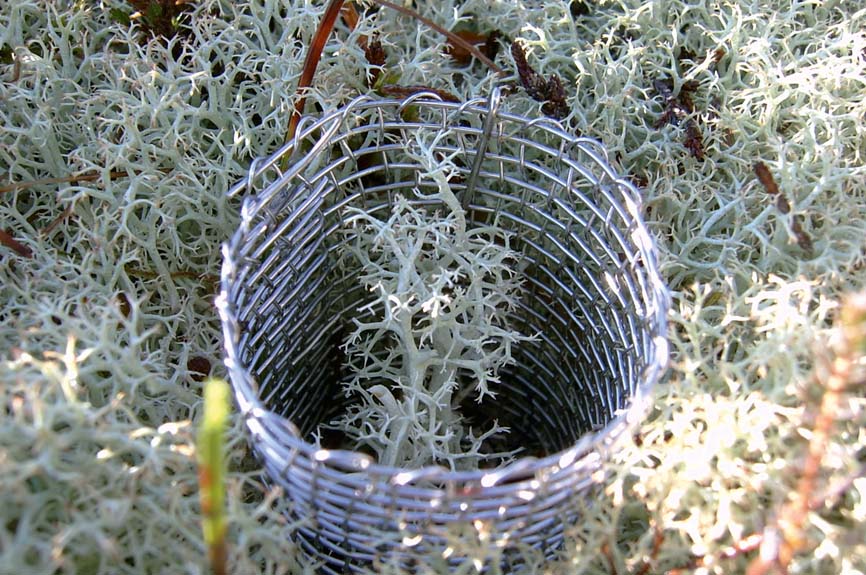
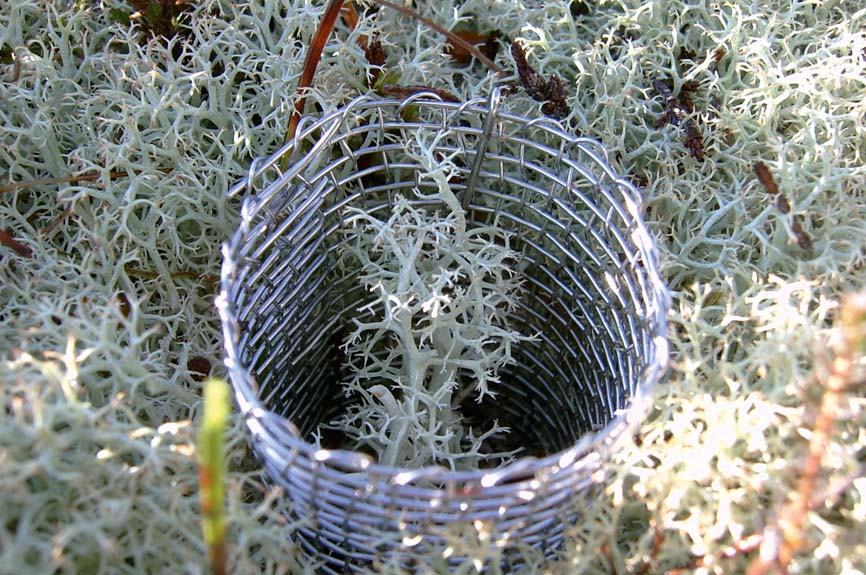
Podetia were then returned to the field on 26 October where they were inserted into otherwise undisturbed C. portentosa mats (T 0 ). Gaps in the lichen mats were created by embedding cylindrical cages of stainless steel mesh (c. 35 mm diam.×85 mm high; 0·4 mm gauge wire with 16 holes cm–2) vertically into lichen cushions (Fig. 1). The diameter of the cages was selected to provide sufficient support to maintain podetia in a ±vertical position, while not unduly constraining lateral growth. Our experience has been that snagging of the podetia on to the steel wire by, for example, lateral growth through the mesh occurs relatively infrequently, perhaps because of the small mesh size and the smooth nature of the steel wire, and perhaps because growth of mat-forming lichens is principally by vertical extension. However, dry thalli are prone to snagging on the wire mesh when being placed into, or being removed from, the cages and these operations were always carried out with thalli in the hydrated state. Approximately 3–6 cages were inserted into each lichen cushion, a mixture of both non-apotheciate and apotheciate podetia being placed within each cushion, and all replicates were located in an area c. 20×20 m. The mesh cages were open at the top and plugged at the base with c. 30 mm depth of compacted lichen ‘litter’ (necromass) to provide a stable substratum permeable to rainwater and to raise the apices of experimental thalli to the same height as surrounding thalli in the intact lichen cushion. Subsets of 15 podetia of each type were harvested after one (T 1 ) and two (T 2 ) years' growth on 28 November 2006, and 22 November 2007, respectively. A small proportion of podetia were lost; the final numbers retrieved ranged between 13–14 in all treatments (Table 1). At each harvest, the longest length of each podetium (straightened if necessary) in the fully hydrated state was measured in the field. Samples were then returned to the laboratory, cleaned, air-dried overnight and re-weighed. Oven dry mass was again estimated as above.
A podetium of Cladonia portentosa placed into a cylindrical stainless steel mesh cage which was inserted into an otherwise undisturbed lichen cushion. In colour online.
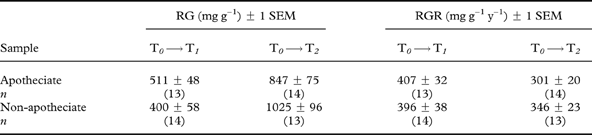
Mean relative growth (RG) and relative growth rate (RGR) values for apotheciate and non-apotheciate thalli of Cladonia portentosa recorded between T0⟶T1 and T0⟶T2 at The Halsary, Scotland. The number of thalli recovered from the field are given in parentheses

Relative growth (RG, mg g–1) and relative growth rate (RGR, mg g–1 y–1) were calculated following Hunt (Reference Hunt1982)
 $${\rm RG}= 1000 \left( {m_{\rm Tx+1}- m_{\rm Tx}\over m_{\rm Tx}}\right)$$
 $${\rm RG}= 1000 \left( {{\rm ln}\ m_{\rm Tx+1}- {\rm ln}\ m_{\rm Tx}\over {_{{\rm Tx+1- Tx}}}}\right)$$
where m is mass (g), T is time (y) and x is the harvest number.
Statistical analyses were performed in SPSS-PASW Statistics v. 18.0, all data being checked for normality and, where necessary, homogeneity of variances. In cases where data did not meet test assumptions, a log10 transformation was applied. Two-way ANOVA (where treatments were sexual state and growth interval) with LSD post-hoc tests were performed to identify any significant differences between samples. The relationship between length and mass of podetia was determined using Pearson's correlation analysis.
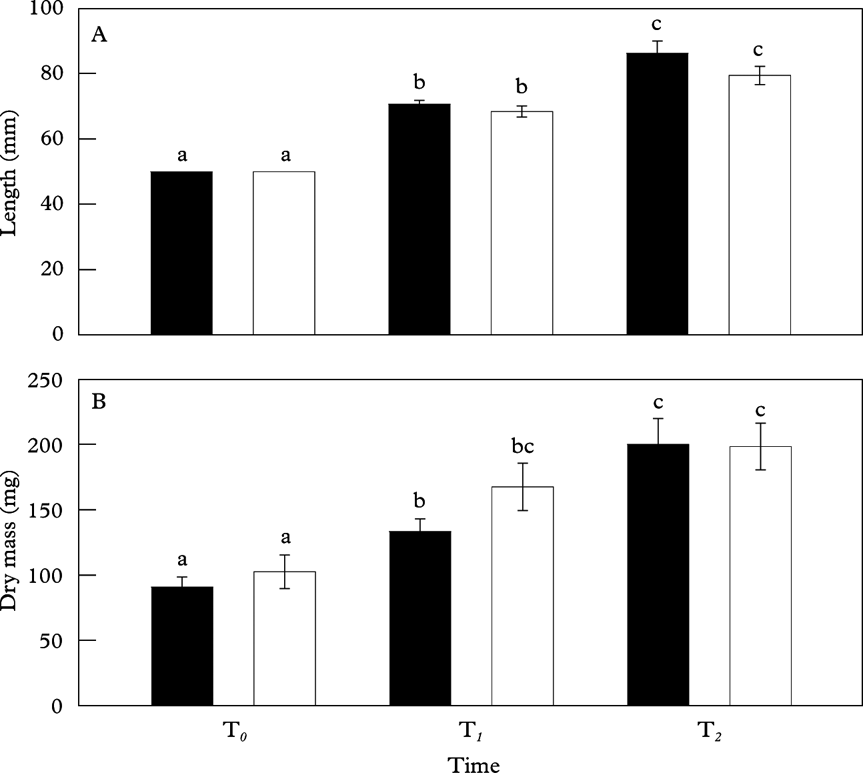
All podetia achieved readily measurable increases in length and mass during the one year (T 0 ⟶T 1 ) and two year (T 0 ⟶T 2 ) growth periods (Fig. 2). However, there were no significant differences in growth rate between apotheciate and non-apotheciate podetia (P>0·161), the RGR for both classes of podetia being c. 300–400 mg g–1 y–1 (Table 1). These values are in line with those reported previously (270–440 mg g–1 y–1) for non-apotheciate podetia of the same species grown using a similar culture method (Hyvärinen & Crittenden Reference Hyvärinen and Crittenden1998; Ellis et al. Reference Ellis, Crittenden, Scrimegeour and Ashcroft2005).
Mean length (A) and dry mass (B) of podetia of Cladonia portentosa selected as non-apotheciate (black bars) and apotheciate (white bars). Measurements were taken at the start (T 0 ), after 1 years' growth (T 1 ) and after two years' growth (T 2 ) at The Halsary, Caithness. Plotted values are means (n=13–14) ± 1 SEM. Columns given the same letter are not significantly different at the P<0·05 level.

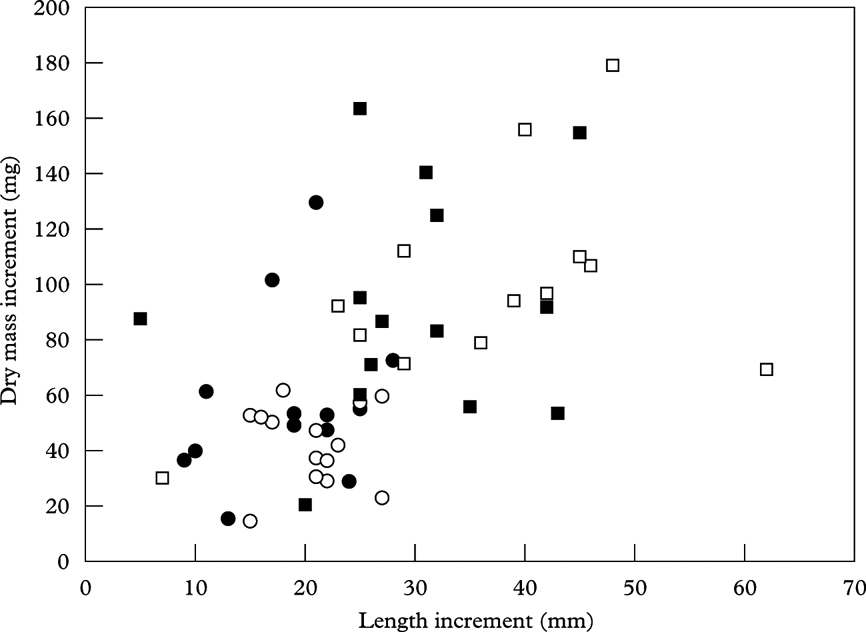
There was a significant positive correlation between the length and mass of podetia of C. portentosa, regardless of reproductive state (r=0·428, P=0·001, Fig. 3). The majority of new growth in this species appears to be associated with an increase in podetium height; mean annual length increment for both classes of podetium was c. 18 mm y–1 (Fig. 2). Ellis et al. (Reference Ellis, Crittenden, Scrimegeour and Ashcroft2005), also working with C. portentosa, reported a similar value (c. 18 mm y–1) which they considered to be relatively high among lichen species. At T 1 and T 2 , it was noted that new non-apotheciate branches commonly developed in those podetia, selected as fertile at T 0 . This is consistent with Jahns et al.'s (Reference Jahns, Hardt and Ott2004) observation on C. rangiferina, that new non-apotheciate branches frequently develop alongside branches bearing numerous apothecia; these non-fertile branches rapidly become the new terminal apices of the lichen cushion. The continued growth of apotheciate podetia by subsequent vertical extension of new non-apotheciate branches could be advantageous if it ensures continued development of deep mats, which maximize nutrient acquisition and light interception, whilst also casting deep shade which can suppress the germination of vascular plant seeds (Crittenden Reference Crittenden1991).
Relationship between length and estimated dry mass increments in podetia of Cladonia portentosa (r=0·529, P<0·001). Symbols refer to the sexual state of thalli and the harvest at which measurements were made: T 1 (•, apotheciate thalli; ○, non-apotheciate thalli), T 2 (▪, apotheciate thalli; □, non-apotheciate thalli), n=13–14.

The present results suggest that the reproductive state of podetia does not significantly influence growth rate in C. portentosa. Nonetheless, the possibility remains that growth rates are lower during the period of apothecial development, as distinct from the period post-development. However, identification of podetia at early stages of apothecium development would probably be difficult.
We thank Forestry Commission Scotland for granting access to The Halsary and S. Gibb for providing laboratory facilities at the Environmental Research Institute, Thurso. This research was funded by the School of Biology, (now School of Life Sciences) University of Nottingham.