


Introduction
According to cognitive conceptualizations of social anxiety disorder (SAD), individuals with SAD engage in a ruminative process following social situations called post-event processing (PEP; Clark and Wells, Reference Clark, Wells, Heimberg, Liebowitz, Hope and Schneier1995; Rapee and Heimberg, Reference Rapee and Heimberg1997). In line with such models, significant associations between PEP and social anxiety have been found in individuals with SAD (e.g. Abbott and Rapee, Reference Abbott and Rapee2004; Kocovski and Rector, Reference Kocovski and Rector2008; Laposa and Rector, Reference Laposa and Rector2011; Perini, Abbott and Rapee, Reference Perini, Abbott and Rapee2006) as well as non-clinical samples (e.g. Dannahy and Stopa, Reference Dannahy and Stopa2007; Hodson, McManus, Clark and Doll, Reference Hodson, McManus, Clark and Doll2008; Kocovski and Rector, Reference Kocovski and Rector2007; Rachman, Gruter-Andrew and Shafran, Reference Rachman, Gruter-Andrew and Shafran2000). Brozovich and Heimberg (Reference Brozovich and Heimberg2008) provided a review of research on PEP that clearly supports its importance. When individuals engage in PEP, they perform a highly detailed analysis of how they performed socially, which selectively focuses on negative elements. With repetition, PEP may alter memories of the event (see Brozovich and Heimberg, Reference Brozovich and Heimberg2008; Cody and Teachman, Reference Cody and Teachman2010), and perpetuate further anxiety in social situations. As such, PEP serves an important maintenance function in those with SAD.
Precedent research has explored PEP in social anxiety using vignettes (e.g. Kocovski, Endler, Rector and Flett, Reference Kocovski, Endler, Rector and Flett2005), retrospectively (e.g. Rachman et al., Reference Rachman, Gruter-Andrew and Shafran2000), or following a standard speech task (e.g. Abbott and Rapee, Reference Abbott and Rapee2004; Edwards, Rapee and Franklin, Reference Edwards, Rapee and Franklin2003; Perini et al., Reference Perini, Abbott and Rapee2006). Few studies have examined present and real social events (e.g. Kocovski and Rector, Reference Kocovski and Rector2008; Laposa and Rector, Reference Laposa and Rector2011). An ecologically valid event poses an excellent stimulus for possibly activating PEP, and would enable us to better understand its nature and specificity. Attendance at the first session of a group anxiety treatment would be an ecologically valid event for those with anxiety disorders. Laposa and Rector (Reference Laposa and Rector2011) demonstrated that among individuals with SAD, peak anxiety level during an in-session exposure midway through a course of CBT was associated with PEP for that event assessed a week later. Further, few studies have examined PEP in the treatment context, using large, well diagnosed, treatment-seeking anxiety disorder populations receiving CBT, and using a largely prospective design.
Research on PEP has focused primarily on its relationship with social anxiety, and there is a strong empirical basis in support of PEP in SAD as a key maintenance process. In contrast to examinations of rumination, we are unaware of any studies examining the specificity of PEP to social anxiety in the context of other clinical anxiety disorders. However, there is evidence that other repetitive thinking constructs, such as worry and trait anxious rumination, have been shown to apply to anxiety conditions more generally and may be transdiagnostic. A transdiagnostic process is a cognitive or behavioural process that is similar across psychological disorders that may contribute to the maintenance of psychopathology (Harvey, Watkins, Mansell and Shafran, Reference Harvey, Watkins, Mansell and Shafran2004). Repetitive thought is related to mood and anxiety symptoms in prospective longitudinal studies (see Watkins, Reference Watkins2008 for a review). Worry, which is often thought of as generalized anxiety disorder (GAD) specific, is heightened across anxiety disorders (Kertz, Bigda-Peyton, Rosmarin and Björgvinsson, Reference Kertz, Bigda-Peyton, Rosmarin and Björgvinsson2012). Similarly, trait anxious rumination has also been shown to be relevant across many anxiety disorders except specific phobia (e.g. Rector, Antony, Laposa, Kocovski and Swinson, Reference Rector, Antony, Laposa, Kocovski and Swinson2008). Thus, repetitive thinking constructs related to content that focuses on future uncertainty/danger, and related to the anxious state, are pertinent to several anxiety disorders and may represent transdiagnostic processes. PEP is hypothesized to be a specific form of rumination that begins after one exits a social situation, and can maintain social anxiety (e.g. Clark and Wells, Reference Clark, Wells, Heimberg, Liebowitz, Hope and Schneier1995). Additional research is warranted in order to explore whether PEP is specific to SAD or whether PEP represents a transdiagnostic cognitive process across the anxiety disorders. This would be a starting point in examining the potential contribution of PEP to the maintenance of anxiety disorders in general.
According to cognitive theories of SAD (e.g. Clark and Wells, Reference Clark, Wells, Heimberg, Liebowitz, Hope and Schneier1995), state activated PEP serves an anxiety maintenance function. Research has yet to examine PEP as a state activated process across anxiety conditions, in the context of a personally meaningful situation. Rachman et al. (Reference Rachman, Gruter-Andrew and Shafran2000) raised the question of whether PEP would exist in other anxiety disorders. They suggested that other than social anxiety disorder, it may be most common in OCD, due to obsessions’ similarity to PEP in terms of both being recurrent, unwanted and intrusive. To compare transdiagnostically, a starting point is to use a stimulus event that is comparable, thereby minimizing variance due to features of the event. We chose the first group treatment session to serve as this stimulus. Heimberg and Becker (Reference Heimberg and Becker2002) report that it is often challenging for clients with social anxiety to attend the first session of a group based treatment. The first session of treatment is likely to be personally meaningful for everyone in attendance. Clients meet strangers with a similar diagnosis and concerns, and start officially working on decreasing their anxiety symptoms. It remains to be determined whether those with anxiety disorders other than SAD would also find the first session to be as anxiety provoking. However, while the group context invariably presents the possibility for social evaluation, it is expected that this situation would be anxiety provoking for most participants irrespective of it being held in a social milieu.
The current study sought to examine: 1) levels of PEP for a standardized event (i.e. the first session of group CBT) in different anxiety disorders; 2) the relationship between peak anxiety levels during the first treatment session and subsequent PEP; and 3) the relationship between PEP and disorder-specific symptom severity. Three hypotheses were tested: 1) PEP will be rated higher in participants with SAD compared to all other anxiety disorder groups examined; 2) higher levels of anxiety during the first treatment session will be associated with greater engagement in subsequent PEP over the following week, particularly in those with SAD; and 3) PEP will be positively associated with symptom severity for those with SAD.
Method
Participants
The sample for this study included 233 treatment-seeking individuals diagnosed using Diagnostic and Statistical Manual of Mental Disorders (4th ed., text rev.; DSM-IV-TR) criteria (American Psychiatric Association, 2000) with a primary anxiety disorder of: SAD (n = 45), obsessive-compulsive disorder (OCD; n = 61), generalized anxiety disorder (GAD; n = 65) or panic disorder with/without agoraphobia (PD/A; n = 62). Diagnoses were based on the Structured Clinical Interview for Axis I Disorders (SCID-1/P; First, Spitzer, Gibbon and Williams, Reference First, Spitzer, Gibbon and Williams1996, Reference First, Spitzer, Gibbon and Williams2002). After completing the SCID, participants completed a brief semi-structured interview to screen for suitability for group-based outpatient CBT for their primary anxiety disorder. Additional exclusion criteria were as follows: 1) active substance abuse/dependence within 3 months of study entry; 2) recent suicide attempt/active suicidality; 3) current self-injurious behaviour; 4) recent adequate course of CBT/current additional CBT for their primary anxiety disorder; and 5) active bipolar or psychotic disorder. Predoctoral and doctoral level assessors with extensive formal training and experience in the administration of SCID interviews conducted the diagnostic assessments. Predoctoral assessors received supervision by a senior clinician to ensure accuracy of diagnoses.
The sample comprised 63% women and 37% men. Participants had a mean age of 34.22 years (SD = 11.62) and the majority were single (61%) and Caucasian (76%). This study was performed in compliance with the standards established by the Research Ethics Board (REB) where the research was conducted. Participation was voluntary and all participants gave their informed consent.
Measures
Post-Event Processing Questionnaire (PEPQ; Rachman et al., Reference Rachman, Gruter-Andrew and Shafran2000). The PEPQ assesses post-event rumination in response to an anxiety-provoking situation. This study employed the 7-item revised self-report version of the PEPQ. The three non-loading items from the 10-item version were excluded (cf. Kocovski and Rector, Reference Kocovski and Rector2008; Laposa and Rector, Reference Laposa and Rector2011; Lundh and Sperling, Reference Lundh and Sperling2002). Items were rated on a visual analogue scale, and then converted to ratings out of 100. All items were responded to with respect to the first treatment session. Examples include “Did your memories and thoughts about the first group session keep coming into your head even when you did not wish to think about it again?” and “Did you ever wish that you could turn the clock back and re-do it [the first group session]- do it again, but do it better?”. Reliability in the current study was adequate, α = .82. The PEPQ correlates significantly with severity of social anxiety symptoms (e.g. Rachman et al., Reference Rachman, Gruter-Andrew and Shafran2000; Laposa and Rector, Reference Laposa and Rector2011), and is elevated in those high in social anxiety vs. those low in social anxiety (Rachman et al., Reference Rachman, Gruter-Andrew and Shafran2000). The PEPQ has also been shown to be significantly correlated with depression, although its relationship with social anxiety remains when depression effects are controlled (Rachman et al., Reference Rachman, Gruter-Andrew and Shafran2000).
Social Interaction Anxiety Scale (SIAS; Mattick and Clarke, Reference Mattick and Clarke1998). The SIAS is a 20-item self-report measure that assesses social anxiety with respect to interacting with others. Items are rated on a 5-point Likert-type scale ranging from 0 (not at all characteristic or true of me) to 4 (extremely characteristic or true of me). The SIAS has demonstrated good reliability and validity (Heimberg, Mueller, Holt, Hope and Liebowitz, Reference Heimberg, Mueller, Holt, Hope and Liebowitz1992; Mattick and Clarke, Reference Mattick and Clarke1998). The internal consistency was adequate for the current sample, α = .90.
Penn State Worry Questionnaire (PSWQ; Meyer, Miller, Metzger and Borkovec, Reference Meyer, Miller, Metzger and Borkovec1990). The PSWQ is a 16-item self-report measure that assesses severity of worry. Items are rated on a 5-point Likert-type scale ranging from one (not at all typical) to five (very typical). The PSWQ has demonstrated good internal consistency in clinical samples (all αs > .86), and acceptable test-retest reliability, convergent, and discriminant validity (Brown, Antony and Barlow, Reference Brown, Antony and Barlow1992; Meyer et al., Reference Meyer, Miller, Metzger and Borkovec1990). The internal consistency was adequate for the current sample, α = .81.
Yale-Brown Obsessive-Compulsive Scale–Self Report (YBOCS-SR; Baer, Brown-Beasley, Sorce and Henriques, Reference Baer, Brown-Beasley, Sorce and Henriques1993). The YBOCS-SR is a 10-item scale that assesses the severity of OCD symptoms. Respondents report the time occupied by obsessions or compulsions, interference and related distress, and perceived control over obsessions or compulsions. The YBOCS-SR yields similar scores to the interviewer-administered version of the YBOCS and demonstrates good internal consistency (Baer et al., Reference Baer, Brown-Beasley, Sorce and Henriques1993; Steketee, Frost and Bogart, Reference Steketee, Frost and Bogart1996), and discriminates between individuals with and without OCD (Steketee et al., Reference Steketee, Frost and Bogart1996). The internal consistency was adequate for the current sample, α = .87.
Panic Disorder Severity Scale–Self Report (PDSS- SR; Shear et al., Reference Shear, Brown, Barlow, Money, Sholomskas and Woods1997). The PDSS is a 7-item self-report measure that assesses key features of panic disorder symptoms. Items assess frequency of panic, anxiety regarding future attacks, interoceptive and situational avoidance, and interference and associated distress. Items are rated on a 5-point Likert-type scale ranging from zero (none) to four (extreme). The PDSS-SR has demonstrated acceptable reliability (Houck, Spiegel, Shear and Rucci, Reference Houck, Speigel, Shear and Rucci2002; Wuyek, Antony and McCabe, Reference Wuyek, Antony and McCabe2011), good internal consistency in clinical samples (Houck et al., Reference Houck, Speigel, Shear and Rucci2002), and has been sensitive to changes that occur in treatment (Houck et al., Reference Houck, Speigel, Shear and Rucci2002). The internal consistency was adequate for the current sample, α = .88.
Peak anxiety. Peak anxiety levels in the first treatment session were assessed by having participants rate their maximum anxiety during the session using a 100-point visual analogue scale. This metric was used given that in therapy we commonly ask our clients for one anxiety rating out of 100 to rate their anxiety during exposures.
Procedure
Participants were asked to complete diagnosis specific symptom severity measures (i.e. the SIAS, PSWQ, PDSS-SR or YBOCS) before attending group CBT specific to their diagnosis. At the end of their first CBT group treatment session, participants rated their maximum anxiety level during the session. One week later, they completed the PEPQ with respect to the first CBT group session. If a participant missed the second session, they completed it upon their return the following week.
Results
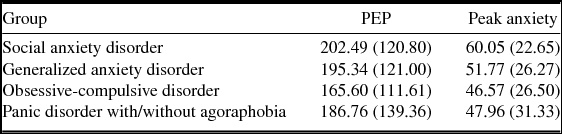
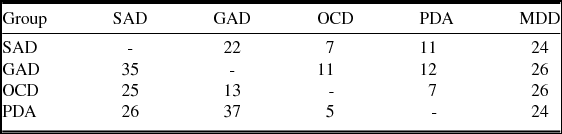
Means and standard deviations for PEP and peak anxiety levels across the anxiety disorder groups are listed in Table 1. Chi square analyses between diagnostic groups revealed no significant differences for sex, χ2 (3) = 6.09, p = .107, or ethnicity, χ2 (18) = 27.21, p = .075. A significant difference emerged on martial status, χ2 (9) = 19.80, p = .019, Cramer's V = .17, where those with SAD were less likely to be married/common law. An analysis of variance (ANOVA) revealed a significant difference between diagnostic groups on age, F (3, 222) = 3.20, p = .024, where participants with PD/A and GAD were older than those with OCD and SAD.Footnote 1 Table 2 shows diagnostic comorbidity among the anxiety disorder groups. A chi square analysis between diagnostic groups revealed no significant differences for comorbidity of major depressive disorder, χ2 (3) = 0.11, p = .991.
Means and standard deviations for PEP and peak anxiety across anxiety groups

Percentage diagnostic comorbidity among the four anxiety disorder groups

Notes: Numbers represent percentage of individuals from that diagnostic group that had a comorbid anxiety or major depressive disorder; SAD = Social anxiety disorder; GAD = Generalized anxiety disorder; OCD = Obsessive-compulsive disorder; PDA = Panic disorder with/without agoraphobia; MDD = Major depressive disorder
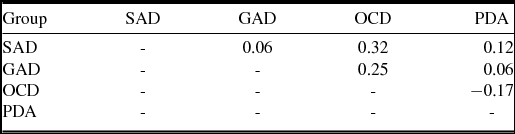
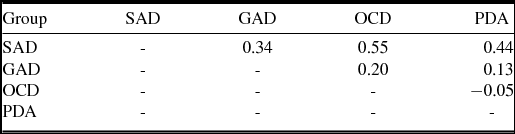
To examine whether PEP varied as a function of diagnostic status, an ANOVA was conducted. Results suggested that PEP levels did not differ significantly across diagnostic groups, F (3, 202) = 0.86, p = .465. See Table 3 for effect sizes between the anxiety disorder groups on PEP. In order to investigate whether this was due to the first group session being equally anxiety-provoking for all anxiety conditions, another ANOVA was conducted on the peak anxiety ratings from the first session. Participants in the different diagnostic groups did not significantly differ on peak anxiety, F (3, 216) = 2.29, p = .08, although there was a trend. Those with SAD reported the highest levels of peak anxiety during the first session. See Table 4 for effect sizes between the anxiety disorder groups on peak anxiety.
Cohen's d effect sizes between anxiety disorder groups on PEP

Notes: SAD = Social anxiety disorder; GAD = Generalized anxiety disorder; OCD = Obsessive-compulsive disorder; PDA = Panic disorder with/without agoraphobia
Cohen's d effect sizes between anxiety disorder groups on peak anxiety during the first group session

Notes: SAD = Social anxiety disorder; GAD = Generalized anxiety disorder; OCD = Obsessive-compulsive disorder; PDA = Panic disorder with/without agoraphobia
Next, to test whether higher anxiety levels contributed to PEP, a regression analysis was conducted with PEP as the dependent variable, and peak anxiety, diagnostic group, and the interaction between the latter two entered as one block as the independent variables. The overall model was significant, F (3,190) = 14.12, p = .000, R2 = .18. The main effect for peak anxiety was significant, β = .64, t = 3.87, p = .000, part r = .25. Neither of the other variables were significant; diagnostic group, β = .20, t = 1.44, p = .151, and peak anxiety x diagnostic group interaction, β = −.31, t = −1.48, p = .140. Thus, PEP was associated with peak anxiety, and this relationship was equivalent across the four anxiety disorder groups.
One question that emerges is whether the equivalence in PEP was due to high comorbidity of SAD in the other diagnostic groups. SAD was comorbid in 26% of those with PD/A, 25% of those with OCD, and 35% of those with GAD. A chi square analysis between those three groups was not significant, χ2 (2) = 2.18, p = .337, suggesting that the rates of SAD comorbidity were equivalent among those three anxiety disorder groups. An ANOVA was repeated with patients with primary anxiety disorders and secondary SAD removed and with PEP scores as the dependent variable. The results demonstrated that anxiety disorder groups did not differ, F (3,150) = 1.42, p = .240, even when taking into account the presence of comorbid SAD. We then ran Pearson correlations between peak anxiety and PEP separately for the non-SAD anxiety groups. Pearson correlations for all participants in that diagnostic group were OCD (r = .42, p = .001), GAD (r = .27, p = .048) and PD/A (r = .52, p = .000). When those with comorbid SAD were removed, correlation significance patterns were equivalent with the exception that for those with GAD, the correlation was no longer significant in those without comorbid SAD. However, this may be due to the significant loss of power, as 35% of those with GAD also had SAD.
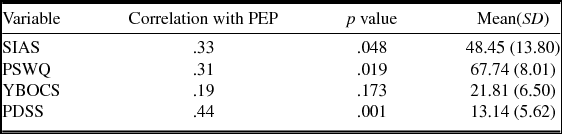
Pearson correlation coefficients were conducted between PEP and each of the four symptom severity measures (i.e. the SIAS, PSWQ, PDSS-SR and YBOCS) to examine whether severity of symptoms was related to subsequent PEP levels as seen in Table 5. Greater engagement in PEP was associated with more severe panic symptoms for those with PD/A, worry for those with GAD, and social interaction anxiety symptoms for those with SAD. Symptom severity of obsessions and compulsions were not significantly associated with PEP for OCD participants. These correlations were re-run without participants with comorbid SAD, and no changes in the statistical significance pattern were observed.
Means and standard deviations for symptom severity measures, and their correlations with PEP

Notes: PEP = post event processing; SIAS = Social Interaction Anxiety Scale; PSWQ = Penn State Worry Questionnaire; YBOCS = Yale-Brown Obsessive-Compulsive Scale; PDSS = Panic Disorder Severity Scale.
Discussion
There is both theoretical (Clark and Wells, Reference Clark, Wells, Heimberg, Liebowitz, Hope and Schneier1995; Rapee and Heimberg, Reference Rapee and Heimberg1997) and empirical (e.g. Brozovich and Heimberg, Reference Brozovich and Heimberg2008) support for the role of PEP in the maintenance of SAD. In the current investigation, we sought to examine the role of PEP in other anxiety conditions. This study investigated the presence and severity of PEP following the first group CBT session across a range of DSM-IV anxiety disorder diagnoses. In addition, the relationship between peak anxiety during the first session and subsequent PEP was assessed, as well as the relationship between PEP and anxiety symptom severity across the anxiety disorder diagnoses.
In contrast to our hypothesis, the results of the group comparisons suggest that there are comparable levels of PEP following the first group treatment session between patients with SAD, PD/A, OCD, and GAD. There were no statistically significant differences in PEP scores between any of the diagnostic groups, and this does not appear to be due to SAD comorbidity in the other groups. PEP levels for those with SAD in this study were comparable to those reported in clinical studies by Laposa and Rector (Reference Laposa and Rector2011) and Kocovski and Rector (Reference Kocovski and Rector2008). The current findings suggest that PEP is present in anxiety disorders other than SAD, and that PEP may not be uniquely associated with SAD, as previously conceptualized.
PEP may be a transdiagnostic cognitive process (Harvey et al., Reference Harvey, Watkins, Mansell and Shafran2004) that is shared across anxiety disorders given that it is present in SAD, GAD, OCD, and PD/A, and not confined to SAD. While PEP has been found to predict SAD symptoms (Brozovich and Heimberg, Reference Brozovich and Heimberg2008), future research examining whether PEP predicts the maintenance of other anxiety symptoms would provide further support that PEP is transdiagnostic. The current finding of PEP across diagnostic groups is consistent with previous findings that trait anxious and depressive rumination is elevated among individuals with SAD, PD/A, OCD, and GAD (Rector et al., Reference Rector, Antony, Laposa, Kocovski and Swinson2008), recent research demonstrating elevated worry across several anxiety disorder groups (Kertz et al., Reference Kertz, Bigda-Peyton, Rosmarin and Björgvinsson2012), and accumulating literature suggesting that repetitive negative thinking, in general, is an important transdiagnostic factor (e.g. Ehring and Watkins, Reference Ehring and Watkins2008; Nolen-Hoeksema, Wisco and Lyobormisky, Reference Nolen-Hoeksema, Wisco and Lyubomirsky2008). However, this finding differs from precedent research that found that patients with SAD reported significantly greater levels of fears of negative evaluation relative to other diagnostic groups (Carleton, Collimore, McCabe and Antony, Reference Carleton, Collimore, McCabe and Antony2011). While it appears that fears of negative evaluation may show specificity with SAD, the current data suggest that PEP may be broadly associated with anxiety pathology. It may be that PEP represents a transdiagnostic repetitive cognitive process whereas the fear of negative evaluation represents the more static degree to which people fear being negatively evaluated. Further research is needed to disentangle the relationships between PEP, fears of negative evaluation, and clinically significant anxiety.
An alternative explanation for the lack of significant differences across anxiety disorders is that PEP is a proxy for neuroticism. To our knowledge, no studies have investigated the relationship between PEP and neuroticism. The current literature suggests that worry and rumination are mediators of the relationship between neuroticism and anxiety and depression symptoms (Barnhofer and Chitka, Reference Barnhofer and Chitka2010; Muris, Roelofs, Rassin, Franken and Mayer, Reference Muris, Roelofs, Rassin, Franken and Mayer2005; Roelofs, Huibers, Peeters, Arntz and van Os, Reference Roelofs, Huibers, Peeters and Arntz2008; Roelofs, Huibers, Peeters and Arntz, Reference Roelofs, Huibers, Peeters, Arntz and van Os2008). Directly determining the relationship between PEP and neuroticism may be a fruitful area for future research.
The regression analysis suggested that PEP following the first group treatment session had an important relationship with peak anxiety experienced during the first session. In line with our hypothesis, these findings suggest that higher levels of anxiety during the first treatment session were associated with greater engagement in PEP. These findings are consistent with previous research that showed that state anxiety during a videotaped in vivo exposure (during the context of group CBT) was prospectively associated with PEP one week later, in individuals with SAD (Laposa and Rector, Reference Laposa and Rector2011). It may be that PEP is activated by anxiety state activation/arousal. The present study extends the work of Laposa and Rector (Reference Laposa and Rector2011) by demonstrating that state anxiety during a situation/event impacts on levels of PEP in individuals with other anxiety disorder diagnoses, and not only those with SAD. The explanation for the attenuated association between PEP and peak anxiety in the primary GAD group when comorbidity was accounted for is not immediately clear, although it may be simply due to reduced power as 35% of the GAD sample had to be removed due to comorbidity.
Differential associations were found between PEP and anxiety symptom severity. PEP was significantly associated with SAD, PD/A, and GAD symptom severity, but not with OCD symptom severity. Given that OCD is now identified as a diagnostic entity outside of the anxiety disorders (APA, 2013), and is a more heterogeneous condition characterized by distinct symptom dimensions (e.g. religious, symmetry, contamination; Mataix-Cols, Rosario-Campos and Leckman, Reference Mataix-Cols, Rosario-Campos and Leckman2005), it may be that PEP is differentially related to certain dimensions. Alternatively, although there is evidence that rumination is elevated across SAD, PD/A, GAD, and OCD (Rector et al., Reference Rector, Antony, Laposa, Kocovski and Swinson2008), it may be that the social evaluative content concerns characteristic of PEP are less relevant in OCD. For example, GAD is often associated with worry about interpersonal relationships and/or rejection, and the diagnostic criteria for PDA includes fear and/or escape from situations in which it might be difficult or embarrassing (APA, 2000). Lending support for this potential explanation, a recent study of the looming vulnerability in anxiety conditions (i.e. the generation of dynamic mental scenarios of threat that intensify faster than individuals can cope with them; e.g. Riskind, Reference Riskind1997) demonstrated that the looming vulnerability to social threat was present in SAD and GAD, but not in OCD (Riskind, Rector and Cassin, Reference Riskind, Rector and Cassin2011).
There are some limitations to the current study that offer directions for future research. First, the current sample was largely comprised of individuals who identified as Caucasian; accordingly, the results may not be generalizable to individuals of different ethnic backgrounds. Second, this study did not include individuals with a principal diagnosis of posttraumatic stress disorder or specific phobia. Future research exploring PEP in these disorders is needed in order to comparatively assess PEP across all of the primary anxiety disorders. Third, the present study did not include a comparison group of individuals without anxiety disorders. Future research should aim to include a nonclinical control group so that differences in PEP between clinical and nonclinical samples may be explored within the same study. Fourth, this study relied on a single rating (i.e. peak anxiety) in order to measure peak/state anxiety. Future research may benefit from including a more comprehensive measure of state anxiety, with well established psychometrics (i.e. the State-Trait Anxiety Inventory; Spielberger, Gorsuch, Luschene, Vagg and Jacobs, Reference Spielberger, Gorsuch, Luschene, Vagg and Jacobs1983) when exploring the relationship between state/peak anxiety and PEP within the anxiety disorders. Fifth, the present study investigated state activated PEP following a non-idiosyncratic social event (i.e. the first group CBT session). Additional research is needed to examine whether the more general tendency to exhibit PEP (i.e. “trait” PEP) is elevated across anxiety disorder groups. Sixth, dimensional aspects of depression were not included. However, it was a well diagnosed sample, and when this was examined at a diagnostic level, differential effects of major depressive disorder were not observed. Lastly, although we have reported on the diagnostic comorbidity between anxiety disorders, the severity of social anxiety symptoms was not assessed in participants with GAD, OCD or PDA.
With these considerations in mind, this study is the first to have evaluated PEP across a range of anxiety disorder diagnoses and to examine the relationships between PEP and diagnostic-specific symptom severity. Overall, these findings suggest that PEP is not only specific to SAD, but also present in PD/A, OCD, and GAD. These data suggest that PEP was significantly associated with peak anxiety during the first group CBT session. In addition, PEP was significantly associated with symptom severity in patients with SAD, PD/A, GAD, but not OCD. The current data add to a growing body of literature exploring potential transdiagnostic features across clinical disorders (e.g. McLaughlin and Nolen-Hoeksema, Reference McLaughlin and Nolen-Hoeksema2011). These findings provide preliminary evidence that PEP may not be uniquely associated with SAD as currently conceptualized in CBT models, but also linked with other anxiety pathology. It remains to be determined to what extent these findings across anxiety disorders will generalize outside of the context of a first group therapy session. PEP may represent a transdiagnostic factor across the anxiety disorders that could be targeted to improve clinical outcomes. Following the distinction made by Watkins (Reference Watkins2008) between structural vs. process aspects of repetitive thought, future research may benefit from further disentangling whether PEP is related to all anxiety disorders because of the “content” of PEP (i.e. social evaluation concerns post-event) or if it is the repetitive thinking process itself that is relevant (e.g. emotional processing), irrespective of content.
Acknowledgements
We thank the participants for completing this study, our research assistants, and anonymous reviewers for their helpful suggestions.



Comments
No Comments have been published for this article.