The Norwood/Fontan palliation is accepted as the principle management pathway in children born with hypoplastic left heart syndrome.Reference Norwood, Jacobs and Murphy 1 , Reference Maher, Gidding and Baffa 2 We have embarked on this approach in 1993. Over time, numerous modifications to the original first-stage Norwood procedure have been employed,Reference Sano, Ishino and Kawada 3 with a right-sided right ventricle-to-pulmonary artery conduit together with homograft patch augmentation of the aortic arch being our preferred surgical technique since 2002.Reference Barron, Brooks and Stickley 4
Cardiac catheterisation remains our main investigative tool of choice in the preparation for staged surgical palliation and in the evaluation and treatment of residual haemodynamic lesions. The threshold for catheter intervention has decreased over the years, with refinement in techniques, increasing experience and wider publication of lesion-specific techniques and results.
This paper summarises our institutional experience with cardiac catheter interventions in this challenging group of patients over a 17-year period.
Methods
The case notes of all 527 patients with hypoplastic left heart syndrome who underwent staged Norwood/Fontan palliation at Birmingham Children's Hospital, United Kingdom, over a 17-year period (1993–2010) were reviewed. A small number of patients have undergone cardiac catheterisation in their local centre and their data are not included in our analysis. During the study period, only seven hybrid Stage I Norwood procedures were performed and these were excluded from analysis.
Overall survival, the incidence and type of interventional cardiac catheterisation procedures, and freedom from re-intervention were defined. Post-Fontan data are presented for patients up to the age of 18 years.
Of the 527 patients, 261 patients received a classical Norwood operation, that is, Blalock–Taussig shunt; 31 a Sano modification, that is, left-sided right ventricle-to-pulmonary artery conduit; and 235 patients a Brawn modification of the Sano technique, that is, right-sided right ventricle-to-pulmonary artery conduit. Stage II procedures consisted of ligation and transection of the Blalock–Taussig shunt or right ventricle-to-pulmonary artery conduit, creation of a superior bi-directional cavopulmonary shunt, and reconstruction of the central pulmonary arteries with a homograft patch, if indicated. An extra-cardiac fenestrated Gore-Tex tube (streched polytetrafluoroethylene, WL Gore and Associates PTFE) was used routinely for completion of the Fontan circulation (Stage III) since 2001. Before this, a lateral intra-cardiac tunnel was used. Cardiac catheterisations were performed at different stages during the follow-up period and catheter interventions were performed when deemed indicated following multi-disciplinary team discussion. In addition to routine interstage cardiac catheterisation, patients with any clinical concerns including desaturations, reduced exercise tolerance, increased breathlessness, or problems noticed on echocardiography had cardiac catheterisation.
All procedures were carried out under general anaesthesia. Whenever possible, a venous catheter approach was preferred over an arterial approach. After cavopulmonary shunt procedures, access to the pulmonary arteries was gained, in preference, from the internal jugular vein, but occasionally from the subclavian vein. Routine heparinisation using 50 IU/kg body weight was used. Complete haemodynamic data were obtained and angulated angiographic projections were used to best delineate the underlying anatomy. Trans-oesophageal ultrasound studies were performed in patients undergoing transcatheter interventions of the Fontan pathways. The mean follow-up in post-Fontan patients was 10.8 years.
The study was reviewed and approved by the local Research & Clinical Audit departments. The need for individual consent was waived.
Statistical analysis
Data was analysed using the Kaplan–Meier plots and were compared using the Log-rank test. Paired Student's t-test was used when appropriate. The software used for analysis was the R: A Language and Environment for Statistical Computing version 2.11.0. Values are expressed as medians and range unless otherwise stated.
Results
During the study period of 17 years from 1993 to 2010, a total of 527 patients with hypoplastic left heart syndrome underwent staged surgical palliation. The median age at Stage I palliation was 4.1 days (0–309 days), at cavopulmonary shunt 5.1 months (0.43–23 months), and at Fontan completion 4.7 years (27–112 months). The 30-day survival rate after individual stages was 76.5% for Stage I, 96.3% for Stage II, and 99.4% for Stage III. There were 170 deaths after Stage I (32.3%), 45 early or late deaths after Stage II (12.8%), and six early or late deaths after Stage III (3.7%).
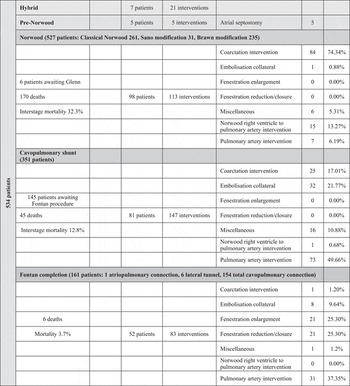
A total of 189 patients underwent 348 catheter interventions: five interventions were pre-Stage I, 113 were interstage I–II, 147 were interstage II–III, and 83 were post Fontan completion (data shown in Table 1).
Overview of catheter interventions in the staged palliative management of patients with hypoplastic left heart syndrome.

Pre-surgical interventions
A total of five patients required emergency balloon septostomy for a highly restrictive atrial communication shortly after birth. They were in a collapsed state, acidotic, and had very low saturations. A static balloon septostomy was performed initially, followed by a pullback septostomy (Rashkind) when feasible (three out of five patients). There were no catheter-related deaths in this group, but only two medium-term survivors after Norwood Stage I palliation.
Pre-Stage II interventions
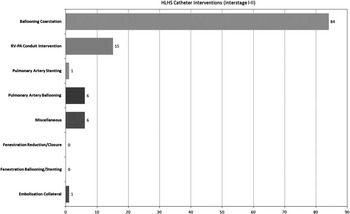
Of the 351/527 patients surviving to the second stage of surgical palliation (66.7%), 98 patients (27.9%) underwent 113 interventional procedures. A total of 84 balloon angioplasties to relieve narrowing of the reconstructed aortic arch were performed, 15 right ventricle-to-pulmonary artery conduit intervention (one balloon, 14 stents), seven pulmonary artery intervention, stenting or balloon dilatation of the atrial septum in three cases, one embolisation of the collateral, one balloon angioplasty of the pulmonary veins, one balloon angioplasty of the innominate vein, one ballooning of the Blalock–Taussig shunt (Fig 1).
Interstage I–II catheter interventions. HLHS = hypoplastic left heart syndrome; RV-PA = right ventricular-pulmonary artery.

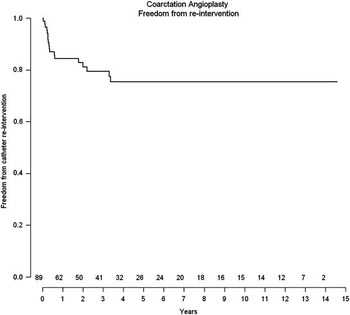
Indication for balloon angioplasty of the reconstructed aorta was an invasive systolic pressure gradient in excess of 10 mmHg together with an angiographic appearance of discrete narrowing rather than a mere calibre change. Balloon size was chosen up to 2 mm larger than the native descending aorta. Mean pressure gradients were reduced from 18 (range 5–60) to 6 (0–35) mmHg (p < 0.01). In 53 (63%) patients, the procedure was performed in an antegrade manner via a transvenous approach. The procedures were complicated by cardiac arrest requiring cardiac massage in seven patients, all of them having had the venous approach. There was no catheter-related mortality. Freedom from catheter or surgical re-intervention for aortic arch obstruction was 75% at 14.8 years post Norwood (Fig 2).
Freedom from re-interventions post coarctation angioplasty.

Relief of right ventricle to pulmonary artery conduit stenosis was performed by implantation of a premounted coronary stent in 14 of the 266 (5.3%) patients after the Sano modification of Stage I. There was one patient who underwent balloon dilation. Indications for stenting were low saturations and young age, precluding early conversion to a cavopulmonary shunt, significant stenosis, kinking or filling defects within the conduit, or a significant drop in saturations after balloon angioplasty of an obstructed aortic arch. There were three cases of prolonged junctional rhythm or complete heart block, with one patient requiring transvenous pacing who died 6 hours after the procedure because of pacing wire dislodgement. Oxygen saturations increased from a mean of 63 (range 50–73)% to 78 (58–86)% (p < 0.01).
Post-Stage II interventions
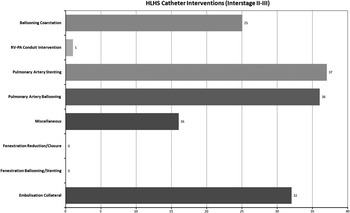
Cardiac catheterisation was performed routinely before consideration for completion of Fontan procedure or in the context of very low arterial oxygen saturations, poor functional status, or signs of re-coarctation. There were 147 interventions in 81 patients out of 161 patients surviving into Stage III – with 145 patients awaiting total cavopulmonary completion. These included balloon or stent dilatations of the pulmonary arteries, that is, 73 procedures – 30 ballooning of the left pulmonary artery, six of the right pulmonary artery, and 37 stents of the left pulmonary artery; embolisation of systemic venous fistulae or systemic collateral arteries (32); balloon angioplasty of re-coarctation (25); and 17 miscellaneous procedures including ballooning of the right and left superior caval vein, embolisation of the left superior caval vein, balloon dilatation of the atrial septum, stenting of the atrial septum, ballooning of the internal jugular vein, inferior caval vein, and innominate artery, balloon dilatation of Sano conduit, electrophysiology study, and radiofrequency ablation (Figs 3 and 4).
Interstage II–III catheter interventions. HLHS = hypoplastic left heart syndrome; RV-PA = right ventricular-pulmonary artery.

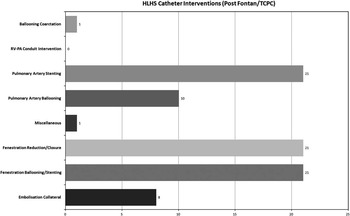
Post-Fontan completion catheter interventions. TCPC = total cavopulmonary connection.

Indication for balloon angioplasty or stenting of the pulmonary arteries was a reduction of the proximal vessel of >25% compared with the distal vessel proximal to the first major branches, a mean pressure gradient of >1 mmHg on pullback, or the finding of markedly reduced capillary phase opacity during pulmonary angiography. Early on during the experience, balloon angioplasty was the preferred technique, but results to left pulmonary artery lesions were suboptimal because of external compression by the neo-aorta. Consequently, it became the preferred practice for most operators to stent the left pulmonary artery in this context. For the entire study population, including post-Fontan patients, the freedom from re-intervention at 7 years after left pulmonary artery intervention was 17% in the balloon angioplasty group compared with 72% in patients in the stent group (p < 0.01, log-rank test).
Post-Stage III interventions
During the study period, 161 out of 351 patients (46%) underwent total cavopulmonary completion at a median age of 4.7 years with one early hospital death (0.6%). There were five late deaths (3.1%).
A total of 83 catheter interventions were performed in 52 out of 161 patients after Fontan completion. Catheter interventions include 31 pulmonary artery interventions – nine ballooning of the left pulmonary artery, one of the left, 21 stenting of the left pulmonary artery; 42 Fontan fenestration interventions; eight embolisation of collateral vessels; one coarctation balloon angioplasty; and one inferior caval vein angioplasty. The median timing of the intervention post Fontan was 1.75 years (2 days–7.2 years). Of the 83 catheter interventions, 31 were performed within 30 days of Fontan completion.
Fenestrations were reopened, enlarged, or created using a diabolo-shaped stent technique Reference Stümper, Gewillig and Vettukattil 5 , Reference Anderson, Bhole and Desai 6 in 21 patients for persistent pleural effusions in 15, low cardiac output state in three, protein-losing enteropathy in two, and bronchial casts in one. There was no procedure-related mortality. A single patient developed transient left hemiparesis, which resolved spontaneously. In this group of patients, pre-intervention oxygen saturations dropped from a median of 94 (range 88–99)% to 84 (range 68–88)% post intervention (p < 0.01).
In all, 21 patients underwent fenestration reduction/closure for significant persistent cyanosis or after neurological events. Devices used were Amplatzer Septal Occluder (AGA Medical Corporation, Plymouth, Minnesota, United States of America) for complete occlusion in eight patients, a custom-made 15-mm PFO star device (FFD15, CARDIA, Burnsville, Minnesota, United States of America) for partial occlusion in nine, and four patients had a reduction of a stent fenestration using a snare technique. Saturations improved from 85 (61–93)% to 95% (77–100)% (p < 0.01).
Pulmonary artery interventions in 30 patients were directed almost exclusively at stenosis or compression of the left pulmonary artery, with stent implantation becoming the preferred technique over the study period.
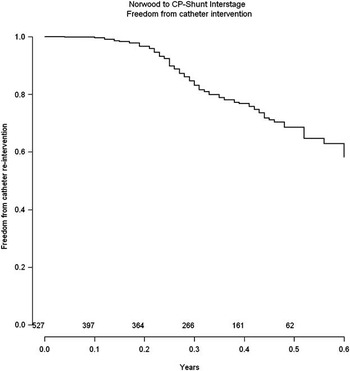
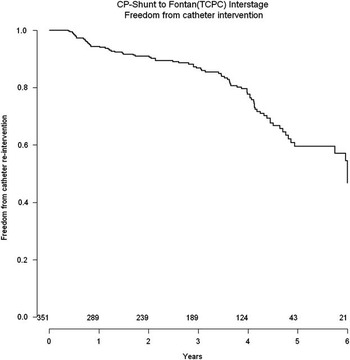
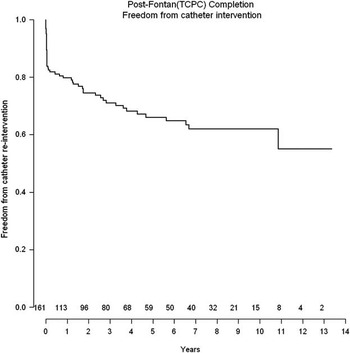
Interstage freedom from catheter re-interventions is demonstrated in Figures 5–7.
Post-Norwood Stage I freedom from re-interventions. CP = cavopulmonary.

Post-cavopulmonary shunt freedom from catheter re-interventions. CP = cavopulmonary; TCPC = total cavopulmonary completion.

Post-Fontan completion freedom from catheter interventions. HLHS = hypoplastic left heart syndrome; RV-PA = right ventricular-pulmonary artery; TCPC = total cavopulmonary completion.

Discussion
In most cardiac centres, the management of patients with hypoplastic left heart syndrome remains a surgical staged palliation starting with a Norwood procedure or one of its modifications and culminating into a Fontan completion. The mortality and morbidity rates with this approach have improved over time.Reference McGuirk, Griselli and Stumper 7 – Reference Algra, Breur and Evens 10 The functional outcome and, ultimately, survival depend on a well-developed and unobstructed pulmonary vascular tree, unimpeded pulmonary venous return, preserved right ventricular function, and unobstructed systemic outflow. Cardiac transplantation to patients with hypoplastic left heart syndrome before Stage I is not routinely offered in our centre but remains an option at a later stage. We set out to analyse our institutional experience with the Norwood programme and to specifically evaluate the incidence and contribution of cardiac catheter interventions in the management of these patients. A previous study by Moszura et alReference Moszura, Mazurek-Kula and Dryzek 11 suggested a large demand for catheter interventions when embarking on a Norwood programme. In that study, however, actuarial survival was not mentioned and thus it was not possible to assess the proportion and the frequency of catheter intervention.
Over the 17-year study period, cardiac catheterisation has remained our investigative tool of choice, despite the recent advances and increasing acceptance of cardiac magnetic resonance imaging as an alternative tool. In the context of the very frequent need for catheter intervention in the Norwood/Fontan population, we have been slow in changing our clinical practice in patients who do require general anaesthesia to undertake cardiac magnetic resonance imaging investigation.
The modified Norwood/Fontan palliation remains our preferred surgical approach. The study describes the cardiac catheter interventions performed relating to the three stages of surgical palliation. Of note is the fact that there has been a steady increase in addressing observed residual lesions. Some 24% of Stage I survivors required balloon angioplasty of an obstructed aortic arch. The freedom from re-intervention was 75% at 14.8 years, further supporting the findings of previous series.Reference Chessa, Dindar and Vettukattil 12 – Reference Tworetzky, McElhinney and Burch 14 Stent placement within obstructed right ventricle-to-pulmonary artery conduits has evolved to become a very effective technique to address haemodynamic instability or to delay Stage II surgery in patients with significant risk factors.Reference Desai, Stumper and Miller 15 , Reference Dähnert, Riede and Razek 16
After Stage II procedure, the bulk of interventions were directed to address left pulmonary artery stenosis (49.6%) and occlusion of systemic venous fistulae (21.8%). Left pulmonary artery stenosis is a frequent finding after the Norwood procedure and is partly due to compression of the left pulmonary artery by the reconstructed aortic arch. Initially, we attempted to address these lesions with balloon angioplasty, but with little effect. Thus, stenting of these lesions is now the preferred technique, especially in children weighing >10–12 kg where stents can be implanted and further dilated to adult dimensions in later life. Interestingly, we have observed a very low incidence of neo-intimal proliferation after left pulmonary artery stenosis stenting (only one patient), which is likely to be related to much reduced sheer stresses in the pulmonary circulation after cavopulmonary connections.
Patients after the Norwood palliation often develop systemic-to-pulmonary collateral arteries, which lead to volume overload and can be deleterious because of excessive pulmonary blood flow.Reference McElhinney, Reddy and Hanley 17 – Reference Kanter, Vincent and Raviele 19 In order to reduce morbidity and mortality, we occlude all significant collaterals. In our cohort, around 9.1% of patients had embolisation of a collateral vessel post cavopulmonary shunt, which is less than in the reported series.Reference McElhinney, Reddy and Hanley 17 , Reference Kanter, Vincent and Raviele 19 We believe that some collaterals regress spontaneously after Fontan completion.
After Stage III (total cavopulmonary connection/Fontan) palliation, the bulk of interventions were directed towards the creation/enlargement or reduction/closure of fenestrations or to deal with a small or compressed left pulmonary artery.Reference Bhole, Wright and De Giovanni 20
The catheter manipulation of Fontan fenestrations has evolved over the years.Reference Tofeig, Walsh and Chan 21 , Reference Rao 22 In our series, we had a low threshold of enlarging or creating a fenestration in the context of extra-cardiac complications related to high pulmonary arterial pressure. All patients were symptomatically improved after such a procedure. We have learnt to reduce the size of stent fenestrations.Reference Anderson, Bhole and Desai 6 Partial fenestration closure using a dedicated deviceReference Stümper, Gewillig and Vettukattil 5 is offered to patients with saturations < 85% at rest and poor exercise tolerance. Complete closure is considered for patients with preceding neurologic events and low saturations with low pulmonary vascular resistance.
Limitations
This was a retrospective case-based review of records held at this institution. We could not scrutinise or include data of catheter procedures or interventions performed at referring institutions. However, the total number of such procedures is small.
Conclusion
Interventional cardiac catheterisation constitutes an integral part in the management of patients with hypoplastic left heart syndrome, and is an essential adjunct to surgery. Almost two-third of survivors required catheter intervention from birth up to 18 years.
This study defines the incidence and the spectrum of cardiac catheter interventions required in the ongoing management of patients undergoing staged Norwood/Fontan palliation of hypoplastic left heart syndrome. It has important implications for the planning of catheterisation services and equipment needs when developing a Norwood programme. It provides very relevant information to be used when counselling parents when agreeing to staged Norwood palliation of their children born with hypoplastic left heart syndrome.
Acknowledgements
The authors are grateful to the surgeons, cardiac anaesthetists, and cardiac surgical and catheterisation laboratory staff at Birmingham Children's Hospital for their contribution in our Norwood programme. Conflict of interest: Dr Joseph De Giovanni is consultant, proctor, and lecturer for AGA.