

Introduction
Numerous bird species are experiencing population declines worldwide, and it is estimated that three billion birds have been lost since the 1970s in North America alone (Rosenberg et al. Reference Rosenberg, Dokter, Blancher, Sauer, Smith, Smith and Stanton2019). Shorebirds are among the most threatened groups of birds on the planet, with half of populations declining or lacking information to accurately characterise their trends (Andres et al. Reference Andres, Smith, Morrison, Gratto-Trevor, Brown and Friis2012, Simmons et al. Reference Simmons, Kolberg, Braby and Erni2015, Smith et al. Reference Smith, McKinnon, Meltofte, Lanctot, Fox, Leafloor and Soloviev2020). North American breeding shorebirds have been particularly affected and 68% of populations have declined by ~40% in the last four decades (Rosenberg et al. Reference Rosenberg, Dokter, Blancher, Sauer, Smith, Smith and Stanton2019). The main cause of shorebird declines is thought to be habitat loss, especially resulting from human activities and climate change (Galbraith et al. Reference Galbraith, Jones, Park, Clough, Herrod-Julius, Harrington and Page2002, Reference Galbraith, DesRochers, Brown and Reed2014, Kirby et al. Reference Kirby, Stattersfield, Butchart, Evans, Grimmet, Jones and O’Sullivan2008, Colwell Reference Colwell2010). For Arctic-breeding species in particular, the combination of accelerating climate change and their extreme migratory strategies pose conservation challenges (Smith et al. Reference Smith, McKinnon, Meltofte, Lanctot, Fox, Leafloor and Soloviev2020).
Estimates of population sizes and trends are critical to assessing and monitoring the conservation status of species (Mace et al. Reference Mace, Collar, Gaston, Hilton-Taylor, Akçakaya, Leader-Williams and Milner-Gulland2008, Kéry et al. Reference Kéry, Dorazio, Soldaat, van Strien, Zuiderwijk and Royle2009). In addition, scientifically informed management efforts require reliable and unbiased information on a species’ habitat-specific abundance, as well as a broad understanding of how abundance is driven by environmental conditions (Sillet et al. Reference Sillett, Chandler, Royle, Kéry and Morrison2012). Such information is especially relevant to the development of management plans focused on species of conservation concern to ensure that decision-makers are well-informed and able to effectively protect important habitats (Buckland et al. Reference Buckland, Marsden and Green2008).
Estimates of population size based on unadjusted count data can be biased by imperfect detection (Kéry and Schmid Reference Kéry and Schmid2004), and several methods have been developed to overcome this issue. For instance, sampling methods that account for the distance at which individuals are first observed are widely used to correct for imperfect detection. Importantly, this approach only requires a single count per interval (e.g. season or year), with no need for physical capture or recapture of individuals (Buckland et al. Reference Buckland, Anderson, Burnham, Laake, Borchers and Thomas2001). Additional methods have been developed to extend conventional distance sampling, e.g. place more emphasis on the relationships between density and environmental covariates (Royle et al. Reference Royle, Dawson and Bates2004), including hierarchical distance sampling models (HDSs). Such models can provide a better understanding of the factors driving species’ abundance and trends, which are especially useful in habitats expected to suffer alterations due to climate change or anthropogenic development (Sillet et al. Reference Sillett, Chandler, Royle, Kéry and Morrison2012).
The Buff-breasted Sandpiper Calidris subruficollis (Vieillot, 1819) (hereafter “BBSA”), is a medium-sized scolopacid shorebird that breeds in the Arctic coastal plains of the USA (Alaska), Canada, and Russia (McCarty et al. Reference McCarty, Wolfenbarger, Laredo, Pyle, Lanctot and Rodewald2020). It spends the non-breeding season in southern South America, especially in coastal areas of Argentina, Uruguay, and southern Brazil (Lanctot et al. Reference Lanctot, Blanco, Dias, Isacch, Verena, Almeida and Delhey2002, Isacch and Martínez Reference Isacch and Martínez2003). During this period, it inhabits mostly heavily grazed grasslands (2–5 cm tall) adjacent to wetlands and lightly flooded rice fields with short vegetation (Lanctot et al. Reference Lanctot, Blanco, Dias, Isacch, Verena, Almeida and Delhey2002, Dias et al. Reference Dias, Blanco, Goijman and Zaccagnini2014, Aldabe et al. Reference Aldabe, Lanctot, Blanco, Rocca and Inchausti2019).
As a species, BBSA is classified as “Near Threatened” globally (BirdLife International 2022), but considered “Vulnerable” both in Brazil (Ministério do Meio Ambiente 2022) and Uruguay (Azpiroz et al. Reference Azpiroz, Alfaro and Jiménez2012). BBSAs are suspected of being in decline, with the major threats currently thought to occur during migration and at their non-breeding areas (Lanctot et al. Reference Lanctot, Aldabe, Almeida, Blanco, Isacch, Jorgensen and Norland2010, Reference Lanctot, Yezerinac, Aldabe, Almeida, Castresana, Brown and Rocca2016). In the 1800s, the BBSA experienced severe declines due to commercial hunting and habitat loss, both during migration through the Great Plains of North America and in South America (McCarty et al. Reference McCarty, Wolfenbarger, Laredo, Pyle, Lanctot and Rodewald2020). However, molecular analyses provided no evidence of significant changes in the species’ effective population size or genetic diversity since the late nineteenth century (Lounsberry et al. Reference Lounsberry, Almeida, Grace, Lanctot, Liebezeit, Sandercock and Strum2013, Reference Lounsberry, Almeida, Lanctot, Liebezeit, Sandercock, Strum and Zack2014). The most recent global population estimate for BBSA is 56,000 individuals (estimated range: 35,000–78,000) (Andres et al. Reference Andres, Smith, Morrison, Gratto-Trevor, Brown and Friis2012). As with several other shorebird species, however, BBSAs are sparsely distributed during the breeding season (McCarty et al. Reference McCarty, Wolfenbarger, Laredo, Pyle, Lanctot and Rodewald2020). Rapid turnover also makes it difficult to estimate their population size and trends at migratory stopover areas (Wang et al. Reference Wang, Chen, Melville, Chi-Yeung, Kun, Liu and Li2022). The combination of these factors and their strong wintering site fidelity (Almeida Reference Almeida2009) means that BBSA population monitoring is best performed at wintering areas. In southern Brazil, BBSA abundance is higher in a few areas where natural grasslands transition into marshes along coastal lagoons (Lanctot et al. Reference Lanctot, Blanco, Dias, Isacch, Verena, Almeida and Delhey2002, Bencke et al. Reference Bencke, Maurício, Develey and Goerck2006, Di Giacomo and Parera Reference Di Giacomo and Parera2008), thus offering an ideal opportunity for population monitoring.
We used data from surveys conducted annually since 2008 at four key non-breeding areas in southern Brazil to estimate BBSA population trends and densities while accounting for imperfect detection and environmental conditions (e.g. vegetation height). We also generated population size estimates for the two most important of these areas using data gathered during the last year of our study (2019/20). Our results provide insights into potential factors that can drive fluctuations in BBSA density on their non-breeding grounds and ways to improve conservation efforts at key areas for the species.
Methods
Study areas
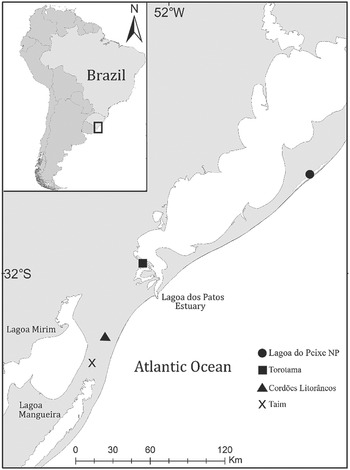
We carried out our study at four study areas within the southern Brazilian Coastal Plain where BBSA occurs in high numbers (Lanctot et al. Reference Lanctot, Blanco, Dias, Isacch, Verena, Almeida and Delhey2002, Bencke et al. Reference Bencke, Maurício, Develey and Goerck2006, Di Giacomo and Parera Reference Di Giacomo and Parera2008) (Figure 1). Climate in the region is temperate humid, with an average annual rainfall of ~1,300 mm. Winds are predominantly from the north-east, particularly during spring and summer (October–March) (Tomazelli et al. Reference Tomazelli, Dillenburg and Villwock2000). Low evaporation creates large flood plains during the austral winter, which may dry out entirely in exceptionally dry summers. The monitoring areas were chosen from the set of important BBSA wintering grounds in Brazil that were established within the framework of the “Alianza del Pastizal” project, an initiative for the conservation of natural grasslands in southern South America led by BirdLife International (Alianza del Pastizal Reference del Pastizal2009). Two of our study areas, Taim Ecological Station (ES) and Lagoa do Peixe National Park (NP), are Ramsar sites (Ramsar Convention Secretariat 2016) and Important Bird Areas (IBAs) of BirdLife International (Bencke et al. Reference Bencke, Maurício, Develey and Goerck2006), and are fully or partially protected by the Brazilian government (although surveyed areas at Taim were carried out on private properties bordering the protected area). Lagoa do Peixe NP is also a Site of International Importance in the Western Hemisphere Shorebird Reserve Network (WHSRN) (Nascimento Reference Nascimento1995, WHSRN 2020). Taim ES comprises 32,797 ha between the Atlantic Ocean and the Lagoa (Lagoon) Mirim, and most of the area is a hydrological complex composed of freshwater marshes, lagoons, and adjacent natural grasslands used for livestock ranching (Bencke et al. Reference Bencke, Maurício, Develey and Goerck2006). Lagoa do Peixe NP is a 36,722-ha protected area consisting of a mosaic of coastal environments that are part of the lagoon system of Lagoa do Peixe, a 35-km long shallow lagoon with an ephemeral estuary (Bencke et al. Reference Bencke, Maurício, Develey and Goerck2006), and includes sandy beaches, saltmarshes, and coastal grasslands. Our third study area was a 60-ha grassland area on the eastern shore of Torotama Island in the estuary of the Lagoa dos Patos, which is characterised by public areas with intermittently flooded grasslands adjacent to saltmarshes that are kept low by intensive communal livestock grazing (Marangoni and Costa Reference Marangoni and Costa2009, Faria et al. Reference Faria, Albertoni and Bugoni2018). Due to a low tidal range, the flooding regime is mostly influenced by wind and rainfall, which ultimately affect the outflow and water level of the estuary, as well as their margins and islands (Garcia Reference Garcia, Seeliger, Odebrecht and Castello1998). The fourth study area, Cordões Litorâneos, is situated immediately behind the coastline between Taim ES and the Lagoa dos Patos estuary. It consists of a broad region formed by alternating stretches of marshes and coastal grasslands in long and narrow parallel sections, and constitutes the largest remnant of primary grassland in the coastal plain (Bencke et al. Reference Bencke, Maurício, Develey and Goerck2006, Souza et al. Reference Souza, Shimbo, Rosa, Parente, Alencar, Rudorff and Hasenack2020).
Four study areas where Buff-breasted Sandpiper Calidris subruficollis was surveyed in southern Brazil between 2008 and 2020.

Survey protocol
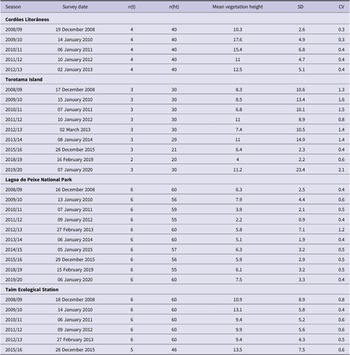
Counts were conducted annually between December and March from 2008/09 to 2019/20, when individuals are expected to be less mobile and restricted to their wintering grounds (Almeida Reference Almeida2009, McCarty et al. Reference McCarty, Wolfenbarger, Laredo, Pyle, Lanctot and Rodewald2020). Surveys were most often conducted in early January, but due to logistical constraints in the first year of the study (2008/09) surveys were carried out in late December 2008, while in late February and early March in 2012/13. Surveys were conducted within two to five days of each other within a year to minimise movements among areas, but not all sites were surveyed in all years (Table 1). We stopped counting at Cordões Litorâneos (2012) and Taim ES (2015) because both areas harboured low numbers of BBSA and we opted to concentrate our efforts in the other two areas for logistical reasons. BBSAs were counted in 19 c.1-km long georeferenced line transects (Cordões Litorâneos n = 4, Taim ES n = 6, Torotama Island n = 3, and Lagoa do Peixe NP n = 6) (Table S1) in short grassland areas known from previous surveys to be used by the species (Lanctot et al. Reference Lanctot, Blanco, Dias, Isacch, Verena, Almeida and Delhey2002, Bencke et al. 2006, Di Giacomo and Parera Reference Di Giacomo and Parera2008, Almeida Reference Almeida2009). Transects were 100–9,000 m distant in each study area. Each transect was fixed and sampled once per non-breeding season. Two or three observers walked slowly across the transect, counting all BBSAs detected up to 250 m to each side and estimating the perpendicular distance of each individual or flock (i.e. individuals <2 m from each other and sharing the same behaviour/moving in the same direction) to the transect line at which they were first observed. Individuals observed on the transect itself were assigned a distance of 0 m. Birds in flight (52 ± 39 per year) were excluded from the analysis. We carried out our surveys with the aid of binoculars. Distances and transect starting/stopping points were determined with a rangefinder and a hand-held GPS with a 5-m error, respectively (distances were estimated visually before 2012, except for Lagoa do Peixe NP). To improve visibility, we preferred to carry out counts during the early morning (07h00–10h00) or late afternoon (16h00–20h00) (Aldabe et al. Reference Aldabe, Lanctot, Blanco, Rocca and Inchausti2019), and on days with favourable weather and visual conditions (i.e. avoiding rain and dawn/dusk periods). During surveys, we also used a ruler to estimate the dominant vegetation height within a 50-m radius from the transect every 100 m. Observers minimised the risk of double counting individuals by moving from one transect to the next immediately after completing a survey.
Transect survey dates, mean vegetation height, and total count of Buff-breasted Sandpipers Calidris subruficollis in each year at four wintering areas in southern Brazil. Survey date is the calendar year at the beginning of the survey season during austral summer, n(t) is the number of transects each summer, and n(ht) is the number of vegetation height measurements each summer. Mean vegetation height is the average height (cm) of all vegetation measurements on all transects. SD and CV are the standard deviation and coefficient of variation of the height measurements, respectively. See Figure 1 for locations of study areas.

Statistical methods
We fitted an HDS model to the dataset, which combined: 1) a model for abundance on each transect with 2) a model for the probability of detection as a function of distance (Kéry and Royle Reference Kéry and Royle2016). The purpose of our HDS model was to explore variation in bird abundance among the four study areas and to evaluate trends in density (and abundance) over time. For clarity and consistency with the literature, we refer here to the four study areas as “strata” and the multiple transects within each study area as “sites”. Given the known habitat associations of BBSA and the effect of vegetation height on its density (e.g. Aldabe et al. Reference Aldabe, Lanctot, Blanco, Rocca and Inchausti2019), we included the mean vegetation height of each site in the abundance model. We analysed data for each year separately and used a log-linear model to investigate the variation in bird density among the strata while accounting for the effects of vegetation height on density:
 $$ {N}_s\sim Poisson\left({\lambda}_s\right) $$
 $$ \mathit{\log}\left({\lambda}_s\right)=\mathit{\log}\left({area}_s\right)+{\beta}_0+{\beta}_1 veg.{ht}_s+{\beta}_2{stratum}_s $$
where
 $ {N}_s $
is the number of flocks at site s,
 $ {\lambda}_s $
is the average number of flocks per ha at site s, area is the area covered at site s, and
 $ {\beta}_1 $
and
 $ {\beta}_2 $
are the effects of vegetation height and stratum (Cordões Litorâneos, Taim ES, Torotama Island, or Lagoa do Peixe NP), respectively, on flock density. Vegetation height measurements were normalised before analysis (i.e. centred and scaled using standard deviation [SD]). When animals occur in groups, e.g. flocks, it is necessary to first estimate the number of groups using the Poisson model above and then multiply by the mean group size to estimate the abundance of individuals (Eq. 5).
The detection process in our model was based on the classical distance-sampling likelihood for line-transect data (Buckland et al. Reference Buckland, Anderson, Burnham, Laake, Borchers and Thomas2001). We expected the detection probability to decrease monotonically with distance from the observer and so modelled this process using a suitable detection function, e.g. the half-normal or hazard rate. Following Buckland et al. (Reference Buckland, Anderson, Burnham, Laake, Borchers and Thomas2001), we inspected histograms of the data under different groupings for evidence of failure of assumptions and to determine appropriate distance bins for the hierarchical model (see Figure S1). In addition, we reviewed the histograms to determine if data truncation was appropriate and identified a suitable truncation point (e.g. discarding 5–10% of the largest distances) (Buckland et al. Reference Buckland, Anderson, Burnham, Laake, Borchers and Thomas2001). In most years, we truncated the distance at 200 m, which resulted in the exclusion of a small number of observations at the extremes of detection limits. To identify an appropriate detection function, we fitted a small number of combinations of half-normal, uniform, and hazard rates as “key functions” with simple or Hermite polynomial adjustments in the DISTANCE software (Thomas et al. Reference Thomas, Buckland, Rexstad, Laake, Strindberg, Hedley and Bishop2010). We evaluated these models using Akaike information criterion (AIC) scores (Burnham and Anderson Reference Burnham and Anderson2002), and assessed goodness-of-fit using the Cramér–von Mises, Kolmogorov–Smirnov, and χ2 tests, also in DISTANCE (Buckland et al. Reference Buckland, Anderson, Burnham, Laake, Borchers and Thomas2001, Thomas et al. Reference Thomas, Buckland, Rexstad, Laake, Strindberg, Hedley and Bishop2010). The hazard rate function without adjustment received the highest support from the data in three seasons (2008/09, 2010/11, and 2013/14), while the half-normal function had the highest support in all other years.
The observation part of the HDS model for each individual was
 $$ {y}_i\sim Bernoulli\left({p}_i\right) $$
where, for a half-normal detection function,
 $$ {p}_i=\mathit{\exp}\left(-{d}_i\times {d}_i/\left(2\times {\sigma}^2\right)\right) $$
or, for a hazard rate detection function
 $$ {p}_i=1-\mathit{\exp}\left(-{\left({d}_i/\sigma \right)}^{-b}\right) $$
In each case, d is the distance measurement and
 $ {\sigma}^2 $
and b are the parameters of the half-normal and hazard rate functions, respectively. We estimated the number of birds (N
birds) at each site s each year with
 $$ {N}_s^{birds}={N}_s\times \overline{x} $$
where
 $ \overline{x} $
is the average flock size across all sites.
Flock size was estimated using a Poisson–Gamma mixture model to account for extra-Poisson variation in the observed flock sizes,
 $ {x}_i $
:
 $$ {x}_i\sim Poisson\left({\theta}_i\right) $$
 $$ {\theta}_i\sim \varGamma \left(a,b\right) $$
where
 $ {x}_i $
is the number of birds in flock i, a and b are the shape and scale parameters of the gamma distribution, and mean group size
 $ \left(\overline{x}\right) $
is equal to a/b (Link and Barker Reference Link and Barker2010).
We estimated bird density (birds per ha) using
 $$ {D}_s=\frac{N_s^{birds}}{2 wL} $$
where w is the truncation distance and L is the length for site s. To facilitate comparisons of population size estimates across strata and years, we extrapolated the calculated density values to a standard-sized area around each site in each stratum using D × 50 ha. We also fitted a separate linear regression of estimated annual bird densities on time to evaluate potential trends in wintering BBSA populations at each site.
We implemented the HDS model following the Bayesian approach with data augmentation described by Kéry and Royle (Reference Kéry and Royle2016). Data were binned for analysis, with bins determined after inspection of histograms of the distance data under different groupings. In most cases, we used 50-m distance bins. To calculate posterior distributions for the parameters, we used Markov chain Monte Carlo (MCMC) in the program JAGS (Plummer Reference Plummer2003), implemented using R package jagsUI (Kellner Reference Kellner2016, R Core Team 2020). We ran three chains of 12,000 iterations with a burn-in period of 2,000 iterations; chains were thinned by two, resulting in 15,000 samples from the posterior distributions. We used vague priors for all parameters. Model convergence was assessed with the
 $ \hat{R} $
statistic (Gelman and Hill Reference Gelman and Hill2007) and visual inspection of chains. Convergence (
 $ \hat{R} $
≤1.1) was obtained for all parameter estimates.
Imagery analysis and population estimates
For the 2019/20 wintering season, we used satellite imagery and remote-sensing analyses to generate BBSA population estimates for Torotama Island and Lagoa do Peixe NP. We first obtained freely available Sentinel-2 satellite images http://glovis.usgs.gov/ to assess the extent of habitats used by BBSA at these strata. Since Sentinel-2 images became available in 2016 (after Taim ES and Cordões Litorâneos surveys had ceased) and sites were consistent across years, we chose to generate estimates for only the last year of our study. The Sentinel-2 provides high-resolution (~10 m2) multispectral satellite imagery with 13 bands in the visible, near infrared, and shortwave infrared parts of the light spectrum (Immordino et al. Reference Immordino, Barsanti, Candigliota, Cocito, Delbono and Peirano2019). Cloud-free images were obtained for the same months of our surveys at Lagoa do Peixe NP and Torotama Island.
We generated multispectral images with bands 8, 4, and 3, as near infrared is effective at detecting different vegetation types as well as exposed soil (e.g. Stratoulias et al. Reference Stratoulias, Balzter, Sykioti, Zlinszky and Tóth2015). These bands have been previously used for saltmarsh habitat classification in southern Brazil (Nogueira and Costa Reference Nogueira and Costa2003, Faria et al. Reference Faria, Repenning, Nunes, Senner and Bugoni2021). We used supervised classification models based on a maximum-likelihood algorithm to classify habitat types (i.e. tree cover, waterbodies, and low and high herbaceous vegetation) and to assign pixel values to distinct habitat categories (Horning et al. Reference Horning, Robinson, Sterling, Turner and Spector2010). This method allowed the use of survey sites as “training areas”. We restricted our classification to terrains under the influence of coastal lagoons where the highest concentrations of BBSA occur (roughly within 2 km from lagoon margins). This excluded areas in which we did not sample BBSA as well as habitats where the species is known to occur but in lower densities. Since trees have negative effects on BBSA occurrence (Aldabe et al. Reference Aldabe, Lanctot, Blanco, Rocca and Inchausti2019), we generated a 350-m buffer around polygons classified as “tree cover” and removed these areas from the analysis. This 350-m distance was obtained based on the distance of our transects, as well as being half the distance found by Wilson et al. (Reference Wilson, Anderson, Bailey, Chetcuti, Cowie, Hancock and Quine2014) to affect shorebird species. Finally, we calculated the Normalised Difference Vegetation Index (NDVI) to refine our vegetation classification. We excluded all polygons with NDVI values outside the range of values recorded in the survey sites where BBSAs were monitored. We then used the estimated density of BBSA by multiplying the mean density of BBSA and the upper and lower 95% credible intervals (CI) by the total amount of suitable habitat determined in our supervised classification models in each stratum. Spatial measurements were based on polygons >0.1 ha due to pixel resolution. All GIS analyses were performed in ArcMap 10.8.
Results
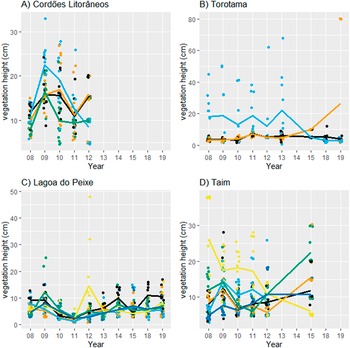
Vegetation height was lowest at Lagoa do Peixe NP across all years and showed relatively little variation among sites. Vegetation height at Torotama island was also relatively low on average, but had the greatest variability among sites (i.e. highest SD) (Figure 2, Table 1). The overall average vegetation height at each stratum across all years was 13.4 ± 5.6 cm at Cordões Litorâneos, 8.5 ± 12.3 cm at Torotama Island, 5.7 ± 3.7 cm at Lagoa do Peixe NP, and 10.9 ± 6.6 cm at Taim ES (Figure 2, Table 1).
Vegetation height at four study areas where Buff-breasted Sandpiper Calidris subruficollis was surveyed in southern Brazil, between 2008 and 2020. Each coloured line shows change in mean vegetation height over time at a different c.1-km transect at the study area. The coloured points show the individual measurements on each transect. The x-axis is the wintering season (e.g. 08 corresponds to the 2008/09 season). Note the different scales on the y-axes. See Table 1 for sample sizes and Figure 1 for location of study areas.

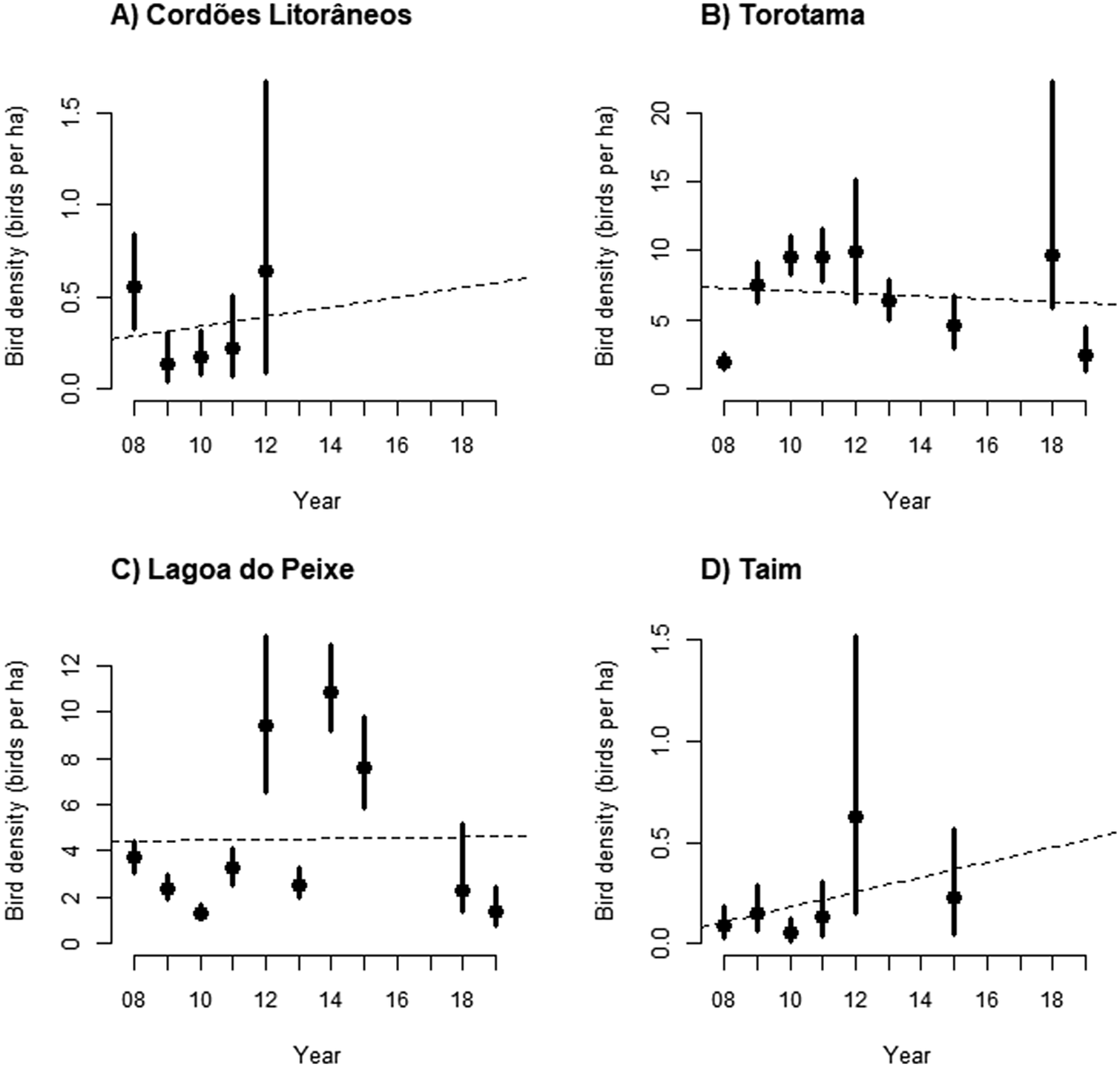
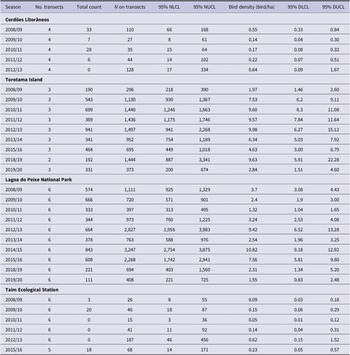
The strata with the highest counts were Torotama Island in the 2012/13 season (n = 941 BBSA) and Lagoa do Peixe NP in 2014/15 (n = 843 BBSA). BBSA estimated density was also highest overall at Lagoa do Peixe NP and Torotama Island, and ranged from 1.32 to 10.82 and 1.97 to 9.98 birds per ha, respectively, between 2008 and 2019. During last year of monitoring, the estimated density was 2.84 (95% Credible Interval CI: 1.51–4.60) at Torotama Island and 1.55 (95% CI: 0.83–2.48) at Lagoa do Peixe NP (Figure 3, Table 2). In contrast, bird density at Cordões Litorâneos and Taim ES ranged from 0.05 to 0.62 and 0.14 to 0.64 birds per ha, respectively (Figure 3, Table 2). At Lagoa do Peixe NP, BBSA density peaked in 2014/15, but in the last two years of the study (2018/19 and 2019/20) it decreased to levels equal to or below those estimated at the beginning of the study (2008–2010). Bird density was similar at the beginning and end of our study period, and there was no clear trend (increase or decrease) in BBSA density over time (Figure 3, Table S2).
Density of Buff-breasted Sandpiper Calidris subruficollis at four study areas in southern Brazil. Note the different scales of the y-axes. Estimates were generated through a hierarchical distance sampling model of density as a function of study area (stratum) and vegetation height. Error bars are the 95% credible interval. The x-axis is the wintering seasons 2008–2020 (e.g. 08 corresponds to the 2008/09 season). There was no significant increasing or decreasing trend at any study area (dashed lines). Regression coefficients for the dashed lines are provided in Table S2.

Estimated population size and density (birds per ha) of Buff-breasted Sandpiper Calidris subruficollis (BBSA) along transects at four wintering areas in southern Brazil, 2008–2020. Total count is the sum of all BBSAs detected on all transects. “N on transects” is the estimated population size from a hierarchical distance sampling model for a standardised amount of area based on number of transects and a standardised transect width and length (Number of transects × 500 m × 1,000 m). NLCL and NUCL are the lower and upper bounds of the 95% credible interval for “N on transects”. DLCL and DUCL are the lower and upper limits of the 95% credible interval for bird density.

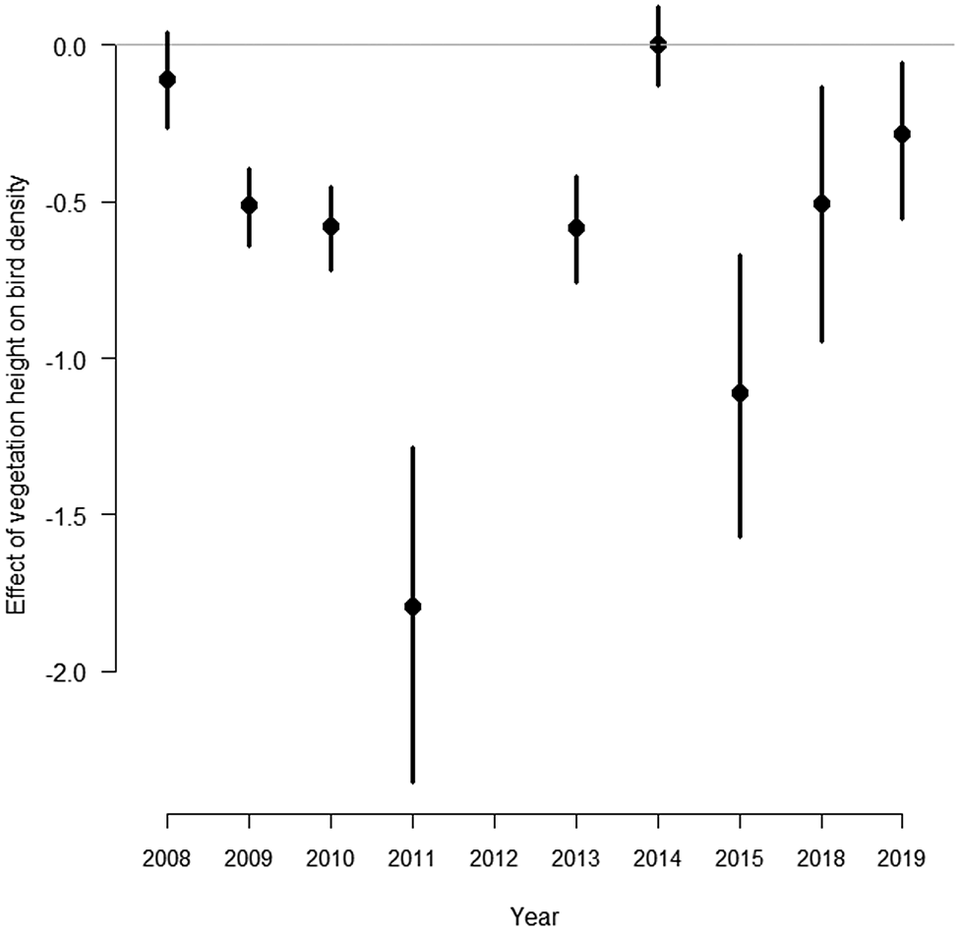
BBSA density was negatively related to vegetation height in most years (Figure 4). The effect of vegetation height was greatest in 2011 when the vegetation at three strata (Cordões Litorâneos, Torotama Island, and Taim ES) was relatively tall but lower at Lagoa do Peixe NP (Figures 2 and 4). Though the strength of the effect of vegetation on BBSA density was variable among years, the 95% credible interval included 0 in only two (2008/9 and 2014/15) of the nine years, showing a consistent negative effect across years (i.e. higher vegetation height relates to lower counts of BBSA) (Figure 4). In 2014/15, only Lagoa do Peixe NP was surveyed (Table 1) and, as noted above, vegetation height was consistently lower across years at this stratum compared with the other strata.
Effects of vegetation height on the density of Buff-breasted Sandpipers Calidris subruficollis at wintering areas in southern Brazil, 2008–2020. The y-axis is the coefficient
 $ {\beta}_1 $
from the hierarchical distance sampling model (Eq. 1), i.e. estimated change in bird density (birds per ha) for each unit increase in standardised vegetation height (mean vegetation height/SD vegetation height). Error bars are the 95% credible interval. The x-axis is the wintering seasons 2008–2020 (e.g. 2008 corresponds to the 2008/09 season).

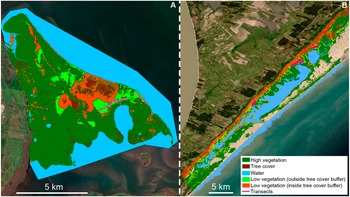
During last year of monitoring, an estimated 373 (95% CI: 200–674) and 694 (95% CI: 403–1,560) BBSAs were present on monitored sites at Torotama Island and Lagoa do Peixe NP, respectively (Table 2), while the supervised classification model indicated 1,442.7 ha of suitable habitat at Lagoa do Peixe NP and 422.6 ha at Torotama Island (Figure 5). Assuming that densities were similar in non-surveyed suitable habitats classified in our model, we estimated 2,232 BBSAs at Lagoa do Peixe NP (95% CI: 1,199–3,584) and 1,201 (95% CI: 637–1,946) at Torotama Island in 2019/20.
Supervised classification model of habitat types in two study areas in Brazil: Torotama Island (A) and Lagoa do Peixe National Park (B) during 2019/20 Buff-breasted Sandpiper Calidris subruficollis non-breeding season. See Figure 1 for locations of study areas.

Discussion
We generated the first analysis of BBSA population trends in one of the species’ main non-breeding areas. We detected fluctuations in BBSA abundance and density on its main non-breeding areas in southern Brazil between 2008 and 2020, with no apparent temporal trend in estimated densities. Of the four monitored areas, Lagoa do Peixe NP and Torotama Island held the largest BBSA densities. Although previous studies had indicated that Taim ES and Cordões Litorâneos were important (Bencke et al. 2006, Di Giacomo and Parera Reference Di Giacomo and Parera2008), BBSA abundance and density were comparatively much lower at these areas. Suitable habitat at Taim ES appears to be more spread out, especially along the shore of the Lagoa Mirim, and may disperse birds across a larger and less discrete area in comparison to Lagoa do Peixe NP and Torotama Island. At Cordões Litorâneos, the grass is taller, and BBSA occurred only in limited sectors where sheep are raised alongside cattle.
Our findings corroborate the results of previous survey efforts showing that Lagoa do Peixe NP and Torotama Island had the highest BBSA densities among several Brazilian sites. Lanctot et al. (Reference Lanctot, Blanco, Dias, Isacch, Verena, Almeida and Delhey2002) estimated BBSA densities of 1.62 birds per ha (95% CI 0.67–3.93) in Brazilian grassland areas, which was lower than those observed in Uruguay in 1999 (2.18 birds per ha and 95% CI 0.89–5.31), but higher than those observed in Uruguay (
 $ \overline{x} $
= 1.08 birds per ha, 0.37–3.18 95% CI) and Argentina in 2001 (
 $ \overline{x} $
= 0.11 birds per ha, 0.04–0.31 95% CI). Our values were also very similar to those observed by Almeida et al. (2009) from 2003 to 2005 in both Lagoa do Peixe NP and Torotama Island (1.32–10.82 birds per ha and 1.97–9.98 birds per ha, respectively), and higher than densities found in Brazilian rice fields (0.11–0.32 birds per ha) (Dias et al. Reference Dias, Blanco, Goijman and Zaccagnini2014).
In addition to differences in sampling dates, BBSA fluctuations among sites and years could potentially be related to variation in the environmental and ecological characteristics of sites such as soil moisture levels and prey availability (e.g. Aldabe et al. Reference Aldabe, Lanctot, Blanco, Rocca and Inchausti2019), which in turn are driven by climatic factors. For example, rainfall can play an important role in the population dynamics of shorebirds (e.g. Aarif et al. Reference Aarif, Nefla, Nasser, Prasadan, Athira and Muzaffar2021, Warnock et al. Reference Warnock, Jennings, Kelly, Condeso and Limpkin2021) and Canham et al. (Reference Canham, Flemming, Hope and Drever2021) detected negative relationships between shorebird counts and freshwater discharges into estuaries. Since BBSAs rely on dynamic habitats, the suitability of sites may vary dramatically between years, with an increase in the amount of suitable habitat leading to a decrease in local densities (Lanctot et al. Reference Lanctot, Blanco, Dias, Isacch, Verena, Almeida and Delhey2002). Both Torotama Island and Lagoa do Peixe NP are located in estuarine areas, where south-west winds associated with cold fronts (Klein Reference Klein, Seeliger, Odebrecht and Castello1998) bring brackish waters to flood the coastal grasslands used by BBSA. Rainfall also causes the temporary flooding of these coastal grasslands, and interannual variation in rainfall in south-eastern Brazil is strongly influenced by El Niño–Southern Oscillation (ENSO) events, which occur every three to seven years (Sverdrup et al. Reference Sverdrup, Duxbury and Duxbury2005). ENSO years are associated with an increase in rainfall and freshwater inflow into estuaries, while intervening years (“La Niña”) are drier than average (Grimm et al. Reference Grimm, Ferraz and Gomes1998). The peak of BBSA density observed in 2014/15 corresponded to a strong ENSO year with elevated rainfall (Brubacher et al. Reference Brubacher, Oliveira and Guasselli2021), which potentially reduces the amount of suitable habitat available for BBSA for resting and feeding. Climatic events can directly influence the amount of continental water discharge and the biogeochemical processes that affect both the vegetation structure (Ciotti et al. Reference Ciotti, Odebrecht, Fillmann and Möller1995) and density of invertebrate prey (Bemvenuti and Colling Reference Bemvenuti, Colling, Seeliger and Odebrecht2010), in addition to the water level itself, which could be key for BBSA densities. Finally, climate change is expected to increase the frequency and severity of extreme rainfall and flooding events in tidal marshes via sea level rise (Schuerch et al. Reference Schuerch, Vafeidis, Slawig and Temmerman2013). In this context, such consequences are predicted to affect wetland dynamics and macroinvertebrate assemblages (Epele et al. Reference Epele, Grech, Williams-Subiza, Stenert, McLean, Greig and Maltchik2022), and thus likely impact coastal bird populations such as BBSA (Wiest et al. Reference Wiest, Correll, Olsen, Elphick, Hodgman, Curson and Shriver2016).
Fluctuations in cattle density can also act as a possible source of variation in BBSA densities among our study sites. Livestock regulate pasture height by creating shorter grass levels, which we confirm has a strong positive effect on BBSA abundance. Aldabe et al. (Reference Aldabe, Lanctot, Blanco, Rocca and Inchausti2019) found a higher probability of BBSA occurrence in Uruguayan paddocks when grass height ranged from 2 cm to 5 cm, and a marked decrease when vegetation exceeded 8 cm. In Lagoa do Peixe NP, cattle are raised in well-delimited paddocks and animal densities are probably more constant over time than in other surveyed sites, which in turn can diminish the variability in vegetation structure and BBSA density (G. A. Bencke, pers. obs.). Finally, the fluctuations we observed in BBSA densities could be additionally explained by interannual differences in components of BBSA demography, such as survival and productivity that are driven by factors occurring outside the non-breeding season. It is known, for example, that shorebird populations can fluctuate interannually due to variation in shorebird predator densities on the breeding grounds (e.g. Underhill et al. Reference Underhill, Prys-Jones, Syroechkovski, Groen, Karpov, Lappo and Vanroomer1993, McKinnon et al. Reference McKinnon, Bertreaux and Bêty2014). However, parameters such as juvenile survival, which are known to drive population trends, are still poorly understood in most Arctic breeding shorebirds such as BBSA (Weiser et al. Reference Weiser, Lanctot, Brown, Gates, Bêty, Boldenow and Brook2020).
Given our findings, both Torotama Island and Lagoa do Peixe NP warrant additional management and conservation attention, as these areas together host the highest densities and supported ~6% (2.3–15.8%) of the global BBSA population in 2019/20 (Andres et al. Reference Andres, Smith, Morrison, Gratto-Trevor, Brown and Friis2012). Considering the areas separately, both are used by at least 1% of the BBSA global population. These results could, therefore, be used to designate Torotama Island as a WHSRN site, which would make it the second site in the Rio Grande do Sul state. It is critical to note that the importance of these areas may be even higher than our results suggest, since 1) our estimates were generated from data obtained during one of the seasons with the lowest BBSA densities at Torotama Island and Lagoa do Peixe NP over our entire study period, and 2) our estimates were conservative, since we restricted our extrapolation to habitats with similar characteristics to our surveyed sites (i.e. areas closer to trees and distant from lagoons were not considered). Although these areas have not suffered significant alterations over the monitoring period, both may be susceptible to pressures in the future. Torotama Island, for instance, is situated in an estuarine area exposed to urban development and land invasion. In contrast Lagoa do Peixe NP is federally protected, but that protection has not been fully implemented. Since cattle ranching in Brazilian protected areas is restricted, livestock may eventually be removed, leading to taller vegetation and fewer BBSAs (Bencke et al. 2006). The rapid development of wind farms onshore in recent decades, which are now established along the entire southern Brazilian coastal plain, are already having indirect negative impacts on shorebirds through habitat alteration, but may also result in direct effects via increased mortality due to collision with wind turbines and powerlines when shorebirds are moving among local areas or during migration (Thaxter et al. Reference Thaxter, Buchanan, Carr, Butchart, Newbold, Green and Tobias2017). The current plans for wind farm development in the Lagoa dos Patos, close to the sites studied here, and the offshore wind farms planned in neritic waters of the Atlantic Ocean are thus potential additional threats (Bugoni et al. Reference Bugoni, Nunes, Lauxen, Gomes, Roos, Serafini, Fialho and Gomes-Filho2022).
We surveyed the most important known areas in southern Brazil but found a relatively low proportion of the previously estimated BBSA population (Andres et al. Reference Andres, Smith, Morrison, Gratto-Trevor, Brown and Friis2012). This suggests three possibilities: 1) there are other important areas holding a larger portion of the global BBSA population; 2) our restrictions on habitat types were too stringent; and/or, 3) the previous population estimate of 56,000 BBSA needs to be revised. Our decade-long monitoring confirms that Lagoa do Peixe NP and Torotama Island are the most important areas now known for BBSA conservation in southern Brazil. However, additional areas important for this species may still be found, especially along the margins of the Lagoa Mirim and the western margin of the Lagoa dos Patos. We therefore encourage the continuation of BBSA monitoring at Lagoa do Peixe NP and Torotama Island, as well as efforts to map previously unidentified areas supporting suitable BBSA habitats. With reference to new monitoring areas, it is important to consider the use of rice fields by the species. During initial planting stages, these fields have characteristics that are similar to the preferred habitats of the species, i.e. flat and dry areas, with short grasses and partially exposed soil (Dias and Burger Reference Dias and Burger2005, Dias et al. Reference Dias, Blanco, Goijman and Zaccagnini2014). Surveys in areas where satellite tagged birds were detected (Tibbitts et al. unpublished data) might also yield new areas of importance (e.g. Aldabe et al. unpublished data). We also recommend the spatial and temporal replication of these analyses, with more than one survey carried out per season to decrease the probability of rare events biasing the results, in concert with surveys at known BBSA wintering areas in Uruguay and Argentina to generate overall non-breeding population estimates. A broader understanding of the impact of livestock grazing/flooding on the use of areas by BBSA is encouraged as well, potentially through exclusion experiments. Increased survey, demographic analysis (i.e. age-related survival), and mapping efforts may, in turn, contribute to a better understanding of the processes driving the regional fluctuations in BBSA populations. Such knowledge may provide information about the influence of microscale (e.g. vegetation height and soil moisture), as well as meso- and macro-scale processes, such as wind and rain regimes and climatic changes, on BBSA populations.
Acknowledgements
The authors are grateful for funding/logistical support from BirdLife International, US Fish and Wildlife Service through the NMBCA Program, US Forest Service, Environment and Climate Change Canada, Manomet Inc., and Fundação Zoobotânica do Rio Grande do Sul, now at Secretaria do Meio Ambiente e Infraestrutura. We are also grateful to Sandro and Jorge for allowing access to their properties, and the Lagoa do Peixe NP park rangers Lauro Lemos, Riti Soares, Marcelo Alves, Jordano Lopes, Márcia Machado, Magnus Severo, and Fernando Weber for their support in fieldwork. Felipe C. Bonow, Andros Gianuca, Jonas Rosoni, Maurício S. Pereira, Fernando Poerschke, André M. Lima, Cristiane A. Silva, Jan K. F. Mähler Jr, Priscila S. Pons, and Christian B. Andretti helped to count birds. Maurício Camargo, Silvina Botta, Richard Lanctot, and two anonymous reviewers provided valuable revision of the manuscript. We thank the landowners for allowing access to their properties. The Instituto Chico Mendes de Conservação da Biodiversidade (ICMBio) allowed part of study to be conducted through License SISBIO No. 31353-5. Funding to FAF was from the Conselho Nacional de Desenvolvimento Científico e Tecnológico – CNPq, through the “Programa de Pós-Graduação em Oceanografia Biológica” (FURG). MSSG holds a postdoctoral contract (ref. 2021-UNIVERS-10414), co-financed by Castilla-La Mancha regional government through the Operative Program of the European Social Fund through Axis 1: “Promotion of sustainable employment and quality and labor mobility”. LB is a research fellow at the Brazilian CNPq (Proc. No. 311409/2018-0). Any use of trade, firm, or product names is for descriptive purposes only and does not imply endorsement by the US Government.
Supplementary materials
The supplementary material for this article can be found at http://doi.org/10.1017/S0959270923000138.