




No CrossRef data available.
Article contents
Reducing the risk of burnout in end-of-life care settings: The role of daily spiritual experiences and training
Published online by Cambridge University Press: 03 March 2006
Abstract
Objective: Individuals in the helping professions are subject to unique stressors that may lead to burnout, and research has shown that those who work with dying or bereaved individuals might be particularly at-risk. This study explores how factors such as spirituality and level of training might buffer the stress of working with terminally ill clients and their families.
Method: A total of 80 medical and mental health practitioners attending palliative care seminars were surveyed, with each completing validated measures of daily spiritual experiences and caregiver burnout, as well as assessments of demographic factors, their general education and training experiences specific to working in end-of-life care and bereavement settings.
Results: Findings indicate that daily spiritual experiences might mitigate physical, cognitive, and emotional forms of burnout in the workplace. In addition, a negative correlation was found between the amount of end-of-life training received and burnout in the physical and cognitive domains. However, training was not related to professionals' level of emotional exhaustion.
Significance of the research: Results reinforce a growing literature on the salutary effects of spirituality, and underscore its relevance as one possible form of constructive coping for professionals attending to the needs of the dying and bereaved. The study carries further implications for how the stresses of such work might be ameliorated by enhanced training efforts, as well as creative facilitation of diverse spiritual expressions (e.g., inclusive forms of ritual recognition of loss) in the workplace.
Information
- Type
- Research Article
- Information
- Copyright
- © 2005 Cambridge University Press
INTRODUCTION
Work in health and social service settings has been shown to be particularly stressful (Pines & Maslach, 1978). Although this stress has assumed a variety of labels, such as secondary traumatic stress (STS; Stamm, 1997), vicarious traumatization (VT; McCann & Pearlman, 1990), and compassion fatigue (Figley, 1995), all of these terms share common features and refer to the potentially harmful effects of working closely with traumatized clients. Health care workers also often experience workplace burnout, which is a gradual loss of emotional, cognitive, and physical energy (Shirom, 2002) that results from continuous exposure to job and life stresses (Jackson et al., 1986). This type of daily stress can have a devastating impact, compromising not only clinicians' level of performance and the success of interventions (Guy et al., 1989), but also job satisfaction and personal health (Carson & Fagin, 1996). Given the potentially damaging effects of stress experienced by health care workers, greater understanding of the factors that might alleviate or prevent it from occurring is needed. In this study, daily spiritual experiences and job-specific training will be explored as factors that might buffer workplace burnout among a particularly at-risk population, namely medical and mental health personnel who work closely with dying and/or grieving clients.
Although a variety of specific stressors have been identified (e.g., increasing workloads, administrative difficulties, lack of resources; Edwards et al., 2000), research suggests that situations that call attention to issues related to death and dying might present unique challenges for health care workers. For example, in a survey of 598 oncologists, 56% of respondents reported burnout, 53% of whom attributed their burnout to excessive contact with terminal illness (Whippen & Canellos, 1991). Similarly, in a longitudinal study that examined sources of stress in medical interns, the most frequently reported stressor was “dealing with death and dying” (Firth-Cozens & Morrison, 1989). In mental health settings, it has also been shown that beginning counselors tend to experience substantially more discomfort when confronted with scenarios that involve death and loss compared to other serious presenting problems (Kirchberg & Neimeyer, 1991; Kirchberg et al., 1998).
This heightened stress that accompanies occupations requiring close contact with fatal illnesses, traumatic loss, and/or grieving clients might be due to several factors. Seeing patients improve has been cited by health care workers as one of the most rewarding aspects of their jobs (Harper & Minghella, 1997; Collins & Long, 2003), and the absence of this intrinsic reward might make working with terminally ill patients particularly difficult. Indeed, physicians have described their burnout as a profound sense of frustration and failure, and many of them report that the low success rate of treatments does significantly contribute to their level of burnout (Whippen & Canellos, 1991). Furthermore, contact with terminally ill and grieving clients might force health care professionals to examine their own death anxieties and concerns (Barnard, 1995; Neimeyer, 2000). Thus, it is not surprising that medical personnel often report feeling anxious about their communication with dying patients (Field & Howells, 1985) and coping with their own emotions when delivering notification of terminal prognoses (Sykes, 1989).
Practitioners might also experience their own feelings of grief either directly when a patient dies or vicariously when coming in contact with the deceased's loved ones (Papadatou, 2000). In a recent survey of 188 physicians, 31% reported that the death of a patient had a strong emotional impact on them, and on average these doctors experienced two symptoms of grief, most notably “feeling upset when thinking about the patient” and “feeling numb” (Redinbaugh et al., 2004). The bereavement experienced by health care providers might be further complicated by the fact that few norms exist to which they can compare their grief experiences (Kaplan, 2000), which can result in a feeling that one's sense of loss is inexpressible or “disenfranchised” (Moss & Moss, 2002).
Because of the unique stressors faced by practitioners who frequently come in contact with situations that involve end-of-life issues, successful coping mechanisms and preventative measures that can help lessen their distress need to be more fully explored. Past research has shown that these health care workers can benefit from a variety of personal and professional factors such as staff retreats, weekly support groups, daily journaling, and maintaining a sense of humor (Riordan & Saltzer, 1992). However, there are theoretical and empirical reasons to believe that other factors, such as spirituality and death/grief specific training, might also play an important role in mitigating the potentially damaging effects of working with dying patients and the loved ones they leave behind.
Daily Spiritual Experiences
It appears that health professionals cope more effectively with repeated exposure to trauma and death-related situations when they find ways to understand and consolidate their experiences into broader meaning structures. For example, in a survey of 79 emergency-response personnel in the aftermath of two large-scale disasters, the coping strategies most frequently reported included attempting to ascertain a sense of meaning and reach cognitive mastery over events (McCammon et al., 1988). In addition, Redinbaugh et al. (2004) found that 36% of hospital doctors coped with the loss of a patient by trying to “see the death in a different light to make it seem more positive.”
In many cases a sense of spirituality or religious conviction might help individuals coping with end-of-life issues frame their experiences in a different and perhaps more positive light (Strang & Strang, 2001; Smith & Harkness, 2002). This insight might be expressed as particular attributed meanings or explanations such as, “It is God's will,” or “It is fate,” or “It is part of a bigger plan” (Papadatou, 2000). Such an explanation is compatible with evidence that intrinsic religiosity (regarding religious values and meanings at the center of one's orientation to life) is associated with reduced death anxiety both in the general population (Neimeyer et al., 2004) and among those providing care to patients with serious illness (Bivens et al., 1995). However, spirituality can also work at a more experiential level. It has been argued that one's daily experience of spirituality, rather than particular beliefs or behaviors, taps more directly into the common processes through which religiousness and spirituality are involved and therefore might exhibit stronger links to other everyday processes, such as thoughts, feelings, and physical health (Underwood & Teresi, 2002). In keeping with this rationale, the Daily Spiritual Experience Scale (DSES), a recently developed measure that attempts to tap into this experiential component of spiritual life (e.g., feelings of blessedness, inner peace, connectedness), has been shown to be negatively correlated with a variety of psychosocial factors, such as anxiety and depression, and behavioral outcomes, such as alcohol consumption (Underwood & Teresi, 2002).
Although spiritual and religious variables in general have been used to predict a multitude of outcomes (Hill & Butter, 1995), few studies have examined the relationship between spirituality and workplace burnout. Overall, the existing literature has indicated that a modest negative correlation exists between spirituality and occupational stress (with Pearson r values ranging from −.16 to −.32), suggesting that more spiritually oriented individuals tend to experience less burnout at work (Rodgerson & Piedmont, 1998; Csiernik & Adams, 2002; Golden et al., 2004). However, these studies have focused mostly on spiritual beliefs, behaviors, and/or traits and have not directly assessed spirituality at the level of daily life. For instance, Csiernik and Adams (2002) measured spirituality using the JAREL Spiritual Well-Being Scale, which assesses specific spiritual beliefs such as “I believe in an afterlife” and “I believe in a supreme power” (Hungelmann et al., 1996). But because workplace burnout represents an affective reaction to ongoing, daily stress (Shirom, 1989), it seems likely that other daily processes, such as daily spiritual experiences, would be more strongly related to burnout. Thus, the current study aims to extend past research and explore the potential positive impact of daily spiritual experiences on workplace burnout among end-of-life care practitioners.
End-of-Life Care Training
Training programs for doctors, nurses, and mental health professionals have steadily begun to recognize the importance of death, dying, and bereavement-specific education (Dickinson & Field, 2002; Haley et al., 2003), and research studies suggest that this type of training can have a positive impact on health professionals in a variety of ways (Durlak & Riesenberg, 1991; Carr & Merriman, 1995–96). Specifically, health care professionals who attend seminars or other training on death and dying are more likely to feel comfortable with death-related issues and the care of dying patients (Carr & Merriman, 1995–96; Terry et al., 1996). Furthermore, a quantitative review examining the effectiveness of death education revealed that this type of intervention tends to positively influence participants' attitudes and values regarding death and also improves on-the-job helping skills and other personal behaviors (e.g., quitting smoking, making out a will; Durlak & Riesenberg, 1991).
The effectiveness of death education has been explained in several ways. It has been proposed that simply remaining current in the field of thanatology might help maintain a much needed sense of mastery when dealing with situations that involve death, dying, or bereavement (Yancik, 1984). For example, medical personnel often report having difficulties recognizing, understanding, and managing pain experiences of terminally ill patients (Oliver, 1989; Moss et al., 2002), and proper training might help refine these skills. Additionally, from a psychological perspective, advances have been made in the way mental health practitioners view reactions to death, making the acquisition of current knowledge a necessary ingredient to ensure optimal client care. For instance, theories that conceptualize grief as a series of stages have largely been replaced by theories that focus more on issues of personal meaning (Neimeyer, 2001; Stroebe et al., 2001). Likewise, refinements in the assessment of death-related emotions, such as grief and death anxiety, have been made in response to studies that revealed the weaknesses of more traditional measures (Neimeyer, 1994; Neimeyer & Hogan, 2001). In general, the burgeoning literature on end-of-life issues reinforces the need for further training in a rapidly changing health care field (Center for the Advancement of Health, 2004).
It is possible that end-of-life practitioners who do not possess a sense of mastery or have an adequate knowledge base might feel overwhelmed by the cognitive as well as emotional demands of their work. Typically, individuals who doubt their abilities in a particular domain feel threatened and seek to avoid activities related to that domain (Bandura, 1997). However, when job tasks cannot be avoided, people often experience stress and exhaustion and come to adopt negative attitudes about their work (Davies & Yates, 1982; Usaf & Kavanagh, 1990). This tendency has led researchers such as Leiter (1992) to begin conceptualizing workplace burnout as “a crisis in self-efficacy.” This link between self-efficacy and burnout highlights the importance of training for employees that specifically targets issues relevant to the job-at-hand. Thus, in this examination of end-of-life practitioners, the relationship between burnout and death/grief-specific training will be explored.
Hypotheses
In the present study, we hypothesized that both the frequency of everyday spiritual experiences and the number of hours of training received specific to end-of-life care will be negatively associated with the level of workplace burnout reported by clinical caregivers working with death and loss. We also predicted that these relationships will be preserved after accounting for demographic factors, such as age and education level.
METHODS
Participants
Following institution review and approval of the study, 80 participants were recruited from three presentations on end-of-life issues offered to health care workers in the Memphis, Tennessee, area. Any attendee whose occupation involved working with traumatic loss, terminal illness, or bereavement was eligible to participate in the study. Overall, participants reported that 37.1% of the patients they worked with were terminally ill and 45.5% were bereaved, indicating a considerable amount of contact with situations that involve end-of-life issues. The sample ranged in age from 20 to 71 years old with a mean age of 44.18 years (SD = 12.38). Eighty-one percent were women, and 19.0% were men. Most of the participants (82.5%) were Caucasian, 16.3% were African-American, and 1.3% were Asian. A diversity of occupations were also represented with 51.3% of participants working as nurses, 19.2% as hospital chaplains, 7.7% as psychotherapists, 6.4% as social workers, 5.1% as volunteers, 2.6% as physicians, and 7.7% who worked in “other” health-related fields.
Procedure
Each eligible participant completed a one-time End-of-Life Care Questionnaire that included the Daily Spiritual Experience Scale, Shirom-Melamed Burnout Measure, questions about their level of education and number of hours of training specific to death and loss, and other demographic questions concerning the participants and the nature of their work (e.g., What best describes your occupation? What best describes the organization you work for?).
Measures
Shirom-Melamed Burnout Measure (SMBM)
The SMBM is a 16-item self-report questionnaire that assesses physical fatigue, emotional exhaustion, and cognitive weariness at work (Shirom, 2002). The measure consists of a variety of statements concerning work-related thoughts and behaviors, followed by a seven-point scale that gauges the frequency with which these events occur, ranging from 1 = never to 7 = almost always. The physical fatigue subscale measures one's subjective experience of bodily tiredness at work and is made up of six items, which include statements such as “I feel like my ‘batteries' are ‘dead.’ ” and “I feel physically drained.” The cognitive weariness subscale also consists of six items and deals with feelings of being overwhelmed by and unable to meet the cognitive demands of work (e.g., “I'm too tired to think clearly”; “I have difficulty concentrating”). The third and final subscale of the SMBM, emotional exhaustion, is comprised of four items that tap into one's ability or inability to be sensitive, compassionate, and empathetic at work (e.g., “I feel emotionally drained”; “I feel I am unable to be sensitive to the needs of coworkers and clients/patients”1
In an effort to use language that was appropriate to the sample surveyed in this study, the words “clients/patients” were used in place of “customers” in the SMBM.
Past studies have shown the SMBM to have good internal consistency, demonstrating reliability coefficients (Cronbach's alpha) as high as 0.91 (Melamed et al., 1999). The measure also appears to have good predictive validity and correlates with a variety of physiological variables in the expected direction. For example, participants' total score on the SMBM has been shown to predict cardiovascular disease (Melamed et al., 1992), salivary cortisol levels (Melamed et al., 1999), and upper respiratory infections (Kushnir & Melamed, 1992).
Daily Spiritual Experience Scale (DSES)
The DSES is a 16-item self-report measure that attempts to gauge one's everyday, ordinary experience of spirituality, rather than specific beliefs or behaviors (Underwood & Teresi, 2002). For instance, the DSES asks participants how often they experience God's love or feel blessed in daily life (e.g., “I feel God's love for me, directly”; “I feel thankful for my blessings”). For the first 14 items, each statement is followed by a six-point scale that assesses the frequency with which a spiritual experience occurs, spanning from 1 = never to 6 = many times a day. The final two items ask participants to rate their level of closeness to God on a scale from 1 to 4, with 1 being not at all close and 4 being as close as possible.
The DSES has demonstrated good internal consistency with Cronbach's alphas as high as 0.95. In addition, a brief six-item version of the measure has been shown to be stable over a 2-day period of time with a test–retest Pearson correlation of 0.85 (Underwood & Teresi, 2002). Past studies have also demonstrated that the DSES has strong predictive validity and correlates with other variables in the expected direction. Specifically, the DSES has been shown to be negatively associated with state-trait anxiety and perceived stress and positively related to optimism and perceived social support (Underwood & Teresi, 2002). Preliminary exploratory factor analysis suggests that this scale is unidimensional (Underwood & Teresi, 2002); therefore, in this study all 16 items were used to obtain a total score that was examined in the analyses.
Other Variables Measured
The amount of death-related training a health care worker had received was measured by a single item that asked participants: “Please indicate amount of training received specific to issues of loss, trauma, and grief,” as a range of hours (i.e., 5 h or less; 5 to 10 h), spanning from none to more than 40 hours. Respondents also provided personal demographic information such as age, gender, ethnicity, and level of education as well as information about their work and clientele such as the type of organization they worked for (e.g., hospital-based palliative care, in-home hospice services, community mental health agency) and the percentage of terminally ill and bereaved clients treated.
RESULTS
For the SMBM and DSES, individual items were summed and averaged to obtain overall scores.2
Because items 15 and 16 of the DSES are on a four-point scale, these items were converted to a six-point scale in order to maintain an equal weighting for each item.
A series of Pearson correlations were first run to examine the relationship between the independent variables, end-of-life care training and the DSES, and the dependent variables, physical fatigue, cognitive weariness, emotional exhaustion, and total burnout. As can be seen in Table 1, the DSES was negatively correlated with all three subscales of the SMBM as well as the total burnout measure with all p values at 0.002 or less. Thus, it appears that, as predicted, individuals who reported a greater frequency of daily spiritual experiences also tended to report less physical, cognitive, and emotional burnout. Conversely, the end-of-life care training variable was negatively correlated with physical fatigue and cognitive weariness (r = −0.29, p = 0.01; r = −0.30, p = 0.006, respectively), but was unrelated to emotional exhaustion (r = −0.04, p = 0.72). Stated differently, individuals who had received a greater number of hours of end-of-life care training tended to experience less physical fatigue and cognitive weariness, but were not necessarily less emotionally exhausted. Level of end-of-life care training was negatively associated with the SMBM overall (r = −0.27, p = 0.02).
Means, standard deviations, and intercorrelations between variables (N = 80)

Next, a hierarchical linear regression procedure was used to examine the effects of end-of-life care training and daily spiritual experiences on the total burnout measure, after accounting for age and education level. Age and education level were controlled because it was believed that these factors might be systematically related to the independent and/or dependent variables but were not a primary interest in this study. For example, education level could potentially obscure the relationship between end-of-life training and burnout because participants with a higher level of education might receive more specialized training and also might experience less stress at work because they have less “front-lines” client/patient contact. In this analysis, education was dichotomized into two categories to better capture one's “level of education” rather than the specific degree received by a participant. The two categories consisted of advanced professionals who had masters' or doctoral level degrees and others who had undergraduate degrees, high school diplomas, or other vocational training.
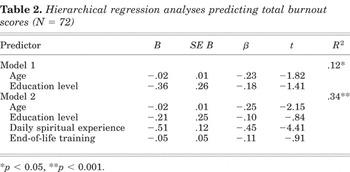
As can be seen in Table 2, in the first step of the model, education level and age alone accounted for a significant proportion of the variance in total burnout scores [R2 = 0.118, F(2,69) = 4.59, p = 0.01]. However, when end-of-life training and daily spiritual experiences were added in the second step, the change in R2 was significant [Rinc2 = 0.218, Finc(4,67) = 8.47, p < 0.001], indicating that together these variables accounted for 21.8% of the variability in burnout scores, after controlling for age and education level. An examination of the beta coefficients revealed that the DSES contributed unique predictive power in the presence of the end-of-life care training variable and the demographic variables [B = −0.51, t(70) = −4.41, p < 0.001]; however, the beta coefficient for the end-of-life care training variable was not significant in this model [B = −0.05, t(70) = −0.91, p = 0.37].
Hierarchical regression analyses predicting total burnout scores (N = 72)

DISCUSSION
Consistent with this study's hypotheses, frequency of daily spiritual experiences was found to be negatively associated with workplace burnout among end-of-life practitioners, and this relationship persisted even in the presence of other variables (e.g., age, education level, and end-of-life care training). Thus it appears that individuals who regularly experience feelings of blessedness, connectedness, and transcendence are less likely to experience tiredness and fatigue in the workplace. Because the observed correlations between spirituality and burnout were larger than those found in previous investigations (e.g., Rodgerson & Piedmont, 1998; Csiernik & Adams, 2002; Golden et al., 2004), this study also lends support to the notion that measuring spirituality at an everyday level might be more appropriate when attempting to detect relationships between spirituality and other everyday processes, such as workplace burnout.
Additionally, the link between daily spiritual experiences and burnout held across all three types of burnout, namely, physical fatigue, cognitive weariness, and emotional exhaustion. Therefore, these results add to the growing body of literature indicating that spiritual factors have a pervasive impact for the individual at both a psychological and physiological level (Powell et al., 2003; Seeman et al., 2003; Fiori et al., 2004).
With regards to the hypothesized relationship between end-of-life care training and workplace burnout, this study provided mixed results. Although individuals who possessed more hours of training specific to grief, terminal illness, and/or trauma also tended to experience less burnout overall, this relationship was weakened when demographic and spiritual factors were taken into account. Interestingly though, correlations between end-of-life care training and the three different types of burnout revealed that participants with more training experienced appreciably less physical fatigue and cognitive weariness but were not necessarily less exhausted emotionally. This finding makes sense if it is in fact the case that training has an impact on workplace burnout by enhancing one's level of self-efficacy. For instance, it might be that practitioners who receive end-of-life care training work more efficiently and with greater intellectual understanding of end-of-life situations, thereby reducing the subsequent cognitive and physical tiredness that accompanies their work, but do not receive any tools that help them cope with the emotional hardships of their jobs.
Clinical Implications
Given the strong inverse relationship between frequency of spiritual experiences and burnout, health care providers would be well advised to create a workplace atmosphere that allows for and encourages spiritual expression among employees. Although end-of-life staff might vary considerably in their spiritual beliefs and practices, memorial services and other rituals that promote a diversity of spiritual expression could prove to be helpful. For instance, a recent study revealed that 58.3% of HIV/AIDS health care workers who attended an institutional memorial service believed that the service helped them “to continue their work with AIDS patients,” and 88% felt that it provided them with “an opportunity to come to terms with the death of a patient” (Tiamson et al., 1998). Future studies should extend anecdotal findings such as these and explore the potential benefits of ritual and spiritual expression in the workplace.
Although daily spiritual experiences had a pervasive relationship to all forms of burnout, end-of-life training seemed to have almost no relationship to the emotional component of burnout among end-of-life practitioners. Further research is needed to determine exactly what kind of effect this type of training has on burnout; however, this initial investigation suggests that end-of-life training might not be addressing the emotional needs of health care workers in a particularly helpful way. Future end-of-life training programs might opt to focus more on health care workers' emotional needs by offering training and information in relevant areas such as starting and maintaining support groups, responding to bereaved coworkers, and normalizing grief experienced after the loss of a patient. Training curricula that allow opportunities for personal value clarification, exploration of one's own attitudes toward death and dying, and experiential learning could be especially important in amplifying the impact of end-of-life and grief education (Durlak & Riesenberg, 1991; Neimeyer, 2000).
Limitations and Future Directions
Although this study certainly contributes to our understanding of burnout among end-of-life care practitioners, it is not without limitations. First, because of the cross-sectional design of the study, it is difficult to know if it was spirituality or training that produced lower burnout, or if other factors were at play. For example, an alternate explanation for this pattern of results might be that those who are drawn to spirituality and are open to these types of experiences possess qualities, such as a positive outlook or psychological hardiness, that also make them less susceptible to workplace burnout. Therefore, no strong causative claims can be made based on this study alone. Future studies should employ longitudinal or experimental designs to better ascertain what kind of relationships exist between daily spiritual experience, end-of-life training, and burnout.
In addition, the measure of end-of-life training used in this study only assessed the number of hours of training received and did not take into account the different types of training health care workers undertook. Therefore, this study cannot make statements about the relative benefits of diverse curricula (e.g., experiential vs. more didactic approaches) with regards to burnout. Further research is needed to examine what training format has the greatest impact on health care workers. As discussed above, the development of a training module that meets the emotional needs of end-of-life practitioners might be of particular importance.
Lastly, studies with larger sample sizes would be better able to make meaningful comparisons between participants in different occupational roles, workplace settings, and so forth. Studies such as these could help elucidate which health care workers suffer the most from burnout and determine who might be best suited to benefit from end-of-life training, daily spiritual experiences, and other ameliorative factors. Nonetheless, the present findings highlight the relevance of both personal and professional factors in predicting workplace burnout in end-of-life care settings served by a variety of disciplines.
References
REFERENCES
Bandura, A.
(1997).
Self-efficacy: The exercise of control.
New York:
W.H. Freeman.
Barnard, D.
(1995).
The promise of intimacy and fear of our own undoing.
Journal of Palliative Care,
11,
22–26.Google Scholar
Bivens, A.J.,
Neimeyer, R.A.,
Kirchberg, T.M.,
et al.
(1995).
Death concern and religious beliefs among gays and bisexuals of
variable proximity to AIDS.
Omega,
30,
105–120.Google Scholar
Carr, M. &
Merriman, M.P.
(1995–96).
Comparison of death attitudes among hospice workers and health care
professionals in other settings.
Omega,
32,
287–301.Google Scholar
Carson, J. &
Fagin, L.
(1996).
Editorial: Stress in mental health professionals: A cause for
concern or an inevitable part of the job?
International Journal of Social Psychiatry,
42,
79–81.Google Scholar
Center for the Advancement of Health.
(2004).
Report on bereavement and grief research.
Death Studies,
28,
6.Google Scholar
Collins, S. &
Long, A.
(2003).
Too tired to care? The psychological effects of working with
trauma.
Journal of Psychiatric and Mental Health Nursing,
10,
17–27.Google Scholar
Csiernik, R. &
Adams, D.W.
(2002).
Spirituality, stress and work.
Employee Assistance Quarterly,
18,
29–37.Google Scholar
Davies, F.W. &
Yates, B.T.
(1982).
Self-efficacy expectancies versus outcome expectancies as
determinants of performance deficits and depressive affect.
Cognitive Therapy and Research,
6,
23–35.Google Scholar
Dickinson, G.E. &
Field, D.
(2002).
Teaching end-of-life issues: Current status in United Kingdom and
United States medical schools.
American Journal of Hospice & Palliative Care,
19,
181–186.Google Scholar
Durlak, J.A. &
Riesenberg, L.A.
(1991).
The impact of death education.
Death Studies,
15,
39–58.Google Scholar
Edwards, D.,
Burnard, P.,
Coyle, D.,
et al.
(2000).
Stress and burnout in community mental health nursing: A review of
the literature.
Journal of Psychiatric and Mental Health Nursing,
7,
7–14.Google Scholar
Field, D. &
Howells, K.
(1985).
Medical students' self-reported worries about aspects of death
and dying.
Death Studies,
10,
147–154.Google Scholar
Fiori, K.,
Hays, J., &
Meador, K.G.
(2004).
Spiritual turning points and perceived control over the life
course.
International Journal of Aging and Human Development,
59,
391–420.Google Scholar
Figley, C.R.
(1995).
Compassion fatigue: Toward a new understanding of the costs of
caring. In
Secondary Traumatic Stress: Self-care Issues for Clinicians,
Researchers and Educators,
Stamm, B.H. (ed.), pp.
3–28.
Lutherville, MD:
Sidran Press.
Firth-Cozens, J. &
Morrison, L.
(1989).
Sources of stress and ways of coping in junior
house-officers.
Stress Medicine,
5,
121–126.Google Scholar
Golden, J.,
Piedmont, R.L.,
Ciarrocchi, J.W.,
et al.
(2004).
Spirituality and burnout: An incremental validity study.
Journal of Psychology and Theology,
32,
115–125.Google Scholar
Guy, J.D.,
Poelstra, P.L., &
Stark, M.J.
(1989).
Personal distress and therapeutic effectiveness: National survey of
psychologists practicing psychotherapy.
Professional Psychology: Research and Practice,
20,
48–50.Google Scholar
Haley, W.E.,
Larson, D.G.,
Kasl-Godley, J.K.,
et al.
(2003).
Roles for psychologists in end-of-life care: Emerging models of
practice.
Professional Psychology: Research and Practice,
34,
626–633.Google Scholar
Harper, H. &
Minghella, E.
(1997).
Pressures and rewards of working in community mental health
teams.
Mental Health Care,
1,
18–21.Google Scholar
Hill, P.C. &
Butter, E.M.
(1995).
The role of religion in promoting physical health.
Journal of Psychology and Christianity,
14,
141–155.Google Scholar
Hungelmann, J.,
Kenkel-Rossi, E.,
Klassen, L.,
et al.
(1996).
JAREL spiritual well-being scale. In
Handbook of Community and Home Health Nursing: Tools for Assessment
Intervention and Education,
3rd ed.,
Stanhope, M. &
Knollmueller, R.N. (eds.), pp.
166–168.
St. Louis:
Mosby.
Jackson, S.E.,
Schwab, R.L., &
Schuler, R.S.
(1986).
Toward an understanding of the burnout phenomenon.
Journal of Applied Psychology,
71,
630–640.Google Scholar
Kaplan, L.J.
(2000).
Toward a model of caregiver grief: Nurses' experiences of
treating dying children.
Omega,
41,
187–206.Google Scholar
Kirchberg, T.M. &
Neimeyer, R.A.
(1991).
Reactions of beginning counselors to situations involving death and
dying.
Death Studies,
15,
603–610.Google Scholar
Kirchberg, T.M.,
Neimeyer, R.A., &
James, R.K.
(1998).
Beginning counselors' death concerns and empathic responses to
client situations involving death and grief.
Death Studies,
22,
99–120.Google Scholar
Kushnir, T. &
Melamed, S.
(1992).
The Gulf War and burnout.
Psychological Medicine,
22,
987–995.Google Scholar
Leiter, M.P.
(1992).
Burn-out as a crisis in self-efficacy: Conceptual and practical
implications.
Work and Stress,
6,
107–115.Google Scholar
McCammon, S.L.,
Durham, T.W.,
Allison, E.J.,
et al.
(1988).
Emergency workers' cognitive appraisal and coping with
traumatic events.
Journal of Traumatic Stress,
1,
353–372.Google Scholar
McCann, L. &
Pearlman, L.A.
(1990).
Vicarious traumatization: A framework for understanding the
psychological effects of working with victims.
Journal of Traumatic Stress,
3,
131–149.Google Scholar
Melamed, S.,
Kushnir, T., &
Shirom, A.
(1992).
Burnout and risk factors for cardiovascular disease.
Behavioral Medicine,
18,
53–61.Google Scholar
Melamed, S.,
Ugarten, U.,
Shirom, A.,
et al.
(1999).
Chronic burnout, somatic arousal and elevated cortisol
levels.
Journal of Psychosomatic Research,
46,
591–598.Google Scholar
Moore, J.E.
(2000).
Why is this happening? A causal attribution approach to work
exhaustion consequences.
Academy of Management Review,
25,
335–349.Google Scholar
Moss, M.S.,
Braunschweig, H., &
Rubinstein, R.L.
(2002).
Terminal care for nursing home residents with dementia.
Alzheimer's Care Quarterly,
3,
233–246.Google Scholar
Moss, S.Z. &
Moss, M.S.
(2002).
Nursing home staff reactions to resident deaths. In
Disenfranchised Grief: New Directions, Challenges, and Strategies
for Practice,
Doka, K.J. (ed.), pp.
197–216.
Champaign, IL:
Research Press.
Neimeyer, R.A.
(1994).
Death Anxiety Handbook: Research, Instrumentation, and
Application.
New York:
Taylor & Francis.
Neimeyer, R.A.
(2000).
Suicide and hastened death: Toward a training agenda for counseling
psychology.
The Counseling Psychologist,
28,
551–560.Google Scholar
Neimeyer, R.A. (ed.).
(2001).
Meaning Reconstruction and the Experience of Loss.
Washington DC:
American Psychological Association.
Neimeyer, R.A. &
Hogan, N.
(2001).
Quantitative or qualitative? Measurement issues in the study of
grief. In
Handbook of Bereavement Research,
Stoebe, M.,
Hansson, R.,
Stroebe, W. &
Schut, H. (eds.), pp.
89–118.
Washington, DC:
American Psychological Association.
Neimeyer, R.A.,
Wittkowski, J., &
Moser, R.
(2004).
Psychological research on death attitudes: An overview and
evaluation.
Death Studies,
28,
309–340.Google Scholar
Oliver, D.
(1989).
Training in and knowledge of terminal care in medical students and
junior doctors.
Palliative Medicine,
3,
293–297.Google Scholar
Papadatou, D.
(2000).
A proposed model of health professionals' grieving
process.
Omega,
41,
59–77.Google Scholar
Pines, A. &
Maslach, C.
(1978).
Characteristic of staff burnout in mental health setting.
Hospital and Community Psychiatry,
29,
233–237.Google Scholar
Powell, L.H.,
Shahabi, L., &
Thoresen, C.E.
(2003).
Religion and spirituality: Linkages to physical health.
American Psychologist,
58,
36–52.Google Scholar
Redinbaugh, E.M.,
Sullivan, A.M.,
Block, S.D.,
et al.
(2004).
Doctors' emotional reactions to recent death of a
patient.
British Medical Journal,
327,
1–6.Google Scholar
Riordan, R.J. &
Saltzer, S.K.
(1992).
Burnout prevention among health care providers working with the
terminally ill: A literature review.
Omega,
25,
17–24.Google Scholar
Rodgerson, T.E. &
Piedmont, R.L.
(1998).
Assessing the incremental validity of the religious problem-solving
scale in the prediction of clergy burnout.
Journal for the Scientific Study of Religion,
37,
517–527.Google Scholar
Seeman, T.E.,
Dubin, L., &
Seeman, M.
(2003).
Religiosity/spirituality and health: A critical review of the
evidence for biological pathways.
American Psychologist,
58,
53–63.Google Scholar
Shirom, A.
(1989).
Burnout in work organizations. In
International Review of Industrial and Organizational
Psychology,
Cooper, C.L. &
Robertson, I. (eds.), pp.
26–48.
New York:
Wiley.
Shirom, A.
(2002).
Job-related burnout: A review. In
Handbook of Occupational Health Psychology,
Quick, J.C. &
Tetrick, L.E. (eds.), pp.
245–264.
Washington DC:
American Psychological Association.
Shirom, A.,
Westman, M.,
Shamai, O.,
et al.
(1997).
The effects of work overload and burnout on cholesterol and
triglycerides levels: The moderating effects of emotional reactivity among
male and female employees.
Journal of Occupational Health Psychology,
2,
275–288.Google Scholar
Smith, A. &
Harkness, J.
(2002).
Spirituality and meaning: A qualitative inquiry with caregivers of
Alzheimer's disease.
Journal of Family Psychotherapy,
13,
87–108.Google Scholar
Stamm, B.H.
(1997).
Work-related secondary traumatic stress.
PTSD Research Quarterly,
8,
25–34.Google Scholar
Strang, S. &
Strang, P.
(2001).
Spiritual thoughts, coping, and “sense of coherence” in
brain tumor patients and their spouses.
Palliative Medicine,
15,
127–134.Google Scholar
Stroebe, M.S.,
Hansson, R.O.,
Stroebe, W.,
et al. (eds.).
(2001).
Handbook of Bereavement Research: Consequences, Coping, and
Care.
Washington DC:
American Psychological Association.
Terry, M.L.,
Bivens, A.J., &
Neimeyer, R.A.
(1996).
Comfort and empathy of experienced counselors in client situations
involving death and loss.
Omega: Journal of Death and Dying,
32,
269–285.Google Scholar
Tiamson, M.,
Mcardle, R.,
Girolamer, T.,
et al.
(1998).
The institutional memorial service: A strategy to prevent burnout in
HIV health care workers.
General Hospital Psychiatry,
20,
124–126.Google Scholar
Underwood, L.G. &
Teresi, J.A.
(2002).
The Daily Spiritual Experience Scale: Development, theoretical
description, reliability, exploratory factor analysis, and preliminary
construct validity using health-related data.
Annals of Behavioral Medicine,
24,
22–34.Google Scholar
Usaf, S.O. &
Kavanagh, D.J.
(1990).
Mechanisms of improvement in treatment for depression: Test of a
self-efficacy and performance model.
Journal of Cognitive Psychotherapy,
4,
51–70.Google Scholar
Whippen, D.A. &
Canellos, G.P.
(1991).
Burnout syndrome in the practice of oncology: Results of a random
survey of 1000 oncologists.
Journal of Clinical Oncology,
2,
1916–1920.Google Scholar
Yancik, R.
(1984).
Coping with hospice work stress.
Journal of Psychosocial Oncology,
2,
19–35.Google Scholar

Means, standard deviations, and intercorrelations between variables (N = 80)
Hierarchical regression analyses predicting total burnout scores (N = 72)
 You have
Access
- 121
- Cited by