Pronasol embodied the social policy expression of the waning hegemonic political equilibrium of the PRI. The new social assistance and decentralized development funds that emerged in the late-1990s slashed the discretionary powers of the federal executive, creating a completely novel social program, based on conditional cash transfers. The CCT program included a notice printed in all communications and documents that read as follows:
We remind you that your participation in Progresa [later renamed Oportunidades] and receipt of benefits are in no way subject to affiliation with any specific political party or to voting for any specific candidate running for public office. No candidate is authorized to grant or withhold benefits under the program. Eligible beneficiary families will receive support if they show up for their doctor’s visits and health education talks and if their children attend school regularly.
This was a far cry from Pronasol that clearly discriminated against PAN- and PRD-affiliated municipalities. Figure II.1 shows the evolution of social development funds in Mexico over time, first within the Pronasol program, and after 1996 with the federal programs that replaced it, in the budgetary category for decentralized spending called Ramo 33. The graph breaks down the per capita allocation of funds according to the partisan affiliation of the municipal government.
Partisan identity of municipal government and poverty-alleviation funds.

Unsurprisingly, Pronasol shows a large gap between PRI municipalities and those governed by PAN and PRD. Funding falls precipitously in 1995 as a consequence of a deep financial crisis.Footnote 1 But after that year, as spending recovered, the partisan differences in funding for PRI and PRD statistically disappeared and became much smaller for PAN. The distribution of funds for municipal public works was henceforth done through partisan-blind formulas based on population, poverty, and unsatisfied basic needs. Given that the PRI enjoyed greater electoral success in underdeveloped municipalities its mayors still received the lion’s share of the decentralized federal funding. But the preference for them was not because of their partisan affiliation, but simply due to the fact that the PRI governed relatively poor places.
The process of transformation of Pronasol into its successor programs has been told only in bits and pieces. Scholars recount the creation of the Fondo de Desarrollo Social Municipal (FDSM) in 1996 (which would become the Fondo de Aportaciones para la Infraestructura Social Municipal [FISM] in 1998) as a story of decentralization, while the creation of the Conditional Cash Transfer program, Progresa, in 1997 is usually couched as one of technocratic innovation.Footnote 2 Although each of these programs had their own champions and opponents, the impetus for the revamping of social policy must be understood as a consequence of a political tsunami triggered by two events, one endogenous and the second exogenous: the Zapatista uprising threatening the stability of the political system; and the financial crisis that started in December 1994 which immediately impacted the federal budgetary process and the available strategies for poverty alleviation and clientelism.
Major threats of revolutionary change from below should not be underestimated as a major thrust for elites to engage in preemptive reforms that lead to the creation of effective social programs. Owing to the clever articulation of the Zapatista movement’s demands by Subcomandante Marcos and the broad empathy it commanded resonating with citizens fed up with corruption and ineffective government, the Chiapas uprising made it transparent that the persistence of poverty was linked to political corruption, government abuse, and lack of democratic accountability. Most citizens agreed that Pronasol’s clientelistic programs did not relieve poverty. The Zapatista rebellion created threats of political instability that, if left unaddressed, could have spilled over into the rest of the country.Footnote 3
Progresa and FISM were born in the heat of true political battles, not dissimilar to those that led to the great shifts of social policy in countries like Britain or Germany in the 1830s and the 1870s. With poverty rising sharply as a result of the economic recession, voter anger and a mounting threat of social rebellion, the new social assistance regime focused on fighting extreme poverty, at a time of serious fiscal restraint. A new social assistance regime emerged, through a compromise between the PRI (its president and the party’s subnational politicians) and the opposition, that agreed to tie the hands of the institution of the presidency.
Since the creation of the PRI, the president played a critical role in the clientelistic apparatus. Fiscal resources were highly centralized and the president had huge leeway to decide who got what and when. The system was purposely designed so that when subnational politicians delegated fiscal powers to the president, the president in turn took care to discipline and unite the heterogeneous PRI behind the common cause of hegemonic party survival (Diaz-Cayeros, Reference Diaz-Cayeros2006). With the FISM, resources would now be distributed among subnational governments according to previously specified formulas negotiated within the legislative arena. States and local communities would now decide what projects to fund, not the president and the federal government.
The Zedillo administration was overwhelmed by economic disorder, having to manage the bankruptcy of the banking sector, bail out insolvent state governments, design a program for debtor relief and pursue macroeconomic stability all at the same time. Instead of enjoying a honeymoon in his first year in office (buttressed by the perception that the PRI had won a clean democratic election, albeit on an unlevel playing field in the areas of campaign finance and media access), Zedillo inherited renewed guerilla unrest, most notably in Chiapas and Guerrero, and elite-level instability and violence within the PRI, as reflected by the two high-level political assassinations in 1994.Footnote 4
Voters reacted bitterly to the PRI. President Salinas had convinced the public that the austerity and liberalization policies his government pursued would pave the way to sustained economic recovery. Instead, some ten years of economic reform, often painful, culminated in an economic recession of shocking proportions. Voters felt betrayed and began to defect to the opposition. In almost every important local election between 1995 and 1997, the PAN won large city mayoralties and several governorships. The PRD, for its part, found massive voter support in Mexico City and profited from local schisms in the hegemonic party in different parts of the country.
Decentralization in Mexico emerged as a reactive strategy of governance that grew and deepened as events unfolded. At a meeting with governors from both the PAN and the PRI, Zedillo called in 1995 for the establishment of a new federal pact, complaining that “centralization in Mexico today is oppressive and backward, socially insensitive and inefficient.”Footnote 5 Governors blamed the president for the economic crisis and suffered the dire consequences of fiscal austerity in their state budgets, which depended heavily on federal transfers. Their demands for budgetary and debt relief were loud and ceaseless. Concessions to state governments in those years were substantial. In January, 1996, the general revenue-sharing rate was increased from 18.51 to 20 percent, which together with some minor changes in special taxes and exemptions meant a 10 percent increase in block grant transfers to the states.Footnote 6
Funds for the construction of schools, adult literacy programs, and rural highways were decentralized to the states. But the most substantial decentralization to the states occurred in health, with the management of almost 7,000 clinics and 120,000 health workers transferred to state governments, together with the financial resources to pay for them. Concessions to municipal governments were just as important. In his state-of-the-union address in September 1995, Zedillo announced that two-thirds of the resources previously allocated through Pronasol would now be decentralized directly to the municipalities as earmarked or conditional transfers to strengthen Mexican federalism. In unprecedented executive decrees, the federal executive provided explicit formulas for the allocation of funds among the states (Mogollón, Reference Mogollón2002), specifying amounts assigned to each state for redistribution to the municipalities and using sophisticated formulas based on poverty gap indicators from the census.
Along with this process of decentralization, a more subtle but profound transformation was taking place with the way in which poverty-alleviation efforts would be pursued. The president delegated authority to make budgetary adjustments to the deputy minister for expenditures, Santiago Levy, in order to achieve fiscal balance. Levy was also the main actor in the negotiation of bailouts for bankrupt state governments. Macroeconomic stability was Levy’s overriding imperative, and to that end he resisted pressures from within his party to increase spending. But Levy was also profoundly committed to a vision of creating a poverty-alleviation program based on conditional cash transfers – a vision he spelled out as a scholar researching poverty before he returned to Mexico to join the government.
In an essay written in 1991, Levy (Reference Levy1991) outlined the logic and design of Progresa. A very small program in place called the Programa de Atención de Servicios de Salud para la Población Abierta (PASSPA) could, with some minor modifications, become the most important program for alleviation of extreme poverty. The proposed centralized program would include: (1) targeting places with the highest poverty indices;Footnote 7 (2) providing nutritional supplements; (3) supplying preventive health care and education; and (4) creating temporal sustainability in order to reach a goal of breaking the intergenerational transmission of poverty.
Levy proposed that the program make transfers through a system of vouchers, arguing against generalized price supports. He was quite emphatic that the purpose of the vouchers was not to transfer purchasing power, but rather to condition households to behavioral changes in family nutrition, health, and education. Moreover, Levy noted from the outset that program success would be judged in terms of reduced “infant mortality and morbidity rates, improvements in primary health and […] hygiene” (1991: 83). In his view, the program should have no other objectives. This outline is virtually identical to the design of Progresa that the government adopted six years later, including geographic targeting, complementary interventions in nutrition, health, and education, and program continuation across political cycles. The one element that was abandoned was the use of vouchers, which instead were replaced by direct cash transfers.
The program began in earnest in the summer of 1997, on a small scale. Legislators from all parties denounced it as asistencialista, a hand-to-mouth welfare program for poor families that would only create chronic dependency on the cash stipends. But program coverage of families in extreme poverty grew, slowly, and in carefully sequenced stages, from the original 300,000 households to 5 million by 2006. After the PRI lost power in 2000, Vicente Fox chose not only to keep the program but also to expand it into the cities, in keeping with Levy’s long-term plan, and change its name to Oportunidades. In a country where few programs survive from one presidential term to the next, the continuity of Progresa/Oportunidades is responsible for the containment and reduction of extreme poverty during the first decade of the twenty-first century.
As should be already apparent, this dramatic transformation and the phasing out of Pronasol would not have occurred had Mexican voters not rebelled against the system. Clientelism requires voters’ complicity to survive as a form of electoral exchange. Poor voters willingly became loyal to the PRI because their loyalty served to facilitate access to government transfers and a future stream of benefits. The patron-client relationship was based on reciprocity. The party delivered access to the system of benefits to keep its clients loyal; in exchange, clients reciprocated with their loyalty and support, including turning up for rallies and political campaigns and showing up at the polls.
The perverse nature of clientelism is that voters willingly sustain a system that is corrupt and keeps them poor. The dilemma is one of coordination. Each voter acting alone has powerful reasons to remain loyal. If the voter defects in isolation, she will be punished or cut off from the benefits of the system. And if everyone reasons likewise, the machine can be sustained in equilibrium. To exit the system, the voter needs to know that many others will vote against the machine; otherwise the lone defector will bear the costs of exiting. The equilibrium is perverse because everyone becomes an accomplice of the system even when it is collectively suboptimal. Simultaneously looming behind this process, a real threat of social unrest made politicians more tolerant of technocratic solutions that sought to redress poverty through new policy innovations. Progresa was one such experiment. It was a very inexpensive intervention that turned out to be remarkably effective.
Moving away from clientelism and pork barrel politics, Mexico radically slashed the pool of resources at the president’s disposal, increasing the available resources to subnational officeholders. Binding rules were established for the distribution of cash transfers targeted to poor families; and decentralized development funds effectively came to reach the poorest local governments to finance much-needed public works. Since Pronasol seemed to prove an electoral effectiveness in both the 1991 and the 1994 federal elections, such radical transformation might be somewhat puzzling. However, the combined forces of decentralization and democratic competition induced ambitious politicians – from both the PRI and the other political parties – to shift their support toward programs that provided real benefits to a broad range of citizens.
This second part focuses on the variation in welfare gains across Mexico’s municipalities during two decades. The next two chapters take a comprehensive view of poverty relief strategies and their differential impacts upon the lives of the poor. Chapter 5 studies the improvements in access to basic public services (water, sanitation, and electricity); while Chapter 6 analyzes health improvement through the lens of infant mortality. The final chapter provides an understanding of the electoral payoffs of social programs in Mexico.
1 The finances of the federal government were in such disarray that year that we do not really know how much money was allocated to municipalities through the remaining Pronasol programs in 1995. But public documents suggest that the amount decentralized in 1996 was two-thirds of the funds, while one-third had been decentralized the prior year. The figure shows that year as a break in the lines.
2 For the most authoritative account of the creation of Progresa, as recounted by its main author, see Levy (Reference Levy2006) and Levy and Rodríguez (Reference Levy and Rodriguez2005). On the decentralization of social spending, and in particular the creation of the FDSM, see Mogollón (Reference Mogollón2002), Rodríguez (Reference Rodríguez1997), and the essays by Scott (Reference Scott1998) and Levy (Reference Levy1998) in the volume edited by the Social Development Committee in the Camara de Diputados.
3 Trejo (Reference Trejo2012) suggests that both the 1994 and the 1996 electoral reforms – which paved the road for Mexico’s democratization in 2000 – were a direct response to the 1994 Zapatista rebellion and to its transformation into a self-determination movement in 1995. We thank an anonymous reviewer for helping us articulate this point.
4 The literature on the political crisis is vast. For work published in English see Oppenheimer (Reference Oppenheimer1996); Levy and Bruhn (Reference Levy and Bruhn2001); and Camp (Reference Camp2007).
5 Inauguration of the Meeting Foro Nacional Hacia un Auténtico Federalismo. http://zedillo.presidencia.gob.mx/pages/disc/mar95/29mar95.html (consulted January 8, 2007, our translation).
Too often, services fail poor people – in access, in quantity, in quality. But the fact that there are strong examples where services do work means governments and citizens can do better. How? By putting poor people at the center of service provision: by enabling them to monitor and discipline service providers, by amplifying their voice in policymaking, and by strengthening the incentives for providers to serve the poor.
5.1 Introduction
This chapter asks about the political conditions and governance structures that facilitate or hinder the translation of social program expenditures into public service delivery that helps the poor. We seek to contribute to a growing literature on public goods provision in developing countries. The story of Francisca told in the introduction to this book illustrates how basic public services can make a critical difference to improve health and prevent premature death. Without access to services like sanitation and health, Francisca’s children were very vulnerable: six out of thirteen died of preventable and curable health ailments. This story is hardly unique. Dehydration caused by diarrhea is the second greatest killer of children in developing countries. The World Health Organization (WHO) and the United Nations Fund for Children (UNICEF) calculate that in 2015 there will be 2.4 billion people without basic sanitation, and children will continue to pay the price in disease, malnutrition, and death. Poor sanitation has negative implications for education. Stomach-related illnesses not only prevent children from attending school regularly, but also have a negative impact on their cognitive skills.
By all accounts, life for the poor in Mexico has witnessed significant improvement with the expansion of public services. In 1990 the average municipal-level household coverage of water and sanitation was 65 and 35 percent, respectively; by 2000 coverage had increased to 72 and 50 percent. Such advances notwithstanding, a large proportion of the extreme poor still live without basic sanitation and other public services. In the state of Guerrero, for example, in 2010 one-fourth of the population lived without sewerage and 38 percent had no access to drinking water. The coverage in Chiapas was better, but still one-sixth had no sanitation system and one-fifth were not supplied with potable water. Similar averages could be found in Veracruz, San Luis Potosí, Puebla, and Oaxaca. And even within these states, inequalities are glaring. In rural villages, only a few households enjoy running water and proper sanitation, while in richer towns and cities the overwhelming majority is covered. High rates of infant mortality, as we discuss in the following chapter, are associated with the lack of access to basic services.
What accounts for variations in public service access and delivery? The failure of public service provision in developing countries can be attributed to both supply- and demand-side problems. Corrupt political institutions or unaccountable governments can be blamed for poor provision of services, while badly informed, distrustful, or ethnically divided citizens may generate free-riding and coordination problems as well as insufficient demand for public goods.
In this chapter we focus on supply, asking how the governance of social programs for public good provision and electoral accountability affect the delivery of collective benefits and services. The Mexican constitution grants the municipality responsibility for a wide range of public infrastructure investments, including roads, street pavement, sewers, running water, public markets and lighting, granaries, slaughterhouses, parks, garbage collection and public restrooms. Potable water, sewage systems, and electricity grids make up the bulk of municipal public goods spending. Although municipalities collect some taxes and can spend own revenues on social infrastructure projects, the overwhelming majority of these projects depend upon federal transfers to be funded.
Infrastructure projects can suffer from significant leakage. For example, successful projects sometimes benefit nontargeted populations; unsuccessful projects are often the result of rent-seeking or corruption on the part of politicians and service providers. Our goal is to identify which of the major social infrastructure programs, Pronasol and FISM, had fewer leakages, as reflected in their differential effect in expanding the provision of public services. These programs were characterized by radically different modes of governance: Pronasol was a centralized program administered from the president’s office while FISM is a decentralized program administered by municipal authorities; Pronasol was characterized by a high degree of governmental discretion in the targeting of programs and projects, while FISM targets funds to municipalities according to nondiscretionary formulas; Pronasol was predominantly a clientelistic program operated from the center to satisfy the PRI’s electoral clienteles and extensive patronage networks, while FISM, in sharp contrast, redistributes federal monies to municipalities on the basis of need rather than partisan interest. The governance of FISM thus works to restrain the manipulation of resource distribution among municipalities, although it does allow local governments considerable discretion to decide resource allocation within their jurisdictions.
This chapter also assesses the extent to which municipal variation in electoral accountability shapes public service delivery. A crucial aspect of accountability stems from voters’ capacity to sanction poor government performance (Ferejohn, Reference Ferejohn1986). Given the constitutional rule in Mexico proscribing reelection at all levels of government, the electoral accountability of municipal governments was necessarily limited.Footnote 1 With short time horizons, it could be argued that the temptation has been strong for mayors to behave as “roving bandits” (Olson, 2002), plundering as much as possible while in office.
The ban on reelection defangs the vote, since citizens cannot reward or punish mayors directly for their performance in office. But the vote retains some sanctioning power when applied to the political parties sponsoring mayoral candidates. Political incentives to serve voters largely hinge upon top-down, intraparty mechanisms available to discipline-elected officials. If parties promote local officials and cadres regardless of their records, accountability will be seriously jeopardized. However, electoral accountability without reelection might still be possible, albeit imperfect, if political parties choose to reward with nominations to higher office competent local elected officials with good reputations and performance (Langston, Reference Langston2011).
Our expectation is that, despite the lack of reelection, higher levels of political competition at the municipal level will increase a municipal government’s imperative to improve public service delivery. In monopolistic and hegemonic electoral markets there should be inadequate provision of collective benefits. As Chapters 3 and 4 discussed, voters in monopolistic places were almost condemned to support the PRI, even when it failed to deliver collective benefits. The problem is one of coordination: since each individual voter acting alone cannot defeat the ruling party; individuals are better off consenting to the system, no matter how corrupt or incompetent, so as to continue to have access to the party’s spoils system or the mere expectation to receive some future benefits. Voters in hegemonic localities had more leverage than voters in monopolistic places, but as we demonstrated in Chapters 3 and 4, the PRI preferred to target particularistic transfers to these localities so as to prevent its loyal base from eroding.
Incentives are likely to be different where there is electoral competition and partisan alternation in power is realistically possible, or where it has already occurred. In these settings, parties must pay closer attention to voters’ interests to be able to win future elections. To evaluate these propositions with empirical data, we measure local “electoral democracy” in several ways. Following Przeworski et al. (Reference Przeworski, Alvarez, Cheibub and Limongi2000), municipalities are classified as democratic where partisan alternation in power in office has taken place. We also create an index that measures a variety of factors normally associated with electoral democracy, including levels of electoral competitiveness and margin of victory. In addition, we analyze the effect of the cumulative number of years since a municipality first experienced partisan alternation.
Correcting for potential endogeneity between spending, electoral democracy, and coverage of public goods (as well as potential sources of unobserved heterogeneity),Footnote 2 our findings show that despite massive investments, the discretionary and centralized funds from Pronasol had negligible effects in improving the poor’s access to basic public services. In contrast, changes in the provision of potable water, electricity, and sewerage in municipal jurisdictions responded strongly to the decentralized and formula-based appropriations through FISM. Further, our results demonstrate that electoral democracy has a strong impact on improvements in public goods, propping a fairly optimistic view of the value of local electoral competition for the poor’s welfare in Mexico. The results are robust to various specifications of the statistical model. We estimate these effects of social programs and local democracy while controlling for the confounding impacts of municipal heterogeneity as captured by shifts in social participation, demography, and economic development.
In contrasting the effects of antipoverty programs and of local democracy on public service delivery, this chapter systematically evaluates the effectiveness of different governance modes for reaching the poor. Together with the next chapter, the discussion provides a clear measure of the leakages entailed in delivering collective benefits primarily through a party’s patronage networks relative to less politicized modes of resource distribution. In a nutshell, this chapter and the next provide measures of the scant welfare effects of discretionary antipoverty programs. Political linkages nurtured through discretionary social policy constitute a major barrier to accountability in governance, hindering effective poverty reduction.
The rest of this chapter is organized as follows. The next section provides an overview of the main theoretical hypotheses advanced in the comparative literature to explain variations in the provision of local public goods and services. We draw from that literature to justify the control variables we use in the estimation. The third section discusses the empirical strategy used to assess the policy effectiveness of funding for local public goods provision. We create two types of instruments for the identification of expenditure effects: one using geographic variables, and the other taking advantage of the mismatch between federal and state formulas in the allocation of social infrastructure funds. We follow with a discussion of our empirical results.
5.2 Heterogeneity, State Capacity, and Democratic Accountability
Well-being hinges not just on family income, but also on access to basic public goods and services. Although public goods can sometimes be privately provided, in general the provision of facilities such as potable water, sewage systems, electricity, schools, and health clinics devolves upon government. What explains differences in the provision of local public goods?
The literature offers four primary explanations for the differential provision of public goods. First, more ethnically homogenous communities seem more capable of providing public goods. Greater social heterogeneity, as measured, for example, through an index of ethnolinguistic fractionalization (ELF), makes it harder for communities to provide public goods (Alesina et al., Reference Alesina, Baqir and Easterly1999). This shortcoming is attributed to the idea that collective action when ethnic groups distrust outsiders and ethnic fragmentation breeds conflict among groups.Footnote 3
Studies linking ethnic diversity to public goods provision generally adopt a statistical approach. The association between polarization, as measured by ELF indexes, and failures to provide local public goods, as measured primarily by public expenditure patterns, seems to be a robust finding. However, there is considerable disagreement in the literature regarding the specific mechanisms through which heterogeneity influences public goods provision. It is possible that there is substitution among public goods, in the sense that some places might get less of certain types of goods, but more of others (Banerjee and Somanathan, 2001). Possibly, ethnically heterogeneous societies have a different taste profile for public goods than homogeneous ones, so that the result is driven by preferences, rather than polarization and conflict (Banerjee and Somanathan, Reference Banerjee and Somanathan2007; Banerjee, Reference Banerjee and Bas2004). The literature fails to specify how ethnic differences are reflected in bureaucratic structures and the political system (Posner, Reference Posner2005), arenas where the provision of public goods is decided.Footnote 4
Nonetheless, this literature suggests that a key determinant of success in local public goods provision is the capacity of communities to work together toward a common goal. In the Mexican context, religious divisions have emerged very strongly during the past decades, becoming an important source of community tensions, particularly in the South, and linguistic differences remain prominent, particularly in areas with a strong presence of indigenous communities.
Second, states that in some measurable way are more “capable” might be better able to provide public goods (Kohli, Reference Kohli2001). Failures in the provision of public goods reflect underlying problems arising from weak states that are incapable of taxing, running a bureaucracy or fulfilling basic public functions. Although there are variations in the administrative capacities of bureaucracies and service providers, state capacity tends to be difficult to measure. Very often states are defined as incapable precisely because they do not provide public goods and services. However, a well-documented example of the case of Ceará in Brazil has shown that it is possible to create an autonomous bureaucracy that can provide public goods effectively even within weak states (Tendler, Reference Tendler1997).Footnote 5 It is usually very hard to find a variable to measure state capacity that is not confounded with the general level of wealth or development. Nevertheless, it is important to acknowledge that public service provision might be better or worse due to differences in bureaucratic performance. In the Mexican context, there is wide variation in the administrative apparatus of municipal governments. Around half of the municipalities can be thought of as lacking state capacity due to their small size, precarious public finances, and high poverty levels (Cabrero, Reference Cabrero1998).
Third, while some cross-country studies show that democracy has a positive effect on the provision of public goods such as education and health (Stasavage, 2005; Besley and Kudamatsu, 2006; Baum and Lake, Reference Baum and Lake2003), others find either no effect in developing countries (Boix, Reference Boix2003) or no significant effect of regime types at all (Ross, Reference Ross2006). In a fascinating study on public service provision in an authoritarian regime, Tsai (Reference Tsai2007) finds that even when formal mechanisms of electoral accountability are not present, the existence of village solidarity groups in some villages in China made local officials more responsive to their communities, and also more likely to have better local public goods provision than villages without them. The uneven process of local democratization in Mexico provides us an opportunity to test regime differences from a subnational perspective.
Fourth, a growing set of studies focus on moral hazard and electoral control, trying to identify the conditions under which politicians’ interests align with voters. The general conclusion emerging from the literature is that electoral competition is not sufficient for good governance. We discuss this last strand of literature in greater detail, given its relevance for our empirical results. Some papers study how improving information among voters works at reducing moral hazard and elite capture, which in turn improves the provision of public services (Khemani and Keefer, Reference Keefer and Khemani2014). Policymakers have increasingly paid more attention to corruption as an explanation for the difficulties governments face in providing public goods and services.Footnote 6 In a particularly poignant example, Reinikka and Svensson (Reference Reinikka and Svensson2004) measured an astronomical leakage of 87 percent in a program in Uganda meant to provide grants to schools for nonwage expenditures. That leakage was successfully reduced through greater citizen involvement and information regarding the allocation of funds to local schools.Footnote 7 Olken (Reference Olken2006) similarly found that the leakage in a poverty-relief program delivering rice in Indonesia was large enough to offset the welfare gains from having the program in place at all. In a fascinating study, Ferraz and Finan (Reference Ferraz and Finan2008) show that providing information to voters about corruption makes them more likely to sanction bad politicians.Footnote 8
Other studies focus on participatory democracy and citizen engagement in collective decision making. In an important contribution to this literature, Olken (2010) shows that direct participation in political decision making can substantially increase satisfaction and legitimacy.Footnote 9 The link between electoral competition and public service delivery has also received some attention. Chhibber and Nooruddin (Reference Chhibber and Nooruddin2004) found that Indian states where electoral competition is stiff (the incumbent faces a strong contest from a single challenger) are more likely to increase expenditure on public goods. They also find that public goods provision in multiparty competition decreases, because in fragmented electorates politicians do not need to build large coalitions.Footnote 10
In the case of Mexico, Hiskey (Reference Hiskey2003) argues that in more competitive electoral environments, measured through the effective number of parties, public service provision is sensitive to public spending. In contrast, Cleary (Reference Cleary2004) does not find an effect of electoral configuration on public service provision, although he does show that variables related to political participation, such as literacy and turnout, improve public service delivery.Footnote 11 Neither of these studies is too conclusive, however, because they both fail to address a problem of endogeneity; namely, that while changes in public good coverage can be the product of electoral competitiveness, competitiveness, in turn, is likely shaped by public goods.Footnote 12
Other studies focus on the effects of particular political institutions on public service delivery. Elective public offices reserved for women leaders in India make local governments more representative by increasing the distribution of public goods preferred by women (Chattopadhyay and Duflo, Reference Chattopadhyay and Duflo2001).Footnote 13 In a similar vein, Pande (2000) has shown that better representation of the scheduled caste in the Indian states improved the provision of education and land reform, which are policies that the poor would surely favor.Footnote 14 In poor indigenous communities in Mexico, traditional participatory institutions, referred to as usos y costumbres, distribute services in a more egalitarian manner than local representative institutions, where political parties tend to distribute services along clientelistic lines (Diaz-Cayeros et al., 2014).
To a large extent these studies get leverage from analyzing the distribution of funds across levels of government. The literature on decentralization is often premised on the notion that local governments are better at providing public services than centralized bureaucracies. In a study of Bolivian municipalities, for example, Faguet (Reference Faguet2004) shows that decentralization made public expenditure decisions more effective for the provision of public goods. While decentralized public goods provision is often successful, the initial optimism regarding the virtues of decentralization has been tempered by a greater awareness that a crucial factor that determines whether a local government is capable of providing public goods is the accountability of local politicians to citizens (World Bank, 2004a; Bardhan, Reference Bardhan and Mookherjee2005).
To sum up, the general thrust of many of these empirical contributions has been to suggest the need to explore failures of electoral accountability and ways to enhance good governance. Our approach in this chapter and the following builds on this work. We explore how clientelism distorts the delivery of collective benefits, including basic services and health. There is consensus in the scholarly literature that clientelism corrupts democracy and electoral accountability (Stokes, Reference Stokes2005; Kitschelt and Wilkinson, Reference Kitschelt and Wilkinson2007; Kitschelt et al., Reference Kitschelt2011). Yet to our knowledge the negative effects of clientelism on government delivery of public goods and voters’ welfare have not been systematically measured.
5.3 Modeling Public Goods Provision
In the Mexican context, access to safe drinking water, electricity, and sewerage, among other local public goods, depends upon provision by municipal governments since the mid-1990s. While education and health facilities are also crucial inputs that impact well-being, their provision in Mexico has been decided from the center. Even after the decentralization of education in 1993 and health facilities a few years later, most of the financing for those two public goods remains federal (Courchene and Diaz-Cayeros, Reference Courchene, Diaz-Cayeros, Giugale and Webb2000), and the decisions regarding the location and support of schools and health clinics are primarily made by state and federal, not municipal, governments. In the empirical test that follows, we limit the analysis to municipal services, not including education and health provision.
Public spending in the past must account for most of the existing provision of local public goods, while current spending should impact that level only marginally, by investing in the maintenance and expansion of existing public assets. If we do not have data available measuring previous spending and the stock of past provision efforts, using as a dependent variable the level of public goods provision observed at a given point in time may involve a serious omitted variable bias. We may falsely attribute very large effects to current spending, only because of its inertial correlation with past expenditures. To solve this problem, the strategy suggested by Banerjee (Reference Banerjee and Bas2004) is to measure public service provision as a first difference. That way we avoid wrongly attributing levels of provision from the past to current spending.Footnote 15
Furthermore, independent variables should also be measured as first differences. That is, changes in public goods provision should be affected by changes in municipal conditions, including shifting expenditure strategies. The advantage of measuring independent variables in this way is that even if some unobserved variables are omitted in the estimation, which may account for some of the cross-sectional variance, their omission does not bias the estimation, provided that these variables do not change over time.
The dependent variable in the analysis is the change in the coverage of public provision of drinking water, electricity, and sanitation services in Mexican municipalities according to census data.Footnote 16 Rather than estimating determinants for each service, we averaged the supply of the three public goods to generate a simple index.Footnote 17 The index is expressed as the log-odds ratio of the average coverage for the years 1990 and 2000. We chose not to use the mid-census estimations (conteos) due to issues of data reliability.Footnote 18 The dependent variable hence takes the form of this first difference:
Where pt = ∑ri/3 and ri is the share of municipal households covered by a service i, namely, water, electricity, and sewerage in each census decade. We transformed the raw percentages into log-odds ratios because an OLS estimation using percentages yields predicted values that are implausible, falling outside the [0,1] interval (see Tucker, Reference Tucker2006). The transformation to log-odds ratio is also preferable because it fits more closely a normal distribution, and it is more sensitive to differences in the low and high ends of the variable’s range (Cleary, Reference Cleary2004). However, a general and well-known problem with a logistic formulation is aggregation. If there is heterogeneity in public service delivery in the localities that comprise the municipality, the model will be correct for the municipal level, but not for lower levels of aggregation (Mookherjee et al., Reference Mukherjee, White and Wuyts1998).Footnote 19
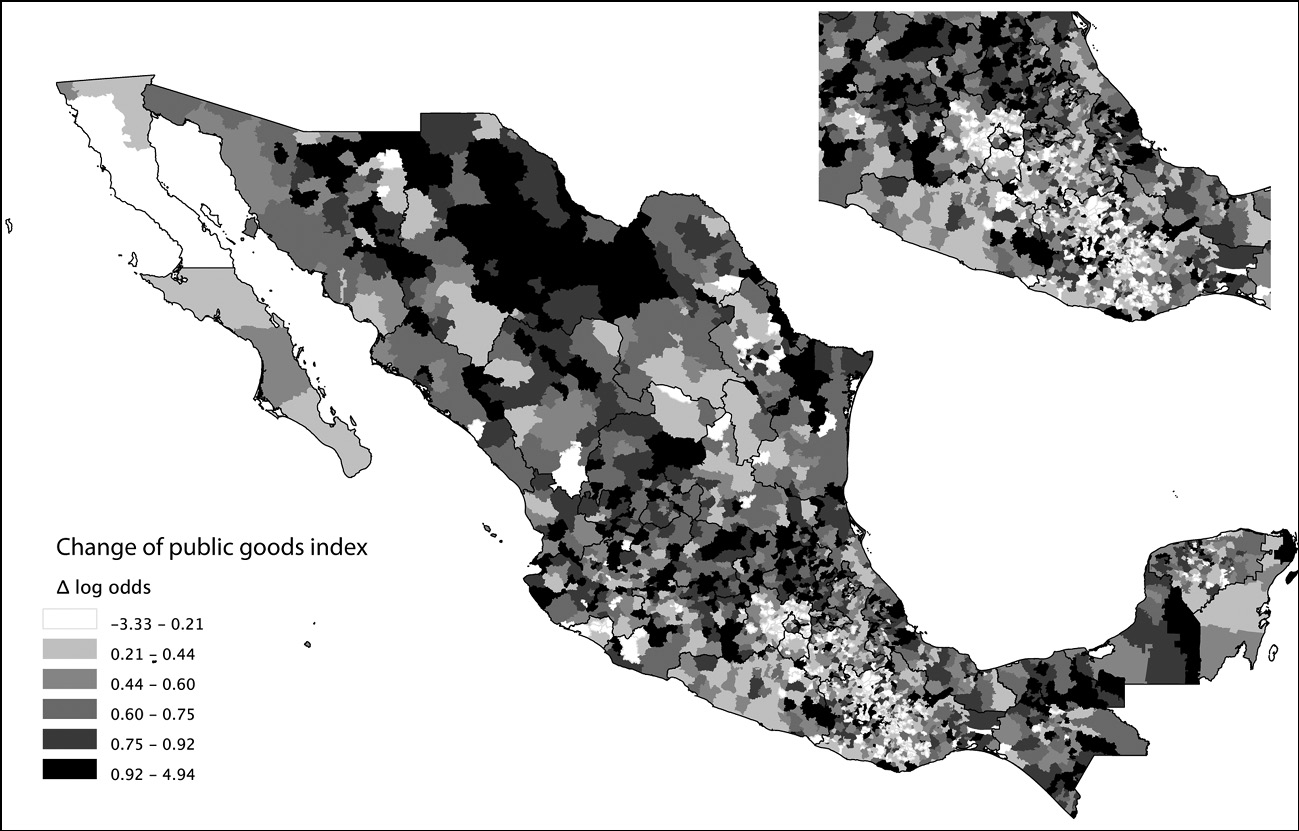
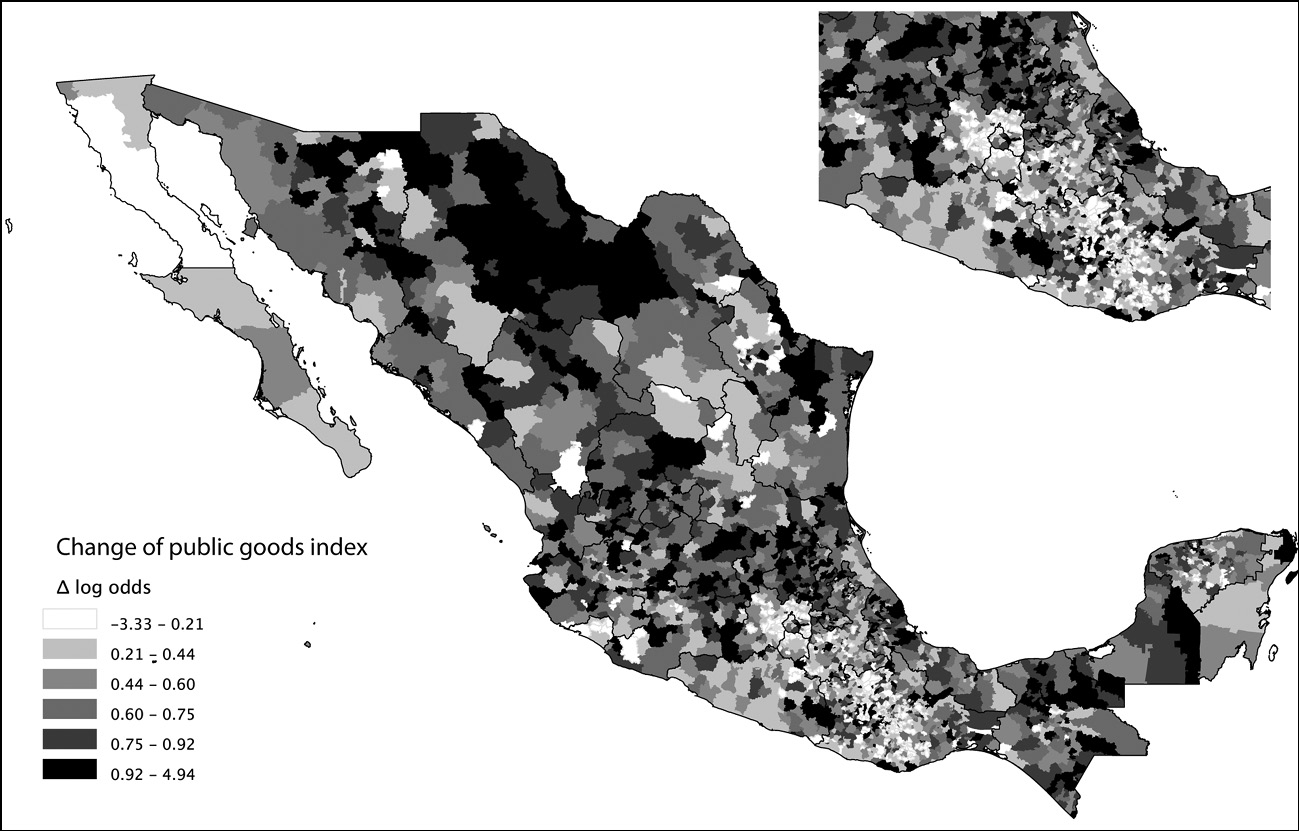
The public goods index coverage of the average municipality in Mexico was 58.9 percent in 1990, increasing to almost 69.7 percent by 2000. The average change in provision for that decade was 10.8 percent. Figure 5.1 maps the change in the index across Mexican municipalities. There were large differences in the provision of public services between poor and rich municipalities.Footnote 20 For example, in 1990 the first decile of the distribution of municipalities had an average coverage of 30.0 percent, while the top decile’s average was almost three times as great, at 85.1 percent.
Change in public good coverage, 1990–2000.
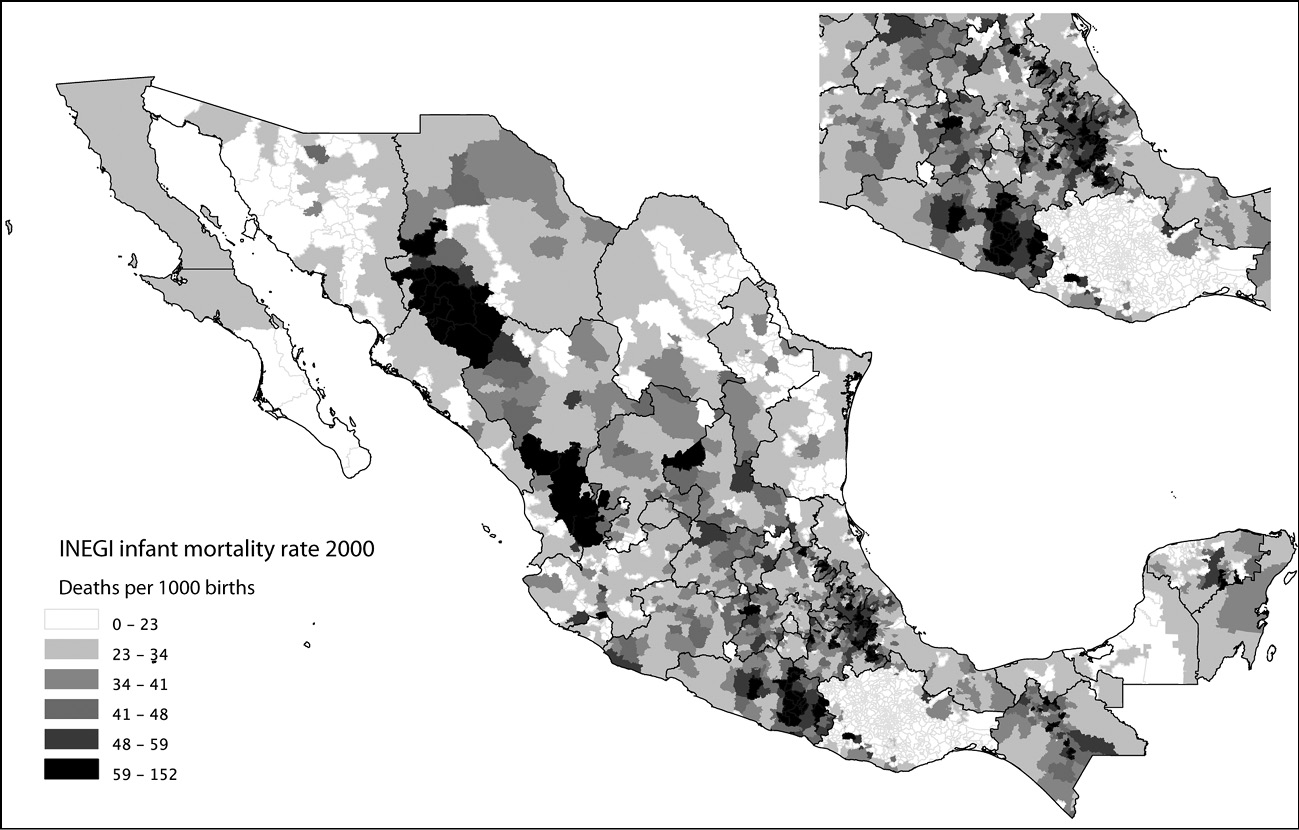
By 2010, the poorest municipalities had increased coverage to 44.5 percent and the richest municipalities to 91.1 percent. This means that the gap between rich and poor municipalities has somewhat narrowed. Improvements in local public goods progressed more rapidly among the lower half of the distribution. However, in 2000 the median municipality failed to provide these essential public goods to about one-fourth of its inhabitants, while the poorest municipalities still left almost half of their inhabitants without basic services.
Independent Variables
Studies by Cleary (Reference Cleary2002 and Reference Cleary2004) and Hiskey (Reference Hiskey2003) provide important insights into variations in public service delivery in Mexico. However, both studies suffer from a methodological shortcoming in that they fail to address endogeneity concerns, which have been central to the work on impact evaluation in development economics (Rawlings and Schady, Reference Rawlings and Schady2002). The problems at hand are twofold: first, budget appropriations are probably endogenous to investment outcomes. Funding allocations for social infrastructure projects for water, sanitation, and electricity are not independent from the perceptions policymakers have of where they believe they can get a larger return on their investment. While we seek to understand how much a given service, say potable water, improved as a consequence of public investment, the decisions regarding the allocation of discretionary funds across municipalities are most certainly influenced by engineering assessments of the conditions of the existing social infrastructure around the country and the likely impact policymakers and politicians believe spending in a particular place will have on the delivery of those social services. If this problem is not addressed, the estimations of the effects of policies may be seriously biased.
The same is true for other public services, such as electricity and sanitation. For example, if a politician wants to claim credit for a large improvement in the coverage of electricity in the few years of his short term in office, he might arguably prefer to allocate funds to urban places that already have a relatively well-developed grid, so that a large number of dwellings can improve very quickly. Or politicians might allocate spending in sanitation where it is more urgently needed, for instance, in some regions where the lack of a proper sewage system could produce a cholera outbreak or some other public health crisis. Policymakers in this case might actually be able to allocate resources with the highest priority to the places where no improvement has been observed in the past. These examples suggest that the selection of where to allocate electricity and sewerage projects might be determined precisely by the dependent variable we want to explain. The challenge is to find exogenous variation in expenditure or at least to isolate its exogenous component.
Municipal electoral democracy also exhibits identification challenges. The omitted correlates that account for levels of democracy (including higher electoral competitiveness, the presence of more political parties, and partisan alternation in office) are also likely to be related to changes in public goods provision. Results in the final chapter suggest, in fact, that changes in public goods provision influence electoral behavior. Thus, variables measuring levels of democracy and competition may well be at least partially endogenous, a consequence of the success or failure of earlier governments in delivering services.
To address these concerns, the literature on impact evaluations has become increasingly demanding about the use of instrumental variable approaches in order to obtain solid inferences concerning the impact of public investments. Zhurakvskaya (Reference Zhurakvskaya2000), for example, uses the Soviet legacy of industrial output over agricultural production as an instrument of spending, in order to assess its impact on public goods provision in Russia. Banerjee and Iyer (Reference Banerjee and Iyer2005) take advantage of the different political organizations and land tenure arrangements among Indian princely states during the colonial era in order to assess the effect of land distribution on economic performance. Paxson and Schady (Reference Paxson and Schady2002) use President Fujimori’s vote share as an instrument to predict Foncodes resource allocations in Peru. In the following section, we explain the strategy employed to instrument the funding of Pronasol and FISM as well as the levels of democracy.
Instrumenting Pronasol Transfers
Public good expenditures in Pronasol were more concentrated in relatively developed municipalities. Despite widespread poverty in the South of the country, a visual inspection of the map in Figure 2.3 shows that few of those funds were targeted to those areas. Pronasol spending is measured as the log of average per capita Pronasol public goods expenditure, measured in real terms (1994 pesos).Footnote 21 If this spending had an effect on public service provision this variable should be positive.
To instrument Pronasol‘s expenditures in public goods we employ alpha, which is our measure of PRI core support, as explained in Chapter 4. The earlier chapter demonstrated that alpha shaped expenditures within Pronasol and in this sense satisfies the first requirement for a good instrument – namely, being a strong predictor of our endogenous independent variable. The exclusion restriction – that the instrument be uncorrelated with the dependent variable – is also satisfied. Recall that alpha is calculated using data from 1970 until 1988 and is hence unaffected by changes in public goods coverage between 1990 and 2000. The share of core voters in the period 1970–1988 in a given municipality cannot be causally related to changes in public goods coverage, except through the way it shapes expenditures.
We also include an additional instrument for public goods expenditures, the Euclidean distance of each municipality from the railroad network. This geographic variable is exogenous to changes in public goods coverage, yet a remarkably good predictor of Pronasol expenditures. Railroads in Mexico were built fundamentally during the late nineteenth and early twentieth centuries. By 1990 no investment in railroad tracks had been made for half a century. Proximity to railroads does not directly influence improvements in public goods, because railroads have become mostly irrelevant for local market activity or passenger transportation (which now pass through the road network). This means that a municipality’s proximity to a railroad is orthogonal to improvements in public infrastructure.Footnote 22
Although distance to railroads is uncorrelated to improvements in public goods provision, it is a good predictor of Pronasol‘s expenditures on public goods. This is because the public goods projects that Pronasol financed were disproportionately assigned to urban and semiurban localities, which happen to be closer to railroad tracks.Footnote 23 Railroads were originally built to connect the main cities and mining towns with ports on the coast and the US-Mexico border. Municipalities that were closer to the railroads were better integrated along trading routes and they developed into more urbanized places. These types of localities happened to also benefit from higher levels of public infrastructure expenditures within Pronasol.
Simulated Instrumental FISM Transfers
The second program we evaluate is FISM. The allocation of these funds was in principle determined by a federal formula, but the actual implementation of this program gave room for states to choose how they would apply the formula. FISM allocations raise a problem of identification because unobserved variables may have caused some states to distribute funds among their municipalities according to desired impacts in public goods provision (precisely the variable we are trying to estimate). Fortunately, we can exploit some details regarding the implementation of the federal formula that generate exogenous variation in the funds municipalities receive, captured by the use of a simulated instrumental variable.
The federal formula for the allocation of FDSM created in 1997 was based on calculating gaps in public service provision and poverty, similar to a Foster-Greer-Thorbecke poverty index (Mogollón, 2012; Levy, Reference Levy1998). These gaps provided estimates of so-called deprivation densities (Masas Carenciales Estatales), which determined the amount of funds states would receive.
However, for the distribution from states to municipalities, governors could either use exactly the same federal formula, or choose a much simpler allocation formula based on similar variables (known as “formula 2”), and incorporating precisely the variables we use in our public goods coverage index (percentage of households with water, electricity, and access to sewerage) as well as the share of residents below the poverty line.Footnote 24 Nineteen states used the simpler formula, while twelve used the federal formula. Since the federal formula was calculated as a gap rather than just a headcount, it was better targeted to the poor.Footnote 25 Once the specific formula was chosen, governors had no discretion in the allocation of these funds to the municipalities. In addition to this choice of formula, during the first years of the FDSM/FISM, one-third of the funds were distributed to states in equal shares, regardless of their population size. State governments, in turn, were bound to distribute the total pool of state resources to their municipalities by their chosen formula.Footnote 26
Our simulated instrumental variable approach captures how much allocations deviated from the counterfactual allocation that would have prevailed had states strictly followed the federal formula, giving greater weight to poverty gaps in fund allocation, instead of the “simpler” formula that most states actually used, which was heavily driven by population and prior public service coverage.Footnote 27 Specifically, we regress INEGI indicators of the percentage of households without electricity and sewerage, the illiteracy rate, the poverty headcount of population earning less than one minimum wage and the inverse of the population in 1995,Footnote 28 on the per capita FDSM/FISM funds between 1996 and 2000 (in real terms).Footnote 29
The results run separately for each year are reported in Table 5.1. Our simulated instrumental variable is the residual of this estimation, measuring how much FISM allocations per municipality depart from an implicit formula.Footnote 30 The simulated instrument can be interpreted as credibly capturing the exogenous variation in appropriations generated by federal law, excluding the endogenous variation due to states’ own choices.
| (1) | (2) | (3) | (4) | |
|---|---|---|---|---|
| FDSM 1996 | FDSM 1997 | FISM 1998 | FISM 2000 | |
| Pronasol | 0.236 | 0.122 | 0.024 | 0.019 |
| (log) | (0.018)** | (0.014)** | (0.011)* | (0.011) |
| No Electricity | 0.414 | 0.448 | 0.840 | 0.833 |
| (0.067)** | (0.048)** | (0.041)** | (0.042)** | |
| No Sewerage | 0.298 | 0.491 | 0.867 | 0.866 |
| (0.061)** | (0.048)** | (0.045)** | (0.044)** | |
| Wage Poverty | 0.469 | 0.264 | 0.388 | 0.402 |
| (0.077)** | (0.061)** | (0.051)** | (0.052)** | |
| Illiteracy | 0.309 | 0.384 | 0.728 | 0.757 |
| (0.121)* | (0.081)** | (0.065)** | (0.066)** | |
| Population | –0.362 | –0.38 | –0.013 | –0.016 |
| (log) | (0.011)** | (0.010)** | (0.008) | (0.008)* |
| Constant | 5.654 | 6.685 | 3.773 | 4.451 |
| (0.189)** | (0.155)** | (0.130)** | (0.130)** | |
| State Fixed Effects | YES | YES | YES | YES |
| Observations | 2208 | 2208 | 2208 | 2208 |
| R-squared | 0.78 | 0.79 | 0.81 | 0.86 |
Note: Robust standard errors in parentheses.
* Significant at 5% level; ** significant at 1% level.
Just like the Pronasol expenditure variable, we expect FISM to have a positive sign, suggesting that when more money is spent, the percentage of households with access to basic public services will increase.
Democracy
To estimate the impact of electoral accountability on public service delivery, we rely on several alternative metrics of democratization. Our first measure focuses exclusively on the impact of partisan alternation in office (a dummy variable where 1 indicates that the PRI lost power in a given municipality in the period between 1990 and 2000, and 0 otherwise). The second measures electoral competitiveness, a dummy variable that takes the value of 1 for municipalities that are marginally won or lost by 10 percent or less of the vote, and 0 otherwise. Our third measure looks at the number of years since a municipality first experienced partisan alternation in office. This can be thought of as a measure of democratic consolidation. Finally, we use an index of “local democratic practice” that reflects the variance in political competition and political change across Mexican municipalities (see Chapter 2). The index ranges from 1 to 7, where 7 reflects highly competitive municipalities in both federal and local elections that have also experienced partisan alternation in office.Footnote 31 This index is akin to measures of democracy that attempt to capture graduation in democratic quality, such as the Freedom House or Polity indexes, rather than a sharp categorical distinction between regimes.
Since levels of democracy, alternation in political power and small margins of victory are likely to be endogenous, we also require an identification strategy. We instrument democracy relying on the alpha parameter, which measures PRI core support. There is compelling evidence that democracy was more likely to take root in Mexico where the PRI was less entrenched. But we believe areas of core support for the PRI were the consequence of deep-rooted historical processes (including organizational linkages forged between peasant and worker confederations in the aftermath of the Mexican Revolution), which are unlikely to be associated with the change in the provision of public goods in the 1990s, for reasons other than the influence core supporters had on the assignment of public expenditures.
We rely on two additional geographic instruments. First we use the (Euclidean) distance to railroad tracks mentioned earlier. Investments in railroads took place almost exclusively before the foundation of the PRI in 1929. A municipality’s proximity to a railroad determined its early chances of development, indicating whether a town was integrated into the main trading routes or stagnated in isolation. Municipalities that were connected to the railroads were thus better able to accumulate capital, tap information and cultural flows, and grow into larger towns. A municipality’s location with respect to railroads hence shaped its long-term economic and institutional development, including its urbanization and propensity to democratize.
In addition, we instrument democracy with the East-West gradient (longitude) of a municipality’s centroid. The geography of settlements in Mexico is not determined by the ease or difficulty with which their location facilitates public goods provision. A well-known North-South gradient of development persists in Mexico, wherein the areas of densely settled indigenous communities of Central and Southern Mexico are poorer than the rich towns and cities emerging from mining and cattle-raising activities in the North. But latitude is not a very plausible instrument for the effect of democracy on the changes in public good provision, because it is correlated with virtually every modernization indicator. A less acknowledged geographic feature in Mexico is that a longitude gradient of settlement patterns, in which the pre-Hispanic civilizations of the Toltec, the Maya, and particularly the Olmec, emerged from the southern Gulf of Mexico toward the central highlands, rather than towards the North or the West. Eastern settlements have a longer tradition of being subject to hierarchical social orders, while the West is characterized by more recent settlement in frontier spaces originally populated by nomadic groups.Footnote 32 As it turns out the longitude gradient is correlated with democratization, but is not a predictor of public good provision.
Sociodemographic and Fiscal Controls
As controls we use a set of independent variables that are consonant with the debates in the literature. First, we control for changes in literacy. This variable can be thought of as a control for political awareness and citizen demands for public services (Banerjee, 2002). It might also reflect overall levels of development. Cleary (Reference Cleary2004) argues that although literacy is correlated with development, it can measure some of the participatory elements of democracy. We include the change in illiteracy, measured as the difference in the percent of population over 15 that could not read and write between the 2000 and 1990 censuses, as an indicator of lack of local empowerment.
For measures of social polarization, religious competition is the most salient cleavage that drives conflict in Southern Mexico (Trejo, 2009 and Reference Trejo2012). The connection between religion and conflict is related to religious organizations’ active construction of social networks for pastoral purposes, spurred by the pressures of religious competition. Trejo shows that as a reaction to evangelical inroads in its dioceses, the Catholic Church in Chiapas became more attentive to the needs and demands of poor indigenous communities. This does not mean that religious affiliation became a source of violence or contention, but rather that conflicts between citizens and state structures might be more intense in places with more active religious competition. A gap within indigenous groups is less prevalent, since localities tend to be more homogeneous in the ethnic dimension than in the religious one. We have thus calculated a measure of religious fractionalization, which is an index of how divided religious beliefs are in a municipality. We calculate the index defined as F = 1 − ∑ pi2, where p is the share of each of the religious affiliations reported in the 1990 census (Protestantism, Catholicism, Judaism, other religions, and agnostic).Footnote 33
A second indicator of social cleavages we use is the share of “bilingual” and “indigenous population,” according to the 1990 census. The indigenous population variable is more inclusive, counting both bilingual and monolingual speakers of indigenous languages. While there is a very high correlation between being poor and Indian identity, the indigenous character of a community might not reflect divisiveness, but in fact improve the provision of public goods. This might be particularly true in places where social organization makes collective endeavors less subject to shirking and opportunism. For example, the most tightly knit communities in Oaxaca use the Tequio as a tax-like mechanism for the provision of public goods and services (Diaz-Cayeros et al., Reference Díaz-Cayeros, Magaloni and Ruiz-Euler2014).Footnote 34 Those municipalities often also use a system of rotation rather than party competition to choose their authorities. These traditional systems, called usos y costumbres have turned out to be a very effective form of governance.Footnote 35 Hence we do not expect a specific direction in the effect of this control variable.
We include a control for demographic change that might exert pressure on the existing physical infrastructure, measuring the rate of population change between 1990 and 2000 (“Population”). We expect the demographic variable to have a negative sign. We also include a measure of the changes in poverty rates. The measure is a “poverty headcount,” defined as the share of individuals earning less than twice the minimum wage according to the 2000 and 1990 censuses. This variable should control for the distribution of poverty in the municipality.
Finally, public expenditure through federal programs is complemented by municipal funds. Public works spending by municipalities constitutes the part of their budget they invest, as distinct from expenditures for debt service and general administration (mostly comprising the municipal payrolls). On average, municipalities during this period spent about half of their budgets on public works. These budgets were much smaller than the total Pronasol funds, and relatively similar to FDSM/FISM funds.Footnote 36 We include municipally allocated public works spending (Local Public Works Budget or lworks), measured as the logged average per capita allocation from 1989 to 2000.
Hence, the reduced form of our estimations has the following specification:
| Δ Public Good Index1990–2000 = | α1 Pronasol (IV) 1989–1994 + |
| α2 FISM (Simulated IV) 1996–2000 + | |
| β1 Local democracy (IV) 2000 + | |
| γ1 Δ Religious Fractionalization 1990–2000 + | |
| γ2 Δ Indigenous Population 1990–2000 + | |
| γ3 Δ Bilingual Population 1990–2000 + | |
| γ4 Δ Population 1990–2000 + | |
| γ5 Δ Poverty Headcount 1990–2000 + | |
| γ6 Δ Illiteracy 1990–2000 + | |
| γ7 Local Public Works Budget 1989–2000 + ε |
5.4 Results
We now proceed to discuss the main findings. The results of the instrumental variable regressions are presented in Table 5.2. The first column is a naive regression without instrumenting for the endogenous explanatory variables, namely, Pronasol and partisan alternation in municipal office. Both variables show positive and statistically significant effects. Our simulated instrumental variable for FISM and local public works budget also impacts the provision of public goods in the same manner. The last columns, instead, provide instruments for Pronasol and alternation of political power in office, estimating one variable at a time or simultaneously. The results of the last model can be summarized as follows: FISM retains its strong positive effects on improvements in public goods coverage, whereas Pronasol’s impact becomes statistically insignificant. In other words, discretionary pork-barreling fails to deliver welfare enhancing infrastructure to the community at large, while nondiscretionary projects accomplish that feat.
| 1 | 2 | 3 | 4 | 5 | 6 | |
|---|---|---|---|---|---|---|
| Pronasol | 0.05 | –0.19 | –0.093 | 0.08 | 0.105 | 0.131 |
| (2.69)*** | (1.84)* | (1.25) | (3.44)*** | (4.03)*** | (1.52) | |
| Alternation | 0.064 | 0.011 | 0.031 | 0.49 | 0.87 | 0.662 |
| (3.01)*** | (–0.36) | (–1.21) | (2.68)*** | (3.74)*** | (4.17)*** | |
| FISM | 0.432 | 0.481 | 0.46 | 0.409 | 0.387 | 0.387 |
| (1.95)** | (1.82)* | (1.87)* | (1.94)* | (1.95)* | (2.00)** | |
| Observations | 2399 | 2375 | 2375 | 2375 | 2388 | 2369 |
| Endogenous | None | Pronasol | Pronasol | Alt. Power | Alt. Power | Pronasol |
| Variable | Alt. Power | |||||
| Instruments | None | Alpha | Railroads | Alpha | Railroads | Railroads |
| Alpha | Longitude | Alpha | ||||
| Longitude |
Note: All models include a constant term and control variables in first differences: population growth, illiteracy, bilingualism, indigenous population, poverty, and religious fractionalization index changes. All models use robust standard errors. All expenditure variables are logged. Instruments pass the Sargan and Basmann tests of overidentification.
* Significant at the 10% level; ** significant at 5% level; *** significant at the 1% level.
t statistics in parentheses.
The second finding is that local democratization is a strong predictor of gains in public goods provision. In order to assess the robustness of this finding, Table 5.3 presents the same basic model using our alternative specifications of local electoral democracy. Once again, Pronasol and the variables measuring electoral democracy are instrumented simultaneously. The table shows that both the index of a minimalist definition of democracy as well as the number of years accumulated since the first turnover in partisan control of local government exhibit positive and statistically significant effects on public goods coverage.
| 1 | 2 | 3 | |
|---|---|---|---|
| Pronasol | 0.094 | –0.029 | 0.207 |
| (1.08) | (0.41) | (1.82)* | |
| Dem. Index | 0.111 | ||
| (2.72)*** | |||
| Margin < 10% | 0.237 | ||
| (1.27) | |||
| Alternation | 0.109 | ||
| (3.40)*** | |||
| FISM | 0.451 | 0.469 | 0.516 |
| (2.09)** | (1.97)** | (2.01)** | |
| Observations | 2332 | 2332 | 2369 |
| Endogenous | Pronasol | Pronasol | Pronasol |
| Variable | Dem. Index | Margin | Alt. power years |
| Instruments | railroads | railroads | railroads |
| alpha | alpha | Alpha | |
| longitude | longitude | longitude |
Note: All models include a constant term and control variables in first differences: population growth, illiteracy, bilingualism, indigenous population, poverty, and religious fractionalization index changes. All models use robust standard errors. All expenditure variables are logged. Instruments pass the Sargan and Basmann tests of overidentification.
* Significant at the 10% level; ** significant at 5% level; *** significant at the 1% level.
t statistics in parentheses.
Pronasol has no significant effects on the first two models, while FISM shows robust positive effects in all models. Overall, our results thus suggest that the decentralized and formula-based program, FISM, is robust in its impact upon municipal-level public service delivery. Local electoral democracy, by various definitions, also consistently drives our dependent variable. By contrast, the centralized/discretionary program, Pronasol, is clearly not robust in its meager effects.
The possibility that general results for these variables, including Pronasol, may hide distinct distributive effects within the total sample of municipalities, leads us to disaggregate the models. The challenges of providing basic public goods in highly marginalized municipalities are likely to be quite different from those facing more developed municipalities. The well-known thesis of the advantages of backwardness implies that poverty-stricken municipalities may exhibit faster improvements in public good coverage than rich municipalities.Footnote 37 Convergence might ensue because latecomers enjoy some advantages adopting technologies that may have become cheaper through time or expanding services that are already being provided elsewhere.Footnote 38 Furthermore, the administrative and political process through which poor municipalities improve public goods coverage is usually quite different from what obtains in richer municipalities. To explore the presence of this heterogeneity in our data, we perform quantile regressions.
This technique allows us to parse the range in the distribution of the dependent variable over which independent variables exert their influence. OLS remains the most efficient unbiased estimator when the conditional distribution is normal. But when there is strong heteroskedasticity and suspected nonlinear effects, the versatility of the quantile regression is that of allowing an estimation of effects not just at the mean, but at various quantiles of the full distribution of municipalities (q20, q40, q60, and q80). Instead of minimizing the sum of squared terms as in OLS, the technique finds the Least Absolute Deviations with respect to any cutoff point. The quantile regression is also more resistant to outliers. Deaton explains the advantage of quantile regressions:
Quantile regressions are not just useful for discovering heteroskedasticity. By calculating regressions for different quantiles, it is possible to explore the shape of the conditional distribution, something that is often of interest in its own right.
Although quantile regression provides a more complete picture than OLS regression, one should be careful in its interpretation. As noted by Angrist and Pischke (2009), one can learn about the characteristics of the distribution, but not necessarily about individuals. Although we may find that a certain treatment (say, democracy) may have a positive effect in the provision of public goods for the lowest quintile of the distribution, that does not mean that the poorest municipalities are necessarily better provided when they have democracy. The estimation only tells us that a regime with democracy yields improvements at that lower tail of the distribution. Quantile regression will allow us to estimate differential effects for our covariates in municipalities that exhibit large improvement (normally the poorest) and in municipalities that exhibit smaller improvements (which tend to be richer).
Tables 5.4 and 5.5 study the differential effect of the two antipoverty programs and two measures of democracy on public goods provision. To be consistent, our endogenous variables are instrumented as before.Footnote 39 The results of these models provide interesting insights into the distributive effects of the independent variables: FISM shows positive and strong effects on improvements in local public goods provision in all but the highest quantile. FISM’s impact increases for lower quantiles, suggesting that federal transfers for social infrastructure are better able to spur improvements in public goods provision at the lower end of the distribution. Strikingly, the opposite is true for Pronasol. The quantile regressions show that the discretionary poverty-relief program produced major improvements in public goods coverage only at the top end of the municipal universe. At the lowest end, it may well have contributed to a deterioration of public service delivery.
| q.2 | q.4 | q.6 | q.8 | |
|---|---|---|---|---|
| ^Alternation | –0.176 | –0.027 | 0.036 | 0.331 |
| (0.93) | (0.23) | (0.36) | (1.95)* | |
| ^Pronasol | –0.26 | –0.098 | 0.102 | 0.415 |
| (1.81) | (1.13) | (1.5) | (4.24)*** | |
| FISM | 1.136 | 1.046 | 0.686 | 0.461 |
| (5.36)*** | (5.23)*** | (2.28)** | –1.5 | |
| Observations | 2369 | 2369 | 2369 | 2369 |
Note: All models include a constant term and control variables in first differences: population growth, illiteracy, bilingualism, indigenous population, poverty, and religious fractionalization index changes. All models use robust standard errors. All expenditure variables are logged. Instruments pass the Sargan and Basmann tests of overidentification.
* Significant at 10%; ** significant at 5%; *** significant at 1%.
t statistics in parentheses.
| q.2 | q.4 | q.6 | q.8 | |
|---|---|---|---|---|
| ^Pronasol | –0.026 | 0.082 | 0.102 | 0.255 |
| (0.24) | (0.75) | (2.44)** | (3.31)*** | |
| ^Dem. Index | 0.118 | 0.105 | 0.259 | 0.823 |
| (2.67)*** | (1.69)* | (2.84)*** | (5.58)*** | |
| FISM | 1.235 | 1.007 | 0.661 | 0.472 |
| (5.67)*** | (5.08)*** | (2.78)*** | (1.43) | |
| Observations | 2369 | 2369 | 2369 | 2369 |
Note: We instrument for democracy and Pronasol with alpha, longitude, and distance to railroads. All models include a constant term and control variables in first differences: population growth, illiteracy, bilingualism, indigenous population, poverty, and religious fractionalization index changes. All models use robust standard errors. All expenditure variables are logged. Instruments pass the Sargan and Basmann tests of overidentification.
* Significant at 10%; ** significant at 5%; *** significant at 1%.
FISM performs much better than the decentralized decisions of mayors with respect to their own budgets. This could be the consequence of a “crowding-out” phenomenon, in which mayors see little reason to devote sizeable parts of their budget to public works when they know they have the earmarked FISM funds available. While FISM greatly improved targeting, its decentralized control by mayors might still have an urban bias. Such bias would limit its effectiveness in the improvement of public good provision.
With respect to the democratization, the results of the models show that partisan turnover in power had a strong positive impact on the highest quintiles, but nil effect in all the other quintiles. Apparently, its impact at the high end accounts for the result for the general models in Table 5.2. Perhaps a more fine-grained specification of local democracy can clarify the mechanisms behind this distributive impact. Thus we run the model for the index of democracy in Table 5.5. The results confirm in this specification very strong effects of democracy on improvements in the highest quantile, and also show smaller but positive and statistically significant impacts on the whole range of quantiles.
In sum, we find that the highly centralized and discretionary Pronasol program was at best a mixed blessing with respect to welfare enhancing infrastructure in Mexican municipalities. Pronasol appears to have widened the gap in public services between rich and poor territories. In dramatic contrast, the decentralized formula-based program, FISM, always has strong positive effects on public goods provision while its impact was skewed in favor of the most marginalized municipalities. The emergence of electoral democracy at the municipal level is also a significant factor accounting for improvements in public services in that decade. However, its distributive profile across all municipalities is much less redistributive than FISM. Democratization, in other words, does not entail the rapid catch-up in public goods promise that well-targeted government expenditures can accomplish. Nonetheless, in Mexico in the 1990s, democracy decidedly improved welfare at the local level. We turn now to the question of whether the effects observed in public goods provision, as well as direct transfers given to individuals, impacted well-being, based on an analysis of infant mortality. Did antipoverty programs in Mexico save lives?
Whether the citizen lives or dies is not a concern of the state. What matters to the state and its records is whether the citizen is alive or dead.
6.1 Introduction
More than 15 years after the Zapatista rebellion, infant mortality rates among indigenous people in Chiapas today are unacceptably high. According to the Health Ministry, in 2007 there was less than one doctor per 1,000 inhabitants in Chiapas, the lowest rate in the country, and nearly 25 percent of the population, mostly indigenous, had no access to any health service. Most of the indigenous population in that state live in a mountainous region, with only one hospital that serves more than 300,000 people spread across 17 municipalities. In the same zone there are only 6 community clinics offering basic services, and around 166 health units – primitive health centers with no doctors, medicines, or, often, even nurses. The infant mortality in the area is more than 40 per 1,000 live births, almost triple the national average of 16.7 for 2005.
Even when the rural poor can get to a clinic, doctors and nurses are often absent and basic medication is unavailable. Located within Guerrero’s municipality of Metlatónoc, Mini Numa is the first community ever to sue the authorities in federal court for denying it basic health services and to win an amparo injunction to force the government to redress the situation. The court’s ruling was unprecedented in Mexico as it affirmed that basic health is a fundamental right and that the state has an obligation to deliver it. The heroic judicial battle of the Nahua community in Mini Numa began after six preventable deaths occurred in 2007, which resulted from clinics being either too far away or nonoperational. People living in the small village had to walk two hours to get services; and upon arrival, they often found the clinic closed. The community asked the governor of Guerrero to build a health clinic, but the request was denied. The inhabitants of Mini Numa then built a health clinic themselves, only to have the authorities refuse to staff it. In 2008 the judge of one of the region’s district courts ruled in favor of the community and, three months later, a doctor was finally sent to the community to begin providing basic health services. The judge’s ruling, however, has met with only partial compliance and the state government has yet to build a new, court-prescribed hospital in Metlatónoc.
Mini Numa’s battle is an illustration of the tragic consequences of extreme poverty. Poverty is a multifaceted condition going beyond low-income levels. It can encompass precarious living standards, deficient health, malnutrition, and lack of access to public services. The children of the extreme poor often die of curable diseases, such as diarrhea, respiratory infections, and other contagious diseases that barely affect the children of the nonpoor. In this chapter we discuss the impact of Mexico’s antipoverty programs, centering on how they affect the life and death chances of the most vulnerable population, namely infants. As in the previous chapter, our goal is to compare two counterposed types of antipoverty policy – the clientelistic Pronasol and the entitlement-based Progresa/Oportunidades – with respect to their efficacy in preventing infant deaths in Mexico’s poor communities. We also seek to assess whether democracy and electoral accountability play a role in reducing infant mortality.
Despite the dismal statistics still present among indigenous people in Mexico, infant mortality rates have been declining for the past three decades after the country embraced UNICEF’s GOBI initiative (Growth monitoring, Oral rehydration, Breastfeeding and Immunization), and the child survival revolution. Although mortality remains unacceptably high, there has been substantial improvement between 1990 and 2000, particularly in the poorest states. Our goal in this chapter is to assess the extent to which the various antipoverty programs contributed to this decline.
Our work contributes to a vibrant debate within the political science literature on the effects of political regimes on infant mortality rates (IMR). Existing comparative literature has focused on how democracy reduces mortality (Przeworski et al., Reference Przeworski, Alvarez, Cheibub and Limongi2000; Navia and Zweifel, Reference Navia and Zweifel2003; Zweifel and Navia, Reference Zweifel and Navia2000; Ross, Reference Ross2006; Gerring et al., Reference Gerring, Thacker and Moreno2005; Lake and Baum, Reference Lake and Baum2001; Baum and Lake, Reference Baum and Lake2003). We depart from this literature in that we study the effects of the design of public policies in the reduction of IMR. Our work shows how improved provision of public goods, such as drinking water, sewerage, and electricity impact IMR; we also look at the impacts of conditional cash transfers (CCTs) versus discretionary transfers to individuals based on patron-client networks.
Social infrastructure programs such as FISM or Pronasol‘s public goods programs might have an indirect effect on infant mortality through their impact on sanitation and the construction of health clinics and roads. Clientelistic programs such as Pronasol’s crédito a la palabra (a subsidized credit program) might have an indirect effect on infant mortality by increasing household’s income. CCTs, for their part, might have both direct and indirect effects on infant health. Household’s increase in cash availability facilitates access to health services. But CCTs also might have a direct effect related to how the program conditions the cash transfer on regular health visits and women health education programs.
The chapter proceeds as follows. The next section briefly discusses the existing comparative literature on infant mortality and how we depart from the conventional approach by assessing policy interventions rather than focusing exclusively on regime type. The third section reviews the national trends for IMR, discussing data quality issues that emerge from shifting from national to local measurements of infant mortality. The section calls for a better understanding of the processes of data collection and reporting in the use of off-the-shelf datasets, which anchor most cross-national research strategies. In particular, the section discusses problems of underreporting and excessive reliance on forecasting models in available IMR datasets in Mexico. The fourth and fifth sections estimate statistical models of changes in municipal IMRs and explore the distributive effects of various poverty-relief interventions and local democratization.
6.2 Comparative Studies of Infant Mortality
There is an important debate within political science regarding the effect of political regimes on infant mortality. In their path-breaking study of democracy and development, Przeworski et al. (Reference Przeworski, Alvarez, Cheibub and Limongi2000) found that democratic regimes generate a host of impacts on demographic behavior, fertility rates, the spacing of children, and their chances of survival. Controlling for regime-selection effects, democracies lead to lower population growth, higher life expectancies, fewer child deaths, and thus enhanced well-being. A crucial element in these findings is that the mechanism for improvement in human development is not simply a higher level of health spending by democracies. What democracies seem to do better than autocracies is to empower women to make free choices about their own fertility and to enjoy higher relative wages.
Lake and Baum (Reference Lake and Baum2001) explore the effect of regime type on public health outcomes and public goods provision, finding that democracies are more likely to reduce IMR. Navia and Zweifel (Reference Navia and Zweifel2003) find similar effects, controlling for regime-selection bias. In their most recent work, they show that, beyond a direct positive effect of democracy in reducing IMR by around 5 percent, policy interventions purportedly aimed at reducing IMR, such as immunization campaigns, generate positive effects only in democracies. They posit that these findings are consistent with the likelihood that democracy provides the public services that citizens actually want.Footnote 1 All of these studies are based on cross-national comparisons using readily available official statistics.
Kudamatsu (Reference Kudamatsu2012) shows that democracy in Africa decreased IMR by an astonishing 18 deaths per 1,000. His analysis differs from previous work in that he uses individual-level data from the Demographic and Health Surveys (DHS), which permit an identification of the effect of democracy by comparing children born to the same mother under different political environments. The mechanisms underlying the findings are related to the improvement of health interventions leading to more medical attention at birth, breastfeeding, and, in general, better health services.
Using historical data from the United States, Miller (Reference Miller2008) found an effect of female enfranchisement upon the survival of children (an improvement ranging between 8 and 15 percent). This analysis is based on a careful reconstruction of IMR across the United States, taking advantage of the differential timing of enfranchisement. In this account, the mechanism that explains the outcome is a shift in legislative behavior once women were given the right to vote, which is followed by rapid increases in local public health spending. This is one of the few studies providing an explicit link between IMR and political arrangements mediated by budgetary priorities and legislative behavior.
Ross (Reference Ross2006) has cast doubt on cross-national analyses of IMR, calling for a greater awareness of the problems of validity in available datasets. In particular, he shows that if missing data in autocracies with relatively good development performance are taken into account, the main findings in the literature tend to disappear. The econometric estimations he proposes include country fixed effects, to control for likely omitted variable biases incurred in the prevailing work. Democracy seems to have no effect in reducing infant deaths.Footnote 2
The only analysis exploring these issues in Mexico is the work by Tania Barham (Reference Barham2011) evaluating the impact of Progresa on IMR. In her carefully designed study, she calculates that Progresa diminished infant deaths in rural areas, as reported in vital registration statistics, by around 11 percent (i.e., too fewer deaths per 1,000 live births). This effect is found in municipalities where the program was implemented by random assignment at an early date, as compared to a control group of municipalities chosen for inclusion, but left untreated. The statistical approach she uses takes advantage of the experimental setting of these temporal waves in the introduction of Progresa, in order to isolate the effect of treatment on otherwise nearly identical rural communities. Hence Barham (Reference Barham2011) finds a clear link between one poverty-relief program and the decline of child mortality. But what about the earlier programs administered under the umbrella of Pronasol from 1989 to 1994? Or the far-reaching decentralized strategy for municipal provision of basic public services since 1996? How have these strategies contributed to the reduction in IMR, compared to Progresa/Oportunidades?
There is general agreement among the public health community that public policy interventions have contributed to the reduction of IMR. IMR trends in Mexico are historically preceded by important policy initiatives, including the widespread distribution of oral rehydration salts since 1984, efforts to extend universal vaccinations since the 1990s and the improvement of water quality with the chlorination program in 1992 (Sepúlveda et al., Reference Sepúlveda, Bustreo, Tapia, Rivera, Lozano, Oláiz, Partida, García-García and Valdespino2006). But studies have failed to specify the channels and mechanisms through which policies affect outcomes. The link is plausibly posited but untested. Statistical analyses of the determinants of IMR based on health surveys, to which the public health community has been very attentive, have failed to determine how important the influence of specific policy interventions are vis-à-vis socioeconomic and physiological factors, because individual-level databases rarely include many policy related and social variables – let alone political ones.
Our working hypothesis is that the antipoverty programs we have analyzed, all of them, should have indirect and/or direct effects on infant mortality. First, social infrastructure projects from Pronasol and FISM affect IMR indirectly by improving access to drinking water, sanitation, electricity, roads, and health clinics. The previous chapter modeled how these programs shaped improvements in public goods provision and showed that formula-based public goods transfers within FISM were more effective at targeting the poor than the discretionary pork-barreling projects within Pronasol. Here we focus on understanding how improvements in public goods provision during the 1990s shaped reductions in IMRs at the municipal level. Second, we model the direct and indirect effects of Progresa transfers and Pronasol’s clientelistic allocations on IMR. Our expectation is that private good transfers within each of these programs shape IMR by increasing a family’s disposable income. After some time, the CCT program’s more direct impact on targeted health monitoring should translate into a much larger effect in infant death.
6.3 Issues in Measuring IMR
Infant deaths provide an undeniable indicator of well-being linked to development policy. Notwithstanding the deprivation of poor regions like Oaxaca, Guerrero, Hidalgo, and Chiapas, overall IMRs in Mexico have declined substantially in the past twenty-five years. These reductions coincided with important innovations in public health and the implementation of different poverty-relief strategies. Although statistical sources vary in their estimates, it is fair to say that IMR in Mexico fell from around 50 deaths per 1,000 in 1980, to levels slightly above those found in developed countries (19 per 1,000 in 2005). The same trend is observed in the children under five years of age (Sepúlveda et al., Reference Sepúlveda, Bustreo, Tapia, Rivera, Lozano, Oláiz, Partida, García-García and Valdespino2006).
Still, failures in government policy and the overall social environment in which poor children live are key determinants of mortality. An early study on poverty in Mexico concluded that 43 percent of deaths in 1974 were preventable (Coplamar, Reference Coplamar1982), in the sense that timely health interventions could have saved their lives. Despite great strides in public health in the intervening years, the percentage of preventable deaths has barely changed. Twenty years after the landmark Coplamar study, the Health Ministry estimated preventable deaths still at around 38 percent during 2000–2004 (Secretaría de Salud, Reference Secretaría de2006). For the specific case of infants, the Health Ministry calculates the percentage of preventable deaths in recent years at around 80 percent. Most infant mortality is related to common infectious diseases, which are preventable with simple medical interventions if appropriate and opportune care is available.
The reduction in infant mortality in Mexico is part of a worldwide phenomenon, and a clear continuation of downward trends observed throughout the century (Roberts, Reference Roberts1973; Bobadilla and Langer, Reference Bobadilla and Langer1990). Mexico is usually considered a success story because it is one of only seven developing countries on track to meeting Millennium Development Goal Number 4: to reduce the underfive mortality rate by two-thirds by 2015 (Bryce et al., Reference Bryce, Terreri, Victoria, Mason, Daelmans, Bhutta, Bustreo, Songane, Salama and Wardlaw2006).Footnote 3 Notwithstanding the national trend of declining mortality during the past decades, there is significant regional variation within Mexico, with some regions experiencing sharper reductions in IMR than others.
To study the regional variation of IMR in Mexico, we first need to tackle an important problem related to the availability of data at the municipal level, which is our unit of analysis. The tragedy of child deaths often goes unnoticed – and therefore uncounted – by both government officials and the public at large. The main thrust of the Ross (Reference Ross2006) critique is that many countries without democracy have better outcomes in IMR, but are frequently not included in international health data due to inadequate reporting. Statistical analysis based on publicly available datasets often entail case-wise deletion of missing values, which can lead to dubious conclusions. Moreover, with the exception of Kudamatsu’s (Reference Kudamatsu2012) use of individual-level survey data, the cross-sectional literature has often not been very conscious of the measurement issues that plague demographic studies of infant mortality. Specifically, the most widely used IMR datasets from the World Health Organization (WHO), the United Nations Children’s Fund (UNICEF), and the World Bank involve a mix of official country data based on vital registration statistics, census information, and survey data.
The problem with using IMR data without understanding their provenance is that estimates can differ according to the methods used to generate them. In particular, IMR statistics are plagued with two problems that determine their quality, namely, the way in which they deal with underreporting and the technical choices made in forecasting models. Researchers need to be mindful of the advantages and disadvantages of the different methods employed to measure IMR and to be explicit about their reasons for choosing one data source over another.
Arguably the most comprehensive effort to deal with the issues of data quality and comparability in IMR across countries has been done by UNICEF.Footnote 4 Infant Mortality Rates are calculated by UNICEF as the best fit model combining direct survey responses, indirect census estimations and official vital registration statistics. Direct estimations of IMR in Mexico are made using the reconstruction of birth cohorts reported in health surveys, such as the internationally sponsored Demographic and Health Survey (DHS) from 1987 and the Encuesta Nacional de Dinámica Demográfica (ENADID) from 1997. An alternative source of IMR data for Mexico comes from official vital statistics collected by the civil registry, as reported by the national statistical office (INEGI).
Both UNICEF and direct estimations from surveys show much higher IMRs than vital registration data. The gap between sources is in the range of around 20 deaths per 1,000. This means that, given the general decline of IMR over the years in Mexico, underreported deaths in vital statistics are an increasingly relevant problem in counting actual infant deaths, defying the downward secular trend. Increases in infant mortality calculated through vital statistics might represent efforts by public officials to improve the registration of children. But they might also signal periods in which the reduction of infant deaths in fact stagnated (say in the early 1970s and late 1980s).
There is hence an obvious challenge in using vital statistics data as an indicator of IMR, particularly since the poorest localities are the least likely to register births and deaths. In addition, according to INEGI, around 40 percent of births in Mexico are registered after a child is more than one year old. In short, calculating infant deaths from vital registries is not very reliable. One of the limitations of the Barham (Reference Barham2011) study on the effects of Progresa on IMR is precisely that it employs vital statistics.Footnote 5
INEGI calculates an alternative disaggregated IMR through demographic models from the relatively reliable census data, estimating deaths and births by mother cohort. Their method does not interpolate or extrapolate and calibrates yearly estimates through independent models of fertility patterns.Footnote 6 As shown in Figure 6.1, municipal IMRs calculated by INEGI have an average value of 47.5 per 1,000 in 1990 and 34.6 in 2000.Footnote 7 The level of those indicators and the decline over the decade are consistent with the calculations of IMR obtained from health surveys, such as ENADID. If we accept the INEGI estimations, municipal vital registration data suffer from underreporting. In the average municipality only 40 percent of the infant death ratios are registered; and in the bottom quartile of the municipalities only one quarter of the ratios between deaths and births are ever registered.Footnote 8
Geography of infant mortality rate in 2000.
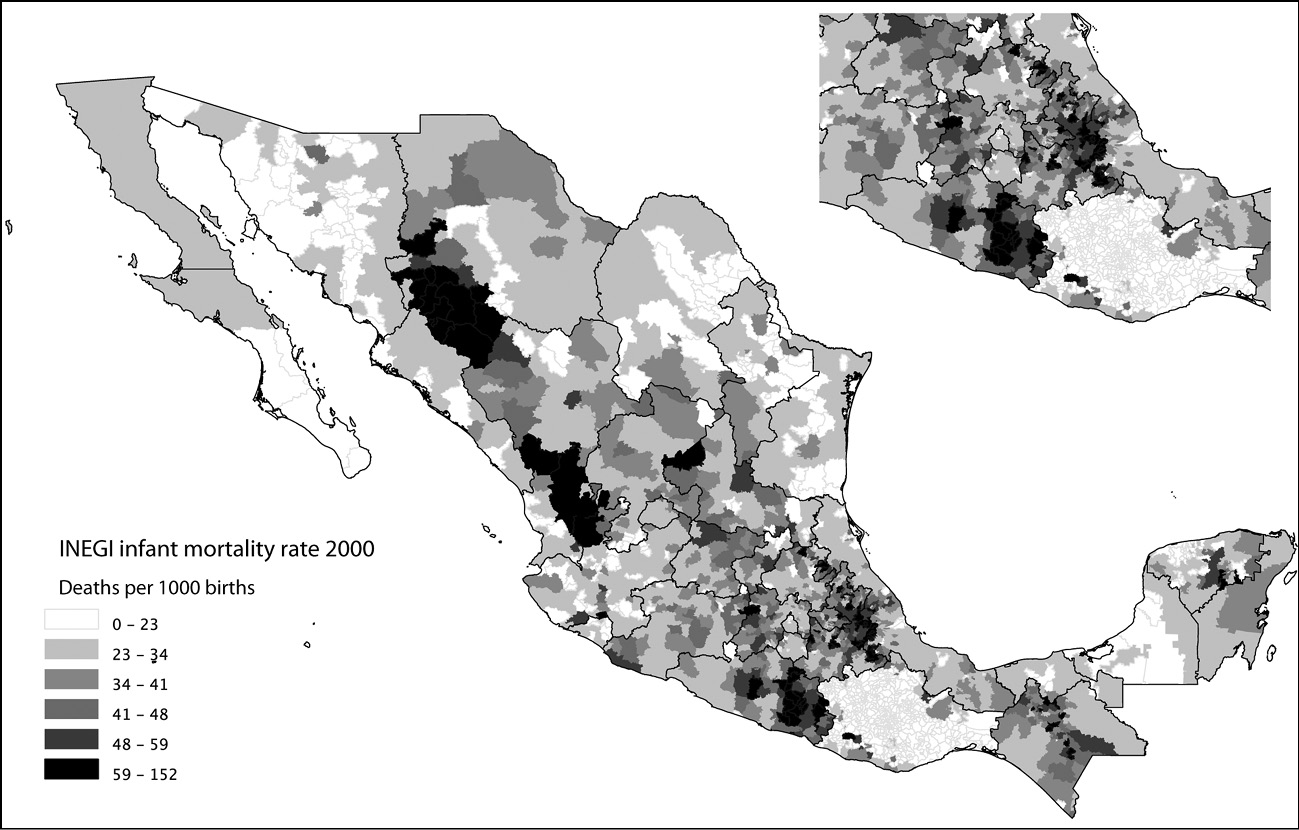
6.4 The Determinants of IMR Decline
In order to explore the determinants of the performance of municipalities in children’s health, and in particular, the role of antipoverty policies in the reduction of infant mortality, we estimate a statistical model in first differences. The dependent variable is the change in every municipality’s IMR between 1990 and 2000. The differentials use indirect estimations based on the reconstruction of births and deaths according to census data, as calculated by INEGI. The model includes improvements in basic public goods, variables measuring antipoverty policies, and municipal changes in political regime. Controls for demographic and health interventions include changes in the level of female illiteracy (as a proxy for maternal capabilities), changes in the rate of infant delivery under doctor supervision, shifts in the quality of birth registrations, population growth and changes in the poverty headcount.
| Δ IMR1990–2000 = | α1 Pronasol Spending 1989–1994 + |
| α2 Progresa Coverage 1997–2000 +β1 Democracy (Instrumented) 1990–2000 + | |
| γ1 Δ Public Goods1990–2000 +γ2 Δ Doctor Deliveries 19990–2000 + | |
| γ3 Δ Delay in Registration 1990–2000 +γ4 Δ Population1990–2000 + | |
| γ5 Δ Poverty1990–2000 + ε |
It should be noted that municipalities with strong declines in mortality are found throughout the country. Places with most improved infant well-being cluster near the Huasteca region, the mountainous zone of Puebla and the state of Chiapas. Coastal municipalities and most northern ones have witnessed much smaller improvements over the decade. A Moran test for spatial autocorrelation, however, found no systematic spatial patterns in the declines of IMR across neighboring municipalities, so no spatial correction is made in the estimations.
The independent variables of interest are three antipoverty policies. The first is the household coverage of Progresa by the end of 2000. Since Progresa transferred cash and nutritional supplements while requiring medical checkups for children, IMR should decline as a consequence of greater coverage, which would be indicated by a negative sign. Mothers benefiting from Progresa take their children in for regular physical exams and vaccinations, and also receive information on breastfeeding, oral rehydration therapy, and basic hygiene. Given that Progresa was allocated according to a system of targeting at locality and household levels, it is important to control for the poverty profile of municipalities so that the substantive indicator reflects the effect of the intensity of Progresa participation, given a certain poverty level.
We also include the prevalence of clientelism in each municipality, as measured by the per capita private goods provision targeted to individuals and groups through Pronasol. This variable might affect IMRs thorough an income effect among benefited households. Given that these transfers were not conditional on health interventions, but rather on political behavior, the relative effect should be much smaller than the one observed for conditional cash transfers.
The third policy variable is the change in the index of public goods provision of water, sewerage, and electricity used in Chapter 5, as an indicator of the improvements in local public goods. This variable reflects infrastructural investments under Pronasol and the decentralized funds of FISM after 1996. As demonstrated in the previous chapter, local public goods provision improved only slightly through Pronasol expenditure, whereas decentralized funds in FISM were much more effective in expanding public service delivery. We expect this variable to show a negative sign, since greater coverage of public goods should be associated with lower IMR.Footnote 9
To measure democratic practices at the municipal level, we follow an approach similar to the previous chapter, where we used alternative specifications for electoral democracy. The analysis poses a problem of econometric identification, which we address following the approach used in Chapter 5.
We include two indicators of state capacity from vital statistics. The first is the change in the share of babies delivered by doctors in each municipality.Footnote 10 The second is the change in the average delay of registering children after they are born. The lower the state capacity, the more we expect families to delay registering their children. These state capacity indicators should show a positive sign.
As a measure of poverty, we include changes in the percentage of the population living below two minimum wages (using one minimum wages makes no difference in the results). Widespread poverty limits the choices and capabilities of mothers and families, so we expect a positive sign in this level variable, indicating a greater difficulty in reducing IMR where poverty is more prevalent.
Table 6.1 shows the results of our IV-regressions. The first column reports the results of a simple regression that does not instrument for clientelism and electoral democracy. Model 2 instruments for clientelism, model 3 for electoral democracy, and model 4 for both variables simultaneously.
| 1 Change in IMR (1990–2000) |
2 Change in IMR (1990–2000) |
3 Change in IMR (1990–2000) |
4 Change in IMR (1990–2000) | |
|---|---|---|---|---|
| Change public | –2.521 | –2.49 | –2.531 | –2.559 |
| Goods index | (2.64)*** | (2.57)** | (2.42)** | (2.72)*** |
| Alternation | –0.317 | –0.062 | –19.301 | –6.362 |
| (0.56) | (0.09) | (1.92)* | (1.82)* | |
| Clientelism | 0.494 | 1.359 | –0.585 | –1.125 |
| (2.20)* | (1.03) | (0.94) | (0.81) | |
| CCT | –58.779 | –64.782 | –101.024 | –62.378 |
| (6.55)*** | (4.82)*** | (4.15)*** | (4.47)*** | |
| Observations | 1817 | 1817 | 1814 | 1814 |
| R-squared | 0.18 | 0.17 | 0.16 | 0.12 |
| Endogenous | None | Clientelism | Alternation | Clientelism |
| Variable | Alternation | |||
| Instruments | None | Alpha | Railroads | Railroads |
| Erosion | Longitude | Longitude | ||
| Alpha | ||||
| Erosion |
Note: All models include a constant term and control variables in first differences: population growth, illiteracy, poverty, and doctor delivery and delay in registration changes. All models use robust standard errors. Instruments pass the Sargan and Basmann tests of overidentification.
* Significant at 10%; ** significant at 5%; *** significant at 1%.
t statistics in parentheses.
The main findings can be summarized as follows: the conditional cash transfer program of Progresa always exhibits a strong and statistically significant effect. Clientelism increases IMR in the first model; but once instrumented it fails to have discernible effects on changes in infant mortality. Improvements in local public goods (water, sanitation, and electricity) have consistent negative effects, indicating that their expansion in the 1990s helped to reduce IMRs. Democracy, as reflected in municipal alternation, shows a similar effect to that found in the previous chapter. There seems to be some effect of greater accountability in health outcomes brought about by electoral contestation.Footnote 11
Table 6.2 estimates similar models using various specifications for electoral democracy. As in the last column of Table 6.1, the models in Table 6.2 instruments for clientelism and electoral democracy simultaneously. A clear pattern emerges from the data suggesting that only alternation of political power at the municipal level makes a difference in health outcomes for the poor, rather than overall levels of electoral competitiveness. The cumulative years since a municipality first experienced political alternation in power and the alternation dummy variable in the 1990s (reported in Table 6.1) have negative and statistically significant effects on IMR. Yet, the index of democracy and close margins of victory do not seem to impact health. In any event both expansion in public goods coverage and the spread of Progresa always reduce infant mortality rates.
| 1 | 2 | 3 | |
|---|---|---|---|
| Dem. Index | –0.673 | ||
| (0.97) | |||
| Margin | 0.537 | ||
| (0.16) | |||
| Years Alternation | –0.598 | ||
| (1.77)* | |||
| Pronasol private | –0.451 | 0.567 | –0.833 |
| (0.32) | (0.42) | (0.65) | |
| Change in public goods index | –2.503 | –2.496 | –2.552 |
| (2.62)*** | (2.56)*** | (2.76)*** | |
| CCT | –63.086 | –55.831 | –57.908 |
| (4.21)*** | (3.60)*** | (4.35)*** | |
| Observations | 1786 | 1786 | 1814 |
| R-squared | 0.17 | 0.18 | 0.14 |
| Endogenous | Dem. Index | Margin | Years Alternation |
| Variable | Clientelism | Clientelism | Clientelism |
| Instruments | Railroads | Railroads | Railroads |
| Longitude | Longitude | Longitude | |
| Alpha | Alpha | Alpha | |
| Erosion | Erosion | Erosion |
Note: All models include a constant term and control variables in first differences: population growth, illiteracy, poverty, and doctor delivery and delay in registration changes. All models use robust standard errors. Instruments pass the Sargan and Basmann tests of overidentification.
* Significant at 10%; ** significant at 5%; *** significant at 1%.
t statistics in parentheses.
6.5 Quantile Regressions
The challenge of improving infant health in highly marginalized zones is likely to be different from reducing deaths in wealthier places. Because of convergence, highly marginalized municipalities tend to exhibit faster improvements in health than rich ones. To explore this heterogeneity in our data, we perform quantile regressions to estimate differential effects for our covariates in municipalities that exhibit large improvements (normally the poorest) and in municipalities that exhibit smaller changes. Because of the way the data is coded, municipalities that exhibit the largest reductions in IMR are in the lowest quantiles.
Table 6.3 dissects the differential effects of our main variables of interest on infant mortality. Our two endogenous variables are instrumented in the same manner as before. The results of the quantile regressions are striking. Progresa shows a consistently strong negative effect on IMR for all quantiles. Similarly, expansion in public goods coverage reduces IMR across the board. Clientelism lowers IMR only in the bottom quantile (q.2), suggesting that under some conditions destitute poor benefited from this form of political linkage. It should be emphasized that any effect of clientelism pales in comparison to Progresa and to actual improvements in public goods.
| q.2 Change in IMR (1990–2000) |
q.4 Change in IMR (1990–2000) |
q.6 Change in IMR (1990–2000) |
q.8 Change in IMR (1990–2000) | |
|---|---|---|---|---|
| chpubgoods | –1.632 | –2.627 | –2.572 | –1.934 |
| (2.96)*** | (2.68)*** | (2.10)** | –1.45 | |
| ^Alternation | –0.219 | –5.038 | –6.103 | –6.967 |
| (0.08) | (2.62)*** | (2.03)** | (2.73)*** | |
| ^ clientelism | –4.297 | –1.978 | 0.481 | 1.411 |
| (2.17)** | (0.9) | (0.19) | (0.68) | |
| oport00 | –50.147 | –63.604 | –61.956 | –66.076 |
| (3.58)*** | (3.88)*** | (3.58)*** | (3.25)*** | |
| Observations | 1814 | 1814 | 1814 | 1814 |
Note: Alternation and clientelism are instrumented with alpha, erosion, distance to railroads, and longitude. All models include a constant term and control variables in first differences: Pronasol hospitals and clinics, population growth, illiteracy, indigenous, poverty, doctor delivery, and delay in registration changes. All models use robust standard errors. Instruments pass the Sargan and Basmann tests of overidentification.
* Significant at 10%; ** significant at 5%; *** significant at 1%.
t statistics in parentheses.
6.6 Final Remarks
When transferring funds to individuals based on their political loyalty becomes the overriding consideration in the design of social policies, the developmental goal of using social programs to help the poor is distorted. That does not necessarily mean that social policies are irrational or always wasteful. Public administrators tend to think that better management of personnel, better planning and oversight, and improved mechanisms for controlling corruption are the best way to make sure that public policies can help the poor. Our analysis suggests, instead, that democracy and the empowerment of women are more promising solutions than seeking to reform governance by administrative design.
Results in this chapter demonstrate that the creation of better-designed social policies targeted to poor women has had a decisive impact on development by saving the lives of children. New social programs such as FISM and Progresa that came as a result of stronger checks and balances increased electoral competition, and decentralization improved the provision of municipal public goods and allowed poor families greater access to health services.
Our results also demonstrate that there were some clear effects of local democracy on the reduction of IMR. Municipalities that experienced an alternation of power between political parties are better at preserving infants’ lives than municipalities that remained under the exclusive hegemonic control of the PRI.
Democracy does not necessarily lead to increases in funding for social programs or a greater budgetary priority for social expenditures, nor does it induce a normative consensus in society to address the plight of the poor. But the introduction of checks and balances brought about by democracy generated the possibility for a compromise among politicians, which led to a better architecture of social policies. The social policies chosen in Mexico combined elements of decentralized decision making for the municipalities, with centralized control by the federal government over the conditional cash transfer program. As the federal government allocated fewer funds to the goal of fighting poverty, compared to the largesse witnessed under Pronasol, it also shifted away from the expensive clientelistic strategies of vote buying in favor of a greater orientation toward public goods provision and the empowerment of the most vulnerable citizens through Progresa.
There are some painful lessons for Mexico and its clientelistic past: thousands of children likely would have remained alive had the transformation of programs occurred a few years earlier. As mentioned in the introduction, Subcomandante Marcos was right in pointing out that children died from curable diseases and no one took notice. Pronasol‘s claims about “putting an end to poverty”are assessed against a clearly defined metric: Was the program able to save the lives of the most vulnerable? Our results suggest that its effects were at best marginal; some poverty alleviation took place, but it was marginal compared to what better-designed poverty-relief policies achieved.
They [the PRI] are giving away the construction materials because of the governor’s campaign. That doesn’t matter, we need it, and when the candidate comes we will put up banners to show our support and [our gratitude]. He promised the material and here it is,” says Petra. “In contrast, those from the PAN give very little, just 15 bags of cement; with that one can’t do anything. And those from the PRD, poor devils, they give nothing.
7.1 Introduction
The PRI governor of Yucatán handed out thousands of portable washing machines to poor women prior to the 2000 presidential elections. He personally distributed 1,003 machines at a rally in Umán’s central plaza. PRI supporters were called to City Hall to turn over their voter identification cards to a local PRI leader and sign up to receive the washing machines at the upcoming rally. The governor’s convoy arrived early in the morning, and Governor Cervera Pacheco himself headed the rally, to chants of “Long Live the PRI!” (New York Times, June 18, 2000). Similar reports of overt vote buying came from all over the country. As in previous elections, the PRI handed out groceries and construction supplies and threatened to cut off subsidized milk rations to nursing mothers if they failed to show up for rallies in support of the PRI’s candidates. Party cadres gave poor housewives bags of rice, beans, and other foodstuffs purchased by a federal government charity headed by the First Lady. As they handed out these goods, party cadres registered the names of the people and made copies of their electoral identification cards. These were the typical vote-buying tactics in campaigns that the PRI’s electoral machine employed and continues to employ at election time.
More serious than campaign handouts, however, were the efforts to coordinate officials who administered government social programs to use them on behalf of the PRI’s campaigns. “The federal government’s social programs are PRI programs, and we’re going to use them to win the presidency,” said Manuel Bartlett, a party heavyweight and former interior minister who at the time was working in the PRI’s presidential campaign (New York Times, June 18, 2000). In the weeks before election day, it was not uncommon in Mexico to come across long queues of people waiting outside public buildings to receive a variety of benefits from social programs – for example, peasants waiting to receive their Procampo checks or mothers expecting subsidized food.
Nevertheless, the recently instituted social assistance program, Progresa, would prove more difficult to manipulate than Pronasol because party officials could no longer control the operation of the program. PRI brokers and some of the program’s village organizers made every effort to frighten beneficiaries by telling them they would be cut off from Progresa if they did not pledge support for the PRI’s candidate. In an attempt to lessen beneficiaries’ fears, Carlos Jarque, the secretary of social development, distributed a letter reminding them that the program did not obligate them to vote for any candidate. Back in 2000 that letter might not have been sufficient to reassure Progresa recipients that they were entitled to their benefits regardless of their vote choice. In those elections, poor voters whose lives had been improved by Progresa went to the polls burdened with anxiety. On the one hand, they feared that party officials would cut their benefits if they failed to signal their allegiance to the PRI. On the other, they feared that if the PRI lost the elections, the incoming administration would punish them for supporting the PRI and the program would be terminated.
After the PRI lost power in 2000, it gradually became clear to Progresa/Oportunidades beneficiaries that the CCT program was more insulated from political manipulation than preceding social programs. “One can be PANísta, PRIísta or PRDísta and still receive benefits from Oportunidades,” a Oaxacan mother of five told us in an interview in 2009. It is clear from our interviews in Oaxacan villages that the poor perceive important differences between the CCT and other social programs, and that they consider it an entitlement rather than a political handout that comes and goes with the election cycle.
This chapter attempts to evaluate voters’ responses to different strategies of vote buying. There are not many studies that answer elementary questions about the electoral yields of government programs in a systematic manner. Most empirical studies of distributive politics have focused on the logic of electoral investment – who gets what, where, and when (Ferejohn, Reference Ferejohn1974; Schady, Reference Schady2000; Dahlberg and Johansson, Reference Dahlberg and Johansson2002; Calvo and Murillo, Reference Calvo and Murillo2004; Stokes, Reference Stokes2005, Brusco et al., Reference Brusco, Nazareno and Stokes2004; Magaloni, Reference Magaloni2006; Magaloni et al., Reference Magaloni, Diaz-Cayeros, Estévez, Kitschelt and Wilkinson2007 are some examples), bypassing the issue of how voters actually respond to vote-buying efforts.
Our study employs both aggregate municipal-level electoral returns and individual-level survey evidence to assess the electoral consequences of two decades of antipoverty programs in Mexico. Recent scholarship has begun to explore the electoral payoffs of government transfers and programs (Magaloni, Reference Magaloni2006; Magaloni et al., Reference Magaloni, Diaz-Cayeros, Estévez, Kitschelt and Wilkinson2007; De la O, 2015; Hseih et al., 2011; Zucco, Reference Zucco2013). All these studies show that voters respond positively to government transfers, a finding that should surprise no one. Our approach moves beyond this research by comparing the electoral payoffs of various types of government programs. How many more votes does clientelism buy relative to entitlements? How many more votes do private transfers buy relative to public goods? These empirical questions are highly relevant for theorizing about distributive politics. Only by understanding the electoral consequences of different vote-buying strategies will we be able to comprehend why politicians choose distributive policies and their beneficiaries as they do.
7.2 The Payoffs for Electoral Investments
Recall from earlier chapters that we categorized Mexican social programs according to the type of benefits delivered – private or collective – and to their discretionary or nondiscretionary design. Discretionary private goods are what we have called clientelism. About a third of Pronasol expenditures from 1989 to 1994 fall into this category. Discretionary transfers of public goods geographically targeted, commonly classified as pork or pork-barreling, made up the larger remainder of Pronasol funds. Nondiscretionary distribution of private goods or entitlements is the third combination, which covers Progresa/Oportunidades, starting in 1997. The last combination is the nondiscretionary distribution of public goods, represented by the FISM program enacted in 1995.
Our theory of conditional party loyalty holds that a party machine targets particularistic transfers to reward the loyalty of its core supporters. The machine targets these benefits to loyal voters that are identified ex ante, according to their known political affinities and ongoing interactions with party agents. If it does not do so, its core voters may become detached and evolve into swing voters. Although the relationship is voluntary, an implicit (and often enough, quite explicit) threat of punishment sustains it. Voters stay loyal to the party because they receive their benefits and because they know these can be denied to them for political reasons.
Hence, our expectation is that clientelism should exhibit the highest electoral return. Discretionary transfers more easily targeted to the machine’s core voters are less subject to the problem of voter opportunism. But the logic of this political linkage implies a form of arm-twisting. Core voters respond to these transfers because they need to signal loyalty to the party in order to obtain similar benefits in the future. The perverse nature of this relationship is that voters can be bought off with an array of material inducements that prove not to be welfare-enhancing in the long run.
Discretionary public goods or pork-barreling projects are riskier investments since they are targeted to places with typically smaller cores where project beneficiaries include many nonsupporters. These transfers thus entail a sizeable problem of potential voter opportunism and, for that reason, we expect pork to return lower electoral yields on average than clientelism.
With respect to the electoral payoffs of nondiscretionary private and public goods, our vote-buying theory does not generate a priori expectations. Nonetheless, it makes intuitive sense to expect that voters will reward parties that transfer benefits to them which entail notable income and consumption gains. Thus, we expect beneficiaries of Progresa/Oportunidades to reward incumbents for improvements in their welfare regardless of the partisan identity of their benefactor. As for formula-based social infrastructure transfers, their electoral return should be no lower than that for discretionary pork-barrel projects, but not particularly higher since, in a federal system like Mexico’s, credit-claiming is more likely to generate rival partisan claims in municipalities under divided vertical government.
Our study of the electoral consequences of all these programs employs both individual-level survey evidence and aggregate electoral results for estimating their actual vote yields. We employ exit polls for the 2000 and 2006 presidential elections.Footnote 1 For our purposes, exit polls of election-day voters are better than postelectoral surveys, which in Mexico are characterized by substantial overreporting in favor of the winning candidate as well as implausible turnout rates. Preelectoral surveys, for their part, tend to have smaller samples with variable levels of undecided voters. They often do not capture last-moment shifts in sentiment and they cannot isolate actual voters through likely voter models.
We supplement our survey research with the systematic analysis of aggregate vote swings in the 1994, 2000, and 2006 presidential elections. Aggregate electoral data are necessary to calculate the electoral returns for many public goods, whose benefits are diffuse and poorly captured by conventional surveys. Surveys are well suited to the study of recipients of private goods in Progresa/Oportunidades but not those of the public goods distributed through Pronasol and FISM.Footnote 2
A second reason why it is difficult to study distributive politics through survey research is that it is practically impossible to rank-order beneficiaries according to the benefits they report having received. We are interested in measuring the yields for electoral investments in a bottom-line pesos-per-voter calculation. This task is simply easier to accomplish with aggregate electoral data than with election surveys limited by short questionnaires and interview times.
Finally, survey research is often inadequate for the study of clientelistic practices because many individuals avoid reporting the benefits received when these are understood to be illegal or corrupt. Specifically, in the comparison of programs we seek to make, survey respondents might be more willing to report benefits received from Progresa/Oportunidades than from Pronasol, creating a problem of underreporting for the latter program.Footnote 3 Although techniques such as list experiments can deal with these flaws, Mexican pollsters in the 1990s did not collect their data with such problems in mind.
7.3 The Political Context of Presidential Elections after 1988
The three elections we analyze in this chapter were all dramatic events. The 1994 election, while cleaner than the 1988 contest, was marked by considerable political violence before and after election day. The 2000 election was the watershed of the Mexican transition to democracy with the upheld defeat of the PRI by Vicente Fox. The controversial 2006 election was the closest race in the country’s history, pitting the two parties that had contested PRI hegemony since 1988 against each other.
The 1994 presidential election took place in a year of significant political turmoil, punctuated by the Zapatista uprising in the Southern state of Chiapas which erupted on the first day of 1994 and by the assassination of the PRI’s presidential candidate on the campaign trail in March. Although the substitute candidate, the technocrat Ernesto Zedillo, went on to score a comfortable triumph, without serious postelectoral conflicts, the long-standing Pax Priista had been shattered.
Initially, analysts thought that these events would jeopardize the peaceful transfer of power, sustained for over sixty years, since the last major political assassination and the creation of the PRI. For the purposes of this book, the Zapatista uprising is particularly noteworthy, since it emerged despite the political success of Pronasol, touted throughout the Salinas term as the definitive strategy for eradicating poverty in the country. The Zapatistas made it clear that poverty relief had yet to reach ample sectors of the destitute poor, especially among its indigenous peoples.
The 1994 presidential election was also special in that it took place after six years of structural transformation of the national economy. Mexico had joined the North American Free Trade Agreement in 1993 and was more fully integrated into international capital markets. By most accounts, macroeconomic stabilization had been successful and domestic consumption was rising, although economic growth remained anemic. Thus, the election as a referendum on economic performance, one of the PRI’s central strategies for the campaign, was by no means a foregone conclusion. The second strategic line was the constant reminder of welfare gains delivered through Pronasol. Despite the Chiapas uprising, the Colosio assassination, and prevailing discontent with the national economy, the PRI was reelected with just under 50 percent of the vote and a whopping margin over its two major rivals. In the next section, we analyze the contribution of Pronasol to the PRI’s electoral success in 1994.
Ernesto Zedillo initiated his presidency with the Tequila Crisis, which sent Mexico into a deep, albeit short, recession. Poverty reached alarming and unprecedented levels in the first two years of his presidency. According to the estimates shown in the first chapter, over 80 percent of rural citizens and over 60 percent of urban dwellers could not meet “basic capacities” (i.e., fulfill minimal nutrition requirements and provide health and education for their families). In reaction to the economic recession, the PRI lost a string of local elections in the aftermath of the crisis and then its majority in the Chamber of Deputies in the 1997 midterm elections. Legislative politics were utterly transformed. For the first time in its history, the PRI was obliged to compromise with the opposition in order to pass ordinary legislation. The establishment in 1997 of Progresa, as we discussed in earlier chapters, represented a turning point in the design of social policy. With Progresa, Mexico witnessed the advent of social entitlements for its poorest citizens. During the Zedillo administration, social infrastructure funds were also decentralized and the distribution of these funds increasingly fixed through poverty-based formulas. By the 2000 presidential elections, the PRI had renounced or been forced to renounce its discretion in the administration of antipoverty programs.
The 2000 presidential election marks the great divide in Mexico’s electoral history, when the PRI lost control of the presidency. PAN candidate Vicente Fox won with 43 percent of the vote, six points above the PRI’s candidate. Despite strong growth rates prior to the elections and high presidential approval rates, the PRI could not win the election because voters were fed up. They had lost confidence in the PRI and perceived that, if returned to power, the party would escort the country into yet another postelectoral recession (Magaloni and Poiré, Reference Magaloni, Poiré, Dominguez and Lawson2004; Magaloni, Reference Magaloni2006). Importantly, the elections were administered by the autonomous Federal Electoral Institute (IFE), which made electoral fraud at the ballot box and in the vote count practically impossible for the PRI. While the average voter was euphoric upon unseating the PRI, a more cautious mood prevailed among the poor, especially those benefiting from government programs such as Procampo and Progresa. The main question for them was whether the incoming PAN administration would retain these programs or scuttle them.
After numerous international policy evaluations supporting the effectiveness of Progresa in reducing extreme poverty, the Fox administration decided to continue with the program, but rebaptized it with a new name, Oportunidades. The expansion of the rural program and its extension to cities under Fox made for impressive coverage of poor households throughout the country. At the end of 1999, Progresa had reached approximately 2.6 million families in extreme poverty, about 40 percent of all rural households. By the end of 2005, coverage under Oportunidades had doubled to almost 5 million families, two-thirds in the countryside and the remainder comprising urban and semiurban households. By 2006 more than half of all families living under the poverty line in Mexico were recipients of these transfers.
Aside from Oportunidades, the Fox administration introduced a new social insurance program to remedy the truncated nature of health care delivery in the country. According to the 2000 census, some 58 percent of the population was not covered by the social security system (including the IMSS Solidaridad hospitals and clinics built with Pronasol funds). Seguro Popular was an ambitious program created to extend health coverage to this uninsured population. The program began in five states in 2001 and by the end of 2005 had been implemented in all thirty-one states plus the Federal District, affiliating almost three million families. In contrast to Oportunidades, centrally administered by the federal government, Seguro Popular was partially decentralized and potentially more subject to political manipulation in its selection and subsidization procedures. Coverage and spending varied widely among states and some doubts remain concerning the criteria for affiliation. Despite these shortcomings, Scott (2006) calculates the incidence of benefit distribution and concludes that affiliation in the new insurance program is more propoor than any other healthcare service except for Oportunidades and IMSS-Oportunidades.Footnote 4 Thus, the innovations in welfare policy engineered by the Fox government clearly entailed an important extension of tangible and needed benefits to the poor.
At the close of the Fox administration, the 2006 presidential election was the most contested election in Mexico’s postrevolutionary history. The front runners were Felipe Calderón, from the PAN, and Andres Manuel López Obrador, from the PRD. The margin of victory, after a recount of around 10 percent of total votes, was slightly more than half a percentage point. Many interpret the tight contest as the outcome of a pitched ideological battle that divided right from left, rich from poor, and North from South. From this perspective, the 2006 election was a prospective exercise, with a clear choice between right-wing continuity and left-wing populism. Yet the PAN’s triumph would not have materialized without the support of ample sectors of the poor, urban and rural, that voted for the right-wing party retrospectively as a result of Oportunidades.Footnote 5
The PRD did not recognize its defeat, claiming that the election had been rigged. López Obrador based his accusations of electoral fraud on several arguments. The first was that the computer program used to tally precinct-level vote totals had been rigged and inconsistencies in the vote count were apparent. He demanded a complete recount, although election law stipulated that ballot boxes uncontested by party representatives at the precinct level did not qualify for a recount. His second argument was that, throughout the campaign, the PAN had manipulated social transfers to the poor in order to buy their electoral support, severely undercutting the fairness of the election.Footnote 6
The claim that fraud was orchestrated in electronic form is hard to document and is a task that goes beyond the scope of this chapter.Footnote 7 But the accusation that the PAN used its access to patronage, pork, and clientelism to generate electoral support, particularly from the poor, is worth addressing. It is conceivable that the PAN used its power over federal resources, following the old practices of the PRI, to coerce or bribe poor voters. In particular, Alianza Cívica, one of the most important and prestigious NGOs engaged in electoral observation, had warned for months that the PAN was using federal social programs as vote-buying currency (Alianza Cívica, Reference Cívica2006). This perception was seconded by Fundar, an NGO for citizen oversight in budgetary matters (Fundar, Reference Fundar2006). The accusations could not be taken lightly, given the reputation and credibility of the sources.
President Fox and the Social Development Ministry (Sedesol) had anticipated these types of accusations, and as a result adopted a strategy of blindaje electoral, i.e., safeguards to shield federal programs from electoral manipulation (Sedesol, Reference Scott and Székeli2005). These safeguards retained the original prohibition from 1997 against the expansion of the CCT program in any federal election year. Further, Sedesol came to an agreement with the United Nations Development Program (UNDP) to make a thorough study of the operation of all its social programs during the election year, including surveys of beneficiaries and nonbeneficiaries, in order to gauge the occurrence of vote buying and coercion (PNUD, Reference Piattoni2007).Footnote 8
Our position on this contentious issue is that Oportunidades made the PAN‘s victory in 2006 possible, but that voters responded to the program freely. Vote buying and credit claiming are complementary facets of democratic politics. However, their scopes can overlap, ranging from voters responding freely to programmatic appeals and the benefits received through social programs to voters supporting a party out of fear of losing their benefits for political reasons. The institutional design of a given program is decisive, but popular perceptions may not turn on knowledge of their operation.
Oportunidades made an explicit effort to publicize the principle that program benefits were not contingent upon political behavior. The program posted a notice on all materials assuring beneficiaries that their participation in the program was not tied to partisan sympathies nor could their benefits be withdrawn for political motives. Beneficiaries were also constantly reminded that their benefits would continue so long as they complied with program requirements of school attendance and periodic visits to the health clinic. However, in a country with such a long tradition of clientelism, we cannot know whether beneficiaries actually believed these statements. Our intuition is that it takes some learning on the part of poor voters in Mexico to feel secure about their entitlements. The fact that Vicente Fox did not reverse Progresa after the PRI´s defeat in 2000 surely helped to assure them that welfare benefits were no longer vulnerable to election cycles nor to the political whims of the leadership.
7.4 Instrumental Variables in the Study of Vote Swings
To model the electoral payoffs of antipoverty programs, this section studies vote swings between presidential elections (1988–1994 and 1994–2000 for the PRI, and 2000–2006 for the PAN). Using interelectoral vote swings as dependent variables helps to address the potentially serious problems arising from omitted variable bias. To the extent that an independent variable remains constant between elections, its omission should not bias the results. Following Tucker (Reference Tucker2006), we calculate all electoral data in log-odds ratios, in order to keep estimates between the range of 0 and 1 and to ensure normality in their distributions.
A methodological problem we face in the study of electoral payoffs of antipoverty programs is endogeneity (as well as reverse causation). When incumbents assign discretionary resources, they surely do so in anticipation of voters’ responses. This implies that explanatory variables are likely to be correlated with the error terms of simple OLS regressions, producing biased and inconsistent estimates.
To model vote swings for 1988–1994 as the product of Pronasol‘s investments per capita in private and public goods, we take an instrumental variables approach. Potential candidates for instruments, as in the previous chapters, are related to physical and human geography. In particular, we use rugged terrain, the landlocked status of a municipality and the average distance from railroad tracks. These variables plausibly influenced investment decisions. The uneven nature of terrain, for example, is a natural factor taken into account when funding public infrastructure projects. It is harder and sometimes excessively costly to build and pave roads, dig ditches and water wells, construct health clinics and schools, and the like, where the terrain is rough and mountainous.
However, to be valid, instruments must work their effect only through expenditure, and thus be exogenous and uncorrelated with vote swings. We can be confident that by using geographic variables a problem of reverse causation is not present, because, for example, rugged terrain does not vary according to how voters behave; and railways in Mexico have not expanded at all since the 1940s. But to be truly convincing as instruments, we must believe that changes in party success are not dependent on these instrumental variables. Taking ruggedness as an example of the issue at hand, the PRI was historically entrenched in places where it was most difficult for opposition parties to successfully present candidates. In the 1960s, for example, the PAN mostly presented candidates in large cities of the Central highlands. But by the 1990s swings for or against the PRI were not particularly related to remote areas: when a PRI splinter occurred it was not uncommon to see massive swings in mountainous regions. To be sure there was gradual erosion of PRI support in the north of the country as democratization proceeded, but coastal municipalities had no particular political configuration making them more or less likely to swing in favor of one party or another. Hence landlocked municipalities had no specific pattern of vote swings as compared to the coast or the border. Furthermore, by the 1990s the places with historical proximity to railroad tracks had no particular advantage in modernization or specific political alignments, because by then the crucial developmental role was being played by highways. These geographic variables are hence good predictors of Pronasol investments but are uncorrelated with vote swings. Our diagnostic tests suggest that neither changes in vote shares nor in turnout are correlated with the residuals of a regression using these variables.Footnote 9
Thus our models employ geographical instruments as correlates of entrenched poverty to predict logged per capita private and public good allocations in Pronasol (private PC^ and public PC^). Our expectation is that the electoral yield for private goods should be significantly higher than that for public goods. The regression controls for the PRI’s vote share in 1988 (PRI 88) and the alpha and erosion parameters discussed in Chapter 4. Higher vote swings in favor of the PRI (or smaller swings against it) should characterize places with large cores (alpha) and slow erosion. We also expect smaller vote swings in places where the PRI performed exceedingly well in 1988. The regressions use state-fixed effects to control for other local patterns of politics stemming from, for example, the partisan identity of incumbent governors, party chapters’ mobilizational capacity, the concurrency of gubernatorial races, and the different types of local party system configurations. Results are reported in the first column of Table 7.1.Footnote 10
| PRI Vote Swing 1988–1994 | PRI Vote Swing 1994–2000 | PAN Vote Swing 2000–2006 | |||
|---|---|---|---|---|---|
| Private PC^ | 0.052 (0.008)** |
Progresa^ | 1.886 (0.389)** |
Oportunidades^ | 0.607 (0.108)** |
| Public PC^ | 0.034 (0.011)* |
FISM^ | 0.070 (0.037)* |
FISM^ | 0.069 (0.028)** |
| PRI 88 | –0.890 (0.024)** |
PRI 94 | –0.605 (0.028)** |
PAN 00 | –0.237 (0.015)** |
| Alpha | 0.043 (0.014)** |
Alpha | 0.076 (0.031)* |
||
| Decline | –0.022 (0.034) |
||||
| Constant | –0.755 (0.034)** |
Constant | –1.158 (0.252)** |
Constant | 1.756 (0.381)** |
| N = 2338 F(35,2302) 141.22 Pr>F 0.000 R2 0.619 |
N = 2346 F(34,2311) 65.12 Pr>F 0.000 R2 0.564 |
N = 2344 F(33,2310) 65.12 Pr>F 0.000 R2 0.336 | |||
Note: Regressions are run with robust standard errors and state fixed effects.
* Significant at the 95 percent level; ** significant at the 99 percent level.
All the coefficients perform as expected and all but one reach reasonable levels of statistical significance. Pronasol was a decisive factor in accounting for municipal vote swings in favor of the PRI in the 1994 presidential elections, even after controlling for state-fixed effects and the divergent electoral histories of municipalities since 1970, as measured by alpha and erosion.
These results reveal a powerful impact of clientelistic transfers vis-à-vis public goods. The vote-buying effect of private goods almost doubles that of collective ones. In terms of votes-per-peso it was significantly more effective for the PRI to distribute particularistic transfers to individuals and small groups of producers than to invest in social infrastructure projects or public goods provision for communities at large. Nonetheless, public goods provision also generated some voting support for the PRI.
Our results thus cast doubt on the existing analyses of Pronasol. Although myriad observers have accredited this program as a key factor in the PRI’s electoral recovery in the 1990s, most empirical analyses have concluded that Pronasol’s electoral effectiveness was disappointing. Bruhn (Reference Bruhn1996: 162) finds no evidence that Pronasol expenditures helped the PRI and undermined the left. Hiskey (1999: 128) concludes that the “political impact of Pronasol funds is noteworthy for its insignificance.” Although Molinar and Weldon claim to find positive effects for this program, their results are counterintuitive because vote gains are generated only in states where gubernatorial elections were held in 1991. “In states where elections for governor were not scheduled in 1991, the PRI did somewhat worse in the federal elections for every extra peso spent on Pronasol ” (Molinar and Weldon, Reference Molinar, Weldon, Cornelius, Craig and Fox1994: 137).
The columns in Table 7.1 present analogous results for the election that stamped the transition to democracy, but centered on the nondiscretionary social transfers introduced by the Zedillo administration. The 1994–2000 vote swings are a function of the instrumented municipal-level coverage of Progresa in 2000 (Progresa^) and the instrumented per capita expenditures in FISM (FISM^). The table also presents the analysis of 2000–2006 vote swings, this time for the PAN as the incumbent party, as a function of the instrumented change between 2000 and 2006 in the coverage of Oportunidades (Oportunidades^) and in the predicted per capita expenditures through FISM (FISM^). These regressions also use state-fixed effects to control for the idiosyncrasies of state-level politics.
Although we recognize that transfers within these programs were determined by objective formulas not easily manipulated, it is plausible that the expansion of Progresa and Oportunidades were politically determined. That is, the formulas constrained the politicians and policymakers to target the poor but they were not constrained in terms of phasing-in program expansion across states and municipalities.Footnote 11 This leeway to skew implementation compels us to instrument change in coverage in Progresa and Oportunidades to eliminate potential problems of endogeneity – that is, the possibility that higher increments in coverage were in part driven by expectations of electoral results. For the case of FISM, as discussed in the previous chapter, the fact that funding was determined by formulas does not rule out the possibility that the choice of the specific elements included in the formula and the distribution resulting from them were the product of political calculations by the incumbent party. Geographic instruments, as in the 1988–1994 model, are good predictors of allocations of Progresa/Oportunidades and FISM but are uncorrelated with the dependent variables.Footnote 12
Regression results perform as expected. Both Progresa and Oportunidades generated strong positive effects on the incumbent parties’ vote swings in the 2000 and 2006 elections. Progresa proved to be particularly potent in favoring the PRI in 2000, about three times more effective in vote gains than Oportunidades for the PAN in 2006. FISM also impacts vote swings in the expected direction. More per capita investment in social infrastructure at the municipal level translates into higher vote swings for the incumbent party in both elections.
To have a sense of the range of effects, Figure 7.1 simulates the vote-buying effects of the various programs, distinguishing between private and public goods. The graph on the top simulates the effects of the discretionary program (the two basic categories of Pronasol transfers) and the other graphs those of the formula-based ones (Progresa/Oportunidades and FISM).
Simulated electoral returns of social programs.
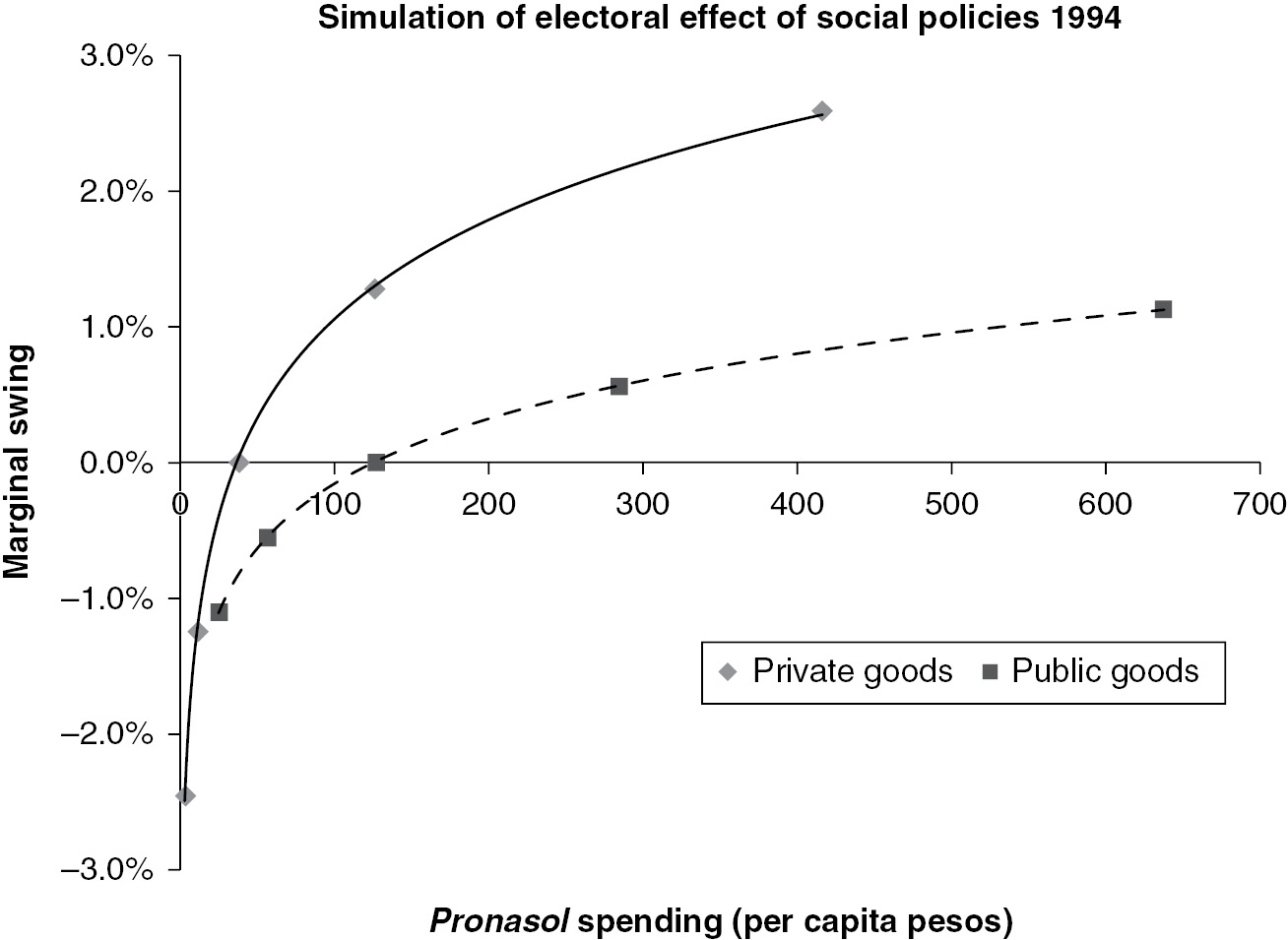
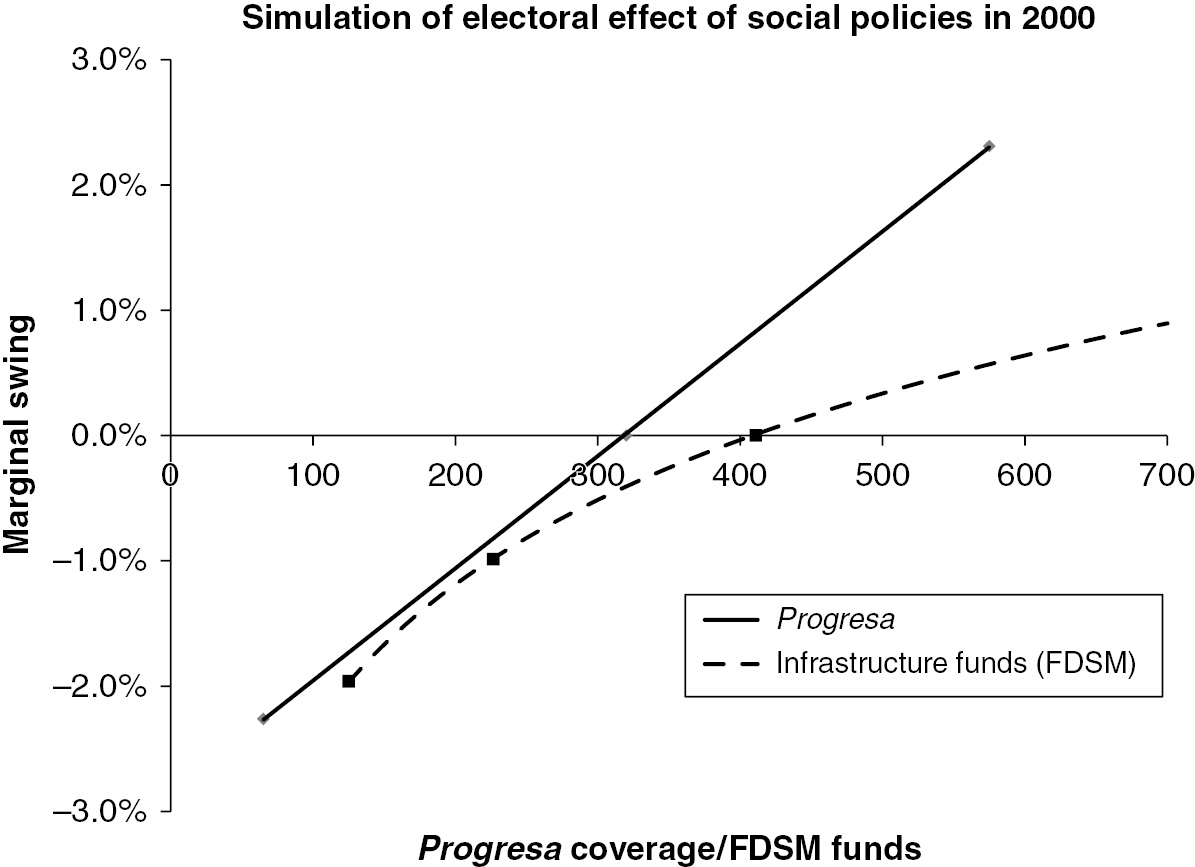
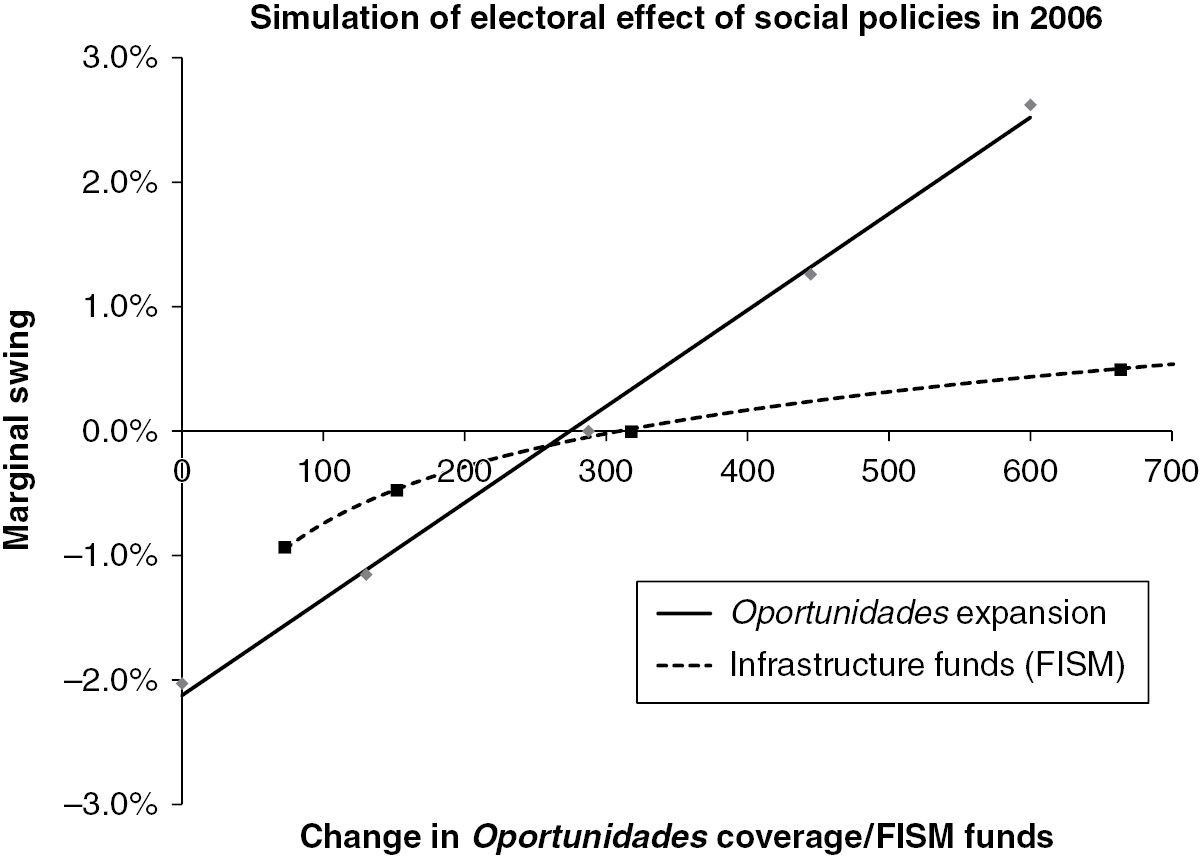
The findings for Pronasol are striking, with far larger payoffs extracted from private goods. Relative to pork-barreling or discretionary public goods allocations, particularistic transfers are vastly superior for buying votes. For example, if the PRI spends 100 pesos per capita in private goods, the simulation predicts a swing of around one point in that party’s favor, while the same expense in public goods would not generate a positive vote swing. Moreover, against the 100 pesos per capita in clientelism, expenditures for pork would need to be almost six times as large in order to replicate a similar gain in votes. That does not mean that electoral investment in public goods is useless, since any money for pork may prevent adverse negative swings. However, there is no question that clientelistic transfers were more effective at producing electoral support for the PRI throughout the whole range of expenditures. Public goods also produced swings of considerable magnitude for this party at higher levels of expenditure, but never outpacing the yield from private goods.
The graphs for swings of the incumbent in 2000 (the PRI) and 2006 (the PAN) simulate the effects of nondiscretionary transfers for private and public goods. The electoral payoffs of nondiscretionary private goods (or entitlements) behave quite differently from those of particularistic transfers. The electoral swings for entitlements are not always higher than the payoffs from public goods. In these estimates, positive vote swings for the PAN in 2006 emerge only after better than half the municipality’s households receive benefits. Hence, the Fox administration’s interest in expanding Oportunidades. At very high levels of CCT coverage, vote swings easily outperform those observed from investments in public goods provision. When poverty relief through entitlements reaches a large critical mass within poor communities, the impact on electoral support for the benefactor (PRI and PAN alike) is stunning.Footnote 13 In contrast, districts with fewer inhabitants living in abject poverty (medium- and large-sized cities) are less generous, requiring stronger investment in public goods in order to generate additional voting support for the incumbent. Portfolio diversification, as we claimed earlier, is practically inevitable in more competitive contexts.
7.5 Investment Yields from CCTs
This section supplements the previous section’s findings with survey research. The study of antipoverty programs with individual-level data also presents serious challenges of selection bias. Thinking in terms of medical research and experiments can help to conceptualize some of the problems involved in studying these types of policy interventions. To estimate the effects of a drug or medical treatment, ideally one would like to have two individuals that are identical in all respects (age, diet, gender, lifestyle, ethnicity, etc.) except for the “treatment.” Medical research solves this issue through experimental design wherein a group of individuals with similar characteristics are randomly selected and divided into two groups, one receiving the “treatment” and the other (the “control” group) not.
As envisioned by its creator, Santiago Levy, Progresa was originally designed to allow for experimental evaluations. Communities with similar characteristics were identified at the onset of the program, but only a randomly selected group began to receive benefits immediately, while the others were incorporated 15 months later. In two innovative studies, Green (Reference Green2005) and De la O (2013) take advantage of the program’s randomization or the delay in incorporation to assess the effects of Progresa on turnout and voting choices. These studies arrive at opposite conclusions. Green finds that Progresa had no effect on voting choices, while De la O obtains a rise in turnout and an increase in the incumbent’s vote share.
A problem for our purposes to compare the variety of electoral strategies across elections is that there is no experimental setting available for Pronasol, FISM, and Oportunidades. If we want to compare the political impact of the various social protection programs, we must rely on observational data. We can, however, use statistical methods to deal with potential selection problems. That is, we contrast treated and untreated individuals by matching comparable persons in terms of the nonrandom set of characteristics that make them potential targets of selection into the program, but with some selected while the others are not. Specifically, we use a nonparametric technique, propensity score matching (PSM), to compare individuals along these lines (Ho et al., 2007; Rosenbaum and Rubin, Reference Rosenbaum and Rubin1983).Footnote 14 The treatment variable in this quasi-experiment is being a Progresa or Oportunidades recipient. We used a similar strategy in Diaz-Cayeros et al. (Reference Diaz-Cayeros and Magaloni2009) to evaluate the electoral impacts of Oportunidades and Seguro Popular on voting decisions in 2006.
In matching, the most common indicator of interest is the mean impact of the treatment on the treated. This indicator is also known as the average treatment effect on the treated (ATT). In the case at hand, we are interested in the comparison of the mean probability of voting for a given party from the treated group and its matched nontreated group. The method is based on an assumption of unit homogeneity. This means that the outcome of the nonparticipant can be taken as an indication of what would have happened holding all other relevant variables constant. In this sense, the hypotheses tests do not control for covariates, since they are already incorporated into the choice of observations to be compared.
Propensity score matching is relatively simple to perform. The first stage involves a probit (or logit) estimation of every individual’s probability of being selected as a Progresa/Oportunidades beneficiary. The second stage is a simple test of means, where treated observations sharing similar propensity scores are compared to untreated ones.
To ascertain the electoral payoffs of Progresa and Oportunidades, we employ two exit polls performed by the newspaper Reforma.Footnote 15 Reforma’s research department is credited with conducting some of the best electoral survey work in Mexico. Their questionnaires are rather comprehensive, including self-reporting of enrolment in Progresa and Oportunidades. The 2000 exit poll sampled 3,380 voters in 119 municipalities (including delegaciones or boroughs in Mexico City); the 2006 poll included 5,807 voters spread among 122 municipalities throughout the country.
The 2000 exit poll shows a relatively even distribution of votes for the PRI’s candidate, Francisco Labastida, in rural and urban localities. By contrast, the 2006 poll shows that support for Felipe Calderón varied considerably according to whether voters lived in rural or urban areas. The urban-rural gap in Calderón’s support is clear from both the survey and the official vote tally. According to official tallies, in rural areas his vote share was 29.7 percent, while in urban areas he reached 38.3 percent of the vote.
The descriptive statistics of the surveys (Table 7.2) show that Progresa recipients voted more frequently for the incumbent party’s candidate, Francisco Labastida – there is a 24 percent point gap in his favor between recipients and nonrecipients. Vicente Fox from the PAN seems to be particularly affected by Progresa, producing a 21 percent gap against him. Similarly, the 2006 poll shows that the PAN’s candidate received more support among beneficiaries of Oportunidades – 37 percent of beneficiaries voted for Calderón versus 32 percent of nonbeneficiaries, a gap of 5 points. If one were to view only the average vote shares for the three main presidential candidates in the 2006 elections among nonbeneficiaries of either program, a fierce tie between Calderón and López Obrador emerges, with Roberto Madrazo from the PRI in a distant third place overall. Among beneficiaries of the programs, however, Calderón outpaces López Obrador by double digits. Any one of these spreads is enough to have tilted the national election in Calderón’s favor.
| 2000 Elections Progresa | 2006 Elections Oportunidades | |||
|---|---|---|---|---|
| Beneficiary (%) | Nonbeneficiary (%) | Beneficiary (%) | Nonbeneficiary (%) | |
| Vote for PAN | 25.4 | 46.9 | 37.2 | 32.3 |
| Vote for PRD | 16.4 | 17.0 | 25.9 | 31.7 |
| Vote for PRI | 57.7 | 33.5 | 23.1 | 17.9 |
But the crucial inference that one wants to make is whether voters in 2000 supported the PRI because they received benefits from Progresa, or because some of the correlates of Labastida’s vote are also related to the selection criteria of beneficiaries into the social program. The same question arises with respect to the effects of Oportunidades on the support for the PAN in 2006.
Table 7.3 shows first-stage probit estimations of our PSM for Progresa and Oportunidades. In estimating the propensity scores, we use individual data from the survey merged with municipal-level data. The merger is important in our case because we know that selection into Progresa/Oportunidades was shaped both by income measured at the individual level in household surveys and by locality-level development indicators.Footnote 16 The merger follows electoral precinct identification at the polling points sampled for the exit poll.
| Model 1: Propensity Score, Progresa Beneficiary (2000) |
Model 2: Propensity Score, Oportunidades Beneficiary (2006) | ||
|---|---|---|---|
| Individual socioeconomic indicators | |||
| Age | –0.023 (0.016) | Age | –0.046 (0.011)** |
| Education | –0.123 (0.035)** | Education | –0.183 (0.025)** |
| Income | –0.090 (0.026)** | Income | –0.041 (0.011)** |
| Woman | 0.146 (0.075) * | Woman | 0.115 (0.050) * |
| Peasant farmer | 0.099 (0.119) | Peasant farmer | 0.158 (0.087) |
| Family size | 0.072 (0.039) | ||
| Aggregate socioeconomic indicators | |||
| Rural precinct | 0.519 (0.098)** | Rural precinct | 0.577 (0.056)** |
| Usos y costumbres | 0.213 (0.143) | Indians (municipal share) | 0.298 (0.189) |
| No water supply (%) | 0.850 (0.372) * | No water supply (%) | 0.166 (0.215) |
| No electricity (%) | –4.062 (0.721)** | No electricity (%) | –0.487 (0.477) |
| No sewerage (%) | 0.708 (0.329) * | No sewerage (%) | –0.847 (0.243)** |
| HDI (2000) | 0.701 (0.847) | ||
| Geographical correlates | |||
| Northing | 0.001 (0.000)** | Rainfall | 0.0003 (0.000)** |
| Easting | 0.0002 (0.000) | Easting | 0.0001 (0.000) |
| Population density | 0.0000 (0.000)** | Temperature | 0.0001 (0.000) |
| Distance to roads | 0.028 (0.007)** | Distance to roads | 0.010 (0.005)* |
| Distance to rails | 0.007 (0.002)** | ||
| Distance to city | 0.002 (0.001) | ||
| Landlocked | –0.301 (0.117)** | ||
| Policy-related variables | |||
| Progresa coverage, 2000 | 4.743 (2.556) * | Seguro Popular insured | 1.236 (0.058)** |
| Private goods % of funds in Pronasol, 1989–1994 | –0.347 (0.331) | Change in Oportunidades coverage, 2000–2006 | 1.403 (0.272)** |
| Constant | –1.857 (0.351)** | Constant | –1.430 (0.716) * |
| Observations | 2379 | Observations | 5019 |
| LR (20) | 328.88 | LR (17) | 1205.68 |
| Prob>LR | 0.0000 | Prob>LR | 0.0000 |
| Pseudo R2 | 0.168 | Pseudo R2 | 0.246 |
Note: Robust standard errors in parentheses.
* Significant at the 95% level; ** significant at the 99% level.
The combination of variables used to calculate the propensity score was inductive: we included variables with predictive power, while satisfying a balancing property among blocks of observations.Footnote 17 We did not include variables that measure vote choice or are closely related to it in a voting model, such as party ID or presidential approval, since those are the outcomes we are interested in studying. We use a rather exhaustive specification for predicting beneficiaries: we follow the practice of trying to include variables that are statistically significant predictors of selection into the program and that meet the balancing property. Thus, these models are similar to each other but not identical.Footnote 18
In table 7.4 we present differences-of-means tests between treated and untreated respondents, which is the program’s impact indicator or the ATT. In our case it corresponds to the comparison of the mean probability of voting for a given candidate between a treated group and its matched nontreated group. For our purposes, it is not necessary to include all relevant controls normally employed in vote choice models in order to infer the political effects of a given policy intervention.
| Vote in 2000 Effect of Progresa | Vote in 2006 Effect of Oportunidades | |||||
|---|---|---|---|---|---|---|
| National | Rural | Urban | National | Rural | Urban | |
| Vote for PRI candidate | 0.167 (0.058)** |
0.286 (0.071)** |
0.087 (0.050)a |
–0.049 (0.027)a |
0.020 (0.064) |
–0.071 (0.039)a |
| Vote for PAN candidate | –0.088 (0.043)* |
–0.195 (0.072)** |
–0.041 (0.050) |
0.113 (0.032)** |
0.113 (0.058)* |
0.126 (0.039)** |
| Vote for PRD candidate | –0.060 (0.046) |
–0.084 (0.064) |
–0.023 (0.039) |
–0.065 (0.037)a |
–0.144 (0.045)** |
–0.039 (0.037) |
| Approval | 0.228 (0.082)** |
0.383 (0.126)** |
0.108 (0.110) |
0.370 (0.060)** |
0.500 (0.116)** |
0.309 (0.060)** |
| Pocketbook | 0.309 (0.098)** |
0.655 (0.106)** |
0.207 (0.134) |
0.412 (0.051)** |
0.366 (0.089)** |
0.422 (0.080)** |
| PID PRI | 0.132 (0.051)** |
0.248 (0.079)** |
0.098 (0.064) |
–0.061 (0.030)* |
–0.046 (0.057) |
–0.045 (0.035) |
| PID PAN | –0.056 (0.034)a |
–0.130 (0.056)* |
–0.031 (0.047) |
0.114 (0.030)** |
0.124 (0.059)* |
0.142 (0.034)** |
| PID PRD | –0.038 (0.033) |
–0.062 (0.056) |
–0.054 (0.037) |
–0.004 (0.028) |
–0.046 (0.046) |
–0.019 (0.031) |
Note: Nearest Neighbor Matching Method with bootstrapped standard errors in parentheses.
* Significant at the 95 percent level; ** significant at the 99 percent level; a significant at the 90 percent level.
The first thing to highlight is that both programs produced significant vote returns for the incumbent parties that implemented them. In 2000, beneficiaries of Progresa were 17 percent more likely to support the PRI’s candidate. This probability jumps to 29 percent for rural beneficiaries, the program’s original target population, with respect to nonbeneficiaries within the rural subsample. In the cities, any impact of Progresa was negligible across the range of political variables. The results also demonstrate that the CCT program hurt the PAN, but not so much the PRD. Thus, our results contrast with Cornelius (Reference Cornelius, Domínguez and Lawson2004), who finds positive but rather marginal effects of Progresa in favor of the PRI (around 7 percent, just a bit more than in De la O, 2013). Cornelius’s study, however, is agnostic about selection bias problems.
In the case of Oportunidades, beneficiaries were 11 percent more likely to vote for the PAN’s candidate than nonbeneficiaries with very similar propensity scores – that is, individuals with the same sociodemographic and community-level characteristics. Program beneficiaries were, at the same time, 7 percent less likely to vote for the PRD’s candidate and 5 percent less likely to support the PRI’s candidate. Thus, our results validate López Obrador’s concerns about Oportunidades as a strategy to steal votes from the left. But they do not support the claim that program beneficiaries were manipulated or coerced into voting for the PAN. Rather, Oportunidades worked to create an electoral constituency for the right-wing party among poor voters, who otherwise probably would have voted for the PAN’s rivals. These results are opposed to Poiré and Estrada (Reference Poiré and Estrada2007), who report no favorable effect for the PAN nor any negative impact on support for other parties. These authors also ignore problems of selection bias.
Importantly, Oportunidades beneficiaries registered similar gains for the PAN in both subsamples. Given the dual expansion of the CCT program in those years, this result is consistent with expectations about beneficiaries’ response to new welfare benefits, regardless of partisan predispositions. The first wave of expansion occurred in rural municipalities between 2001 and 2004. The second one began in 2002, in a rapid extension of the program to urban contexts with modified selection procedures (including self-selection by potential beneficiaries with agency review of their applications). Both phases involved similar numbers of new beneficiaries.
Rural gains for the PAN, however, came almost exclusively at the expense of the left, while its urban gains were mostly charged against the PRI. It bears emphasizing that the effects of Oportunidades are smaller by half among rural beneficiaries than was the case for Progresa. Rural expansion of the program increased recipients about 60 percent over those incorporated by 2000, in the range of PAN gains in the countryside by 2006. With respect to the cities, the urban electorate is over twice as large as the rural one. While the urban premium for Oportunidades is smaller than the rural one for 2000, in absolute terms the PAN’s urban support in 2006 grows precisely as a result of its gains among the urban poor.
The last rows of Table 7.4 report the effects of the program on presidential approval, pocketbook evaluations, and partisan identification. These attitudes and assessments are, of course, strongly associated with vote choice, in most studies of electoral behavior. Consistently, the effect of the program on treated versus untreated voters is to increase presidential approval, reflect stronger pocketbook evaluations, and reveal more partisan identification in favor of the incumbent party. These results are in line with the effects on vote choice and, indeed, undergird them.
We highlight three implications from these results. First, it is clear that Progresa and Oportunidades produced high electoral payoffs for incumbent benefactors. While at first sight Progresa apparently reaped more votes for the PRI than did Oportunidades for the PAN, the payoffs from the latter may have been decisive in the PAN’s victory in 2006. The program enabled the PAN’s victory by generating support among the poor for this party’s candidate at the expense of his rivals (see also Magaloni et al., Reference Diaz-Cayeros and Magaloni2009). A similar dynamic in vote buying among rural beneficiaries of Progresa in 2000 proved insufficient for maintaining the incumbent party in power.
Second, these results suggest that partisan loyalties are conditional, as argued in Chapter 3. If one compares two individuals nearly identical in sociodemographic and municipal-level traits, one treated and the other not, their partisan identities are likely to be different as a result of these benefits. Welfare benefits appear to create or re-create partisan identification. In the Mexican case, Progresa reinforced the rural poor’s loyalties to the old ruling party, while Oportunidades helped the PAN generate new partisan sympathies in the same voter group and its urban counterpart. It is worth noting that the program works to decrease partisan identification with the PRI, but does not affect identification with the PRD. Notwithstanding the electoral success of the program in its two phases of implementation, predispositions among the poor in favor of the left perhaps remain latent and capable of being mobilized in future elections.
Third, a crucial way in which Progresa and Oportunidades shaped voting decisions is by spurring higher voter satisfaction with government performance (approval) and with their own material well-being (pocketbook evaluations). The impact of Progresa and Oportunidades on voters’ self-reported material improvements is impressive. For example, a rural Progresa beneficiary was 60 percent more likely to report that her material well-being had improved than a rural nonbeneficiary. Similarly, both programs cause a significant increase in presidential approval. In rural localities, recipients of Oportunidades were 50 percent more likely to approve of Vicente Fox as president than nonrecipients.
These patterns of preference beg the question of credit-claiming for Oportunidades, since it is an outgrowth of Progresa, introduced by a rival political party in 1997 and credibly claimed by the PRI as its own. Of course, the inherited program was almost entirely rural in its community coverage in 2000 and more narrowly distributed. The relative impact of this program’s expansion can be plausibly inferred by contrasting the columns of the table reporting rural subsamples. First, Oportunidades in 2006 does not affect rural beneficiaries’ support for the PRI nor their level of identification with that party. This suggests that the PRI suffered no adverse effects from rural expansion of the CCT program and that it was able to retain much of the rural support generated by Progresa until 2000. But secondly, if rural voters had credited the PRI for Oportunidades, they should not have returned higher yields for the PAN. These gains, combined with the high rates of presidential approval in the same subsample, would argue in favor of the opposite interpretation – namely, that beneficiaries in the countryside accurately credited the PAN for program maintenance and expansion.
7.6 The Efficacy of Vote-Buying Strategies
We began this chapter by asking about voters’ responses to different instruments of electoral investment. We classified these according to whether they deliver private or public goods and according to the level of government discretion in policy implementation. Our results provide a clear measure of the electoral benefits of clientelism relative to other vote-buying instruments, and unveil one powerful reason why politicians in the developing world have a strong preference for this form of political linkage. Clientelism produces high electoral yields at low cost and low risk. Politicians mobilize electoral support with selective inducements, and voters respond positively to these favors. Not only do they value the benefits as such; by staying loyal to the machine, they assure access to a future stream of benefits.
A second reason why clientelism exhibits high electoral returns, we have suggested, is because party machines can screen voters ex ante and target benefits to those who are most likely to vote for them – namely, loyal voters. In targeting their core voters, machines minimize the risk of voter opportunism. Our results also demonstrate that discretionary private goods have far higher electoral returns per peso spent than public goods projects. One possibility is that voters prefer excludable benefits over public goods that everyone can enjoy, as in Wantchekon (Reference Wantchekon2004). However, it seems implausible that voters not value public infrastructure projects that improve their welfare, often more than particularistic favors.
Another possibility explaining the lower electoral return of public goods projects, as suggested by our theoretical approach, is that they entail higher risk of voter opportunism. The PRI targeted public goods projects, as our results in Chapter 4 demonstrated, disproportionately to small-core districts in an attempt to buy off swing voters and even opposition backers. The electoral returns of these investments are hence lower because it costs more to buy nonloyal voters and because the machine cannot twist their arms to assure good behavior at the ballot box.
Despite having uncovered remarkable electoral efficiency for clientelism, we should note that our results leave room for optimism. Poor voters handsomely rewarded incumbents that were credited with establishing or expanding CCT programs. The delivery of welfare-enhancing benefits through entitlements and sustained policy innovation matters for a governing party’s electoral prospects. The influence on voting decisions exerted by such programs, singly and in combined form, is logically tied to a retrospective calculation that overshadows prospective ones. What is ironic in 2006 is the partisan identity of the two sides of vote buying, with the right delivering policy benefits unassociated with its historical reputation against the left credibly promising changes in distributive policies in the future. In the end, the average beneficiary reasoned in line with the saying, “Better a bird in the hand than two in the bush.” The Spanish version exaggerates the discount rate of the future: Más vale un pájaro en mano que cien (100) volando. Effective vote buying, in line with folk wisdom, is usually based on tangible exchanges from the past rather than welcome promises to the future. Vote buying of this sort is fully consistent with democracy and, as the two previous chapters have demonstrated, it is welfare-enhancing where clientelism is not.
We end our discussion in this chapter by reflecting on the limits of electoral accountability. Our results in this book reveal a paradox of pseudo-democratic and democratic politics. Clientelistic parties and patronage politics persist despite the fact that these fail to enhance the poor’s welfare, as Chapters 5 and 6 compellingly demonstrated. These practices persist because they exhibit high electoral returns.
This chapter has demonstrated that voters reward clientelism over other “vote-buying strategies,” including the provision of public goods and the distribution of welfare-enhancing targeted benefits through entitlement programs. Understanding why voters respond in this apparently irrational manner is critical for advancing knowledge on the workings of democracy and electoral accountability in developing societies.
Following Magaloni (Reference Magaloni2006) our approach stresses a collective action dilemma. Each individual core voter acting alone has powerful reasons to remain loyal to the machine, even if this is corrupt, because she wants to continue to receive benefits and spoils today and into the future. The clientelistic linkage implies a credible threat of punishment to those who defect to the opposition (Magaloni, Reference Magaloni2006). The PRI’s clientelistic practices, as the narratives at the beginning of the chapter suggest, demanded a clear choice from a loyal voter: either stick with the machine or be denied benefits. Only voters loyal to the machine are given access to its spoils. The credible threat of future punishment for disloyalty plays a central role in keeping voters loyal and to a large extent accounts for the high electoral yield of clientelism, despite the fact that this form of political linkage is not welfare enhancing.
The problem is one of voter coordination. If all core voters could coordinate to vote against the machine, they might arrive to a Pareto optimal equilibrium where politicians supply welfare-enhancing benefits and public goods. But if each individual voter defects in isolation, she will solely bear the cost of opposing the machine. Often only middle-class voters are able to bear the costs of exiting the machine and make “ideological investments.” The poor are more likely to remain trapped in clientelistic linkages.
Mexico is the country of inequality. Nowhere does there exist such a fearful difference in the distribution of fortune, civilization, cultivation of the soil and population. […] This immense inequality of fortune does not only exist among the caste of whites, it is even discoverable among the Indians.
8.1 A Political Transformation
With these words Prussian geographer and explorer, Alexander von Humboldt, described Mexico at the beginning of the nineteenth century. The paragraph could have been written to refer to most other Latin American countries today. Income inequality is one of the most distinctive traits of the region. This book has recounted how a Latin American developing country combated poverty in myriad ways and what it took for competing political parties to relinquish discretion in the allocation of public transfers, limiting the capacity of incumbent governments to distort antipoverty programs for partisan or electoral purposes. The book traces a major political transformation in Mexico’s emerging democracy, which led elected officials and bureaucrats to serve the poor. We have demonstrated how clientelism distorts incentives to alleviate poverty. We have also explained how a society can transit from this type of suboptimal equilibrium in distributive politics to one in which governments deliver public goods and politicians become more accountable. From both a historical and a comparative perspective around the world, these kinds of transformations are relatively rare.
In Mexico millions of families were lifted out of extreme poverty through the establishment of a new system of social protection.Footnote 1 Despite lags in the remote areas of the country, the poor unquestionably benefit from properly targeted transfers, and enjoy better sanitation and access to local public services than before.Footnote 2 This book argues that what underlies this progress is a monumental political transformation.
The transition to democracy empowered Mexico’s poor citizens. When winning votes in democratic elections became decisive for the fate of politicians, the policymaking arena changed. Contrary to what many observers at the outset feared, the transition to democracy did not reinforce clientelistic ties, but resulted instead in the design of effective social policies. The ability of political parties to manipulate social transfers was curbed, and more competent and autonomous bureaucrats were pushed to better target social assistance to the poor.Footnote 3
The Mexican state deployed its considerable capacity and resources, including teachers, doctors, nurses, and social advocates, within a centrally controlled bureaucratic agency to extend a Conditional Cash Transfer program to virtually every village and irregular urban settlement in Mexico. At the same time, investment funds for social infrastructure successfully combined federal revenue-sharing (targeted transfers skewed in favor of the poorest municipalities) with effective decentralization (with local elected officials in charge of project selection). Removed from the national partisan considerations that drove the allocation of such funds in the typical dynamic of pork-barrel politics inherited from the past, investment in public works has translated into the delivery of water, sewerage, electricity, and other basic services in a more efficient and inclusive manner. And changes in social policy have had impacts beyond the income effects of cash transfers. Thousands of children who would otherwise have died have been saved by timely interventions.
Throughout the developing world most social programs are still characterized by clientelism and political manipulation. Can the experience of Mexico shed light on how to improve the design of social protection and poverty relief reforms elsewhere? In this conclusion we recapitulate our theoretical contributions, summarizing the main empirical findings of our study, and push for an agenda of future research that embraces conditional cash transfers as a legitimate strategy of social protection, rather than a defective intervention falling short of the social-democratic ideal of a contributory universalistic welfare state. In outlining this agenda, we provide a comparative institutional perspective on poverty alleviation through cash transfers. We suggest that this entitled social protection is here to stay, and is not better nor worse than other institutional solutions for poverty relief, such as the welfare state, church-based charity, or private philanthropy. In the final section we speculate about the future of social policy in Mexico.
8.2 Democratization, State Capacity, and the Demise of Clientelism
At least since the classic work by Scott (Reference Scott1972b), social scientists and many policymakers understand that clientelism is a false solution to the quandaries of the poor. But for politicians clientelism is an extremely attractive strategy for assuring political support. Although the scholarly literature provides good accounts of the conditions under which clientelism thrives, there is lesser consensus about the factors that lead to the demise of this form of intermediation between politicians and voters.Footnote 4
Clientelism depends on both supply and demand conditions that allow political machines to broker votes and entice citizens to pledge them. Kitschelt and Wilkinson (Reference Wilkinson2004) note the profound association between modernization and the erosion of clientelism, summarizing the channels through which economic development undermines both demand and supply factors. On the demand side, they suggest that with modernization social networks become territorially larger, which create voter loyalties to larger groups; lower discount rates make voters more patient in awaiting the benefits of programmatic promises; and the cognitive sophistication of poor voters enhances their capacity to see the causal process linking public policies with personal benefits.
On the supply side, Kitschelt and Wilkinson (Reference Wilkinson2004) note that the monitoring problem of local brokers becomes more challenging as social networks expand and citizens are spatially more mobile; there will be greater constraints on parties obtaining the resources to pay increasingly expensive votes as citizens become richer; the greater heterogeneity of voters may create greater trade-offs for politicians and deter them from continuing with particularistic appeals; and media exposure may hinder the capacity of parties to engage in corruption, fraud, and favoritism.Footnote 5
The experience in Latin America suggests, however, that the demise of clientelism can take a very long time, even under conditions of economic development.Footnote 6 Furthermore, the historical experience with clientelism in European democracies should warn against a simple modernization story being taken as the explanation for the difference between countries that embraced the programmatic design of social transfers, and those that have not, even under long consolidated democratic regimes.
In the European context, the historical emergence of clientelism is often understood as an institutional process intrinsically linked to the emergence of political parties and democracy. As initially formulated by Martin Shefter (Reference Shefter1994) and explored more fully in the essays collected in Piattoni (Reference Piattoni2001), demand conditions for clientelism depend fundamentally on cultural norms and voter attributes that may be relatively unchanging, making some countries more susceptible to this form of political intermediation. But most of the variation in clientelism across Europe, following the institutionalist account, lies on the supply side.
According to Shefter (Reference Shefter1994), when the enfranchisement of voters occurred historically after a charter of bureaucratic autonomy for public servants had been established, clientelism and patronage ceased to be an option and parties decided to mobilize voters more readily on the basis of programmatic appeals. As noted by Piattoni (Reference Piattoni2001), this institutional approach seems to be accurate for continental Europe, but is harder to reconcile with cases that successfully reformed highly clientelistic systems, like the United States and Britain.
Stokes et al. (Reference Stokes, Dunning, Nazareno and Brusco2013) suggest a mechanism for the reform of clientelism that seeks to reconcile a modernization account with the institutionalist one just described. In their view, the thrust to abandon clientelism emerges from within political parties, responding to shifts in the electorate. In their account party leaders are at odds with their copartisan brokers because of problems of agency loss. Public resources intended for clients are appropriated by intermediaries who are interested in capturing rents and not only in winning elections. The agency problem emerges because brokers have local knowledge and monitoring capacity that leaders lack. In their model party leaders are concerned about excessive leakage of scarce financial resources within their organizations. Reforms in machine politics are driven by this motivation, not an effort to curb corruption per se.
Using this theoretical framework, Stokes et al. (Reference Stokes, Dunning, Nazareno and Brusco2013) seek to explain the demise of clientelism in Britain and the United States, precisely the cases that are more difficult to explain in the Shefter model (Hicken, Reference Hicken2011). The largest weight of their explanation, however, is not institutional. Primacy is given to the effects of industrialization and economic growth on voters. As the electorate became richer, they argue, it was harder for parties to monitor their behavior; and as costs of communication were reduced, parties could appeal more directly to voters. Given the conflict posited with party brokers and confronted with these modernizing trends, “leaders were only too happy to slough off their machines” (Stokes et al., Reference Stokes, Dunning, Nazareno and Brusco2013: 201).
This is not the place to adjudicate between explanations for the demise of clientelism in the United States and Britain. But our evidence, drawing from the case of Mexico, suggests that changes in bureaucratic autonomy had powerful effects on clientelism, independent from modernization processes. In our discussion of social policy reform in Mexico, we noted that a more professional administration of federal agencies tasked with social policy was made possible by a process similar to that described by Barbara Geddes (Reference Geddes1994) in Brazil, where politicians found it to their advantage to allow bureaucracies to decide resource allocation without partisan considerations. Similar stories are told regarding the reform of the postal service in the United States, from a system of patronage structured around party careerism, to what Carpenter (2001) has characterized as reputational autonomy built on the basis of a “coalition of esteem” among the publics at large.
The main thrust of social policy in Mexico changed, as clear and transparent formulas, instead of political discretion, determined the allocation of decentralized social funds and the selection of beneficiaries of CCT programs.Footnote 7 Although we recognize that serendipity played a role in this transformation, in the sense that one individual’s role (Santiago Levy) in both designing and skillfully gaining support for his new architecture for social policy played a critical role in these changes, there is no question that the autonomous bureaucratic capacity of the Mexican state loomed large as an enabling condition for these changes to take place. The social policy bureaucrats (and the indefatigable promoters on the ground, like Enrique Bentzul) were able to put in place a program that works and to implement credible evaluations of its performance. Political actors initially opposed to the policy changes had to tolerate the new programs. As the programs expanded, beneficiaries became further empowered, shifting the balance of power within the ruling coalition and achieving permanence for entitled social protection. PRI politicians in Mexico would probably have preferred to keep their party machines; and politicians from the other parties, in fact, spent substantial resources trying to build machines of their own in the states. But agencies in charge of social policy, at least at the federal level, became professionalized and relatively free from political influence.
A final comment is in order with respect to the links between clientelism and the process of democratization. The literature has noted the importance of ballot secrecy for the weakening of clientelism. For example, throughout Latin America, an important discussion has involved the use of the Australian ballot as an effective way to prevent electoral corruption.Footnote 8 In one of the most interesting contributions, Baland and Robinson (Reference Baland, Robinson and Schaffer2007 and Reference Baland and Robinson2012) studied the effects of Chile’s adoption of the secret ballot, including a decrease in the value of political brokers and, perhaps most remarkably, a decrease in land values (owning large expanses of land with captive blocks of voters became less valuable for the oligarchy). Research in Argentina, and elsewhere, however, has suggested that political operatives on the ground can often monitor votes even when they are secret.Footnote 9
For the specific case of Mexico, Larreguy (Reference Larreguy2012) has exploited, in a truly creative manner, the difference between electoral precincts drawn to respect the boundaries of rural communities with communal ejidos and those that do not. He shows that monitoring is more likely when the “fit” between those two territorial units is close than when they are only loosely matched. In his evidence, the PRI successfully obtains more votes in places where it can easily monitor voters in their ejido community. He also shows that the provision of public goods (public education facilities) suffers in those same places easily monitored. Hence, politicians choose clientelistic intermediation with those ejidos’ poor inhabitants. It is clear that even in the presence of the secret ballot and after the decline of PRI hegemony, it is feasible for clientelism to survive, particularly in small, poor, and isolated communities.Footnote 10
8.3 The Range of Poverty Alleviation Programs in Mexico
Clientelism has commanded much attention among development specialists, particularly in Latin America, but it has seldom been studied, as in this book, in the context of the range of options for social policy interventions available to politicians.Footnote 11 The decentralization of federal programs for the construction of basic social infrastructure in favor of the municipalities in Mexico led to the creation of poverty-formula-based transfers that have transformed the way municipalities undertake basic public works projects. The Fondo de Infraestructura Social Municipal (FISM) has become a reliable source of federal monies not conditioned by partisan alignments. By decentralizing control over the selection and execution of local public goods projects, the federal government created incentives for mayors to be more attentive to citizen demands and more effective in the use of these resources. It is probable that corruption in public works, or at least some of the leakage in the flow of resources among levels of government, has also been reduced. Resources have flowed away from state capitals and metropolitan areas to more peripheral and underdeveloped municipalities, where a higher social impact of infrastructure funds can be achieved.
In contrast, Pronasol left poverty seriously unattended. Political discretion is a key explanatory variable accounting for the distortion of that antipoverty program. Ample discretion remained for government officials to fund and operate projects through the party’s clientelistic networks. There was also a great deal of corruption in the implementation of Pronasol. Government officials at all levels of government –federal, state, and municipal – diverted resources for personal gain because there was virtually no public scrutiny of resource employment. Given the lack of transparency and accountability in Pronasol’s operations, it is not at all surprising that a massive amount of government resources meant to alleviate poverty ended up in the wrong hands. Very few of these investments reached the extreme poor.
To be self-sustaining, clientelistic linkages require voters’ complicity. Poor voters willingly support a party machine because it gives them access to a steady stream of benefits and favors. Voters willingly sustain a system that is corrupt and keeps them poor. To exit the system, the voter needs to know that many others like her will vote against the machine, for otherwise she alone would bear the costs of defection. The equilibrium is perverse because everyone is an accomplice of a system that is collectively suboptimal.
This book has argued that the impetus to restrain clientelism in Mexico first came from a voter rebellion against the system. Massive voter defection after the peso crisis of 1995 brought about a reshuffling in the workings of the institutional apparatus, fundamentally transforming presidential-legislative relations, the balance of power between the president and the party, and between the federal and subnational governments. The critical moment was the loss of majority control by the ruling party in the lower chamber of Congress after the 1997 midterm elections.
All these changes, however, fall short of institutionalizing a universalistic system of social protection in the mold of the European welfare state. For many critics on the left, the new programs represent a defeat in the effort to create truly redistributive arrangements of social solidarity through which risks can be shared fully among citizens and the most disadvantaged members of society protected. CCTs are decried for displacing an agenda of social reform instead of being hailed as a triumph for the democratically empowered poor majority.
8.4 Poverty Relief in Comparative Historical Perspective
Beyond the Mexican case or the current debates on clientelism, how should we think about poverty relief strategies in the context of a redefined role for the state in the provision of social protection in the twenty-first century? In order to do so we should understand the transformation of clientelistic poverty relief into social entitlements from a comparative historical perspective. We can gain, in fact, a richer perspective of the experiences of poverty relief strategies by looking at the deep historical origin of entitlements and cash transfers, well before the advent of the welfare state.
Targeted transfers and entitlements should not be judged primarily on the basis of how they compare to an ideal-typical welfare state like the ones developed in the advanced industrial democracies during the twentieth century. Conditional cash transfer programs are not defective systems devised by neoliberal technocrats to avoid caring for the poor. They are a new institutional strategy for poverty relief emerging at the outset of the twenty-first century, in response to democratic challenges faced by policymakers from across the political spectrum. Responsive to citizen demands at a time of fiscal retrenchment, governments have become more efficient and more effective in their resource deployment. Depending on the bureaucratic capacity of the state, those strategies may well succeed in bringing an end to extreme poverty, not just in Mexico but throughout most of Latin America.
Latin American nations failed to develop welfare state systems like those of Sweden or Canada – and it remains highly unlikely they ever will. Behind the lofty ideals of the welfare state proclaimed by many governments in the region since the early twentieth century, what has prevailed in practice throughout the region is a discriminatory and regressive system of state transfers benefiting corporatist interests and the middle classes. The counterfactual against which antipoverty policy reforms should be compared is this truncated welfare state, or the alternative of leaving the poor to be tended by private philanthropy or religious charity.
While the new systems of social protection may be criticized as a step backward in their evolution toward the welfare state, Latin American nations have never been on a clear path toward the creation of European-style solidarity systems of redistribution. The welfare state in Latin America has remained truncated, benefiting only a fraction of the urban working class. Furthermore, the adoption of pension, health, and social security reforms in several countries in Latin America during the past decade suggests that, despite the evidence of overall retrenchment in expenditures (Haggard and Kaufman, Reference Haggard and Kaufman2008), many countries have in fact expanded the coverage of risk-mitigating social security institutions (Mares and Carnes, Reference Mares and Carnes2009).
The social protection regime emerging from the neoliberal adjustment at the turn of this century is undeniably far removed from the social democratic ideal. In some regards, as stressed by critics on the left, the new arrangements are a reversion to features characteristic of poor relief strategies during the liberal era of the nineteenth century. Poor relief institutions were in place for several centuries in several European countries before the advent of the modern welfare state, and had been transplanted in a rather tentative, embryonic manner to many Latin American cities, also during the nineteenth century. The political motivations and constraints explaining these forms of social protection are poorly understood, whether before the emergence of the modern welfare state or after the fiscal crisis impelling its retrenchment.Footnote 12
The new institutional responses to poverty in the twenty-first century can be traced from a comparative historical perspective to processes occurring before the advent of the welfare state. A good place to start is with the very prominent debates assessing the effects of the English Poor Laws.Footnote 13 In his classic work, Karl Polanyi (1957 [1944]) argues that a critical institutional shift (The Great Transformation) occurred in England with the abolishment of the so-called Speenhamland system of poverty relief to be replaced by the New Poor Laws of 1834. This shift would shape the way in which the state dealt with poverty from then on. The Poor Law Reform of 1834 was motivated by a vigorous debate in Britain and in continental Europe, to a large extent neglected by current scholarship. The debate is important because it demonstrates that targeted systems of poverty relief existed well before the late nineteenth and early twentieth centuries, when poor relief was substituted by welfare state systems of social protection. In the developing world, this replacement did not occur, but poverty relief systems did have precedents in the colonial period and postindependence in the nineteenth century.
A connection between the early strategies of poverty alleviation and the emergence of the welfare state in Europe is now better appreciated (Kahl, Reference Kahl2005; Van Kersbergen and Manow, Reference Van Kersbergen and Manow2009). Specifically, the budding scholarship has highlighted the importance of Catholic versus Protestant traditions of charity (and the peculiar Calvinist version). Going back to the pre-welfare-state era allows us to understand the full range of strategies for poverty relief that were available and attempted by governments at various moments, and how they were distinct from the polar extremes of clientelistic practices and welfare-state redistributive compensation.
Tracing the origins of entitlement and cash transfer systems of poverty relief to nineteenth-century liberalism also highlights the role of church-based charitable organizations, mutualist societies, and other philanthropic forms of associational life that, for many decades if not centuries, were the mainstay of poverty assistance in Europe, Latin America, and the United States before the advent of poverty relief. The political conditions under which liberal social reformers wrested control of social policy from the Church and forged new forms of social policy shed some light on the emergence of contemporary systems of social protection as progressive rather than regressive developments.
In his Memoir on Pauperism published in 1835, Alexis de Tocqueville noted that there were two alternatives for “welfare” (p. 26): either the Catholic model of charity found on the continent, or what he characterized as the Protestant model of public charity, found in England. Indeed, during much of the premodern and modern eras, European nations dealt with poverty through a relatively uniform model of parish-centered charity organizations. The English Old and New Poor Laws were in fact institutional innovations in response to the model based on the Church.
To understand the political conditions that give rise to poverty relief strategies in the world today, it is useful to highlight the history of the country with the longest tradition of poverty alleviation programs, England. The English Poor Laws were established as a compulsory system of poor relief administered and financed by local governments (parishes) through the Elizabethan Acts of 1597–1598 and 1601. Able-bodied males were supposed to be put to work, children given apprenticeships, and the so-called deserving poor (old or disabled) relieved with “competent sums of money.” The system was secular, public, and national in scope, but administered by local government.
The so-called Speenhamland system was introduced in 1795, to a large extent, as a reaction to the challenges posed by the French Revolution, to provide compensation for the poor through local parishes, for the first time ensuring a minimum income to the poor. Eliminating this system in 1834 was a momentous decision that occurred only after a sea change in English politics. As Polanyi notes, “The Parliamentary Reform Bill of 1832 disenfranchised the rotten boroughs and gave power in the Commons once and for all to the commoners. Their first great act of reform was the abolishing of Speenhamland” (p. 101). The Poor Law Reform of 1834 was a critical moment in the evolution of modern capitalism, according to Polanyi, since it created unfettered labor markets, abolished most outhouse poor relief, and replaced it with poorhouses.Footnote 14
The larger part of the debate over the English reform concerned the issue of whether poverty relief created the correct incentives for work.Footnote 15 The main conclusion of the Report of the Poor Law Commission in England was that poor relief fostered massive voluntary unemployment. The “mythology” of the Old Poor Law has been debunked by recent scholarship, starting with the influential essay from Blaug (1963), who suggested that the 1834 report’s findings regarding the effects of poor relief on incentives to work were unfounded. The evidence regarding the use of relief by able-bodied men was highly suspect.Footnote 16 Moreover, recent scholarship suggests that the Old Poor Law and Speenhamland may have, in fact, played a critical role in preventing famine and chronic malnutrition (Kelly and O’Grada, Reference Kelly and O‘Grada2010). But as noted by Block and Somers (Reference Block and Somers2003), the dispute over weak work incentives generated by direct income transfers to the poor has loomed large in later debates over entitlements in countries like the United States.
Perhaps a more instructive precedent of the importance of poor relief before the advent of the welfare state, less tainted by the misinformed discussions of the effects of poor relief on the poor, is the case of the Netherlands. According to De Vries and Van der Woude (Reference De Vries and Wan der Woude1997), transfers for income support in Dutch municipalities, primarily for the poor, unemployed, or dependent persons in urban areas and mostly during winter months, may have accounted for as much as 3–4 percent of the national income since the mid-eighteenth century. They may have reached up to 15 percent of the population by the nineteenth century (Lindert, Reference Lindert1998).
The origin of the system of charitable and poor relief institutions in the Netherlands can be traced back to the revolt against Spanish rule and the expropriation of Church property by the provinces in 1574. Continuing the Catholic tradition of charity, but under a Calvinist model, parishes and Reformed deacon boards (consistories) from various denominations became responsible for poor relief (De Vries and van der Woude, 1997: 656).
In 1682 a clearly decentralized system emerged in which cities and villages became legally responsible for the support of “their” poor. By the second half of the seventeenth century a coordinated network of religious and public agencies were in place, and remained so until the twentieth century. As this system became financially more burdensome and under a mounting critique of the incentives for work it may have generated, not dissimilar to the one voiced by many in the English setting, efforts were made to transform the outdoor relief efforts into workhouses. But those municipal poorhouses were never particularly successful, so that the basic outline of the poverty transfers system of the Netherlands survived well into the beginning of the twentieth century.Footnote 17 The modern welfare state of the country was built on this foundation.
From a historical vantage point, what were the alternatives to the poor relief systems of income transfers? In the case of the Catholic countries, the system of compensation to the poor remained primarily under the control of the Church.Footnote 18 The state did not succeed in wresting control of these compensatory resources away from religious corporations. Thus, instead of public funds playing a complementary role as in England and Holland, systems of almsgiving were based primarily on voluntary philanthropy and Church endowments. No system was deemed superior to the other at the time, and, in fact, a moral argument was made justifying the voluntary charity system as superior on the grounds that it created mutual obligations between persons (Tocqueville, 1835 [1997]).Footnote 19
In Italy, for example, as late as the end of the nineteenth century, institutions for pious works (opere pie) were very numerous, although poorly endowed. According to a contemporary study (Emminghaus, Reference Emminghaus1870) of the more than 20,000 institutions operating throughout the Italian peninsula and Sicily, the vast majority of them had insufficient resources to run their own administration, let alone to provide relief to the poor. Venice (and probably other cities, including Florence) was an exception, with around 13 percent of its population receiving some form of support (Emminghaus, Reference Emminghaus1870). But by leaving poverty relief to voluntary almsgiving and private philanthropy, the Italian state had, for all practical purposes, abandoned the poor.
A particular element of the Italian model of opere pie was brought to Spain by the Bourbon kings in the 1760s with the establishment of Montepios, official agencies providing pensions for survivors of public functionaries, that evolved into lending institutions and, in a residual fashion, providers of beneficence to the poor (Chandler, 1991). In the case of New Spain (now Mexico), the Bourbon innovation was the direct precedent to the establishment of the Sacro y Real Monte de Piedad y Animas (now the Nacional Monte de Piedad), founded in 1775 as a pawnbroker and still functioning today. The scale of these interventions was not trivial. For example, from 1775 to 1792 the Monte de Piedad in New Spain engaged in almost one million transactions (Villamil, Reference Villamil1877).Footnote 20
During the nineteenth century debates regarding “pauperism” wrongly conflated the prevalence of poverty with the count of the population actually receiving transfers. The assumption that pauperism could be equated with poverty led Tocqueville, for example, to claim that Portugal and Spain had lower poverty rates than England. The empirical evidence showed only that a greater share of inhabitants received aid in England than elsewhere. As late as 1875, studies commissioned by the British Parliament to explore poor relief around the world noted, in a discussion about the Russian peasantry, that widespread peasant poverty notwithstanding, “absolute pauperism or want of food is rarely met” (Doyle, 1875: 404).Footnote 21 In the same report, Portugal was characterized as follows:
In Portugal pauperism does not exist […] This evil which accompanies the development of industry in the large centres of operatives, and which casts large populations into permanent conditions of brutish ignorance and misery, does not exist in our country, which is more agricultural than industrial.
In the case of New Spain, Alexander von Humboldt knew better. In his careful statistical analysis of the demographic and social conditions at the end of the eighteenth century, the German scholar calculated that between 15 and 20 percent of the population in Mexico City was completely destitute. He understood well that poverty in the countryside was even worse. “Mexican Indians … offer a picture of extreme misery” and the “natives live only from hand to mouth” (Humboldt, 1811: 139). He characterized poverty in rural settings as a consequence not just of the culture or the Indian character, a commonplace among European observers at the time, but he linked poverty to the deficiency of colonial administration, the racial divisions of the caste system, and a general situation of disempowerment of Indian communities. He did note that conditions in mining towns were probably better, a pattern in poverty profiles that persists in Mexico even today.
The Catholic model of continental Europe was transferred to the Spanish crown possessions, although with adaptations in both the colonial and postindependence periods. During the colonial period, a combination of hospitals funded by private beneficence, almsgiving through the Church (including the resources channeled to the needy through the tithe), public granaries (alhondigas) to deliver food during droughts and famines, and pawnbroker institutions conformed a fragmented system of social protection for the poor.
Perhaps the most notable example of the hospital model in Mexico would be the Hospital de Jesus, the first hospital in the hemisphere founded by Hernan Cortez himself in 1524, sustained until 1932 by the Pignatelli family, the heirs of the conquistador, and still operating to this day. Juan de Dios Peza (Reference Peza1881) describes the system of hospitals that took care of the poor in the latter part of the nineteenth century, to which he adds orphanages, the poorhouse, and incipient vaccination campaigns.
Almsgiving (through the moral duty of caritas) and beneficence (bienfaisance) were the prime mechanisms through which the poor were compensated for their misfortunes during the liberal era of the nineteenth century. In Mexico, the first law establishing and regulating nonreligious benevolent charity organizations was decreed in 1899. This law was subsequently modified and reformed multiple times after the Revolution, but remains in place today.
This piecemeal package of poor relief, anchored by charity and philanthropy, is the origin of the frequent accusation that social programs aimed at the poor are merely asistencialistas,Footnote 22 connoting minimum assistance that is degrading, creates dependence and possibly alienation, and is inadequate to the task of helping the poor to escape from their destitution.Footnote 23 Yet this same package is historically grounded in an early modern approach widespread in continental Europe and bequeathed to Latin America through Spanish colonialism.
Tocqueville was concerned with the moral implication of moving away from a model of charity, which in his view connected citizens in mutual obligations in a way a state transfer would never do. In the United States conservatives often argue that entitlement programs, such as Aid to Families with Dependent Childern (AFDC), make recipients dependent on the state and remove the natural incentives for work. AFDC is the most important entitlement program in the United States, emerging from the New Deal.
Arguably, one of the most striking features of the debate surrounding means-tested relief in the United States is how much of the rhetoric resonates with the much earlier debate surrounding the Poor Laws in England. As Skocpol (Reference Skocpol1992) argues, the broad popular acceptance of common public schooling was not present for the case of social protection for the poor (p. 92).Footnote 24 In contrast “local communities did not so readily compete to emulate and outdo one another in their provisions for the poor and the dependent” (p. 93). Although the United States developed Almshouses and “outdoor relief” in the English model, the support of either the federal government or local legislatures for these efforts at compensation were more driven by the distributive politics imperatives of political parties than by efforts to benefit the poor. Indeed, the rise of entitlements has the same origin, as parties sought at both state and national levels to outbid each other in legislating benefits for veterans and their families after the civil war. In their timing, entitlements for soldiers coincided with the rife clientelism of machine politics throughout the North.
In a remarkable turn of public discourse, in the United States citizens have, in fact, internalized a stigma associated with the understanding of “being on welfare” as a derogatory term, very different from a situation of participating in the “welfare state” (Gordon, 1994), which at least for “liberals” or “progressives” should have a positive connotation. Although this is not the place to provide a nuanced account of the rise of entitlements in the United States, from a nineteenth-century perspective the critiques are not particularly novel or buttressed by hard evidence.
Skocpol (Reference Skocpol1992) has helpfully clarified that social policy in the United States developed through regulations and social spending that indeed buffered citizens from market dislocations, family crises, and material want, just like in Europe. But rather than creating “sets of regulations and benefits devised by male bureaucrats and politicians for the good of male wage earners and their dependents” (p. 525), the United States protected mothers and soldiers. This first phase of social protection for the disabled, elderly, widowed, and orphaned was accompanied by female enfranchisement and expansions in health expenditures to protect children and mothers (Miller, Reference Miller2008). This process never quite developed into a “maternalist welfare state” (Skocpol, Reference Skocpol1992: 526) focused on families, but it does signify that the United States was not as much a laggard in social protection as the literature on the European welfare state would lead us to believe.
The American case also suggests a rather important connection between social protection and the threat of conflict and protest which the more or less linear evolution of welfare state development in Europe tends to obscure. In their now classic work, Piven and Cloward (Reference Piven and Cloward1993) suggest that poverty relief in the United States was determined by cycles of protest and threats of civil unrest, which were counterbalanced by market forces seeking to prop strong incentives to work. In their study of poverty relief, specifically the most important means-tested program in the United States from 1935 to 1996, Aid to Families of Dependent Children (AFDC),Footnote 25 the poor seldom had any voice in government, and therefore did not necessarily benefit from many of the social policies enacted. But at times of social turmoil the poor can make their voices heard loud and clear. This resonates strongly with our discussion of the Zapatista uprising as an impetus for the reform of social policy in Mexico.
8.5 Entitled Social Protection: An Emerging Paradigm?
Most scholars have a great admiration for the history of social democracy and its success at creating a comprehensive welfare state system in Europe. They do acknowledge that the influences that led to the development of institutions that generated solidarity, socialization of risks, and redistribution are not the exclusive province of the left, but that one can trace their origin to preemptive reforms like those of Bismark in Germany. And recent scholarship has allowed a better understanding of how there were also other influences, including a religious one noted by Kahl (Reference Kahl2005), that are not dissimilar to some of the processes observed in Latin America, where the Catholic Church has had such a prominent role in charity and tending to the poor.Footnote 26
The liberal reforms of the nineteenth century in England do not appear as particularly progressive from the vantage point of the welfare state literature. And the US American historical development, moving away from partisan-controlled bureaucracies to provide clientelistic transfers under the guise of social protection, to be substituted by entitlements are usually seen as small achievements compared to the monumental task of creating full-fledged welfare state institutions. But all these are remarkable stories of social reform.
Our previous discussion, however, should recast the image of one of the three worlds of Welfare Capitalism. The “conservative welfare regimes” from Esping-Andersen (Reference Esping-Andersen1990) should perhaps be conceived in a new light. The truncated welfare state of Latin America is not retrenching because it was never too complete to begin with. It is rather being complemented by new forms of poverty assistance programs, which have precedent in the fragmented, local, and Catholic inheritance of social protection systems inherited from the past. Conditional Cash Transfers do not simply represent a neoliberal abandonment of the ideal of a comprehensive welfare system for compensation and redistribution. They are part of a less centralized or less unified approach to social protection, which was characteristic of poverty relief systems existing before the twentieth century.
The failure of Latin American welfare states to develop should be understood as only one more element within a complex system of aid to the poor. The fragmented systems of poverty relief in Latin America have always included private philanthropy, public interventions targeted to specific groups or behaviors, and the coexistence of some more or less comprehensive universalistic systems to share risks of disease, unemployment, or old age.
Entitlement transfers are often regarded as inferior because they usually involve less money than the massive mobilization of financial resources associated with the welfare state. Hence the amount of cash deployed by the state, rather than the coverage and targeting or the effects on well-being, became the metric of success. It is an inappropriate standard. Can the demographic and financial conditions that allowed for the two waves of expansion of welfare state be reproduced in the future? Can the political conditions that enabled a coalition of progressive reformers to be entrusted with such an enormous amount of power and resources be repeated? We do not think so. But this does not mean that welfare states are doomed. We are fitfully learning in the current retrenchment era how to reduce costs while respecting acquired rights and protecting the less fortunate members of society.
Mares and Carnes (Reference Mares and Carnes2009) suggest that the future of Latin American social protection is not easy to surmise under a simple linear monocausal story where globalization pressures inexorably erode the truncated social protection institutions already in place, nor by a political account where reformist programmatic parties on the left or the right articulate a new vision of how to create social policies for the realities of the twenty-first century. Mares and Carnes (Reference Mares and Carnes2009) demonstrate “the existence of significant variation across policy areas in the trajectories and distributional implications of social policies in developing countries” (p. 110), quite at odds with the conventional wisdom emerging from a narrow subsample of countries that covers fourteen–eighteen OECD economies (p. 94). In their view, means-tested policy solutions are the significant product (relatively neglected by scholars) of a political equilibrium supported by a coalition of the middle classes and the poor. This equilibrium differs from the much discussed privatization scenario where welfare states unravel and become dismantled under the forces of globalization and fiscal restraint. It also diverges, of course, from universalistic coverage with redistribution and socialization of risks. In what they label the “targeting” regime, there is a high degree of redistribution of resources from rich to poor, but risk is fundamentally individualized, meaning that “individuals face risk alone and not as part of a broader community of risks” (Baldwin, Reference Baldwin1990, p. 3). Risks are not socialized because the state exhibits very low extractive capacity, and because citizens are willing to accept only a very short temporal lag between the contribution and the receipt of benefits.
The two cornerstones of the new forms of social protection are, we argue, the establishment of conditional cash transfer programs and the use of decentralized social funds to produce public goods. Those strategies are very different from both old poor relief and welfare state interventions. The differences can be summarized in terms of the financing of transfers, their redistributive effects, the fragmentation of the institutions involved, and the role of women.Footnote 27
Financing. The first major difference between classic welfare state interventions and CCTs (and most of the new social protection interventions) is that the former are financed from contributory payroll taxes for both workers and employers while the later are financed from general taxation. In contrast to the Poor Laws of the nineteenth century and other forms of poverty relief from the modern era, CCTs are centralized in their administration: the responsibility to provide for the poor is in CCT is usually met by national governments rather than each local parish or municipality. Compensation is hence accomplished at the national level. In this sense, although there is no socialization of risk among occupational classes or industries, in the manner of the welfare state, the new forms of social protection still pool risks across the national population. The financing of public works through decentralized social funds also comes from general revenues. Rather than expecting local governments to privatize public services, or to pay for them with their own revenues, the compensatory logic of these systems is that regional redistribution can be achieved through formulas that provide more resources to the neediest local governments.
Redistribution. The systems of entitled social protection will not generate dramatic changes in the distribution of income. But to the extent that they are well-targeted they have an important income effect that reduces poverty instantaneously, and they might even improve at the margin the measures of income distribution. Even though CCT transfers are a very small portion of social expenditures, they constitute a very large part of the income of families in extreme poverty. In combination with targeted expansion of basic public services, these benefits may well suffice to provide the very poor with a gateway to what Deaton has called the “Great Escape” (Deaton, Reference Deaton2013). With CCTs children will no longer die prematurely and we should expect that people will be able to live healthier and longer lives. Decentralized funds for the provision of local public goods can be mildly redistributive, but this will depend fundamentally on the allocation formulas created to distribute them. In the Mexican case they are highly redistributive toward poor places, but this is not an intrinsic characteristic of their design. It is conceivable that such funds could be structured to favor the largest urban metropolitan areas, with very large demands for public good, rather than in favor of poor municipalities.
Institutional fragmentation. The motivation to introduce or expand entitled social protection system does not necessarily come from the imperative of serving a large social class or group, but usually from specific challenges of destitution faced by smaller groups, including the elderly, the unemployed, indigenous peoples, or single mothers. This suggests that from an institutional standpoint, there is no reason to expect a single coherent national system of entitled social protection to emerge in Mexico or elsewhere. The combination of pressures emerging from the democratic process channeling citizen demands and specific capacities of the state in various arenas and realms might determine the coverage and relative coherence of the various policy interventions. The generosity of benefits might be defined through the political process in ways that defy the idea of a minimum support or income line. After all, the definition of the relevant poverty line to establish thresholds for targeting and who deserves to be included in the social benefits will be endogenous to political processes. Perhaps the process of creation of new forms of social protection through the cumulative but fragmented social choices will gradually lead to more comprehensive coverage. Decentralization and federalism might play a role here, in closing off the route to the welfare state, leading to more piecemeal reforms for the creation of specific transfers to specific groups, many of them managed by local or state governments. That was precisely the story of entitlements for soldiers and mothers in the United States in the later part of the nineteenth century. In this sense, an important issue is whether the centralization of entitled social assistance will continue in the future. In the Mexican context, for example, the addition in 2006 of income supplements for the old (70+) in very poor communities has been replicated by many state governments and after 2010 turned into a national entitlement program for persons 65+. There is no definite trend toward centralization or decentralization, but there is no question that the institutional architecture will remain fragmented.
The role of women. The English Poor Laws sought to distinguish the deserving poor by emphasizing that aid would be targeted preferably to women. In the United States the emergence of entitlement involved the imperative of protecting mothers and widows. Mothers have in fact played a crucial role in the expansion of social services benefiting the poor, particularly in the realm of health and provision of services for children.Footnote 28 We should expect that the systems of social protection of the future will continue empowering women, rather than providing transfers to male heads of households. In poor communities, women will have the greatest impact in the choices they will make regarding their own fertility, everyday practices of hygiene and provision of a healthy environment, the allocation of scarce proteins within the household, or the priorities given to different children to continue in school. This will probably still be short from a maternalistic welfare state, but it will at least ensure that women are not at a disadvantage regarding their potential role in development.
8.6 The Future of Social Protection in Mexico
What future awaits the millions of poor Mexicans who witnessed the transformation of social programs we studied in this book? The question is not just about whether we can expect sustained improvements in well-being for poor families in the coming years, but more fundamentally, about whether Mexican citizens have become empowered by the democratic process to demand high-quality local public goods and social programs delivered as entitlements emerging from an underlying social pact, which seeks to promote a more equitable distribution of capabilities and life chances. Or will the country revert to a system of political representation with weak accountability, in which voters are captured in a web of dependence, passively waiting to receive transfers and benefits from corrupt governments that provide as little services as they can get away with?
A critical element for the permanent transformation of social policies regards the role of women (and men) that come to expect better performance from state institutions. The conditionality of Oportunidades means that communities throughout the country have learnt to demand that teachers actually attend their classes and that nurses and doctors keep health clinics open during regular business hours. The decentralization of social infrastructure funds to municipalities has empowered mayors to choose projects that resonate more clearly with the preferences of local dwellers, and many communities have learned to create mechanisms for the oversight of municipal expenditures.
Is the transformation of social policies in Mexico breaking the transmission of poverty across generations? We have shown that children were more likely to survive and therefore have greater chances to enjoy a more productive adult age thanks to the programs that the political transformation we have studied brought about. But are the children of Oportunidades, who have enjoyed better public services, likely to have better life chances and well-being than their parents? The prospect for improved livelihoods must be at the core of the final verdict of the success of these programs.
Despite improvements in accountability, the linkages between citizens and politicians in municipal governments in Mexico have been very imperfect. In particular, the institutional anomaly of the rule of nonreelection perverted accountability, because local politicians could not be punished or rewarded for their performance in office. The municipal three-year terms were so short that a typical complaint was that the first year a mayor devoted to learn how to do his or her job, the second year actually doing it, and the third year looking for their next appointment. Without reelection there are few incentives for building up programmatic reputations, and many observers have noted that corruption is more likely when there is complete certainty that one cannot continue in the job, even if performing well. The administrations of municipal government also have a dramatic turnaround every three years, even when mayors are elected from the same party.Footnote 29
The governance of municipal institutions is not particularly conducive to much citizen involvement either. Although in principle citizens may engage in planning exercises and voice their views in town council meetings, in practice there is very little voter information regarding public decision making at the local level and very little oversight of municipal public servants. Hence, although mayors have more money they can autonomously use to provide public services and expand coverage of basic infrastructure, they do not have the right incentives to think about the long-term impacts of investments in public goods on the well-being of their citizens. For example, even though expanding the provision of water is one of the main priorities of almost every mayor in poor Mexican municipalities, there are no incentives for their administrations to be very concerned regarding the long-term impact of clean water in public health. The mayor may be interested in generating a contract for a firm to expand the existing network of pipes around the town, but has little incentives to provide water systems to villages in the periphery or to ensure that existing systems are maintained and the quality of water is strictly enforced through the oversight of chlorination and frequent testing of the water supply.
In fact, our findings regarding the impact of social programs on infant mortality rates (IMR) suggest that there is little that mayor can do to improve health outcomes. They may increase coverage of local public goods, but have no authority on the quality of federal and state health interventions; no budgetary or oversight authority over health clinics; and are explicitly excluded from the functioning of Oportunidades (in order to ensure the protection of the program from political manipulation, it is important to note). Our estimations suggest that the single most powerful intervention to save the lives of children was the incorporation of families into the conditional cash transfer program Progresa/Oportunidades, followed by the democratic quality of governance as reflected in the alternation in office.
Unfortunately, there is little evidence suggesting a significant change in social mobility in Mexico. The evaluation of the long-term effects of the social programs that have been in place over more than a decade is elusive, in part due to the inherent difficulties of scientific inference in which there are many confounding variables that may explain the changes in well-being, but also because the Mexican economy has underperformed, both compared to its historical record before the debt crisis, and in comparison to peer countries in Latin America.
Our hope for a better future comes from the innovation of social programs that strengthen democratic accountability through the empowerment of poor citizens, who are now able to demand the quality of public services and entitlements they deserve. Inequality and poverty will remain a reality in every country. But extreme destitution will be overcome when deprivation from basic human capabilities and functionings is eliminated through investments in high-quality education, timely access to health services, and in general, a social policy that ensures prospects for social mobility. This is the daunting task still ahead.