Consumer credit is an important aspect of public policy in many countries and relates to debates concerning financial exclusion (FSA, 2000; Kempson and Whyley, 1996). Consumer credit has become a more central issue since the 2007–08 financial crisis because of its roots in the mis-selling of mortgage finance to disadvantaged consumers. The subsequent economic strain on public finances in many countries following the crisis has led to significant demands for policies of redistribution (Blekesoune, 2012). The success of policies designed to tackle financial exclusion have also come under closer scrutiny as those already at risk come under more pressure in the current economic climate given the pressure on household budgets (Rowlingson and McKay, 2013). Credit exclusion is just one feature of financial exclusion, which refers to the inability of individuals to gain access to credit from mainstream providers. Public policy in advanced Western societies has used consumer credit as a vehicle to promote a greater degree of social equality, to alleviate poverty and as a means of wealth distribution. A number of methods have emerged over recent years to combat credit exclusion, including microfinance, community finance and community development finance, which individually and collectively have been proposed as a basis for a ‘new economics’ that has the potential to create self-sustaining local economies (Mellor and Affleck, Reference Mellor and Affleck2006).
An important reason for the interest in financial inclusion is that it promotes economic citizenship for all. Financial inclusion is not a monolithic phenomenon but is multi-layered and interpreted in different ways, which range from having a bank account on the one hand to making full use of financial instruments on the other. There are considerable economic and monetary costs linked to financial exclusion. The lack of a bank account results in the lack of a secure place to keep money; a limit to the methods of paying bills, including spreading the costs of household bills over time; and a lack of help in smoothing variations in household income (Kempson and Collard, Reference Kempson and Collard2012). There are also important social and psychological costs to financial exclusion and it should be understood as a complex set of overlapping barriers in society (Mitton, Reference Mitton2008). Those that suffer most from financial exclusion in the UK are the unemployed, the sick and disabled, pensioners, lone parents, and individuals and households in certain ethnic groups (African-Caribbean, Pakistani and Bangladeshi). Furthermore, the national cultural context can play an important role in defining the different dimensions of social inclusion/exclusion. In the UK, as opposed to Kuwait, there is more consultation with vulnerable groups and the services and organisations that represent them; partnerships, financial advice services that are more appropriate to the needs of specific groups; and campaigning for long-term funding that will help to retain experienced staff (Kempson and Collard, Reference Kempson and Collard2012). However, while bank accounts, credit and money advice have become government priorities over time, insurance services remain neglected; and explicit targets to encourage progress have not been forthcoming in many other areas of financial service provision. Where the private sector has responsibility for placing more emphasis on financial inclusion, there has been slow progress and the results have been patchy (New Policy Institute, 2007).
Consumers that benefit from credit inclusion have attributes embedded in credit referencing and scoring technologies used by financial institutions in the process of awarding consumer finance. Positive characteristics include full-time, permanent employment; a regular documented salary, preferably paid into a bank account; home ownership; residence in respectable areas; and being married. Importantly, these attributes are tracked and measured over time and are widely used in the process of assigning individuals as good or bad credit risks (Burton, Reference Burton2007). Good credit risks are associated with stability and predictability in employment, housing and relationships, whereas those experiencing credit exclusion are characterised by the opposite: transience, unpredictability and uncertainty. Public policies have often focused on addressing ‘gaps’ such as whether these systems discriminate unfairly against certain groups in society, and, in some circumstances, the state provides a safety net in instances where individuals are unable to access credit from elsewhere. However, many of the financially included that have enjoyed good access to financial services can find themselves in difficulties. For example, in 2008–09 around 7 per cent of households in the UK had entered into one of the statutory or informal actions on debt (e.g., bankruptcy, individual voluntary arrangement or debt management programme), and there has been a sharp increase in insolvencies since 2000 (Rowlingson and McKay, Reference Rowlingson and McKay2013). Indebtedness has also become a problem in some Islamic countries, but there is often unwillingness on the part of governments to acknowledge the problem and this has led to it being dealt with in different and often novel ways. For example, in Saudi Arabia the state periodically instructs financial institutions to curb consumer excesses because they are against the teachings of Islam. The interaction of Islam, consumption and consumer credit in the Middle East makes the case study of Kuwait particularly interesting.
Public policy in Kuwait has, where access to consumer credit is concerned, generated a class of what might be termed ‘super-included’ individuals in some countries. Super-inclusion is based on citizenship not on the market definitions of creditworthiness commonly used by financial institutions in most advanced societies. The super-included are citizens, and those excluded from super-inclusion are temporary residents, expatriates or guest workers. There is sometimes an additional category of stateless people who can be present in large numbers, those who reside in the country waiting decisions on naturalisation and who benefit in some areas of policy and practice but are excluded from others. There are different dimensions to super-inclusion and its relationship to consumer credit, which is not only reflected in access to credit but also in connection with credit referencing systems which influence the distribution of credit, the procedures for dealing with default and other favourable policies which can include the repayment of debt.
The relationship between super-inclusion and access can take a variety of forms including preferential grants; interest-free loans or loans on which minimal interest is payable; and social policies that favour Kuwaitis such as marriage loans. The relationship between super-inclusion and credit referencing includes the relatively high salaries that Kuwaitis can command, which influences the amount they can borrow. This, in turn, places them in an advantageous position since most expatriates in the country are low-level service workers. Furthermore, Kuwaitis have permanent jobs, whereas all expatriates are temporary workers. In effect, Kuwaiti citizens represent less of a credit risk since the credit history of permanent residents can be tracked over many years. The relationship between super-inclusion and default in Kuwait is highly influenced by Sharia law. For example, the country does have bankruptcy legislation but it is rarely enforced. If Kuwaiti citizens who are in real financial difficulties come before the courts, they are shown leniency and the government repays their debts. By contrast, expatriates have to pay their own debts, and if they flee the country owing money, then their employer has to compensate the creditors. The relationship between super-inclusion and the repayment of debt is most obvious in relation to one-off gifts of money that citizens receive from the government by virtue of their citizenship, and debt cancellation programmes in which consumer debts are periodically written off. Public policy as we know it in many Western countries is turned on its head in societies that pursue policies of super-inclusion since the patrimonial state's primary concern is social reproduction/social engineering to benefit its citizens rather than fostering equity among the population.
The main objective of the article is to illustrate and develop the concept of super-inclusion in the context of consumer credit by using a case study of Kuwait. Discussions of public policy in wealthy Middle Eastern countries have not received a great deal of attention compared with impoverished neighbours in the region, such as Egypt, Tunisia, Algeria and Turkey (Jawad and Yakut-Cakar, Reference Jawad and Yakut-Cakar2010). Using Kuwait as the context for the study also provides interesting insights into the concept of variegated capitalism, which has overwhelmingly centred on differences internal to the advanced capitalism of the Northern Hemisphere (Peck and Theodre, Reference Peck and Theodore2007). The capitalist varieties of the Arabian Gulf are complex; many countries have embraced aspects of Western capitalism with respect to the transfer of aspects of culture, language, consumerism, consumer goods and technical expertise, but filtered through an Islamic cultural lens. Kuwait's relationship with Britain can be traced back to the seventeenth century, and it was a British protectorate for sixty years between 1899 and 1961. By 1905–06, British goods accounted for 50 per cent of imports in Kuwait as the country became more closely linked with the world capitalist system (Peterson, Reference Peterson and Potter2009). However, in other ways, the country is still less Westernized and democratic, for example in the context of equal opportunities, human rights and the widespread existence of corruption (Al-Fuzai, Reference Al-Fuzai2009: 10). Kuwait is also a rentier state (Bablawi, 1987; Mahdavy, Reference Mahdavy and Cook1970). Some political economists maintain that rentier states have a well-charted development path. By contrast, revisionist accounts view oil rents as just one intervening variable among many in the development process, and their political impact is mediated by pre-oil legacies, which include social factors, cultural values and traditions (Smith, Reference Smith2007; Lowi, Reference Lowi2009; Kamrava, Reference Kamrava2010). The policies and politics of super-inclusion in the context of consumer credit are a particular outcome of the historical, political, economic and social fabric of Kuwaiti society.
Data and methodology
Data sources comprise secondary and primary data. The secondary data comprises statistics on the growth of consumer credit and interest rates produced by the National Bank of Kuwait. The Kuwaiti government provides very good online information relating to the benefits it provides for citizens, the criteria used for assessing entitlement and the system for claiming. Government reports provide data on employment and policy, as does the main English newspaper in the country the Kuwaiti Times. Finally, the main credit scoring bureau, Ci-Net, has a website, which provides details about the use of credit scoring in the country.
In addition to the secondary data, the paper also benefits from primary data collected by the author on a three-month visit to the country. Semi-structured, in-depth interviews were conducted with a senior Western investment banker who had experience of working in Kuwait, Bahrain and Saudi Arabia, and five branch managers of one Kuwaiti retail bank. All of the retail banks in Kuwait are Kuwaiti owned as stipulated by government regulations, and most are owned by members of the country's merchant elite. The bank managers were all Kuwaitis, and expatriates comprise only 5.65 per cent of the banking and finance-related workforce in the country (compared with 45 per cent in retailing) and mostly work in investment banking (State of Kuwait, 2013). The interviews with the bank managers focused on three main themes: lending policies and practices at the bank; how they interacted with and used credit-scoring systems; and how banks pursued consumers in instances of default. A variety of retail outlets were also visited to gain some insights into the consumer culture of Kuwait, including all of the large Western-style malls, the main electrical superstore and the leading supermarkets. The sample also included three traditional souqs (markets).
The case of Kuwait
Kuwait is a small country located in the north of the Arabian Gulf and is a member of the Gulf Cooperation Council. On 31 December 2013, Kuwait was home to 3,965,022 people. Kuwaiti nationals represent 31.3 per cent of the population, compared with 37.8 per cent of expatriates from Asia and 27.9 per cent from Arab nations. Africans, North Americans, Europeans and Australians are less prominent groups (Toumi, Reference Toumi2014). Oil was discovered in Kuwait in 1938, and the economy has shifted from being based on fishing and pearling to petroleum which accounts for nearly half of GDP, 95 per cent of export revenue and 95 per cent of government income. The vast oil wealth of the Kuwaiti economy places it fourteenth in the world ranking according to its gross national income per capita (International Monetary Fund, 2013). Oil revenues have underpinned the provision of many public services for citizens, including pensions, sickness and unemployment benefits, free compulsory education, other social security benefits and medical care. Kuwaiti citizens also benefit from a significant range of state subsidies for goods and services, including electricity, water and telephone charges which are estimated to cost the country KD4.5 billion ($15.9 billion) each year and which the International Monetary Fund has recently described as unsustainable.
State subsidies for citizens are a relatively well-documented feature of Kuwaiti society, less attention has focused on subsidies relating to consumer credit, and how higher levels of consumer debt are funding consumption. For example, between 2008 and 2012, the value of housing loans and loans for the purchase of equities increased more than tenfold, and the value of consumer loans increased threefold. Furthermore, consumer credit received an additional boost in October 2012 when the bank discount rate was halved from 4 per cent to 2 per cent (banks are allowed to charge 3 per cent above the discount rate on consumer and housing loans). The country's merchant elite own the retail banks, and foreign banks are restricted from entering this market. The merchant elite are important beneficiaries of the expansion of consumer credit because 52 per cent of their interest income derives from providing credit facilities to retail clients (Central Bank Kuwait, 2013a).
A number of factors are responsible for the increase in consumer credit. First, are the inflated salaries against which citizens can borrow. On average, salaries increased by 29 per cent in 2012 compared with 7 per cent in 2011 (Central Bank of Kuwait, 2013b). A little over 80 per cent of Kuwaitis work for the government. Public sector jobs are prime jobs, very well paid and have good benefits, including retiring at a little over fifty years of age. Individuals recruited to government jobs usually have strong social networks that delineate ‘insiders’ from ‘outsiders’. These networks are commonly known as wasta, referring to the intense loyalty to primary groups which is as endemic in Kuwait as it is in other Arab countries. Private sector jobs have become a little more attractive in recent years because of the introduction of allowances and benefits to reduce differential terms and conditions compared with those in the public sector (Embassy of the State of Kuwait, 2010). In order to create ‘full’ employment, Kuwaiti Manpower Laws have also created ‘ghost’ jobs. Foreign companies have to meet quotas for employing Kuwaitis, but there may not be any suitably skilled nationals to do the job. In these instances, Kuwaitis are paid a salary for doing no work and this policy has kept the unemployment rate in the country at a little over 4 per cent, as opposed to estimates which suggest it would have otherwise exceeded 40 per cent.
Another factor that has influenced the demand for consumer credit is the political decision to provide citizenship to Bedouins (desert dwellers, stateless people who lived in the area between Kuwait, Iraq and Saudi Arabia). There are an estimated 115,000 Bedouins in Kuwait, but the government estimates that only around 34,000 qualify for citizenship; there have also been protests in the country concerning the tardiness of the naturalization process. Citizenship for this group of people was based on ensuring their loyalty in times of conflict. Tribal sheikhs encouraged their kinsmen to join the army and they did so in large numbers; indeed the response was so great that there was a lack of appropriate housing and shanty towns emerged as a response to the housing crisis. Bedouins were provided with public housing among the general population and encouraged to establish nuclear families, but as they settled in subsidized housing next to wealthier citizens, their expectations increased and fuelled a demand for credit to purchase homes, cars, furniture and other consumer durables (Smith, Reference Smith, Henry and Wilson2004). Large numbers of Bedouins still work in low-prestige low-salary occupations, and/or rely on the state to support their daily needs.
A final factor that has generated more demand for credit in Kuwait is the availability of Sharia-based credit products. Prior to their introduction, conservative Muslims had to save up to buy goods and services instead of becoming indebted, but, once they emerged, there was considerable uptake. Demand for Islamic financial services, including credit, has grown faster in the MENA region than services offered by conventional banks (Iqbal and Wilson, Reference Iqbal and Wilson2005). The Kuwaiti Finance House (KFH) is a leading supplier of finance locally, regionally and globally, and provides banking services, internet banking, the purchase and sale of properties, leasing and other trading activities without practicing usury (Othman and Owen, Reference Othman, Owen, Iqbal and Wilson2005). The KFH is one of the largest real estate owners in Kuwait and a market leader in auto finance.
The increase in levels of affluence and a growing acceptance of credit has turned spending money into an economic practice and a complex cultural and social activity. Crystal (1995) maintains that the Kuwaiti welfare state has created a new social class, which has made the transition from being the recipients of state benefits to becoming affluent consumers that have begun to emulate elite behaviour. New customs have emerged, including socialising outside of the family, tribe or religious community in schools, workplaces, political parties, voluntary and professional associations, and in the new cultural spaces for consumption. Developments such as these give a completely new meaning to the ‘deserving rich’ (Rowlingson and Connor, Reference Rowlingson and Connor2011), as a moral sense of entitlement to a share of the riches of the country's gifts of nature has become a reality for Kuwaiti citizens.
The most obvious physical manifestation of the consumerist shift is the existence of large numbers of Western-style malls, shopping precincts, up-market coffee shops and huge numbers of restaurants. Kuwaiti's tax-free status has kept prices relatively low and has further enhanced the population's ability to engage in conspicuous consumption. There is substantial demand for high-end luxury; international brands that are mostly Western in origin. Food shopping has also undergone a revolution with two large Sultan Centre hypermarkets catering to the needs of affluent Kuwaitis and Western expatriates by stocking premium-priced international brands, specialty foods and high-quality readymade meals. The new malls and up-market supermarkets contrast with the traditional souks (markets) such as downtown Souk Al Mubarakiya where people with lower incomes shop and which have an altogether different atmosphere.
Greater aspirations in consumption were most obvious in connection with expensive items such as housing and motor vehicles. Kuwaiti homes are huge and are becoming larger over time as aspirations increase and despite the decreasing family size: births per woman in Kuwait in 1981 were 5.4 but by 2010 that had decreased to 2.3 (Wilson, Reference Wilson2013). Very expensive high performance cars are also a visible feature of the country's motorscape. High average incomes and the very low cost of subsidised petrol have resulted in demand for up-market brands and large sports utility vehicles. Strong consumer spending is also the result of a recovery in real estate prices and equity markets, following the global financial crisis. This has made consumers feel richer, and generated a feel-good factor (Kuwaiti Times, 2013a). The penchant for large houses and multiple cars has generated a demand for domestic servants to attend to them. Many Kuwaiti homes have a nanny, cook, driver and up to five house cleaners; interestingly, the government has recently refused to grant wage increases for these groups of servants in order to reduce the financial hardship on Kuwaitis that employ them.
Credit referencing and control
As a consequence of Kuwaitis funding their consumption with credit and generating increased trading through instalment credit and consumer loans, a credit referencing bureau, Ci-Net, was established in Kuwait in 2002. The main function of the credit referencing system in Kuwait is to limit the borrowing of citizens to 40 per cent of their salary, which the state has deemed an affordable level of indebtedness. Prior to the system being established, consumers were able to significantly exceed their lending limits by spreading debt across several financial institutions, without lenders being fully aware of all their financial commitments. Part of the reason for this lack of tracking may have its roots in the value of on-line purchases. Kuwait is the third largest computer market in the Gulf, and although it has a population of 3.9 million there are 5.7 million mobile lines (Central Statistical Bureau, 2012). The Ci-Net database relies exclusively on the personal data generated from within the lending community. Each time consumers complete a credit application, they must agree to lenders acquiring their personal data held within the database. In addition, all lenders are required to use the same definitions of delinquency in order to standardise the information held. The system also provides a warning if the application will result in the consumer exceeding their prescribed credit limit.
The state, rather than the market, decides on the individual level of consumer credit, a policy informed by Sharia law which counsels Muslims against indebtedness. Unlike modern Western societies, where financial institutions make a judgment on the suitability of lending propositions on a case-by-case basis, in Kuwait it is the state that prescribes permitted categories of consumer lending. Loans are currently available for cars, furniture, medical treatment and education. Banks have also recently lobbied the government to allow travel loans since Kuwaitis spend over US$1 billion on air travel each year (Kuwaiti Times, 2013b). Central Bank regulations on consumer loans dictate that they should not exceed KD15,000 ($53,040), or fifteen times the customer's monthly salary, and the maximum repayment period is five years.
The information logged onto the Ci-Net database is generated from two main sources. The first is personal information from the Public Authority for Civil Information which provides the individual's correct name, latest address, status and other relevant information that could affect lending decisions. In advanced countries, it tends to be the individual's address that acts as the main vehicle for tracking an individual and their repayment behaviour but the usefulness of addresses in Kuwait is far less important for two reasons. First, the same building can have different addresses. For example, an address where the author lived for a short period of time while researching this article had a Western address and one which was of Kuwaiti origin and they were completely different. Second, there is no established national postal service which lessens the importance of the address in tracking individuals; the only way of delivering to a home address is via a courier. Postal boxes located at the post office are frequently used in Kuwait.
Within Kuwait, the most important piece of information is the Civil Identity Number. It is a requirement for citizens with permanent residency, and expatriates with temporary residency. All expatriates in Kuwait are temporary residents because their residency relates to their work visa. Individuals with Civil Identification Numbers are by default automatically entered into the Ci-Net credit referencing system; there is no necessity for the individual to have previously taken out a loan. In many Western societies, a lack of a credit history can be a barrier to obtaining credit. The Ci-Net system is more about consumer surveillance than risk assessment, but recent initiatives are moving towards the latter (Business Information Industry Association, 2013). The number of times a consumer makes an application for credit is logged on to the system. Unlike Western credit referencing systems where multiple applications for credit adversely affect the consumers’ creditworthiness, this is not the case in Kuwait. The database includes positive and negative information about all loans and consumer repayments over a five-year period, including the amount of credit outstanding, the loan repayment history and any penalty fees for late payments. All the bank managers indicated that the system had made a positive contribution to a decline in applications from potential bad payers and had also reduced bad loans rolling into delinquent collections, the cost of legal cases and write off.
Citizenship and access to finance
The political and economic context of Kuwait has supported an environment in which consumer credit has become more acceptable and widespread, as the country has developed into a fully fledged consumer society. In addition, citizens are beneficiaries of a range of subsidised loans and gifts of money. It is also noteworthy that, since the Arab Spring, the value of these initiatives has increased. Three main sources of preferential credit are available to citizens: mortgages, home renovation loans and marriage loans.
Homeownership as a material practice has a specific meaning in the culture of Kuwait. It is a cultural signifier and occupies a symbolic boundary between ‘insiders’ and ‘outsiders’ since only Kuwaiti citizens are permitted to own property. A pre-requisite for obtaining housing loans through the government scheme is that citizens conform to the requirements of Islam. For example, housing loans are paid to married couples, rather than those that are single and choose not to marry, and are paid to the male head of the household. On his marriage, every male Kuwaiti is entitled to an interest-free loan of KD70,000 ($247,566) for either purchasing a plot of land and building a house, or purchasing an existing house. Loan repayments are made over a period of thirty to forty years (but can extend to sixty years) (Kuwaiti Government, 2013a). Interestingly, in 2013, a consultation took place to increase the government-housing loan to KD100,000 ($353,644).
Interviews with the bank managers provided some further details about the logistics of obtaining housing loans. For example, if individuals want to buy a plot of land they often have to wait a long time before one becomes available in their preferred area, but it is also the case that citizens receive considerable subsidies in purchasing plots of land from the government rather than paying the market rate, as one bank manager explained:
I placed my name on the list for a plot of land as soon as I was married but had to wait thirteen years for one to become available and, during that time, we had to rent a property. But although we had to wait a long time, it was much cheaper to buy a plot from the government. We paid KD8,000 ($28,292) but a plot purchased privately in the same area would cost anything between KD100,000−150,000 ($353,644−530,680). (Bank manager I)
He also reported that KD70,000 ($247,556) was rarely enough to buy or build a family home and that extra finance was usually required. This explains why Kuwait has large numbers of unfinished homes because of the owners running out of money (Koushki et al., Reference Koushki, Al-Rashid and Kartam2005; Mahgoub, Reference Mahgoub2007).
The government also provides alternative kinds of finance in the form of renovation loans, which are designed to help families maintain and improve the condition of their home. Kuwaitis are entitled to a renovation loan ten years after they receive the funding for building or buying a house. The maximum value of renovation loans is KD30,000 ($106, 093), which is also interest-free (Kuwaiti Government, 2013b).
Another rather different source of consumer finance is the marriage loan. The government provides newly married couples with KD6,000 ($21, 218) to assist with setting up a home and any additional living expenses incurred. Interestingly, the funding threshold was raised from KD4,000 ($14,146) to KD6,000 ($21, 218) in 2013. The award is presented as a marriage grant of KD4,000 (which is a gift) and an interest-free loan that is repayable through monthly instalments. In order to qualify for a loan, the husband and wife must be Kuwaiti citizens; only in instances where the husband is disabled may a non-Kuwaiti wife be eligible (Kuwaiti Government, 2013c).
Consumer debt cancellation policies
Another area of preferential credit for citizens (and perhaps the one that is most controversial) is the cancelling of citizen debt. This process requires a complex accounting process whereby the banks are required by the government to calculate the total of consumer debt for each citizen within a stipulated time-frame, the value is then written off the customers’ accounts, and the retail banks are subsequently reimbursed by the government. To understand how this process, which is unique to Kuwait, has arisen, it is necessary to understand the historical relationship between the royal family, the country's merchant elite and Kuwaiti foreign policy. Kuwait is a small country, which is located some distance north of the main hub of the Gulf, and its isolation led the ruling family to court Western countries in the hope of securing economic aid, military assistance and other goods and services to consolidate their domestic power (Yom, Reference Yom2011). Rulers needed to be perceived as actively pursuing a strategy of national stability which led them to engage with contentious groups rather than crush them, possibly using violent force, which would have been unacceptable by influential Western governments. The ruling family took an active decision early on in the country's development to sacrifice some of its autonomy and power in exchange for loyalty by making state institutions accountable to the demands of social groups (Crystal, Reference Crystal1995); a process which has been referred to as ‘popular renterism’ (Yom, Reference Yom2011: 1) and ‘indigenous democratization’ (Tetreault, Reference Tetreault, Tetreault, Okruhlik and Kapiszewski2011: 74). This history partly explains why Kuwait is one of the few Arab countries to have a parliament in the form of the National Assembly, which has held regular and irregular elections since 1921 and has elected women as members of parliament. The election of women as MPs resulted in substantially more prominence being given to women's issues, especially in the area of social services, employment law, family law and the custody and citizenship rights of children of Kuwaiti women married to non-Kuwaiti men. In 2006, the Kuwaiti Parliament introduced a new press and publication law, which provided greater press freedom, eased restrictions on obtaining newspaper licenses and curtailed the government's authority to close down media outlets (Selvik, Reference Selvik2011).
The discursive field of debt cancellation first emerged in 1982, after a Bourse (stock market) crash in the country, and the state implemented a plan to settle $20 billion in bad loans for investors. The merchant elite orchestrated this action in order to protect their social and financial power; the ruling family relented in order to secure their loyalty and future investment in Kuwait. In order to deflect criticism for supporting an elite group of investors, as opposed to considering the welfare of all its citizens, and thus risk losing its legitimacy, the ruling family also agreed to write off consumer debt. A second episode of consumer debt cancellation occurred in the aftermath of the 1991 Gulf War; the justification this time around was to regenerate the country's war-torn economy and in so doing underpin the values of nation and citizenship. A third write-off took place in 2007 when citizens mobilized and MPs successfully lobbied for a KD300 million ($1,060 million) state fund to assist citizens in settling their debts (Al-Fuzai, Reference Al-Fuzai2009). A fourth citizen debt write-off programme occurred in 2009, totalling KD2.2 billion. Islamist MPs supported the initiative and justified their decision because it would benefit all sectors of the economy and therefore the nation. Consumer debt cancellations are part of the tradition in the country, in essence a ritual in a culture that has become increasingly materialistic and, arguably, less Islamic. Rather than bringing Kuwaitis together, debt cancellation programmes can be viewed as divisive, because pious Muslims are less likely to become indebted in the first place and therefore less likely to benefit. Some Islamists even suggested that the Iraqi invasion and the occupation of Kuwait signalled God's displeasure at the level of conspicuous consumption in the country (Foley, Reference Foley2010). The ‘gift exchanges’ proffered by the ruling family are not simply a matter of generosity, but have their basis in the values of self-interested calculation. A ‘politics of value’ (Appadurai, 1990) has emerged as citizens engage in social struggles with elites in their attempts to secure a larger proportion of the nation's oil wealth, while elites try to retain theirs under duress.
The morality of debt cancellation and its implication for future generations is a point of considerable debate in Kuwait since it is unsustainable over the longer term (Wilson, Reference Wilson2013). The morality and wastefulness of money, moral decay and squandering of oil wealth are recurrent themes (Sharabi, Reference Sharabi1988). Furthermore, there is concern that the government is creating an environment in which moral hazard can flourish because citizens take risks by loading themselves up with debt in the knowledge that their loans may be repaid by the government at some future date. Likewise, the retail banks are being relieved of having to write-off greater levels of unpaid debt – debt which may reflect lending decisions by the banks. The bank managers supported the issue of moral hazard as they observed the financial behaviour of their customers, as one reported:
The day after loans have been written off I have a queue of customers outside my door waiting to apply for new ones . . . The practice is especially prevalent among young people that have grown up taking on credit and spending and then having it cancelled . . . obviously it is good for us and the other banks because it cuts the number of bad debtors. (Bank manager II)
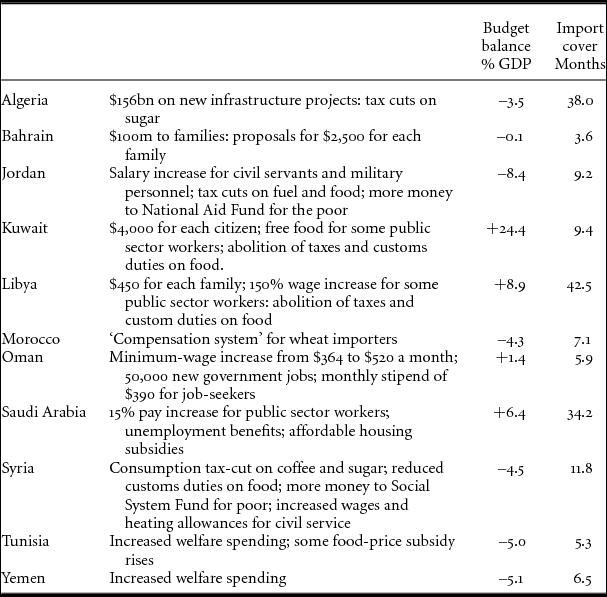
The most recent debt cancellation programme coincided with the major uprising in the Middle East associated with the Arab Spring in 2011 and took the form of material ingratiation in return for social peace (see Table 1). However, many of the initiatives were employment-related, including increasing salaries and the minimum wage, as well as an expansion in welfare spending. Two features of the provision in Kuwait stand out from elsewhere in the Middle East: the very generous financial nature of what was on offer, and that benefits were consumption rather than production orientated. The provision for Kuwaiti citizens was particularly generous and fortuitously coincided with large-scale national celebrations commemorating fifty years since gaining independence from being a British protectorate, and twenty-five years since the end of the Gulf War. These two major events in Kuwait's history served to unite the country rather than making its divisions more visible. The celebrations (included a national holiday for all) served to minimise any direct relationship between civil unrest and citizens’ payments, and the Emir was therefore able to emerge as the generous benefactor of the nation. Kuwaitis were provided with free food staples for a year, a gift of KD1,000 ($3,537) each, and the writing off of consumer debts. The value of consumer debt written off does not enter the public domain, but its impact on consumption is visible in car sales that are buoyant because of citizens spending their welfare handouts. In many countries, the Arab Spring was primarily about poverty, inequality, corruption and youth unemployment and led to severe political unrest, instability and the overthrow of national leaders. In Kuwait the opposition was confined to demonstrations focusing on achieving greater democratic rights.
Subsidies for peace: new spending measures, selected countries, 2011

Source: Economist 2011.
It needs to be recognised that Kuwait was not the only Middle Eastern country to trade various forms of financial incentives for social peace, but the rewards on offer were a much greater proportion of GDP than in any other country and that excluded the cancelling of consumer debt. However, there is evidence that the tide may be turning as, recently, lobbying by parliament and consumers for more debt and interest cancellation programmes have been rejected by the government as external pressure from outside agencies like the IMF raise concerns about the governance of the country, and the extent to which oil reserves are being depleted. Unsurprisingly, consumer reaction to this news was not positive, since many citizens have taken out very large loans in anticipation of a loan write off. Interestingly, the discourse in the country has now shifted to punishing the bankers that gave the loans in the first place, which is a similar development to that in many advanced Western societies, although the cultural pathway through which these discourses have emerged is very different (Fattahova, 2012; Izzak, Reference Izzak2012).
Citizenship and credit default
The inability to repay debt is a moral issue in most religious countries (Graeber, Reference Graeber2011) but is very serious in many Islamic countries where a bounced cheque can lead to a term of imprisonment. This scenario is very different from advanced Anglo-Saxon countries where a greater tolerance of over-indebtedness is manifest in more lenient consumer bankruptcy laws. Within Kuwait, an individual's citizenship status has important implications because of the cultural meaning attached to indebtedness, which results in the stigmatisation of some groups more than others. In the event of outright non-payment of loans due to financial hardship, lenders take debtors to court. An individual who genuinely cannot afford to repay is shown leniency according to Sharia law. Any Kuwaiti citizens that come before the court and fall into this category have their debts repaid by the government to avoid bankruptcy.
However, recognition of the larger numbers of citizens who were coming before the courts because of repayment difficulties − especially in the aftermath of the 2008 global financial crisis – suggested a more formalised, systematic approach was required. As a result, the Family Fund law act 2012 operates as a formal bailout facility for citizens that cannot repay their debts. Under the terms of the Act, the government is required to purchase the loan (minus interest) of a registered beneficiary and then reschedule the repayments. This arrangement effectively means that the loan originator is only entitled to receive the principal amount loaned, as opposed to the principal amount plus interest. Consumer and instalment loans taken from banks and finance companies before the 30 March 2008 are included within the remit of the scheme. However, by 12 October 2013, only 40 per cent of the debtors eligible to register for assistance had done so, and only half of the KD710 ($2,510) million had been claimed. Two factors explain this low rate of adoption: first, most of the interest was repaid when the Act came into force; and, second, parliamentary attacks against the fund have affected debtors’ decisions to register (Kuwaiti Times, 2013c).
Individuals without Kuwaiti citizenship are not included under the terms of the Act and have to make their own arrangements for future repayments. This reflects recent government policy of taking a tougher line on expatriates in other areas of daily life, such as their restricted use of public hospitals, and limiting the number of driving licenses to ease congestion on the roads. The country intends to reduce the number of foreigners by 100,000 each year over the next decade and, as a result of this tougher stance, Kuwait has dropped down the World Economic Forum's ranking for friendliness to tourists and visitors, and is ranked 137 out of 140 countries. The non-payment of loans by expatriates is an interesting issue because ultimately employers are responsible for their debts. Over the years, this has led to expatriates in Kuwait and other Gulf countries loading themselves up with debt to enjoy a lifestyle beyond their financial means and fleeing the country before they start to generate a pattern of default. In this respect, one of the few ‘advantages’ expatriates have over citizens is that they can return home and escape their debts in the knowledge that all the retail banks in Kuwait are locally owned and credit referencing systems are overwhelmingly national in nature; thus their history of credit default is unlikely to follow them elsewhere.
An important public policy sanction is the travel ban, which serves partly to address the problem of people leaving the country without first repaying what they owe. The system of travel bans includes citizens and expatriates, and the number of bans in force is increasing year on year. In 2011, 86,000 people faced travel bans, which were mostly for unpaid debts or fines of KD50 ($177) or over. Of this number 42,000 were Kuwaiti citizens and 44,000 expatriates predominantly from India, Bangladesh, Egypt, Syria, Lebanon, Pakistan, the Philippines, Nepal and Ethiopia (Kuwaiti Times, 2012). By the middle of 2013, the number of debtors on the travel ban list had increased to over 100,000 mostly for mobile phone usage, and car and apartment rental (Abdal, Reference Abdal2013).
Conclusion
This paper has introduced the concept of super-inclusion as a novel concept in the domain of consumer credit and public policy. The main factor distinguishing super-inclusion from mainstream financial inclusion is that the former is based on citizenship as opposed to being market-based. Super-inclusion in Kuwait provides an interesting example of the latest reworking of the rentier paradigm, which capitalises on the consumerist aspirations of citizens and aligns them with the demands for policies of redistribution. In Kuwaiti society, the ruling elites recognise that, as long as oil revenues continue to support collective and individual consumption, their tenure is unlikely to be compromised. How sustainable this policy is in the long-term is debatable as pressure grows from outside agencies like the IMF and the World Bank over the governance of the country. In the post-Arab Spring period, there has been a more concerted attempt on the part of citizens to extract a greater share of national wealth and this is illustrated by an increase in the value of gifts, loans and reductions in the interest payments on loans for citizens that were unable to repay their debts. The overall value of market-based credit extended to citizens has also witnessed a considerable increase, raising the issue of moral hazard, especially among young people who have grown up in an environment with a laissez-faire attitude to credit, despite the country's Islamic foundations. There are some interesting contradictions in Kuwait, where objections to credit and debt exist based on religious reasons yet simultaneously the state promulgates both as part of its consumerist, self-preservation agenda.
At the same time as Kuwaitis have leveraged their citizenship to further their super-inclusive consumerist ambitions, in the post-Arab Spring period a parallel discourse has emerged which has been hostile to expatriates who are portrayed as a burden on the state. Proposals to withdraw their state subsidies on essential services (e.g., water and electricity) and to limit access to public services have been aired or implemented. The widening of the gap between citizens and expatriates where public policy and the provision of consumer credit is concerned is an extension of wider processes on the part of citizens to secure more of the country's resources in the post-Arab Spring environment. There is a need for more research into the public policy dimensions of citizenship where consumer credit is concerned, especially as the democratisation of credit is widely viewed as a precursor to development. The experience of Kuwait demonstrated that, in fact, the reverse is the case with sharper divisions between the super-included citizens and the excluded expatriates in the domain of consumer credit.