Introduction
The analysis of social change is a major contribution that archaeology has made to our understanding of human societies. Many archaeologists have ventured into the identification of causal factors that may underlie differences between societies or differences within the same society in different time periods. Many scholars conceptualize social change as an abstract process that is driven by some specific external or internal factors identified by the researcher (Crellin Reference Crellin2017; Hodder Reference Hodder2016). This distinction between external and internal causal forces can lead to an implicit nature–culture dichotomy.
In recent years, the concept of ‘ontological turns’ has become an alternative and increasingly popular theoretical trend in archaeology, a trend that also addresses the issue of social change (e.g. Alberti Reference Alberti2016; Alberti et al. Reference Alberti, Jones and Pollard2013; Conneller Reference Conneller2011; Crellin Reference Crellin2020; Crellin et al. Reference Crellin, Cipolla, Montgomery, Harris and Moore2021; Harris Reference Harris and Watts2013; Reference Harris2014; Harris & Cipolla Reference Harris and Cippolla2017). The approaches in this trend include Actor Network Theory (Latour Reference Latour1993; Reference Latour2005), meshwork (Ingold Reference Ingold2006; Reference Ingold2011; Reference Ingold and Harvey2013), assemblage (e.g. Crellin Reference Crellin2017; Fowler Reference Fowler2017; Hamilakis & Jones Reference Hamilakis and Jones2017; Harris Reference Harris and Watts2013; Reference Harris2014; Reference Harris2017) and Native American perspectivism (e.g. Viveiros de Castro Reference Viveiros de Castro1998). These approaches provide pragmatic tools that depart from (and are critical of) the duality between humans and things, and instead explore the interrelations between people and things. These ‘things’ may be natural objects; they may also be objects produced by the humans themselves that have specific properties, vitality and vibrancy. Within this framework, social change is produced not by external or internal factors operating independently of each other, but rather by an interaction between internal human dynamics and external ‘things’ in their environment. These external ‘things’ in turn create elements in their environment with which humans must deal.
Among these approaches, Ian Hodder's entanglement theory has come to occupy a special place. This theory emphasizes the asymmetrical and dialectic interactions between human and things. It maintains that humans are not only entangled, but in a sense often entrapped, by their connections to things that they themselves produce (Hodder Reference Hodder2012; Reference Hodder2016; Hodder & Lucas Reference Hodder and Lucas2017). In specific cases, archaeologists often analyse how human–thing entanglement can become more complex over time, as people deal with the practical problems of daily life and are confronted with the ability of material factors to set constraints on human behaviour (Hodder Reference Hodder2016; Reference Hodder2018a). But to expand Hodder's paradigm, we also recognize that certain non-material and intangible forces also play important roles in human behaviour, such as those forces that promote social coherence and create social memory.
Our focus here is on the decline of the Hamin Mangha 哈民忙哈 (HM) Neolithic site. The decline or collapse of ancient societies is a hotly and widely debated topic in archaeology. Some archaeologists attribute social decline to one major single cause, particularly, the environment (Middleton Reference Middleton2012; Weiss & Bradley Reference Weiss and Bradley2001). In this vein, Tainter (Reference Tainter1988) summarized 11 factors, several of them environmental, that could cause the collapse of complex societies. In a similar vein, many environmental archaeologists in China have attempted to link changes in ancient societies to climatic processes. In doing this, they implicitly treat environmental factors as the major cause of social change and social decline (e.g. Wu & Ge Reference Wu and Ge2014a,Reference Wu and Geb).
In some cases, human groups are indeed influenced by environmental fluctuations, as argued by proponents of cultural ecology (Chen S. Reference Chen2013). However, other archaeologists argue that concepts of environmental determinism overlook the cultural and social factors that are also involved in social transformations (Hodder Reference Hodder and Hodder1982; Reference Hodder1986; Shanks & Tilley Reference Shanks and Tilley1987). Unlike over-simplified mono-causal approaches to analyse the driving forces of social change, entanglement theory argues that major transformations can occur simply as the unintended consequences of daily ‘entanglements’ between humans and the things which they create (Hodder Reference Hodder2016, 40). Entanglement theory approaches social change by detailed reconstruction of human–thing interconnections in people's daily life.
The case study in this article will apply a human–thing entanglement model to explore the causes behind social decline among the Neolithic Hamin Mangha population in China. But as suggested above, entanglement theory by itself, focusing on material objects with which humans interact, runs the risk of ignoring less tangible forces that also play a role in social change. To deal with this issue, I will introduce into the analysis other factors involving relational ontology, habitus and social memory to present a more comprehensive picture of human–thing interconnections.
In expanding on Hodder's model of entanglement, I will accept his premise that humans are often entrapped by the things they create. But I will also include, among the forces that entrap humans and determine their behaviour, several non-material intangible factors such as culturally generated cognitive understandings and emotional attitudes. My major thesis is that external causes such as pestilence, environmental fluctuations or demographic pressure cannot by themselves adequately explain all elements of the social change that occurs in a society. My major argument will be that a major factor in the decline of HM society was the impact of the internal forces of complexity, instability and contradiction that are brought about by the entanglement between humans and the elements that they themselves create. Among these elements with which humans grapple, however, are not only material things but also culturally generated and intergenerationally transmitted cognitive and emotional complexes. It is in this framework that we will examine the decline of the HM site.
Toward an expanded theory of entanglement and social change
Definition of entanglement
Entanglement is defined by Hodder as four sets of dependence (reliance) and dependency (constraint) between human and things (Hodder Reference Hodder2012, 88). It is a double-bind, dialectic and tension-ridden relationship (Hodder Reference Hodder2016; Reference Hodder2018a). As distinct from other relational approaches, such as Latour's Actor Network Theory, which emphasizes the relational power of things and the symmetrical status of human and things (Latour Reference Latour2005), the key feature of entanglement is a series of asymmetrical relations between humans and things. Specifically, humans always end up entrapped by the things they create and by human–thing relations. This entrapment is the central feature of the relation. In the process of entrapment, humans are continuously forced to focus attention on the physical properties of the things that they use. Other relations, especially those that deal with more abstract phenomena, are eclipsed. Fortunately, entanglement theory is inclusive and flexible enough that intangible factors can also be included in analysis. In this sense, entanglement theory could be modified to enable including in its analysis people's attitudes towards things in the past and the cognitive meanings that they attached to these things.
Abstract entanglement: relational ontology and social coherence
The first type of abstract entanglement can be considered from the view of relational ontology. People in pre-modern societies understood both their material artifacts and their environment in a relational perspective. Viveiros de Castro's ‘perspectivism’ holds that for Native Americans, both humans and non-humans are subjects that share similar souls and a parallel capacity for conscious intentionality and agency (Viveiros de Castro Reference Viveiros de Castro1998, 476). Descola (Reference Descola and Kuper1992, 114) also notices that many indigenous people endow natural beings with human dispositions and social meaning when different objects are used as bodily decorations or heirlooms. These relational ontology perspectives complicate and extend the scope of entanglement and allow humans to avoid total entrapment in inanimate things, by endowing these things with identity, consciousness and affective capacities.
The intangible social meaning of things also contributes to abstract entanglement. Hodder once argued that in many Neolithic societies, routinized habitual repetition of practices within buildings and social memory are two steps to hold people together and to maintain social coherence (Hodder Reference Hodder2018a; Hodder & Cessford Reference Hodder and Cessford2004). The habitual practice could be analysed in the framework of Pierre Bourdieu's habitus theory. Habitus is a system of durable but modifiable social or practical norms that can generate and organize practices and representations (Bourdieu Reference Bourdieu1990, 53). It keeps a society in order and mitigates potential contradictions or conflicts. Social memory encompasses multiple practices that intentionally construct shared ideas about the past (Van Dyke Reference Van Dyke2019). It functions to help construct social relations among community members and their ancestors.
These two steps are not merely abstract concepts. They are embedded in the context of daily practice and human–thing entanglement. Habitus or habitual practice and social memory, if they are to survive, still need material manifestations. Habitual practice can be achieved by regularly repeating actions or by specific material and spatial patterns. Social memory cannot be established or maintained without monumental architecture, ritual performance and special durable heirlooms to create connections to ancestors. In this sense, people can endow objects with social meanings, but must also invest time, energy and resources on maintaining these meanings. These pages will place emphasis on this entanglement of humans, not only with material things, but also with social meanings and abstractions. In this sense, this article will depart from most previous discussions of entanglement.
Potential perspectives of entanglement to social change
One of the most effective applications of entanglement theory in archaeology is the analysis of social change. The properties of entanglement endow it with the power to make social change occur along different paths. The first type of change can be considered from the incoherence or contradiction of entanglement. Hodder argues that, in the case of a specific entanglement, a linkage between material objects and their broader and more abstract social context across different domains should be compatible with embodied, habituated practice (Hodder Reference Hodder2012, 120). In contrast, if the distinct elements that are entangled, including not only material conditions but also social memories and social meanings, are mutually incoherent or contradicted, then the entire entanglement structure will begin to come apart. Fukuyama (Reference Fukuyama1995) argued that if the cultural realm in a society does not generate collective trust, the economy, customs, morals and social virtues are not coherent and the entire social order can malfunction. This disintegration is one source of social change.
Another type of change can be understood in the unstable property of entanglement. Hodder argues that, in a human–thing entanglement, humans are entrapped by many factors, such as the dependence of objects on constant care by humans and the ability of objects to resist human interventions (Hodder Reference Hodder2012, 104). These complicating factors create unstable entanglements. Consequently, change can happen unexpectedly when something goes wrong. For instance, in prehistoric times, the products of human activity such as crops or brick walls have their own cycles of growth and decline. They are also interconnected with many other things, such as soil and weather. In other words, crops and brick walls are involved in complex entanglements that are dependent on flows of matter, energy and information. The humans involved in these entanglements are often unable to perceive the whole network of complex entanglements, though they struggle to find solutions to the problems caused by entanglement. If catastrophic weather events, or other ecological or social events occur, crops may fail and brick walls may fall down.
Social change can also be attributed to the result of the qualities of general complex human–thing interactions, such as relations of assemblage (Crellin Reference Crellin2017; Reference Crellin2020; Hamilakis & Jones Reference Hamilakis and Jones2017; Harris Reference Harris2017). Society in this complex system is composed of various highly interconnected components that are constantly in flux and vibrant, and it is endangered by contingency, instability, chaos and unpredictability (Bentley Reference Bentley, Bentley and Maschner2003; McGlade & Garnsey Reference McGlade, Garnsey, Garnsey and McGlade2006; McGlade & van der Leeuw Reference McGlade, van der Leeuw, McGlade and van der Leeuw1997). A social system, in this sense, is always temporary, fluctuating and in a state of potential crisis. Sudden, unexpected and occasionally catalytic change can be triggered off, and moreover, even a tiny perturbation can have avalanche-like consequences. So as a special complex interaction, entanglement shares the common qualities of general complex interaction: complexity, contingency and instability (Hodder Reference Hodder2012: 158–67). These qualities can trigger sudden and destructive change and thus can contribute to our understanding of social decline.
In this article, other perspectives will be integrated into entanglement theory to draw a more refined diagram of human–thing entanglement and to expose the complexity of entanglement. Concepts of habitus and social memory are particularly relevant. They focus on the maintenance of social coherence and on the requirement of people to continuously invest in materials, time and energy. We will assess the relevance of these investments to the local conditions that led to the decline of HM society in ancient China. As the shared features of both entanglement and general complex systems, complexity, instability and contradiction will be used as analytic concepts to analyse the forces that led to the destruction of HM society.
The background of the HM site
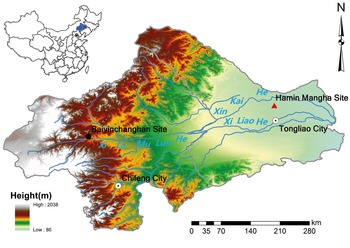
Hamin Mangha is a huge Neolithic settlement occupying more than 100,000 square metres. It was excavated systematically but not completely between 2010 and 2014 (Neimenggu Wenwukaogu Yanjiusuo Reference Neimenggu2015; Neimenggu Wenwukaogu Yanjiusuo & Jilindaxue Bianjiangkaogu Yanjiuzhongxin Reference Neimenggu and Jilindaxue2012; Neimenggu Wenwukaogu Yanjiusuo & Kezuozhongqi Wenwuguanlisuo Reference Neimenggu Wenwukaogu and Kezuozhongqi2012). It is located in Kezuo Zhongqi, Tongliao City, Inner Mongolia Province, which belongs to Horqin Sand Land (Fig. 1). Its location is a typical ecotone area between forest and grassland whose inhabitants oscillated between agriculture and animal husbandry. The environment here in different historical periods changed dramatically. In the Liao Dynasty (907–1125 ad), the Horqin Sand Land was forest steppe, but in the Jin Dynasty (1115–1234 ad), this area experienced serious desertification. Multivariate palaeoenvironmental analysis indicates that there were several climatic fluctuations occurring over the centuries between 6000 and 4000 years ago, when the local climate at the HM site was becoming drier, cooler and very unstable (Liu B. et al. Reference Liu, Jing and Sun2011). From the view of cultural ecology, the wild resources and vegetation zones in the HM area were prone to be influenced by frequent climatic fluctuations that exerted a negative impact on the subsistence and social life of HM people (Chen S. Reference Chen2013).
The location of Hamin Mangha and sites mentioned in the article.

Analysis of five charcoal samples indicates that the occupation of HM site occurred approximately between 3600 and 3100 bc (Zhu & Ji Reference Zhu and Ji2016; Zhu Y. 2016). Since there is only one stratum that contains ancient remains without any superposition, and the artifacts in different strata do not indicate cultural differences, excavators proposed that the houses of the HM site are substantially contemporaneous (Zhu Y. Reference Zhu2016). In addition, the excavated houses were burned and no evidence of disturbance was discovered. These phenomena indicate that the arrangement of houses and the distribution of artifacts reflected social life during the entire occupation period. The non-disturbance of houses and associated artifacts will serve us as the basis for the entanglement analysis and interpretation below.
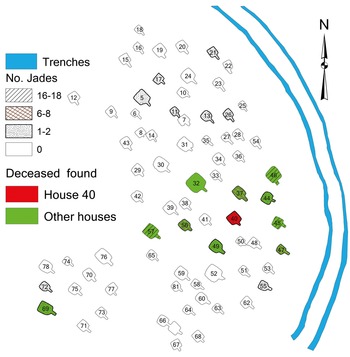
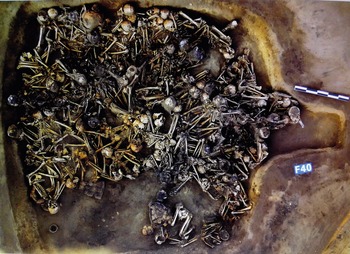
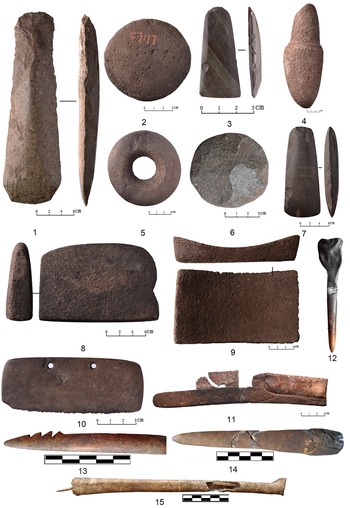
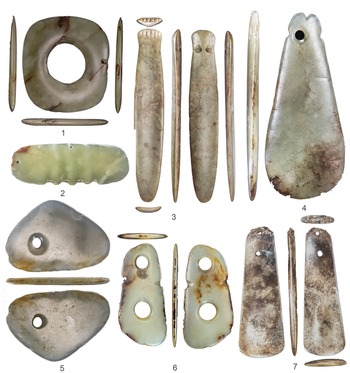
In the HM site, multiple varieties of remains were discovered and subjected to detailed analysis. Although only a part of materials on the excavations were published in the form of initial archaeological reports, they nonetheless give us an overall picture of HM society. Archaeologists excavated 8200 sq. m and discovered 78 semi-subterranean houses with wattle-and-daub walls, 14 burials, 57 pits and 2 ditches. These houses were arranged in rows and the doorways of each house were oriented to the same direction (Fig. 2). The area of individual houses ranges between 10 and 40 sq. m. In several burned houses, the wooden frameworks were preserved and piles of human skeletons were deposited (Fig. 3). Many pottery artifacts, productive tools and jade articles (Figs 4 & 5) were placed in a regular fashion on the house floors.
The distribution of houses, jades and the deceased in the Hamin Mangha site (excavated area). Note: items excavated from House 49 to House 72 were not explicitly reported. (After Ji & Deng Reference Ji and Deng2018.)

The human skeletons in House 40 of the Hamin Mangha site. (Ji & Deng Reference Ji and Deng2018.)

Stone tools in the Hamin Mangha site: (1) pickaxe; (2) round grinding tool; (3) adze; (4) pestle; (5) doughnut stone; (6) stone head of food hammer; (7) axe; (8) handstone; (9) grinding slab; (10) knife; (11) notched knife with microlithic blade; (12) bone hairpin; (13) harpoon; (14) bone awl; (15) bone needle cylinder. (1–11 after Chen S. et al. Reference Chen, Yang, Li, Zhu and Ji2016; 12–15 after Chen Q. et al. Reference Chen, Chen, Ji and Wang2016.)

Jade articles in the Hamin Mangha site: (1, 6) jade Bi 璧 from House 37; (2) hooked cloud jade 勾雲形器 from House 46; (3) jade dagger匕 from House 46; (4) pendant 墜 from House 56; (5) fish from House 44; (7) jade Yue 鉞 from House 37. (After Ji & Deng Reference Ji and Deng2018.)

Analyses of palaeoanthrobotany, zooarchaeology, stable isotope, lithic function and residue have been conducted (Chen J. Reference Chen2014; Chen S. et al. Reference Chen, Chen, Ji and Wang2016; Sun et al. Reference Sun, Zhao and Ji2016; Zhang et al. Reference Zhang and Sun2022; Zhu Y. Reference Zhu2016). Integrating the results of these analyses, archaeologists have inferred that HM people adopted a strategy that is similar to a broad-spectrum subsistence. In this subsistence, though the inhabitants of the HM site had transitioned to agriculture, elements of diversified hunting and foraging continued to be elements of the local economy. In the food resources of the HM population, Artemisia sieversiana (a kind of wild potherb,used for food by the local population in periods of nutritional stress), millet (Setaria italica), broomcorn millet, Canidae, hares, boars, rodents and roe deer are the predominant components. Such diversity survived in the HM site as an adaptive strategy suitable for the unstable ecotone environment in which it was located (Sutton & Anderson Reference Sutton and Anderson2004). In terms of environmental challenges, evidence on local weather patterns indicate that droughts lasting more than two years happened frequently. These droughts would have placed major pressure on local resources (Shi Reference Shi1989). These short-cycle climatic events are difficult to document in available climate records. We can nonetheless infer that economic stress related to the shortage of food resources and/or to increasing demographic pressure was a frequent occurrence during the HM occupation (Chen S. et al. Reference Chen, Yang, Li, Zhu and Ji2016).
Interestingly, the local environmental and ecological conditions do not seem to have been adequate to provide a solid material basis for the sedentary lifestyle that prevailed in the huge HM settlement. As a result, HM society seems to have adopted creative social strategies based on special organizational or administrative arrangements to permit the continual occupation of such a huge settlement (in the sense of habitus concept). Since HM society emerged after the disintegration of the Hongshan Culture (4500–3000 bc), the society of which belonged to what anthropologists refer to as chiefdoms (Drennan et al. Reference Drennan, Peterson, Xueming and Tao2017; Peterson et al. Reference Peterson, Lu Xueming, Drennan and Da2017), and some styles of pottery vessels and types of jade articles were inherited from the Hongshan Culture, it is reasonable to infer that HM was a society endowed with a certain level of complexity with administrative organization. The social complexity and the social strategies will be discussed in a later section. For the moment, the goal is simply to present some basic data on the overall social organization that seems to have prevailed at the site.
The most striking discovery is that, on the floor of House 40, 98 human skeletons are piled up (Fig. 3). Physical anthropologists claimed that this house was used as a mortuary and that these skeletons were put there separately after they died from a plague (Zhou et al. Reference Zhou, Zhu and Ping2012; Zhu H. et al. Reference Zhu, Zhou and Zhang2014). In addition to House 40, another 83 human skeletons are dispersed in eight different houses. These discoveries have attracted the attention of archaeologists, puzzled as to why so many people were left dead in these houses and what factors were behind the decline of HM society. The most common interpretation is that HM people died from some abrupt event, the major hypothesis being plague. Scientists now can discover the direct evidence of Yersinia pestis from ancient DNA (e.g. Rasmussen et al. Reference Rasmussen, Allentoft and Nielsen2015; Rascovan et al. Reference Rascovan, Sjögren, Kristiansen, Nielsen, Willerslev, Desnues and Rasmussen2019). But DNA research has not yet been conducted in the HM site to test for pestilence. Even so, the age structure of the dead at the HM site is very similar to that of the Miaozigou Neolithic site in the central region of Inner Mongolia. In that location, a plague definitely broke out. Large numbers of rodents that can transmit plague were discovered in the HM site as well. In addition, Horqin Sand Land is a plague-prone area in both ancient and contemporary periods. In light of these facts, physical anthropologists infer that plague forced the HM people to abandon their settlement (Zhou et al. Reference Zhou, Zhu and Ping2012; Reference Zhou, Niu, Ji, Zhu, Zhu and Zhang2022; Zhu H. et al. Reference Zhu, Zhou and Zhang2014).
Epidemics did play important roles in social decline. But this explanation by itself ignores other potential forces behind the decline of local society. In the following discussion, a more comprehensive potential process of HM decline is presented from the view of a modified entanglement model that is enriched by relational ontology, habitus and social memory approaches.
Reconstruction of entanglement
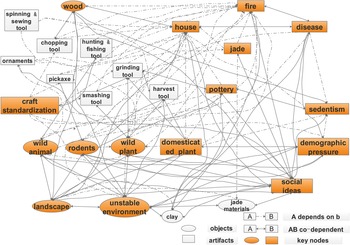
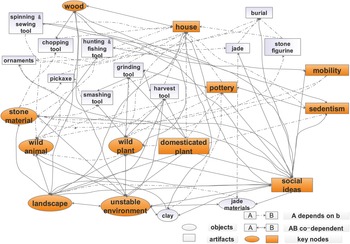
Integrating the results of scientific analysis by other scholars to the remains of the HM site, I have reconstructed an HM human–thing entanglement model (Fig. 6). Although the quantitative dimensions of lithic technology in HM remain obscure and the survival may reuse the usable tools and materials (Chen S. et al. Reference Chen, Yang, Li, Zhu and Ji2016), the archaeological materials left by HM people can still give us a qualitative picture of the overall pattern of human-thing relationships. In Figure 6, rectangles indicate artifacts that are manufactured and maintained by humans. Circles represent other natural objects or items in the natural environment. The unidirectional arrowheads with dots and dashes stand for a simple dependence relationship between the connected items. For instance, diseases are facilitated by sedentism; that is, high population density and close contact between humans and animals create conditions that favour the spread of diseases. But sedentism does not depend for its existence on disease; that is, the emergence or degree of sedentism has been caused by other factors (such as the transition to agriculture), not by disease. The bidirectional arrowheads with solid lines represent patterns of co-dependency. For example, wild plants ‘require’ the existence of digging tools to be exploited as human food. In turn, those tools also depend on the existence of wild plants to carry out the digging functions for which they were manufactured.
Entanglement diagram of the Hamin Mangha site.

In the entanglement diagram (Fig. 6), it is noted that some things are more entangled than others. These could be called key nodes. Key nodes could be defined not only quantitatively by the number of connections they have with other nodes, but also qualitatively by the importance and impact on the whole entanglement system. In the HM case, if the amount of a node is more than 7, it can be defined as a key node. This number is evaluated in the context of the overall pattern of interconnections. For example, jade is a key node not because of the number of connections, but because of its impact on social coherence. This will be argued below. Houses are one of the most highly entangled nodes. In the HM site, many activities like food and tool processing, cooking, eating, sleeping and reproduction occur in the house. The house also has social meanings. Moreover, houses are the final places in which human remains in HM were deposited. Some of them are used as mortuaries in which humans who died from the plague were stacked. It will also be argued below that the houses in the HM site could reflect habitus and other social ideas. Some key nodes, such as disease, demographic pressure and fire, are highly connected with nature and culture and would potentially trigger destructive impacts on the whole entanglement system. Therefore, these key nodes are depicted as having more connections. If these key nodes are changed, damaged or eliminated, the whole entanglement system would itself be transformed.
The preceding paragraphs dealt with purely material elements. But in addition to material factors, culturally shaped idea systems also played important roles in the HM entanglement. In the HM area, shamanism is an indigenous religious system which can be traced back to the Neolithic period and perhaps further (Eliade Reference Eliade1964; Harvey & Wallis Reference Harvey and Wallis2010). Hongshan Culture is just a society where shamanistic beliefs and practices were popular and were represented symbolically in jade objects, such as the hooked cloud jade and Jade Bi. These jade articles are viewed as being alive and as having personalities, so they have spiritual relations with people (Descola Reference Descola2013; Harvey Reference Harvey2006; Reference Harvey2013; Herva & Lahelma Reference Herva and Lahelma2020; Ingold Reference Ingold2000; Qu Reference Qu2019; Viveiros de Castro Reference Viveiros de Castro1998). Because these two kinds of jade were popular in HM society (e.g. Fig. 5: 3) and their styles were inherited from Hongshan Culture, archaeologists argue that this jade was probably related to shamanism (Deng Reference Deng, Ping and Cong2018a). They connected people (shaman) and the God (Li Reference Li2020), and had transformative forces that acted as agents and complicated the HM entanglement.
Apart from invisible symbolic beliefs, some social ideas represented as the patterns of social practice are somewhat more visible. The HM site was a huge settlement (>100,000 sq. m). Anthropologists and archaeologists know that communities of that size are generally held together by complex patterns of social and political organization (e.g. Prince & Feinman Reference Prince and Feinman2010). As we will discuss in the interpretation section, HM society was an incipiently complex society in character as indicated by the unequal distribution of jade articles in different houses. In addition to socio-political strategy, habitual practice (habitus) and social memory, as we discussed, are mainly two practical ways to strengthen social cohesion in order to hold community members together (Hodder Reference Hodder and Hodder2018b). Though they are not material objects, such practical strategies can also be considered as ‘things’ invented by humans and with which humans subsequently become entangled and entrapped. People invest large amounts of time, energy and resources in creating, maintaining and dealing with these strategies.
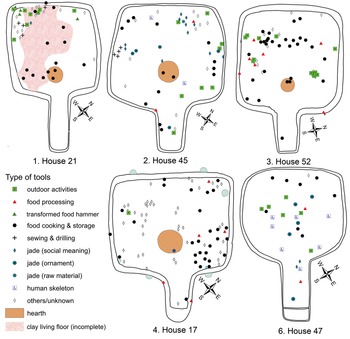
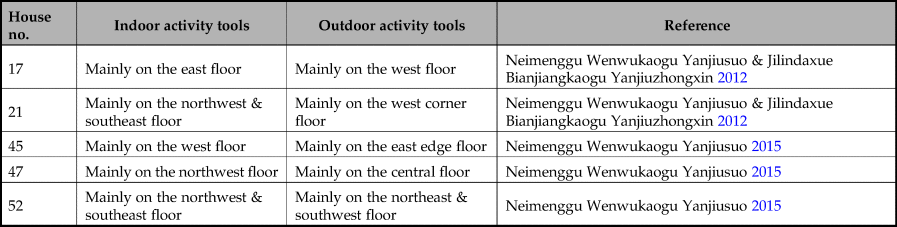
The structure and organization of living spaces is fairly well preserved in the archaeological record, which gives us insights into the internal division of houses. We can see artifact clusters with different functions in the HM site. Those clusters provide evidence to indicate the ways of habitual practice. Firstly, the orientation of the floors and the internal structures in each house are consistently oriented to the southeast, and all the HM houses stand in rows. More importantly, the distribution of artifacts on many house floors displays specific spatial patterns (Fig. 7; Table 1). For instance, on the living floor of House 45, tools of outdoor activity (adze, pickaxe and notched knife with microlithic blade) are mainly located on the eastern floor of the house, while food-processing tools and food-related pottery are mainly located on the western part of the floor (Fig. 7: 2). In this particular house, 16 jade objects were collected. Jade objects used as ornaments (beads, pendants) and are mainly found on the west side of the floor and jade objects with potential social meanings (Bi, Huang, Yue and hooked cloud jade) are mainly located on the east side of the floor. The spatial distribution of artifacts on the living floor of House 47 provides another piece of evidence. On the living floor of this house, tools of outdoor activities are mainly located on the central floor, while food-related pottery objects are mainly located on the northwest part of the house floor (Fig. 7: 5). In this house, eight jades were collected. Jades that functioned as ornaments are mainly located on the central floor, while jades with potential social meanings are mainly located near the doorway.
Distribution of artifacts on the house floors in the Hamin Mangha site.

The distribution pattern of artifacts on the house floors in the Hamin Mangha site.

Admittedly, the recycling and recollecting behaviours of HM survivors, as some scholars have said (Chen S. et al. Reference Chen, Yang, Li, Zhu and Ji2016), might influence the accuracy of the spatial patterns. But Chen and Zhu (Reference Chen and Zhu2022) analysed the abandonment patterns of HM site and maintained that the artifacts on the living floors of many houses, including those listed in Table 1, were formed either by abrupt abandonment triggered by epidemics, or by temporarily seasonal abandonment. So it could be inferred that the artifacts on the living floors formed by these two abandonment processes were not disturbed. Moreover, habitual practice occurs in many indigenous communities globally (e.g. Bourdieu Reference Bourdieu1990; Hodder & Cessford Reference Hodder and Cessford2004; Huang Reference Huang1995), and habitual practice has a long history in the area of the HM site and could be traced back to the Xinglongwa Culture (6200–5200 bc) (Liu Y. Reference Liu2020a,Reference Liub). Therefore, the distinct spatial patterns above, to some degree, could prove the fact that habitual practice occurred in HM society.
In interpreting these phenomena, it should be remembered that HM is located in an ecologically challenging ecotone in which wild food resources and domesticated food production are both unstable. In such settings, special social strategies are required to maintain social cohesion during periods of subsistence pressure (Chen S. Reference Chen2013; Hayden Reference Hayden2009). To deal with such periods of stress, the inhabitants of HM would have had to construct social relations via habitual practice in their daily life to keep society functioning and hold people together. The habitus behind their habitual practice became a shared embodied knowledge and social norm to keep the HM people in harmony, via people's moving in different part of their houses and experiencing the spatial patterns and meanings of their household configurations.
Another way to construct social cohesion is through social memory. In the case of HM, where a plague killed off people in large numbers, such memory appears to have focused on maintaining contact with the dead. Based on the supposition that the human skeletons were victims of the plague, and examining the locational patterns of the human skeletons that were deposited in the houses, Deng et al. (Reference Deng, Ji, Deng, Ping and Cong2018a, 38–47) proposed that House 40 was used as a public mortuary in which 98 human corpses were given secondary burial. Since the skeleton piles were not completely excavated, the real number of skeletons may have been more than 100 deposited in three time periods in which the plague broke out. In addition, 105 human skeletons were primarily deposited in nine houses around House 40 after the space inside House 40 was fully occupied. Deng et al. (Reference Deng, Ji, Deng, Ping and Cong2018a, 47–56) were insistent in their claim that most of these nine houses had abundant deposits of delicate jades, such as Bi and hooked cloud jade, which had special ritual meanings. Since the HM population most probably had shamanistic or animistic religious beliefs, the jades were redistributed or inherited by descendants in an effort to keep alive the memory of their ancestors.
This inheritance and redistribution of jade could be considered as one vehicle for the construction of social memory mentioned above. People who inherited their ancestors’ jades also inherited their personality and spirit (Joyce Reference Joyce, Gillespie and Joyce2000, 203–6; Mauss Reference Mauss1954; Strathern Reference Strathern1988). In this manner, the descendants were able to coexist symbolically with their ancestors. In this sense, the inherited jades may have played an important role in helping the living form a social or psychological bond and a shared identity with their ancestors. Such a bond with the ancestors would have been of special importance during plague outbreaks. Ancestral bonds could facilitate social cohesion in times of danger. In this sense, the possible reason that most of the skeletons and jades in HM site were assembled and deposited in nine houses around House 45 may reflect a collective effort to share the same identity, and maintain cohesiveness, with their ancestors.
Interpretation: entanglement and social decline
It will be recalled that entanglement theory has traditionally focused on the relationship between human beings and material objects. We are proposing an expansion of this paradigm by adding social and ideational patterns to the factors that entangle and entrap people. In this sense, we can view HM society as an entangled combination of human, material, social and ideological patterns. It works like a complex system that is made up of flows of matter, energy and information. Each flow has its own distinct temporality, unruliness and instability (Hodder Reference Hodder2012, 160). The entangled system can flow smoothly under ordinary circumstances. But the relationships among components of the entanglements may become disrupted if forces arise that are powerful enough to make the entanglement change abruptly. In the following sections, three features of the HM entanglement—their complexity, instability and contradiction—will first be described. I will then demonstrate how disruptions in these three features led to the decline of HM society.
Complexity: vibrant key nodes, social complexity and comparative analysis
The first variable to be examined here is that of complexity. The complexity of any particular entanglement can be demonstrated in many ways. As we claimed above, some nodes in HM entanglement are highly connected across many domains. A house is one such node. A house is not only the place where many daily activities take place, such as food processing and consumption, but also the place where the inculcation of practical norms that direct habitual practices takes place. We have seen that in HM society, some houses were also used as mortuaries in which the remains of deceased ancestors were deposited. And in other houses, jades of ancestors were redistributed. So houses in HM society played an important role in maintaining social cohesion and social memory. HM houses functioned to connect material things, such as jade, with abstractions (memory of the dead) and allowed the whole entanglement to become more complex.
But there was a danger waiting to emerge. Houses in HM society were constructed by people using clay and wood extracted from a fluctuating environment. The construction of houses, associated with the adoption of agriculture, entails a decrease in mobility and the adoption of a sedentary lifestyle. As more and more people congregated in a single settlement, however, they were more likely to be threatened by demographic pressure and epidemics. In HM society, demographic pressure could be partially alleviated by a broad-spectrum subsistence strategy or by some creative administrative strategies. But since the local environment in this ecotone was unstable and unpredictable, demographic pressure most likely produced stress. And because sedentary HM people were in close contact with rodents that potentially carried the plague, they were susceptible to epidemic outbreaks. In response to these dangers, HM households engaged in complex material and social relations. Once the houses were abandoned due to external factors, such as epidemics, various connections within the entanglement structure would be threatened and would have to change.
Besides houses, jade objects also increased the complexity of HM entanglement. Each jade article had a long life history which is not depicted in the HM entanglement diagram. The source of HM jades was geographically distant. The raw material of HM jade had two sources: one was around Lake Baikal, and the other was in Xiuyan, Liaoning Province in China (Neimenggu Wenwukaogu Yanjiusuo & Kezuozhongqi Wenwuguanlisuo Reference Neimenggu Wenwukaogu and Kezuozhongqi2012; Neimenggu Wenwukaogu Yanjiusuo & Jilindaxue Bianjiangkaogu Yanjiuzhongxin Reference Neimenggu and Jilindaxue2012; Neimenggu Wenwukaogu Yanjiusuo Reference Neimenggu2015). The technique of perforation of HM jade originated in Jilin Province, Heilongjiang Province and the Lake Baikal area (Deng & Ji Reference Deng, Ji, Ping and Cong2018). Some types of jade in HM like hooked cloud jade and bead were influenced by the Hongshan Culture (Deng et al. Reference Deng, Ji, Liu, Ping and Cong2018b). And in terms of manufacturing process, there were five stages in hooked cloud jade manufacturing and each of them required refined technology (Deng Reference Deng, Ping and Cong2018b). Therefore, in terms of our complexity discussion, the HM jade articles experienced long multiple threads of human-material-geographical-technical movements. And this complex movement entrapped HM people into an extensive human–thing entanglement from which people could hardly disengage by their investment in these jade articles. Any malfunctions in this process would have a negative impact on the HM population.
As for their role in social life, jade articles were linked to social relations and identity. Some jade articles, such as those located around House 45, were typically used to maintain the pattern of habitual practice in order to keep the HM society in order and mitigate potential contradictions. Some jade articles, such as those located around House 40, were possibly used as heirlooms and inherited by the living people during the epidemic to establish an intimate relation with the dead. Some jade articles, like the hooked cloud jade, were probably associated with shamanistic religious practices (Li Reference Li2020). In this religious context, both humans and non-humans are in a constant process of metamorphosis that occurs via a dynamic human–thing interaction (Ingold Reference Ingold2007, 80; Reference Ingold2011, 63). In this sense, the HM jade articles, in particular the hooked cloud jade, have a vibrant power to transform. This capacity of jade endows it with the potential power to increase the complexity and reduce the stability of the HM entanglement. A change in this and any other key component of the entanglement could trigger the transformation of the HM entanglement.
Another dimension of complexity is social in character. Social complexity is illustrated in craft specification and in social hierarchies. Using statistical methods and methods of experimental archaeology, archaeologists discovered that some craft specialization existed in the lithic and ceramic production of HM society (Chen & Chen Reference Chen and Chen2016; Chen S. et al. Reference Chen, Yang, Li, Zhu and Ji2016; Chen Z. Reference Chen2020). Craft specialization presupposes the existence of some organized professional handicraft group in HM society (Costin Reference Costin1991), although we are uncertain as to the details of this group. Since the HM society inherited some cultural elements of Hongshan Culture and Hongshan was an incipiently complex society—as seen in its divine power, refined jade articles, burials of high-ranked monumental landscape, supernatural cosmology and long-distance communication networks among the upper classes of Hongshan with those of other similar societies (Chifeng International Collaborative Archaeological Research Project 2011; Drennan et al. Reference Drennan, Peterson, Xueming and Tao2017; Guo Reference Guo2019; Li Reference Li2017; Peterson et al. Reference Peterson, Lu Xueming, Drennan and Da2017)—social inequality and hierarchy were almost certainly present in HM society. This inequality could be seen in the unequal distribution of jades in different houses. House 45 was very distinct. In this house, only one human skeleton was discovered, but 16 jade articles were located on the floor of the house. It may be the case that these 16 jade articles were owned by one person. If so, this person possessed the largest number of jade articles. In addition, a Jade Yue that symbolized political power was discovered in House 37. In House 46, the largest Jade Bi and a hooked cloud jade were attached to the same skeleton. These phenomena indicate that HM was, to some degree, an incipiently complex society. In such a society, entangled social relations are hierarchical. Some people (craftsmen or elites) could possess more things, have more chains of entanglement and minimize the entrapment of entanglement, while other people (commoners or non-elites) were entrapped both by things and elite people (Hodder Reference Hodder2016, 68). In a word, craft specification and social inequality make the HM entanglement asymmetrical, extensive and complex.
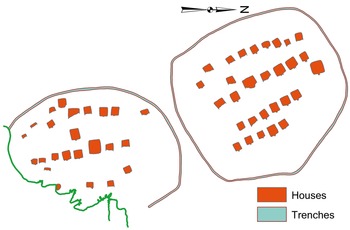
The third dimension of complexity could be assessed by contrasting the HM entanglement with the Baiyinchanghan 白音長汗 (BY) entanglement. BY Neolithic site is one of the few sites in the HM area that has fair quality of materials. It comprised of two separate settlements (about 7200 sq. m in total) and its major remains belong to the Xinglongwa Culture (6200–5200 bc) (Neimenggu Zizhiqu Wenwukaoguyanjiusuo Reference Neimenggu Zizhiqu Wenwukaogu2004) (Fig. 8). Both the HM and BY site are located in the same ecotone area (Fig. 1), and adopted strategies of broad-spectral subsistence and habitual practice. Most of the material assemblages on house floors are still usable and appear to have resulted from abandonment rituals or seasonal abandonment (Liu & Chen 2012: 130), so they provide access for our understanding of the BY daily life. In this sense, the functional categories of material remains are selected as nodes, just as we did in the HM entanglement. These phenomena serve as the basis for this comparative analysis.
Map of Baiyinchanghan site. (After Neimenggu Zizhiqu Wenwukaogu Yanjiusuo Reference Neimenggu Zizhiqu Wenwukaogu2004.)

The analytical results indicate that the HM entanglement is more complex. This complexity is proven by many dimensions of evidence. First, the nodes, key nodes, connections and codependence in the HM entanglement outnumber those in the BY entanglement (Fig. 9; Table 2). Even in nodes shared by the two components, like technology and resource acquisition, the HM entanglement demonstrates a higher level of complexity. In terms of technology, unlike the HM entanglement, no evidence indicates that craft specification, long-distance technological diffusion and transformed lithic tools existed in the BY site. With regard to food resources, the main animal resources in the BY community were big game, such as red deer, roe deer and wild boar (Neimenggu Zizhiqu Wenwukaogu yanjiusuo Reference Neimenggu Zizhiqu Wenwukaogu2004), whereas various types of small animals were predominant in the HM society. In addition, no indications of social hierarchy were discovered in the BY site. More importantly, destructive elements, such as epidemics, rodents, demographic pressure and fire have not emerged as (key) nodes in the BY entanglement. And archaeologists infer that in order to acquire resources seasonally, BY people abandoned their smaller settlement temporarily, rather than abruptly, and planned to return (Chen S. Reference Chen2013, 235), so they did not need to deal with issues such as demographic pressure and epidemics as HM people did. By contrast, archaeologists discovered that the diversified ways of subsistence in the HM site formed various abandonment patterns, and catastrophic abrupt abandonment was just a deadly pattern (Chen & Zhu Reference Chen and Zhu2022). All these phenomena suggest that the movement of flows of matter, energy and information in HM entanglement was more frequent and the HM people were more entangled in the investment in dealing with subsistence and social relations, as well as destructive epidemics. Therefore, the HM entanglement is more extensive and complex, and more potential forces of change emerge in it.
Entanglement diagram of the Baiyinchanghan site.

Comparison between Baiyinchanghan (BY) and Hamin Mangha (HM) entanglements.

Instability: unintended circumstances, raw materials, plague and changing relations
After the variable of complexity, the second element of entanglement is instability. Since the HM entanglement is so complex and the components in this entanglement are unruly and unstable (Hodder Reference Hodder2012, 160), the entire HM entanglement itself is unstable. Society and its objects may have the appearance of stability. But the illusion of this stability is achieved via great effort (Hodder Reference Hodder2012, 209). So given the heterogeneous components and connections, the HM entanglement is a complex, self-organizing system. Instability is actually at the core of this complex system (McGlade & van der Leeuw Reference McGlade, van der Leeuw, McGlade and van der Leeuw1997). In the case of HM society, in order to deal with the unstable human–environmental relationships and the pressure to sustain a huge settlement, people had to adopt a broad-spectrum economy, supplementing agriculture with the procurement of small mammals, birds and aquatic resources. In this process, unanticipated dilemmas may surface, such as shortage of wood, insufficiency of the raw materials of jade, diseases disseminated by rodents and birds, deterioration of the environment and of houses, as well as the disruption of social meanings. All these dilemmas could catapult the entire society into a state of disequilibrium. In this section, three concrete factors will be discussed in detail.
The first source of instability involved the acquisition of raw materials for lithic tools. Lithic analysts point out that since only a small number of flakes were discovered and there was no evidence of local lithic production, acquisition of the raw materials of stone could have been a problem, given the large distance to the source of stone. Larger stone tools (such as pickaxes) were therefore transformed into other small tools (such as the stone head of a food hammer) when they were worn out (Chen S. et al. Reference Chen, Yang, Li, Zhu and Ji2016; Chen Z. Reference Chen2016). This lack of local raw materials, and the disruption it caused, was probably one of the factors that led to the decline of HM society.
The second destabilizing factor was the threat of plague. As we mentioned, physical anthropologists infer that HM people had been killed by plague, since the ages of the dead were similar to those of a typical plague site (Zhou et al. Reference Zhou, Zhu and Ping2012; Zhu H. et al. Reference Zhu, Zhou and Zhang2014). In addition, physicians have determined that the hares and rodents which were abundant in HM society are able to carry and transmit plague. They have been identified as sources of infection in many ancient plagues worldwide (Kohn Reference Kohn2008; McNeill Reference McNeill1976). Historians have recorded that during 1910– 1931, several plagues broke out in Manchuria (northeast China), which is precisely where the HM site is located (Jiao Reference Jiao2006; Kohn Reference Kohn2008; McNeill Reference McNeill1976; Nathan Reference Nathan1967; Wang D. Reference Wang2005a,Reference Wangb; Wang & Meng Reference Wang and Meng2005). According to the medical reports of the local Center for Disease Control and Prevention, plagues frequently occurred in the HM area in recent years (Feng et al. Reference Feng, Gaowa and Wangli2013; Sun et al. Reference Sun, Xiaodong and Luojincai2006). Therefore, even if a particular generation of HM people was not killed by plague, they probably still felt threatened by it. Small mammals such as rodents, a sedentary lifestyle and a dense population formed the ideal setting for the outbreak of an epidemic.
The third destabilizing factor is the changing configurations of human–thing relations. Archaeologists maintain that the connections of things were changing and situationally related in traditional societies that relational ontology or shamanistic religion dominated (Herva & Lahelma Reference Herva and Lahelma2020). In HM society, the danger of plague and the large numbers of people that had already died probably changed the context of human–thing relations. Many of the HM people who survived the epidemics refused to inherit their ancestors’ jades and burned down the houses. In order to prevent a similar calamity from happening once again, HM people apparently chose to leave and abandoned the whole settlement. The relations between people, the bones of the dead, house, and jade were disrupted, potentially leading to a decline in HM society.
Contradiction: key nodes and material-social incoherence
We have discussed entanglements in terms of their complexity and their stability. We will now discuss the third factor leading to the decline of HM society: contradictions that arise within the HM entanglement.
In the entanglement structures of the HM site, there were several types of contradiction. The first type of contradiction existed among the key nodes. There was an incompatibility between the unstable ecotone environment and the construction of large settlements, entailing the growth of a dense population and the outbreak of a plague. Constructing a large settlement pulled HM people away from a mobile foraging economy into a sedentary life based on agricultural food production. But, in an unstable ecotone environment such as that of HM society, a wiser strategy would have been to adopt a mixed broad-spectrum economy and maintain a high level of residential mobility, instead of settling down into a demographically dense sedentary lifestyle (Chen S. Reference Chen2013) that was likely to lead to an increase in the density of the population. As we know, nearly 200 human skeletons were discovered in the excavated areas with 6000 sq. m. Archaeologists inferred that the actual number of HM people in the whole settlement was several thousand by the standard of a 30 per cent death rate produced by plague (Chen S. et al. Reference Chen, Yang, Li, Zhu and Ji2016; Zhu Y. Reference Zhu2016). This would be considered a dense population. Dense population as well as the unstable ecotone and relatively scarce resources placed stress on the subsistence of HM people (Liu et al. Reference Liu, Jing and Sun2011) and forced them to make disastrous decisions. One such unfortunate decision was the incorporation of disease-transmitting rodents into the local diet. Moreover, a large territory with a dense population facilitates the outbreak and rapid spread of a plague. In this sense, once the outbreak of disease began, the plague would quickly spread as infected individuals would rapidly transmit the infection to the rest of the population. It was a disastrous plague that was probably the principal factor in the decline of the HM site. The impact of this epidemic, however, was probably exacerbated by pre-existing subsistence pressures on an agrarian economy that was not fully suitable for the region to begin with. At any rate, the contradictions created by these ecological, demographic, residential and epidemiological factors contributed to the eventual disappearance of HM society.
But there was yet another internal contradiction that contributed to the HM decline. There was an incompatibility or incoherence between the social and practical efforts required to keep HM society together, and the physical-material conditions of HM society. According to the principles of cultural ecology, besides the diversified subsistence as an adaptive strategy, dense population and the unstable ecological conditions requires the creation of administrative strategies to maintain social cohesion (Chen S. Reference Chen2013; Hayden Reference Hayden2009). Social cohesion in HM society is facilitated by a structure with three distinct elements: (1) material elements such as jade that serve as symbols of social or shamanistic ontology (relational ontology); (2) strategies of habitual and embodied practice (habitus) illustrated by organizational arrangements of house floors that permit administration of a dense population; and (3) ideational strategies, such as the inheritance of jade articles, to create a sense of shared history and shared identity (social memory). Such a pyramid-like structure of material-organizational-ideational complexes arose in HM to hold society together. However, the challenging physical environment and unfriendly landscape placed stress on this complex entangled structure. As we noted, the material conditions of the HM site, such as insufficient raw material of stone and the unstable resources due to frequent droughts (Chen S. et al. Reference Chen, Yang, Li, Zhu and Ji2016; Shi Reference Shi1989), did not lay a sufficiently solid foundation for a large, complex society with complicated social arrangements. Therefore, the material foundation, the embodied practice (habitual practice and the habits of bodily jade ornaments) and the abstract meanings (such as the social meanings of house spaces and jade articles) were not coherent in the long run.
A dense population with an unstable subsistence base found it difficult to function even in normal times. The occurrence of a plague that suddenly wiped out a large number of the population was the coup-de-grace against traditional life and rendered the components of the HM entanglement incoherent. But the HM people did not immediately take ‘rational’ steps. As Deng et al. (Reference Deng, Ji, Deng, Ping and Cong2018a, 47–56) insisted, in the incipient stage of the outbreak, House 40 was transformed into a public mortuary and the corpses were stacked in it. The survivors around House 40 had inherited the jade articles in House 40 to sustain intimate spiritual bonds with their ancestors and express their social identities. As the plague became out of control, the people around House 40 also died. Those surviving distanced themselves from the dead, refusing to inherit or even to touch the jade articles of the deceased. The corpses of the dead inspired panic in the living, who burned the corpses to ashes in the houses where they had been stacked. Eventually, the HM population abandoned the doomed settlement.
Conclusion
The entanglement model that emerged in archaeology notes that humans become ‘entangled’ and ‘entrapped’ by things. We have expanded the entanglement paradigm to include non-material dimensions of human culture, including habitual practice, social memory and relational ontology. Humans are ‘entangled’ and ‘entrapped’, not only by the material things which they have created or inherited, but also by the social arrangements and the idea systems, including religious ideas (relational or shamanistic ontology), which they have inherited from their ancestors and share with other members of their society. This article concludes that complexity, instability and contradiction—the key features of the material-social-ideational entanglement of the HM site—led to the decline of HM society.
In the entanglement model, jade objects and houses are key nodes; that is, they are not only prominent in the archaeological record, but they are also densely connected to other elements in local life, engaged in social practices, and are endowed with rich symbolic meanings. These two things contributed to the complexity of the HM entanglement. We have suggested in the paper that the adoption of agriculture in HM society was at least associated with a growth in population that created environmental and economic stress. The HM community, thus, in adopting agriculture, in effect entrapped themselves in pathways from which there was no turning back. With the growth of a dense sedentary population, which is usually a concomitant of agriculture, the HM community found itself obliged to develop a more complex society. The unequal distribution of jade articles (e.g. in House 45) within the HM community gives evidence of inequality in wealth and social status. In such an incipiently complex society, habitual embodied practice and social memory were strategies taken by the HM people to hold the whole community together. We see this in the distinct distribution of daily artifacts and bodily ornaments on house floors (habitus), the distribution of jade articles around House 40 (social memory) and the shamanistic religious functions of jade articles (the hooked cloud jades in particular) as a vehicle for connecting people to the invisible spirit world. Since those objects played important social roles in HM society, they received heavy levels of investment in materials, time and energy, increasing the complexity of entanglement structures in HM. This complexity is also support by the result of a comparative analysis between the HM entanglement and the BY entanglement.
There were some unintended negative consequences in this drama. Such consequences created instability in the lives of the HM population. Three major destabilizing factors—the insufficient local supply of stone, the local threat of plague and the changing reality of the human-thing relations—contributed to the disintegration of HM society. The stress created by the lack of local stone supplies was attested by several pieces of empirical evidence: an unusually large number of transformed tools, no evidence of local lithic production and the large distance to the source of stone. Since stone objects were important both for daily life and for maintaining social cohesion, the lack of an adequate stone supply threatened the survival of HM society. The threat of epidemics was supported by these factors: the similar age structures of the corpses for HM settlement with another Neolithic site where epidemics was a definite occurring disaster; multiple remains of small mammals carrying and transmitting plague virus; historical reports of frequent fatal plagues in the HM area. When the epidemic outbreak and large numbers of corpses occurred, the context of the human–thing relations was changed. The HM survivors discontinued the spiritual bonds with the dead, refused to inherit the jades of their ancestors and eventually abandoned the settlement.
The complexity and instability of life in HM society are not the only factors leading to decline. There is also the issue of contradiction and incoherence between various components of life in HM. Two points can be mentioned in this regard. The first point entails contradictions that existed among certain key elements of local life. The marginal environmental conditions prevailing at the HM site were incompatible with a large sedentary settlement. Sedentary settlement eventually contributed to a dense population that exceeded the carrying capacity of the local environment and the productive capacity of the local subsistence economy. This inadequate resource base might explain why many small plague-transmitting mammals had to be included in the local diet. A dense sedentary population dependent on rodents constitutes a dangerous environment prone to plague. The occurrence of one or more plagues led to the decline of the entire society.
An additional contradictory element is found in the non-sustainable level of heavy investment that was required to maintain social cohesion in the context of a marginal physical environment. The HM population was forced to make heavy investments both in instrumental material objects and in objects in association with maintaining social cohesion. But the marginal material conditions of HM could not support continued investment in such materials, especially in times of economic or epidemiological stress. The outbreak of epidemics, in particular, appears to have destroyed patterns of local life. The mortality from the plague in HM led the community to convert a normal house into a mausoleum for the stacking of large numbers of corpses. As the epidemic situation became out of control, residents who once lived around the mausoleum and inherited the jade articles of the corpses also died. The survivors burned the houses and abandoned the HM settlement.
To sum up, the stresses of a marginal environment in combination with the impact of epidemics have to be seen as major causes of the decline of HM society. However, these macro-causes operated through numerous micro-causal pathways linked to cultural elements in which the population of HM had become involved. People's ideas, attitudes and choices influence how they will deal with environmental and epidemiological stress. The material conditions of life in HM society were accompanied by cultural understandings held by the population at large. But people's involvement in these shared understandings and their involvement in the material objects of their culture prevented them from taking ‘sensible’ steps to cope with problems. So to some degree, it was not the things themselves, but rather the choices and thoughts that people had about these things, that entrapped HM people. In other words, they were caught in a trap of their own making and dug themselves into a hole from which there was no escape. The lesson that we can draw from the HM case is that we should assess the situation in which history has placed us, we should be aware of the resources that we possess, and we should foresee the long-term consequences to which our actions may give rise.
Acknowledgements
The author thanks Ian Hodder at Stanford University for reading the original draft of this article and for providing critical suggestions; Gerald Murray at University of Florida for his expert language editing and advice on other writing matters; Shengqian Chen at Renmin University in China and Quanjia Chen at Jilin University in China for their generous sharing of drawings and photos; and three anonymous reviewers for their constructive comments. This research is funded by the Fundamental Research Funds for the Central Universities of China (Grant No. 310422142), Development Support Project for Young Faculty of School of History at Beijing Normal University, National Social Science Foundation of China (Grant No. 21&ZD234) and China Postdoctoral Science Foundation (Grant No. 2019M660534).