Mao Tse-Tung advised that militant leaders “should know not only how to employ tactics but how to vary them,” because this would allow irregulars to surprise better-equipped state forces, keep them on their heels, and eventually overcome their defenses.Footnote 1 Mao is far from alone in this emphasis on tactical diversity: the writings and practices of leaders as disparate as Sun Tzu and Osama bin Laden stress the benefits of variety in the use of force. Violent nonstate actors rely on tactical diversity to reduce the predictability of their actions, forcing states to spread their defensive capabilities thin. It is therefore a key component of asymmetric conflict because it helps militants overcome disadvantages in terms of resources and personnel. Policymakers recognize this and they cite expansive tactical repertoires as a serious impediment to successful counterterrorism.Footnote 2
Prominent cases bolster the notion that diversification is disruptive to states but beneficial to militants. The Popular Front for the Liberation of Palestine (PFLP), for example, bedeviled Israeli counterterrorism efforts for decades by consistently expanding their tactical portfolio. Similarly, the Irish Republican Army (IRA) consistently sought to diversify their approach to violence during “the troubles.” By altering their mix of (and approaches to) hijackings, assassinations, and bombings, both organizations complicated defenses, appealed to their public constituencies, and kept their rivals guessing.
Those charged with understanding and combating militants intuitively recognize the importance of tactical diversity. According to an irregular warfare intelligence analyst from the US Army:
understanding what leads to diversification in militant tactics and violence is essential in helping to assess capability and reduce uncertainty … Given that much of what we care about in an insurgent context is not directly observable, visible indicators like diversity in militant violence are critical. Successful militant groups are highly adaptable; they observe, learn, and evolve in response to environmental and/or COIN [counter insurgency] pressures through diversification. From the state perspective, a highly diversified militant group can drain scarce resources and therefore pose a more serious threat to mission objectives.Footnote 3
Among scholars, however, the question of tactical diversity has largely fallen by the wayside. What work there is primarily focuses on the related question of innovation.Footnote 4 Other related research focuses specifically on particularly disruptive tactics. Examples include suicide bombing,Footnote 5 improvised explosive devices,Footnote 6 aerial hijacking,Footnote 7 kidnapping,Footnote 8 and weapons-of-mass-destruction (WMD) terrorism.Footnote 9 Scholars give little attention to the extent to which organizations use tactics in combination. In response, we explore the conditions under which organizations adopt either diverse or narrow portfolios of tactical capabilities.
Despite the apparent benefits of broad tactical expertise, variation in the level of diversification across groups, and even among highly capable groups, suggests that it is neither universally desirable nor obtainable. For example, the Weather Underground, Euskadi Ta Askatasuna (ETA), and the Red Army Faction all limited the number of tactics that they employed, preferring tried-and-true methods of violence to the uncertainty of experimentation and diversification.Footnote 10 This reticence suggests that, despite the apparent advantages, tactical diversification comes with costs and risks that ultimately deter certain groups.
Why then do some organizations employ many tactics while others rely on one or a few? We argue that militant groups diversify when their organizational viability is threatened, overshadowing the costs of expansion. We focus on the two pre-eminent threats to organizational survival: from the state and from competitors. In the face of substantial repression from the state, militants rely on tactical expansion to circumvent defenses, improve their success rate, and ultimately ensure their continued relevance. Similarly, when faced with rivals—and particularly very capable rivals—groups will tactically expand as a means of increasing their operational pace, signaling their strength and resolve, and maintaining their appeal to local populations. This expectation is closely related to the notion of outbidding,Footnote 11 which holds that organizations escalate into particular tactics such as suicide bombing. However, while escalation is important, the broader concept of diversification presents distinct challenges for counterterrorist forces that have long been overlooked.
We test these arguments against both the Global Terrorism Database (GTD) and Minorities at Risk Organizational Behavior (MAROB) data sets, finding clear evidence that state repression and intergroup competition lead to tactical diversification.Footnote 12 To address the potential endogeneity between repression and tactical diversification, we confirm these findings using a multi-process model in which we rely on ethnic fractionalization as a first-stage indicator of repression. Finally, we further differentiate between escalation and diversification by drawing on both interviews with practitioners and analyses of target types.
These results have important implications for the academic study of militant groups as well as for policymakers concerned with nonstate violence. In the context of global threats from rapidly multiplying militant organizations, policymakers need to anticipate how organizations are likely to respond. Tactical diversification is an important part of this process, and our findings confirm that it is a form of militant adaptation to mounting pressures from competitors and from the state. The policy implications are disquieting—pressure on organizations, rather than driving them into retreat and quiescence, can instead lead to a spiral of bloodshed.
The Logic of Diversification
For many organizations the logic of diversification is intuitive: it is unwise to “put all your eggs in one basket.” When operating in an environment of uncertainty, strategically minded actors reduce their exposure to risk by avoiding reliance on a single strategy.Footnote 13 That said, while diversification should be employed pre-emptively as a hedge against risk and uncertainty, it is more commonly a post hoc response to external challenges and setbacks.Footnote 14 As we will demonstrate, militant organizations tend to share this tendency towards post hoc, rather than pre-emptive, diversification.
Research shows that firms tend to expand their strategies in response to external pressures and competition.Footnote 15 As Chakrabarti notes in the context of firms responding to the recent financial crisis, the more extensively and rapidly the environment changes, the more organizations need to adapt to survive.Footnote 16 In such environments, shocks and disruptions become stimuli for diversification and other forms of risk taking as firms seek out strategies to mitigate such occurrences in the future.Footnote 17
State militaries, which are perhaps more directly analogous to militant groups than firms, value diversification for similar reasons. One can trace this concept back to at least Sun Tzu, who writes “when I have won a victory I do not repeat my tactics but respond to circumstances in an infinite variety of ways.”Footnote 18 Unpredictability places pressure on military adversaries, increasing confusion and making them more likely to make mistakes.Footnote 19 Furthermore, diversified military power contributes to victory in war “because the state gains flexibility when it mixes instruments of power in varying combinations: it can thereby choose the best instrument(s) for the particular conditions faced and the level of victory sought.”Footnote 20
Emphasis on diversification extends to the realm of nuclear security as well. Historically, states have sought to strengthen their nuclear deterrent by deploying weapons in multiple locations and by utilizing an array of delivery vehicles.Footnote 21 This is precisely why the United States developed a nuclear triad (nuclear-armed bombers, nuclear-armed submarines, and land-based nuclear-armed missiles) as a means of ensuring second-strike capability. Notably for our argument, this enormous investment occurred in the context of a pronounced competition with the Soviet Union.Footnote 22
Not all organizations, however, embrace diversification. Firms that needlessly diversify distract from their core competencies, wasting both time and resources.Footnote 23 Whatever their domain—business, military, or otherwise—organizations develop core competencies over time and diversification can divert resources away from these developed and proven capacities. Diversification requires organizations to take a risk by spending resources on uncertain outcomes, and it can prove unsuccessful and needlessly costly if the new approach is never fully mastered. This suggests that organizations face competing incentives: to stick to the status quo, utilizing existing approaches they have mastered, or to branch out towards uncertain, though potentially rewarding, new abilities.
In sum, diversification increases flexibility and unpredictability and complicates adversary calculations, but embracing diversification is risky because it requires resources that can tax an organization while distracting from developed capabilities. As a result, organizations generally pursue diversification when the operating environment presents new challenges that tip the ratio of risk and rewards, incentivizing experimentation over complacency.
The Payoffs of Diversification for Militant Organizations
For militant organizations, tactical diversification is designed to undercut and challenge counterterrorism, create new vulnerabilities, and increase the likelihood of attack success.Footnote 24 This process works through multiple mechanisms.
First, diversification expands the number of targets that a state must defend and the ways in which it must defend them. According to Wilkinson, “the key components of the counter-terrorism strategy must be geared to the type of terrorist threat confronted.”Footnote 25 If militant organizations make predictable, limited tactical choices then governments can design their defensive efforts for fewer and more specific modes of attack.Footnote 26 Diversification, however, precludes this sort of specialization since “substitution effects,” which are perhaps most acute when facing a tactically diverse adversary, “allow the terrorists to evade tactic-specific counterterror.”Footnote 27 For instance, the British government was able to focus its operations on remotely detonated explosives and armed assaults because they were relatively unconcerned by the possibility of IRA suicide operations or aerial hijackings.Footnote 28 More varied threats therefore require more complex, costly, and coordinated responses.Footnote 29
Second, if tactical diversity stretches defenses and forces states to prepare for a broader range of possible attacks, it can ultimately introduce new vulnerabilities that militants can subsequently exploit. Rebalancing resources in response to an evolving militant threat requires significant communication and coordination among vested government bureaucracies. Miscommunication and other temporary lapses during this process can leave forces susceptible to attack.Footnote 30 Moreover, most counterterrorism budgets are relatively fixed, with states deciding how to allocate funds based on expected types of attack.Footnote 31 As a result, tactical diversification can force states to apportion their defensive resources more broadly, thereby spreading them thin and leaving key targets underdefended. Combined, widely distributed fixed budgets and the uncertainty of new defenses can create openings for successful militant attacks.
Third, tactical diversification enables militants to overcome or circumvent defensive innovations. Wilkinson and Jenkins find that “the history of attacks on aviation is the chronicle of a cat-and-mouse game, where the cat is blocking old holes and the mouse always succeeds in finding new ones.”Footnote 32 Consider groups that specialized exclusively in aerial hijackings, a tactic largely nullified by states’ technological and procedural adaptations, such as metal detectors.Footnote 33 Groups with a diverse tactical arsenal are better positioned to withstand such changes in the defensive environment since they can more readily switch to another form of attack. Ultimately, for an attack to succeed there needs to be a match between an organization's tactical capabilities and the operational requirements of the attack—more tactical capabilities mean that more operations are potentially on the table.Footnote 34
Our proposition is that tactical diversification increases the odds of operational success in the face of adversity. These successes contribute to organizations’ core long-term objectives of survival and favorable political outcomes. Blomberg, Engel, and Sawyer find that “the level of violence perpetrated by an organization … suggests that success breeds survival.”Footnote 35 Success can translate into organizational strength by inspiring support among the population.Footnote 36 In the end, militants should face potent incentives to expand their tactical portfolio that they must balance against the costs of doing so.
Given the advantages it can bestow, it is unsurprising that there is clear correlation between diversification and favorable political outcomes. For example, among the 181 militant organizations that achieved formal talks with the government (as identified by Cronin),Footnote 37 the average number of tactics employed is 4.6 in the final year in which they achieve their favorable political outcome. However, for unsuccessful groups, the average number of tactics is only three (p < 0.001).Footnote 38 A similar pattern emerges among groups that did and did not reach their strategic goals, with the former employing 4.1 tactics compared to 3.2 for their less-successful counterparts (p = .056). Ultimately, groups wielding a broader tactical arsenal achieve somewhat greater success.Footnote 39
From the perspective of the militant organization, however, diversification is not a universal best practice. The factors that we have identified as impeding diversification among other types of organizations also influence militant groups. This is evident in the fact that many organizations with extensive capabilities and resources do not draw on these advantages to diversify their tactical arsenal. Organizations, and particularly clandestine organizations, have a logical bias toward the status quo, especially when they are thriving. As we have noted, research on organizational behavior finds that groups most commonly diversify tactics and strategies in response to substantial external pressure.Footnote 40 Lacking this pressure, militant organizations have little reason to expend resources to institute internal changes, particularly if those changes might expose them to risk.Footnote 41 The risks associated with diversification, in particular, can be substantial. Groups seeking to rapidly expand their tactical arsenal might spread resources thin and strain internal relations, possibly leading to intraorganizational splits. Moving into less tried-and-true tactics also introduces the risk of failed missions that can cast a positive light on the state's defensive efforts, making militants appear less threatening and driving down support among those they seek to win over.
The foremost objective of militant organizations, and arguably any organization, is survival.Footnote 42 As such, adaptation occurs primarily when it bolsters survival and is curtailed when it puts it at risk.Footnote 43 We therefore expect militant organizations to diversify their tactics when circumstances force them to adapt—a process that has direct parallels in the way that existential threats incentivize tactical innovation in national militaries.Footnote 44 In contrast, organizations in less precarious positions rely on patterns and routines that have worked in the past; for them, change introduces risks that are not worth the cost.
Thus, our theoretical proposition is about adaptation: militant organizations rationally diversify their tactical approaches in response to external pressures. Although there is a plausible competing story around selection—in which organizations that do not respond to these pressures are weeded out, leaving us to observe only those that manage to adapt—we find no evidence to support this intuition.Footnote 45 Furthermore, although militant groups strive for political objectives, they rarely do so at the expense of their organizational viability. Consequently, groups will overcome the barriers to diversification when they face a mix of pressures and incentives that force them to do so. Two types of incentive are critical for tipping the calculus away from the status quo and towards tactical expansion: state repression and intergroup competition.Footnote 46
Pressures for Diversification: Repression and Competition
The political environment shapes the incentives of militant groups when it comes to tactical diversification. The lower the pressure from the state, the lower the security threat to the group, and the greater the bias toward the status quo that ensures survival and organizational viability. Repression, however, shakes organizations from this complacency. It forces organizations to adapt or perish, and tactical diversification is one way to accomplish this. This expectation is in line with a substantial body of work showing that repressive policies often have unintended consequences; instead of weakening organizations, they embolden them and prompt increased violence as groups seek to retaliate and reestablish their standing.Footnote 47
High levels of repression also magnify a militant group's desire and need to successfully retaliate against the state. Successful response operations become especially important in the context of state crackdown because they signal the group's continued capacity, resolve, and viability—all of which are necessary to bolster organizational cohesion and maintain external support. This is especially true when repression is indiscriminate, which can anger the local population and further legitimize the use of violence. For instance, with respect to Northern Ireland, numerous studies show that repressive British interventions led to an increased risk of unrest, including a proliferation of Republican attacks using a variety of low-level tactics.Footnote 48
Repression can incentivize diversification across the spectrum of escalation—while it generally pushed Republican organizations into a proliferation of low-level violence, in the Palestinian–Israeli conflict, repression motivated Palestinian organizations to adopt suicide bombing. According to Abu Husam, a senior leader of the PFLP, “The Popular Front did not believe in [suicide bombings]: this method is still not part of our ideology, this is an immediate reaction to what we were subjected to, and came as a response to being directly targeted by the Israelis.”Footnote 49 For militant groups, failing to successfully retaliate to repression, regardless of the level of escalation, can undercut popular support and seriously threaten the group's long-term viability. Thus, while a broader tactical arsenal does not necessarily represent an escalation of violence, it does increase the odds of tactical successes, which is the ultimate goal.
Taken together, this implies a clear general relationship between repression of the organization and tactical diversification:
H1
As state repression increases, tactical diversity will increase.
Given their illicit nature, the most immediate threat to the survival of militant organizations comes from the state. But over the longer term, success is achieved only by also outcompeting rival organizations to win the support of a target population. When constrained to the same geographic space, groups have to compete for money, civilian support, and recruits. As the number of active organizations increases, groups adopt new tactics to “distinguish themselves from the other organizations” and gain notice and popular support.Footnote 50 Elsewhere in the literature, this process has been used to explain the emergence of suicide bombing and other “high-level” tactics,Footnote 51 but the story is actually a broader one that incorporates diversification more generally. Successful, frequent attacks (regardless of the level of escalation) demonstrate to the population that an organization is capable of confronting the state, making them worthy of their support.
For example, the rise of the Islamic State (IS) has been accompanied by the emergence of a dense network of IS affiliates across the Muslim world, and in many cases to competition between organizations with al Qaeda and IS affiliations. According to Watts, competition between al Qaida and the Islamic State has led to both groups’ franchises “aggressively pursuing attacks in an attempt to one up each other.”Footnote 52 Notably, this increase in violence has been about pace and tactical diversity rather than technological escalation. The consequence, however, has been highly disruptive as counterterrorists across the globe struggle to keep up with the scope of the resulting violence. This leads to our second hypothesis:
H2
As competition between organizations increases, tactical diversity will increase.
Research Design
To assess these hypotheses, we conduct a series of empirical tests on the relationship between tactical diversity and organizational stress. We assess the validity of our arguments in two distinct data contexts. We begin by analyzing the Global Terrorism Database (GTD), which focuses on “terrorist” events from 1970 to 2014. In response to the limited availability of other covariates, we examine the time period from 1980 to 2010.Footnote 53 We then turn to organizations for the 1970s identified by the Minorities at Risk Organizational Behavior (MAROB) database.Footnote 54 The MAROB data are more constrained than GTD because they were collected with an eye toward organizations rather than incidents. These organizations are, by definition, located in the Middle East and North Africa, ethnically based, politically motivated, and active for at least three consecutive years. MAROB groups need not be violent, and if violent they need not employ terrorism. We run tests on all organizations in the MAROB data set, as well as the subset of militant organizations that employ violence.Footnote 55 We present results primarily for the violent organizations since they more closely match the theory, but we find substantially similar results in both cases. For the MAROB analyses, we assess the period from 1980 to 2004, which is the full range of the data.
We test our hypotheses on these two data sets for several reasons. First, given its regional focus and attention to ethnically based minorities rather than terrorism, MAROB draws from a different universe of cases than GTD. Second, since every data set has idiosyncrasies, testing our hypotheses in multiple empirical contexts generates more robust results. Third, because of its specifically organizational focus, MAROB includes data that specifically address state repression of the organization rather than the broader society. This allows for a more direct test of our first hypothesis. MAROB also offers superior measures of organizational capability (a potential alternative explanation) that are unavailable in the GTD data. Fourth, others have considered MAROB data in the context of strategic diversity and exploring these data allows us to speak to that body of work.Footnote 56 Finally, subsets of the incidents documented in the GTD have no recorded perpetrator or the listed perpetrator is not an organization (e.g., “rioters,” “Kurdish militants,” etc.). Testing our theory on the MAROB data ensures that this aspect of the GTD data does not drive the findings.Footnote 57
We measure the dependent variable, tactical diversity, by counting the number of tactics that a group employs each year as outlined in the GTD and MAROB data, respectively. We identify eleven separate tactics that largely follow the coding decision set forth by GTD: (1) armed assault, (2) arson, (3) assassination, (4) hostage taking, (5) facility and infrastructure attacks, (6) coordinated attacks, (7) suicide bombing, (8) nonsuicide bombing, (9) airline hijacking, (10) maritime hijacking, and (11) nuclear, biological, chemical, or radiological (NBCR) attacks. MAROB data include binary indicators of tactical usage by year for: (1) armed attacks, (2) arson, (3) assassinations, (4) hostage taking, (5) bombings, (6) hijackings, (7) kidnappings, (8) suicide attacks, and (9) NBCR. Since some organizations will not utilize their entire tactical portfolio in a given year—particularly in lower-intensity conflicts—we reassess each of our models with a three-year moving average of this diversity variable.Footnote 58 Table 1 shows descriptive statistics for tactical diversity in both data sets.
Descriptive statistics of primary dependent variables—yearly tactical usage in GTD and MAROB

Note: The MAROB statistics are for violent organizations only.
In the GTD-based models, we operationalize repression (H1) with the CIRI Human Rights data set, which measures the “physical integrity” rights of each country on a scale from 0 (no substantial violations) to 8 (significant human rights violations).Footnote 59 The variable incorporates four separate subindexes that are each coded from 0 to 2: extrajudicial killings, torture, political imprisonment, and disappearances.Footnote 60 In the appendix we report equivalent results for models employing the Political Terror Scale (PTS) data, which code yearly country reports by both Amnesty International and the US State Department into a scale ranging from 0 (countries that follow the rule of law and where torture is “rare or exceptional”) to 5 (countries such as North Korea where all people live under constant threat).Footnote 61
In the MAROB models, we are able to account for direct government repression of the group with data that come directly from within that data set. This indicator runs from one to three, with one indicating that the state is not using lethal violence against the organization and three, that lethal violence is consistently applied.Footnote 62 While it might seem that governments would repress all militant organizations, there is actually substantial variation (mean 1.25, standard deviation 0.53), likely a result of at least some variation in government preferences and capacity.
To assess the competition hypothesis (H2), we count the number of active groups in an organization's home country in a given year. We generate this number by counting the number of terrorist organizations in GTD that launch at least one attack in a given country in a particular year, after removing entities that are clearly not actual terrorist organizations (e.g., “protestors,” “rioters,” “students,” etc.). We use this operationalization of competition in both the GTD and MAROB models. However, in the appendix we rerun these models without dropping any entities and the results remain virtually the same.
Fully specifying these models requires accounting for organization and country-level features that are potentially confounded with both tactical choice and the repression and competition mechanisms. There are, however, legitimate concerns about both the availability and accuracy of the data on the features of militant groups that would be needed to accomplish this task. We therefore begin with, and rely primarily upon, relatively sparse equations that include our key explanatory variables (repression and competition) along with country and organization fixed effects, allowing us to account more completely for unobserved unit-level heterogeneity. We then sequentially assess country and then organizational covariates relying on the best available data (while removing the corresponding fixed effects). The results are consistent across these specifications.
Among organizational covariates, capacity or strength likely plays a critical role. Even the most motivated organizations will fail to diversify if they lack the material capability to do so. While militant capabilities arise from many sources, we focus on two that are directly tied to the question of tactical diversification: connections to other organizations (in the GTD models) and state support (in the MAROB models).Footnote 63 Asal and Rethemeyer, Horowitz and Potter, and others demonstrate that connections to other organizations facilitate the diffusion of tactics and capabilities.Footnote 64 Similarly, prior research shows that foreign state support increases organizational capability precisely because it provides both the capital and knowledge needed to develop new tactics.Footnote 65 The measure of connections to other organizations is taken from Horowitz and Potter,Footnote 66 while the measure of state support comes from the MAROB data set.Footnote 67
These measures of organizational strength are rough, and we reiterate that the models with organization fixed effects analyses may therefore better address the issue of organizational capacity. More relevant, however, the significant yearly variation in tactical usage by some of the strongest and most well-known militant organizations—including the IRA, al Qaeda, the Taliban, and Hamas—suggests that strength alone is an insufficient explanation. If strength were in fact driving our findings, one would expect to see these organizations converge around maximal tactical variation. They do not.
We also account for organizational age—counting from the first year of recorded activity and increasing for every subsequent year—to address the possibility that younger groups might have greater flexibility to expand their tactical portfolios or that older groups might have more overall capacity. Horowitz, for example, demonstrates that older organizations are less likely to adopt suicide tactics since they have more bureaucratic hurdles and veto players that inhibit change and successful collective action.Footnote 68
Finally, we account for various ideologies that motivate organizations: for GTD, anarchist, religious, nationalist–separatist, racist, communist–socialist, right-wing, and “other” (taken from the Terrorist Organizational Profiles data).Footnote 69 For the MAROB data we are able to identify, religious, nationalist, right-wing, and ethnic motivations from within that data set. The omitted category for both data sets is Leftist. These are very rough categorizations of ideology—there is, for example, much that separates the motivations of Islamic State and the IRA, despite the “religious” identities attached to each. We include these organization-level controls because some of them (particularly religion and nationalism) play an important role in arguments made elsewhere in the literature. They do not, however, play a key role in our theory. This is another reason that we put much more stock in our primary models with organization level fixed effects.
For models that include country-level covariates rather than country-level fixed effects, we include the Polity 2 regime score of the home country of a militant group, ranging from −10 (autocratic) to 10 (democratic).Footnote 70 Some scholars argue that democracy encourages terrorism, while others believe that democracy reduces terrorism since it promotes nonviolent means of dispute resolution.Footnote 71 We include country age to address the possibility that the defensive capabilities of younger countries might be less developed and therefore relatively weaker than that of older countries. We also control for a country's total population (logged), its energy consumption per capita, GDP per capita growth, and infant mortality rate.Footnote 72 Larger countries might produce a greater and more diverse pool of recruits, which could positively affect the tactical knowledge available to militant organizations. Per capita energy consumption, GDP, and infant mortality address the potential link between societal wealth and the propensity for violence. Finally, we include a measure of the number of neighboring countries with ongoing civil wars since they might provide a nearby haven for militants or a source for arms.Footnote 73
Results
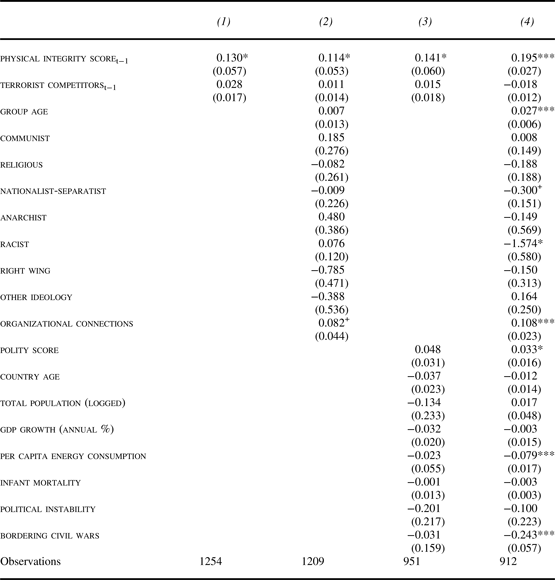
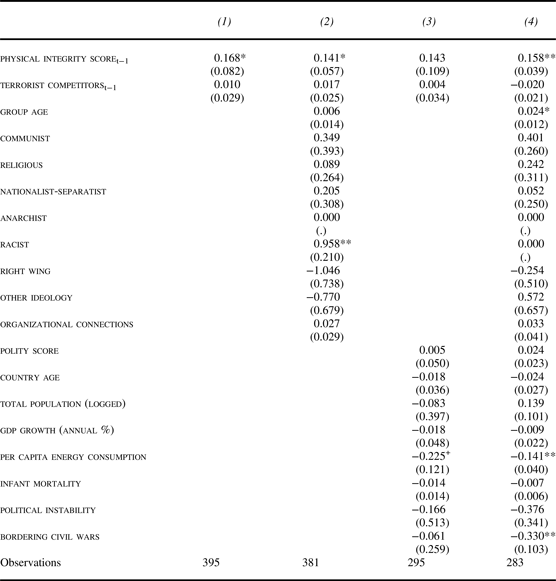
Table 2 presents results from linear regressions (the results are consistent for negative binomial models. See appendix).Footnote 74 Model 1 is the sparse model featuring the key explanatory variables with group and country fixed effects. Model 2 introduces the organization-level controls (instead of group fixed effects), along with country fixed effects. Model 3 includes country controls with organization fixed effects. Model 4 contains both sets of controls with only year fixed effects. Our key explanatory variables, repression and competition, are lagged by one year in all models (models with a lagged moving average and the change in the moving average are in the appendix).
OLS models of tactical diversity by year, GTD data

Notes Clustered standard errors in parentheses. Country and organization fixed effects in Model 1; country fixed effects in Model 2; organization fixed effects in Model 3; year fixed effects in Model 4. + p < .1; *p < .05; **p < .01; ***p < .001.
In line with our first hypothesis, across all of the specifications, organizations operating in repressive environments employ a more diverse tactical portfolio in the following year.
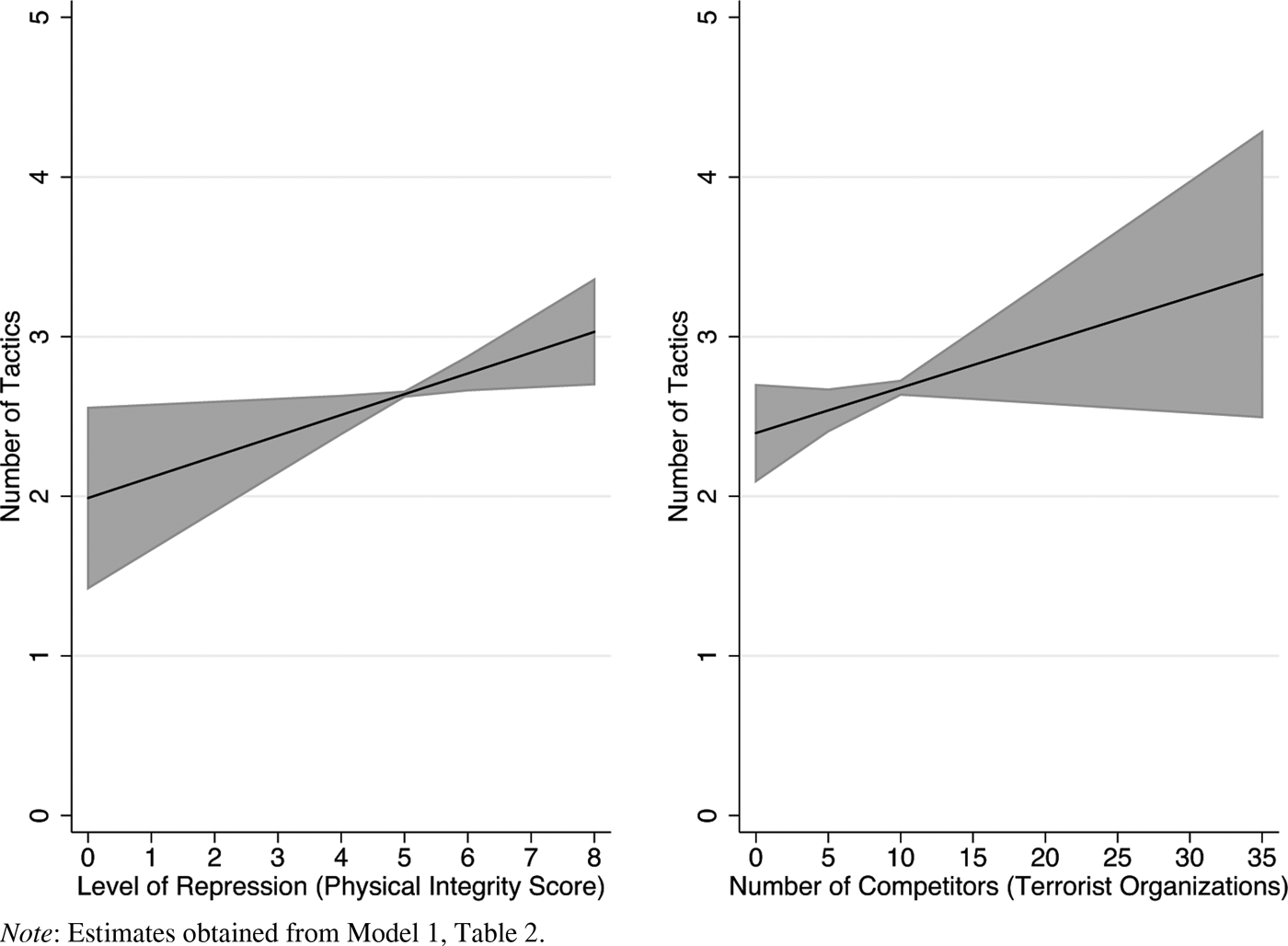
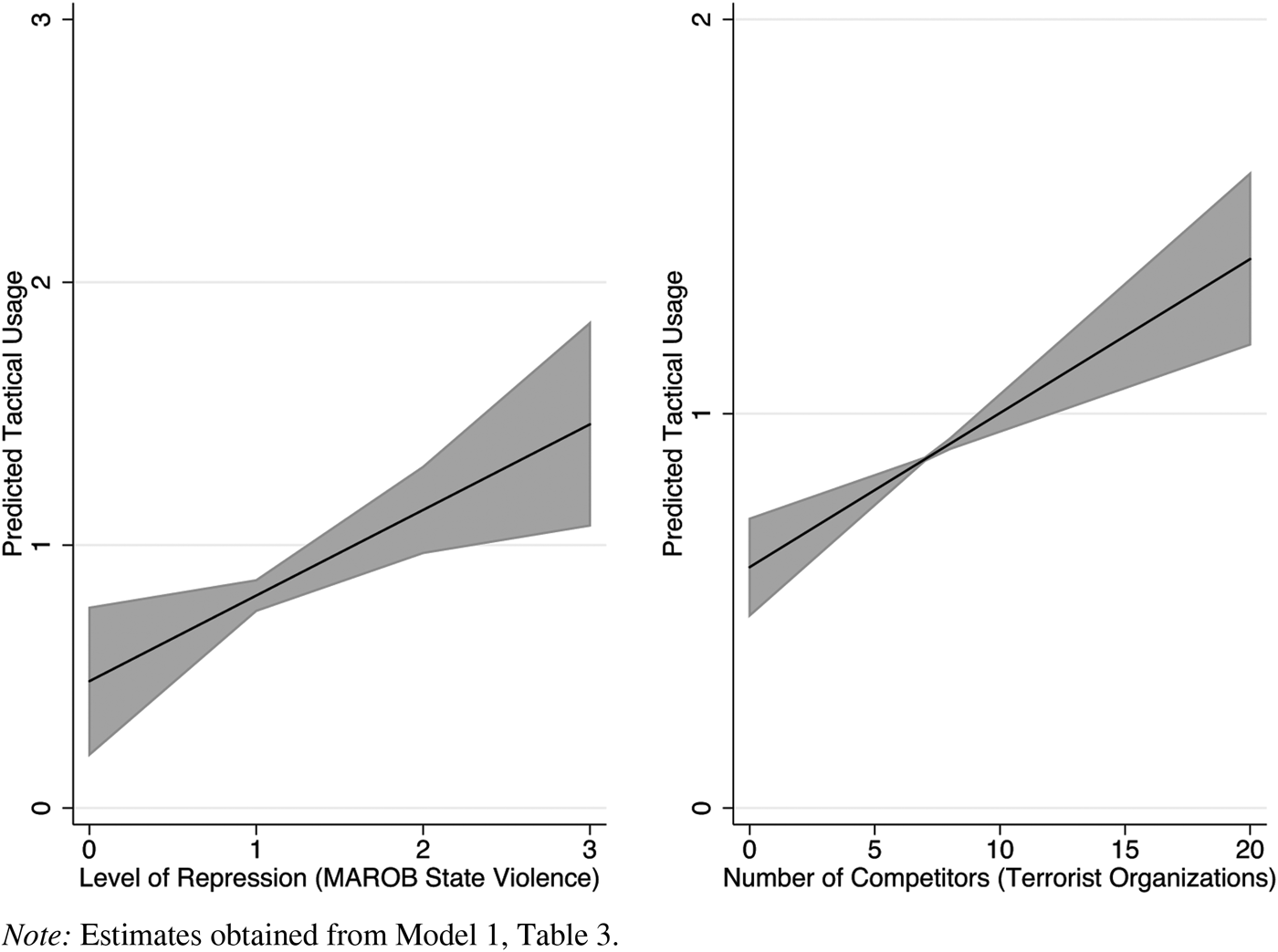
Figure 1, panel 1 plots the substantive effects of repression on tactical diversification—the difference in tactical usage between groups in the least repressive versus the most repressive environment is approximately one tactic per year.
Repression, competition and tactical diversity, GTD data

Table 2 and the second panel of Figure 1 indicate that there is a positive but statistically insignificant relationship (owing to larger confidence intervals at the high end of competition where the data become sparse) between the number of active organizations and tactical expansion. However, this should not lead to an immediate rejection of the second hypothesis. As we have noted, it is likely that not all organizations equally inspire their peers to diversify their tactics. The implication is that the problem may be our initial approach to measurement rather than our theory—mixing groups that represent true competition with those that do not introduces noise, thereby increasing the confidence interval.
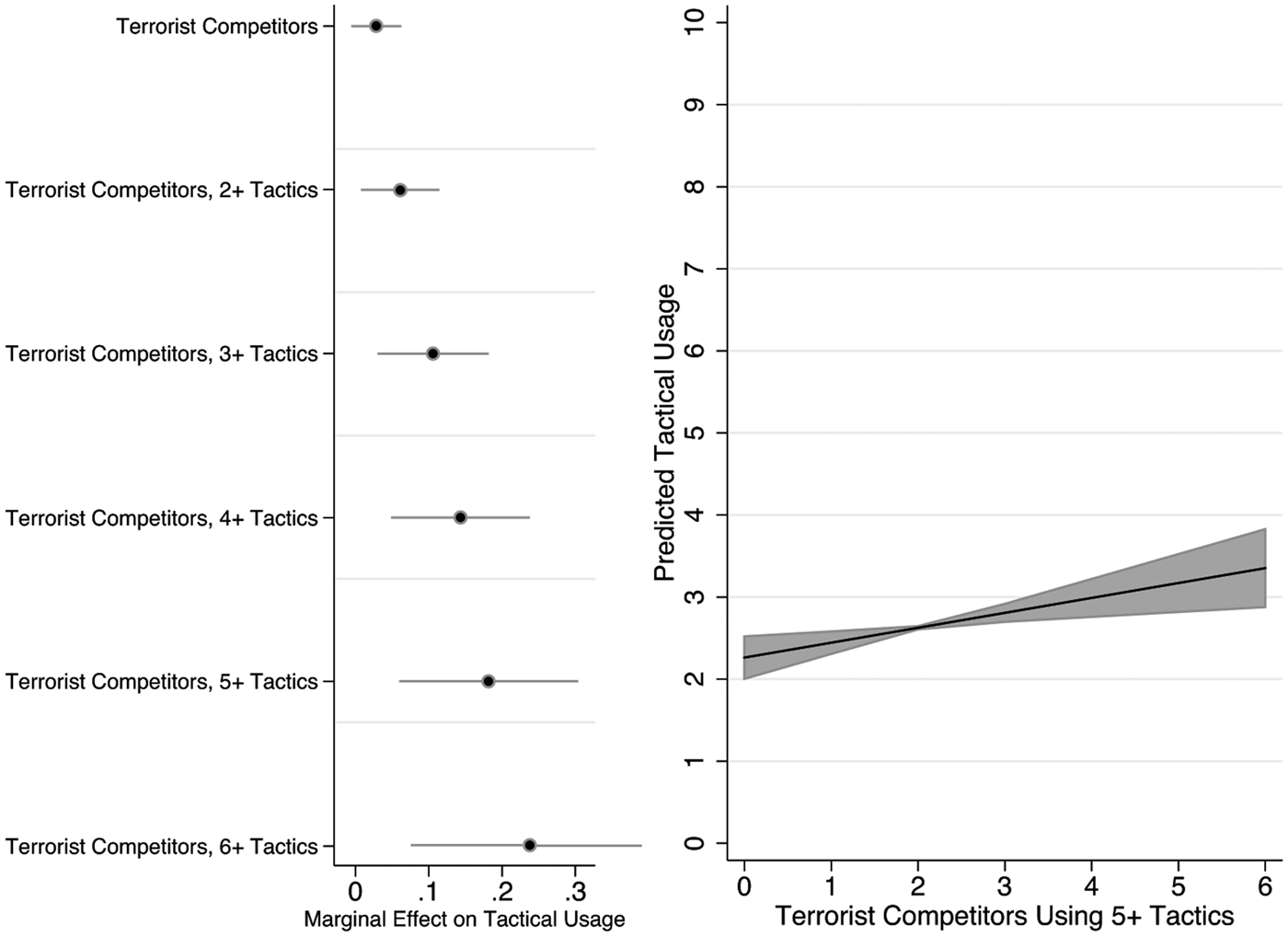
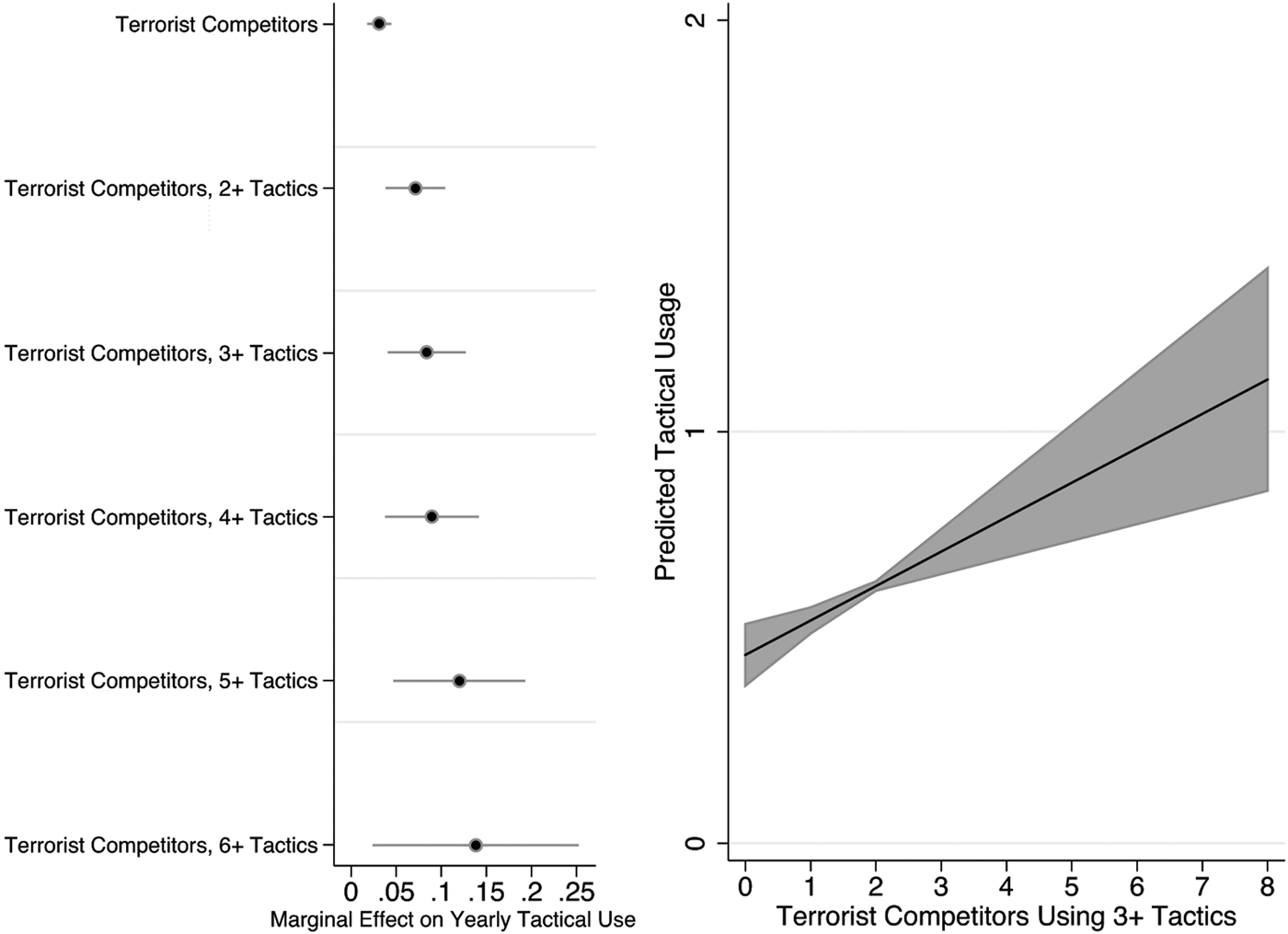
To test the possibility that organizations are primarily driven to diversify by other groups that are themselves diversified, we specify models where we count only competitors that surpass an escalating series of thresholds of tactical diversity: one or more, two or more, three or more, four or more, five or more, and six or more. If our intuition is correct, there should be a stronger relationship with diversification when competitors are themselves more diversified.
Figure 2 presents the predicted marginal effect of tactical usage from six additional replications of Model 1 in which the measure of competition escalates from all groups active in the home country (identical to Table 2, Model 1), to groups active in the country employing two or more tactics, to those employing three or more tactics, and so on through six or more tactics.Footnote 75 As was the case in Figure 1, at the lower end of this escalating range the 95 percent confidence interval for the estimated effect crosses zero, but beginning with the model of competitors employing two or more tactics the relationship becomes significant and increasingly large. The second panel of Figure 2 indicates that as the number of competitors utilizing at least five tactics increases from zero to six (the observed range of the data) the predicted number of tactics employed increases from about 2.5 to about 3.5.
Tactical diversification of competition and predicted tactical usage, GTD

MAROB Tests
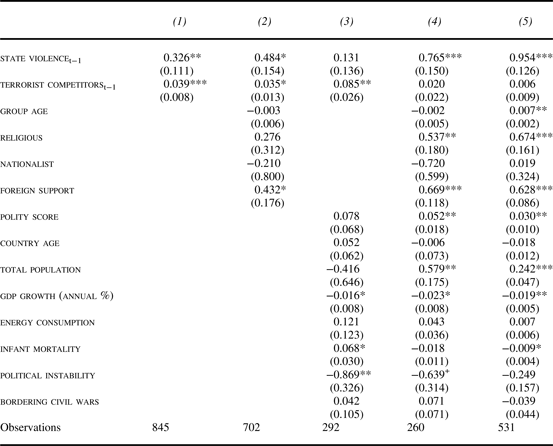
To demonstrate the robustness of these findings and expand the analysis further, we turn to the Minorities at Risk Organizational Behavior (MAROB) data set. Table 3 presents the results, which closely replicate those in Table 2.Footnote 76 Model 1 is the core model with country and organization fixed effects. Model 2 replaces the organization fixed effects with the organization-level covariates. Model 3 replaces the country fixed effects with country-level covariates. Model 4 contains both the country and organization covariates with year fixed effects. Model 5 replicates Model 4 but does so for all MAROB groups rather than just militant organizations.
Tactical diversity by year, MAROB data

Notes: Clustered standard errors in parentheses. Organization and country fixed effects in Model 1; country fixed effects in Model 2; organization fixed effects in Models 3; year fixed effects in Model 4. + p.1; *p < .05; **p < .01; ***p < .001.
These models consistently show a relationship between repression and diversification. As repression moves from zero to the maximum (three), the expected number of tactics increases by nearly 1.3. Groups that increased their tactical variation as repression increased include Fatah, the PLO, Hamas, the Kurdistan Democratic Party, and the Progressive Socialist Party in Lebanon. This is significant since this repression variable captures whether or not the state uses direct violence against the specific organization.
As before, we use the number of active militant organizations in a group's home country to proxy for the level of intergroup competition. In contrast to the analysis that we conducted with the GTD data, the measure is immediately significant in most of the models in Table 2. However, to confirm that competition is primarily inspired by the most capable groups, we vary our measure of competitors in the same manner as before, and plot the substantive effects in Figure 4.Footnote 77 The findings show that competitors that are themselves tactically diverse drive their peers to diversify.
Repression, competition and tactical diversity, MAROB data

Tactical diversification of competition and predicted tactical usage, MAROB

The remaining coefficients in Table 3 largely corroborate the findings from the GTD analysis. Foreign support has a positive, statistically significant relationship with tactical diversity in Models 4 and 5, but not Model 2. It is also of note that organizations in more democratic countries generally employ a greater number of tactics, though this relationship was less clear in the GTD analysis.
Robustness and Alternative Explanations
Our initial results establish a robust correlation between organizational stress (in terms of repression and competition) and tactical diversification. We have also developed a theoretical argument whereby external pressure incentivizes diversification as a means of ensuring continued organization viability and ultimately survival. Critics might raise several questions in response, which we address here. Additional robustness checks can be found in the online appendix.
To begin, one might argue that rather than emerging from our theoretical mechanism, our results could arise instead from an endogenous process in which groups diversify first and then the government represses them in response. Because we must rely on observational data to establish our argument, we cannot refute this possibility with absolute certainty. In our primary models, we lagged repression and competition variables by a year so that our estimates assess how repression the prior year influences the number of tactics. This temporal solution to the problem is not definitive because there could be an element of anticipation among governments that see signs that organizations are in the process of expanding their capabilities. Alternatively, some third factor (such as increasing militant capabilities) might be contributing to both diversification and the repression, but perhaps on different timelines.
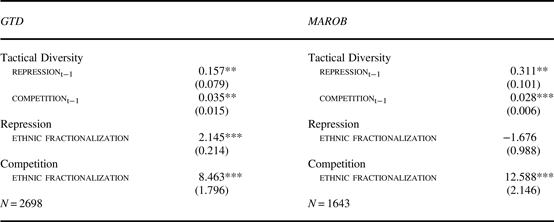
To increase confidence that our empirical findings arise from the processes that we have theorized, we replicate our findings with a two-stage model where ethnic fractionalization within countries serves as a first-stage predictor of repression.Footnote 78 Our goal for these models is modest. We are not asserting that this is a fully identified specification (and posit that this standard is likely impossible for models of tactical diversification), but rather another piece of evidence that strengthens the case that repression has an impact on diversification in a meaningful way—even if the reverse may also be true in some instances.Footnote 79 Introducing this first stage with ethnic fractionalization “soaks up” one of the potential pathways for reverse causation since it is unlikely to have an independent effect on diversification. It is, however, an imperfect solution because ethnic fractionalization could plausibly be related to adoption of tactics that indiscriminately target civilians—something that the literature associates with polarized societies.Footnote 80 That said, ethnic fractionalization is more stable over time when compared with our measures of diversification, so this mechanism is certainly not the full story behind tactical diversification.
A substantial proportion of research on repression explores how ethnic diversity contributes to or is associated with escalating levels of state repression.Footnote 81 Importantly for our purpose, ethnic fractionalization is also not correlated in a meaningful way with our measure of tactical diversity (−0.047). To leverage this, we retest our GTD and MAROB models, but with two first-stage equations in which ethnic fractionalization predicts both the level of repression and the extent of organizational competition. While we are not as concerned about endogeneity with regard to the competition story, there is no clear reason to anticipate that ethnic fractionalization would be associated with the number of organizations operating within a given conflict. Therefore, to fully specify the model, we directly relate ethnic fractionalization to organizational competition as well.
An additional complicating factor is that while our model of diversification is linear, repression is an ordered indicator. To accommodate this, we employ a recursive multi-process model in which the repression equation is ordered probit, the competition equation is linear, and the second-stage diversification equation is also linear.
Table 4 contains the results of these models for both the GTD and MAROB data. These are based on GTD Model 1 in Table 2 and MAROB Model 1 in Table 3, the basic models with country and group fixed effects. The substance of the results is remarkably similar to those in Tables 2 and 3.Footnote 82
Multi-process instrumental variable models, GTD and MAROB

Note: **p < .01; ***p < .001.
The models also support the validity of ethnic fractionalization as an instrument. The instrument passes the best available assessments of strengthFootnote 83 —among other tests, the R 2 is high for both first-stage equations and the F test is well over 10. Moreover, because the repression equation is not a linear model (in which case the regression would be exactly identified), we are also able to conduct a basic test of exogeneity by adding the instrument (ethnic fractionalization) to the second stage.Footnote 84 The resulting coefficient is insignificant, which, though not definitive, is reassuring since its significance would be a strong indication that the variable was not excludable. Given the results in Table 4 and the fact that the instrument passes several tests of instrument strength and validity, these assessments provide additional evidence that the main results reflect the underlying impact of repression and competition on tactical diversity, and not the other way around.
While these instrumental variable models should increase confidence in the direction of the relationship between repression and diversification, two additional points further suggest that our results are not primarily driven by a process in which tactical diversity gives rise to repression. First, even if tactical diversity could encourage crackdowns by the government (perhaps because of its association with success), these crackdowns are likely to further incentivize tactical diversification. Second, and more significantly, government repression occurs for a variety of reasons including ideology, history, domestic institutional arrangements, and other factors. The impact of tactical diversification by militant groups likely plays an extremely small role in the overall calculations of governments to repress. The impact is almost certainly smaller than the impact of government repression on how groups view their relationship to the government and need to engage in new tactics to survive.
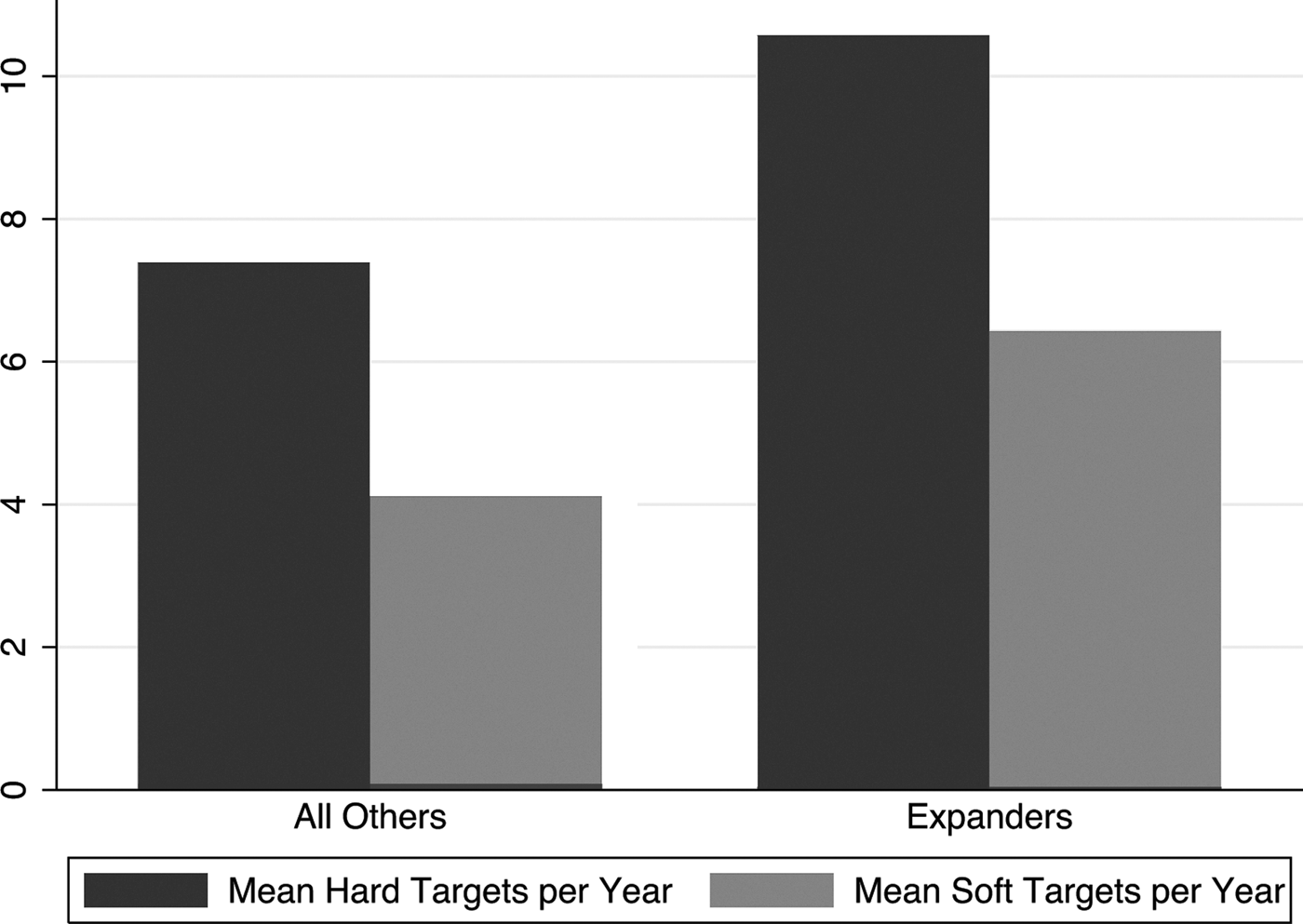
Additional problems for our argument would arise if groups that diversify their arsenal expand only into certain types of targets. It could be, for instance, that groups under pressure simply adopt more indiscriminate tactics, thereby leading to greater repression. To preliminarily address this concern, Figure 5 explores whether diversifying organizations generally attack hard or soft targets, since soft targets such as population centers are often the locale for more indiscriminate attacks. As our theory anticipates, diversifiers increase their proportion of both hard and soft targets in a roughly equivalent way, suggesting that there is no single pattern of tactical expansion in favor of one or the other.
Hard and soft targeting

Related to the question of targeting is the nagging issue of the relationship between the related concepts of tactical diversification and escalation. It is possible, for example, that diversification still remains as a proxy for escalation despite our initial results. While it is well known that militant organizations respond to repression and competition by escalating their levels of violence, we argue that variety—and not just volume or sophistication—is consequential.
The available qualitative evidence certainly indicates that diversification can challenge counterterrorists both when it is escalatory and when it is not. The Northern Ireland case powerfully illustrates the importance of diversification, even when it does not involve escalation into a tactic like suicide bombing. Following Operation Demetrius in 1971, when the British instituted repressive internment, “the defining characteristic of the IRA in the weeks and months following internment was the utter spontaneity and unpredictability of its violence … there was an incredible amount of activity at this time, remembered one activist, ‘We would mount five or six operations in one day—a bank would be robbed, a bomb downtown, a booby trap for the Brits, snipes, a float.’”Footnote 85 “Snipes” refers to targeted sniper activity, and a float was when a group of IRA members would drive the streets and fire on British patrols. Notably, the IRA's response to pressure was to diversify—mixing high and low tech, and discriminate and indiscriminate attacks.Footnote 86
To gain more traction on the relationship between tactical diversification and the related issue of tactical escalation, we conducted interviews with US Army Special Forces officers to gain insight into how tactical diversification itself influences counterterrorist behavior. These interviews suggest that diversification does indeed matter independently of escalation. An excellent example comes from one Army officer who discussed the reaction of his patrols to diversification of ambush tactics in Iraq. To be explicit, these patrols are a concrete manifestation of the sort of repression that we are exploring in our broader empirical analyses. They were directly aimed at disrupting and dismantling militant organizations.
The standard operating procedure at the outset of the conflict was for counterinsurgents to patrol in a wedge formation. However, this was undermined by the placement of improvised explosive devices (IEDs) in the center of roadways. Units then moved to column formations (something that had been used in the past), but this was subsequently undermined by coordinated attacks that took advantage of soldiers “lined up like sitting ducks.” Crucially, the IED placement that obviated the wedge was sometimes, though not always, maintained. As a result, uncertain patrols were forced into loose, flexible formations that reduced their vulnerability to the diversified tactics, but this in turn reduced operational effectiveness and left them more vulnerable than if they maintained the wedge. To reduce vulnerability, soldiers were trained to immediately break to any available cover on the sides of the road when faced with fire. In response, insurgents diversified still further by sometimes preplacing IEDs in the location of that cover. The result was yet another change to standard operating procedure—soldiers were trained to take a knee in place and return fire immediately rather than seek cover.
This evidence shows that tactical diversification by militants forced counterinsurgents from an equilibrium in which they were patrolling in a secure formation with the ability to break to cover to one in which they were returning fire from exposed and disorganized positions. Crucially, that outcome could be achieved only by diversifying, which instilled uncertainty about exactly what tactic would be employed. Simple escalation would have allowed patrols to maintain standard operating procedures that would have been preferable. While this anecdote focuses on more micro-level tactical changes than our cross-national analyses can pick up, it is reassuring that we find evidence of the same mechanism at multiple levels of analysis.
That said, given the space between the aggregate data and the anecdotal evidence, it is useful to further assess the distinction between diversification and escalation empirically, using the same data that we use for our core models. To accomplish this, we distinguish between “pure diversification” (observations where there was an increase in the number of tactics employed but no adoption of suicide bombing or coordinated attacks) and “pure escalation” (observation in which suicide bombing and/or coordinated attacks were adopted, but the overall number of tactics employed stayed the same). The literature holds that suicide bombings and coordinated attacks represent escalation.Footnote 87 As Pape puts it, “over the past twenty years, suicide terrorism has increasingly become the choice for groups that choose to escalate rather than to quit.”Footnote 88
On average, “pure diversifiers” kill forty-five individuals per year while “pure escalators” kill an average of thirty individuals per year. Along similar lines, “pure diversifiers” strike nine hard targets per year compared to five for “pure escalators.” That fatalities in particular decrease when these tactics are used as replacements rather than in addition to an existing repertoire is consistent with our theory. Furthermore, diversifiers conduct an average of twenty attacks per year compared to twelve for escalators. One interpretation of this disparity is that even when organizations adopt tactics that scholars and practitioners consider highly sophisticated and destructive, if they do so in a way that erodes an organization's tactical “base” (i.e., by replacement) it actually sets them back, at least temporarily. Abandoning the tried-and-true results in an organization that is less active, kills fewer people, and strikes fewer hard targets. In contrast, when organizations add variety they grow their capacity for violence. This is true even when that organization does not conduct complex attacks.
The core results we presented in Table 2 for the relationship between organizational pressure (in terms of repression and competition) hold even when the sample is restricted to the much smaller number of cases of “pure diversification”—that is, expansion into tactics other than suicide bombings or coordinated attacks. Table 5 replicates the models in Table 2 with this restriction and the results are substantively equivalent.
OLS regression: Yearly tactical usage by diversifying organizations

Notes: Clustered standard errors in parentheses. Country and organization fixed effects in Model 1; country fixed effects in Model 2; organization fixed effects in Model 3; year fixed effects in Model 4. + p.1; *p < .05; **p < .01.
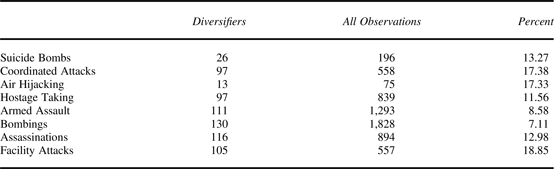
It is also worth exploring the possibility that repression leads only to the adoption of particular tactics rather than general diversification. Our theory suggests that there should not be strong patterning in the tactics that organizations adopt since diversification itself is of strategic value. In other words, it strengthens our argument if all tactics are equally likely to emerge in response to repression. To explore this question we investigate tactical changes in cases where diversity scores increase in response to repression. The results support our theory. The first column of Table 6 provides the number of cases in which organizations responded to increased repression by adopting each tactic (“Diversifiers”). For example, twenty-six organizations adopted suicide bombing in response to an increase in repression from the prior year. “All Observations” is a count of the total number of group-year observations where the tactic was used. We find no clear pattern or tactical proclivity for groups that diversify their arsenal, which provides strong support for the diversification, rather than escalation, mechanism.
Tactics adopted after repression

Overall, these additional findings support the independent effect of diversification. At the same time, they add a wrinkle to the commonly held argument in the literature that violence against civilians and attacks on hard targets are manifestations of opposing strategies—those of discriminate and indiscriminate violence.Footnote 89 Instead, our findings show that when organizations diversify, they add to their tactical repertoire in a way that increases their overall pace of operations—by combining the new with the old they are able to both do more and succeed more often. In contrast, when groups escalate through substitution they typically reduce the number of operations and their lethality declines in turn. This indirectly supports the micro-level discussion on troop formations in Iraq. Diversification, however, means adding to what an organization does in a way that forces opposition forces to consider both new and old types of violence, all the while maintaining those tactics that they have already perfected. Escalation without diversification may be also disruptive, but it allows states to update their defenses without dividing their focus. At the same time, militants are abandoning tactics they have already perfected in favor of new operations that they are less familiar with and less competent at.
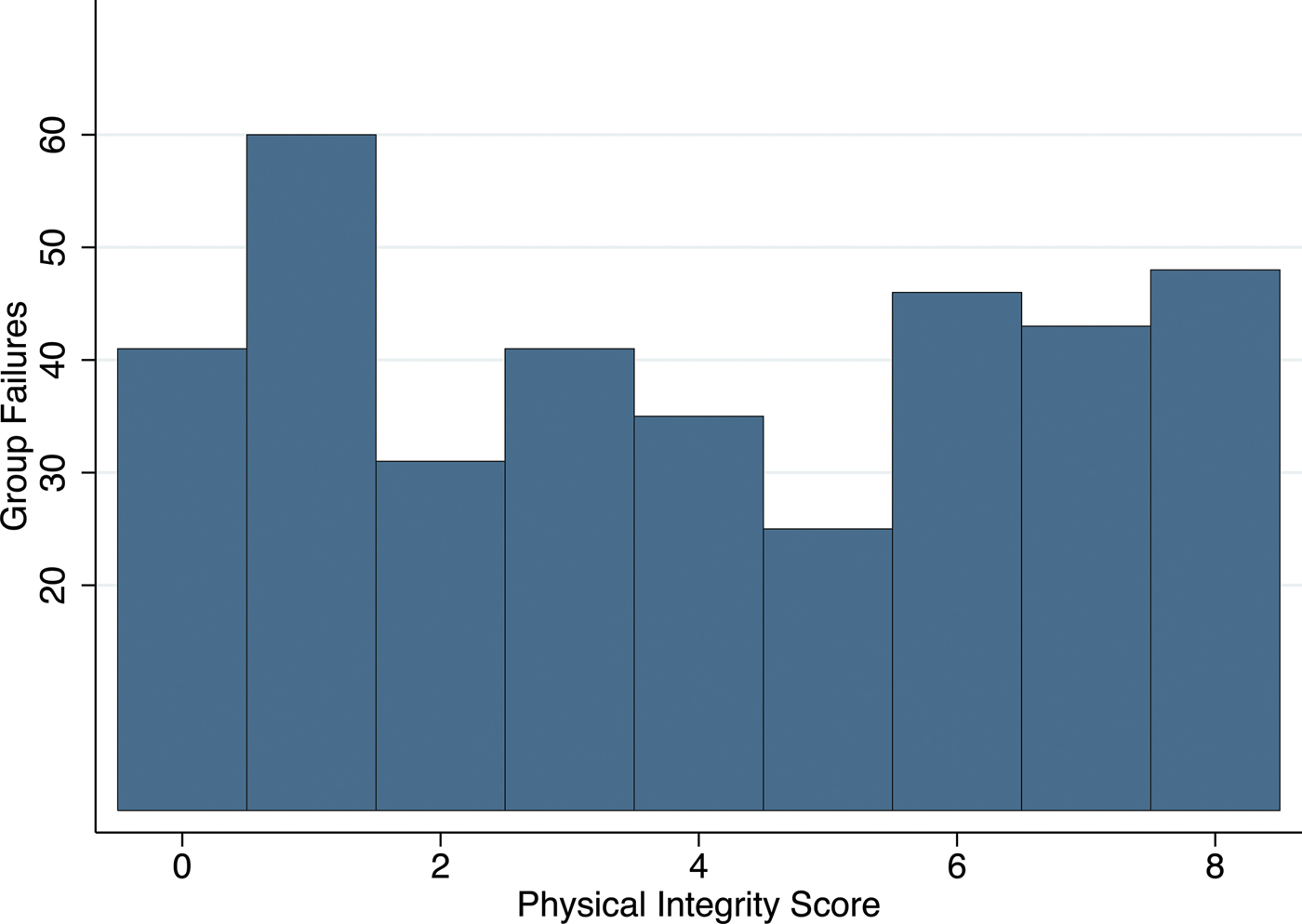
A critic could argue that the mechanism that leads to diversification is one of selection rather than adaptation. In other words, groups that enter a period of repression with few tactics are weeded out, leaving only those who were diverse to begin with. If selection were the primary story, we would observe organizations rapidly failing in the face of repression and competition while a subset that diversify survive. The data do not support this interpretation. Figure 6 graphs the number of group failures by physical integrity scores (our measure of repression) and demonstrates no relationship between the variables.Footnote 90
Group failures by physical integrity score

To further test for a selection mechanism, we replicate our core models with two variations: first, analyzing only the subset of organizations that persist for at least ten years; and second, changing the dependent variable from the number of tactics in a single group-year to the change in yearly tactical diversity. The results hold in both of these formulations.Footnote 91 These robustness tests reinforce that organizations have tools (including diversification) with which to respond to repression, and diversification ultimately stems from adaptation rather than selection.Footnote 92
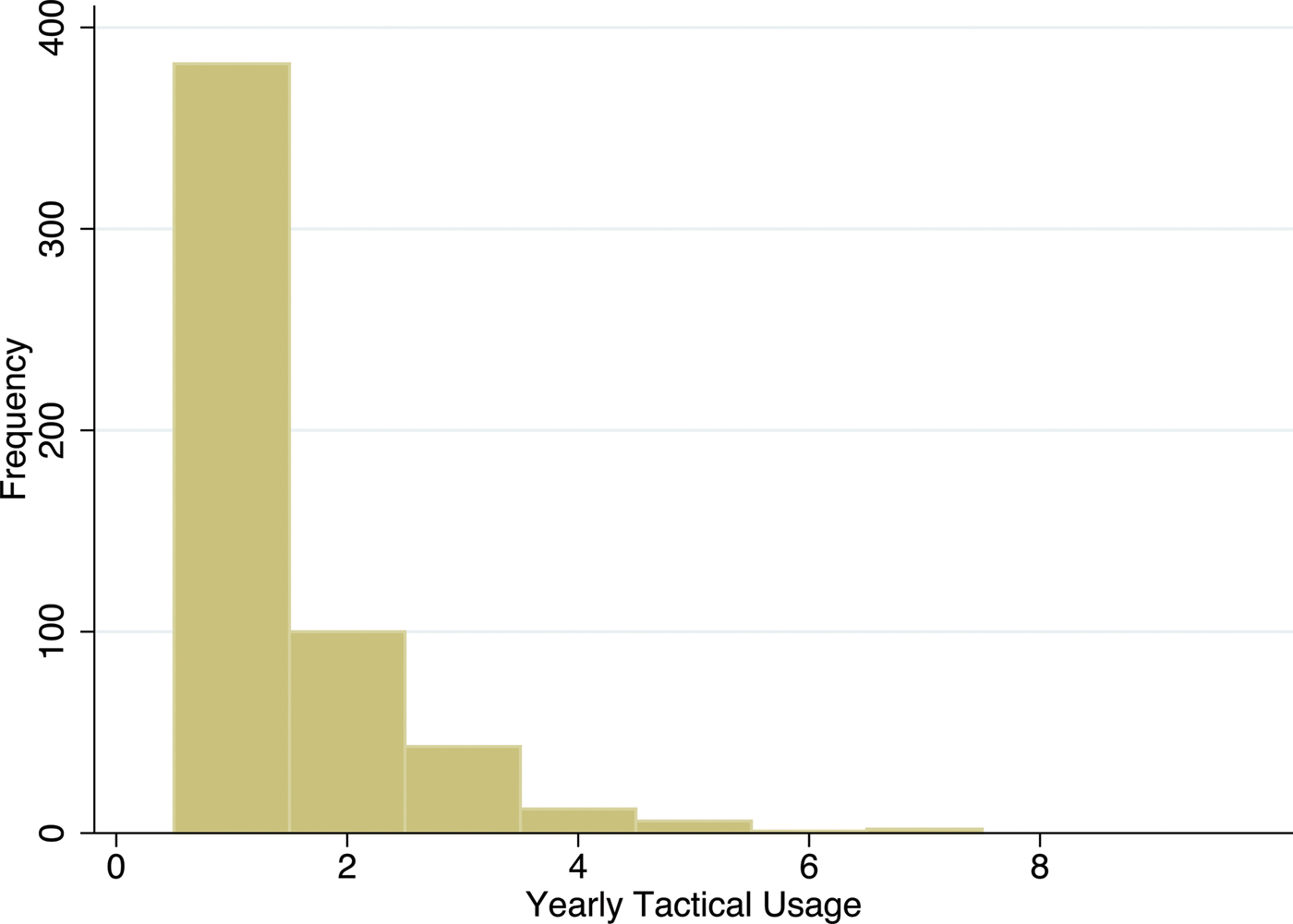
Related to the issue of selection, it is also worth considering how a group's initial tactical diversity might influence its future evolution and a state's decision to engage in repression. Many factors, stemming from both the nature of the conflict and the nature (and origin) of the organization, likely dictate the initial tactical choices of a new organization. This topic warrants a more in-depth investigation in future research, but an initial evaluation of the GTD data shows that most organizations start with relatively modest levels of tactical diversity (Figure 7). As such, we can be confident as a first cut that initial tactical endowments are not significantly driving our findings.
Tactical diversity among organizations in their first year

Finally, one must consider the possibility that the relationship between diversification and repression could be spurious because states might calibrate repression to the level and seriousness of the conflict (the threat it poses to the state). At the same time, diversification might be better achieved by bigger, more capable groups, which are also those likely to be engaged in bigger, more serious conflicts. To better account for this possibility, we re-run our models while controlling for the number of attacks a group conducts, the number of fatalities it inflicts, as well as the cumulative number of attacks and fatalities in the country in which the organization operates. The details of the regressions can be found in the online appendix, but in all cases, the core results hold.
Conclusion
Choices about tactical diversification influence the success or failure of political organizations, national militaries, and firms. Militant groups are no different. We present initial evidence that militant organizations expand their tactical portfolio in response to pressures both from the state and peer competitors. When state repression increases, our results show that militant groups will broaden their tactical capabilities to inflict greater harm and foil state defenses. One implication is that repression of these groups and the broader population can, in some cases, have negative consequences.
Similarly, when groups face meaningful competition from other militant organizations they are also likely to adopt more tactics, using this expanded arsenal to prove their relative strength and capability and shore up local support. In this case we find evidence of a more nuanced relationship than most existing research implies: not all groups are equally likely to inspire outbidding behavior. Instead, the effect increases along with the tactical diversity of one's competitors. This suggests an organizational imperative to compete along the same means, similar to how the adoption of suicide bombing has been linked to other groups mimicking the tactic in turn.
This story about organizational pressure and diversification has additional testable implications that could—and in our view should—be the subject of further research. First, it suggests that when faced with external pressure, failing to diversify should be costly. The outliers to our model that fail to diversify should face consequence in terms of their operational effectiveness and, by extension, organizational strength and prominence. Second, if diversification is risky and happens under pressure (as we posit), then it should sometimes fail. Future research could uncover the conditions under which this does and does not occur.Footnote 93 Third, future research could focus more on the relationship between pressure-based diversification and innovation adoption, connecting this research to the large body of research on adaptation and innovation by military organizations
Overall, these findings fit within a broader research agenda on militant groups that focuses on organizational incentives and processes as a way of ultimately understanding their behavior. One way to advance this research is by continuing to find similarities between militant groups and other types of societal actors about which we know much more. This nexus between seemingly distant literatures opens up an array of new insights, and future research could aim to further develop and expand this line of research.
These findings also have important policy implications. Understanding the internal and external organizational processes that incentivize diversification can improve how governments respond to one of the largest security challenges in the modern environment. Our results provide systematic evidence in favor of the “folk wisdom” that more tactically diverse organizations are harder for governments to keep up with. Moreover, the results also suggest risks for governments that seek to counter the threat of militant groups through broad-based repression. By extension, it also suggests that cutting off avenues for tactical innovation or particular types of attacks represents a potentially fruitful counterterrorism strategy in some cases. By limiting groups to smaller sets of tactics, governments can increase the predictability of militant violence and in turn, potentially increase the odds of successful counterterrorism.
Supplementary Material
Supplementary material for this article is available at <https://doi.org/10.1017/S0020818317000467>.