This article examines judicial entrepreneurship in the enforcement of bankruptcy law in Wenzhou, focusing on how local court leaders promoted and institutionalized this mechanism in the absence of central mandates. Bankruptcy is often regarded as politically sensitive and technically complex in China (Jiang Reference Jiang2014; Z. Wang Reference Wang2015). Yet since 2011, Wenzhou has drawn national attention as its bankruptcy caseload surged, its courts pioneered new practices, and the “Wenzhou model” became widely recognized, with formal endorsement by the Supreme People’s Court (SPC) (Yu and Meng Reference Yu and Meng2013). High court leaders repeatedly praised Wenzhou’s innovation in internal bulletins and submitted related reports to the SPC leadership (Xu, Chen, and Ju Reference Xu, Chen and Ju2015, 364–5). In 2016, the Zhejiang government designated Wenzhou’s bankruptcy adjudication as a “replicable and transferable” model and called for its wider adoption across the province; in 2017, the Zhejiang Province High People’s Court (ZHPC) held a provincial conference in Wenzhou to disseminate its experience (Xu et al. Reference Xu, Ju, Wang and Ren2021, 94).
Existing scholarship on Chinese courts highlights external and institutional determinants, such as economic development (Peerenboom Reference Peerenboom2002; He Reference He2009b; Y. Wang Reference Wang2015), bureaucratic control (Kinkel and Hurst Reference Kinkel and Hurst2015), and Party oversight (He Reference He, Ginsburg and Simpser2013b; Li Reference Li2019; Clarke Reference Clarke2022). Less understood, however, is why specific regions promote certain legal innovations at particular moments, and how the incentives, strategies, and constraints of judicial actors shape that trajectory. This article addresses that gap by foregrounding judicial entrepreneurs—an idea borrowed from “policy entrepreneurship” (Kingdon Reference Kingdon1995; Mintrom and Norman Reference Mintrom and Norman2009)—who mobilize judicial resources, political authority, and social networks to initiate and sustain legal innovations.
Drawing on fieldwork in Wenzhou in 2019 and 2023, this article shows that judicial entrepreneurs were pivotal in making bankruptcy a viable tool. Confronted with widespread defaults of private lending in 2011, some court leaders embraced bankruptcy as a solution, experimented with sensitive cases, and adapted national rules to local conditions. Following initial successes, they implemented comprehensive measures to institutionalize bankruptcy practice. Yet entrepreneurship remained bounded, as judicial innovation was constrained by formal legal frameworks and legal cultures, vulnerable to inconsistent enforcement, and circumscribed from encroaching upon the state’s core interests.
Judicial entrepreneurs were driven by a combination of personal attributes and self-serving interests. Personal attributes often catalyze early experimentation, while self-serving interests may sustain long-term commitment. As noted below, this dual feature helps explain why, despite similar debt crises elsewhere since the 1980s, only Wenzhou turned decisively to bankruptcy in 2011, while other localities relied on traditional strategies and still received rewards for favorable outcomes.
This article contributes in three ways. First, it enriches the understanding of China’s Enterprise Bankruptcy Law (EBL). Enacted in 2006, the EBL marked a significant advance over its 1986 predecessor by extending the application to private enterprises and introducing market-oriented mechanisms for insolvency and restructuring. However, the number of bankruptcy filings declined by more than half between 2006 and 2014, and started to recover since 2015, when Beijing moved to eliminate zombie firms and addressed the difficulty in the execution of judicial decisions (Zhang Reference Zhang2022). Scholars identified various barriers to bankruptcy enforcement: cultural resistance; government intervention to avoid losing face, employment, and tax income; and courts’ reluctance to handle bankruptcy cases that encumber judicial performance and implicate social instability (Li and Wang Reference Li and Wang2011; Z. Wang Reference Wang2015; Zhang and Tomasic Reference Zhang and Tomasic2016). This study examines how and why Wenzhou managed to overcome these constraints.
Second, this study contributes to the debates on courts and social change (Rosenberg Reference Rosenberg1991; McCann Reference McCann1994), which often overlooks the role of judicial leaders. Judicial entrepreneurs can be decisive agents of change, who forge political alliances and craft jurisprudence that mobilizes key audiences. Third, the findings challenge the conventional zero-sum view of courts in authoritarian contexts, which assumes that judicial empowerment occurs only when regime leaders willingly delegate authority (Moustafa and Ginsburg Reference Moustafa, Ginsburg, Moustafa and Ginsburg2008). Judicial entrepreneurs need not wait for such delegation. They can initiate reforms that expand judicial authority while simultaneously strengthening the regime’s capacity to govern.
This article proceeds as follows. Part one outlines the theory and methodology of this study, along with background information on bankruptcy enforcement in Wenzhou. Part two examines the 2011 private lending crisis and the initial experimentation with bankruptcy. Part three analyzes the institutionalization of bankruptcy procedures through various strategies. Part four explores personal attributes and self-serving interests that motivated judicial entrepreneurs. Part five illustrates constraints faced by judicial entrepreneurs. Part six discusses theoretical implications. Part seven concludes.
Theoretical and Methodological Backgrounds
Prior research on Chinese courts
Scholars remain divided on the scope of judicial power in China. Some observe that courts have become increasingly important since 1978. One theory emphasizes China’s commitment to judicial reforms to attract foreign investment and promote economic development (Lubman Reference Lubman1999; Peerenboom 2002; Reference Peerenboom, Ginsburg and Albert2009; Clarke, Murrell, and Whiting Reference Clarke, Murrell, Whiting, Brandt and Thomas2008; Y. Wang Reference Wang2015). Another theory emphasizes the state’s turn toward legality. Courts have been empowered to control local governments (Liebman Reference Liebman2007; Reference Liebman2014; deLisle Reference deLisle2017). Administrative litigation, for example, was introduced to supervise local affairs (Peerenboom Reference Peerenboom2002; He Reference He, Balme and Michael2009a; Yu Reference Yu and Ahl2021). More recently, Beijing promoted centralization reforms that transfer authority over local court personnel and finances from local to provincial levels, raise judicial salaries, establish circuit courts, and promote transparency of court decisions (Yu Reference Yu2017; Zhang and Ginsburg Reference Zhang and Ginsburg2019; Wang Reference Wang2021; Chen, Liu, and Tang Reference Chen, Liu and Tang2022; Sun and Fu Reference Sun and Fu2022). The Party has also strengthened judicial expertise and autonomy, recognizing that citizens increasingly link legality to political legitimacy (Gallagher Reference Gallagher2006; Whiting Reference Whiting2017; Zhang and Ginsburg Reference Zhang and Ginsburg2019; Lu et al. Reference Lu, Zhou, Yao and Wang2022).
By contrast, other scholars stress the persistent constraints on judicial power. Judges are subject to informal pressure, such as corruption and social networks (Li Reference Li2012; He and Ng Reference He and Hang Ng2017; He Reference He2021b). The performance evaluation system, which emphasizes efficiency and stability, has been established to control judges bureaucratically (Ai Reference Ai2008; Minzner Reference Minzner2009; Reference Minzner2011; Kinkel and Hurst Reference Kinkel and Hurst2015; Li, Kocken and van Rooij Reference Li, Kocken and van Rooij2018; He Reference He2021a, 62–67). Decision making is further influenced by adjudication committees and professional judges’ meetings (Liu Reference Liu2006; He Reference He2012; Sun and Fu Reference Sun and Fu2022). Externally, courts depend on local governments for funding and coordination (He Reference He2009b; Y. Wang Reference Wang2013; Wang Reference Wang2021), and local officials exercise significant influence over the appointment of court leaders (Zuo Reference Zuo2014), both of which may create bias in favor of local elites (He and Su Reference He and Su2013; Lu, Pan and Zhang Reference Lu, Pan and Zhang2015; Wang Reference Wang2018; Zhou et al. Reference Zhou, Liu, He and Chen2021). Ultimately, courts remain under Party leadership that guides judicial principles and coordinates outcomes to ensure stability (Su and He Reference Su and He2010; He Reference He, Ginsburg and Simpser2013b; Li Reference Li2016; Reference Li2019; Clarke Reference Clarke2022).
Despite these divergent views, most scholars portray Chinese courts as passive institutions whose authority is shaped by external and structural factors. Fewer studies examine how courts actively shape law enforcement. In administrative litigation, scholars highlight innovative judicial practices, such as interpretive avoidance of sensitive claims, interpretive expansion of legal rules, use of judicial suggestions, or requiring officials’ presence at trials (Kellogg Reference Kellogg2007; He Reference He2013a; Yu Reference Yu2014; Chen, Xu, and Yu Reference Chen, Xu and Yu2024). Constitutional scholars also note that the SPC functions as a policy-making body that reflects its leadership’s sociopolitical preferences (Ip Reference Ip2010; Zhang Reference Zhang2012; Ahl Reference Ahl2019). Yet much of this literature focuses on courts’ interpretive authority. Less is known about whether courts can actively implement judicial policies and how they mobilize resources to do so. This article addresses this gap by foregrounding the role of judicial entrepreneurs.
A Theory of Judicial Entrepreneurship
Definition
The concept of policy entrepreneurs, first articulated by John Kingdon (Kingdon Reference Kingdon1995), has been widely embraced by scholars across different contexts (Mintrom and Norman Reference Mintrom and Norman2009; Frisch-Aviram, Beeri and Cohen Reference Frisch-Aviram, Beeri and Cohen2020). Scholars of Chinese politics also rely on it to understand the entrepreneurial activities of local officials (Zhu Reference Zhu2012; Zhu and Xiao Reference Zhu and Xiao2015; Teets Reference Teets2015; Gong Reference Gong2022). Yet, the role of courts in policy reforms remains understudied.
This paper introduces the term “judicial entrepreneurs” to understand the pivotal role played by judicial leaders in promoting innovative proposals. In the USA, prior research highlights justices’ entrepreneurial role in shaping law and strengthening judicial autonomy (McIntosh and Cates Reference McIntosh and Cates1997; Crowe Reference Crowe2007). Comparative studies also stress judicial leaders’ contributions to institutional autonomy, socioeconomic rights, and democratic consolidation (Ip Reference Ip2010; Reichman Reference Reichman, Kapiszewski, Silverstein and Robert2013; Castillejos-Aragón Reference Castillejos-Aragón, Kapiszewski, Silverstein and Robert2013). Yet a comprehensive account of judicial entrepreneurship remains underdeveloped.
This paper defines judicial entrepreneurship as the capacity of judicial leaders—whether in apex courts, lower courts, or even international tribunals—to mobilize judicial, social, and political resources to implement policies. In this study, judicial entrepreneurs are typically (vice-)presidents of basic and intermediate courts, who oversee judicial decision making and administration, enforce directives from higher authorities, and coordinate with the government. The concept is analyzed along three dimensions: incentives, strategies, and constraints.
Incentives
Prior studies on policy entrepreneurship in China link innovation either to career advancement (Heberer and Trappel Reference Heberer and Trappel2013; Kennedy and Chen Reference Kennedy, Chen, Teets and Hurst2014; Ahlers and Schubert Reference Ahlers and Schubert2015) or to individual initiative (Teets, Hasmath, and Lewis Reference Teets, Hasmath and Lewis2017; He Reference He, Bakir and Jarvis2018). However, both perspectives are inadequate for explaining policy innovation: the careerist view assumes uniform preferences and behaviors among officials, while the individualist view overlooks the political embeddedness of elites. This article argues that judicial entrepreneurs are driven by a combination of personal attributes and self-serving interests, with the relative weight of each shifting across stages of policy innovation.
Personal attributes encompass ideas, biographies, and identities. Judicial ideas—ranging from policy positions to ideologies and beliefs (Ingram Reference Ingram2015)—shape judicial outputs across jurisdictions (Solberg and Waltenburg Reference Solberg, Waltenburg, Epstein, Grendstad, Šadl and Weinshall2024). Biographies and identities also inform these ideas and influence in-group decision making (Basabe-Serrano, Epstein, and Weinshall Reference Basabe-Serrano, Epstein, Weinshall and Epstein2024). Political actors likewise differ in their preferences for innovation: while many are risk-averse and favor conventional measures, entrepreneurs act on deeply held commitments even in the face of uncertainty or public skepticism (Ingram Reference Ingram2015; Teets Reference Teets2015; Hasmath, Teets, and Lewis Reference Hasmath, Teets and Lewis2019). Such personal traits are particularly crucial during the early stages of reform (Mintrom and Norman Reference Mintrom and Norman2009; Zhu and Xiao Reference Zhu and Xiao2015).
Beyond personal attributes, self-serving interests are a crucial force, particularly in sustaining long-term commitments to innovation. Judicial leaders may issue path-breaking opinions to gain recognition from their sociopolitical audiences (Baum Reference Baum2009). In elected judiciaries, judges often behave strategically for an upcoming election (Carroll and Tiede Reference Carroll and Tiede2011). In civil law systems such as China, where performance evaluation strongly shapes career prospects (Kinkel and Hurst Reference Kinkel and Hurst2015), leaders may advocate reforms to demonstrate competence to higher authorities. Once reforms are launched, successors may also uphold them as a “golden-lettered signboard” to preserve institutional reputation and avoid losing face.Footnote 1
Decisions to pursue reform are inherently contextual (Teets, Hasmath, and Lewis Reference Teets, Hasmath and Lewis2017). They depend on both intrinsic and extrinsic factors, including the perceived feasibility and effectiveness of proposals, anticipated resistance or support from stakeholders, the relative merits of alternatives, and the potential for recognition from superiors. For example, in the USA, elected state judges are less likely than appointed judges to advance school finance reforms when confronted with growing inequalities in funding (Howard et al. Reference Howard, Roch, Schorpp and Gleason2021). In China, local cadres in poorer regions often prioritize reforms that preserve stability over those that promote economic growth, reflecting provincial leaders’ shifting preferences (Tsai and Dean Reference Tsai and Dean2014). Similarly, in Wenzhou, where small businesses dominate the economy, local judges had limited opportunities to handle high-profile cases that could distinguish their careers, except for bankruptcy.Footnote 2
Strategies
Since courts generally lack enforcement powers of either the purse or the sword, and risk reversal or retaliation from other branches (Rosenberg Reference Rosenberg1991; Kapiszewski and Taylor Reference Kapiszewski and Taylor2013), they must secure support from external stakeholders to ensure compliance with court orders. Aware of these constraints, judicial entrepreneurs act strategically to promote their proposals. Their strategies operate along two dimensions: phases of policy innovation (experimentation and routinization) and types of resources mobilized (judicial, social, and political).
Scholars often posit that entrepreneurship is most critical before a policy is formally enshrined (Kingdon Reference Kingdon1995; Mintrom and Norman Reference Mintrom and Norman2009). Yet policy implementation is a lengthy process with distinct challenges at different stages. In the early phases, judicial entrepreneurs exploit policy windows created by political shifts, crises, or disasters (Kingdon Reference Kingdon1995). They highlight the failures of existing policies, introduce alternative ideas, and reframe public debates (Mintrom and Norman Reference Mintrom and Norman2009). By leading with exemplar cases or innovative rulings, they mitigate skepticism, rally support, and demonstrate the feasibility of reform (Mintrom and Norman Reference Mintrom and Norman2009; Zhu Reference Zhu2012; Zhu and Xiao Reference Zhu and Xiao2015).
Over time, entrepreneurs shift toward ensuring sustainable enforcement of their policy. Initially, the spotlight is on introducing new proposals through high-profile projects or cases. As reforms gain traction, entrepreneurs must ensure that their proposals are not one-off successes but can be sustained and replicated on a broader scale. A central challenge is expanding caseloads to amplify impact. Judicial entrepreneurs thus work to broaden access by loosening restrictive procedures, lowering litigation costs, improving case management, and helping build supportive structures (Cappelleti and Garth Reference Cappelleti and Garth1978; Landau Reference Landau2018). Perhaps most importantly, they must secure the backing of government actors, given that courts lack coercive powers and technical expertise in enforcement (Farhang Reference Farhang2018; Chilton and Versteeg Reference Chilton and Versteeg2018). Without such collaboration, reforms face neglect, resistance, or reversal (Kapiszewski and Taylor Reference Kapiszewski and Taylor2013).
The second dimension of entrepreneurial strategies concerns mobilizing resources both inside and outside the judiciary. Social resources include potential litigants, interest groups, civil society, and public opinion. By publishing commentaries, giving interviews, launching campaigns, or even soliciting litigation, judicial leaders can generate public support that ensures compliance with court decisions and encourages more lawsuits (He Reference He2009b; Baum Reference Baum2009; Trochev and Ellett Reference Trochev and Ellett2014).
Political alliances are equally crucial. Entrepreneurs must cultivate relationships with legislators and officials to mitigate resistance and secure support (Mintrom and Norman Reference Mintrom and Norman2009). They lobby for funding, regulations, or judicial institutions (Crowe Reference Crowe2007). They also collaborate with agencies—through ad hoc coordination, joint memorandum, or work groups—to develop practical solutions to interdepartmental issues. As noted below, since bankruptcy enforcement requires coordination with multiple agencies, building alliances is indispensable.
Judicial leaders also deploy resources inside their courts strategically. Entrepreneurs may craft decisions with careful attention to timing, tone, and audience (Dixon Reference Dixon2021). They may use “dialogic activism” by issuing rulings that invite government participation or establish consultative mechanisms (Rodríguez-Garavito Reference Rodríguez-Garavito2011). They may adapt national laws to local conditions, as Wenzhou judges did when tackling private enterprises with management irregularities, a scenario not envisaged under the EBL 2006.
Beyond jurisprudence, entrepreneurs engage in “judicial institution building”—defined as efforts to strengthen the judiciary’s structural and organizational capacity to intervene in politics—primarily through three dimensions: functions, individuals, and resources (Crowe Reference Crowe2012). Functions involve expanding jurisdiction, reforming procedures, and adjusting remedial structures to make litigation more accessible (Landau Reference Landau2018). Individuals concern courts’ organizational changes, such as creating new chambers or tribunals, restructuring divisions, or revising evaluation and promotion mechanisms. For instance, establishing a specialized tribunal helps improve expertise and prioritize policy enforcement (Baum Reference Baum2011). Resources include budgets, personnel, and legal infrastructures, which entrepreneurs may reallocate internally or seek from external actors to sustain reform priorities.
Constraints
Some factors constrain the effectiveness of judicial entrepreneurship. First, judicial innovation faces limits when reforms lack grounding in the legal framework or conflict with prevailing legal cultures. Rosenberg observes that judges are aware of the need for predictability and political accountability when interpreting the Constitution expansively to establish new rights; they risk reversal or criticism if deviating too far from the established legal culture (Rosenberg Reference Rosenberg1991). Hilbink also argues that a prevailing legal culture of apoliticism in Chile discouraged assertive defense of rights (Hilbink Reference Hilbink2007). The fact that many constitutions have recently incorporated socioeconomic rights (Law and Versteeg Reference Law and Versteeg2012) simultaneously narrows judicial capacity to advance interests excluded from those texts (Rosenberg Reference Rosenberg2024). In China, when national regulations omit relevant provisions or administrative rules dictate otherwise, judicial entrepreneurs struggle to extend protection beyond established boundaries—as illustrated below by Wenzhou’s limited experiments with individual insolvency.
Second, judicial entrepreneurship is hindered by inconsistent enforcement across groups and over time. It sometimes takes the form of campaign-style enforcement, which mobilizes extraordinary resources over a short period (Liu et al. Reference Liu, Lo, Zhan and Wang2015). While such approaches can capitalize on fleeting policy windows, they also produce side effects. Authorities may emphasize visible outcomes—such as rising caseloads or intensified enforcement—to signal responsiveness, at the cost of fairness (van Rooij Reference van Rooij, Bignami and Zaring2016). In China, early environmental litigation disproportionately targeted weaker polluters (van Rooij and Lo Reference van Rooij and Wing-Hung Lo2010), whereas in Brazil, health rights litigation disproportionately benefited wealthier litigants (Ferraz Reference Ferraz2011; Biehl, Socal, and Amon Reference Biehl, Socal and Amon2016). Sustainability—inconsistency over time—is another challenge, as shifts in political attention, leadership turnover, or the loss of key experts can erode reforms (Manion Reference Manion2004; van Rooij Reference van Rooij2006). Entrepreneurial efforts also face a “low-hanging fruit” problem. In the early stages, judicial entrepreneurs often achieve visible progress by focusing on high-profile cases or intensifying enforcement. As easier opportunities are exhausted, further innovation requires engagement with more complex and politically sensitive issues, where progress is harder to achieve. This declining return can weaken the incentives for innovation. Local courts also reveal increasing concerns about meeting performance targets such as caseloads, which may overshadow entrepreneurial efforts.Footnote 3 Limited specialization further compounds the situation. When only a small number of judges handle bankruptcy, their departure can derail local initiatives, as noted below.
Third, judicial entrepreneurship remains constrained by courts’ relative weakness in the political system. Across regime types, elites tolerate judicial power only insofar as it avoids encroaching on their core interests. In the US federal system, for instance, courts are largely deferential to the Executive in matters of national security and foreign affairs, and to Congress in matters of business regulation. They practice self-restraint in these areas, as they rely on other branches for enforcement, budgets, and jurisdictions (Ferejohn and Kramer Reference Ferejohn and Kramer2002). In Egypt, the Supreme Constitutional Court, empowered to attract foreign investment, avoided challenging military courts and state security courts, both of which were used to control opponents (Moustafa Reference Moustafa2003). In Russia, President Yeltsin suspended the first Constitutional Court after Justice Zorkin’s active involvement in executive-legislative conflicts, which generated political unpredictability (Trochev Reference Trochev2008). In China, courts must align with state priorities such as growth and stability, and their reliance on government support encourages self-censorship in politically sensitive cases (Stern Reference Stern2014a; Ng and He Reference Ng and He2017).
Methodology
The findings presented here draw on fieldwork conducted during two periods in Wenzhou: August–October 2019 and September–October 2023. During these intervals, I collected local documentation and interviewed twenty-eight practitioners and officials, including fourteen bankruptcy lawyers, fourteen local judges, and three government officials. For each interview, I sent a request and questions in advance; upon receiving a response, I arranged meetings that lasted between thirty and 120 minutes. I used a semi-structured approach, which allowed researchers to design open-ended questions to elicit contextual details and concrete examples, thereby shedding light on how respondents interpret and navigate their sociopolitical environment (Kapiszewski, Maclean, and Read Reference Kapiszewski, Maclean and Read2015).
Semi-structured interviews, however, risk response bias, as respondents may conceal information that conflicts with their interests or images. I took two steps to mitigate this problem. First, drawing on prior research on bankruptcy enforcement (Wang Reference Wang2011; Zhang and Tomasic Reference Zhang and Tomasic2016), I incorporated targeted questions about enforcement challenges, such as case rejection, government intervention, and failed coordination. Interviewees were generally candid in response. Second, I triangulated data across respondents and against local documentation. Lawyers, less invested in preserving the judiciary’s image and more sensitive to barriers affecting their practice and income, more often provided candid insights into enforcement obstacles. Documents and literature also offered useful references to recurring challenges (Xu, Pan, and Xu Reference Xu, Pan and Xu2018).
Additionally, between 2017 and 2019, I examined bankruptcy enforcement in other Chinese cities, conducting thirty-eight interviews with practitioners. While not directly part of the Wenzhou study, this broader fieldwork offered comparative contexts and highlighted local variations. Together, these data provide a rich foundation for analyzing Wenzhou’s experience and its broader theoretical implications.
Economic context and bankruptcy enforcement in Wenzhou
Wenzhou is a prefectural-level city in southeastern Zhejiang Province. In 2023, its GDP reached 873 billion yuan, ranking thirtieth among Chinese cities. The city is famous for its private economy. Since 1978, private enterprises have expanded rapidly and become the backbone of local development (Tsai Reference Tsai2007). By the 2020s, domestic private enterprises accounted for more than 90 percent of industrial enterprises above designated size and produced roughly 70 percent of their gross output. However, Wenzhou has lagged behind other coastal cities in foreign investment. Foreign firms contributed only 5 percent of gross output among industrial enterprises above a designated size, which makes the commitment theory less applicable here (Peerenboom Reference Peerenboom2002; Y. Wang Reference Wang2015).
Wenzhou has a two-tiered judiciary, comprising numerous basic people’s courts (BPCs) and the Wenzhou Municipal Intermediate People’s Court (WIPC). Traditionally, BPCs and the WIPC handled bankruptcies for enterprises registered at the district/county or municipal level, respectively. In 2019, the city established the Wenzhou Bankruptcy Court (WBC)—the first specialized bankruptcy tribunal at the prefecture level in China—that centralized jurisdiction from three districts and two counties.
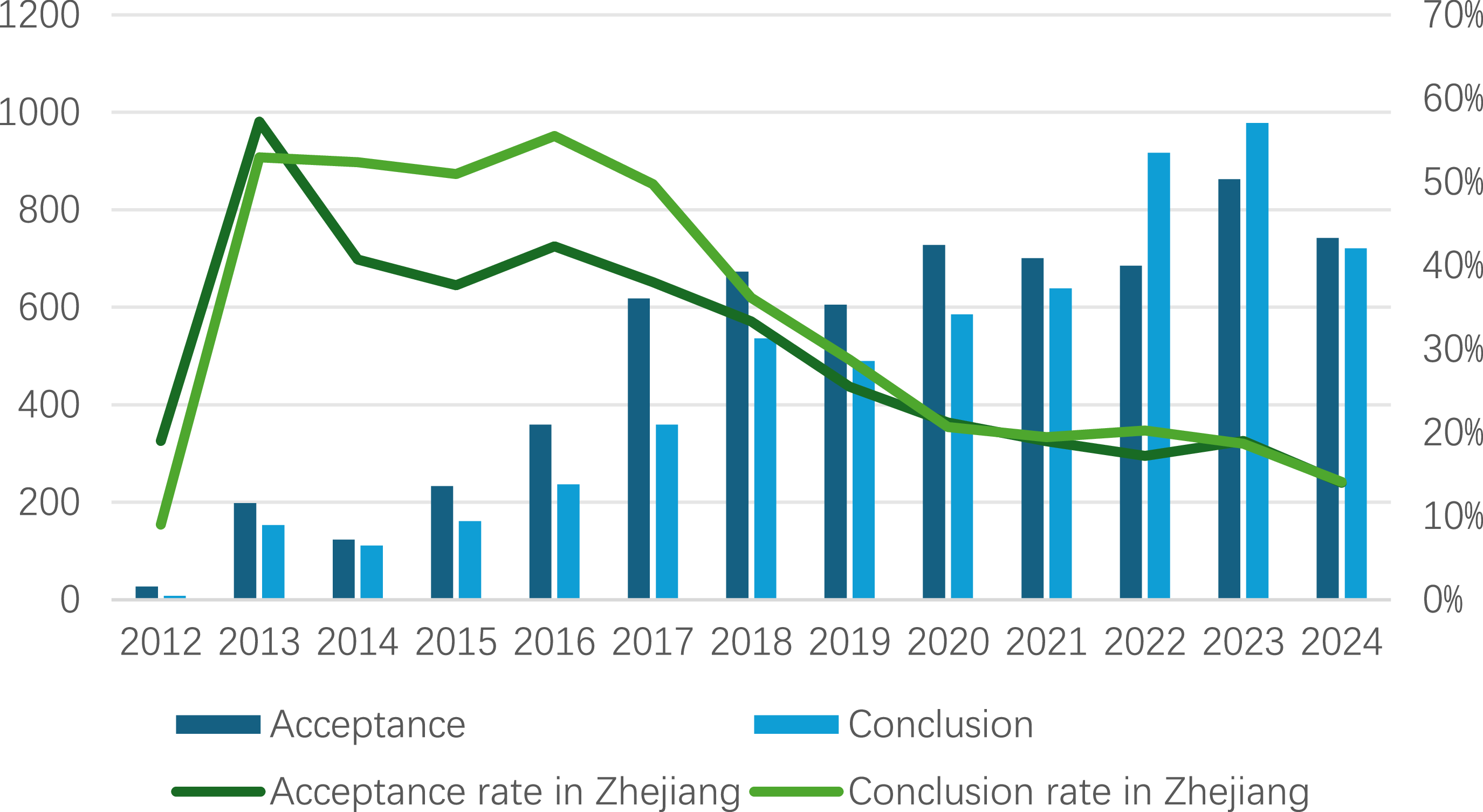
As elsewhere in China, bankruptcy had long been underenforced in Wenzhou. From 1982 to 2011, the Ouhai district of Wenzhou saw only four cases (Xu, Pan, and Xu 2018, 54). Between 2007 and 2011, local courts accepted just twenty-four bankruptcies, while about 8,000 companies exited the market each year (Xu, Ju, and Wang Reference Xu, Ju and Wang2014). Demand for relevant legal services was minimal, as both consultations and applications were rare.Footnote 4 A turning point came in 2012, when courts accepted twenty-seven cases, including eleven restructurings. Caseloads then grew rapidly, rising twenty-fourfold in six years (Figure 1). Between 2012 and 2024, Wenzhou handled about 5,900 bankruptcies, representing about one-quarter of Zhejiang’s total.
Bankruptcy Caseloads in Wenzhou and Zhejiang (2012-2024)
Source: annual reports on bankruptcy trials in Zhejiang (2012–2024) (Xu et al. Reference Xu, Ju, Wang and Ren2021; Anon 2025a); Report on Bankruptcy Trial by Wenzhou Courts (2020–2024) (Zhang and Hu Reference Zhang and Liyi2025).

Figure 1 Long description
Panel A: A bar graph compares the acceptance and conclusion of bankruptcy caseloads in Wenzhou and Zhejiang from 2012 to 2024. The horizontal axis represents the years from 2012 to 2024, and the vertical axis represents the number of cases, ranging from 0 to 1200. The graph includes two sets of bars: dark blue bars for acceptance and light blue bars for conclusion. The data shows fluctuations in both acceptance and conclusion rates over the years, with notable peaks and troughs. Panel B: A line graph shows the acceptance and conclusion rates in Zhejiang from 2012 to 2024. The horizontal axis represents the years from 2012 to 2024, and the vertical axis on the left represents the number of cases, ranging from 0 to 1200. The vertical axis on the right represents the percentage rate, ranging from 0 percent to 70 percent. The graph includes two lines: a dark green line for the acceptance rate and a light green line for the conclusion rate. The data shows a general decline in both acceptance and conclusion rates over the years, with some variations.
The Emergence of Bankruptcy Enforcement
The 2011 private lending crisis
Private lending has been central to Wenzhou’s economic development since the late 1970s. Local residents and businesses frequently turned to informal financial sources to meet their needs (Tsai Reference Tsai2000; Reference Tsai2002). Yet the expansion of this market also increased financial instability. Over three decades, Wenzhou endured repeated debt crises, each resulting in significant economic losses and violent unrest (Zhang Reference Zhang1992; Tsai Reference Tsai2002). Despite this, the informal lending market repeatedly rebounded. By 2010, an estimated 89 percent of households and 59 percent of local enterprises were involved in informal finance (Luo Reference Luo2013, 106).
A severe new crisis erupted in 2011, fueled by the rapid post-2009 growth of private lending and soaring interest rates. Between 2009 and 2011, private financing swelled from seventy to 110 billion yuan, with annual loan rates surging from fourteen to nearly 24.4 percent (Wu Reference Wu2011). Complex guarantee chains deepened systemic risks: more than 4,560 such groups existed, involving over 30 percent of local enterprises (D. Chen Reference Chen2015). In these chains, the collapse of one firm could trigger cascading defaults, pulling otherwise viable companies into distress.
Local governments tried to contain the crisis. In response to business owners’ suicides, governments advanced wages and managed layoffs to prevent unrest.Footnote 5 Newly created financial work offices (FWO) negotiated with banks to sustain credit, cut interest rates, and restructure debts, so as to protect companies entangled in guarantee chains.Footnote 6 The municipality created an on-lending fund to provide bridge financing.Footnote 7 Special work groups were formed to intervene in high-profile collapses and prevent creditors from overwhelming troubled companies and their guarantors (Shen and Huang Reference Shen and Huang2018).
The crisis deepened in September 2011 when Hu Fulin, chairman of Xintai Group—a major glass producer—disappeared, leaving two billion yuan in debt. Hu, a former deputy to the Municipal People’s Congress and a member of the Provincial Committee of the Chinese People’s Political Consultative Conference, had heavily invested in the photovoltaic sector, financed partly through informal credit (Ma and Mei Reference Ma and Mei2014). His temporary disappearance triggered mass protests by employees and creditors and prompted the government’s takeover of Xintai (Liu, Yang, and Qian Reference Liu, Yang and Qian2011).
Despite these interventions, bankruptcy was not yet considered a viable solution. A key limitation of these efforts was the ad hoc and unequal treatment of insolvent enterprises and their creditors. Not every failed firm could receive a special task force or fiscal rescue. Outcomes may hinge on resources, political ties, and the risk of unrest (He, Xu, and McIver Reference He, Xu and McIver2019; Xu Reference Xu2020). Moreover, most measures focused on stabilizing chaos rather than liquidating or rehabilitating businesses.
The crisis also caught the attention of Beijing. Then Premier Wen Jiabao visited Wenzhou in October 2011, and met with local officials and private entrepreneurs (Hu and Lin Reference Hu and Lin2012, 167–75). In July 2012, Beijing designated Wenzhou as a pilot zone for financial reform, yet bankruptcy remained absent from the national plan.
Defining Problems and Leading by Example
Amid the crisis, several forward-looking judicial leaders started to promote bankruptcy. Among them was Tao Jiaolong, then president of the WIPC. Having previously managed complex textile bankruptcies in Shaoxing, Tao urged lower courts to accept cases and publicly praised judges willing to take on such challenges.Footnote 8 Under his leadership, the WIPC accepted the landmark restructuring of Haihe in 2012, as explained below. Tao’s unexpected death later that year was widely mourned; tributes credited him with advancing bankruptcy practice (Zhao and Liu Reference Zhao and Liu2013). His successors, Xu Jianxin and Xu Yanong, continued to treat bankruptcy as a solution to the debt crisis. As noted in the next section, both leaders engaged with the media (K. Wang Reference Wang2013; Anon 2016), published commentaries (Xu Reference Xu2013; Xu, Chen, and Ju Reference Xu, Chen and Ju2015; Xu, Pan, and Xu Reference Xu, Pan and Xu2018), and promoted a series of procedural and structural reforms.
Basic courts followed. Ye Jianping, then vice president of the Ouhai District Court, began to handle bankruptcy in the early 2000s and had long been a persistent bankruptcy advocate (Ye Reference Ye2019, 175–87). In 2012, he presided over Wenzhou’s first corporate reorganization. He was said to introduce the proposal at an internal meeting and voluntarily supervise the case.Footnote 9 He later presided over Xintai Group’s restructurings. That year, Ouhai alone handled one-third of Wenzhou’s total bankruptcy caseload.
Municipal Party Secretary Chen Derong also lent crucial political backing. Drawing on earlier experience with SOE restructuring,Footnote 10 Chen endorsed bankruptcy in late 2011 at a government meeting, stating that “while enterprises, as a legal entity, could reorganize or go bankrupt when confronting real difficulties, [owners] must not abscond” (Chen Reference Chen2011). He later directed the courts to process a hundred bankruptcy cases the following year. Although Chen departed in 2013, interviewees consistently described his support as pivotal.Footnote 11
Many, however, had doubts about this idea. Bankruptcy carried a cultural stigma and was widely perceived as conflict-prone and politically risky. Judges would rather individualize collective grievances (Chen and Xu Reference Chen and Xu2012; Gallagher Reference Gallagher2017) or simply stand behind the government (Su and He Reference Su and He2010), since few ways exist to shift blame when conflicts coalesce in a single case.
In addition, there were significant concerns about whether bankruptcy could effectively address the complexities of local business practices, as private enterprises frequently operated in ways that diverged from conventional corporate governance principles. Many businesses lacked reliable accounting, understated liabilities and depreciation, or kept multiple inconsistent financial records (Xu, Pan, and Xu Reference Xu, Pan and Xu2018, 59).Footnote 12 Moreover, corporate and personal assets were often intertwined. Business owners often withdrew corporate funds or assets for personal use without recording these transactions in the company’s books. They might borrow money to finance their businesses or provide personal guarantees. This blurring of boundaries made it extremely difficult to trace corporate assets or funds. Such practices, which fall outside the scope of the EBL 2006, posed significant challenges for bankruptcy.
Some judges leaned toward criminalizing financial misconduct, a common approach to such issues in China (Gao Reference Gao2017). As one recalled:
There was a part of unfulfilled payment for goods [indebted by the debtor] which amounted to a million yuan.… [A judicial leader in charge of criminal laws at the WIPC] insisted that the police department must intervene for a cause of check fraud … because the debtor had twice sent a check to the creditor. In both events, the creditor could not have those checks cashed at maturity…. I contended that the default did not constitute check fraud.… Though the debtor had twice sent a check, he did not intend to cheat the creditor.… [He] truly could not pay off his due debt.Footnote 13
Despite these challenges, some courts cautiously piloted this mechanism. They avoided the stigmatized term “bankruptcy” (Zhou et al. Reference Zhou, Chen, Yang and Huang2015). In addition, they explored innovative legal techniques and engaged stakeholders early and extensively to manage tensions. For example, the Xintai Group eventually moved forward with reorganization after securing consent from the majority of its creditors for a restructuring plan (Ye Reference Ye2019, 204–7). The judicial panel, presided over by Ye Jianping, took significant precautions to ensure the process was handled carefully. As recalled by an interviewee who was heavily involved:
[Because hundreds of creditors would come], we had communicated with the court, the political legal committee, and the social maintenance office in advance to ensure public security. Hu Fulin’s safety was our priority, as he would be present. We had prearranged where he would enter and exit the conference.… We had been working diligently with financial institutions to ensure the approval of the restructuring scheme. One day before the meeting was to be held, we had still been coordinating with the tax agency [till midnight to revise tax-related content]. [On the same day,] we met with the court to walk through security, the meeting and ways to explain the scheme. Even court leaders were uncertain about whether the plan could be approved successfully.… We had investigated each creditor in advance to identify those with intense emotions … and paid close attention to six specific creditors. We deployed six bailiffs sitting behind these creditors who would foreseeably make trouble. Had they intended to create turbulence, we would lose no time in controlling them.Footnote 14
WIPC judges (including one who later rose to a leadership position) exercised similar caution in handling Haihe’s restructuring, another pilot case in 2012. Haihe, a manufacturer of traditional Chinese medicine with a three-hundred-year history, faced severe financial difficulties after its acquisition in 2010. The new owner had used the company and its affiliate to guarantee fundraising activities, resulting in billions of yuan in debt. Viewing the case as an opportunity to test bankruptcy’s potential, judges persuaded creditors to pursue reorganization (Chen Reference Chen2012). A central challenge in Haihe was the entanglement of corporate and shareholder assets. Stakeholders flagged this issue at pre-acceptance hearings and eventually consented to trace all funds entering the enterprise, regardless of the nominal borrowers. To ensure compliance, the court required written confirmation from each stakeholder endorsing the agreed-upon plan (Xu et al. Reference Xu, Fan and Xu2021, 252).
In practice, judges demonstrated remarkable ingenuity by adapting national bankruptcy rules to local complexities. As a judge suggested:
[Many firms] lack fulfilled registered capital. A shareholder may embezzle money from his company to purchase real estate for himself, which was then used to guarantee loans to the company. Here, we adopt a strategy to repossess [personal] properties and merge them into [the] bankruptcy estate. [In addition,] we adjust [the] appreciation of factory buildings to fulfill payments of registered capital, along with undistributed profits.… [Moreover,] enterprises are largely beset with funding gaps (such as [a] mismatch of capital on the books and in the accounts). We require business owners to explain the whereabouts of corporate properties. However, they hardly have any idea. We thus ask them if any company [has made] any payment that has not been recorded yet. A bankruptcy administrator will record these expenses to narrow any gaps. Business holders will be liable for any gaps after our narrowing-down attempts.Footnote 15
From Pilots to Practice: Routinizing Bankruptcy
The successful management of pilot cases not only demonstrated the effectiveness of bankruptcy but also helped build a consensus on its significance. In 2013, Xu Jianxin, newly appointed president of the WIPC, highlighted the importance of bankruptcy in an article for a SPC-edited journal. He emphasized that bankruptcy could serve as a catalyst for economic transformation, mitigate financial risks, and improve corporate governance (Xu Reference Xu2013), which signaled a growing recognition of this mechanism.
Local initiatives soon attracted provincial and national attention. The ZHPC selected both Xintai and Haihe as top-ten model bankruptcy cases in 2012 (Xu, Pan, and Xu Reference Xu, Pan and Xu2018, 287), while the SPC praised Wenzhou’s management of the debt crisis and designated the WIPC a pioneer in bankruptcy reform (Yu and Meng Reference Yu and Meng2013). Around the same time, Secretary Chen’s directive to resolve a hundred bankruptcies the following year pushed local courts to expand their caseloads. The convergence of these events and early successes emboldened entrepreneurial judges to invest further in building an efficient and widely accepted bankruptcy system.
Mobilizing social resources
Judicial entrepreneurs actively solicit stakeholders to file bankruptcy cases. In 2013, following Secretary Chen’s mandate, the WIPC launched a citywide effort to engage local banks for screening distressed firms. Some court leaders even leveraged personal ties. As one judge recalled:
[The (vice-)president] had good relationships with local banks. He asked those banks to select some old cases in which, while companies subject to enforcement could not pay off their debts, shareholders had money because they had carried on new businesses in other cities. We asked banks to pay some fees—like five thousand yuan per case—to bankruptcy administrators and take out a hundred thousand yuan in total to file twenty applications. After accepting a petition, we would find the defendant’s shareholders and ask him to come for a settlement that we concluded in the name of bankruptcy. Why were those bosses willing to make the payments? It is because they were afraid of personal liability. Most of those private enterprises were beset with management irregularities. They would have borne joint liability once called upon to be accountable. As far as I know, [the bank that filed the first batch of petitions] reclaimed over ten million yuan of loans, which motivated it to apply for bankruptcy actively afterward.Footnote 16
Entrepreneurs also worked to reshape public perception. The WIPC collaborated with the municipal propaganda department to craft a publicity strategy (Chen Reference Chen2014). Local newspapers ran feature stories on bankruptcy and exemplary cases (Jiang and Miao Reference Jiang and Miao2013; Miao, Chen, and Zhong Reference Miao, Chen and Zhong2013). Court leaders, including Xu Jianxin and Ye Jianping, appeared on the 2013 TV program Enterprises Saved by Bankruptcy to explain legal rules and showcase reform efforts (K. Wang Reference Wang2013). Another 2016 program, Help Zombie Enterprises to Be Reborn, featured judicial leaders, officials, and business owners to discuss bankruptcy’s role in reviving distressed firms (Anon 2016). These strategies underscored the efforts to facilitate a broader understanding of bankruptcy.
Mobilizing judicial resources
While public promotion increased awareness, long-term judicial impact depended on efficiency. Judicial entrepreneurs therefore restructured procedures and organizations to make bankruptcy cases faster, more predictable, and more attractive to creditors.
Procedural reforms
The protracted duration of proceedings had long discouraged filings. Before 2013, an average bankruptcy in Wenzhou lasted 382 days (Xu, Pan, and Xu Reference Xu, Pan and Xu2018, 18). Bank creditors, in particular, required timely outcomes to write off non-performing loans.Footnote 17 Judicial entrepreneurs focused on simplifying procedures and reducing delays to encourage more stakeholders, especially banks—who were among the primary targets of these reforms—to utilize the system. In 2013, the WIPC issued a regulation aimed at simplifying procedures for cases with straightforward facts and few disputes (Xu, Pan, and Xu Reference Xu, Pan and Xu2018, 260). This regulation made significant adjustments to the bankruptcy system, including streamlining notices and reducing creditors’ meetings. These changes led to substantial improvements, cutting average case time to 179 days by 2016 (Xu, Pan, and Xu Reference Xu, Pan and Xu2018, 18).
Courts also experimented with cases transformed from execution to bankruptcy (zhixing zhuan pochan an’jian, hereinafter “zhizhuanpo”). Both legal processes are closely linked, as creditors often exhaust judgment execution before seeking bankruptcy. To increase caseloads, local courts attempted to identify insolvent enterprises in execution proceedings and transfer them into bankruptcy. However, this approach was controversial, because zhizhuanpo usually has minimal assets to satisfy creditors (Zhang Reference Zhang2022). Critics called these cases futile, as they consume judicial resources and waste time. But supporters saw them as crucial for building judicial expertise and reducing stigma, both of which were believed to be requisite to an efficient bankruptcy system.Footnote 18
A consensus eventually coalesced around the policy, prompting the WIPC to issue formal zhizhuanpo guidelines in 2013 and later meeting minutes to refine practice (Xu, Pan, and Xu Reference Xu, Pan and Xu2018, 271, 281, 290). To encourage transfer, the WIPC prohibited fair distribution in judgment execution—a partial substitute for bankruptcy (Zhang Reference Zhang2019)—and pushed creditors whose claims were not prioritized toward bankruptcy. Moreover, to appease secured creditors—particularly banks, the WIPC facilitated the early repayment of secured claims in execution, provided it did not disrupt bankruptcy.
Today, zhizhuanpo and simplified procedures have become default practices. A majority of bankruptcy cases now originate from execution.Footnote 19 Local judges, by default, follow simplified procedures and move to regular ones when complexities arise.Footnote 20
These mechanisms have since spread nationwide, with Wenzhou playing a notable role in their development. In 2014, the SPC named the WIPC a pilot site for bankruptcy reforms, including a task of zhizhuanpo (Ju and Zhang Reference Ju and Zhang2019, 43). As early as 2013, Wenzhou had begun experimenting with this mechanism—being one of the first cities to do so—and issued a series of policy minutes that provided reference points for other regions. In 2016, the ZHPC issued its own rules for managing zhizhuanpo. In 2017, the SPC released a related judicial interpretation and incorporated this mechanism into its evaluation of lower courts (Zhang Reference Zhang2022). Wenzhou was also among the first to experiment with simplified procedures and repeatedly earned recognition from higher judicial authorities. In a March 2013 directive, the then-president of the ZHPC lauded Wenzhou for “boldly tak[ing] the lead … [and pioneering] a new, market-oriented path to simplified procedures” (Xu, Chen, and Ju Reference Xu, Chen and Ju2015, 366). The reform’s core was to minimize the various time limits subject to judicial discretion to reduce the trial period for simple cases to six months. Although some judges questioned whether the EBL 2006 authorized lower courts to adopt such measures,Footnote 21 the practice has since gained broad acceptance. In 2020, the SPC issued the Opinions on Promoting Lawful and Efficient Trials of Bankruptcy Cases, calling for the creation of a quick trial mechanism to resolve simple cases within six months; by 2022, high courts in more than ten provinces had issued related rules, most of which likewise set a six-month trial period (Liu Reference Liu2022).
Structural reforms
Heavy caseloads and performance metrics unfavorable to complex and time-consuming cases had long discouraged judges from taking bankruptcy (Li and Wang Reference Li and Wang2011; Z. Wang Reference Wang2015). To change this, judicial entrepreneurs developed expertise and redesigned evaluation systems.
To bolster expertise, local courts created specialized panels and divisions. The WIPC created a bankruptcy adjudication division in 2015 and, in 2019, upgraded it to the Wenzhou Bankruptcy Court (WBC)—the first prefecture-level specialized bankruptcy tribunal in China. This new tribunal centralized the bankruptcy jurisdiction of three districts and two counties. By 2023, it had seven permanent judges—accounting for 6 percent of the WIPC’s personnel—and routinely seconded judges and clerks from basic courts for training.Footnote 22
Basic courts did similar jobs, assigning dedicated judges or creating bankruptcy panels, which was crucial for developing judicial expertise.Footnote 23 Some followed the WIPC’s guidance to create their own specialized divisions after 2015 (Pan, Fang, and Ye Reference Pan, Fang and Ye2016). A basic court, for instance, created a bankruptcy division in 2015, initially staffed with three permanent judges who handled both bankruptcy and other civil disputes. As the court’s proficiency in bankruptcy grew, it shifted jurisdiction over non-bankruptcy disputes to other divisions and assigned one more judge to bankruptcy.Footnote 24 These efforts were essential to developing judicial expertise. As one judge noted:
[Our court] designated three judges to specialize in bankruptcy.… We hold (bi-)monthly meetings to discuss legal ambiguities, establish standards, and develop conventional practices.… It is essential for us to unify our practices and document them explicitly, ensuring consistency. We summarize issues we have encountered, engage in thorough discussions, and record the outcomes in formal meeting minutes. Occasionally, we invite court leaders to join our discussions to incorporate their insights.Footnote 25
However, bankruptcy divisions did not always operate independently. In some cases, they shared personnel with other divisions,Footnote 26 a practice known as “one team, two signboards” in China (Liu Reference Liu2011). As one judge noted:
When forming a new judicial division, the local government typically approves two positions for middle-level cadres. Our Civil Division No. 2 [responsible for bankruptcy] consists of six judges and handles nearly fifteen hundred cases annually. The workload is extremely demanding, [making it impractical to reallocate two/three judges from this division.]Footnote 27
Performance metrics were also recalibrated to reflect bankruptcy judges’ workloads. Starting in 2013, the WIPC introduced a case conversion method, quickly adopted by basic courts (Pan, Fang, and Ye Reference Pan, Fang and Ye2016). This method values bankruptcy cases of different types as equivalent to different numbers of routine cases. Conversion rates varied over time and across courts but generally followed two principles: courts with better bankruptcy administration assigned lower rates, and rates were redesigned to help bankruptcy judges meet average performance.Footnote 28 For example, one basic court valued a liquidation with minimal assets as equivalent to fifteen routine cases, given that its judges typically handled 450 cases annually, and this court was mandated to finalize thirty bankruptcies that year.Footnote 29
The WIPC also integrated bankruptcy into its citywide performance evaluation. In 2013, when tasked with handling a hundred bankruptcy cases as requested by Secretary Chen, the WIPC broke down the requirement into sub-tasks for basic courts.Footnote 30 Since then, it has consistently formulated annual indicators for bankruptcy trials. These indicators had three categories: key work, innovative work, and routine work.Footnote 31 Key work included numerous metrics that basic courts must satisfy to avoid point deduction, such as bankruptcy caseloads, long-pending caseloads, and simplified procedure use rates. Innovative work focused on local initiatives recognized by senior officials. Routine work evaluated expertise, interdepartmental collaboration, digitalization, and stability maintenance.
The assessment has been refined over time. Initially focused on caseloads and judicial expertise, performance metrics have progressively incorporated new indicators aligned with new priorities, such as zhizhuanpo, prepackaged reorganization, simplified procedure, and personal insolvency.Footnote 32 Since about 2017, the ZHPC has started to assess bankruptcy enforcement, thereby reinforcing Wenzhou’s evaluation of basic courts’ performance in handling bankruptcy.Footnote 33
Mobilizing political resources
Judicial entrepreneurs collaborated with other municipal departments to address interdepartmental challenges in bankruptcy proceedings. Their frequent interactions with departmental heads and the demonstrated success of their initiatives, which garnered the interest and support of senior leaders, facilitated smoother interdepartmental cooperation.
A critical issue was fiscal constraints in cases with inadequate assets to afford bankruptcy costs (Zhang Reference Zhang2022). Judges expressed concerns that insolvency administrators who anticipated minimal financial returns might lack incentives to act diligently, could invoke conflicts of interest as a pretext, or even choose to relinquish their qualifications altogether.Footnote 34
Beginning in 2013, the WIPC, in collaboration with the Municipal Bureau of Finance, created special aid funds to support cases with minimal assets. Basic courts later set similar funds (Xu, Pan, and Xu Reference Xu, Pan and Xu2018, 10). Initially, these funds covered the costs of announcing bankruptcy decisions, a legally required process to notify creditors of their claim-filing rights.Footnote 35 Over time, they were used for administrator compensation when bankrupt estates could not cover their fees. By 2017, Wenzhou had invested 10.5 million yuan in these funds (Xu, Pan, and Xu Reference Xu, Pan and Xu2018, 10). In 2021, Zhejiang province created a sixty-million-yuan fund. In 2023 alone, the WIPC received about two million from the city and one million from the province, respectively.Footnote 36 The fiscal support underscored a concerted effort to promote bankruptcy as a viable solution.
In addition to money, bankruptcy enforcement often required interdepartmental cooperation, such as on stability maintenance, tax clearance, and administrative permits. These tasks were sometimes hindered by a lack of clear legislative guidance or conflicting legal interpretations, which could inadvertently impact the interests of various government divisions. Courts, institutionally weaker than other agencies, struggled to orchestrate the necessary coordination (Ng and He Reference Ng and He2017; Li Reference Li2023). Judges sometimes had to enlist party organs, such as the Discipline Inspection Committee (DIC), to overcome collaborative hurdles.Footnote 37
Tax matters proved especially contentious, exemplified by the discord between the SPC and State Administration of Taxation over whether late-payment penalties ranked as priority claims (Xu, Fan, and Xu Reference Xu, Fan and Xu2021). As a lawyer recalled:
[During the conclusion of a reorganization in 2014,] we encountered obstacles in attempting to write off [these fees]. The tax authorities rejected a write-off. Although the court attempted to mediate, their efforts yielded limited results. Ultimately, we engaged the DIC who facilitated communication with the tax authorities. The provincial state tax bureau later issued a legal opinion confirming the legitimacy of writing off [these fees].Footnote 38
In 2015, the WIPC negotiated a landmark agreement with tax authorities that aligned tax rules with the EBL 2006, including treating late-payment penalties as general claims (Xu, Pan, and Xu Reference Xu, Pan and Xu2018, 242–52). Additionally, if corporate income tax generated by asset disposal had been prepaid during execution procedures prior to bankruptcy, the bankruptcy estate could reclaim the prepaid tax if the enterprise was insolvent at the time of execution. These policies enhanced the feasibility of pursuing bankruptcy.
Judicial entrepreneurs also institutionalized interdepartmental coordination by facilitating the creation of the Disposal Affairs of Enterprise Leadership Small Group (LSG) in 2014. Small groups, a unique feature of China’s political landscape, are designed to forge consensus among various agencies and orchestrate the implementation of targeted policies (Miller Reference Miller and Brodsgaard2017). In Wenzhou, the LSG was typically chaired by the mayor and included the WIPC president and agency heads (Xu, Pan, and Xu Reference Xu, Pan and Xu2018, 9–10). It convened periodically to resolve issues collected from the city’s two-tiered courts. Through this mechanism, judicial entrepreneurs turned ad hoc coordination into routine governance that reduced the need for repeated negotiations.Footnote 39 The LSG has since issued at least seven policy minutes on such critical issues as tax write-offs, deregistration of insolvent enterprises, and credit repair for restructured firms.
Initially, the LSG received limited attention outside Wenzhou, with judges from other coastal cities expressing skepticism about potential government interference in judicial affairs.Footnote 40 However, within a few years, the collaborative model pioneered in Wenzhou gained nationwide traction. In 2016, the SPC issued the Notice on Lawfully Trying Bankruptcy Cases and Vigorously, Steadily and Properly Advancing the Revival and Liquidation of Bankrupt Enterprises, for the first time calling for the creation of a “unified coordination mechanism of the government, court and enterprises.” The SPC has since reiterated this idea in subsequent bankruptcy-related policy documents. A recent study examining sixty bankruptcy white papers between 2019 and 2024 finds that every single one referenced such coordination (Xue Reference Xue2024), which underscores how deeply Wenzhou’s reform has permeated national practice.
Why were Judicial Entrepreneurs Motivated
Two narratives attempt to explain why court leaders in Wenzhou promoted bankruptcy: one attributes their efforts to career advancement,Footnote 41 and the other to the lending crisis (Yu and Meng Reference Yu and Meng2013). However, neither fully captures the dynamics of policy innovation. When confronted with a crisis, do judicial leaders always innovate? Can they earn political rewards by restoring stability through adhering to traditional, risk-averse methods?
This article argues that both personal attributes and self-serving interests matter, but personal traits are especially decisive at the onset of reform. The 2011 private lending crisis in Wenzhou was not unprecedented. Similar crises occurred in the 1980s, when the boom and bust of rotating credit associations triggered mass defaults, fleeing borrowers, and violent debt collection (Zhang Reference Zhang1992). At that time, local authorities reacted conventionally: they criminalized financiers, seized illicit funds, and created debt-clearing offices to liquidate assets. Although some rules were drawn from the EBL 1986, local officials diverged sharply on whether to exempt small businesses from unpaid debts (Zhang Reference Zhang1992, 70, 92). In subsequent decades, new forms of private lending proliferated in Wenzhou but remained weakly regulated and poorly governed, leading to repeated collapses and recurring crackdowns (Tsai Reference Tsai2002; Chen Reference Chen2008).
By the early 2010s, debt crises erupted across several provinces (Hu and Lin Reference Hu and Lin2012, 136–58), but most regions relied on conventional measures. In Ordos, Inner Mongolia—a city built on coal, mining, and real estate—the decline in energy prices triggered a debt crisis in 2011. Local judges worked alongside other officials to maintain stability, prosecute high-profile debtors for illegal fundraising, and accelerate dispute resolution (Wang, Zhang, and Hou Reference Wang, Zhang and Hou2013). In Shenmu, Shaanxi, judges received praise for managing private lending disputes successfully through similar techniques (Zhang Reference Zhang2017). Wenzhou, too, could have secured political credit by following this conventional path. Its decision to pivot toward bankruptcy instead highlights the decisive role of judicial entrepreneurs—especially their personal initiatives—in driving reform. Many judges elsewhere lacked expertise and hesitated to experiment. As a lawyer recounted from a northern province:
We once represented a creditor filing a petition. As soon as we submitted materials, the court immediately refused to register the case. At first, they did not give us the real reason and instead claimed that the credit amount was too small to constitute a legitimate petition. We pushed back, citing the EBL 2006, which does not require a minimum credit threshold for applying for bankruptcy. They then shifted their reasoning, stating that the case could only proceed with the government’s consent. We reached [out] to a district leader, who convened a meeting with the court to secure the necessary approval. Despite this, the court eventually admitted the truth: none of them understood bankruptcy.Footnote 42
As Wenzhou’s reform progressed, self-serving interests increasingly reinforced these choices. Many interviewees linked the continuation of reform to political interests—such as earning recognition from higher authorities, acquiring political credentials, and advancing one’s career.Footnote 43 Broader contextual factors also illuminate these incentives.
First, the political significance of bankruptcy has expanded since the 2010s. The SPC issued two interpretations to the EBL in 2011 and 2013, urging more case acceptance. Its leaders repeatedly and publicly acknowledged barriers to bankruptcy filings (Wang and Yin Reference Wang and Yin2011, 504–8; Reference Wang and Yin2012, 499–501; Reference Wang and Yin2013, 466–71). Yet national caseloads remained declining until 2014, giving Wenzhou a leading role in promoting bankruptcy.
Second, Wenzhou’s early success attracted attention from above. In 2012, two local restructurings ranked among Zhejiang’s top ten model bankruptcy cases. In 2014, the SPC designated the WIPC as a pioneer in bankruptcy reform. High court leaders repeatedly praised Wenzhou’s innovation in internal bulletins (Xu, Chen, and Ju Reference Xu, Chen and Ju2015, 364), and local courts began receiving dozens of study visits each year. Such recognition created strong pressure to maintain Wenzhou’s lead in bankruptcy—a so-called “golden-lettered signboard.”Footnote 44
Third, bankruptcy offered a rare professional niche, as local judges found it difficult to distinguish themselves in Zhejiang. Given that Wenzhou’s economy was driven by small businesses in relatively low-tech industries, local courts had limited opportunities to handle headline-grabbing disputes related to listed companies, intellectual property, or complex finance.Footnote 45 Bankruptcy became a visible platform to make a mark.
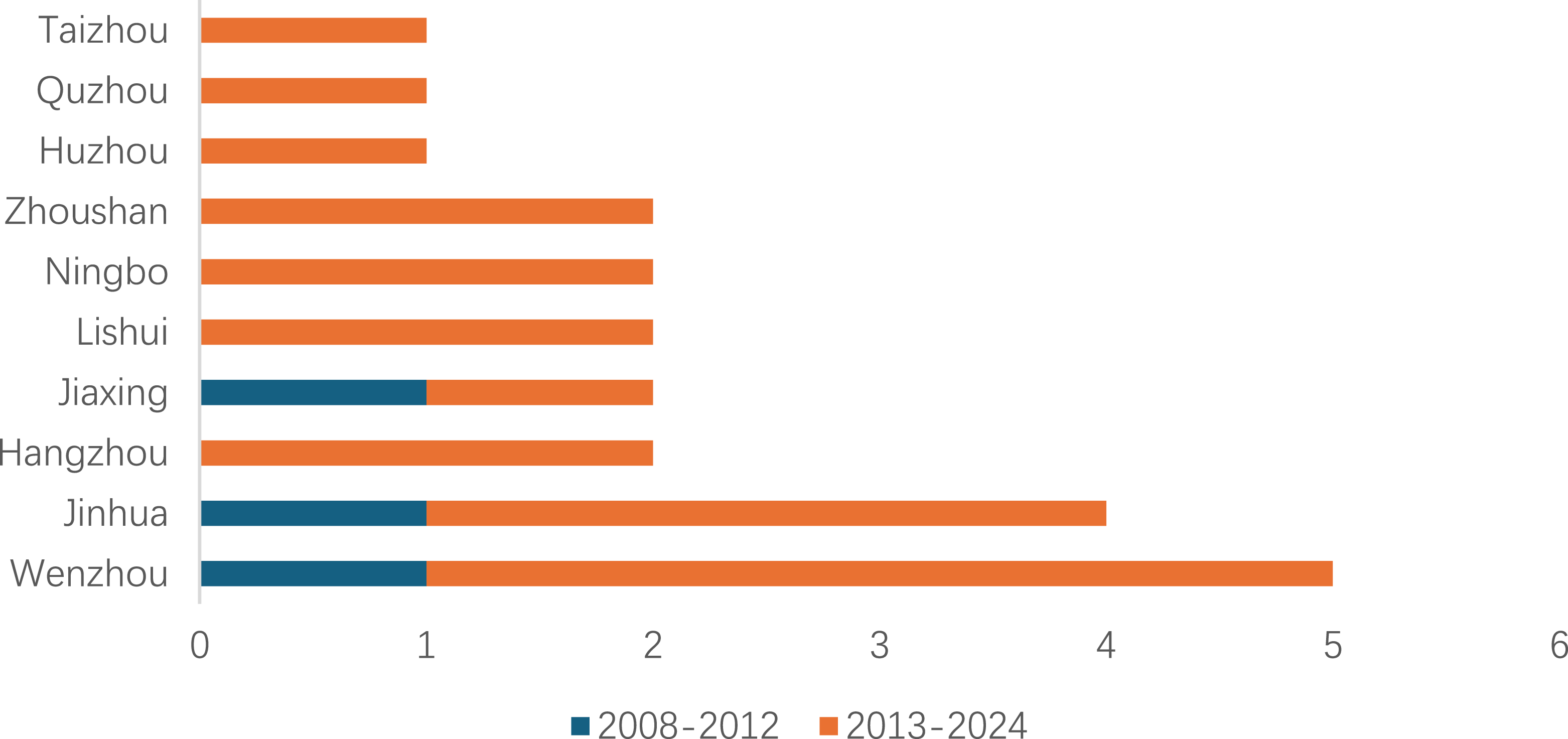
Finally, several judicial entrepreneurs have been promoted either within Wenzhou or to the ZHPC, which provides retrospective evidence of the underlying self-serving interests. Drawing on publicly available records, I compiled promotion data for appointments of deputy-chief-judge (futingzhang) positions and above to ZHPC tribunals between 2008 and 2024.Footnote 46 During this seventeen-year period, the ZHPC made over 214 appointments, involving over 119 judges. Of these, twenty-nine were transferred from outside; twenty-two came from Zhejiang municipalities (excluding maritime courts and universities), as shown in Figure 2. Wenzhou contributed five—more than any other city in Zhejiang—and all were judges from its two-tiered courts. Between 2008 and 2012, only one judge was promoted from Wenzhou, who specialized in criminal law. By contrast, between 2013 and 2024, four Wenzhou judges got promoted, and all were engaged in bankruptcy before and after their transfers.
Geographical Disitrbution of Leadership Promotion to the ZHPC from Zhejiang Municipalities
Source: the Zhejiang Daily; the Zhejiang Provincial People’s Congress Gazette

Bounded Innovation: The Constraints on Judicial Entrepreneurs
Judicial entrepreneurs, while influential, operate within a complex web of competing interests, institutional structures, and legal frameworks that constrain their capacity to innovate. These limits fall into three categories: constraints imposed by laws, enforcement inconsistency, and the government’s core interests.
Constraints imposed by laws
Local innovations in bankruptcy were bound by national law and administrative regulation. For instance, the Wenzhou Bankruptcy Administrator Association—established in 2016 with support from the WIPC to strengthen professional expertise and self-discipline—has used membership fees and a share of administrators’ remuneration to subsidize assetless cases. Yet, recent regulations restricting the membership fee structure to no more than four tiers have complicated the Association’s ability to issue receipts and manage these funds effectively.Footnote 47
A more illustrative example concerns personal bankruptcy that, though not addressed by the EBL 2006, has received increasing attention recently (Austin and Lin Reference Austin and Lin2021; Yin Reference Yin2022). Shenzhen, leveraging its special legislative authority, adopted China’s first Personal Bankruptcy Regulation in 2020. Wenzhou introduced a similar “personal debt adjustment” system in 2019, allowing insolvent debtors who meet certain criteria to negotiate repayment plans with creditors in judgment execution (Austin and Lin Reference Austin and Lin2021). However, without national legal backing, these plans require unanimous creditor consent and bind only participating creditors.Footnote 48 This discourages filings and results in low success rates—roughly 15 percent in the courts studied.Footnote 49
Constraints imposed by enforcement inconsistency (sustainability)
Judicial entrepreneurship is constrained by inconsistent enforcement across parties and over time. In this study, enforcement sustainability—namely, inconsistency over time—emerged as salient. This challenge, not unique to bankruptcy, is widely observed across policy domains in China (Manion Reference Manion2004; van Rooij Reference van Rooij2006). Honestly, bankruptcy will likely remain a priority—its revision is on the agenda of the National People’s Congress, and many areas still invite experimentation (Steele et al. Reference Steele, Godwin, Chun, Changyin, Yimin and Weihong2018). The Party’s push to improve China’s business environment also supports continued attention to bankruptcy.
However, the early and intensive enforcement has led to the exhaustion of “low-hanging” opportunities and diminishing returns of innovation. Identifying model cases with innovative management strategies has grown harder. So has sourcing new cases, as many debtors in the judgment execution have already been converted to zhizhuanpo.Footnote 50 Several basic courts now struggled to meet annual targets of caseloads; judges even joked that “there are no more enterprises to bankrupt.”Footnote 51 Caseloads in Wenzhou have recently plateaued, with a spike to about 850 new cases in 2023 followed by a decline of roughly a hundred in 2024. Probably reflecting slower economic growth, Chinese courts have recently seen a sharp rise in commercial cases—such as labor or corporate disputes (Anon 2025b)—which may help keep bankruptcy filings relatively high. Yet, looking ahead, as the backlog of pending execution cases has been gradually resolved, overall bankruptcy caseloads are likely to stabilize or even decline.
Sustainability also depends on personnel continuity. A basic court that pioneered bankruptcy enforcement saw its core bankruptcy team—including leaders and frontline judges—leave around 2021. Since then, it has produced fewer reforms or exemplary cases, which highlights that leadership turnover and the loss of experienced personnel may disrupt judicial entrepreneurship.
Constraints imposed by the regime
Thirdly, judicial entrepreneurs are constrained by the government’s core interests, which generates self-censorship in reviewing bankruptcy filings. Chinese courts are embedded in local politics and must account for the priorities of other political actors (Ng and He Reference Ng and He2017). In Wenzhou, judges consulted the government before accepting bankruptcies involving firms on enterprise assistance lists (EALs). These lists, first developed during the debt crisis, typically included companies above a designated size, local industry leaders, and otherwise politically significant firms.Footnote 52 To help these firms, FWOs coordinated bank lending, severed joint liabilities, and delayed judicial action.Footnote 53 In 2014, Wenzhou issued the Opinions on Implementing Classified Assistance Program for Enterprises, which created a three-tiered assistance system: maintaining loans, delaying judicial action, and proceeding with bankruptcy. This system required courts to confer with the government before adjudicating protected firms.Footnote 54
In practice, EALs were imperfectly disseminated. Judges often used alternative criteria—such as output value, industrial status, investor size, and reputation—to infer political sensitivity. One court leader explained:
There are many annual “top ten” rankings and similar awards issued by local officials. The government will lose face if such enterprises go bankrupt. We meet with the government to determine whether a firm may enter bankruptcy, how to address its debts, and how to facilitate coordination. If a company produces significant output value, is famous, or involves enormous employment issues, we cannot decide alone.Footnote 55
Social stability also influences judicial decision making (Liebman Reference Liebman2014; Ng and He Reference Ng and He2017). Judges tended to decline cases with active petitions or a large number of creditors (Li and Wang Reference Li and Wang2011; Z. Wang Reference Wang2015). An institutional lender’s lawyer recalled:
The debtor was a leading enterprise in the town and was expected to list its stocks. The basic court found it extremely challenging to handle the case and was unwilling to take it on. We then filed a new application with the WIPC but ultimately withdrew. Local cadres told us that many local people, including public servants, invested in this enterprise. If it had gone bankrupt, nobody could have adequately explained the situation to these investors.Footnote 56
In addition, sensitive industries—such as real estate, education, and finance—received strict scrutiny and required government input. Judges often refrain from directly accepting bankruptcies of schools or real estate enterprises due to their impact on students, employees, and home buyers, as well as the complexities of administrative permits involved, all of which require careful coordination.Footnote 57
Financial institutions, such as P2P lending platforms, are especially sensitive, given their dispersed creditors and potential for social unrest. Since 2016, a wave of collapses in these platforms has drawn significant attention (Liu Reference Liu2018). In Wenzhou, these cases were typically managed through administrative liquidation, with courts taking a back seat.Footnote 58 The process usually began with police investigations to probe the companies, arrest suspects, and recover misappropriated assets. Given that these cases often involved economic crimes, police involvement was crucial and set the stage for subsequent actions. Following the investigation, the government would establish a work group to coordinate interdepartmental efforts and maintain stability. It would issue a limited public notice and invite a select group of law firms to bid on the case. The winning firm would then form a liquidation team, led by government officials, tasked with handling the case according to the EBL 2006.Footnote 59
While administrative liquidation raises concerns about transparency and fairness—since creditors often have limited access to liquidation schemes and asset disposal details, this approach reflected several practical considerations. The sheer scale of victimization may overwhelm courts. In addition, police-court coordination is fraught. As one practitioner noted:
[The core issue is determining who has the authority to dispose of assets and how to distribute the proceeds.] Creditors are divided into two groups: criminal complainants and bankruptcy creditors. Not all creditors report their claims in both forums. Some approach public security authorities, while others report to bankruptcy administrators. If the police handle asset disposal, they distribute the proceeds directly to criminal complainants, leaving bankruptcy creditors without a share. Administrators must consider claims from the criminal side, but criminal complainants often believe they are entitled to the entire amount.Footnote 60
Given this, administrative liquidation is often preferred to avoid procedural conflicts and ensure a more controlled resolution process.
Despite self-censorship, judicial autonomy remains substantial, as also observed by other scholars (Steele et al. Reference Steele, Godwin, Chun, Changyin, Yimin and Weihong2018). Judges rarely confer with the government, and political intervention is infrequent.Footnote 61 When consultation occurs, it now follows a formalized process: judges issue inquiries to FWOs through the government OA system; the latter must respond timely and, if necessary, state clear reasons for delaying judicial action. Courts typically pause such cases for six months, and then reexamine the case once officials decline further support or interim assistance proves ineffective.Footnote 62
In practice, censored cases vary in criteria across courts. Some flag any firm with a plant, while others consult only on major cases. One judge noted:
I have never faced direct government pressure to reject a bankruptcy. A few years ago, the FWO came to coordinate, since some bankruptcy cases were related to financial disputes.… However, things necessitating coordination are rare. I have never been criticized by the government simply for accepting a bankruptcy case.… I do not think our local government dislikes it. They were initially surprised by it, but later got used to it.Footnote 63
Additionally, local governments—especially FWOs—generally support bankruptcy and favor market-based assistance. A district-level FWO leader explained:
We assist companies by allocating time to help them manage their debts, but we must respect market logic. If the company has no value or further assistance [ ] lapses, it should proceed with bankruptcy. Our support is constrained by law…. Think of a struggling company like someone with a cold. We offer medicine first. But if that fails, surgery—or, in the worst scenario, a final farewell—may be necessary.Footnote 64
Self-censorship, while underscoring the court’s limited autonomy, proves necessary for resolving disputes effectively. Sensitive cases involving complex social and economic issues frequently exceed the court’s legal mandate. Without proper consultation, an influx of such disputes could overwhelm judicial capacity. Besides, other agencies may evade their responsibilities, which may place significant pressure and blame on courts and discourage them from undertaking contentious disputes (He Reference He2007). More importantly, self-censorship can strengthen the court’s standing in the political system. By signaling awareness of the government’s core interests, courts present themselves as responsible partners while advancing a legal discourse that frames bankruptcy as a viable solution to the problem at hand. This positioning highlights the court’s growing discursive power—its ability to define problems and propose transparent, procedurally fair, and market-oriented remedies without appearing politically reckless. As noted above, consultation is used rarely and has been institutionalized with clear timelines and outcomes. Seen this way, self-censorship is not purely defensive but a strategy that allows courts to push the boundaries of their authority and cultivate credibility with other political players.
Theoretical Implications of Judicial Entrepreneurship
Judicial entrepreneurship is not a novel concept (McIntosh and Cates Reference McIntosh and Cates1997; Crowe Reference Crowe2007), and prior studies have long emphasized the influences of judicial leaders (Ip Reference Ip2010; Reichman Reference Reichman, Kapiszewski, Silverstein and Robert2013). This research presents a comprehensive framework that views judicial leaders as proactive actors in institutional change, explaining their incentives, strategies, and limitations. The theory also contributes to other academic conversations.
One perspective concerns whether courts can drive social change. One line of this scholarship follows a positivist and institutional approach, asserting that courts are ill-equipped to complex social policy cases, primarily due to their lack of technical expertise, enforcement power, and fiscal ability (Horowitz Reference Horowitz1977; Rosenberg Reference Rosenberg1991; Chilton and Versteeg Reference Chilton and Versteeg2018). However, scholars like McCann employ a constitutive approach, suggesting that courts, by rendering novel decisions, can generate rhetorical power that compels change from the ground up (McCann Reference McCann1994). Both approaches, however, sideline the importance of judicial leaders. Judicial entrepreneurs can address material constraints by forging alliances. They can cultivate the public by developing new jurisprudence that reframes problems, accommodates statutory texts to local conditions, and resonates with broader audiences.
A well-known example is the 1989 Kentucky school finance case Rose v. Council for Better Education, where Chief Justice Robert Stephens led the state supreme court in declaring the entire state education system unconstitutional—to everyone’s surprise, which helped galvanize legislative reforms now regarded as a landmark in the USA. Justice Stephens articulated a vision of an “adequate” common school, which appealed to the public and was circulated by various groups and officials over the next few years (Paris Reference Paris2010, 198). Bosworth asserts that Stephens, who was the leader in the court and had substantial experience in public life, played a crucial role, since “the good relations [he] had built over time with the legislature … smoothed the way” (Bosworth Reference Bosworth2001, 233). Rumors even suggested that Stephens was friends with some powerful senators who possibly had encouraged him to seize this reform moment and provided political backing.
Another possible illustration comes from Chile, where judicial reforms since the 1990s—that have enhanced judicial expertise, salaries, and independence of lower courts, and transferred concrete judicial review to the Constitutional Court—opened space for judicial activism (Couso and Hilbink Reference Couso, Hilbink, Helmke and Ríos-Figueroa2011). Criminal judges in lower courts began to uphold due process rights, question the violation of due process in military courts, and even take actions off the bench. Some engaged the media, founded professional associations, and published commentaries. While both authors emphasize structural and ideational shifts, I would suggest that entrepreneurial judges who seize opportunities to take actions inside and outside the courtrooms may play a role in determining the content and timing of these reforms.
In addition, this research contributes to the research on courts in authoritarian regimes. Previous studies identify a range of functions that courts can play in such contexts, including controlling political opponents, bolstering regime legitimacy, maintaining administrative discipline, attracting foreign investment, and implementing controversial policies on behalf of the government (Ginsburg and Moustafa Reference Ginsburg and Moustafa2008; Moustafa Reference Moustafa2014). It is often assumed in literature that judicial politics is a zero-sum dynamic, where the court’s gain of power is the other branches’ loss. Judicial empowerment occurs only when regime leaders willingly delegate authority. For instance, when political leaders confront controversial policies that risk provoking public opposition or fracturing their ruling coalition, they may delegate contentious questions to the judiciary. By deferring to judicial rulings, they can shift blame and insulate themselves from political fallout (Moustafa Reference Moustafa2007). Another illustration concerns economic growth. Both agencies and courts can handle commercial disputes, yet local firms often enjoy a comparative advantage in agency-led proceedings, owing to their familiarity with local norms and networks; this leaves foreign investors vulnerable, with limited assurance that their properties and contractual rights be impartially protected (Y. Wang Reference Wang2015). The delegation of dispute-resolution authority to an independent judiciary thus signals a credible commitment to foreign capital (Moustafa Reference Moustafa2003; Sidel Reference Sidel2008). Yet the empowerment is two-sided, as opponents may use judicial channels to challenge ruling elites (Ginsburg Reference Ginsburg2012), which reflects a zero-sum game of politics.
This research casts doubts on the assumption. Courts, and particularly judicial entrepreneurs, need not passively await elite delegation. They can actively reshape problems, offer solutions where administrative agencies fall short, and secure regime trust by exercising power effectively yet within perceived bounds. In this study, judicial entrepreneurs in Wenzhou pioneered the use of bankruptcy law despite public skepticism. Motivated less by regime demands for legitimacy or foreign investment (Peerenboom Reference Peerenboom2002; Y. Wang Reference Wang2015; Zhang and Ginsburg Reference Zhang and Ginsburg2019) than by their conviction that bankruptcy was essential for a functioning market economy, court leaders judicialized massive and collective business failures, collaborated with officials, and ultimately institutionalized bankruptcy as a viable governance tool. In doing so, judicial entrepreneurs strengthened rather than weakened regime power. That is, they expanded judicial authority while simultaneously enhancing the regime’s capacity to govern. This suggests a symbiotic rather than zero-sum relationship between courts and regime leaders.
Conclusion
This article examined how judicial entrepreneurs drove the rise of bankruptcy enforcement in Wenzhou. During the 2011 lending crisis, local court leaders actively promoted bankruptcy as an effective mechanism for resolving failing firms. They began with pilot cases and gradually institutionalized bankruptcy through mobilizing various resources. Their efforts were motivated by both personal attributes and self-serving interests, with the former critical for initiating reform and the latter essential for sustaining reform momentum. Yet, this entrepreneurship was constrained by the legal framework and faced limits to enforcement sustainability. Moreover, they could not infringe on the government’s core interests, leading to self-censorship, a practice that both signals political prudence and highlights the court’s growing discursive power to propose judicial remedies.
This study, however, has several limitations. As a single case study, it cannot fully capture the diversity of judicial entrepreneurship across regions and policy areas. Additionally, its supply-side focus on judicial behaviors leaves less explored the demand-side perspective of bankruptcy. While some scholars question the EBL’s efficacy in rehabilitating troubled companies and protecting creditors (Zhang and Tomasic Reference Zhang and Tomasic2016; Zhang Reference Zhang2022), others argue that bankruptcy law, particularly the creation of specialized tribunals, is good for resource allocation (Li and Ponticelli Reference Li and Ponticelli2022). More research is needed to settle this debate.
Theoretically, this article makes several contributions. First, it extends policy entrepreneurship analysis to the judiciary and shows that policy implementation is a multi-stage process requiring different strategies as reforms evolve. Second, it adds judicial entrepreneurs as a determinant to the debates on courts and social change. The study shows how court leaders can overcome institutional constraints by forging alliances, cultivating the public, and tailoring national laws to local conditions. Third, it shows that judicial leaders in authoritarian regimes can expand their authority without waiting for elite delegation. By grasping policy windows and addressing governance problems, they can strengthen the regime’s capacity while increasing their own power, which suggests a symbiotic rather than zero-sum state-court relationship.
Acknowledgements
I am deeply grateful to Meng Hou, Yang Feng, Jinhua Cheng, and others for their invaluable feedback. My sincere thanks also go to Tian’ai Chen, Shunxuan Wan, Wendi Huang, and Peiqi Yu for their research assistance during the revision process. However, I take full responsibility for the content of this article.
Funding statement
This work was supported by the Shanghai Pujiang Talent Program (No. 2022PJC044). The fieldwork conducted from 2017 to 2019 for this research was approved by Georgetown University, IRB Protocol ID STUDY00000011.