Introduction
The prevalence of HIV among 15- to 49-year-olds is estimated at 0.9% in Mali (UNAIDS, 2012). As in most countries in sub-Saharan Africa, HIV transmission primarily occurs through sexual intercourse. The majority of new infections occur in steady relationships, the steady sexual partner (SSP) being infected either before the start of the relationship, or as a result of sexual relations with other partners during the relationship (Carpenter et al., Reference Carpenter, Kamali, Ruberantwari, Malamba and Whitworth1999; Hugonnet et al., Reference Hugonnet, Mosha, Todd, Mugeye, Klokke, Ndeki, Ross, Grosskurth and Hayes2002; Malamba et al., Reference Malamba, Mermin, Bunnell, Mubangizi, Kalule and Marum2005; Guthrie et al., Reference Guthrie, de Bruyn and Farquhar2007; Eyawo et al., Reference Eyawo, de Walque, Ford, Gakii, Lester and Mills2010). In this context, one of the main barriers to the reduction of HIV transmission is the non-disclosure of HIV serostatus to the steady sexual partner.
HIV disclosure is defined as the act of telling a third party (e.g. family member, sexual partner, friend, colleague) that one is seropositive. Disclosure can either be ‘voluntary’ (i.e. the person living with HIV (PLHIV) takes the initiative to disclose) or ‘involuntary’ (e.g. when a third party reveals the seropositivity without the PLHIV's consent or when someone deduces one's seropositivity). Disclosure is a critical issue for newly diagnosed PLHIV. Disclosing to family, friends or a steady sexual partner can bring social support to the PLHIV, which may in turn have positive effects on psychological well-being (Zea et al., Reference Zea, Reisen, Poppen, Bianchi and Echeverry2005). Financial support may also be a reason to disclose (Miller & Rubin, Reference Miller and Rubin2007; Kadowa & Nuwaha, Reference Kadowa and Nuwaha2009). While it may have been a strong motivation in Mali, especially for women, the financial burden of HIV care has eased since the extension of free access to treatment in 2004, with the consequence that PLHIV can minimize their economic dependence on their family and friends for HIV care. Within a couple, disclosing entails the possibility to negotiate about safer sex practices, in particular condom use (Marks et al., Reference Marks, Burris and Peterman1999; Olley et al., Reference Olley, Seedat and Stein2004; Loubiere et al., Reference Loubiere, Peretti-Watel, Boyer, Blanche, Abega and Spire2009). Disclosure has also been associated with earlier testing of the sexual partner and, if necessary, access to care (Nebié et al., Reference Nebié, Meda, Leroy, Mandelbrot, Yaro and Sombié2001; Yaméogo et al., Reference Yaméogo, Bila and Kouanda2008). However, disclosure can be risky for PLHIV in case of negative reactions. Family exclusion of the PLHIV may follow disclosure and is in some cases associated with emotional and/or physical violence (Ogden & Nyblade, Reference Ogden and Nyblade2005). The risk of stigmatization and discrimination is still very strong, and can have devastating consequences on the familial, social and economic lives of PLHIV (Mahajan et al., Reference Mahajan, Sayles, Patel, Remien, Sawires, Ortiz, Szekeres and Coates2008). The anticipation of negative consequences is the main barrier cited by PLHIV for non-disclosure, as they are afraid of discrimination and stigmatization, or of a negative reaction of the partner leading to rejection, abandonment, break-up or violence (Hays et al., Reference Hays, McKusick, Pollack, Hilliard, Hoff and Coates1993; Maman et al., Reference Maman, Mbwambo, Hogan, Weiss, Kilonzo and Sweat2003; Akani & Erhabor, Reference Akani and Erhabor2006). Disclosure and its positive and/or negative consequences are therefore important determinants of a PLHIV's quality of life (Chandra et al., Reference Chandra, Deepthivarma and Manjula2003; Préau et al., Reference Préau, Marcellin, Carrieri, Lert, Obadia and Spire2007).
Disclosure is a process that occurs over time as HIV-positive individuals disclose to different people in their network, influenced by many factors (e.g. social norms and context, family dynamics, gender, age group, type of social relationships, income and educational level, health access and quality) (Hardon et al., Reference Hardon, Gomez, Vernooij, Desclaux, Wanyenze and Ky-Zerbo2013). Disclosing to a family member might be a different challenge than disclosing to one's spouse or sexual partner, especially in sub-Saharan Africa. While studies show that the majority of PLHIV disclosed to at least one of their relatives, wider variation in terms of disclosure rate to sexual partners was found, ranging from <20% to >90%, indicating a different and complex underlying mechanism (Obermeyer et al., Reference Obermeyer, Baijal and Pegurri2011; Bott & Obermeyer, Reference Bott and Obermeyer2013; Hardon et al., Reference Hardon, Desclaux and Lugalla2013).
Furthermore, while disclosing seropositivity still remains a very difficult issue for PLHIV in all spheres of their social lives, the Malian legislation requires that PLHIV reveal their seropositivity to their spouse and sexual partner(s) ‘as soon as possible’ or ‘within six weeks’ after HIV diagnosis (Loi 06-028, 2006), adding even more complexity to the issue of disclosure for PLHIV in Mali. Despite the importance of this issue, at the individual level and in terms of public health, very few studies on disclosure, in particular to one's sexual partner, have been performed so far in Mali.
In Mali, PLHIV can receive comprehensive care either in public centres or in community-based organizations (CBO). The CBOs are well known for being critical stakeholders in PLHIV care in Mali. The biggest CBO in the country, named ARCAD-SIDA, provides care for more than 50% of the HIV-positive patients in the country. This organization is renowned for the quality of patient management and the comprehensive nature of its care, which combines medical attention and psychosocial support, in a spirit of community mobilization and involvement of PLHIV.
Community-based participatory research is a form of research aiming at transcending academic boundaries and evolving towards a model of inter-disciplinary collaborations, involving academic researchers and community stakeholders in a balanced partnership ensuring mutual benefits. In Africa, this type of research has long been in existence, allowing the gradual emergence of a participatory health democracy (Mosavel et al., Reference Mosavel, Simon, van Stade and Buchbinder2005). This form of research is now increasingly used and participates in the global movement of community mobilization, empowerment and representation. Considering the importance of community mobilization and empowerment in the issue of disclosure in Mali, and in the framework of ethical considerations, a community-based study was performed to explore the factors independently associated with voluntary disclosure of serostatus to one's steady sexual partner in a population of PLHIV in contact with the community-based organization ARCAD SIDA.
Methods
This study is a sub-study of PARTAGES, a community-based cross-sectional research study. Developed and implemented by a mixed (researchers/CBO members) international research consortium from seven countries (Canada, Democratic Republic of the Congo, Ecuador, France, Mali, Morocco and Romania), its objective was to document the factors associated with serostatus disclosure by PLHIV in contexts where available data are rare (Loukid et al., Reference Loukid, Abadie, Henry, Hilali, Fugon and Rafif2014; Lazar et al., Reference Lazar, Verdes, Henry, Fugon, Bernier, Otis and Préau2014).
In Mali, the study was performed between May and October 2011 on 300 PLHIV who were in contact with ARCAD SIDA. The inclusion criteria were as follows: HIV positive, 18 years old or over, and aware of seropositivity for more than six months. Five sites participated in the recruitment of participants: three in Bamako, one in Koulikoro and one in Kati. The PLHIV were asked during their routine medical visit at one of these sites if they were willing to participate in the study. After providing written informed consent, they were administered a questionnaire by one of ten interviewers, most of whom were members of ARCAD SIDA living with HIV. All were trained beforehand in interviewing techniques.
The questionnaire was designed following individual interviews and focus groups with PLHIV, health care personnel and social workers. These sessions identified many challenges faced by PLHIV and field stakeholders. It was considered important to include all these challenges in the questionnaire, to be in line with what was identified by stakeholders and the community. Consequently, the questionnaire contained 125 questions, divided into eight sections (socioeconomic data, history and contact with HIV, serostatus disclosure and reaction of others to disclosure, self-efficacy, intimate and social life, sexuality, quality of life and contact with CBOs). The study was approved by the Faculty of Medicine Ethics Committee of Bamako in 2011.
Explanatory variables
Based on the existing literature and challenges identified by field stakeholders and PLHIV, the following categories of variables were tested for their association with voluntary disclosure to one's SSP: gender, age, having children, main activity, being accompanied to the survey site, number of years since HIV diagnosis, using means other than highly active anti-retroviral treatment (HAART) to treat HIV and knowing others who had publicly declared their seropositivity. The last two variables mentioned above are indicators of beliefs and are fundamental contextual elements, especially in sub-Saharan Africa.
Additionally, two scales were used in the analysis: a self-esteem scale and a self-efficacy scale. They were included in the questionnaire because they have been under-investigated so far, and they are good indicators of individual characteristics. These scales come from validated scales and have been adapted in the field, with tests on various persons in different contexts to ensure good understanding of questions as well as answers. All the items were simplified to a binary choice: agree/yes (1) vs disagree/no (0). Global scores were constructed as the sum of item scores. The unidimensionality of each scale was validated with a principal factor analysis of the tetrachoric correlation matrix, and the internal consistencies were assessed via ordinal alphas (α) (Gadermann et al., Reference Gadermann, Guhn and Zumbo2012). The results of the factor analyses were satisfactory for each scale, ensuring the validity of these scales.
Self-esteem, defined as ‘the value which we give to ourselves’ (Martinot, Reference Martinot2001), was based on the Rosenberg Self-Esteem Scale. Only four of the original scale items were kept (items 1, 2, 4 and 5). A high score corresponds to a high level of self-esteem (α=0.71) (Rosenberg, Reference Rosenberg1965). The General Self-Efficacy Scale is a ten-item scale adapted from Schwarzer's scale (questions 1–6, 8–11), assessing perceived efficacy to solve daily hassles and problems (Schwarzer, Reference Schwarzer1992). It was asked to focus especially on the problems related to HIV status. A high score corresponds to a high level of perceived self-efficacy (α=0.95).
Statistical analysis
The sample was weighted using a variable based on the socio-demographic characteristics (age group, gender and recruitment site) of PLHIV followed by ARCAD SIDA, to ensure that the sample was representative of the population followed by the CBO. To study voluntary disclosure to one's SSP, the analysis was restricted to the participants who declared having a SSP and who answered the question about disclosure to their SSP. Qualitative variables were compared using the χ2 test or Fisher's exact test, and for quantitative variables the comparisons of the means were performed using Student's t-test or non-parametric Kruskall–Wallis or Wilcoxon tests. Potential explanatory variables were screened for inclusion in the model by testing each one independently for an association with voluntary disclosure of serostatus to one's SSP, using weighted univariate logistic regression. Variables with a significance level of p≤0.20 in the univariate analysis were included in the multivariate analysis. For the multivariate analysis, a complete case analysis was performed and the final model was built using a backward elimination approach based on the log-likelihood ratio test (p≤0.05). A receiver operating characteristic (ROC) curve was used to assess the logistic regression model's ability to accurately distinguish participants who had disclosed their seropositivity from the others. The area under the ROC curve (AUC) provided a measure of discrimination (Hosmer & Lemeshow, Reference Hosmer and Lemeshow2000). Data management and statistical analyses were performed using SPSS v20.0 (IBM Corp., 2011).
Results
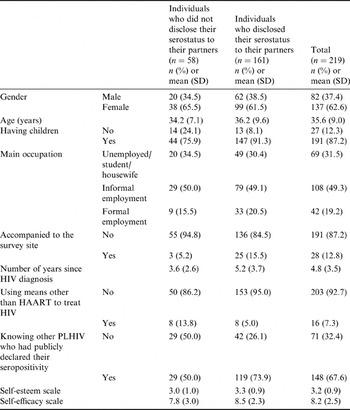
Among the 300 participants, 219 declared that they had a SSP and answered to the question about HIV voluntary disclosure to their SSP. Among them, 161 (73.5%) declared that they had voluntarily disclosed their serostatus to their steady sexual partner. A description of the characteristics of these 219 persons is presented in Table 1. Approximately two-thirds of the study sample were female (63%), the mean age was 35.6 years and a large majority of participants (87%) had children.
Characteristics of the individuals included in the analysis (n=219)

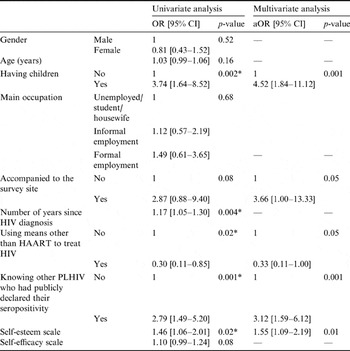
In Table 2, the results of the univariate and multivariate analyses are described. While all the results are presented for the univariate analysis, only the significant ones for the multivariate analysis are shown (p≤0.05). Multivariate analysis (Table 2) showed a positive, independent and statistically significant association of the following factors with HIV voluntary disclosure to a SSP: having children (odds ratio [95% confidence interval]: 4.52 [1.84–11.12], p=0.001), being accompanied to the survey site (3.66 [1.00–13.33], p=0.05), knowing other PLHIV who had publicly declared their seropositivity (3.12 [1.59–6.12], p=0.001) and having higher self-esteem (1.55 [1.09–2.19], p=0.01). To the contrary, using means other than HAART to treat HIV was negatively associated with disclosure (0.33 [0.11–1.00], p=0.05). The area under the ROC curve of the final multivariate model was 0.75, indicating an acceptable degree of discrimination, according to Hosmer & Lemeshow (Reference Hosmer and Lemeshow2000).
Factors associated with voluntary disclosure to one's steady sexual partner, univariate and multivariate analyses (n=219)

OR: odds ratio; CI: confidence interval; aOR: adjusted odds ratio.
For multivariate analysis, the model included 217 participants; only the significant results are presented here (p≤0.05).
* p≤0.05.
Discussion
Of the 219 PLHIV included in the analysis, 73% declared that they had voluntarily disclosed their serostatus to their SSP. This is higher than in another study performed in Mali where 59% of the PLHIV interviewed had disclosed their serostatus to their most recent SSP (Centre d'étude et de recherche sur l'information en population et santé, 2012). In other contexts, the percentage of disclosure to one's SSP varies widely, between <20% and >90% (Bouillon et al., Reference Bouillon, Lert, Sitta, Schmaus, Spire and Dray-Spira2007; Obermeyer et al., Reference Obermeyer, Baijal and Pegurri2011; Amoran, Reference Amoran2012; Erku et al., Reference Erku, Megabiaw and Wubshet2012; Vu et al., Reference Vu, Andrinopoulos, Mathews, Chopra, Kendall and Eisele2012; Bott & Obermeyer, Reference Bott and Obermeyer2013). These differences are dependent on study design, but also show the importance of the contextual and individual factors in the disclosure process.
Eighty-seven per cent of the respondents in the study sample declared that they had children. Having children was positively associated with disclosure to one's SSP. In other studies on seropositive sub-Saharan women, the presence of children in the household was also shown to be predictive of disclosure (Loubiere et al., Reference Loubiere, Peretti-Watel, Boyer, Blanche, Abega and Spire2009; Suzan-Monti et al., Reference Suzan-Monti, Blanche, Bilé, Koulla-Shiro, Abu-Zaineh and Marcellin2011).
The link between parenthood and disclosure may reflect diverse realities, depending on whether seropositivity was diagnosed before parenthood, during pregnancy or when children were already present in the household. When seropositivity is discovered before parenthood, the desire to have a child may encourage disclosure to one's steady sexual partner (Desgrées-du-Loû, Reference Desgrées-du-Loû, Desclaux, Msellati and Sow2011). Disclosure may highlight the individual's concern about HIV transmission to the other parent or to future offspring and facilitate access to medical and social support specifically tailored to parenthood within the context of seropositivity. Seropositivity may also be discovered during pregnancy thanks to programmes to prevent vertical transmission. In many countries, women are often first tested when pre-natal monitoring begins (Desgrées-du-Loû, Reference Desgrées-du-Loû, Desclaux, Msellati and Sow2011). Indeed, among the 137 women in this study sample, 35 (26%) had discovered their seropositivity during pregnancy. Mothers who disclose their seropositivity to their partner tend to do so just before giving birth, during early weaning or when sexual relations recommence (Brou et al., Reference Brou, Djohan, Becquet, Allou, Ekouevi and Viho2007).
If seropositivity is discovered when there are already children in the household, the desire to have children tested may be a driver for disclosure to one's partner. In this sample, among participants having children, 17% had at least one seropositive children and 12% had lost one or more children to HIV/AIDS. Previous HIV transmission to a child may increase a mother's vigilance towards other children of the household. Although HIV infection may threaten the strength of the couple relationship by complicating the issue of sexuality and reproduction (Desgrées-du-Loû, Reference Desgrées-du-Loû, Desclaux, Msellati and Sow2011), the fact that children are already present is often perceived as providing stability and a guarantee for the future. Then, the presence of children may limit the fear of being abandoned or rejected when the PLHIV contemplates disclosure.
A positive link between being accompanied to the survey site and voluntary disclosure to the SSP was found. On the day of the survey, 13% of the PLHIV in the study sample were accompanied to the health care site. The survey questionnaire was administered without the presence of the accompanying person(s). The PLHIV may be accompanied to the health care site by a close family member or friend, by one of the steady partner's family members or relatives, or by the steady partner him/herself. In this sample, women were more often accompanied than men (p=0.06). This may be explained by the fact that in Malian society, women are more often economically and/or socially dependent on their family or on their partner. In Mali, women are more often accompanied by one of their steady partner's family members or relatives rather than by their male spouse or steady partner. Previous studies have highlighted this low level of involvement by male spouses/partners in health care programmes, including HIV care programmes (Antelman et al., Reference Antelman, Smith Fawzi, Kaaya, Mbwambo, Msamanga, Hunter and Fawzi2001; Orne-Gliemann et al., Reference Orne-Gliemann, Tchendjou, Miric, Gadgil, Butsahvili, Eboko, Desclaux, Msellati and Sow2011). If accompaniment was not chosen or agreed upon, especially for women, it was certainly difficult for PLHIV to hide their status, because the nature and function of the health care establishment providing HIV services are easily identifiable on site. In this case, PLHIV may have decided to disclose their seropositivity to their sexual partner to prevent the latter from discovering it by him/herself, either upon arrival at the health care unit or from the person who accompanied the PLHIV.
If accompanied by the partner, it may be part of a disclosure strategy involving the help of the health care team. In this kind of situation, the seropositive person may repeat the HIV test at the same time as the partner, and then pretend to discover his/her seropositivity for the first time when the results are made known to the couple (Henry et al., Reference Henry, Préau, Himmich, Cissé, Matamba, Dascalu and Herdoiza2010). Strategies involving medical personnel in the announcement of seropositivity to a partner have been identified in other studies (Collignon et al., Reference Collignon, Gruenais and Vidal1994; Ky-Zerbo et al., Reference Ky-Zerbo, Somé and Simaga2013). The PLHIV's primary concern is to ensure that their partner takes the HIV test. If the partner is found to be seropositive, the PLHIV can protect him/herself from the possible accusation that it was he/she who first brought the infection to the couple. In Burkina Faso, for example, this kind of accusation is primarily directed towards women (Egrot, Reference Egrot2004). The desire of PLHIV for their partners to be tested has been identified as one of the main reasons to disclose (Kadowa & Nuwaha, Reference Kadowa and Nuwaha2009). Indeed, in Abidjan, male partners informed about their female partner's seropositivity were more likely to go for testing than those unaware (Brou et al., Reference Brou, Djohan, Becquet, Allou, Ekouevi and Viho2007). Being accompanied to the health care centre may also be the consequence of a poor state of health, which makes it more difficult for PLHIV to keep their seropositivity secret from their partner (Bouillon et al., Reference Bouillon, Lert, Sitta, Schmaus, Spire and Dray-Spira2007).
This study has highlighted that knowing other PLHIV, either personally or through the media, who had publicly declared their serostatus, was positively associated with disclosure to a steady sexual partner. Public declaration of seropositivity by PLHIV changes the social environment and may reduce stigmatization by demystifying the negative social perceptions associated with HIV infection (Paxton, Reference Paxton2002). In Mali, public declarations by PLHIV are quite frequent. HIV has been visible in the media since the beginning of the epidemic. Despite the scepticism of a minority of the audience regarding their veracity, public declarations give the epidemic a face and increase people's awareness of the daily lives of those living with the disease. For the PLHIV's partner and close circle of family and friends, it therefore becomes easier to ‘hear’ announcements of seropositivity, which in turn may facilitate the PLHIV's decision to disclose.
Public declarations of seropositivity may also provide the occasion for a PLHIV whose infection is still secret to ‘test’ what his/her partner's perceptions and opinions are about the issue (Orne-Gliemann et al., Reference Orne-Gliemann, Tchendjou, Miric, Gadgil, Butsahvili, Eboko, Desclaux, Msellati and Sow2011). This may even entail discussion about the subject with the possible realization that the partner is not as adverse to the subject as previously thought (Galliard et al., Reference Galliard, Melis and Mwanyumba2000). The anticipation of support from one's partner has been shown to be associated with the act of disclosing (Amoran, Reference Amoran2012). Moreover, as theories of social identity suggest (Tajfel & Tuner, Reference Tajfel, Tuner, Worchel and Austin1986), PLHIV who publicly declare their seropositivity may be considered role models by other PLHIV, who feel more confident about following their example. The former are often actors involved within CBOs, and their public declaration increases the visibility of such organizations. In turn, this increased visibility may encourage PLHIV to visit these organizations and meet other PLHIV, some of whom have already publicly disclosed their seropositivity.
A positive association between disclosure to a steady sexual partner and self-esteem was observed. Self-esteem manifests itself by a positive or negative orientation towards oneself, starting from an evaluation of one's own worth (Terra et al., Reference Terra, Marziale and Robazzi2013). The feeling of self-esteem daily impacts on physical and psychological well-being (Martinot, Reference Martinot2001) and influences social performance (Terra et al., Reference Terra, Marziale and Robazzi2013). Accordingly, self-esteem may be considered as an indicator of psychosocial well-being. In this study, a higher level of self-esteem was associated with disclosure. Disclosure to a steady sexual partner may strengthen a PLHIV's self-esteem, especially when the partner reacts positively to the news. In this way, the study by Parsons et al. showed that one of the ‘positive rewards’ for disclosing was ‘the reaffirmation of one's sense of self’ (Parsons et al., Reference Parsons, VanOra, Missildine, Purcell and Gómez2004). In a study on homosexual and bisexual men, Holt et al. also showed that disclosure helped to facilitate the self-acceptance of one's condition (Holt et al., Reference Holt, Court, Vedhara, Nott, Holmes and Snow1998).
Having high self-esteem may also facilitate the process of coming to terms with one's seropositivity and disclosing it, in particular to one's sexual partner. An interesting fact is that in our study, self-esteem is significant and not self-efficacy. Self-esteem is the emotional component of the self, whereas self-efficacy refers to beliefs about the efficacy of one's behaviours (Martinot, Reference Martinot1995, Reference Martinot2001). Thus, self-efficacy is a more accurate and selective measure than self-esteem. In the case of serostatus disclosure to one's sexual partner, self-efficacy only concerns the behaviour of revealing one's serostatus, while self-esteem refers to the global emotional effort of taking the decision to disclose to one's sexual partner. In relation to the disclosure to one's sexual partner, it seems plausible that the global emotional effort of taking the decision to disclose is more strongly associated with disclosure than the belief in the efficacy of one's behaviour of disclosing.
A negative association between using means other than HAART to treat HIV and voluntary disclosure to one's SSP was identified. A small number of respondents (7%) declared that they used traditional and alternative means to treat their HIV infection, including the use of plants (in particular leaf decoctions, tree bark or tree roots) or making offerings. Most of these people were on HAART (91%). This is similar to findings in other contexts (Owen-Smith et al., Reference Owen-Smith, McCarty, Hankerson-Dyson and Diclemente2012). The belief that HIV can be cured thanks to alternative treatments, often described as being used to ‘complement’ HAART, reflects mystical and inaccurate perceptions. If a PLHIV is convinced that he/she can be cured, disclosure to his/her sexual partner may seem less necessary. Accordingly, in a study performed in Cameroon on seropositive women, a significant link was found between the belief that HAART cures HIV and non-disclosure of seropositivity to a primary partner (Loubiere et al., Reference Loubiere, Peretti-Watel, Boyer, Blanche, Abega and Spire2009). A study in Uganda also showed that ‘not seeing any reason to disclose to sexual partners’ – which could potentially reflect a poor understanding of the different ways of HIV transmission – was associated with keeping serostatus confidential from one's partner (Kadowa & Nuwaha, Reference Kadowa and Nuwaha2009). Nevertheless, the small number of people in this study sample using alternative treatments suggests these results should be interpreted with caution.
Study limitations
First, the sample used in this study was a convenience sample, drawn from seropositive persons in contact with a Malian CBO working in the fight against HIV/AIDS. The beneficiaries of this organization's services are supported medically, psychologically and socially. In particular, they are encouraged and supported in their decision to disclose their serostatus. Therefore, PLHIV in this sample might have disclosed more than those who are not in contact with CBOs (Ncama, Reference Ncama2007). This sample then cannot be considered as representative of all the PLHIV in Mali. Second, the study being cross-sectional, the dynamics of the disclosure process could not be captured. Third, thanks to a standardized questionnaire, disclosure was explored in the five countries participating in the PARTAGES study. The different socio-cultural contexts in these countries may limit the relevance of the concept of ‘steady sexual partner’. In Mali, polygamy is authorized by law, and men may therefore legally have up to four wives. Men and women can also have several partners outside marriage. This study only focused on the ‘main’ steady sexual partner identified spontaneously by the PLHIV. Finally, the existence of a law requiring PLHIV to disclose to their SSP may have introduced a selection and/or a desirability bias. Nevertheless, this bias should be very limited since the law has never been enforced in Mali. Most PLHIV did not even know of its existence. Moreover, the fact that the study was conducted by NGO members who had been trained on the study protocol and ethical issues as well as the pre-existing confidence relationship between respondents was rather a guarantee of good-quality answers.
Perspectives
This study highlights the link between disclosure of one's seropositivity to a steady sexual partner and multi-level factors. At the individual level, the familial context plays a role in the disclosure process. Parenthood was significantly associated with disclosure to a steady sexual partner. Accordingly, the offer of care during pregnancy could encourage testing and disclosure in the couple. It could also reduce the risk of transmission to both the child and the partner. Innovative approaches focusing on the couple and the nuclear family should be developed on the field. A few interventions have been recently developed in this way. The study by Orne-Gliemann et al. showed the feasibility and the relevance of implementing pre-natal HIV counselling for couples (Orne-Gliemann et al., Reference Orne-Gliemann, Tchendjou, Miric, Gadgil, Butsahvili, Eboko, Desclaux, Msellati and Sow2011). This study also highlighted the link between being accompanied to the health care site and disclosure to a steady sexual partner. Including, with the PLHIV's consent, the circle of family and friends in issues regarding medical care is important as their emotional and economic support plays a major role in the disclosure process.
Other individual characteristics of PLHIV, in particular self-esteem, are also determining elements for disclosure. Certain activities organized by CBOs help to build self-esteem, strengthening the PLHIV's capacity in terms of self-acceptance, trust in others and communication of seropositivity, especially to a partner. Such activities should be expanded. In this way, the Gundo So programme (Otis et al., Reference Otis, Yattassaye, Henry, Diop, Dembele and Kassogue2012), culturally adapted to the Malian context from a Canadian programme (Otis et al., Reference Otis, Bellier and Massie2010), focused on increasing self-awareness and developing personal competences in women living with HIV to support them in their decision whether to disclose their seropositivity or not.
The PLHIV's beliefs about infection and treatments may also be associated with disclosure to a steady sexual partner. Consequently, medical personnel and community-based actors should work together in order to increase PLHIV's understanding of infection and treatment mechanisms. If traditional healers are involved, it may be possible to convince them to help in the process of providing correct and comprehensive information regarding these aspects, to prevent denial of seropositivity or treatment adherence problems.
Finally, the social environment is also associated with disclosure. Social models, particularly through public declarations of HIV infection, seem to be an important factor facilitating disclosure to a steady sexual partner. Consequently, this study validates the benefit of CBOs' activities at the community level focusing on the issue of disclosure, like support groups.
Conclusion
In conclusion, this study identified several factors associated with disclosure to one's SSP in Mali. Interventions aiming at facilitating disclosure to partners should be personalized and take into account individual characteristics, as well as familial and social environment. Empowerment interventions should be developed in the field to improve personal skills as well as knowledge regarding the disease, routes of infection and treatment options. Finally, global interventions aiming at reducing stigmatization and discrimination, like public declarations of seropositivity, should be continued, so as to ensure positive reaction of the social environment of PLHIV if/when willing to disclose.
Acknowledgments
This study was funded by the French Agency of AIDS Research (ANRS) and Sidaction. These organizations were not involved in the study design, implementation, analysis or writing of the article. This study was made possible thanks to the organization ‘Coalition Internationale Sida’. The authors thank all the PLHIV who agreed to participate in this study, and the partners of the other countries involved in PARTAGES for their contribution to its success at the local and international level. Finally, the authors would like to thank Jude Sweeney for reviewing the English in this manuscript.