Introduction
Recent figures suggest that only 37 per cent of adults living in England and Wales have a will (Douglas et al., Reference Douglas, Woodward, Humphrey, Mills and Morrell2011). Findings from other countries suggest that the rate in England and Wales is on the lower end, with the USA and Australia reporting higher rates of 44 per cent (LexisNexis, 2011) and 59 per cent (see e.g. Tilse et al., Reference Tilse, Wilson, White, Rosenman and Feeney2015) respectively. As might be expected, the prevalence of wills varies with age (National Consumer Council, 2007; Will Aid, 2014; Tilse et al., Reference Tilse, Wilson, White, Rosenman and Feeney2015); while a majority of those aged over fifty-five have a will, the figure is much lower for young people. Prevalence also varies with ethnicity and education level, with DiRusso (Reference DiRusso2009) observing lower rates of testacy amongst non-whites, and those without a college degree.
Death has previously been described as overlooked in policy debates and absent from social policy texts (Foster and Woodthorpe, Reference Foster, Woodthorpe, Foster and Woodthorpe2016). Social policy debate has typically focused on end of life care (e.g. Department of Health, 2008) rather than the implications of dying intestate. Yet social policy has a considerable impact for how death is experienced and our understanding of death (Foster and Woodthorpe, Reference Foster, Woodthorpe, Foster and Woodthorpe2016), affecting not only those who are nearing the end of their lives, but also the consequences for those left behind. With an ageing population and a rising death rate in England and Wales (Office for National Statistics, 2014; Foster and Woodthorpe, Reference Foster, Woodthorpe, Foster and Woodthorpe2016), the social and economic costs of intestacy, including those arising from the adjudication of disputes, administration of affairs and protection of children, are ultimately borne by the state. There is good reason to consider the role social policy initiatives might play in reducing intestacy and to consider how initiatives intended to initiate behavioural change can be effectively evaluated.
The impact of intestacy
It has previously been observed that ‘in an ideal world we would all make a will,’ as ‘the process of grieving, and of adjustment to change, can be made far worse by uncertainty and anxiety about money or belongings’ (Law Commission, 2009: 1). An increasing number of people leave something of financial value behind when they die, and dying intestate may give rise to financial instability, loss of housing and may strain family, social and employment relationships (Rowlingson, Reference Rowlingson, Foster and Woodthorpe2016; Valentine and Bauld, Reference Valentine, Bauld, Foster and Woodthorpe2016; Corden, Reference Corden, Foster and Woodthorpe2016). Often a lack of will is borne out of an individual's belief that he or she has insufficient property to justify formal distribution of assets and one half of the population leaves nothing of value when they die (Walker, Reference Walker, Foster and Woodthorpe2016).
The view that one has insufficient material wealth to justify a will points to public lack of awareness on the subject of wills and intestacy; suggesting a lack of appreciation of the other potential functions of a will. Wills do not simply operate to distribute assets of value, they play a key role in minimising the tensions of survivors, ensuring that minor children are cared for (although this can also be done by signed statement: Children Act 1989, s.5), designating an executor to handle the affairs of the deceased and minimising the risk of disputes over these issues playing out in court.
While there is less need for individuals to know the intricacies of the law as opposed to understanding general principles (Casebourne et al., Reference Casebourne, Regan, Neathey and Tuohy2006), presumptions as to the general rules guiding inheritance law, including rules regarding financial provisions, are often erroneous. In a recent study, 13 per cent of respondents indicated that a will was unnecessary ‘because their loved ones will automatically inherit’ (Will Aid, 2014), whilst in another study 23 per cent of respondents wrongly believed that without a will their possessions would automatically go to their family (Law Society, 2014). Such views are in keeping with the tendency for those who do not possess specific knowledge about the law, to presume that it aligns with their notions of social logic, fairness and morality (see e.g. Kim, Reference Kim1999; Darley et al., Reference Darley, Carlsmith and Robinson2001; Barlow et al., Reference Barlow, Duncan, James and Park2005).
These presumptions are not homogenous; previous studies have shown that the public fail to agree on what the law should mandate in the case of intestacy (Fellows et al., Reference Fellows, Simon and Rau1978). Cultural beliefs and practices may proscribe ways of dealing with intestacy in a manner not recognised by the legal architecture (e.g. ‘heir property’ amongst African American communities (Dyer and Bailey, Reference Dyer and Bailey2008)). As Lewis et al. (Reference Lewis, Tennant, Taylor, Miles and Probert2009: 107) have observed, ‘people's perceptions of their rights and duties are learned in a social context.’ As is the case in other areas of law (see e.g. Denvir et al., Reference Denvir, Balmer and Pleasence2013), beliefs may be ‘resistant to change’, as a fairness norm ‘overshadows the influence of most demographic and experiential factors’ (Kim, Reference Kim1999: 448). Behaviour, particularly that which is rooted in cultural norms can also be difficult to influence, even when specific legislative interventions are introduced to address inheritance practices (see e.g. Gedzi, Reference Gedzi2012). Conversely, some cultural and religious environments may have the opposite effect, with the Quran prescribing a requirement for Muslims to ensure they have a will (or waṣeyya) before death, as well as proscribing that the will is to be made in writing and witnessed (see e.g. Affi and Affi, Reference Affi and Affi2014: 172).
As knowledge operates as a function of salience (Saunders, Reference Saunders1975), it is perhaps not surprising that the public lack understanding of an area of law that has little bearing on their lives and in fact only becomes relevant upon their death. Indeed 42 per cent of twenty-five to thirty-four-year-old respondents to the Will Aid research without a will felt they were ‘too young’ to write wills. Yet the median age at death of those dying intestate is seventy-three, compared to eighty-three for others (Law Commission, 2009). This suggests that optimism bias may play a role in undermining any sense of urgency with respect to estate planning and optimism regarding one's longevity may encourage delay and suppress accurate risk perception (see e.g. Weinstein, Reference Weinstein1980; Sharot, Reference Sharot2011).
The gap between public perceptions of intestacy law and the reality is of (often severe) consequence. In England and Wales for example, cohabitants are not recognised by intestacy laws (Administration of Estates Act 1925, s.46(1)); though application for financial provision is possible under the Inheritance (Provision for Family and Dependants) Act 1975. As a result, the non-exercise of testamentary freedom cannot be viewed as the result of rational actors’ intentional reliance on the default rules of intestacy. Few are said to know or understand these rules in sufficient detail to make such an informed choice.
As issues of age and cultural norms foreshadow, ignorance of the protections afforded by the law, or the risks of dying intestate, may not wholly account for the failure to take action. Even for those with recent experience of intestacy, such as successors involved in probate hearings in County Courts, proximity to the consequences of dying intestate does not necessarily prompt will-making (Sussman et al., Reference Sussman, Cates and Smith1970). Reluctance to engage in will planning has been associated with psychological fears regarding mortality and an aversion to consider matters relating to death (Shaffer, Reference Shaffer1969). Life changes such as marriage, ageing, or the acquisition of property may be more effective catalysts for change (Sussman et al., Reference Sussman, Cates and Smith1970; Tilse et al., Reference Tilse, Wilson, White, Rosenman and Feeney2015).
Others point to the public's belief that will-making is laden with formality, and a process which is obscure, complex, burdensome and expensive (Weisbord, Reference Weisbord2012). This argument persists even in spite of the fact that an online industry has emerged geared towards simplifying and reducing the costs associated with will creation. Writing one's own will, with or without the help of a £10 will kit template, means that actual cost (as opposed to perceived cost) should not be a barrier to will creation. Further, whilst the cost of will creation with the assistance of a lawyer can vary (£100-£400 depending on complexity), a number of charities operate deferred payment schemes in which they pay for a lawyer to write up a will, in exchange for a charitable bequest (see e.g. Will Aid https://www.willaid.org.uk).
While it is acknowledged that a better understanding of intestacy law will not necessarily lead to greater ‘legal rationalism’ in the form of contingency planning, the impact of information provision is not entirely clear. Advocates of Public Legal Education which seeks to provide ‘people with awareness, knowledge and understanding of rights and legal issues’, support the view that education interventions have the potential to trigger proactivity, ‘(helping) people develop a new awareness of how things work, what particular laws can offer, and what options and opportunities are available in a particular situation (PLEAS Taskforce, 2007: 1).’
Public legal education and information has been recognised as ‘perhaps the oldest and most widely used form of legal assistance delivered around the world’ and ‘one of the most promising areas of justice innovations (Wintersteiger, Reference Wintersteiger2015: 6).’ Activities centred on prevention seek to encourage the public to take action to avoid unnecessary legal disputes or escalating conflicts. Meanwhile awareness-raising designed to warn of new obligations, or to deal with common misconceptions (Wintersteiger, Reference Wintersteiger2015), has the potential to remedy public misperceptions regarding the law, and in the case of death, correct the view that those who have nothing of financial value to leave have nothing to fear from intestacy.
Within the social policy space, initiatives have often focused on prompting action, through improving public understanding of the implications of dying intestate via awareness raising campaigns. Examples of these include: a recent ‘Planning Ahead’ campaign by the New South Wales Trustee and Guardian in Australia (http://planningaheadtools.com.au); the ‘Planning for the Future: Choice not Chance’ campaign launched by the Ministry of Justice in England and Wales in 2015; information supplied by the Legal Services Commission in England and Wales (see further below); and the Scottish ‘Start the Conversation’ Campaign, which encouraged residents to consider the importance of arranging a power of attorney (http://www.mypowerofattorney.org.uk/the_campaign/). More specific initiatives have been directed at a particular outcome (i.e. making a will) as seen in the ‘Make-a-Will Month’ campaign launched in 2014 by the Yukon Department of Justice in Canada (Government of Yukon, 2015).
Yet evidence drawn from health suggests mixed results with respect to generic interventions and behavioural change (see e.g. McVey and Stapleton, Reference McVey and Stapleton2000; Bauman et al., Reference Bauman, Bellew, Owen and Vita2001; Lustria et al., Reference Lustria, Noar, Cortese, Van Stee, Glueckauf and Lee2013) while, in finance, longer term capability building programmes have shown limited success (Mandell and Schmidt-Klein, Reference Mandell and Schmidt-Klein2009). Within PLE, and particularly within intestacy, the impact of providing generic information as a catalyst for will-creation, is not well understood. Evaluation of PLE programmes commonly occur only after an intervention has been rolled out, and tend to focus on fungible performance measures such as campaign awareness, as opposed to measuring behavioural change (see e.g. Westwood Spice (2015) for an evaluation of the NSW Trustee and Guardian mass media campaign ‘Get it in Black and White’). Evaluations conducted at the conclusion of a wide-scale initiative may also come under pressure to demonstrate impact and justify initial programme expenditure (see e.g. Weiss, Reference Weiss1999; Greve, Reference Greve and Greve2017).
As compared to case-control studies, qualitative studies, expert views, or cohort studies, more robust, generalisable evaluations as to likely cost/benefit are possible with the use of random control trials (RCTs) (see e.g. Greve, Reference Greve and Greve2017). Yet whilst RCTs present as the ‘gold standard’ of intervention measurement, they necessitate costly trials, specific participant recruitment and observation of results over a longer period of time. An alternative to a full trial comes in the form of opportunist experimentation a ‘type of RCT that studies the effects of a planned intervention or policy action [in contrast to] other types of RCTs [which] examine an intervention or policy action that is implemented for the research study’ (Resch et al., Reference Resch, Berk and Akers2014: 1).
Methodologists have previously introduced RCTs into longitudinal surveys in order to evaluate participant retention methods (e.g. Chipperfield and Bell, Reference Chipperfield and Bell2010; Booker et al., Reference Booker, Harding and Benzeval2011; Boyd et al., Reference Boyd, Tilling, Cornish, Davies, Humphries and Macleod2015; Cleary and Balmer, Reference Cleary and Balmer2015). Others have spoken about the potential benefits of embedding experiments in education policy field studies (see further Schneider et al., Reference Schneider, Saw and Broda2016). Yet to date, little has been said about the role that ‘opportunistic experimentation’ may play in the ex ante evaluation of specific social policy interventions. This article addresses this gap, integrating an RCT into a longitudinal survey to test whether exposure to an existing general public legal education intestacy initiative results in a higher incidence of will creation.
Aims and hypothesis
In this article we report on the results of an experiment embedded in Wave 1 of the English and Welsh Civil and Social Justice Survey (CSJPS), which occurred in 2010 in which half of the respondents to the survey who were identified as not having wills, were randomly selected to receive an information intervention to convey the importance of making a will. The purpose of the experiment was two-fold: (1) to explore the potential of longitudinal surveys as an environment for opportunistic experimentation to help policy-makers ascertain the potential cost/benefit of an intervention prior to roll-out; and (2) to evaluate the impact of exposure to a simple PLE awareness raising intervention by observing and reporting on differences in rates of will-creation as a result of a participant's random assignment to a control (no information) or test (information) group.
In line with the definition of opportunistic research proposed by Resch et al. (Reference Resch, Berk and Akers2014), the intervention selected for the basis of study was an existing information/awareness-raising intervention developed by the Legal Services Commission in 2010 (discussed in further detail below). There was limited existing evidence to inform expectations as to the likely outcome of this type of PLE intervention. Evaluations of the impact of awareness-raising and education campaigns in other fields, including health (McVey and Stapleton, Reference McVey and Stapleton2000; Bauman et al., Reference Bauman, Bellew, Owen and Vita2001; Lustria et al., Reference Lustria, Noar, Cortese, Van Stee, Glueckauf and Lee2013) and financial capability (Mandall and Schmidt-Klein, Reference Mandell and Schmidt-Klein2009) have produced mixed results. Nevertheless, exposure to information was linked to an increase in will creation in one recent study (Westwood Spice, 2015) and on this basis, it was hypothesised that those exposed to information in the study would demonstrate a greater incidence of subsequent will creation, than those who did not receive this information.
Findings from this study add to the body of existing methodological literature on opportunistic experimentation, and demonstrate how PLE initiatives might pre-emptively evaluate likely programme success and cost/benefit, prior to wider programme roll-out. By evaluating the efficacy of the intervention actually staged, our results also highlight the impact of simple information provision on subsequent will-creation. While respondents to the CSJPS were resident in England and Wales, findings have significance for the evaluation of social policy and public legal education delivery beyond this jurisdiction.
Methods
Data
Data in this study were drawn from the CSJPS, a large-scale survey of the general population's experience of ninety-seven types of legal problem (concerning consumer issues, employment, neighbours, owned housing, rented housing, money, debt, welfare benefits, education, clinical negligence, relationship breakdown, domestic violence and care proceedings) and strategies used to resolve them. Problems were identified by asking a variant of the following question in relation to each of the thirteen categories of legal problem included in the surveys: ‘[have you/has your partner] had any (other) problems or disputes of the type shown on this card since [18 months]?’
The survey was a substantial development of the English and Welsh Civil and Social Justice Survey (CSJS), which was first conducted in 2001 (Pleasence et al., Reference Pleasence, Buck, Balmer, O'Grady, Genn and Smith2004), then again in 2004 (Pleasence, Reference Pleasence2006) and on a continuous basis between 2006 and 2009 (Pleasence et al., Reference Pleasence, Balmer, Patel and Denvir2010). The CSJS was itself a substantial development of the Paths to Justice survey (Genn, Reference Genn1999).
Two waves of the CSJPS were conducted prior to the survey's replacement by the Justiciable Problems Resolution Survey in 2012. Wave 1 interviews were conducted between June and October 2010. Wave 2 interviews were conducted eighteen months later, concluding in May 2012. The first wave of the survey included 3,806 adults (aged sixteen plus), drawn from a random selection of 2,316 residential household addresses across 194 postcode sectors of England and Wales. The household response rate was 61 per cent, and the cumulative eligible adult response rate was 54 per cent. The second wave included 3,911 adults, 2,604 of whom had also been interviewed at wave 1. Of the remainder, 148 were resident in a household surveyed at wave 1, but not interviewed until wave 2, ninety-six were new residents in a household surveyed at wave 1, and 1,063 were new respondents from new households. For the longitudinal sample, the household response rate was 75 per cent and the cumulative eligible adult response rate 70 per cent (the individual level response rate was a very high 93 per cent). For the cross-sectional sample the household response rate was 53 per cent and cumulative eligible adult response rate was 43 per cent. Wave 1 interviews took an average of thirty-seven minutes, and wave 2 interviews an average of thirty-five minutes. An initial longer form of the questionnaire (asking about more questions in detail) averaged forty-two minutes (n=762), with the final questionnaire averaging thirty-five minutes (n=3,044). Across both waves of the survey, the sample was broadly representative of the adult residential household population of England and Wales, which comprises around 98 per cent of the total population.
In this randomised experiment, respondents to the 2010 CSJPS who were identified as not having wills were randomly selected into an intervention and a control group. The intervention group received a twelve page information leaflet – Dealing with a Will – produced by the Community Legal Service. The control group did not receive an information leaflet. Proper randomisation was key to the study and its ability to measure the impact of the information leaflet on will making. Crucially, randomisation eliminates selection bias, balancing both known (for example, factors such as age, health status or property ownership) and unknown prognostic factors in the assignment of treatments (Moher et al., Reference Moher, Hopewell, Schultz, Montori, Gøtzsche, Devereaux, Elbourne, Egger and Altman2010). Without randomisation, comparisons (i.e. between those who may or may not have been exposed to information on will and probate) may be prejudiced, whether consciously or not, by selection of participants of a particular kind to receive (or not receive) information.
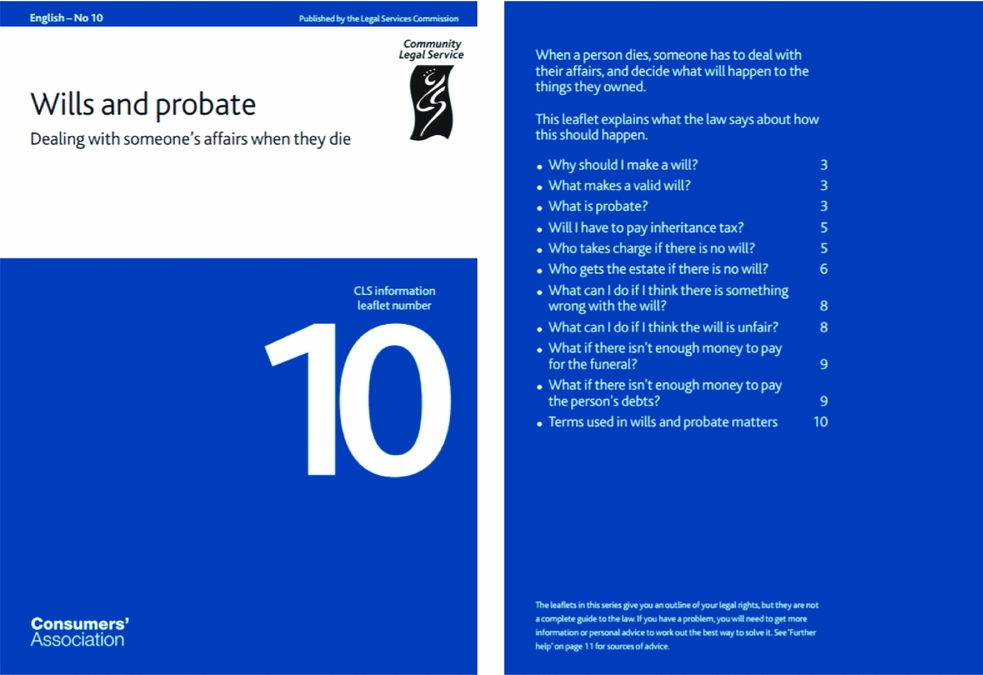
The leaflet provided basic information on the requirements for valid wills, the consequences of dying intestate (including a brief sentence indicating the situation for those not ‘married to or in civil partnership with’ their partner), and sources of further information and advice about wills. Significantly, the first text (page 3) covered ‘Why should I make a will?’ with additional particularly relevant sections on ‘What makes a valid will?’, ‘Who takes charge if there is no will?’ and ‘Who gets the estate if there is no will?’ The front cover and contents page of the leaflet are shown in Figure 1.
The front cover and contents page of the wills and probate information leaflet received by the intervention group

Four of ten pages set out substantive information about the law that concerned intestacy and reasons for making a will, including the ‘Why should I make a will?’ section on page 3 (the first text after the contents page), which read:
When you make a will, you can say how your funeral should be dealt with, and what will happen to your possessions and other assets (your ‘estate’) when you die. If you die without making a will (called ‘dying intestate’), it can be complicated to work out who will get what. If you die without a will, the law sets out how your estate is to be shared out – which means it might not go to the people you want it to. This could have very serious consequences: for example, depending on your family situation, your husband or wife might have to sell the family home to give your children the money they are entitled to.
The objective of the experiment was to ascertain whether this ‘intervention’ impacted on the likelihood of respondents subsequently making a will. Those 2010 CSJPS respondents not selected to receive the leaflet were not given any information about wills.
It should be noted that while the leaflet detailed why respondents should have a will, it was not designed specifically for the purposes of the study. Importantly, it was available and in use throughout England and Wales at the time of the experiment.
The CSJPS was the first legal needs survey worldwide to integrate (randomised) experimental research into its design, with this study one of a number included. Others included research on knowledge of marriage/cohabitation rights (Pleasence and Balmer, Reference Pleasence and Balmer2012), knowledge of consumer, employment and housing rights (Pleasence et al., Reference Pleasence, Balmer and Denvir2017) and the impact of different forms of between-wave engagement on response to longitudinal surveys (Cleary and Balmer, Reference Cleary and Balmer2015).
Analysis
In exploring findings from the CSJPS we first examine the demographics of will making among survey respondents, looking at the factors distinguishing those who reported having a will from those who reported not having a will, including the relationship with age and income. We then explore the results of our experiment, with whether or not respondents had made a will in the past eighteen months (since the initial interview) analysed on the basis of whether they were in the will and probate information leaflet or control (no leaflet) group. Since a large number of participants were included in the experiment (2,177 randomised into the leaflet and no leaflet groups) randomisation ensures a good balance of baseline variables between the two groups, with covariate adjustment making little difference (Pocock et al., Reference Pocock, McMurray and Collier2015). In addition, in this type of randomised experiment, unadjusted analysis provides an unbiased estimate of the treatment effect. Consequently, primary analysis took the form of a simple chi-squared test. Findings were then contextualised with an assessment of cost/benefit.
Results
The demographics of will making
In line with findings from elsewhere, the CSJPS indicated that only a minority of the population of England and Wales have wills. As suggested by the recent Will Aid (2014) survey, the percentage of CSJPS respondents with wills increased between 2010 and 2012, from 41 per cent to 43 per cent.
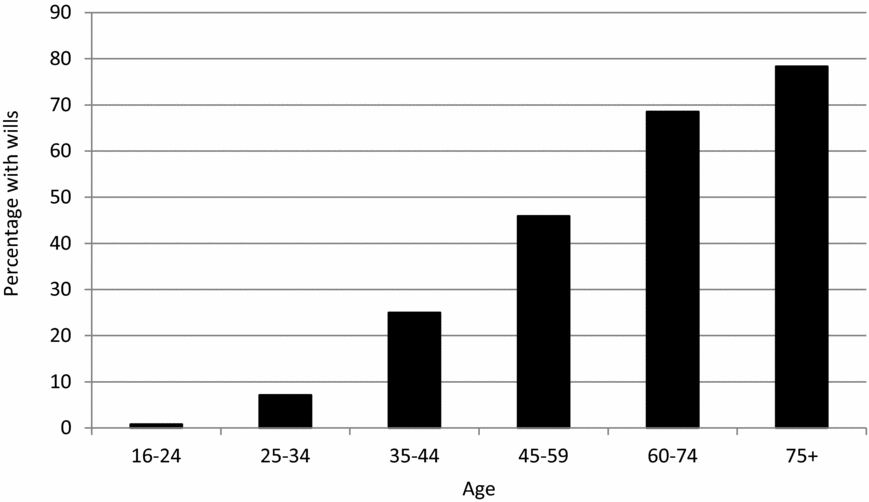
Looking at the 2012 CSJPS, the social patterning of wills was evident. As can be seen from Figure 2, there was a gulf between the extent to which the youngest and oldest age groups had wills. While just 1 per cent of those under the age of twenty-five had wills, the figure was 78 per cent for those over the age of seventy-five.
Percentage of general population with wills, by age

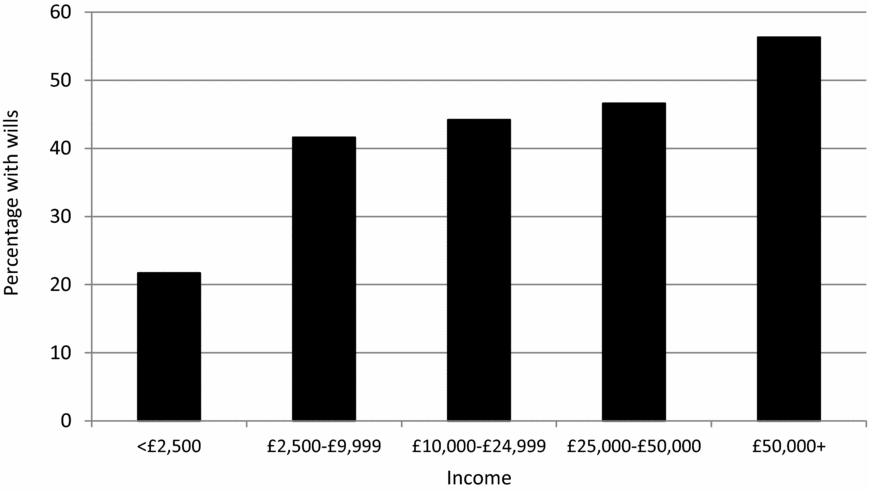
Furthermore, as can be seen from Figure 3, there was also a gulf between the extent that those on the lowest and highest personal incomes had wills. While 22 per cent of those earning less than £2,500 per year had wills, the figure was 56 per cent for those earning £50,000 or more.
Percentage of general population with wills, by income

Linked to this, differences were also seen in relation to (for example) professional status, and form of tenure. While just 14 per cent of those living in the rented sector had wills, the figure rose to 37 per cent for those with a mortgage and 74 per cent for those who owned their homes outright. Similarly, while just 28 per cent of routine manual and service workers had wills, the figures were 44 per cent for clerical and intermediate workers, 48 per cent for traditional professionals and 58 per cent for senior managers and administrators.
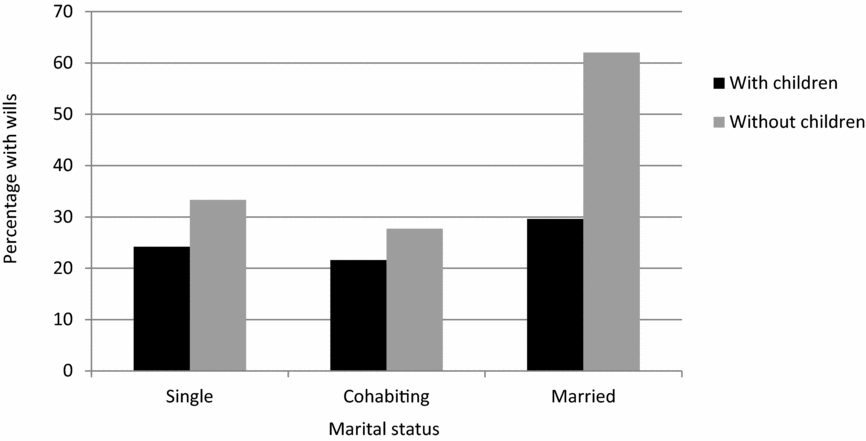
Also, confirming previous findings that cohabitees – a group that can be particularly disadvantaged by the intestacy rules – are less likely than those who are married to have wills, the 2012 CSJPS found that just 26 per cent of cohabitees had wills, compared to 53 per cent of those who were married. Moreover, within both these groups, those with dependent children were significantly less likely to have wills. So, as can be seen from Figure 4, while just 22 per cent of cohabitees with dependent children had wills, the figure was 62 per cent for those who were married and had no children.
Prevalence of wills by marital status and children

Differences in the prevalence of wills were also observed in relation to ethnicity and religion. For example, black and minority ethnic CSJPS respondents reported having wills on far fewer occasions than white British respondents (17 per cent vs. 46 per cent). And linked to this, unexpectedly (as Islam places emphasis on having a will, or al wasiyah), not a single Muslim CSJPS respondent reported having a will (compared to 47 per cent of Christians and 29 per cent of those with no religion). However, for most religions, numbers were too small to allow for a reliable comparison.
Finally, there were differences in the prevalence of wills by health and disability status; though there was a significant disparity between long-term health and disability generally and mental health. In the former case, those 2012 CSJPS respondents who reported having a long-term limiting illness or disability were more likely to have a will than others (51 per cent vs. 40 per cent), perhaps indicating more common reflection on mortality. However, in the case of mental illness, the position was reversed (38 per cent vs. 44 per cent).
Results of the experiment
Of the 2,177 CSJPS respondents in 2010 without a will 1,021 (47 per cent) were randomly selected to receive the Dealing with a Will leaflet (the intervention), with the remaining 1,156 (53 per cent) receiving no information. Of the 1,021 selected to receive the leaflet, 858 (84 per cent) actually received it. Of those who did not receive a leaflet many suggested that they had already received one (i.e. their spouse had already received one in an earlier household interview). A number also refused the leaflet on the basis that it was not wanted or needed. The results were analysed on the basis of whether or not respondents were randomly selected to receive the leaflet rather than whether or not they actually received it. This is known as ‘intention-to-treat’ analysis and is designed to avoid potentially misleading results as a consequence of non-random attrition of participants or crossover (into other conditions).
1,387 (64 per cent) of the original participants in the experiment were re-interviewed eighteen months later as part of the 2012 CSJPS. Of the 654 remaining respondents who had been selected to receive the leaflet, fifty-two (8 per cent) made a will between interviews. Of the 729 respondents not selected to receive the leaflet, fifty-two (7 per cent) had since made a will. The difference (0.9 per cent) fell well short of statistical significance (using a simple chi-squared test; χ21 = 0.33, p = 0.57).
Significance, effect size and cost-benefit
The difference observed in will making rates between the intervention and control groups was small and consequently not statistically significant. Were a separate experiment to be undertaken to determine whether an information leaflet such as the Dealing with a Will leaflet actually results in an additional 1 per cent of those without wills going on to make a will, then – assuming an alpha level (risk of a false positive, or Type I error) of 0.05 and power of 0.8 (likelihood of avoiding a false negative, or Type II error) – a sample size of around 30,000 would be required.
While the observed difference was small, this does not necessarily mean that a 0.39 per cent increase in will prevalence (through 1 per cent of those people without a will going on to make one when they would otherwise not have done so) is of practical insignificance. Supposing a cost of leaflet delivery of £2, the cost of each additional will made would be just over £500. The practical significance of the observed difference (were it not a product of chance) would therefore depend upon the balancing benefits of avoiding intestacy (and, in social policy terms, who would bear the cost and reap the benefit). Of course, this is largely speculative, since the experiment did not demonstrate that the provision of the ‘Wills and Probate’ leaflet resulted in an increase in will making.
Discussion and conclusion
Our findings confirm that only a minority of the population of England and Wales have a will, and that having a will is socially patterned. The prevalence of wills clearly increases with age and wealth and is lower among ethnic minorities, as has been found previously (National Consumer Council, 2007; DiRusso, Reference DiRusso2009; Douglas et al., Reference Douglas, Woodward, Humphrey, Mills and Morrell2011; Will Aid, 2014). Our findings also highlight that, despite the greater hazards of intestacy for cohabitees, cohabitees are among the least likely to make wills; a situation sometimes compounded by the general association of children with lower wills prevalence.
As regards the experiment run within the CSJPS, with a view to determining whether the targeted distribution of generic legal education materials might generate an observable impact on will prevalence, our findings fell well short of statistical significance. The observed differences between the intervention and the control groups were of a small magnitude (0.9 per cent). In order to determine whether this difference was a real effect (assuming it were indeed 0.9 per cent), we would require a sample size of around 30,000; substantially greater than the CSJPS experiment sample size of just over 2,000. Clearly there are difficulties in testing the statistical significance of an intervention where the impact of the intervention may be very small. These challenges diminish where the sample size of the survey increases or where the effect size increases, and further experiments in this area may be better focussed on increasingly bespoke, targeted and practically focussed interventions.
We would urge caution in placing too much emphasis on this challenge as indicative of the merits of surveys as a vehicle for testing initiatives. The aim of this study was not to test the efficacy of all PLE interventions, but rather to test the efficacy of a specific type of intervention with a specific group in a specific type of law. It is important not to overgeneralise the results. A small effect size meant that we were not able to conclusively ascertain the impact of our intervention but this will not be true of all interventions. Further, we must not overlook the practical benefits that arise. Small (statistically insignificant) effects deriving from a low cost intervention have practical significance and can play a role in helping policy-makers better assess and contextualise the cost/benefit of a social policy initiative in many social policy settings where it is impossible to estimate the likely cost/benefit of an intervention.
As it relates to social policy in respect of public legal education and intestacy, the findings of this study – notably the effect size observed between groups – does raise questions regarding the impact of information provided in certain forms, as well as the appropriate timing of educational intervention. Setting aside the potential for information to be distributed in a relatively cost-effective manner in a survey, our results call into question whether a more appropriate social policy intervention might coincide with life events that have ramifications for inheritance.
While in many situations it is not practical or desirable to intervene ‘just in time’ (i.e. immediately before the need for a will emerges) it may be practical to intervene at other times. Many life events trigger an interaction with the Government: when an individual moves into full time work; enters into marriage; when children are born or start school; when assets are purchased; or when ill-health leads to medical treatment. These events provide scope to capitalise on what other studies have identified as existing catalysts for action (Sussman et al., Reference Sussman, Cates and Smith1970; Tilse et al., Reference Tilse, Wilson, White, Rosenman and Feeney2015) by providing information ‘just in time’ or, perhaps more aptly, ‘just at the right time’.
There are also further avenues of research that must be explored. While our intervention tested the impact of information provision, it is possible that other behavioural nudges are more effective in bringing about action. As previously discussed, variations in the timing or type of information may produce a greater effect size. Similarly, testing other types of interventions (such as economic incentives, the provision of DIY will-kits, longer term education programmes) may yield different results, which help inform social policy makers as to ‘what works’.
In a climate of austerity, there is even greater pressure on policy makers to ensure that limited public resources are directed towards initiatives where impact can be demonstrated. Our experiment illustrates the possibility of opportunistic experimentation as a means by which to test the potential impact and cost/benefit of an intervention. The efficacy of the particular form of intestacy information intervention tested here appears limited. However, the methodology employed within this study points to the possibility of more bespoke and substantial initiatives in the future and suggests that there is merit to considering what role surveys may have in the validation and testing of social policy interventions, prior to wider roll-out.
Acknowledgements
We are very grateful to The Legal Education Foundation for funding this work and to the 5,113 respondents who gave their time to take part in our survey.