Introduction
Annual lung cancer screening is now recommended by the US Preventive Services Task Force and other guideline groups for current and former smokers between ages 55–80 with a history of smoking at least 30 pack-years over their lifetime (Centers for Medicare and Medicaid Services, 2015; Moyer & Force, Reference Moyer and Force2013). Healthcare providers, insurers, and medical and professional organisations recognise that implementation of this recommendation must include smoking cessation support for current smokers. The Centers for Medicare and Medicaid Services requires smoking cessation be discussed as part of offering screening (Centers for Medicare and Medicaid Services, 2015). There is limited evidence about how to effectively tailor or implement cessation counselling in this important high-risk population (Fucito et al., Reference Fucito, Czabafy, Hendricks, Kotsen, Richardson and Toll2016).
Despite the recommendations and requirements to offer counselling, multiple barriers exist to integrating counselling into screening delivery (Hung, Leidig, & Shelley, Reference Hung, Leidig and Shelley2014). The Veterans Health Administration's (VHA) Lung Cancer Screening Demonstration Project identified preliminary implementation challenges associated with integrating smoking cessation including limited resources, staff time, and training to effectively support smokers in cessation efforts, uncertainty about which provider is responsible for addressing cessation, and challenges with timing and coordination of cessation in the screening process (Kinsinger et al., Reference Kinsinger, Anderson, Kim, Larson, Chan and King2017; Zeliadt et al., Reference Zeliadt, Heffner, Sayre, Klein, Simons and Williams2015). This adds to the substantial literature acknowledging that despite recognising the importance of supporting smokers to quit, many providers struggle to implement guideline recommended tobacco treatments and often are unenthusiastic about discussing cessation (Jamal, Dube, Malarcher, Shaw, & Engstrom, Reference Jamal, Dube, Malarcher, Shaw and Engstrom2012). Even in the National Lung Screening Trial, only 10% of current smokers received full cessation support, including being offered cessation medications (Park et al., Reference Park, Gareen, Japuntich, Lennes, Hyland and DeMello2015). A recent survey by Ostroff, Copeland, Borderud, Shelley, and Henschke (Reference Ostroff, Copeland, Borderud, Li, Shelley and Henschke2015) of 97 lung cancer screening clinics identified that although clinics universally reported that promoting smoking cessation was a priority, just 57% reported routinely providing counselling, and only 37% reported they routinely made recommendations for cessation medications. A focus of this intervention was to enlist a telephone counsellor, who does not face clinic time constraints, to overcome these provider barriers.
There are also many potential patient barriers to delivering cessation in the screening context (Slatore, Baumann, Pappas, & Humphrey, Reference Slatore, Baumann, Pappas and Humphrey2014; Solberg, Maciosek, Edwards, Khanchandani, & Goodman, Reference Solberg, Maciosek, Edwards, Khanchandani and Goodman2006). These barriers include a lack of interest in discussing cessation as part of the screening process, low self-efficacy to quit, exaggerated beliefs about the protective value of screening, and a false sense of reassurance about individual risk or unintended ‘license to smoke’ when screening results are not directly worrisome for cancer (Zeliadt et al., Reference Zeliadt, Heffner, Sayre, Klein, Simons and Williams2015). Long-term smoking is also stigmatising, and guilt with previous unsuccessful cessation attempts may interfere with patients asking for support from their providers (Solberg et al., Reference Solberg, Maciosek, Edwards, Khanchandani and Goodman2006). The intervention was designed to specifically target these barriers.
Currently, there is limited guidance about how evidence-based practices should be adapted and implemented in the lung cancer screening setting (Fucito et al., Reference Fucito, Czabafy, Hendricks, Kotsen, Richardson and Toll2016). A small study of 18 patients integrated 12 weeks of cessation support and visits with a medical oncologist into the screening process, suggesting that providing tobacco dependence treatment prior to screening may help encourage cessation (Ferketich et al., Reference Ferketich, Otterson, King, Hall, Browning and Wewers2012). Taylor et al. (Reference Taylor, Hagerman, Luta, Bellini, Stanton and Abrams2017) recently reported promising findings for a study of 92 patients, of whom half were offered six telephone counselling sessions by their screening program. Although both the counselling and usual care group had similar rates of self-reported abstinence and identical rates of readiness to quit, 30% in each group, the rate of biochemically confirmed abstinence was higher among the counselling group (17.4%) compared to the usual care group (4.3%); p = 0.04. This preliminary data provided support for a subsequent multicentre trial.
These pilot trials do not address questions about the optimal intensity and level of targeting of cessation counselling needed for the lung cancer screening context. A review of early studies of cessation interventions in lung cancer screening context by Piñeiro, Simmons, Palmer, Correa and Brandon (Reference Piñeiro, Simmons, Palmer, Correa and Brandon2016) noted that the evidence base of what constitutes effective interventions in this context is limited, and that providing some direct support is likely necessary as provision of educational and self-help tools has not demonstrated any meaningful effect (Ostroff et al., Reference Ostroff, Copeland, Borderud, Li, Shelley and Henschke2015). The content of counselling sessions has been highlighted as a priority for research. Piñeiro et al. (Reference Piñeiro, Simmons, Palmer, Correa and Brandon2016) highlighted that interventions focused on the latter steps of the 5A's model, ‘Ask, Advise, Assess, Assist, and Arrange’, notably talking with patients about how to get assistance with quitting through pharmacotherapy and behavioural support, and specifically arranging their use, were the only types of interventions with demonstrated effectiveness. This review also highlighted the uncertainty of how to use lung cancer screening as a motivator or teachable moment, concluding that interventions should include an exploration of risk perceptions, beliefs, and expectations about lung cancer and smoking-related diseases in relation to screening.
Building on the evolving evidence-base in this area, we developed a telephone-delivered smoking cessation intervention to address both the organisational and patient barriers to smoking cessation. The main aim of this pilot trial was to demonstrate the feasibility of having a provider unaffiliated with the patient's existing care team proactively contact screening participants to ensure smoking cessation is adequately addressed and connect patients with cessation support, as this is a critical barrier in the VA setting in which a wide range of providers initiate screening discussions (Kinsinger et al., Reference Kinsinger, Anderson, Kim, Larson, Chan and King2017).
Methods
Study Design and Setting
Current smokers who were offered screening at four VA medical centres (NY Harbor, NY, Portland, OR, Charleston, SC, and Durham, NC) were identified by a research assistant located at the study site (Seattle, WA) using weekly data extractions from the VHA's National Corporate Data Warehouse. Once identified based on procedure codes, the research assistant reviewed provider notes to determine each Veteran's smoking status. Current smokers identified as having an upcoming screening visit and could be contacted by phone prior to receiving their screening results were assigned to the intervention group; individuals who had recently been screened and had already received their screening results when identified during the weekly data extractions were assigned to the control group, similar to a waitlist control study design. Both groups were sent study invitation packets, which for intervention participants described the two-call intervention and subsequent telephone evaluation survey, and for control participants described only a telephone evaluation survey about lung cancer screening. The invitation packets included contact information to call if the recipient was interested in participating in the study, as well as an opt-out postcard and a telephone number if a potential participant did not want to be contacted. We waited 10 business days after the invitation packet had been mailed and attempted to reach potential participants who had not yet contacted the study office. Participants in both groups received lung cancer screening care as it was provided by their medical centre, which included screening results letters providing the national VA Quitline number (1-855-QUIT-VET) and access to tobacco treatment services at their facility. All study procedures were reviewed by VHA's Central IRB, which included a verbal consent protocol, a waiver of documentation of informed consent and a HIPAA waiver. Intervention participants were reimbursed $25 for all three study activities, and control participants $10 for completing the telephone evaluation.
Intervention Description
Lung cancer screening is cognitively stimulating for many individuals as it raises the possibility of identifying cancer (Volk et al., Reference Volk, Linder, Leal, Rabius, Cinciripini and Kamath2014). We designed the intervention content to respond to this stimulation guided by the Extended Parallel Process Model (EPPM), which is a theory of health communication that focuses on how individuals react to personal risk, and proposes that engagement in protective action requires both understanding of a perceived threat as well as sufficient self-efficacy that they can do something about it (Gore & Bracken, Reference Gore and Bracken2005; Reference WitteWitte, n.d.). Messages that do not present a way to control fear or are perceived as too difficult contribute to maladaptive responses such as denial or avoidance. Thus, we combined messaging that acknowledged the perceived threat of lung cancer and harm from tobacco use, with support for positive behaviours including participating in screening and utilisation of available cessation support tools. Messages were designed to reduce the possibility that patients misunderstood their susceptibility to the health harms of smoking and avoid exaggerated beliefs about protection provided by screening. We attempted to convey the message that while screening is a first step to action, the use of smoking cessation treatment is an additional, even more powerful step, and one that is both needed and possible to combine with screening. Motivational interviewing (MI) strategies were used to enhance self-efficacy for attempting cessation, and facilitate decision making about smoking cessation (Miller & Rollnick, Reference Miller and Rollnick2002). Example, MI strategies for building motivation and self-efficacy include rolling with resistance to change smoking behaviour; eliciting Veterans’ concerns about the other health risks of smoking, including health, financial, relationship, and spiritual; reinforcing personal successes in cutting down or quitting in the past; and reframing past failures as learning opportunities. Calls were tailored based on readiness to quit, and we discussed prior quit attempts with smokers who expressed frustration when they had previously tried quitting. Each call included the offer of a warm handoff to the VA Quitline, which is a centralised support call centre familiar with available tobacco treatments at VA medical centres including in-person support groups, and is trained in providing support for Veterans related to nicotine replacement therapy and other medications according to the VHA formulary. All intervention calls were delivered by a clinical psychology postdoctoral fellow with previous experience in smoking cessation and MI (PG). Sessions followed a written treatment manual outlining key session activities. All post-results calls were recorded. One of the authors (PK), a licensed clinical psychologist with expertise in MI, coded a random sample of 50% (14 of the 27) calls that patients gave us permission to record. Calls were coded using a standardised form and assessed the presence of key cessation counselling skills across four domains: treatment alliance (7 items), counselling skills (9 items), cessation planning (8 items), and discussion of screening results considering smoking (4 items).
Measures
A telephone evaluation survey was conducted approximately four weeks after each patient had been notified of their screening results. This telephone survey was conducted by the research coordinator who mailed the invitation packets and fielded phone calls from interested participants. He also helped schedule the intervention counselling calls, but was not directly involved in any counselling sessions. Because lung cancer screening in VHA focuses on connecting participants with VHA tobacco control services, we assessed whether the participant reported use of any behavioural support service including: (a) connecting with the VA Quitline, (b) an appointment with a tobacco treatment counsellor, or (c) participation in a group counselling session. Secondary outcomes included seven-day self-reported cigarette abstinence and seven-day abstinence from any tobacco product, motivation to quit as measured by the Contemplation Ladder (Biener & Abrams, Reference Biener and Abrams1991), the 3-item Stages of Change algorithm (Etter & Sutton, Reference Etter and Sutton2002) and a single item cessation self-efficacy measure. Intervention participants were asked four additional items about their satisfaction with participating in the intervention based on items from Consumer Assessment of Healthcare Providers & Systems (CAHPS).
Data Analysis
The sample size for the pilot trial was based on guidelines for Stage I treatment development projects (Rounsaville, Carroll, & Onken, Reference Rounsaville, Carroll and Onken2001). Frequencies and descriptive statistics are reported, along with estimates of the intervention effect size using risk ratios and 95% confidence intervals rather than null hypothesis significance testing as is appropriate and recommended for the pilot trial (Kleinman & Norton, Reference Kleinman and Norton2009; Munafo & Wileyto, Reference Munafo and Wileyto2015). All analyses were conducted using Stata 14 (StataCorp LLC).
Results
Study Participation and Feasibility
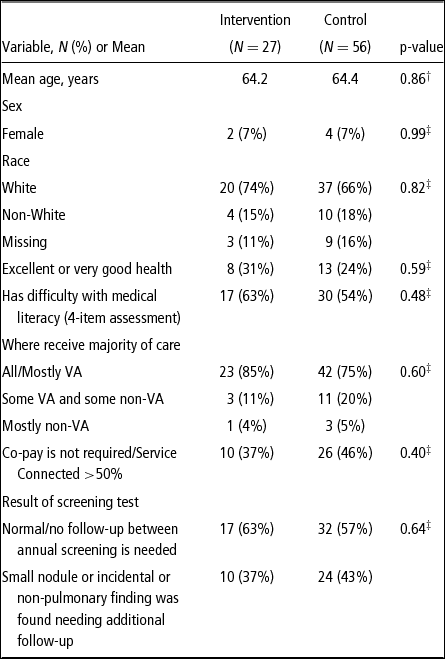
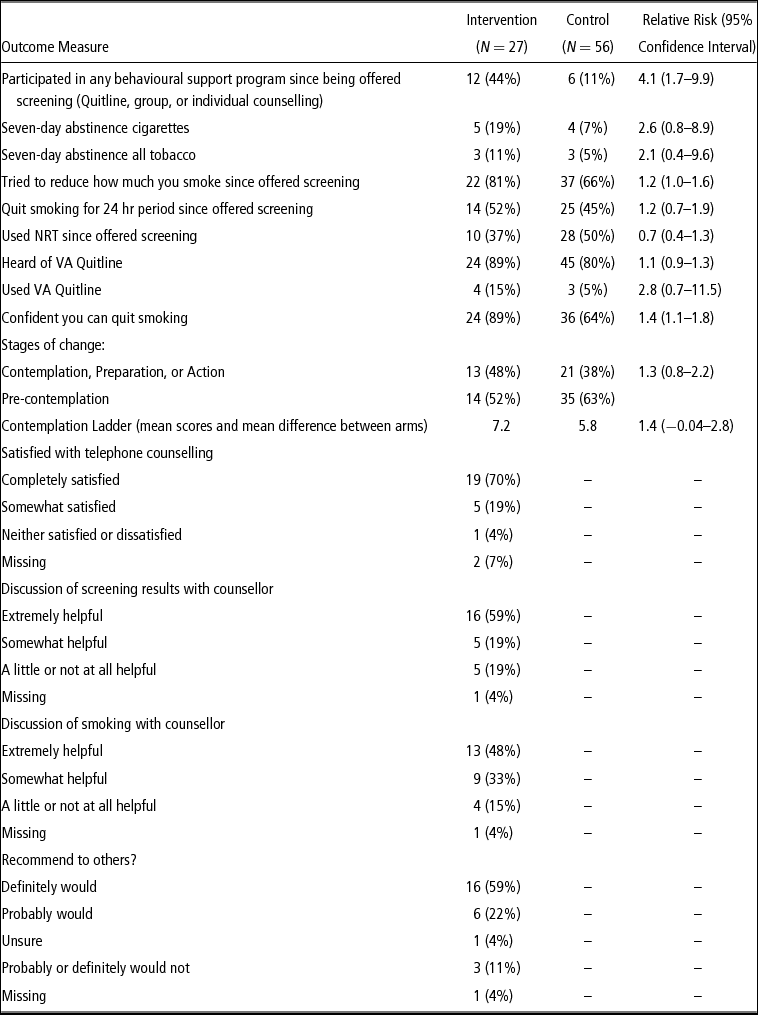
Overall, 28 of 98 (28%) individuals approached participated in the two-call research intervention, and 27 (28%) participated in the telephone evaluation. The average length of the recorded post-results intervention call was 25 minutes ranging from 7 to 49 minutes. Of the 141 participants approached for the control evaluation, 56 (40%) participated. Both groups were similar to each other in demographic and clinical characteristics (Table 1), and participants were similar to those who were approached but declined participation in demographic characteristics available in the EMR as well as to the demographics of Veterans participating in lung cancer screening nationally across VHA including age, race, and sex (Kinsinger et al., Reference Kinsinger, Anderson, Kim, Larson, Chan and King2017). Enthusiasm for the intervention was high, with 89% of participants reporting they were satisfied with the proactive telephone calls and 81% indicated that they would definitely or probably recommend participating in the calls to a friend (Table 2). Specifically, 78% reported that discussions about their screening results were helpful, and 81% indicated they found the support about smoking cessation to be helpful (Table 2).
Participant characteristics

†T-test.
‡Two-sided Fisher's exact test for small sample sizes.
Study outcomes

Treatment Use
More intervention participants utilised behavioural cessation support services compared to control participants (44% vs. 11%; Table 2). This represents a four-fold positive effect size of the intervention (Relative Risk (RR) 4.1; 95% confidence interval (CI): 1.7–9.9). This pilot activity was intended to demonstrate that proactive outreach is feasible for connecting patients with the existing national VA Quitline resources; directly providing separate cessation counselling outside of this existing resource was beyond the scope of this pilot study. We stratified the findings by whether patients had a finding that required short-term follow-up or had normal findings with a recommendation for repeat annual screening. Notably, the intervention effect size was nearly doubled among patients with a finding that required short-term follow-up. Among these patients, 8% of the control reported using cessation services compared to 50% of the intervention group; the relative risk was 6.0 (95% CI: 1.4–26.0). Among patients who had normal findings, 13% of the control group reported using cessation support services compared to 42% of the intervention group representing an effect size of 3.3 (95% CI: 1.1–9.7).
Cessation and Behaviour Change Process Outcomes
For the secondary outcome of cessation, more participants receiving the intervention reported seven-day abstinence from cigarettes two weeks after receiving their screening results compared to control participants (19% vs. 7%, RR: 2.6; 95% CI: 0.8–8.9). Process outcomes, including key intervention targets of motivational readiness and self-efficacy to quit, were better among intervention participants (Table 2). Mean scores on the Contemplation Ladder were higher for the intervention group (7.2) compared to the usual care group (5.8); p = 0.06. More intervention participants indicated they had high confidence they could quit compared to control participants (89% vs. 64%, RR: 1.4; 95% CI: 1.1–1.8). Most participants in both groups reported they were familiar with the VA Quitline, although more intervention participants reported using it than control participants (15% vs. 5%, RR: 2.8; 95% CI: 0.7–11.5). One unexpected finding was that overall pharmacotherapy use was high among both groups with fewer intervention participants reporting utilising medications since participating in screening compared to control participants (37% vs. 50%, RR: 0.7; 95% CI: 0.4–1.3).
Treatment Fidelity
Fidelity was generally high across all four treatment domains for the 14 calls we reviewed. The mean score for treatment alliance was 6.9/7, the mean for counselling skills was 7/9, the mean for cessation planning was 6.6/8. Discussion of screening results in light of smoking deviated slightly from the treatment manual (2.7/4). Notably, specific mention of the importance of stopping smoking relative to screening was only mentioned in 3 of 14 calls coded.
Discussion
These pilot-trial findings strongly suggest that proactive telephone smoking cessation counselling using a motivation enhancing EPPM-based protocol is feasible to integrate into lung cancer screening care delivery, even by a provider with whom the patient has not had a prior relationship. The intervention was well received by participants and was associated with promising increases in utilisation of behavioural cessation counselling. Considering that 40% of Veterans invited to participate in the assessment-only control group agreed to do so, the 28% acceptance rate for the intervention activities suggests that a majority of Veteran smokers who are amenable to research participation were willing to accept a proactively delivered smoking cessation intervention. As a feasibility study, randomisation was not necessary and the scope of the study was not powered to detect differences in gold standard cessation outcomes (e.g. biochemically confirmed abstinence rates). Pragmatic trials, in which patients are randomised between two or more forms of usual care activities, are important in this context to inform delivery systems about real-world effectiveness of alternative approaches. These findings are important because they provide necessary justification for a pragmatic trial to evaluate the effectiveness of proactive telephone counselling routinely integrated into care.
There have been few studies of interventions to improve quit rates in the lung cancer screening context, primarily resulting in null findings (Clark et al., Reference Clark, Cox, Jett, Patten, Schroeder and Nirelli2004; Ferketich et al., Reference Ferketich, Otterson, King, Hall, Browning and Wewers2012; Marshall et al., Reference Marshall, Courtney, Passmore, McCaul, Yang and Bowman2016; van der Aalst, de Koning, van den Bergh, Willemsen, & van Klaveren, Reference Van der Aalst, de Koning, van den Bergh, Willemsen and van Klaveren2012). This pilot trial is innovative in its focus on connecting cessation counselling with screening results. The Centers for Medicare and Medicaid Services requires that cessation is addressed during the initial screening decision making process; however, our study and the emerging literature suggests that continuing to address cessation after the results are reported may also be critical to effective support (Fucito et al., Reference Fucito, Czabafy, Hendricks, Kotsen, Richardson and Toll2016; Piñeiro et al., Reference Piñeiro, Simmons, Palmer, Correa and Brandon2016; Taylor et al., Reference Taylor, Hagerman, Luta, Bellini, Stanton and Abrams2017). This approach has broad dissemination potential through the existing infrastructure of telephone tobacco quitlines, which are available in all 50 states and have been shown to be effective and cost-effective at increasing cessation (Joyce et al., Reference Joyce, Niaura, Maglione, Mongoven, Larson-Rotter and Coan2008). Prior work suggests that the delivery of screening results is a critical time for cessation support, as many current smokers will potentially misinterpret their screening findings as suggesting that their smoking has not harmed them (Zeliadt et al., Reference Zeliadt, Heffner, Sayre, Klein, Simons and Williams2015). Communicating screening results is challenging and must focus on several priorities in addition to smoking cessation, including clearly reporting the findings of the test and encouraging patients to return for repeat annual screening or short-term follow-up if necessary. The use of dedicated telephone counsellors, who have expertise in MI, may help ensure that cessation counselling is repeatedly and consistently delivered allowing primary care clinic staff to focus on clinical activities including the logistics of coordinating future visits (Ferketich et al., Reference Ferketich, Khan and Wewers2006; Jamal et al., Reference Jamal, Dube, Malarcher, Shaw and Engstrom2012; Park et al., Reference Park, Gareen, Japuntich, Lennes, Hyland and DeMello2015; Solberg et al., Reference Solberg, Maciosek, Edwards, Khanchandani and Goodman2006).
Our study findings are consistent with the emerging literature of smoking cessation in the context of lung cancer screening. Notably, our finding that the effect of the intervention was stronger among patients who had a screening result requiring short-term follow-up is similar to studies suggesting positive findings may be a stronger teachable movement (Slatore et al., Reference Slatore, Baumann, Pappas and Humphrey2014). Although the effect size was smaller among patients with normal screening results, the intervention was still positive, suggesting that counselling should be provided to all patients. Additionally, our findings are similar to the recently reported telephone counselling intervention offered by academic screening programs, which included a six session counselling protocol offered by the screening program (Taylor et al., Reference Taylor, Hagerman, Luta, Bellini, Stanton and Abrams2017). This study observed self-reported abstinence rates among patients receiving counselling of 22%, and biochemically confirmed abstinence rates of 17%, which is similar to our self-reported rate of 19%. These findings begin to address gaps in the literature noted by Piñeiro et al. (Reference Piñeiro, Simmons, Palmer, Correa and Brandon2016) and suggest that interventions tailored to this population and setting may provide additional benefit. However, questions remain about the timing, frequency, and intensity of these interventions, although evidence exists elsewhere that extended interventions may be no more effective than brief interventions (Moyer et al., Reference Moyer, Finney, Swearingen and Vergun2002).
There are several potential study limitations. The small size of the trial limits interpretation of the four-fold positive effect. For example, in discussing the unexpected higher rates of reported use of cessation medications in the control group, we discovered that one clinic initiated a policy of providing NRT lozenges to screening participants during the period when control subjects were being assessed. Additionally, we enrolled patients based on being offered screening by their provider and their provider's ascertainment of their smoking history. Notable details such as pack-year history, age of initiation of smoking, or current smoking intensity were infrequently recorded in the EHR when screening was offered. It is possible that smoking intensity may have been different between the intervention and control groups when screening was offered. Such confounding factors in non-randomised pilot trials can only be addressed in a fully-powered, randomised pragmatic trial. However, increased utilisation of NRT in the control group resulting from a change in usual care should lead to an attenuation of the observed effects of the intervention. Thus, our preliminary effect size may be an underestimation of the true effect. Another limitation is that our telephone counsellor was not able to directly provide medications or cessation assistance. Our calls were intentionally brief, intending to evoke smokers’ motivation and connect them to the VA Quitline rather than replicate the cessation support offered by the Quitline or the participant's medical centre. It is possible that arranging medications during the calls or more closely integrating with the Quitline cessation counselling protocol would further increase abstinence rates. Neither participants nor the study team were blind to participation in the intervention or evaluation activities, which may have inadvertently introduced social desirability bias in participants’ survey responses or experimenter bias by the interviewers during evaluation survey. To address this, we used separate telephone interviewers for the evaluation survey, and a uniform script was used across both groups although the last questions about satisfaction with the intervention unblinded the interviewer at the end of the script. Although we attempted to mimic routine care as closely as possible, this was a research study and participants were approached by asking them to volunteer in a research activity. Thus, our participation rate may not be reflective of offering proactive support as part of clinical care. The centre where the study was conducted required outgoing phone calls to be identified on caller ID as ‘Unknown Caller’ which may have limited participation compared to known labels such as ‘VA Medical Center.’ Although the study was intended to determine the feasibility of providing proactive outreach by a third party telephone counsellor who is not part of the patient's care team, our findings may not generalise to other settings if the telephone counsellor is not perceived as being integrated into the healthcare system. We do highlight that demographics of Veterans who participated in the intervention are very similar to Veterans who are eligible for lung cancer screening nationally (e.g. nationally mean age of screening eligible Veterans is 64.8 years and 3.5% are female) (Kinsinger et al., Reference Kinsinger, Anderson, Kim, Larson, Chan and King2017).
Overall, these findings suggest that integrating risk messages with brief motivational interventions when counselling current smokers participating in lung cancer screening, both before screening and after they have their screening results, can be a valuable component of lung cancer screening delivery. This study demonstrates that this counselling can potentially be delivered by a telephone counsellor with whom the patient has not previously interacted during an in-person clinic visit.
Acknowledgements
The findings and conclusions in this article are those of the author(s) and do not necessarily represent the official position of the Department of Veterans Affairs or the Centers for Disease Control and Prevention. We would like to acknowledge Dr. Kim Hamlett-Berry and Dr. Dana Christofferson in VHA's Office of Tobacco and Health for support and guidance in designing the study to address potential implementation of the intervention activities in VHA's Quitline program. We also would like to acknowledge Dr. Linda Kinsinger (retired) and Dr. Jane Kim in VHA's National Center for Health Promotion and Disease Prevention for guidance in designing the intervention to be incorporated into routine lung cancer screening care within VHA as developed in the Lung Cancer Screening Clinical Demonstration Project.
Financial Support
This work was supported by the Department of Veterans Affairs Office of Research and Development, Health Services Research and Development Service, (PI: Zeliadt, PPO-14-130), and is a product of a Prevention Research Center supported by Cooperative Agreement Number (14-011) from the Centers for Disease Control and Prevention.
Conflict of Interest
None.
Ethical Standards
The authors assert that all procedures contributing to this work comply with the VHA Handbook 1200.05: Requirements for the Protections of Human Subjects in Research as revised in 2014, and comply with the ethical standards of the relevant national and institutional committees on human experimentation and with the Helsinki Declaration of 1975, as revised in 2008.