Introduction
In conventional feeding systems, feed intake in laying hens is mainly controlled by energy intake and feed form (Bouvarel et al., Reference BOUVAREL, NYS and LESCOAT2011). In choice feeding systems, feed intake not only relies on dietary energy concentration, but also feed particle size and a specific appetite for Ca (Mongin and Sauveur, Reference MONGIN and SAUVEUR1974). In addition, in choice feeding systems, hens appear able to regulate their nutrient intake based on the daily egg formation cycle (Chah and Moran, Reference CHAH and MORAN1985; Leeson and Summers, Reference LEESON and SUMMERS2009).
Three choice feeding systems have been studied as alternatives to conventional feeding: the ‘free choice’ system which offers two or three diets in separate containers simultaneously. Hens are able to select between whole grains, a protein concentrate and Ca particles to meet their requirements (Robinson, Reference ROBINSON1985; Forbes and Covasa, Reference FORBES and COVASA1995). In ‘loose-mix feeding systems’ only one diet is offered throughout the day in a single trough, containing a mixture of the three dietary components, similar to those used free choice diets, with different particle sizes. This system allows the simultaneous distribution of different nutrients in a single diet and exploits the hen's ability to sort out whole grains, Ca particles and protein concentrate (Picard et al., Reference PICARD, MELCION, BOUCHOT and FAURE1997; Umar Faruk et al., Reference UMAR FARUK, BOUVAREL, MÊME, RIDEAU, ROFFIDAL, TUKUR, BASTIANELLI, NYS and LESCOAT2010a; Reference UMAR FARUK, BOUVAREL, MEME, ROFFIDAL, TUKUR, NYS and LESCOAT2010b). In sequential feeding, diets (most frequently two) with different compositions in energy, protein and Ca, are presented successively in the same trough throughout the day to supply specific nutrients required during sequential phases of the daily egg formation cycle (Umar Faruk et al., Reference UMAR FARUK, BOUVAREL, MÊME, RIDEAU, ROFFIDAL, TUKUR, BASTIANELLI, NYS and LESCOAT2010a; Reference UMAR FARUK, BOUVAREL, MALLET, ALI, TUKUR, NYS and LESCOAT2011; Traineau et al., Reference TRAINEAU, BOUVAREL, MULSANT, ROFFIDAL, LAUNAY and LESCOAT2013).
This review explores the physiological basis of the hourly changes in hen nutrient requirement elicited by egg formation and evaluates the impact of alternative feeding systems on egg production and quality.
Kinetic of egg component synthesis and secretion
Birds are oviparous and produce an egg every day which contains all the essential nutrients for the development of an embryo. The egg is composed of three main compartments, separated by membranes (vitelline membrane, eggshell membranes). Each compartment has a specific composition, an emulsion of triglyceride-rich lipoproteins and proteins in yolk, a salty solution of proteins in albumen and Ca carbonate (CaCO3) in the shell (Nys and Guyot, Reference NYS and GUYOT2011). Egg components are produced sequentially by two different anatomical structures, the ovary and the oviduct. The liver produces the egg yolk components. In hens, hepatic lipogenesis and lipemia are increased 15- and 20-fold, respectively, at sexual maturity (Etches, Reference ETCHES1996). Amongst the 10,000 oocytes present in the ovary at hatching, 2,000 oocytes develop slightly for about 60 days during the growth of the immature pullet. During the hen's production cycle, between five and eight follicles grow simultaneously for eight to ten days to insure a particular hierarchy (Etches, Reference ETCHES1996; Nys and Guyot, Reference NYS and GUYOT2011). Yolk synthesis is a continuous process in the liver of mature laying hens throughout the laying period and is regulated by sex steroid hormones and additional ovarian factors. The precursors of the yolk are transported via the bloodstream and deposited into the ovary during the last phase of rapid growth of the yolk for about eight days. At ovulation, the largest ovarian follicle releases a mature egg yolk into the oviduct. Following this, specialised segments of the oviduct synthesise and sequentially secrete the constituents of the outer vitelline membrane, the egg white (albumen), the shell membranes and finally the eggshell during the next 24 h.
This temporal and spatial sequence is precisely controlled by the hormonal secretion of the ovary and hypothalamus. All albumen proteins are continuously synthesised by the magnum. Protein synthesis occurs regardless of the presence or absence of an egg in the oviduct, but can be accelerated during the passage of the egg in the magnum (Muramatsu et al., Reference MURAMATSU, HIRAMOTO and OKUMURA1991). These authors estimated that the amount of protein that accumulated in granules at the apical region of secretory cells corresponded to that required for two eggs. In contrast, albumen proteins are secreted for only a short period of about 3h 30 min. Secretion occurs by pinocytosis and is induced by the dilatation of the magnum by the forming egg. The isthmus is the site where the two shell membranes are secreted for 1 h. Then the egg enters the uterus 6 h after ovulation and stays in this compartment for nearly 20 h. First, the egg is hydrated (plumping), attains its ovoid shape and, when in close contact with the uterine mucosa, the process of mineralisation is initiated. From 10 to 22 h after ovulation, a large quantity of CaCO3 is quickly deposited, together with a small proportion of proteins composing the organic matrix of the shell (Nys and Guyot, Reference NYS and GUYOT2011). This linear deposition is arrested about 2 h before egg expulsion (oviposition), when the shell is covered with the organic cuticle.
The transfer of eggshell precursors is a rapid process, as the material is continuously secreted at a high rate per hour (0.35g eggshell per hour from 10 to 22 hrs post ovulation). In the uterus no Ca storage occurs before shell formation. The amount of Ca needed for forming a shell is high (2 g), therefore the pool of blood ionic Ca is renewed every 12 min during the 12 h rapid shell deposition phase. Ca is provided directly by the diet or indirectly by bone resorption. Shell formation occurs mainly during the night when only low or no dietary Ca is available due to the absence of feed intake. Therefore, any dietary adjustment, such as the addition of large particles of Ca that synchronise intestinal supply with requirements for shell formation, can improve the eggshell strength (Mongin and Sauveur, Reference MONGIN and SAUVEUR1974; Nys, Reference NYS2017). Eggshell carbonates (CO3) are directly derived from blood CO2 and the pH reduction in the uterine fluid or plasma during shell formation facilitates the short-term supply of CO3 to the eggshell. The hourly regulation of uterine ionic transport is demonstrated by the stimulation of gene expression for some ionic transporters during the process of CaCO3 secretion (Brionne et al., Reference BRIONNE, NYS, HENNEQUET-ANTIER and GAUTRON2014; Nys and Le Roy, Reference NYS and LE ROY2018). The turnover of isotopic deposition of carbon in egg compartments (13C) reflecting the rate of protein synthesis has been explored by substituting wheat by maize in the laying hen diet (Segalen et al., Reference SEGALEN, MILLS, SEBILO, LABOURDETTE, VAURY and NYS2013). These cereals show different isotopic signatures and the replacement of one cereal by the other changes the dietary isotopic ration. This approach allows the kinetics of deposition in egg compartments after the introduction of the new dietary source of carbon to be explored. The first isotopic change in the respective egg compartment and the plateau (reflecting the duration of synthesis of the egg proteins) are reached after two and six days for albumen, four and 11 days for yolk but only one and two days for the eggshell, respectively (Segalen et al., Reference SEGALEN, MILLS, SEBILO, LABOURDETTE, VAURY and NYS2013). In conclusion, the secretion of egg shell precursors follows a short temporal sequence (<1 day), while albumen protein and yolk synthesis take longer (>2 days, >4 days, respectively).
Factors influencing feed intake in hens
Daily feed intake is considered to be mainly influenced by energy concentration of the diet. Feed intake and energy concentration are linearly and negatively correlated, as shown by a meta-analysis based on nine references (Bouvarel et al., Reference BOUVAREL, NYS and LESCOAT2011; Variation in intake (%) = 1.452 - 0.685 x variation in energy (%), R2 = 0.875). However, the hourly feed intake pattern is more closely related to the nycthemeral rhythm and is affected by the egg formation cycle. Two peaks of feed intake can be observed during the day: the first one between 4-6 h after lights-on and the second and largest one at 14-16 h after lights-on, just before lights-out (Keshavarz, Reference KESHAVARZ1998a). The second peak of consumption is clearly reinforced by shell formation (Mongin and Sauveur, Reference MONGIN and SAUVEUR1974). This large increase in feed intake prior to the scotophase allows the crop to act as a reservoir. During the nocturnal phase, it releases feed gradually, supplying energy, protein and calcium. This was confirmed by Scanes et al. (Reference SCANES, CAMPBELL and GRIMINGER1987) who found limited variations in the digesta contents of the gastro-intestinal tract of hens. A period of fasting probably occurs at the end of the scotophase (Scanes et al., Reference SCANES, CAMPBELL and GRIMINGER1987) and may affect liver metabolism. The first increase in feed consumption by hens in the morning might be the result of the nocturnal fast, but it is low in magnitude, suggesting little influence of the requirement for albumen formation. However, in early literature, hens were reported to eat slightly more when albumen proteins were secreted, compared to the daytime when no egg and albumen were formed (28 vs. 19g; Morris and Taylor, Reference MORRIS and TAYLOR1967). On the other hand, some authors have questioned hens’ ability to select between protein and energy sources during the day to meet any specific requirement. In fact, when considering the whole day's requirement, this capacity was indeed observed when hens were choice fed a cereal (energy source) and a protein concentrate (Cumming, Reference CUMMING1994; Forbes and Covasa, Reference FORBES and COVASA1995). There was, however, no evidence for any hour to hour regulation of feed consumption, with the exception of Ca. In contrast, the choice feeding for Ca, when supplied as particles, has been demonstrated (Mongin and Sauveur, Reference MONGIN and SAUVEUR1974). The consumption of Ca prior to the scotophase contributes to the supply of Ca for eggshell formation during the night.
Daily feed intake is influenced by the particle size of the dietary components. Birds are reluctant to pick up fine particles in the premix which contains supplemented amino acids, vitamins or minerals. Therefore, they may under-consume certain nutrients (Bennett and Classen, Reference BENNETT and CLASSEN2003). Distribution of a fine rather than a coarser meal (31% vs. 9% particles <0.5 mm) reduced feed consumption (-4 g/d), laying rate (-3.4%) and egg weight (-0.9 g) (Joly, Reference JOLY1999). Feed intake increased when particle size was enlarged. For particles less than 0.63 mm, consumption increased from 13-16% to 21-22%, without any effect on hen productivity (Safaa et al., Reference SAFAA, JIMÉNEZ-MORENO, VALENCIA, FRIKHA, SERRANO and MATEOS2009). Feed intake was reported to be higher in hens (30 weeks) when maize particle size was 1.1 mm compared to 0.64 or 0.87 mm, but egg production and egg weight were similar (Amornthewaphat et al., Reference AMORNTHEWAPHAT, ATTAMANGKUNE, SONGSERM, RUANGPANIT and THOMAWONG2007). Portella et al. (Reference PORTELLA, CASTON and LEESON1988) observed that hens (24 weeks of age) had a preference for larger particles in a mash feed.
Crumbled or pelleted diets can be used: these stimulate feed consumption in hens and prevent under-consumption of fine particles, but reduce the duration of feed consumption. A coarse feed was reported to improve ileal digestibility of starch compared to a fine feed (Ruhnke et al., Reference RUHNKE, RÖHE, KRÄMER, GOODARZI BOROOJENI, KNORR, MADER, SCHULZE, HAFEEZ, NEUMANN, LÖWE and ZENTEK2015). Whole grains incorporated into the diet favour the muscular development of the gizzard to grind the grains more efficiently (Amerah et al., Reference AMERAH, RAVINDRAN, LENTLE and THOMAS2007). To achieve these positive effects, meals with larger particles of cereals are more frequently used in practice compared to crumbles. Breeding company guidelines recommend having 75-80% of the particles between 0.5 - 3.2 mm (Pottguetter, Reference POTTGUETTER2015). Despite the benefits of having a coarser diet, the preference of hens for large particles, which are always picked out and consumed first, can result in more competition between hens and impair flock uniformity (Forbes and Cosava, 1995), whereby the dominant and larger hens are able to eat more coarse particles.
Training hens in alternative feeding systems
Laying hens are sensitive to any changes in the feeding system. Training birds at an early age to accustom them to whole cereals was reported to be an important issue, both in broilers and in laying hens, regardless of the feeding system. It is recommended that whole cereals are introduced at 15-18 weeks of age to pullets to avoid any failure to select feed at later ages (Forbes and Covasa, Reference FORBES and COVASA1995). The use of furnished cages or free-range systems with groups of hens favours social interaction compared to individual caged birds. Therefore, in group-housed hens, learning is needed to select between different diets and to meet nutrient requirements (Meunier-Salaün and Faure, Reference MEUNIER-SALAÜN and FAURE1984) and this process can be accelerated by the presence of birds with previous experience (Mastika and Cumming, Reference MASTIKA and CUMMING1987) but the latter maybe difficult to apply because of the biosecurity. An adjustment period to novel feeding systems at about 15 weeks of age for commercial hens allows the birds to learn how to choice-feed before they are challenged by the particular nutritional demands for egg production. In addition, it allows hen diets to be adjusted to build up the Ca reserves (Leeson and Summers, Reference LEESON and SUMMERS2009; Nys, Reference NYS2017).
Free choice feeding and its effect on hen performance and egg quality
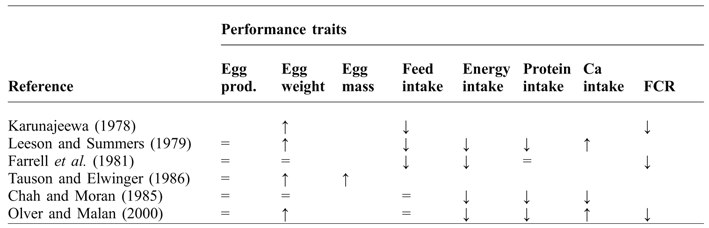
Free-choice feeding studies have been reported to give either similar or improved performance or egg quality compared to a conventional diet (Table 1). Chah and Moran (Reference CHAH and MORAN1985) fed hens separately an energy mash containing ground maize as the main cereal (2800 kcal/kg, 8% CP; 0.75% Ca), protein pellets (50% CP, 2500 kcal/kg, 0.2% Ca) and oyster shell flakes. They found similar feed intake, egg production and egg weight compared to a conventional diet (2800 kcal/kg, 18% CP, 3.75% Ca). Haugh unit of eggs did not differ, whereas shell resistance to deformation improved with free choice feeding. In a similar study, Olver and Malan (Reference OLVER and MALAN2000) offered whole maize instead of ground maize, with pelleted protein concentrate and limestone for pullets as soon as birds reached seven weeks of age and recorded performance until 80 weeks. During the laying period there was no difference in feed intake or egg production, but higher egg weight and shell thickness and lower feed conversion (FCR) was observed in the free-choice fed group. In agreement, higher egg weight and lower FCR were reported by Karunajeewa (Reference KARUNAJEEWA1978) but observed lower feed intake when offering a protein concentrate and whole wheat to hens. Similarly, Leeson and Summers (Reference LEESON and SUMMERS1979) reported lower feed intake and larger egg weight when hens were offered a high energy, high protein low Ca diet and a low energy, low protein high Ca diet simultaneously (3065 kcal/kg; 19.2% CP, 0.47% Ca vs. 1740 kcal/kg; 10.7% CP, 13.1% Ca, respectively). Egg production was similar to the conventional diet (2794 kcal/kg, 17.1% CP, 3% Ca). However, the effects of free choice feeding were reported to be variable among birds, which resulted in increased heterogeneity in the flock (Forbes and Covasa, Reference FORBES and COVASA1995). Lower egg quality, impaired plumage, and increased feed intake have been reported in flocks fed with choice feeding systems (Tauson and Elwinger, Reference TAUSON and ELWINGER1986; Al Bustany and Elwinger, Reference AL BUSTANY and ELWINGER1988).
Effect of free-choice feeding on performance traits compared to conventional feeding1.

↓: represents a significant decrease ↑: represents a significant increase
=: no significant difference, no sign: parameter is not reported
Alternatively, Farrell et al. (Reference FARRELL, HAMID and HUTAGALUNG1981) reported improved FCR compared to conventional feeding when offering three free-choice diets based on energy sources; 100% maize, 60% maize mixed with 40% cassava and 94% maize mixed with 6% palm oil. Egg production and egg weight were similar but feed intake was higher with the conventional diet and lower with the maize and cassava mixture compared to the other treatments.
Loose-mix feeding and its effect on hen performance and egg quality
whole grains and protein concentrate
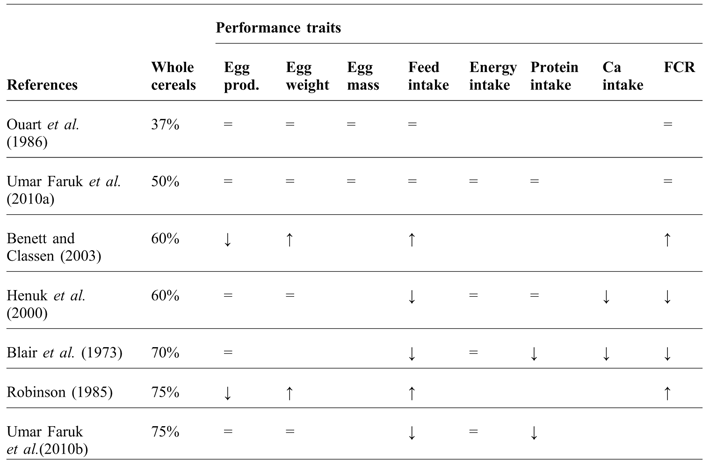
Studies investigating loose-mix feeding based on whole grains and a protein concentrate reported contradictory results in laying hens (Table 2). Incorporating 45% whole wheat in a complete laying diet resulted in unchanged egg production and FCR as reported by Ouart et al. (Reference OUART, MARION and HARMS1986). Umar Faruk et al. (Reference UMAR FARUK, BOUVAREL, MÊME, RIDEAU, ROFFIDAL, TUKUR, BASTIANELLI, NYS and LESCOAT2010a) mixed whole cereal and a diet providing a higher concentration of protein in a ratio 50:50 (limited to 121 g daily). Hens fed this experimental treatment showed similar feed intake, egg production, egg mass and FCR to hens fed the conventional system. A proportion of whole cereal, increased to 60% as whole barley, reduced egg production, FCR, egg specific gravity, but it increased feed intake and egg weight compared to a mash diet with same amount of ground barley (Bennett and Classen, Reference BENNETT and CLASSEN2003). However, when 60% of whole wheat was mixed with 40% protein concentrate in pelleted form, similar egg production and egg weight, but lower feed intake and better FCR were recorded when compared to a complete mash diet (Henuk et al., Reference HENUK, THWAITES, HILL and DINGLE2000). Increasing the amount of whole grain to 75% (wheat and oats) in the diet mixed with granulated limestone and decreasing the protein concentrate to 25% lead to decreased egg production, FCR and higher mortality (Robinson, Reference ROBINSON1985). With the same ratio of wheat and balancer diet (75:25) Umar Faruk et al. (Reference UMAR FARUK, BOUVAREL, MEME, ROFFIDAL, TUKUR, NYS and LESCOAT2010b) did not report any significant reduction in egg production or increase in FCR, however, they found reduced feed intake and egg mass compared to a conventional diet. In a similar loose-mix system, where different whole cereals (wheat, barley or maize) were mixed with a protein concentrate and oyster shell grit in a ratio 70:23:7, Blair et al. (Reference BLAIR, DEWAR and DOWNIE1973) also reported similar egg production, but lower feed intake and better FCR in the loose-mix system compared to a conventional mash.
Effect of loose-mix feeding compared to conventional feeding1.

↓: represents a significant decrease ↑: represents a significant increase
=: no significant difference, no sign : parameter is not reported
These contrasting results highlight that the relative proportion of whole cereals (50 to 70%) and protein concentrate (mash or pellet) can be a crucial factor when preparing loose-mix diets.
calcium and other micro ingredients
It is well-recognised that dietary supply of large Ca particles allows hens to express their specific appetite for Ca and improves eggshell quality and bone mineralisation. According to Guinotte and Nys (Reference GUINOTTE and NYS1991), egg shell breaking strength was increased when birds were fed particulate seashells or limestone (in general 2-4 mm particle size), than those fed ground limestone (<0.5 mm). Tibia breaking strength and ash percentage were greatly increased with the use of particulate Ca sources. Recent research has confirmed the benefits of coarse Ca sources on egg shell quality. Coarse limestone (0.8-2 mm) increased egg shell breaking strength compared to the addition of fine limestone (<0.5 mm) in 50 week-old brown laying hens (Skřivan et al., 2016). Coarse Ca was reported to improve relative shell density (Safaa et al., Reference SAFAA, SERRANO, VALENCIA, FRIKHA, JIMÉNEZ-MORENO and MATEOS2008; Pizzolante et al., Reference PIZZOLANTE, KAKIMOTO, SALDANHA, LAGANÁ, SOUZA and MORAES2011) and egg shell breaking strength (Koreleski and Swiatkiewicz, Reference KORELESKI and SWIATKIEWICZ2004; Lichovnikova, Reference LICHOVNIKOVA2007; Pizzolante et al., Reference PIZZOLANTE, KAKIMOTO, SALDANHA, LAGANÁ, SOUZA and MORAES2011; Skrivan et al., Reference SKRIVAN, ENGLMAIEROVA, MAROUNEK, SKRIVANOVA, TAUBNER and VIT2016). However, the source of coarse Ca and experimental conditions (age of hens, dietary Ca level) can have an influence on shell quality which may explain why some studies reported no beneficial effects (Pelicia et al., Reference PELICIA, GARCIA, MORI, FAITARONE, SILVA, MOLINO, VERCESE and BERTO2009; Cufadar et al., Reference CUFADAR, OLGUN and YILDIZ2011). Furthermore, attention should be paid to the proportion of the coarser Ca particles in the diet. Koreleski and Swiatkiewicz (Reference KORELESKI and SWIATKIEWICZ2004) found that the percentage of coarse particle refusal can increase when the diet contains 100% of coarse limestone or oyster shells for hens of 25 to 72 weeks of age.
Ahmad and Balander (Reference AHMAD and BALANDER2004) substituted 50% of fine limestone with oyster shells only in the afternoon diet of white hens (28-64 weeks of age) along with a reduction of the available phosphorus (avP) from 0.45% to 0.32%. The plasma level of P was decreased by 25% with oyster shells but only by 6% in hens fed lower avP. The effect of oyster shells was mainly due to decreased bone mobilisation during the night. The requirement of P is therefore greatly influenced by the particle size of Ca sources. Sauveur (Reference SAUVEUR1991) highlighted the importance of supplying different levels of P throughout the day in addition to changes in dietary Ca, to favour bone formation just after oviposition.
New research at Euronutrition (Saint Symphorien, 72240 France) has shown that using 100% coarse limestone and coarse di-calcium phosphate instead of fine sources can be both beneficial to the performance and shell quality of brown hens (46-62 weeks of age). As the coarse CaCO3 level in the diet increased, particle size distribution of the mash diet changed, and the amount of particles below 0.2 mm decreased close to zero, whereas the amount of larger particles between 2-4 mm increased. Premix particle size can influence performance and egg quality as shown in a recent CCPA commercial trial conducted in France, including a premix with a coarse presentation (>65% particles between 1-2 mm) in the diet of brown hens (18-26 weeks of age) resulted in higher egg mass (+1.7 g/d) and decreased FCR (-0.08) compared to hens receiving a standard fine premix (>65% of particles were between 0.1-0.5 mm). The premixes had the same composition, containing the same amount of vitamins and trace elements, but had different particle size distribution. These results highlight that a premix with coarse particle size can secure the intake of micro nutrients (vitamins and trace elements), and can help to cover the birds’ needs better. In addition, both trials confirmed the preference of laying hens for particles between 1-4 mm.
Sequential feeding and its effect on hen performance and egg quality
Sequential feeding of a protein rich diet in the first half of the day, followed by a low protein diet in the second half resulted in similar egg production compared to feeding a diet with a constant protein level during the day (Penz and Jensen, Reference PENZ and JENSEN1991; Keshavarz, Reference KESHAVARZ1998a; Reference KESHAVARZ1998b). However, albumen weight could be affected by the changes in protein supply at different times of the day (Penz and Jensen, Reference PENZ and JENSEN1991). This suggested that more protein might be needed after oviposition to meet the protein requirements for the synthesis of the albumen. In other studies, not only the protein level, but also energy and Ca levels were adjusted. The supply of a high energy, high protein and low Ca diet in the morning (3040 kcal/kg, 18% CP, 0.5% Ca) and a low energy, low protein and high Ca diet in the afternoon (2320 kcal/kg, 13.7% CP, 9.5% Ca) improved FCR. However, the treatment did not affect egg production, but lowered egg weight compared to a conventional diet (Lee and Ohh, Reference LEE and OHH2002). De los Mozos et al. (2012) reported similar performance (egg production, egg weight, egg mass), but a slightly lower feed intake and therefore improved FCR when decreasing the energy and protein level of the afternoon diet (2650 kcal/kg, 15.5% CP) compared to a single diet (2750 kcal/kg, 17% CP). A lower Ca supply in the afternoon reduced shell quality, but a lower Ca intake in the morning had no effect (Keshavarz, Reference KESHAVARZ1998a; Reference KESHAVARZ1998b). This was also observed when cereals with low Ca content were provided in the morning. The balancer diet of the afternoon with high Ca ensured normal shell formation and quality (Umar Faruk et al., Reference UMAR FARUK, BOUVAREL, MÊME, RIDEAU, ROFFIDAL, TUKUR, BASTIANELLI, NYS and LESCOAT2010a; Reference UMAR FARUK, BOUVAREL, MEME, ROFFIDAL, TUKUR, NYS and LESCOAT2010b). The changes in energy and protein levels in diets allocated either in the morning or in the afternoon to laying hens did not affect feed intake, egg production and body weight when all afternoon diets included particulate limestone (Traineau et al., Reference TRAINEAU, BOUVAREL, MULSANT, ROFIDAL, LAUNAY and LESCOAT2015). This observation confirms the hypothesis that hens might not be able to adjust their feed consumption of protein and energy level in the short term (half a day).
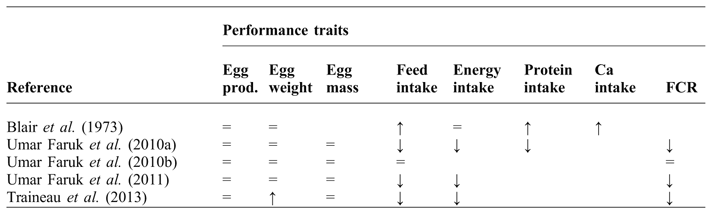
The use of whole cereals as the energy source in the morning combined with a diet containing a higher protein level (protein pellet or diet enriched in protein) fed in the afternoon led to improved FCR in laying hens in most studies. Higher feed intake due to increased protein pellet consumption was only found when cereals (wheat, barley and maize) and concentrated pellets were available ad libitum in a sequential system, but egg production was comparable to the conventional feeding system (Blair et al., Reference BLAIR, DEWAR and DOWNIE1973). However, when restricted feeding (121 g/d) was used and cereals and protein concentrate were provided in a ratio of 50:50, feed intake was lower because of a reduced intake of cereals in the morning: FCR was largely improved in this sequential feeding compared to both conventional or loose-mix system (Table 3; Umar Faruk et al., Reference UMAR FARUK, BOUVAREL, MÊME, RIDEAU, ROFFIDAL, TUKUR, BASTIANELLI, NYS and LESCOAT2010a). Egg production, egg weight and egg mass were similar in all feeding systems. The improvement in FCR in the sequentially fed group was due to lower wheat intake and improved nutrient digestibility. Feeding whole wheat favoured FCR by developing the gizzard and the digestion capacity. When the amount of whole wheat was increased to 75% and was fed sequentially with a balancer mash diet, egg production, egg weight and feed intake of hens were similar to those fed only 50% whole wheat in sequential feeding with a balancer mash (Umar Faruk et al., Reference UMAR FARUK, BOUVAREL, MEME, ROFFIDAL, TUKUR, NYS and LESCOAT2010b, diets fed ad libitum). Both treatments were comparable to conventional feeding in terms of egg production and FCR. It is noteworthy that wheat intake and egg weight were lower when ground wheat was fed instead of whole wheat and egg production and egg mass remained unaffected.
Effect of sequential feeding of whole cereals on performance traits compared to conventional feeding1.

↓: represents a significant decrease; ↑: represents a significant increase; =: no significant difference; no sign: parameter is not reported
The use of ground wheat or maize either at 100% or mixed with whole wheat in a ratio 80:20, lowered egg weight and egg mass, without affecting egg production compared to whole wheat in sequential feeding (Traineau et al., Reference TRAINEAU, BOUVAREL, MULSANT, ROFFIDAL, LAUNAY and LESCOAT2013). Feeding ground cereals was less efficient than whole wheat in sequential feeding but was still superior to conventional mash with regard to FCR.
Conclusions
Experimental studies on choice feeding systems have been conducted with individual or small groups of laying hens in cages for relatively short periods. Therefore, production scale studies are needed in practice and should include alternative housing systems (aviary with or without free-range). Group size, activity of birds, genotype (white vs. brown hens) might affect performance and feeding behaviour in choice feeding systems. In addition, offering different diets during the day requires good management of feed distribution and availability to avoid competition between birds and over-consumption of the balancer diet. The difficulty of providing separate feeders limits the use of free choice feeding under practical conditions. The loose-mix system is easier to establish practically, but depends on the capacity of hens to sort heterogeneous particle sized nutrients. Clear benefits of coarse Ca particles are now well recognised to ensure better mineral status and shell quality. A further decrease in the proportion of fine particles using particulate phosphate or premix looks promising. The use of whole grains should be carefully considered because it can increase competition, resulting in heterogeneity in the flock and even feather pecking (Jordan et al., Reference JORDAN, UMAR FARUK, LESCOAT, NABIL ALI, ŠTUHEC, BESSEI and LETERRIER2010). In loose mix feeding there is potential for using home grown cereals, but results in terms of bird behaviour and performance are contradictory, therefore more technical knowledge is needed at the farm level. Some development of sequential feeding at the farm level have already been tested using two silos supplying a morning (high energy, high protein, P, low Ca) and an evening diet (low energy, low protein, high Ca, low P) or by adding a third silo dedicated to particulate Ca distributed in the evening. The main expectation is to reduce FCR and to improve shell quality. Sequential feeding of P and Ca can strongly reduce bone mobilisation and the excretion of P, and might impact both welfare and the environment positively. Potential feed cost savings could be achieved due to improved feed efficiency which would compensate the investment cost for more storage capacity of different diets on farm.