

The secondary education school attached to the University of Tokyo is known in Japan because many pairs of twins study at the school. The school was established in 1948. When the school was established, twin studies were burgeoning in Japan. Since its establishment, the school has gathered applications from twins in addition to applications from the general student population. About 50 pairs of twins aged 11–12 years, of all sex and zygosity combinations, and living in the Tokyo metropolitan area, take an entrance examination each year. Based on the results of this examination, about 10–20 twin pairs are admitted each year (Ooki, Reference Ooki2013; Ooki & Asaka, Reference Ooki and Asaka2006; Ooki et al., Reference Ooki, Okazaki and Asaka2004). The school provides ongoing education for the 6 years of junior and senior high school. Of the 120 students in each grade, there are about 20–40 twins (10–20 pairs). During their 6 years of enrollment, the twins participate in observational studies for educational and related projects.
As shown in Figure 1, three datasets exist: one for school applicants (age 11–12 years), one for enrolled students (12–18 years) and one for graduates (18–85 years). Although an extraordinarily large amount of data on twin pairs exists in these databases, the same items were not necessarily gathered or obtained from year to year because the data collection was performed over a long term. Not all of the data have been exhaustively and effectively combined as yet; however, part of these databases has been combined. All data from the retrospective perinatal and neonatal periods through childhood, school age and adulthood are theoretically linkable using individual-specific identification numbers referred to as 'zygosity numbers’. In practice, the linkage has been partially completed thus far, with longitudinal physical growth data from birth being one of the categories of data that have been linked.
Relationships among the three twin databases.

Database of Junior High School Applicants (1981–2018)
The basic characteristics of the database are presented in Table 1. Applicants and their parents are the subjects of this database. The parents of all of the twin applicants complete and return a Twins Protocol Questionnaire, the format of which has remained fairly constant since 1981. The questionnaire gathers information on family structure, obstetrical findings, the twins’ physical growth, zygosity and placentation, and motor and mental development from birth through 11–12 years of age. Information on socioeconomic status has recently been excluded because of privacy concerns. Both parents of each applicant (formerly only the mother) participate in a medical interview conducted by two or three interviewers, in which responses to the questionnaire are checked carefully. A total of 1277 parents of applicants have returned questionnaires to date. Moreover, complete copy data from the Maternal and Child Health Handbook have been obtained since 1992. This handbook is presented by the Ministry of Health and Welfare to all pregnant women and includes detailed obstetric records written by obstetricians and a detailed record of the child’s general growth until the age of 6 years, written by the parents at home or by medical staff members at regular mass health examinations. The data in this handbook are widely used irrespective of plurality as a standard for questions regarding the growth and development of Japanese children. Zygosity has been determined by means of a questionnaire (Ooki & Asaka, Reference Ooki and Asaka2004). All same-sex twins and their mothers complete the zygosity questionnaire, on the basis of which the twins’ zygosity is determined with greater than 95% accuracy. No subjects showed apparent growth retardation at 11–12 years of age. This dataset undoubtedly represents one of the largest and most thorough sets of accurate growth data on twins in Japan (Ooki & Asaka, Reference Ooki and Asaka2005), especially since zygosity testing is very rare in Japan. The growth and development features of twins in childhood were extensively analyzed for maternal and child health (Ooki & Yokoyama, Reference Ooki and Yokoyama2003, Reference Ooki and Yokoyama2004; Ooki, Reference Ooki2005a, Reference Ooki2006) and were found not to be markedly different from those of the general Japanese twin population (Kato, Reference Kato2004), at least regarding physical growth within the normal range. Several genetic studies have also been performed (Ooki, Reference Ooki2005b, Reference Ooki2005c, Reference Ooki2005d, Reference Ooki2008). Some of the data on 1948–1980 applicants were added to the 2012 database (Ooki, Reference Ooki2013).
Basic characteristics of the applicants database
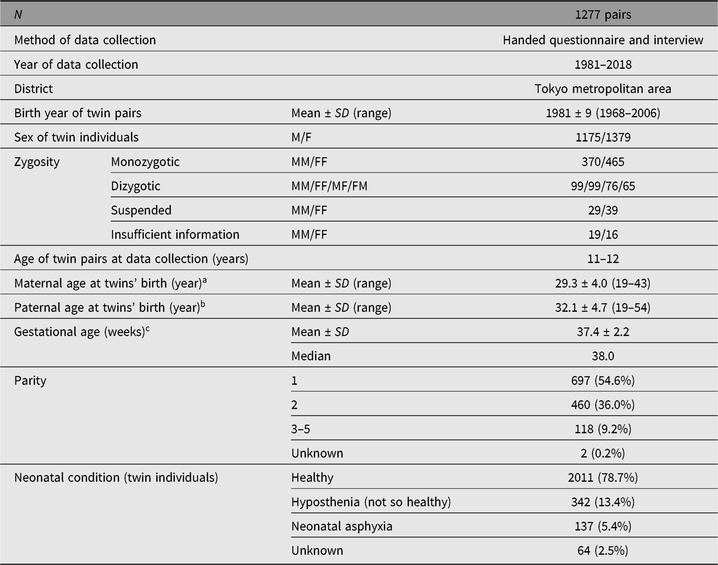
SD = standard deviation; M = male, F = female.
a 5 missing values.
b 18 missing values.
c 18 missing values.
Database of Junior and Senior High School Students (All Students 1975–2018)
Table 2 presents a database of junior and senior high school students. Once twin applicants are admitted to the school, the twins and their parents undergo a medical examination through which detailed anthropometric and physical measurements are gathered. The blood pressure of the twins and their parents is also measured. Blood specimens are taken, but at present these are permitted to be used only for the purposes of zygosity diagnosis and medical checks. These examinations, including the zygosity diagnosis based on DNA/genetic markers, are performed by the twins’ medical examination committee (Ooki & Asaka, Reference Ooki and Asaka2004).
Database of junior and senior high school students by sex and zygosity
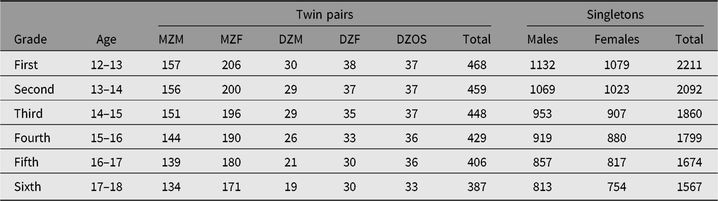
Note: Birth year of twin pairs ranges from 1962 to 2000; First-grade students are followed longitudinally. MZM = monozygotic males, MZF = monozygotic females, DZM = dizygotic males, DZF = dizygotic females, DZOS = dizygotic opposite sex.
The data on 2013–2018 twin enrollees have not yet been entered.
The data on 2000–2018 singleton enrollees have not yet been entered.
We gather predominantly longitudinal data on physical growth and development and on medical conditions such as eyesight and allergic disease, through the results of the health examination performed each year at the Japanese School of Health Law. These results as a whole are presented as school health statistics by the Ministry of Education, Culture, Sports, Science and Technology. Information on singleton students is gathered as control data. This is basically longitudinal data; first-grade students are followed for 6 years.
Adult Twin Database of High School Graduates
The information on all graduates of the school has been updated regularly. The distribution of birth year and sex–zygosity combinations of this cohort is shown in Table 3. A total of 901 pairs of twins, consisting of 720 monozygotic (MZ; 336 male–male and 384 female–female) and 181 dizygotic (DZ; 59 male–male, 59 female–female and 63 opposite-sex) twins, have graduated from this school as of March 2018. Zygosity has been diagnosed strictly by the best method available, given the year of entrance. For example, many anthropometric characteristics and blood groups were used in early years. More recently, DNA/genetic markers have been used (Ooki, Reference Ooki2013; Ooki et al., Reference Ooki, Okazaki and Asaka2004).
Twin pairs in the Graduates Database by birth year, age, sex and zygosity
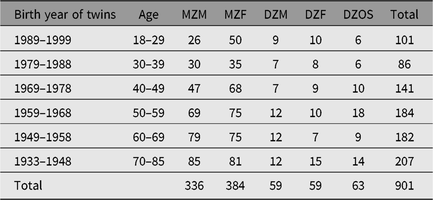
MZM = monozygotic males, MZF = monozygotic females, DZM = dizygotic males, DZF = dizygotic females, DZOS = dizygotic opposite sex.
Twins are followed longitudinally (Ooki, Reference Ooki2013; Ooki et al., Reference Ooki, Okazaki and Asaka2004). Three follow-up studies have been performed (Ooki & Asaka, Reference Ooki and Asaka2006). All three surveys included questions about occupation, marital status, number of children, body weight and height, drinking and smoking habits, food preferences, medical history (especially in regard to life style-related diseases), and so forth. The database was reconstructed for future studies. Family data have also been collected. The fourth follow-up survey is planned to be conducted soon.
Longitudinal Database from Birth to Adulthood
Linking the records in the databases of the applicants, school students and graduates would make several important research projects possible, such as a life course genetic epidemiologic study and verification of the so-called fetal origin of adult disease hypothesis (Barker, Reference Barker1998) or the developmental origins of health and disease (DOHaD) hypothesis (Gluckman & Hanson, Reference Gluckman and Hanson2006). It is very difficult to perform lifetime follow-up studies, especially for twins; the existing datasets permit this type of pioneering twin research in Japan, although the sample size and data quality are insufficient for many studies. Epigenetic studies could be performed using a large number of MZ adult pairs.
The distribution of birth year and sex–zygosity combinations in the longitudinal data is shown in Table 4. The relationship between birth weight data and physical growth or noncommunicable diseases for a total of 411 pairs of twins, consisting of 338 MZ (112 male–male and 226 female–female) and 73 DZ (18 male–male, 19 female–female and 36 opposite-sex) twins, could be analyzed using these data.
Longitudinal data from birth to adulthood
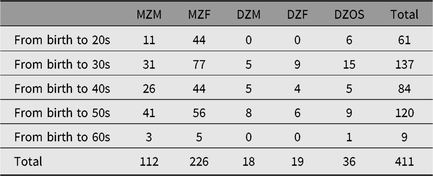
MZM = monozygotic males, MZF = monozygotic females, DZM = dizygotic males, DZF = dizygotic females, DZOS = dizygotic opposite sex.
Perspective
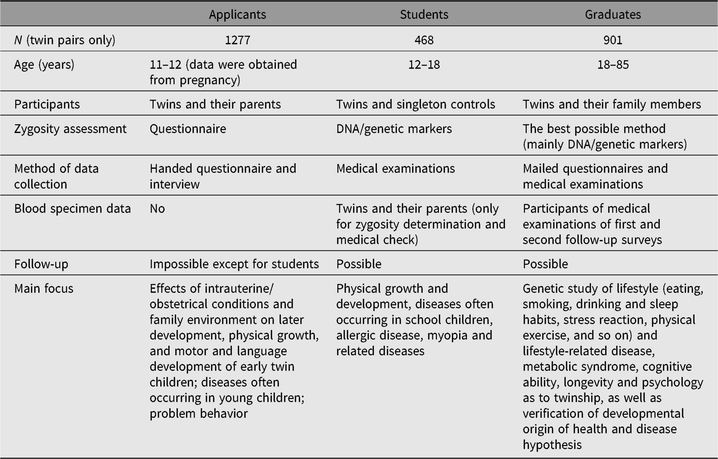
The main focus of each database is shown in Table 5. The secondary education school attached to the University of Tokyo provides one of the most important sources of data in the history of twin studies in Japan because a wealth of data have been collected through the school over 70 years. In the future, the data will be better organized for systematic analysis.
Summary of the database
Ethical Issues
The intention of statistical analysis of the data for scientific purpose is clearly written in the application document, and detailed explanations concerning the collection of data by questionnaire and interview and the sampling of blood for zygosity examination and health checks were added in another document beginning in 1999. Moreover, written informed consent is obtained from each twin and his or her parents, beginning in 2001. The data analysis is also permitted by the ethical committee of the school. Zygosity diagnosis using DNA samples is permitted through the ethical committee of the Graduate School of Medicine, University of Tokyo.
Limitations
The greatest limitation of this cohort is its selection bias based on the sampling process itself. The subjects lived in the Tokyo metropolitan area when they were enrolled at the school, and all took the entrance examination. Thus, they are not representative of Japanese children in general with regard to socioeconomic status or abilities. Moreover, the zygosity imbalance in favor of MZ twins, in contrast to the small sample size of DZ pairs, especially in the students and graduates group, clearly differs from the MZ/DZ ratio of the twin population in Japan overall (Imaizumi & Nonaka, Reference Imaizumi and Nonaka1997). This difference may be a result of the entrance process. Even given these characteristics and limitations, however, we need to maintain and make the best use of this historically important cohort in Japan.
Acknowledgments
We would like to thank the many collaborators of the secondary school attached to the Faculty of Education at the University of Tokyo. We would also like to thank Prof. Katsushi Tokunaga of Tokyo University, the present Director of the Twins’ Medical Examination Committee, Akio Asaka, M.D., and many other researchers who have been maintaining this historically important cohort. We gratefully acknowledge the help of Toshimi Ooma and Yuko Sugiura regarding data management. This work was supported by JSPS KAKENHI Grant Number JP15H04785.
Conflict of Interest
None.



