


The treatment of demand is the branch of economic theory in which methodological problems are most important and most difficult.
[Knight Reference Knight1944, p. 289]I. INTRODUCTION
The Sonnenschein–Mantel–Debreu (SMD) theorems on aggregate excess demand functions are some of the most important results in Walrasian general equilibrium theory.Footnote 1 The series of papers by Hugo Sonnenschein (Reference Sonnenschein1972, Reference Sonnenschein1973, Reference Sonnenschein1974); Rolf Mantel (Reference Mantel1974, Reference Mantel and Intriligator1977); Daniel McFadden, Andreu Mas-Colell, Rolf Mantel, and Marcel Richter (Reference Mantel1974); and Gerard Debreu (Reference Debreu1974) effectively demonstrated that the only restrictions consumer choice theory imposes on aggregate excess demand functions are continuity, zero degree homogeneity, and Walras’ Law. This is a “deeply negative result” (Rizvi Reference Rizvi, Mirowski and Hands2006, p. 234) because it implies that almost any function can be an excess demand function, making it extremely easy to generate Walrasian economies with unstable and/or non-unique equilibria (Scarf Reference Scarf1981). And without “stability or uniqueness, the intrinsic interest of economic analysis based on the general equilibrium model is extremely limited” (Kirman Reference Kirman, Mirowski and Hands2006, p. 257). The “anything goes” (Mas-Colell, Whinston, and Green Reference Mas-Colell, Whinston and Green1995, p. 598) implications of the SMD theorems thus “became a sort of leitmotiv (or nightmare) running through all research into uniqueness and stability” (Ingrao and Israel 1990, p. 317) and are one of the main reasons that the Walrasian research program “has finally run out of gas” (Rizvi Reference Rizvi and Davis1998, p. 274).
All this is well known to general equilibrium theorists (Kirman Reference Kirman1989, Reference Kirman1992; and Shafer and Sonnenschein 1982, for example),Footnote 2 and it is well documented in the recent literature on the history of Walrasian general equilibrium theory (Ingrao and Israel 1990; Kirman Reference Kirman, Mirowski and Hands2006; Rizvi Reference Rizvi1994, Reference Rizvi and Davis1998, Reference Rizvi, Samuels, Biddle and Davis2003; and Tohmé Reference Thomé, Mirowski and Hands2006, for example). This paper will add to neither the theoretical literature nor the historical research on the implications of the SMD results. The paper is historical, but it will focus on the upstream literature (the theoretical developments immediately preceding the SMD results) rather than on the downstream implications of SMD for the development of general equilibrium theory.
The argument will be that the literature on integrability in demand theory —a literature that can be traced back to Antonelli (Reference Antonelli, Chipman, Hurwicz, Richter and Sonnenschein1886), was stabilized in its modern form in Samuelson (Reference Samuelson1950), and was given its canonical discussion in two chapters (Hurwicz Reference Hurwicz, Chipman, Hurwicz, Richter and Sonnenschein1971, Hurwicz and Uzawa Reference Hurwicz, Uzawa, Chipman, Hurwicz, Richter and Sonnenschein1971) of Chipman et al. Preferences, Utility, and Demand (1971)—set the stage for the SMD results appearing in the early 1970s. The integrability problem in this literature involved rationalizing individual demand—finding conditions that guarantee that individual demand functions could have been generated by a budget-constrained, utility-maximizing, neoclassical agent—while the SMD results involved rationalizing aggregate excess demand—finding conditions that guarantee that aggregate excess demand functions are the sum of individual excess demand functions (and thus could have been generated by budget-constrained, utility-maximizing, neoclassical agents). Not only do the two theoretical questions differ only by a sum (∑), they are both questions that emerged within the same general research program; their solution involved similar mathematical tools; and many of the same economists were involved in both projects. For example, two of the key contributors to the literature on SMD—Sonnenschein and Richter—were editors of, and significant contributors to, the Preferences volume,Footnote 3 which appeared in print only one year before the first of the SMD papers (Sonnenschein Reference Sonnenschein1972).
Although the main point of the paper is to make the case that the SMD results were a natural extension of the integrability literature (a fact that has not been recognized within the existing historical literature), the paper is neither an exercise in the proper identification of precursors nor in the assignment of priority (or responsibility). The two literatures will be compared—and, given the sequence, topics, tools, and contributors, some degree of causality certainly runs from integrability to SMD—but while these two sets of theoretical results do have much in common, they are also very different. The most obvious difference is that the integrability results were considered a great success among economic theorists, while most viewed the SMD results as a black mark on the entire Walrasian program. The same research program, the same rationalizing theoretical strategy, similar mathematical tools, the involvement of many of the same economic theorists, and separated by only a year or so; and yet the first set of results is a success story while the second is generally considered a failure. What a difference a sum makes indeed.
II. INTEGRABILITY AND RATIONALIZABILITY
I have agued elsewhere (Hands Reference Hands, Mirowski and Hands2006) that the integrability literature in the 1930s was quite diverse, with various economic theorists having quite different theoretical, conceptual, and methodological ideas about what the integrability problem was, and what an adequate solution would mean for economic theory. Although great diversity did exist in the broad integrability literature of the 1930s, that is not the case for the integrability research relevant here. The integrability literature relevant here—rationalization of individual demands—is a rather tightly focused research project. The problem was framed in the modern era by Paul Samuelson in 1950; substantial contributions were made by Hirofumi Uzawa (Reference Uzawa, Arrow, Karlin and Suppes1960), Leonid Hurwicz and Uzawa (Reference Hurwicz, Uzawa, Chipman, Hurwicz, Richter and Sonnenschein1971), and others during the period 1960 to 1971; and it was put in its final form by Hurwicz and Richter (Reference Hurwicz and Richter1979a, Reference Hurwicz1979b). In order to discuss this literature, it is useful to introduce some notation used throughout the paper.
Consider the n-good consumer choice problem (CP) under standard textbook assumptions. The consumer maximizes a well-behaved (differentiable and strictly quasi-concave) ordinal utility function U(x) subject to a linear budget constraint:

where xT = (x 1, x 2,…, xn) > 0 are the quantities of the n goods, pT = (p 1, p 2,…, pn) > 0 are competitive prices, and M > 0 is money income. Solving (CP) generates the consumer’s demand function for each of the n goods:
 for all i = 1,2,…,n.
Under these standard assumptions demand functions will have the following five properties:
Budget Constraint:

Homogeneity of Degree Zero:

Slutsky Symmetry:

Negative Substitution Effect:

Negative Semi-definiteness of the Slutsky Substitution Matrix:

where S is the Slutsky substitution matrix with representative element [Sij].
These implications, now standard in any advanced textbook, are all variations of results that appeared during the first half of the twentieth century in works such as Hicks (Reference Hicks1939), Hicks and Allen (Reference Hicks and Allen1934), Pareto (Reference Pareto and Schwier1971), Samuelson (Reference Samuelson1947), and Slutsky (Reference Slutsky1915).
These five conditions are necessary for budget-constrained utility maximization, and they essentially exhaust the implications of standard consumer choice theory. The proper answer to the question “What are the implications of rationality for consumer demand functions?” is thus B, HD, S, NSE, and NSD.
The integrability question is the converse of this question about the implications of consumer choice theory. Rather than asking the implications of rationality for demand, it asks the conditions for the rationalizability of demand. Integrability concerns restrictions that are sufficient to guarantee that the relevant demand functions could have been generated by a budget-constrained, utility-maximizing consumer under standard assumptions.Footnote 4 As Hurwicz explained in his 1971 survey of integrability theory:
But what about the sufficiency of these conditions? That is, what properties of the demand relations guarantee the existence of the “generating” utility function (or, more generally, of a “generating” preference ordering of the commodity bundles), i.e. of a utility function that is maximized, subject to the budget, by these demand relations? Furthermore, it such a utility function exists, how can it be “recovered” (determined) from the knowledge of the demand relations? (Hurwicz Reference Hurwicz, Chipman, Hurwicz, Richter and Sonnenschein1971, p. 176)
Although it is primarily an issue for pure economic theory, integrability may also have empirical significance. As Donald Katzner explains:
In a very real sense, the Slutsky theory … is incomplete. Utility maximization implies an array of restrictions on the consumer’s demand functions which, if not exhibited, invalidate the theory as an explanation of behavior. But what if these properties are observed? This question, frequently referred to as the problem of integrability, is as important from an empirical point of view as the implications of utility maximization themselves (Katzner Reference Katzner1970, p. 65).
The answer to the integrability question, at least under the textbook regularity conditions considered here,Footnote 5 is the symmetry (S) and negative semi-definiteness (NSD) of the Slutsky substitution matrix. If these two conditions hold on individual demand functions—assumed to satisfy (B), (HD), and certain continuity conditions—then the demand functions can be rationalized: they could have been generated by a utility-maximizing, budget-constrained, neoclassical consumer. As Hurwicz and Uzawa summarize this result:
The basic result … states, roughly, that a single-valued differentiable demand function arises from the maximization of a utility function subject to the budget constraint if the Slutsky substitution matrix is symmetric and negative semidefinite (Hurwicz and Uzawa Reference Hurwicz, Uzawa, Chipman, Hurwicz, Richter and Sonnenschein1971, p. 115).
Although later research has weakened some of the mathematical restrictions and provided more elegant proofs (Hurwicz and Richter Reference Hurwicz and Richter1979a, Reference Hurwicz1979b), the basic S+NSD integrability result has withstood the test of time. Since these results effectively closed the book on the “integrability problem,”Footnote 6 the subject receives little attention in contemporary textbooks, although where it is discussed, the argument is essentially the same as that presented by Hurwicz and Uzawa (see, for example, Mas-Colell, Whinston, and Green Reference Mas-Colell, Whinston and Green1995, pp. 75–80).
In many ways, this integrability result completes the circle from the necessary conditions for utility maximization derived during the early years of the ordinal revolution to the sufficient conditions for maximization associated with the integrability problem of 1950 to 1971, and, as such, it played a significant role in the stabilization of consumer choice and demand theory during the middle of the twentieth century. It also seems to be “a comforting fact” (Mas-Colell, Whinston, and Green Reference Mas-Colell, Whinston and Green1995, p. 80) that the required conditions are exactly the same for both cases: the symmetry and negative semidefiniteness of the Slutsky matrix. Solving the integrability problem in this way—combined with the results of Hicks, Allen, Samuelson, Slutsky, and others during the first half of the twentieth century (including Samuelson’s weak axiom of revealed preference)—has been called “one of the most glorious chapters in the history of economic thought” (Chipman Reference Chipman and Feiwel1982, p. 48). Whether one agrees with the strength of this assessment or not, integrability was clearly a success story and played an important role in stabilizing what is now the standard textbook version of consumer choice theory.
III. AGGREGATE EXCESS DEMAND AND THE SONNENSCHEIN–MANTEL–DEBREU (SMD) RESULTS
It is now time to turn to the SMD results on aggregate excess demand functions. Here, too, it is useful to lay out some notation that will be used in the rest of the paper. Given that the main SMD results apply to pure exchange Walrasian systems, it sufficient to restrict our discussion to the pure exchange case.Footnote 7 In the interest of convenience, we will also assume, as above, that all the relevant functions are continuous and mathematically well-behaved, all prices are strictly positive, and all solutions are interior.
Consider the n-good pure exchange Walrasian general equilibrium model with H consumers. Each consumer h has an initial endowment of the n goods given by  for all h = 1,2,…,H. Each consumer maximizes a well-behaved ordinal utility function Uh(x) subject to the budget constraint generated by the endowment. Under these conditions the consumer choice problem becomes:

The solution to (CP’) is consumer h’s demand function,

where 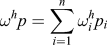 for all h. Consumer h’s excess demand for good i is given by:

and thus h’s excess demand vector is,

Summing the excess demand functions of all H consumers we have the aggregate or market excess demand function,

where 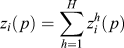 for all i = 1,2,…,n.
Under these standard assumptions, aggregate excess demand functions are homogeneous of degree zero (H) and satisfy Walras’ Law (W)


Finally, the well-known Arrow-Debreu existence theorems guarantee that an equilibrium price vector  exists where
zi(p*) = 0 for all i = 1,2,…,n.
Even under these (rather strong) assumptions, the equilibrium price vector p* need not be unique, although it will be locally unique (Mas-Colell, Whinston, and Green Reference Mas-Colell, Whinston and Green1995, pp. 589–598). In addition, we do not know anything about the (local or global) stability of p*, and determinate comparative statics results are not generally available. Uniqueness, stability, and determinate comparative statics results require either additional restrictions on the excess demand functions themselves—gross substitutes being the most common—or the corresponding restrictions on the preferences of the individual consumers.
The first few sentences of Sonnenschein (Reference Sonnenschein1972), the paper considered to be the opening salvo of the SMD literature, summarizes these well-known results from Walrasian general equilibrium theory:
The concept of a market excess demand function occupies a central role in the explanation of value furnished by all models of the competitive mechanism. It is elementary that these functions must be homogeneous of degree zero in all prices and satisfy Walras’ Law. Under a standard set of assumptions they will be continuous.… Walras’ Law together with continuity guarantee that excess demand functions must have a zero, or in more familiar terminology, that equilibrium prices must exist (Sonnenschein Reference Sonnenschein1972, p. 549).
But Sonnenschein then quickly turns to the converse question at the heart of the SMD literature: “Can an arbitrary continuous function, defined on a compact subset C of the interior of a positive orthant, be an excess demand function for some commodity in a general equilibrium economy?” (ibid.).
In other words, while the conditions (H), (W), and continuity are implications of rationality (the budget-constrained, utility-maximizing actions of individual consumers) for aggregate excess demand, the SMD question instead focuses on finding conditions for the rationalizability of aggregate excess demand. Given a function with certain continuity assumptions, does there exist a Walrasian pure exchange economy with H consumers that could have generated it? In other words, what conditions are sufficient to rationalize aggregate excess demand? Notice this is precisely the question asked in the integrability literature discussed above, except that now the question concerns aggregate excess demand functions rather than simply individual demand functions.
Sonnenschein (Reference Sonnenschein1972, Reference Sonnenschein1973) gave a qualified answer to this question for economies with a small number of commodities; Mantel (Reference Mantel1974) extended the result to a larger number of commodities; and Debreu (Reference Debreu1974) provided the most general result. The bottom line for all this work is that the conditions (H), (W), and continuity are, in fact, sufficient for the rationalizability of aggregate excess demand. As Shafer and Sonnenschein summarize Debreu’s result in their influential survey of the SMD literature: it “says that for every continuous function F which satisfies homogeneity and Walras’ Law, and for every compact set of positive prices K, there exists an economy with market excess demand function F on K” (Shafer and Sonnenschein Reference Shafer, Sonnenschein, Arrow and Intriligator1982, p. 672). In particular, these results imply that no additional restrictions (such as an aggregate versions of S or NSD) are generally available for aggregate excess demand, and thus if excess demand is to have any more structure than simply (H), (W), and continuity—in particular the additional structure required for stability and uniqueness—it will be necessary to impose such restrictions directly on the excess demand functions. Bruna Ingrao and Giorgio Israel nicely summarize the broad negative implications of these results.
Sonnenschein’s theorem thus demonstrated conclusively that the classical hypotheses on utility functions or individual excess demand functions impose no significant restrictions upon market excess demand functions obtained by aggregating individual functions. In fact, they turn out to be quite arbitrary. The theorem thus clearly brought out the difficulty of obtaining significant results in the field of uniqueness and stability. However, it also cast doubt upon a cornerstone of the theory that had played a leading role in practically every stage of its development and had been energetically stressed by Samuelson: the belief that significant results could be obtained by starting from very general hypotheses about the behavior of economic agents. The endeavor to keep the theory at the highest level of generality thus proved to be one of its weakest points (Ingrao and Israel 1990, p. 316).
IV. WHAT A DIFFERENCE A SUM MAKES
The previous two sections have summarized the integrability and SMD literatures with an eye toward drawing out their common features. This section will examine the relationship between these two sets of results in more detail—both similarities and differences—and section V will speculate about the general lessons the relationship between these two theoretical literatures might hold for the history of economic thought.
It seems clear that the theoretical strategy employed in the SMD research was simply an extension of that which had previously been employed in the integrability literature. For integrability, the issue was to find conditions that would “rationalize” individual demand functions; that is, to find conditions that would guarantee they could have been generated by a budget-constrained, utility-maximizing consumer. The SMD results start with the aggregate excess demand functions rather than individual demands, but ask exactly the same question about rationalization: what conditions would need to be imposed on aggregate excess demand functions to guarantee that they could have been the result of adding up the excess demand functions generated by utility-maximizing, budget-constrained consumers? In the first case, the answer is Slutsky symmetry (S) and negative semi-definiteness (NSD), but in the second case, since neither of the Slutsky conditions places any restrictions on the aggregate excess demands, one simply ends up with (H) and (W).Footnote 8 This is the same “style” of theorizing—asking exactly the same question of two different theoretical constructs (demand functions and aggregate excess demand functions). It employs similar (although in the case of SMD, more sophisticated) mathematical tools, involved many of the same economists, and the exact same restrictions (zero degree homogeneity and some version of the budget constraint) appear in both solutions. Add to this the short time span between the two sets of results and it seems hard to deny the integrability parentage of SMD.Footnote 9
Although it is not necessary to demonstrate that the relevant economists consciously applied the results (of their own work or others) from integrability theory to questions about the characteristics of aggregate excess demand functions in order to make the argument, there is a close connection between the two literatures. In this case, there clearly is a smoking gun. Sonnenschein made the connection quite explicit on the second page of his first contribution to the SMD literature (Sonnenschein Reference Sonnenschein1972). He cites both Hurwicz and Uzawa (Reference Hurwicz, Uzawa, Chipman, Hurwicz, Richter and Sonnenschein1971) and Samuelson (Reference Samuelson1950), and explains the connection between the integrability literature and his own (then new) research project. Given the importance of what he says, it is useful to quote him at length.
If a demand function is derived from utility maximizing behavior, then its matrix of substitution terms must be symmetric and negative definite at each point in the domain of the demand function. Furthermore, if a function of prices and income yields a substitution matrix which is symmetric and negative definite, then it is possible to derive that function as a demand function; that is, the function can be generated from an individual’s utility maximizing behavior. To interpret this theorem in a slightly different way: the only relationship among prices, quantities demanded, and rates of change in quantities demanded, that is implied by the utility hypothesis, is that the substitution matrix be symmetric and negative definite when evaluated at each point in the domain of the demand function.
In Theorem 5 we prove a local analogue of the above characterization for the case of aggregate excess demand functions. It states that Walras’ Law characterizes the comparative statics properties of the class of excess demand functions which arise from aggregating individual utility maximizing behavior. Informally, we summarize this proposition by saying that Walras’ Law is the only local comparative statics theorem of competitive equilibrium analysis (Sonnenschein Reference Sonnenschein1972, p. 550, emphasis added).
Although Sonnenschein’s remarks provide a nice confirmation of the linkage between integrability and SMD, the connection is much more general than what can be attributed to any one particular theorist. The general point is that once the move from necessary to sufficient conditions for maximization was made for the individual consumer—and remember, that is what integrability as rationalization entailed—it was a natural next step to ask the same set of questions for aggregate excess demand. It took thirty-five years—from Slutsky (Reference Slutsky1915) to Samuelson (Reference Samuelson1950)—to make the loop from necessary through sufficient conditions for the individual consumer. On the other hand, the SMD literature essentially solved both problems for aggregate excess demand functions simultaneously during the first few years of the 1970s. The two problems, integrability as rationalizability and SMD, are sufficiently similar that it would have been effectively impossible not to apply the reasoning from the former to the latter case.Footnote 10
But, of course, even if there is a strong connection between the two sets of results, there is also a big difference: one was a great success and the other opened Pandora’s box. In the case of integrability of individual demand functions, the goal was to find the simplest possible conditions that would do the job—that is, accommodate the budget-constrained, utility-maximizing, neoclassical agent—and it was considered to be quite positive (perhaps even “comforting”) that the restrictions that would rationalize individual demands were few in number and quite familiar. On the other hand, when it comes to rationalizing aggregate excess demand functions, the fact that the conditions were few in number and relatively familiar means that almost any continuous function can be an excess demand function. Unlike in the integrability case, this was not a positive result. The fact that almost any continuous function can be an excess demand function for some well-behaved economy opened the floodgates for the production of counter-examples to almost every desired property of general equilibrium models: stability, uniqueness, determinate comparative statics, etc. The problem for the aggregate Walrasian model is its lack of structure—more structure is needed to guarantee stability and uniqueness than provided by the assumption of maximizing agents—and this is precisely the opposite of the minimalist goals of the integrability literature during the period from 1950 to 1971.
The problem is that the kinds of results theorists were seeking were quite different in the two cases. In the case of individual demand theory, Slutsky symmetry and negative semi-definiteness were viewed as extremely positive and powerful results; in Goldilocks fashion, they were just right (not “too much” like the cardinal and separable utility functions of the early neoclassicals, and yet not “too little” like simply accepting whatever relationship between price and quantity consumed happens to emerge from the empirical evidence). The problem was that because nothing is being maximized at the Walrasian equilibrium—it is just where z(p*) = 0 —there is no analog to second order conditions to help discipline the behavior of the functions involved. Stability and uniqueness results required additional structure (gross substitutes, vanishing income effects, or such), and that was not provided by the assumption that the background agents were maximizing (they were, but the market wasn’t). Many of the restrictions that proved to be sufficient for stability and uniqueness reduced to the property that the revealed preference axiom holds on aggregate excess demand functions, a condition that makes the economy behave as if there were just one big consumer. But the SMD results say that no such restrictions hold in general. The weak-but-something results that worked so effectively in the case of individual demand become, under aggregation, the so-weak-as-to-give-us-nothing results on market demand functions (see Hands Reference Hands2009 for a further discussion of some of these issues). Just where more structure was needed, the SMD results said that even less was available.
In closing this section I would like to note that the argument presented here does not require a strictly negative assessment of the last thirty or so years of general equilibrium theory. It is not inconsistent with such a view, but it does not necessarily imply it. First of all, even those economic theorists who continue to work in the Walrasian trenches, applying ever more sophisticated mathematical toolsFootnote 11 to the traditional Walrasian questions, recognize that the SMD results were negative; they raise concerns that must be addressed (or eliminated) before general equilibrium theory can move forward in a progressive way. But optimism about repairing (or eliminating) the potential damage of the SMD results is not the only way to read the recent history of Walrasian general equilibrium theory in a positive light. It has also been argued that while the profession has recently moved away from the traditional Walrasian questions, the change is only because the goals of the Walrasian research program were effectively achieved (see Colander Reference Colander2000 and Davis Reference Davis2006, for example). The goal was to investigate the complete implications of the perfectly competitive assumption, and work within the Walrasian research program during the period from 1950 to 1971 (including SMD) accomplished that task. SMD is a negative result in that the implications of perfect competition ended up being weaker than what economic theorists of the 1950s and 1960s had expected (or wanted), but the investigation is complete, and that is a positive for the Walrasian program.
V. LESSONS FOR THE HISTORY OF ECONOMIC THOUGHT
So what is the lesson of this story for the history of economic thought? Is there something in this particular small slice of the history of Walrasian theory that provides insights for historical work in other areas of economics? There are probably many such lessons, but I will mention just two: the first is specifically concerned with the history of demand/consumer choice theory; and the second is more general.
The lesson for the history of consumer choice theory is that integrability matters. Integrability played a key role in Philip Mirowski’s analysis of the history of neoclassicism in More Heat (1989), and, in a series of papers over the last two decades (Hands Reference Hands and De Marchi1993, Reference Hands1994, Reference Hands, Mirowski and Hands2006, Reference Hands2011), I have tried to explain how taming integrability was essential to the stabilization of consumer choice theory and, in turn, Walrasian general equilibrium theory, during the middle third of the twentieth century. At one level, this paper is yet another episode in that general story. Integrability is related to the existence of utility functions and/or well-ordered preferences, and constrained optimization on the basis of such preferences is essential to neoclassical choice theory. During the period from 1950 to 1971, integrability was reduced to the purely mathematical problem of finding sufficient conditions for the rationalization of individual demand functions; that narrowing and the subsequent solution to the mathematical problem allowed consumer choice theory to steer its way around a host of critical issues that had been raised during the 1930s (some of which have recently resurfaced in the behavioral and experimental literature), and, in doing so, played an important role in turning one particular theory of consumer choice into the theory of consumer choice.Footnote 12 This paper runs the story forward from 1971, and shows how the mathematical/conceptual framework that had worked so effectively in stabilizing the theory of individual demand had just the opposite effect on Walrasian general equilibrium theory.
The second lesson is that this episode may have application far wider than the history of consumer choice theory or even Walrasian economics; it may provide some insight into the role of conceptual/mathematical structures in the development of economic theory more generally. One way to read the previous sections is that they provide an explanation of the role of the “rationalizing conception” in the history of Walrasian economics: first in the integrability as rationalization literature, and later in SMD. Notice that this is a story that is difficult to tell either in terms of the progressive growth of objective scientific knowledge or in terms of interests-based sociology of scientific knowledge (SSK) such as the early Strong Program (e.g., Bloor Reference Bloor1991). There is little evidence that the theoretical development from Samuelson (Reference Samuelson1950) to Debreu (Reference Debreu1974) came about because the relevant economic theory was being challenged by the empirical evidence, or that it was associated with an increased understanding of the real causal forces underlying either individual or market demand (although such things were desired by many of the contributors to the literature). However one views scientific progress in economics—empirical confirmation, surviving attempted falsification, prediction of novel facts, providing deeper understanding, uncovering the real underlying causal mechanisms, consilience, or whatever—it seems very difficult to explain the theoretical developments discussed above in these terms.
But there is also a problem if one tries to explain this series of theoretical moves in terms of interests-based SSK; that is, in terms of the social “interests” of the relevant economists, the community of economists in general, or those they might represent. The problem is that SMD is a negative result. Sonnenschein, Mantel, Debreu, and the others who made contributions to the SMD literature were not trying to find problems with Walrasian general equilibrium theory, and, broadly speaking, it was not in their interest, or the interests of their main constituencies, to do so. And yet they did. Once the commitment was made to a particular mathematical conceptualization—in this case, rationalization in terms of a budget-constrained, utility-maximizing, neoclassical agent—then the negative result took on a life of its own, and was effectively out of the control, and possibly the interests, of those involved. For interests-based SSK, “scientific practice always reflects the interests of individual scientists and the social constraints on scientific practice, as if we need only understand these social causes to understand the development of science” (Davis Reference Davis and Davis1998, p. 297), and this case—at least the SMD part of the story—seems to be very difficult to explain in such terms.
One approach to understanding scientific practice that emphasizes the interactive interplay of free and forced moves is Andrew Pickering’s “mangle of practice” (Pickering Reference Pickering1995).Footnote 13 Although Pickering’s view is influenced by SSK, he is quite critical of the lack of “material agency”—the world, the facts, nature, being causally responsible—in certain versions of SSK. For much of SSK, the only agency—the only way to explain what takes place in science—is social, and Pickering sought to replace that overly human/social interpretation with “the mangle”: “the reciprocal turning of human and material agency, turning that can itself reconfigure human intentions” (Pickering Reference Pickering1995, p. 21). Although his primary focus is laboratory science, he also applied the mangle framework to developments in purely mathematical theory (Pickering Reference Pickering1995, chapter four; and Pickering and Stephanides Reference Pickering, Stephanides and Pickering1992).Footnote 14 Here he characterizes conceptual systems as a kind of “disciplinary agency” that plays a similar role to the material agency at work in more empirical and experimental science.
Conceptual systems, then, hang together with specific disciplined patterns of human agency, particular routinized ways of connecting marks and symbols with one another. Such disciplines—acquired in training and refined in use—carry human conceptual practices along, as it were, independently of individual wishes and interests.… I want to describe this human passivity in terms of a notion of disciplinary agency. It is, I shall say, the agency of a discipline—elementary algebra, for example—that leads us through a series of manipulations within an established conceptual system (Pickering Reference Pickering1995, p. 115).
In particular, Pickering characterizes the relevant aspect of the modeling process in three steps: bridging (identifying a possible extension of a conceptual system); transcription (copying “established moves from the old system into the new space fixed by the bridgehead” [ibid., p. 116]); and filling (“completing the new system in the absence of any clear guidance from the base model” [ibid., p. 116]). The bridging and filling parts of the process are free moves (human agency), while transcription is forced (disciplinary agency). It is in the process of transcription “where discipline asserts itself, where the disciplinary agency … carries scientists along, where scientists become passive in the face of their training and established procedures” (ibid., p. 116). As a result, “scientists are not fully in control of where passages of conceptual practice will lead” and must simply “play through the moves that follow from the construction of specific bridge heads and see where they lead” (ibid., p. 117). Or, as Daniel Breslan and Yoval Yonay put it: “Models act independently of the will of the economist, often in unexpected ways” (Breslan and Yonay Reference Breslau and Yonay1999, p. 321).
This argument seems to nicely capture the series of theoretical moves from Samuelson (Reference Samuelson1950) to Debreu (Reference Debreu1974) when one views the rationalizing conceptual framework as a type of disciplinary agency. The decision to think about excess demand functions in the same way that individual demand functions had been conceptualized in the previous integrability literature was a bridging move, and, as such, it involved a decision, a free move, on the part of the relevant theorists. But once the bridgehead was established, the translation took on a life of its own, and its implications followed as forced moves directly from the rationalizing framework. Finally came the filling, the implications of the SMD results for general equilibrium theory, and here the element of human agency returned. This not only seems to capture the various moves in this particular series of papers, it may also be able to provide a framework for the historical investigation of other highly mathematical areas within economic theory.
VI. CONCLUSION
I have made the case that the SMD literature was a natural extension of the integrability literature of the period from 1950 to 1971. This fact has not been recognized by the historians of economics who have discussed the SMD theorems and their impact on the development of the Walrasian program, and the main purpose of the paper was to make that connection explicit. But common strategies, tools, and authors do not necessarily mean similar outcomes. Problems are embedded in historically contingent conceptual frameworks, and subject to a variety of different forces. Worse yet, sometimes the very success of a particular theoretical strategy, even in a domain as formalized as mathematical general equilibrium theory, often sows the seeds of its own destruction. The integrability literature discussed here played a role in stabilizing the demand theory that formed the theoretical backbone of Walrasian general equilibrium theory, and yet, extended to aggregate excess demand functions, it helped undermine the very theoretical structure it helped build. This is, of course, just one small episode in the history of general equilibrium theory, but perhaps similar stories can be told for other areas, particularly highly mathematical areas, in modern economic theory.


