INTRODUCTION
The Veneridae (Rafinesque, Reference Rafinesque1815) is the most speciose family of heterodont bivalves, comprising more than 800 species (Chen et al., Reference Chen, Li, Kong and Zheng2011). Some species are of considerable commercial value and support both wild and farmed fisheries, such as the quahog Mercenaria mercenaria (Linnaeus, Reference Linnaeus1758) and the Manila clam Ruditapes philippinarum (Adams & Reeve, Reference Adams, Reeve and Adams1850) – both widely introduced for culture purposes. These species have also been introduced into the Mediterranean: M. mercenaria to France and Italy (Bascheri, Reference Bascheri1965; Bini, Reference Bini1983), and Ruditapes philippinarum to France, Italy, Tunisia and Turkey (Bodoy et al., Reference Bodoy, Maitre-Allain and Riva1981; Cesari & Pelizzato, Reference Cesari and Pelizzato1985; Albayrak, Reference Albayrak2001; Ben Souissi et al., Reference Ben Souissi, El Menif, Mahjoub, Mejri, Quignard, Capape, Zaouali and Özhan2005). Yet, of the dozen alien venerid bivalves recorded in the Mediterranean, ten have been introduced through the Suez Canal. The first records date back over a century: Dosinia erythraea Römer, Reference Römer1860 and Gafrarium pectinatum (Linnaeus, Reference Linnaeus1758) were collected in Port Said, Egypt (Tillier & Bavay, Reference Tillier and Bavay1905). These species illustrate the prevailing patterns of invasion: whilst the former species was not recorded again in the Mediterranean, the latter spread to Israel, Lebanon, Syria, Turkey and Cyprus (Lindner, Reference Lindner1987; Bitar & Kouli-Bitar, Reference Bitar and Kouli-Bitar1999; Mienis, Reference Mienis1999; Zenetos et al., Reference Zenetos, Konstantinou and Konstantinou2009; Albayrak, Reference Albayrak2010, Reference Albayrak2011). Five additional species are known from a single record: Antigona lamellaris Schumacher, Reference Schumacher1817 (Engl & Çeviker, Reference Engl and Çeviker1999), Callista florida de Lamarck, Reference de Lamarck1818 (Moazzo, Reference Moazzo1939), Circenita callipyga (von Born, Reference Von Born1778) (Mienis, Reference Mienis2000), Redicirce sulcata Gray, Reference Gray1838 (Mienis, Reference Mienis, Őztűrk and Salman2004) and Timoclea marica (Issel, Reference Issel1869) (Bogi & Galil, Reference Bogi and Galil1999); Clementia papyracea (Gray, Reference Gray1825) was recorded from Gaza and Turkey (Haas, Reference Haas1948; Enzenross et al., Reference Enzenross, Enzenross and Niederhöfer1990) and Paphia textile (Gmelin, Reference Gmelin1791) is known to occur in the Levant (Haas, Reference Haas1948; Enzenross et al., Reference Enzenross, Enzenross and Niederhöfer1990; Kucheruk & Basin, Reference Kucheruk and Basin1999; Lakkis & Novel-Lakkis, Reference Lakkis and Novel-Lakkis2005; Zenetos et al., Reference Zenetos, Konstantinou and Konstantinou2009). However, the purported record of this species from the northern Adriatic Sea (Kellner, Reference Kellner2003) is erroneous.
In the course of a long-running study of the benthic biota off the Mediterranean coast of Israel, specimens of two more alien venerid species were collected. Upon examination, they were determined as Costellipitar chordatum (Römer, Reference Römer1867) and Gouldiopa consternans (Oliver & Zuschin, Reference Oliver and Zuschin2001).
MATERIALS AND METHODS
During survey efforts of the shallow soft bottoms along the Mediterranean coast of Israel, sediment samples were collected, preserved in 4% formalin and, within days, sieved on a 250 mm mesh. The retained material was preserved in 70% alcohol, tinted with rose Bengal, and sorted. Specimens were deposited in the Steinhardt National Collections of Natural History, Tel Aviv University, Israel, and the balance retained in the private collections of C. Bogi, Livorno, Italy and J. van Aartsen, Dieren, the Netherlands. Abbreviations used.
RESULTS
SYSTEMATICS
Superfamily VENEROIDEA Rafinesque, 1815
Family VENERIDAE Rafinesque, 1815
Genus Gouldiopa Iredale, Reference Iredale1924
Gouldiopa consternans (Oliver & Zuschin, Reference Oliver and Zuschin2001)
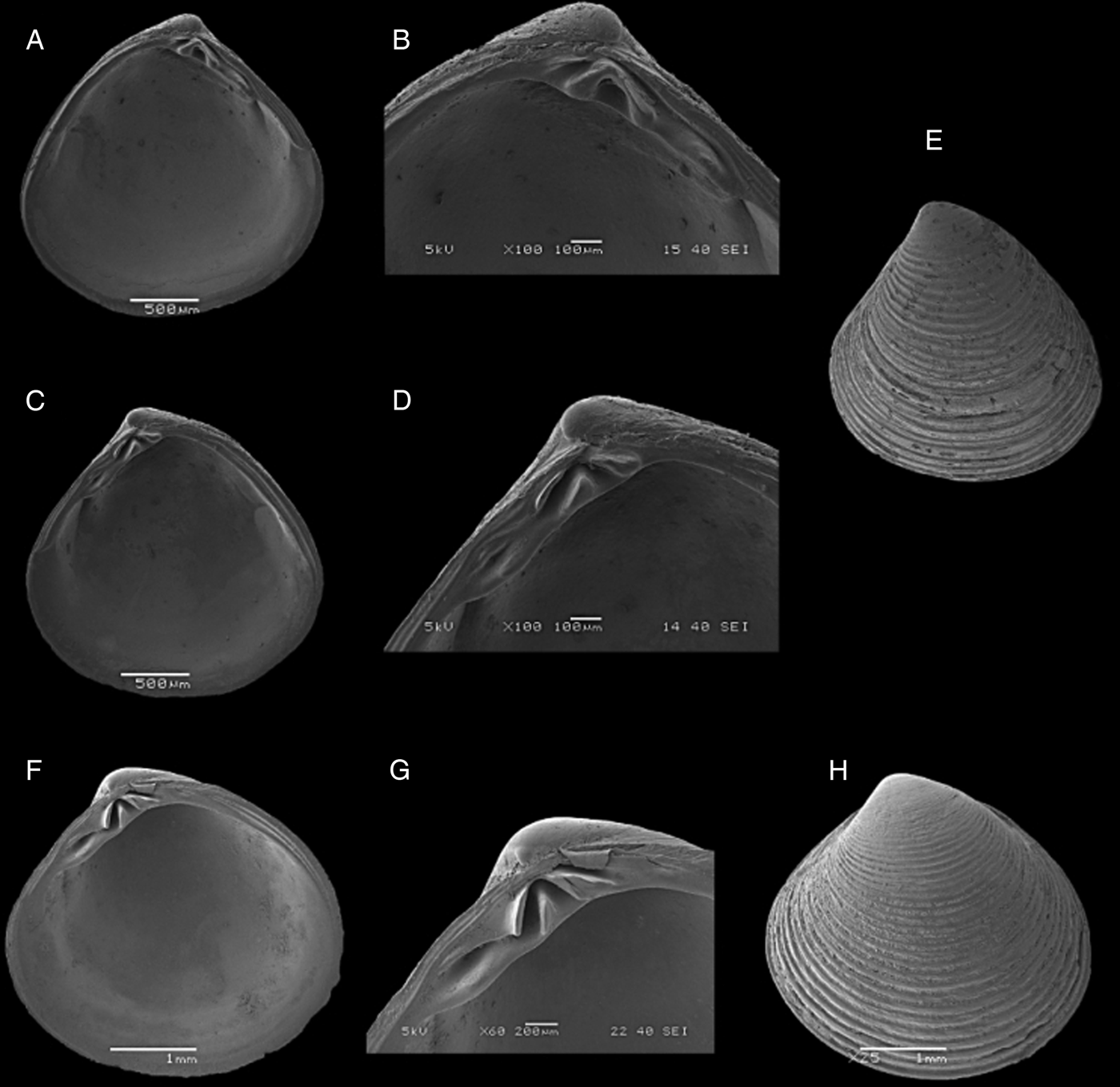
(Figure 1A–E)
A–E: Gouldiopa consternans Soreq. A: Left valve (LV), internal view; B: LV, detail of the hinge; C: Right valve (RV), internal view; D: RV, detail of the hinge; E: LV, external view. F–H: Costellipitar chordatum Hani South. F: RV, internal view; G: RV, detail of the hinge; H: LV, external view.

Gouldia minima var. triangularis Montagu – Moazzo, Reference Moazzo1939: 90, Figure 4.
Microcirce sp. – Zuschin & Hohenegger, Reference Zuschin and Hohenegger1998, pl. 56, Figures 4 & 5.
Pauliella miliacea Issel – Hoenselaar & Dekker, Reference Hoenselaar and Dekker1998: 206, Figures 1–6.
Microcirce consternans Oliver & Zuschin, Reference Oliver and Zuschin2001: 225, Figures 17A–B, 18A–F, 19A–D & 20A–D; Zuschin & Oliver, Reference Zuschin and Oliver2003: 150.
Gouldiopa consternans – Ovalis & Mifsud, Reference Ovalis and Mifsud2013: 9, Figure 1.
MATERIAL EXAMINED
Mediterranean Sea. Israel, Haifa Bay, 32°54′N 35°04′E, 2 August 2011, 11.2–15 m, four specimens; 9 September 2013, 10.6–13.5 m, four specimens. Soreq, 31°56′N 34°41′E, 6 June 2012, 18–22.5 m, 16 specimens; 11 October 2012, 18.6–25.4 m, 89 specimens; 15 October 2013, 17–22.3 m, 82 specimens; 31°56′N 24°41′E, 20 May 2014, 17.3–25 m, 56 specimens (one specimen, TAU M 79747). Ashdod, 31°51′N 34°39′E, 21 May 2012, 9.5–27 m, 11 specimens; 10 October 2012, 13.4–26.6 m, 105 specimens; 30 August 2013, 10.7–16 m, three specimens. All the specimens were collected live.
DIAGNOSIS
Shell minute (average shell height 2.5 mm), equivalve, not compressed, generally slightly higher than long, subovate-trigonal. Anterior and posterior margins sloping steeply, with rounded ventral margin. Posterior margin more curved than lunule margin, lunule weakly defined. Ventral margins smooth. Sculpture consists of low concentric ridges. The hinge on the right valve comprises three cardinal teeth: anterior narrow, laminar and parallel to the shell margin and in line with upper lateral, forming a pseudo-lateral socket with median cardinal, posterior and median large, triangular. The hinge on left valve consists of three cardinal teeth, posterior small, laminar, median large and triangular, anterior long, laminar; anterior and median teeth dorsally joined, forming deep triangular socket; anterior lateral tooth large and in the line with anterior cardinal. Marginal grooves and ridges present. Valves similar, but anterior with a groove and posterior with a ridge. Adductor scars not well defined. Shell colour white, tinged pale orange or pink. The adult specimens collected off the Israeli coast are smaller than those collected in the Red Sea. Like Oliver & Zuschin (Reference Oliver and Zuschin2001), we noted an intraspecific variability in the shape of the apical angle (forms trigonal and subovate), and in the rugosity of the sculpture on the external surface of the valves.
REMARKS
Gouldiopa consternans was recorded in Singapore (Huber, Reference Huber2010), the Arabian Sea, the Persian Gulf and the Red Sea (Safaga, Egypt), but is possibly widely distributed in the Indo-Pacific Ocean (Oliver & Zuschin, Reference Oliver and Zuschin2001). It was reported from the Suez Canal (Moazzo, Reference Moazzo1939, as Gouldia minima var. triangularis Montagu, 1803). Oliver & Zuschin (Reference Oliver and Zuschin2001) noted that the species was collected at depths of 20–30 m, on shell gravel, muddy-sand and sand bottoms, whereas, off Taşucu, Turkey, it was collected at a depth of 10 m (Ovalis & Mifsud, Reference Ovalis and Mifsud2013). Off the Israeli coast specimens were collected at depths ranging from 9.5 to 26.8 m, on sandy and sandy-mud bottoms, and occurred in highly eutrophic and polluted sites adjacent to Haifa port and the Kishon estuary, and the outfall of the Dan Region Wastewater project, which discharges 14,000 m3 day−1 excess sewage sludge.
The first specimens were collected in Haifa Bay in August 2011, the following year a couple of specimens were collected in Turkey (Ovalis & Mifsud, Reference Ovalis and Mifsud2013). Since the Israeli sites are subject to annual or biannual sampling as part of long-running surveys of the shallow soft bottoms, we may assume that this is a very recent introduction. The large number of specimens, including numerous juveniles, collected in October 2012 and 2013 may signify this species as likely ‘invasive’.
Genus Costellipitar Habe, Reference Habe1951
Costellipitar chordatum (Römer, Reference Römer1869)
(Figure 1F–H)
Caryatis chordate Römer, Reference Römer1869: 125.
Costellipitar chordatum – Habe, Reference Habe1977, pl. 53, figs 14–16.
MATERIAL EXAMINED
Mediterranean Sea. Israel, Nitzanim, 31°44′N 34°34′E, 10 May 2012, 25 m, two specimens; 31°49′N 34°35′E, 10 May 2012, 37 m, two specimens. Soreq, 31°56′N 34°41′E, 6 June 2012, 18–22.5 m, five specimens. Mikhmoret, 32°24 ′N 34°51′E, 7 August 2014, 13 m, one specimen (TAU M79746). All the specimens were collected live.
DIAGNOSIS
Shell shape trigona, fragile, equivalve, inequilaterale, with prominent umbos nearly central, turned anteriorly. Generally as wide as high, with rounded ventral margin. The sculpture consists of concentric ribs rounded, equidistant and regular, most evident along the ventral margin. Interior ventral margins smooth. Lunula large, oval, heart-shaped. A much coarser co-marginal ribbing is present. Hinge with three cardinal teeth on each valve; those in the right valve (Figure 1F–H) are divergent, the anterior lateral teeth are small and at a clear angle to each other, the second tooth is stronger and the third oblique and incised on the top. Colour white opaque. The maximum size of our specimens was 4.5 mm wide and 4 mm high, which corresponds to the size of the species type.
REMARKS
Costellipitar chordatum is distributed in the Indo-Pacific Ocean, from Japan and East China Sea to Safaga, Egypt and the Red Sea (Habe, Reference Habe1977; Bernard et al., Reference Bernard, Cai and Morton1993; Dekker & Orlin, Reference Dekker and Orlin2000; Oliver & Zuschin, Reference Oliver and Zuschin2000). This is the first record of the species in the Mediterranean Sea. Though the specimens are few in number, they were collected 90 km apart. It is quite likely that the species is already established along the southern and central Mediterranean coast of Israel.
ACKNOWLEDGEMENTS
The authors thank the technicians and crew of R/V Shikmona, IOLR and Jeroen Goud, National Biodiversity Centre ‘Naturalis’, Leiden, the Netherlands, for the SEM photos of the specimens.