I. INTRODUCTION
Lithium ion batteries are driven by electrochemical intercalation, whereby lithium ions are inserted and extracted within gaps in the host lattice without substantial changes to the lattice itself, Reference Mohri, Yanagisawa, Tajima, Tanaka, Mitate, Nakajima, Yoshida, Yoshimoto, Suzuki and Wada1–Reference Mizushima, Jones, Wiseman and Goodenough3 and the performance of lithium ion batteries is intrinsically dependent on the structure and/or composition of the intercalation electrodes. Reference Croguennec, Pouillerie, Mansour and Delmas4–Reference Thackeray, David, Bruce and Goodenough6 Li4Ti5O12, which possesses a spinel-type structure, has been advocated as an attractive anode material for use in lithium ion batteries of long calendar life. The deintercalation of lithium ions from the Li4Ti5O12 lattice proceeds with the two-phase coexistence of Li4Ti5O12 and Li7Ti5O12 domains with similar lattice parameters, Reference Ronci, Reale, Scrosati, Panero, Rossi Albertini, Perfetti, di Michiel and Merino7–Reference Scharner, Weppner and Schmid-Beurmann9 which leads to a very small variation in volume during lithium intercalation/deintercalation. Reference Ronci, Reale, Scrosati, Panero, Rossi Albertini, Perfetti, di Michiel and Merino7 The macroscopic zero-strain behavior contributes to the superior cycle stability of the Li4Ti5O12 electrode during electrochemical cycling.
Nanosizing of Li4Ti5O12 has recently been the focus for improving the rates of lithium deintercalation by reducing the path lengths for electronic and lithium ion transport in the electrode. Reference Wang, Liu, Wang, Eiji, Wang and Zhou10–Reference Guerfi13 As the surface area of the Li4Ti5O12 electrode increases with decreasing particle size, interfacial phenomena at the Li4Ti5O12/organic liquid electrolyte interface influences the electrode properties. Reference Borghols, Wagemaker, Lafont, Kelder and Mulder12,Reference Hirayama, Kim, Toujigamori, Cho and Kanno14 Although interfacial behavioral patterns have been widely reported for oxide cathodes and carbon anodes, Reference Hirayama, Ido, Kim, Cho, Tamura, Mizuki and Kanno15–Reference Eriksson, Andersson, Bishop, Gejke, Gustafsson and Thomas20 there is insufficient experimental information regarding the Li4Ti5O12/electrolyte interfaces to fully elucidate the impact of interfacial reactions on the intercalation properties. Some electrolyte species decompose at the Li4Ti5O12 surface, which results in the formation of a solid electrolyte interphase (SEI) layer, Reference Liu, Bian, Li, Ji, Hao and Yu21–Reference He, Liu, Huang, Zhang, Yu, Li, Kang and Kim24 and it has been proposed that the composition and electrochemical stability of the SEI layer determines the retention of the discharge–charge capacity of Li4Ti5O12 electrodes. Reference Liu, Bian, Li, Ji, Hao and Yu21–Reference He, Liu, Huang, Zhang, Yu, Li, Kang and Kim24 On the electrode side, an irreversible crystal structure change occurs in the surface region of Li4Ti5O12 during the electrochemical process, Reference Lu, Gu, Hu, Chiu, Li, Demopoulos and Chen25–Reference Kitta, Akita, Maeda and Kohyama27 and these interfacial reactions vary considerably according to the combination of the electrode and the electrolyte materials. These findings suggested the significant importance of surface phenomena for cycle stability and rate capability of Li4Ti5O12 anode which is usually operated in the high voltage regions above 1 V versus Li/Li+. However, previous studies on Li4Ti5O12/electrolyte interfaces have only focused on one of these combinations, which makes systematic investigation difficult. Furthermore, ex situ experimental techniques such as x-ray photoelectron spectroscopy and transmission electron microscopy were used in most studies, providing interfacial information indirectly.
In this work, we analyzed the interfacial reactions of Li4Ti5O12 with different electrolytes using an epitaxial-film model electrode and in situ neutron reflectometry (NR). Epitaxial thin films have a single orientation and an atomically small surface roughness of less than a few nanometers, and do not contain addictive carbon or binder, Reference Hirayama, Ido, Kim, Cho, Tamura, Mizuki and Kanno15,Reference Hirayama, Sonoyama, Abe, Minoura, Ito, Mori, Yamada, Kanno, Terashima, Takano, Tamura and Mizuki17 which results in an ideal reaction field for investigating interfacial reactions. Furthermore, epitaxial Li4Ti5O12 films with (111) and (110) orientations have been successfully fabricated on Nb:SrTiO3 single crystal substrates via pulsed laser deposition (PLD). Reference Hirayama, Kim, Toujigamori, Cho and Kanno14,Reference Kim, Toujigamori, Suzuki, Taminato, Tamura, Mizuki, Hirayama and Kanno28 NR is a powerful technique that can provide an atomistic understanding of solid/liquid interfaces as a function of the depth, Reference Majkrzak29 since neutrons have a sufficiently small absorption cross-section for penetrating electrochemical cells so that electrochemical interfaces can be probed. As a light element, lithium has a relatively high neutron scattering power compared to that of x-rays, and the depth profile of the neutron scattering length density (SLD) obtained by curve fitting can reveal the surface structure changes of the Li4Ti5O12 film during electrochemical processes. Analyses combining in situ NR and ex situ x-ray diffraction (XRD)/x-ray reflectometry (XRR) measurements provided direct information regarding the surface structural changes of Li4Ti5O12 with different electrolytes, as well as the underlying intercalation properties.
II. EXPERIMENTAL
Epitaxial Li4Ti5O12(111) thin films were grown on SrTiO3(111) substrates (10 × 10 × 0.5 mm or 20 × 20 × 5 mm, Crystal Base Co., Ltd.) using a KrF excimer laser with a wave length of 248 nm and PLD apparatus (PLAD131, AOV Inc., Tokyo, Japan). The following optimal synthetic conditions were selected based on results of our previous studies Reference Hirayama, Kim, Toujigamori, Cho and Kanno14,Reference Kim, Toujigamori, Suzuki, Taminato, Tamura, Mizuki, Hirayama and Kanno28 : oxygen pressure, pO2 = 6.6 Pa; distance between substrate and target, d = 60 mm; laser frequency, f = 10 Hz; deposition time, t d = 5–25 min; energy density, E = 0.3–0.4 J/cm2; temperature, t = 650 °C.
Discharge–charge characteristics were performed using a two-electrode configuration involving two different electrochemical cells: a 2032-type coin-cell and an in situ spectroelectrochemical cell designed for NR. Reference Yonemura, Hirayama, Suzuki, Kanno, Torikai and Yamada30 The cells were assembled inside an argon-filled glove box using lithium metal for counter and reference electrodes and the Li4Ti5O12 thin film as the working electrode. The electrolytes used comprised propylene carbonate (PC; Kishida Chemical Co., Ltd, >99.5%, water content of <30 ppm) and ethylene carbonate–diethyl carbonate with a volume ratio of 3:7 (EC/DEC; Kishida Chemical Co., Ltd., >99.5%, water content of <30 ppm) as the solvents and 0.5, 1.0, or 2.4 mol/dm3 LiPF6 as the supporting electrolyte. The charge–discharge characteristics were examined at room temperature, and the cut-off voltages were 1.0 and 3.0 V for discharge and charge, respectively. The charge–discharge capacities of the cells were calculated by taking into account the area over which the film was deposited (10 × 8 mm for the coin cells and 15 × 15 mm for the spectroelectrochemical cells), the film thickness and the theoretical density of Li4Ti5O12 (3.48 g/cm3).
Ex situ XRD and XRR analyses were performed to investigate the structural changes of Li4Ti5O12 films induced by electrochemical cycling. The cell was disassembled in the charged state after electrochemical cycling, and the Li4Ti5O12 film was then washed in dimethyl carbonate. XRD patterns and XRR spectra were collected via an x-ray diffractometer (ATX-G, Rigaku Corporation, Tokyo, Japan) using 0.1541 nm as the x-ray wave length. The thickness, density, and roughness of the films were refined from XRR spectra using the Parratt Reference Parratt31 and MOTOFIT Reference Nelson32 programs, which apply Parratt's method. Reference Parratt33
In situ NR measurements were performed on SOFIA (BL-16, Materials and Life Science Facility, Japan Proton Accelerator Research Complex, Tokai, Japan), which is a time-of-flight reflectometer. Reference Yonemura, Hirayama, Suzuki, Kanno, Torikai and Yamada30,Reference Yamada, Torikai, Mitamura, Sagehashi, Sato, Seto, Sugita, Goko, Furusaka, Oda, Hino, Fujiwara, Takahashi and Takahara34,Reference Mitamura, Yamada, Sagehashi, Torikai, Arita, Terada, Kobayashi, Sato, Seto, Goko, Furusaka, Oda, Hino, Jinnai and Takahara35 An electrochemical cell was composed of a Li4Ti5O12/SrTiO3 cathode, a Li anode and deuterated carbonate based electrolytes containing LiPF6 as a supporting electrolyte, Reference Yonemura, Hirayama, Suzuki, Kanno, Torikai and Yamada30,Reference Hirayama, Yonemura, Suzuki, Torikai, Smith, Watkinsand, Majewski and Kanno36 with the purpose of the deuterated electrolytes being to prevent incoherent scattering (80.27 and 2.05 for 1H and 2H, respectively). Deintercalation and intercalation were performed via the potentiostatic method using a potentiostat/galvanostat (Ivium Tech., Compactstat, Eindhoven, The Netherlands). The NR spectra were collected using the single-frame mode at 0.3, 0.6, and 1.2°, and the individual data points were combined. The cell conditions were monitored after the cell construction (OCV), at 1.6, 1.4, and 1.2 V (versus Li/Li+) at the first discharge, 3.0 V at the first charge, and after discharging and charging in the fifth cycle.
III. RESULTS AND DISCUSSION
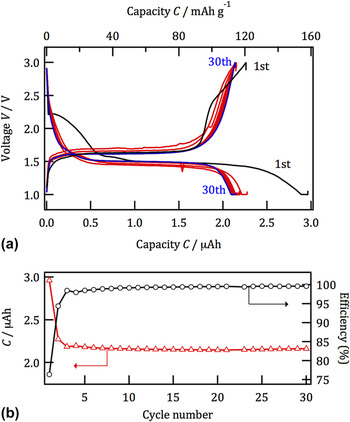
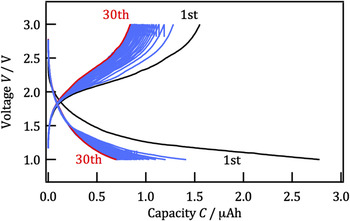
Figure 1(a) depicts the discharge–charge curves of a 23.8 nm-thick Li4Ti5O12(111) film, which was synthesized on Nb-doped SrTiO3(111) during the 30 cycles. The spectroelectrochemical cell used for in situ NR consisted of a Li4Ti5O12(111)/Nb:SrTiO3(111) cathode, 1.0 mol/dm3 LiPF6-containing PC electrolyte, and a Li metal anode. A plateau region was observed at around 1.5 and 1.6 V in the discharge and charge curves, respectively, which represents a two-phase coexistence of spinel-type Li4+αTi5O12 and ordered rock-salt type Li7−βTi5O12 domains Reference Borghols, Wagemaker, Lafont, Kelder and Mulder12,Reference Guerfi13,Reference Ohzuku, Ueda and Yamamoto37 that demonstrates the lithium intercalation activity of the Li4Ti5O12(111) film electrode. The first discharge and charge curves showed slope regions from 2.3 to 1.7 V and from 2.4 to 3.0 V, respectively, which could be associated with side reactions occurring in the cell. As a Nb:SrTiO3(111)/1.0 mol/dm3 LiPF6 PC/Li cell delivered no significant capacities in these voltage regions (see Supporting Information S1), electrochemical decomposition of electrolyte species did not contribute the discharge and charge capacities in the slope regions. Thus, the slope regions observed during the first cycle suggested an irreversible phase change in the Li4Ti5O12(111) film. During the following cycles, the Li4Ti5O12(111) film exhibited reversible lithium intercalation with high capacity retention and high cycle efficiency, as shown in Fig. 1(b). The discharge capacity was 2.18 μAh (116 mA h/g) at the 3rd cycle and remained stable at 2.16 μAh (115 mA h/g) at the 30th cycle. The discharge capacities were much smaller than the theoretical value of lithium intercalation from Li4Ti5O12 to Li7Ti5O12 of 3.28 μAh for the 23.8 nm-thick film (corresponding to 175 mA h/g). From these results, we can speculate that lithium intercalation reversibly proceeded into the Li4Ti5O12(111) except for a part of the film which irreversibly changed to an inactive phase at the initial electrochemical process.
(a) Discharge–charge curves of a 23.8 nm-thick Li4Ti5O12(111)/SrTiO3(111) film with an electrolyte of 1 mol/dm3 LiPF6 PC and (b) variation of discharge capacity and cycle efficiency during 30 cycles. The discharge–charge measurements were collected using an in situ NR cell. The constant current applied was approximately 6.6 μA, which corresponds to a current density of 350 mA/g (2 C) for the Li4Ti5O12 film electrode. The active area of the Li4Ti5O12(111) film was 15 × 15 mm.

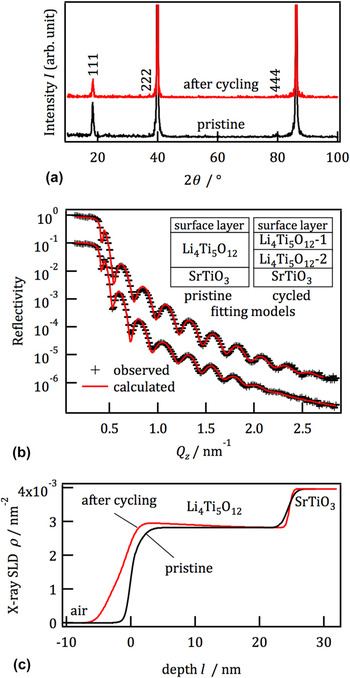
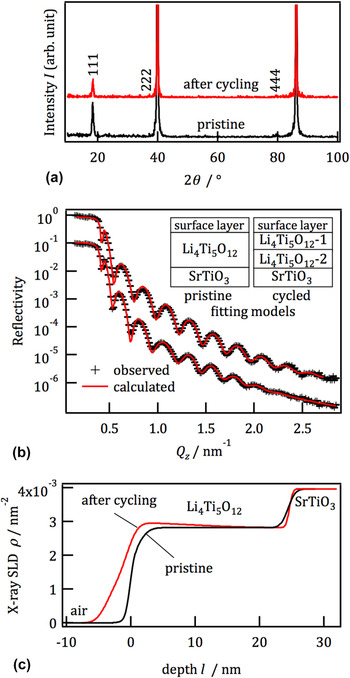
Ex situ XRD and XRR analyses were conducted to investigate the structural change of the Li4Ti5O12(111) induced by the electrochemical processes. Figure 2(a) shows out-of-plane XRD patterns of the 23.8 nm-thick Li4Ti5O12(111) in pristine condition and after 30 cycles. The intensities were normalized using the value of the SrTiO3(111) diffraction peak, which was obtained by fitting a Gaussian curve. The pristine film generated diffraction peaks at 18.4°, 37.2°, and 79.6° along the out-of-plane [111] direction, which are attributed to the hhh diffraction peaks of Li4Ti5O12 with the
 $Fd\bar 3m$
space group, and these observations confirmed the (111) orientation of the Li4Ti5O12 film. The out-of-plane lattice parameter was calculated to be 8.365(3) Å, and no considerable change in lattice parameter was observed for the cycled sample, which supported the reversible intercalation of the Li4Ti5O12 film during the 30 cycles. By contrast, the diffraction peaks showed a decrease in the intensities after the electrochemical cycling, which indicates a partial phase change from Li4Ti5O12 to another phase, as proposed from transmission electron microscopy and scanning probe microscopy studies.
Reference Kitta, Akita and Kohyama26,Reference Kitta, Akita, Maeda and Kohyama27
Figure 2(b) illustrates the XRR analysis results and the x-ray SLD profiles of the pristine and cycled Li4Ti5O12 films. The reflectivity spectra were plotted as functions of the scattering vector, Q
z = 4π sin θ/λ, where λ is the x-ray wave length (0.1541 nm) and θ is the glancing angle. A two-layer model consisting of a surface impurity and the Li4Ti5O12 film closely fitted the reflectivity curve of the pristine film. The thickness, surface roughness, and x-ray SLD value of the Li4Ti5O12 film were refined to 23.6 ± 0.4 nm, 1.5 ± 0.6 nm, and 2.83 ± 0.02 × 10⁻³ nm−2, respectively [Fig. 2(c)]. The SLD value was consistent with that expected for stoichiometric Li4Ti5O12 (2.82 × 10⁻³ nm−2). The pristine film was covered with a surface impurity layer with a thickness of 1.0 ± 0.3 nm, and the surface impurity had a SLD value of 1.69 ± 0.04 × 10⁻³ nm−2. Considering the SLD values of typical lithium containing oxides (1.74 × 10⁻² nm−2 for Li2CO3, 1.61 × 10⁻³ nm−2 for Li2O, and 1.25 × 10⁻³ nm−2 for LiOH), the surface layer appears to mainly consist of Li2CO3. The fringes of the XRR spectrum of the cycled sample shifted to lower Q
z values, which indicates an increase in the total thickness of the film [Fig. 2(b)]. Thus, we added a SEI layer to the structural model since a SEI layer has been reported to form on the Li4Ti5O12 surface by electrolyte decomposition.
Reference Liu, Bian, Li, Ji, Hao and Yu21–Reference He, Liu, Huang, Zhang, Yu, Li, Kang and Kim24
Furthermore, we divided the Li4Ti5O12 layer into two parts: a bulk region and a surface region for investigating the irreversible phase change indicated by the discharge–charge and XRD results. The three-layer model composed of SEI layer/Li4Ti5O12-surface/Li4Ti5O12-bulk/SrTiO3 fitted more closely (χ2 = 5.22 × 10⁻³) than the three-layer model composed of SEI layer/Li4Ti5O12/SrTiO3 (χ2 = 6.41 × 10⁻³). The fitting curve and the SLD profile as calculated using the four-layer model are shown in Figs. 2(b) and 2(c). In the SLD profile, the bulk region of the cycled Li4Ti5O12 had a similar SLD value to that of the pristine sample, whilst the 10-nm surface region had a higher SLD value of 3.00 ± 0.03 × 10⁻³ nm−2. The XRR analyses highlighted the phase change in a high-density phase in the surface region. The SEI layer on the Li4Ti5O12 surface had a thickness of approximately 4 nm after 30 cycles, and the slope of the SLD profile implied a gradation of chemical composition in the SEI layer.
(a) Out-of-plane XRD patterns, (b) XRR analysis results of Li4Ti5O12(111)/SrTiO3(111) films, and (c) x-ray SLD profiles in pristine condition and following electrochemical cycling. The XRD patterns and XRR spectra were collected in air.
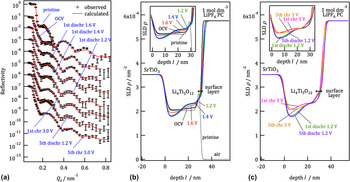
To clarify the phase change process occurring at the Li4Ti5O12 surface, we conducted in situ NR analyses at the Li4Ti5O12/LiPF6-containing PC interface upon battery operation. Figure 3 shows the NR spectrum fitting results and neutron SLD profiles of the Li4Ti5O12(111) film during the first and fifth discharge–charge processes. The reflectivity spectra were plotted as functions of the scattering vector, Q z = 4π sin θ/λ, where λ is the neutron wave length and θ is the glancing angle. Similar to the XRR analysis, a two-layer model consisting of surface impurity/Li4Ti5O12/SrTiO3 fitted closely with the reflectivity curve for the pristine film [Fig. 3(a)]. The SLD value of the pristine Li4Ti5O12 films was 2.03 ± 0.04 × 10⁻⁴ nm−2, which is consistent with the theoretical value of 2.04 × 10⁻⁴ nm−2 as calculated with the ICSD data (#15787). The pristine film was covered with a surface impurity layer with a thickness of 2.0 ± 0.3 nm, and the surface impurity had a higher neutron SLD value than the Li4Ti5O12 layer [Fig. 3(b)]. Considering the SLD values of typical lithium containing oxides (3.46 × 10⁻⁴ nm−2 for Li2CO3, 8.15 × 10⁻⁵ nm−2 for Li2O, and 6.02 × 10⁻⁶ nm−2 for LiOH), the surface layer consisted of Li2CO3, which is consistent with the XRR result. The formation of the carbonate and hydroxide components was indicated by x-ray photoelectron spectroscopy (see Supporting Information S2). These observations demonstrate that NR can detect the structural changes that occur within several nanometers of the electrode surface.
(a) In situ NR analysis results of epitaxial Li4Ti5O12(111) films during cycles 1 and 5 in 1 mol/dm3 LiPF6 PC electrolyte. Refined neutron SLD profiles (b) at the first discharge and (c) during the following processes. The insets in (b, c) depict magnified profiles near the Li4Ti5O12 regions.

NR spectra collected under the electrochemical conditions were analyzed using a three-layer model (SrTiO3/Li4Ti5O12-bulk/Li4Ti5O12-surface/surface impurity or SEI/electrolyte), which was a simple extension of the model used for the cycled sample in the ex situ XRR analysis. Following the cell construction (OCV: open circuit voltage), the SLD value of the Li4Ti5O12 layer increased in the 10–15 nm region from the Li4Ti5O12/electrolyte interface [Fig. 3(b)], whereas no significant change was observed in the bulk region. This result indicates that the phase change from the Li4Ti5O12 was initiated following soaking in the electrolyte prior to electrochemical cycling. Kitta et al. have reported that a phase transition to a lithium-deficient rocksalt (LiTi5O10.5) occurs at the Li4Ti5O12 surface in 1.0 mol/dm3 LiPF6-containing PC electrolyte, characterized from TEM/electron energy-loss spectroscopy. Reference Kitta, Akita and Kohyama26 The SLD increase in the surface region is consistent with the previous report, because the lithium-deficient phase should have a higher SLD value than Li4Ti5O12 because natural lithium has a negative coherent scattering length for neutrons (−1.9 fm for 7Li:6Li = 92.5:7.5). Further, the decrease in the SLD value of the surface impurity region under the OCV condition was observed, which indicates the chemical or electrochemical reactions of the surface impurity phases with electrolyte species at the interface. This could be attributed to the initiation process of the SEI formation. During the first discharge from OCV to 1.2 V, the Li4Ti5O12 surface region showed a further increase in the SLD, and the phase change proceeded in the surface region during the first discharge. In contrast to the surface region, the bulk region showed no significant change in the SLD from the OCV to 1.6 V and from 1.4 V to 1.2 V. Thus, the discharge capacity observed from 3.0 V to 1.6 and 1.4 V–1.0 V in the first discharge curve may primarily correspond to the phase change of Li4Ti5O12 in the surface region. The SLD value in the Li4Ti5O12 bulk region decreased to 1.76 ± 0.08 × 10⁻⁴ nm−2 from 1.6 V to 1.4 V. The decrease in the SLD corresponds to lithium intercalation in the Li4Ti5O12 bulk region, which was consistent with the plateau region observed at around 1.5 V in the first discharge curve. The SLD value of the bulk region at the discharged state corresponded to the theoretical value for Li7Ti5O12 (1.71 × 10⁻⁴ nm−2). The lithium intercalation proceeded in the Li4Ti5O12 bulk region through the surface region. The neutron SLD profiles during the subsequent conditions are shown in Fig. 3(c). After the first charging, the SLD value in the Li4Ti5O12 bulk reversibly increased to 2.02 × 10⁻⁴ nm−2, and the Li4Ti5O12 bulk showed similar SLD values under the discharged and charged conditions at cycle 5 to those observed at the first cycle. Furthermore, the SLD value and the thickness of the Li4Ti5O12 surface region remained stable at around 2.3 × 10⁻⁴ nm−2 and 15 nm after the first cycle, respectively. The low electrochemical activity of the surface-reconstructed phase may cause a decrease in the reversible capacity, which is consistent with the small discharge–charge capacities of the Li4Ti5O12(111) film (approximately 115 mA h/g) compared to the theoretical value (175 mA h/g). In contrast, highly-reversible lithium intercalation proceeds in the bulk region by lithium diffusion through the surface region during the electrochemical cycling. The SEI layer at the interface was grown in the initial cycles, and the thickness after the fifth cycle was 6.1 ± 0.2 nm. The SEI formation could suppress the further phase change in the surface region of Li4Ti5O12. The depth profiling of the Li4Ti5O12/electrolyte interface using in situ NR clarified the intermediate process of the surface-reconstruction and the SEI formation during the initial electrochemical cycling.
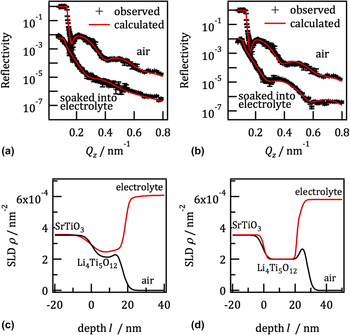
To investigate the effect of the electrolyte composition on the surface-reconstruction behavior, we conducted NR analyses of the Li4Ti5O12(111) film in contact with different electrolytes. Figure 4 shows NR analysis results of Li4Ti5O12(111) films in pristine condition and following soaking in different electrolytes of 2.4 mol/dm3 LiPF6 PC and 1.0 mol/dm3 LiPF6 EC/DEC (3:7 vol.). Both pristine Li4Ti5O12(111) films were covered with the surface impurity layer. NR spectra collected under the OCV condition were analyzed using the three-layer model (SrTiO3/Li4Ti5O12-bulk/Li4Ti5O12-surface/SEI/electrolyte) [Figs. 4(a) and 4(b)], which was the same model used for the Li4Ti5O12(111) film in the 1.0 mol/dm3 LiPF6 PC electrolyte. When the film electrode was soaked in the 2.4 mol/dm3 LiPF6 PC electrolyte, the SLD increased in the entire region of the 16 nm-thick Li4Ti5O12 film [Fig. 4(c)] and the SLD value of approximately 2.4 × 10⁻⁴ nm−2 was similar to that observed for the Li4Ti5O12 surface following the first cycle in the 1.0 mol/dm3 LiPF6 PC (2.5 × 10⁻⁴ nm−2). The surface-reconstruction could be promoted via contact with the PC electrolyte of higher LiPF6 content. Conversely, the Li4Ti5O12 layer showed no significant changes in the SLD using 1.0 mol/dm3 LiPF6 EC/DEC electrolyte [Fig. 4(d)]. Furthermore, no surface-reconstruction proceeded at the Li4Ti5O12 surface following soaking in the EC/DEC-based electrolyte, and the surface-reconstruction of Li4Ti5O12 was influenced by the solvent and the solute species in the organic electrolytes.
(a, b) In situ reflectometry analysis results and (c, d) neutron SLD profiles of epitaxial Li4Ti5O12(111) films in pristine conditions and after soaking in different electrolytes of 2.4 mol/dm3 LiPF6 PC (a, c) and 1 mol/dm3 LiPF6 EC:DEC (3:7 vol.) (b, d).

Figure 5 shows the discharge–charge curves of the coin-type cell, which consisted of a 23.5 nm-thick Li4Ti5O12(111) cathode, 1 mol/dm3 LiPF6 PC electrolyte, and a Li anode. The discharge–charge curves had no clear plateau region at around 1.5 V, which corresponds to the lithium intercalation even though the same combination of cathode, electrolyte, and anode materials were used. It is generally considered that water and hydrogen fluoride in electrolytes lead to electrode deterioration, but it could not explain the difference in the deterioration because the coin-type cell contained a smaller amount of the electrolyte (∼0.5 mL) than the in situ spectroelectrochemical cell (∼5 mL). In contrast to the in situ spectroelectrochemical cell, which was made from electronically-insulating poly-chloro-trifluoro-ethylene, the coin-type cell was made from electron-conductive stainless steel. Thus, side reactions of the cell body with the electrolyte species could not have been negligible to identify the intercalation properties of the Li4Ti5O12(111) film. The side reactions were investigated via the discharge–charge curves of the Nb:SrTiO3 substrate in the 1 mol/dm3 LiPF6 PC electrolyte which were collected using the coin-type cell [Fig. S1(b)]. The Nb:SrTiO3 substrate without the deposited Li4Ti5O12 active material exhibited the first discharge and discharge capacities of 1.6 and 1.2 μAh, respectively. These values were much larger than those observed for the in situ spectroelectrochemical cell [Fig. S1(a)], which confirmed the significance of the side reactions in the coin-type cell.
Discharge–charge curves of a 23.5 nm-thick Li4Ti5O12(111)/SrTiO3(111) film with an electrolyte of 1 mol/dm3 LiPF6 PC. The discharge–charge measurements were collected using a 2032-type coin-cell. The constant current applied was approximately 1.3 μA, which corresponds to a current density of 175 mA/g (1 C) for Li4Ti5O12 film electrode. The active area of the Li4Ti5O12(111) film was 10 × 8 mm.

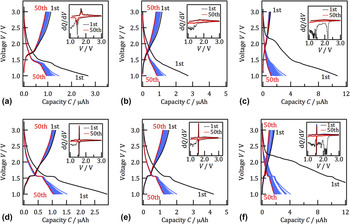
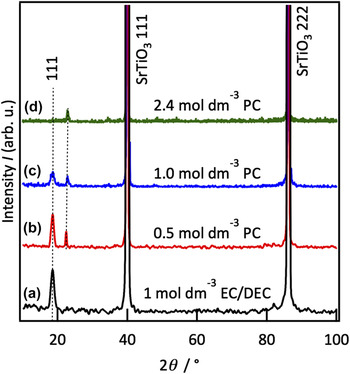
To further understand the effects of the side reactions on the intercalation inactivity of the Li4Ti5O12(111) film, the discharge–charge measurements were conducted using coin-type cells with different electrolytes. Figure 6 shows the discharge–charge curves of 10-nm-thick Li4Ti5O12(111) films in PC and EC/DEC based electrolytes with different LiPF6 concentrations. The insets in each figure depict the dQ/dV plots at the first and 50th cycles. The discharge–charge curves of all coin-type cells mainly consisted of the slope regions, which were associated with the side reactions, and the capacities of the slope regions increased as the LiPF6 concentration increased, which indicated the participation of the Li+ and PF6 – ions in the side reactions. When the 0.5 mol/dm3 LiPF6-containing PC was used as the electrolyte, the plateau regions were observed at around 1.4 and 1.7 V in the discharge and charge curves, respectively [Fig. 6(a)]. The sharp dQ/dV peaks observed at the 50th cycle confirmed that the reversible lithium intercalation proceeded in the Li4Ti5O12(111) film. By contrast, the dQ/dV peaks became smaller as the LiPF6 concentration increased to 1.0 and 2.4 mol/dm3 [Figs. 6(b) and 6(c)]. As described in the above sections, the Li4Ti5O12(111) film delivered the reversible lithium intercalation using the spectroelectrochemical cell, even when the 1.0 mol/dm3 LiPF6-containing PC electrolyte was used. Thus, we can speculate that the side reactions between coin-cell components and the electrolyte species generate some products that enhance the deterioration of the Li4Ti5O12 electrode. It must be noted that the Li4Ti5O12(111) films in LiPF6-containing EC/DEC electrolytes showed clear plateau regions in the discharge–charge curves as the LiPF6 concentration increased from 0.5 to 2.4 mol/dm3 [Figs. 6(d)–6(e)]. The discharge capacities in the plateau regions at the 50th cycle were 0.17, 0.19, and 0.18 μAh when the LiPF6 concentrations were 0.5, 1.0, and 2.4 mol/dm3, respectively, which indicates no dependence of the capacity on the LiPF6 concentration. Furthermore, the dQ/dV peaks were observed at around 1.55 V for both discharge and charge processes, showing a considerably small polarization compared to those observed for the PC-based electrolytes. These results confirmed that the highly-reversible lithium intercalation of Li4Ti5O12 proceeded in the LiPF6-containing EC/DEC electrolytes. Figure 7 shows XRD patterns of the 10-nm-thick Li4Ti5O12(111) films after 50 cycles in different electrolytes. The Li4Ti5O12(111) film cycled in the 1.0 mol/dm3 LiPF6 EC/DEC showed a 111 diffraction peak at 18.5°, which supports the reversible lithium intercalation. By contrast, the Li4Ti5O12(111) films cycled in the LiPF6 PC electrolytes showed a diffraction peak at 22.5°, which could not be attributed to the Li4Ti5O12 and Li7Ti5O12 spinels. An irreversible phase change from the spinel-type phase was clearly detected after the discharge–charge reactions in the coin-type cells. The intensity ratios of the Li4Ti5O12(111) to the new peaks decreased with LiPF6 concentration, and the Li4Ti5O12(111) peak was not observed for the sample cycled in the 2.4 mol/dm3 LiPF6 PC. The decrease in the intensity ratio can be reasonably related to the decrease in the electrochemical capacity in the plateau regions shown as Figs. 6(a)–6(c). Our results demonstrated that the electrochemical stability of the surface region of Li4Ti5O12 varied with electrolyte composition and cell components, and a phase change from the Li4Ti5O12 spinel to an electrochemically-inactive phase occurs during the initial electrochemical process, which results in the small capacity and large polarization during the subsequent cycles.
Discharge–charge curves of 10-nm-thick Li4Ti5O12(111)/SrTiO3(111) films with (a–c) PC and (d–f) EC/DEC(3:7 vol.) electrolytes containing (a, d) 0.5, (b, e) 1.0 and (c, f) 2.4 mol/dm3 LiPF6. The constant current applied was approximately 0.5 μA, which corresponds to a current density of 175 mA/g (1 C) for Li4Ti5O12 film electrode.

Ex situ XRD patterns of the 10-nm-thick Li4Ti5O12(111) films following 50 cycles in (a) 1 mol/dm3 LiPF6 EC:DEC (3:7 vol.) and (b) 0.5, (c) 1.0, and (d) 2.4 mol/dm3 LiPF6 PC electrolytes.

IV. CONCLUSION
The surface structure changes and lithium intercalation properties of the Li4Ti5O12 anode have been investigated using epitaxial-film model electrodes and x-ray and neutron scattering techniques. The NR analyses revealed that the phase change occurs in the 10-nm surface region from the Li4Ti5O12/organic electrolyte interfaces during the initial reaction processes. The surface-reconstructed phase formed in the LiPF6-containing PC electrolytes limits the lithium intercalation although the surface-reconstruction behavior is highly influenced by the electrolyte composition and the cell component. The Li4Ti5O12 surface does not show transitions to the low-active phase in the EC/DEC based electrolytes, which leads to highly-reversible lithium intercalation. The coin-type cells lead to further side reactions of electrolyte species, and the products could be associated with electrode deterioration at the Li4Ti5O12 surface. Our results have demonstrated the importance of surface reactions in the development of Li4Ti5O12 anodes for lithium ion batteries of high power density.
Supplementary Material
To view supplementary material for this article, please visit http://dx.doi.org/10.1557/jmr.2016.320.
ACKNOWLEDGMENTS
This work was partly supported by a Grant-in-Aid for Scientific Research (A, C) of Japan Society for the Promotion of Science (Nos. 25410237, 25248051, and 16K05929). The neutron experiments were performed as projects approved by the Japan Proton Accelerator Research Complex (2010A0057, 2013B0166, 2015A0233).