1. INTRODUCTION
Novelties in consumption traditionally have been attributed to towns. They were where new goods first arrived, where markets were recurrently held, and the wealthier ranks of society had their residence. Employing a term by F. Braudel, towns acted as ‘electric transformers’ of the countryside, a world whose material culture was largely defined by austerity, tradition and reluctance to follow fashion and innovation.Footnote 1 There has been, though, a good deal of evidence that challenges this view. Scholarship on consumption in the last 20 years has demonstrated that the countryside also participated in the general proliferation of goods that took place in pre-industrial Europe.Footnote 2 In the case of the later Middle Ages, C. Dyer made significant efforts to show that this process can be tracked already in the fourteenth and fifteenth centuries, what seems to be a historical phenomenon of European dimensions. Southern European societies also experienced significant improvements in material wealth. This can be seen not only in well-known works such as those by M. S. Mazzi and S. Raveggi for Italy, but also in recent ones by historians of the Crown of Aragon, such as those by A. Furió, J. V. García Marsilla and F. Garcia Oliver for the kingdom of Valencia, Ll. To, P. Ortí, J. Bolòs and I. Sànchez-Boira for Catalonia, and C. Laliena and M. Lafuente for the kingdom of Aragon.Footnote 3 Thus, the villagers seem to have had access to better food, clothing, lighting, and furnishings. Important improvements also seem to have occurred in a particular range of goods that became progressively more popular: earthenware.Footnote 4 Ceramics were among the goods that saw major improvements in medieval and early modern consumption, in both urban and rural areas. Regardless of differences in time and space, historians have found episodes in which earthenware spread to more households, while production centres developed and technology improved to provide new styles, colours and motifs. This allowed pottery (a demand-elastic commodity whose function could be performed by other materials, such as wood or metals) to compete and even replace them.Footnote 5
If villagers acquired more earthenware in the course of the later Middle Ages, what caused them to do so? Most arguments about changes in consumption have traditionally drawn on improvements in purchasing power. Trends in real wages developed by H. Phelps-Brown and S. Hopkins more than 50 years ago have provided a basic framework for explanations of late medieval changes in consumption. ‘The unusual economic conditions following the demographic devastation of the Black Death stimulated higher per capita expenditure and fostered spending on a growing diversity of goods and services’, M. Kowaleski observed.Footnote 6 Clearly real wages series are not sufficiently representative of the rural population, but recent calculations of GDP per head have supported the idea of a post-plague rise in spending power in places like England, though they refine its supposedly ‘revolutionary’ dimensions. With various nuances, this idea is generally accepted among historians of the Crown of Aragon, as can be seen in traditional works by F. Zulaica and, more recently, by A. Furió.Footnote 7
These findings are important and cannot be neglected. Yet this should not imply that all changes in material culture were a consequence of a higher purchasing power. It is in fact problematic to attribute some changes in consumption to personal wealth. Scholars such as L. Weatherill and R. Porter have warned that a complex variety of elements modelled consumer behaviour towards certain goods.Footnote 8 Earthenware can be considered one of these. M. Overton et al. have highlighted the inefficiency of wealth as a determinant of consumption of durable goods such as those related to hot drinks.Footnote 9 This is reasonable since these objects could hardly have been out of reach for anybody. Pottery is characteristically, even in the case of painted exemplars, a widely affordable, cheap product.Footnote 10 When historians have attempted to explain innovations in tableware, their arguments have been found in the field of practices, the development of new activities within the household. Changes in early modern tableware, for instance, have been related to the rising fashion of having tea, coffee and sugar.Footnote 11 In the case of the later Middle Ages, the emergence of new pottery shapes has been related to the development of a ‘drinking culture’ that resulted from the expansion of ale consumption.Footnote 12 However, how and why this process might have occurred in the countryside has not been considered, and indeed, is difficult to explore in a period in which probate inventories are scarce in Northern Europe.
There are, therefore, several questions in need of explanation. How much earthenware did medieval villagers possess? Did they actually purchase more of these goods in the course of the later Middle Ages and, if so, how much more? Were they cheap, affordable products for them? For what purpose did they want these objects and how did they use them? Fundamentally, why did medieval villagers buy earthenware? This article will attempt to shed light on such questions. It will explore the consumer behaviour of the villagers of a Mediterranean state, the Kingdom of Valencia, whose exceptional documentation allows for a quantitative analysis of probate inventories since the late thirteenth century. The second section will present the features of Valencian inventories and the sample under study. Section 3 will consider if a rise in rural earthenware consumption took place and how it manifested itself. Section 4 will explore pottery prices and provide estimates on household expenses on these goods. Finally, section 5 will explore the practices surrounding earthenware consumption in rural life.
2. THE KINGDOM OF VALENCIA AND ITS INVENTORIES: A SAMPLE PRESENTATION
The Kingdom of Valencia was one of the states located in the east of Iberia during the later Middle Ages and most of the early modern era. It was founded in 1238 through the destruction of prior Islamic political formations, and integrated within the Crown of Aragon, a confederation of realms that also included Catalonia, Majorca and Aragon. The kingdom became a powerful political and economic entity during the fifteenth century thanks to its strategic geographical position, connecting the Atlantic and Mediterranean trade networks. This prompted a flourishing local industry, especially in textiles, but also a market-oriented agriculture, altogether making the kingdom a centre for export of products to southern and northern Europe. At the end of the fifteenth century, when the kingdom reached its Segle d'Or (‘Golden Century’), it hosted 55,700 hearths, thus some 278,500 inhabitants out of the million of the Crown of Aragon.Footnote 13
This dynamic economic activity left a mark in a number of ways in the records of public notaries, common figures in many regions of the western Mediterranean, particularly in the Crown of Aragon, Italy and southern France, during the later Middle Ages. In the case of Valencia these records are preserved from the 1280s, just 50 years after the creation of the kingdom. A number of document types can be found within them, from contracts of sale and debt registries, to wills and also inventories. These lists of goods were issued in Valencia under similar circumstances as probate inventories in other parts of Europe. An individual who was going to inherit certain possessions from the deceased commissioned an inventory.Footnote 14 The constitutional law of the kingdom (the Furs) treated ordering inventories both as a right and as an obligation. It was the right of an heir who wanted to prevent the inheritance of an unexpected amount of debt incurred by the deceased. It was an obligation of someone who wanted to manage the goods of somebody else, in most cases tutorship administrators of minor children. These are indeed the only causes of creation the inventories themselves make explicit. In practice, these documents were a legal resource that Valencian society could resort to before contentious situations, which could adopt a variety of shapes.Footnote 15
A quantitative analysis of these documents requires enquiry into their particularities. Positive aspects for the purposes of this study include that they do not seem to neglect minor goods or address them with less attention. Descriptions of pottery items are normally individualised, defining at least each item, number and material, sometimes their size and quality (even if damaged or broken), and occasionally usage and decoration. In addition, if they had something valuable to leave in inheritance, all social ranks seem to have commissioned inventories. This was something the constitutional law safeguarded by establishing the maximum price of making an inventory at the value of four sous per page. In practice, most inventories required a total investment of three to six sous in the fifteenth century, which would correspond to one or two day's wages in the same period.Footnote 16
Yet Valencian inventories are not, as in other European cases, exempt from handicaps in exploring consumption. They show a stock of goods in a fixed, non-dynamic image of the household life cycle. Some objects might have been in the house for years and have been sold when the owner was ill, before the inventory was ordered. Some objects could also have been inherited rather than purchased, which would particularly affect durable goods. Moreover, inventories record the goods of one person, the one who died and whose possessions were to be transferred to another. This implies inventories do not list all goods within the house, for they are able to distinguish those of the deceased from those of the spouse, if still alive. For this reason, inventories of women – whether widows or not – should in principle provide a more incomplete and biased image of household possessions since they include the dowry goods only.Footnote 17
These issues are inherent elements of inventories, and in practice, it proves difficult to avoid them. This is particularly clear in the case of the later Middle Ages, a period in which the small number of extant inventories requires sacrificing some degree of representativeness in favour of having any profitable findings or any sense of change. For the purposes of this article, 251 inventories will be studied, covering c. 1280 to c. 1450.Footnote 18 It is a sample of limited dimensions if compared to early modern scholarship, but as far as the medieval period is concerned, with few comparisons.Footnote 19
Geographically, these inventories refer to four areas of the Valencian ‘countryside’ within that period. This is a crude term. Ideally, the focus of this study would be what documents call llauradors, agricultural workers, ranging from affluent farmers to agricultural wage-earners.Footnote 20 In practice though, many inventories do not reveal the occupation of the deceased, thus almost all extant inventories referring to these locations within this period have been explored. The reason is that, with the exception of noblemen, which are not included in the sample, these individuals can simply be considered as ‘villagers’, since they lived in populations where agriculture had a major role in everyday economic activity. Studies of local occupational structures through fiscal sources support this view. Two of these places, Alcoi and Vilafranca, for instance, were medium-size localities of nearly 1,000 people. Alcoi was located in the mid-south of the kingdom, while Vilafranca lay in the very north, bordering Catalonia and Aragon. Although these were localities with a relevant presence of secondary occupations, such as artisans and merchants, and sources refer to them as viles (‘towns’), scholars generally consider them ‘rural communities’ since most of the population were somehow involved with agricultural work. The third locality under exploration, Morvedre, was just a few kilometres north of the city of Valencia. The population here was probably larger, and it is regarded as one of the main towns of the kingdom, although at least half of the residents might have been llauradors. Finally, the fourth area corresponds to the hinterland of the city of Valencia, historically called the horta (literally ‘orchard’). This was an irrigated, highly intensive agricultural space integrated under the economic needs of the city of Valencia, where the population lived either in isolated farmsteads or small centres of a hundred dwellers.Footnote 21
3. A RISE IN CONSUMPTION
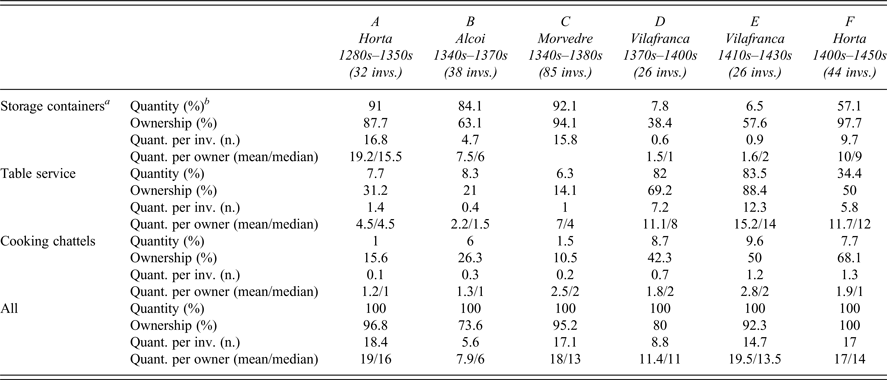
It is necessary to start by exploring whether a significant change in the acquisition of earthenware occurred in the period. Basic quantitative analysis can reveal this. Table 1 addresses all the regions under study, including data on the ownership of pottery, as well as possessed quantities per inventory and per owner. ‘Pottery’ includes other earthen products related to foodstuff, such as cooking and storing chattels, so that the relation between earthenware and these chattels can also be considered. The first thing that can be observed is that discussing pottery in the fourteenth-century countryside is essentially a discussion of storage containers. This category mainly consists of large clay jars, enormous containers for keeping hundreds of litres of wine and olive oil, as well as other objects such as flagons. These goods represented c. 90 per cent of all recorded pottery in the rural surroundings of the city of Valencia (horta, column A), but also in the case of Alcoi (column B) and Morvedre (column C). Moreover, these objects were owned in the greatest quantities in all these places. The number of pieces per inventory reached 15 in the horta and Morvedre, and 5 in Alcoi. The vast dimensions of these goods suggest they were used for the preservation of agricultural produce for both trade and household consumption. This would explain why possessed quantities of these jars were higher in the more urbanised and commercialised areas. Thus, the degree of market-oriented activities would largely determine the acquisition of these goods. Morvedre, for instance, was significantly a centre of wine production and distribution.Footnote 22
Pottery consumption in various areas of the kingdom of Valencia (1280s–1450s)

a ‘Storage containers’ include different types of large clay jars (gerres/alcolles/alfàbies, orces) and flagons (cànters). ‘Table service’ ítems are various types of bowls (escudelles, greals), plates (tallador), jugs (terrasos/terraces, setres) and cups (taces). Finally, ‘cooking chattels’ includes mortars (morters), kneading troughs (llibrells), and diverse pots (olles, cassoles).
b ‘Quantity’ is the percentage that the goods represent of the total of pottery products. ‘Ownership’ refers to the percentage of inventories showing at least one of the specific goods in a given location. Finally, ‘quantities’ are the number of pieces, divided by the inventories having at least one of such pieces (if ‘per owner’) or all inventories (if ‘per inv.’).
Sources: Inventories dataset (see endnote 18).
It can be said, therefore, that pottery consumption was essentially concentrated on these utilitarian products by the mid-fourteenth century. This correlates with evidence from the supply side. Contracts between merchants and potters from the main production centres of the kingdom, Manises and Paterna (8 km to the west of the city of Valencia), show the absolute predominance of this rough, unglazed pottery.Footnote 23 Excavations at the kilns of Paterna have also revealed these objects as the most distinctive clay products of the period, while the production of ceramics remained comparatively low.Footnote 24 Inventories suggest this was also the case for consumption. According to the sample, having an earthen dish was uncommon in most houses. Only one third of households possessed earthen tableware, and even these only had a few items per home (up to 4) (Table 1, columns A–C). Other materials, especially wood, must have satisfied the demand for table service items. An analysis of woodenware rural consumption has not been undertaken on this occasion, but it is widely known that such items were widespread across Europe, even until the eighteenth century in some regions.Footnote 25 In the case of the city of Valencia, a study by P. López Elum showed that 64 per cent of all recorded tableware in urban inventories was made of wood by 1350, while only 23 per cent was of clay.Footnote 26 Only earthen cooking items seem to have been less popular than earthenware. These were food preparation items, mortars and kneading troughs that barely surpassed the quantity of one piece per home, and were only seen in one fourth of them (Table 1, columns A–C).
It is undeniable that a high demand for pottery emerged from different areas of the countryside. Yet it was concentrated on rough, unglazed products. This impression changes substantially in inventories of subsequent periods. Unfortunately, inventories from Alcoi or Morvedre are not preserved for later periods, but one can turn to two other populations. The first one is the horta itself, from which inventories from the first half of the fifteenth century are abundant (Table 1, column F). In this case, all pottery types expanded to more houses, even storage containers, being present in almost all rural houses. But it was earthenware and cooking items that saw the most significant changes. Table service items made of clay were possessed not only by 20 per cent more houses, but quantities per family were four times higher. There were also changes in the case of cooking items, which were acquired in similar quantities but by a greater number of families, due to the diffusion of earthen kneading troughs and mortars, which tended to replace previous wooden versions. It is a similar process to that of Vilafranca. This locality can be explored in the period from the end of the fourteenth to the mid-fifteenth centuries. The abundance of inventories allows one to distribute them into two balanced periods, which reveal a slow but progressive rise in the acquisition of pottery. Both cooking and table service items expanded to 10 per cent more houses in this period. Quantities of the former remained c. 1 piece per inventory in both periods, ranging from 0.7 to 1.2, while quantities of the latter almost doubled, going from 7.2 to 12.3 (see Table 1, columns D and E).
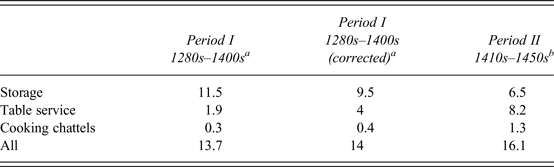
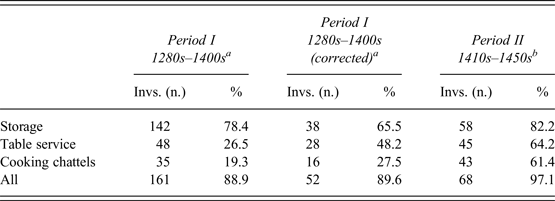
All regions under study seem to reveal a common process, a change in the way that rural consumers acquired pottery. The uses and practices surrounding clay-made objects were progressively moving away from a strictly utilitarian usage, altering the composition of pottery consumption. If in the 1350s nearly 90 per cent of pottery was devoted to storage, by the 1450s only c. 60 per cent was of such a kind in the horta, and even less in Vilafranca – although the employment of earthen jars here was minor, mostly due to the popularity of wooden barrelsFootnote 27 (see Table 1, all columns). If one takes the evidence coming from these regions together, a provisional estimate on the possession and diffusion of such goods at the level of the kingdom proves possible. Table 2 and Table 3 combine the data coming from these regions into two artificial periods, which represent the extremes of the studied chronology. This suggests consumption of storage containers reduced roughly by a half, from 11.5 to 6.5 pieces per inventory, without significant changes in their social diffusion. Meanwhile, table service items multiplied by four (from two to a staggering eight pieces per inventory), and reached more than twice as many houses (from 26.5 to 64.2 per cent). Cooking chattels seem to have followed a similar process of rising popularity, which made them present in three times as many houses (from 19.3 to 61.4 per cent), although their acquisition grew relatively little (from 0.3 to 1.3 pieces per inventory). Either way, given that ‘period I’ includes regions for which no extant data exist in ‘period II’, a ‘corrected’ version of the second period, including exactly the same places, slightly refines this pattern. Storage pottery reduced by a third, while tableware and cooking items doubled, being present in 75 and 200 per cent more houses, respectively.
Pottery possession per inventory in the Valencian countryside (1283–1450) (in number of pieces)

a Period I is based on inventories in columns A, B, C and D in table 1 (181 inventories). Its ‘corrected’ version merges those in columns A and D (58 inventories).
b Period II is a combination of columns E and F (70 inventories). For details see text.
Sources: Inventories dataset (see endnote 18).
Ownership of pottery in the Valencian countryside (1283–1450)

a Period I is based on inventories in columns A, B, C and D in table 1 (181 inventories). Its ‘corrected’ version merges those in columns A and D (58 inventories).
b Period II is a combination of columns E and F (70 inventories). For details, see text.
Sources: Inventories dataset (see endnote 18).
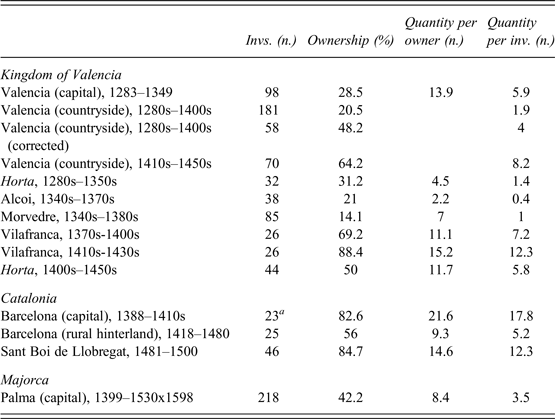
Such ‘global’ averages are not necessarily representative of most parts of the kingdom. Even so, this data and that for these specific regions proves consistent with other contemporary patterns. Table 4 presents a compilation of data on earthenware ownership and quantities per owner and inventory in various regions of the Crown of Aragon. By comparing data from Valencia to that of Catalonia in similar periods a common pattern can be observed, in which consumers in larger population centres possessed more earthenware, followed by medium-size towns and smaller localities. The dwellers of the city of Valencia possessed a mean of approximately six pieces per inventory, six times more than in Morvedre (one piece), and still more than in Alcoi, where these goods were marginal (0.4 pieces per inventory). There were also differences between rural areas. The villagers of the horta were more familiar with these objects than those of Alcoi (1.4 pieces per inventory). In fifteenth-century Catalonia, pieces per inventory in Barcelona were c. 18, 3 times higher than in its hinterland (c. 5 pieces), but only slightly higher than in a medium-size locality such as Sant Boi de Llobregat (c. 12 pieces). In fact, there were similarities between areas with presumably similar degrees of urbanisation. The ownership of earthenware in the rural surroundings of Barcelona was similar to that of the horta in the first half of the fifteenth century (56 and 50 per cent respectively), even in the case of the pieces per owner (9.3 and 11.7 pieces) and per inventory (5.2 and 5.8 pieces). Meanwhile, in medium population centres such as Vilafranca and Sant Boi, the ownership was 88.4 and 84.7 per cent respectively, with similar quantities per inventory (12.3 pieces exactly in both of them) and per owner (14.6 and 15.2).
Earthenware consumption in Valencia as compared to other areas of the Crown of Aragon (thirteenth to fifteenth centuries)

a This quantity also includes some auctions.
Sources: Data on the city of Valencia is extracted from L. Almenar Fernández, ‘Los inventarios post mortem de la Valencia medieval: una fuente para el estudio del consumo doméstico y los niveles de vida’, Anuario de Estudios Medievales 47, 2 (2017), 533–66. All other figures on the kingdom of Valencia are based on Table 1. Data for Catalonia and Majorca are constructed from transcriptions of inventories or systematised lists of possessions in P. Benito i Monclús, ‘Casa rural y niveles de vida en el entorno de Barcelona a fines de la Edad Media’, in press; E. Broida, ‘Els atuells de terrissa a les llars barcelonines vers l'any 1400’, in M. Riu Riu ed., Ceràmica grisa i terrissa popular de la Catalunya medieval (Barcelona, 1984), 228–39; J. Codina and N. Sales, Els santboians de 1490: Cóm es vivia fa 500 anys a la vila de Sant Boi de Llobregat (Barcelona, 1990), 346–54; and M. Barceló Crespí and G. Rosselló Bordoy, Terrissa: Dades documentals per a l'estudi de la ceràmica mallorquina del segle XV (Barcelona, 1996), 21–92.
Such levels of consumption, therefore, are consistent with contemporary examples. What is striking is how they compare to published data on earthenware consumption in the early modern period. Estimates by L. Weatherill revealed that earthenware was present in 26 per cent of rural English inventories in 1675,Footnote 28 nearly half as many as Valencian inventories reveal 1280s–1400s (48.2 per cent, corrected data). At the level of particular regions, available data suggests earthenware could have been more widespread in the thirteenth to fourteenth-century horta (31.2 per cent) than in seventeenth-century London (14 per cent) or eighteenth-century Virginia (2.3 per cent).Footnote 29 Certainly these figures are not comparable. The number of inventories in early modern cases is much higher and they cover a wider spectrum of consumers. Yet it is remarkable that the ownership of earthenware is ‘0 per cent’ in many early modern cases, such as in Worcestershire and the American colonies.Footnote 30 This is even true of sixteenth-century Oxford, whose region had been a centre of pottery production since the Middle Ages.Footnote 31 Some of these goods might have been omitted in those inventories, but it is not a far-fetched assumption that earthenware was more widespread in the Crown of Aragon even within these chronological differences. England was a centre of importation of ceramics from the Middle Ages, especially German stoneware, and only after the 1680s would local tin-glaze productions compete and replace imports.Footnote 32 Valencia, on the other hand, exported tin-glaze earthenware all around Europe, including to England, from the thirteenth century.Footnote 33 More important, perhaps, is the presence of other tableware materials in northern Europe, which could embody similar functions to ceramics, such as pewter. Pewterware was predominant over earthenware in England and Holland until the first half of the seventeenth century.Footnote 34 Meanwhile, this material does not seem to have enjoyed such popularity in Valencia, and the very reason could be precisely the early development of the pottery industry.Footnote 35
Irrespectively, as far as the case of Valencia is concerned, a rise in pottery consumption was taking place, but it was earthenware that saw the most significant changes. Pottery could be seen less as a utilitarian product, mostly represented by storage jars, and more as a product of usage and display in everyday meals. For villagers, earthenware stopped being a rare good, and became progressively an everyday one. Detecting this shift is relatively simple. What proves harder is establishing whether this phenomenon had any significance for medieval villagers or was just a curious fact with no relevance for their living standards.
4. POTTERY PRICES, HOUSEHOLD EXPENSES AND RURAL INCOMES
How did villagers manage to purchase more of these goods? Following a traditional explanation one could suspect an increase in purchasing power. Real wages in Valencia have not been estimated for most of this chronology – only for the fifteenth century – and do not seem to show a clear upward trend.Footnote 36 Furthermore, it seems clear that real wages have a limited representativeness for rural populations. Wages were not the sole source of income for the villagers, nor the market the only method of subsistence. Recent work by J. Hatcher has vindicated the credibility of alternative methods to assess rural purchasing power, such as household budgets, in which a number of variables –much closer to the elements that shaped villagers’ incomes – are considered.Footnote 37 In order to assess whether earthenware was more affordable, a similar – but simpler – exercise can be reproduced here.
It is necessary to first establish the levels of expenditure on these goods, for which pottery prices are a requirement. Unlike early modern specimens, medieval inventories from this region did not normally include a valuation of the listed goods.Footnote 38 The value of clay-made products can be explored by resorting to sales in public auctions records (almonedes), documents that frequently follow probate inventories in notarial sources, which were studied in various areas of the Crown of Aragon by J. V. Garcia Marsilla, C. Vela, G. Navarro, J. Bolòs and I. Sànchez-Boira. Unlike valuations, these documents include prices resulting from real market transactions, concerning goods normally being sold a few days after the death of the owner.Footnote 39 In the kingdom of Valencia, these almonedes are preserved in notarial records from the 1380s, and they seem to have been held in major towns. Only examples of the city of Valencia and Vilafranca have been found for this research, which means it is only possible to know the prices in these centres. These prices, of course, need to be subject to discussion. Second-hand prices are by definition different from first-hand ones. Unfortunately, the everyday purchase of pottery in the first-hand market does not seem to have left a mark in notarial records, which must mean the cost of the transaction was so low that a notarial act proved unnecessary. On the other hand, through use objects were often damaged, described as ‘broken’, ‘rotten’ and the like. Since this could extremely reduce the value of the pieces, prices from these exemplars have not been considered.
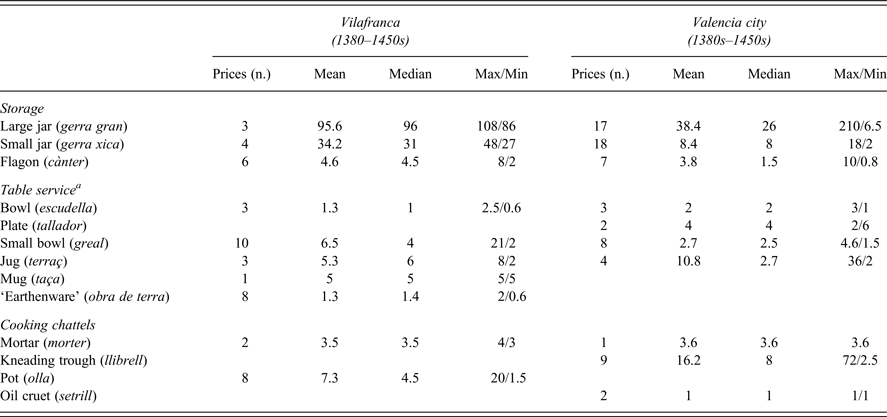
All this makes it impossible to establish short-term trends, but a collection of prices can be made to explore differences among these items. Table 5 collects pottery prices from 44 public auctions in Valencia and Vilafranca for the first half of the fifteenth century.Footnote 40 What this shows is that the value of the pieces was largely determined by their size in both locations. Storage containers were the products with higher prices, particularly large clay jars. They ranged between at least three sizes – 10, 20 and 30 cànters, roughly 100, 200 and 300 litres – and sometimes more, reaching 210d (17.5s). This reinforces the idea of these objects as real investments. By contrast, earthen cooking and table service items were given significantly lower values. One earthen bowl had a mean cost of just 2d in Valencia, 4d in the case of plates. Other objects such as jugs (terraces) and minor versions of bowls (greals) depict similar prices, which in most cases seem to be higher in Vilafranca than in Valencia, although never representing high values (in the case of jugs, a median price of 6d). Cooking utensils made of clay were only slightly more expensive. Earthen mortars (morters) could cost 3.5d, similar to the case of pots (olles, 4.5d), while kneading troughs (pasteres) could be worth 8d.Footnote 41
Pottery prices (in diners) in Vilafranca and Valencia city (1380s–1450s)

a Table service items include both lustreware and regular earthenware. Combining both prices is consistent with the aim of estimating household expenditure on all earthenware. Irrespectively, the evidence has been that the prices of both styles were not significantly different (see text).
Sources: Public auctions dataset (see endnote 40).
The general image is that of a significant variation between the value of earthen storage containers and that of tableware and cooking chattels, which must have virtually separated the approach to these goods by their consumers. While the first ones were expensive goods, midway between household needs and the businesses surrounding the rural holding, the latter were extremely low-value products. It is debatable whether these prices were really that low or, as previously stated, an effect of second-hand prices. Yet other sources support this picture, such as pottery prices stemming from contracts between potters and merchants. A fifteenth-century merchant could pay 8–11s per grossa (144 pieces) for the most common earthenware types, which is 0.6–0.9d per unit. Only lustrewares could reach higher prices of 24–38s per grossa, which still is 2–3d per unit.Footnote 42 Evidence from other locations in the Crown of Aragon collected by J. Bolòs, I. Sànchez-Boira, G. Navarro and C. Villanueva also show earthenware pieces worth a few diners, while jars some sous.Footnote 43
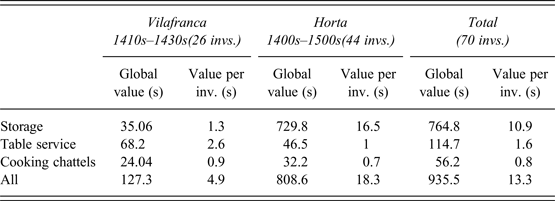
Therefore, the prices in Table 5 should be reliable since they agree with further evidence. Moreover, it is very likely that these prices suffered little change, at least during the first half of the fifteenth century. Work by E. J. Hamilton on prices in Valencia shows non-agricultural prices (that is, based on building materials such as iron and wood, but also clay) maintained significant stability at least during this half century.Footnote 44 Thus, there is a solid basis on which to cross-reference these prices with the objects that villagers possessed, to provide estimates of household expenditure on pottery. Table 6 shows the results for the case of the horta and Vilafranca, the only locations where both inventories and prices are preserved. Leaving aside the global value of the products, in which the number of inventories plays a role, values per inventory allow first comparisons. In general terms, these estimates show that expenditure per inventory was much higher in the horta than in Vilafranca (18.3s compared to 4.9s), although this is largely due to storage containers that, as previously shown, were more commonly owned in this area. But focusing on earthen cooking and table service items, it seems clear that expenditure on them was significantly low in both places. The earthenware possessed by an individual in Vilafranca could be worth nearly 3s, and in the horta 1s. Meanwhile, the value of cooking chattels did not even reach 1s per inventory in either place.

If these estimates are somehow close to reality, it is hard to believe earthenware consumption could produce any significant impact on an annual household budget. Work on various rural Valencian communities has led to some general figures provided by A. Furió and P. Viciano that can be taken to assess this. It has been estimated that 5 hectares of land, the standard size of a fifteenth-century Valencian rural holding, could yield an output of 50 hectolitres of cereal. The post-harvest available cereal, after subtracting the required quantity for the next harvest (12.5 hl) and that for domestic consumption (in a regular Valencian family of 4 members, 12 hl/year), could be around 25 hl (a mix of wheat and barley), which in the fifteenth century can be valued at c. 310s. Considering contemporary tax pressure in royal land, the annual agricultural output, finally, could be between 220s and 250s.Footnote 45 For most villagers, who lived primarily off their family holding, resorting complementarily to wage labour, these sums should represent the budget to meet all costs throughout the year. If any of these villagers acquired all their earthenware at once, which has been estimated here to cost 1–3s, this would have represented a hundredth of their annual budget. Furthermore, it is likely that many of these durable goods were acquired in different years, reducing the impact of their acquisition on household incomes.
These objects were affordable products for the villagers, at least in the fifteenth century. The question is, was this situation different in the prior century and does this explain why they acquired more of these goods? It is not possible to provide a collection of tableware prices for the fourteenth century given the lack of preservation of public auctions records from these periods. Moreover, a similar exercise of household budget estimate proves difficult with the available data. However, rural incomes must have been, in global terms, higher in the late thirteenth century than in subsequent moments. The Valencian regime of inheritance tended to fragment plots by dividing holdings among all brothers. As mentioned above, most fifteenth-century peasant holdings had a mean size of five ha, but this was nearly a half of what it was at the end of the thirteenth century (nine ha), when the weight of taxation was significantly lower.Footnote 46 It was, therefore, when villagers theoretically enjoyed higher incomes, that they did not consume earthenware at the levels of subsequent periods.
5. THE USES OF EARTHENWARE IN THE COUNTRYSIDE
If there was a rise in consumption, and if this was not accompanied by higher disposable incomes, alternative explanations must be sought. Some historians have suggested the higher popularity of earthenware might have been linked to the development of new practices within the household. The problem is in identifying these. The alleged birth of a ‘drinking culture’ could certainly have taken place, but if so, it manifested in complex manners in the countryside. Objects with the specific purpose of being a drinking vessel underwent little change in these inventories. In the horta, objects such as mugs (taces) are absent, and only present in a few inventories from larger places such as Morvedre. Jugs (terraces) might even have declined in ownership, from 12.5 to 4.5 per cent. The only drinking item that became more popular was the flagon (cànter). Unlike jugs or mugs, these flagons were not light, small chattels to put on the table while eating, but robust, heavy objects held with two handles. Their ownership increased in the horta from 12.5 to 22.7 per cent, while their mean per owner saw little change (from 1.5 to 2). They normally appear related to wine drinking in inventories, which can be taken as the counterpart of ale in this region of Europe.
Although relevant, these changes are not of decisive magnitudes. If there was a new ‘drinking culture’ it does not seem to have pushed the villagers to purchase specialised objects, committed solely to the act of drinking. On the contrary, the objects that had the leading role in the proliferation of earthenware in the countryside were bowls. In the horta, bowls (escudelles) doubled both in terms of ownership (from 21.8 to 43.1 per cent) and quantities per owner (from 5.7 to 10 exemplars), while smaller versions (greals) appear in 10 per cent of houses by the fifteenth century. Archaeology has also detected how these objects became more fashionable during the second half of the fifteenth century, according to a general shift in taste. By the mid-fourteenth century, elaborate green wares were the most commonly found ceramics. Afterwards, these pieces were progressively and completely replaced by simple, schematic blue wares, whose primary shape were bowls of a number of sizes.Footnote 47
One can speculate that this particular style was behind the rise in rural consumption of earthenware. Blue wares have been described as ‘massive-diffusion’ products for popular consumption, given their quick, rough decoration, and their abundance in comparison with former green wares.Footnote 48 Moreover, production centres of blueware proliferated in the countryside, in the horta itself.Footnote 49 These were certainly exporting pieces to the city of Valencia, but their inhabitants must have also seen and bought their products. The popularity of these pieces has been attributed to the fact they were made to order, which allowed consumers to select and combine an arrangement of motifs according to their taste.Footnote 50 Some of them are difficult to interpret, such as geometric, vegetal motifs and a great variety of animals, but many were icons related to the warlike values of feudal society, such as castles and fortresses. Some became extremely popular in the fifteenth century, like pseudo-heraldic coats of arms, which imitated the royal flag of the kings of Aragon in complex and often unrecognisable ways. Others, on the contrary, were inspired by Islamic motifs. Fatima hands, eight-pointed stars, and the hom or ‘tree of life’, all of them coming from North African and Middle Eastern traditions, were common themes that show feudal society could also feel admiration for this culture as something oriental and exotic.Footnote 51
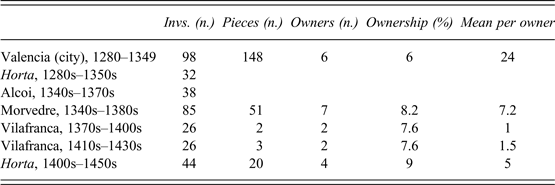
Whether villagers possessed blue wares with these motifs, or such wares themselves, is something one can only ponder given the archaeological evidence. The reason is that notaries did not record the colours of these common wares. They only seem to have been systematic in recording lustreware, the most distinctive ceramic product of medieval Valencia. Its metallic glaze (‘lustre’) provided these pieces an appearance that could resemble the golden and silver wares of the wealthiest ranks of medieval society.Footnote 52 In doing so, these objects could embody connotations of luxury without prohibitive prices. C. Fairchilds categorised goods of such features as ‘populuxe’.Footnote 53 Inventories reveal that villagers were consumers of these objects. Table 7 presents a compilation of references found in this sample, alongside data from a similar study of the city of Valencia. Lustreware, certainly, was not an unknown product in the countryside, at least no more so than in towns. For the fifteenth-century horta 9 per cent of inventories show an example of these pieces, a figure that is not very different from that of Vilafranca at similar dates (7.6 per cent), or Morvedre in the 1350s (8.2 per cent). Even inventories from the city of Valencia show a similar – even smaller – ownership in the 1350s (6 per cent). The main differences can be found in quantities owned. While the deceased from the fifteenth-century horta had a few pieces, those of the capital of the kingdom had a mean of 24 by the 1350s.
References to lustreware in inventoriesa

a Pieces regarded as lustreware are those qualified as obra de Màlica (‘work from Malaga’) or obra de Manizes (‘work from Manises’) in inventories. On this identification and the contemporary denominations of lustrewares, see P. López Elum, Los orígenes de la cerámica de Manises y Paterna (1285–1335) (Manises, 1985).
Sources: Data for the city of Valencia is taken from in Almenar Fernández, ‘Consumir la obra de terra’. All other data comes from this dataset of inventories (see endnote 18).
The reasons villagers were interested in these bowls are obscure. In principle, in contrast to the idea of the ‘drinking culture’, one should pose the development of a new ‘eating culture’. The reason why it was ‘new’ is that earthen bowls, unlike wooden versions, entailed the presence of a range of colours and motives – messages and meanings – in the act of having everyday meals. This fact does represent a substantial change in domestic practices, which can be perceived through the space these objects occupied within the household. In most occasions, inventories reveal earthenware was contained within a variety of boxes and baskets around the house. This suggests a preservation for a different moment, perhaps just as our current notion of the ‘fine ware’ that needs to be kept exclusive for special days. Indeed, sometimes one finds earthenware in sophisticated objects such as chests as well as opening benches (artibanchs), where elegant cloths and jewels also appear.Footnote 54 In other cases, these pieces were placed on a wooden board whose function was specifically for ‘holding bowls’ (tenir escudelles), sometimes called significantly the ‘bowler’ (escudeller). One can find examples such as that of Jaume Bardins, inhabitant of the small village of Sedaví, in the horta, who had ‘ten earthen bowls in the bowler’: or the one of Miquel Morella, a llaurador living within the walls of the city of Valencia, having ‘three medium lustre bowls’.Footnote 55
It is difficult to say if the placing of earthenware on these ‘bowlers’ was an attempt to store them or set them up for display. Sometimes, though, there is clear evidence ceramics could have surpassed the borders of functionality, becoming a product of fashion and style. Some inventories show these goods tied together and hung directly on the walls of rural houses. Domingo Bernat, llaurador of Cataroja (horta), had ‘six small bowls on the wall’ of his house in 1450.Footnote 56 The visual impact of these objects could have been important in many cases. Vicent Leopart, llaurador of Russafa (horta), possessed ‘fourteen bowls and platters on the wall’,Footnote 57 which was nothing compared to the case of Domingo Pérez, from the village of Mislata (horta), who had forty-five pieces of lustreware in the form of bowls and jugs.Footnote 58 In these cases, the goods must have been appreciated for their aesthetic qualities. It is a clear separation from the action of eating, and could have represented an element of decorum and observation: an art piece.
Why would the villagers place bowls on walls? A possible answer emerges in observing that all these pieces were placed in a particular room: the ‘entrance’ (entrada). In rural houses, this was the room where most domestic activity took place, since most houses had only a pair of rooms – the entrance and the restroom or ‘chamber’ (cambra). Here was where most villagers cooked, ate, spent leisure time and even slept.Footnote 59 All the aforementioned examples are indeed related to this room.Footnote 60 One can only speculate as to the reasons for such practices. The entrance must have also been a room of sociability, in which guests could dine in and be entertained. Eating together is, now and in the past, a social rite of confraternity, and it was perhaps the place where the villagers concluded deals with other members of the community and from outside. Some of these villagers might have felt the need to give an impression of taste and distinction to colleagues and customers. This is possible, but one cannot underestimate that they might also have purchased these objects for the simple fact they enjoyed their appearance. A few inventories show examples of ceramic pieces in chambers, the major private space. It does not seem they were stored, but on display. Some of these were indeed luxurious pieces, such as the ‘two small lustre bowls’ Jaume Mojolí, a llaurador of Russafa, had in his chamber.Footnote 61 Berenguer Palau, an inhabitant of Vilafranca, had his earthenware placed on wooden boards in his chamber, and exposed in on some sort of specialised case.Footnote 62
Everything suggests the growth of ceramic consumption can be linked to a higher sense of refinement in rural households. This seems to be primarily related to the wish to display a range of images and motifs at ‘entrances’ that represented a semi-private space, where villagers had everyday meals and perhaps received visits and guests. Why these practices increased in the course of the later Middle Ages is something for which a clear answer remains elusive. The only clear element that appears to have had some influence on earthenware consumption is the exposure to towns, as discussed in section 3. It is difficult to understand what this influence represents. These goods may have been more available in larger centres where markets were held more frequently, but these objects were not rare products, but affordable ones with a long existence. M. Overton also detected the relevance of this ‘urban factor’ and speculated that the anonymity of urban environments helped to create identity and fashion, something difficult in small rural communities.Footnote 63 This is possible, but when we focus on these particular objects we need to remember inventories reveal that they were not entirely in the public space, but within the house, in those ‘entrances’ in which guests perhaps were received. Unlike clothing, the capability to see and ‘desire’ these objects would have been more limited, but still existent and possible. One can also wonder to what extent these villagers were affluent members of their communities, for whom their involvement in business required the presence at home of potential clients to whom they wanted to give a good impression.Footnote 64 Perhaps larger population centres generated more economic activity, in which these villagers got involved, and caused them to wish to embellish their entrances more than their counterparts from smaller villages. Further research will be needed to explore this.
This ‘urban factor’ should not be interpreted as if the villagers were passive entities without particular consumer preferences. The fact they adopted these products mean they had a particular sensitiveness towards them. As scholars such as B. Moreno and C. Dyer have argued, the villagers had their own consumer preferences, agreeing with their needs and life style.Footnote 65 It cannot be ignored that no one forced the villagers to purchase more earthenware. That must have been the villagers' own decision and achievement.
5. CONCLUDING REMARKS
Earthenware became a product of increasing popularity among Valencian villagers in the course of the later Middle Ages. These objects were cheap, affordable goods that were easily acquired with the incomes generated by the villagers' rural holdings. The growing interest of rural consumers in these goods seems to be related to a greater preoccupation with table manners and refinement in the private space. More villagers supplied their meals with a wide variety of colours and motifs. Some of these could have been messages for guests to whom a sense of taste or distinction needed to be transmitted. Other villagers could have purchased the goods simply for the fact they admired their aesthetic and beauty. Such a rising sense of decorum in the rural house poses, either way, further questions. Were there other objects that rose in popularity as part of such preoccupations? Were these practices the result of the imitation of other social groups? Did other social strata develop similar attitudes in the same period? Further research is needed.
The case of earthenware shows that the reasons why consumption grew in the course of the later Middle Ages are still far from clear. Conclusions based upon purchasing power are important, but do not sufficiently explain all changes in consumption. Some objects increasingly acquired were certainly expensive products that became more accessible for consumers. Yet others, just as ceramics, were affordable goods that became fashionable for complex reasons that require more research. Not every good was acquired for the same causes. Objects fulfil a need for consumers. Should these needs change, a want could become a necessity, and a must-have could turn into a disposable, obsolete possession. Some of the objects that have characterised the most distinctive changes in consumption of the pre-industrial era could well have followed similar processes. Understanding the ‘why’ of consumption therefore proves absolutely necessary. For, in the end, if the late medieval economy had something of a growing, flourishing market economy this was due to a vast mass of consumers willing to purchase objects they considered worth paying for.
ACKNOWLEDGEMENTS
This research was conducted as part of the Spanish Ministry for Education and Culture (MEC) project ‘Economic Growth and Social Inequality in Mediterranean Europe, 13th–15th Centuries' (HAR2014-58730-P). The support of the FPU scholarship is gratefully acknowledged. This work benefited from the useful comments of the members of the Cambridge Group for the History of Population and Social Structure, thanks to a Spanish Government ‘estancias breves’ grant for short stays abroad for FPU scholarship holders. I must thank Chris Briggs, Antoni Furió and Sebastian Keibek for their reading of the earliest drafts, as well as three anonymous referees for their remarkably useful corrections. I am finally grateful to Spike Gibbs and Alex Wakelam for their linguistic support and corrections.