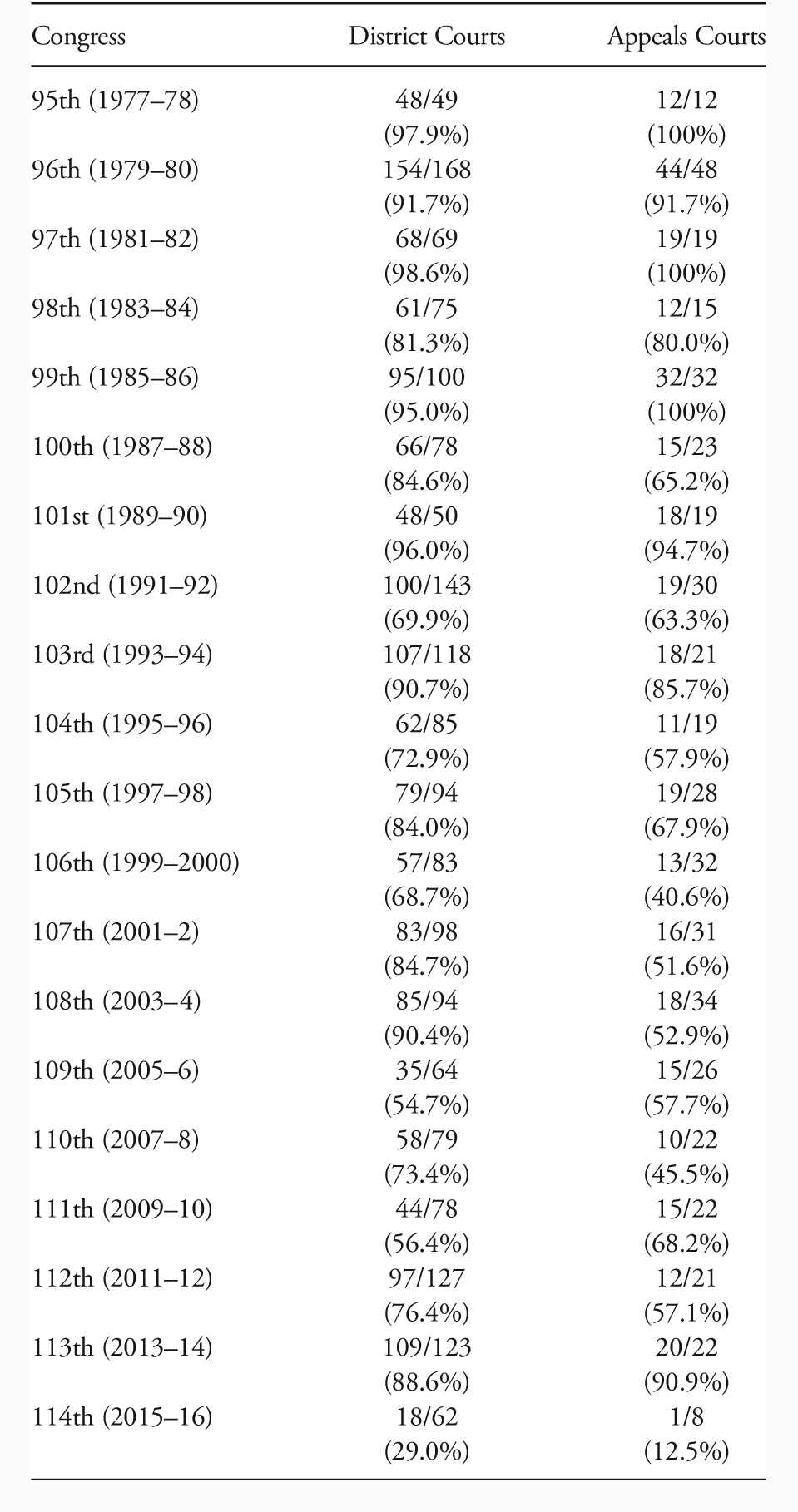
The tumultuous events concerning judicial selection during the last 2 years of the Obama presidency, with both houses of the 114th Congress in Republican hands, was one for the books. Midterm elections in 2014 resulted in Republican control of the Senate, which led to an unprecedented level of obstruction and delay of judicial nominations as documented in tables 2 and 3 below. Only one nominee to an appeals court of general jurisdiction was confirmed, and only 18 nominees to district courts were likewise confirmed. And the proportions of those confirmed in relation to the numbers nominated were at all-time lows as seen in table 1 below. Also unprecedented were the nominations that actually made it through the Senate Judiciary Committee and were favorably reported to the Senate, only to go nowhere and left to die without confirmation votes taken (some 20 district court and three appeals court nominations met this fate). And then, most famously, is the case of Merrick Garland, who was nominated by President Obama to fill the seat left vacant by the sudden death of Justice Antonin Scalia on February 13, 2016. However, Garland was not even accorded the courtesy of a Senate hearing much less a vote on the Senate floor. During the fall of 2016 before the presidential election, some Republican senators were reported as threatening to block Hillary Clinton, who was then expected to win the election, from appointing anyone to the Court (Graham Reference Graham2016). And in the background of this judicial selection saga was the exceedingly ugly presidential campaign waged by Republican candidate Donald J. Trump.
Trump, first in a vitriolic primary campaign for the Republican nomination, spewed falsehoods about his opponents (DelReal and Johnson Reference DelReal2016; USA Today 2016), and then in the general election campaign, he turned against his Democratic opponent Hillary Clinton. Trump threatened to imprison Clinton if he were elected (Applebaum Reference Applebaum2016), attacked the integrity of a federal judge hearing a lawsuit against Trump University (Wall Street Journal 2016), attacked the media (Ingram Reference Ingram2016), and attacked the integrity of our election system, hinting that he might not accept the results of the election, but only if he lost (New York Times 2016), all of which appealed to his supporters—social conservatives, Rust Belt workers, evangelicals, the so-called alt right, among others. The specter of authoritarianism appeared to overhang Trump’s appeals. And then, Trump won an electoral college victory and thus the presidency despite losing the popular vote by close to 3 million votes (CNN 2016). The likely Trump impact on judicial selection and the judiciary will be discussed at the end of this article.
Our task here is to analyze judicial selection during the last 2 years of Obama’s presidency, examine the overall portrait of the Obama judiciary, and assess Obama’s judicial legacy. As in the articles in this series (Goldman, Slotnick, and Schiavoni Reference Goldman, Slotnick and Schiavoni2011, Reference Goldman, Slotnick and Schiavoni2013; Slotnick, Goldman, and Schiavoni Reference Slotnick2015; Slotnick, Schiavoni, and Goldman Reference Slotnick2016), we rely on interviews with Democratic officials in the White House and the Department of Justice and Democratic and Republican staffers at the US Senate, all of whom were at the center of judicial selection and confirmation activity. Some of those interviewed requested that we not identify them by name, and we have honored that request. We also relied on interviews with advocacy groups on the political left and right. For demographic data on the confirmed nominees, we mined the judicial questionnaires they completed for the Senate Judiciary Committee. Political party affiliation or identification when not suggested by material in the questionnaires was gleaned from media reports and, in some instances, from boards of election. When none of these sources yielded persuasive data, the judges were classified as “none” as to party.
We begin first with an overview of judicial selection processes during Obama’s final 2 years in office, coinciding with the 114th Congress. This is followed by consideration of confirmation processes including the views and participation of advocacy groups as well as the use of the blue slips in the 114th Congress. We also take a closer look at the obstruction and delay that characterized the 114th. We then move to the demographic portrait of the few Obama nominees confirmed during the 114th Congress and in general an overall portrait of the legacy of 8 years of appointments. We pay special attention to the diversity and partisan makeup on the bench at the end of the Obama presidency. And finally, we speculate on what lies ahead in terms of Trump and the judiciary.
Judicial Selection Processes during President Obama’s Final Two Years
In previous iterations of our studies of the judicial selection processes utilized by the Obama administration for identifying and confirming judicial nominees, we have detailed extensively the respective roles in the process played by its two major institutional actors, the White House, through the Counsel’s Office, and the Office of Legal Policy (OLP) in the Department of Justice (Goldman et al. Reference Goldman, Slotnick and Schiavoni2011, Reference Goldman, Slotnick and Schiavoni2013; Slotnick et al. Reference Slotnick2015, Reference Slotnick2016). Our biannual descriptions of the process have documented that, in a fundamental sense, the contours of responsibility have remained largely unchanged through the Obama years. Specifically, the “political” facets of the process, the task of identifying prospective nominees and negotiating their way through confirmation processes, were lodged primarily in the White House Counsel’s Office (with the assistance of the Office of Legislative Affairs when working directly with senators), while the “professional” duties, the major vetting of prospective nominees, took place in the Justice Department’s OLP. We can report that little significant change took place in fundamental processes and functions during the 114th Congress, though, of course, in the context of the significantly altered judicial selection environment in the Senate, there was some inevitable change in workloads and, as well, some shifting and movement of key personnel.
Specifically, in the White House Counsel’s Office, Margaret (Maggie) Whitney, a long-time senior staff aide to Senator Patrick Leahy, who last served as his chief counsel for nominations on the Senate Judiciary Committee, moved to the White House, where she assumed the position of special assistant and senior counsel to the president. In this capacity, she became the focal point for judicial selection activity in the White House, taking the place of Christopher Kang, deputy assistant and deputy counsel to the president, who played this central role between 2009 and 2015 prior to becoming the national director of the National Council of Asian Pacific Americans upon leaving the White House. Whitney remained in this post through most of the 114th congressional session, leaving for a position in private practice only after, for all intents and purposes, the judicial selection work of her White House office had reached its end. Through this period, Neil Eggleston remained in his role as White House Counsel. In the OLP, Michael Zubrensky continued on as the deputy assistant attorney general primarily responsible for OLP’s vetting processes while a transition did occur at the cabinet level in the Department of Justice, with Eric Holder being succeeded by Loretta Lynch in April 2015 for the duration of the Obama administration.
One of the strengths of the Obama selection team had always been the close collegial working relationship developed over the years between Christopher Kang in the White House and Mike Zubrensky at OLP, a relationship that dated back to their joint service as congressional aides in the office of Democratic Senator Dick Durbin of Illinois. By every indication, a similarly close partnership naturally took hold in the day-to-day interactions between Maggie Whitney, a seasoned veteran of the judicial selection wars, and Mike Zubrensky. As Zubrensky noted, “I’ve known Maggie for many years. Things really didn’t change much. Perhaps at the margins little things changed, just because we’re human beings. But 99% of the process stayed the same as it was with Chris” (interview, January 9, 2017).
While the nature of the process itself did not change, clearly the drop in the number of nominations being submitted and, more to the point, confirmation processes in motion did have an impact on the nature of workloads, more so for Whitney than Zubrensky. In the case of the latter, staffing patterns moved in concert with workload alterations, so “the lack of nominations and confirmations changed my life very little. There were fewer people who were working on nominations. In the first six years, OLP had more attorneys detailed to work on judicial nominees because the volume was so great. During the past two years, we had someone in 2015 and in the first few months of 2016. But for most of 2016, we had no one detailed.” Because of the evaluative role played by OLP, as long as there remained prospective nominees being considered, Zubrensky’s role remained the same. He noted, “I spent all my time on nominations because we had more work to do on that end, the vetting was more time consuming than the White House work on selection.” In the White House, where a three-person team had worked for 6 years primarily as a “nominations unit” on judicial selection concerns, there was a morphing into a team that dealt with both judicial selection and clemency matters, the latter, a focus that gets greater attention in the Department of Justice as a president’s term in office winds down. By the end of her tenure in the White House, it was noted that Whitney was spending a greater amount of her time on clemency matters than on judicial selection.
If an outside view would suggest that laboring in the judicial selection minefield in the OLP during the 114th Congress was seemingly going through the motions in a hopeless and dispiriting enterprise where one’s labors would bear no fruit, such a notion was put to rest by Mike Zubrensky:
Before the election, we were all very hopeful. Maybe Merrick Garland would get a hearing. If Clinton had won there was a feeling that many of the pending nominees would be confirmed. There was a real hopefulness that nominations that had been bogged down, there hadn’t been a confirmation since July 6th, there was a real feeling that there would be movement when Hillary Clinton won. No one really contemplated that Donald Trump would win. Even after the election, there was hope that some nominees would be confirmed during the lame duck. There were a number of nominees, roughly ten, who were from red states.
In the White House, of course, work on clemency petitions was something that could and did continue until the president’s last days in office.
Advocacy Groups and Judicial Selection in the 114th Congress
Since the 114th Congress corresponded to the last 2 years of a two-term presidency and was in the context of an ongoing presidential election campaign, it was fair to assume that the flow of judicial nominations would recede and that the number of confirmations during the last months of the congressional session would slow to a trickle. In such a setting one would expect group activity on nominations that were “in process” to be “routine” and relatively modest as well. This calculus was, of course, altered immeasurably by the death of Justice Antonin Scalia in February 2016 and the nomination of Merrick Garland to fill his seat on the Supreme Court 1 month later. Garland’s nomination was accompanied by a virtually complete shutdown of lower court confirmation processes, injection of the Supreme Court into the presidential election campaign, and a confirmation battle over the Supreme Court vacancy.
In such a context, as one Judiciary Committee aide commented, the “airspace” for group activity was small, especially with regard to the lower courts, where confirmation processes were at a virtual standstill, resembling a “blockade” as characterized by Marge Baker, executive vice president of People for the American Way (PFAW). Indeed, as Paul Gordon, PFAW’s senior legislative counsel noted, “We actually tried to connect the Supreme Court and the lower court vacancies. … Because the Garland seat was getting such attention it gave us an opportunity to say that this is not an isolated situation. We have the same crap going on with Circuit Courts and District Courts. The thing that’s getting in the news is the tip of a very very dangerous iceberg” (interview January 12, 2017).
Such efforts to turn attention to the lower courts ultimately failed as Judge Garland’s nomination floundered, largely because, as Marge Baker put it, “What sucks energy from an organizing context is their blockade. They’re not doing anything. It’s hard to fight against them not doing anything. You don’t see it and it’s really hard to push that into the view of the media and activists who were fairly energized. But it’s hard to sustain that in the face of just doing nothing. The ability to obstruct through a blockade is an advantage” (interview, January 12, 2017). Curt Levey, president of the conservative Committee for Justice, was in substantial agreement about the impact of the Supreme Court vacancy on the lower courts: “Our side isn’t complaining. … Certainly once the Garland thing got going, you always see a block whenever there’s a Supreme Court vacancy, even though there were no hearings. It just consumes the energy. In some sense, not having a hearing might have even had a bigger effect on the lower courts. After the summer, nothing was going to happen, but in the first half of the year the energy and leverage that would normally be spent on lower court nominees just wasn’t there” (interview, January 11, 2017). The irony of the critical nature of the timing of Scalia’s death and the subsequent Garland nomination was not lost on Levey: “If the vacancy had occurred a little bit earlier? Psychologically, if it had occurred in late 2015 it could have been very different. It really was a historic situation. Certainly take away any of those things to make it less historic, including not happening in the final year and I do think Garland would have been confirmed.”
For their part, advocacy groups on the left were completely flummoxed and frustrated by the turn of events. And much of their disappointment was focused on the Democratic candidates who were vying to replace Barack Obama in the Oval Office as well as, pointedly, on the president himself. One group leader expressed the wish that “Hillary Clinton had talked about the Supreme Court. I wish that Bernie Sanders had spoken about the Supreme Court, and spoken about it in a way that galvanized people to take an interest. The most that Bernie Sanders would say is that we want a justice who would overturn Citizens United. Really? That’s all you can say?”
Prominent in the consternation of liberal groups was a sense that, in the unfolding of the Garland confirmation debacle,
the White House played a total inside game. It was as if they went through the motions of getting confirmation for Merrick Garland. But it wasn’t real, the support wasn’t real, the President didn’t whip up support. And, in part, he didn’t whip up support because Mitch McConnell, moments after Scalia’s death, said that we’re not doing anything. He would say, if he were here, “What would you want me to do? I’m not in control of the Senate. I couldn’t make it happen. So should we just yell and scream and rant and rave?” And there would be some merit to that.
Such frustration extended to the lower courts. Nan Aron asked, “Where are all of the senators who wanted their nominees confirmed? They would say we did what we could. We spoke to Grassley, McConnell. They played very much an inside game” (interview, January 9, 2017).
Our interviews with group leaders took place in January 2017, before the Trump inauguration and the subsequent appointment and confirmation of Neil Gorsuch to the Scalia/Garland vacancy on the Court. Inevitably, our discussions turned to how these groups envisioned their role going forward. Curt Levey anticipated that “friendly” groups on the right, presumably groups such as the Federalist Society and the Heritage Foundation, given their reported role in helping to frame the first two lists of prospective Supreme Court nominees announced by then candidate Trump to showcase his stance on the Court, would continue to play a salutary role. “It’s too soon to know the degree to which this administration will consult with outside groups. … The early signs … on judicial nominations, at least on the Supreme Court nomination, Trump relied very much on outside groups, so I think that’s a good sign.”
For groups on the left, this prospect, coupled more generally with lingering doubt about the postelection Democratic party’s ability to lead the opposition, was viewed as a call to action. Marge Baker noted that “the coalition is massive and deep and engaged and active. Folks are ready for a fight. They’re ready to take it on principle.” These comments were made without the knowledge of the forthcoming Gorsuch nomination. And while the battle over his confirmation would be fierce, requiring the Republicans to resort to the “nuclear option” to cut off debate and, effectively, require only 51 votes to confirm him, there was some suggestion that the struggle over this nominee would constitute only one battle in judicial selection warfare but that the “big one” would occur over President Trump’s prospective second nomination to the Supreme Court. Marge Baker has a somewhat different perspective: “From my vantage point you look at each fight on its merits. And if you nominate somebody as extreme as he’s likely to nominate, you have to fight back. You don’t keep your powder dry for the next fight … even though everyone realizes that it’s an uphill fight.”
Advocacy groups have limited resources and must make strategic choices about how to use them (Steigerwalt Reference Steigerwalt2010). Having observed judicial selection battles, large and small, from vantage points inside the Senate’s confirmation processes and the White House in senior staff positions, Maggie Whitney displayed cautious skepticism about what groups can, realistically, accomplish days before the massive Women’s March was held in Washington and elsewhere around the country to greet the Trump presidency:
I have no idea what it will take to do anything. I hope that the interest groups in general will wait until something really matters. I don’t think these general demonstrations against Trump and the Republicans are going to do anything. It can coalesce people, it can get you energized, make you feel better, but does it change anything? I hope the same people who come and march, who I fully support, will also march in Kentucky and Wisconsin when necessary. In the home districts of the people who actually are going to be making a difference versus the general opposition to everything. Because they can just sort of write them off. Nobody’s going to listen. Hopefully, we’ll pick our battles and pick them well.
(Interview, January 11, 2017)Blue Slips and the 114th Congress
Throughout the course of our biannual studies of federal judicial selection processes, we have placed considerable focus on the operation of the blue slip system, a long-standing norm utilized by the Senate Judiciary Committee for gauging the reaction of home state senators to lower federal court judges nominated by the president in their states (Denning Reference Denning2002; Binder and Maltzman Reference Binder2009). While different committee chairs have exhibited different “nuances” in their enforcement of the rule in a limited number of instances to satisfy their partisan preferences, it was followed in its most pristine “absolute” form by Judiciary Committee Chairman Patrick Leahy during the first 6 years of the Obama administration. Under Leahy and, in truth, most Judiciary Committee chairs most of the time, enforcing the blue slip has meant that unless a home state senator from either party, whether in a blue, purple, or red state, returned the proffered blue slip to signal his or her acquiescence in a nomination (or opposition to a nomination) going forward, a hearing would not be scheduled for the nominee and, for all intents and purposes, the nomination was dead on arrival, left to languish in the committee until the end of the congressional session. Just as damaging to a nominee’s candidacy as submitting a negative blue slip to the committee chair was a senator simply not returning the slip at all and thereby exercising, in effect, a “pocket veto” on a nomination.
Ostensibly, the blue slip system is premised in “good faith” and is meant to ensure that the president “consults” with home state senators, even those of the opposition party, on judicial appointments in their states. What form such “consultation” must take and whether or not the president will defer to the wishes of home state senators varies a good deal across presidencies, relationships between a president and a given senator, and, to a certain degree, committee chairs who, during limited periods of the norm’s existence, treated it (or threatened to treat it) as something short of absolute. The blue slip system, which gave Republicans an important say in judicial selection during the first 6 years of the Obama presidency, would surely offer them even greater power in the Senate majority with Charles Grassley serving as chair during Obama’s last 2 years.
Interestingly, as we document in our focus on obstruction and delay of judicial nominees in the 114th Congress, having successfully obtained blue slip approval from one’s home state senators was far from a guarantee of confirmation for a nominee, even in red or purple states, in the environment of the postnuclear congressional session. (In the prior 113th congressional session the majority Democrats had gone “nuclear,” altering filibuster rules for lower court nominations such that they could be confirmed by a simple majority vote. This left the blue slip system as the only tool for potentially blocking judicial nominations in those states that had at least one Republican senator as long as Senator Leahy continued, which he did, to follow the norm without any exception.) But beyond focus on those nominees who failed to obtain blue slip acquiescence from their home state senate delegations or who despite blue slip approval languished, nevertheless, in committee processes or on the floor of the Senate in the 114th Congress, it is critical to add to the equation the unusual number of judicial vacancies that went without any nomination during the Obama years and to assess the role of the blue slip system as a “tactic” in this happenstance.
According to data reported by the OLP in the Department of Justice, there were 99 vacancies on Article III courts at the close of the 114th Congress. Approximately one-half of these both were vacant and lacked a nominee. In invoking the nuclear option in the previous Congress and, in the context of the final years of Obama’s tenure, a Republican majority in the Senate, and the prospect of a Republican presidency to come, Republicans were in no mood to support the judgeship choices of Obama in those states where they could use withholding blue slip approval to keep judicial seats open. Indeed, “credit” could be given to Senate Majority Leader Mitch McConnell for the legacy that nearly half of the vacant seats on the lower federal courts did not have nominees during the congressional session. A senior aide on the Obama judicial selection team asserted that, “behind the scenes,” McConnell would
encourage Republican senators not to engage with the White House on judicial vacancies in their home states. So we have … close to a record high number and the vast majority of these vacancies are in red states because for the last year, and in some cases such as Alabama, for the last two years, the home state senators have said to the White House that “we are not going to engage with you on filling these vacancies. We are going to wait for the next president.” McConnell certainly said that with respect to the Supreme Court, but at the lower court level that dynamic happened as well. Not across the board, there wasn’t an edict that McConnell laid down for his caucus and so there were some exceptions. … There were some red state senators who worked with the White House and worked in good faith. Even the Texas senators dragged their feet for years but ultimately agreed to a package of five. A cynical person might say that they agreed on it too little too late. … But there were some Republicans who worked in good faith with the White House to fill vacancies.
It should be noted that none of the Texas nominees, who did not have hearings until September 2016, were ultimately confirmed.
To give an empirical sense of the magnitude of the issue highlighted here, the Alliance for Justice reported (http://www.afj.org/our-work/issues/judicial-selection) 46 existing current vacancies (seven of which were on the circuit courts of appeals) without nominees at the end of the 114th Congress. More than half (24) were from states with two Republican senators, with another nine such vacancies located in purple states with one Republican senator. Put differently, considerably more than two-thirds (71.7%) of the existing lower federal court vacancies without nominees at the end of the Obama presidency were found in red or purple states, offering strong circumstantial evidence that the threat of not signing off on a blue slip for a prospective nominee was having a strong chilling effect on submitting nominations for these courts. Some of the instances of these nominee-less seats were particularly egregious. Seven of them had been vacant for more than 1,000 days, virtually 3 years (or more). One district court vacancy in Texas had been without a nominee for 2,036 days, more than 5½ years, and two Fifth Circuit vacancies from Texas did not have nominees for more than 1,000 days. Both Alabama and Kentucky had two district court vacancies lacking nominees for over 1,000 days. All of these instances reflect red states with two Republican senators. Ignoring the number of days their seats had been vacant, Texas accounted for eight of the vacancies without nominees, two of which were on the US Court of Appeals for the Fifth Circuit. The state of Alabama, noted above for the lack of cooperation of its senators with the Obama White House, had five district court seats lacking nominees when the president left office.
There is a good deal that can be said about such numbers and the blue slip politics, which, in large measure, brought them about. Much depends, of course, on the perspective of the beholder. A senior Republican Judiciary Committee aide admitted that “the hardest slots to negotiate were those where you have a split between the White House and the home state senators. And whose fault that is, is in the eye of the beholder.” This aide ultimately attributed such fault to some nominees who were sent forward:
They sent up a number of nominees whom they knew before they pressed the send button that those nominees had no shot of getting home state senator support. And that means either they flat out couldn’t get an agreement or they didn’t work hard enough … because most of those home state senators, almost to a one … would say … that we sent the White House recommendations for exceptionally qualified, not overly conservative judges, judges that they could have nominated, but wouldn’t do it. … The point is they complain about not being able to fill some of those seats. Well, okay. But it’s not as if you didn’t have recommendations from those home state senators for nominees that could have gotten done.
There would appear to be two responses to such an argument. For one, as our focus on obstruction and delay in the 114th Congress well documents, there were a significant number of nominees from red and purple states, ostensibly with the necessary home state Republican senatorial support, whose nominations never received a vote on the Senate floor, made it out of committee, or even had a hearing. More to the point, this aide’s argument seems to place the constitutional authority for nominating judges on its head, giving the home state senators the power to definitively “nominate” with the advice and consent of the president. While it is true that much of the name generation responsibility for lower federal court judgeships has devolved to home state senators, that is much more likely to be the case when those senators are from the president’s political party. And even in such instances, it is only the president who definitively can place a candidate’s name in nomination.
In the end, one is left with a picture of a blue slip process that can sometimes stymie a president’s wishes when followed to the letter of the norm, and there is no clear-cut answer for how passive or aggressive a president should be in pushing nominations, a supportive blue slip notwithstanding. Clearly there are some documented instances during the Obama years in which nominations were made without prospects of blue slip support. But President Obama seemed to act in a more constrained manner in this regard than prior presidents, and in those limited instances in which blue slip opposition was tested, the nominations were, ultimately, not successful.
One can argue that undue deference by the president is not the best policy in a hostile selection environment, a position taken by a senior Democratic aide who worked in both the legislative and executive facets of the judicial selection process during the Obama years:
Do I wish at the beginning of the administration that they were far more aggressive? I don’t know where they got the idea that you needed the absolute agreement of home state senators before vetting a nomination. I don’t think that was part of the system. The next administration is not going to be following that. The President can nominate anyone he wants. Nobody is stopping him. My real frustration was that they felt that Leahy following the blue slip meant that the President just can’t do this. Absolutely not. … I kind of wish that they were a little more aggressive on the front end because they ceded a lot of power. … But, somehow the power flipped a little bit. You try to find out is this person acceptable or not. And if you don’t get an answer, you nominate. And then you have the pressure in the home state. It changed the dynamic of who got to pick at the end of the day.
The “next president” is, of course, now in office. At the time of this writing he has named his first slate of nominees to the US district and circuit courts of appeals, yet there is little known about the processes President Trump has followed in filling these seats in the wake of Neil Gorsuch’s confirmation to the Supreme Court, where he relied heavily on a list of prospective nominees developed, at least in large measure, by the Federalist Society. That said, we do have a more developed sense of expectations for the operation of the blue slip system in the Judiciary Committee chaired by Senator Chuck Grassley in the Republican-controlled Senate.
Setting the tone for these expectations is the legacy of strict adherence to the blue slip’s dictates established by Democratic Senator Patrick Leahy, even in the face of strong opposition from within his own party, when Republican senators utilized their blue slip prerogative to derail Obama nominees. Indeed, in one prominent instance, that of Elissa Cadish, a district court nominee supported strongly by Nevada Democrat and then Senate Majority Leader Harry Reid, Leahy withstood push-back and honored Nevada Republican Senator Heller’s refusal to return his blue slip on Cadish, who ultimately withdrew from consideration. As an aide to a Senate Judiciary Committee Democrat observed,
When issues over Cadish occurred you had people in the Reid camp who wanted to change the blue slip policy. This is an instance where Senator Leahy has very much been vindicated. If Senator Leahy had changed the blue slip policy, we would have zero check on judicial nominations. [Leahy’s practice] was right because it gives us more leverage to say that we did this with our own president. If you want the Senate to be more than a rubber stamp then you should keep this too because it is the only way that you have any say over the process. If you took this away, you’re putting essentially 100% of the authority into the White House to choose whomever they want without your input. Senator Leahy has been proven right over and over again about that.
Another senior Senate Democratic Judiciary Committee aide added that, beyond concerns over upholding the prerogatives of home state senators, the blue slip system was an absolute necessity as a practical matter for filling federal judgeships at the state level:
Had I been in the Senate and the blue slip went away, I would have gone insane. … I can see the attractiveness of wanting to get rid of the blue slip on a very superficial level. And I know that our folks were pushing us to get rid of it and they couldn’t believe that Leahy was upholding it. … The blue slip diffuses responsibility so that it’s not just on the Committee and the Chairman of the Committee to push everybody through. At some point, it’s just too much. So you really need the champions in the Senate. How would it work? How am I, sitting in Washington, going to find people who are qualified … ? Having seen what happened when Hatch tried to get rid of the blue slip, it doesn’t work. It creates opposition. No one judge is worth getting that amount of opposition from everybody. … At the end of the day, senators want to keep their personal power. The system would kind of fail if it just started to be a total free-for-all.
Yet even such a staunch supporter and advocate of Leahy’s approach to the blue slip seemed to leave a back door wedge for an escape from that absolutist stance: “Do I think there are abuses? Absolutely. If Alabama won’t support anybody, that’s an abuse. You can’t do that. Those are the cases where I wish that we could have pushed. Senator Leahy could have said, ‘You get the best people and they will have to pay a political price.’”
It is in the apparent space created by this wedge where questions about the status of the blue slip system going forward clearly reside. Charles Grassley, like Patrick Leahy, is a strong Senate “institutionalist,” and his reflexive instinct will be to uphold long-standing Senate norms. As PFAW’s Marge Baker observed, “Grassley has said that he will honor blue slips and I expect Democrats will use that. And I expect the Democrats will use everything the Republicans did … and not yield to everything the Administration wants. I think that we’re going to see push-back” (interview, January 12, 2017).
Nan Aron of the Alliance for Justice was in agreement while raising a cautionary note: “The blue slip is the only thing that we’ve got. We love the blue slip, love it. But that’s easier said than done. It’s getting Democratic senators to take control over the power that they’ve got. Everything in the next four years will be decided by a court. … Everything that Trump wants to do will be challenged in a court. And if the Democrats don’t get that now? So that blue slip is, at the moment, crucially important” (interview, January 9, 2017).
Questions remain, however, about how far Grassley will be willing to go in giving deference to the blue slip. Curt Levey of the Committee for Justice acknowledges that Grassley is a “traditionalist” and that the blue slip has “always been mostly honored.” Yet, for Levey, there remains that room for wiggle, the scope of which may be all telling: “I think there’s always an understanding when using the blue slip that it can’t be used the way you would use, say, a filibuster. The blue slip is there to promote compromise. It’s not there to allow you to block any nominee that’s from your state. If the Democrats tried to use it that way … any Judiciary Committee Chair would have to reconsider” (interview, January 11, 2017).
And therein lies the rub. As we document throughout this article, the scope of Republican obstruction and delay in the 114th Congress was, by any measure, unprecedented. There are a number of Democratic senators who, in good faith, recommended candidates for the district and circuit courts, in several instances in purple states with bipartisan senatorial support, who saw those nominees languish without confirmation hearings or, in those instances in which they were reported out of committee, subsequent action on the Senate floor. It is fair to say that it is not likely that many of these nominees will be renominated by President Trump. In such a setting as a veteran of the judicial selection wars during the Obama years observed,
It will be interesting to see how many Democratic senators decide to play hardball with the Trump White House and say “I’m not going to return a blue slip on anyone but the nominee that I recommended to President Obama who was treated unfairly by the Republican senate. …” There may well be some Democratic senators who take that approach. [According to this observer, this could] prompt Grassley to change the blue slip rule. … I think that whether or not he continues to honor it will depend on how many Democratic senators take this position. If it’s just one or two or three and there are only a small handful of nominees blue slipped, then I don’t think that Grassley would change the blue slip rule. But if it’s an organized effort by the Democratic senators en masse to keep vacancies open unless Obama’s people are renominated, I think Grassley would change the blue slip rule or, at least, modify it in some way.
Judicial Confirmations in the 114th Congress: A Portrait of Obstruction and Delay
Viewed by virtually any metric, the climate in the Senate for judicial confirmation processes and the nature of their outcomes reached a historic low during the tenure of the 114th Congress corresponding to the last 2 years of the Obama administration. There was, of course, the unprecedented refusal by the Republican Senate majority to commence confirmation processes following the nomination of Judge Merrick Garland on March 16, 2016, to fill the seat vacated by the death of Justice Antonin Scalia. Garland’s nomination occurred with fully 10 months remaining in Obama’s term in office and landed in a Senate where Majority Leader Mitch McConnell had pronounced, approximately an hour after Scalia’s death a month earlier, that “the American people should have a voice in the selection of the next Supreme Court Justice. Therefore, this vacancy should not be filled until we have a new president” (Everett and Thrush Reference Everett2016). This argument was, according to a senior Democratic Judiciary Committee aide, “how they felt they could message this and that’s all it was. It’s always been an absurd argument to the extent that the current president had been popularly elected for four years and the people had spoken.”
Ironically, McConnell’s populist position does not even seem to pass muster when one considers the popular vote in the very election he wished to defer to, where Hillary Clinton amassed nearly 3 million votes more than the presidential “winner,” Donald Trump. Further, McConnell’s intention to virtually shut down judicial selection processes to the lower federal courts during the 114th Congress, particularly the US circuit courts of appeals, had been made public more than 8 months earlier when he observed in an interview that “so far, the only judges we’ve confirmed have been federal district judges that have been signed off on by Republican senators.” When asked if this was the continued expectation through 2016, McConnell responded, “I think that’s highly likely” (Benery Reference Benery2015).
McConnell’s pronouncements were effectively acted on, as a practical matter, to truncate a presidency. As Christopher Kang, former deputy counsel to the president, who oversaw judicial selection through most of the Obama years, observed, “The idea that a president’s term is seven years and not eight years with respect to the Supreme Court, and to expand that to say that it’s six years with respect to the lower courts? That’s going to be a huge hit if the judiciary is not going to get nominees confirmed for, really, almost two and a half years if not more when you look at how long it will take to staff up and make the nominations to fill these vacancies” (interview, February 22, 2017).
A fundamental overview of the almost total scope of obstruction and delay of judicial confirmation processes in the 114th Congress can best be gleaned from the data presented in table 1. Over the course of those 2 years the president successfully appointed only 18 of his 62 district court nominees and only one of eight nominees to the US circuit courts of appeals of general jurisdiction. Both numbers are the lowest associated with the modern presidency dating back beyond the term of Jimmy Carter, the last data point in our tables. The previous low for district court confirmations was established with President George W. Bush during the Republican-controlled Senate of the 109th Congress in 2005–6, a Senate that expended significant Judiciary Committee resources processing the successful Supreme Court nominations of both John Roberts to the chief justiceship and Samuel Alito to an associate justiceship. President Obama’s single successful nomination to the appeals courts with general jurisdiction during his last 2 years in office was dramatically fewer than the 10 circuit court judges successfully confirmed by a Democratic Party–controlled Senate in the comparable last 2 years of W. Bush’s presidency.
Number and Percentage of Nominees Confirmed by the Senate

When viewed from the perspective of the “success rates” for presidential administrations dating back to Jimmy Carter, that is, the percentage of one’s nominees actually confirmed in a 2-year congressional session, President Obama’s record in the 114th (29.0% district courts, 12.5% courts of appeals) continues to greatly lag behind that of all of his predecessors. Thus, in the aforementioned 109th Congress, W. Bush still managed to have more than half (54.7%) of his district court nominees confirmed, while President Bill Clinton, undergoing an impeachment trial in the Senate of the 106th Congress, still managed to seat 13 court of appeals judges, with a success rate of 40.6%.
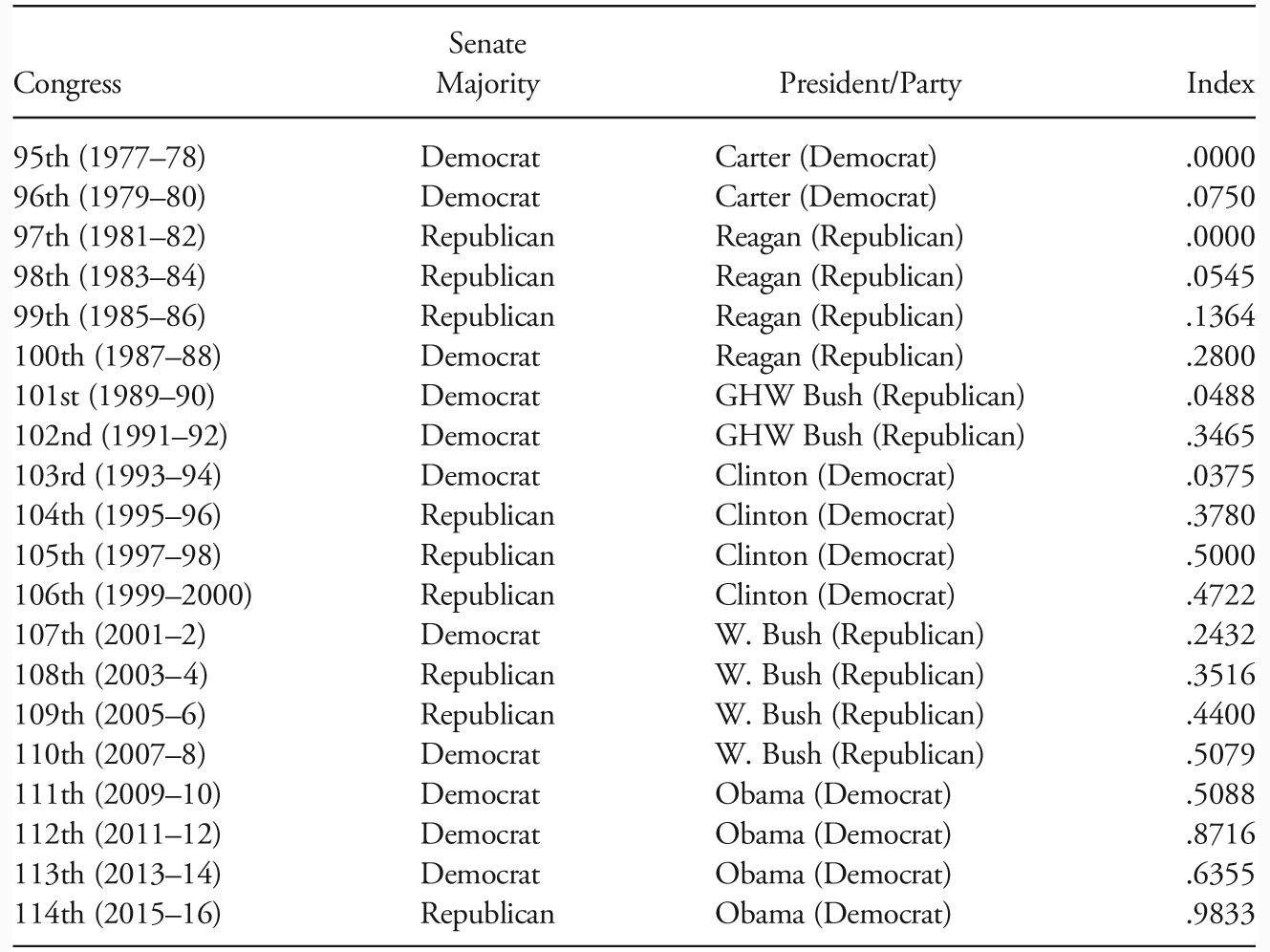
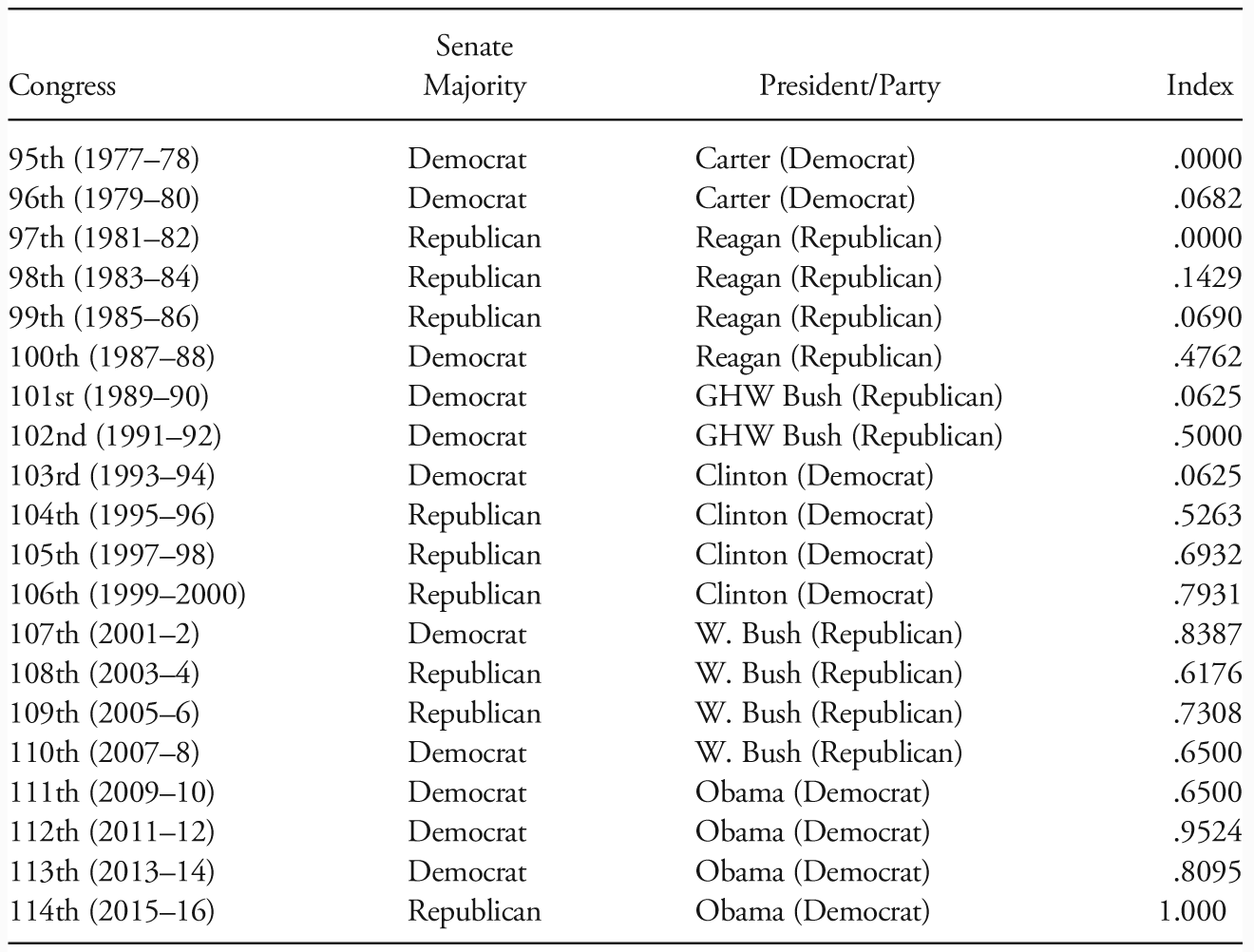
When we turn to table 2 (for district courts) and table 3 (for courts of appeals) regarding confirmation processes, which present our Index of Obstruction and Delay for the 114th Congress, an even more nuanced portrait emerges of the futility characterizing confirmation processes during President Obama’s last 2 years in office. The index is a simple metric using the percentage of a president’s nominees who remain unconfirmed or whose confirmation processes took over 180 days from nomination to confirmation in the congressional session (Goldman Reference Goldman2003). The historic trend for district courts, documented in table 2, can be readily described. In short, district court confirmation processes were relatively “routine” and noncontroversial through the first five Senates pictured between 1977 and 1986, with a slight blip upward in the Republican Senate of the 99th congressional session when Ronald Reagan was president. That “blip,” however, more than doubled during Reagan’s last 2 years in office, in a Senate controlled by Democrats, with over a quarter of the president’s nominees “obstructed and delayed.” While relative calm in district court confirmation processes would return in some congressional sessions (see the 101st and 103rd Congresses), a modicum of obstruction and delay would continue to characterize what had once been a routine and noncontroversial confirmation process.
Index of Obstruction and Delay in the Senate Processing of District Court Nominees

Note.—The index is only for nominations to lifetime appointments to the district courts. Territorial district courts with set terms are excluded. The index is calculated as the number of nominations unconfirmed plus the number of nominations that took more than 180 days from nomination to confirmation. It ranges from .0000, which indicates the complete absence of obstruction and/or delay, to 1.0000, which indicates complete obstruction and/or delay. Nominations made after July 1 of the second session of each congress are excluded from the index.
Index of Obstruction and Delay in the Senate Processing of Courts of Appeals Nominees

Note.—The index is only for nominations to courts of appeals of general jurisdiction. This means that the US Court of Appeals for the Federal Circuit is excluded. The index for the 107th Congress excludes the nominations made by President Clinton shortly before leaving office that were subsequently withdrawn by President Bush. The index is calculated as the number of nominations unconfirmed plus the number of nominations that took more than 180 days from nomination to confirmation. It ranges from .0000, which indicates the complete absence of obstruction and/or delay, to 1.0000, which indicates complete obstruction and/or delay. Nominations made after July 1 of the second session of each congress are excluded from the index.
The first president to see major district court obstruction and delay was Bill Clinton (index of .5000) in the Republican-controlled Senate of the 105th Congress, and new record “lows” conforming to robust measures of obstruction and delay of district court nominees were registered by Presidents George W. Bush (index of .5079) and Barack Obama (index of .5088) in the Senates of the 110th and 111th Congresses, respectively, both controlled by the Democrats. The seemingly inexorable march toward what was once unheard of, the routine obstruction and delay of district court nominees, continued through the remaining 6 years of the Obama presidency culminating in the virtually complete obstruction and delay (index of .9833) of nominations to the US district courts in the Senate of the 114th Congress. In light of this reality, judicial selection consultant Vincent Eng concludes that “it’s fair to say that Obama was treated in a more partisan manner for the mere fact that he had to fight for his District Court nominees,” a striking break with judicial selection norms (interview, January 10, 2017).
The picture created in table 3 for obstruction and delay of nominees to the US circuit courts of appeals is even more stark and clear-cut. The waters here were relatively calm until, once again, the Democratic Party–controlled Senate of the 100th Congress, when the index for the Reagan nominees showed considerable obstruction and delay (index of .4762), a much larger index than the previous record (.1429), also associated with the Reagan presidency during the last 2 years of his first term. By the last 6 years of the Clinton presidency, obstruction and delay in courts of appeals confirmation processes had become the new normal, with new record high levels marking the Senates of the 104th (index of .5263), 105th (index of .6932), and 106th (index of .7931) Congresses, all controlled by Republican majorities.
Taken together, tables 2 and 3 seem to suggest that the first shots across the bow in the judicial selection wars that we have witnessed were taken by the Democrats during the Reagan years, with obstruction and delay, however, escalating dramatically in the Republican-controlled Senates during the final 6 years of the Clinton presidency. What we have witnessed since has been a dysfunctional game of tit for tat, reaching its nadir in the final 6 years of the Obama presidency at the court of appeals level with obstruction and delay measures .9524 and .8095 when the Democrats controlled the Senate in the 112th and 113th congressional sessions. In the president’s last 2 years in office, obstruction and delay of Obama nominees was complete, with our metric reaching its highest possible numeric value (1.00). Obstruction and delay had become the order of the day for every single court of appeals nominee.
Numbers, of course, can generally be utilized to bolster alternative story lines. Clearly, it is difficult if not impossible to dispute that the Obama administration’s record of confirming judges in the Senate of the 114th Congress was dismal at best. Viewing the last 2 years of the Obama record may, however, raises the larger question of whether the president was treated “fairly” across the 8 years of his administration. Thus, the argument has been made that, writ large, Obama’s success in appointing federal judges mirrored that of his predecessor, George W. Bush. As argued by Curt Levey of the Committee for Justice, Obama’s last 2 years, like the 2 years before it, should be viewed as anomalies: “You had a two year period of record highs and, then, a two year period of record lows. It averaged out by the end of the day. I always think that 35–40% of the federal judiciary will be replaced in eight years and I think he’s right in there. … Obama got basically the same number confirmed [as W. Bush]. … It’s just sort of an historical fluke that, because of what Reid did, the low point comes at the very end” (interview, January 11, 2017).
A senior Republican Senate Judiciary Committee aide amplifies this argument: “Over the eight year period, there is always an ebb and flow where more nominees get done during one congress than another congress … but … over that longer time period, it tends to level out and be somewhat consistent. That has played out here.” The specific argument made by this aide was that in “going nuclear” in the 113th Congress, Obama had more than his fair share of judges confirmed, only to be rebuffed by the Republican Senate majority in the 114th Congress, the tit-for-tat reality that we have identified:
At the end of 2014, they did a whole bunch right at the end of the lame duck. That was a break from historical practice. Typically … you don’t confirm people during the lame duck and you certainly don’t confirm those numbers. … What you typically do not do is report people out of Committee during the lame duck and, then, confirm those people. We did that in 2014 with about a dozen who fell into that bucket. … In other words, you ought to count those who were confirmed at the end of the prior congress and view them as folks who should have been confirmed early in the 114th.
This argument, that the Senate’s record of confirming judges in the 114th Congress was not that bad when viewed contextually along with the 113th Congress, was often repeated and even made its way into an exchange on the Senate floor in July 2015 between Judiciary Committee Chair Charles Grassley and then-third-ranking Democratic Senator Schumer, who characterized the session’s judicial confirmation record as “a disgrace.” Grassley retorted, “Had we not confirmed those 11 nominees during the lame duck last year, we’d be roughly at the same pace we were for judicial confirmations this year compared to 2007,” a comparative reference point chosen because it corresponded to the last 2 years of the W. Bush presidency. Grassley’s point made, he advised Senator Schumer to “put that in your pipe and smoke it” (Kim Reference Kim2015).
To further justify the Obama record during his last 2 years in office, especially with regard to the virtually complete stoppage of confirmations to the circuit courts, a senior Republican Judiciary Committee aide suggested that blue slip issues may have been present:
If you look at these vacancies … those are in states, the 5th Circuit, the 11th Circuit, the 6th Circuit where the White House, from our perspective, wouldn’t work with those home state senators to a sufficient degree to reach a consensus nominee. Typically, as White Houses get to the end of that second term they are more willing to nominate individuals that maybe they wouldn’t have in the first two years. When you’re coming to the end of your second term and you’re dealing with a state with two Republican members, your incentive at that point is to nominate somebody that they can support. If you’re not going to do that, you’re not going to get those seats filled. [Stressing his takeaway from the Republican point of view, this aide concluded] At the end of the day, you shake all of this stuff up and you pour it out over an eight year period and it’s pretty remarkably similar.
Vincent Eng, who had worked with several Obama nominees during their confirmation processes, conceded the point: “If you look at the final tallies … at the end of the day, it really comes down to how many judges did you get? They might have waited longer and so forth, but you still got your judges. At the end of the day, Obama still got his so-called fair share” (interview, January 10, 2017).
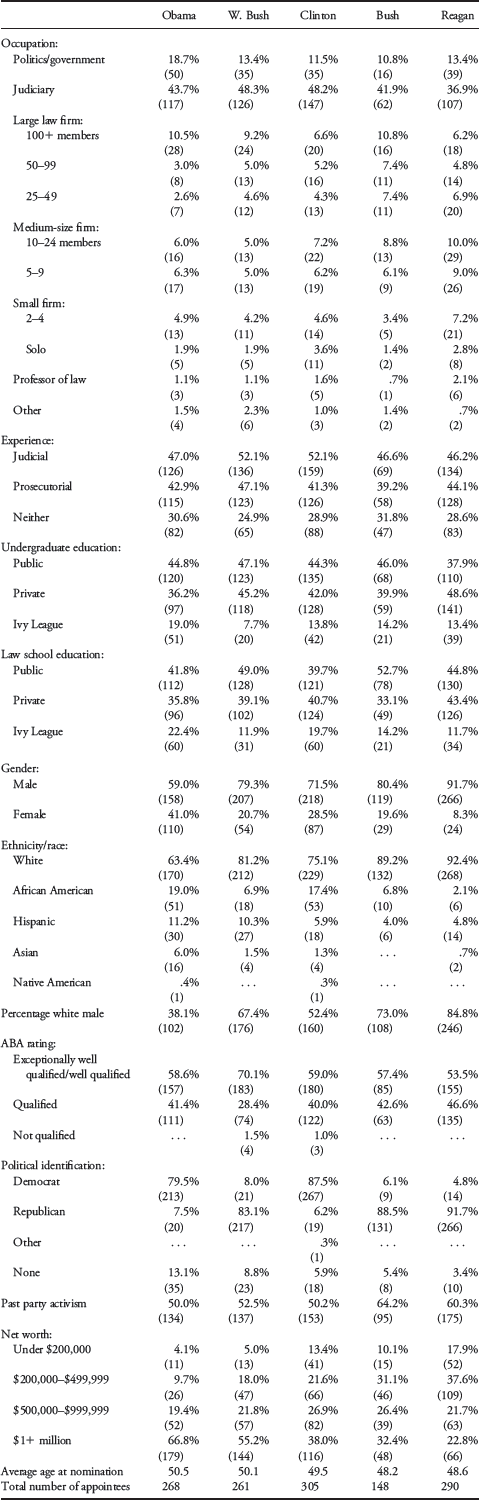
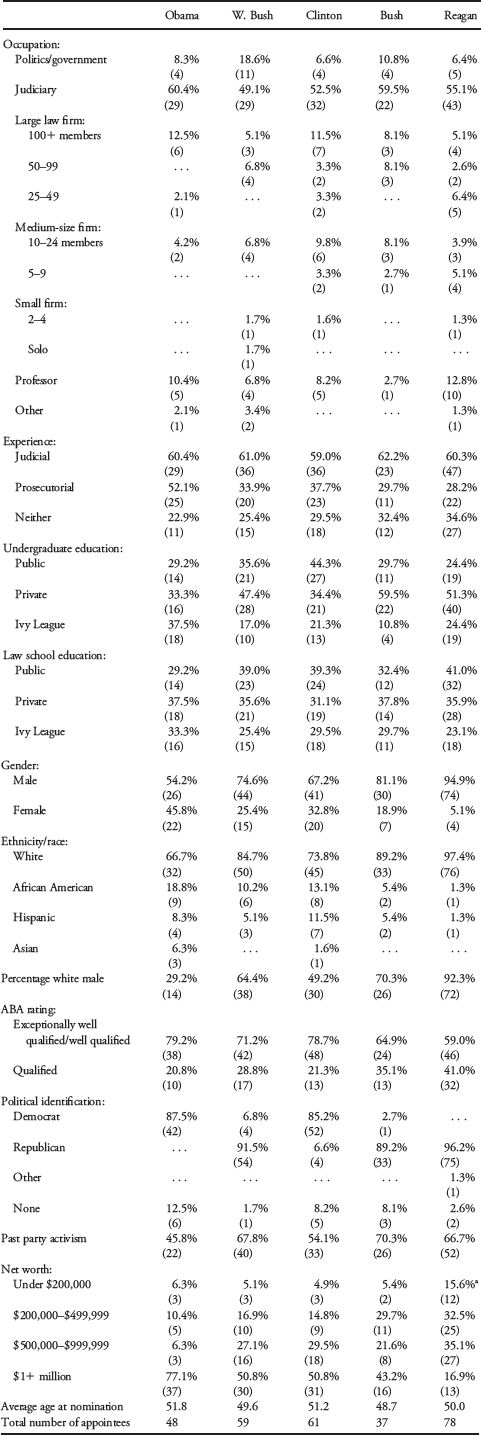
The “equivalency argument,” most strongly associated with the Republicans and the political right to characterize the “fairness” in the treatment of Presidents Obama and W. Bush across their tenures in office, offers much to chew on. In an absolute sense, by the sheer numbers of judges confirmed during their two terms in office, there appears to be some merit to the argument on its face. Thus, as seen in table 6 below, President Obama actually had a handful more district court judges confirmed (268) than did President W. Bush (261). Table 7 below reveals that those numbers are reversed, however, at the more critical US circuit courts of appeal, where President Obama’s 48 confirmees lag behind W. Bush’s total of 59 circuit court confirmations. While granting the greater impact of the circuit confirmations, one can still concede, on the numbers alone, that the two presidencies were treated with relative equivalence, with President Obama seating 316 lower federal court judges and President W. Bush enjoying 320 confirmations. That said, however, there are many levels on which the equivalency argument can be seen to break down and fail to give an accurate portrayal of the disparate treatment of these presidents. In short, comparisons based on equivalence in terms of numbers alone are fundamentally acontextual.
When confronted with the equivalence argument, Marge Baker of PFAW was quick to respond, “That’s absolutely false! There’s so many ways to knock that down. One is that Obama had a lot more, many more vacancies to fill than Bush did. So the fact that he had about the same number confirmed as Bush is meaningless. It’s comparing two numerators without knowing the denominators” (interview, January 12, 2017). A senior member of the Obama judicial selection team concurred, characterizing the focus on the equivalency of numbers as an “irresponsible analysis. … Republicans have used that talking point for the last two years, but there were more vacancies under Obama and, therefore, you should have had much higher numbers of confirmations. The fact that you don’t is a testament to the irresponsible approach that McConnell and his caucus have taken to judicial vacancies.” More pointedly, Baker asserted, “This is McConnell and the Republican caucus willing to go along with a scheme that, at its heart, denies the legitimacy of the presidency and essentially rejects what the senator’s role is in the constitutional process. And so I put this at the feet of the Republican leadership, their shamelessness and their lack of respect for the Constitution and the American people. There is not a more egregious example of playing politics with the Constitution.” Reacting to this state of affairs, Christopher Kang admitted that
I am stunned by how McConnell was able to get away with it. I never imagined that he would only confirm one Circuit Court judge or that all of those District Court judges would be left hanging. The idea that President Obama had the same number confirmed or even a handful more so this was okay? … There are enough numbers out there that you can say whatever you want and make it seem like you’re on the level when you really aren’t. And I just couldn’t believe that that was going to hold the day. (Interview, February 22, 2017)
Yet, such a continual reliance on citing the equivalency of numbers seems to have given McConnell sufficient cover to pursue his tactics. This point was driven home by a senior Democratic Judiciary Committee staff member: “He said over and over, we’re treating this President fairly. And he measured that by the numbers. And we pressed. … And the answer always was, ‘Bush had this many, so Obama can have this many.’” With a touch of wry irony this aide then added, “And we got him by two or three depending on how you count them.”
At bottom, McConnell simply recognized the leeway and the opportunity that the nature of the judicial selection issue gave him. Another Democratic Judiciary Committee aide deftly observed that
I think that what Mitch McConnell understands is that judicial nominations is a niche area that has a lot of influence over policy but he will never lose any votes over it. That’s why he did what he did the last two years in filling judicial vacancies. That’s why he had no compunction against holding up the Obama nominations process in the early years. He’s internalized this because he’s seen the way that this can advance his political agenda, and he knows that he’s not going to get any blowback in the political sphere.
The one anomaly in McConnell’s “blockade,” given his statement of June 2015 regarding prospective confirmation of red state judges, the criticisms of President Obama’s “recalcitrance” in negotiating with Republican senators cited earlier notwithstanding, is the large number of lower court nominees from red and purple states, those with the support of their Republican senators, who were not moved through the confirmation process, either from the Senate’s Judiciary Committee to the Senate floor or from the floor through confirmation. These were, after all, nominees who, ostensibly, had the support of their home state Republican senators through their successful passage through the blue slip system. By our count, two court of appeals nominees from purple states had been reported out from committee but were not confirmed, with eight district court nominees from red and three from purple states meeting the same fate. Indeed, of the 23 lower court nominees left unconfirmed on the Senate floor at the end of the Senate in the 114th Congress, well over half (56%) were from red or purple states. In a similar vein, while all three court of appeals nominees to courts of general jurisdiction left languishing in the Judiciary Committee at the end of the congressional session were from blue or purple states, of the 20 district court nominations expiring in the committee, 17 had blue slip approval from the home state senators with 12, over 70%, from red (six) or purple (six) states. In light of these numbers, Christopher Kang confessed to being
stunned by how McConnell was able to get away with it. … I thought that, especially for District Court judges who have the support of home state senators … the respect for the home state senators’ role and their positive recommendations would have more influence at the end of the day than it did. … I have no idea why that happened. You would think that these Republican senators would go to Senator McConnell and say “This is someone I support. This is a vacancy that … we really need to fill.” … And, in particular, when you think about the fact that it wasn’t anticipated that Donald Trump would win, so what is the harm? … So I’m really not sure what to think of it or what to make of it, or how the Republican senators justified it. They were constantly out there saying “I support this nominee. I hope this nominee is confirmed.” Were they just going through the motions or were they really that ineffective?
(Interview, February 22, 2017)A number of prominent examples with seemingly strong Republican support can be found among several red state district court nominees unconfirmed on the Senate floor. Four, in particular, warrant mention: David Nye, supported by Senators Crapo and Risch from Idaho; Scott Palk, supported by Senators Inhoffe and Langford from Oklahoma; Edward Stanton III, supported by Republican Senators Corker and Alexander from Tennessee; and Claude Kelly III, supported by Senator Cassidy and outgoing retiring Senator Vitter from Louisiana. Nye and Palk have since been renominated to their respective district courts by President Trump in his initial slate of lower court nominees, suggesting, in at least some instances, that good-faith efforts were made by President Obama and red state senators to fill vacancies. Stanton was an example in which, it was thought, a perfect choice had been made. Christopher Kang observed that of those left behind,
the number one person was a guy … from Tennessee. He was an African American, a U.S. Attorney who had been supported for that position by Senators Alexander and Corker, who tend to be more institutionalist senators. And then supported by them for a judgeship. He’s a U.S. Attorney, you couldn’t ask for anything better than that in terms of the typical judicial nominee. And, on top of that, he’s also African American. I couldn’t believe that Ed Stanton wasn’t confirmed. … And then they made him hang out there for a year on top of everything else. It’s astounding.
Equally confounding was the case of Claude Kelly from Louisiana, as recounted by a senior Democratic aide:
We really liked Claude Kelly and we felt that we found this pot of gold in that this was someone with whom [retiring Louisiana Senator] Vitter was close and whom he would personally fight for. He was someone whom the administration could support and the fact that he was leaving, we really thought that this would really push things forward. This is his best friend since kindergarten. They are the godfathers of each other’s children. You had someone who was a federal defender, who cared about issues. I really would have thought that Vitter would have fought tooth and nail, stopping at nothing. Nothing.
Going forward, it will be interesting to see whether Stanton and Kelly are renominated by President Trump as one might expect. But their cases, as well as others from red and purple states, raise the question of why didn’t their nominations succeed? Was it simply the animus and resolve of Mitch McConnell and the Republican leadership to not confirm Obama nominees, or is there more to the story? We think the latter, with alternative explanations, perhaps, more germane to understanding the outcomes for different red and purple state nominees left behind during President Obama’s last 2 years in office.
To be sure, given his focus on “the numbers,” even if their importance lies primarily in their service as a talking point, McConnell was not overly anxious to push nominees. A Democratic aide underscored that, even in red states, “that really wasn’t a concern of his. He still viewed them as an Obama nominee, rather than somebody who was a Crapo nominee, this is someone who my Republican senators want.” More generally, the question could be raised of some red and purple state nominees, the examples developed above notwithstanding, of how strong and committed their Republican support really was. As Curt Levey of the Committee for Justice noted, “The best you can do through the use of your blue slip or for any other reason a Democratic president might give you deference as a Republican senator is to come up with someone that you don’t object to, but he’s not going to be their favorite. So why would they renominate them? It’s all about bargaining power. If I were a Republican senator, I’d be very deferential if I got a Garland instead of a radical for the lower courts. Why should I settle for that now?” (interview, January 11, 2017). Thus, it appears, one should not expect large numbers of nominees from red and purple states who went unconfirmed to be renominated.
Perhaps more to the point, whether the support in red and purple states was tepid or strong for a nominee, there remain strong Senate traditions, rules, and norms that heavily constrain the order in which matters are brought to the floor, dictates that even the majority leader would have difficulty ignoring. Thus, as a Republican Senate Judiciary Committee aide stressed of nominations, “They come out to the floor … on the Executive Calendar and they’re typically brought up in a particular order. The Senate operates via consent. To bring up a nominee from a state with two Republican members needed consent just as it takes consent to bring up a nominee from a state with two Democratic senators. So, if they were trying to bring up a nominee from, wherever, Alabama, for example, and there are nominees above them on the calendar from a Democratic state, that will likely end up eliciting an objection.” In short, as one Democratic participant in the judicial selection process noted,
Despite the comments from McConnell that he was going to give favorable treatment to senators from red states he doesn’t, at the end of the day, have the power to enforce that. Grassley is the one who decides who has hearings. I suppose McConnell could have told Grassley that I only want you to have hearings for red state nominees but, had he done that, it would have been a real break from the past. So, McConnell could have done that but, at the end of the day, President Obama could have made the decision not to appoint those judges. There is this arcane system that, even if you are confirmed, that you’re not a judge until the President appoints you, signs your commission. So, if the Republicans played games and only confirmed people from red states, it would have been an awkward thing for President Obama not to sign commissions for his own judicial nominees, but there are maneuvers that can be played on either side.
Indeed, in one notable case in which the majority leader did attempt to go out of order to favor, in this instance, a purple state senator, he was rebuffed. A Senate Democratic Judiciary Committee aide explained, “The only time McConnell felt the need to push through Republican judges was for election purposes. When senators would go to the floor asking for unanimous consent to confirm some judges he shut it down. But right before the election he tried to negotiate some kind of package where he’d skip people, but include two Pennsylvania judges. So it was Pat Toomey saying, ‘Look, I need these.’ And, when we said, ‘No, we won’t go out of order,’ he could only go one by one.”
While the major responsibility for the obstruction and delay of Obama judges in the 114th Congress falls to Majority Leader McConnell and the allied leadership in the Republican Senate caucus, before leaving this topic, some additional focus should be placed on the role played by Judiciary Committee Chair Charles Grassley. Elsewhere, in our discussion of the blue slip system, we identified Grassley as a Senate “institutionalist” or “traditionalist” who, on becoming chair in the 114th Congress, stated his intention to honor the blue slip’s norm of deference to home state senators in lower federal court appointments. That commitment was, of course, an easy one to make in the context of a Republican Senate and a Democratic president, where the likelihood of a senator using a blue slip to obstruct a nominee was virtually guaranteed to be coming from a Republican Senate colleague. As noted, of great interest going forward in the 115th Congress is whether Grassley will continue to honor the norm in those instances in which Democratic senators refuse to return their blue slips on Trump nominees, particularly in cases in which their own preferred nominees were among those not processed by the Republican majority during President Obama’s last 2 years in office. Here our focus turns to what role, if any, Senator Grassley played in the pattern of obstruction and delay that we have witnessed.
A beginning to an answer to that question can be found in what might be called a “minimalist” conception and approach Grassley brought to his chair’s position when the issue at hand was the confirmation of judges. According to a senior congressional staffer to a Republican senator, Grassley’s view was,
“I’m Chairman of the Committee and if they have home state support and if they have enough support to move out of Committee, I’ll move them up, I’ll take them up in regular order.” Bringing somebody up and getting them done on the floor takes a consent agreement. It’s not as if one member, even the leader, can just magically bring them up. That takes a lot of members to agree to it. Senator Grassley doesn’t run the floor, but if they had the home state support and they had enough support in Committee, he would move them out of Committee which is what he did.
From the perspective of the Democrats, that movement in order through the committee was often seen as occurring at an all too glacial pace. One senior Democratic Judiciary Committee staff member noted of Senator Grassley’s Chief Nominations Counsel for the Committee, “I was stunned. Ted Lehman, hats off to him, he did his job. He stalled and dragged his feet. Grassley just didn’t care. He had his numbers.” A similarly placed Democratic staff member characterized the situation a bit differently, suggesting that “there were times when Grassley has wanted to move some of these District Court judges, but he just didn’t have any clout with McConnell,” implying that moving judges “was a decision driven by McConnell.”
In point of fact, both characterizations appear to contain elements of the truth as suggested by a close observer of confirmation processes: “It’s a little bit of both. Except Grassley, I don’t think … disagreed with the leadership. They kind of pointed at each other as the excuse. … It was kind of a back and forth.”
What is most striking is the patently different approach that Senator Grassley appears to have taken to his role as chair than did Democratic Senator Patrick Leahy before him. A senior Democratic Judiciary Committee staff member asserted that
Leahy would never say that “I have no influence over the Majority Leader over the judicial nominations process.” You are the Chairman of the Senate Judiciary Committee and, so, it says one of two things. Either you are lying and just building that excuse and saying “It’s up to him, it’s on the floor and we have nothing to do with it,” or it really shows just how weak Chuck Grassley is as Chairman because the fact that he’s saying, “Well, I think we should do this” and the Majority Leader just completely ignores you says something about your relationship with him.
Comparing his perception of the current situation with that experienced under Leahy, this aide continued, “Once they were on the floor, Leahy would always say, ‘Why don’t you move these noms?’ And the Majority Leader would check with Senator Leahy, ‘We’re about to vote on a nomination or negotiate on a nomination and what are your thoughts?’ There is always consultation between the Majority Leader and their Committee Chairmen. If it really is the case that Grassley is that in the dark it really says something … about how he views his role as Chair of the Judiciary Committee.”
Interestingly, and somewhat ironically, once the Garland nomination was submitted for the Supreme Court vacancy and focus and public attention, as we have noted, completely shifted away from lower court confirmation processes, there appeared to be a bit of an uptick in Judiciary Committee activity on the lower courts. In Grassley’s view, as a Republican staff aide put it, the lower courts were “a separate discussion. … What Grassley said at the time and what he did was … continue to process lower court nominees. From his perspective they were distinct.” Vincent Eng added, “I think that many nominees got hearings because of Scalia. I never thought that Lucy Koh would get a hearing and [that others] would get a hearing. And I think that they got hearings because of Scalia. Republicans needed to start doing something on judges, and what’s the easiest way to do it than begin to move the lower courts?”
The Koh case was particularly interesting. Appointed by President Obama to a district court seat in California in 2010, she was confirmed unanimously by the Senate and had served on the federal bench for more than half a decade as the first ever female judge of Korean background on an Article III federal court. More than half a year passed between Koh’s nomination to the Ninth Circuit, getting a hearing and being reported out to the Senate floor. A Democratic Senate aide opined that Grassley “never would have done that had the Garland vacancy not been there. … Him feeling that I have to show people that I’m doing things, even if I’m being very political in refusing to process Garland’s nomination. So I think that it had the opposite effect for Grassley though, ultimately, it didn’t matter since McConnell was the backstop who prevented people from going through and Grassley had a built-in excuse.” In the final analysis, according to Christopher Kang, “It was almost like, ‘Look how much obstruction we can get away with.’ They sort of took it to the most extreme level that … in the course of the debate [over Garland] and the presidential election and everything else [the Democrats] had a hard time trying to cut through it.”
Rounding out the response of the Democrats and the left to the equivalency argument put forward by the Republicans when making their claim that President Obama was treated no differently than President Bush before him in the judicial selection realm, Christopher Kang points to “another unreported aspect of the obstruction on the courts that needs to be brought out,” specifically, the lack of “more judgeships created during his presidency. It’s not for lack of need. The need is huge. … Judicial emergencies with staggering caseloads. Because they didn’t want President Obama to fill those seats they wouldn’t allow these seats to be created.” This occurred despite recommendations by the Judicial Conference, the national policy-making body for the federal courts, proposing in both 2013 and 2015 that five new courts of appeals and 68 new district court judgeships be created by Congress. These new seats would have represented the first significant change in the size of the federal bench since 85 new federal judgeships were created by the Judicial Improvements Act of 1990 during the presidency of George H. W. Bush. In the final analysis, Kang concludes, “I don’t know how you can look at the last two years and even suggest that the President was treated fairly.” That said, more broadly, Kang opines, “the question should not be whether President Obama was treated fairly but whether the judiciary was treated fairly. And I don’t think that you can argue that it was. Given the number of increased vacancies, given the number of consensus nominees who were left hanging and not confirmed, I have a hard time arguing that what happened to the judiciary as an institution and, on top of that, what happened to the Supreme Court was fair in any way.”
In the final analysis, Marge Baker of PFAW characterized what we witnessed in federal judicial selection processes in the Senate of the 114th Congress as “a sheer exercise of raw political power, and it worked in the short run. I don’t know where this ends. … It has politicized the process so badly that I don’t know how you recover from that” (interview, January 12, 2017).
Demographic Portrait of the Obama Judiciary
When the 114th Congress came to an end, 18 nominees to the district courts and one nominee to a court of appeals of general jurisdiction had been confirmed. Another 20 to the district courts and three to appeals courts were favorably reported out of the Senate Judiciary Committee and would normally have been routinely moved to the Senate floor for a confirmation vote, but Senate Majority Leader Mitch McConnell chose not to schedule the nominations for a floor vote. Our demographic portrait looks at both the group confirmed by the Senate of the 114th Congress and the entire group of Obama appointees confirmed during his 8 years in office. We look at the district and appeals courts separately.
District Courts
When the curtain fell on the 114th Congress, Obama’s judicial legacy was sealed. Eighteen district court nominees were confirmed and when added to the 250 confirmed during the previous 6 years brought the total number of Obama district judges to 268: seven more than the 261 appointed by George W. Bush but fewer than the 305 appointed by Bill Clinton and the 290 by Ronald Reagan. But it was a struggle to get even these last 18 noncontroversial nominees confirmed. Forty-four other district court nominees submitted during the 114th Congress did not make it through the Republican-controlled Senate, including 20 who were favorably reported out of the Senate Judiciary Committee. These 20 were not voted on by the Senate, which was unprecedented. Senate Majority Leader Mitch McConnell may have deliberately done this as payback for the Democrats using the nuclear option during the 113th Congress, thus ending the 60-vote threshold for stopping filibusters of lower court nominees.
The numbers paint a grim picture as we pointed out earlier. Only 29% of Obama’s district court nominees during his last 2 years in office were confirmed—the smallest proportion ever recorded (table 1). The index of obstruction and delay was at an all-time high: almost, but not quite, complete obstruction and delay (table 2).
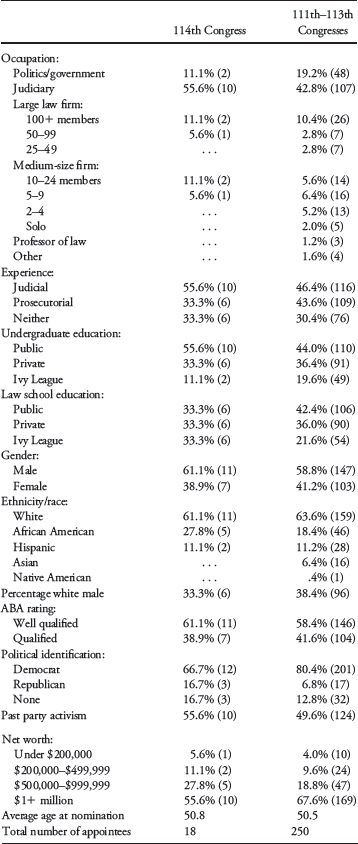
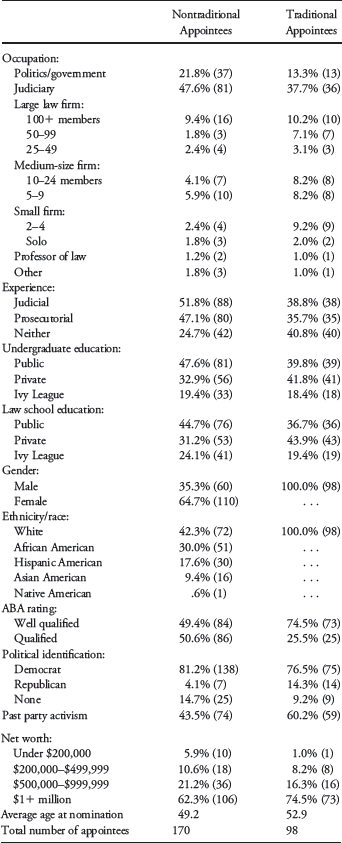
Although the numbers of confirmed district court appointees were small, we compare in table 4 the demographics of this cohort confirmed by the 114th Congress to the cohort confirmed during the previous 6 years. In table 5 we also look at the nontraditional appointees compared to the traditional (i.e., straight, white male) appointees for the entire Obama presidency. And finally in table 6 we examine the composite profile of the Obama district court appointees compared to the profiles of Obama’s four predecessors in office.
How Obama Appointees to the Federal District Courts Confirmed during the 114th Congress Compare to Those in Obama’s First Six Years

Note.—Numbers of appointees are in parentheses.
How the Obama Nontraditional Appointees Compared to His Traditional Appointees to the Federal District Courts

Note.—Numbers of appointees are in parentheses.
US District Court Appointees Compared by Administration

Note.—Numbers of appointees are in parentheses.
In table 4 we find the occupation at time of appointment of the 18 confirmed to the district courts during the 114th Congress compared to the 250 confirmed during Obama’s first 6 years. Because the numbers in the first cohort were so low, differences in proportions between the two cohorts must be treated cautiously. We also examined the demographics of the 20 nominees favorably reported to but not voted on by the Senate. It is of interest to note that when we combined the confirmed judges in the first cohort with the favorably reported but not voted-on nominees, the proportion of those who were judges (state, local, or federal magistrates) at the time of appointment was much closer to that for the cohort confirmed during the first 6 years (the proportion was 47.4%). The same is true for those who were government lawyers at the time of nomination (21.0%).
In terms of judicial and prosecutorial experience, both cohorts, as suggested by table 4, were roughly similar, although if the 20 favorably reported but not voted on were included with the 18 who were confirmed, the proportion with more prosecutorial experience than judicial experience would have been slightly greater.
When we focus on undergraduate and law school education between the two cohorts in table 4, we find no dramatic differences. With the exception of undergraduate education for the smaller cohort, the majority graduated from private colleges and universities.
Of course, diversity in gender and ethnicity characterizes the Obama judicial legacy, and table 4 clearly shows this. The proportion of white males was under 40% for both cohorts. This holds true when the 20 favorably reported but not confirmed are added to the statistics.
The American Bar Association (ABA) ratings of the two cohorts are approximately the same, with the majority awarded the highest “well qualified” rating. This also held true for the favorably reported but not confirmed nominees.
In terms of political party identification, table 4 hints that the Obama administration was even more solicitous of Republican senators during the 114th Congress than in earlier congresses by naming proportionally fewer Democrats in the most recent cohort (and more Republicans and Independents) than in the larger cohort. Interestingly, in the group of 20 not brought to the floor by the majority leader, the majority were Republicans (five) or not affiliated (seven), adding credence to the suggestion that the administration recognizing the political realities was seeking to accommodate Republican senators. Why the Senate Judiciary Committee went through the motions of holding hearings and voting to favorably report 20 district judge nominees (and three appeals court nominees) is one of the great questions overhanging the 114th Congress. Perhaps this was done with the expectation that Hillary Clinton would be elected and that floor votes would be taken in the lame-duck session. Perhaps this was done, as suggested earlier, to counter critics of the committee that in the wake of doing nothing on the Garland nomination, it was nevertheless moving ahead with lower court nominations.
The figures for past party activism are roughly comparable for the two cohorts reported in table 4 as was the net worth at time of nomination. The majority of both cohorts had a net worth in excess of $1 million. With the net worth of the favorably reported but not confirmed cohort added to that of the 114th Congress confirmed cohort, the proportion with a net worth in excess of $1 million was almost identical (65.8%) to that for the cohort confirmed during Obama’s first 6 years in office. The average age at time of nomination of both cohorts was comparable (and this held true when the 20 favorably reported on were included; average age was 50.7). The conclusion is inescapable that the demographic portrait of appointees of Obama’s last 2 years in office was essentially the same as that of the first 6 years.
The findings in table 5 comparing the nontraditional appointees to the traditional appointees are noteworthy in several respects. In terms of occupation at time of nomination, two-thirds of the nontraditionals either were serving in the judiciary or were government lawyers compared to one-half of the traditionals. The nontraditionals had more judicial and prosecutorial experience than did the traditionals. And tellingly, while only about one in four nontraditionals had neither judicial nor prosecutorial experience, fully two in five traditionals lacked such experience. What this suggests is that judicial and prosecutorial experience enhanced the attractiveness of the nontraditionals as judicial candidates but also reflected the somewhat different career paths and opportunities of the two cohorts.
The findings in table 5 for law school education suggest that a larger proportion of the nontraditionals may have had a more prestigious legal education than the proportion of the traditionals.
Of the nontraditionals, women outnumbered the men about two to one. As for ethnicity and race, white women accounted for over two in five of the nontraditionals. This was followed by African Americans, Hispanic Americans, Asian Americans, and the one Native American.
About three out of four traditionals were accorded the highest ABA rating compared to about one out of two nontraditionals. It would seem that for a traditional to be nominated, having the highest ABA rating might well have been a tiebreaker. For nontraditionals, receiving a “qualified” rating was the minimum necessary to receive serious consideration. There have been some suggestions in the literature that nontraditionals are somewhat less likely than traditionals to receive the highest ratings (Smelcer, Steigerwalt, and Vining Reference Smelcer2012). Thus for an administration that aimed for diversity in its judicial appointments, not insisting on the highest rating for all its nontraditional appointments may have been a realistic response to the suspicion that sometimes hidden or subtle biases may have been involved in some instances of not according nontraditionals the highest rating.
Slightly more nontraditionals than traditionals were identified as Democrats and considerably more traditionals were Republicans. Nontraditionals had the highest proportion not identified with either of the major political parties. In terms of a record of past partisan activism, the traditionals had a notably higher proportion than the nontraditionals. This is consistent with the larger proportions of nontraditionals whose career paths in government service (judiciary or government lawyer) would be incompatible with party activism.
A somewhat higher proportion of traditionals than nontraditionals had a net worth in excess of $1 million. The average age of the nontraditionals was 49.2 compared to 52.9 for the traditionals—a difference of close to 4 years.
Table 6 provides a composite portrait of all the Obama district court appointees compared to the appointees of his four immediate predecessors in office. The major findings for occupation at time of appointment and experience suggest that the growing professionalization of the judiciary peaked with the presidencies of Bill Clinton and George W. Bush. Almost half of their appointees held or had held judicial office at the state or local level or as federal magistrate or federal bankruptcy judges. The proportion of the Obama judges was lower than that of the Clinton and W. Bush judges. On the other hand, the proportion of Obama appointees who were in nonjudicial government positions including public defenders and those in private practice was the largest for all five administrations. This points to the Obama administration’s quest for experiential diversity. In general, the proportion of Obama appointees with judicial experience was only somewhat greater than the proportion of those with prosecutorial experience and actually was the smallest gap since the Reagan appointees. Had the 114th Congress cohort had proportions similar to those of the 113th Congress cohort, the second-term Obama appointees would have actually had a higher proportion with prosecutorial experience than judicial experience. Interestingly, the proportion with neither judicial nor prosecutorial experience was the highest since the first Bush administration.
The professionalization of the federal judiciary is indicated by the proportions elevated from the ranks of federal magistrates or federal bankruptcy judges. The proportion of President Reagan’s appointees promoted from within the federal judiciary was about 5%. The first President Bush’s proportion was 11%, Clinton’s was 12%, and W. Bush’s was almost 17%. And Obama’s was about 16%. It is too soon to tell whether in fact the trend toward an American career judiciary will continue. The Trump appointees may well signal that. Certainly the current Supreme Court has all but one justice elevated from the courts of appeals (note that Trump appointee Neil Gorsuch was elevated from the Tenth Circuit).
The findings for undergraduate and law school education in table 6 indicate that the Obama appointees had the highest proportions of Ivy League undergraduates and law school graduates. The findings for law school education are impressive given that the Ivy League law schools are among the best and most prestigious of law schools. More than one in five Obama appointees graduated from the Ivys. If we add other prestigious non–Ivy League law schools to the mix, some 44% of the Obama appointees had a prestige legal education. This compares to the approximately 31% of the W. Bush appointees and 38% of the Clinton appointees who graduated from prestigious law schools (Goldman et al. Reference Goldman, Slotnick and Schiavoni2013, 38).
Gender and ethnic/racial diversity characterize the Obama appointees and indeed constitute Obama’s historic accomplishment—and judicial legacy. Obama appointed 110 women, the greatest number to the federal district courts than any other president in history. The proportion of women appointees dwarfs that of even his closest competitor, Bill Clinton. As for African American appointees, Obama’s proportion is the largest in history, but in absolute numbers Obama appointed 51 African Americans to Clinton’s 53. Had the favorably reported district judges been voted on and confirmed, the Obama total of African American judges would have been 54, thus resulting in the first African American president holding the record for the most African American appointments to the district courts.
President Obama does hold the record in absolute numbers and proportions of Hispanic Americans and Asian Americans appointed. And the proportion of white males is the lowest in American history. Thus, the Obama judicial legacy is that over six in 10 appointees were nontraditional, opening up the federal judiciary to highly qualified groups that historically were shut out of federal judgeships (Goldman Reference Goldman1997).
When considering the ABA ratings, we find that in contrast to the W. Bush and Clinton cohorts, none of the appointees had been rated “not qualified.” The W. Bush appointees, however, had a larger proportion with the highest rating, which may be an artifact of the Bush administration’s exclusion of the ABA from the prenomination stage (Goldman et al. Reference Goldman, Slotnick and Schiavoni2013, 42).
In terms of political identification, perhaps the most startling statistic is the relatively large proportion who could not be identified with any political party. As suggested by table 5, the large majority of the unaffiliated were nontraditional appointees. The trend since the Reagan presidency has been for each successive administration to have a larger proportion of its cohort not identified with a political party, although to be sure the large majority were indeed identified with the president’s party. Interestingly, there appears to be somewhat of a decline since the Reagan administration of those with a history of some degree of past partisan activism. Yet fully half of the Obama appointees could be characterized as having some party activism in their backgrounds. This was a slightly lower proportion than that of the W. Bush and Clinton appointees.
The net worth figures for the Obama district judge appointees reflect long-run trends. With each successive administration, there are fewer appointees from the lower end of the socioeconomic spectrum and more from the upper end. Thus two out of three Obama appointees had a net worth in excess of $1 million. This was three times the proportion of Reagan appointees with such a high net worth. Inflation is undoubtedly responsible, in part, for the finding that regardless of appointing administration, each presidential cohort as a whole was wealthier at the time of nomination. This undoubtedly reflects the fact that relatively low judicial salaries compared to what can be earned in the private sector result in some highly qualified lawyers unable or unwilling to take a serious pay cut to become federal judges (Rehnquist Reference Rehnquist2001; Roberts Reference Roberts2008).
When the average age at time of nomination is examined, we find the Obama appointees with the highest average age of all five administrations. The Reagan appointees were, on average, about 2 years younger than the Obama appointees.
Appeals Courts
We noted in our previous article that as a result of the so-called nuclear option, the confirmation rate of President Obama’s appeals court nominees in the 113th Congress was the highest in about 25 years (Slotnick et al. Reference Slotnick2015, 334). But with the Republicans taking over the 114th Congress, the confirmation rate of appeals court nominees to courts of general jurisdiction plunged to the lowest ever recorded. Only one nominee to an appeals court of general jurisdiction was confirmed, although three others successfully made it through the Senate Judiciary Committee and were favorable reported—but never voted on in the Senate.
The Obama record on lifetime appointments to the courts of appeals with general jurisdiction is essentially not altered by the confirmation of Judge Luis Felipe Restrepo on January 11, 2016, to the US Court of Appeals for the Third Circuit. Judge Restrepo, from Pennsylvania, was first nominated for elevation from his federal district court judgeship over 1 year earlier, on January 7, 2015. He had a rich and varied professional background including serving as an assistant federal defender for 3 years before going into private practice for 13 years. His first judicial appointment was as a federal magistrate judge, a post in which he served for 7 years before being elevated to the district court bench by President Obama in 2013. Judge Restrepo, rated well qualified by the ABA, was in many respects the prototypical Obama appointee—nontraditional, a registered member of the president’s party, varied professional background but with major judicial experience, and with a net worth in excess of $1 million.
The three nominees who were favorably reported out of committee but not voted on were two women including one Asian American and a white male (Lucy H. Koh to the Ninth Circuit, Jennifer K. Puhl to the Eighth Circuit, and Donald K. Schott to the Seventh Circuit). All three had been nominated early in 2016.
Table 7 presents the complete Obama record of appointments to appeals courts of general jurisdiction compared to such appointments by his four immediate predecessors in office.
US Appeals Court Appointees Compared by Administration

Note.—Numbers of appointees are in parentheses. Statistics are for lifetime appointments to courts of general jurisdiction. Two recess appointments by W. Bush and one by Clinton are not included in the statistics.
a Net worth was unavailable for one appointee.
In terms of occupation at the time of nomination, Obama appointed a record proportion from the state or federal judiciary. He also appointed the most with prosecutorial experience and the fewest with neither judicial nor prosecutorial experience.
Fully one-third of Obama’s appeals court appointees had an Ivy League law school education. When non–Ivy League prestigious institutions are included, this raises the proportion to 50% with a prestige legal education. This is comparable to the W. Bush and Clinton cohorts. Bush 1 and Reagan cohorts had lower percentages (Goldman, Schiavoni, and Slotnick Reference Goldman2009, 285).
Just as with the district court appointees, the appeals court appointees set historic records for gender and race/ethnicity diversity. Over seven in 10 Obama appointees to the courts of appeals of general jurisdiction were nontraditional. Over two in five were women—the highest percentage and absolute numbers in history. If the three appeals court nominees who had been favorably reported out of the Senate Judiciary Committee had been voted on and confirmed by the Senate, another two women would have been added to the roster. Close to one in five appointees were African American, the highest in absolute numbers and proportions in history. The number and proportion of Asian Americans were the highest ever recorded. Only the record for Hispanic Americans fell below the record set by Bill Clinton, although of course Obama named Sonia Sotomayor to the Supreme Court, the first and thus far only Hispanic American to sit on the highest bench. The literature showing the effects of gender and race on judicial behavior (Brudney, Schiavoni, and Merritt Reference Brudney1999; Farhang and Wawro Reference Farhang2004; Peresie Reference Peresie2005; Sunstein et al. Reference Sunstein2006; Chew and Kelly Reference Chew2009; Boyd, Epstein, and Martin Reference Boyd2010; Epstein, Landes, and Posner Reference Epstein2013; Kenney Reference Kenney2013; Farhang, Kastellec, and Wawro Reference Farhang2015; Haire and Moyer Reference Haire2015) suggests that Obama’s diversification of the bench may have important decisional consequences.
Close to nine out of 10 of the Obama cohort were identified as Democrats. None were identified as Republicans. Under half had a background of some party activism. This is in contrast to the W. Bush cohort, in which about two out of three had such a background.
Over three out of four of the Obama cohort had a net worth in excess of $1 million, the largest proportion and absolute numbers of all five administrations. What we suggested earlier with regard to comparable findings for the district court appointees is applicable here. Inflation plus the gap between judicial salaries and those in the private sector likely results in a segment of highly qualified potential nominees opting not to become candidates for judgeships, thus skewing the net worth figures toward the higher end of the economic spectrum.
In our previous article we noted that the average age of the Obama appeals court cohort confirmed during the 113th Congress was 4 years younger than that of the first-term cohort, and overall, the average age was the highest of all five presidencies. Since Judge Restrepo (55 years old when nominated for elevation) was the only Obama appeals court nominee confirmed by the 114th Congress, the statistics remain essentially the same. The three nominees favorably reported but not voted on by the Senate were 41, 48, and 60 years of age. Had they been confirmed, the average age of the Obama cohort would have been only marginally lower.
We turn our attention to a further in-depth analysis of Obama’s diversification of the bench followed by an analysis of the party configuration of the lower courts at the end of the Obama presidency and start of the Trump administration.
Triumph of Diversity on the Bench
From the outset, the Obama administration set a goal of diversifying the judiciary so that it better reflected the nation, and by all measures, they succeeded. Table 8 aggregates the diversity numbers and proportions for lifetime appointments to the federal courts of general jurisdiction since the Franklin Roosevelt administration and clearly shows the evolution of token diversity to the historic proportions of the Obama administration.
Nontraditional Lifetime Judicial Appointees to Federal Courts of General Jurisdiction by Presidential Administration from Franklin Roosevelt through Barack Obama

Note.—Percentages refer to the total number of appointees to lifetime judgeships on courts of general jurisdiction (US district courts, US appeals courts, and US Supreme Court). For Obama appointees, the numbers include those who identified themselves as multiracial. They are counted in each of the appropriate racial categories in this table, thus accounting for the differences with the combined totals of race/ethnicity that are not double counted as reported in tables 6 and 7.
During Obama’s tenure, 134 women were confirmed, which accounts for over 40% of his appointees. Of these 134 women, over 35% were women of color. The proportion of women confirmed far exceeds that of any previous administration (including Clinton, who made the largest impact on diversifying the federal bench prior to Obama). African American appointees also enjoyed great success, as they made up almost 20% of those confirmed, and Obama’s 35 Hispanic American appointees constituted 11% of his total appointments. Both were proportionately higher than any previous administration. However, the most striking comparison across presidential administrations is for Asian Americans/Pacific Islanders (AAPI) and openly gay individuals. Over his 8 years in office, Obama appointed 20 AAPI and 10 openly gay judges to the federal bench, which is more than all presidents in history combined.Footnote 1 The AAPI appointees made up almost 7% of those confirmed; the next-largest proportion is 1.4% during Clinton’s tenure, a noteworthy difference. Furthermore, by naming 10 openly gay individuals to the bench, Obama appointed more openly gay LGBT jurists than had ever served as federal judges in the entire history of our nation. These statistics clearly illustrate that Obama prioritized diversity in his judicial selections: proportionately and in absolute numbers, he exceeded all prior administrations in every category of diversity.
Furthermore, President Obama appointed a record number of judges who have more than one diversity characteristic. Over 8 years, he appointed 46 double diverse judges and five judges with three diversity characteristics. These judges embody diversity at an entirely new level, and their presence on the bench is representative of the changing citizenry at large.
This attention to diversity translated to a high proportion of nontraditional appointees during Obama’s 8 years in office. For the first time in American history, women and ethnic minorities, who together constitute a large majority of the population, received the large majority of judicial appointments. Out of 318 appointments to lifetime judgeships on courts of general jurisdiction, 206 (64.7%) were nontraditional, that is, were not straight white males.
Another way to evaluate diversity on the federal bench is to look at the proportion of authorized judgeships held by nontraditional judges. Table 9 shows that for the first time in 10 years, overall diversity of the federal bench actually decreased during Obama’s last 2 years in office. As of January 1, 2017, 46.1% of authorized lifetime positions were held by nontraditional judges compared to 48.2% on January 1, 2015. In absolute numbers, there were 17 fewer nontraditional judges at the end of the 114th Congress than at the start—a decrease of 4.21%. The most dramatic decrease came from women on the district courts, where there was a net loss of 12 (5.8%). As we cautioned in our 2016 article, Obama’s record over his final 2 years depended on his continued success in obtaining confirmation of a large and diverse set of appointees to counter the normal flow of nontraditional judges leaving the bench. While the last cohort of Obama nominees was sufficiently diverse—13/19 (68%) were nontraditional—it simply was not large enough to make up for the typical number of diverse judges leaving active service. Put simply, the dearth of confirmations during the 114th stymied Obama’s ability to diversify the federal bench further.
Proportion of Nontraditional Lifetime Judges in Active Service on Courts of General Jurisdiction: January 1, 2015, and January 1, 2017

a Out of 663 authorized lifetime positions on the US district courts. Some double and triple counting are inevitable. In 2017, 64 women also were African American, Hispanic, AAPI, Native American, or openly gay. Additionally, there were five women who fit into two other nontraditional categories. There was also one openly gay African American man and one man who identified as both African American and Hispanic.
b Out of 167 authorized lifetime positions on the numbered circuits and the US Court of Appeals for the DC Circuit, all courts of general jurisdiction. Some double counting is inevitable. In 2017, 11 women also were either African American, Hispanic, or AAPI.
c Out of nine authorized positions on the US Supreme Court. One woman was also Hispanic.
d Totals and percentages do not double count those who were classified in more than one category.
However, reflecting on the entirety of Obama’s presidency, his judicial legacy is defined by the “historic firsts” of his judicial nominees. Justice Sonia Sotomayor was confirmed as the first Latina to serve on the US Supreme Court; Diane Humetewa is the first and only Native American woman ever to serve as a lifetime-appointed federal judge; Sri Srinivasan is the first AAPI judge to serve on the prestigious DC Circuit; Paul Oetken is the first openly gay man confirmed to any federal court. These are but a few of the many firsts Obama achieved over 8 years.
Moving beyond the many individual firsts, the overall impact of Obama’s nominees on the gender, racial, and ethnic diversification of the federal bench is clear. When Obama took office in 2009, 38.8% of judges were nontraditional compared to 46.1% when he left—an impressive 18.7% increase or 61 seats (table 10). When we look at each individual category, the results are even more notable. At the end of Obama’s tenure, 30.0% of judges in active service were women, an increase of 18.9% (40 seats). This includes, of course, two appointments to the US Supreme Court, where there are now three women, a historic achievement. In terms of racial and ethnic diversity, 12.8% of federal judges were African American, 9.1% were Hispanic American, and 2.9% were AAPI, an increase of 17.6% (16 seats), 26.7% (16 seats), and 300% (16 seats), respectively. Finally, just over 1% of federal judges were openly gay, but this still represents a 900% increase or gain of 10 seats during Obama’s time in office.
Proportion of Nontraditional Lifetime Judges in Active Service on Courts of General Jurisdiction: January 1, 2009, and January 1, 2017

a Out of 663 authorized lifetime positions on the US district courts. In 2017, 64 women also were African American, Hispanic, AAPI, Native American, or openly gay. Additionally, there were five women who fit into two other nontraditional categories. There was also one openly gay African American man and one man who identified as both African American and Hispanic.
b Out of 167 authorized lifetime positions on the numbered circuits and the US Court of Appeals for the DC Circuit, all courts of general jurisdiction. In 2017, 11 women also were either African American, Hispanic, or AAPI.
c Out of nine authorized positions on the US Supreme Court. One woman was also Hispanic.
d Totals and percentage do not double count those who were classified in more than one category.
District Courts
These trends hold when examining the district courts separately, where the proportion of nontraditional judges at the end of the 114th Congress was 45.9%—an increase of 16.5% from 2009. Every group made gains during Obama’s presidency: women (+17.5%), African Americans (+11.8%), Hispanic Americans (+31.3%), AAPI (+162.5%), Native Americans (+100%), and openly gay individuals (+900%).
Most obviously, the Obama cohort was able to diversify the district courts because 63% of his appointees were nontraditional. In addition, despite the dearth of confirmations during the 114th Congress, Obama appointed 268 district court judges to the bench over his 8 years in office, which is more than George W. Bush but still less than Clinton. When combined—a large number of nominees of whom the vast majority were nontraditional—the result is a much diversified district court bench.
When looking at individual district courts, the Obama judicial legacy is even more evident. Over 8 years Obama appointed women to seats on 17 district courts where there previously had been none; that leaves only six in which there has never been a female judge compared to 23 when he took office.Footnote 2 African American judges were confirmed to four district courts in which there previously had been none and Hispanic judges to three. However, that still leaves 35 district courts (38%) without having ever seated an African American judge, and 62 courts remain without Hispanic representation. AAPI judges are present on district courts in only nine states, but President Obama is credited with appointing the first AAPI jurist to district courts in four of those nine.
When considering the totality of his appointments, at the start of Obama’s presidency, 14 district courts had never seated a nontraditional judge, and at the end of 8 years, this number dropped to four. Furthermore, it is worth noting that many of the district courts that have remained all-white straight male are the smallest courts in the nation and thus provide fewer appointment opportunities.
Courts of Appeals
When not double counting women who also belong to a racial minority group or are openly gay, the proportion of nontraditional judges on the courts of appeals at the end of Obama’s presidency was 47.3%, an increase of 25.4% (or 16 seats) from the start of his term (table 10). Nearly half of the president’s circuit judge appointees were women, which explains why the proportion of women jurists on courts of appeals increased by 20% during Obama’s tenure. African American judges increased by 50%, but the largest gain was by AAPI judges: there were none when Obama entered office and he appointed three. Despite appointing four Hispanic judges to the courts of appeals, Obama was not able to shift the balance: the number of Hispanic judges remains the same as it was when Obama entered office. Currently, there are no Native American or openly gay appeals court judges, nor have there ever been.
During his two terms, Obama’s appellate appointments led to a majority of nontraditional judges on six circuits: the Second, Fourth, Fifth, Sixth, Eleventh, and DC. Gender diversity increased on eight courts of appeal (the First, Second, Fourth, Sixth, Ninth, Tenth, Eleventh, and DC Circuits). Presently, all of the geographic circuits have a sitting female judge and all but the Eighth Circuit have more than one woman. The Ninth Circuit boasts the most female judges in absolute numbers (10), but the Sixth Circuit lays claim to more women proportionately (47%).
Similarly, racial and ethnic diversity increased on eight circuit courts: the First, Second, Third, Fourth, Sixth, Ninth, Eleventh, and DC Circuits. Notably, over 8 years Obama appointed nontraditional judges to five courts of appeals where they were not previously represented: AAPI jurists now sit on the Second and DC Circuits, Hispanic jurists sit on the Fourth and Eleventh Circuits, and there is an African American judge on the First Circuit.
Table 11 aggregates district courts by circuit. The table also lists the percentage of women judges in each district and compares the percentage of African Americans, Hispanics, and AAPI to the percentage of each group in the circuit’s general population, since we expect states with more diverse populations to also have more diverse courts. Proportionately, women have the greatest presence on district courts within the Second and DC Circuits, where they achieved near parity, and the lowest within the Sixth and Ninth Circuits. Notably, over the last 8 years, the number of women serving on district courts in the Fourth Circuit, which includes Maryland, North Carolina, Virginia, West Virginia, and South Carolina, has more than doubled—increasing from eight to 17. Similarly, there are 50% more women serving on district courts in the Eighth Circuit than when Obama took office, resulting from a net gain of five seats. Overall, in aggregate, the number of women sitting on district courts increased in eight circuits and remained the same in two—further evidence that Obama nominated female jurists to courts in states where they were previously underrepresented.
Diversity on the District Courts, January 1, 2017: Active Judges Aggregated by Circuit

Note.—Data on 2016 general population are compiled from the US Census Bureau. Note that according to the standards set by the Office of Management and Budget and implemented by the Census Bureau, race and Hispanic origin (ethnicity) are separate and distinct concepts, and when collecting data via self-identification, two difference questions are used.
a Excluding Puerto Rico.
The highest concentration of African American district court judges is on the district court within the DC Circuit. The Second Circuit has the second-highest percentage and added five African American judges over the past 8 years, a 71% increase. When comparing overall representation on the bench to the general population, seven circuits have African American representation on the courts near or greater than their representation in the population; this is up from five when Obama took office. The largest “overrepresentation” occurs on district courts within the Ninth Circuit, where 12.5% of the active district court judges are African American compared to 5.5% of the population. Conversely, there are six circuits where African Americans are underrepresented at the trial level, with the largest disparities occurring in the southern circuits (the Fourth and Eleventh Circuits). Additionally, despite Obama’s attention to adding diverse judges to the bench, only three circuits ended up with more African American district court judges than when Obama entered office.
The results are mixed for representation of Hispanic Americans. Obama’s appointments led to an increase in Hispanic jurists on district courts within six circuits including the Second and Third, which doubled the number of Hispanic judges within the circuit. Similarly, a net gain of six seats led to 60% more Hispanic judges serving on district courts in the Ninth Circuit than when Obama took office. The impact of these appointments is that there is greater congruence between population and judicial representation in these circuits. However, the states within the First, Fourth, Sixth, and Eighth Circuits had no Hispanic district court judges at the start of Obama’s presidency and still have none. And relative to their representation in the population, the Fifth, Seventh, and Ninth Circuits have very few. This is certainly an area ripe for a “first” for President Trump if he follows the path of President George W. Bush, of whose appointments nearly 10% were Hispanic.
Owing to Obama’s historic record of appointing AAPI judges to the bench, they are present on district courts within eight circuits, of which he appointed the first AAPI judge on five. This underscores the fact that Obama was not simply appointing AAPI jurists to district courts in states where they are already represented, that is, New York and California.
There are no AAPI judges on districts within the Fifth, Eighth, Tenth, and Eleventh, despite having a very large (and growing) presence in Texas and Florida, according to the US Census Bureau. District court representation roughly equals that of the general population in the First, Sixth, and Ninth Circuits, and it is not particularly surprising that the highest concentration of AAPI district judges is in the Ninth Circuit—10.4%—since it also is the circuit with the largest population of AAPI (12.3%). Finally, with the confirmation of Judge Derrick Kahala Watson in 2013, the US District Court for the District of Hawaii is the first federal court in US history with a majority of AAPI judges.
It is clear that the administration has enjoyed great success in reshaping the judiciary to better reflect the populace in terms of race, ethnicity, gender, and sexual orientation. However, as the page turns on the Obama presidency, one has to wonder how long the impact of his efforts will remain. As the 114th Congress illustrated, diversity on the federal bench is contingent on the appointment of enough nontraditional judges to counter the natural evolution of diverse judges leaving active service. A major wave of minority and female judges were confirmed during the Clinton administration, and many of them are at the point at which they can retire. It is quite possible that diversity on the federal courts will diminish over the next few years, even if President Trump were to appoint the same proportion of nontraditional judges as W. Bush, simply because so many diverse judges leave active service.
Partisan Makeup of the Bench
At the end of the 113th Congress, after 6 years in office and a near-record-setting number of district court appointments, President Obama was finally able to shift the overall partisan balance on the lower federal courts in the Democrats’ favor. As the curtain fell on his presidency, the Democrats held on to the advantage, but ever so slightly. Owing to the paucity of confirmations during the 114th Congress, the proportion of authorized seats on lower federal courts held by judges appointed by Democratic presidents decreased from 53.3% to 51.6% in the last 2 years of Obama’s presidency (table 12). When considering only active judges, thus excluding vacancies, the overall percentage rises to 58.1%, illustrating the impact of the historic number of vacancies left on the lower federal courts. As we have suggested, unprecedented levels of obstruction under divided government came into play during the 114th, and if the 23 judges who were favorably reported out of the Senate Judiciary Committee had been confirmed, the picture would be more typical of past presidents, where they saw the partisan balance of the courts increase during their last 2 years in office.Footnote 3
Judgeships by Party (%)

Considering the totality of his presidency, the picture is more representative of a two-term president. From the start of Obama’s tenure to the end, the cohort of judges appointed by Democrats increased from 39.1% to 51.6%. While it is instructive to examine the overall partisan change on lower courts, we also separately analyze the district courts and courts of appeals, as two somewhat different stories are told at those different levels of the federal courts.
District Courts
Following the trend of lower courts overall, the proportion of authorized seats on district courts held by Democratic appointees decreased to 52.3% in 2017 from 53.7% in 2015 (−1.4 percentage points). Democratic appointees still hold a slight majority, but this diminution stands in stark contrast to the 113th, during which Obama was able to increase the proportion of Democratic appointees by +9.5 percentage points.
As we cautioned in our 2016 article, maintaining the Democratic edge in appointments depended on two things: (1) Obama’s ability to appoint a critical mass of district court judges during his last 2 years and (2) continued partisan equilibrium of judges leaving active service. As for the first prong, during the 114th Congress, Obama was limited to a scant 18 confirmations out of 62 nominations (29%) from 95 appointment opportunities—not nearly enough to counter the loss of Democratic appointees leaving office. However, interestingly, the vast majority—over 60%—of “new” vacancies were created by Republican appointees leaving active service.Footnote 4 This was a reversal from Obama’s first 6 years, where 65% of vacancies were from Democratic appointees leaving active service. The slowdown of Democratic appointees leaving the bench certainly helped Obama maintain the slim Democratic majority on district courts at the end of his term and may continue into the future if history is any guide.
Historically, accelerated departures from the bench—especially judges taking senior status—accompany changes in partisan control of the White House. This makes sense since judges who are eligible to take senior status or retire with full benefits would most likely do so under a partisan-compatible president and Congress since their replacement is more likely to be ideologically similar. Given this precedent, the Democratic majority on the district courts may remain for the near future since the presidents’ ability to alter the partisan makeup of the bench is contingent on their ability to replace appointees of the other party with their own.
Also notable about the vacancies that occurred during Obama’s presidency is that of the 317 judges who left active service on the federal district courts, 171 (53.9%) were Clinton appointees. This represents the “generational effect,” which suggests that the overall complement of departing judges in any given administration is dominated by the appointees of a specific predecessor of the same party as the sitting president. Carter appointees departed during Clinton’s administration, Reagan appointees departed during W. Bush’s 8 years, and Clinton appointees left the district court during Obama’s tenure. It will be interesting to see if this holds true for the W. Bush district court cohort.
Although the cumulative impact of Obama appointees may have diminished over the last 2 years, his 263 district court judges account for nearly 40% of authorized seats on the district courts. More significantly, though, when Obama entered office, Democratic appointees held 39.8% of the total authorized positions for the district courts, and by the end, the percentage had increased to 52.3%; when not including vacancies the proportion grows to 59.1.
Courts of Appeals
Turning our attention to the courts of appeals reveals a somewhat different picture. The bitter partisan divide observed during the first 6 years of Obama’s presidency reached a climax during the 114th Congress as evidenced by the increase in the Index of Obstruction and Delay for court of appeals nominees, which shows total obstruction and delay (table 3). In terms of confirmations, Obama was significantly less successful during the last 2 years of his term, securing confirmation for only one out of eight nominations to appeals courts with general jurisdiction (12.5%). This proportion of confirmations is the lowest ever recorded and dramatically affected the partisan balance on the courts of appeals. While Obama was finally able to attain a Democratic majority after the 113th Congress—52.1% of authorized seats on the courts of appeals were held by judges appointed by Democratic presidents—this number decreased to 48.5% at the end of his term (−3.6 percentage points).Footnote 5 Taking into account only active judges, a slight Democratic advantage emerges: 54.0% of active service judges are Democratic appointees.
In a comparison of district courts to courts of appeals, a difference emerges when we analyze the size of the Obama cohort relative to other presidents. Whereas nearly 40% of authorized seats on the district courts were filled by Obama, his appointees accounted for only 27.5% of authorized seats on the courts of appeals at the end of his term, still lagging the W. Bush cohort of 28.7% even after 8 years out of office (table 13). Notably, Clinton appointees still make up 20.1% of authorized seats on the courts of appeals. In total, over 8 years, Obama had 98 appointment opportunities to the courts of appeals for which he submitted 73 nominations. He succeeded in getting 48 nominees confirmed (49%), which is slightly less than the 268 of 479 opportunities at the district court level (55.9%).
Makeup of Federal Bench by Appointing President, January 1, 2017: Lifetime Positions on Lower Courts of General Jurisdiction

Note.—Percentages were rounded to 100%.
a Does not include temporary district court judgeships.
However, when looking at the totality of his term, it is clear that the Obama appointees tilted the courts of appeals in the Democrats’ favor. Of his 48 total appointments, 26 were to seats in which the incumbent was appointed by a Republican (54.2%). This is important since the president can affect the balance on the bench only if he is able to appoint judges to seats previously held by the opposing party or newly authorized seats. In addition, different from the district courts, we saw greater partisan equity in departures from the bench. At the courts of appeals, 53.8% of those who left active service were appointed by Democrats. This meant that Obama did not have to play quite as much “catchup” with his appointments.
Indeed, while it may be seem that Republicans are well positioned to recapture the majority of active judges on the courts of appeals by the end of Trump’s first term, this may not be as simple as it appears. The number of vacancies (17), and his attention to filling open seats on the courts of appeals—Trump’s first slate included five court of appeals nominees—bode well for a turnaround but belie the difficulty presidents encounter from judges leaving active service.Footnote 6 As we mentioned earlier, it is typical for there to be accelerated departures from the bench—especially judges taking senior status—when partisan control of the White House changes. During President Obama’s first 2 years in office, 16 vacancies occurred on the courts of appeals when, on average, 12 typically occur. Moreover, a majority of these vacancies usually come from judges appointed by a partisan-compatible president. This would suggest that we would see more Republican-appointed judges leaving the bench during Trump’s first term. In fact, all of the Reagan and H.W. Bush appointees are currently eligible to retire with full benefits, and nearly half of them are 80 years old or will turn 80 during Trump’s first 4 years. If even just half of the eligible Reagan and H.W. Bush appointees retire, this presents a significant obstacle to shifting the partisan balance on the courts of appeals in the near future.
Another way to evaluate the impact of a president’s appointees on the partisan makeup at the appellate level is to aggregate by circuit and examine how many courts have Republican-appointed majorities or vice versa. Analyzing Obama’s time in office by this measure confirms the considerable impact of his appointees at the appellate level. At the start of Obama’s presidency, nine of the 12 geographical circuits had Republican-appointed majorities, one had a Democratic-appointed majority, and two were evenly divided.Footnote 7 As he left office, however, only four courts had Republican majorities and eight had Democratic majorities. That means that seven courts of appeals on which Republican appointees had a majority or were evenly split at the start of his term now have Democratic-appointed majorities: the First, Second, Third, Fourth, Tenth, Eleventh, and DC. The most dramatic shifts were on the Fourth and DC Circuit Courts of Appeals, where upon entering office, Republican appointees held a 7–4 and 6–3 advantage, respectively. Owing primarily to Obama being able to fill long-standing vacancies on both courts, the partisan balance shifted to 9–6 and 7–4, in the Democrats’ favor, by the end of his second term. Looking forward, it would appear that Trump appointees might have the most immediate impact on the Third Circuit Court of Appeals given that there are currently three vacancies, and Democratic appointees hold seven seats and Republican nominees hold four. However, even if Senate Judiciary Chair Charles Grassley does not abide by the long-standing blue slip tradition for circuit court nominees whereby senators from individual states within the circuit are given blue slip consideration, it will be difficult to find a consensus nominee when five out of the six senators who represent states in the Third Circuit are Democrats. Trump may be better served using his judicial resources to fill vacancies from more “red” states, many of which have been vacant for 2 or more years because Republican senators refused to return blue slips for Obama nominees.
Besides shifting the partisan balance on the courts of appeals, Obama also made significant strides in decreasing the number of courts on which Republicans, particularly W. Bush nominees, constitute a supermajority. When he entered office, six of the 12 geographical circuits had Republican supermajorities, where Republican appointees occupied at least twice the number of seats as Democratic appointees.Footnote 8 At the end of his presidency, only two remained: the Seventh and Eighth Circuits. However, given the number and distribution of vacancies, it is quite likely that with the addition of Trump appointees, Republican supermajorities will reemerge on the Fifth and Seventh Circuits. Currently, Democratic appointees hold a supermajority on the First, Ninth, and Eleventh Circuits, although if Trump is able to fill three of the four current vacancies on the Ninth Circuit, the supermajority of Democratic appointees will be lost.
Besides detailing the partisan alignment of active judges, the data in table 13 also underscore the impact of judges opting to take senior status. Over the past 20 years the number of senior judges has been steadily increasing, especially on the district courts. At the end of the 114th Congress there were 453 senior judges on district courts, more than we have seen in the 22 years for which we have records. For comparative purposes, in 1995 there were 273 district court judges with senior status and 10 years later (2005) there were 352. On the courts of appeals, there are 100 senior judges currently, which is on the higher end of the range, but not the record, which was 108 in 2011.Footnote 9 The number of senior judges is nearly 70% of the number of active judges on the district courts and 60% at the courts of appeals.
While senior judges have reduced caseloads, they nonetheless are a critical component of the judiciary, which is especially true in an era when the federal judiciary is rarely fully staffed yet the courts are faced with a heavy (and growing) caseload. Republican appointees make up a clear majority of senior judges—55.2% and 62% on the district courts and courts of appeals, respectively—and certainly the strong Republican majority has an impact on judicial decision making. Given that we anticipate a wave of Republican appointees taking senior status over the next 4 years, Republicans will have the numerical advantage for many years to come.
One final measure of Obama’s impact on the partisan makeup of the bench solidifies our conclusion that his appointments were especially consequential. Combining both court levels and including both active and senior judges, 51.9% of all judges currently hearing cases were appointed by Democratic presidents.
Concluding Observations and What Lies Ahead
When Barack Obama left office on January 20, 2017, he left a legacy including the transformation of the federal judiciary not only in terms of its gender/racial/ethnic diversity but also in terms of its ideological and judicial philosophical orientation. The predominantly white male George W. Bush–appointed cohort, with its decidedly conservative ideological/philosophical bent, gave way to the Barack Obama cohort with its majority of nontraditionals whose ideological/philosophical bent overall was moderate to liberal. Nowhere are the differences between Bush and Obama appointees more evident than with the voting behavior of their Supreme Court appointees. On many controversial issues, Bush’s appointees, Chief Justice John Roberts and Associate Justice Samuel Alito, demonstrated a conservative ideology and judicial philosophy. Obama’s appointees, Associate Justices Sonia Sotomayor and Elena Kagan, were widely seen as more liberal in their ideology and judicial philosophy. Had the Republican senatorial leadership not prevented the consideration of Judge Merrick Garland to fill the vacancy caused by Justice Antonin Scalia’s death and had Garland been confirmed, it is likely that he would have been more aligned with the liberal than the conservative wing of the Court, and that would have fundamentally changed the dynamic on the Court.
But, of course, Garland’s nomination died at the end of the Obama presidency. Some observers have suggested that Democratic presidents and Democrats in general have not placed sufficient priority and exercised assertiveness in staffing the courts at all levels. One scholar recently wrote that Democrats have not shown “a willingness aggressively to prioritize and push judicial nominations” (Fontana Reference Fontana2017, 322). This has meant that Democrats demonstrate “excessive cooperation with political forces that do not manifest the same behavioral patterns of cooperation” (287). Despite the provocation of the obstruction of the Garland nomination, at the Democratic National Convention in 2016, speaker after speaker including the president himself essentially ignored what the Republicans were doing to the Garland and many lower court judgeship nominations. Nan Aron of the Alliance for Justice noted, “I was stunned that we went through a four day convention and Merrick Garland’s name was not mentioned once. It was as if the Democratic Party decided to take it off the list of priority issues. It was mind-boggling” (interview, January 9, 2017). Perhaps the reason is that the Democratic Party is more interest group oriented while the Republican Party is more ideological (Grossman and Hopkins Reference Grossman2016). Whatever the reason, the Obama administration and Democratic senators were seen as not having fully used “available and aggressive political strategies” to shape a federal bench that would be more of a counterweight to Republican appointees particularly on the circuit courts (Fontana Reference Fontana2017, 323).
Given Republican obstructionism in the Senate, should President Obama have been less concerned with pleasing Republicans by naming white male centrist Garland rather than someone more identifiably liberal and nontraditional who presumably would have energized the base? Perhaps a piece of the Obama judicial legacy is that in a highly polarized and politicized environment, not being aggressive enough in seeking to shape the judiciary will be disadvantageous politically.
President Obama, it would seem, sought to lower the political temperature in the judicial selection and confirmation process. The question is whether by not being aggressive and prioritizing judicial appointments in his public comments and on the campaign trail, the president wound up with less than he otherwise would have. Christopher Kang offers an alternative perspective on what President Obama sought to accomplish:
Writ large, he didn’t seek to politicize the judiciary or judicial nominations in a way that other presidents have. This nomination of Judge Garland folds into that overall narrative. … Nominating Judge Garland, as a moderate white male, and not playing into identity politics furthered … [the] goal which is to instill more confidence in the judiciary. He made clear that he was not playing political games with the Supreme Court. He was trying to put the person that he thought was the best nominee at that time for that vacancy in that seat. I think that was really in line with how the President viewed the institution of the judiciary. And would it have made political sense to do something different? Maybe, but at what cost? I think that the President was always looking to strengthen the legitimacy of the role of the judiciary within our government. Again, you assume that the Republicans would not have allowed anybody to fill that seat, so you ask at what cost to even further politicize the judiciary? I don’t know that it would have been worth it. Almost anything could have made a difference when you talk about the tens of thousands of votes that it took to sway it [the election]. It certainly would not have been the way that the President would have wanted to think about that question. As a lawyer, I wouldn’t want him to make that calculus. Judicial nominations always have a political aspect to them, but I, for one, as a somewhat detached observer, really appreciated that it was clear that politics was not going to be the driving force in his selection of Judge Garland.
(Interview, February 22, 2017)While there is no answer to the what if question concerning Garland, we need to return to the big picture and emphasize the historic Obama judicial legacy of diversity and note that Obama leaves a judiciary more center-left ideologically than 8 years earlier when he assumed the presidency. That surely will have an impact on the course of judicial decision making.
Turning our attention to what lies ahead with the Trump administration and judicial selection, we can note at the outset that, like the George W. Bush administration in 2001, the American Bar Association Standing Committee on the Federal Judiciary was removed by the Trump administration from the prenomination stage. No longer would the ABA be asked to provide ratings and be given the names of potential nominees for the ABA to rate in advance of potential nomination. This may influence the ABA ratings subsequently provided to the Senate Judiciary Committee just as it may have affected the ratings of the W. Bush nominees (Goldman et al. Reference Goldman2009, 274). President Obama restored the traditional ABA role that President Trump has now terminated (New York Times 2017).
In his first 4 months in office, President Donald Trump successfully appointed a Supreme Court justice, Neil Gorsuch, and nominated eight people to lifetime positions on the lower courts of general jurisdiction. His first lower court judicial nomination was on March 21, 2017, to Amul R. Thapar for elevation from the federal district court in Kentucky to the Sixth Circuit. He is the first Indian American to serve on the Sixth Circuit. Since he is young, very well credentialed, unanimously given the highest ABA rating, conservative, and a person of color, speculation is that he will certainly be in the running for filling another Supreme Court vacancy if one occurs.
Judge Thapar was confirmed on May 25, 2017, by a vote of 52–44. The number of days from nomination to confirmation was 65. The number of days from nomination to confirmation of Obama’s lone circuit court appointee in the 114th Congress was 374. The average number of days from nomination to confirmation of Obama’s 18 district court judges in the 114th Congress was 307. Compared to the confirmation delays during the Reagan administration, the Obama nominees waited well over twice the number of days (O’Connell Reference O’Connell2015), raising the question whether the dysfunctional federal judicial selection process can be fixed (Tobias Reference Tobias2016).
Interestingly of Trump’s first eight lower court nominees to lifetime judgeships on courts of general jurisdiction, three are nontraditional, perhaps an indication that while the Obama diversity record will not be duplicated, the George W. Bush record may and, perhaps, will be exceeded. Another point of interest is that two of the nominees to circuit courts were on the Federalist Society list of potential Supreme Court nominees that Trump pledged to choose from for filling the Scalia vacancy, a pledge he kept (Baum and Devins Reference Baum2017). The Trump administration can be expected to continue to give the Federalist Society and other conservative groups a seat at the judicial selection table. Also, aside from Judge Thapur, none of the other appeals court nominees are elevations from the federal district courts. Two of the district court nominees were among the 20 Obama nominees that were favorably reported but not voted on by the Senate, both from red states.
But it is the successful Neil Gorsuch appointment to the Supreme Court that is of particular moment. The Democrats considered the Scalia vacancy one that President Obama rightly should have been able to fill; thus this was from their perspective a stolen seat that Democrats were inclined not to let Trump fill. Senate Democrats, and in particular Senate Minority Leader Chuck Schumer, took a gamble in filibustering the Gorsuch nomination, the gamble being that the Republicans would indeed change the rules and allow the filibuster to be broken by a simple majority. Democrats in the 113th Congress had, after all, ended the filibuster for lower court nominees. With the change in the rules for the Supreme Court, Gorsuch, a young, mild-mannered, relatively noncontroversial conservative appeals court judge with outstanding academic accomplishments and the highest ABA rating, was confirmed. Had the Republicans not changed the rules, the Gorsuch nomination would have been withdrawn and the stage would have been set for Gorsuch’s replacement by possibly a more extreme and thus from the Democrats’ standpoint more objectionable Trump nominee for whom the Republicans would then have changed the rules to be able to confirm by a simple majority vote. On the other hand, there was the possibility that were Gorsuch successfully filibustered, his replacement would have been “somebody more moderate,” according to Christopher Kang.
Whatever the calculus, the Democratic senatorial leadership believed it had no alternative but to filibuster Gorsuch. Now the Democratic hope is that they regain control of the Senate in 2018 and prevent Trump from filling any vacancy that might arise until after the 2020 presidential election. In this sense, were this to come to pass, the Garland precedent will be very much invoked by the Democrats.
Democratic senators still have the power of the blue slip, which means that Democratic senators can, in effect, attempt to obstruct Trump nominees from their states. Put in a broader perspective Christopher Kang observed,
The real question, as you project ahead, is what is going to happen next and how are Democrats now going to respond? … It will be interesting to see how Democrats use their blue slips and whether or not this path of obstruction that Republicans have set the Senate on is sustainable. Is there another level? Usually, as we see, one side takes it to one level of obstruction and the other side one ups them as it goes on. It’s not to say that the Democrats are at all faultless in all of this. Where does this end and how do we get the judiciary back on track to where it should be? … I can make a case that the Democrats should not confirm more than 60 judges for Trump in the first two years because that’s what the Republicans did to President Obama. On the other hand, it would be somewhat hypocritical for me to suggest that’s the best thing for a judiciary that has 40% more vacancies today than it did in 2009.
Were Democratic senators to continually use or, from the Republican perspective, abuse the blue slip tradition, will Senator Grassley do away with the blue slips altogether? There is some talk in late May 2017 that Senator Grassley may decide not to honor blue slips for circuit court appointments (Washington Post 2017). Clearly there is a lot to play out that increasingly looks, from the vantage point of this writing, to be in the context of an administration under siege and a presidency in crisis. In that context, Democrats may be willing and able to use whatever procedural tools that remain at their disposal to obstruct and delay Trump’s judicial nominations. The consequences for the federal judiciary and the administration of justice, coming after the treatment of Obama nominees during the 114th Congress, are incalculable. Nevertheless, President Trump will undoubtedly be able to leave his imprint on the judiciary (Wheeler Reference Wheeler2016).
That said, it is worth reiterating that at the end of the day the Obama judicial legacy is a formidable one now that the final chapter has been written.