Introduction
Advancing age increases the risk of cognitive impairment. Lifestyle behaviors, such as physical activity, smoking cessation, moderate consumption of alcohol, and healthy diet, have been suggested to play a role in their association with cognitive impairment (Lee et al., Reference Lee2010). In particular, as a number of studies confirmed that excessive drinking is associated with lower cognitive function and prevalence of dementia, growing attention has been paid to the relationship between alcohol drinking and cognitive function (Lee et al., Reference Lee2010; Etgen et al., Reference Etgen, Sander, Bickel and Forstl2011).
As for the influence of alcohol drinking on cognitive health, contradictory results have been reported depending on the amount and frequency of consumption. Excessive drinking is not only a risk factor for mild cognitive impairment but is also highly associated with dementia (Deng et al., Reference Deng, Zhou, Li, Wang, Gao and Chen2006; Xu et al., Reference Xu, Liu, Yin, Zhu, Zhang and Fan2009). In contrast, moderate alcohol drinking has been reported to positively influence memory and cognitive function, and is also reported to be associated with a reduced risk of dementia (Ganguli et al., Reference Ganguli, Vander Bilt, Saxton, Shen and Dodge2005; Reid et al., Reference Reid, Ness, Hawkins, Towle, Concato and Guo2006; Virta et al., Reference Virta2010).
Although a number of studies have supported the idea that moderate alcohol consumption delays cognitive decline and conversion to cognitive impairment, the relationship between moderate drinking and cognition is still controversial. The inconsistency in previous studies suggests that alcohol may affect certain areas of cognitive ability, rather than uniformly affecting all cognitive abilities. In particular, decreased memory is the most prominent symptom related to cognitive impairment in old age as well as an early sign of dementia (Goldman and Morris, Reference Goldman and Morris2001). If the influence of alcohol varies depending on different memory structure, the potential mechanism by which alcohol drinking protects memory impairment may also differ.
This study examined the relationship between alcohol drinking and impairment in verbal and visuospatial memory of older people.
Materials and methods
Data source
The database of the Clinical Research Center for Dementia of South Korea (CREDOS) was used for the analysis of this study. CREDOS is an ongoing nationwide hospital-based registry of dementia in the Republic of Korea since September 2005 (Park et al., Reference Park2011). The CREDOS study was designed to examine the characteristics of cognitive impairment and dementia by recruiting patients from 31 participating memory clinics of university and general hospitals. The research was approved by the institutional review boards of all participating centers.
A total of 7,331 participants, aged between 60 and 90 years, were registered in the CREDOS study from January 2008 to August 2012. The 5,759 participants registered before 2008 were excluded from the analysis because items on health behaviors, such as alcohol drinking, were included in the survey from 2008. This study analyzed 1,572 participants (489 males and 1,083 females) who completed the standardized neuropsychological battery, the Seoul Neuropsychological Screening Battery (SNSB; Kang and Na, Reference Kang and Na2003), and the health questionnaire.
Measurement
With respect to alcohol drinking, the participants were asked about the frequency, age at first drink, duration of drinking, and average intake per occasion through a standardized health questionnaire. If the participant failed to respond to a drinking item, due to memory deterioration, the questionnaire was completed by the accompanying family caregiver. Those who reported that they have never consumed alcohol in lifetime were defined as abstainers. Past drinkers were defined as those who used to drink but were not drinking currently, that is at the time of the interview. Among current drinkers, average drinks per week were calculated by multiplying average drinking frequency per week and the drinking amount per occasion for all types of alcohol consumed. A standard drink contains about 14 g of pure ethanol. Because older adults have less lean body mass and greater sensitivity to alcohol's effects, moderate drinking was defined as no more than seven drinks per week and three drinks per day (National Institute on Alcohol Abuse and Alcoholism, 2005). Alcohol consumption above this level was categorized as heavy drinking.
Verbal memory was measured using the Seoul Verbal Learning Test (SVLT; Kang and Na, Reference Kang and Na2003), standardized with an appropriate word list for Korean people from the Hopkins Verbal Learning Test, which is widely used for verbal learning and memory test. The delayed recall of verbal memory was conducted through the following procedures. The participants were first asked to listen to 12 words (e.g., ladle) at 2-sec interval and repeat them immediately. After 20 min, the participants were asked to recall the same words again. A score of 1 was assigned for correct response, regardless of the order of recall, with a total score of 12. A recognition trial was done following the delayed recall test. The recognition task comprised 24 words, 12 from the recall list, six distracters that are semantically related to the recall items, and six unrelated words.
Visuospatial memory was measured using the Rey Complex Figure Test (Kang and Na, Reference Kang and Na2003). The delayed recall of visuospatial memory was carried out through the following procedures. The participants were first asked to copy a picture of complicated figures and immediately draw it on another paper. After 20 minutes, the participants were asked to recall and draw what they drew, and then the shape and location were evaluated. For each of the 18 units comprising the figure, a score of 2 was assigned if the shape and location presented on the picture were exactly drawn, 1 if the location was correct but the shape was not or if the shape was correct but the location was not, 0.5 point if both location and shape were incorrect but the examiner can recognize the related parts, and 0 if no attempt was made. The total score was 36. Verbal memory impairment and visuospatial memory impairment were defined as more than 16 percentile (1 standard deviation [SD]) below the mean scores (Ye et al., Reference Ye2012).
Covariates included socio-demographic variables, with age, gender, and years of education (highest level). Smoking status was dichotomized as smoker (current) and non-smoker (never or past). Physical activity was defined as participation in any type of regular physical activity or exercise in the past week. The participants were classified as those who engaged in physical activity or not. For the level of overall cognitive function, a Korean version of the Mini-Mental State Examination (K-MMSE; Kang et al., Reference Kang, Na and Han1997) comprising 30 items was used. A family history of dementia was also asked. A 15-item Korean version of the Geriatric Depression Scale (S-K-GDS; Bae and Cho, Reference Bae and Cho2004) was used to assess depressive symptoms, with a cutoff score of 8 and over defined as being depressed. High-density lipoprotein (HDL) cholesterol was measured by a blood test and processed as a continuous variable (normal range: 40 to 60 mg/dL). Chronic diseases included self-reported hypertension, diabetes mellitus, and stroke.
Statistical analysis
For general characteristics of the participants, percentage, mean value, and standard deviation were presented. Verbal memory and visuospatial memory tests of the alcohol drinking participants were presented by the original scores along with t-scores
 $\left( {10 \times \frac{{{\rm Original}\;{\rm score} - {\rm mean}}}{{{\rm Standard}\;{\rm deviation}}} + 50} \right)$
, and analyzed using one-way analysis of variance. For the statistical test on the relationship between drinking and memory impairment, odds ratio (OR) and 95% Confidence Interval (CI) were presented using the hierarchical logistic regression analysis. In order to adjust for covariates, Model 1 included socio-demographic variables (e.g., age, gender, education) and Model 2, in addition, adjusted for health behaviors and health-related variables. Statistical significance was based on an α level of 0.05 using a two-sided test. All statistical analyses were performed using IBM SPSS version 20.0 (IBM Corp, Armonk, New York).
Results
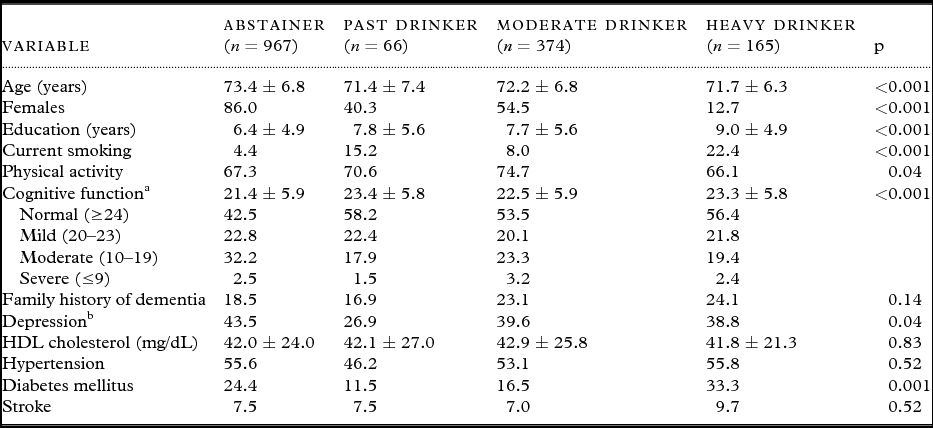
The mean age of 1,572 participants was 72.9 (±6.8) years, with more women (68.9%) than men. The mean number of years of education was 7.1 (±5.2). More than one-third (34.3%) consumed alcohol, 7.6% were smokers, and 69.1% participated in regular physical activity. The mean K-MMSE score was 22.0 (±6.0), with 52.7% having cognitive impairment (K-MMSE < 24), and 20.1% reporting a family history of dementia. Depression was present in 41.3% of the sample. The mean level of HDL cholesterol was 42.2 (±24.2) mg/dL. Hypertension was present in 55.0% of the participants, with 24.4% having diabetes mellitus and 7.6% had stroke.
Of the total participants, 61.5% (n = 967) were abstainers, 4.3% (n = 66) were past drinkers, 23.8% (n = 374) were moderate drinkers, and 10.5% (n = 165) were heavy drinkers. Abstainers tended to be older, with a higher percentage being female and with lower years of education (Table 1). Heavy drinkers were more likely to be current smokers. Participation in physical activity was the highest among moderate drinkers. Compared with abstainers, current drinkers showed higher levels of cognitive function, but had a higher proportion of those reporting a family history of dementia. Prevalence of depressive symptoms and diabetes mellitus was the lowest among past drinkers.
Characteristics of the participants according to levels of alcohol consumption (%, mean ± standard deviation)

Notes: aLevel of cognitive impairment was measured by the Korean version of the Mini-Mental State Examination (K-MMSE). The score ranges from 0 to 30, with ≤23 indicating cognitive impairment.
b15-item Geriatric Depression Scale (S-K-GDS) ≥ 8.
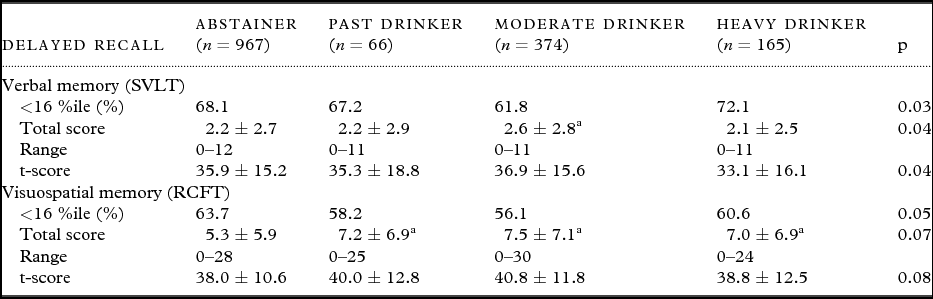
Impairments in verbal memory and visuospatial memory were present in 67.0% and 61.3% of the participants respectively. Verbal and visuospatial memory impairment was least prevalent among moderate drinkers (Table 2). The performance of delayed recall of verbal memory was the highest in the moderate drinking group (p < 0.05). The performance of delayed recall in visuospatial memory was also the highest in the moderate drinking group, but was not statistically significant.
Memory performance by alcohol consumption (mean ± standard deviation)

Notes: SVLT = Seoul Verbal Learning Test; the score ranges from 0 to 12. RCFT = Rey Complex Figure Test; the score ranges from 0 to 36.
aSignificant difference in Tukey's test of multiple comparisons at α = 0.05. Reference group is the abstainer.
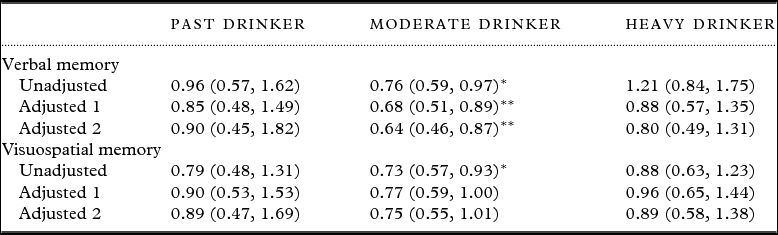
Association between levels of alcohol consumption and impairment (<16 percentile) in delayed recall of memory, odds ratio (95% confidence interval)

Notes: *p < 0.05, **p < 0.01.
Reference group is abstainer.
Adjusted 1: Adjusted for adjusted for age, sex, and education.
Adjusted 2: Additionally adjusted for smoking, physical activity, K-MMSE, family history of dementia, depression, HDL cholesterol, hypertension, diabetes mellitus, and stroke.
The results of hierarchical logistic regression analysis of the relationship between drinking and impairment in delayed recall of verbal memory are presented in Table 3. Compared with abstainers, moderate drinkers were significantly less likely to have verbal memory impairment (p < 0.05). Adjusting for socio-demographic variables, the strength of the association increased. Further adjusting for health-related covariates, the risk of impairment in delayed recall was significantly lower in the moderate drinking group than in non-drinkers by 36% (OR = 0.64, 95% CI: 0.46–0.87).
For impairment in visuospatial memory, in the unadjusted analysis, moderate drinkers showed a significantly lower likelihood than that in non-drinkers (Table 3). After adjusting for confounding factors, however, the risk of impairment in delayed recall of visuospatial memory was not statistically significant (OR = 0.75, 95% CI = 0.55–1.01).
Discussion
In this study, the risk of impairment in verbal memory among moderate drinking older adults was significantly lower than that in the non-drinking elderly individuals, even after adjusting confounding factors. Moderate drinking up to seven drinks per week was significantly related to a lower risk of impairment in delayed recall of verbal memory by about 36% (OR = 0.64, 95% CI = 0.46–0.87). This is similar with the study results of Elias et al. (Reference Elias, Elias, D’Agostino, Silbershatz and Wolf1999), who investigated the relationship between drinking and the subarea of cognitive domain through a neuropsychological test, asserting that drinkers having two to four drinks per day, compared with non-drinkers, had a significantly better performance of verbal memory in both men and women. In addition, Bermejo-Pareja et al. (Reference Bermejo-Pareja, Benito-León, Vega, Medrano and Román2008) in a three-year follow-up study of older Spanish adults aged 65 years and more reported that the risk of dementia in current drinkers was significantly lower than that in non-drinkers by 39%. A number of epidemiological studies have supported the result that drinking is associated with cognitive function (Ganguli et al., Reference Ganguli, Vander Bilt, Saxton, Shen and Dodge2005; Reid et al., Reference Reid, Ness, Hawkins, Towle, Concato and Guo2006; Virta et al., Reference Virta2010), although a direct comparison has not been possible.
In contrast, there are studies reporting that drinking is not significantly related to cognition (Stampfer et al., Reference Stampfer, Kang and Chen2005; Wright et al., Reference Wright, Elkind, Luo, Paik and Sacco2006). Although alcohol's effect on overall cognitive ability may not be significant, alcohol drinking may not exert the same influence on all cognitive domains. Stampfer et al. (Reference Stampfer, Kang and Chen2005) showed that the performance of verbal memory in old adults drinking moderately, with less than 15 g per day (a bottle of 360 cc beer), was significantly higher than that in non-drinkers, but no significance was found on the overall cognitive level. This suggests that the positive influence of moderate alcohol drinking might be specific to verbal memory.
Impairment in verbal memory is a prodromal symptom related to progression from amnestic mild cognitive impairment to Alzheimer's dementia (Perri et al., Reference Perri, Serra, Carlesimo and Caltagirone2007). From the anatomical viewpoint, impairment in the delayed recall of verbal memory is closely related to impairment of the mesial temporal lobe, specifically the hippocampus. The hippocampus is known to have functional lateralization, with the right hippocampus being responsible for visuospatial memory, while the left hippocampus is mainly responsible for verbal memory (Lim et al., Reference Lim, Hong, Choi, Kim and Moon2012). A recent neuroimaging study has demonstrated that the impairment of the hippocampus is lateralized depending on the degree of cognitive impairment in elderly individuals (Shim et al., Reference Shim, Yang, Kim and Chung2007). According to Salmon and Franck (Reference Salmon and Franck1989), although decrease in local blood flow was found in both hemispheres of the cerebrum in about 50% of typical Alzheimer's patients, in case of mild cognitive impairment or early stage of Alzheimer's patients, the decrease in local blood flow was found mostly in the left hippocampus. The reduced risk of verbal memory impairment by moderate alcohol consumption may thus reflect its beneficial effect on the early stages of cognitive impairment and dementia.
The potential benefits of moderate alcohol consumption on cognition may involve multiple pathways. First, drinking a small amount of alcohol is known to reduce levels of fibrinogen, thrombus factors, and C-reactive proteins (Whitfield et al., Reference Whitfield, Heath, Madden, Pergadia, Montgomery and Martin2013), but increases HDL cholesterol (Mukamal et al., Reference Mukamal2005). The present study also showed that the mean level of HDL cholesterol in the moderate drinking elderly adults was higher (42.9 mg/dL) than that in heavy drinkers (41.8 mg/dL) and non-drinkers (42.0 mg/dL). Second, light alcohol drinking stimulates secretion of the hormones related to memory and learning. Drinking is related to the secretion of acetylcholine, which plays an important role in the memory activities of the cerebrum (Stott et al., Reference Stott2008). Alcohol also increases the secretion of acetylcholine in the hippocampus. Since the hippocampus is responsible for short-term memory, moderate drinking might have a preventive effect on memory impairment (Henn et al., Reference Henn, Loffelholz and Klein1998). Third, the antioxidant properties of flavonoid in alcohol may have a positive effect on the cognitive health of older people (Mehlig et al., Reference Mehlig2008). Finally, older adults who consumed moderate amounts of alcohol, compared with non-drinkers or heavy drinkers, tended to engage in more healthy behaviors, thought to protect against cognitive decline. In this study, moderate drinkers compared with heavy drinkers were more likely to refrain from smoking and to participate in physical activity. They also exhibited lower prevalence of hypertension, diabetes, and stroke.
However, mechanisms regarding the effect of moderate drinking on specific cognitive domains are not sufficiently identified (Espeland et al., Reference Espeland2005). This study suggests some speculations where moderate alcohol consumption may protect against impairment in verbal memory. First, impairment in verbal memory is clearly identified in the early stages of cognitive impairment in elderly adults (Perri et al., Reference Perri, Serra, Carlesimo and Caltagirone2007; Lim et al., Reference Lim, Hong, Choi, Kim and Moon2012). The reduced risk of impairment in verbal memory observed among moderate drinkers may indicate alcohol's protective influence in the progression of cognitive impairment to dementia. Second, mild cognitive impairment is classified into heterogeneous groups depending on its onset. Early onset cognitive impairment, which occurs before the age of 65 years, tends to be associated with damage of the right hemisphere, related to visuospatial memory, while the late onset cognitive impairment, occurring in the 65 years or older group, disproportionately affects the left hemisphere (Baron et al., Reference Baron2001). It is possible that alcohol drinking is related to the late onset of mild cognitive impairment, which is associated with verbal memory.
We did not find significant association between alcohol consumption and visuospatial memory. The relationship between moderate alcohol consumption and visuospatial memory has not been widely investigated. The specific mechanism for which alcohol affects visuospatial memory is still unknown. Moreover, our study did not find that heavy drinkers, compared with abstainers, were more likely to have cognitive impairment or memory problems, as suggested by other studies (Xu et al., Reference Xu, Liu, Yin, Zhu, Zhang and Fan2009; Virta et al., Reference Virta2010). This may be due the low proportion of the study participants consuming an excessive amount of alcohol, with only 6.9% and 3.5% having >14 drinks/week and >21 drinks/week respectively. Many may have already stopped drinking because of other health problems. Further study is needed to confirm the relationship between heavy drinking and memory impairment.
There are several limitations to the study, which need to be considered. First, the cross-sectional design of the current study precludes any causal inference of the association between alcohol drinking and memory impairment. Second, since the participants of the study were from outpatient memory clinics, the results cannot be generalized to the community population. Moreover, there is a possibility of selection bias due to those excluded from the study. The study sample (n = 1,572) and the excluded participants (n = 5,759), however, did not differ in characteristics such as age, gender, education, K-MMSE, and verbal memory impairment (<16 percentile in SVLT). Third, alcohol drinking was assessed by a questionnaire, which is prone to recall bias. Reports on the frequency of alcohol consumption may have further induced some under-reporting, and if so, then to an under-estimation. Alternatively, abstainers may include those who did not consume alcohol because of health problems. Abstainers tended to have lower levels of cognitive function and more depressive symptoms. This might have led to an overestimation in the magnitude of the association. Moreover, gender differences in the association were not determined because of the low proportion of women drinkers (2.5% past, 18.8% moderate and 1.9% heavy drinkers). Fourth, although this study used standardized neuropsychological tests to assess cognitive function, other clinical exams, such as neuroimaging data, were not included in the analysis.
Conclusions
In the patient population from memory clinics, compared with the abstainers, the odds of impairment in delayed recall of verbal memory were significantly lower among moderate drinking older adults consuming seven drinks or less per week. There was, however, no significant relationship between alcohol consumption and delayed recall of visuospatial memory. Further study is warranted to examine potential benefits of moderate alcohol consumption on verbal memory in older adults.
Conflict of interest
None.
Description of authors’ roles
Haewon Byeon designed the study, preformed statistical analysis, and wrote the first draft. Yunhwan Lee was involved in data interpretation, assisted with writing the paper, and supervised the research. Soon Young Lee, Kang Soo Lee, So Young Moon, and HyangHee Kim performed critical revisions of the manuscript. Chang Hyung Hong, Sang Joon Son, and Seong Hye Choi were responsible for diagnosing memory disorder. All authors read and approved the final paper.
Acknowledgments
This study was supported by a grant of the Korea Healthcare Technology R&D Project, Ministry of Health and Welfare, Republic of Korea (HI10C2020).