Introduction
The vast majority of species on Earth are insects feeding on plants (Lewinsohn et al. Reference Lewinsohn, Novotny and Basset2005; Novotny et al. Reference Novotny, Drozd, Miller, Kulfan, Janda and Basset2006; Lewinsohn and Roslin Reference Lewinsohn and Roslin2008). What prevents these species from consuming all of their food has then remained a key question for ecologists over the last half century (Begon et al. Reference Begon, Townsend and Harper2006). Natural enemies have been proposed as one of the key factors determining herbivore abundances across the globe (Hairston et al. Reference Hairston, Smith and Slobodkin1960; for an overview of hypotheses, see Gripenberg and Roslin Reference Gripenberg and Roslin2007), thus suggesting that interactions between herbivorous insects and their natural enemies are a main force in sustaining the world as we know it. As a consequence, predator–prey interactions within plant-based insect communities and food webs remain at the core of ecological research.
Among the natural enemies of herbivores, parasitoids (i.e., insects whose larvae develop on the bodies of other arthropods eventually causing the death of the host) offer key advantages for ecological and entomological research. In this group, trophic links between predator and prey can be established by rearing. Accordingly, host–parasitoid associations have been extensively explored from a population-dynamic perspective (e.g., Hassell Reference Hassell2000), with important insights into evolutionary ecology (e.g., Godfray Reference Godfray1994) and practical applications such as biological control (e.g., DeBach Reference DeBach1964; Askew Reference Askew1971; LaSalle Reference LaSalle1993).
Originally prompted by the need to understand the natural enemy complexes attacking common pests, parasitoid communities have attracted major interest (e.g., Askew Reference Askew1975; Askew and Shaw Reference Askew and Shaw1986; Mills Reference Mills1992; Memmott and Godfray Reference Memmott and Godfray1993; Hawkins Reference Hawkins1994; Hawkins and Sheehan Reference Hawkins and Sheehan1994; Kopelke Reference Kopelke1994; Tscharntke and Hawkins Reference Tscharntke and Hawkins2002). As specific interactions between individual host and parasitoid taxa form part of larger networks of multiple interactions, the total effect of multiple interactions comes with interesting consequences for both population and community dynamics (Holt and Lawton Reference Holt and Lawton1994; Morris et al. Reference Morris, Lewis and Godfray2004; van Veen et al. Reference van Veen, Morris and Godfray2006; Tack et al. Reference Tack, Gripenberg and Roslin2011).
Adding complexity to our understanding of parasitoid communities, food webs, and their dynamics is the bewildering wealth of life histories and trophic interactions revealed within most communities (Gauld and Bolton Reference Gauld and Bolton1988; Godfray Reference Godfray1994; Quicke Reference Quicke1997). Research over the past few decades, however, has exposed some general patterns and their underlying mechanisms. For instance, the realisation that parasitoids can be divided into two broad categories as based on their life history has yielded major insights. Of these groups, koinobionts allow the host to feed and grow after parasitisation, whereas idiobionts permanently paralyse or kill the host upon parasitisation (Haeselbarth Reference Haeselbarth1979; Askew and Shaw Reference Askew and Shaw1986). As the two groups tend to differ in terms of host range (koinobionts generally having a narrower and idiobionts a wider host range, especially at the level of higher taxa) and in their occurrence on assemblages of exophytic versus endophytic hosts (see below), this general classification has proven informative in describing and interpreting patterns in parasitoid community structure (e.g., Askew and Shaw Reference Askew and Shaw1986; Hawkins Reference Hawkins1994; Quicke Reference Quicke1997; Santos et al. Reference Santos, Quicke, Borges and Hortal2011).
Although the literature of host–parasitoid associations is fraught with problems (including the propagation of errors; see Askew and Shaw Reference Askew and Shaw1986; Shaw Reference Shaw1994), Hawkins (Reference Hawkins1994) made a successful attempt to synthesise global patterns in parasitoid community structure. One of the robust patterns found was that while the number of parasitoid species associated with exophytic hosts declines towards the tropics, the diversity of parasitoid species attacking endophytic hosts appears constant across latitudes. As idiobionts seem to dominate on concealed and koinobionts on exposed hosts (Hawkins et al. Reference Hawkins, Askew and Shaw1990; Hawkins Reference Hawkins1994), one might then predict that the species diversity of koinobionts should decrease with decreasing latitude, with no corresponding change among idiobionts. This pattern has been repeatedly found in Ichneumonidae (Hymenoptera) – but also documented in Braconidae (Hymenoptera) (e.g., Askew and Shaw Reference Askew and Shaw1986; Gauld Reference Gauld1987; Quicke Reference Quicke1997). Nonetheless, recent criticism (Santos and Quicke Reference Santos and Quicke2011) and a counter-example from the tropics (Veijalainen et al. Reference Veijalainen, Sääksjärvi, Erwin, Gómez and Longino2013) suggest that global patterns of parasitoid community structure may prove more complex than anticipated.
While the main body of research on the latitudinal patterns of parasitoid species diversity has focused on the tropics, Arctic parasitoid communities have been largely neglected (but see Smith et al. Reference Smith, Fernández-Triana, Roughley and Hebert2009; Fernández-Triana et al. Reference Fernández-Triana, Smith, Boudreault, Goulet, Hebert and Smith2011). General theory developed to explain global patterns in biodiversity (e.g., Wright Reference Wright1983; Currie Reference Currie1991; Brown and Lomolino Reference Brown and Lomolino1998; Allen et al. Reference Allen, Brown and Gillooly2002) suggest that three main factors of the physical environment will greatly affect biodiversity, i.e., the availability of energy, water, and nutrients. In cold environments, all three of these may clearly limit species richness. As a consequence, it has been suggested that high-Arctic ecosystems are controlled by strong abiotic constraints and are typically composed of only two trophic levels, implying a strong herbivore control on the plant biomass (van der Wal and Hessen Reference van der Wal and Hessen2009; see also Oksanen and Oksanen Reference Oksanen and Oksanen2000 for vertebrate herbivores). Based on this hypothesis, and on the latitudinal patterns of koinobiont and idiobiont diversity identified above, the following predictions can be made: in high-Arctic ecosystems, (i) the general species diversity of parasitoids should be low, and (ii) the ratio of koinobiont versus idiobiont parasitoid species and genera (see Quicke Reference Quicke1997, Fig. 10.3, p. 310) should be higher than in temperate (and tropical) ecosystems. Yet, given the absence of well-documented parasitoid communities from high latitudes, empirical data to test this and other intriguing hypotheses regarding large-scale patterns in parasitoid community structure have so far been critically lacking.
In this paper, we describe a systematic effort to characterise the structure of a high-Arctic parasitoid community: its species richness and composition, the sampling effort needed to establish it, and the level of host specificity encountered among its members. We also summarise what is known about the taxonomy, phenology, and host use of the component species, to the benefit of future research to be conducted in the area.
Materials and methods
Study area
The study area is located in the high-Arctic zone of northeast Greenland (∼74°30′N, 21°00′W) within Northeast Greenland National Park, and comprises the Zackenberg Valley and the drainage basin of the Zackenberg River (Meltofte et al. Reference Meltofte, Christensen, Elberling, Forchhammer and Rasch2008). The local geological diversity is represented by Caledonian gneiss bedrock, Cretaceous sandstones, and Tertiary basalts. The area is characterised by continuous permafrost with a maximum active layer thickness varying from 20 to 100 cm. The mean monthly air temperature ranges between −20 °C and +5 °C (Meltofte et al. Reference Meltofte, Christensen, Elberling, Forchhammer and Rasch2008).
The flora of the Zackenberg Valley consists of >150 vascular plant species (Bay Reference Bay1998). The main vegetation types include fen, grassland, salt marsh, Cassiope tetragona (Linnaeus) Don (Ericaceae) heath, Vaccinium uliginosum Linnaeus (Ericaceae) heath, Dryas Linnaeus (Rosaceae) heath dominated by the hybrid of Dryas octopetala Linnaeus and Dryas integrifolia Vahl, Salix arctica Pallas (Salicaceae) snowbed, abrasion plateau, fell-field, and lake vegetation (Bay Reference Bay1998).
Sampling
Our approach is based on a high sampling effort, distributed across multiple complementary techniques: (i) extensive sampling using Malaise traps and yellow pitfall traps (the latter combining advantages of both yellow pan traps and traditional pitfall traps; for a description see Böcher and Meltofte Reference Böcher and Meltofte1997), combined with less intensive sweep netting, direct searching, and standard yellow pan trapping, all aimed at revealing the adult wasp community associated with Lepidoptera, and (ii) extensive rearing of hosts aimed at identifying host associations.
Six Malaise traps (length 130 cm, width 70 cm, height of the collecting head 112 cm, and of the lower end 50 cm, fitted with a collecting jar containing 75% ethanol) were operated during 15 July–2 August 2009, 7 June–4 July 2010, and 18 June–19 August 2011 (Figs. 2–5). In 2009, the traps were placed along a 3.4 km semilinear transect from the bank of Zackenberg River (∼10 m elevation) to the slopes of Aucellabjerg (∼150 m elevation). These represented several vegetation types: Dryas heath (two traps), wet fen (one trap), Salix snowbed (one trap), a combination of Cassiope and Vaccinium heaths (one trap), and a combination of semi-open Dryas heath and Vaccinium heath on the lower slopes of Aucellabjerg (one trap) (see Ilmonen and Várkonyi Reference Ilmonen and Várkonyi2011). In 2010, owing to the difficult snow conditions at the beginning of the season, the sites at Aucellabjerg and the wet fen were rejected and two new trapping sites were established near the salt marsh area of the old delta of Zackenberg River (3 m elevation) and in a patch of Cassiope heath (7 m elevation). In 2011, traps were operated at the same sites as in 2009, with the exception that the trap at the wet fen was transferred to a warm semi-open Dryas-Kobresia Willdenow (Cyperaceae) dominated patch on 12 July. Traps were emptied usually once every 7–10 days (range 5–14 days). Malaise samples were sorted and parasitoids of Lepidoptera identified at the Finnish Environment Institute in Kuhmo, Finland. The host groups of individual parasitoid taxa were confirmed by using recent literature (for details, see the entries in the section “Members of the parasitoid community”).
A total of 99 yellow pitfall traps (Pantone, Carlstadt, New Jersey, United States of America; 108U, 10 cm in diameter, 8 cm deep) were operated from 17 June to 23 August 2011. The traps were arranged in five transects situated in Dryas heath, grassland, Cassiope heath, and abrasion plateau types of vegetation. As the main purpose of trapping was to collect living Lepidoptera larvae for rearing, the pitfalls were operated in a dry mode. Accordingly, pitfalls were emptied relatively often, i.e., every second or third day. Parasitic wasps found in the traps were preserved individually in 75% ethanol and subsequently identified.
Rearing was done during the entire field seasons of 2009–2011. Lepidoptera larvae and pupae as well as cocoons of parasitoid wasps found in the field were reared individually in clear plastic jars (4.5 cm in diameter, 7.5 cm deep) indoors at the Zackenberg Research Station. Rearings were checked and fresh food supplied every second or third day. Any changes in the condition of the rearings were registered. Emerging adult parasitoids were preserved individually. At the end of the field seasons, all rearings were transferred to a laboratory at the University of Helsinki, where they were kept under controlled conditions (14 °C, 24 hours daylight, 80% relative humidity) until late autumn. At this stage, the rearings were exposed to an artificial winter diapause lasting until the following spring. The overwintered immature insects were then returned to normal rearing conditions until they produced either Lepidoptera or parasitoid imagines, or died.
Estimating parasitism rates from larvae collected in the field rely on the assumption that parasitised and unparasitised hosts are detected with the same probability, and that parasitoids have had the chance to attack each host before it was removed from field exposure. Although our data are so far insufficient to fully counter either concern, we note that preliminary analyses of the relatively abundant species reveal no real differences in parasitism rates between larvae collected early versus late in the season or by different sampling methods (such as pitfalls and direct searching, potentially targeting individuals with different activity). We are therefore confident that our current sampling regime offers unbiased estimates of true parasitism rates.
As Lepidoptera pupae are more difficult to find by active searching than are larvae, and as the idiobiont parasitoid guild attacking (pre)pupae is hence likely to remain poorly represented in rearings, we performed a pilot experiment in 2011. With the aim of obtaining parasitised pupae of a single target species, we exposed 27 prepupae of Sympistis nigrita zetterstedtii (Staudinger) (Lepidoptera: Noctuidae) (Table 3) to their idiobiont parasitoids in the field. Nine living (including parasitised) pupae were recovered and taken for indoor rearing after approximately two weeks of exposure. Given the limited availability of larvae and the challenges involved in exposing them to parasitoids under natural conditions, no similar experiments were performed on other Lepidoptera species. Hence, for the main part of idiobiont prepupal and pupal parasitoids, we still lack direct rearing records of trophic interactions (but see direct observations on ovipositing behaviour of some idiobiont species under section “Members of the parasitoid community”).
Sweep netting and direct searching were regularly used in 2009–2011 for sampling of both adult parasitoids and Lepidoptera larvae. All major vegetation types were targeted. To further improve the coverage of the local parasitoid community in our samples, 15 yellow pan traps filled with water and detergent were operated in 2011 along an edge of an abrasion plateau and a semi-open Dryas-graminoid biotope (5–7 July) and in a Dryas-Kobresia dominated patch (13–16 and 19–20 July).
The species identity of Lepidoptera larvae and pupae was verified with the aid of direct literature-based identification and by rearing to adults. Adult Lepidoptera were identified by T.R., and the species identifications of adult and immature Lepidoptera were confirmed by Jaakko Kullberg (Finnish Natural History Museum, Finland) and Kimmo Silvonen (Helsinki University of Technology, Finland), respectively. Parasitoid wasps were identified by G.V. using recent literature (for details see section “Members of the parasitoid community”) and by comparison with the private collection of Reijo Jussila (Paattinen, Finland). James O'Hara (Agriculture and Agri-Food Canada, Ottawa, Canada), Riikka Kaartinen (University of Helsinki, Finland), and G.V. identified parasitoid flies.
Community structure and trophic associations
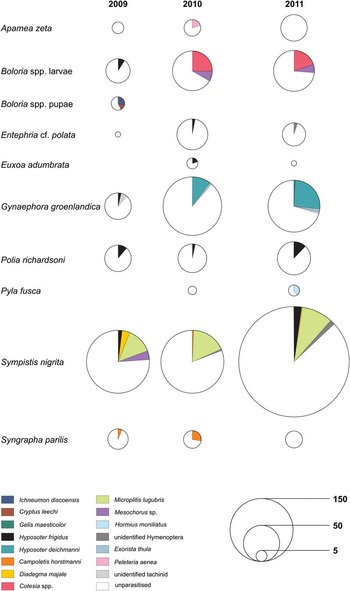
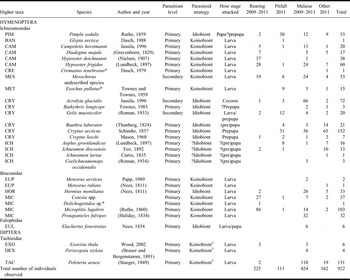
Our extensive sampling in 2009–2011 yielded a total of 922 individuals (or, in the case of gregarious parasitoids, broods) of parasitoids associated with Lepidoptera hosts, representing 30 parasitoid taxa (Tables 1–2, Fig. 1). Out of 1450 rearings of Lepidoptera larvae, 225 produced parasitoids (16 taxa). Altogether 424 parasitoid individuals (24 taxa) were collected by Malaise traps (Table 1), whereas 111 individuals (15 taxa) were collected by pitfalls (Table 1). An additional 162 parasitoid specimens (21 taxa) were collected by sweep netting, direct searching, and yellow pan trapping.
Mortality of Lepidoptera larvae and pupae caused by insect parasitoids of the Zackenberg Valley, Greenland in 2009–2011. The area of each pie is directly proportional to the number of host individuals upon which it is based. As the two Boloria species occurring in the area (Table 3) could not be separated at the immature stages, we combined them as Boloria spp. In addition to the Lepidoptera species represented above, two larvae of each Entephria punctipes (Curtis) Lepidoptera: Geometridae) and Colias hecla Lefèbvre (Lepidoptera: Pieridae) were also collected but are excluded from the figure, as they did not produce any parasitoids. Results from a pilot experiment in 2011, where prepupae of Sympistis nigrita zetterstedtii were exposed to idiobiont parasitoids, are also excluded from the figure, as these rearings are not directly comparable to those of field-collected S. nigrita zetterstedtii.

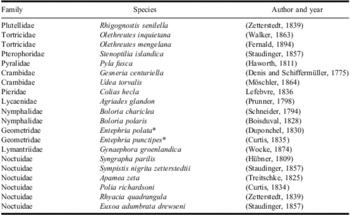
A summary of parasitoid species encountered in Zackenberg Valley, Greenland during 2009–2011.

*Species are new to the fauna of Greenland. Parasitoid natural history was inferred from our own data in the present study and from references in Yu et al. (Reference Yu, van Achterberg and Horstmann2005).
†See Belshaw (Reference Belshaw1994) and Dindo (Reference Dindo2011) concerning the usefulness of the idiobiont/koinobiont dichotomy in Tachinidae.
Full taxonomic reference, main life history traits, and the number of individuals detected by each method are given.
PIM, Pimplinae; BAN, Banchinae; CAM, Campopleginae; CRE, Cremastinae; MES, Mesochorinae; MET, Metopiinae; CRY, Cryptinae; ICH, Ichneumoninae; EUP, Euphorinae; HOR, Hormiinae; MIC, Microgastrinae; EUL, Eulophinae; EXO, Exoristinae; DEX, Dexiinae; TAC, Tachininae.
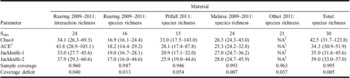
Species richness of parasitoids encountered at Zackenberg, Greenland.
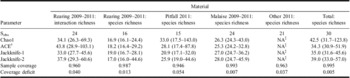
Here, Sobs offers observed species richness, whereas Chao1, ACE, Jackknife-1, and Jackknife-2 refer to different estimators of true species richness (i.e., to Sobs plus species so far undetected), all given as point estimates (with 95% confidence intervals).
Sample coverage and sample deficit describe the completeness of the sample obtained to date (for descriptions of individual statistics, see main text).
Columns refer to materials collected by individual methods corresponding to those of Table 1, with one distinction: for rearings, we here report two different measures of richness – the number of trophic interactions as the number of distinct host–parasitoid species pairs (column “Rearing 2009–2011: interaction richness”) and the number of parasitoid species involved in these interactions (column “Rearing 2009–2011: species richness”).
†For highly heterogeneous communities (CVrare > 0.8), we report the value of the ACE-1 estimator (Chao and Lee Reference Chao and Lee1992).
‡NA = As these figures refer to a compound material obtained by multiple sampling methods, we have refrained from deriving any separate estimate of species richness at this level.
Among the parasitoid taxa detected, the ratios of koinobiont to idiobiont diversity were surprisingly low among Ichneumonidae (Hymenoptera) species (8:11) and genera (7:9; see Table 1). For Braconidae (Hymenoptera) wasps, the respective rates were much higher (6:1 for species and 5:1 for genera), but lower than earlier reported from the high Arctic of North America, i.e., >17:1 for species and >7:1 for genera in Quicke (Reference Quicke1997; see prediction (ii) in the section “Introduction”).
In total, we obtained direct rearing records of 24 different pairwise associations between individual parasitoid and Lepidoptera host taxa (Figs. 1–2). These interactions encompassed 10 of the 20 Lepidoptera species (Table 3), and 16 of the 30 associated parasitoid taxa (Table 1) encountered in the area. The likely host associations of two further parasitoid species were established by observations of the ovipositing behaviour of females. For an additional 12 parasitoid species, information on the likely host group was extracted from the literature or inferred from the host ranges of higher taxa. Details of the natural history of individual parasitoid taxa are described in the section “Members of the parasitoid community”.
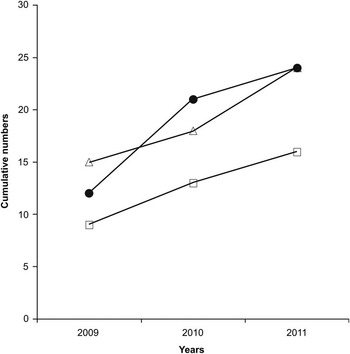
Temporal accumulation of species detected in the Zackenberg Valley, Greenland from 2009–2011. Solid circles: accumulation of distinct pairwise host–parasitoid interactions. Open triangles: accumulation of parasitoid species associated with Lepidoptera as detected by Malaise trapping. Open squares: accumulation of parasitoid species associated with Lepidoptera as detected by rearing.

Most parasitoid species were reared from only a single host species (Fig. 1). Two primary and one secondary parasitoid species were observed in multiple host associations: Hyposoter frigidus (Lundbeck) (Hymenoptera: Ichneumonidae) was observed from six host species, Campoletis horstmanni Jussila (Hymenoptera: Ichneumonidae) from two host species, and a Mesochorus Gravenhorst species (Hymenoptera: Ichneumonidae) from two primary parasitoid host species (each associated with a single Lepidoptera host). Of these, the quantitatively dominant parasitoid H. frigidus most frequently attacked a single host (S. nigrita zetterstedtii), with much less impact on other hosts (see Fig. 1).
Dominant parasitoids of the most abundant host species caused surprisingly similar mortality rates across years (Fig. 1), with species-specific rates varying from 19.7% to 25.0% for Cotesia Cameron (Hymenoptera: Braconidae) species parasitising Boloria Moore (Lepidoptera: Nymphalidae) species and 10.3–25.7% for Hyposoter deichmanni (Nielsen) (Hymenoptera: Ichneumonidae) parasitising Gynaephora groenlandica (Wocke) (Lepidoptera: Lymantriidae) to 9.0–17.7% for Microplitis lugubris (Ruthe) (Hymenoptera: Braconidae) parasitising S. nigrita.
Methodological considerations
In examining the overall structure of the parasitoid community, a key question emerges: to what extent does our current sampling suffice to describe our target community, i.e., to what extent is our inference likely to change when sampling is extended? Exploring this question in an Arctic setting is important, as very different sampling effort may be needed to characterise communities of different diversity (Chao and Jost Reference Chao and Jost2012): a simple high-Arctic community may potentially be well characterised by a sample of some tens or hundreds of individuals, whereas a complex tropical one may be poorly characterised by an even 10-fold or 100-fold effort.
The general question can in essence be broken down into three components: first, what is the true species richness of the study system (i.e., what is the sum of species already detected and species yet to be detected if the sampling was exhaustive); second, how do different methods of sampling compare to and complement each other (i.e., what fraction of species might be found by what method); and third, what is the sample coverage already achieved (i.e., how well do our current samples suffice to characterise the community)?
Estimation methods
Of the three questions outlined above, the first one is the hardest to address. As total species richness is based on both common and rare species, no realistic sampling effort is ever guaranteed to reveal all species. As a consequence, Chao (Reference Chao2005) has suggested that the best we can do is to establish a lower bound for the likely richness of our target community. For this purpose, she has offered multiple nonparametric estimators as aimed at quantifying at least how many species might have remained undetected. Of these, we adopted two to estimate the species richness of the parasitoid community at Zackenberg: Chao1 (Chao Reference Chao1984, Reference Chao2005) and Abundance-based Coverage Estimator (ACE; Chao and Lee Reference Chao and Lee1992; Chao et al. Reference Chao, Ma and Yang1993). Chao1 was originally derived as a lower bound of species richness in Chao (Reference Chao1984), but later shown to offer a relatively good point estimator of the total species richness of many communities (e.g., Chao et al. Reference Chao, Shen and Hwang2006). To estimate the number of undetected species, it uses only the information contained in singletons (i.e., species encountered in single samples or as single individuals) and doubletons (i.e., species encountered twice). In contrast, the ACE estimator also uses the information contained in rare species encountered at slightly higher frequencies. As an additional nonparametric method based on the frequency of rare species, we used two jackknife estimators of Burnham and Overton (Reference Burnham and Overton1978). Here, the rationale is to assess how our biased estimator of species richness (i.e., the number of species actually detected) reflects the underlying true species richness, by using information on how the estimator changes when individuals are successively deleted from the original data. Again, we use the frequency of rare species as our prime source of information (focusing on singletons alone for first-order estimator Jackknife-1, and on singletons and doubletons for second-order estimator Jackknife-2). Each of these four estimators (Chao1, ACE, Jackknife-1, and Jackknife-2) was applied to our sample of the parasitoid community of Zackenberg as aggregated at two levels: first, to the compound sample obtained by each individual sampling method, and second, to the pooled sample across all collection methods (Tables 1 and 2). For completeness, we also used information on the presence of species in individual samples from pitfall and Malaise traps to explore undetected species richness (Chao Reference Chao1987; Lee and Chao Reference Lee and Chao1994). Nonetheless, as the results were qualitatively identical to the ones obtained from method-specific pooled samples (and should be so for theoretical reasons), we refrain from reporting the detailed results. All estimations were implemented in program SPADE (Chao and Shen Reference Chao and Shen2010).
The second question is partly an extension of the first one. Although we may simply compare the number and identity of species detected by each collection method (Table 1), this does not account for the fact that all samples are finite, and that more species may be detected by each method if sampling was continued (Table 2). As a straightforward solution, we may then apply the Chao1 estimator to derive the true number of species shared among collection methods (see Chao et al. Reference Chao, Hwang, Chen and Kuo2000, Reference Chao, Shen and Hwang2006). Again, estimations were implemented in SPADE (Chao and Shen Reference Chao and Shen2010).
The final question of how well our current sample suffices to characterise the community offers the most rewarding target for estimation. This is because regardless of how many rare species we have potentially failed to detect, we may still evaluate what summary proportion of individuals in the community is made up of those hidden species (Chao and Jost Reference Chao and Jost2012). This fraction is called the “coverage deficit”, and comes with an intuitively attractive interpretation: the coverage deficit of the sample is the probability that the next individual to be encountered represents a previously unsampled species. Subtracting the coverage deficit from unity yields the coverage per se; i.e., the total number of individuals in a community that belong to the species represented in the sample. In fact, the coverage (see Good Reference Good1953) and its deficit have been identified as the only aspects of unobserved or hidden species that can be accurately estimated by sample data (Chao and Jost Reference Chao and Jost2012). Importantly, the Chao1 estimator actually equals the expected number of species in a sample where coverage approaches one, thus offering a clear-cut link to the estimators of species richness defined above. To evaluate the current completeness of our samples from Zackenberg, we estimated the sample coverage and its deficit using the method of Chao and Jost (Reference Chao and Jost2012). As above, we examined our material both as partitioned by collection method and as a whole.
Results: what is the true species richness of Zackenberg and how well is it revealed by our samples and methods?
Not surprisingly, our estimates suggest that multiple parasitoid species and multiple trophic interactions in which they are involved remain to be detected at Zackenberg. Clearly, the confidence limits of our current estimates are wide and asymmetrical (Table 2). This reflects the inherent challenges of the estimation problem: it is relatively easy to put a lower bound on likely species richness, as we know at least how many species we encountered. However, it is very hard to know how many rare and hard-to-detect species may be hiding in the surroundings. Nonetheless, current point estimates suggest that we have already detected between 70% and 90% of total species richness (Table 2). This finding is also supported by a decelerating rate of new species detected over the years: if we are reaching the species asymptote – or have at least gone through most common and easy-to-detect species of the region – then we should detect less new species for every year that we continue sampling. This is what we see in terms of both species and trophic interactions (Fig. 2).
Overall, different methods of sampling seemed to usefully supplement each other (Table 1). Among the three main sampling methods employed, Malaise-trap samples contained the highest number of parasitoid species associated with moths and butterflies (Table 1). Five of these parasitoid species were collected uniquely by this method. A high degree of complementarity among methods was also suggested by pairwise comparisons among the samples: of 21 species detected by either pitfalls or rearings, 10 (48%) were detected by both methods (Table 1). For pitfall and Malaise trapping, the corresponding figure was 13 species out of 26 (50%), for rearing and Malaise trapping 14 species out of 26 (54%). These patterns suggest that multiple collection methods are needed to detect different parts of the fauna. However, it does not account for the fact that all samples are finite, and that more species may be detected by each method if sampling was continued (Table 2).
Applying the Chao estimator to derive the true number of species shared among collection methods, we note that several species observable by multiple methods are likely still undetected: the true number of species detectable by both pitfall trapping and rearing was estimated to be as high as 23.2 species (95% confidence limits 11.9–99.1 species); by both pitfall and Malaise traps 17.0 (13.4–53.8) species and both rearing and Malaise traps 15.4 (14.1–52.7) species. We thereby estimate that there are still at least 13 shared species to be discovered by both pitfall trapping and rearing; four by both pitfall and Malaise traps but only one by both rearing and Malaise traps. Hence, as also suggested by our method-specific estimates (Table 2), many species likely remain to be detected for each respective technique – but the total number of species still hiding from all methods is likely relatively low (Table 2; column Total). Importantly, not all species could even theoretically be detected by rearing of larvae, e.g., as some taxa will attack other stages in the life cycle (Table 1).
We are encouraged that, regardless of the rare species still hiding in the Zackenberg Valley, the overall sample coverage achieved through three years of sampling was found to be high. For individual collection methods, it ranged from 95% to 99%, and of the full community, we estimate that only five per mille of individuals represent species not yet detected in our samples (Table 2). The probability that the next parasitoid inspected at Zackenberg represents a new species is then one in 200. Perhaps most importantly, our current characterisation of trophic interactions among parasitoids and hosts seems to offer a comprehensive description of the overall food web: the trophic interactions described should encompass 96% of the individual interactions occurring in the full community.
Members of the parasitoid community
The summary description of the parasitoid community above hides substantial variation in the specific natural history of individual taxa. As a basis for understanding the finer connections between individual host and parasitoid taxa, and to allow for in-depth analyses of this food web module of the Zackenberg Valley in future studies, we next provide a concise overview of the taxonomy and natural history of each taxon encountered (Table 1). In particular, we describe the general distribution, phenology, ecology, and observed host associations for each taxon.
Hymenoptera: Ichneumonidae
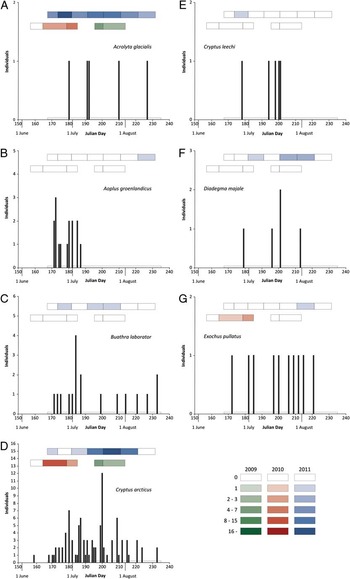
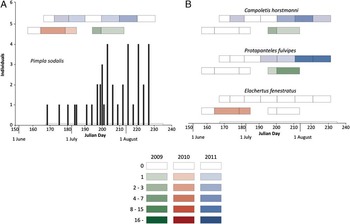
Pimpla sodalis Ruthe (Pimplinae) exhibits an arcto-alpine distribution throughout the Holarctic region. It has been repeatedly collected in northeast Greenland (Roman Reference Roman1934; Jussila Reference Jussila1996). At Zackenberg, adult wasps were most frequently encountered from the second half of July onwards (Fig. 5A). Female wasps were frequently seen crawling in half-open Dryas-dominated vegetation on sandy ground. Pimpla sodalis is an idiobiont parasitoid of Lepidoptera hosts of several families (Horstmann Reference Horstmann2001). According to Shaw (Reference Shaw1994), species of Pimpla Fabricius mainly attack pupae of Lepidoptera. However, as no direct observations are made on the ovipositing behaviour of P. sodalis, the possibility of prepupal attack cannot be excluded. At Zackenberg, two males of P. sodalis were reared in a small-scale experiment where prepupae of S. nigrita zetterstedtii were exposed to idiobiont parasitoids (see “Materials and methods” section). The fact that two of the nine living pupae found after exposure produced P. sodalis suggests that this species might be a regular (but not necessarily the dominant) idiobiont parasitoid of S. nigrita.
Glypta arctica Dasch (Banchinae) is reported from northern Greenland by Reference JussilaJussila (in press), offering the first record of this species from Greenland. A single female of G. arctica was sampled at Zackenberg on 15 August 2011 in a pitfall, situated in a moist, low-sedge-dominated biotope. Two further female specimens collected in a yellow pitfall and a white pan trap in mid-August 2012 suggest that this species is a constant member of the parasitoid community at Zackenberg. Species of Glypta Gravenhorst are koinobiont endoparasitoids of microlepidoptera larvae living in concealed situations (Gauld and Bolton Reference Gauld and Bolton1988; Wahl and Sharkey Reference Wahl and Sharkey1993), particularly Tortricidae (see Yu et al. Reference Yu, van Achterberg and Horstmann2005). There are no host records of G. arctica (see Dasch Reference Dasch1988; Yu et al. Reference Yu, van Achterberg and Horstmann2005).
Campoletis horstmanni Jussila (Campopleginae) was described from northeast Greenland (Jussila Reference Jussila1996), and it seems to be endemic to Greenland (Reference JussilaJussila, in press). At Zackenberg, the flight season of this species peaks in late July–early August (Fig. 5B). Like all campoplegine species encountered at Zackenberg (see Table 1), C. horstmanni attacks larvae of exposed macrolepidoptera species and develops as a koinobiont endoparasitoid. The literature offers no host records for this species. At Zackenberg, C. horstmanni attacks early-instar host larvae (all parasitised hosts were in second to third instar when collected). Its main host is Syngrapha parilis (Hübner) (Lepidoptera: Noctuidae) but it was also reared from S. nigrita zetterstedtii on a single occasion (Fig. 1).
Diadegma majale (Gravenhorst) (as “Angitia cf. claripennis Thomson”) (Campopleginae) was earlier reported from northeast Greenland (Roman Reference Roman1933). Specimens from Zackenberg key out as D. majale (and not as D. claripenne) using Horstmann (Reference Horstmann1969, Reference Horstmann1973). Neither of these species is listed in Yu et al. (Reference Yu, van Achterberg and Horstmann2005) from Greenland. At Zackenberg, D. majale has been repeatedly reared from early-instars of S. nigrita zetterstedtii (Fig. 1) but only sporadically collected using other methods (Fig. 3F). Species of Diadegma Förster usually but not always (see Yu et al. Reference Yu, van Achterberg and Horstmann2005) attack microlepidoptera hosts, hence the trophic association of D. majale with two noctuid species in northeast Greenland is a noteworthy exception.
Phenology of parasitoid species associated with Lepidoptera in the Zackenberg Valley, Greenland in 2009–2011. (A) Acrolyta glacialis, (B) Aoplus groenlandicus, (C) Buathra laborator, (D) Cryptus arcticus, (E) Cryptus leechi, (F) Diadegma majale, and (G) Exochus pullatus. Only species represented in our overall samples (excluding rearings) by ⩾5 individuals are shown. Vertical columns represent daily species abundances in combined catches from pitfall trapping, sweep netting, yellow pan trapping, and direct searching. Pitfall catches are attributed to the days of emptying traps (every second or third day). The narrow empty bar on the top of the time scale represents the field period in 2011 – the single individual outside this period in (D) was collected by an employee of the Zackenberg station (M.R. Pedersen). Horizontal bars show species abundances in combined Malaise trap samples in different years.

Hyposoter deichmanni (Nielsen) (Campopleginae) is a well-known parasitoid of G. groenlandica (e.g., Nielsen Reference Nielsen1910). Yu et al. (Reference Yu, van Achterberg and Horstmann2005) consider H. deichmanni a junior synonym of Hyposoter pectinatus (Thomson) but it is, according to Reference JussilaJussila (in press), a distinct species. Though H. deichmanni has been reported only from Greenland, the Hyposoter Förster species attacking G. groenlandica on Ellesmere Island in Canada, referred to as H. pectinatus (e.g., Kukal and Kevan Reference Kukal and Kevan1987), is probably conspecific with the Greenlandic population of H. deichmanni and not with the European H. pectinatus, which seems to be associated with lymantriid genera other than Gynaephora Hübner (see Yu et al. Reference Yu, van Achterberg and Horstmann2005). At Zackenberg, H. deichmanni was frequently reared from mid-instars of G. groenlandica (Fig. 1). Only once was it sampled using other methods, by a Malaise trap at ∼150 m (30 July–9 August 2011).
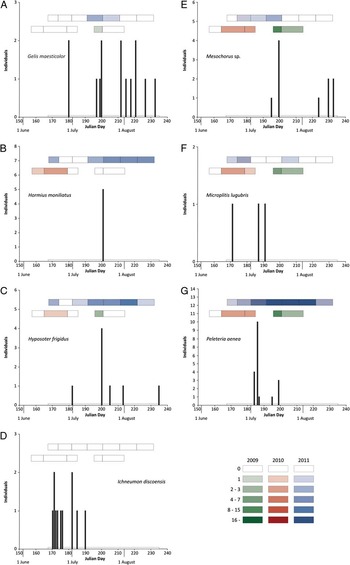
Hyposoter frigidus (Campopleginae) is a common species in northeast Greenland (see Roman Reference Roman1934; Jussila Reference Jussila1996). There is no prior information on its natural history (see Yu et al. Reference Yu, van Achterberg and Horstmann2005; Reference JussilaJussila, in press). At Zackenberg, adult wasps were frequently collected using various methods, especially in July and August (Fig. 4C). The species was reared from six species and four families: Boloria species (Nymphalidae), Entephria polata (Duponchel) (Lepidoptera: Geometridae), G. groenlandica (Lepidoptera: Lymantriidae), Euxoa adumbrata drewseni (Staudinger) (Lepidoptera: Noctuidae), Polia richardsoni (Curtis) (Lepidoptera: Noctuidae), and S. nigrita zetterstedtii (Lepidoptera: Noctuidae) (Fig. 1).
Phenology of parasitoid species associated with Lepidoptera in the Zackenberg Valley, Greenland in 2009–2011. (A) Gelis maesticolor, (B) Hormius moniliatus, (C) Hyposoter frigidus, (D) Ichneumon discoensis, (E) Mesochorus undescribed species, (F) Microplitis lugubris, and (G) Peleteria aenea. For explanations, see Fig. 3.

Cremastus tenebrosus Dasch (Cremastinae) is here reported as a species new to Greenland. Cremastus tenebrosus was originally described from the Arctic parts of Canada (Dasch Reference Dasch1979). A single female was caught by hand netting at Zackenberg on 3 July 2011, in semi-open vegetation dominated by Dryas and grass on sandy ground. The specimen keys out to and fits well the description of C. tenebrosus with the only notable exception that the ovipositor is somewhat shorter than in the description (1.6×, instead of 2.3×, length of metatibia). Species of Cremastinae are koinobiont endoparasitoids of mainly microlepidoptera larvae in semi-concealed situations (Gauld and Bolton Reference Gauld and Bolton1988; Wahl and Sharkey Reference Wahl and Sharkey1993). The host at Zackenberg may then be a microlepidoptera species developing in leaf rolls or similar structures.
The genus Mesochorus Gravenhorst (Mesochorinae) offers particular taxonomic problems in Greenland. Horstmann (Reference Horstmann2002) attempted to clarify the species limits and correct nomenclature of Mesochorus agilis Cresson, Mesochorus nigripes Ratzeburg, Mesochorus punctipleuris Thomson, and Mesochorus nigriceps Thomson. According to Horstmann (Reference Horstmann2002), (i) the name M. nigriceps, used by Schwenke (Reference Schwenke1999), is a homonym and the correct name for this species is M. punctipleuris; (ii) the synonymy of M. agilis and M. punctipleuris (Dasch Reference Dasch1971) is incorrect; (iii) M. agilis is restricted to North America; (iv) M. punctipleuris is a Holarctic species. The Greenlandic Mesochorus species is often referred to as either M. nigripes or M. nigriceps (see Henriksen Reference Henriksen1939) or, more recently, M. agilis (Jussila Reference Jussila1996). Using the keys by Dasch (Reference Dasch1971) and Schwenke (Reference Schwenke1999) for Greenlandic Mesochorus material, one will end up with M. agilis and M. nigriceps (correctly: M. punctipleuris), respectively. Nonetheless, all three above-mentioned species belong to a species group that exclusively attacks primary parasitoids associated with Coleoptera. The Mesochorus species occurring at Zackenberg is a common obligate hyperparasitoid of Lepidoptera hosts via microgastrine (Hymenoptera: Braconidae) primary parasitoids (Fig. 1, Table 1). In addition, the Coleoptera fauna of Zackenberg is extremely scarce, with e.g., Curculionidae, the common host group of the three Mesochorus species mentioned above (Schwenke Reference Schwenke1999, Reference Schwenke2000), completely lacking. We therefore consider the Greenlandic Mesochorus species a hitherto undescribed species. A formal description of this new species will be given elsewhere and, until then, it will be referred to as Mesochorus undescribed species. At Zackenberg, this species is on the wing during the entire growth season (Fig. 4E). As a larva, it causes notable mortality in the primary parasitoids M. lugubris (within its Lepidoptera host S. nigrita zetterstedtii) and Cotesia species (within Boloria species; Fig. 1).
Exochus pullatus Townes and Townes (Metopiinae) is a high-Arctic species known to occur in North America (Townes and Townes Reference Townes and Townes1959; Oliver Reference Oliver1963). It was sampled at Zackenberg in small numbers from mid-June to mid-August (Fig. 3G). The species has not been earlier reported from Greenland. Exochus Gravenhorst species are koinobiont endoparasitoids of microlepidoptera larvae living in leaf rolls and folds (Wahl and Sharkey Reference Wahl and Sharkey1993; Yu et al. Reference Yu, van Achterberg and Horstmann2005).
Acrolyta glacialis Jussila (Cryptinae) was originally described from northeast Greenland (Jussila Reference Jussila1996). Species of Acrolyta Förster are obligate hyperparasitoids (Yu et al. Reference Yu, van Achterberg and Horstmann2005 and references therein), and some species are known to be pseudohyperparasitoids (Janzen et al. Reference Janzen, Walker, Whitfield, Delvare and Gauld2003), i.e., to attack the primary parasitoid host once the latter has hatched from its herbivore host. In a study of an extensive reared material of European Acrolyta (Schwarz and Shaw Reference Schwarz and Shaw2000), most species were found to be associated exclusively with microgastrine cocoons. At Zackenberg, A. glacialis is relatively abundant (Fig. 3A), but was only reared on two occasions: (i) one female hatched on 17 June 2010 from a brood of Cotesia cocoons found in the field on 8 June 2010, and (ii) one male hatched on 2 May 2012 from a cocoon of M. lugubris that had been reared from an early instar of S. nigrita zetterstedtii. This moth larva had been used in a pilot experiment aimed at attracting pupal parasitoids (see “Materials and methods” section), and hence exposed to natural enemies between 27 July and 2 August 2011, during which period the primary parasitoid larva hatched and spun its cocoon. At Zackenberg, A. glacialis seems to attack cocoons of both solitary and gregarious microgastrine hosts.
Bathythrix longiceps Townes (Cryptinae) is a species reported from high-Arctic Canada (Townes Reference Townes1983), with previous records from Greenland restricted to the northwest part of the island (three specimens: Reference JussilaJussila, in press). At Zackenberg, it was collected using Malaise traps (one male, 21 July–2 August 2009; one female, 20–30 July 2011) and by visual search in semi-open, Dryas-dominated vegetation (two females, 5 and 15 July 2011). Some species in the genus Bathythrix Förster are known to be idiobiont hyperparasitoids of a wide range of hosts (see Yu et al. Reference Yu, van Achterberg and Horstmann2005). Though the host use of B. longiceps at Zackenberg remains to be established by rearings, field observations made by one of us (G.V.) offer tentative indication of its life history. On 15 July 2011, a female Buathra laborator (Thunberg) (Hymenoptera: Ichneumonidae) was observed ovipositing deep in the sand in semi-open vegetation dominated by Dryas at a steep portion of the Zackenberg riverbank. Here, a female of B. longiceps was waiting at a distance of less than 10 cm until the B. laborator female left. The female B. longiceps then walked to the exact spot of oviposition, cleaned her antennae, and inserted her entire metasoma in the loose ground. That the B. longiceps female waited until the herbivore host became parasitised suggests that the species might be a (idiobiont) parasitoid of presumably Lepidoptera hosts, possibly using the primary parasitoid B. laborator for locating the host and hence exhibiting cleptoparasitism.
Gelis maesticolor (Roman) (Cryptinae) was originally described from northeast Greenland (Roman Reference Roman1933), and has not been reported from anywhere else. At Zackenberg, the species was regularly collected in small numbers, especially during July (Fig. 4A). All specimens seen were females, suggesting that this species reproduces by thelytoky (see Godfray Reference Godfray1994; Quicke Reference Quicke1997), i.e., parthenogenetic reproduction in which females give birth to female offspring without mating. Many species in the genus Gelis Thunberg attack insect cocoons, including cocoons of primary parasitoids of herbivore hosts, hence may act as either primary or secondary parasitoids, while other species exclusively attack spider egg sacks (Schwarz and Shaw Reference Schwarz and Shaw1999). There is no previous information of the host associations of G. maesticolor. At Zackenberg, the species was reared on two occasions: (i) from a white microgastrine cocoon (probably a Cotesia species) found in a batch of three in the field on 17 July 2009, and (ii) from a mummified medium-size larva of G. groenlandica collected on 2 July 2011. In the latter case, the hatching took place after an artificial winter diapause. As the Lepidoptera host had been anchored to the vegetation by white silk protruding from the ventral part of the mummy, the primary parasitoid was probably H. deichmanni.
Buathra laborator (Cryptinae) is widely distributed in Greenland (Henriksen Reference Henriksen1939). The Greenlandic population of this species is considered to form the subspecies B. laborator fabricii (Schiødte) (Townes and Townes Reference Townes and Townes1962). At Zackenberg, the species was frequently observed on south-exposed sandy slopes, where females search for hosts. Nothing is known about the identity of its hosts in Greenland but based on the habitat and the relatively large size of the parasitoid, likely hosts include Apamea zeta (Treitschke) (Lepidoptera: Noctuidae), E. adumbrata drewseni, and/or S. nigrita zetterstedtii. Buathra laborator is an idiobiont (pre)pupal parasitoid of noctuid moths (see Yu et al. Reference Yu, van Achterberg and Horstmann2005). At Zackenberg, specimens were collected from snowmelt until late August (Fig. 3C).
Cryptus arcticus Schiødte (Cryptinae) is a Nearctic species found all over coastal Greenland. At Zackenberg, this is one of the most frequently observed parasitoid species, its main habitat being semi-open Dryas-Kobresia-dominated biotopes. The phenology of the species shows two peaks (Fig. 3D): males occur only early in the season, with a second peak in mid-July co-occurring with the time when the bulk of S. nigrita zetterstedtii population reaches the prepupal stage. Despite the high abundance of C. arcticus, its host use was previously unknown. On several occasions, females were observed by one of us (G.V.) to oviposit inside the loose cocoon spun by the prepupa of S. nigrita zetterstedtii under mats of Dryas. The prepupae and fresh pupae of S. nigrita zetterstedtii found following observations on ovipositing behaviour (n = 2) were heavily superparasitised (and possibly multiparasitised; see Godfray Reference Godfray1994), as five and 10 parasitoid eggs and/or young larvae were found on the host individuals, respectively.
Cryptus leechi Mason (Cryptinae) is a relatively rarely collected high-Arctic species only known from Nunavut, Canada, and Greenland (Mason Reference Mason1968). Its natural history was previously unknown. At Zackenberg, C. leechi occurs in the same habitat as C. arcticus, though on a single occasion it was also collected from the basalt cap area of Aucellabjerg (>700 m). It was collected in small numbers in June and July (Fig. 3E). A single male was reared from a pupa of Boloria sp. found under a stone on 24 July 2009 (Fig. 1).
Aoplus groenlandicus (Lundbeck) (Ichneumoninae) is endemic to Greenland. The species has been reported from both the eastern and western coast of the island (see Henriksen Reference Henriksen1939). At Zackenberg, A. groenlandicus is on the wing early in the season (Fig. 3B), with females likely overwintering as adults, as in many other ichneumonines (see Heinrich Reference Heinrich1961). Like the other species of Ichneumoninae encountered at Zackenberg (Table 1), A. groenlandicus is probably an idiobiont (pre)pupal parasitoid of macrolepidoptera hosts, as our extensive rearings of larvae of the local exophytic macrolepidoptera fauna did not produce any ichneumonines (Table 1). There are no host records of this species.
Ichneumon discoensis Fox (Ichneumoninae) is also known from both the western and eastern coast of Greenland (Henriksen Reference Henriksen1939; Jussila Reference Jussila1996 (as Ichneumon scoresbysundensis)). At Zackenberg, its activity peaks soon after snowmelt (Fig. 4D), when females are frequently seen in Dryas-Kobresia-dominated vegetation. No prior host records were available. At Zackenberg, I. discoensis was reared twice from Boloria pupae found under stones on 24 and 27 July 2009 (Fig. 1).
Ichneumon lariae Curtis (Ichneumoninae) is a widely distributed Holarctic species. The subspecies I. lariae aurivillii (Roman) is endemic to Greenland, and occurs around the coast of the island. According to 19th century literature (see references in Yu et al. Reference Yu, van Achterberg and Horstmann2005), I. lariae has been reared from Gynaephora rossii (Curtis) in Arctic Canada. At Zackenberg, a single female was collected by hand on 28 June 2011 in vegetation dominated by V. uliginosum and S. arctica, the main habitat of G. groenlandica. We therefore postulate that in Greenland, I. lariae aurivillii may parasitise G. groenlandica, but direct rearing records are needed to substantiate this hypothesis.
Coelichneumonops occidentalis (Roman) (Ichneumoninae) was originally described from northeast Greenland (Roman Reference Roman1934), with its current known range encompassing northern Canada, Greenland, and Iceland (for references see Yu et al. Reference Yu, van Achterberg and Horstmann2005). At Zackenberg, the species is a rarely collected but distinct member of the parasitoid community associated with Lepidoptera. Three males were collected by a Malaise trap operated in a Salix-dominated snowbed area near a rivulet during 15–20 July 2009. A few further specimens were sampled with a net and by a yellow pan trap put at the edge of an abrasion plateau in semi-open Dryas vegetation. The (likely macrolepidoptera) host remains unknown.
Hymenoptera: Braconidae
Meteorus arcticus Papp (Euphorinae) was originally described from northeast Greenland (Papp Reference Papp1989) and subsequently collected from both west and east Greenland, including Zackenberg (van Achterberg Reference van Achterberg2006). We collected one female between 2 and 11 July 2011 in a Malaise trap located on a sandy slope with semi-open vegetation dominated by Dryas and Salix. One male was collected during 20–30 July 2011 by a Malaise trap operated in a Cassiope-Vaccinium heath. Species of Meteorus Haliday are koinobiont endoparasitoids of Lepidoptera or Coleoptera larvae (Yu et al. Reference Yu, van Achterberg and Horstmann2005). The host at Zackenberg is then most likely a Lepidoptera, but direct rearing records are so far lacking.
Meteorus rubens (Nees) (Euphorinae) is a widely distributed Holarctic species, and has been frequently collected in Greenland (van Achterberg Reference van Achterberg2006). A single male wasp was sampled using a net >700 m on the basalt cap of Aucellabjerg on 1 August 2011. According to van Achterberg (Reference van Achterberg2006), a series of 10 females was reared from a larva of Rhyacia quadrangula (Zetterstedt) (Lepidoptera: Noctuidae) in South Greenland. As this noctuid moth also occurs at Zackenberg (Table 3), it is a potential host of M. rubens in the area.
Hormius moniliatus (Nees) (Hormiinae) is known from the Palaearctic, Oriental, and Nearctic regions (Yu et al. Reference Yu, van Achterberg and Horstmann2005). In Greenland, the species is known from the southern and north-eastern parts of the island, with no prior records from Zackenberg (van Achterberg Reference van Achterberg2006). During the current study, it was regularly collected from Zackenberg by Malaise traps (Fig. 4B) and yellow pan traps operated in warm Dryas-dominated habitats on sandy soil. Species of the genus Hormius Nees are gregarious idiobiont ectoparasitoid of microlepidoptera larvae (see Whitfield and Wharton Reference Whitfield and Wharton1997) that are more or less concealed by silk (Shaw and Huddleston Reference Shaw and Huddleston1991). At Zackenberg, H. moniliatus was reared twice in Zackenberg (Fig. 1): two broods of cocoons were found on 24 July 2011 together with their dead microlepidoptera hosts (identified as Pyla fusca (Haworth) (Lepidoptera: Pyralidae) by T. Hopkins, University of Helsinki, Finland) within the silky web of the host. Adult parasitoids hatched indoors on 24 August and 2 September 2011, respectively.
Of the five species of Cotesia Cameron (Microgastrinae) recorded from Greenland (Papp Reference Papp1989; van Achterberg Reference van Achterberg2006), three species, namely Cotesia hallii (Packard), Cotesia yakutatensis (Ashmead), and Cotesia eliniae Papp, have been reported from northeast Greenland (Papp Reference Papp1989; van Achterberg Reference van Achterberg2006). For C. eliniae, the records include Zackenberg (van Achterberg Reference van Achterberg2006). Van Achterberg (Reference van Achterberg2006) reported on a larger extent of variation in some morphological characters used by Papp (Reference Papp1989) than anticipated. Applying the key of van Achterberg (Reference van Achterberg2006) to our Cotesia material from Zackenberg, we ended up at the closely related species pair C. hallii and C. eliniae, but did not succeed to reliably separate these two species. Owing to this problem and our preliminary molecular findings, we refrain from identifying the Zackenberg Cotesia specimens at the species level. At Zackenberg, adult Cotesia specimens were encountered during most of the growing season, most often in July. Cotesia broods were frequently reared from Boloria larvae, and they were often hyperparasitised by Mesochorus species (Fig. 1). In our rearings, the size of Cotesia batches from single hosts varied between 1 and 9. Oviposition took place in an early instar. Cotesia larvae hatched from mid to late instar Boloria, after which large hosts occasionally stayed alive for many days but eventually died.
The genus Dolichogenidea Viereck sensu Whitfield (Reference Whitfield1997) (Microgastrinae) was previously unknown from Greenland (see Yu et al. Reference Yu, van Achterberg and Horstmann2005; van Achterberg Reference van Achterberg2006). On 17 July 2011, a microgastrine cocoon attached to the remains of a microlepidoptera larva was found under a tuft of Saxifraga cespitosa Linnaeus (Saxifragaceae) >700 m in the bare basalt cap area of Aucellabjerg. By 24 August 2011, a female Dolichogenidea species hatched from this sample. As S. cespitosa is the host plant of Stenoptilia islandica (Staudinger) (Lepidoptera: Pterophoridae) (Table 3), as several specimens of this microlepidoptera species were seen and collected (exclusively) at high elevations on Aucellabjerg, and as Dolichogenidea species (like all microgastrine wasps; for the Zackenberg species see Table 1) are koinobiont endoparasitoids of Lepidoptera larvae (Shaw and Huddleston Reference Shaw and Huddleston1991), S. islandica seems a potential host of this species. Clearly, direct rearing records are needed to verify this hypothesis.
A complete list of Lepidoptera species encountered in Zackenberg Valley, Greenland during 2009–2011.

*The identity of Entephria taxa occurring at Zackenberg is currently being clarified by rearing and DNA sequencing techniques.
Microplitis lugubris (Ruthe) (Microgastrinae) is a Palaearctic species (Nixon Reference Nixon1970; Yu et al. Reference Yu, van Achterberg and Horstmann2005), extending its range in the west to northeast Greenland, including Zackenberg (van Achterberg Reference van Achterberg2006). No other Microplitis Förster species is known from Zackenberg. Microplitis lugubris is the single most often reared species in our material, with 20, 25, and 41 individuals reared in 2009, 2010, and 2011, respectively. In each case, the host was a larva of S. nigrita zetterstedtii (Fig. 1). Oviposition took place in the early-instar host larva. A fraction of parasitised hosts was hyperparasitised by Mesochorus species (Fig. 1). Using other sampling methods, M. lugubris was only collected in small numbers (Fig. 4F).
Protapanteles fulvipes (Haliday) (Microgastrinae) is widely distributed in the Palaearctic region and all around Greenland (Yu et al. Reference Yu, van Achterberg and Horstmann2005; van Achterberg Reference van Achterberg2006), but had not been previously reported from Zackenberg. At Zackenberg, P. fulvipes was sampled in relatively high numbers by Malaise traps in late July and August (Fig. 5B). All Malaise traps that were operated in late summer collected this species but it was most abundant (14 specimens of total 32) in a trap put next to the rivulet Kærelv. The Greenlandic host species of this parasitoid is so far unknown. In Europe, it is a gregarious parasitoid recorded most commonly from Noctuidae and Geometridae (Yu et al. Reference Yu, van Achterberg and Horstmann2005).
Hymenoptera: Eulophidae
Elachertus fenestratus Nees (Eulophinae) has a wide, mainly Holarctic, distribution (see Noyes Reference Noyes2002). In Greenland, it seems to have a rather northern range (Baur Reference Baur2005). According to Baur (Reference Baur2005), earlier findings of E. artaeus (Walker) from Zackenberg (Buhl Reference Buhl1997) actually represent E. fenestratus. The two specimens in the material of Buhl (Reference Buhl1997) were collected in yellow pan traps on 1 July 1996. We sampled this species using Malaise traps: three specimens during 15–28 June 2010 and three specimens during 29 June–4 July 2010 (Fig. 5B). Five out of the six specimens were collected in a trap operated near a salt marsh at the old delta of Zackenberg River (3 m) in a rather moist biotope with Carex species (Cyperaceae), S. arctica, Ranunculus species (Ranunculaceae), Armeria scabra Pallas ex Roemer and Schultes (Plumbaginaceae), and Papaver radicatum Rottbøll (Papaveraceae). Elachertus fenestratus is an idiobiont primary parasitoid of microlepidoptera hosts with concealed larvae (see Noyes Reference Noyes2002). There are no host records from Zackenberg.
Phenology of parasitoid species associated with Lepidoptera in Zackenberg Valley, Greenland in 2009–2011. (A) Pimpla sodalis and (B) Campoletis horstmanni, Protapanteles fulvipes, and Elachertus fenestratus. For explanations, see Fig. 3.

Diptera: Tachinidae
Exorista thula Wood (Exoristinae) was originally described from Ellesmere Island, Canada, and reported as a parasitoid of G. groenlandica (Morewood and Wood Reference Morewood and Wood2002). In their revision of tachinid parasitoids of Arctic Gynaephora, Morewood and Wood (Reference Morewood and Wood2002) suggest that the Greenlandic rearing record of Exorista fasciata (Fallén) from G. groenlandica (Henriksen and Lundbeck Reference Henriksen and Lundbeck1918) actually refers to E. thula. We here report on three rearings of E. thula from Zackenberg: a dead larva of G. groenlandica collected on 9 June 2010 produced one adult E. thula on 22 June 2010, whereas single Exorista parasitoids hatched on 23 June and 2 July 2011, respectively, from two dead larvae of G. groenlandica (found on 19 and 22 June 2011). Exorista thula was also collected in Malaise traps operated in dry Dryas-Kobresia-dominated biotopes: altogether three specimens were sampled in the second half of July in 2009 and 2011.
Periscepsia stylata (Brauer and Bergenstamm) (Dexiinae) is a well-known parasitoid of G. groenlandica larvae in Greenland (Nielsen Reference Nielsen1910; Arnaud Reference Arnaud1978; also see Morewood and Wood Reference Morewood and Wood2002). Seven specimens have been collected from Zackenberg: one specimen 15–20 July 2009, one specimen 21 July–2 August 2009, and two specimens 11–20 July 2011 in a Malaise trap operated at ∼150 m on the slopes of Aucellabjerg; one further individual 24 June–2 July 2011 in a Malaise trap in a dry lowland Dryas-Kobresia-dominated biotope (see previous entry); and two specimens collected by hand netting on 19 and 26 July 2009, respectively. There are no rearing records from Zackenberg.
Peleteria aenea (Staeger) (Tachininae) is a common species at Zackenberg. It is known from all around Greenland and the Canadian Arctic (see Morewood and Wood Reference Morewood and Wood2002). According to Morewood and Wood (Reference Morewood and Wood2002), the suggestion by Henriksen and Lundbeck (Reference Henriksen and Lundbeck1918) that this species would be parasitic on G. groenlandica is erroneous, as it has been never reared from that (or any other) host. At Zackenberg, P. aenea inhabits sandy biotopes with semi-open vegetation and is often found together with B. laborator, C. arcticus, and P. sodalis. It is most often encountered in July (Fig. 4G). Peleteria aenea was reared twice at Zackenberg from a large larva and a prepupa of A. zeta (Fig. 1), collected under stones on 8 and 11 June 2010 (respective dates of hatching 28 and 27 July 2010). These rearings, as supported by our observations that P. aenea inhabits a biotope untypical of G. groenlandica, offer further support to the hypothesis of Morewood and Wood (Reference Morewood and Wood2002; see above) that P. aenea is not associated with Gynaephora, but rather with noctuids. A similar niche has been detected among European Peleteria, as the main hosts of Peleteria rubescens (Robineau-Desvoidy) are species in the noctuid genera Agrotis Ochsenheimer and Euxoa Hübner (Lepidoptera: Noctuidae) inhabiting open and warm sandy environments (Tschorsnig and Herting Reference Tschorsnig and Herting1994).
Discussion
The parasitoid community associated with Lepidoptera host species at Zackenberg Valley proved both diverse and complex. Parasitism rates were notably high, with four trophic levels present in the plant-based partial food web (counting plants, herbivores, primary parasitoids, and secondary parasitoids). Both observations refute the hypothesis of van der Wal and Hessen (Reference van der Wal and Hessen2009) that Arctic communities would be strongly dominated by herbivores and restricted to two trophic levels. Instead, our data suggest that biotic interactions among multiple trophic layers may be important in structuring communities of Arctic invertebrate herbivores (see, e.g., Roininen et al. Reference Roininen, Danell, Zinovjev, Vikberg and Virtanen2002 for a similar inference).
With four families, 26 genera, and at least 30 species detected to date, the parasitoid community of Lepidoptera hosts at Zackenberg appears surprisingly diverse as compared with our own a priori expectations. Yet, the high diversity exposed falls second to recent observations of the parasitoid community of Churchill, Manitoba, in subarctic mainland Canada. Here, morphological and DNA barcoding results revealed an extraordinary high diversity of microgastrine wasps (Fernández-Triana et al. Reference Fernández-Triana, Smith, Boudreault, Goulet, Hebert and Smith2011): with 79 species detected and an estimated fifth still to be found, the microgastrine species pool of Churchill (Fernández-Triana et al. Reference Fernández-Triana, Smith, Boudreault, Goulet, Hebert and Smith2011) is clearly much higher than that at Zackenberg (⩾4 species; Table 1).
The striking difference between Zackenberg and Churchill may be explained by at least three complementary factors. First, Churchill is located much further to the south (58°N) than is Zackenberg (74°N). Hence, the vegetation zones also differ accordingly (subarctic versus high Arctic). Second, Churchill is part of the mainland, whereas Zackenberg is located on an island, with likely consequences for the colonisation and extinction rates of species. Considering the size of the ice-free area of Greenland (∼82% of its area is covered by the Greenland ice sheet, see Meltofte et al. Reference Meltofte, Christensen, Elberling, Forchhammer and Rasch2008), and the added constraint that any dispersal within this area must follow the coastline, colonisation rates at Zackenberg are likely to be much lower than in Churchill. Finally, our identifications of the Zackenberg microgastrine material were performed using solely morphological characters and should thus be considered preliminary – in particular within the problematic genus Cotesia (see above; Fernández-Triana et al. Reference Fernández-Triana, Smith, Boudreault, Goulet, Hebert and Smith2011). Nonetheless, it seems unlikely that Greenland would hide an amount of cryptic species high enough to substantially narrow the difference in diversity between the two sites.
More similar to the diversity observed at Zackenberg is the species richness observed on Ellesmere Island, Canada. Here, Oliver (Reference Oliver1963) reported on extensive sampling carried out during two consecutive years at Hazen Camp (81°49′N) with the involvement of several professional entomologists (for a more recent sampling and a comparison of historical versus modern parasitoid community structure of this site, see Reference Timms, Bennett, Buddle and WheelerTimms et al. in press). With three species of microgastrine wasps (“Apanteles 3 spp.”), and a moderate local (14 species) and total (18 species) species richness of parasitoids associated with Lepidoptera at Queen Elizabeth Islands, Oliver's (Reference Oliver1963) results are well comparable to our present findings. A major recent update of the Canadian and Alaskan checklist of Microgastrinae (Fernández-Triana Reference Fernández-Triana2010) reports on four species from Nunavut, the Canadian territory including Ellesmere Island, with a total land area comparable to entire Greenland. Though the microgastrine checklist of the northern areas of North America is still far from being complete (Fernández-Triana Reference Fernández-Triana2010), the qualitative results of Fernández-Triana (Reference Fernández-Triana2010) correspond well with both those by Oliver (1963) and our present findings from Zackenberg.
Though Oliver (Reference Oliver1963) offers only scarce information on methodology, his data offer scope for an additional comparison concerning the ratio of koinobiont to idiobiont taxa. Although ratios at the generic level cannot be extracted from these data (owing to subsequent changes in taxonomy), ratios at the species level were surprisingly similar to our results for both ichneumonids (5:7) and braconids (4:0). Quicke's (Reference Quicke1997) results on respective ratios of braconid taxa in North Canada and Alaska (>17:1 for species, >7:1 for genera) are basically similar to Oliver's and ours, except for a higher ratio at the species level. Part of this discrepancy may be attributed to the difference in mainland-island setting, as also suggested by a larger comparison of ichneumonoid faunas across 73 archipelagos worldwide (Santos et al. Reference Santos, Quicke, Borges and Hortal2011).
Our estimates of actual species richness, our comparison of sampling techniques, and our assessment of the rate with which new species accumulate across years all illustrate that a massive sampling effort is needed to describe even a high-Arctic parasitoid community. After three years of sampling, we are still to detect multiple species likely present in the target community. Yet, our estimation of sample coverage reveals that the species still hiding from us will account for only a minor fraction of individuals and trophic interactions in the target community. From an ecological perspective, our characterisation of the parasitoid community at Zackenberg is therefore well comprehensive.
Of individual sampling techniques, yellow pitfalls proved surprisingly efficient in collecting a diverse fauna of Hymenoptera parasitoids attacking Lepidoptera (Table 1). Although the pitfalls did not contain any fluid, they frequently attracted parasitoids searching for a host or shelter. Nonetheless, only a single parasitoid species was collected uniquely by this method (Table 1). By contrast, Malaise traps are known to be particularly efficient to detect well-flying insects such as Hymenoptera and Diptera (e.g., Southwood and Henderson Reference Southwood and Henderson2000; for parasitoid wasps see Fraser et al. Reference Fraser, Dytham and Mayhew2008). Yet, had we restricted ourselves to Malaise traps only, we would have missed five species detected in samples collected by other methods (i.e., 17% of the encountered taxa, see Table 1). Overall, our estimates suggest that even under an exhaustive sampling regime, the number of species detectable by single method remains limited (see “Methodological considerations” section). This shows the value of a versatile sampling programme, with multiple sampling methods usefully complementing each other.
In terms of trophic associations, our rearings over three years revealed records of 24 pairwise host–parasitoid (including primary parasitoid – hyperparasitoid) links. However, even after sampling thousands of host larvae, we still have not been able to identify the exact host associations of 12 parasitoid species encountered as adults – and we are actually still to find the larvae of eight Lepidoptera species encountered as adults in the region. This demonstrates just how large a sampling effort is needed to cover a full food web – an issue rarely raised in empirical studies. As a promising way forward, we are currently exploring the use of molecular-based techniques in filling in trophic links, and in resolving species limits (see Kaartinen et al. Reference Kaartinen, Stone, Hearn, Lohse and Roslin2010; Rougerie et al. Reference Rougerie, Smith, Fernández-Triana, Lopez-Vaamonde, Ratnasingham and Hebert2011).
Taken together, this study shows the value of a versatile sampling programme aimed at resolving the parasitoid community of a finite area. By revealing the structure of the current parasitoid community at Zackenberg and its trophic links to host species, it sets a benchmark towards which to gauge future changes brought by ongoing climate change. It also develops a data point for global studies of food web structure. Most importantly, it shows the importance of predator–prey interactions (in a broader sense) in the insect communities of the high Arctic.
Acknowledgements
The authors wish to thank Malin Ek and Tapani Hopkins for their help during fieldwork and Bess Hardwick for her assistance in taking care of the rearings. Special thanks to the BioBasis and logistic staff at Zackenberg for help in research arrangements and to all those station visitors who contributed field-collected larvae to our rearings. They are indebted to Reijo Jussila (Paattinen, Finland) and Thomas Pape (Zoological Museum of the University of Copenhagen, Denmark) for providing their unpublished manuscripts on Greenlandic Ichneumonidae and Oestroidea, respectively, to our use. Pirjo Appelgren (Finnish Environment Institute) kindly helped us in preparing the figures. Mark R. Shaw and two anonymous referees gave valuable comments on an earlier draft of the manuscript. Funding by the Academy of Finland (projects 111704 and 213457 to T.R.) and the University of Helsinki is gratefully acknowledged. In addition, the research leading to these results has received funding from INTERACT (grant agreement 262693) under the European Community's Seventh Framework Programme.