


Introduction
Reforms in Ghana’s educational curriculum in the 1980s meant that Greek and Latin could no longer be offered to students in secondary schools. These reforms introduced the Junior Secondary School (now Junior High School) and Senior Secondary School (now Senior High School) curricula in place of the Ordinary and Advanced Level curricula, effectively removing classical languages from pre-tertiary education (Okyere Asante Reference Okyere Asante2022). This left ancient Greek and Latin as subjects of study only at the University of Ghana and the University of Cape Coast, the two universities in Ghana where Classics degrees have been offered since 1948 and 1962 respectively.Footnote 1 Thus, for three decades following the 1980s reforms, Classics has had no formal presence in Ghanaian public schools, and students have come to the Classics degree programmes with no prior knowledge of the discipline. For those who choose to enrol in the optional ancient Greek and Latin language courses offered at the University of Ghana from the third year of study, university marks their first introduction to these ancient languages.
This absence of pre-tertiary classical language education contrasts with contexts in the United Kingdom and the United States, where Latin and sometimes Greek remain available in secondary schools, creating pathways into university Classics programmes. Against this backdrop of removal from national curricula, one private pre-tertiary institution in Accra (which we will call X International School (XIS) to preserve anonymity) reintroduced Greek and Latin as compulsory subjects under the label ‘Vocabulary Competence’. XIS’s approach to Greek and Latin under this label differs from traditional philological instruction. Rather than teaching students to translate ancient texts or study the history of Greece and Rome, the school employs a vocabulary-based pedagogy linking Greek and Latin roots to English words across disciplines. Lessons emphasise etymological breakdowns connected to science, social studies, and everyday life, with Greek and Latin positioned as tools for decoding English vocabulary rather than languages to be mastered for their own sake (Okyere Asante & Peprah Reference Okyere Asante, Peprah, Mlambo, Bettenworth, Chitando and Willisforthcoming; cf. Aguilar García Reference Aguilar García2024).
This vocabulary-based approach represents a significant departure from classical language pedagogy as typically practised and researched. Unfortunately, limited research exists on vocabulary-based etymology instruction outside formal examination structures, where external motivation is absent, and student engagement depends entirely on intrinsic interest and perceived relevance. Rather, most existing research on student experiences with Greek and Latin examines traditional philological instruction within formal examinable frameworks.Footnote 2
In a study by Katahena (Reference Katahena, Hunt and Bulwer2024), current and former students of the University of Ghana reported both positive and negative learning experiences during their study of Greek and Latin. Her survey shows a number of factors that negatively impact undergraduate students’ and alumni’s learning experiences in Greek. These factors include the lack of resources, such as textbooks, discouraging instructor teaching styles, unfamiliarity and difficulty with the Greek alphabet, and uncertainty about the language’s applicability outside of academia. Students did not find Greek to be ‘fun’, ‘exciting’, or ‘interesting’, though those who aspired to go on to graduate studies reported some positive learning experience in the way Greek helped them to read Classical texts. Students and alumni reported positive learning experiences in Latin compared to Greek, from curiosity and excitement to perceived relevance to law and vocabulary development. However, those who went on to professions outside academia reported no usefulness in their professional lives.
In other contexts, like Foster’s (Reference Foster2018) exploration of secondary school students’ responses to Ancient Greek in three schools in the United Kingdom, students approached the language with enthusiasm, which stemmed from cultural curiosity and the novelty of the alphabet, though engagement was highly dependent on teachers’ attitudes towards students. Thus, rather than finding motivation in learning the language because of grammar, ‘students exhibited the most positive attitudes to the cultural aspects of the language and to its exotic otherness’, with the dedication of the teachers contributing to the students’ own enthusiasm for the language (Reference Foster2018, p. 171). However, writing from her experiences teaching Latin to students in the United States, Baglio (Reference Baglio2022) notes that a positive learning environment and the fostering of student–teacher relationships do not always contribute to positive outcomes for Latin learning in the classroom when there is a lack of intrinsic motivation. She emphasises that the development of intrinsic motivation, through such methods as giving students constructive feedback on exercises, using culturally relevant material, employing creativity through stories and games and ‘satisfying students’ needs for autonomy, competence and relatedness’, can catapult students to performing better (Reference Baglio2022, p. 3).
Bennett (Reference Bennett2021), in a study exploring pupil perceptions of Latin in a Year 9 classroom in a UK school, observes the ambivalence in pupils’ learning experiences. While, overall, pupils emphasised the difficulty of learning Latin grammar, they were divided over their liking for translation, even though those who disliked translation acknowledged its importance while complaining about its frequency. On the other hand, some students found Latin to be challenging but rewarding. Students’ perceptions of the relevance of Latin also revealed some ambivalence. Some students perceived that Latin could help them to better their English and other modern languages as an intellectually stimulating activity, while others perceived Latin as holding no relevance since it was not spoken. Bennett notes from his study, however, that people’s learning outcomes were influenced more by their experiences learning the language rather than their perceptions of it and encouraged teachers to employ methods to create a more positive learning experience for pupils in the classroom.
While Katahena’s (Reference Katahena, Hunt and Bulwer2024) study was conducted in a Ghanaian tertiary institution and those of Foster (Reference Foster2018), Baglio (Reference Baglio2022), and Bennett (Reference Bennett2021) were conducted in UK and US pre-tertiary schools, common patterns in students’ learning experiences are evident across the different contexts: overall, students reported more positive experiences in Latin than in Greek, though some noted the aesthetic appeal of Greek while affirming the prestige of Latin; students’ level of internal motivation and curiosity about antiquity encouraged their participation and performance; and the learning environment and teachers’ personalities contributed largely to their experiences.
However, the literature has some limitations. First, most existing research comes from Western contexts, particularly the United Kingdom and the United States, where classical languages have centuries-long presence in educational systems and considerable institutional support.Footnote 3 How students in African contexts – where classical languages were introduced through colonialism and may carry different cultural meanings – experience Greek and Latin instruction remains understudied.Footnote 4 Second, the existing literature captures student perspectives during or immediately after instruction, reflecting immediate reactions but not long-term retrospective evaluations. For example, do students who find Greek and Latin frustrating during instruction come to appreciate it later? Do perceived benefits during instruction translate to actual applications in students’ subsequent education and careers? The temporal dimension of student attitudes – how perceptions and experiences evolve over time – remains largely unexplored. This study addresses these gaps by investigating former students’ retrospective experiences learning Greek and Latin through vocabulary-based instruction in a Ghanaian pre-tertiary institution where the subjects were introduced as a school-based initiative outside the national curriculum framework. The study is guided by three research questions:
-
1. What were students’ initial and ongoing attitudes toward vocabulary-based Greek and Latin instruction during their pre-tertiary education?
-
2. How do former students retrospectively evaluate the long-term benefits of their classical language instruction for their tertiary studies and professional development?
-
3. What pedagogical and institutional factors facilitated or hindered students’ engagement with and retention of vocabulary-based etymology skills?
Materials and methods
Research design and study setting
This study employed a mixed-methods case study design to explore students’ retrospective experiences learning Greek and Latin through a vocabulary-based pedagogical approach in a private pre-tertiary institution in Accra, Ghana. The case study approach was chosen to allow in-depth examination of students’ attitudes, challenges, and perceived benefits of classical language instruction. The mixed methods approach combined quantitative analysis of demographic data with a qualitative thematic analysis of narrative responses, enabling both breadth and depth in understanding students’ experiences.
The institution (XIS) where this study was carried out, was selected using a purposive sampling approach. To the best of our knowledge, this is the only pre-tertiary institution in Ghana running a National Curriculum where ‘Greek and Latin’ (later renamed ‘Vocabulary Competence’) is studied in some form. Students who attend this school are mostly from middle- to high-income-earning homes. The school runs a mixed curriculum from primary to secondary school, combining an enhanced version of the National Curriculum with the Singaporean Math and Cambridge curricula.Footnote 5 Within this mixed curriculum, XIS introduced Greek and Latin (Vocabulary Competence) with the aim of developing enhanced understanding of concepts and terms met in other disciplines. While this is compulsory for students from Primary 6 to Form 3 (Junior High School), it does not count as an examinable subject at the national level. Instead, students write internal examinations at the end of each term.
Selection of study participants
Data were collected through an online questionnaire completed by 22 former students of XIS, using both purposive and snowballing sampling approaches. Because the study focused on participants who were alumni of the school and could provide retrospective accounts of their pre-tertiary Greek and Latin instruction, the snowballing approach was employed to help expand the data set. Initial participants were identified through the school’s informal networks, and these participants were asked to refer other alumni who had studied Greek and Latin at the school. The eligibility criteria for participation were: (1) having studied Greek and/or Latin at XIS during their pre-tertiary education, and (2) being willing to provide informed consent to participate in the study. No restrictions were placed on current educational status, employment status, or time elapsed since completing pre-tertiary education, though in practice most respondents were current undergraduate students. Despite this, it was difficult to get a larger number of respondents since the school did not have a formal database of its alumni. Thus, the number of respondents does not represent the large number of pupils who have passed through the school since Greek and Latin instruction was introduced. The modest sample size reflects the practical constraints of retrospective research in contexts where it is difficult to track alumni.
Data collection
The primary data source for this study was an online Google Form questionnaire sent to alumni through email and social media platforms. The questionnaire was designed to elicit both quantitative demographic information and qualitative narrative responses about students’ retrospective experiences. The questionnaire employed primarily open-ended questions to allow students to describe their experiences in their own words, and included the following sections: background information, initial and ongoing experiences, and long-term benefits and applications.
In addition to the questionnaire data, the study drew on classroom observations conducted at XIS after the questionnaire respondents had left the school. These observations helped to understand how the vocabulary competence approach was implemented in practice and provided context for interpreting students’ retrospective accounts (see Okyere Asante & Peprah Reference Okyere Asante, Peprah, Mlambo, Bettenworth, Chitando and Willisforthcoming). The observations involved noting student–teacher interactions, teaching methods and approaches, and teacher attitudes towards students. However, the students in the observed classes were not interviewed, as the focus of this study was on long-term retrospective evaluation by alumni rather than immediate reactions by current students.Footnote 6
Semi-structured interviews were also conducted with two individuals at XIS: (1) the administrator who was responsible for introducing Greek and Latin to the school’s curriculum and who taught the subject consistently throughout its implementation; and (2) the school’s headmaster who doubled as the French teacher. These interviews provided valuable context on the motivations for introducing vocabulary-based etymology instruction, the pedagogical philosophy underlying the approach, and the challenges faced in implementation. The interview data inform the study’s framing and contextual background but are not the primary focus of the analysis presented here.
Data analysis
The collected data were downloaded from Google Forms in Excel format and analysed using a combination of quantitative descriptive statistics and qualitative thematic analysis. For the quantitative component, demographic data and categorical responses (such as whether students enjoyed the instruction, preferred Greek or Latin, reported benefits, or experienced specific challenges) were initially organised using ChatGPT (GPT-5.2). All calculations were subsequently redone from scratch by the author, and preliminary outputs were corrected where necessary to ensure full accuracy. For the qualitative component, open-ended responses were examined thematically, with ChatGPT used only to assist in the initial grouping of responses. Final thematic categories, interpretations, and all reported findings were determined by the author through close reading of the original data. All results were verified against the raw survey responses and are presented in four summary tables (see ‘Results and discussion’). The classroom observation data and the interviews with the director and the headmaster provided additional context.
Ethical considerations
All participants provided informed consent to participate and were informed that their responses would be confidential and used for research purposes. No identifying information was collected as part of the research questionnaire; thus, student responses are identified by participant number (S/N). While the questionnaire asked students to reflect on experiences that in some cases involved intimidating or even physically punitive teaching practices, participants were not asked to identify specific instructors by name. To preserve anonymity, instructors are referred to by alphabetical labels (Teacher A, Teacher B) throughout this paper. This approach protects individual identities while preserving the analytical distinctions necessary for understanding how different teaching styles affected student experience.
Limitations
Some limitations should be acknowledged. First, the sample size of 22 respondents is modest and may not capture the full range of experiences among all alumni who studied Greek and Latin at XIS. Second, the study relies on retrospective self-reports, which are subject to recall bias and may be influenced by students’ current perspectives (cf. Leeming Reference Leeming2015; Anna Reference Anna2026). Third, this study lacks a control group of students who did not receive Greek and Latin instruction. This makes it difficult to attribute reported benefits definitely to the classical language instruction versus other factors such as the school’s generally enhanced curriculum, students’ socioeconomic backgrounds, or individual aptitude. Finally, the study captures experiences from one specific implementation of vocabulary-based classical language instruction. Despite these limitations, the study provides valuable insights into students’ experiences with an innovative pedagogical approach to classical languages in a context rarely studied. The study also offers a nuanced understanding of how students perceive and benefit from etymology instruction over time, contributing to ongoing discussions about relevance and the future of classical language education in diverse global contexts.
Results and discussion
Background characteristics of study participants
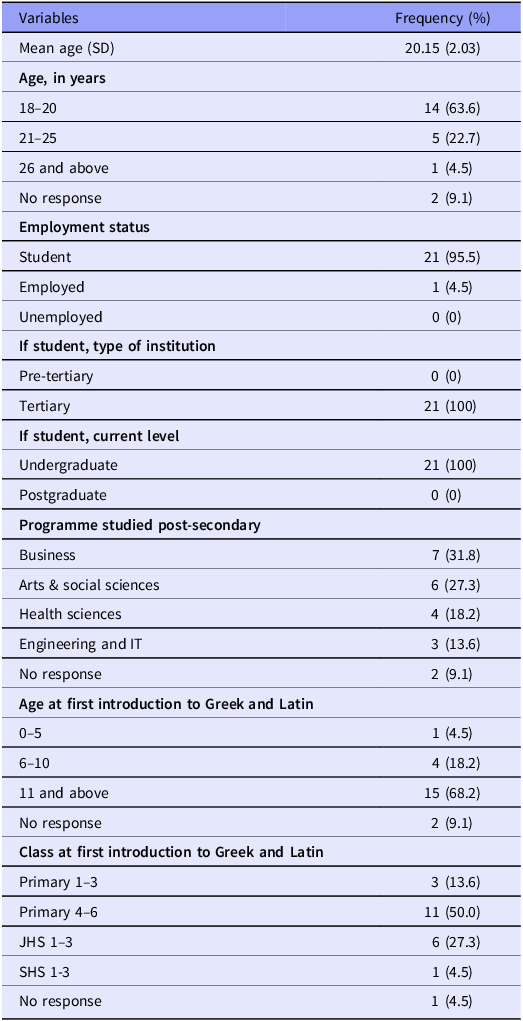
Table 1 presents the demographic characteristics of the 22 study participants. The mean age was 20.15 years (SD = 2.03), with the majority (63.6%) aged 18–20 years. Nearly all respondents (95.5%) were current students, with one employed alumnus. All student respondents were enrolled in tertiary institutions at the undergraduate level.
Background characteristics of study participants

Table 1. Long description
A table with 26 rows and 2 columns detailing demographic characteristics of 22 study participants. The columns are labeled ‘Variables’ and ‘Frequency (%)’. The table includes data on age distribution, employment status, type of institution, current level of study, programme studied, and age at first introduction to Greek and Latin. Row 1: Mean age (SD), 20.15 (2.03). Row 2: Age, in years, 18-20, 14 (63.6). Row 3: Age, in years, 21-25, 5 (22.7). Row 4: Age, in years, 26 and above, 1 (4.5). Row 5: Age, in years, No response, 2 (9.1). Row 6: Employment status, Student, 21 (95.5). Row 7: Employment status, Employed, 1 (4.5). Row 8: Employment status, Unemployed, 0 (0). Row 9: If student, type of institution, Pre-tertiary, 0 (0). Row 10: If student, type of institution, Tertiary, 21 (100). Row 11: If student, current level, Undergraduate, 21 (100). Row 12: If student, current level, Postgraduate, 0 (0).
The participants represented diverse academic disciplines: Business (31.8%), Arts and Social Sciences (27.3%), Health Sciences (18.2%), and Engineering and IT (13.6%). Most respondents (68.2%) were first introduced to Greek and Latin at age 11 or above, typically between Primary 4–6 (50.0%) or JHS 1–3 (27.3%). This late introduction suggests students encountered these classical languages after their foundational English literacy skills were already established, positioning Greek and Latin as tools for vocabulary enhancement rather than primary language learning. This contrasts with contexts where classical languages are introduced earlier as part of comprehensive language education, and has implications for how students perceive and engage with the instruction.
Student attitudes and experiences
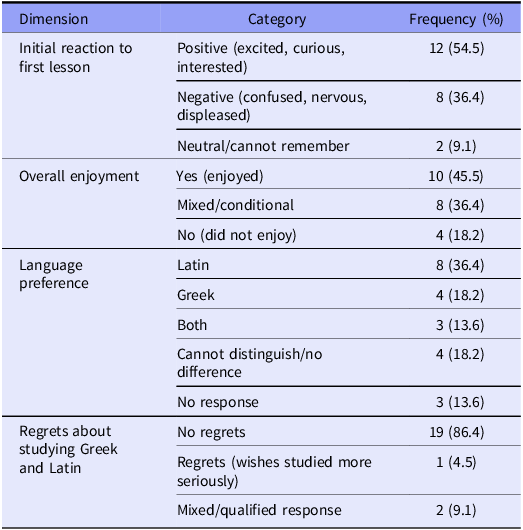
Table 2 presents students’ overall attitudes towards their Greek and Latin instruction, capturing initial reactions, sustained interest, language preferences, and retrospective evaluations. The data reveal a complex picture of engagement that evolved significantly over time, with teacher demeanour emerging as perhaps the most influential factor shaping these experiences.
Student attitudes and experiences with Greek and Latin instruction

Table 2. Long description
A table with four rows and three columns detailing student attitudes and experiences with Greek and Latin instruction. The columns are labeled Dimension, Category, and Frequency (percent). The rows are grouped by different dimensions: Initial reaction to first lesson, Overall enjoyment, Language preference, and Regrets about studying Greek and Latin. Each dimension has multiple categories with corresponding frequency percentages. For Initial reaction to first lesson, the categories are Positive, Negative, and Neutral/cannot remember with frequencies 54.5 percent, 36.4 percent, and 9.1 percent respectively. For Overall enjoyment, the categories are Yes (enjoyed), Mixed/conditional, and No (did not enjoy) with frequencies 45.5 percent, 36.4 percent, and 18.2 percent respectively. For Language preference, the categories are Latin, Greek, Both, Cannot distinguish/no difference, and No response with frequencies 36.4 percent, 18.2 percent, 13.6 percent, 18.2 percent, and 13.6 percent respectively. For Regrets about studying Greek and Latin, the categories are No regrets, Regrets, and Mixed/qualified response with frequencies 86.4 percent, 4.5 percent, and 9.1 percent respectively.
Initial reaction and early engagement
Student reactions to their first Greek and Latin lessons covered a wide spectrum. Positive reactions dominated, with most students (54.5%) expressing curiosity, excitement, or interest. Some students responded: ‘I was curious and eager to learn more about it’ (S/N 5), ‘excited’ (S/N 7), and ‘I was excited to start learning a new language’ (S/N 11). However, negative reactions were substantial, with 36.4% reporting confusion, nervousness, or displeasure. One student admitted being ‘Pissed-off and … confused’ (S/N 6), while another stated ‘I didn’t like it’ (S/N 20). Two students were neutral or could not remember their initial reactions.
These divergent first impressions are significant for understanding students’ subsequent engagement. The data suggest that initial curiosity did not guarantee sustained interest. Several students who began with enthusiasm later reported declining interest: ‘As we went higher it became more technical and boring’ (S/N 1). Conversely, some who started with negative reactions came to appreciate the subject’s value retrospectively, suggesting that early attitudes may be poor predictors of long-term outcomes, a finding with important implications for how we evaluate the success of classical language pedagogy in the short term versus the long term.
Sustained interest throughout the course
When asked whether they enjoyed learning Greek and Latin overall, responses revealed continued ambivalence. Only 10 students (45.5%) gave unqualified positive responses, with comments such as ‘Yes. I love languages’ (S/N 4) and ‘Yes, it was enlightening’ (S/N 7). Eight students (36.4%) provided conditional or mixed responses, indicating enjoyment at certain points or under specific circumstances. S/N 2’s response captures this complexity: ‘Yes, I did but not always due to the strict nature of our [senior teacher] who taught us mostly’. Four students (18.2%) explicitly stated they did not enjoy the instruction, emphasising lack of engagement or perceived irrelevance. S/N 8 complained: ‘No, I actually thought we were just being burdened with an archaic language’.
The evolution of attitudes over time presents a significant finding. S/N 1 exemplified a common trajectory: initial enthusiasm gave way to boredom as the material became ‘more technical’. Yet many students who did not enjoy the lessons during their pre-tertiary years came to appreciate their value later. This delayed recognition of relevance suggests that immediate student satisfaction may be a poor metric for evaluating educational value in subjects whose benefits accrue over time. Several students who found Greek and Latin boring or irrelevant during instruction came to value it highly once they encountered technical terminology in their tertiary studies. S/N 14 articulated this evolution: ‘Honestly, until later in life I never saw the relevance of Greek and Latin when we were studying it,’ yet proceeded to explain how etymology now helps decipher word meanings without dictionaries. S/N 8 admitted initially thinking it was ‘just an archaic language’ but later regretted ‘not studying it very effectively because now more than ever, I need it’. S/N 22, who initially thought Greek and Latin were ‘time wasting,’ later acknowledged: ‘I actually wish I took it more seriously because it is necessary going up the education ladder’.
Several factors appear to have contributed to this delayed appreciation. First, encountering technical vocabulary at university made etymological connections visible. Second, students recognised efficiency gains from etymological knowledge; S/N 17 noted being able ‘to grasp concepts at a quicker pace than others’. Third, the ability to infer meanings rather than memorising each new term reduced cognitive load. Finally, some students became aware of their advantage when observing classmates struggling with terminology they could easily decode.
This delayed recognition of value raises important pedagogical questions. If students cannot perceive relevance until years after completion, how can educators maintain engagement during the learning process? The data suggest that making explicit connections between etymological knowledge and students’ future disciplines, providing concrete examples of technical terms they will encounter, and potentially inviting testimonials from recent alumni might help bridge this relevance gap.
Language preference: Greek versus Latin
Students expressed clear preferences between Greek and Latin, with Latin emerging as the more favoured language. Of the 22 respondents, 8 (36.4%) preferred Latin, 4 (18.2%) preferred Greek, 3 (13.6%) liked both equally, and 4 (18.2%) could not distinguish between them. Students who favoured Latin consistently cited its proximity to English and practical utility. S/N 12 noted that ‘most root words were from Latin’, while S/N 17 explained: ‘Latin, the reason being that it was closer to the English language compared to the Greek. It was easy to determine that the etymology of an English word was Latin as compared to Greek’. The familiarity of the Latin alphabet also contributed to its preference, as S/N 16 noted being ‘not conversant with the Greek Alphabet’.
Despite Latin’s dominance, some students found Greek more engaging. S/N 5 appreciated ‘the creative style of alphabet used to represent their sounds’, while S/N 10 found it ‘Very easy to understand’. Three students saw value in studying both languages together, with S/N 9 explaining: ‘I considered them as one subject because it was quite difficult for me to tell them apart. Studying both at a time made it easier for [me] than choosing one to study at a time’. This inability to distinguish between the languages is significant. In a vocabulary-based approach aimed at etymology rather than language learning per se, the integrated presentation of Greek and Latin roots may have successfully created a unified framework for understanding the origins of English words.
These findings confirm Katahena’s (Reference Katahena, Hunt and Bulwer2024) study, which found more positive experiences with Latin than Greek, with unfamiliarity with the Greek alphabet identified as a significant barrier. However, the current study reveals that in a vocabulary-based approach, where neither language is taught for reading ancient texts, the distinction between them may become deliberately blurred, potentially reducing the intimidation factor while still providing etymological tools.
Retrospective evaluation and regrets
One of the study’s findings is the near-universal absence of regret among respondents. Of the 22 students, 19 (86.4%) explicitly stated they had no regrets about studying Greek and Latin, with only 1 student expressing regret. Many who had reported negative experiences nevertheless expressed no regrets. S/N 1, who found the subject increasingly ‘technical and boring’, stated: ‘No. It really helps me understand words I have never met before which is a big plus’. S/N 6, initially ‘[p]issed-off and … confused’, responded: ‘Not at all. It’s made my vocabulary improve’.
Several students expressed a paradoxical form of regret: not regretting the instruction itself, but regretting their own level of engagement. S/N 22 exemplified this: ‘Not at all. I actually wish I took it more seriously because it is necessary going up the educational ladder’. This sentiment reflects a mature understanding of the subject’s value that was not apparent during the original instruction. Only S/N 21, studying accounting, expressed regret: ‘Yes. I hardly or even don’t use it in my life, not even in my studies’. This stands in contrast to other business students who found value, suggesting that individual differences in learning transfer matter more than disciplinary categories alone.
The positive retrospective evaluation contrasts with Katahena’s (Reference Katahena, Hunt and Bulwer2024) findings from University of Ghana Classics students, where many questioned the usefulness of Greek outside academia. The difference may lie in pedagogical approach: vocabulary-based instruction provides immediately transferable skills applicable across disciplines, whereas traditional philological instruction focused on reading ancient texts may have less obvious relevance outside Classics.
Benefits to further studies and career
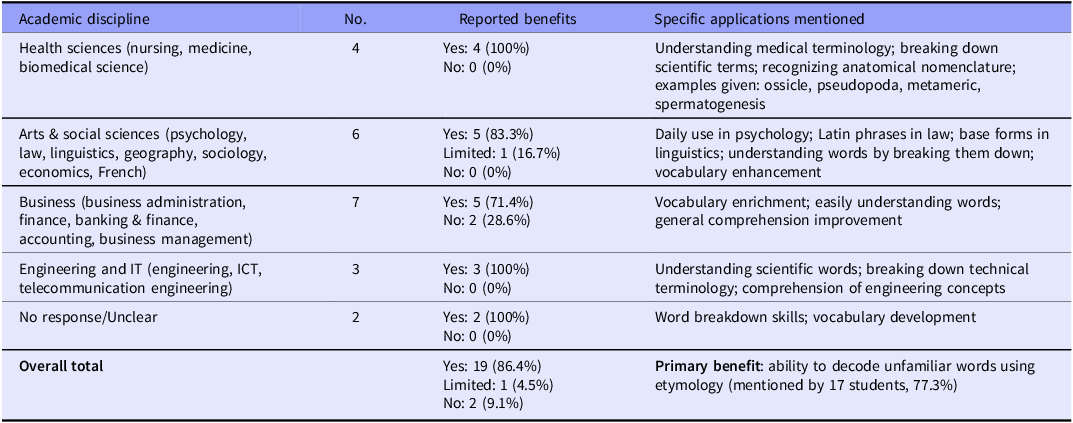
Evidence for the value of the vocabulary-based approach emerged in students’ reports of long-term benefits (Table 3). Most students (86.4%) reported that Greek and Latin had benefited their further studies or careers, with only two students (9.1%) reporting no benefits. One student gave a qualified response about minimal benefits (Table 3). These findings suggest that vocabulary-based instruction produces successful transfer of learning, enabling students to apply etymological knowledge across diverse contexts quite different from the original learning setting.
Benefits to further studies and career by academic discipline

Table 3. Long description
A table comparing the benefits of Greek and Latin studies across various academic disciplines. The table has six rows and four columns. Column headers are Academic discipline, Reported No., Specific applications mentioned. Row labels include Health sciences, Arts & social sciences, Business, Engineering and IT, No response/Unclear, and Overall total. Each row lists the academic discipline, the number of students reporting benefits, and specific applications mentioned. For example, Health sciences reports 4 students with benefits, Arts & social sciences reports 6 students, and so on. The table shows that most students across different disciplines found benefits in studying Greek and Latin, with specific applications mentioned in each field.
The core transferable skill: word breakdown
The ability to deconstruct unfamiliar words using knowledge of Greek and Latin roots emerged as the primary and most valued outcome. This skill was mentioned repeatedly across disciplines. S/N 1 explained:
studying the language helped me learn to break down words I don’t understand (words with/without Greek/Latin origins) to ones I did and try to understand the whole word from the fragments I understood.
S/N 9 provided a concrete example:
In my Greek and Latin lessons I learnt that ‘com’ means together or joint so when I meet a word with the prefix ‘com’ I know it has something to do with together or joint even before others check the dictionary.
This word-decoding skill was particularly valued because it reduced dependence on dictionaries and enabled students to infer meanings in real-time during reading or lectures. S/N 13 noted: ‘It has helped in the understanding of words in the absence of a dictionary’. S/N 14 stated: ‘I can decipher meanings of words sometimes without the dictionary just because I know what certain prefixes and suffixes mean’.
Discipline-specific applications
The benefits varied systematically by academic discipline, with particularly strong applications in health sciences, law, and linguistics (see Table 3). Students in nursing, medicine, and biomedical sciences reported especially significant benefits. S/N 7 (biomedical scientist) stated: ‘Yes. In my field biomedical science, it’s easier to understand terminologies’. S/N 11 (psychology) reported daily use: ‘Yes it has. I use it almost daily in breaking down scientific and psychological terms’. S/N 16 (engineering) provided specific examples:
Yes. Later, it helped and still helps me breakdown and understand (though partially) difficult words I may not know. Eg. some words like ossicle (deduction: related to bone), pseudopoda, metameric, epiphyte, diurnal, spermatogenesis.
The prevalence of Greek and Latin roots in scientific and medical terminology makes the benefits particularly apparent in health sciences (cf. Stephens & Moxham Reference Stephens and Moxham2016). Terms like ‘spermatogenesis’ (sperm + generation), ‘mammography’ (breast + writing/recording), and ‘pseudopoda’ (false + feet) become transparent rather than opaque when students recognise their etymological components. This transparency reduces the cognitive burden of learning technical vocabulary, as students can deduce meanings rather than memorising each term as an arbitrary label.
Law students reported substantial benefits, though sometimes tinged with regret. S/N 8 (law) admitted:
The effect is very little owing to the fact that I did not take it too seriously. I seriously encounter a lot of Latin words and phrases in my study of law.
This acknowledgement validates the relevance of classical language instruction for legal studies while highlighting that passive exposure may not fully prepare students for intensive Latin usage in legal contexts. Students in humanities disciplines also reported benefits. S/N 15, who studied linguistics at university, found direct application: ‘Yes. At the university level I studied linguistics where most base forms of words were Latin or Greek’. Business students showed more variable outcomes, though most reported vocabulary enhancement. S/N 22 (accounting) appreciated its value for ‘easily understanding words’, while S/N 21 (accounting) was the notable exception, stating: ‘No, it hasn’t benefited me in any way. It isn’t necessary in my studies’. This variation within a single discipline (accounting) underscores that transfer depends not just on disciplinary content but on individual factors – perhaps the specific courses taken, the instructor’s vocabulary usage, or the student’s metacognitive awareness of when to apply etymological strategies.
Competitive advantage and enhanced literacy
Several students noted that Greek and Latin knowledge provided distinctive advantages relative to peers. S/N 5 explicitly stated:
It sets us apart from those who didn’t study it. Not every school taught Greek and Latin. Makes you read and understand faster and better than those who didn’t learn the duo subjects.
S/N 17 noted being able ‘to grasp concepts at a quicker pace than others’. These comments reveal awareness of relative advantage – students recognised not just that they possessed skills, but that these skills distinguished them from classmates who lacked etymological training.
Beyond discipline-specific applications, many emphasised general vocabulary improvement and enhanced reading comprehension. S/N 18 described improved reading ability:
It has given me good vocabulary power. Although there can never be an end to learning words, I can say I am remarkably better off with this knowledge than before.
This general literacy enhancement may be as important as discipline-specific benefits. Students who can decode unfamiliar words encounter less friction when reading academic texts, reducing cognitive load and enabling deeper engagement with content. The cumulative effect of reduced word-level processing demands may enhance comprehension, reading speed, and confidence across all academic work.
The positive reports of long-term benefits, combined with the near-absence of regret, suggest that vocabulary-based etymology instruction successfully achieves transfer of learning in ways that traditional philological instruction may not. Students who learned to break down English words using classical roots found this skill valuable across diverse tertiary disciplines, while research on philological instruction (Katahena Reference Katahena, Hunt and Bulwer2024) suggests that students who learned to read Latin or Greek texts often questioned the applicability outside Classics-related fields.
Challenges encountered
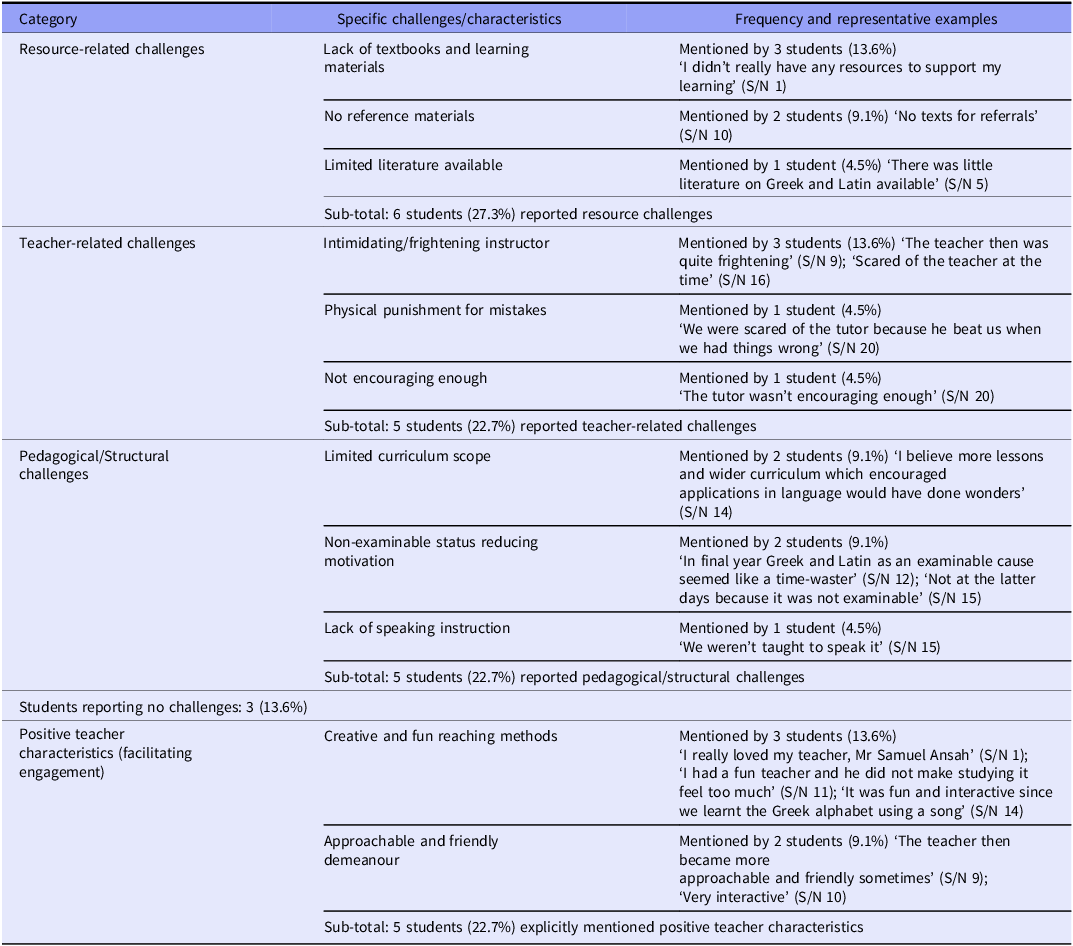
Table 4 presents the challenges students encountered and their perceptions of teacher characteristics. The data reveal that while teacher demeanour emerged as the most influential factor in student engagement, resource limitations and pedagogical constraints created additional obstacles to optimal learning. Understanding these challenges provides important context for interpreting the reported benefits and for designing future implementations of vocabulary-based classical language instruction.
Challenges encountered and teacher characteristics influencing student experiences

Table 4. Long description
The table has five columns: Category, Specific challenges/characteristics, Frequency and representative examples, and two sub-totals. It lists challenges and positive teacher characteristics reported by students. The categories include Resource-related challenges, Teacher-related challenges, Pedagogical/Sructural challenges, and Positive teacher characteristics. Each category has specific challenges or characteristics with corresponding frequencies and examples. For instance, under Resource-related challenges, lack of textbooks and learning materials was mentioned by 3 students. Under Teacher-related challenges, intimidating/frightening instructor was mentioned by 3 students. Pedagogical/Sructural challenges include limited curriculum scope and non-examinable status reducing motivation. Positive teacher characteristics include creative and fun reaching methods and approachable and friendly demeanour. The table also notes that some students reported multiple challenges and that percentages do not sum to 100%.
Some students reported multiple challenges, thus percentages do not sum to 100%.
The critical role of teacher personality and pedagogical approach
An important theme that consistently ran across the data was the impact of instructor personality on student experiences. The responses reveal a clear dichotomy between creative, approachable teachers who inspired engagement, and intimidating instructors who created barriers to learning – barriers that persisted even when students recognised the content’s inherent value. Multiple students referenced Teacher A’s intimidating presence as a significant obstacle. S/N 2 noted that despite enjoying the content, enjoyment was tempered by ‘the strict nature of [Teacher A] who taught us mostly’. S/N 14’s response was particularly revealing:
I particularly did not enjoy [Teacher A’s] Greek and Latin lessons mainly because he came off as a very intimidating character, encouraging more fear than courage to study Greek and Latin.
This fear-based dynamic extended to physical punishment. S/N 20 reported: ‘We were scared of the tutor because he beat us when we had things wrong’. Teacher A’s teaching style created a paradoxical situation where students recognised the subject’s value while dreading the learning environment. S/N 9 captured this tension: ‘The teacher then was quite frightening, so it wasn’t so easy to be in that class for one hour. Aside that, Greek and Latin was fun to study outside the classroom’. The impact manifested in various ways. S/N 16 admitted that intimidation made students prefer less instructional time: ‘Just one lesson in the week seemed enough for me since I did not like encountering [Teacher A] very much’.
In contrast, students who had creative and approachable teachers reported markedly different experiences. S/N 1 fondly remembered: ‘I think it was fun for me because I really loved my teacher, [Teacher B]’. S/N 11 emphasised: ‘Yes, I did. Because I had a fun teacher and he did not make studying it feel too much’. S/N 14 highlighted pedagogical creativity: ‘It was fun and interactive since we learnt the Greek alphabet using a song. I still remember the song till date’. These positive experiences were characterised by approachability, creativity, and accessibility.
This teacher effect extends findings from other contexts while adding important nuances. Foster’s (Reference Foster2018) study of Ancient Greek in UK secondary schools found that student enthusiasm was highly dependent on teacher passion and contextual framing. However, the Ghanaian case adds a dimension not emphasised in Foster’s work: the detrimental impact of fear and intimidation. While Foster found that teacher dedication inspired students, the current study reveals that teacher intimidation can actively undermine even intrinsically valuable content. The findings also confirm Bennett’s (Reference Bennett2021) observation from a Year 9 Latin classroom in a UK school that learning outcomes are influenced more by students’ experiences learning the language rather than their initial perceptions of it.
Baglio’s (Reference Baglio2022) study of students’ experiences learning Latin in the United States noted that positive learning environments and teacher–student relationships do not always contribute to positive outcomes when there is a lack of intrinsic motivation. The XIS data both confirm and complicate this finding. While some students lacked intrinsic motivation initially, many developed appreciation retrospectively – but this delayed appreciation did not erase the negative impact of intimidating pedagogy during the learning process. The implication is that even when content proves valuable in the long term, poor teacher–student dynamics during instruction represent a lost opportunity for deeper engagement and more effective learning.
Resource limitations and pedagogical challenges
The most frequently mentioned structural challenge was the lack of learning materials. S/N 1 stated: ‘I didn’t really have any resources to support my learning’. S/N 5 noted: ‘There was little literature [textbooks] on Greek and Latin available’. S/N 10 mentioned: ‘No texts for referrals’. Six students (27.3%) explicitly cited resource limitations as obstacles to their learning. This scarcity of resources is particularly significant in the Ghanaian context, where educational materials for subjects outside the national curriculum are difficult to obtain and often expensive. The absence of textbooks meant students had limited opportunities for self-directed study or revision outside classroom time. When students wanted to review material, practice etymology skills, or explore connections to their other subjects, they lacked the resources to do so independently. This dependence on classroom instruction alone may have limited the depth and retention of learning.
The resource challenge also affected pedagogical options. Without workbooks containing progressive exercises, teachers could not easily assign homework or independent practice. Without reference materials, students could not verify their etymological analyses or explore word families beyond what the teacher presented. Teacher A’s creation of a 1,800-word entry vocabulary textbook represents an admirable response to these constraints, but even this resource had limitations. As a word list with etymologies rather than a pedagogical textbook with exercises, examples, and cultural context, it served reference purposes better than learning purposes, and it contained quite a number of errors.
Linguistic and cognitive challenges
Several students struggled with linguistic aspects of Greek and Latin. S/N 4 cited ‘[p]ronunciation of some words’, while S/N 6 found it ‘[d]ifficult to remember, and … couldn’t tell the difference’ between Greek and Latin. S/N 13 admitted: ‘I couldn’t keep the prefixes and suffixes in mind’. S/N 19 mentioned ‘[t]he endless memorizing’, and S/N 21 struggled with ‘[t]he words’ pronunciation, spelling’. The Greek alphabet presented a particular obstacle, as S/N 16 noted being ‘not conversant with the Greek alphabet’. These linguistic challenges align with Katahena’s (Reference Katahena, Hunt and Bulwer2024) finding that unfamiliarity with the Greek alphabet was a major challenge for University of Ghana students learning Greek philologically. However, in a vocabulary-based approach where students do not need to translate texts, the roots of Greek and Latin words are presented in transliteration hence avoiding the use of the Greek letters themselves.
Nevertheless, students had challenges with memorisation, pronunciation and spelling. Learning etymology involves memorising numerous roots. For students without strong verbal memory or without effective memorisation strategies, this can feel overwhelming. Traditional philological instruction distributes vocabulary acquisition across reading passages, where repetition and context aid retention. Vocabulary-based instruction, focusing on isolated roots, may require more deliberate memory techniques.
Pedagogical and structural challenges
Students also identified pedagogical concerns that affected their learning experiences. S/N 12 noted: ‘In final year, Greek and Latin as an examinable course seemed like a time-waster’, highlighting the tension created by the non-examinable status at the national level. Two students (9.1%) mentioned the non-examinable status as reducing motivation. In highly exam-oriented educational systems like Ghana’s, students allocate study time and effort based on assessment consequences. Subjects not contributing to final grades or university entrance examinations may be perceived as luxuries that divert time from ‘serious’ subjects. However, it should be noted that this structure preserved pedagogical flexibility: the vocabulary-based teaching was rather meant as an aid to the externally examinable subjects. My interview with the headmaster who also taught French suggested that students seemed more enthusiastic and serious about French not just because it was an examinable subject, but more importantly because of its external value as a spoken foreign language. Vocabulary-based etymology instruction does not aim to teach students to speak Latin or Greek; it aims to help them decode English words. But to some students, learning a ‘language’ implies acquiring speaking ability, and the absence of conversational practice may feel incomplete. As S/N 15 pointed out: ‘We weren’t taught to speak it’, suggesting a desire for more comprehensive instruction. This comment reflects ambiguity in students’ perceptions of the course’s goals. Clearer communication about pedagogical goals – what the course does and does not aim to achieve – might address this expectation mismatch.
S/N 14 provided the most extensive critique:
Just one lesson in the week seemed enough for me since I did not like encountering [Teacher A] very much. But at the same time, I believe more lessons and wider curriculum which encouraged applications in language would have done wonders.
This student recognised that despite the intimidating instructor, the limited scope of instruction was insufficient. They continued:
In addition, Greek and Latin are ancient languages, however they are not really spoken anymore, but it didn’t feel like we were learning a language; rather, we were just learning bits and pieces. Honestly, until later in life I never saw the relevance of Greek and Latin when we were studying it.
This comment captures a fundamental tension in vocabulary-based classical language instruction: students may struggle to see relevance when the instruction focuses narrowly on etymology without broader cultural or linguistic context. Philological approaches provide cultural context through reading about Roman civilisation, Greek mythology, and ancient history. Living language approaches provide context through conversational practice and cultural immersion. Vocabulary-based approaches, focusing on isolated roots and derivatives, may feel fragmentary and abstract unless instructors deliberately create connections to students’ current subjects and future disciplines. Notably, not all students struggled. S/N 7 reported ‘None’, S/N 11 stated ‘I did not experience any challenges’ and S/N 3 ‘Can’t remember’ any particular difficulties. This variation suggests that individual factors – prior knowledge, learning styles, aptitude for languages, or quality of specific instructors – significantly influence the learning experience.
Conclusion
This study reveals that vocabulary-based Greek and Latin instruction can provide long-term benefits to students across diverse disciplines, even when taught in resource-limited, non-examinable contexts. The majority of respondents (86.4%) reported that etymology knowledge enhanced their vocabulary, reading comprehension, and ability to understand technical terminology in fields including medicine, law, psychology, engineering, and sciences. None regretted receiving this instruction, and several wished they had engaged more seriously. However, the study also exposes significant challenges in implementing such programmes effectively. Teacher demeanour emerged as the single most influential factor in student engagement, with intimidating instructors creating fear that impeded learning despite the content’s intrinsic value. Resource limitations, narrow curriculum scope, and the non-examinable status of the subject created additional obstacles to optimal learning. The temporal gap between students’ experiences during instruction and their retrospective appreciation suggests that vocabulary-based etymology teaching provides genuine educational value that may not be immediately apparent to learners.
The findings have implications beyond the immediate context. They suggest that classical languages can be successfully repurposed for vocabulary development rather than textual reading – a reframing that may make Classics more sustainable in educational systems where humanities subjects must demonstrate pragmatic value. They demonstrate that such instruction can work in African contexts quite different from the European and North American settings where most research on classical language education has been conducted. And they reveal both the possibilities and the pitfalls of teaching Greek and Latin outside examination frameworks, showing that non-examinable subjects can provide lasting value but face motivational challenges in exam-obsessed systems. Ultimately, the study affirms that when taught through accessible, applied methods by supportive and creative instructors, classical languages can enrich interdisciplinary literacy even in contexts far removed from traditional classics education.
Acknowledgements
The author acknowledges the use of ChatGPT (GPT-5.2; OpenAI), accessed through https://chat.openai.com in November 2025, to assist with the preliminary organisation of quantitative and qualitative data. All calculations, corrections, and final interpretations were conducted by the author, and all outputs generated by the tool were verified against the original dataset.
Competing interests
The author taught “Greek and Latin” at XIS when it had not yet been renamed “Vocabulary Competence”. The data (online survey responses, interviews and classroom observation) were collected years after the author had left the employment of the school.
Author biography
Michael K. Okyere Asante is an assistant lecturer in critical thinking at the University of Environment and Sustainable Development, Somanya, Ghana and a PhD candidate in Classics at the University of Cambridge.

 Open access

