INTRODUCTION
In a perfectly competitive market, the law should give effect to the parties’ agreements. Real-life markets are often characterized by market failures (including behavioral ones), which call for regulation to be considered. For decades, market regulation has focused on disclosure duties, yet mounting evidence suggests that these are not very effective. While never ending attempts to improve disclosures continue, there is growing disillusion with this approach (Radin Reference Radin2013, 219–20; Ben-Shahar and Schneider Reference Ben-Shahar and Schneider2014; Willis Reference Willis2006; Marotta-Wurgler Reference Marotta-Wurgler2011; Zamir and Teichman Reference Zamir and Teichman2018, 173–75). More recently, there has been much enthusiasm about the use of nudges—“low-cost, choice-preserving, behaviorally informed approaches to regulatory problems” (Sunstein Reference Sunstein, Zamir and Teichman2014, 719)—as a nonintrusive way of influencing people’s behavior in desirable ways (Thaler and Sunstein Reference Thaler and Sunstein2009; Zamir and Teichman Reference Zamir and Teichman2018, 177–85). However, there are growing doubts about the effectiveness of nudges, as well—especially when suppliers have an incentive to counter their effects (Barr, Mullainathan, and Shafir Reference Barr, Mullainathan, Shafir, Moss and Cisternino2009, 25; Bubb and Pildes Reference Bubb and Pildes2014; Willis Reference Willis2013, 1200–10).
In response to these realizations, some have been inclined to conclude that regulation—or, at least, most of it—should be abandoned altogether, leaving the scene to market forces of reputation and competition (Bar-Gill and Ben-Shahar Reference Bar-Gill and Ben-Shahar2013; Bebchuk and Posner Reference Bebchuk and Posner2006). An alternative conclusion, however, is that what is needed is more extensive use of mandatory regulation of the content of transactions. This article focuses on such measures, which we dub mandatory rules. Mandatory rules aim not to improve the conditions under which contracts are made but rather directly intervene in their content.
Advocates of mandatory rules argue that they are sometimes necessary to overcome market failures, such as information problems and externalities; to prevent suppliers from exploiting customers’ cognitive biases (and protect customers from their own fallibilities); to promote fairness of exchange; to redistribute power and wealth insituations of unequal bargaining power; to give effect to customers’ true intentions (when standard-form contracts typically do not); and even to promote democratic values (because indiscriminate enforcement of suppliers’ standard-form contracts transfers quasi-legislative power from the legislature to suppliers). In response, opponents of mandatory rules claim that market failures should preferably be treated by other means, such as disclosure duties and default rules (if they are to be treated at all); that even monopolies have no reason to use inefficient terms (except for charging supracompetitive prices); that legal policymakers suffer from cognitive biases just as much as customers; that redistribution through market regulation is less effective and less legitimate than tax-and-transfer mechanisms (if it is legitimate at all); that legal paternalism is incompatible with respect for individual autonomy; and that governmental policymakers are more likely to advance their own interests and those of powerful interest groups than to promote the public good (and therefore, the less they interfere with the market, the better). This normative and policy debate is unlikely to be resolved soon (for a recent review of the abundant literature on these issues, see Zamir and Ayres Reference Zamir and Ayresforthcoming).
As a matter of fact, mandatory rules are already used extensively in all modern legal systems. Even in the United States—where federal and state legislatures and courts are generally reluctant to prescribe such rules—they are quite prevalent. While explicit mandatory rules are comparatively rare in the common law of contracts, they are quite common in many specific areas, such as insurance (Schwarcz Reference Schwarcz2011; Baker and Logue Reference Baker, Logue, Schwarcz and Siegelman2015), residential leases (Campbell Reference Campbell2013; Super Reference Super2011; Franzese et al. Reference Franzese, Gorin and Guzik2016), residential mortgage loans (15 U.S.C. § 1639c(c)), credit cards (e.g., Credit Card Accountability, Responsibility, and Disclosure Act of 2009, Pub. L. No. 111-24, 123 Stat. 1734 (2009); Bar-Gill and Bubb Reference Bar-Gill and Bubb2012), builders’ liability for defects in new homes (e.g., New York Warranties on Sales of New Homes Act of 1988, N.Y. Gen. Bus. Law §§ 777–777-b; Sovern Reference Sovern1993), and sellers’ liability for defective new vehicles (Carter, Van Alst, and Sheldon Reference Carter, Van Alst and Sheldon2015, 559–608). Issues pertaining to the introduction and design of mandatory rules are therefore very important, irrespective of whether one believes that use of such rules should be extended, reduced, or remain as it is.
One key issue that policymakers should take into account when considering mandatory rules is the prevailing judgments about their desirability—and how these judgments are affected by the rules’ design. Rightly or wrongly, disclosure duties appear to enjoy broad support, because they do not curtail the parties’ freedom to shape the contract as they please but rather facilitate rational and informed decisions by both parties. Even if they are not very effective, disclosure duties are commonly perceived as harmless at worst. According to the 1996 US General Social Survey (GSS), a majority of the US population strongly or somewhat agrees that the government should require businesses to provide consumers with the information they need to make informed choices.
Nudges are somewhat more controversial—especially in the United States—as some consider them manipulative and therefore disrespectful of people’s autonomy (Sunstein and Thaler Reference Sunstein and Thaler2003; Klick and Mitchell Reference Klick and Mitchell2006; Hausman and Welch Reference Hausman and Welch2010). In light of the controversy surrounding nudges, previous surveys have sought the public’s opinion about them, in the United States and elsewhere, and found that they enjoy much greater support than one might expect from the public and academic discourse (e.g., Sunstein Reference Sunstein2016; Reisch and Sunstein Reference Reisch and Sunstein2016; see also Jung and Mellers Reference Jung and Mellers2016; Hagman et al. Reference Hagman, Andersson, Västfjäll and Tinghög2015; Dogruel Reference Dogruel2019; Tennenbaum, Fox, and Rogers Reference Tennenbaum, Fox and Rogers2017).
However, no comparable studies have been conducted to find out what the public at large thinks about mandatory rules.Footnote 1 Surveys of related issues, conducted by the GSS, indicate that most Americans oppose or strongly oppose legislative control of prices and wages (surveys from 1985, 1990, and 1996) and support or strongly support the reduction of government regulation of businesses (surveys from 1985, 1990, 1996, and 2006). Therefore, the goal of the present study is to examine laypersons’ attitudes toward mandatory rules and, in particular, how the formulation of mandatory rules might affect their judged desirability.
The public attitude to mandatory rules is important for principled as well as instrumental reasons. As a matter of principle, even if deviations from citizens’ preferences are justified when those preferences are misinformed, incoherent, or trumped by more important values (such as the protection of minority rights), “the presumption of democracy is that there be a close correspondence between the laws of a nation and the preferences of citizens who are ruled by them” (Rehfeld Reference Rehfeld2009, 214). At the pragmatic level, there is evidence to suggest that the perceived fairness of the justice system is key to its effectiveness: to achieve legitimacy and compliance, legal rules must be consistent with prevailing moral intuitions (although this claim is contested—for a recent discussion, see Symposium: How Law Works 2017). Moreover, even if one doubts that legal policymakers should pay much heed to public attitude on such issues (e.g., because the public attitude may be unsound, or attitudes on such issues are unlikely to affect compliance), in a liberal democracy one would expect that elected policymakers would actually pay heed to their constituencies’ attitudes in a bid to enhance their popularity. Either way, this is an important issue.
Numerous aspects of the formulation of mandatory rules—such as the choices between rules and standards and between various degrees of strictness—might affect their judged desirability. Two dimensions of the design of mandatory rules are of particular interest. One concerns the choice between negative and positive framing of the same substantive mandatory rules. To illustrate, consider the choice between the following two rules: [Negative] “An agreement that exempts a retailer from liability for malfunctioning of home appliances is void and unenforceable,” and [Positive] “Notwithstanding any agreement to the contrary, a retailer is liable for malfunctioning of home appliances.” While the negative framing invalidates certain contractual arrangements, the positive one mandates the complementary arrangement. As a matter of fact, it appears that across legal systems, negative formulations of mandatory rules are considerably more prevalent than positive ones. Doctrines such as unconscionability, the invalidity of excessive restraints of trade, and the German and Israeli regulations of standard-form contracts (German Civil Code §§ 305–10; Israeli Standard Contracts Law 1982)—are all formulated as negative mandatory rules.
The second dimension pertains to the choice between merely establishing substantive mandatory rules, and supervising the wording of the contract (so-called phrasing rules), as in the choice between the two rules cited above and the following ones: [Prohibition] “A retailer must not include in the agreement a term that exempts the retailer from liability for malfunctioning of home appliances,” and [Duty] “A retailer must include in the agreement a term according to which the retailer is liable for malfunctioning of home appliances.” Thus, when the law uses phrasing rules, it is not content with merely influencing the content of the parties’ relationships, but actively intervenes in the wording of the contract as well. Since customers are often unfamiliar with the legal norms, they tend to draw information about their contractual rights from the formal contract and assume that the contractual terms are valid and that they have no rights beyond those listed in the contract. In the absence of phrasing rules, suppliers are therefore tempted to insert invalid terms into their contracts and to avoid mentioning customers’ rights—thereby misleading customers about their legal entitlements. Phrasing rules are therefore much more effective in protecting customers than merely substantive rules; and yet, they are considerably less prevalent than substantive rules in virtually all legal systems.
Based, in part, on the abovementioned GSS surveys, we conjectured that US subjects would be quite hostile to mandatory regulation of the content of contracts, since it curtails personal freedom and intervenes in the free market. Accordingly, we hypothesized that people would find mandatory rules less attractive the more intrusive they are. Thus, we predicted that substantive rules would gain more support than phrasing rules, because the former do not interfere with the wording of the contract. By the same token, we hypothesized that the Negative pair (Negative and Prohibition) would enjoy greater support than the Positive pair (Positive and Duty), because prohibiting inappropriate conduct appears to be less intrusive than mandating appropriate conduct.
To test these hypotheses empirically, we ran four studies. The studies focused on transactions between commercial providers (and purchasers) of products and services, including retailers, insurers, lenders, landlords, and employers (collectively labeled suppliers), and consumers, insureds, borrowers, tenants, employees, etc. (collectively labeled customers). Study 1 was (1) conducted on the MTurk platform, (2) examined participants’ assessments of the various formulations in a within-subject design (i.e., each participant read all four formulations of one rule), and (3) used a separate mode of assessment (that is, each participant assessed each formulation separately).
Each of the following studies diverged from Study 1 in one of these respects. Thus, Study 2 was conducted with a representative sample of the entire US adult population, rather than MTurk master workers; Study 3 used a between-subject design (that is, each participant read only one formulation of several rules), rather than a within-subject design; and Study 4 used a comparative mode of assessment—meaning that the participants were asked to compare between pairs of formulations of the same rule (rather than assessing each formulation separately). In Study 4 we also directly elicited participants’ reasons for judging certain formulations to be more desirable than others.
Contrary to our initial hypotheses, subjects generally judged phrasing rules to be more desirable than merely substantive ones, and positive rules as more desirable than negative ones. Accordingly, of the four possible formulations, substantive negative rules gained the least support. Put differently, the more intrusive the mandatory rule appears to be along the two dimensions, the greater its judged desirability. More generally, the findings suggest that pro-customer mandatory rules enjoy strong support among the US population (although more studies are necessary to substantiate this claim).
Insofar as our findings are externally valid and generalizable, and assuming that the law should correspond with prevailing attitudes, these results have potentially powerful policy ramifications. They can guide the drafting of mandatory rules and possibly legitimize more extensive use of such rules.
The article begins by discussing the two choices facing the designers of mandatory rules, which lie at the heart of the present study—namely, between substantive rules and intervention in the phrasing of the contract, and between negative and positive framings of the rules. We then describe the four empirical studies. Finally, we highlight our key findings; consider their strengths, limitations, and policy implications; and chart the course for future empirical research.
DESIGNING MANDATORY RULES
This section analyzes two choices that must be made when designing mandatory rules, thereby providing the theoretical background for the empirical studies described below.
Substantive Rules and Intervention in the Phrasing of the Contract
Mandatory rules can be limited to specifying the substantive law that governs the transaction, regardless of the contractual terms (substantive rules), or they can also supervise the wording of the contract (phrasing rules). The unconscionability doctrine is an example of the former option—that is, a substantive rule that does not intervene in the wording of the contract. Under § 2–302(1) of the Uniform Commercial Code, if the court finds a contract clause unconscionable, it “may refuse to enforce” the clause. Another example may be found in the California Civil Code, which prohibits the providers of consumer credit, who had been involved in arranging credit disability insurance to the debtor, from using remedies against the debtor during the disability claim period (Cal. Civ. Code § 1812.408 (2018)). Under this statute, “any waiver by the debtor of the provisions of this title shall be void and unenforceable.”
An example of phrasing rules can be found in § 1670.8 of the California Civil Code, which provides that consumer contracts “may not include a provision waiving the consumer’s right to make any statement regarding the supplier, its people, or the goods or services.” And under § 3215(d) of the New York Insurance Law, no life insurance or contract of deferred annuity “shall provide that the face amount of life insurance shall be reduced because of any disability benefits paid, except that….” Sometimes insurance law requires insurers to include specific provisions in their contracts. For example, § 3412(g) of the New York Insurance Law provides that “[a]ll policies providing automobile physical damage coverage shall include a provision authorizing the insurer to take the insured motor vehicle into custody for safekeeping, when notified that the motor vehicle reported stolen or found to be abandoned has been located.”
It is widely acknowledged that customers do not ordinarily read standard-form contracts before entering the contract (Bakos, Marotta-Wurgler, and Trossen Reference Bakos, Marotta-Wurgler and Trossen2014; Ayres and Schwartz Reference Ayres and Schwartz2014; Ben-Shahar and Schneider Reference Ben-Shahar and Schneider2014). However, even customers who do not read standard-form contracts in advance, may well read them once a dispute with the supplier arises (Furth-Matzkin Reference Furth-Matzkin2017). Since customers are often unfamiliar with the legal regime, they tend to assume that the contractual provisions are legally valid (or, at least, that any attempt to challenge them might be difficult and costly), so they submit to them (Mueller Reference Mueller1970, 272–74; Bentley Reference Bentley1974, 852; Olafsen Reference Olafsen1979; Kuklin Reference Kuklin1988; Stolle and Slain Reference Stolle and Slain1997; Sullivan Reference Sullivan2009).Footnote 2 Similarly, when a contract fails to mention the customer’s rights or the supplier’s obligations, customers might conclude that those rights and obligations do not exist (Furth-Matzkin Reference Furth-Matzkin2017, 35–40; Furth-Matzkin Reference Furth-Matzkin2019). A well-studied cognitive phenomenon—dubbed WYSIATI, for “What You See Is All There Is”—refers to the tendency to make decisions based on the immediately available information, while neglecting other information (Kahneman Reference Kahneman2011, 85–88).
Given such ignorance and biases among customers, mandating that certain clauses be included in the contract can have a much greater impact than merely prescribing substantive mandatory rules, or even just prohibiting the inclusion of invalid terms in the contract. While the availability of legal information on the web somewhat mitigates this concern, customers may fail to look for information online or fail to find the accurate information, or misunderstand it. Recent survey and experimental studies suggest that laypeople draw much of their knowledge about contractual rights and obligations from the contract itself (Furth-Matzkin Reference Furth-Matzkin2017, 35–40; Furth-Matzkin Reference Furth-Matzkin2019). Indeed, the best evidence of the practical impact of the presence of unenforceable terms and the absence of terms about customers’ rights in standard-form contracts arguably lies in the fact that suppliers continue to use such techniques (Bar-Gill and Warren Reference Bar-Gill and Warren2008, 27; see also Hoffman and Strezhnev Reference Bar-Gill and Warrenn.d.).
Substantive mandatory rules are generally much more prevalent than phrasing rules. This state of affairs—namely, allowing the inclusion of unenforceable contractual clauses and failing to require the inclusion of details about customers’ mandatory (or default) rights in the contract—might possibly be justified on practical and principled grounds. One practical consideration is that not only customers but suppliers as well may be unaware of the existence or the precise content of mandatory rules. This is especially true when the substantive norm is in the form of a vague standard. Often, the precise meaning of such norms is determined ex post by judicial or administrative decision-makers, whose decisions may be unclear, inconsistent, and wavering (Tucker Reference Tucker2015). The less the parties differ in terms of sophistication and power, the weaker the justification for imposing a duty on one of them to inform the other about the law.
Moreover, inasmuch as the legal precedents are unclear or not well-established, suppliers might include questionable terms in the hope that future courts might rule them to be valid—and even when the precedents are clear, a supplier might legitimately wish to challenge them (or so the argument goes) (Kuklin Reference Kuklin1988, 879–81; Tucker Reference Tucker2015). Another reason to avoid wording requirements and prohibitions has to do with the costs of compliance, especially when the rules are complex. Nevertheless, more often than not it seems fair and efficient to incentivize suppliers, rather than customers, to bear the costs of eliminating misleading clauses from their contracts, and of including valid ones, even if this means seeking legal advice about the applicable laws (Kuklin Reference Kuklin1988, 847–69). It is much easier and cheaper for the supplier—who transacts with numerous customers, usually through standard-form contracts—to get such legal advice, than it is for customers.
Beyond the practical considerations, there may be a principled objection to interventions in the drafting of contracts. Arguably, such interference, especially in the form of requirements to include certain clauses in the contract (as opposed to merely prohibiting the inclusion of invalid ones), is more detrimental to the parties’ autonomy than merely setting substantive rules—especially in the (rare) cases where those duties are backed by administrative or criminal sanctions (e.g., Ala. Code § 5-18-9 (2018)). Phrasing rules may even raise a concern about their adverse effect on suppliers’ freedom of speech (Expressions Hair Design v. Schneiderman, 137 S. Ct. 1144 (2017); Shanor Reference Shanor2016; Anderson Reference Anderson2017).
To be sure, the very introduction of phrasing rules may not be enough, as some suppliers might still not comply with those rules—by failing to include the mandated clauses, or by including prohibited ones in their contracts. Administrative or even criminal sanctions may therefore be necessary to enforce phrasing rules (Tucker Reference Tucker2015). For example, in Massachusetts, the attorney general may bring an action against landlords for using certain types of invalid clauses in their rental agreements (Mass. Gen. Laws ch. 93A §4; 940 Code Mass. Regs. § 3.17(3)).
Ultimately, it appears that, at least when it comes to sophisticated commercial suppliers, attaining the goals of mandatory rules—whatever they might be—requires the use of phrasing rules, rather than merely substantive ones. Accordingly, it has been speculated that when legal policymakers only set substantive rules, they are not really seeking to deter the inclusion of invalid terms in contracts (or the noninclusion of valid ones), but merely ensuring “that courts are not complicit in the prohibited agreements” (Sullivan Reference Sullivan2009, 1132). This may be because policymakers are influenced by effective lobbying of suppliers’ organizations. Discovering what ordinary people think about the choice between substantive rules and intervention in the wording of contracts may possibly affect policymakers’ decisions in this regard.
Positive Versus Negative Framing
There is an entrenched moral conviction that the prohibition of harming other people is more compelling than the duty to benefit others (Ritov and Baron Reference Ritov and Baron1990; Zamir Reference Zamir2015, 178–88). Commonsense morality is deontological, rather than consequentialist. Most people believe that, while it is important to enhance good outcomes (particularly human welfare), doing so is subject to moral constraints—most importantly the constraint against harming other people. Now, there is a crucial difference between the duty to refrain from harming others and the duty to aid them. The prohibition of killing someone in order to use her organs to save the lives of three other people implies that coming to the aid of the three is less imperative than the prohibition of killing the one (for a collection of studies of the doing/allowing distinction, see Steinbock and Norcross Reference Steinbock and Norcross1994). In reality, most people, most of the time, refrain from actively (or intendedly) harming others—yet fail to come to the aid of the poor or even of starving people.
However, when there is a well-defined range of collectively exhaustive possibilities, prohibiting part of that range may be logically tantamount to mandating the complementary range. For example, the rule “An agreement that exempts a contractor from liability for bodily injury caused by its negligence is void and unenforceable” is equivalent to the rule “Notwithstanding any agreement to the contrary, a contractor is liable for bodily injury caused by its negligence.” These are two formulations or framings of the same substantive rule—the former negative, and the latter positive. The negative formulation focuses on what the supplier must not do (exempt itself from liability) while the positive one on what the supplier must do (bear liability).
This distinction is also applicable to rules that intervene in the wording of the contract, but in that context it is not typically only a matter of framing. Take, for example, the following two rules: “A contractor must not include in the agreement a term that exempts the contractor from liability for bodily injury caused by its negligence,” and “A contractor must include in the agreement a term whereby the contractor is liable for bodily injury caused by its negligence.” The choice between these two rules is not merely a matter of framing, because in addition to refraining from including a clause that denies the supplier’s liability and including a clause that states that the supplier is liable, there is a third possibility: not including any clause about the supplier’s liability. While the positive phrasing rule excludes that possibility, the negative one does not.
Clearly, choosing between negative and positive formulations that differ in substance should be based on the rule’s desired content. However, even when the negative and positive formulations are merely different framings of the same rule, the choice between them may be consequential due to linguistic and psychological factors. From a linguistic perspective, the implicature of the rule—i.e., the meaning it conveys beyond the literal meaning of the words that it uses—may depend on whether it is framed in a positive or negative manner (Huang Reference Huang and Huang2017). Compare, for example, the following two formulations: (1) “The tenant’s right to withhold rent when the landlord breaches its maintenance obligations may not be waived, unless the waiver is reasonable in the circumstances”; (2) “The tenant’s right to withhold rent when the landlord breaches its maintenance obligations may be waived, if the waiver is reasonable in the circumstances.” Strictly speaking, the two rules are equivalent. However, a judge may reasonably conclude that the landlord’s burden of persuasion that the waiver was reasonable is heavier under the former rule, because its point of departure is that the waiver is not allowed.
As for the psychological perspective, some sixty years ago Peter Wason (Reference Wason1959) demonstrated experimentally that it takes people considerably longer to process information presented in negative terms than in positive ones (for similar findings, see Gough Reference Gough1965). Subsequent studies have indicated that this is likely due to the fact that understanding a negation involves first constructing the counterfactual (affirmative) meaning (Hasson and Glucksberg Reference Hasson and Glucksberg2006; see also Christensen Reference Christensen2009). Positive and negative formulations may therefore differ in terms of their fluency—the subjective experience of ease or difficulty with which people process information—which, in turn, affects their judgments and decisions, beyond the content of the information. This is significant, because people tend to believe that statements that are more fluent are truer (Schwarz Reference Schwarz2004). Since negative statements contain a negation element, which does not exist in affirmations, the former tend to be less fluent.
These linguistic and psychological insights give rise to the hypothesis that subtle differences between negative and positive formulations of mandatory rules may have practical outcomes. Specifically, they may bear on a rule’s desirability in the eyes of legal policymakers and the public at large; affect the drafting of contracts by suppliers or their legal advisors; impinge on the decisions made by contracting parties once a dispute arises (e.g., whether to file a lawsuit and whether to settle it); and influence judges’ discretion in applying the norm. While it is difficult to confidently predict these effects, one may conjecture that people who oppose regulation of the content of transactions may find negative formulations less objectionable, since prohibiting inappropriate conduct by suppliers appears less intrusive than prescribing appropriate conduct. Concomitantly, people who believe that the government should offer vigorous protection of customers may prefer positive formulations to negative ones, even if those formulations are not substantially different (and would not necessarily affect the drafting of contracts or judicial decision-making). More generally, advocates of mandatory rules may favor more fluent formulations—both because they are more likely to gain public support, and because it may be easier for customers to rely on them. The studies described below examine one aspect of the framing of mandatory rules—namely, its effect on people’s support for the rule.
EMPIRICAL STUDIES
This section describes four empirical studies that aimed to gain insight into people’s judgment of the desirability and other aspects of mandatory rules, depending on their design. Three of the four studies—1, 3, and 4—were conducted on Amazon Mechanical-Turk—an internet platform that facilitates online surveys and randomized experiments, and is widely used for behavioral studies. It has been shown that MTurk workers are comparatively more attentive to study materials, and importantly, that they produce similar results in treatment effects as subjects in other representative and unrepresentative platforms (Mullinix et al. Reference Mullinix, Leeper, Druckman and Freese2015; Irvine, Hoffman, and Wilkinson-Ryan Reference Irvine, Hoffman and Wilkinson-Ryan2018). Furthermore, to ensure high-quality data the participants in these studies were all Master Workers—namely, subjects who regularly participate in studies on MTurk and have demonstrated consistent success in performing a wide range of assignments (compare Peer et al. Reference Peer, Vosgerau and Acquisti2014). All participants were from the United States. People who took part in any one of these three MTurk studies could not participate in either of the other two. To address the concern that MTurk workers are not a representative sample of the entire population, Study 2 was conducted with a larger, representative sample of the US population.
Study 1: Within-Subject Design, Separate Judgments
In the first study, subjects first read four formulations of a mandatory rule, and then assessed each formulation in terms of desirability, fairness, and more. We used this within-subject design in order to make the differences between the formulations more conspicuous.
Procedure and Participants
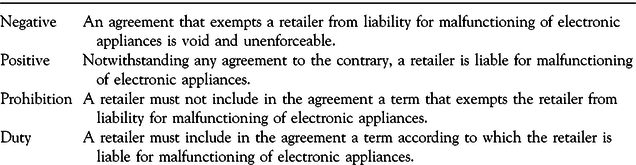
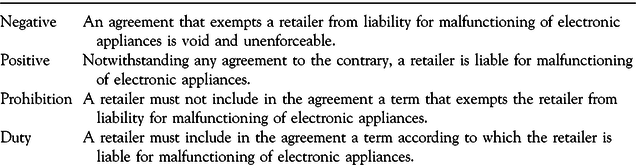
We used a mixed-factorial design, with the key independent variable—formulation of the rules—manipulated within-subject. Participants were randomly assigned to one of five versions of a survey about mandatory rules regarding various aspects of suppliers’ liability: Electronics, Contractor, Insurance, Apartment, and Apartment 24 months. Electronics dealt with a retailer’s liability for malfunctioning of electronic appliances; Contractor with a contractor’s liability for bodily injury or damage to property caused by its negligence; Insurance with an insurer’s liability for loss occurring while a building is temporarily unoccupied, under a fire-insurance policy; and Apartment and Apartment 24 months with a construction firm’s liability for defects discovered within a reasonable time and 24 months, respectively (see Appendix A). Each version comprised four formulations of a mandatory rule about the same issue: Negative, Positive, Prohibition, and Duty. The Negative formulation stated that a liability disclaimer was void and unenforceable. The Positive formulation imposed mandatory liability on the supplier. The Prohibition formulation prohibited the supplier from including a liability disclaimer in the agreement. Finally, the Duty formulation imposed a duty on the supplier to include a term about liability in the contract. Table 1 illustrates the four formulations in Electronics.
The Four Formulations of Electronics in Study 1
Existing law with regard to some of the rules used in Study 1 (and the following studies) is relatively uniform across the United States, yet it varies with regard to other rules. Thus, retailers can generally exclude their liability for malfunctioning of electronic appliances, provided that they use the required language and do so conspicuously and in writing (UCC § 2–316). This basically means that none of the formulations of Electronics are consistent with existing law. In contrast, while some states impose mandatory liability for construction defects in the sale of new apartments by construction firms, others do not (Carter, Van Alst, and Sheldon Reference Carter, Van Alst and Sheldon2015, 700–01; Zamir and Ayres Reference Zamir and Ayresforthcoming). Plausibly, the participants in Study 1 (and the following studies) did not know what the precise rules in their jurisdiction are—and even if they did, it is highly unlikely they would know how the rules are formulated (when they exist).
Each participant first read the set of four formulations of the rule (in one of four orders) and then assessed each formulation separately along eight 9-point Likert scales: Desirability, Fairness, Freedom, Paternalism, Market Competition, Protection of Weaker Party, Power Redistribution, and Wealth Redistribution (in that order; see Appendix A). For example, in the Desirability question, participants were asked to rate each formulation on a scale of 1 to 9, where 1 meant that the rule was very desirable, and 9 that it was very undesirable. Similarly, they were asked to rate each rule in terms of its fairness, limitation of the parties’ freedom of contract, paternalism, impact on market competition, protection of the weaker party, transfer of power from the stronger to the weaker party, and transfer of wealth from the richer party to the poorer one. A ninth scale was used as an attention check.Footnote 3 The instructions emphasized that participants should express their own opinion about the rules, regardless of what the actual rule in their jurisdiction might be. Thus, the study consisted of 5 (rules) x 4 (formulations) x 4 (orders of formulations) independent variables, and 8 dependent variables. At the end of the questionnaire, participants were asked to provide some demographic details, and to rate themselves on two 0–100 scales that gauged their ideological worldview (from liberal to conservative) and degree of religiosity, respectively.
A total of 250 subjects completed the survey for $1 each. Twenty-five participants who failed the attention question were excluded from the analysis.Footnote 4 Out of the remaining 225 participants, 127 were male, 96 female, and two did not indicate their gender. Their average age was 41.64 (SD=11.64). A total of 168 participants had attended college, or had higher education. The average ideological worldview was 29.62 (SD=41.67), where 0 indicated being liberal and 100 being conservative; and the average religiosity (where 0 meant not being religious at all and 100 strongly affiliated with religion) was 34 (SD=27.18).
Results
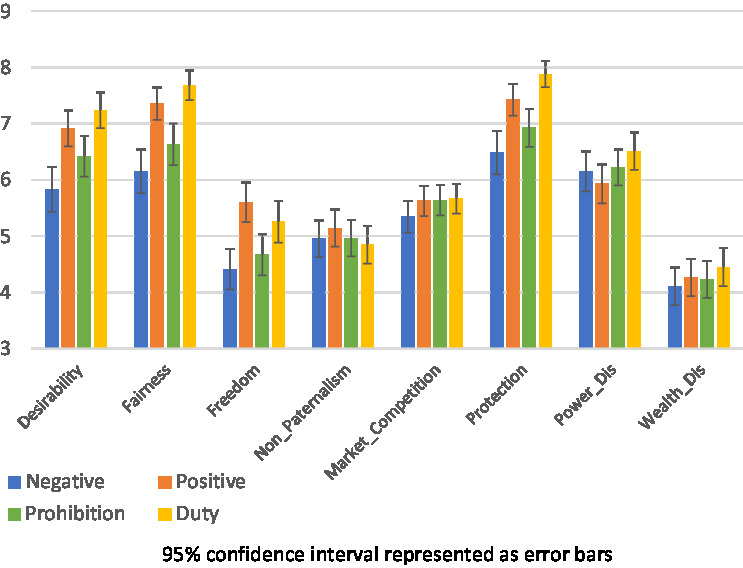
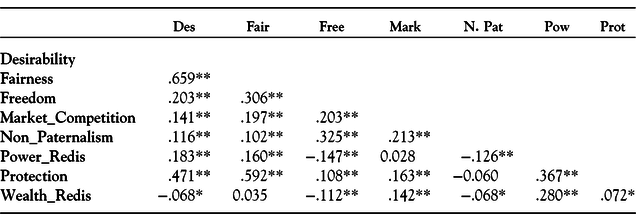
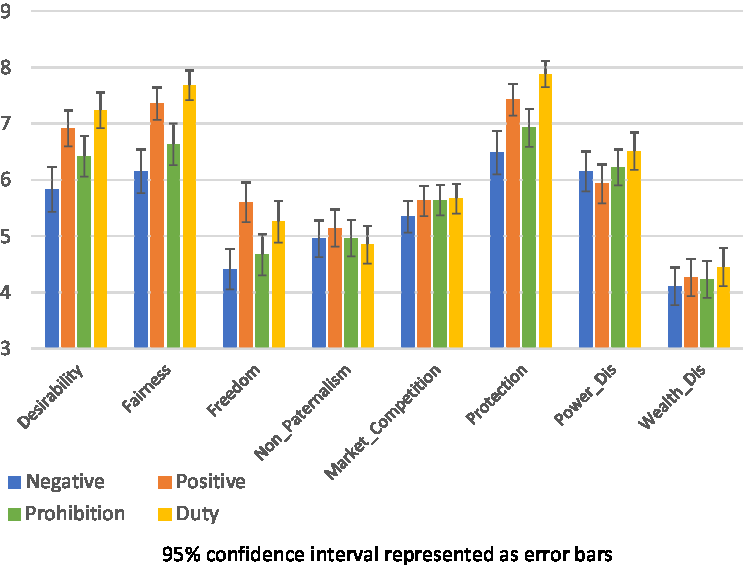
As depicted in Table A-1 (see Appendix B), although the different scales correlated with each other, most of the scales measured a unique attitude toward the formulation. However, the scales of Desirability, Fairness, and Protection were strongly correlated with one another and formed a unified reliable scale (α=0.8). They may therefore be considered as a measure of the same attitude. Figure 1 displays the mean answer for the five rules regarding the four formulations on each scale. For expositional purposes, when presenting the results of this study, we reversed the scales of Desirability, Fairness, Market Competition, Protection, Power Redistribution, and Wealth Redistribution, such that a high rating in each scale represents an apparent support of the rule (i.e., the highest rating means that the rule is very desirable, absolutely fair, not limiting freedom, greatly enhancing competition, not paternalistic, very protective, and clearly transfers power and transfers wealth).
Attitudes toward formulations (Study 1, N=225).
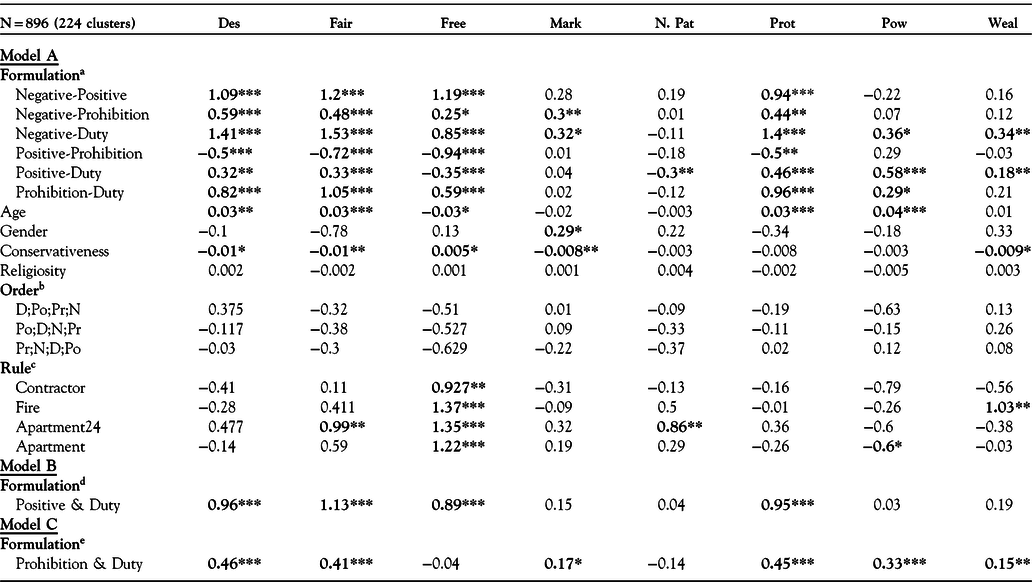
To better understand the effect of the different formulations on peoples’ attitudes, we ran a regression for each scale, using as predictors the formulations, rules, the order in which the formulations were presented, and the demographic details, clustered by participants (see Table 2, Model A).Footnote 5 These regressions show that gender, religiosity, and order of formulations had no significant effect on any of the scales. Age did have a very small effect on some of the scales: the older participants were the more they found the rule desirable, fair, protective, enhancing power redistribution, and limiting the parties’ freedom. Ideological worldview also had a small effect on people’s attitudes: compared to liberals, conservatives believed the rules to be less desirable, less fair, and less protective, more detrimental to market competition, and less effective in transferring wealth. The rules also had some effects on the scales, but since the rules differed from one another on several dimensions, no reliable conclusions can be drawn from these effects.
Linear Regression Analysis Using Attitudes’ Scales as Dependent Variables
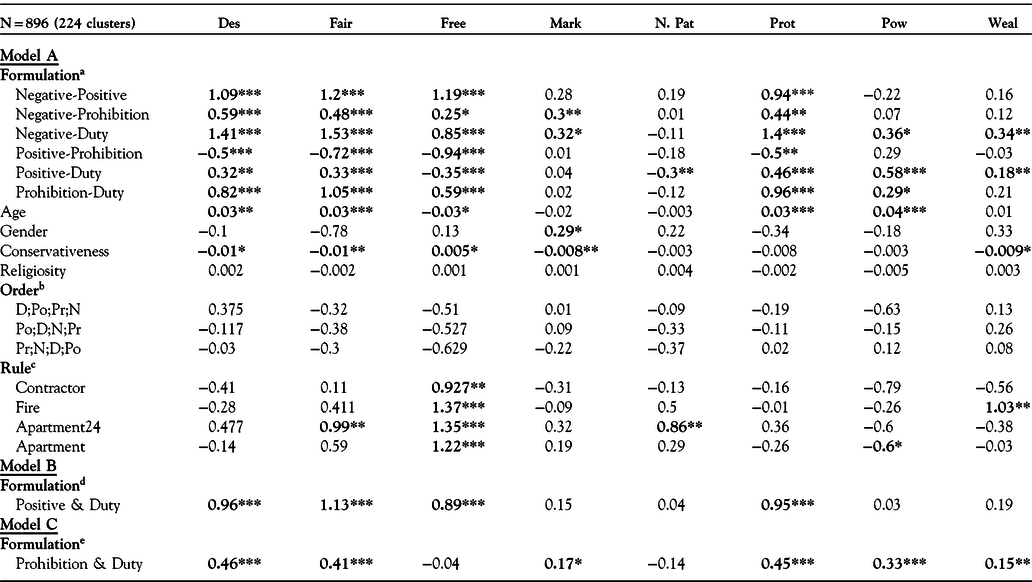
Notes: Standard errors clustered by participants; aTo calculate the effect for the six possible comparisons between formulations, we conducted three sets of regressions—each time using a different formulation as a reference category (being the first formulation in each pair). Since changing the reference category does not affect the coefficients of the other variables, all of these comparisons are reported in the same table. A positive value indicates that the second formulation was rated higher in term of desirability, fairness, etc.; bN;Pr;Po; Dserves as a reference category; cElectronics serves as a reference category; dNegative & Prohibition formulations together serve as a reference category; eNegative & Positive formulations together serve as a reference category.
*p < 0.1; **p < 0.05; ***p < 0.01
Most importantly, the way in which the rules were formulated had several statistically significant effects. In the main, participants ranked the formulations in terms of desirability, fairness, less limitation on freedom, and protectiveness in the following order: Duty, Positive, Prohibition, and Negative (where the Negative formulation was perceived as the least desirable, least fair, least protective, and (surprisingly) as imposing greater limits on the parties’ freedom (see Table 2, Model A). When we compared the Negative pair (Negative and Prohibition) to the Positive pair (Positive and Duty), the former was judged to be less desirable, less fair, and less protective (see Table 2, Model B). When comparing the formulations that merely laid down Substantive rules (Negative and Positive) to the Phrasing rules (Prohibition and Duty), it was found that the Substantive rules were perceived as less desirable, less fair, and less protective than the Phrasing rules. In addition, the participants thought the Substantive rules to be less effective in enhancing market competition and in transferring power and wealth (see Table 2, Model C).Footnote 6
To see if these attitudes were shared by conservatives, we conducted a further analysis, where we included only participants who rated themselves above 50 on the ideological worldview scale (MConserv=75.04; SD=16.4; N=77). The results did not change dramatically: even in this relatively small sub-sample, the Positive and Duty formulations were judged to be significantly more desirable than Negative (B=1.23, p=0.005; B=1.54, p < 0.001, respectively), and Duty was significantly more desirable than Prohibition (B=1, p=0.006). In addition, when pairs of formulations were considered, the Negative pair was significantly less desirable than the Positive pair (B=1.12, p=0.001), and the Substantive pair was significantly less desirable than the Phrasing pair (B=0.43, p=0.02).
Discussion
The results of Study 1 suggest that in general, people (or, at least, MTurk workers from the United States) are pro-customer in orientation and that they support the use of mandatory rules to protect customers. This conclusion derives from the correlation between the fairness and desirability scales and the protection scale: the more people perceived a rule to be protective of the weaker party, the more they viewed it as fair and desirable. Furthermore, the fact that the participants ranked the Negative formulation as the least desirable (and fair), and Duty as most desirable (and fair) suggests that they believed that relatively more intrusive measures are needed to protect customers. This conclusion is also supported by the findings that the Positive rules were judged to be more desirable than the Negative rules, and the Phrasing rules to be more desirable than the Substantive rules.
As previously noted, the pro-customer inclination was somewhat lower among conservatives. However, even they judged Positive and Duty as more desirable than Negative; Duty as more desirable than Prohibition; and the more intrusive pairs (Positive and Phrasing) as more desirable than the less intrusive ones (Negative and Substantive, respectively). It appears, therefore, that even relatively conservative participants favor more intrusive measures in a bid to protect customers.
Another surprising finding was the effect of formulation on the extent to which people believed that the rule limits the parties’ freedom. Counter intuitively, the participants considered the Negative formulation—which appears to be the least intrusive of the four—as the most restrictive of the parties’ freedom. This result possibly indicates that the participants focused on limitations of customers’ freedom rather than on that of suppliers, and believed that restricting suppliers’ freedom increases customers’ freedom. According to one possible interpretation, participants had a surprisingly sophisticated understanding of the notion of freedom, akin to the distinction between “negative” and “positive” liberty—and opted for the latter. As described in the Stanford Encyclopedia of Philosophy, “Negative liberty is the absence of obstacles, barriers or constraints. One has negative liberty to the extent that actions are available to one in this negative sense. Positive liberty is the possibility of acting—or the fact of acting—in such a way as to take control of one’s life and realize one’s fundamental purposes” (Carter Reference Carter2016; for a seminal discussion of this distinction, see Berlin Reference Berlin1969). Thus, participants who supported mandatory rules believed that the more effectively the law bars inappropriate, pro-supplier contractual arrangements, the more it promotes customer freedom.
Study 2: Within-Subject Design, Separate Judgments, Representative Sample
To confirm the surprising results of Study 1, Study 2 used a comparable design and the same statistical analysis, but with a different pool of participants. MTurk subjects from the United States are more representative of the US population than the in-person convenience samples that are often used by experimental researchers. However, there are some notable differences between the general US adult population and the MTurk sample pool. Studies have demonstrated that, compared to the general US population, MTurk respondents tend to be younger and more liberal, less religious, less racially diverse, more educated, and their annual income is lower (Berinsky, Huber, and Lenz Reference Berinsky, Huber and Lenz2012; Huff and Tingley Reference Huff and Tingley2015). Therefore, to enhance the external validity of our findings, we recruited participants through Toluna, a company specializing in web-based surveys. The participants in Study 2 were a representative sample of US adult population in terms of age, gender, income, and ethnicity.
Procedure and Participants
The design of Study 2 followed that of Study 1, with several modifications. First, of the five rules used in Study 1, in Study 2 we used only two: Electronics and Apartment (see Appendix A). As in Study 1, each participant read and assessed four formulations of the same rule. Then, instead of eight scales (plus one that served as an attention check), Study 2 featured only four scales (plus the attention check) only. We omitted the scales where no difference had been found in Study 1 between the formulations—namely, Paternalism, Market competition, Power Redistribution, and Wealth Redistribution. We also omitted the Protection-of-weaker-party scale, because of its high correlation with Desirability and Fairness in Study 1. At the same time, given the surprising—and not easily explicable—answers to the question about the formulation’s effect on “the parties’ freedom of contract” in Study 1, in the present study we split this scale into two: the rule’s effect on the supplier’s freedom of contract and its effect on the customer’s freedom of contract (see Appendix A).
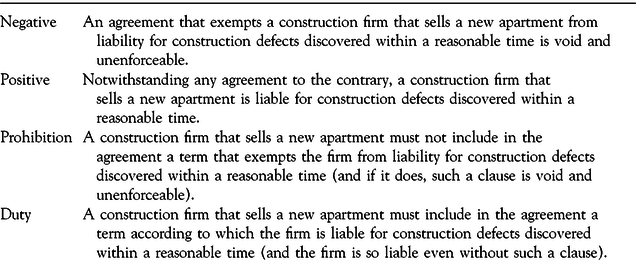
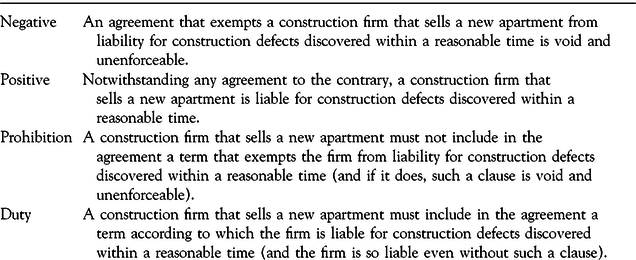
We also clarified the Prohibition and Duty formulations: in Prohibition it was explicitly stated that if, despite the prohibition, the supplier includes the prohibited clause in the contract, it is void and unenforceable; and in Duty it was clarified that the supplier is liable even if it fails to include the required clause in the contract (see Appendix A). To illustrate, Table 3 displays the four formulations of Apartment.
The Four Formulations of Apartment in Studies 2–4
Finally, while in Study 1 we inferred participants’ overall support for mandatory rules that protect customers, based on the correlation between the Desirability, Fairness, and Protection scales (the more people perceived a rule as protective of the weaker party, the more they saw it as desirable and fair), in Study 2 we added a direct question about participants’ general attitude toward pro-customer mandatory rules (General Support), as follows: “In general, what is your opinion about the prospect of the law setting mandatory rules (i.e., rules that the parties cannot contract around) in contracts between suppliers (including retailers, lenders, landlords, employers, and insurers) and customers (including buyers, borrowers, tenants, employees, and insureds)?” The participants marked their answer on a 9-point Likert scale, ranging from Strongly oppose to Strongly support such rules. Thus, the study consisted of 2 (rules) x 4 (formulations) x 4 (orders of formulations) independent variables, and 5 dependent variables (4 scales and the General Support question). After answering these questions, participants were asked to provide some demographic details (which, in Study 2, included participants’ annual income, as well) and to rate themselves on two 0–100 scales that gauged their ideological inclination (from liberal to conservative) and degree of religiosity, respectively.Footnote 7
A representative sample of 968 US adults participated in Study 2, online.Footnote 8 Half of the participants read the four formulations of the Electronics rule, and half the formulations of Apartment. Both halves were representative samples of the US adult population. Participants’ average score on the ideological worldview scale was 52.88 (SD=29.41), and average religiosity was 49.80 (SD=35.71). As expected, the general US population sample proved to be, on average, more conservative and more religious than the MTurk pool.
Results
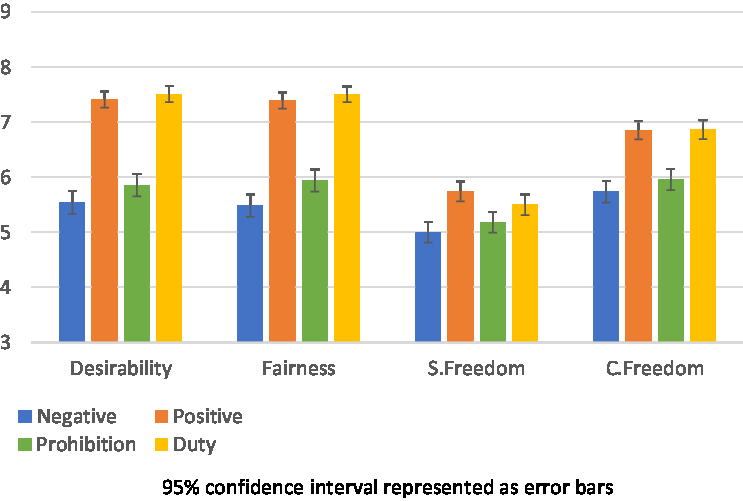
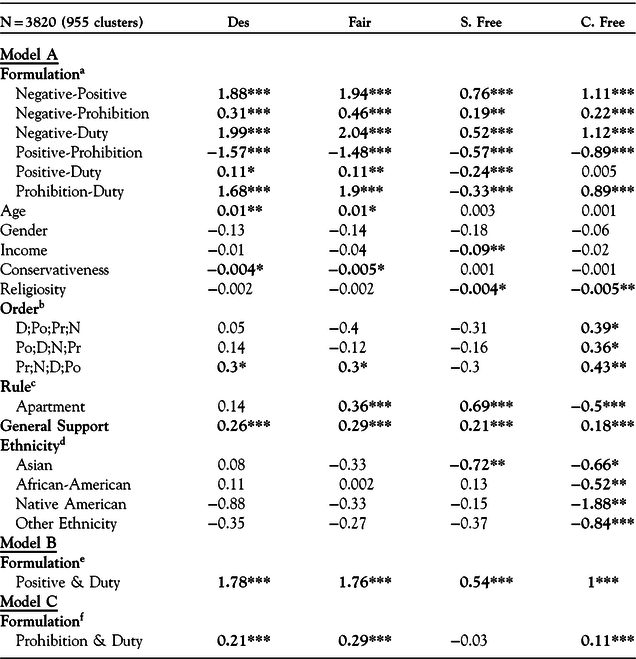
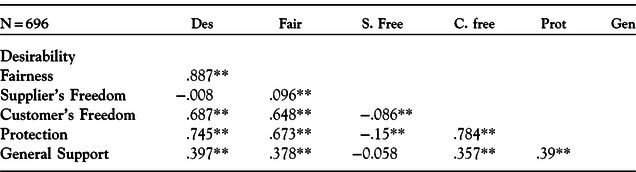
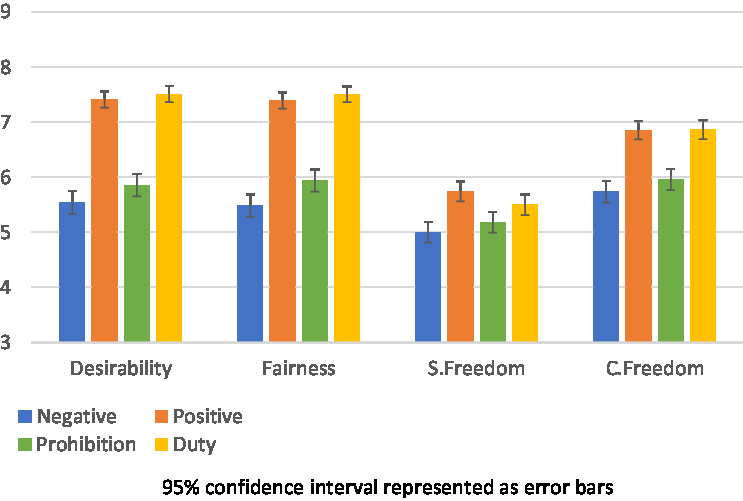
Figure 2 displays the mean answers on the four scales, regarding each formulation, for the two rules combined. To better understand the effect of the different formulations on peoples’ attitudes, we ran a regression for each scale, using as predictors the formulations, the rules, the order in which the formulations were presented, the participants’ answers to the General Support question, and the demographic details, clustered by participants (see Table 4, Model A).Footnote 9 The regression shows that age, gender, income, religiosity, ideological worldview, and order of formulations had very small, unsystematic, and mostly not statistically significant effect on any of the scales. Ethnicity had a significant effect on Customer’s Freedom, where white people perceived the rules as less restrictive of customers’ freedom. There were also differences between the two rules—across the four formulations, the Apartment rule was judged to be fairer and less restrictive of the supplier’s freedom, and more restrictive of the customer’s freedom, then the Electronics rule—but since the two rules varied in several respects, not much can be learned from these differences. Participants who were more supportive of mandatory rules in the General Support question judged the rules to be more desirable, fairer, and less restrictive of both the supplier’s and customer’s freedom.
Attitudes toward formulations (Study 2, N=968).
Linear Regression Analysis Using Attitudes’ Scales as Dependent Variables
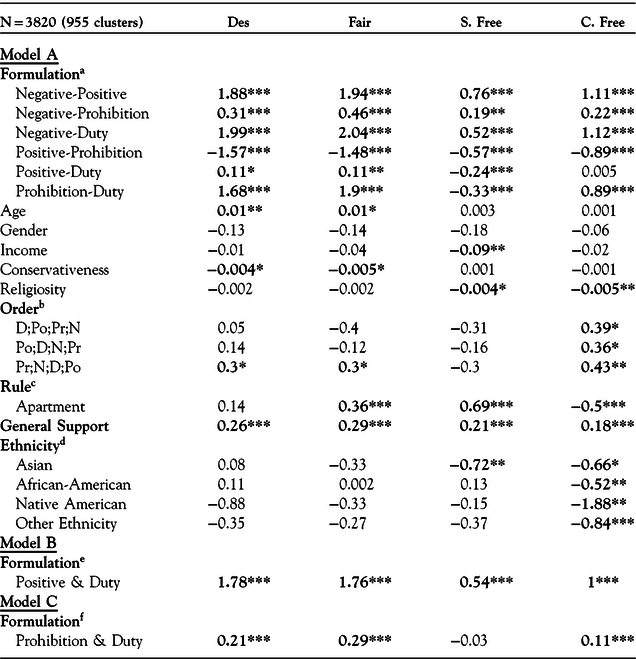
NOTES: Standard errors clustered by participants; aTo calculate the effect for the six possible comparisons between formulations, we conducted three sets of regressions, each time using a different formulation as a reference category (being the first formulation in each pair). Since changing the reference category does not affect the coefficients of the other variables, all these comparisons are reported in the same table. A positive value indicates that the second formulation was rated higher in term of its desirability, fairness, etc.; bN;Pr;Po;D serves as a reference category; cElectronics serves as a reference category; dWhite serves as a reference category; eNegative & Prohibition formulations together serve as a reference category; fNegative & Positive formulations together serve as a reference category.
*p < 0.1; **p < 0.05; ***p < 0.01
Notably, the way the rules were formulated significantly affected all the scales. Participants ranked the formulations in three of the scales—Desirability, Fairness, and Customer’s Freedom—in the following order: Duty, Positive, Prohibition, and Negative (where the Negative formulation was perceived as the least desirable, least fair, and most restrictive of customers’ freedom). In the Supplier’s Freedom scale, the order was Positive, Duty, Prohibition, and Negative (where the Negative formulation was perceived as the most restrictive of the supplier’s freedom). When we compared the Negative pair (Negative and Prohibition) to the Positive one (Positive and Duty), the former was judged as relatively less desirable, less fair, and more restrictive, both to the supplier’s and to the customer’s freedom (see Table 4, Model B). When comparing the formulations that merely laid down Substantive rules (Negative and Positive) to the Phrasing rules (Prohibition and Duty), the Substantive rules were judged to be less desirable, less fair, and more restrictive of customers’ freedom than the Phrasing rules (see Table 4, Model C).
To see if these attitudes were shared by conservatives, we conducted a further analysis where we included only participants who rated themselves above 50 on the ideological worldview scale (MConserv=76.76; SD=16.73; N=475 of the 955 who were included in the regression)—as we had done in Study 1. Most of the formulations’ effects on the four scales that were found to be significant when analyzing all responses remained statistically significant in this analysis, as well. The only meaningful differences were that among conservatives, the differences between Positive and Duty in the Fairness and Desirability scales were not statistically significant (although they were in the same direction).
In response to the General Support question, the participants in Study 2 strongly supported pro-customer mandatory rules. On a 9-point Likert scale ranging from Strongly oppose to Strongly support, the median was 7, and the mean was 6.48 (SD 2.18).Footnote 10 Of the 968 participants, only 136 (14 percent) marked their opinion in the range of 1 to 4, reflecting opposition to such rules; 172 (18 percent) marked 5, indicating that they neither opposed nor supported mandatory rules; and a considerable majority of 660 (68 percent) marked their opinion in the range of 6 to 9, reflecting various degrees of support for such rules. A similar picture emerged from the answers to the Desirability and Fairness questions across the four formulations of the two rules: M=6.58 (SD=2.93) and M=6.58 (SD=2.91), respectively, on scales of 1 to 9—where 9 indicates the greatest desirability and fairness.
While support for mandatory rules was not significantly associated with age, gender, or income, a linear regression showed that it was positively associated with liberal attitude and with religiosity (B=0.006, p=0.02; B=0.006, p=0.002, respectively). However, even when considering only the participants who rated themselves above 50 on the ideological worldview scale (482 out of 986)—namely the more conservative participants—the median and mean of their answers to the General Support question were very close to those of the entire sample: 7 and 6.38 (SD=2.29), respectively.
Discussion
By and large, the findings of Study 2 replicated the findings of Study 1 with a larger, representative sample of US adults. As in Study 1, the participants in the present study judged the Positive Pair (Positive and Duty) to be more desirable than the Negative Pair (Negative and Prohibition) and the Phrasing rules (Duty and Prohibition) as more desirable than the Substantive rules (Positive and Negative). It thus appears that the participants preferred more effective and intrusive mandatory rules to less effective and less intrusive ones. This preference was consistent with the strong support for pro-customer mandatory rules in the abstract, expressed in response to the General Support question (regardless of participants’ age, gender, and income). These judgments were shared by liberals and conservatives alike, with the participants’ ideological worldview having only a very small and marginally statistically significant effect.
The findings of Study 2 also shed light on the question raised by the findings of Study 1 concerning the judged effect of the various formulations on the parties’ freedom of contract. Recall that in Study 1, the Negative formulation—which is presumably the least intrusive of the four (because it neither positively dictates the content of the parties’ obligations, nor interferes with the wording of the contract)—was judged the most restrictive of the parties’ freedom. We conjectured that this judgment may have stemmed from the participants’ focus on the customer’s freedom, rather than the supplier’s, and their adoption of a positive notion of liberty that requires an ability to take control of one’s life and realize one’s goals (as opposed to merely having no external restrictions placed on one’s options).
Arguably, this conjecture was supported by the answers to the new question about customers’ freedom of contract: the participants judged the Positive pair (Positive and Duty) to be more conducive to customers’ freedom of contract than the Negative pair (Negative and Prohibition), and the Phrasing rules (Prohibition and Duty) as more conducive to customers’ freedom than the Substantive rules (Negative and Positive). Viewing more intrusive mandatory rules as enhancing customers’ freedom of contract is arguably inconsistent with a negative notion of freedom, as it decreases, rather than increases, the range of contractual possibilities open to them. Indirect support for our conjecture may also be found in the fact that across all formulations, the participants judged the mandatory rules to be significantly more restrictive of suppliers’ freedom of contract than of customers’ freedom of contract: M=5.35 (SD=2.96) and M=6.35 (SD=2.92), respectively (p < 0.001).
However, our conjecture would presumably entail that the ordering of the four formulations in terms of their impact on the supplier’s freedom would be the reverse of their ordering in relation to the impact on the customer’s freedom—but this is not what we found. In fact, the ordering of the four formulations in terms of their assessed impact on the supplier’s freedom was quite similar to their assessed impact on the customer’s freedom. Possibly, this was a manifestation of the halo effect. Originally identified by Edward (Reference Thorndike1920), the halo effect denotes the tendency for an impression created, or judgment made, with respect to one attribute (usually of a person, but occasionally of other objects) to influence impressions and judgments of other attributes (Greenwald and Banaji Reference Greenwald and Banaji1995, 9–10), or “the influence of a global evaluation on evaluations of individual attributes” (Nisbett and DeCamp Wilson Reference Nisbett and DeCamp Wilson1977, 250). Perhaps participants who assessed a given formulation as being more (or less) desirable and fair, tended to assess it as more (or less) conducive to the supplier’s freedom of contract, as well.
Study 3: Between-Subject Design, Separate Judgments
To better understand the results of the previous studies, and to examine their generality and robustness, Study 3 included several modifications compared to the previous ones. Most importantly, whereas in Studies 1 and 2 each participant saw all four formulations—thus highlighting the differences between them—in Study 3 each participant was asked to assess only one of the four formulations (Negative, Positive, Prohibition, or Duty) of four different rules (Electronics, Insurance, Contractor, and Apartment). We therefore examined our main independent variable in a between-subject design. Since the results of Apartment and Apartment 24 months were roughly similar in Study 1, in Study 3 we omitted the latter. We used five scales: Desirability, Fairness, Supplier’s Freedom of Contract, Customer’s Freedom of Contract, and Protection of the Weaker Party (see Appendix A). As in Study 2, Study 3 also included a question about the participants’ general attitude toward pro-customer mandatory rules (General Support).
Procedure and Participants
Each participant was randomly assigned to one of four versions of the survey. Each version featured four randomly ordered mandatory rules (Electronics, Insurance, Contractor, and Apartment), and each participant read only one formulation of the rules (Negative, Positive, Prohibition, or Duty). Participants assessed each rule individually, on five 9-point Likert scales: Desirability, Fairness, Supplier’s Freedom, Customer’s Freedom, and Protection of Weaker Party. They were then asked to rate their general support for mandatory rules in contracts on a 9-point Likert scale, and answer an attention question (similar to the one used in the previous studies) (see Appendix A). At the end of the survey, they were asked to provide some demographic details about themselves. Thus, the experiment consisted of 4 (rules) x 4 (formulations) independent variables, and 6 dependent variables (5 scales and the general support question).
A total of 201 MTurk master workers completed the survey. They were each paid $1.20 for taking part. Twenty-seven participants who failed the attention scale were excluded from the analysis, as were two participants who did not answer the demographic questionnaire. Of the 172 remaining participants, 99 were male and 73 were female.Footnote 11 Their average age was 38.99 (SD=10.48). Seventy-five percent of the participants had attended college or had higher education. Forty-one percent had an annual income of less the $30,000, 40 percent earned between $30,000 and $60,000 per year, and 19 percent earned more than $60,000 a year. Participants were asked to rate themselves on two scales: ideological world view and religiosity, ranging from 0 (liberal, or not at all religious) to 100 (conservative, or strongly affiliated with religion). The average score on the ideological worldview scale was 36.42 (SD=29.25) and the average religiosity 25.95 (SD=34.34).
Results
As depicted in Table A-2 (see Appendix B), most of the scales correlated with each other. When considering the scales of Desirability, Fairness, Customer’s Freedom, and Protection they form a unified reliable scale (α=0.89). The Supplier’s Freedom, however, had almost no correlation with the other scales combined (r=-0.037).
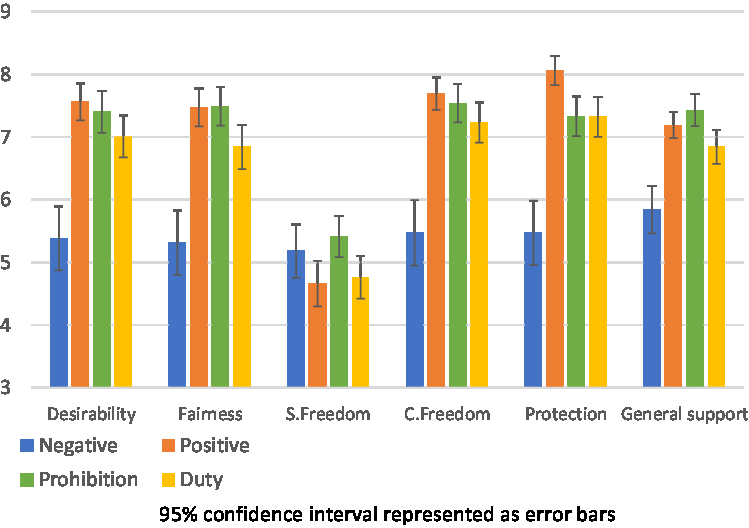
Figure 3 displays the average rating of the four rules with regard to the four formulations, on each scale, as well as the rating of the general support for mandatory rules. It demonstrates that Study 3 broadly replicated a key finding of Studies 1 and 2—namely, that the Negative formulation is perceived as the least desirable, fair, and protective; and the most restrictive of customers’ freedom. We did not, however, find the same effect with regard to the Supplier’s Freedom scale. Unlike Studies 1 and 2, where the various formulations were assessed within subject, in the between-subject design of Study 3 no significant differences were found between the other three formulations. The average rate on the general support of mandatory rules was 6.88 on a 1–9 scale (SD=1.95), and the median was 7. Eighty percent of the participants (138 of 172) supported pro-customer mandatory rules to some degree, by marking an answer in the range of 6–9, and only 15 percent (26 of 172) opposed them to some degree or other, by marking an answer in the range of 1–4 (the remaining 5 percent, 8 of 172, marked 5—meaning that they neither supported nor opposed mandatory rules).
Attitudes toward formulations (Study 3, N=172).
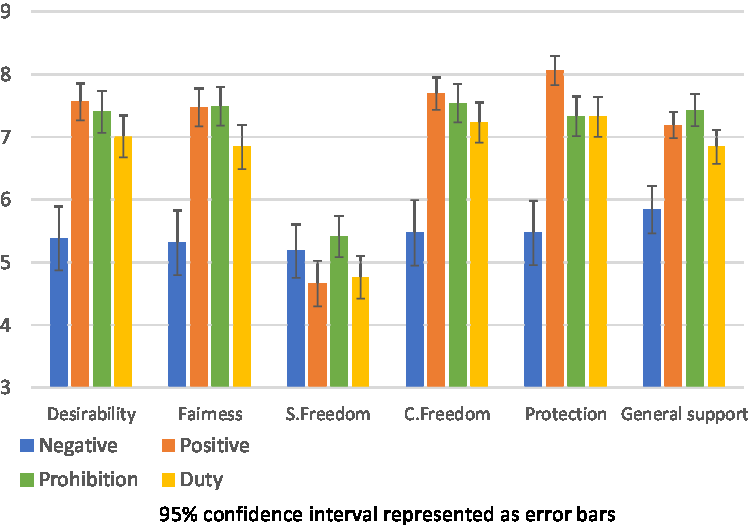
None of the demographic variables were statistically significantly associated with participants’ general support for mandatory rules. Interestingly, although the General Support scale did not refer to any specific formulation, participants were influenced by the formulation they read before they answered the General Support question: participants assigned to the Negative formulation were statistically significantly less in favor of mandatory rules than participants in the other conditions (compared with Positive: t(83)=-3.2 p=0.002; compared with Prohibition: t(82)=-3.48 p=0.001; compared with Duty: t(83)=-2.13 p=0.037)—which is in keeping with the fact that this formulation gained the smallest support.
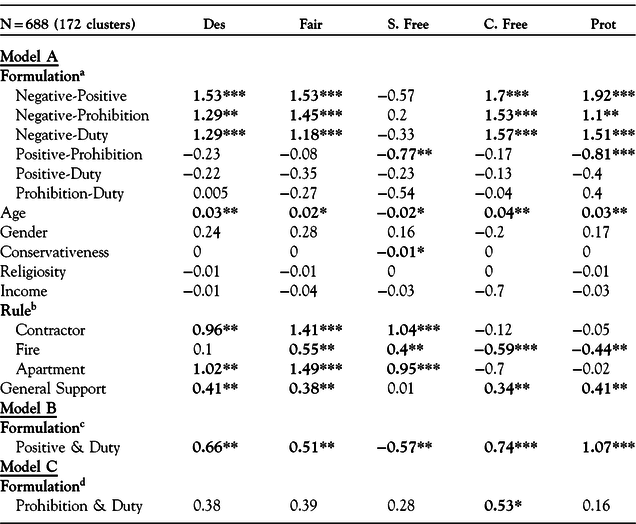
To better understand the effect of the different formulations on people’s attitudes, we ran a regression for each scale using as predictors the formulations, rules, General Support rating, and demographic details, clustered by participants (see Table 5, Model A).
Linear Regression Analysis Using Attitudes’ Scales as Dependent Variables
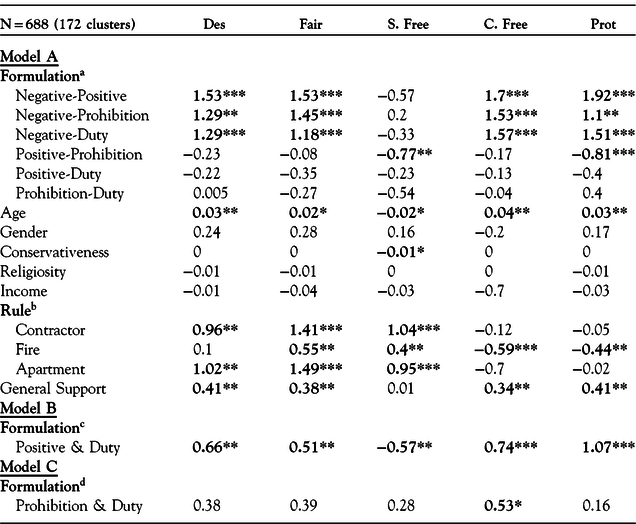
Notes: Standard errors clustered by participants; aTo calculate the effect for the six possible comparisons between formulations, we conducted three sets of regressions—each time using a different formulation as a reference category (being the first formulation in each pair). Since changing the reference category does not affect the coefficients of the other variables, all these comparisons are reported in the same table. A positive value indicates that the second formulation was rated higher in term of desirability, fairness, etc.; bElectronics serves as a reference category; cNegative & Prohibition formulations together serve as a reference category; dNegative & Positive formulations together serve as a reference category.
*p < 0.1; **p < 0.05; ***p < 0.01
The main results in the regressions are basically similar to what is shown in Figure 3, where the main effect of the Negative formulation remained significant across all four scales. The demographic details had no meaningful effect, and as expected given the within-subject presentation of the rules, the rules had several significant effects on the scales, but given the numerous differences between the rules, they are difficult to interpret.
Once again, no strong association was found between participants’ ideological worldview and their assessments of the various rules. However, when the correlation between participants’ general support for mandatory rules and their ideological worldview was calculated, we did find that being conservative is positively correlated with opposition to mandatory rules (r=-.32, p < 0.01).
Discussion
As one might expect, when moving from a within- to a between-subject design, the differences between the various formulations were less salient in terms of their judged desirability, fairness, etc. However, Study 3 did replicate one key finding of Studies 1 and 2—namely, the lesser judged desirability of Negative compared with the other, more intrusive formulations. It also showed that participants generally favor mandatory rules and replicated the finding that they believe that such rules enhance customers’ freedom. When controlling for the variables included in the regression, the formulation had no statistically significant effect on suppliers’ freedom.
Study 4: Within-Subject Design, Comparative Judgments
Study 4 had two major goals. First, it sought to further explore people’s attitudes toward different formulations of mandatory rules in a comparative, rather than separate, evaluation mode. Earlier research suggests that for a given set of options, when the options are presented simultaneously and evaluated in comparison with one another, people may rank them differently than when each option is presented on its own and evaluated separately (Hsee et al. Reference Hsee, Loewenstein, Blount and Bazerman1999). Thus, while Studies 1–3 elicited subjects’ assessment of each formulation separately on a 9-point Likert scale (although participants had read all four formulations before providing these separate assessments), Study 4 involved a direct comparison between pairs of possible formulations. The second goal of Study 4 was to directly elicit participants’ reasons for judging certain formulations as being more desirable than others. The comparative mode of evaluation allowed us to ask participants to describe the reasons for their judgments.
Procedure and Participants
We used a between-subject design, randomly assigning each participant to two of six possible pairs of formulations (Negative-Positive and Prohibition-Duty; Negative-Prohibition and Positive-Duty; Negative-Duty and Positive-Prohibition) of one of two rules (Electronics or Apartment). Each participant read only one rule and saw each formulation only once (in one of the two comparison he or she was reading). Order of formulations within each pair was counterbalanced between subjects (such that subjects who read, for example, Negative before Positive read Prohibition before Duty, and those who read Positive before Negative read Duty before Prohibition), and the order of pairs within each questionnaire was randomized.
Subjects were asked: “Which of the following two rules is more desirable in your opinion?,” and could mark one of three answers: “The first rule/The second rule/The two rules are equally desirable.” They were then instructed: “Please explain why you have answered the previous question as you did.” Subsequently, as in Studies 2 and 3, subjects were asked to rate their general support for contractual mandatory rules on a 9-point Likert scale, and to provide demographic details about themselves. Thus, the study consisted of 2 (rules) x 6 (combinations of pairs of formulations) x 2 (order of formulations) independent variables.
A total of 344 MTurk master workers—167 male, 176 female, and one who did not indicate gender—took part in the study in return for $0.60. Their average age was 39.51 (SD=10.83).Footnote 12 A total of 245 participants had attended college or had higher education. Thirty-eight percent had an annual income of less than $30,000; 38 percent earned between $30,000 and $60,000 a year; and 24 percent had a yearly income of over $60,000. As in the previous studies, the participants were asked to rate themselves on the ideological worldview and religiosity scales of 0–100. The average ideological worldview was 38.13 (SD=28.72) (where 0 means liberal), and the average religiosity 29.16 (SD=35.9) (where 0 indicates not religious at all).
Results
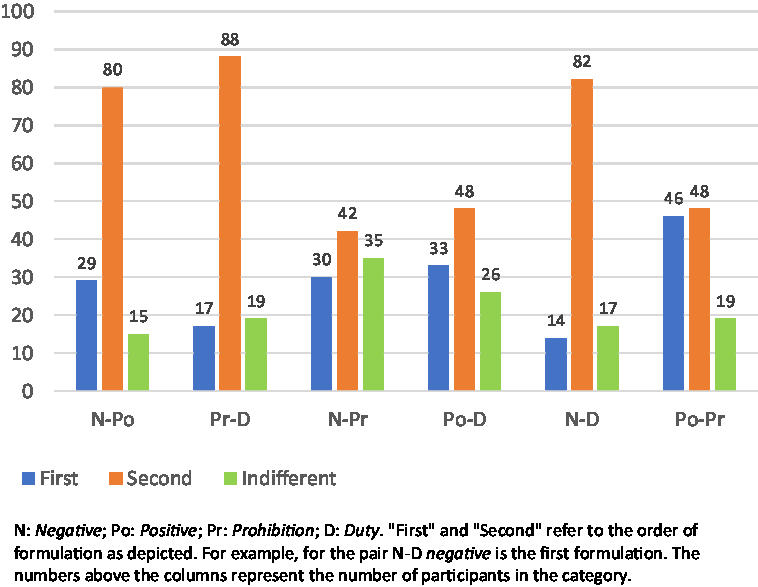
The order of the formulations within each pair had no statistically significant effect in five of the six comparisons.Footnote 13 Similarly, the rule (Apartment or Electronics) had no statistically significant effect in five out of the six comparisons.Footnote 14 Across the two orders and two rules, after excluding subjects who were indifferent between the two formulations, three of the comparisons had a significant effect: subjects judged Positive to be more desirable than Negative (NPositive: 80; NNegative: 29; χ2(1)= 23.862; p < 0.001); Duty as more desirable than Negative (NDuty: 82; NNegative: 14; χ2(1)=48.16; p < 0.001); and Duty as more desirable than Prohibition (NDuty: 88; NProhibition: 17; χ2(1)= 48.01; p < 0.001). In addition, one comparison had a marginally significant effect: subjects judged Duty as more desirable than Positive (NDuty: 48; NPositive: 33; χ2(1)=2.78; p=0.096). These judgments replicate, in a comparative mode, the judgments expressed in Studies 1 and 2 in the separate evaluation mode.Footnote 15 Figure 4 depicts the judgments of comparative desirability across the six comparisons.
Formulations’ Comparative Desirability (Study 4, N=344).
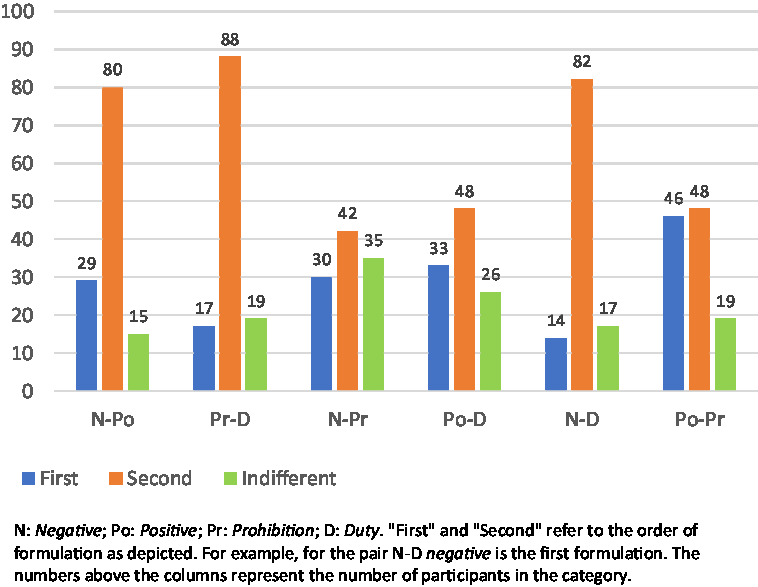
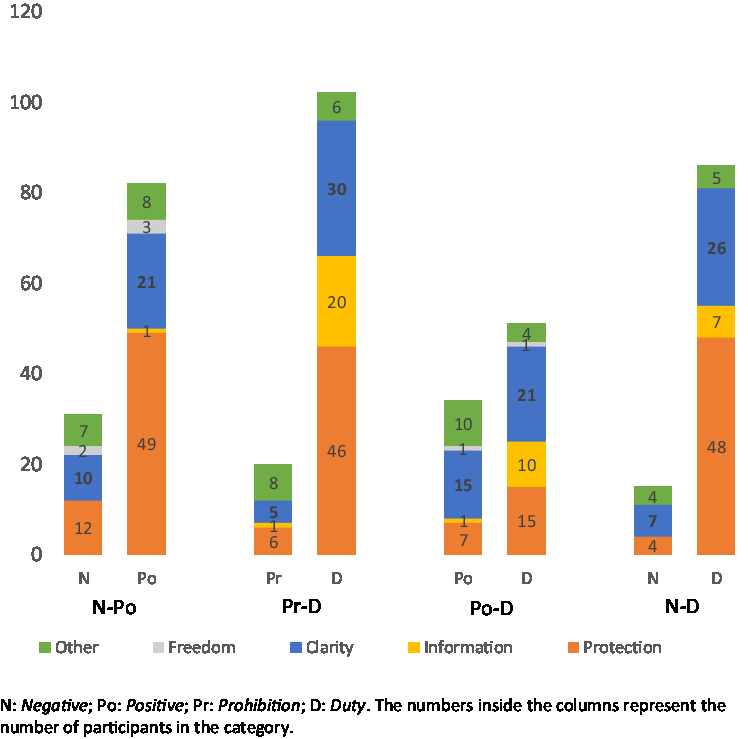
To analyze participants’ explanations for their judgments of comparative desirability, we coded their answers into five categories: (1) Greater Protection for customers (including arguments that the preferred formulation was more effective; provided customers with greater protection; or imposed a higher level of liability on suppliers; as well as arguments such as that the supplier should be held liable and that the preferred formulation enhances the chances of enforcement); (2) Information (including arguments highlighting the importance of informing customers of their rights; making customers aware of their rights; and giving information in advance); (3) Clarity of the rule (including arguments that the preferred formulation is straightforward; clearer; provides greater certainty; avoids “legal mumbo jumbo”; is more explicit; more specific; avoids double negatives; and that positive phrasing is preferable to negative); (4) Freedom of contract (including arguments that the preferred formulation promotes freedom of choice, and involves less governmental regulation); and (5) Other (including phrases such as: “because it allows to deal with disputes on a case-by-case basis,” and statements that the preferred formulation was “fairer” without indicating why).
When participants provided explanations that belonged to two different categories, each explanation was coded separately (no participant provided more than two different explanations). Two research assistants coded the explanations independently. Usually there was agreement between the two coders, and when there were differences, we examined the coding, and resolved the controversies.
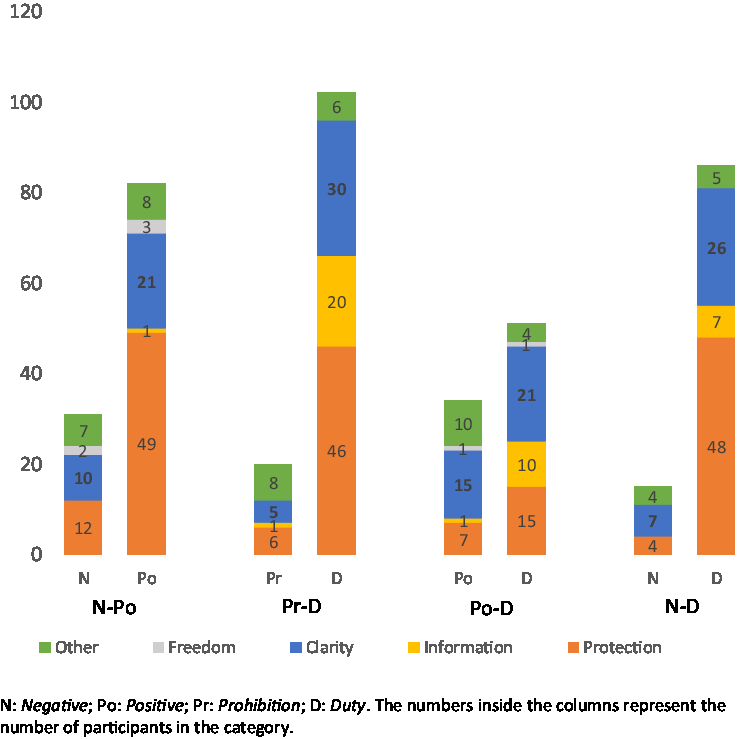
Figure 5 displays participants’ explanations for each of the four comparisons that yielded statistically, or marginally statistically, significant differences. As it demonstrates, the most prevalent reason given by participants for their judgments was that the more desirable formulation in their opinion provided greater protection for customers.
Explanations for Judgments of Comparative Desirability.
Participants’ answers regarding their general support of mandatory rules replicated the results of the previous studies, revealing a general support for pro-customer mandatory rules (Median: 7, Mean: 6.69 (SD=1.76) on a 9-point scale). Of the 344 participants, 255 (74 percent) supported such rules, 34 (10 percent) opposed them, and 55 (16 percent) neither supported nor opposed them. A linear regression showed a significant positive association between the level of support for mandatory rules and a liberal attitude (B=0.01, p=0.0001). The rule participants were presented with before they answered this question had no statistically significant effect on their answer (t(142)=0.719; p=0.47).
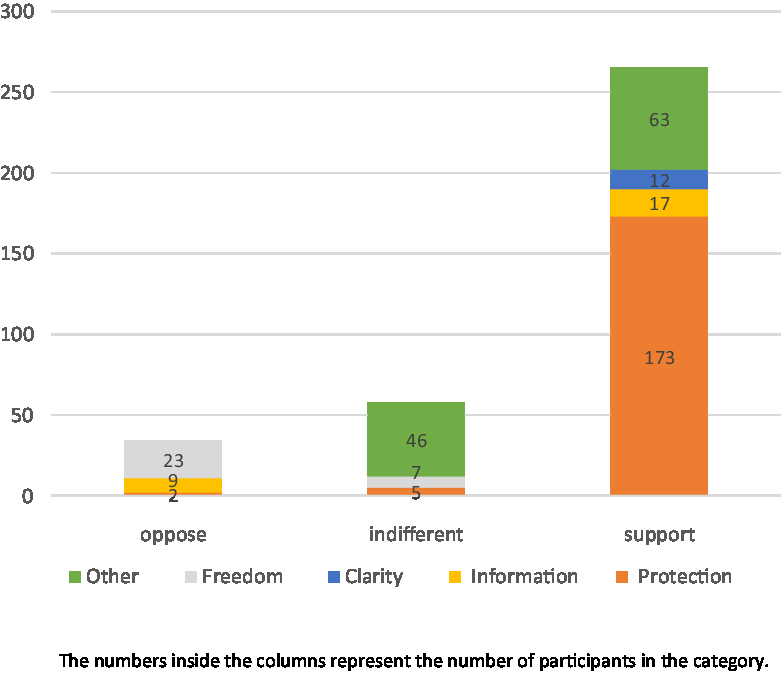
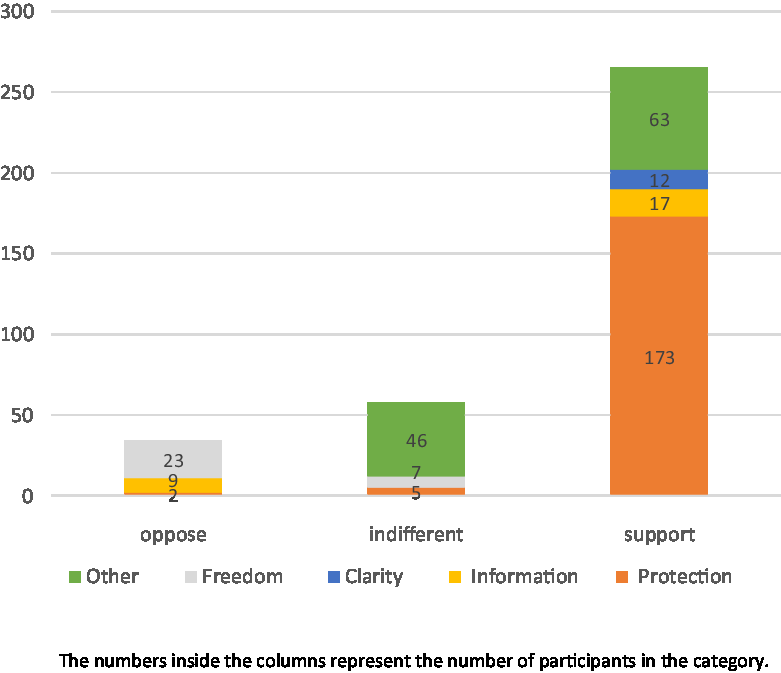
To analyze participants’ explanations for their level of support for mandatory rules, we used the same coding method as in the coding of the explanations for participants’ judgments of comparative desirability. Here too, the main reason for people’s general support for mandatory rules was that such rules enhance the protection afforded to customers. Figure 6 displays participants’ explanations for their level of support for mandatory rules, divided into three groups: Oppose mandatory rules (participants who answered 1–4 on the 9-point scale), Indifferent (participants who answered 5 on the scale), and Support (those who answered 6–9).
Explanations for Level of Support for Mandatory Rules.
Discussion
The results of Study 4 generally corroborate the results of the previous studies. In a direct comparison between pairs of formulations, Positive was judged to be more desirable than Negative, and Duty more desirable than Prohibition, Negative, and (marginally statistically significantly) Positive. Apparently, of the six comparisons, it is easier to draw a comparison within the two Substantive rules (Negative and Positive) and within the two Phrasing rules (Prohibition and Duty), as they differ from one another in only one respect—and indeed there were statistically significant results in these two comparisons. While it is more difficult to compare between formulations that differ in two parameters (negative versus positive, and substantive versus phrasing rules), it is nevertheless quite easy to compare between Negative and Duty, as the former is seen as inferior on both counts, since it belongs both to the Negative pair and to the Substantive rules; hence—as in Studies 1 and 2—Duty was judged to be more desirable than Negative. The most difficult comparison to draw is arguably between Positive and Prohibition, as each of them might appear superior in one dimension: Positive on the negative/positive dimension, and Prohibition on the substantive/phrasing dimension. Accordingly, there was no statistically significant difference between these two formulations. Finally, while the Negative pair (Negative and Prohibition) and the Positive pair (Positive and Duty) may also be described as involving a single dimension, there was no statistically significant result in the former, and only marginally significant result in the latter—possibly because it was more difficult to draw those comparisons.
Beyond the specific comparisons, Study 4 replicated the results of the previous studies in finding strong support for mandatory rules in general. The analysis of the explanations participants gave to their judgments of the relative desirability of the various rules showed that these were driven mostly by the desire to protect the interests of customers. In this respect, explanations coded under the category of Information may arguably be combined with those coded under Protection, as it stands to reason that participants who preferred a given formulation because it better informs customers of their rights, thought that this would result in more effective protection of customers’ interests. The fact that, in the three comparisons where Duty was judged more desirable than the other three formulations, participants who judged Duty to be more desirable mentioned Protection much more often than Information (109 versus 37 times), may indicate that most of the participants do not value more information per se, but rather seek greater protection of customers’ interests.Footnote 16 These results are consistent with the correspondence found in the previous studies between the judged Desirability of formulations rules and their judged Protection.
The explanations given by the participants for their answers to the General Support question, as visually depicted in Figure 6, possibly shed light on the findings of the previous studies regarding the assessed impact of the various formulations on freedom of contract. Recall that in Study 1, the participants judged the more intrusive formulations to be more conducive to freedom of contract; in Study 2 they made a similar judgment about the effect of such rules on both the customer’s and the supplier’s freedom of contract (though the effect was less pronounced in relation to the supplier’s freedom); and in Study 3 they made such a judgment about the formulations’ effect on the customer’s freedom of contract—but not on the supplier’s freedom. While this inconsistency raises a question about the validity of the findings concerning this issue, Study 4 possibly clarifies the picture. In Study 4, none of the participants who supported mandatory rules (255 out of 344) indicated that such rules enhance freedom of contract. Concomitantly, a large majority of the small minority of those who opposed such rules—23 out of 34—did so because mandatory rules curtail freedom of contract. It appears that people who strongly care about freedom of contract, and prioritize it over other values, do not support mandatory rules. The large majority of people, who support such rules, apparently do not care much about freedom of contract when it is at odds with customer protection.
GENERAL DISCUSSION AND CONCLUSION
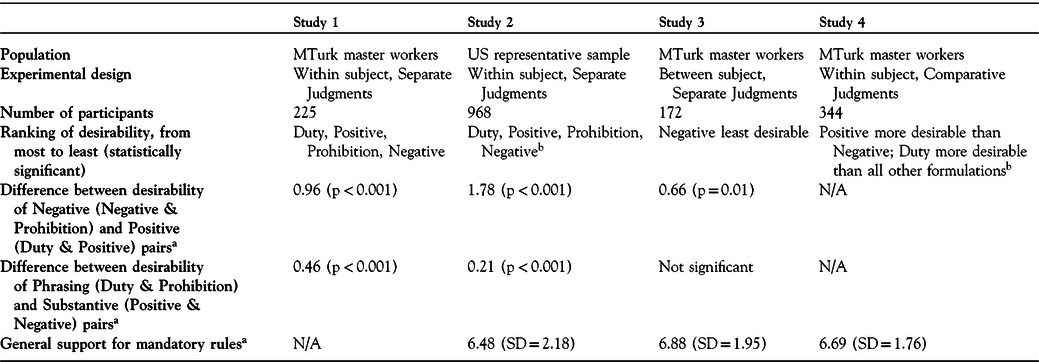
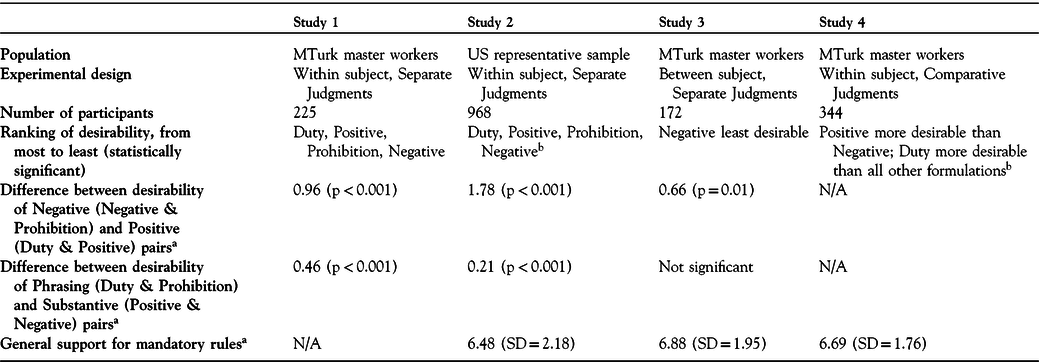
As summarized in Table 6, the picture emerging from the four studies is quite consistent.
Summary of Findings of Studies 1–4
aOn a scale of 1 to 9; bThe difference between duty and positive was marginally significant.
Contrary to our initial, tentative hypothesis, the participants in our studies generally judged more intrusive rules—i.e., those that are not content with merely invalidating exemption clauses, but rather positively impose liability, and those that go beyond substantive rules and regulate the wording of contracts by the suppliers—as being more desirable, fairer, and more protective of customers’ interests.Footnote 17 They also tended to judge the more desirable rules as enhancing freedom of contract—at least when focusing on customers’ freedom. These results were obtained in studies conducted with MTurk master workers and with a large, representative sample of US adult population; they were obtained primarily in a within-subject design, but largely corroborated in a between-subject design, as well; they were basically replicated both in separate judgments of the various formulations and in a comparative judgment of their desirability; and substantiated by the reasons participants gave for their rankings.
We also found strong support among US responders for mandatory rules in contracts between retailers and consumers, insurers and insureds, contractors and their clients, and construction firms and real estate buyers. This strong support was shared by men and women, younger and older participants, poorer and more affluent people, and across ethnic groups. While in some of the studies, the more liberal participants were somewhat more supportive of pro-customer mandatory rules than the more conservative participants, the latter expressed strong support for such rules, as well.
While the evidence provided by the four studies appears to be robust, we concede that our findings and their proposed explanations are not conclusive. In particular, when gauging people’s general support for mandatory rules, we did not ask them to compare such rules with other modes of regulation—such as disclosure duties or nudges. Therefore, it would be useful to examine the robustness and generalizability of our preliminary findings with other rules, other designs, and other research methodologies, and in comparison with other modes of regulation. Future research should also empirically study the impact of various formulations of mandatory rules on the drafting of contracts by suppliers; on customers’ inclination to challenge dubious contractual terms; and on judicial decision-making when the validity of such terms is adjudicated.Footnote 18 Another possible extension would be to study the prevailing views about mandatory rules in other societies.
Assuming, reasonably, that public attitudes to pro-customer mandatory rules is an important consideration that policymakers should take into account for principled (democratic) and pragmatic (compliance) reasons, our findings arguably suggest that legal policymakers should introduce more, and more effective, mandatory rules. However, this argument is, again, inconclusive, as other arguments point at the opposite direction. It stands to reason that, since the great majority of participants in all of our studies were customers rather than suppliers, they were naturally inclined to take the customer’s perspective on the pertinent issues, rather than an all-things-considered perspective. To be sure, this fact does not detract from the external validity of our findings, as it is generally true that in their daily lives, most people act as customers rather than as suppliers (and while most customers never make judgments or decisions as suppliers, those who make decisions on behalf of suppliers do act as customers in their daily lives). However, just as the majority’s views do not ipso facto justify rules and policies that adversely affect the interests of members of minority groups, customers’ judgments do not necessarily justify the introduction of pro-customer mandatory rules. Customers’ may even be wrong as to what is best for them. Arguably, the participants who expressed support for more intrusive mandatory rules might have failed to consider the effect of such rules on prices, insurance premiums, etc. Future research should examine this claim. It should be noted, however, that previous empirical findings suggest that unlike other variables (such as market competition), the one-sidedness of “invisible terms,” such as exemption clauses, have little, if any, effect on prices (Marotta-Wurgler Reference Marotta-Wurgler2007, Reference Marotta-Wurgler2008).
As previously noted, mandatory rules are less prevalent in the United States than in many other Western countries.Footnote 19 Since the normative arguments for and against the use of mandatory rules are basically similar in all liberal-democratic societies and the socioeconomic conditions in those societies are comparable, one may wonder why US legal policymakers, at the federal and state levels alike, are considerably more reluctant to use pro-customer mandatory rules than their counterparts elsewhere in the world. Our preliminary results suggest that the explanation for this reluctance most likely does not lie with public opposition to such rules, since there appears to be a strong support for them, which cuts across various strata of society. In the same vein, the current inclination to use substantive—rather than phrasing—mandatory rules cannot be explained by public opposition to phrasing rules, as the public actually appears to favor them. Rather, the relative paucity of mandatory rules (and the rarity of phrasing rules) in the United States is likely due to other factors. One such factor might possibly be the neoliberal ideology of US elites, including lawmakers and regulators. Another factor might be regulatory capture by organized interest groups (Lessig Reference Lessig2011; Lehman Schlozman, Verba, and Brady Reference Schlozman, Verba and Brady2012; Gilens and Page Reference Gilens and Page2014; Bartels Reference Bartels2016). Without delving into these big issues, which lie beyond the scope of the present discussion, we believe that our findings should give legal policymakers much food for thought.
Appendix A. Text of Studies
Rules and Formulations
Electronics (All studies)
[Negative] An agreement that exempts a retailer from liability for malfunctioning of electronic appliances is void and unenforceable.
[Positive] Notwithstanding any agreement to the contrary, a retailer is liable for malfunctioning of electronic appliances.
[Prohibition] A retailer must not include in the agreement a term that exempts the retailer from liability for malfunctioning of electronic appliances [Studies 2–4: (and if it does, such a clause is void and unenforceable)].
[Duty] A retailer must include in the agreement a term according to which the retailer is liable for malfunctioning of electronic appliances [Studies 2–4: (and the retailer is so liable even without such a clause)].Footnote 20
Contractor (Studies 1 and 3)
[Negative] An agreement that exempts a contractor from liability for bodily injury or damage to property caused by its negligence is void and unenforceable.
[Positive] Notwithstanding any agreement to the contrary, a contractor is liable for bodily injury or damage to property caused by its negligence.
[Prohibition] A contractor must not include in the agreement a term that exempts the contractor from liability for bodily injury or damage to property caused by its negligence [Study 3: (and if it does, such a clause is void and unenforceable)].
[Duty] A contractor must include in the agreement a term according to which the contractor is liable for bodily injury or damage to property caused by its negligence [Study 3: (and the contractor is so liable even without such a clause)].Footnote 21
Insurance (Studies 1 and 3)
[Negative] A fire insurance policy that exempts the insurer from liability for loss occurring while the building was temporarily unoccupied is void and unenforceable.
[Positive] Notwithstanding any agreement to the contrary, the insurer in a fire insurance is liable even if the loss is occurring while the building was temporarily unoccupied.
[Prohibition] An insurer who issues a fire insurance policy must not include in the policy a term that exempts the insurer from liability for loss occurring while the building was temporarily unoccupied [Study 3: (and if it does, such a clause is void and unenforceable)].
[Duty] An insurer must include in a fire insurance policy a term according to which the insurer is liable even if the loss is occurring while the building was temporarily unoccupied [Study 3: (and the insurer is so liable even without such a clause)].Footnote 22
Apartment (All studies)
[Negative] An agreement that exempts a construction firm that sells a new apartment from liability for construction defects discovered within a reasonable time is void and unenforceable.
[Positive] Notwithstanding any agreement to the contrary, a construction firm that sells a new apartment is liable for construction defects discovered within a reasonable time.
[Prohibition] A construction firm that sells a new apartment must not include in the agreement a term that exempts the firm from liability for construction defects discovered within a reasonable time [Studies 2–4: (and if it does, such a clause is void and unenforceable)].
[Duty] A construction firm that sells a new apartment must include in the agreement a term according to which the firm is liable for construction defects discovered within a reasonable time [Studies 2–4: (and the firm is so liable even without such a clause)].Footnote 23
Apartment 24 months (Study 1)
[Negative] An agreement that exempts a construction firm that sells a new apartment from liability for construction defects discovered within 24 months is void and unenforceable.
[Positive] Notwithstanding any agreement to the contrary, a construction firm that sells a new apartment is liable for construction defects discovered within 24 months.
[Prohibition] A construction firm that sells a new apartment must not include in the agreement a term that exempts the firm from liability for construction defects discovered within 24 months.
[Duty] A construction firm that sells a new apartment must include in the agreement a term according to which the firm is liable for construction defects discovered within 24 months.
ScalesFootnote 24
Desirability (Studies 1–3)
How would you rate each of the rules along a scale of 1 to 9, where 1 indicates that the rule is very desirable, and 9 indicates that it is very undesirable?
Fairness (Studies 1–3)
How would you rate each of the rules along a scale of 1 to 9, where 1 indicates that the rule is absolutely fair, and 9 indicates that it is absolutely unfair?
Freedom (Study 1)
How would you rate each of the rules along a scale of 1 to 9, where 1 indicates that the rule extremely limits the parties’ freedom of contract, and 9 indicates that the rule does not limit the parties’ freedom of contract at all.
Supplier’s Freedom (Studies 2 and 3)
How would you rate [Study 2: each of the rules; Study 3: this rule] on a scale of 1 to 9, where 1 means that the rule extremely restricts the [retailer’s/contractor’s/insurer’s] freedom of contract [of the construction firm], and 9 that the rule does not restrict the [retailer’s/contractor’s/insurer’s] freedom of contract [of the construction firm] at all.
Customer’s Freedom (Studies 2 and 3)
How would you rate [Study 2: each of the rules; Study 3: this rule] on a scale of 1 to 9, where 1 means that the rule extremely restricts the [buyer’s/owner’s/insured’s] freedom of contract [of the purchaser], and 9 that the rule does not restrict the [buyer’s/owner’s/ insured’s] freedom of contract [of the purchaser] at all.
Paternalism (Study 1)
How would you rate each of the rules along a scale of 1 to 9, where 1 indicates that the rule is extremely paternalistic, and 9 indicates that it is not paternalistic at all?
Market (Study 1)
How would you rate each of the rules along a scale of 1 to 9, where 1 indicates that the rule greatly enhances market competition, and 9 indicates that it greatly reduces market competition?
Protection (Studies 1 and 3)
How would you rate each of the rules along a scale of 1 to 9, where 1 indicates that the rule protects the weaker party very much, and 9 indicates that it does not protect the weaker party at all?
Power Redistribution (Study 1)
How would you rate each of the rules along a scale of 1 to 9, where 1 indicates that the rule clearly transfers power from the stronger party to the weaker one, and 9 indicates that it does not transfer power from the stronger to the weaker party at all?
Wealth Redistribution (Study 1)
How would you rate each of the rules along a scale of 1 to 9, where 1 indicates that the rule clearly transfers wealth from the richer party to the poorer one, and 9 indicates that it does not transfer wealth from the richer to the poorer party at all?
General Support (Studies 2–4)
In general, what is your opinion about the prospect of the law setting mandatory rules (i.e., rules that the parties cannot contract around) in contracts between suppliers (including retailers, lenders, landlords, employers, and insurers) and customers (including buyers, borrowers, tenants, employees and insureds)? Please mark your answer on a scale of 1 to 9, where 1 indicates that you strongly oppose such mandatory rules, and 9 means that you strongly support them.
Attention check (Studies 1 and 2)
How would you rate each of the rules along a scale of 1 to 9, where 1 indicates that you read the rules before you marked your answers on the previous scales, and any other number indicates that you did not read the rules before answering the scales at all?
Attention check (Study 3)
How would you rate the rules presented above on a scale of 1 to 9, where 3 indicates that you have read the rules before marking your answers, and any other number indicates that you did not?
Appendix B. Tables
Correlations Between the Answers Across the Five Rules and the Four Formulations on Each Scale
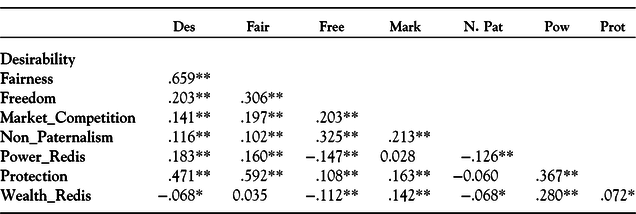
*p < 0.5; **p < 0.01
Correlations Between the Answers Across the Four Rules and the Four Formulations on Each Scale 1
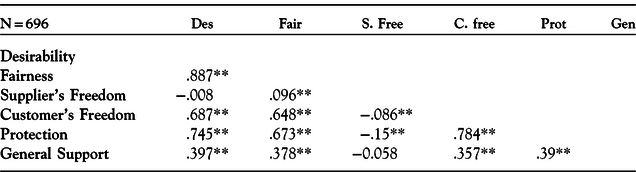
*p < 0.5; **p < 0.01