Professional discourse and its role in social work
The formal social work discourse in many countries has explicitly emphasised the profession's commitment to confronting the problem of poverty and to aiding those living in poverty. This is manifested in professional ethical codes in the United States (NASW, 1999), Canada (CASW, 2005) and Israel (ISASW, 1995), and has been reconfirmed during the last decade (Krumer-Nevo, Reference Krumer-Nevo2006; Craig, Reference Craig2002; Jordan, Reference Jordan2008). Given these manifestations of professional commitment in the declared modes of social work discourse, it might be expected that one would find also references in other modes of the professional discourse to what Davis and Wainwright (Reference Davis and Wainwright2005) call ‘poverty-aware social work’.
Professional discourse includes a profession's written texts or the language spoken between specialists in the same profession (intra-professional discourse), between those in different professions (inter-professional discourse), and between professionals and clients. It also includes different forms of non-verbal communication (Gunnarsson et al., Reference Gunnarsson, Linell, Nordberg, Gunnarsson, Linell and Nordberg1997; Linell, Reference Linell1998). It is a form of social practice operating according to conventions and generally accepted rules, even if those are not explicitly stated or made conscious (van Dijk, Reference Van Dijk and Van Dijk1997). Indeed we can presume that the more formal the discourse (e.g. written documents such as codes of ethics, mission statements, public professional reports), the more it will tend to reflect the profession's declared ethos. The more informal the discourse (e.g. oral discourse, intra-profession conversations, staff meetings, corridor talk), the less self-conscious it might be.
In contrast to the perspective that emphasises professional discourse as a reflection of the ideal shape a profession should take, a critical perspective emphasises the role of professional discourse in creating and structuring the profession and its associated professional practices (Gunnarsson et al., Reference Gunnarsson, Linell, Nordberg, Gunnarsson, Linell and Nordberg1997). This perspective argues that professional discourse has a powerful role, much of it tacit, in producing social organisation, and defining who the professionals are (Mumby and Clair, Reference Mumby, Clair and Van Dijk1997). Professional discourse reflects and structures reality by defining the role and status of the profession in society, its values and norms, and the normative relationships between professionals themselves and between them and recipients of their services (Gunnarsson, Reference Gunnarsson, Gunnarsson, Linell and Nordberg1997). Rojek et al. (Reference Rojek, Peacock, Collins, Rojek, Peacock and Collins1987) claim that social workers tend to adopt the professional jargon used in the institutions in which they work, and this jargon influences the type of interaction they create with their clients. Thus, analysis of professional discourse is an important instrument in understanding the profession, its practice (Iedema, Reference Iedema2005) and the links between everyday practice and larger issues of social structure and meanings (Mumby and Clair, Reference Mumby, Clair and Van Dijk1997).
Examining professional discourse in the context of public discourse regarding social problems is especially relevant for social work. Social work has always been a contested activity, characterised by a history of uncertainty regarding its identity, mandate and methods (Powell et al., Reference Powell, Lovelock, Lyons, Lovelock, Lyons and Powell2004). However, unlike education, law and medicine (e.g. Iedema, Reference Iedema2005; Mishler, Reference Mishler1984; Mehan, Reference Mehan1979; Sinclair and Coukthard, Reference Sinclair and Coulthard1975), social work discourse has been the subject of surprisingly limited empirical research.
Similarly, Hall et al. (Reference Hall, Sarangi, Slembrouck, Gunnarsson, Linell and Nordberg1997) see in the discourse of social services a site that both reflects and creates social constructions of human suffering and public morality. Howe (Reference Howe1994) claims that ‘social work's discourse . . . defines both the clients and the social worker. It structures knowledge and defines the rules as for what can be said’ (p. 517). Hence, the ways in which poverty is represented in social work's professional discourse both reflect and construct the profession's attitude towards people living in poverty. It has the potential to reveal declared and tacit attitudes regarding poverty, and social workers’ role in this regard. Yet, it is important to analyse different levels of the social work discourse, because they may reveal distinctive attitudes toward the same phenomenon.
Social workers’ job descriptions
Job descriptions are formal documents prepared by employers in order to define the nature of their employees’ work, the tasks they are expected to perform and their place in the organisational hierarchy (Ducey, Reference Ducey2002; Mitchell, Reference Mitchell1982; Stenmark, Reference Stenmark2000). A job description constitutes a quasi-contract that indicates what is expected of the employee, and usually reflects the organisation's values and priorities (Sidani and Irvine, Reference Sidani and Irvine1999). At the same time, it might be influenced by abstract professional commitments and values, as well as by the interests of politicians, high-level civil servants or administrators.
Israel can serve as an interesting case for the study of social work discourse relating to poverty through the analysis of job descriptions due both to the professional standing of social work, the structuring of social care, the role played by social workers in the writing of job descriptions and their role in dealing with people living in poverty. Since its beginnings in that country in the early twentieth century, social work has undergone a constant process of professionalisation. Indeed, it appears to enjoy a more solid professional status than that of social work in many other countries (Weiss et al., Reference Weiss, Spiro, Sherer and Korin-Langer2004). Social work has received public recognition as a unique profession and is a protected trade mark. The 1996 Israeli Social Workers Law offers state-sanctioned jurisdiction over the use of the title ‘social worker’, and requires both social workers and social agency managers to be registered social workers and to have social work degrees (Weiss et al., Reference Weiss, Spiro, Sherer and Korin-Langer2004). The profession's exclusive domains have expanded over time. Most social workers enjoy a relatively high degree of professional autonomy and are employed in services headed by social workers. They are employed in a wide variety of social services, mainly state services, but also in those within the private and the non-profit sectors. Social workers engage in case management, protection of populations at risk, material assistance, brokerage, community development, case advocacy, labor market integration, individual and family counselling and group work.
The 1996 Social Workers Law provided elements of the professional code of ethics with a mechanism of enforcement, and strengthened social work's professional monopoly in various fields of activity. In this context, a significant share of job descriptions is drawn up by, or in cooperation with, social workers. Thus, social work job descriptions in the public sector, where most social workers in Israel are employed, are usually written by social workers.
Given social workers’ involvement in writing these documents, it can be assumed that job descriptions would reflect some aspects of the ideal model of the professional role and of the service in general, as well as public perspectives on the profession, of the social problems it faces and how to deal with them. Clearly, it would be naïve to assume that job descriptions reflect only the ethos of the profession or that they can be seen as face value accounts of what social workers do in practice. Obviously, the job descriptions are influenced by the local social, cultural and political context. Nevertheless, analysis of job descriptions can contribute to the understanding of the messages conveyed by social work's professional discourse, as well as of subliminal notions that find implicit expression in the discourse on social workers’ functions and workplaces.
A recent analysis of official job descriptions in Israel found that almost half of them incorporate requirements for social workers to engage in policy change (Weiss-Gal and Levin, in press). Moreover, they also manifest the profession's commitment to the value of partnership, and incorporated direct guidelines for partnership-oriented practice (Levin and Weiss-Gal, Reference Levin and Weiss-Gal2009). Although the authors of these studies expressed disappointment with regard to the actual volume of job descriptions references to these central social work values, these findings lead us to expect that we would find some evidence of ‘poverty aware social work’ in social workers’ job descriptions.
What is poverty-aware social work?
Davis and Wainright (Reference Davis and Wainwright2005) characterise the poverty-aware approach as ‘based on social workers developing detailed understanding of poverty's impacts on their clients on the individual, organisational, and social levels’ (p. 261). To enrich this broad characterisation, we define poverty-aware social work as:
1. Understanding poverty in a broad socio-economic context rather than as personal pathology. Two approaches divide the poverty discourse: one perceives of poverty as a phenomenon resulting from individual traits, values, moral standards and behaviour, while the other sees poverty as a social and political phenomenon linked to a range of policy, structures and institutions (Alcock, Reference Alcock1997; Lister, Reference Lister2004). Poverty-aware practice stems from the latter perception of poverty and would view people living in poverty as struggling with limited social opportunities in several major aspects of life, such as housing, education, employment and health care. Poverty-aware social work would seek to increase social opportunities and realise the social rights of those who live in poverty, rather than (implicitly) blaming service users for their poverty and perceiving change in personal conduct as the main way of improving their situation.
2. Recognising poverty as a central source of individual and family distress. While poverty may sometimes be a result of behavioural problems (such as alcohol addiction), poverty is more often a cause of such problematic situations and behaviour (Krumer-Nevo, Reference Krumer-Nevo2006; Waldergrave, Reference Waldegrave2005). Thus, poverty-aware practice would pay close attention to the specific context of a client's behaviour problems, seeking factors such as lack of appropriate employment, educational framework or social support.
3. Assessing poverty's effects on everyday situations. Some writers have pointed out that a primary assessment of clients’ situations should include an assessment of their economic status (Vosler, Reference Vosler and Turner1996; Orcutt, Reference Orcutt and Turner1996). However, in accordance with the previous principle, poverty-aware social work should not be content with a narrow definition of economic distress as only a lack of money, but extend it to include a severe lack of social opportunities (in health, education or housing) and of symbolic capital (as manifested by exclusion, stigma and lack of voice) (Lister, Reference Lister2004). It is necessary precisely to evaluate how poverty affects the availability of resources in everyday situations, as well as the feelings and experiences of service users. Thus, for instance, the primary assessment process in poverty-aware practice should include availability of food, child care and educational resources; the specific conditions of employment, housing and health; the level of personal security; as well as experiences of being stigmatised or marginalised due to poverty.
4. Inclusion of poverty in the definition of purpose and methods of professional intervention. Poverty-aware practice should position the clients’ lack of material, social and symbolic resources as a target for change and action, similar to the way in which other purposes of treatment, such as ‘stopping spousal violence’ or ‘improving parental functioning’, are defined. A poverty-related intervention purpose can be achieved both by individual strategies, such as empowerment, advocacy for individual's rights, procuring necessary resources and active assistance in finding employment, as well as through social strategies, such as social advocacy, policy practice and community economic development.
Purpose of the study and research questions
This study seeks to examine to what extent the formal language employed in the formal intra-professional discourse reflects awareness of poverty, through a quantitative and qualitative analysis of job descriptions of social workers in Israel. It examines four questions: (1) how service users’ groups are defined in job descriptions, and what place poverty occupies in these descriptions; (2) whether and how service users’ economic distress is referred to in the assessment directions; (3) whether and how service users’ economic situation is referred to in the purposes of treatment, and in the directions for professional intervention; (4) what characterises the services that refer to economic distress in their job descriptions.
Method
The sample of job descriptions
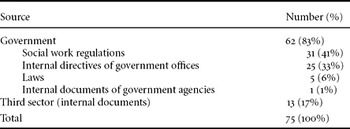
The study comprised 75 formal job descriptions of social workers in Israel. The documents were obtained in a two-stage procedure. First, a wide range of organisations employing social workers in the government, non-profit and for-profit sectors were located, using existing mappings of such organisations (Katan, Reference Katan, Aviram, Gal and Katan2007; Spiro et al., Reference Spiro, Sherer, Korin-Langer, Weiss, Mayadas, Watts and Elliot1997). Second, job descriptions were obtained from three sources: (a) government websites and internal directives of government offices; (b) heads of services (in all three sectors); and (c) social workers, especially in the non-profit and for-profit sectors. During a five-month process in 2007, we had collected 78 documents, three of which were related to areas of work rather than job descriptions proper, and were therefore not included in the analysis. The distribution of the documents by organisation of origin is presented in Table 1.
Distribution of job descriptions by publishing organisation (N = 75)

Table 1 shows, first, that the majority of job descriptions (83 per cent) originated in the local and national government sectors, while 17 per cent originated in the non-profit sector. This is consistent with the dominance of public sector employment of social workers in Israel (Bar-Zuri, Reference Bar-Zuri2004). Despite our efforts, we obtained no job descriptions from the for-profit sector, in which 3 per cent of Israel's social workers are employed (Bar-Zuri, Reference Bar-Zuri2004). All the organisations approached in this sector lacked formal job descriptions.
The lion's share of job descriptions (41 per cent) was published by the Ministry of Welfare and Social Services in its ‘Social Work Regulations’. These pertained to social work jobs in local welfare bureaus throughout Israel. This rate is consistent with the pattern of distribution of social workers in Israel, where local welfare bureaus are the major employer of social workers, accounting for about 40 per cent of the total (Bar-Zuri, Reference Bar-Zuri2004).
One-third of the descriptions (33 per cent) were published in internal directives, one in directives of the Ministry of Education, the remainder in Ministry of Health directives. The Ministry of Health's job descriptions are for social work positions in public health bureaus and hospitals; the Ministry of Education job description is for social workers in boarding facilities for at-risk youths. The 6 per cent of job descriptions published in the Laws of Israel are for social workers in the youth or adult probation services and for ‘welfare officers’ assigned to populations at risk, whose tasks are regulated by state law (e.g., youth protection workers). Another 5 per cent were published by government hospitals. Finally, 13 documents (17 per cent) were job descriptions obtained from non-profit organisations, published by a variety of service-providing organisations (e.g., hospitals, centers for substance abusers, shelters for women who are abused by their partners) or by organisations that engage in advocacy (e.g., providing services and advocacy for persons with disabilities). Of 40 non-profit organisations approached, 27 notified us that they had not developed formal job description documents.
Analysis
The method of analysis combined quantitative content analysis (Holsti, Reference Holsti1969) and qualitative content analysis (Altheide, Reference Altheide1987), and comprised three stages. Initially, the content of the document was analysed by means of a coding schedule that enumerated the variables, and a coding manual that represented possible values for each variable (Bryman, Reference Bryman2001). Each job description was coded according to the following schedule and coding manual:
1. General information on the document: the organisation that composed the document (the Ministry of Social Welfare, state laws, ministry circulars, internal documents of a government service, internal documents of a voluntary organisation).
2. Information on the social worker's function: position title, administrative status of the position (none, team- or unit- administration level, organisation-, department- or service-administration level).
3. Information on the service users’ group definition: whether a definition of service users’ group appears in the job description (yes/no); if yes, whether this definition includes references to their economic situation.
4. Information on psychosocial assessment: whether there is a reference to psychosocial assessment (yes/no); if yes, whether this assessment includes references to the economic situation.
5. Information on the goal of, and directions for, intervention: whether the purpose of social worker's intervention is defined (yes/no), and whether specific actions required of the social worker are defined; if yes, whether any references to poverty or economic distress appear in the intervention purpose or directions.
In this analysis, we looked for all the expressions, euphemisms and synonyms referring to ‘poverty’ in the job descriptions, such as ‘socio-economic distress’, ‘lack of financial resources’, etc. (the term ‘social exclusion’, which has entered the discourse on poverty in the European Union, is not prevalent in Israeli social work professional discourse). Each document was coded according to the schedule using SPSS software.
In the second, qualitative stage of analysis, we copied into three separate documents all the references to the following issues (whether mentioning poverty [or a related term] or not): definitions and descriptions of client groups, directions for assessing the situation of service users and goals of and directions for intervention.
In the third stage, each document was analysed individually. The guiding questions of analysis were:
Service users’ group definition: What are the groups outlined in the job description? What words are used to describe them? When poverty appears in the description, what service users’ group(s) is it associated with? What poverty-related sub-topics appear in the description? What terms are used to refer to the sub-topics?
Assessment of service users’ situation: When referring to an assessment of service users situations, how is this termed? What should the social worker assess? When poverty (or related terms) appears in the description of assessment, how is it represented? What terms refer to poverty?
Goals of intervention and directions for practice: What are the goals of professional practice outlined in the document, and how are they defined? When poverty appears in intervention goals or directions, what sub-topics appear in the description and how are they formulated?
Findings
Defining service users’ groups: the place of poverty in the definitions
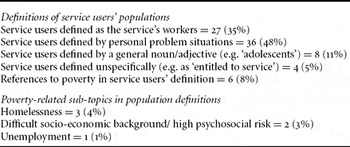
In about one-third (35 per cent) of job descriptions, the target population is not the service users proper but the social workers themselves (descriptions of administrative or professional training and instruction positions.) Analysis of the remaining 48 job descriptions (65 per cent) revealed three types of definition of client groups: (1) Focus on an individual problem situation; (2) Use of a general category; and (3) Unspecific definition.
Focus on an individual problem situation: In most job descriptions (36 documents, 48 per cent of the total), service users are described by focusing on their individual problem situation. In a typical job description of a ‘substance abuse treatment social worker’, the service users are defined as ‘alcohol addicts’;Footnote 1 a ‘care coordinator for the mentally retarded’ job description defines the clients as ‘the mentally retarded’; a description of a ‘rehabilitation coordinator for invalids and the handicapped’ job defines the clients as ‘invalids and the handicapped’, and for a ‘chief probation officer’, the service recipients are ‘criminals’.
Use of a general descriptive category: Eight job descriptions (11 per cent) define the service users by their age or another status feature that does not necessarily connote a problem situation. For instance, for a ‘social worker for the elderly’, the service users are defined as ‘the elderly’; and the job description of ‘immigrant absorption coordinator’ uses the definition of ‘the immigrants in the community.’ In these cases, service users’ definitions do not refer to states of specific need, problems or distress.
Unspecific definitions: Four of the job descriptions (5 per cent) use an unspecific definition of service users. These job descriptions refer to the clients as ‘all those entitled to service’, or ‘all those who approach the social service or are referred to it’, without mentioning any additional characteristics of the clients. For instance, the job description of a ‘social services department director’, the definition in use is ‘those entitled to social services’, and for a ‘diagnosis and classification worker’ the definition used is ‘those approaching the department’.
In only six cases (8 per cent) was there reference to economic situation in defining client group. In these cases, the definition used was longer, and extended to a whole sentence or more. Analysis of sub-topics shows that the reference to poverty is indirect, and the word ‘poverty’ is not used in any of them. In three cases ‘the homeless’ are mentioned, in two there is a reference to a ‘difficult socioeconomic background’ and ‘psychosocial risk’, and one mentions ‘unemployment’.
Definitions of service recipients in all the job descriptions and analysis of these definitions by poverty-related sub-topics appear in Table 2. The job descriptions mentioning ‘the homeless’ belong to health services.
Definitions of service users’ population and poverty-related sub-topics in the definitions

In a description of a ‘hospital social worker’, the service recipient population is described as: ‘the patient and his/her family, victims of a mass terror attack, victims of familial violence, the newborn, children and the helpless . . . populations characterised by a combination of health and social problems, combined morbidity, and [patients in] special situations such as new immigrants, homeless, and the like’. In the job description of a ‘social services director in a psychiatric hospital’ appear examples of ‘populations characterised by combined morbidity and special problems (such as alcohol and drug addicts, new immigrants, homeless, victims of family violence, helpless, and the like)’. ‘Homeless’ are also included in the description of a ‘social worker in an urgent care department’.
In a job description of ‘social work in child development institutions’, the service users are defined as ‘children and families of children suffering from developmental problems/ children exposed to “psychosocial risk”’, while in the description of a ‘social worker in youth villages’, service recipients are ‘boarding school students, the majority of whom are children and adolescents at high risk, who arrive at boarding schools from difficult socio-economic background, from families in distress, and often after heavy [psychological] trauma’. In the case of a ‘coordinator for families in crisis and at high risk’, the clients are defined at length and in detail: ‘families in the community who are in situations of crisis and/or at high risk, such as single-parent families, families suffering from violence, parents putting their children at risk, parents in crisis, [in a situation of] unemployment, etc.’
Psychosocial assessment of service users’ situation: the place of poverty
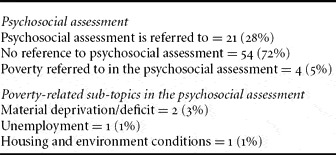
Only 21 job descriptions (28 per cent) mentioned psychosocial assessment. Most of these related to work with children in special education frameworks or boarding schools (six documents) or to work in health care (hospital, psychiatric hospital, child development institute or medical center – six documents). Other descriptions pertained to work with victims of violence and sexual abuse and with drug addicts (two job descriptions in each group). References to psychosocial assessment also appeared in job descriptions relating to the following groups: old people, people with disabilities, criminal offenders, people with developmental disabilities (one description per group). In addition, there was a reference to psychosocial assessment in a job description for an ‘in-take and diagnosis social worker’.
Of the 21 job descriptions referring to psychosocial assessment, only four (19 per cent) related to economic distress, mentioning three aspects of it in all: ‘material deprivation’ (two job descriptions), ‘unemployment’ (one description) and ‘housing and environment conditions’ (one description). The distribution of references to psychosocial assessment in all job descriptions and these references’ analysis by poverty-related sub-topics appear in Table 3.
Psychosocial assessment and poverty-related sub-topics in the assessment

Sub-topic analysis shows that only two of the documents refer to economic distress directly as a material deficit. A job description for a ‘social worker attached to educational institutions (schools)’ says: ‘the social service at school will concern itself with treatment of the child's problems arising from the following: physical or mental handicap, dysfunctional relationships between family members, lack of understanding and education of the child at home, neglect or a problematic attitude of a parent towards the child, social integration failure, orphanhood, parental separation, material deprivation’.
In a description of a ‘social worker in a geriatric ward in a general hospital’, the following specification appears: ‘old age is often characterised by multiple problems: multiple illnesses, isolation, economic problems, impaired functioning, cognitive impairments. . . Studies indicate that about a quarter of elderly population lives under the poverty line, which often causes inability to afford prescribed medicines, inadequate nutrition and situations of general infirmity. This issue, among others, requires intervention of a social worker.’
In a job description for a ‘social worker in a child development institute’, the reference is not directly to poverty but to ‘unemployment’ as one of the risk factors: ‘children from families characterised, in addition to a developmental problem, by one of the following parameters . . . [One of the six parameters identified is] Social problems in the family, which are likely to influence its responsiveness to the treatment program, such as divorce, impaired functioning of one of the parents, severe disease, a death in the family, familial violence, single-parent family, unemployment, drug or alcohol abuse in the family. . .’
In a job description for a ‘probation officer’, there is no direct reference to economic distress, yet the social worker is expected to collect detailed information about the service user which includes, among others, a diagnosis of housing and environment conditions: the social worker ‘should collect details concerning the individual's personality, physical, intellectual and mental development, housing and environment conditions, as well as the circumstances of the crime of which he is accused and the motives that brought him to commit it’. It is not clear whether the category of ‘housing and environment conditions’ comprises material or other conditions.
Poverty in intervention purposes and directions for practice
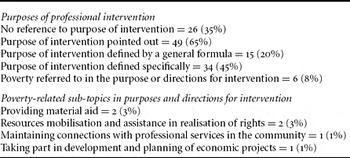
In 49 documents (65 per cent), there appear definitions of the purpose of the intervention that the social worker is required to carry out. Among these, we can distinguish between those with a general, very broadly defined intervention purpose, and those with a more specific purpose, according to the service users’ population and character of the service. The broad general definition, appearing in a fifth of job descriptions, uses a recurrent set formula: ‘improvement of personal, familial and social functioning’, or similar formulations: ‘care of personal welfare’ or ‘helping the client to restore optimal functioning’.
In the remaining job descriptions, specific formulations appear. In a description of a ‘community social worker’, intervention seeks the: ‘encouragement of local leadership, organisation of the residents for active involvement in community values’ promotion, services planning, as well as initiation and foundation of new services’. In a job description for a ‘social worker for youth in distress’, the purpose is described as ‘earning the youths’ trust, developing in the youths a desire for change and for confronting problems independently’. In another job description for a ‘head of the elderly programs in the community’, it is said that ‘the worker . . . encourages them to action, mutual help and full realisation of their rights, and activates the general population on their behalf’.
With regard to directions for practice, references to dealing with economic distress appeared in six job descriptions (8 per cent). These included provision of material aid (two documents); mediation between service users and existing resources and assistance in realisation of rights (two documents); maintaining links with professional services in the community (one document); and participation in the planning of economic projects (one document). The distribution of intervention purpose descriptions and analysis by poverty-related sub-topics in the documents appear in Table 4.
Purposes and directions for professional intervention and poverty-related sub-topics

Provision of material assistance appears in a job description for a ‘social worker attached to educational institutions (schools)’, where the worker is expected to ‘provide material relief to students who need such help, according to the Ministry of Welfare and Ministry of Education policy concerning material relief’. Also in a job description for a ‘probation officer’, the description notes that ‘if the probation officer perceives a need for providing financial aid to the client, he can, with approval of the district probation officer or his representative, act to procure such aid from relevant organisational bodies or persons owing maintenance to the client’.
Resource mobilisation and assistance in the realisation of rights appear in directions for practice in a job description for child development institution: ‘organisation and raising of support networks within the extended family and the community, resource mobilisation, informing the families about existing services, organisations and associations, assistance in rights realisation in the systems of health care, education, employment and welfare’. Similarly, a job description for a social worker in a geriatric ward of a general hospital referred to ‘realisation of rights (such as applying for the nursing benefit, to allow assignment of a personal carer, paid for by the National Insurance Institute for a number of hours daily). . .’.
Maintaining links with professional services in the community appears in the job description of a ‘coordinator for families in crisis and at high risk’: the social worker is expected to ‘maintain contact with professional services in the community (such as psychological services, mental health services, employment and education services)’.
Taking part in the development of economic projects appears in a job description of a ‘coordinator of community work’: it includes ‘participation in communal planning of physical or economic projects, according to the department head's directions’.
Characteristics of the job descriptions mentioning poverty
The fourth research question was concerned with characterising those job descriptions that contained any references to poverty or economic distress. Pooling the references to economic distress revealed that such references appeared in 12 (16 per cent) job descriptions, amounting to 17 references altogether, whether in definitions of the service recipients’ population, directions for assessment or in intervention purposes and directions for practice. All the 12 documents were formulated by government sector services. Five of the job descriptions are in health care services (a local health department, general hospitals and a psychiatric hospital), while four are in children and adolescents services (educational and boarding school frameworks, correctional service and child development institutes). Another two of the job descriptions are in communal services. Most of these job descriptions relate to non-administrative positions.
Discussion
The results of this study offer an unambiguous response to our research question regarding the extent to which social work's obligation to treat poverty is expressed in social workers’ official job descriptions. Only 12 of the documents (16 per cent) include any reference to economic distress or poverty, whether in defining the service users’ population, defining directions for assessing their condition or determining the aims of intervention and directions for action.
While we were not surprised that poverty did not play a key role in this manifestation of the professional discourse, the extent of its marginality was unexpected. Nevertheless, it is commensurate with other findings regarding the place of poverty in the social work training curriculum in Israel and other countries (Davis and Wainwright, Reference Davis and Wainwright2005; Harding et al., Reference Harding, Ferguson and Radey2005; Krumer-Nevo et al., Reference Krumer-Nevo, Weiss-Gal and Monnickendam2009), and in the attitudes of social work students regarding their preferred client groups (Limb and Organista, Reference Limb and Organista2003; Weiss, Reference Weiss2005). It is also commensurate with the tendency of Israeli social work students to consider the provision of material assistance as ‘unprofessional’ (Krumer-Nevo and Lev-Wiesel, Reference Krumer-Nevo and Lev-Wiesel2005).
We understand the lack of reference to poverty in the job descriptions as what Huckin (Reference Huckin2002) terms ‘textual silence’, defined as ‘omitting chunks of information that are crucial for the topic discussed’ (p. 347). Taxonomy of textual silence includes two forms that are relevant to our discussion: The Genre based silence, which refers to omissions that are conventional to a particular genre, such as the omission of any negative comments or facts about the deceased in formal obituaries; and manipulative silence, which is the omission of information that involves ideological aspects. Unlike genre-based silence, in which the reader/listener is aware of the genre's rules, the success of manipulative silences depends on these elisions being difficult to discover, and creating the impression that the text gives a full description of the phenomenon.
Ostensibly, the textual silence in the job descriptions of social workers would appear to be primarily genre-based. Being bureaucratic texts, job descriptions are not supposed to relate to social problems, among them poverty, in any detail. They should be neutral, not excessively long, and sufficiently general. Yet reading the textual silence regarding poverty as genre-based does not explain why those same job descriptions that ignore poverty relate in more detail to other elements, such as the requirement that social workers be involved in policy-practice (Weiss-Gal and Levin, in press) and the directions for initiating partnership with clients (Levin and Weiss-Gal, Reference Levin and Weiss-Gal2009). Moreover, the fact that some job descriptions do indeed include references to poverty indicates that it is commensurate with the rules of the genre.
Examining the silence regarding poverty reveals some characteristics of manipulative silence. First, manipulative silence implies knowing the facts that are silenced. As the social workers who wrote the job descriptions were likely to have the necessary knowledge about the importance of poverty in the lives of service users, it is difficult to see in this textual exclusion a result of unawareness or accidental omission. Moreover, in some job descriptions that relate to poverty, the reference occurs more than once. One can conclude that when authors of job descriptions do decide to mention poverty, they find it relevant to different parts of the job description.
The second characteristic of manipulative silence, e.g. that it is purposeful, needs more consideration. As Huckin (Reference Huckin2002: 367–8) claims, when the writer is anonymous and represents a large organisation, silence contributes to promotion of the organisations’ goals and interests. The authors, who are under the ideological pressure of the organisation for a long period, internalise the requirements of the organisation to such an extent that these requirements become unconscious.
In our case, this omission might be the result of the political context of the profession. A major part of social work in Israel is practiced under the auspices of the state, either directly through local welfare bureaus, which are the primary comprehensive social care services for people in poverty, or indirectly through state funding of non-profit service suppliers. This long-term dependency can cause a situation in which the professionals who author the job descriptions reflect a discourse that conceals the existence of social problems and the government's responsibility for it, and offers a discourse that emphasises personal problems and pathology instead.
Thus, the textual silence regarding poverty in formal job descriptions may be an expression of the conservative ideological attitude of the profession, and it is performed in such an effective way that poverty becomes ‘non-existent’ as a social phenomenon and is only considered as a personal condition.
Examination of the services that did include references to poverty in their job descriptions helps to clarify an additional question: Where does textual silence occur. Job descriptions that do relate to poverty are concentrated in three fields: health services and services for children and adolescents (nine descriptions), and community social work (two descriptions). By contrast, in job descriptions of local welfare bureaus, which are the most immediate address for service users who face poverty-related problems, there are almost no references to poverty. Instead, most of the job descriptions that relate to poverty come from health care services and children and adolescents services, which are multi-professional, are not identified directly with social work and in which poverty is not the main reason for which people turn to or are referred to them.
One possible explanation for this phenomenon is that the services that mention poverty in their job descriptions deal with people whose need for social protection is mostly legitimised, such as minors or people with mental illness. This explanation, however, is only partial, because it does not account for references to poverty by general health frameworks, not only those designated for people with mental illness. A second possible explanation is that both health care services and that of children and adolescents are usually multi-professional and not led by social workers. Different professional discourses exist simultaneously in a multi-professional staff, and they undergo re-contextualisation, retaining some of their original profession's characteristics while changing others (Linnel, Reference Linell1998; Manor-Binyamini, Reference Manor-Biniamini, Kacen and Krumer-Nevo2010). Thus, the appearance of poverty in job descriptions of these organisations may not arise from the professional discourse of social workers alone, but from the need of social workers in a multi-professional context to define their expertise, or from the influence of other professional discourses (those of education and medicine) current in the organisation.
The textual silence of poverty in job descriptions may reflect a conservative and individualistic professional discourse, but it simultaneously reproduces it in turn. The choice to base the definition of the service users on functionally problematic situations, while underemphasising the implications of poverty, construes pathologic behaviours as objects in their own right rather than as derivatives of social inequality. The ignoring of poverty in the directions for psycho-social assessment and the definition of intervention's goal (‘to improve personal, familial and social functioning’), in total disregard to the intertwined relations between functioning and socio-economic context, contribute also to the denial of poverty as a crucial element in people's lives.
Even when economic distress is mentioned, the references to it are mostly indirect, have a narrow and reduced character, express an a-political understanding of poverty and of the social worker's role in relation to poverty and do not encourage ‘poverty-aware practice’ as defined earlier in this article. Thus, references to homelessness, which appeared in three documents from health care services, reveal an awareness of the exceptional condition of the homeless, and of the fact that it is impossible to examine, evaluate or treat the health problems of those patients without considering the fact that they have no permanent and safe dwelling place. However, the specific reference to the homeless, who are a very small group in Israeli society (1,890 homeless people in Israel were known to the Welfare Ministry in 2007, Shaintoch, Reference Shaintoch2008), and who are in an extreme condition of poverty, provides indirect evidence of textual suppression of the fact that economic difficulties influence the condition of many more patients, even if they are not homeless. For example, a study revealed that about 17 per cent of the respondents waived medical treatment or prescription medicine because of their cost at least once in 2005, and that the highest rates of waiving are among people who live in poverty (Gross et al., Reference Gross, Barmeli-Grinberg and Rosen2007). In a certain sense, references to the poverty of homeless people only create linkage between poverty and one of its most extreme expressions, and reinforce the textual exclusion of poverty as a widespread phenomenon, characterising much greater numbers of social services’ users.
An additional sub-topic that was found in definitions of client groups is ‘unemployment’. Regarding unemployment as a risk factor would appear to indicate a welcome tendency to recognise rather than silence poverty as a structural social factor. Yet unemployment connotes a temporary situation of distress, and only in certain populations and over time does it become connected to poverty. Since the usage of ‘unemployment’ occurs in a job description from ‘a center for families in crisis and at high risk’, which deals with families that suffer from poverty and prolonged economic difficulties, rather than from temporary unemployment, we see in the use of the term ‘unemployment’ a blurring of the central role of poverty in the life of this population.
Only in one document, describing the position of ‘a social worker in child development institutes’, is economic distress described as a factor that influences the children's conditions in many different ways. This document confirms that when awareness of poverty exists, poverty is considered to be an important and relevant topic that should be referred to in the job description.
The examination of sub-topics of poverty, as they appeared in the psychosocial assessment of clients, reveals that they are limited in their scope. Examination of goals and directions for professional intervention yields similar results. In most job descriptions, changing the situation of poverty is not a goal or a direction for practice. Examination of sub-topics shows that there are references to giving financial/material assistance (to minors), and to some important components of work with people living in poverty, such as mediation, personal advocacy and development of economic projects. The latter three modes of assistance can be seen as indicative of a continuous line between local and temporary assistance to the individual and effecting structural change, but since none of these modes occurred more than twice in the documents, and all these activities are mentioned in only six job descriptions, it is premature to draw any conclusions from the distinctions between them. As noted above, the isolated occurrences of these direct references to ways of assistance for economic distress indicate that potentially they can be included in job descriptions and in the professional discourse.
This study, which examines the intra-professional discourse of social work as reflected in formal job descriptions, does not allow generalisations about the discourse of social work as a whole. On the contrary, the gap between what is expressed in the codes of ethics and what has emerged in this study indicates that the social work discourse is a rich and complex arena and underscores the importance of further systematic research, including cross-national comparative research. In addition, the findings do not enable us to reach conclusions about the actual practice of social workers. They do indicate however that even if social workers do relate to poverty in their practice, this is not expressed in the discourse of job descriptions, and this absence may cause poverty-related practice to remain unspoken, marginal and unconceptualised. This inevitably begs questions regarding the influence of the profession's declared ethos and the extent to which – in the Israeli context at least – it succeeds in incorporating poverty into the profession in all its diverse modes. Moreover, it is clear that insofar as social workers see job descriptions as texts with any educational role, matching the profession's values, they should work to change and re-design them in a way that would enable development of poverty-aware social work.
Acknowledgement
The authors thank Calanit Tzalach for her assistance in the analysis.