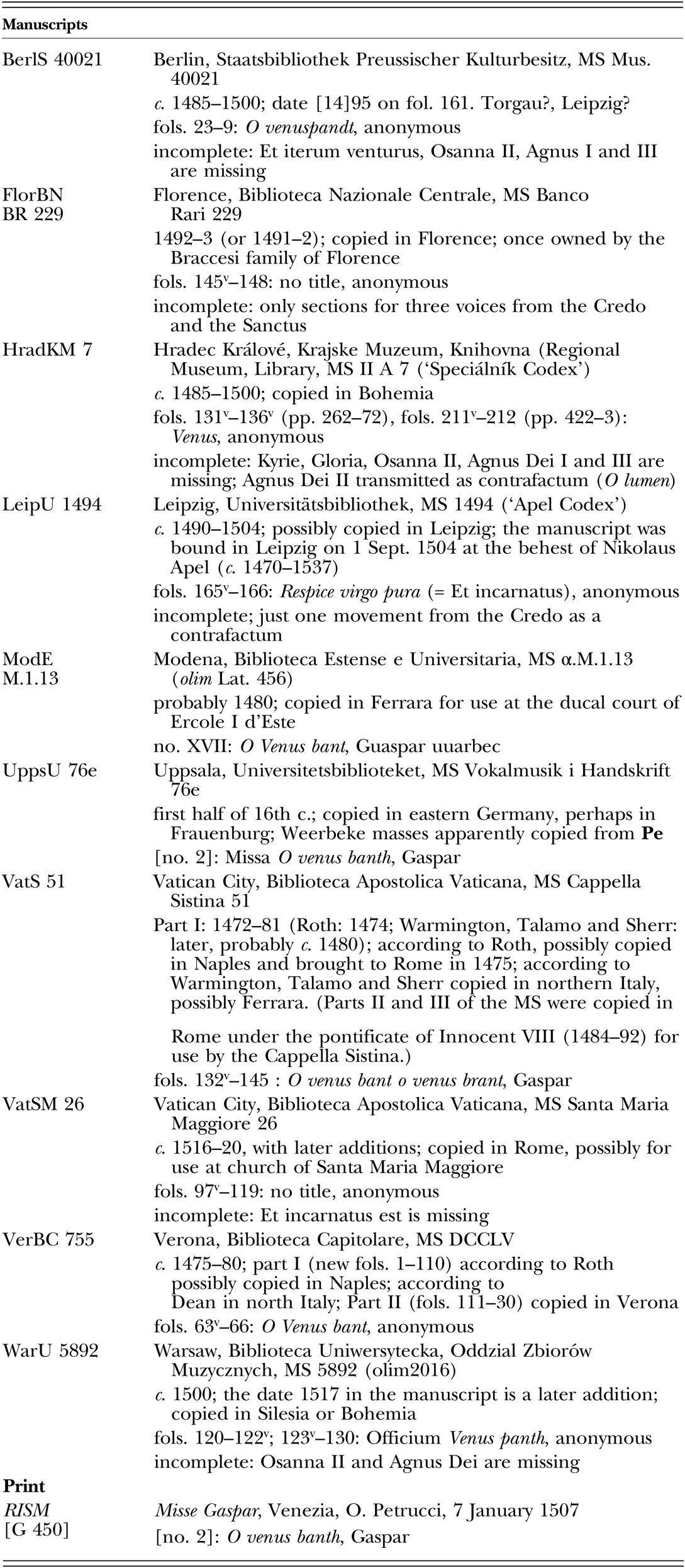
Nothing is known about the circumstances that led to Gaspar van Weerbeke’s composition of a mass on the melody O Venus bant.Footnote 1 Judging by the conspicuous number of sources preserved in various regions of Europe, however, this work seems to have enjoyed the widest circulation and diffusion of all of Weerbeke’s compositions. In fact, compared to other masses, which are primarily transmitted in two or three sources, mostly of Italian origin, this Ordinary cycle is attested in no fewer than eleven sources, with copies reaching central Europe and Germany (see Table 1).Footnote 2 The survival and distribution of sources is also significant when considered in the wider context of polyphonic mass transmission in the 1460s and 1470s. Only a very few mass cycles from this period are transmitted in a comparable number of copies.Footnote 3
Sources of the mass O Venus bant by Gaspar van Weerbeke

Why this mass enjoyed such international reception cannot easily be answered. Given today’s fragmentary landscape of the production and circulation of polyphonic music, one might speculate and consider several possible reasons for its substantial manuscript transmission. If it is thinkable that it was appreciated in itself simply as a great piece of music, it is also quite plausible to believe that other aspects might have played an essential role in the circulation of the mass. The map of concordances seems, in fact, to suggest some prominent compositional circumstance: could the mass O venus bant have had its origin in a special event? If this was the case, what might that event have been?
ON THE ORIGIN OF THE MASS: THE FIRST HYPOTHESIS
Gaspar van Weerbeke’s career as a singer and composer is chiefly related to Italy, where he spent most of his life after moving to Milan in the winter of 1471/72 (very little is known about his early years in Flanders). After serving the Sforza court for ten years, he entered the papal chapel in 1481, where he remained until autumn 1489, when he returned to Milan. He served in the ducal chapel of Gian Galeazzo Sforza and then of Ludovico il Moro until spring 1495. After three years subsequently spent in the north as singer in Philip the Fair’s chapel, he rejoined the papal chapel at the end of the 1490s. In Rome he is documented until the end of his life, the precise date of which is still unknown (in any case after 1517).
Throughout his career Weerbeke took part in the rich musical and artistic life of important cultural centres such as Milan and Rome in the era of Sandro Botticelli and Leonardo da Vinci and then Michelangelo and Raphael. His musical output is largely devoted to sacred genres, polyphonic masses and motets; these, however, are not easy to date or to relate to a specific moment of Weerbeke’s activity.
In his dissertation and subsequent book on Weerbeke’s masses of 1997, Eric Fiedler carried out the first systematic investigation of Weerbeke’s settings of Ordinary cycles. He cogently pointed out the grounds for assuming Ave regina caelorum and O Venus bant to be his earliest masses; for the latter, he hypothesised that the cycle might have been composed for a marriage.Footnote 4 His assumption was based on the mass’s cantus firmus, which is derived from a Flemish melody on a text about the bond of love. The theme of love is given prominence in the opening, invoking Venus as love personified (see the Appendix for the text).Footnote 5 Since he lacked specific historical evidence, Fiedler left open the question whether the mass was a work dating back to Weerbeke’s years in Flanders, or was instead a product of his initial Milanese years (although he tended to prefer the former hypothesis, considering the Flemish cantus firmus and the style of the mass).Footnote 6 The only certain fact, however, was that its composition had to be dated before Franchinus Gaffurius cited the mass in his Tractatus practicabilium proportionum (c. 1481–3).Footnote 7 Claiming a marriage as the reason for its composition made it possible, at any rate, to imagine different circumstances for its origin on Italian soil.
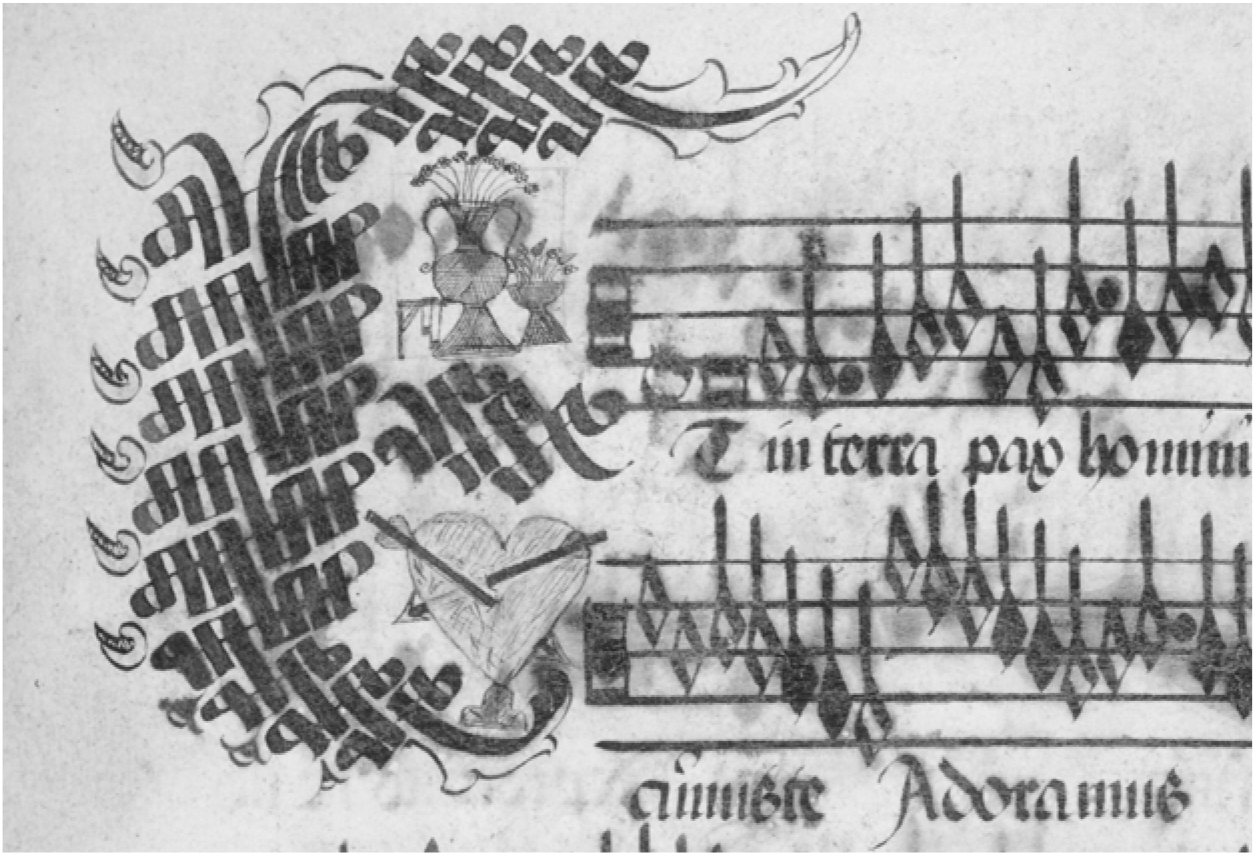
Following Fiedler’s idea, Adalbert Roth proposed a date and a specific occasion for the cycle in his study of the earliest manuscripts of polyphonic music from the Sistine Chapel: namely, the marriage of Ercole d’Este and Eleonora of Aragon in 1473.Footnote 8 The arguments in favour of this hypothesis are specifically related to the characteristics of its transmission in MS Capp. Sist. 51 of the Biblioteca Apostolica Vaticana: the decorations that Roth analysed as part of his investigation of the physical aspects and contents of the codex. Weerbeke’s mass has several initials with decorative motifs that might have a specific symbolic value. Roth paid particular attention to the initial ‘E’ of the ‘Et in terra’ in the altus part, which comprises two vases alongside a device with dangling objects (see Figure 1).Footnote 9 He interpreted these visual elements as emblems of the Este and Sforza houses. Furthermore, he read the motif of the pierced heart, appearing at the bottom of the same initial, as a hint at the negotiations that led to marriages between the houses of Sforza, Este and Aragona.Footnote 10 Following this interpretation, Roth’s elaborate explanation of O Venus bant’s visual elements was used to support the source’s origin in Naples, alongside the related manuscript, Capp. Sist. 14. Only later would the codices come to Rome as a gift to the Pope – according to Roth – from the King of Naples, Ferrante d’Aragona, probably on the occasion of the Holy Year 1475.Footnote 11
Detail from the superius incipit of the Gloria of Gaspar van Weerbeke’s Missa O Venus bant, Biblioteca Apostolica Vaticana, MS Cappella Sistina 51, fol. 135r. ©2019 Biblioteca Apostolica Vaticana by permission of the Biblioteca Apostolica Vaticana, with all rights reserved

Roth’s hypothesis about the origin of the manuscripts has been questioned by various scholars, who have raised extensive and substantial objections relating to the content and logic of his arguments.Footnote 12 Mitchell Brauner, Pamela Starr, Rob C. Wegman and Flynn Warmington in particular have pointed out the inconsistencies in Roth’s arguments and especially in his reading of the iconographic elements used to substantiate the hypothesis of the Neapolitan origin of the manuscripts. Brauner specifically called attention to the lack of positive data to identify the repertory as ‘Neapolitan’ in relation to its provenance. Warmington’s research on the visual elements of the manuscripts has paved the way for new conjectures on the provenance of the manuscripts in question, leading to a wider rejection of the ‘Neapolitan’ hypothesis.Footnote 13 However, since Roth’s publication there has been no new research on Weerbeke’s mass O Venus bant, neither concerning its transmission in Capp. Sist. 51, nor its possible compositional genesis.
Roth’s interpretation of the decoration of the mass in Capp. Sist. 51 becomes much more problematic when one examines the specific details used to contextualise the mass. For example, what Roth regarded as a symbol of the house of Este – the vase with flowers – has not been documented as an emblem of the Este family. While a vase does exist in the Este family iconography, it is filled not with flowers, but with branches.Footnote 14 Roth’s interpretation of the element on the left raises further doubts (see Figure 1 above). The object represented does not correspond, as speculated, to the Sforza impresa of two full water buckets hanging from a burning stick with the motto ‘Humentia siccis’. In fact, the decisive part of the emblem showing the firebrand is missing here. Furthermore, the drawing shows markedly different characteristics that do not at all address the tilted burning stick.Footnote 15 Consequently, Roth’s reading of the image turns out to be quite arbitrary.
Although it is difficult to determine the significance of the letter decoration, it is clear that the interpretation Roth gave is neither sufficiently founded nor supported by contemporary sources. Moreover, the iconographic and decorative elements do not necessarily reveal the occasion for which O Venus bant was composed. Thus it is unknown whether these drawings are in fact connected to Weerbeke’s mass and its genesis – as Roth suggested by identifying, for instance, the woman with a pointed hat drawn on fol. 134r with the bride, Eleonora d’Aragona – or, conversely, whether they represent visual comments with a different meaning, to be considered as part of the iconography of the manuscript as a whole.Footnote 16 Unsupported by any evidence, therefore, Roth’s proposal of the 1473 marriage falls and, with it, one of his decisive arguments to support the Neapolitan genesis of the manuscript.
All the arguments brought forward until now, in any case, call for two separate strands of research: one related to the composition of O Venus bant, the other to the genesis of the manuscript (here not investigated further).Footnote 17 Regarding Weerbeke’s mass, one wonders whether a wedding really was the occasion for its composition, especially if we take into consideration that the poem O Venus bant would not be very appropriate for such an occasion since it thematises the figure of a lover who is unhappy that his mistress does not reciprocate his love. Furthermore, it seems rather doubtful that Weerbeke would have chosen a Flemish melody for a mass composed for a marriage between two illustrious Italian families, as proposed by Roth. Although the motives behind the selection of cantus firmi in polyphonic masses are still largely a matter of speculation – i.e., whether a cantus firmus alludes to a specific occasion or takes on a broader meaning on a metaphorical or compositional levelFootnote 18 – it remains difficult to find a reason why a Flemish melody might refer to a union on Italian soil between Italian noble families and the house of Aragon. More plausible instead, and in tune with what we know or understand about patronage at that time, would be to suppose that the choice of cantus firmus points to a specific celebration related to the provenance of the melody itself and its context.
THE CHOICE OF THE O VENUS BANT MELODY AND THE FLEMISH CONNECTION
The possibility that the only known mass composed by Weerbeke on a Flemish cantus firmus melody dates back to the composer’s Flanders period before moving to Milan cannot be ruled out per se, especially since this option in itself would seem to motivate the choice of a Flemish cantus firmus. Moreover, a native cantus firmus would even not make it necessary to identify a specific occasion for which the mass was composed. Nevertheless, one should give consideration to the circumstances that would have led to its genesis. Not much is known about the young Weerbeke, nor are we aware of compositions dating from the years preceding his first service at the Sforza court (1471–81).Footnote 19 No documents have been discovered which would attest to an official position of the young musician within an established institution or some kind of service at the Burgundian chapel or at institutions close to the court. With Antoine Busnoys, Johannes Regis and Guillaume Du Fay still alive, active and dwelling in the region, the court of Burgundy certainly had a sufficient number of very experienced composers for occasions that required new music. It does not seem convincing that Weerbeke was charged with the task of composing a mass for the court environment without having a specific position within it. An alternative hypotheses might be that the young Weerbeke composed the mass in Flanders for a minor religious institution or for the brotherhood of which he was a member, but it would be hard to find a satisfactory explanation for the international circulation of the mass as it is documented today.Footnote 20 Even if considering the large amount of music that has been lost in the Burgundian regions, including that of major churches and institutions,Footnote 21 Weerbeke’s mass O Venus bant maintains its particular position. That the masses by a then famous composer like Guillaume Du Fay survive in a far smaller number of sources demonstrates that the fortune of Weerbeke’s cycle cannot even be explained in terms of outstanding quality.Footnote 22 Further, when bearing in mind that in the fifteenth century the tradition of the chanson mass was probably most often related to court environmentsFootnote 23 – and in its first manifestation was a phenomenon specifically tied to the Burgundian and French area – the idea of a local commission to the composer from a religious institution is even less persuasive. In consideration of the following discussion the same applies to the view that the mass was originally meant for general use as a Marian mass. Instead, the international circulation of the mass O Venus bant can be more convincingly explained if one presupposes that the circumstances of its composition were somehow exceptional and probably also that Weerbeke had attained a better professional position as cantor and composer within a distinguished chapel.
Since the mass was known to Franchinus Gaffurius, as mentioned, in the early 1480s and its composition must therefore go back to the years preceding that time, the most plausible possibility is that Weerbeke composed O Venus bant during his first Milanese stay. Even if the dating of Capp. Sist. 51 is still debated and varies between the 1470s and the early 1480s, the copy of the mass in the Este manuscript α.M.1.13 (ModD), thought to have been copied in 1480/81, furnishes another reliable terminus ante quem for its origin.Footnote 24
The oldest known mention of a mass with the melody of O Venus bant, however, is recorded in Flanders. During the year 1475 two masses ‘O Venus banden’ were copied in Bruges by Martin Colins tenorista for the church of St Donatian.Footnote 25 Since the author of the masses is not specified, it cannot be established with certainty if the copying note refers to Weerbeke’s mass. This is, however, the only cycle entitled O Venus bant known today that would perfectly fit into the chronological frame given by the sources – even though no Flemish sources of Weerbeke’s mass nor of other O Venus bant masses still exist. An anonymous Venus bant mass transmitted in the Milanese Librone 3 should also be taken into account; yet it was not copied earlier than the 1490s.Footnote 26 Given that other contemporary masses with the same melody have not survived for the late fifteenth century, the assumption that the record of St Donatian refers to Weerbeke’s mass seems more than plausible, also considering the ample manuscript circulation of the mass and its rather unique position. If that is true, we could make an even more precise guess as to the date of Weerbeke’s composition: the mass would have been ready at some point during the year 1475 at the latest. The composition might have been written between Weerbeke’s arrival in Milan in 1471–2 and 1475, and possibly after the enlargement and consolidation of the chapel from 1473 onwards.Footnote 27 However, how can we convincingly account for an origin of the mass in Milan and a copy in Flanders in 1475?
A MILANESE CONTEXT FOR A FLEMISH MASS
A plausible answer is provided by the chronicle of the events that happened in 1475 involving the Duchy of Milan and the court of Galeazzo Maria Sforza. In that year, the half-brother of Charles the Bold – Antoine of Burgundy – stopped in Milan on his way to Naples, where he was heading to arrange a possible marriage contract between his son and the daughter of the Prince of Venosa. At the same time, he brought the insignia of the Order of the Golden Fleece to Ferrante of Aragon.Footnote 28 In his history of Milan Bernardino Corio briefly records that Antoine, ‘the Grand Bastard’, who arrived on the 13th of March, was received ‘con grande magnificenza’.Footnote 29 His visit to Milan was in fact of wide significance for the politics and diplomatic relations of the Sforzas. Just less than two months earlier Galeazzo Maria had formed an alliance with Charles the Bold after years of military tension, during which he had supported Louis XI, King of France, Charles’s opponent.Footnote 30 This alliance, which revolutionised Galeazzo’s political sympathies and the balance of power, had been strongly encouraged and supported by Yolande of France (wife of Amadeus IX of Savoy and daughter of Charles VII of Valois) and Mary of Anjou (sister of Louis XI, and sister-in-law of Galeazzo himself).Footnote 31 Yolande, who at that time held the duchy of Savoy, was in need of political support in order to safeguard her rule and protect it from both her brother and her brothers in-law (Jacques of Romont-Vaud and Jean-Louis of Savoy, bishop of Geneva), as well as Philip De Bresse (known as ‘the Landless’).Footnote 32
According to the correspondence between Milan and Burgundy, the alliance between Galeazzo Maria and Charles the Bold was signed on the 31st of January 1475.Footnote 33 Only when concluded – and weeks after the confirmation of the contract – the alliance was made public. For the official proclamation of the league of Moncalieri in Neuss, Charles the Bold organised festivities that included a solemn mass in the presence of ambassadors, eminent clerics and the members of the Order of the Golden Fleece. He also sponsored public events with sounds of ‘trombeti’ and ‘pifari’, two other masses and fires ‘of alegrezza’. In the morning, Charles made his way to church wearing clothes and ornaments of the utmost magnificence and appropriate to the significance of the occasion, as the ambassador of the Sforza court in Burgundy – Giovanni Pietro Panigarola – accurately described.Footnote 34
Galeazzo decided to match the alliance’s public proclamation on the feast of St George, which was traditionally celebrated by the court on the 23rd of April with an extensive display of resources.Footnote 35 In fact, St George’s feast perfectly served the purpose, since the characterisation of St George as a ‘soldier of Christ’ had led the feast to acquire a heightened military nature.Footnote 36 The medieval ceremony included a procession followed by a short mass. After that, the solemn mass was celebrated in the Cathedral, where the blessing of the flags took place and a specially composed oratio was recited. The documents that Paul and Lora Merkley collected show that the musical section of the ceremony, in comparison to the medieval tradition, was probably expanded from the early 1470s under the rule of Galeazzo and should also have provided, in addition to prayers and chant, performances in polyphony. For the feast of St George in 1475 Galeazzo planned the participation of over 4,000 soldiers from the court, including his brothers’ squadrons, and they had to be housed in the city. The display of resources for that occasion was quite extraordinary, with one hundred and twenty other people, courtiers or others called to represent the court, in attendance.Footnote 37 The singers, who were required to take part in the celebration, usually got new clothes for St George’s day.Footnote 38 In 1475, however, additional expenses for clothes and hose alla sforzesca (in the Sforza style) were recorded on that occasion.Footnote 39 Galeazzo invited ambassadors to the ceremony from Venice, Ferrara and Savoy, and also personally invited the marquess of Mantua.Footnote 40
That such a celebration was an important moment of Milanese life and also had special significance for ducal policy can be inferred from the programme of frescoes that Galeazzo had planned for the Castle at Porta Giovia. Among the subjects that would have been included was a representation of the St George’s feast at the very moment of the blessing of the flags. ‘All the singers with their turche (solemn long clothes) and hoods’ were to be portrayed as realistic subjects. Weerbeke would also have had to appear in the painting, which seemingly was never realised.Footnote 41
Because of the involvement of the duchy of Burgundy, the feast of St George on the 23rd of April of 1475 represents the most likely occasion for the composition of Weerbeke’s mass O Venus bant, designed to celebrate the League of Moncalieri – that is, the military union of the three duchies. From the creation of the alliance at the end of January to its public proclamation, Weerbeke could realistically have had the time necessary to compose it, choosing an ‘ultramontane’ tune suitable to the specific event. The composition of the mass for the public celebration of the alliance would explain not only the choice of a Flemish cantus firmus, but would also provide a reason for the ‘bond’ of love evoked by the text, the union declared by the title and symbolised by Venus.Footnote 42 In addition, it would provide a logical explanation for the copying of the masses O Venus bant in Flanders during the same year, supporting the hypothesis that one of two masses recorded in the payments at St Donatian was the setting by Weerbeke.Footnote 43
If referring to Weerbeke’s Ordinary cycle, the copying record in Bruges would document the arrival of the mass in the realm of its dedicatee – Charles the Bold – shortly after its composition. Opportunities for the transfer of the mass would not have been missed, considering the complex diplomatic networks, exchanges of letters between Milan and Burgundy, the transit of those in Galeazzo Maria’s service to Flanders and the seats of Charles’s court, as well as the diplomatic mission of Antoine and his visit in Milan. One could imagine several possibilities for passing on a musical work conceived with celebratory and representative purposes for a political event directly related to the strategies of ducal power. Yet the two copies made in Bruges also seem to suggest that two settings of O Venus bant might have been composed for the same special occasion – to be celebrated with appropriate majesty and pomp – which in turn might suggest a sort of coordinated compositional process involving two Ordinary cycles (and one would be almost tempted to identify the recorded ones with the two masses surviving today). Nevertheless, it cannot be completely excluded that the copying note referred to two copies of the same O Venus bant mass – or even to different settings not matching the surviving ones. The coincidence of the year 1475 with the historical facts summarised above, however, makes the identification of Weerbeke’s mass in the Bruges record likely and encourages evaluation of the implications that follow from that.
O VENUS BANT AND BURGUNDY: MUSICAL CONNECTIONS
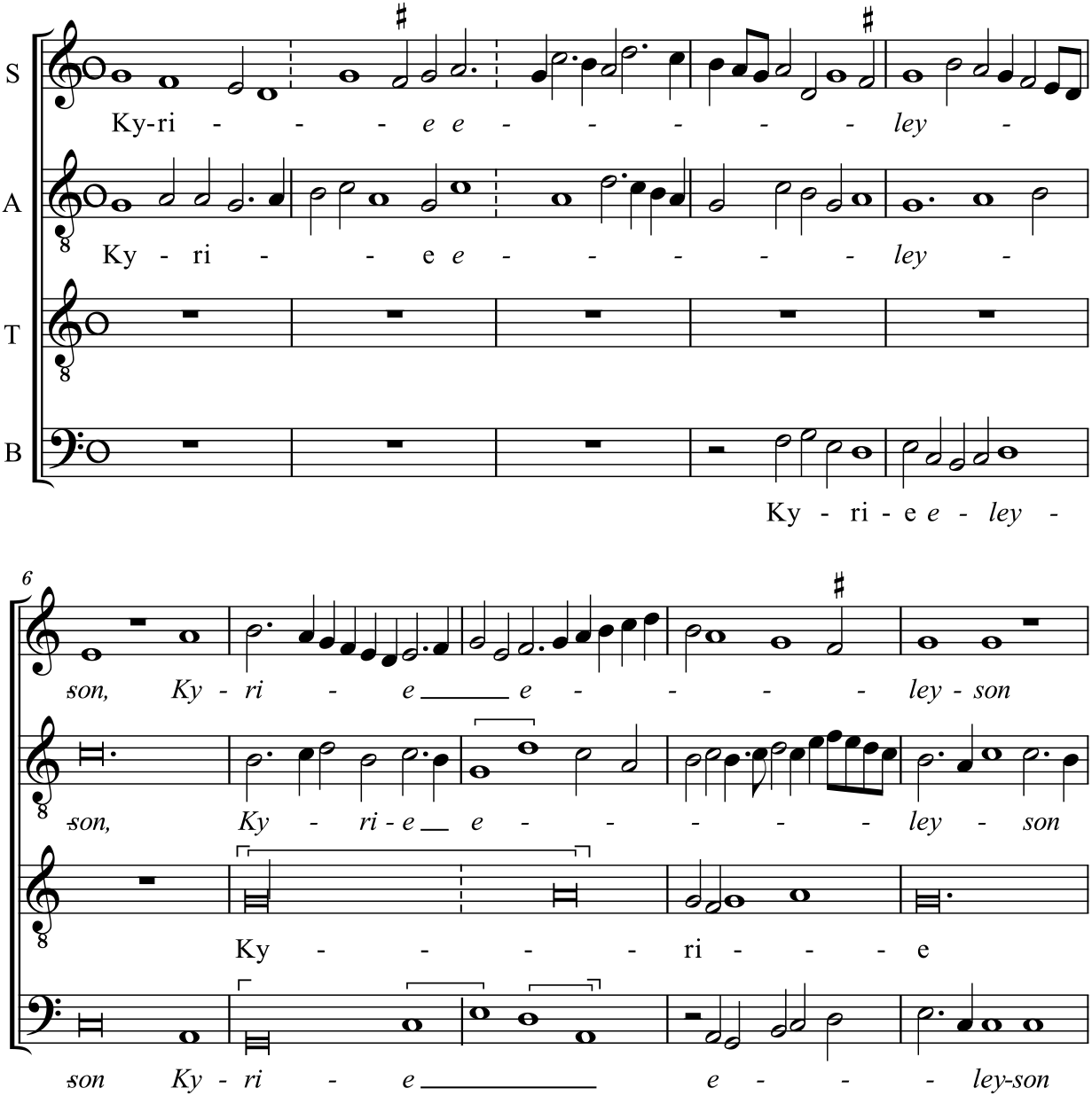
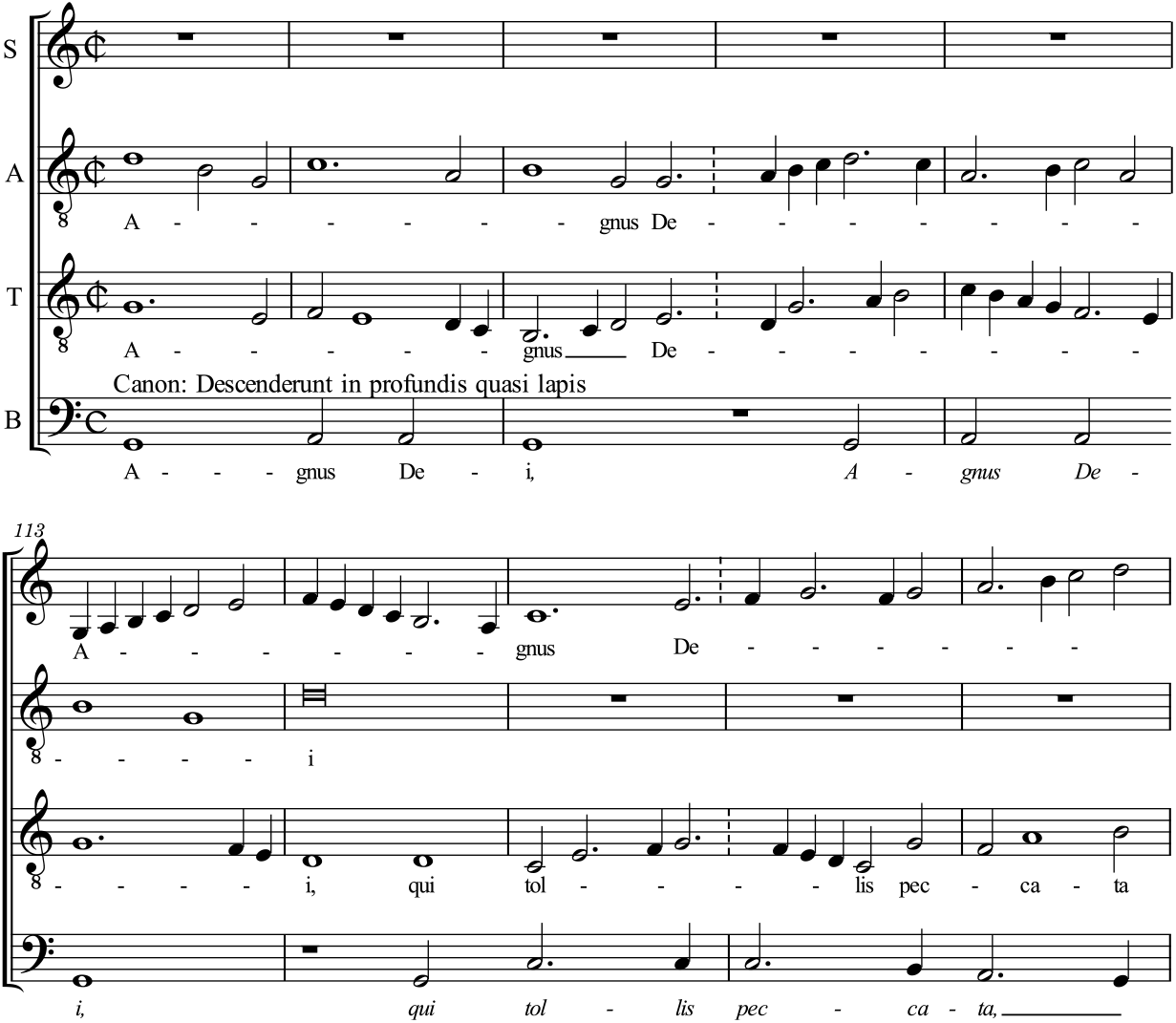
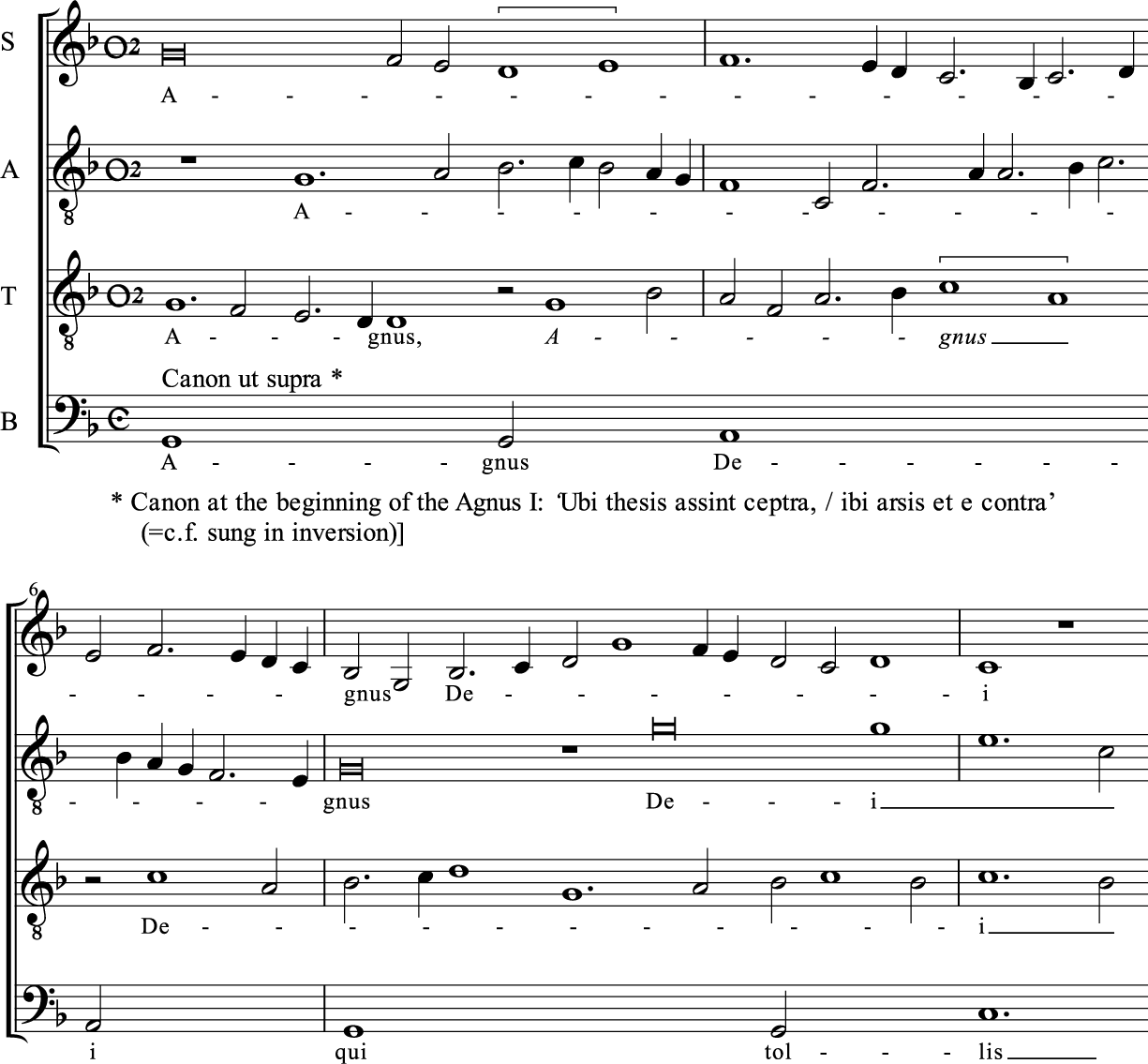
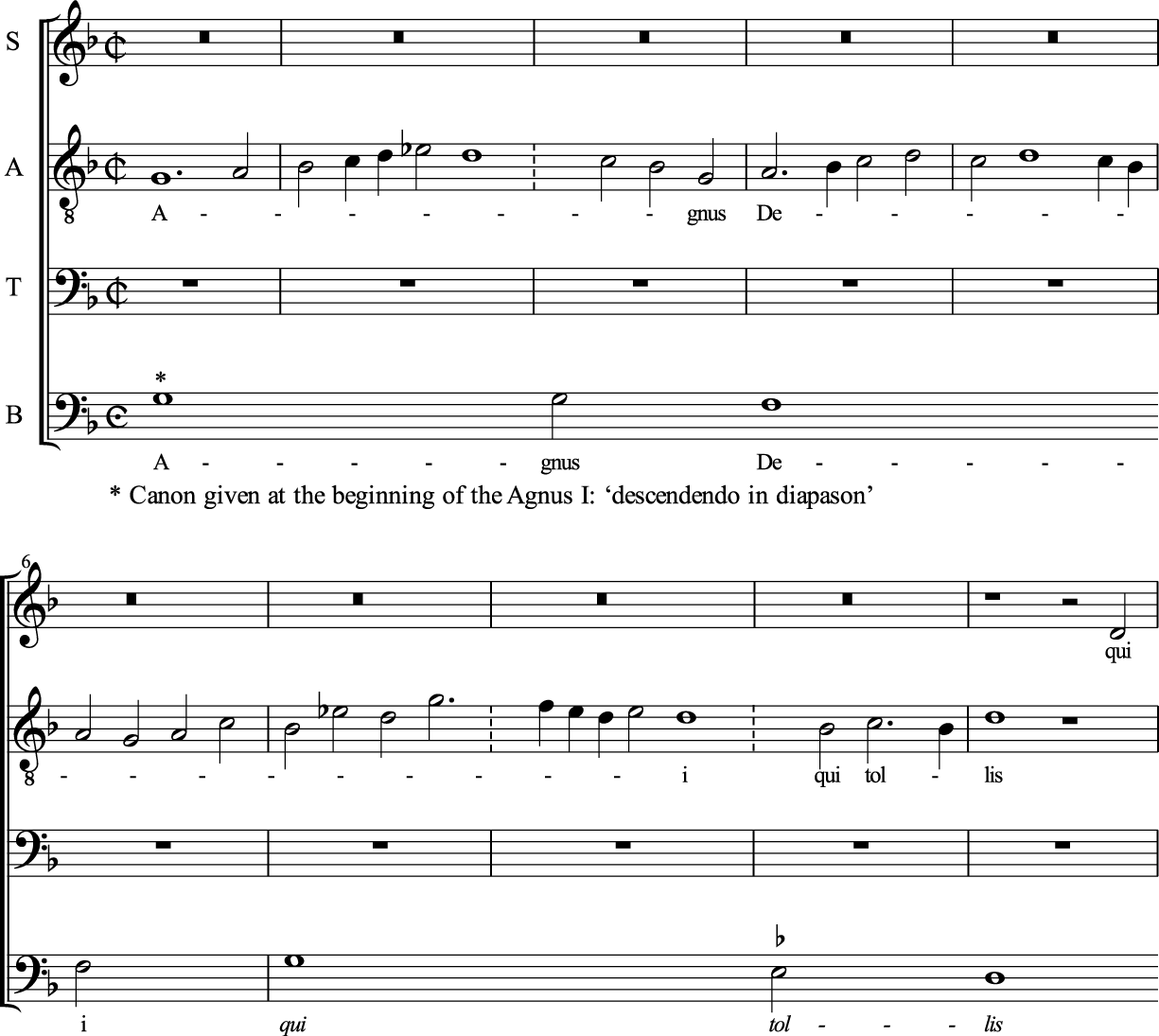
In the context of the political events of the first months of 1475, and of the plausible circumstances proposed above for the composition, some structural features of Weerbeke’s mass acquire a deeper significance. Composed as a cantus-firmus mass, the Ordinary cycle is characterised by the use of motto technique. Each movement begins with a superius–altus duo composed on the same melodic material.Footnote 44 The superius line opens with the melodic line that is associated with the text O Venus bant in later sources, while the altus anticipates the cantus firmus in the tenor, presenting the initial motif of the O Venus bant melody as documented in the first polyphonic tradition (Example 1).Footnote 45 The melodic outline of the superius in its turn also recalls the opening line of the chanson De tous biens plaine by Hayne van Ghizeghem; on the other hand, the altus incipit is similar to the beginning of the popular tune of He Robinet.Footnote 46 Whereas it is difficult to establish if these analogies are intentional or just coincidences, other aspects of the composition of the mass setting suggest that Weerbeke, in conceiving his Ordinary cycle, looked at particular models in the contemporary tradition of polyphonic masses. In this regard the third Agnus Dei is especially interesting. A canon (verbal inscription) directs the exchange of the lower voices by moving the cantus firmus to the bassus (Example 2). This procedure, in fact, immediately recalls the L’homme armé tradition, and especially Antoine Busnoys’s and Johannes Ockeghem’s masses, both characterised by the use of a canonic inscription and by the sounding of the cantus firmus in the bassus in the third Agnus Dei (Example 3a–b).Footnote 47 As in these masses of the L’homme armé tradition, in Weerbeke’s Agnus Dei the cantus-firmus melody is given in integer valor, which is to be augmented in the proportion 2:1 in performance.Footnote 48 This procedure is even more significant when one considers that a similar use of augmentation cannot be found in any of Weerbeke’s other surviving masses. Another affinity arises in the features of the cantus firmus itself. The melody of O Venus bant, in fact, shares with that of L’homme armé a popular-like (or rustique) character, distinguished by style and tone from the melodies associated with the courtly lyric and the formes fixes.Footnote 49 On the basis of the chosen cantus firmus, the mass could thus be seen as an example of a common mass subgenre.Footnote 50
Gaspar van Weerbeke, Missa O Venus bant, Kyrie, incipit

Gaspar van Weerbeke, Missa O Venus bant, Agnus III, bb. 108–17: c.f. in the bassus

Antoine Busnoys, Missa L’homme armé, Agnus Dei III, incipit: c.f. in the bassus

Johannes Ockeghem, Missa L’homme armé, Agnus III, incipit: c.f. in the bassus

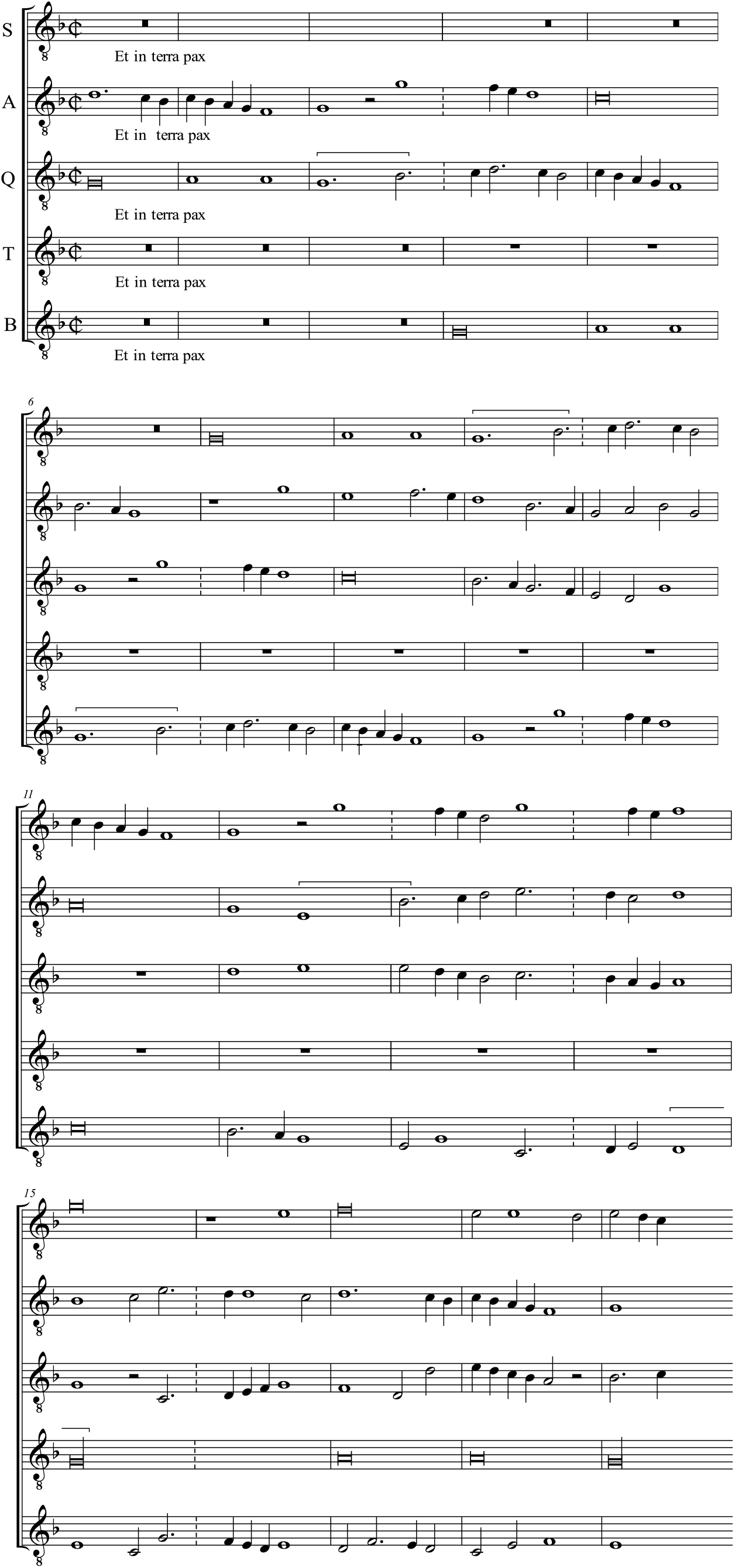
Anonymous, Missa O Venus bant (Milan, Archivio della Veneranda Fabbrica del Duomo, Librone 3, fols. 99v–100r), Gloria, bb. 1–19

The compositional thread that ties the mass O Venus bant to the L’homme armé tradition turns out to be extremely meaningful when we consider that it directly evokes the Burgundian tradition of the L’homme armé and its political significance when connected to the activities of the Order of the Golden Fleece, promoted at first by Philip the Good and later by Charles the Bold.Footnote 51 The compositional choice made by Weerbeke in his Agnus Dei can thus be understood through its symbolic significance, especially in relation to Busnoys’s model, which originated in the Burgundian context. Hence it supports the idea that the cycle was composed for an occasion related to the Duchy of Burgundy, in accordance with what the Flemish melody itself suggests. Moreover, it reinforces the view that the performance of the mass took place in a festive ceremony such as the feast of St George, whose military connotations fit perfectly with the ceremonies of the order of the Golden Fleece.Footnote 52 Despite mentioning Venus at the beginning of the text – which apparently refers to matters of love – the mass would perfectly fit into a set of works conceived for the purposes of celebration, with political and strategic implications.Footnote 53 In this perspective, the choice of a text on the theme of love, behind which an important political fact is concealed, conforms to a metaphorical use of poetic texts that were surely more widely diffused than we can grasp from the individual texts today. In this respect, the case of Du Fay’s mass Se la face ay pale is particularly eloquent, as Anne Walters Robertson’s exemplary study has convincingly argued.Footnote 54
From the perspective of a plausible contextualisation of Weerbeke’s mass, it is worth looking briefly at the anonymous massO Venus bant surviving in Librone 3 as well.Footnote 55 While its five-part texture seems to suggest relevant compositional circumstances if related to the 1470s or 1480s, the mass shows a quite peculiar uniformity of register: the parts, which are all noted in the tenor clef, occupy almost the same ambitus – the only difference being that the two lower parts move in the lower half of the common range (Example 4). Likewise, the tenor voice, anticipated at the beginning by the quintus part, maintains its function of supporting the composition, carrying the tune of O Venus bant in large note values. These compositional features are quite unusual in Ordinary cycles of the end of the fifteenth century. Eric Fiedler suggested that the cycle might have been designed for instrumental performance, since some passages in stepwise crotchets would reveal a possibly more instrumental than vocal character, suitable to be performed with wind instruments of the alta capella, piffari and trombones.Footnote 56 Although this hypothesis can be easily questioned, bearing in mind that at that time a distinction between vocal and instrumental features is often not clear-cut, in this specific case it is nevertheless worth considering this possibility, also taking into account that the Ordinary texts are not underlaid, with the exception of the section incipits.Footnote 57 The main question in this context is, however, how this mass might be related to Weerbeke’s, and whether it would be plausible to identify it with one of the Bruges copies made in 1475. The idea that two cycles of O Venus bant might have been performed during the same St George feast at different times of the day, adapting the ceremonial to the special occasion that had to be celebrated on that day, is not inconceivable.Footnote 58 Yet, since the Milanese Librone 3 still has not been precisely dated and may have been copied at the beginning of the sixteenth century, and the mass style cannot easily be positioned in a narrow chronological span, no concrete assertions can be made on the origin and performance context of the work; as to the relationship with Weerbeke’s mass, nothing can be said except that they share the same cantus firmus. Therefore, whilst for Weerbeke the occasion of the League of Moncalieri represents a plausible political context for the composition of O Venus bant, for the other cycle its status as an anonymous unicum of uncommon features makes it difficult, at present, to put forward any reliable suggestion.
THE CHANSON O VENUS BANT AND ITS TRANSMISSION
By assuming that Weerbeke’s mass O Venus bant was composed for the public celebration in Milan of the League of Moncalieri, the transmission of chansons on the same melody can be read in a new perspective. The oldest polyphonic versions of O Venus bant – one attributed to Josquin or Weerbeke, and two others by Agricola – cannot be dated with precision, but circulated, as it seems, from the second half of the 1470s (Weerbeke/Josquin) or the beginning of the 1480s (Agricola).Footnote 59 The manuscript now in Seville, probably copied in Naples or Rome, is the only source to attribute the chanson O Venus bant to Weerbeke (‘Gaspre’).Footnote 60 Although this source has not been precisely dated (1470–85), it was produced at a similar time to the date proposed here for Weerbeke’s mass. Similarly, and significantly, the gathering in Munich 3154 that includes this setting (without attribution) can be dated to around 1476.Footnote 61 Only in the sixteenth century, in Petrucci (1501) and in later sources, is the chanson found with attribution to Josquin (i.e., in sources at least twenty years younger than the Seville manuscript).Footnote 62 In consideration of the transmission data – and also of the fact that the manuscripts in question were written in all likelihood before Josquin moved to Italy – there would be good evidence to credit the chanson to Weerbeke and to suggest a composition at the same time as the mass.Footnote 63 Notably, O Venus bant is untraceable in Flemish or northern sources of the same period (1470s–1480s): it appears neither in the version of Weerbeke/Josquin nor in that of Agricola.Footnote 64 Although the spread of the Flemish song in Italian sources can certainly be explained by the presence of numerous Dutch and Flemish singers in Italy, assuming an Italian origin of the polyphonic version attributed to Weerbeke in connection with the composition of the mass would justify its wide circulation on Italian soil as well as the absence of the melody from all existing chansonniers of the 1460s and 1470s. At the same time, it would explain the vogue of O Venus bant documented by later sources, particularly of Florentine origin, and the different instrumental reworkings made in Italy over the years.Footnote 65 Taken together, these aspects help to strengthen the Weerbeke attribution for the Seville manuscript version. In the absence of reliable biographical information concerning Agricola for almost all the 1470s and 1480s, it is difficult to offer a key to understanding the spread of his chansons O Venus bant in Italy, and in particular of the setting in the Casanatense manuscript. Yet the link to Weerbeke offers clues for further research and suggestions regarding Agricola’s presence in Italy at some time, as was assumed in the past.Footnote 66
From all these considerations new importance may be given to the similarity of the tenor incipit in O Venus bant (Example 5) – as transmitted in the setting with attribution to Weerbeke – to the incipit of the melody of He Robinet (Example 6). This melody is transmitted in several sources, including the Italian manuscript at El Escorial, MS IV.a.24 (EscB, 1460–74); it was used along with the melodies of O rosa bella and L’homme armé in a quodlibet by Johannes Tinctoris, included in his Proportionale musices.Footnote 67 Particularly relevant is that the melody of He Robinet is explicitly mentioned in a letter written in 1472 by Galeazzo Maria Sforza and addressed to Antonio d’Appiano, his envoy at the Savoy court. In this letter the duke requested the music of ‘Robineto notato su l’ayra de Rosabella’ with the words that Antonio Guinati used to sing upon it.Footnote 68 At that time Guinati was chapel master at Yolande of Savoy’s court. This document gives evidence that the melody in that particular quodlibet version was known in Milan in 1472 at the latest, and it suggests at the same time that He Robinet had a special significance or popularity in the context of the Sforza court.Footnote 69 This allows us to suppose that Weerbeke’s choice of O Venus bant with the same few opening notes might not have been a coincidence, and that he did explicitly refer in all incipits of his mass to the He Robinet melody.Footnote 70 The affinity of the tenor of Venus bant with the melody of He Robinet might thus provide further clues to assess the origin of the O Venus bant complex in the context of the Sforza court. Moreover, since He Robinet might have been related to L’homme armé, as suggested by Tinctoris’s quodlibet,Footnote 71 Weerbeke’s choice of O Venus bant might indeed imply intertextual relationships alluding to the proposed compositional circumstances.
Chanson O Venus bant, tenor incipit from Munich, Bayerische Staatsbibliothek, Mus. Ms. 3156, fol. 53v

Melody of He Robinet from El Escorial, Palacio Real, Monasterio de S. Lorenzo, MS IV.a.24, fol. 4v

Even more difficult to grasp is the specific connection of Weerbeke’s O Venus bant chanson with the monophonic melody, which is also transmitted in relatively late sources.Footnote 72 Despite the idea that O Venus bant represents a popular tune circulating orally for a long time, on which Weerkeke would have drawn,Footnote 73 O Venus bant – as well as O Jhesus bant (probably its contrafactum, if not the contrary) – is documented so far in notated form only from the end of the fifteenth century. The hitherto known sources give no more precise cues to determine the time in which the song text and its music originated, although they do not allow it to be placed very early.Footnote 74 This circumstance is problematic, since we are not able to estimate how many sources have been lost and what has been entrusted to an oral or semi-oral tradition. Nevertheless, that the dating of the extant sources cannot be pushed back before the date proposed here for Weerbeke’s mass would allow us to consider a more recent origin of the monophonic O Venus bant than previous studies have suggested, at least in combination with this text. It would also invite reconsideration of Weerbeke’s role in the international spread of the melody itself.
Supposing that Weerbeke’s mass originated in 1475 would lead us to question whether, even for the monophonic song, one could trace its origin back to a salient event of the Burgundian court to which Weerbeke could have alluded in his choice of the Flemish song. This would accord with the similar proposals Planchart has made for the L’homme armé tune.Footnote 75 Lacking any evidence, such an idea remains merely speculative. Nevertheless, it seems plausible that the poem O Venus bant might have been connected with the court environment, and not just with the bourgeois circles of the Rederijker vereinen (chambres de rhétoriqueurs) of the Low Countries – where poets and amateurs met – which are considered to be the most likely milieux from which the poem would have stemmed.Footnote 76
CONCLUDING REMARKS
For all the uncertainties, some points concerning the origin of Weerbeke’s mass seem established: the dating of the mass around 1475, supported by the record from Bruges, and its musical connection to the North provided by the cantus firmus and by the reference to L’homme armé tradition. By evoking the Dutch or Flemish sphere, the cantus firmus created a direct association with a literary and a musical tradition that was foreign to the Italian context – where Weerbeke lived most of his adult life and where the earliest sources of the mass survive. The specific reason for using a Flemish melody as a mass cantus firmus may have been a Flemish or Burgundian connection: as proposed, it probably was the alliance between Weerbeke’s host court, his country of provenance and their neighbours – represented by Galeazzo Maria Sforza, Charles the Bold and Yolande of Savoy, who all signed the League of Moncalieri in 1475. With his mass, and also plausibly with his chanson, Weerbeke probably initiated a new musical tradition linking the O Venus bant melody to foreign lands, which over the years seems increasingly to have become disconnected from its provenance and origin. The circulation of instrumental pieces based on the melody shows the autonomous development of a compositional idea, which presumably initially had its own particular aims and semantic connotations. It is particularly suggestive to imagine that Weerbeke’s most popular mass indeed originated at the celebration of that special bond that accompanied the composer for the greatest part of his future life as a Flemish singer on Italian soil, and that it was from Milan that his music resounded later, even in far regions of Europe.
Many questions remain unanswered regarding Weerbeke’s work and the O Venus bant tradition, including the much discussed and still enigmatic origin of the main witness of the mass, the manuscript Capp. Sist. 51. Nevertheless, the steps taken to frame Weerbeke’s composition do invite future research and reflection – not least on potential political implications inherent in specific compositional choices in the fifteenth-century cyclic mass repertory.
Schola Cantorum Basiliensis/FHNW
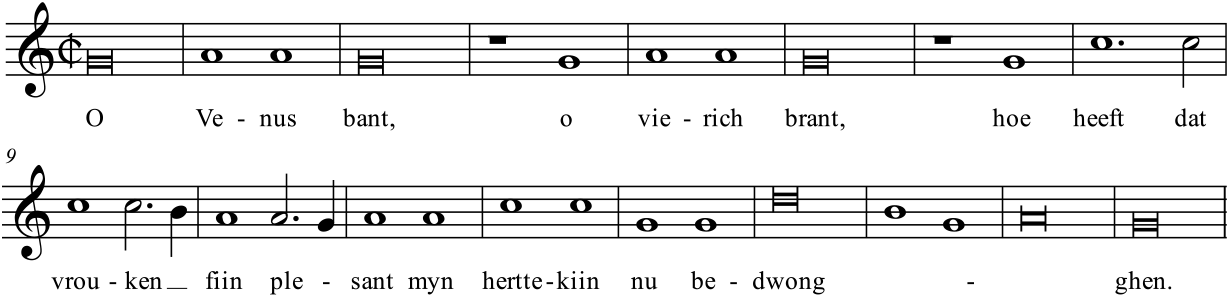
APPENDIX O Venus bant
Text and translation from New Josquin Edition, vol. 27, no. 29, ed. J. van Benthem and H. M. Brown, Critical Commentary, pp. 194–5 (based on the manuscript Amsterdam, Universiteitsbibliotheek, MS 1 A 24n)