There is a disconnect in the US healthcare system between high expenditures and variable quality of care.1–Reference Zimlichman, Henderson, Tamir, Franz, Song, Yamin, Keohane, Denham and Bates3 In an effort to improve outcomes and to tie payments to quality, the federal government has altered its general reimbursement scheme. Specifically, these new rules penalize hospitals for readmissions within 30 days following an initial discharge.4
These initiatives are controversial in that generally there is little evidence suggesting that factors correlated with short-term rehospitalization are amenable to modification. However, for select hospital-acquired complications (HACs), it seems reasonable to hypothesize that the prevention of these events will promote the avoidance of rehospitalizations. One such frequent and costly complication that has engendered close scrutiny is Clostridium difficile infection (CDI).Reference Magill, Edwards and Wendy Bamberg5, Reference Dubberke and Olsen6 Targeted as an HAC that requires urgent reduction, CDI nevertheless continues to escape efforts to contain it.Reference Pépin, Valiquette, Abary, Villemure, Pelletier, Forget, Pépin and Chouinard7–Reference Hubert, Loo and Bourgault14
Within the hospital, the intensive care unit (ICU) is one of the most resource-intensive areas, and ICU patients, specifically those with respiratory failure requiring mechanical ventilation, are at a 10-fold higher risk for developing CDI than the general hospitalized population.Reference Zilberberg, Nathanson and Sadigov15 This, in turn, elevates their risk of hospital mortality and prolongs their hospital and ICU lengths of stay (LOS).Reference Zilberberg, Nathanson and Sadigov15–Reference Lagu, Stefan, Haessler, Higgins, Rothberg, Nathanson, Hannon, Steingrub and Lindenauer18 Less is known about CDI recurrence and its impact in this critically ill population. A recent study by Micek et alReference Micek, Schramm and Morrow16 has demonstrated a 13% CDI recurrence rate, 45% of which occurred within 30 days of discharge from the index hospitalization. One potential consequence of a recurrence is the need for rehospitalizaion. Whether recurrent CDI poses a direct risk for rehospitalization among CDI patients in the ICU is unknown. We conducted a study to explore whether CDI recurrence may be predictive of 30-day rehospitalization among critically ill patients requiring mechanical ventilation.
Methods
We conducted a secondary analysis of a multicenter retrospective cohort study of critically ill mechanically ventilated patients who survived their index hospitalization that was complicated by CDI. The details of the original cohort have been previously reported.Reference Micek, Schramm and Morrow16 Briefly, the study was conducted at 3 academic medical centers: Barnes-Jewish Hospital (1,250 beds) in St. Louis, Missouri; Mayo Clinic (1,951 beds) in Rochester, Minnesota; and Creighton University Medical Center (335 beds) in Omaha, Nebraska, between January 2009 and December 2010. The Human Studies Committee at each institution approved the study.
Study Cohort
All adult ICU patients, both medical and surgical, requiring tracheal intubation and mechanical ventilation for at least 48 hours were eligible for inclusion. Patients were enrolled if they developed clinical symptoms of CDI and had a stool sample positive for C. difficile enterotoxin A or B or both. Mechanical ventilation could either predate or follow the onset of CDI. Patients were eligible for the current analysis if they survived the index hospitalization.
Definitions
CDI was defined by diarrhea, pseudomembranous colitis or toxic megacolon and a positive assay for C. difficile toxins A and/or B. Patients with severe ileus were included if they had also been diagnosed with CDI by their treating clinical team. The index episode of CDI was classified according to definitions adapted from the surveillance recommendations as follows: (1) hospital-onset healthcare-facility-associated (HO-HCFA), if CDI onset occurred after hospital day 3; (2) community-onset healthcare facility associated (CO-HCFA), if CDI occurred within the first 3 days of the index hospitalization and there was evidence of a prior CDI within 60 days or the patient was transferred from another healthcare facility, and (3) community-associated (CA), if CDI occurred within the first 3 days of the index hospitalization, and there was no evidence of a prior CDI episode and the patient was admitted from home.Reference Cohen, Gerding and Johnson19 Septic shock was defined as the need for vasopressors (norepinephrine, dopamine, epinephrine, phenylephrine, or vasopressin) within 24 hours of the diagnosis of CDI to maintain a mean arterial pressure ≥65 mmHg. Patients who survived their index hospitalization were followed for 30 days following discharge for signs of CDI recurrence or for the need for rehospitalization. Recurrence of CDI after the index episode was defined as the reappearance of diarrhea and a positive C. difficile toxin assay after cessation of therapy for the index episode, and the subsequent need for retreatment either during the same hospitalization or after discharge.
Microbiology Data
The microbiology laboratories at Barnes-Jewish Hospital and Creighton University Hospital used the commercial assay Techlab TOX A/B II to detect C. difficile toxin in stool samples. Mayo Clinic Division of Clinical Microbiology used a rapid real-time polymerase chain reaction assay developed at their institution, which used the LightCycler (Roche Diagnostics, Indianapolis, IN), to detect tcdA and tcdB as well as tcdC.
Data Elements
Patient-specific baseline characteristics and process of care variables were collected from the automated hospital medical records, microbiology laboratories, and pharmacy databases of the 3 hospitals. The baseline characteristics collected included age, gender, ethnicity, comorbidities, and severity of illness. The Acute Physiology and Chronic Health Evaluation (APACHE) II was calculated based on clinical data present during the 24 hours after ICU admission.Reference Knaus, Draper and Wagner20 Infection-related characteristics examined included antibiotic therapy for index CDI, recurrent CDI, and need for colectomy. Active infection control practices for the prevention of CDI were present at the time of the investigation within all 3 hospitals.Reference Bobo, Dubberke and Kollef21
Statistical Analyses
The primary end point for the study was readmission within 30 days. Continuous variables were reported as means with standard deviations when distributed normally or as medians with 25th and 75th percentiles when skewed. Differences between mean values were tested using Student’s t-test, while differences between medians were examined using the Mann-Whitney U test. Categorical data were summarized as proportions, and the χ2 test or Fisher’s exact test for small samples was used to examine differences between groups. All tests were 2-tailed, and P<.05 was deemed a priori to represent statistical significance in the bivariate analyses.
We developed a multiple logistic regression model to identify clinical predictors of readmission within 30 days. All risk factors significant at ≤.20 in the bivariate analyses, as well as all biologically plausible factors, even if they did not reach this level of significance, were entered into the model. All variables were assessed for colinearity, and interaction terms were tested. The most parsimonious model with the best fit as measured by the c-statistic was derived using the backward elimination method. The model’s calibration was assessed using the Hosmer-Lemeshow goodness-of-fit test. All tests were 2-tailed, and, due to the small sample size and the desire to minimize type II error, P<.10 qualified the independent variables for retention in the model.
All computations were done in Stata/SE, version 9 (StataCorp, College Station, TX).
Results
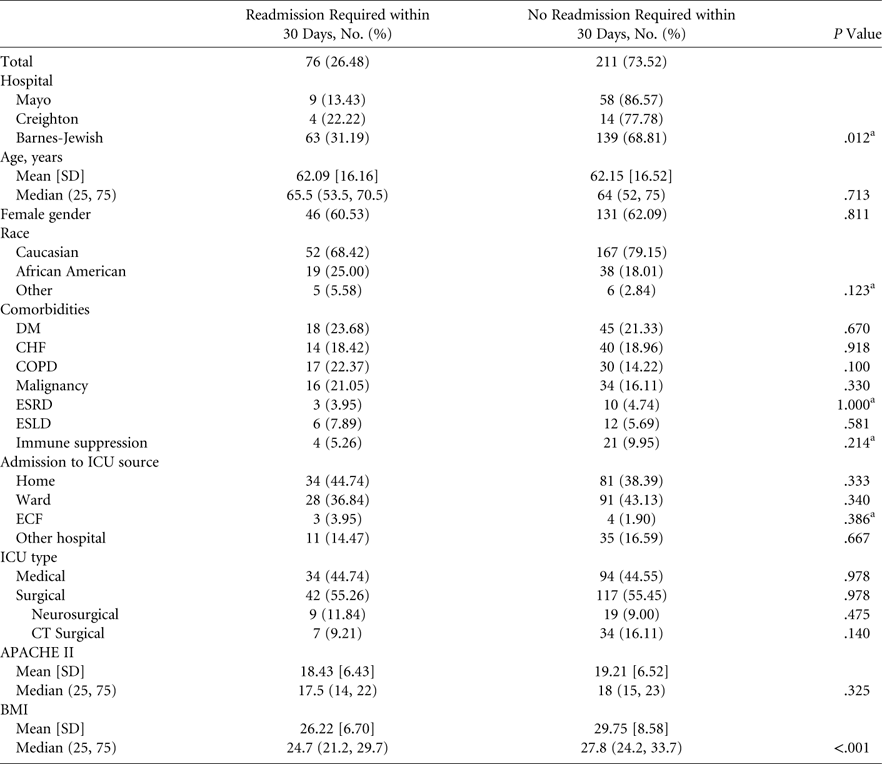
Of the 386 patients enrolled in the cohort, 287 (74.4%) survived to hospital discharge. The great majority of the patients (70.4%) were enrolled at the Barnes Jewish Hospital (Table 1). Among these hospital survivors, 76 (26.5%) required readmission within 30 days after discharge. At baseline, the group requiring rehospitalization did not differ significantly from the group that did not based on demographics, comorbidities, APACHE II scores or ICU type (Table 1). The median body mass index (BMI), however, was significantly lower among those who were rehospitalized than those who were not rehospitalized (24.7 vs 27.8, P<.001).
Baseline Characteristics

NOTE. SD, standard deviation; DM, diabetes mellitus; CHF, congestive heart failure; COPD, chronic obstructive pulmonary disease; ESRD, end-stage renal disease; ESLD, end-stage liver disease; ICU, intensive care unit; ECF, extended care facility; CT, cardiothoracic; BMI, body-mass index.
a P-value derived using Fisher’s exact test.
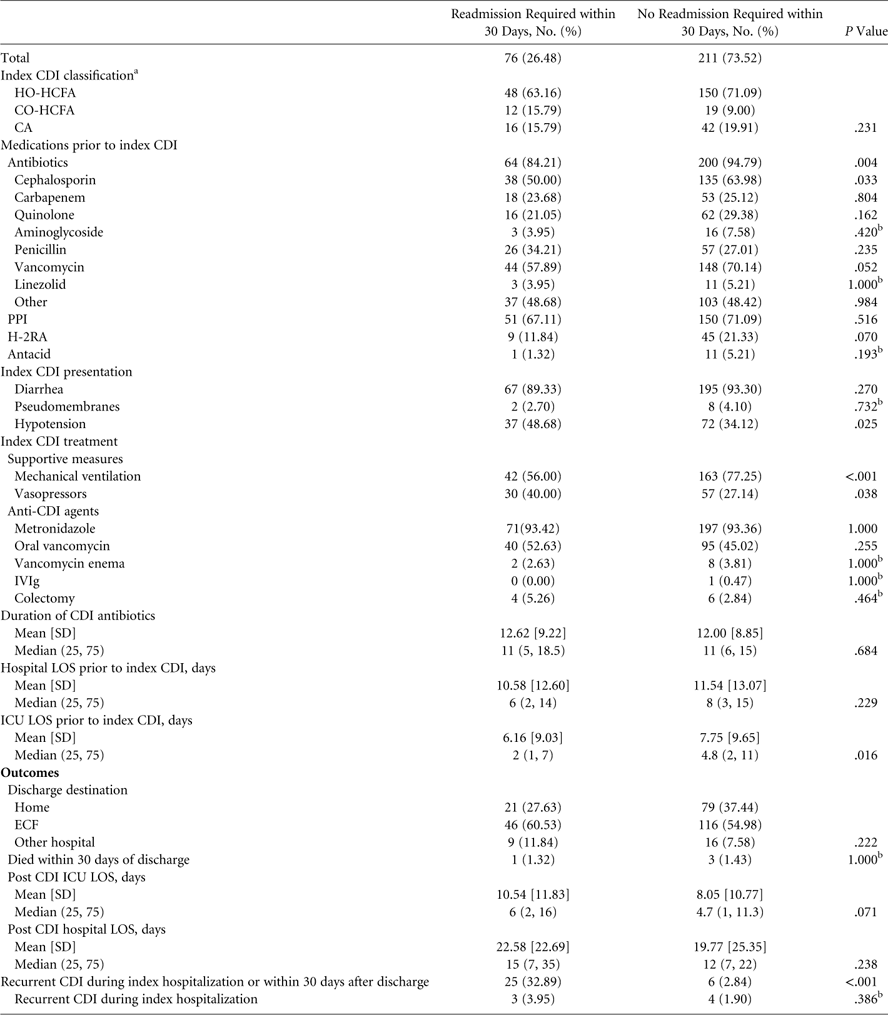
Characteristics and outcomes of the index episode of CDI are listed in Table 2. The majority of the cases in both groups were classified as HO-HCFA. At the time of onset of the index episode of CDI, those eventually rehospitalized were less likely than those who were not rehospitalized to have been exposed to antibiotics in general (84.2% vs 94.8%, P=.004), and to certain classes of antibiotics, specifically cephalosporins (50.0% vs 64.0%, P=.033) and vancomycin (57.9% vs 70.1%, P=.051). They were also more likely to experience hypotension (48.7% vs 34.1%, P=.025) and require vasopressors (40.0% vs 27.1%, P=.038), but they were less likely to require mechanical ventilation (56.0% vs 77.3%, P<.001).
Clostridium difficile infection (CDI) Index Characteristics and Outcomes
NOTE. HO-HCFA, hospital-onset healthcare facility associated; CO-HCFA, community-onset healthcare facility associated CDI; CA, community-associated CDI; PPI, proton pump inhibitor; H-2RA, histamine-2 receptor antagonist; IVIg, intravenous immune globulin; SD, standard deviation; LOS, length of stay; ICU, intensive care unit; ECF, extended care facility.
a Adapted from Cohen et al.Reference Cohen, Gerding and Johnson19
b P-value derived using Fisher’s exact test.
After the onset of CDI, both the hospital LOS and the ICU LOS were not significantly different between the groups that did and did not require rehospitalization (Table 2). No difference between the groups was observed with respect to either discharge destination or the risk of death within 30 days after discharge from the index hospitalization. However, a clear relationship between recurrence and subsequent rehospitalization was identified. Namely, a far greater proportion of those readmitted had developed a recurrence either during the index hospitalization or within 30 days after discharge (32.89% vs 2.84%, P<.001) (Table 2).
In a logistic regression, CDI recurrence emerged as the strongest predictor of the need for readmission within 30 days (adjusted odds ratio [OR] 15.33, 95% confidence interval [CI] 5.58–41.40) (Table 3). The model’s discrimination (c-statistic=0.796) and calibration (Hosmer-Lemshow P=.154) were adequate.
Independent Predictors of 30-Day RehospitalizationFootnote a
NOTE. OR, odds ratio; CI, confidence interval; CDI, C. difficile infection; BMI, body mass index.
a Factors not retained at P<.10: hospital indicator, race, ICU type – CT surgical, COPD, prior quinolone, proton pump inhibitor, histamine 2 receptor antagonist, antacid, prior vancomycin, index hospital LOS, index CDI HO-HCFA. Area under the receiver operating characteristic curve=.796; Hosmer-Lemeshow P=.154.
Discussion
This multicenter cohort study demonstrates that >25% of the ICU survivors whose hospitalization was complicated by an episode of CDI required readmission within 30 days of discharge. More importantly, a recurrent episode of CDI is an important predictor of rehospitalization. While the overall recurrence rate was relatively low (10.8%), for those requiring rehospitalization, recurrence contributed to the need for rehospitalization in ~33% of cases.
To the best of our knowledge, this is the first study to examine 30-day rehospitalization in the context of CDI recurrence among the critically ill. The Affordable Care Act of 2010 has required the Department of Health and Human Services to establish a program to address what are perceived as high readmission rates.4 These rates are deemed by CMS to connote poor quality care. Because the diagnoses for which this penalty has taken effect (acute myocardial infarction, congestive heart failure, and pneumonia) disproportionately impact ICU patients, this population’s rehospitalization rates are likely in turn to disproportionately impact a hospital’s quality rating and reimbursements. In contrast to pneumonia, where factors other than hospital complications are most influential in rehospitalization, CDI as a complication of sepsis appears to predict rehospitalization.Reference Shorr, Zilberberg and Reichley22 That is, ICU patients who survive their illness complicated by CDI are exceedingly likely to require a rehospitalization within 30 days of discharge if their CDI recurs. The implications of the current finding are that assiduous efforts at preventing recurrent CDI may pay off not only in terms of reducing the associated morbidity and mortality but also as a way to diminish 30-day rehospitalizations and thus to improve quality of care.
How does one reduce the risk of a CDI recurrence? Prior investigations have reported that advanced age, chronic renal insufficiency, elevated white blood cell count, low serum albumin, use of gastric acid suppression, as well as continued use of systemic antimicrobials are all important risk factors for CDI recurrence.Reference Garey, Sethi, Yadav and DuPont23–Reference Kim, Graham and Jang28 Of these factors, only exposures to gastric acid suppression and antibiotics are amenable to treatment alterations. Interestingly, in our study, we have found cephalosporin treatment prior to the onset of CDI to be protective against a 30-day rehospitalization. Although it is unclear what the mechanism of such protective effect may be, this finding requires further exploration. Clearly, any antimicrobial treatment needs to be narrowed and tailored strictly to the specific needs of the patient to avoid complications such as CDI and antibiotic resistance.
While it is imperative to strive to reduce each patient’s exposure to antibiotics to the extent possible, this remains a challenging undertaking in the ICU, despite studies suggesting potential usefulness of biomarkers such as procalcitonin.Reference Prkno, Wacher, Brunkhorst and Schlattmann29, Reference Albrich, Dusemund and Bucher30 Similarly, and particularly among those on mechanical ventilation, eliminating gastric acid suppression may subject patients to the risk of gastrointestinal bleeding.31 Until the risks of these interventions are balanced against their benefits, these factors will remain difficult to eliminate altogether.
Other promising strategies have been reported, however, for lowering the risk of a CDI recurrence. For example, in two large clinical trials, fidaxomicin has been found to cut the rate of CDI recurrence by approximately 50%.Reference Louie, Miller and Mullane32, Reference Cornely, Crook and Esposito33 Fecal microbiota transplant (FMT) is yet another promising modality for reducing CDI recurrence as reported in a recent systematic review.Reference Cammarota, Ianiro and Gasbarrini34 Neither fidaxomicin nor FMT, however, has been studied adequately among patients in the ICU or in other important populations and circumstances.Reference Louie, Miller and Mullane32, Reference Cornely, Crook and Esposito33, Reference Lofgren, Moehring, Anderson, Weber and Fefferman35, Reference Rao, Young and Aronoff36 Furthermore, whether these interventions can impact CDI-related 30-day rehospitalization rates requires further investigation.
Notably, the recurrence rate of CDI observed in our study is lower than that reported generally. In a meta-analysis examining risk factors associated with CDI recurrence, Garey et alReference Garey, Sethi, Yadav and DuPont23 reported recurrence rates between 13% and 50%, and more current data from randomized controlled trials suggest that CDI is likely to recur in ~25% of the patients treated with vancomycin.Reference Louie, Miller and Mullane32, Reference Cornely, Crook and Esposito33 On the other hand, studies in populations similar to ours, which focus exclusively on hospitalized patients, report a similar recurrence rate.Reference Zilberberg, Reske, Olsen, Yan and Dubberke37 The explanation for this disparity may lie at least in part in how the data in the current study were collected. First, we purposely limited the recurrence to either the index hospitalization or to the subsequent 30 days, as this was the timeframe for the primary outcome of interest. This meant that we did not include recurrences that occurred beyond this time, thus undercounting all potential recurrences. Second, since most of the laboratory samples at the participating centers originated either from inpatient wards or the emergency room, with the minority coming from the community, a selection bias was likely introduced. That is, we were more likely to identify recurrences among patients who required a rehospitalization than among those who did not. Although this is a limitation of our study, this misclassification was unlikely to impact patients whose recurrent infection was severe enough to present to the hospital for evaluation. Our results would be expected to hold for this more severe group. Furthermore, when a patient who received healthcare within one of the healthcare systems that participated in the study presented to a non-system hospital, he/she was nearly always transferred back into the integrated system because of issues of insurance coverage. Although majority of the discharged patients were generally followed up at practices affiliated with each of the systems participating in this study, and, thus, their records were available for follow-up assessment, the medical records of a small minority of patients may not have been available. Assuming ~20% unavailability of follow-up records and an overall 10% CDI recurrence rate, we may have missed an additional 2 cases. This number would not impact our findings substantively. On the other hand, the relatively reduced rate of recurrence is consistent with the previous report that ICU onset of the index CDI episode is protective from a subsequent recurrence.Reference Zilberberg, Reske, Olsen, Yan and Dubberke37 This may be explained by high mortality rates encountered in the ICU. Indeed, of our original cohort of 386 patients, ~25% died before having the opportunity to develop a recurrence. Alternatively, heightened attention to prevention, as well as prompt diagnosis and aggressive management of ICU complications, may account for the low recurrence rate. This focus on prevention may also serve as an explanation for our finding that mechanical ventilation at the onset of index CDI is protective against a rehospitalization.
Our study has a number of limitations. As a retrospective cohort, it is subject to bias, most notably a selection bias, which we discussed above. To mitigate biases, we enrolled all consecutive patients meeting the predetermined criteria. Although we dealt with potential confounding factors through adjusted analyses, residual confounding factors likely remain. As described in the paragraph above, because the 30-day follow-up relied on hospital records for the evidence of C. difficile recurrence, it is likely that we undercounted this event. The study was performed at 3 academic medical centers; thus, the findings may not be broadly generalizable to institutions that do not resemble these centers. At the same time, while we considered multiple healthcare centers in this study, 70% of the cohort originated from Barnes-Jewish Hospital in St. Louis, Missouri, which may further reduce the generalizability of the findings.
In summary, our study is the first to detect a strong relationship between CDI recurrence and the need for rehospitalization within 30 days of discharge among ICU patients who had required mechanical ventilation. Although requiring confirmation, our finding has major implications for the management of ICU patients. Not only does it once again stress the importance of preventing the initial CDI episode, it also argues for more fastidious attention to recurrence prevention as a way to improve quality of care.
Acknowledgments
We thank Drs. Garrett Schramm and Lee Morrow, who led the original investigation at the Mayo Clinic and Creighton University Medical Center, respectively.
Financial support: This study was supported by a grant from Cubist Pharmaceuticals, Lexington, Massachusetts.
Potential conflicts of interest: MDZ has served as a consultant to and/or received research funding from Cubist, Astellas, Pfizer, CareFusion, and Theravance. AFS has served as a consultant to and/or received research funding from Cubist, Astellas, Pfizer, Forest, Theravance, and CareFusion. STM has served as a consultant to and/or received research funding from Cubist, Astellas and Pfizer. MHK has served as a consultant to and/or received research funding from Cubist, Astellas, Pfizer, Forest, and Theravance.