Introduction
In clinical routine and research, abstract thinking difficulties are often tested by assessing the patient's ability to explain and understand nonliteral, “figurative” expressions such as proverbs, metaphors, and idioms (Chapman et al., Reference Chapman, Ulatowska, Franklin, Shobe, Thompson and McIntire1997; Kempler, Van Lancker, & Read, Reference Kempler, Van Lancker and Read1988). Especially in the case of proverbs, this diagnostic procedure has a long tradition within psychiatry and neurology (Andreasen, Reference Andreasen1977; Gorham, Reference Gorham1961; Hadlich, Reference Hadlich1931; Thoma & Daum, Reference Thoma and Daum2006; Wegrocki, Reference Wegrocki1940). However, although applied routinely, there is no current consensus on the diagnostic reliability and specificity of this procedure in dementias. This is unfortunate, since complex language deficits may represent interesting diagnostic tools for dementias: language deficits occur early in the course of Alzheimer's disease (AD), and performance on verbal tasks was suggested as an important diagnostic criterion for both AD and mild cognitive impairment (MCI) in a recent review (Taler & Phillips, Reference Taler and Phillips2008).
The past decade brought an enormous increase of knowledge on the cognitive and brain function processes behind comprehension of nonliteral language (NL language) (Kacinik, & Chiarello, Reference Kacinik and Chiarello2007; Rapp, Reference Rapp2009, Reference Rapp2011; Schmidt, Kranjec, Cardillo, & Chatterjee, Reference Schmidt, Kranjec, Cardillo and Chatterjee2010).
Several new studies addressed nonliteral language comprehension processes in patients with dementia, especially of the Alzheimer subtype. However, to our knowledge, no current review has summarized the findings. Consequently, the aim of this study is to review studies addressing nonliteral language comprehension in dementia. It includes work on metaphors, metonymies, proverbs, idioms, and irony/sarcasm.
Linguistic Aspects: Nonliteral Language and Its Comprehension Processes
Nonliteral language (often called “figurative” language) is a heterogeneous linguistic entity of speech forms that go beyond the literal meaning of the words and requires the ability to process more than the literal meaning of an utterance to grasp the speaker's intention in a given context. Although several definitions exist for nonliteral language, there is general consensus that metaphors, proverbs, idioms, irony, sarcasm, and metonymy are among the most important types of nonliteral language. A widely accepted—but not precisely defined—approach to classify nonliteral language is the distinction between salient (sometimes called “fossilized”) and nonsalient (“novel”) nonliteral expressions. A salient expression is “frequently” used in everyday language, whereas a “novel” expression is not. It is generally accepted that the cognitive processes between salient and nonsalient expressions differ (Giora, Reference Giora2003; Glucksberg, Reference Glucksberg2003), although the exact nature of these differences are still subject of debate and investigation (Giora, Reference Giora2007). An important remark is that salience is not identical with familiarity in an individual subject. In other words, an individual may be not familiar with even a very “popular,” salient nonliteral expression such as, for example, “kick the bucket” (which in English is metaphorical for “to die”). As many nonliteral expressions are not self-explaining, this means that the individual, if unfamiliar with the expression, is often unable to access its meaning. This may sound trivial, but is significant if differences in familiarity are not considered in studies comparing subject populations.
Newer research demonstrates that the various different forms of nonliteral language differ in their structure, communicative function, and processing demands (Colston & Gibbs, Reference Colston and Gibbs2002; Giora, Reference Giora2007; Rapp, Reference Rapp2009, Reference Rapp2011; Rundblad & Annaz, 2010; Winner & Gardner, Reference Winner and Gardner1993; Zaidel, Kasher, Soroker, & Batori, Reference Zaidel, Kasher, Soroker and Batori2002). Correspondingly, brain imaging studies investigating the functional neuroanatomy of different nonliteral expressions in healthy subjects show activation differences between different types of nonliteral language (Ahrens et al., Reference Ahrens, Liu, Lee, Gong, Fang and Hsu2007; Eviatar & Just, Reference Eviatar and Just2006; Schmidt & Seger, Reference Schmidt and Seger2009; Yang, Edens, Simpson, & Krawczyk, Reference Yang, Edens, Simpson and Krawczyk2009).
Methods
The aim of this work is a systematic review of the current evidence on nonliteral language comprehension in Alzheimer's disease (AD) and related disorders. Relevant literature was identified using the databases PsychInfo and PUBMED and the search terms metaphor, idiom, proverb, metonymy, irony, sarcasm in combination with Alzheimer, dementia, or mild cognitive impairment.
Results
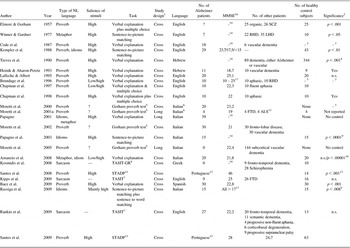
Our literature search identified 24 studies on nonliteral language in dementia (Table 1). Of these 24 studies, 20 reported data in Alzheimer's dementia. Half of the studies report comparisons with patient samples other than AD [fronto-temporal dementia (FTD) (n = 4), vascular dementia (n = 4), or schizophrenia (n = 2), see Table 1]. One additional study (Campanha et al., Reference Campanha, Lira, Diniz, Ortiz, Bertolucci and Minett2008; n = 60 AD patients) was excluded because it was only published as a conference abstract. Astonishingly, no studies regarding mild cognitive impairment could be identified. First, the literature was analyzed with reference to linguistic aspects. In the second part of this review, disease specific aspects are discussed.
Studies on nonliteral language in AD and other dementia

Note. AD = Alzheimer's disease; Organic = organic brain damage; SCZ = schizophrenia; LHD = left hemisphere brain damage; RHD = right hemisphere brain damage; FTD = fronto-temporal dementia; ALS = amyotrophic lateral sclerosis; n.s. = not significant; TASIT = the Awareness of Social Inference test.
1Cross = cross-sectional, Long = longitudinal.
2AD patients relative to healthy control subjects.
3No control group.
4For the whole patient group vs. controls.
5Paper reports use Gorham proverb test in 1968 original form. However, likewise an Italian version was used.
6Likewise, no information reported.
7TASIT sarcasm test (McDonald et al., Reference McDonald, Bornhofen, Shum, Long, Saunders and Neulinger2006).
8Greek Version of the TASIT sarcasm comprehension test.
9For both tasks.
10Not significant for conventional metaphors and idioms, p < .00001 for new metaphors.
11Screening Test for Alzheimer's Disease with Proverbs (STADP, Santos et al., Reference Santos, Sougey and Alchieri2009). The STADP has 3 subtests.
12Not mentioned in an explicit manner, but likewise Portuguese.
13For the total score of the STADP, significant results relative to controls also in all subtests except stage b (executive functions).
14Not reported.
15For all subtests (recognizing, interpreting, abstracting).
16Mini-mental state examination (Folstein et al., Reference Folstein, Folstein and McHugh1975), reported mean value for patients. The study by Kempler et al. (1988) reports three patient groups with different severity levels.
17Range (No mean value reported).
Metaphor
Metaphors (such as “life is a journey”) are used for conceptualizing and making expressible relevant parts of our lives that are otherwise difficult to explain (Lakoff & Johnson, Reference Lakoff and Johnson1980). Taken literally, metaphoric statements are mostly wrong (Glucksberg, Reference Glucksberg2003). The meaning of a metaphor is suggested through association and comparison of similarities between different expressions that are not stated explicitly. Beyond semantic and word-by-word analysis, understanding the figurative meaning of a metaphor requires mental linkage of different category domains normally not related to each other (Glucksberg, Reference Glucksberg2003; Rapp, Leube, Erb, Grodd, & Kircher, Reference Rapp, Leube, Erb, Grodd and Kircher2004).
Several imaging and lesion studies investigated the functional neuroanatomy of metaphor comprehension in healthy subjects (Chen, Widick, & Chatterjee, Reference Chen, Widick and Chatterjee2008; Hillert, & Buracas, Reference Hillert and Buracas2009; Mashal, Faust, Hendler, & Jung-Beeman, Reference Mashal, Faust, Hendler and Jung-Beeman2005; Rapp, Leube, Erb, Grodd, & Kircher, Reference Rapp, Leube, Erb, Grodd and Kircher2004, Reference Rapp, Leube, Erb, Grodd and Kircher2007; Schmidt & Seger, Reference Schmidt and Seger2009; Shibata, Abe, Terao, & Miyamoto, Reference Shibata, Abe, Terao and Miyamoto2007; Stringaris, Medford, Giampietro, Brammer, & David, Reference Stringaris, Medford, Giampietro, Brammer and David2007) and brain lesioned patients (Gagnon, Goulet, Giroux, & Joanette, Reference Gagnon, Goulet, Giroux and Joanette2003; Rinaldi, Marangolo, & Baldassarri, Reference Rinaldi, Marangolo and Baldassarri2004; Zaidel et al., Reference Zaidel, Kasher, Soroker and Batori2002). Results indicate that a predominantly left-lateralized fronto-temporal network with some right hemisphere involvement is crucial in metaphor appreciation (Rapp, Reference Rapp2011). Lesion studies and hemifield research (Anaki, Faust, & Kravetz, Reference Anaki, Faust and Kravetz1998; Faust & Mashal, Reference Faust and Mashal2007; Kacinik & Chiarello, Reference Kacinik and Chiarello2007; Schmidt, DeBuse, & Seger, Reference Schmidt, DeBuse and Seger2007) indicate that laterality within this network is possibly task-dependent: right hemisphere lesioned subjects have difficulties in matching orally presented metaphors with an appropriate picture (Gagnon et al., Reference Gagnon, Goulet, Giroux and Joanette2003; Hillekamp, Knobloch, & Buelau, Reference Hillekamp, Knobloch and Buelau1996; MacKenzie, Begg, Brady, & Lees, Reference MacKenzie, Begg, Brady and Lees1997; Winner & Gardner, 1977), whereas they give adequate verbal descriptions of metaphors (Giora, Zaidel, Soroker, Batori, & Kasher, Reference Giora, Zaidel, Soroker, Batori and Kasher2000; Winner & Gardner, Reference Winner and Gardner1977). In contrast, left hemisphere-damaged patients often offer “concrete” or “literal” verbal explanations of the metaphors in most studies (Burgess & Chiarello, Reference Burgess and Chiarello1996; Rapp, Reference Rapp2011; Winner & Gardner, Reference Winner and Gardner1977). These findings are of potential relevance for testing procedures: while multiple choice tasks are clearly a bihemispheric function, this situation is less clear for verbal explanation approaches.
So far, three studies investigated the comprehension of metaphors in Alzheimer's dementia (Amanzio, Geminiani, Leotta, & Cappa, Reference Amanzio, Geminiani, Leotta and Cappa2008; Papagno, Reference Papagno2001; Winner & Gardner, Reference Winner and Gardner1977). In a seminal study of the field, Winner and Gardner (Reference Winner and Gardner1977) investigated the comprehension of frequently used metaphoric expressions (such as “lend a hand”). In their study, AD patients were seriously impaired in selecting the picture representing the correct metaphoric meaning of an utterance out of four alternatives and in explaining the meaning of a metaphor with own words. However, in this study a small sample of only seven patients was investigated.
In a prospective study, Papagno (Reference Papagno2001) investigated the comprehension of metaphors (taken from Papagno et al., Reference Papagno, Cappa, Forelli, Garavaglia, Laiacona, Capitani and Vallar1995) over a time period of 6–8 months. Her paradigm was a verbal explanation task. The decrement in metaphor comprehension, but not idiom comprehension, was significant after this time period. Only conventional, that is frequently used, metaphors were used. There was no healthy control group. The question whether the used metaphors are salient (frequently used in everyday language) is of relevance since the neural correlates for nonsalient metaphoric stimuli possibly differ (Ahrens et al., Reference Ahrens, Liu, Lee, Gong, Fang and Hsu2007; Schmidt & Seger, Reference Schmidt and Seger2009; Yang et al., Reference Yang, Edens, Simpson and Krawczyk2009; Yang, Fuller, Khodaparst, & Krawczyk, Reference Yang, Fuller, Khodaparst and Krawczyk2010), and possibly a greater extent of right hemisphere recruitment could be required for their comprehension process (Giora et al., Reference Giora, Zaidel, Soroker, Batori and Kasher2000; Giora, Reference Giora2007; Schmidt et al., Reference Schmidt, Kranjec, Cardillo and Chatterjee2010). Amanzio et al. (Reference Amanzio, Geminiani, Leotta and Cappa2008) compared comprehension of conventional metaphors and new metaphors in a sample of 20 AD patients with a mean Mini-Mental State Examination (MMSE) score (Folstein, Folstein, & McHugh, Reference Folstein, Folstein and McHugh1975) of 22. The same stimuli as in Papagno (Reference Papagno2001) were used. Relative to an age-matched control group, AD patients were only significantly impaired for new metaphors, but not for conventional metaphors and idioms.
Metonymy
Metonymy is a frequent form of nonliteral language, in which one expression is used to refer to the standard referent of a related one (for example “Kremlin” for “the Russian government”) (Lakoff & Johnson, Reference Lakoff and Johnson1980; Panther & Radden, Reference Panther and Radden1999).
Newer linguistic research highlights the cognitive differences in the comprehension process between metonymy and metaphor. Whereas metaphor requires the mapping across two semantic domains, metonymy requires only one semantic domain (Annaz et al., Reference Annaz, Van Herwegen, Thomas, Fishman, Karmiloff-Smith and Rundblad2009; Rapp et al., Reference Rapp, Markert, Erb and Grodd2010; Rundblad, & Annaz, Reference Rundblad and Annaz2010). No studies have yet addressed the comprehension of metonymy in AD or other dementias.
Proverbs
The highest proportion of studies on NL language in Alzheimer's disease investigated the comprehension of proverbs (Table 1; Báez, Mendoza, Reyes, Matallana, & Montañés, Reference Báez, Mendoza, Reyes, Matallana and Montañés2009; Brundage & Brookshire, Reference Brundage and Brookshire1995; Chapman et al., Reference Chapman, Ulatowska, Franklin, Shobe, Thompson and McIntire1997; Chapman, Highley, & Thompson, Reference Chapman, Highley and Thompson1998; Code & Lodge, Reference Code and Lodge1987; Elmore & Gorham, Reference Elmore and Gorham1957; Heinik & Aharon-Peretz, Reference Heinik and Aharon-Peretz1993; Kempler et al., Reference Kempler, Van Lancker and Read1988; Lafleche & Albert, Reference Lafleche and Albert1995; Moretti, Torre, Antonello, & Cazzato, Reference Moretti, Torre, Antonello and Cazzato2000, Reference Moretti, Torre, Antonello and Cazzato2001a, Reference Moretti, Torre, Antonello and Cazzato2001b; Moretti, Torre, Antonello, Cazzato, & Bava, Reference Moretti, Torre, Antonello, Cazzato and Bava2002; Moretti et al., Reference Moretti, Torre, Antonello, Cazzato, Bava and Manos2005; Santos, Sougey, & Alchieri, Reference Santos, Sougey and Alchieri2009; Treves, Ragolsky, Gelernter, & Korczyn, Reference Treves, Ragolsky, Gelernter and Korczyn1990). Proverbs are simple, popularly known sayings based on a common sense or practical experience. Some, but not all proverbs are metaphors.
In analogy to metaphor, the distinction between verbal explanation and multiple choice (MC) tasks is of relevance. Whereas most studies used verbal explanation tasks (Brundage, Reference Brundage1993; Code & Lodge, Reference Code and Lodge1987; Elmore & Gorham, Reference Elmore and Gorham1957; Heinik & Aharon-Peretz, Reference Heinik and Aharon-Peretz1993; Lafleche & Albert, Reference Lafleche and Albert1995; Treves et al., Reference Treves, Ragolsky, Gelernter and Korczyn1990) or multiple choice (Kempler et al., Reference Kempler, Van Lancker and Read1988), few studies applied both tasks in their sample (Chapman et al., Reference Chapman, Ulatowska, Franklin, Shobe, Thompson and McIntire1997, Reference Chapman, Highley and Thompson1998). In multiple choice tests, AD patients are significantly impaired. In the study by Kempler et al. (Reference Kempler, Van Lancker and Read1988), 29 AD patients performed significantly worse relative to 43 healthy controls. In everyday clinical routine, testing proverb explanation is much quicker than a multiple choice task. There is some evidence from the study by Chapman et al. (Reference Chapman, Ulatowska, Franklin, Shobe, Thompson and McIntire1997) that the impairment in proverb explanation is less severe compared with MC. However, their results rely on only 10 patients and a low number of stimuli. Few studies compared proverb explanation in AD with healthy controls. In a historical study, Elmore and Gorham (1957) found significantly impaired proverb comprehension on the Gorham proverbs test (Gorham, Reference Gorham1956). However, their group of “organics” is not further specified (Fogel, Reference Fogel1965). Another study has a similar limitation. Treves et al. (Reference Treves, Ragolsky, Gelernter and Korczyn1990) applied a proverb explanation task to a group of 89 dementia patients and found a p < .001 significance level relative to healthy control subjects. However, their study did not discriminate between AD and vascular dementia. Other proverb studies predominantly had small samples or had no healthy control group (Brundage & Brookshire, Reference Brundage and Brookshire1995; Code & Lodge, Reference Code and Lodge1987; Moretti et al., Reference Moretti, Torre, Antonello, Cazzato and Bava2002, Reference Moretti, Torre, Antonello, Cazzato, Bava and Manos2005) (Table 1). Future research should consider findings from newer linguistic research. The perhaps most important aspect is familiarity of proverbs. It is now clear that comprehensibleness of proverbs interdepends with their familiarity (Nippold & Haq, 1996) that is, whether the subject “knows” the proverb or not (Uekermann, Thoma, & Daum, Reference Uekermann, Thoma and Daum2008). Research in healthy subjects and patients indicates that familiar proverbs are easier to interpret (Penn, Jacob, & Brown, Reference Penn, Jacob and Brown1988). One explanation given in the literature is that successful recognition of familiar nonliteral expressions likewise involves perception of an “overall pattern” (Gibbs, Reference Gibbs1980; Horowitz & Manelis, Reference Horowitz and Manelis1973; Lieberman, Reference Lieberman1963; Osgood & Housain, Reference Osgood and Housain1974), whereas, in contrast, comprehension of proverbs that are novel to the subject can require extensive semantic association processes and referring to general world knowledge.
Few studies addressed this effect of proverb familiarity on comprehension in AD patients. Chapman et al. (Reference Chapman, Ulatowska, Franklin, Shobe, Thompson and McIntire1997) applied two tasks to a sample of 10 AD patients: verbal explanation and multiple choice. According to normative data collected in a previous study by Delis, Kramer, and Kaplan (Reference Delis, Kramer and Kaplan1984), five proverbs were “familiar”, versus five “unfamiliar” ones. Results showed a familiarity × diagnosis interaction: Whereas in the verbal explanation task AD patients were significantly impaired only for unfamiliar, but not familiar proverbs AD patients were impaired in the multiple choice task only in familiar, but not unfamiliar proverbs. Their finding that AD patients have difficulties especially with verbal explanation of unfamiliar proverbs is also strengthened by a study of Brundage & Brookshire (1995), who found a significant effect of proverb familiarity on comprehension in AD patients. In their study, AD patients gave verbal description of the proverbs and the answer was rated using an “adequacy score” (Brundage & Brookshire, Reference Brundage and Brookshire1995). The maximum possible adequacy score for a proverb was 20. Significantly associated with familiarity, the scores for the different proverbs ranged between 20 (indicating that all 10 AD subjects gave perfect descriptions) and 0 (indicating that none of the subjects gave a meaningful description). This result indicates that proverb familiarity is a strong predictor of comprehension performance in AD. However, several factors limit the generalizability of these findings. First, the study has no control group, although other research from the same group indicates that healthy subjects show a similar effect (Qualls & Harris, Reference Qualls and Harris2003; Brundage & Brookshire, 1995; Ulatowska et al., Reference Ulatowska, Chapman, Highley and Prince1998; Roos & Lewis, Reference Roos and Lewis1962). The familiarity for the proverbs was not directly measured in the study population. Instead, normative data were used (Delis et al., Reference Delis, Kramer and Kaplan1984). This point is of relevance as marked inter-individual differences exist in people's familiarity with individual proverbs (Haynes, Resnick, Dougherty, & Althof, Reference Haynes, Resnick, Dougherty and Althof1993; Penn et al., Reference Penn, Jacob and Brown1988; Van Lancker, Reference Van Lancker1990). As well, the number of applied stimuli (five in each condition) is low in the study by Chapman. A rational approach for future research and routine concerning proverb familiarity could be to first directly ask the patient if he/she is familiar with the proverb and then assess comprehension (Thoma et al., Reference Thoma, Hennecke, Mandok, Wähner, Brüne, Juckel and Daum2009; Uekermann et al., Reference Uekermann, Thoma and Daum2008).
Three recent studies from Brazil investigated proverb comprehension in larger samples of AD patients. Campanha and colleagues (Reference Campanha, Lira, Diniz, Ortiz, Bertolucci and Minett2008) investigated comprehension of popular Brazilian proverbs in a comparatively large sample of 60 AD patients and 60 healthy controls. Results exhibited a significant decrease in AD for recognizing, interpreting, and abstracting proverbs. However, their research is so far only published as a conference abstract. Santos et al. (Reference Santos, Guerra, Menezes, Carvalho, Alchieri and Sougey2008, Reference Santos, Sougey and Alchieri2009) investigated the performance of AD patients and older subjects on the Screening Test for Alzheimer's Disease with Proverbs (STADP) (Santos et al., Reference Santos, Sougey and Alchieri2009). This screening test consists of six cards from the “memory game of Proverbs” (Santos, Carvalho, Bastos, & Sougey, Reference Santos, Carvalho, Bastos and Sougey2005). In three subtests, subjects need to recognize, interpret, and recall proverb meanings. In their first study, 14 AD subjects were significantly impaired in the STADP total score, but not in the subtest for interpreting proverbs. All subtests were significantly correlated with the MMSE (Folstein et al., Reference Folstein, Folstein and McHugh1975). The latter finding was replicated in a different sample of 28 AD subjects and 63 healthy controls (Santos et al., Reference Santos, Sougey and Alchieri2009).
Idioms
Idioms form a large group both in terms of syntactic and semantic characteristics. Idioms are structurally “frozen,” that means they are fixed expressions. Some idioms—like metaphors—can be understood by comparison of the semantic entities within, whereas others cannot (like “kick the bucket”, which in English language is an idiomatic expression for “to die”). Five studies have as yet investigated idiom comprehension in Alzheimer dementia (Amanzio et al., Reference Amanzio, Geminiani, Leotta and Cappa2008; Kempler et al., Reference Kempler, Van Lancker and Read1988; Papagno, Reference Papagno2001; Papagno, Lucchelli, Muggia, & Rizzo, Reference Papagno, Lucchelli, Muggia and Rizzo2003; Rassiga, Lucchelli, Crippa, & Papagno, Reference Rassiga, Lucchelli, Crippa and Papagno2009).
In contrast to the proverb studies, most idiom studies used multiple choice tasks. In a study with 29 AD patients, Kempler et al. (Reference Kempler, Van Lancker and Read1988) did not differentiate between idioms and proverbs but found a more severe deficit for familiar expressions relative to controls. However, the patient group was significantly impaired as well in understanding literal control stimuli. This illustrates the importance of literal control stimuli, which are unfortunately missing in five other studies on proverb comprehension (Table 1).
Papagno et al. (Reference Papagno, Lucchelli, Muggia and Rizzo2003) tested nonambiguous opaque idioms (like “to be at the seventh sky”), a specific class of idioms in which it is not possible to figure out their meanings from the individual words. In their study, they used a sentence to picture matching paradigm. AD probands with a mild degree of cognitive decline (MMSE 16–22) were significantly impaired relative to a comparison group, when they had to choose between two pictures, one representing the figurative and one the literal one. However, the performance improved when the picture with the literal meaning was replaced by one representing an unrelated situation.
In another study, the same workgroup (Rassiga et al., Reference Rassiga, Lucchelli, Crippa and Papagno2009) investigated comprehension of ambiguous idioms in 15 patients with mild probable AD. Two tasks were used: In the first, patients had to select the correct meaning out of four pictures while in the second they chose among four words. For both tasks, the alternatives were the picture/word corresponding to the figurative meaning, a semantic associate (picture/word) to the last word of the idiom, and two unrelated alternatives. AD patients were significantly impaired in both tasks, however the effect was stronger in the sentence to picture matching task. The authors concluded that AD patients, like subjects with aphasia, have difficulties as well in the “easier” category but that other factors than semantic language comprehension could have an impact. Such a result would be consistent with aphasic subjects (Papagno & Caporali, Reference Papagno and Caporali2007). As well, extralinguistic executive functions play a role in these tasks.
Only one study used a verbal explanation task. Papagno (Reference Papagno2001) investigated the comprehension of 20 idiomatic phrases in a prospectively designed study in 39 patients with mild to moderate AD. Her study has no control group, but normative data from 321 healthy controls in the task are available (Novelli et al., Reference Novelli, Papagno, Capitani, Laiacona, Vallar and Cappa1986). After 6 months follow-up, no significant impairment was present for idioms. However, the same sample showed a significant decrease in metaphors.
Irony and Sarcasm
In verbal irony the speaker uses words that express something other—in most cases the opposite—of what he literally says (Katz, Blasko, & Kazmerski, Reference Katz, Blasko and Kazmerski2004). To detect irony, the listener hence needs to understand not only that the speaker does not mean exactly what she/he said, but also that she/he does not expect to be taken literally (Blasko & Kazmerski, Reference Blasko and Kazmerski2006; Colston & Gibbs, Reference Colston and Gibbs2002). Consequently, relative to other types of nonliteral language, the comprehension of irony involves additional cognitive processes like second-order theory of mind (TOM) processing (Blasko & Kazmerski, Reference Blasko and Kazmerski2006; Rapp, Mutschler, et al., Reference Rapp, Mutschler, Wild, Erb, Lengsfeld, Saur and Grodd2010). Sarcasm is mostly defined as a severe form of irony often intended to insult or wound. In sarcastic expressions the speaker says the opposite of what he means (for example “this is just great” after something bad happens). Sarcasm can be difficult to grasp in written form and is easily misinterpreted. Comprehension of irony relies on both cerebral hemispheres (Eviatar & Just, Reference Eviatar and Just2006; Schmidt et al., Reference Schmidt, Kranjec, Cardillo and Chatterjee2010; Zaidel et al., Reference Zaidel, Kasher, Soroker and Batori2002) and ventral fronto-medial cortex (Rapp, Markert, Erb, & Grodd, Reference Rapp, Markert, Erb and Grodd2010; Shamay-Tsoory & Aharon-Peretz, Reference Shamay-Tsoory and Aharon-Peretz2007). Patients with AD are impaired in such second-order theory of mind processes (Cuerva et al., Reference Cuerva, Sabe, Kuzis, Tiberti, Dorrego and Starkstein2001).
To our knowledge, three studies have yet investigated irony comprehension in Alzheimer or other dementia (Rankin et al., Reference Rankin, Salazar, Gorno-Tempini, Sollberger, Wilson, Pavlic and Miller2009; Kipps, Nestor, Acosta-Cabronero, Arnold, & Hodges, Reference Kipps, Nestor, Acosta-Cabronero, Arnold and Hodges2009). Two used identical stimulus material, the Awareness of Social Inference test (TASIT; McDonald, Flanagan, Rollins, & Kinch, Reference McDonald, Flanagan, Rollins and Kinch2003), whereas the third study translated the same test into Greek language (Kosmidis, Aretouli, Bozikas, Giannakou, & Ioannidis, Reference Kosmidis, Aretouli, Bozikas, Giannakou and Ioannidis2008). During the TASIT, subjects watch short video vignettes in which professional actors interact. After that, the subject has to answer four yes/no questions about the actions, thoughts, words, and emotions of the characters. Two subtests (“simple sarcasm” and “severe sarcasm”) include ironic stimuli.
Kipps et al. (Reference Kipps, Nestor, Acosta-Cabronero, Arnold and Hodges2009) applied the TASIT to a sample of nine early AD patients with a mean MMSE score of 25 and did not find a significant impairment relative to a control group. Rankin et al. (Reference Rankin, Salazar, Gorno-Tempini, Sollberger, Wilson, Pavlic and Miller2009) applied the same test to a sample of 27 AD patients (mean MMSE 22.2) and found no significant impairment relative to a control group. In both studies other dementia subtypes with comparable MMSE scores (FTD in Kipps et al., Reference Kipps, Nestor, Acosta-Cabronero, Arnold and Hodges2009), semantic dementia in Rankin et al. (Reference Rankin, Salazar, Gorno-Tempini, Sollberger, Wilson, Pavlic and Miller2009) showed a more severe impairment in the severe sarcasm condition, a finding that could possibly be explained by a more pronounced frontal lobe deficit in these disorders. These findings at least point against an early severe impairment of irony detection in AD. Another study (Kosmidis et al., 2009) applied a Greek version of the TASIT to a sample of nine patients with FTD. Relative to a healthy control group, these subjects were significantly impaired in the “minimal,” but not the “severe sarcasm” subtest.
These findings are surprising in the context of recent imaging studies which compared the functional neuroanatomy of irony and metaphor comprehension. Relative to other types of nonliteral language, the comprehension of irony involves additional cognitive processes like second order theory of mind processing (Blasko & Kazmerski, Reference Blasko and Kazmerski2006). Whereas first-order TOM is sufficient for understanding metaphors, an attribution of second-order representations, that is the ability to reflect on the speaker's thought about an attributed thought, is needed for correct interpretation of irony (Happé, Reference Happé1996; Filippova & Astington, Reference Filippova and Astington2008). Other research demonstrates that patients with AD are impaired in second order theory of mind processes (Cuerva et al., Reference Cuerva, Sabe, Kuzis, Tiberti, Dorrego and Starkstein2001). As well, relative to comprehension of salient metaphors, the comprehension of irony relies more on bilateral brain processes (Eviatar & Just, Reference Eviatar and Just2006; Giora et al., Reference Giora, Zaidel, Soroker, Batori and Kasher2000; Zaidel et al., Reference Zaidel, Kasher, Soroker and Batori2002; Schmidt et al., Reference Schmidt, Kranjec, Cardillo and Chatterjee2010) and ventral fronto-medial cortex (Rapp et al., Reference Rapp, Markert, Erb and Grodd2010; Shamay-Tsoory & Aharon-Peretz, Reference Shamay-Tsoory and Aharon-Peretz2007).
A few factors independent of unimpaired irony comprehension in early AD may contribute to the negative results. Unlike most other tests of sarcasm performance (Channon et al., Reference Channon, Rule, Maudgil, Martinos, Pellijeff, Frankl and Shieff2007; Shamay-Tsoory, Tomer, & Aharon-Peretz, Reference Shamay-Tsoory, Tomer and Aharon-Peretz2002, Reference Shamay-Tsoory, Tomer and Aharon-Peretz2005; Shibata, Toyomura, Itoh, & Abe, Reference Shibata, Toyomura, Itoh and Abe2010; Zaidel et al., Reference Zaidel, Kasher, Soroker and Batori2002) the stimuli in the TASIT are arguably more “less artificial” (Kipps et al., Reference Kipps, Nestor, Acosta-Cabronero, Arnold and Hodges2009) than written ironic stimuli, and may more effectively incorporate affective paralinguistic cues as to the speaker's real intention (Kipps et al., Reference Kipps, Nestor, Acosta-Cabronero, Arnold and Hodges2009).
Implications for Clinical Practice and Further Research
The significance of nonliteral language as diagnostic tool interdepends with its applicability in everyday clinical routine and its diagnostic reliability and specificity. However, astonishingly few studies have directly addressed these points.
In “bedside” investigations, the applicability of verbal explanation tasks is superior relative to multiple choice tasks, since verbal explanation of nonliteral expressions can be tested within seconds. During evaluation, the patient is asked to explain the meaning of a nonliteral expression with own words and the answer is then rated for its concreteness and other types of formal thought disorder (Brundage & Brookshire, Reference Brundage and Brookshire1995; Gorham, Reference Gorham1956; Wechsler, Reference Wechsler1976). This diagnostic procedure has a long tradition within psychiatry (Finckh, Reference Finckh1906; Farrar, Reference Farrar1906; Benjamin, Reference Benjamin1944; Gorham, Reference Gorham1956; Goldstein & Salzman, Reference Goldstein and Salzman1965; Andreasen, Reference Andreasen1977), but is nevertheless under scrutiny for its reliability. Whereas some studies in younger populations indicated poor retest-reliability (Andreasen, Reference Andreasen1977; Burgos, Reference Burgos1986), other studies found better reliability (Reich, Reference Reich1981) and the same caveat holds for diagnostic validity (Sander & Greenberg, Reference Sander and Greenberg1968; Andreasen, Reference Andreasen1977). That is, diagnostic reliability and validity are not necessarily poor, but remain widely undetermined especially in geriatric populations. The quality of the testing procedure could be improved, however, if clinicians consider some points:
One important point is the nonliteral language test material used for the assessment. Proverbs, metaphors, and idioms are probably likewise equally suitable, whereas testing irony comprehension in a verbal explanation approach is from our perspective more difficult. As highlighted above, salience and familiarity of nonliteral expressions are important moderators of performance and should be considered while selecting the nonliteral expressions used for testing. High salience indicates that the expression is frequently used in a population, whereas familiarity indicates that the individual “knows” (is familiar with) the expression. For diagnostics in clinical routine, we recommend the use of familiar stimuli, although in research contexts unfamiliar stimuli can be interesting as well. We would recommend testing familiarity of the subject for any stimulus under investigation. Familiarity is a predictor of performance in nonliteral language comprehension in a sense that performance decreases and is less predictable in with unfamiliar nonliteral idioms (Nippold & Taylor, Reference Nippold and Taylor2002) and proverbs (Nippold & Haq, Reference Nippold and Haq1996; Thoma et al., Reference Thoma, Hennecke, Mandok, Wähner, Brüne, Juckel and Daum2009). A high salience of an expression makes it more likely that an individual “knows” an expression, but it is no proof. In clinical practice, one worthwhile procedure to test familiarity could be to first ask for the familiarity with a nonliteral expressions (e.g., “are you familiar with the proverb . . . ”) and then test comprehension (Tseng & Streltzer, Reference Tseng and Streltzer2008; Uekermann et al., Reference Uekermann, Thoma and Daum2008).
Whether it makes sense to use unfamiliar nonliteral expressions in the assessment is currently still controversial. From our perspective, it is not meaningful to test comprehension of expressions that are both unfamiliar to the subject and not self explanatory (like “kick the bucket,” which in English is a salient metaphoric idiom for “to die”) outside a research context. This is because a correct interpretation is difficult (and often impossible to reach) in unfamiliar, not self-explanatory idiomatic expressions and proverbs. If the term has a plausible literal interpretation—which is true in many frequently used “test proverbs”—a literal interpretation is not the result of a failure of abstract thinking, but instead the only plausible interpretation. This cautionary remark is not trivial, as a remarkable proportion of “test proverbs” given in textbooks have a plausible literal interpretation. In the research context, the use of unfamiliar (“novel”), self-explanatory metaphors can be interesting as the cognitive demand for processing these stimuli is higher and less confounded by familiarity effects (Rapp, 2011).
An alternative to testing by verbal explanation is matching the meaning of nonliteral expressions with given alternatives. The disadvantages of this approach in clinical routine are that only a small number of tests are available and the execution takes more time. Of note, the availability of NL language tests for AD diagnosis is limited. In English language, the Proverb subtest of the Delis-Kaplan Executive Function System (D-KEFS) is available (Delis, Kaplan, & Kramer, Reference Delis, Kaplan and Kramer2001). The D-KEFS Proverb Test consists of eight sayings that are presented in two conditions, free inquiry and multiple choice. The most frequently applied test in English language is Gorham's proverb test (Gorham, Reference Gorham1956). Both tests are not validated for dementia. This limitation is also true for multiple choice tests in other languages such as Italian (Novelli et al., 1986) and German (Barth & Küfferle, Reference Barth and Küfferle2001; Jäger & Althoff, Reference Jäger and Althoff1983; Uekermann et al., Reference Uekermann, Thoma and Daum2008). The situation is best for Portuguese, where the STADP (Santos et al., Reference Santos, Sougey and Alchieri2009) is available and evaluated for dementia. Normative data on populations with older age exist only for the tests by Delis et al. (Reference Delis, Kaplan and Kramer2001), Uekermann et al. (Reference Uekermann, Thoma and Daum2008) and Jäger and Althoff (Reference Jäger and Althoff1983). Testing sarcasm and irony “bedside” is difficult as well. The TASIT (McDonald et al., 2003) is available in English and Greek language, but is too time-consuming for everyday clinical routine and not validated for dementia as well.
A question of clinical relevance is whether nonliteral language is a promising tool for differential diagnosis of AD. Although many textbooks recommend the use of proverbs during assessment, the method has been criticized for its specificity.
For other important differential diagnoses, the situation is even less clear. Doubtlessly the most studies for proverb explanation in clinical samples exist for schizophrenia. The first experimental study was published by Wegrocki (Reference Wegrocki1940). Since then, more than 105 experimental investigations addressed nonliteral language in Schizophrenia (Rapp & Schmierer, Reference Rapp and Schmierer2010). Evidence for a comprehension deficit exists for all types of nonliteral language (Hensler, Reference Hensler2009; Rapp, Reference Rapp2009). However, data on comparisons relative to AD is scarce. One recent study (Kosmidis et al., 2008) compared sarcasm comprehension between FTD and schizophrenia and found a less global deficit in FTD relative to Schizophrenia. Still, such a result may highly depend on the progression of dementia. The benefit for differential diagnosis between these diagnoses must so far be considered to be low.
The differential diagnosis between AD and depression is often difficult and sometimes confounded by comorbid depression in patients with beginning dementias. Nonliteral language impairment could theoretically separate between these disorders as there is some evidence that higher order language performance may be different between these two groups (Murray, Reference Murray2010). However, it is important to note that there is some evidence for nonliteral language impairment in depression among younger subjects (Brattemo, Reference Brattemo1962; Carter, Reference Carter1986; Iakimova, Passerieux, & Hardy-Baylé, Reference Iakimova, Passerieux and Hardy-Baylé2006). These studies did not address depression in older populations. We are not aware of any study investigating nonliteral language in geriatric depression. Furthermore, our literature search did not detect any studies comparing nonliteral language difficulties between depression and AD. A less severe impairment of depressed relative to dementia probands is, therefore, still speculative at this time point.
The clinical discrimination between delirium and dementia is another challenge in clinical geriatrics. As many bedside tests do not sufficiently discriminate between dementia and delirium, further tests with discriminative power would be helpful. A proverb impairment in delirium would be plausible: in delirium, a frontal–subcortical impairment is commonly observed, so that delirium affects brain networks with a critical role in the comprehension of nonliteral stimuli. Some classical studies demonstrate a proverb impairment in delirium (Campbell & Schubert, Reference Campbell and Schubert1992; Engel & Romano, Reference Engel and Romano1959), so that proverb comprehension has been suggested as a diagnostic tool in delirium (Engel & Romano, Reference Engel and Romano1959). However, no studies yet compared the discriminative power of nonliteral language tests so far, so research comparing proverb interpretation between delirium and dementia is highly eligible.
Several studies so far addressed impairment in nonliteral language in patients with traumatic brain injury, and there is consistent evidence for impairment (Channon, Pellijeff, & Rule, Reference Channon, Pellijeff and Rule2005; Davis, Reference Davis2007; McDonald et al., Reference McDonald, Flanagan, Rollins and Kinch2003, Reference McDonald, Bornhofen, Shum, Long, Saunders and Neulinger2006). Most studies addressed irony comprehension, which can be impaired for a long period after the trauma (see Martin & McDonald, Reference Martin and McDonald2005 for review). Like in delirium and depression, there is a lack of studies comparing the performance with AD patients.
Further studies in AD and geriatric populations are needed. From our perspective, it is not likely that such research will demonstrate excellent diagnostic specificity for nonliteral language, because apart from AD, nonliteral language difficulties have been demonstrated for the important differential diagnoses of Alzheimer's disease mentioned above. On the other hand, it is likely that nonliteral language could differentiate between AD and differential diagnoses to some extent. There is good evidence from numerous brain lesion and functional imaging studies that a network including (left) inferior frontal and bilateral lateral temporal gyri plays a key role in the comprehension of nonliteral language (Rapp, Reference Rapp2011). Theoretically, in their early course, dementias with a predominantly fronto-temporal pattern of atrophy should show a greater decline in nonliteral language relative to AD patients, where prefrontal functions often decline in a later stage of the illness. This theoretical assumption is supported by the studies of Moretti and colleagues (e.g., Moretti et al., Reference Moretti, Torre, Antonello, Cazzato and Bava2002), in which patients with FTD were more impaired than AD patients in proverb comprehension in the study. However, this effect was less prominent when sarcastic stimuli were used (Rankin et al., Reference Rankin, Salazar, Gorno-Tempini, Sollberger, Wilson, Pavlic and Miller2009). The research by Moretti et al. further indicates that NL language performance is only moderately correlated with the MMSE and clock drawing test. NL language may thus provide adjuvant information to the clinician.
In conclusion, an increasing number of studies address nonliteral language comprehension in AD and related diseases. We identified 25 published studies on nonliteral language, of which many studies have pilot character with low numbers of subjects included. In the face of the ubiquitous usage and decade-long tradition of proverbs in psychiatric assessment, this is an astonishingly low number of studies. Alzheimer patients tend to be impaired for the interpretation of metaphors, proverbs, and idioms. In the limited studies available, they have not been severely impaired for understanding irony. The comprehension of metonymy has not yet been studied. From a research perspective, several important questions mentioned above are addressed insufficiently, so that future research eligible: evidence regarding decline of nonliteral language over the course of the illness is limited. So far, almost no studies delineated proverb comprehension in high risk populations such as patients with mild cognitive impairment and the pattern of impairment especially during the early stages of AD is not yet clear. Currently, there is a lack of studies addressing performance in direct comparison to relevant differential diagnoses like older-age depression, delirium, stroke, traumatic brain injury, or other psychiatric diseases. Notwithstanding these unaddressed questions, we still conclude nonliteral language can represent a worthwhile test tool in everyday clinical routine. The applicability of verbal explanation tasks is good and many clinicians have wide personal experience in nonliteral language testing. An insufficient ability to comprehend nonliteral expressions may indicate a deficit to the clinicians that is not sufficiently detected by other screening tests like the MMSE or clock drawing test. Correct interpretation of nonliteral expressions essentially requires an intact function of a fronto-temporal network and supposedly involves the right cerebral hemisphere in most cases. A perfectly preserved ability to comprehend nonliteral expressions may, therefore, give the clinician an indication that a severe disturbance of the fronto-temporal networks is less likely.
Acknowledgements
This research received no specific grant from any funding agency, commercial or not-for-profit sectors. The authors report no conflict of interest.