



The management of antipsychotic-induced weight gain is one of the most complex clinical challenges in modern psychiatry, and Agarwal et al’s (Reference Agarwal, Stogios and Ahsan2022) Cochrane systematic review and meta-analysis evaluates the efficacy of pharmacological interventions to prevent it.
Clinical context
Schizophrenia is a severe and heterogeneous psychiatric disorder. Its lifetime prevalence ranges from 0.30 to 0.66% under strict diagnostic criteria, but this rate increases to approximately 2.3% when considering the broader schizophrenia spectrum (van Os Reference van Os and Kapur2009).
The management of schizophrenia centres on the chronic use of antipsychotic medication. However, the majority of antipsychotics, especially second-generation, trigger metabolic alterations and weight gain. The aetiology of this metabolic risk is multifactorial. Although these drugs directly disrupt metabolic balance by blocking specific central and peripheral receptors (such as histaminergic H1, muscarinic M3, serotonergic 5-HT2c and adrenergic receptors), there is converging evidence of a pre-existing metabolic vulnerability in this population, including both genetic and clinical factors. This underlying vulnerability interacts with the effects of antipsychotic treatment and lifestyle factors to drive weight gain and reduce insulin sensitivity (Rajkumar Reference Rajkumar, Horsdal and Wimberley2017). The prevalence of obesity in people with schizophrenia is 1.5–4 times higher than in the general population (Gurpegui Reference Gurpegui, Martínez-Ortega and Gutiérrez-Rojas2012). This has a direct impact on survival; the life expectancy of individuals with schizophrenia is 15–20 years shorter than that of the general population, owing to the early onset of cardiovascular disease (Hoang Reference Hoang, Stewart and Goldacre2011).
Additionally, this Cochrane Review highlights further detrimental consequences of weight gain: increased weight exacerbates cognitive impairment (Bora Reference Bora, Akdede and Alptekin2017), drastically reduces quality of life (Bueno-Antequera Reference Bueno-Antequera, Oviedo-Caro and Munguia-Izquierdo2018) and is a key factor in treatment non-adherence (Weiden Reference Weiden, Mackell and McDonnell2004).
What prior evidence suggests (the rationale for prevention)
Initial exposure to antipsychotics with a high metabolic risk leads to rapid weight gain; for example, the average weight gain for an antipsychotic-naive patient starting olanzapine is 8.5 kg in 12 weeks (Correll Reference Correll, Manu and Olshanskiy2009). Even antipsychotics considered ‘metabolically neutral’, such as molindone, may simply exhibit a delay in the onset of weight gain (Findling Reference Findling, Johnson and McClellan2010). Once metabolic dysregulation and weight gain have already occurred, any intervention has to make up for a considerable deficit. As the authors of this Cochrane Review point out, standard weight-loss medications (e.g. orlistat) only manage to induce a modest 2–5 kg weight loss (Agarwal Reference Agarwal, Stogios and Ahsan2022).
Prevention therefore emerges as a primary and highly critical therapeutic strategy.
Brief summary of the Cochrane Review
This review brings together data from 17 randomised controlled trials (RCTs), totalling 1388 patients (Agarwal Reference Agarwal, Stogios and Ahsan2022). It is important to note that the literature search was completed on 10 February 2021; therefore, the core evidence base evaluated was over 5 years out of date at the time of this article’s submission.
Most of the individuals enrolled in these studies were young adults with schizophrenia spectrum disorders, with a median age of 26.5 years. The authors set out to answer a very practical clinical question: if a patient is given a prophylactic add-on medication at the exact same time that they start antipsychotic medication, will it prevent weight gain? To find out, the review looked at how these adjunctive treatments compared with standard care or placebo.
Population and intervention
The patient population studied included individuals with schizophrenia or schizophrenia-like illnesses who were administered a drug to prevent weight gain simultaneously with the initiation of antipsychotic therapy.
The drugs used in these studies were: metformin (five studies), topiramate (three studies), H2 antagonists (three studies), monoamine modulators (four studies) and one study each for melatonin and samidorphan. All primary trial data discussed here are sourced directly from the Cochrane Review (Agarwal Reference Agarwal, Stogios and Ahsan2022), with the exception of specific methodological flaws detailed below and the phase 3 samidorphan trial (Correll Reference Correll, Newcomer and Silverman2020).
Comparison
The control arm was either placebo or standard care (no preventive treatment).
Main findings
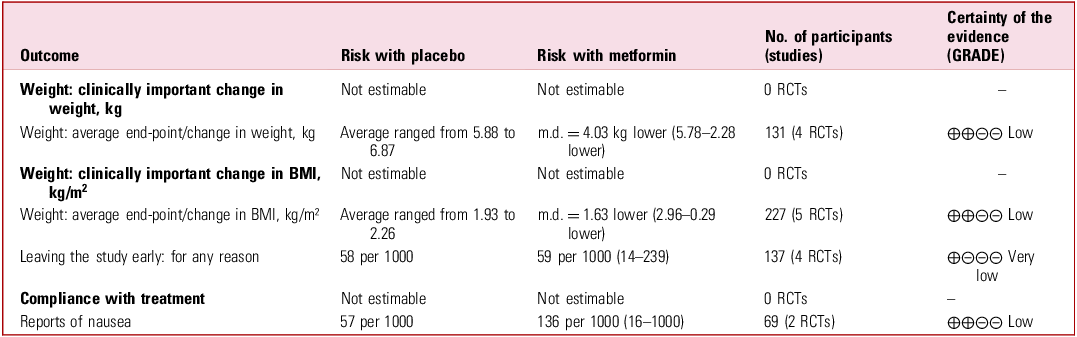
The study findings suggest that metformin may be effective in preventing weight gain and body mass index (BMI) increase when used concurrently with antipsychotic medication, with a mean difference (m.d.) of −4.03 kg. This indicates that individuals taking concurrent metformin alongside antipsychotic medication completed the RCTs weighing, on average, 4 kg less than those receiving placebo (Table 1) (Agarwal Reference Agarwal, Stogios and Ahsan2022).
Extract from the summary of findings table for metformin, illustrating the absence of data (‘0 RCTs’ and ‘Not estimable’) for clinically important outcomes, highlighted in bold

TABLE 1 Long description
A table comparing the effects of placebo and metformin on weight, BMI, and treatment compliance. The table has 4 rows and 5 columns. Column headers are Outcome, Risk with placebo, Risk with metformin, No. of participants (studies), and Certainty of the evidence (GRADE). Row labels include Weight: clinically important change in weight, Weight: average end-point/change in weight, Weight: clinically important change in BMI, Weight: average end-point/change in BMI, Leaving the study early: for any reason, Compliance with treatment, and Reports of nausea. For Weight: clinically important change in weight, the risk is not estimable for both placebo and metformin with 0 RCTs. For Weight: average end-point/change in weight, the average ranged from 5.88 to 6.87 kg with placebo and m.d. = 4.03 kg lower (5.78-2.28 lower) with metformin, involving 131 participants in 4 RCTs. For Weight: clinically important change in BMI, the risk is not estimable for both placebo and metformin with 0 RCTs. For Weight: average end-point/change in BMI, the average ranged from 1.93 to 2.26 kg/m2 with placebo and m.d. = 1.63 lower (2.96-0.29 lower) with metformin, involving 227 participants in 5 RCTs. For Leaving the study early: for any reason, the risk is 58 per 1000 with placebo and 59 per 1000 (14-239) with metformin, involving 137 participants in 4 RCTs. For Compliance with treatment, the risk is not estimable for both placebo and metformin with 0 RCTs. For Reports of nausea, the risk is 57 per 1000 with placebo and 136 per 1000 (16-1000) with metformin, involving 69 participants in 2 RCTs.
RCT, randomised controlled trial; m.d., mean difference; BMI, body mass index.
Source: adapted from Agarwal et al (Reference Agarwal, Stogios and Ahsan2022).
According to the meta-analysis data, H2 antagonists and monoamine modulators offered minimal benefit, yielding an average attenuation of weight gain by 1.32 kg (95% CI −2.09 to −0.56) and 1.89 kg respectively, whereas topiramate was not effective at preventing weight gain in this patient population (Agarwal Reference Agarwal, Stogios and Ahsan2022). The new combination of olanzapine plus samidorphan (Correll Reference Correll, Newcomer and Silverman2020) shows promise (a difference of −2.38 percentage points for percentage weight change), but this is currently supported by only this single phase 3 study.
Methodological appraisal
The strength and generalisability of systematic reviews and meta-analyses lie in their methodology, which we will analyse in this section. It is important to acknowledge the rigorous foundational methodology of this Cochrane Review; the authors utilised a broad study-based register, conducted independent data extraction and risk-of-bias assessments, systematically applied the GRADE (Grading of Recommendations Assessment, Development and Evaluation) framework, transparently retained prespecified categorical outcomes in the ‘summary of findings’ tables (despite the lack of data) and performed robust sensitivity analyses. However, to adequately translate these findings into clinical practice, several structural limitations within the underlying evidence base must also be critically examined.
Research question formulation (PICO) and the need for network meta-analysis
The authors include a number of drugs with distinct mechanisms of action under the umbrella of ‘pharmacological interventions’, including peripheral insulin sensitisers (metformin), drugs that act centrally on gamma-aminobutyric acid (GABA) receptors (topiramate), selective serotonin reuptake inhibitors (fluoxetine) and noradrenaline reuptake inhibitors (reboxetine), and even gastric histamine receptor antagonists (nizatidine, famotidine).
Although the review appropriately analysed each drug separately, the limited number of head-to-head trials comparing these distinct interventions directly against one another highlights a significant gap in the literature. Given this heterogeneity, it would be more compelling for future research to employ a network meta-analysis to better determine the comparative efficacy and hierarchy of these different biological mechanisms.
Sparse categorical data and reporting limitations
A critical limitation, transparently acknowledged by the review’s authors, stems from the primary trial data rather than the review methodology itself. The review’s a priori protocol was robust: aiming to measure ‘clinically important change in weight’. A relevant metric in antipsychotic trials is the percentage of patients successfully avoiding a clinically significant weight increase (conventionally defined as avoiding a ≥7% gain from baseline). However, the authors stated that ‘The included studies very rarely reported the primary outcomes’ (Agarwal Reference Agarwal, Stogios and Ahsan2022). Consequently, they added continuous outcomes (average end-point/change in weight) post hoc (Box 1). Although the review handled this sparse reporting appropriately by retaining the original categorical end-points, the necessary reliance on continuous mathematical averages limits the clinical interpretation of the data. Selective reporting may have occurred at the trial level if the primary authors measured but failed to report threshold outcomes.
The paradox of ‘0 RCTs’ and continuous averages
In clinical trials, a categorical threshold (such as avoiding a >7% weight increase) and a continuous average (mean weight change) measure the same underlying outcome but tell very different clinical stories. Although the 7% cut-off is a standardised convention, it remains a crucial metric for demonstrating clinically significant prevention.
In their review, Agarwal et al (Reference Agarwal, Stogios and Ahsan2022) originally prioritised the categorical threshold of ‘clinically important change in weight’. Finding these data largely absent for the main interventions (e.g. 0 randomised controlled trials (RCTs) for metformin – see Table 1), they retained the original outcome but added ‘average change in weight’ as a post hoc primary outcome.
Although mathematically sound, relying on continuous averages can obscure individual clinical responses. For instance, a mean weight reduction of 2 kg in a 100-person cohort could result from a small subset experiencing massive weight loss, while the majority experience no benefit, masking the true distribution of the drug’s efficacy.
Risk of bias management: allocation and blinding
The study designs of the included studies have methodological limitations that affect both external validity and internal selection bias.
First, regarding external validity (applicability), the patient populations enrolled in the evaluated trials were frequently subject to restrictive inclusion and exclusion criteria (Agarwal Reference Agarwal, Stogios and Ahsan2022). The exclusion of individuals with complex medical comorbidities, substance use disorders or significant non-adherence in these controlled trial cohorts limits their ability to represent the reality of psychiatric populations in real-world settings.
Second, regarding internal validity, there are significant concerns regarding selection bias.
Only 3 out of the 17 studies explicitly detailed adequate allocation concealment procedures (these included Baptista Reference Baptista, Martinez and Lacruz2006 and Wu Reference Wu, Zhao and Guo2008) (Box 4). For the remaining trials, these procedures were not reported. This absence of information strictly results in an ‘unclear’ risk of bias rather than definitively ‘high’ risk, yet it still leaves the structural internal validity of the broader evidence base open to question.
How to read the ‘certainty of evidence’ (the GRADE system)
The GRADE (Grading of Recommendations Assessment, Development and Evaluation) system is not meant to evaluate whether a drug works, but how much one can trust the results. To achieve this, the GRADE system evaluates the body of evidence across five specific domains:
-
• risk of bias (methodological flaws within the trials)
-
• inconsistency (contradictory results or heterogeneity between trials)
-
• indirectness (how applicable the patients or outcomes are to real-world practice)
-
• imprecision (small sample sizes or overly wide confidence intervals)
-
• publication bias.
As an example, although the meta-analysis of metformin trials shows a favourable average weight difference (−4.03 kg), the overall certainty of evidence for this outcome is classified as low (Agarwal Reference Agarwal, Stogios and Ahsan2022). The review authors downgraded this evidence because of the risk of bias, in particular:
-
• the study by Vishnupriya et al (Reference Vishnupriya, Ezhilramya and Meenakshi2016) lacked both blinding (open-label design) and allocation concealment
-
• other metformin trials included in the meta-analysis failed to adequately report allocation concealment procedures.
Besides this risk of bias, what other specific factors triggered the devaluing of the review’s evidence within the GRADE system?
Imprecision was another primary culprit: the total number of participants pooled together across the trials was inadequate to achieve statistical power. For example, the evidence relied on just 131 participants across 4 studies for metformin, and just 103 participants across 3 studies to estimate the effect of monoamine modulators (Agarwal Reference Agarwal, Stogios and Ahsan2022).
Last but not least, inconsistency heavily affected other interventions: in cases like topiramate, the results of the few available studies contradicted each other significantly (I² = 74%), further lowering the overall certainty of the data (Agarwal Reference Agarwal, Stogios and Ahsan2022).
When encountering low or very low certainty, the message to the clinician is that the true effect, measured in clinical practice on large populations, could differ substantially from the provisional estimate provided by current trials, and that such data and conclusions should be interpreted with caution.
Interpreting heterogeneity: I²
To measure statistical variance between studies we use the heterogeneity index I². An I² of 0% indicates that no statistical heterogeneity was detected, although in small samples this estimate can be imprecise.
Although a notable attenuation of weight gain was observed with topiramate (−4.82 kg, 95% CI −9.99 to +0.35), the I² was high, at 74% (Agarwal Reference Agarwal, Stogios and Ahsan2022). This highlights significant unexplained variance between the studies.
This statistical discordance limits the generalisability of the results and their applicability to clinical practice.
Selection bias and the importance of allocation concealment
To minimise selection bias, neither the physician nor the patient must be able to predict or influence assignment to the experimental or control group; this procedure is called allocation concealment.
In the absence of strict concealment and robust randomisation methods, a clinician (even in good faith) might assign the most diet-conscious and adherent patients to the ‘new preventive drug’ arm, and patients with more disordered lifestyles to the ‘control’ arm.
This could alter the results, creating a selection bias that makes the drug appear artificially more effective than it is.
In addition, the authors included open-label studies (such as Vishnupriya Reference Vishnupriya, Ezhilramya and Meenakshi2016), which introduces a degree of performance bias. Given that trial outcomes included subjective parameters such as the frequency of nausea and clinical psychiatric scales like the Clinical Global Impressions (CGI) and Positive and Negative Syndrome Scale (PANSS), the absence of a double-blinded design leaves the scores susceptible to bias, for both patient and investigator, which may affect reporting of side-effects and inflate the estimated effect of the intervention. It is important to note, however, that body weight is an objective physiological metric. Therefore, the lack of blinding in such open-label studies is less likely to cause severe detection bias for the chosen end-point.
Statistical excellence: the treatment of skewed data
The mathematical caution applied by the authors to prevent distortions in continuous data (skewed data) is commendable.
They used the formula
 ${{\left( {{\rm{mean}}\; - \;{\rm{lowest}}\;{\rm{possible}}\;{\rm{value}}} \right)} \over {{\rm{standard}}\;{\rm{deviation}}}}\; \lt 1$
for studies with fewer than 200 participants: data should be considered skewed if the distance from the mean to the lowest possible value of the scale is less than one standard deviation. This prevents a few outliers from generating false average efficacies, establishing a gold standard that should be used where possible in all psychiatry secondary research.
Interpretation of results
The interpretation of the quantitative results in this review (Agarwal Reference Agarwal, Stogios and Ahsan2022) reveals a difference between statistical significance and clinical utility. Examining the summary of findings tables, the loudest data point is, paradoxically, a missing one.
Effect sizes versus clinical meaningfulness: the metformin case
Metformin appears to be the most effective intervention, demonstrating a mean change in body weight (mean difference, m.d.) of −4.03 kg compared with placebo (Baptista Reference Baptista, Martinez and Lacruz2006; Wu Reference Wu, Zhao and Guo2008). Although heterogeneity is null (I² = 0%), the assessment of real clinical impact remains incomplete. As highlighted above, these trials still failed to report the proportion of patients who successfully avoided a clinically significant weight increase (the >7% threshold).
Moreover, although metformin is a recognised standard of care for the management of type 2 diabetes, with a generally favourable tolerability profile across the broader patient population (ADA 2026), its clinical utility in this specific demographic needs meticulous evaluation.
The reported relative risk (RR) for metformin-induced nausea was 2.38, but this estimate was extremely imprecise (95% CI 0.28–19.95), leaving the true risk highly uncertain (Agarwal Reference Agarwal, Stogios and Ahsan2022). Critically, long-term treatment adherence was not consistently documented in any of the reviewed studies.
So, does an average weight reduction of 4 kg genuinely warrant the increased pill burden and heightened risk of gastrointestinal discomfort, particularly in people with schizophrenia, a population already struggling with complex polypharmacy and often compromised adherence rates?
Statistical variance: the topiramate case
Topiramate provides a textbook case of the pitfalls of descriptive statistics. At first glance, it looks as if it guarantees the most impressive average attenuation of weight gain (−4.82 kg). However, reviewing the confidence limits tells a different story. The confidence interval is wide, ranging from −9.99 kg to +0.35 kg, crossing zero and confirming the absence of statistical significance for this intervention (Box 3).
The high statistical discordance between trials dramatically reduces the clinical utility of the data. However, interpreting this as evidence that the treatment worked in certain settings but not others would require appropriate subgroup analysis or meta-regression, which was not feasible.
Quality of evidence (GRADE)
The systematic downgrading within the GRADE system led to a determination of ‘low’ or ‘very low’ certainty (Agarwal Reference Agarwal, Stogios and Ahsan2022). The authors attributed these findings to the limited number of participants aggregated in each meta-analysis (for instance, 131 patients across 4 studies for metformin-induced weight loss), which is insufficient for a single, adequately powered study (Box 2).
This is a general rule in statistics; using small samples does not generate statistical robustness, it amplifies uncertainty.
Applicability to practice
The included studies had a number of design limitations that further bring into question the validity of results. Specifically, the short trial durations, the absence of guideline-concordant lifestyle interventions, the inadequate sample sizes and the risk of selection bias limit applicability to real-world psychiatry.
The dominance of short-term thinking
Although schizophrenia is a heterogeneous condition, a substantial subgroup of patients requires chronic treatment; yet, the average duration of the evaluated interventions was only 12 weeks. Although short-term studies are valid and necessary for assessing initial efficacy and tolerability, especially since antipsychotic-induced weight gain occurs rapidly early in treatment, they cannot establish durability or long-term clinical outcomes. Assessing the actual prevention of metabolic syndrome requires extended treatment windows.
This again limits the translatability of this work into clinical practice. There are no data to suggest that such treatment effects will continue long-term, nor that adverse effects will not force the discontinuation of the combined therapy.
Standard care versus guideline adherence in trial design
The authors acknowledge that the majority of the analysed pharmacological studies did not include, or did not describe, any lifestyle counselling component, whereas clinical guidelines clearly state that any strategy for weight control must be accompanied by lifestyle interventions (namely, diet and exercise) (Carolan Reference Carolan, Hynes-Ryan and Agarwal2025).
The lack of lifestyle modifications in both the active and control groups, although not invalidating the pharmacological impact of the investigated drugs, indicates a notable departure from established clinical guidelines, likely attributable to resource limitations in the trial environments. Therefore, the efficacy of these supplementary drugs in a genuine real-world scenario, where standard lifestyle protocols are applied, remains to be determined.
Conclusion
Overall verdict
Agarwal et al’s (Reference Agarwal, Stogios and Ahsan2022) review does not provide sufficient evidence to recommend the routine use of any of the prophylactic pharmacological therapies studied for antipsychotic-induced weight gain. The small sample size, inadequate treatment duration, deviations from the original protocol and minimal treatment effects limit the study’s validity and translation into clinical practice.
What clinicians should take away
Metformin was the only agent demonstrating a clear beneficial effect on weight (reducing it by approximately 4 kg) (Agarwal Reference Agarwal, Stogios and Ahsan2022).
Current guidelines, such as Carolan et al (Reference Carolan, Hynes-Ryan and Agarwal2025), provide a strong recommendation for co-commencing metformin alongside antipsychotics specifically for targeted, high-risk individuals. However, across the broader demographic, it remains uncertain whether a weight reduction of 4 kg translates into appreciable long-term cardiometabolic improvements. Therefore, although targeted use is supported by guidelines, routine prophylactic polypharmacy for the general psychiatric population – especially without concurrent behavioural and dietary interventions – lacks sufficient evidence and cannot be recommended as a stand-alone comprehensive clinical solution. Current best practice must continue to prioritise baseline metabolic risk evaluation and the selection of low-risk antipsychotic agents.
What future research should address
Future research requires abandoning short-term studies in favour of trials lasting a minimum of 12 months. It is essential to reintroduce well-defined clinically meaningful thresholds (e.g. prevention of weight gain >5% or >7%) as primary outcome measures and to assess adherence rates.
The promising fixed-dose combination (olanzapine/samidorphan) requires ongoing evaluation. Although supported by the initial phase 3 trial (Correll Reference Correll, Newcomer and Silverman2020) and a subsequent phase 3 trial in young adults that reported binary outcomes (Kahn Reference Kahn, Silverman and DiPetrillo2023) – which post-dates the Cochrane search – reliance on industry-sponsored trial programmes remains a limitation; robust, independent multicentre RCTs are needed.
Finally, there have been major recent advances in weight-loss drugs (glucagon-like peptide-1 (GLP-1) receptor agonists and dual GLP-1/glucose-dependent insulinotropic polypeptide (GIP) agonists) such as semaglutide and tirzepatide (Trott Reference Trott, Arnautovska and Siskind2024; Varshney Reference Varshney, Panda and Fernando2025). Encouragingly, recent independent clinical trials have begun to evaluate the efficacy of these agents specifically for people with schizophrenia spectrum disorders (Sass Reference Sass, Klausen and Schwarz2026). Furthermore, clinical registries indicate additional ongoing investigations in this area (e.g. NCT05333003). The outcomes of this emerging evidence base will be critical in shaping future weight management guidelines for this population.
Acknowledgements
Artificial Intelligence use: The authors made use of generative AI (Gemini, Google, Mountain View, CA, USA; accessed from https://gemini.google.com/app in February 2026) solely to assist with English language editing, grammar correction and formatting of the manuscript. It was not used for data collection, analysis or generating primary academic content. The authors take full accountability for the final content, accuracy and references of this manuscript.
Author contributions
D.P. drafted the manuscript. V.T.K. critically revised the manuscript and acted as senior author. Both authors approved the submitted version and agree to be accountable for the work.
Funding
This work received no specific grant from any funding agency, commercial or not-for-profit sectors.
Declaration of interest
None.



eLetters
No eLetters have been published for this article.