Neuroticism as a personality trait has been associated with vulnerability for psychopathology (e.g., Hettema et al., Reference Hettema, An, Neale, Bukszar, van den Oord, Kendler and Chen2006; Hettema, Prescott, & Kendler, Reference Hettema, Prescott and Kendler2004; Jardine, Martin, Henderson, & Rao, Reference Jardine, Martin, Henderson and Rao1984; Krabbendam et al., Reference Krabbendam, Janssen, Bak, Bijl, de Graaf and van Os2002; Munafò, Clark, Roberts, & Johnstone, Reference Munafò, Clark, Roberts and Johnstone2006; Ormel, Rosmalen, & Farmer, Reference Ormel, Rosmalen and Farmer2004). However, Ormel et al. (Reference Ormel, Rosmalen and Farmer2004) stated that it was unclear what neuroticism as a trait represents in everyday affective processes. Studies have shown a positive correlation between neuroticism and stress reactivity (Komulainen et al., Reference Komulainen, Meskanen, Lipsanen, Lahti, Jylhä, Melartin and Ekelund2014; Mroczek & Almeida, Reference Mroczek and Almeida2004; Suls, Green, & Hillis, Reference Suls, Green and Hillis1998), with stress reactivity being defined as the effect of subjective appraisals of everyday stressors on negative affect (NA). Of note, even though neuroticism and stress reactivity have been the subject of several general population studies, less is known about how both neuroticism and stress reactivity are expressed in those with an autism spectrum disorder (ASD).
In a recent meta-analysis on the Big Five personality traits in individuals with ASD, adults and adolescents with ASD scored higher on neuroticism compared with controls (Lodi-Smith, Rodgers, Cunningham, Lopata, & Thomeer, Reference Lodi-Smith, Rodgers, Cunningham, Lopata and Thomeer2019). Moreover, in an Australian study, people with ASD reported higher levels of stress compared with the general community (McGillivray & Evert, Reference McGillivray and Evert2018). In previous analyses on the current study sample, Van der Linden and colleagues investigated differences in stress reactivity between adults with ASD and controls (submitted manuscript; van der Linden et al., Reference van der Linden, Simons, Viechtbauer, Ottenheijm, van Amelsvoort and Marcelis2019). It was shown that adults with ASD experienced higher levels of NA in response to activity- and event-related stress compared with controls, but similar levels of reactivity in response to social stress. To our knowledge, the link between neuroticism and stress reactivity in daily life has not been studied in ASD.
A common way of collecting daily life data is by making use of the experience sampling method (ESM). ESM is a self-assessment technique which assesses affect, stress, and contextual correlates in everyday life. At random times, subjects are asked to fill out a short questionnaire.
Beside everyday stress, the context of social interactions could be considered another contextual determinant associated with variation in both daily life NA and neuroticism. In general population samples, laboratory studies showed a protective effect of the presence of supportive others (even a stranger) while performing a stressful task (Ditzen & Heinrichs, Reference Ditzen and Heinrichs2014; Matias, Nicolson, & Freire, Reference Matias, Nicolson and Freire2011; Uchino & Garvey, Reference Uchino and Garvey1997). In addition, an observational daily diary study by Gunthert, Cohen, and Armeli (Reference Gunthert, Cohen and Armeli1999) showed that participants with higher neuroticism reported more stress related to social interactions than those low on neuroticism. Côté and Moskowitz (Reference Côté and Moskowitz1998) reported similar findings, suggesting people high on neuroticism experience more NA being in the company of others than those low on neuroticism.
Investigating the association between neuroticism, social context, and NA in ASD is relevant given that difficulties in social interaction and communication are among the core features of ASD (American Psychiatric Association, 2013). One ESM study, with a small sample of adults with ASD (N = 8) versus controls (N = 14), reported on the association between social context and NA (Hintzen, Delespaul, van Os, & Myin-Germeys, Reference Hintzen, Delespaul, van Os and Myin-Germeys2010). This study explained that being in the company of strangers as opposed to familiar people, was associated with higher levels of NA in adults with ASD, but not in controls. Moreover, previous studies demonstrated that the majority of adults with ASD reported problems in social interactions (Orsmond, Krauss, & Seltzer, Reference Orsmond, Krauss and Seltzer2004). Whether neuroticism impacts the associations between social context or stress and NA has not been studied yet in ASD. Exploring associations between neuroticism and daily life functioning may help to understand part of the heterogeneity of social functioning in ASD (Lodi-Smith et al., Reference Lodi-Smith, Rodgers, Cunningham, Lopata and Thomeer2019). This in turn, may contribute to guidelines for more effective diagnostic and treatment approaches beyond the core autism features.
The aim of the present study was to investigate associations between neuroticism, stress reactivity and social context in ASD, for which we used the ESM. We explored the association between neuroticism and the most common types of ESM stress measures, that is, event-related stress, activity-related stress, and social stress (Myin-Germeys, van Os, Schwartz, Stone, & Delespaul, Reference Myin-Germeys, van Os, Schwartz, Stone and Delespaul2001; van Winkel et al., Reference van Winkel, Nicolson, Wichers, Viechtbauer, Myin-Germeys and Peeters2015). The main objectives in this study were: (a) to compare levels of neuroticism in daily life between adults with ASD and controls, (b) to explore the moderating role of neuroticism in explaining the association between appraised stress and NA in both groups, and (c) to explore the moderating role of neuroticism in explaining the association between social context and NA in both groups.
Method
Participants
The sample included 50 participants with an ASD diagnosis and 51 participants without ASD, referred to as controls, between 18 and 65 years of age. Participants with ASD were recruited by contacting mental healthcare facilities in the South of the Netherlands, through patient associations and via social media. Only those participants with ASD who had (a) a short-term psychological treatment history (maximum two years), and (b) no past psychiatric admission were included. The second author (KL) conducted the Autism Diagnostic Observation Schedule II (ADOS-2; Lord et al., Reference Lord, Rutter, DiLavore, Risi, Gotham and Bishop2012) module 4 (fluent speech) in all participants of the ASD group to confirm their diagnoses. Medication use and comorbid disorders were no cause for exclusion except in the case of acute psychotic symptoms, suicidal tendencies, or a bipolar disorder. The Mini-International Neuropsychiatric Interview (MINI; Lecrubier et al., Reference Lecrubier, Sheehan, Weiller, Amorim, Bonora, Harnett Sheehan and Dunbar1997; Sheehan et al., Reference Sheehan, Lecrubier, Sheehan, Amorim, Janavs, Weiller and Dunbar1998; van Vliet & de Beurs, Reference van Vliet and de Beurs2007), a structured diagnostic interview for Diagnostic and Statistical Manual of Mental Disorders – fourth edition (DSM-IV) axis I disorders, was used to assess comorbid disorders.
Controls without a developmental or psychiatric disorder were recruited via social media. Control participants were excluded if they had a first-degree family member diagnosed with or suspected of having ASD. The Autism Spectrum Quotient (AQ; Baron-Cohen, Wheelwright, Skinner, Martin, & Clubley, Reference Baron-Cohen, Wheelwright, Skinner, Martin and Clubley2001; Hoekstra, Bartels, Cath, & Boomsma, Reference Hoekstra, Bartels, Cath and Boomsma2008) was used to identify the degree of ASD features in controls; a score above 26 led to exclusion (Woodbury-Smith, Robinson, Wheelwright, & Baron-Cohen, Reference Woodbury-Smith, Robinson, Wheelwright and Baron-Cohen2005). The MINI was used to exclude control participants with a current psychiatric disorder. General exclusion criteria were (a) suffering from known genetic abnormalities, brain injury, epilepsy or metabolic disorders, and (b) estimated intelligence quotient (IQ) below 70. Estimated IQ was tested with two subtests (matrix reasoning and vocabulary) of the Wechsler Adult Intelligence Scale – fourth edition (WAIS-IV; Wechsler, Reference Wechsler2008a, Reference Wechsler2008b).
Procedure
This study was approved by the medical ethics committee of Maastricht University (NL51997.068.15) and was carried out in accordance with the Declaration of Helsinki (World Medical Association, 2001).
All participants were well informed about the study and gave written informed consent at the start of the screening appointment. The participant was screened to determine eligibility for the study and asked to fill in the Dutch version of the NEO-FFI (Hoekstra, Ormel, & Fruyt, Reference Hoekstra, Ormel and Fruyt2007). If the participant met the inclusion criteria, he/she was invited for a briefing session in which the ESM protocol was explained.
The experience sampling method
Daily life assessments were done with the ESM, delivered via the PsyMate™ application. Participants received an iPod or downloaded the application on their smartphone. For 10 days, 10 times a day, the application sent a beep at random moments between 07:30 hr and 22:30 hr. Participants filled in questions about mood, stress, social context, and activities, completing their reports within an allotment of 10 min after the signal. The questionnaire consisted of 7-point Likert scales to capture momentary experiences and categorical questions to capture context (e.g., social context, activities). Participants were encouraged to follow their own routines during the day. All participants were contacted by telephone after two days of sampling to ask if they experienced any problems concerning the protocol. It was also possible for them to contact the researchers if they had questions or experienced problems with the ESM data collection. Exclusion from the analysis followed if less than 30% valid reports were acquired (30 out of 100), as previous work has shown that these data are less reliable (Delespaul, Reference Delespaul1995).
After collecting the ESM data, participants were invited for a debriefing session in which their experiences were evaluated.
Measures: Clinical measures
NEO-FFI personality inventory
Neuroticism was measured with the Dutch version of the NEO Five-Factor Inventory (NEO-FFI) (Hoekstra et al., Reference Hoekstra, Ormel and Fruyt2007). The NEO-FFI is a self-report questionnaire designed to measure the Big Five personality dimensions (neuroticism, extraversion, openness, conscientiousness, and agreeableness). It is a short version of the Revised NEO Personality Inventory (NEO-PI-R) from Costa & McCrae (Hoekstra et al., Reference Hoekstra, Ormel and Fruyt2007). The NEO-FFI shows a good validity and an acceptable to good reliability (Hoekstra et al., Reference Hoekstra, Ormel and Fruyt2007). Furthermore, earlier research on validity and reliability of the NEO-PI-R showed no differences between adults with ASD and controls (Hesselmark, Eriksson, Westerlund, & Bejerot, Reference Hesselmark, Eriksson, Westerlund and Bejerot2015). We used the total sum of the 12 items on the NEO-FFI “Neuroticism” scale as a measure of neuroticism (Cronbach's α = 0.92).
Measures: Momentary assessment measures
Negative affect
Mood states were assessed at each beep with nine adjectives rated on 7-point Likert scales from 1 (not) to 7 (very). Principal component analysis of the mood adjectives data, with oblimin rotation on mean scores aggregated per person, identified two factors with Eigen values greater than 1, explaining together 55% of the total variance. Two factor-based scales with equal weights for each item were created, namely negative affect (NA) and positive affect (PA). For this study, we only used NA. Ratings on the items “insecure”, “lonely”, “down”, and “anxious” were averaged to form a NA scale (Cronbach's α = 0.70). The item “irritated” had low loadings on the NA scale and was therefore excluded.
Momentary stress
Stress was conceptualized as subjectively appraised stress after normal daily life encounters or activities. Three different stress measures were obtained. First, activity-related stress was operationalized starting with the question “What are you doing?”. This question was followed by three questions (i.e., “I would rather do something else”; “This is difficult for me”; and “I can do this well”, reverse coded). These questions were scored on a 7-point Likert scale ranging from 1 (not) to 7 (very) and were combined into a mean activity-related stress variable (Cronbach's α = 0.72). Second, event-related stress was based on the question “What was the most important event since the last beep?” Participants subsequently scored how pleasant/unpleasant the event was on a bipolar scale (−3 very unpleasant, 0 neutral, +3 very pleasant). Positive events (scores 1, 2, and 3) were recorded to zero, and negative scores were reverse coded (i.e., higher scores reflect higher stress/unpleasantness levels) for the event-related stress variable. Lastly, social stress was operationalized starting with the question whether they were in the company of others or alone. If they were in company of others, they were asked to rate the item “I would prefer to be alone” on a 7-point Likert scale ranging from 1 (not) to 7 (very).
Social context
Social context was assessed at every beep by the question “Who am I with?”. This variable was recoded into a dummy variable with three different categories: being alone, being with familiar people (inner circle), and being with co-workers and less familiar people (outer circle).
Statistical analysis
All analyses were carried out in Stata version 13.1 (StataCorp, 2013). Group comparisons (analysis of variance [ANOVAs]) were performed to test whether the average levels of NA and momentary stress differed between ASD and controls (Group: 0 = controls; 1 = ASD). Effect sizes are represented in Cohen's d. Cohen suggested that d = 0.25 is considered a small effect size, 0.5 represents a medium effect size and 1.0 or higher a large effect size (Hinkle, Wiersma, & Jurs, Reference Hinkle, Wiersma and Jurs2003).
Differences in neuroticism level between groups
To test for differences in neuroticism level between participants with ASD and controls, a regression analysis was performed with neuroticism as a dependent variable and group as an independent variable.
Neuroticism as moderator of appraised stress and social context in models of NA
To test the other study aims, a two-level mixed-effects regression model (using the “mixed” command in Stata) was used, with observations (Level 1) nested within subjects (Level 2). To regulate the Type I error for multiple analyses, the Simes correction (Simes, Reference Simes1986) for multiple testing was used if six or more models were tested, which was the case for the study aim on the interaction between neuroticism and appraised stress in the model of NA.
Stress reactivity and neuroticism
To investigate the interaction between neuroticism and stress in models of NA, multilevel analyses were conducted for each stress variable (activity-related stress, event-related stress, and social stress), in each group (ASD/control) separately. We considered the use of a three-way interaction model (Group × Stress × Neuroticism) but this was appraised invalid due to lack of power according to Monte Carlo simulations by Dawson and Richter (Reference Dawson and Richter2006). Dawson and Richter stated that around 250 subjects were needed to obtain 80% power to detect a slope (correlation) difference of 0.30. To detect smaller effect sizes, such as a slope difference of 0.10, a sample size of around 400 was needed (Dawson & Richter, Reference Dawson and Richter2006).
Thus, six multilevel analyses (three in the ASD and three in the control group) were carried out with NA as the dependent variable and neuroticism, stress (three types: activity-related, event-related, or social) and their interaction as the independent variables.
First, the independent variables neuroticism, stress, and their interaction and the covariates lifetime depression (yes/no), age and sex were entered in the model as fixed effects (Level 1), and random intercepts and random slopes were added (at subject level) setting an unstructured covariance matrix for the random effects. Effects were estimated using restricted maximum likelihood estimation (REML). Neuroticism was used as a continuous variable in these multilevel analyses.
Second, in case of a significant interaction (Neuroticism × Stress), the margin dydx command was used to get the slopes of stress on NA while holding the value of neuroticism constant at values running from 12 to 60 with increments of 1. This was used to interpret the interaction. In addition, the marginsplot command was used to graph these predicted marginal effects.
Social context and neuroticism
To examine the interaction between neuroticism and social context in models of NA, analyses were conducted in both the control group and the ASD group. Social context was operationalized as a dummy variable with three different categories: being alone, being with familiar people (inner circle), and being with co-workers and less familiar people (outer circle). The use of a three-way interaction model (Group × Social Context × Neuroticism) was considered but turned out to be invalid due to lack of power. For each group (ASD/control) separately, a multilevel regression analysis was conducted with NA as the dependent variable. The independent variables neuroticism, social context, and their interaction (Neuroticism × Social Context) and the covariates lifetime depression, age and sex were entered in the model as fixed effects (Level 1), and random intercepts and random slopes were added (at subject level), setting an unstructured covariance matrix for the random effects. Effects were estimated using restricted maximum likelihood estimation. Neuroticism was used as a continuous variable in these multilevel analyses.
Next, the margins and marginsplot commands were used to graph the output from the predictive margins. For the stratified analyses, the margin dydx command was used to get the slopes of neuroticism on NA for the different social contexts (being alone, with inner circle, with outer circle). The Wald-test was used to test for differences between social contexts in intercepts and slopes and the LINCOM command was used to retrieve the corresponding confidence intervals.
Sensitivity analysis
To verify whether the results of the main analyses were robust, we performed a sensitivity analysis. We excluded the few participants diagnosed with depression (ASD n = 3, controls n = 0) since depression is known to be associated with anxiety (Angst, Vollrath, Merikangas, & Ernst, Reference Angst, Vollrath, Merikangas, Ernst, Maser and Cloninger1990; Kessler, Stang, Wittchen, Stein, & Walters, Reference Kessler, Stang, Wittchen, Stein and Walters1999), perceived stress (Bergdahl & Bergdahl, Reference Bergdahl and Bergdahl2002), and NA (Forbes, Williamson, Ryan, & Dahl, Reference Forbes, Williamson, Ryan and Dahl2004). This led to the exclusion of n = 3 in the ASD group; no controls were excluded because depression was an exclusion criterion for controls. Therefore, only the analyses in the ASD group were repeated.
Results
Sample characteristics
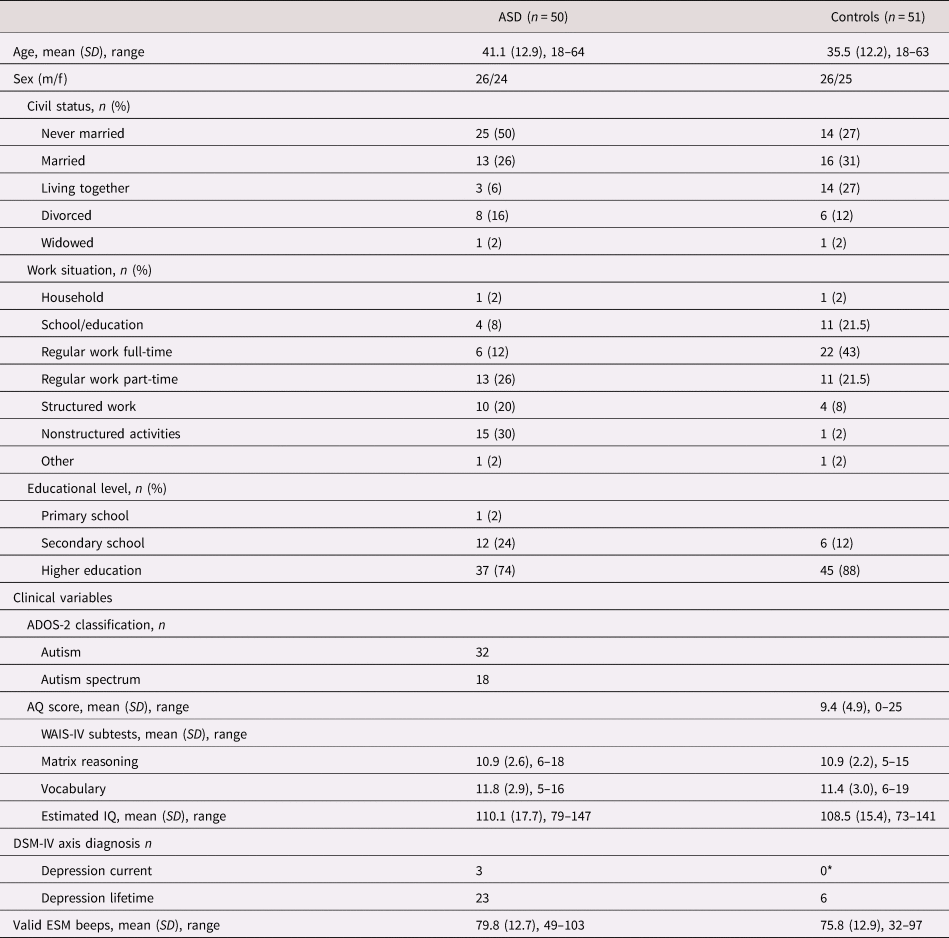
The final sample included 101 participants (ASD n = 50, controls n = 51), no participants were excluded. Overall, a total of 7,861 valid ESM observations were completed. Although the ASD group completed more ESM reports than the control group, the difference was not significant (p = .116). Furthermore, the mean age was higher in the ASD group (p = .028), but no group differences were found for sex (p = .918) and estimated IQ (p = .636). The sample characteristics are summarized in Table 1.
Sociodemographic and clinical characteristics

Note. *Current depression was an exclusion criterion in the control group; ASD = autism spectrum disorders; SD = standard deviation; ADOS-2 = Autism Diagnostic Observation Schedule-II; AQ, Autism Spectrum Quotient; WAIS-IV = Wechsler Adult Intelligence Scale – Fourth Edition; IQ = intelligence quotient; ES = experience sample method.
Measures (mean levels)
The ASD group reported a significantly higher mean level of NA, activity-related stress, event-related stress, and social stress compared to controls (see Table 2 for all results).
Means (standard deviations) and F-test statistics of the ESM variables for individuals with autism spectrum disorders (ASD) and controls

Note. *For each subject, a mean was calculated over all reports, and the mean per subject was additionally aggregated over the group to obtain the group mean and SD, standard deviation. ASD = autism spectrum disorders, P = p value.
Differences in neuroticism level between groups
Group significantly predicted neuroticism scores (B = 13.45, 95% CI [10.34, 16.55], p < .001), with participants with ASD (M = 41.04, SD = 8.85) reporting higher neuroticism scores than controls (M = 26.02, SD = 5.68). The model explained a significant proportion of the variance, adjusted R-squared = .55, F(4, 96) = 31.23, p < .001. The effect size of the differences in neuroticism levels between the participants with ASD and the controls was large, Cohen's d = 2.02.
Stress reactivity and neuroticism
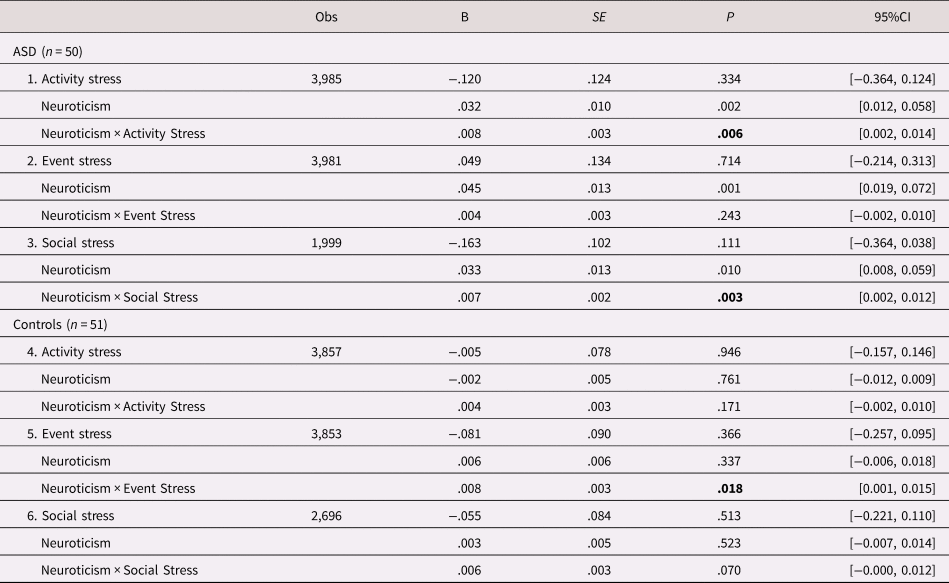
The interaction between neuroticism and stress (independent variables) in models of NA (dependent variable) was conducted for each stress variable (activity-related stress, event-related stress, and social stress), in each group (ASD/control) separately. The results of these six multilevel regression analyses are presented in Table 3.
Multilevel regressions estimate of stress, neuroticism, and their interactions in the model of negative affect (NA)

Note. ASD = autism spectrum disorders; Obs = number of observations; B = standardized regression coefficient; SE = standard error; CI = confidence interval; P = p value; Dependent variable in all models is negative affect. All models control for age, sex, and lifetime depression. The Simes correction was used on the p values of the interactions. All initial significant p values remained significant after this correction.
ASD group
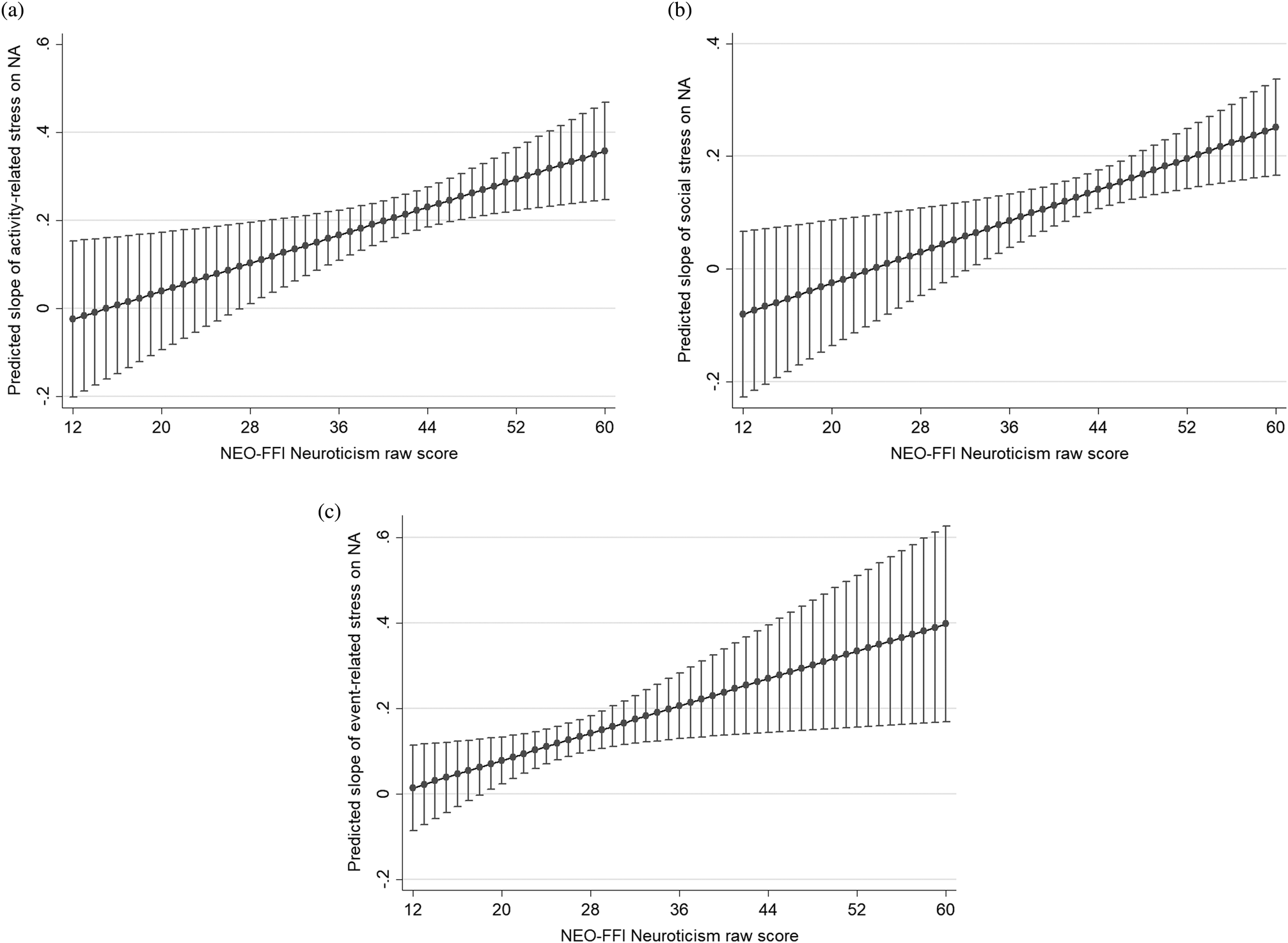
In the ASD group, the correlation between neuroticism and NA was r = .38. There was a significant interaction between activity-related stress and neuroticism in the model of NA (Figure 1a). Predicted marginal effects showed a significant positive association between activity-related stress and NA in participants with ASD with neuroticism levels of 28 and higher. There was no significant association between activity-related stress and NA in participants with ASD and neuroticism scores below 28. There was no significant interaction between event-related stress and neuroticism in the model of NA. However, there was a main effect of neuroticism, showing a positive association with NA (B = 0.045, 95% CI [0.019, 0.072], p = .001). There was no main effect of event-related stress in the model of NA. Furthermore, there was a significant interaction between social stress and neuroticism in the model of NA (Figure 1b). Predicted marginal effects showed a significant positive association between social stress and NA in participants with ASD with neuroticism scores of 33 and higher. There was no significant association between social stress and NA in participants with ASD and neuroticism scores below 33.
Predicted marginal effects of stress on negative affect (NA) per neuroticism score. NB. Predicted marginal effects were calculated once there was a significant interaction between stress and neuroticism in the model of NA (see Table 3). Three significant interactions were found. Figure 1a: Activity-related Stress × Neuroticism in the ASD group; Figure 1b: Social Stress × Neuroticism in the ASD group); Figure 1c: Event-related Stress × Neuroticism in the control group.

Control group
In the control group, the correlation between neuroticism and NA was r = .08. In the control group, there was no significant interaction between activity-related stress and neuroticism in the model of NA. Furthermore, there were no main effects of activity-related stress or neuroticism in the model of NA. There was a significant interaction between event-related stress and neuroticism in the model of NA (Figure 1c). Predicted marginal effects showed a significant positive association between event-related stress and NA in control participants with neuroticism scores of 19 and higher. There was no significant association between event-related stress and NA in control participants with neuroticism levels below 19. Furthermore, there was no significant interaction between social stress and neuroticism in the model of NA. There were no main effects of social stress or neuroticism in the model of NA.
Social context and neuroticism
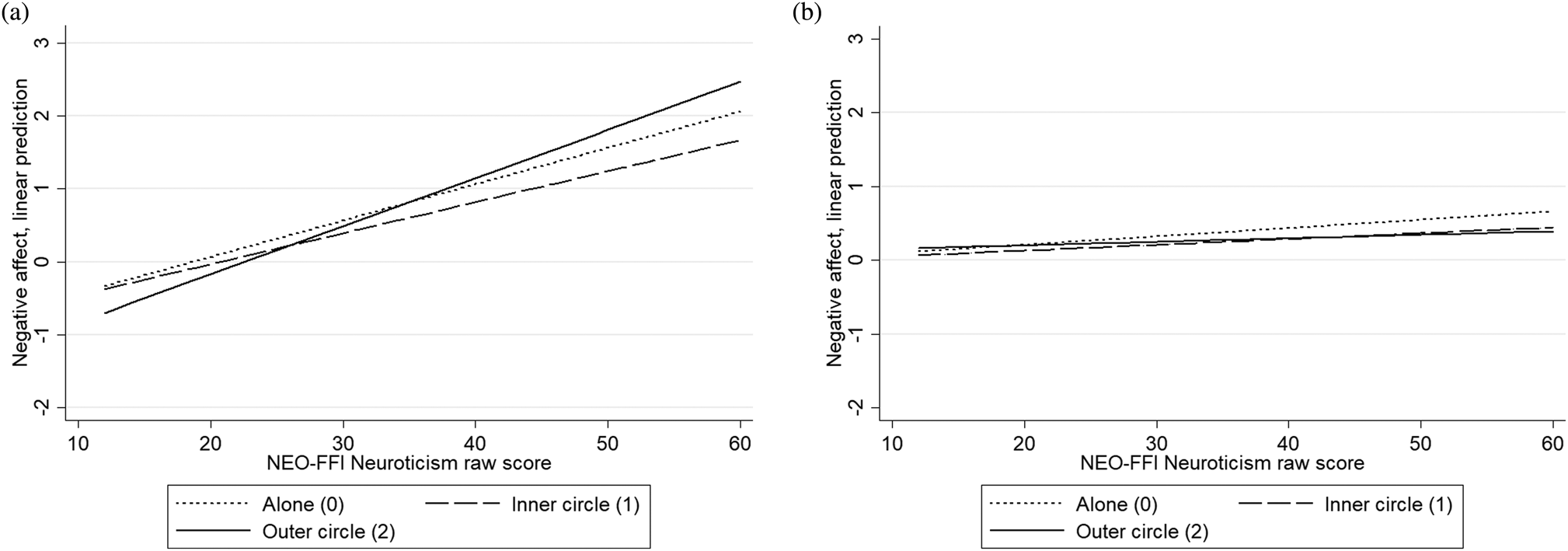
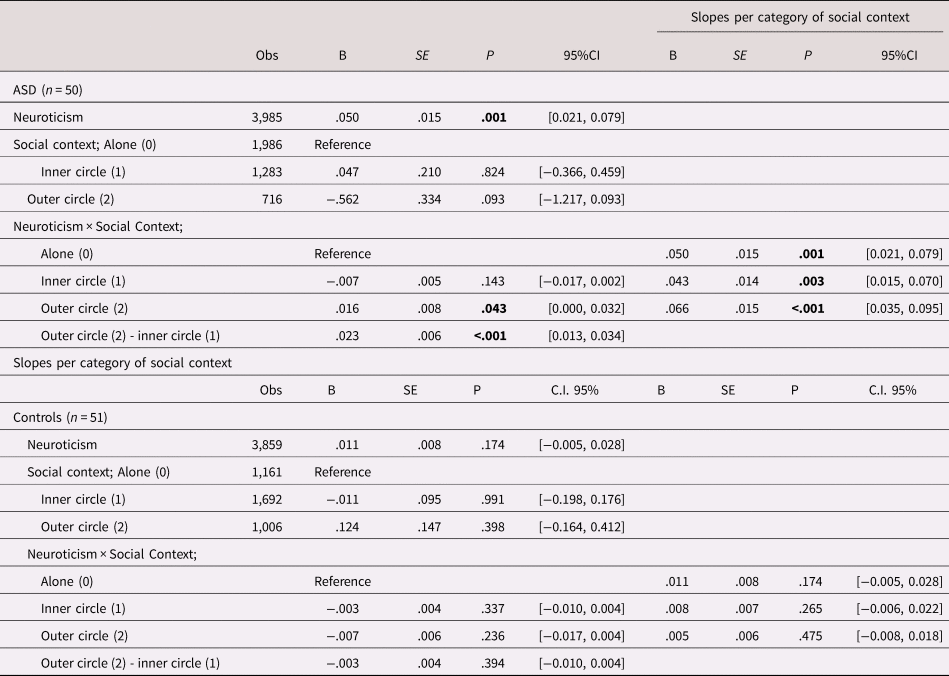
The results of the two multilevel regression models are presented in Table 4. Next, stratified analyses were used to further investigate and interpret possible associations. In participants with ASD, there was a significant interaction between neuroticism and social context in the model of NA. In the ASD group, for all categories of social context, there was a positive association between neuroticism and NA. However, stratified analyses showed that the positive association between neuroticism and NA was significantly stronger when in company of people from the outer circle, compared to the other social contexts (Figure 2). Being alone or being with people from the inner circle caused no difference in the effect on the association between neuroticism and NA. The stratified tests for the simple slopes between neuroticism and NA showed a stronger association in the company of people from the outer circle (B = 0.066, 95% CI [0.037, 0.095], p < .001) than in the company of people from the inner circle (B = 0.043, 95% CI [0.015, 0.070], p = .003) or being alone (B = 0.050, 95% CI [0.021, 0.079], p = .001), see Table 4. In the control group, there was no significant interaction between social context and neuroticism in the model of NA. Furthermore, there were no significant main effects of social context or neuroticism in the model of NA (Figure 2).
Predictive margins for the interaction of neuroticism and social context in the model of negative affect.

Multilevel regressions estimate of neuroticism, social context and their interactions in the model of negative affect

Note. Obs = number of observations; B = standardized regression coefficient; SE = standard error; CI = confidence interval; P = p value; Dependent variable in all models is negative affect (NA). All models control for age, sex, and lifetime depression.
Sensitivity analysis
Additional analyses were carried out, excluding participants with depression from the sample (ASD: n = 3, controls: n = 0). The results remained similar for the first and second aim. For the third aim, the sensitivity analysis yielded different results for the ASD group. Although the results still showed a stronger effect of neuroticism on NA while being with people from the outer circle compared with being with people from the inner circle, the difference between being alone compared with being with people from the outer circle did not hold. The results are presented in Supplementary Tables S1, S2, and S3.
Discussion
Main findings
This study was designed to examine differences in neuroticism levels between adults with ASD and controls, as well as exploring the moderating role of neuroticism on stress reactivity and on the association between social context and NA. Adults with ASD showed a higher level of neuroticism compared with controls. Adults with ASD and high neuroticism showed a stronger NA-reactivity associated to momentary activity-related and social stress, but not event-related stress, compared with adults with ASD and low neuroticism. Furthermore, in the company of people from the outer circle, adults with ASD showed a stronger positive association between neuroticism and NA, compared with being alone or in the company of people from the inner circle. For controls, there was mainly absence of significant interactions between neuroticism and everyday stress or social context in their association with NA. The only significant interaction in the control group was between event-related stress and neuroticism in the model of NA.
Neuroticism in individuals with autism spectrum disorder
The finding that the ASD group showed a higher neuroticism level than the control group is in line with findings from the meta-analysis of Lodi-Smith et al. (Reference Lodi-Smith, Rodgers, Cunningham, Lopata and Thomeer2019), showing that adults with ASD reported higher scores on neuroticism compared with controls. However, the present effect size (Cohen's d = 2.02) is larger than the mean effect size (mean Cohen's d = 1.34, 95% CI [1.02, 1.67]) found in the meta-analysis of Lodi-Smith et al. (Reference Lodi-Smith, Rodgers, Cunningham, Lopata and Thomeer2019). Possibly, the current effect size is inflated due to a selection bias in the control group. Indeed, the average neuroticism score of the control group was 5 points below the general population average of neuroticism as indicated by the Dutch norm-reference (Hoekstra et al., Reference Hoekstra, Ormel and Fruyt2007). This could accordingly be the result of the strict exclusion criterion of this study (e.g., excluding any current psychiatric disorder).
Stress reactivity and neuroticism
In the ASD group, neuroticism was associated with higher levels of NA.
In line with our hypothesis, adults with ASD and higher neuroticism showed a stronger stress reactivity associated with momentary activity-related and social stressors, compared with participants with ASD and lower neuroticism. However, we did not find this association for event-related stress. These findings support the theory of Lodi-Smith et al. (Reference Lodi-Smith, Rodgers, Cunningham, Lopata and Thomeer2019) that variety in personality traits (e.g., neuroticism) could account for some of the heterogeneity in the everyday life of adults with ASD. In the current sample, for instance, there was no significant difference in social stress reactivity between ASD and controls (submitted manuscript; van der Linden et al., Reference van der Linden, Simons, Viechtbauer, Ottenheijm, van Amelsvoort and Marcelis2019). Interestingly, we did find meaningful differences in social stress reactivity dependent on neuroticism level in the ASD group. Neuroticism as a personality trait thus appears to be related to everyday stress reactivity in adults with ASD.
In contrast to earlier research and to our hypothesis, there was no evidence for a consistent moderating effect of neuroticism on the association between everyday stress and NA in the control group. This is in contrast with earlier findings that point out a positive association between neuroticism and stress reactivity in the general population (Komulainen et al., Reference Komulainen, Meskanen, Lipsanen, Lahti, Jylhä, Melartin and Ekelund2014; Mroczek & Almeida, Reference Mroczek and Almeida2004; Suls et al., Reference Suls, Green and Hillis1998). One possible explanation for the contrasting results is that the restricted range of neuroticism scores within our control group may have precluded the detection of significant differences. Second, methodological differences between studies can be considered as an explanation. For example, Mroczek and Almeida (Reference Mroczek and Almeida2004) used a retrospective diary approach with a 24-hr delay of self-report, which may have introduced bias due to memory flaws.
Social context and neuroticism
In support of our hypothesis, a moderating effect of neuroticism on the association between social context and NA was found in the ASD group. Adults with ASD (but not controls) reported a stronger positive association between neuroticism and NA in the company of less familiar people compared with being with familiar people or being alone. These results add novel information to the findings of Hintzen et al. (Reference Hintzen, Delespaul, van Os and Myin-Germeys2010) that people with ASD are more vulnerable to experience higher levels of NA in social interaction with less familiar people. Indeed, the current findings indicate that the NA associated with social interaction may be dependent on neuroticism levels. That is, the degree to which individuals with ASD seem to be bothered (in terms of NA) by interacting with less familiar people may depend on the level of neuroticism.
Clinical implications
Placing the results in a broader perspective, Lodi-Smith et al. (Reference Lodi-Smith, Rodgers, Cunningham, Lopata and Thomeer2019) suggested that adults with ASD are more likely to show a Big Five personality profile characterized by high neuroticism and low extraversion, openness, agreeableness, and conscientiousness. Importantly, diversity in these personality traits in ASD is as common as it is in other (psychiatric and nonpsychiatric) populations. Schwartzman, Wood, and Kapp (Reference Schwartzman, Wood and Kapp2016) pointed out that because of this variation, there is no universal approach for diagnosing and treating all patients with ASD. Comorbid problems and the influence of (normal) personality diversity can be hard to pinpoint (Kerns et al., Reference Kerns, Kendall, Zickgraf, Franklin, Miller and Herrington2015). Therefore, in the light of the current study, we suggest that more structural use of available personality inventories (e.g., NEO-FFI) alongside clinical assessment of ASD can be a useful aid in this process. With a better understanding of personality diversity in relation to daily life variables such as affect, stress, and social interaction in ASD, developing personalized treatment for these individual needs may be the next step. From this point of view, the cut-off scores for neuroticism in ASD found in the present study (e.g., neuroticism = 28 for activity-related stress reactivity, and neuroticism = 33 for social stress reactivity) are interesting results. However, these cut-off scores should not yet be used in clinical practice, as this is the first study to come to this conclusion, therefore warranting replication as well as investigation of specificity and sensitivity.
Strengths and limitations of this study
Our study has several strengths. To our knowledge, this is the first study to examine neuroticism and stress reactivity in adults with ASD. Secondly, we had a reasonably large sample size compared to other ESM studies with adults with ASD. Thirdly, we used ESM to collect daily life data. Compared to retrospective reports, this type of data is less influenced by memory biases. Finally, by comparing the results to controls, a context was provided in which the clinical relevance of the results can be interpreted.
There are also a few limitations to consider. First, due to the large difference in neuroticism levels between the two groups, comparing the groups on neuroticism was difficult. If there was a larger control sample to draw from, propensity score matching, potentially even on level of neuroticism, could have helped to derive more equivalent samples. Second, although we aimed to select a representative sample, we cannot rule out a selection bias in the control sample. For example, in the control group only two participants would be labeled as high neurotic by the Dutch reference-norms of the NEO-FFI manual. Finally, most results have been interpreted in terms of stress reactivity toward subjective appraised stress. However, as this is a naturalistic observational/correlational study, it is impossible to test a causal relationship. Therefore, one could just as well assume that NA influences the subjective appraisal of stress. Either explanation, however, has clinical relevance.
Conclusions and Future Study
In ASD, neuroticism moderates the association between appraised stress and NA as well as the association between social context and NA. These findings deepen our understanding of the heterogeneity in functioning of adults with ASD. Therefore, it is worthwhile to start thinking about interventions that address the specific challenges of high neuroticism in ASD (e.g., some individuals may need more help dealing with stress, others may need help to regulate negative emotions in certain social interactions). Further research should focus on getting a better understanding of the mechanisms by which personality traits may impede or facilitate (social) functioning of adults with ASD, and to which extent these mechanisms may differ compared with non-ASD populations, especially with comparable levels of neuroticism.
Supplementary Material
The supplementary material for this article can be found at https://doi.org/10.1017/S0954579420002278
Data Availability
The datasets for this manuscript are not publicly available due to patient confidentiality and participant privacy. Requests to access the datasets should be directed to Machteld Marcelis, m.marcelis@maastrichtuniversity.nl.
Acknowledgments
The authors would like to thank the participants, Centrum autisme GGzE, GGz Breburg, Apanta GGz and “Nederlandse Vereniging voor autisme (NVA).” In addition they would like to thank Truda Driesen, Emmy Ottenheijm, Mario Meulendijks, Taco Hübner, Richard van Roy, Jeanine van der Meijden, Kees Spitters, Debora Op ‘t Eijnde, Dafne Op ‘t Eijnde, Karel Borkelmans, and Ron Mengelers for their assistance in data collection, analysis, technical support, and management.
Funding Statement
This work was financially supported by Mental Health Institute Eindhoven (Geestelijke Gezondheidszorg Eindhoven; GGzE) and Maastricht University.
Conflicts of Interest
None