Introduction
Males are almost invariably born in excess of females (James, Reference James1987), and the ratio of male-to-female live births is often (albeit technically incorrectly) expressed as the ratio of male to total births. This convention will be used in this paper. A wide variety of factors have been shown to influence the sex ratio at birth (SR), and these include secular and geographical variation (Pavic, Reference Pavic2015), as well as seasonal trends (Melnikov, Reference Melnikov2015). However, toxins, including exogenous chemicals (James, Reference James1987), as well as endogenous hormones produced by stress, invariably lower the sex ratio at birth (James, Reference James2004). This accords with the Trivers–Willard hypothesis, which maintains that evolution should have favoured parents with the ability to influence SR according to conditions surrounding conception and during pregnancy. This is because in polygynous species, a robust son who is conceived under favourable environmental conditions has greater reproductive opportunities than an equivalent daughter who is constrained by pregnancy and lactation. On the other hand, under adverse conditions, a male fetus (which requires greater resources in order to be carried to term) will be less likely to survive pregnancy. If it does, such a frail male may not survive to reproductive age, and if so, would compete poorly with more robust males for mating privileges. However, a frail female is more likely to survive and reproduce. Hence, under unfavourable conditions, the parental passage of genes is favoured if fewer males are produced through the culling of weaker males (Trivers & Willard, Reference Trivers and Willard1973).
Terrorist attacks have been shown to reduce the sex ratio at birth, presumably due to the above-mentioned process. This was famously noted in relation to the September 11 attacks, after which fewer males were born, not only in New York (Catalano et al., Reference Catalano, Bruckner, Marks and Eskenazi2006), but also across the country in California (Catalano et al., Reference Catalano, Bruckner, Gould, Eskenazi and Anderson2005). This event generated significant population stress (Schlenger et al., Reference Schlenger, Caddell, Ebert, Jordan, Rourke and Wilson2002), and it has been proposed that the SR dip was stress induced (Catalano et al., Reference Catalano, Bruckner, Marks and Eskenazi2006). The mechanism was shown to be that of excess male fetal loss, with a decline in male births three months after September 11 (Bruckner et al., Reference Bruckner, Catalano and Ahern2010) and with different ethnic responses (Grech, Reference Grech2015a).
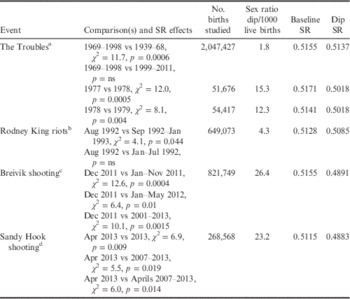
Other stressful events have been shown to cause a transient dip in the sex ratio at birth. For example, in Northern Ireland during the sectorial violence colloquially known as ‘The Troubles’ (1969–1998), SR was lower than during the period beforehand (p=0.0006). There was also a very sharp dip in 1978 (p≤0.004; Table 1) during this particular year of renewed violence and heavy civilian attacks (Grech, Reference Grech2015b). Similarly, the 1992 Los Angeles Riots (also known as the Rodney King Riots) constituted six days of widespread civil rioting following the acquittal of white police officers who had been videotaped brutally attacking Rodney King, an African-American man, after a high-speed pursuit. Video footage clearly showed King being beaten by police officers while lying on the ground. In Los Angeles, SR dipped significantly in August 1992, four months after the riots (p=0.044; Table 1) (Grech, Reference Grech2015c). An analogous result occurred in Norway following the terrorist attacks of Breivik, a Norwegian right-wing extremist who exploded a car bomb in the executive government quarter of Norway. This killed eight and injured another 209, twelve seriously. The assailant moved to Utøya Island, 30 km north of Oslo, and in a shooting spree killed 69 people with an additional 110 injuries, 55 seriously so. In Norway, SR dipped significantly in December 2011, five months after the affair (p=0.004; Table 1) (Grech, Reference Grech2015c). The Sandy Hook Shooting in Connecticut occurred at the Sandy Hook Elementary School after a lone gunman killed his mother, and then 26 people at the school, including 20 first-grade children aged 6–7 years. The SR dipped significantly in Connecticut in April 2013, four months after the event (p=0.009; Table 1) (Grech, Reference Grech2015c).
Summarized results of sex ratio at birth of previous studies for stressful events

a Northern Ireland 1969–1998; source: WHO, N. Ireland Statistics & Research Agency.
b California, US, late April 1992; source: CDC Wonder, CDC Vitalstats.
c Norway, 22nd July 2011; source: Befolkningsstatistikk, Statistisk Sentralbyrå.
d Connecticut, US, 14th December 2012; source: CDC Wonder, CDC Vitalstats.
Modified from Tables 1 and 2 of Grech (Reference Grech2015c). Data not seasonally adjusted.
The year 1968 was a momentous one for France. Unrest began in January due to student protests, who were then supported and joined by workers. Universities were closed, many hundreds were arrested and several marches and huge demonstrations were violently quelled by the police. The Mouvement du 22 Mars was a French student movement founded at the University of Nanterre, which carried out a prolonged occupation of the university’s administration building. The police were called in and a public scuffle ensued, which garnered national media attention. Cars were burned by protestors, and there was also significant other property damage. Large sections of Paris temporarily closed, with an eventual ban on public demonstrations that was ignored, leading to violent confrontations between the protesters and the police. The violence continued to escalate with barricades being erected by the protestors, and clashes between the population and the police culminating in the launching of Molotov cocktails by the former and tear gas by the latter. The events were broadcast on radio and television. The Parti Communiste Français (PCF) participated with the major union federations, resulting in a one-day general strike. On the 13th May, over a million people marched through Paris and the Sorbonne was occupied by students. Several other worker strikes occurred, the National Theatre in Paris was seized by demonstrators and several factories were occupied by workers, such that by May ten million workers (two-thirds of the entire French workforce) were on strike. The Paris Stock Exchange was also set on fire by protestors. The crisis eventually ended in June and while the insurgents and campaigners were not frank terrorists, the events precipitated led to very similar results (Prialux & Ungar, Reference Priaulx and Ungar1969).
Aum Shinrikyo is the former name of a Japanese religious cult that is now known as ‘Aleph’. In 1992, the cult’s founder (Shoko Asahara) declared himself Japan’s only enlightened master and outlined a doomsday prophecy that included a global nuclear Third World War. On the 20th March 1995 in Tokyo, the world’s largest city, members of the cult released sarin (isopropyl methylphosphonoflouridate) in a terrorist attack on the civilian populace. Sarin is an organophosphorus ester that produces potent and irreversible inhibition of cholinesterase. This chemical is toxic to the nervous system and is considered a chemical warfare agent. The toxin was released during the rush hour in five simultaneous co-ordinated attacks on five different trains, many kilometres apart, converging on the centre of Tokyo at the Kasumigaseki station of the subway system. Kasumegaseki is home to most of Tokyo’s government offices and is considered to be the city’s power and nerve centre. By the end of the day, fifteen stations in the world’s busiest subway system had been affected. The attack was devastating, killing twelve people, severely injuring 50 and causing temporary vision problems for nearly 1000 others. On this day, ambulances transported 688 patients to hospitals and nearly 5000 more reached hospitals by other means. In total 5510 patients were seen in hospitals, of which seventeen were critical, 37 severely and 984 moderately ill with vision problems. This remains the most serious attack to occur in Japan since the end of the Second World War (Olson, Reference Olson1999).
This study was carried out to assess the impact of the 1968 French riots and the Aum Shinrikyo sarin Tokyo subway attack on the sex ratio at birth in France and Japan, respectively. Based on the above-mentioned studies, any impact on SR from the events described in France and Japan would be expected to manifest as a dip in the ratio some 3–5 months after the events, and definitely >1 month and<9 months afterwards.
Methods
For France, monthly data for French live births were available from an anonymized, publicly available live-birth database from 1968 to 2011 inclusive (INSEE: Institut National de la Statistique et des Etudes/Économiques – National Institute of Statistics and Economic Studies). Only annual male and female live births were available prior to 1968, and these were obtained directly from a World Health Organization mortality database (WHOSIS, HFA – Health For All). For Japan, monthly data for 1990–2000 were obtained from E-Stat, the portal site of Official Statistics of Japan. These were available as a mixture of scanned portable document format files and comma delimited files.
Segmented regression was used to analyse the data. This technique analyses temporal ‘broken sticks’ or jumps at certain points in time by considering partial trends of different time periods (Pastor & Guallar, Reference Pastor and Guallar1998). A series of seasonality tests were carried out on each time series after the ARIMA (autoregressive integrated moving average) model was determined. These included non-parametric tests for stable seasonality using Friedman, Kruskall–Wallis tests, a test for the presence of seasonality assuming stability and an evolutive seasonality test for detecting the presence of identifiable seasonality (Maravall et al., Reference Maravall, López-Pavón and Pérez-Cañete2015). All those tests are calculated using the final unmodified seasonal-irregular (SI) component. The first three tests assess the presence of seasonality in the series, whereas the evolutive test verifies if seasonality is stable over years. These are combined within the final test (combined seasonality test), which checks whether the seasonality of the series is identifiable.
Seasonal adjustment is a statistical method for removing the seasonal component within a given time series that displays seasonality and is performed in order to ascertain trends independent of such seasonal components (Ghysels & Osborn, Reference Ghysels and Osborn2001).
To determine the effects of the events in France and Japan on births, the seasonally adjusted series for the sex ratio at birth was extracted and checked for normality using the Kolmogorov–Smirnov test (Lilliefors, Reference Lilliefors1967). Percentiles were computed to determine the frequency distribution of the adjusted sex ratios.
For the seasonal adjustment of time series for both countries, a model-based method (Tramo Seats) was applied through JDemetra+ (version 2.0.0.) software (Findley et al., Reference Findley, Lytras and Maravall2015). Using the Tramo-Seat RSA4 specification, a direct approach was applied to each series: male births, female births and the sex ratio at birth (Maravall et al., Reference Maravall, López-Pavón and Pérez-Cañete2015). The automatic procedure covered the following: test for level/logarithmic transformation, working days, Easter and outlier detection. Manual pre-adjustment of fitting an ARIMA model included checks for significant outliers and calendar effect.
France
The France time series time span covered monthly data for the years 1968–2011. Series were also analysed for the shortened time span 1968–1973 to assess the significance of the May 1968 dip in SR. For the time span 1968–2011 no outliers were identified as significant under JDemetra+ for either the male or female birth time series. Calendar regression variables were identified as significant: working days (including the weekday–weekend contrast variable, leap year) and Easter effect. Following the pre-adjustments, ARIMA models were fitted to the time series: model (0,1,1)(0,1,1) for male births and model (1,1,1)(0,1,1) for female births.
Japan
For Japan, the time span covered monthly data for the years 1990–2000. No outliers were identified for the female birth series. For the male births JDemetra+ identified a significant outlier in October 1995 (TC: transitory change). Calendar regression variables were identified as significant: working days for both female and male births. Following the pre-adjustments, an ARIMA model was fitted to the time series: model (1,0,0)(0,1,1) for both male and female births.
Results
France
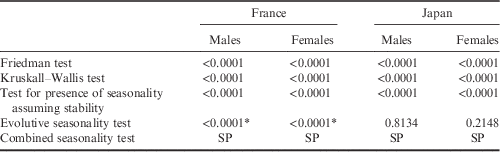
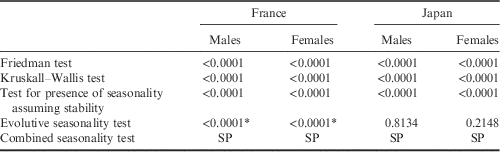
A total of 34,523,327 French live births were studied (SR=0.5124, 95% CI: 0.5123–0.5126). Segmented regression revealed a significant dip in SR in France for the year 1968 (1964–73, dip 1968–69, p=0.042). Both male and female French series exhibited significant seasonal variation (p<0.01; Table 2). Overall, SR peaked between April and June and dipped to a trough between October and November.
JDemetra+ and seasonality tests for male and female births in France in 1968 and Japan in 1995
SP=seasonality present.
* Moving seasonality present at the p<0.05.
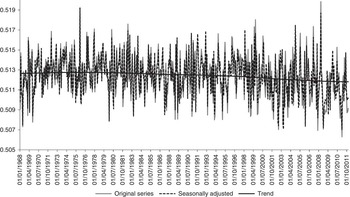
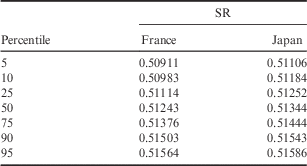
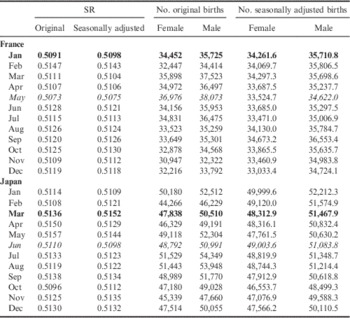
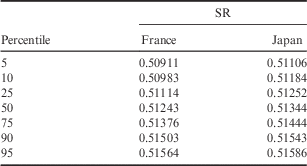
The seasonally adjusted sex ratio is depicted in Fig. 1 for the years 1968–2011. The adjusted sex ratio was 0.51242±0.00201. Hence, the 95% confidence intervals for the adjusted series were 0.51042–0.51443. The calculated percentiles for SR are shown in Table 3. Unrest commenced in France at the beginning of 1968. The seasonally adjusted SR for May 1968 fell below the 5th percentile with a value of 0.5075. Moreover, within the time span 1968–1973 under JDemetra+ for the SR time series, the May 1968 dip was statistically significant (p=0.015), correcting for any seasonal component, with this dip being in an expected month relative to the commencement of the events (Table 4).
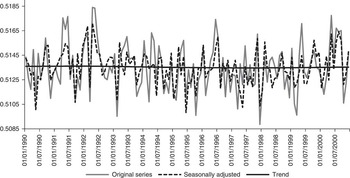
Original and seasonal pattern for French sex ratio at birth 1968–2011. Dotted line represents 5th centile for adjusted SR.

Percentiles for adjusted SR for France in 1968 and Japan in 1995
Number of original and seasonally adjusted births and SR for France in 1968 and Japan in 1995

Event in bold; effect in italics.
Japan
A total of 13,237,076 Japanese live births were studied (SR=0.5135, 95% CI: 0.5132–0.5138). There was no significant dip in the SR in Japan for 1995 (1980–2014, 1995 dip, p=0.0665). The male and female series of Japan exhibited a significant seasonal variation (p<0.01; Table 2). For both unadjusted series there was a peak in July and a dip in February. Overall, SR peaked in April to June and dipped to a trough in February–March and October–November.
The seasonally adjusted sex ratio is depicted in Fig. 2. The adjusted sex ratio was 0.5135 ±0.00145. Hence, the 95% confidence intervals for the adjusted series were 0.51205–0.51495. The calculated percentiles for SR are shown in Table 3. The Tokyo subway sarin attack, which happened in March 1995, showed its effect in June 1995. The seasonally adjusted SR for that month fell below the 5th percentile with a value of 0.5098. It was also identified in JDemetra+ as an outlier with a p-value of 0.026 (Table 4).
Original and seasonal pattern for Japanese sex ratio at birth 1990–2000. Dotted line represents 5th centile for adjusted SR.

Discussion
The human male/female sex ratio slumps following catastrophic or tragic events if these are felt to be momentous enough by a given populace. For example, the sex ratio at birth was shown to dip in East Germany in 1991 following the reunification of Germany after the fall of the Berlin Wall and the subsequent collapse of East Germany’s economy (Catalano, Reference Catalano2003). Similarly, the 2007 recession was shown to transiently decrease SR in both Ireland (which was one of the European countries greatest affected) and the United States (Grech, Reference Grech2015b, Reference Grechd). Even comparatively inconsequential events have been shown to transiently depress SR, such as the accidental death of a loved public figure, Lady Diana, Princess of Wales, in 1997, which resulted in a decrease in SR in England and Wales (Grech, Reference Grech2015e).
All of these events provoked significant population stress, which may have directly caused the observed decline in SR since stress is known to increase spontaneous abortion rates, which are higher for male than for female fetuses (Bruckner et al., Reference Bruckner, Catalano and Ahern2010).
Terrorism strives to elicit the severest possible levels of population stress by shocking the public and by multiplying the effects of terrorists’ acts through the media for political purposes. In this way, terrorists influence a much wider audience than the swathe of individuals that they directly target (Hoffman, Reference Hoffman1999). It is for this reason that societies struggle to come to terms with the motivation of such events, an effect that psychologists refer to as ‘attribution theory’ – the need to assign motivation so as to understand why such events are driven to occur; ‘how else to explain the inexplicable’ (Corrigan, Reference Corrigan2013). Graspable and coherent motives are notably absent in individuals who commit these acts, and for this reason mental illness is often presumed. However, Western jurisprudence is cognizant of the fact that not all instances of such inexplicable crimes denote mental illness (Corrigan, Reference Corrigan2013).
This study therefore confirms that stress may have precipitated the culling of male fetuses in France and Japan in already pregnant mothers who were negatively influenced by traumatic events, in accordance with the Trivers–Willard hypothesis (Trivers & Willard, Reference Trivers and Willard1973). It has been purported that stress stimulates particular hormonal changes in pregnant females, which in turn provoke the spontaneous abortion of small/frail/weak male fetuses (Forchhammer, Reference Forchhammer2000; Owen & Matthews, Reference Owen and Matthews2003). This is because the fetus appears to be more vulnerable to maternal stress in the latter half of gestation (Van den Bergh et al., Reference Van den Bergh, Mulder, Mennes and Glover2005), and it has been proposed that pregnant women somehow gauge fetal responses to stress as a surrogate test for robustness (Owen & Matthews, Reference Owen and Matthews2003).
There are additional dips apparent in the dataset and these may be due to chance alone, reflecting an unavoidable limitation of this study. However, SR dips were found at significant levels as per a priori expectations from domain-specific expertise, supporting the contention that the dips observed in relation to the events studied were not due to chance alone. Yet another limitation is the absence of miscarriage data in France and Japan, which would have served to strengthen the argument. One other limitation is that it was not possible to factor in possible interruptions to routine health care which may have increased the miscarriage rate due to inadequate antenatal care.
The perinatal mortality rate (number of stillbirths and deaths in the first week of life/1000 live births) is universally considered a major marker in the assessment of the quality of health care delivery. This was 6.26 for the United States for 2011 (Gregory et al., Reference Gregory, MacDorman and Martin2014) and 6.7 for England and Wales for 2013 (Office for National Statistics, 2015). It has been pointed out that the decline in male births in relation to terrorist attacks is comparable to the perinatal mortality rates of these countries (Catalano et al., Reference Catalano, Bruckner, Marks and Eskenazi2006; Bruckner et al., Reference Bruckner, Catalano and Ahern2010; Grech, Reference Grech2015c). While the sex ratio at birth dips noted in relation to terrorist attacks are relatively transient and therefore almost invisible losses, Public Health Authorities may be able to utilize SR as an inexpensive way to gauge the effects of stress on entire populations.