Introduction
Strengthening educational achievement among children and young people in out-of-home care (OOHC) is critical to improving the life trajectories within this cohort. International research consistently demonstrates children and young people in OOHC continue to experience a wide range of educational issues at rates disproportionate to their peers. These include low academic achievement (Trout, Hagaman, Casey, Reid, & Epstein, Reference Trout, Hagaman, Casey, Reid and Epstein2008); clinical levels of emotional and behavioural issues (Fernandez, Reference Fernandez2008); over-representation in restrictive special education settings (Scherr, Reference Scherr2007); high levels of non-normative school changes and attendance concerns (Ferguson & Wolkow, Reference Ferguson and Wolkow2012); frequent repetition of school year levels (Montserrat & Casas, Reference Montserrat and Casas2017) and low rates of high school completion and post-secondary enrolment (Cashmore, Paxman, & Townsend, Reference Cashmore, Paxman and Townsend2007; Creed, Tilbury, Buys, & Crawford, Reference Creed, Tilbury, Buys and Crawford2011). As school failure in adolescence is directly associated with lower economic status later in life (Chen & Kaplan, Reference Chen and Kaplan2003), improved educational attainment among children and young people in OOHC may serve as a protective factor against future adversity among care leavers, who are at greater risk of homelessness, poverty, unemployment, incarceration and violent crime victimisation (Ferguson & Wolkow, Reference Ferguson and Wolkow2012).
Education and Child Protection System Collaboration
Effective cross-system collaboration is integral to the provision of educational support. However, poor interagency relationships are one of the most frequently cited barriers to improving educational outcomes among students in OOHC (Ferguson & Wolkow, Reference Ferguson and Wolkow2012). Child protection agencies and schools often lack a shared agenda because academic achievement is the primary focus of schools, while child protection agencies are concerned with the overall safety and protection of children (Gustavsson & MacEachrom, Reference Gustavsson and MacEachron2011). Additionally, although both child protection and educational professionals report the need for greater collaboration to support educational attainment, each perceive barriers arising within the other system as more detrimental to the process (Garstka, Lieberman, Biggs, Thompson, & Levy, Reference Garstka, Lieberman, Biggs, Thompson and Levy2014). Child protection agencies and education systems must share responsibility and accountability in order to improve educational outcomes among students in OOHC (Zetlin, Weinberg, & Kimm, Reference Zetlin, Weinberg and Kimm2005).
Research exploring stakeholders’ perceptions of education and child protection system collaboration in the United States have identified consistent barriers to educational support delivery for students in OOHC. Disagreements regarding information sharing stem from confidentiality concerns and potential stigma (Lee, Benson, Klein, & Franke, Reference Lee, Benson, Klein and Franke2015; Noonan et al., Reference Noonan, Matone, Zlotnik, Hernandez-Mekonnen, Watts, Rubin and Mollen2012; Stone, D'Andrade, & Austin, Reference Stone, D'Andrade and Austin2007). Other common barriers to education and child protection system collaboration include low levels of communication and trust (Day, Somers, Smith, & Yoon, Reference Day, Somers, Smith Darden and Yoon2015; Zetlin, Weinberg, & Shea, Reference Zetlin, Weinberg and Shea2010); limited resources (Garstka et al., Reference Garstka, Lieberman, Biggs, Thompson and Levy2014; Lee et al., Reference Lee, Benson, Klein and Franke2015); minimal or conflicting understandings of education policies and the responsibilities of each system (Day et al., Reference Day, Somers, Smith Darden and Yoon2015; Noonan et al., Reference Noonan, Matone, Zlotnik, Hernandez-Mekonnen, Watts, Rubin and Mollen2012); difficulties obtaining educational data (Garstka et al., Reference Garstka, Lieberman, Biggs, Thompson and Levy2014; Zetlin et al., Reference Zetlin, Weinberg and Shea2010); high staff turnover and large workloads (Lee et al., Reference Lee, Benson, Klein and Franke2015). However, the relevance of these findings to the Australian context is uncertain.
There is limited available research regarding education and child protection system collaboration in Australia, but the studies available have demonstrated how strengthening cross-system communication can improve service delivery. In Queensland, employing a social worker to work collaboratively across the education, child protection and juvenile justice systems led to an increased capacity among educators to support ‘at risk’ students and families (Knight, Knight, & Teghe, Reference Knight, Knight and Teghe2007). Similarly, regular communication between caseworkers (CWs) and educators, and well-implemented supports, enabled improved outcomes among Queensland students in OOHC (Tilbury, Reference Tilbury2010). A study exploring stakeholders' perceptions of cross-system collaboration to support students in OOHC with complex needs in Queensland highlighted the benefits of multi-disciplinary agency coordination services (Ziviani, Darlington, Feeney, Meredith, & Head, Reference Ziviani, Darlington, Feeney, Meredith and Head2013). Research in South Australia examining collaborative practices to support students in OOHC with extremely challenging behaviours found that conflicting perspectives of behaviour management, resource issues and a lack of consultation and transparency impeded collaboration (McLean, Reference McLean2012). These findings demonstrate the need for additional research exploring cross-system collaboration to meet the educational needs of Australian students in OOHC. No previously existing research has examined this topic in Western Australia.
The study examined child protection workers’ perspectives of cross-system collaboration to support the educational needs of students in OOHC in Western Australia. The primary aim of this research was to understand how child protection agency workers view their relationships with educators in Western Australia, including classroom teachers, other school-based staff and district administrators. Secondary aims were to explore how jointly established protocols inform participants’ day-to-day practices and provide insight into whether, and how, they perceive barriers to collaboration with schools.
Study Context
The study addressed a research gap in Western Australian by exploring how child protection agency workers engage with educators to support students in OOHC. The aims of the study were to gain an in-depth understanding of participants’ perceptions of cross-system collaboration, including successful strategies, barriers and the impacts of information sharing and education planning protocols. In Western Australia, The Department of Communities, Child Protection and Family Support Division (CPFS) provide OOHC for children and young people aged 0–17 who are unable to live with their parents (Commonwealth of Australia, 2011). In the present study, the term ‘students in OOHC’ refers to school age children and young people residing in both home-based placements and structured group environments, such as residential care.
On June 30, 2016, Western Australia had the lowest OOHC placement rate nationwide, at 6.9 per 1000 children and young people, with a total of 4100 in care. The majority resided in home-based placements and were of school age. Nationally, just over half of children and young people in OOHC reside in major cities, two-fifths live in regional areas, and the remaining 4% are located in remote areas. OOHC rates are much higher among children and young people in remote or very remote areas (AIHW, 2017). In Western Australia, Aboriginal and Torres Strait Islander children and young people 17.5 times more likely than their non-Indigenous peers to be in OOHC. This disparity is far greater than in any other jurisdiction in Australia (AIHW, 2017). These rates are also considerably higher than in other countries. For instance, in the United States, Native American children are four times more likely than non-Indigenous children to be in OOHC, and in New Zealand, the rate of OOHC is 1.5 times higher among Maori children (Tilbury, Reference Tilbury2009). Throughout Australia, individuals who reside in remote and very remote areas are more likely to be Indigenous, and access to government and other services is limited in these areas (Baxter, Hayes, & Gray, Reference Baxter, Hayes and Gray2011).
Methods
Case study methods enabled the researchers to gain an in-depth understanding of the context and complexity of CPFS and education system collaboration from the perspective of Western Australian child protection workers. While criticised for lacking generalisability, case studies retain the meaningful characteristics of real-life events, rather than producing statistical generalisations. Case study methods enable the use of multiple data sources to establish a chain of evidence that strengthens construct validity (Yin, Reference Yin1994). As the present study sought an understanding of both education planning policies and the experiences of CPFS workers, the sources of data included policy documents and individual interviews.
Data collection was conducted in two stages. CPFS and Department of Education (DoE, formally known as DETWA) policy documents relating to education planning for students in OOHC were triangulated with semi-structured interviews with a purposeful sample of 11 child protection workers. The Human Research Ethics Committee at The University of Western Australia and the CPFS Executive Directors of Metropolitan Services, Country Services, and Policy and Learning granted research approval.
Participants
Eleven CPFS workers participated in the study, including five CWs, five Education Officers (EOs) and one Senior EO. CWs review and make recommendations on the care and management of children and young people, and work collaboratively with families and other professionals to provide services. The minimum educational requirement for CWs is a Bachelor or Master of Social Work, a 4-year Bachelor of Psychology or other relevant qualification in Human Services. EOs coordinate and monitor the delivery of educational services, and identify, develop and maintain educational resources and support to children and young people in OOHC. Additionally, Senior EOs provide education case practice consultation and support to EOs. EOs typically possess a 4-year Bachelor Degree in Education, and ‘demonstrated experience in maintaining schooling and education support to children, schools, carers and/or families; and working and liaising with schooling and alternative education programs’ (CPFS, 2017).
Participants had between 8 months and 20 years of experience in the profession and were employed in 9 out of 40 CPFS districts throughout Western Australia. This included six in metropolitan areas, five in regional areas and one participant in a remote Aboriginal Community. While all 11 participants were female, this is somewhat reflective of the of the CPFS workforce, which is 81.1% female (CPFS, 2016). The participant sampling strategy was not aimed at achieving representativeness, but rather to enable the researcher to best answer the research questions. Therefore, participant viewpoints are not intended to represent the perceptions of child protection workers as a whole, and do not necessarily reflect the views of CPFS.
Data Collection
The first stage of data collection consisted of identifying relevant policy documents. Document analysis provides the researcher with contextual information to enhance other data collection techniques (Holosko, Reference Holosko and Thyer2010). Publicly available documents were obtained from government websites. These included the original and updated Memorandums of Understanding (MOU) between the education and child protection systems in Western Australia (CPFS, 2013; DCP, 2009), Rapid Response Framework (McSweeney, Reference McSweeney2011), CPFS Casebook Practice Manual (n.d.), Schools Plus (DETWA, 2005) and Department of Education Guidelines (DETWA, n.d.). The CPFS Casebook Practice Manual (CPFS, n.d.) is an internal document that was provided by CPFS.
In the second stage, a recruitment advertisement outlining the proposed research aims and strategies was distributed by CPFS to potential participants, who made initial contact with the researchers by phone or email. The researchers provided an information letter and consent form to potential participants and made follow-up phone calls to schedule interviews. A pilot-tested interview schedule was provided to participants beforehand to encourage more meaningful replies and to ensure all pertinent topics were addressed. Topics of discussion included participants’ job tasks in relation to educational support delivery and collaboration with educators; understandings and perceptions of joint protocols; successful collaboration strategies and their benefits to students in OOHC; and collaboration barriers and recommendations for improvement. Interviews were conducted in person and by telephone when travel was unfeasible, and lasted between 45 minutes and 2 hours. Interviews were audiotaped with participant permission and transcribed by the first author.
Data Analysis
Data collection and analysis was conducted concurrently to enable the testing of propositions emerging from early analysis and additional data collection to fill in knowledge gaps (Miles, Huberman, & Saldana, Reference Miles, Huberman and Saldana2014). Data analysis began with descriptive coding to summarise segments of the policy documents and identify emerging patterns. Documentary data provided the researcher with a preliminary understanding of policies related to the education of students in OOHC. Inferences made from these documents were used to corroborate evidence from interviews to determine how participants interpreted the policies, and which aspects were the most salient to their work (Yin, Reference Yin1994).
The researcher looked for negative evidence, checked the meaning of outliers, and solicited feedback from participants to verify propositions. Common themes generated by participants were labelled with short pattern codes identifying the subject matter. Charts were used to indicate responses from each participant and ensure consistent code usage. In some instances, the researcher calculated the number of participant responses to determine the extent of support for propositions.
Findings were conceptualised using systems theory to illustrate the openness of exchanges between child protection workers and educators, and the extent of various influences on the collaborative process. Despite criticism for focusing on the whole system over individuals within it, systems theory has made a significant contribution to the understanding of collaborative processes in social work (Crawford, Reference Crawford2012). When applied to collaboration between child protection workers and educators, each profession is considered a separate, bounded system (Crawford, Reference Crawford2012). The influence of inputs, including funding, information and human resources (Robbins & Barnwell, Reference Robbins, Barnwell, Robbins and Barnwell2002), and interactions between individuals in each system were examined to enhance understanding of collaboration influences (Payne, Reference Payne2002).
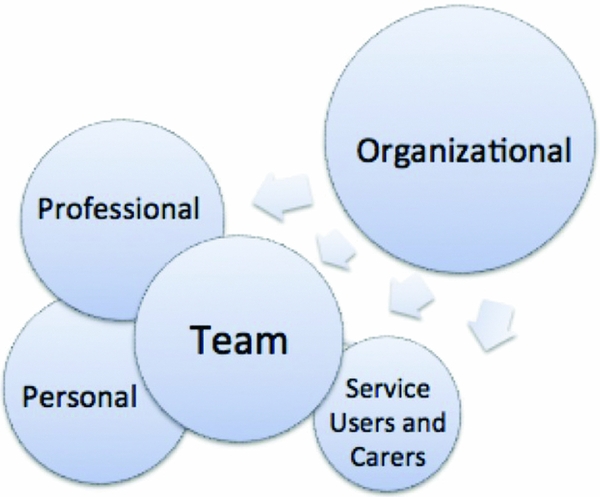
An adaptation of Whittington's (Reference Whittington, Weinstein, Whittington and Leiba2003) Two-Stage Model of Collaboration, underpinned by systems theory and the social construction of identity, was developed to more accurately reflect the hierarchical nature of collaboration influences emerging from the data analysis. The original model consists of five interconnected spheres of influence within care services including Personal characteristics and experiences that impact the work environment; Professional training, registration, practice models and workplace socialisation; Organisational models, administrative principles and bureaucracy; Team interactions and working groups. Finally, Service Users and Carers are centrally grouped to reflect their primary importance to practice. The second stage of Whittington's model provides a framework for analysing the interactive processes between spheres, as Personal becomes Inter-Personal, and Professional becomes Inter-Professional, etc. Findings were categorised using these themes to inform the development of a one-stage adapted collaboration, as stakeholder characteristics and the processes between them are generally indistinguishable in the present study.
Whittington's (Reference Whittington, Weinstein, Whittington and Leiba2003) model is well-suited to the conceptualisation of child protection and education system collaboration, as it emphasises both individuals and organisations, and offers concrete strategies for service development (Crawford, Reference Crawford2012). Moreover, unlike earlier models of inter-agency collaboration, which are limited in scope to the role of a coordinator (Alexander, Reference Alexander1993), or prioritise small, joint actions over a shared master plan (Eisenburg, Reference Eisenburg, Rigsby, Reynolds and Wang1995), it identifies the relationships between multiple stakeholders at various stages of the collaborative process. In both stages, each sphere of influence is given equivalent prominence, although, ‘it is not suggested that these identities are all equally in play simultaneously, or all of the time’ (Whittington, Reference Whittington, Weinstein, Whittington and Leiba2003, p. 41).
Findings
The findings of this study are presented in relation to the authors’ adaptation of Whittington's (Reference Whittington, Weinstein, Whittington and Leiba2003) Two-Stage Model of Collaboration (Figure 1). The adapted model better reflects the hierarchy of cross-system collaborative influences as described by CPFS CWs and EOs. The Organisational sphere is the largest and located at the top of the model, with arrows pointing downward to reflect the perception that financial constraints and structural limitations were beyond participants’ control. The Team sphere is portrayed as a central feature overlapping the Personal, Professional, and Service Users and Carers spheres, as the boundaries between different stakeholder identities appeared less defined than the original model suggests. Interviews revealed that education planning protocols strengthened cross-system communication and education planning accountability. Overarching structures and individual stakeholder characteristics had both positive and negative influences on collaboration between the education and child protection systems in Western Australia.
Adapted model of collaboration.

Organisational
The Organisational sphere is associated with government regulations and bureaucratic structures. Every participant articulated a solid understanding of the responsibilities of the child protection and education systems as outlined in the jointly established MOU (CPFS, 2013; DCP, 2009). The MOU defines all students under the care of CPFS as ‘being at educational risk’, and thus requiring Documented Education Plans (DEPs). An updated MOU that came into effect in October 2013 implemented processes for enrolment disputes based on eligibility, capacity or the ability of the school to provide services. It specifies that shared information includes a student's legal status, placement arrangements, court orders, and education, medical, social and emotional needs. Finally, the agreement reflects an increase in cross-system collaboration by stating that DEPs are to be updated twice yearly with joint determination of the need for educational planning meetings, and includes additional agreements covering mandated reporting, child abuse investigations and tracking school absences.
Five participants expressed that MOU protocols for information sharing and education planning had increased accountability and inter-agency communication, particularly through joint case conferences. As a CW stated, ‘Everyone goes around the table and, to me that is a bit more useful’. Participants shared a willingness to provide educators with information they deemed to be in the best interests of a student in OOHC, including details that might help provide duty of care, understand and manage classroom behaviours or be sensitive to specific issues. Information sharing often led to increased trust, as a CW explained, ‘When you provide that pertinent information that may impact the child's behaviour in school, the school in turn then provides you with what is happening’. However, five participants stated that obtaining DEPs continued to be a struggle.
Participants attributed difficulties obtaining DEPs to educators’ heavy workloads, and limited awareness of the requirement. One EO speculated, ‘I think they introduced it to their principals and maybe some of the principals forgot to tell anybody else in the school’. The Senior EO described working with a DoE regional manager to heighten awareness while avoiding blame-placing, stating, ‘I'm not about to go, “Look, you DoE people don't know what you are doing”. I'm going, “Look, what can we do together to make sure that this happens?”’ A few participants described how some schools, particularly those with numerous students in OOHC, tended to provide educators with extra time and support for completing DEPs and attending case conferences. In other instances, classroom teachers were expected to take full responsibility for the DEP process regardless of their level of knowledge or experience. Although guidelines outlining these requirements are available to educators (DETWA, n.d.), the MOU fails to identify responsibility for this task.
Financial and structural constraints limited educational support provision. Every EO described a lack of alternative education options for students with complex needs, although two CWs disagreed by stating that the challenge was students’ unwillingness to engage. An EO summarised the issue as, ‘We are all government departments and none of us have got the money’. When students in OOHC presented with significant academic or behavioural issues, some educators assumed that CPFS would automatically provide funds for an Education Assistant. While availability was limited, and ‘not kind of a given’, all six EOs described how they could make special purpose funding requests to help meet the educational needs of a specific student for services such as tutoring, but stressed that education system supports needed to be exhausted before exploring CPFS funding options.
At the time of interviews, DoE supplementary funding was available for students with specific diagnoses requiring significant support through Schools Plus (DETWA, 2005). However, participants stated that many students in OOHC with severe academic and/or behavioural issues are ineligible, and that the lengthy and complicated application process was often prolonged due to waiting lists for assessments. Although the Western Australia Cabinet-endorsed Rapid Response Framework (McSweeney, Reference McSweeney2011) entitles all children and young people in OOHC to priority access to health, psychological, education, employment, and housing services, four participants stated that this had not effectively reduced appointment wait times. Furthermore, knowledge of Rapid Response appeared limited within CPFS, as two participants expressed that they were unaware that students in OOHC were entitled to priority service access. An EO explained, ‘It's a good plan, but it needs more dissemination to different departments to say that children in care are priority cases’.
Team
The centrality of the Team sphere illustrates the importance of developing strong working relationships in order to effectively support students in OOHC. As an EO affirmed, ‘Well, if you're going to collaborate with people, you've got to have relationships, don't you?’ For instance, EOs described compiling resources and advice for educators, who they felt were ‘really, really happy to have the extra information’. Additionally, EOs described how ‘it is also helpful to go to schools and speak the language’, and recommended the use of shared vocabulary between systems. Three participants indicated that they had established rapport with a specific individual who helped them navigate the educational system. According to a CW, ‘If you know that one person, even if it is not their role, they can tell you who you need to talk to’. Similarly, an EO described herself as an intermediary who ‘always encourages teachers to come to me. . . as sort of the go-between between the Education Department and DCP’ regarding any type of child protection issue.
All but one participant emphasised ongoing communication with educators through telephone, email and face-to-face contact. For instance, the Senior EO hosted a morning tea for CPFS and school administrators to provide each with the opportunity ‘to really get an understanding of what is it you do’. An EO described how psychologists from each system modelled cross-system collaboration, ‘To avoid a “Here's DCP coming in to tell us what to do”, we would align our Psych with a School Psych, so it's like a partnership thing as well’. Case conferences were perceived as integral to the implementation of educational support, as described by two CWs who felt that the meetings rendered the DEP ‘far more meaningful’ as it becomes a ‘a useful, working document rather than a bureaucratic exercise’. Both EOs and CWs described how strong relationships with DoE administrators helped ensure that schools followed student suspension protocols and supported out-of-catchment enrolments. Another EO explained, ‘There is a bit of an understanding with the Director in place, a willingness to make it work’.
Additionally, five EOs emphasised the importance of strong collaboration within CPFS. One described giving advice to enable CWs ‘who don't have that education knowledge and background to get into schools and talk the talk’. Others expressed frustration when files were not updated or they were not informed about circumstances impacting on educational delivery because ‘there wasn't necessarily that whole feedback loop’. On the other hand, only one CW mentioned that, ‘it's quite helpful when they (EOs) know the internal school processes’, and none acknowledged the need to share information with EOs. The CPFS Casebook Practice Manual outlines formal procedures for CW and EO consultations, but no participants referred to this process.
Professional
The Professional sphere is concerned with child protection worker and educator training and identity. A few EOs who commented on professional differences, such as ‘working with the social workers is quite different, because they tend to be much more relaxed about time’. EOs also frequently described how their education training and background ‘often gives me a little bit more credibility from their point of view’. Two EOs expressed greater professional identification with education than social work, as one stated, ‘I see myself as part of the school, in a sense. I see myself as their colleague’. Participants perceived variable levels of understanding among educators regarding OOHC issues. According to a CW, ‘Some teachers are either trained or just really clued in to the impact of trauma, some of them. . . just have no idea’. Many agreed that ‘the schools in sort of lower socio-economic areas that are dealing with these kids all the time have developed more strategies and are great at it’. However, seven participants recommended that educators would benefit from formal training on OOHC and the impact of trauma on learning and behaviour. Some identified existing programmes for which CPFS and education system representatives jointly presented trainings on these topics, and an EO indicated that further training was being developed.
Stigma among educators associated with child protective services and students in OOHC was another frequent concern. Three participants identified occasional bias against students in OOHC by educators who felt ‘it's not that kind of school’. One CW described frustrations with a particular school, ‘Because they are Aboriginal carers and they are Aboriginal children, it almost seems like they are not worth the same courtesy’. Although this is a unique finding, other participants indicated that more resources were needed for Aboriginal students. Four CWs and an EO described negative opinions among educators towards child protective services. In particular, one CW cited the historical systematic removal of children of Aboriginal and Torres Strait Islander descent as a cause of reputational damage, stating, ‘We used to be the same department of welfare that encouraged the Stolen Generation. . . There are negative connotations’. Participants recognised that transcending negative associations was imperative, and discussed developing good reputations by making themselves available to discuss child protection concerns and assisting with protective behaviours curriculum. As an EO declared, ‘It's in my best interest to make sure that the school's relationship with DCP outside of my role is a good one’.
Personal
Participants identified how Personal characteristics within themselves and educators influenced collaboration. Many expressed that a shared commitment to the needs of students in OOHC encouraged professionals in both systems to establish rapport and work towards mutual goals. For instance, two EOs recognised the need to value educators’ professional judgments. As one explained, ‘It's good to respect the school's knowledge of the child, if they've been there for a while, knowing what strategies work with the child’. Ten out of eleven participants expressed an awareness of the demands of teaching in statements such as, ‘I think it is an incredibly difficult job’, and, ‘Their time is so precious’. Many also emphasised the importance of ‘just being available and responding so the teachers feel listened to as well’.
A few participants employed in regional and remote areas of Western Australia described particularly close relationships with educators. For instance, a CW perceived living and working in a regional community as beneficial because ‘one of the things about being in a small town is you get to know people really well. If you need to talk to the principal, you have talked to them already recently’. For a CW in a remote Aboriginal community, having very few people reside onsite led to exceptionally strong bonds with educators, as she explained, ‘We socialise with each other because there is no one else here’. Perhaps more importantly, she indicated that offering emotional support to cope with cultural differences, extreme isolation and workplace stress meant that educators could ‘talk to someone who is actually not a teacher, outside of the school, and just debrief’. On the other hand, the geographic isolation of some schools inhibited collaboration, as an EO remarked, ‘I can't just book a flight because they might want me there that day’.
Service Users and Carers
While located centrally in Whittington's (Reference Whittington, Weinstein, Whittington and Leiba2003) model, participants did not extensively discuss Service Users and Carers. Therefore, it is the smallest sphere in the adapted model and placed at the bottom. Four CWs and two EOs briefly described how foster carer involvement strengthened collaboration in support of students in OOHC. As one CW expressed, ‘Some carers, I talk to them and I say, “Can you pass this on to the school?” because they've got the relationship with the school teacher’. Others indicated that foster carers sometimes accepted responsibility for communication books used to relay messages between all stakeholders. The only reference to student involvement among participants occurred when a CW stated that the school's procedure for DEP meetings ‘is to sit down with me, the carer and the child to draw up this plan’. No other participant referred to student or foster carer consultation during the arrangement of educational services.
Discussion
Findings from the present study suggest that jointly established protocols for education planning and information sharing have the potential to improve educational service delivery for students in OOHC. As the MOU strengthened communication, trust and accountability between the child protection and education systems, extending this agreement to include disability, mental health and juvenile justice providers has the potential to improve overall outcomes for young people who use these services. Previous Australian research has demonstrated how a mandated agreement for shared responsibility and service integration between the education, health and child protection services minimised gaps in service provision through coordinated planning (Ziviani et al., Reference Ziviani, Darlington, Feeney, Meredith and Head2013). However, inconsistent understandings of education policies for students in OOHC can impede service delivery (Noonan et al., Reference Noonan, Matone, Zlotnik, Hernandez-Mekonnen, Watts, Rubin and Mollen2012; Weinberg, Zetlin, & Shea, Reference Weinberg, Zetlin and Shea2009). Adequate dissemination through training and information sessions can help ensure that practitioners are aware of changing policies and practices.
An Ombudsman investigation conducted prior to the implementation of the MOU revealed DEPs in only 63 out of 293 CPFS files. The report cited ‘deficiencies in the interagency process’ (OmbudsmanWA, 2011, p. 75) and recommended central monitoring and reporting of educational planning for students in OOHC by the Department of Education. It appears that improvements have been made, as 67.1% of students in OOHC in Western Australia had a current DEP on file in 2015 (CPFS, 2016). Participants in the present study attributed difficulties obtaining DEPs from educators to educators’ heavy workloads and limited knowledge regarding the process. While child protection workers described working with educators to heighten policy awareness, further dissemination of the policy is still needed. Within the education system, administrators could provide educators with additional time to complete DEPS and attend meetings (Day et al., Reference Day, Somers, Smith Darden and Yoon2015). Additionally, ensuring that students in OOHC are supported by highly experienced educators could benefit both education planning, and learning and behavioural outcomes. Finally, increased consultation with ground level stakeholders from both systems may provide additional solutions to these and other policy issues.
Difficulties associated with accessing supplementary funding for students in OOHC with severe academic and behavioural needs was a primary cause of cross-system tension. These findings are similar to a Queensland study which attributed delays in educational service delivery to the need for financial approval, waiting lists for assessments and interventions, and poor coordination between the child protection, education, and health systems (Tilbury, Reference Tilbury2010). Financial constraints are a commonly cited source of tension between child protection and education systems (Lee et al., Reference Lee, Benson, Klein and Franke2015; McLean, Reference McLean2012; Stone et al., Reference Stone, D'Andrade and Austin2007). The Gonski Report (DEEWR, 2011) recommends increased funding to better meet the educational needs of specific equity groups, including students from Indigenous and low socio-economic backgrounds, in order to benefit both individuals and society through improved employment outcomes and greater social cohesion. A similar funding allocation specifically for students in OOHC would also help to reduce educational disadvantages.
A new funding model in Western Australia implemented in 2015 is intended to increase the decision-making capacity of schools and more flexibly accommodate student needs (WAGov, 2014). Future research is needed to explore how these changes may influence education and child protection system collaboration and identify the potential impacts on school outcomes for students in OOHC. One possibility to explore is merging resources and service structures between the two systems (McLean, Reference McLean2012). Such an approach could potentially streamline academic supports, particularly given that formal resource sharing has been linked to reduced costs and more timely service delivery.
Despite tension caused by financial constraints, participants described a willingness between child protection and education professionals to work together to support individual student's needs. Additionally, most expressed high levels of respect for educators’ knowledge and practices, which is in stark contrast to previous research reporting that child protection workers perceive educators as unwilling to support students in OOHC (Stone et al., Reference Stone, D'Andrade and Austin2007). These are promising findings that demonstrate a shared commitment to improving educational outcomes among students in OOHC. EOs described working closely with educators to review progress, evaluate strategies and brainstorm new ideas. Other research has demonstrated similar benefits of employing education professionals in child protection, including broader access to education supports (Berridge, Reference Berridge2012), increased awareness of OOHC education issues among educators (Shea, Zetlin, & Weinberg, Reference Shea, Zetlin and Weinberg2010), and more knowledge among child protection workers regarding the education system (Zetlin et al., Reference Zetlin, Weinberg and Kimm2005). Furthermore, administrators from both systems worked together to improve practitioner knowledge regarding the educational needs of students in OOHC. Strong leadership has previously been associated with greater collaboration between child protection and education systems (Weinberg et al., Reference Weinberg, Zetlin and Shea2009).
Very little research has explored the context of child protection and education system collaboration in regional and remote areas of Australia. Findings from the present study echo previous research indicating that geographic distance limits contact and the ability to establish working relationships between educators and child protection workers based in different areas. The present study also highlights an overlap between professional relationships and social bonds quite different to what is typically experienced in metropolitan areas. A deeper examination of relationships between educators and child protection workers employed in isolated locations would be highly valuable to both policy makers and practitioners, particularly given the interpersonal tensions associated with employment in rural and remote communities (Jervis-Tracey, Chenoweth, McAuliffe, O'Connor, & Stehlik, Reference Jervis-Tracey, Chenoweth, McAuliffe, O'Connor and Stehlik2012).
Participants identified minimal understanding among some educators regarding child protection and the impact of trauma on learning and behaviour. They also described how stigma concerning students in OOHC and the child protection system as a whole sometimes impeded their ability to develop effective relationships with educators. Negative professional stereotypes and a lack of trust or understanding are well-established cross-system collaboration barriers (Sloper, Reference Sloper2004). As each stakeholder group is likely to attribute collaboration barriers to problems within the other system (Garstka et al., Reference Garstka, Lieberman, Biggs, Thompson and Levy2014), additional research is needed to explore multiple stakeholders’ perceptions of the knowledge, resources and assistance needed to provide effective support for students in OOHC. This information can potentially inform training jointly attended by educators and child protection workers, which has been previously identified as strengthening cross-system collaboration (Zetlin et al., Reference Zetlin, Weinberg and Shea2010).
Overall, participants frequently emphasised that cross-system collaboration should be grounded in the child's best interests, but only one participant mentioned the importance of student involvement in the education planning process. Thus, it appears that the benefits of including children and young people in OOHC in their own education planning was undervalued, despite the fact that appropriate student involvement is encouraged in the CPFS Casebook Practice Manual, Department of Education Guidelines (DET, n.d.), and National Standards for OOHC (Commonwealth, 2011). One possibility is that student involvement went unmentioned because the interviews focused on participants’ interactions with educators. However, a few participants discussed foster carer involvement, as they believed this strengthened communication between educators and child protection workers. Given the fundamental differences between the needs and interests of services users and carers (Whittington, Reference Whittington, Weinstein, Whittington and Leiba2003), genuine and meaningful involvement from both foster carers and students in OOHC is necessary to ensure education planning includes relevant, appropriate and feasible strategies to address individual learning goals.
Limitations
The intent of the conceptual model is to reflect education and child protection system collaboration in Western Australia, therefore its applicability to other research contexts is somewhat limited. Other limitations of the present study are that it only included 11 participants and did not consider the perspectives of educators or students in OOHC. However, including multiple perspectives was outside the scope of a study of this size, and restricting the breadth of the study to CPFS increased the depth of analysis. The choice to exclude other perspectives was also pragmatic in order to ensure the confidentiality of students in OOHC.
Conclusion
This study explored how jointly established protocols strengthened collaboration between the child protection and education systems in Western Australia. An adaptation of Whittington's (Reference Whittington, Weinstein, Whittington and Leiba2003) Two-Stage Model of Collaboration illustrates the hierarchical nature of influences on the collaborative process. Unlike the majority of previous stakeholder research, participants described how on-going communication and a shared commitment to the needs of students in OOHC facilitated trusting relationships with educators. These findings suggest that education and child protection systems may minimise collaboration barriers through the development and implementation of mutually developed and agreed upon processes to support the unique educational needs of students in OOHC. However, challenges occurred due to financial constraints, difficulties obtaining mandated DEPs, and insufficient awareness among some educators of the child protection system and the impact of trauma on learning and behaviour. Further research is needed to examine the feasibility and appropriateness of strategies such as formal resource sharing and cross-system professional development attendance as a means of strengthening collaboration. Such strategies have the potential to improve working conditions for child protection workers and educators, thus enabling them to better meet the needs of students in OOHC. Resulting improvements in delivery may enhance the school experiences students in OOHC and contribute to positive life outcomes.
Acknowledgements
The authors wish to thank Susan Young, Lecturer Social Work and Social Policy, as well as Jane Simmons and Kaija Pay from the CPFS Research Department for their continued assistance throughout the research process.