Introduction
Political debates about ageing and health care in high-income countries often focus on whether social insurance programmes are affordable. Alarmists in the United States warn that a growing number of older people will create a gerontocracy that demands an ever larger share of public resources (Peterson, Reference Peterson2000; Kotlikoff and Burns, Reference Kotlikoff and B.2004). Critics of social insurance programmes often point to the growth of Medicare as evidence that the ‘elder lobby’ is a powerful, nearly unstoppable, political force. The intergenerational equity frame has played an important role in framing health care politics in the United States since the 1980s, but some argue the importance of this argument has diminished. Day argues that “conservative rhetoric about old-age social insurance is less about supporting the young vs. the old, and more about reducing government by shifting the risk of illness and income loss in retirement to the individual” (Day, Reference Day2011).
Although intergenerational equity may no longer be the focus of conservative leaders in the United States, there are at least three reasons to believe that though leaders in the United States are still more likely to define health care spending in terms of intergenerational equity than those in Canada and the United Kingdom. The most important factor is that the United States uses an age criterion to establish eligibility for Medicare, its social insurance programme that covers health care costs for older people. Unlike countries with universal coverage, public spending on health care in the United States is targeted in a more visible way towards older people.
Second, some scholars argue that citizens of the United States are less likely to embrace solidarity than are citizens of Canada and the United Kingdom (Brown, Reference Brown1998). While other scholars argue that solidarity, along with individualism, has always been an important feature of American political culture (Morone, Reference Morone2005; Sabin, Reference Sabin2012), compared with Canada and the United Kingdom, the notion of solidarity is less likely to motivate health policy debates in the United States. With a few notable exceptions, health policy debates in the United States ‘have eschewed’, rather than embraced, the concept of solidarity (Rudiger, Reference Rudiger2008). In this context, claims about an ‘unfair’ allocation of health care resources across generations may be more likely to resonate with policymakers, the media and the public, even if they do not hold up to scrutiny (Marmor and Mashaw, Reference Marmor and Mashaw2006).
Finally, the total amount of spending on older people and the average per capita spending on people age 65 and older are higher in the United States than in either of the other countries (Centers for Medicare and Medicaid Services, Office of the Actuary, 2012; Canadian Institute for Health Information, 2012). This, combined with the age criterion for Medicare eligibility, creates a situation in which the public may be more likely to focus on the significant level of public spending on older people. Of course, when we account for total societal resources dedicated to health care, the picture is more complex. More than a decade ago Anderson and Hussey (Reference Anderson and Hussey1999) found that the ratio of average per capita spending on those 65 and over to average per capita spending on those 0–64 years was higher in Canada and the United Kingdom than the United States. So while the literature suggests that intergenerational equity is a bigger issue in the United States than Canada or the United Kingdom, the actual allocation of health care spending across age cohorts might lead us to expect the opposite. Despite this, previous research supports the claim that intergenerational equity is more salient in the United States than in Canada.
Cook et al. argued that, although intergenerational equity emerged as an important issue in United States health and social policy debates during the 1980s and early 1990s, it did not become an important issue in Canada (Cook et al., Reference Cook, Marshall, Marshall and Kaufman1994). During the mid-1990s, when concern about the viability of the social security system emerged as an important issue in Canada, a number of articles focused on intergenerational equity appeared in the Canadian media, but the issue faded quickly (Foote and Venne, Reference Foote and Venne2005). The latter finding suggests that the issue of intergenerational equity may become more salient when there is a fiscal crisis and public spending is constrained. If so, we should see an increase in such claims in all three countries by the end of 2007, when the scale of the current global economic crisis became clear.
This article compares how the problem of health care spending is defined in Canada, the United Kingdom and the United States. Specifically, we are interested in the following questions: to what extent are increases in health care spending attributed to population ageing? Is increased health care spending on older people still framed as a threat to spending on younger people in the United States or, as Day suggests, is this no longer a relevant issue? Has the issue of intergenerational equity surfaced in either Canada or the United Kingdom?
It is impossible to understand policy choices without first understanding the ‘assumptive worlds’ of policymakers. The assumptions of policymakers shape their understanding of problems, target solutions and the appropriateness of competing solutions (Klein and Marmor, Reference Klein and Marmor2006). Media framing is one factor that contributes to these perceptions (Iyengar, Reference Iyengar1990). When the media frames an issue it promotes “a particular problem definition, causal interpretation, moral evaluation, and/or treatment recommendation for the item described” (Entman, Reference Entman1993). Gamson (Reference Gamson1992) argues that framing includes the use of symbols and claims about causes and consequences or appeals to moral claims.
To better understand the politics of ageing and health policy in Canada, the United Kingdom and the United States, we compared the problem, definition and causal stories associated with health care spending by presenting the results of a content analysis of major newspaper stories during the past decade. We found that population ageing was cited as an important source of health care cost increases in all three countries but, less so in Canada than either the United Kingdom or United States. Direct claims about intergenerational equity are relatively infrequent among the articles we coded, but newspaper articles in the United States were more likely than those in Canada and the United Kingdom to claim that high health care spending on older people take resources away from younger people. Among the three countries we examined, newspaper articles published in Canada raised concerns that health care spending is crowding out other social priorities most frequently. Finally, we found that almost no articles in the United States challenged the view that population ageing causes health care spending whereas in both Canada and the United Kingdom a small, but a steady stream of articles, challenged the idea that population ageing is to blame for increased health care spending.
Methods
In this article we reviewed newspaper articles that addressed health care spending during the period 2005–2010. During this time period, conservative governments came to power in Canada (in 2006) and the United Kingdom (in 2010). In the United States, President Obama, and large Democratic majorities in both Houses of Congress won in 2008, followed by significant Republican victories in the 2010 mid-term election. This time period also captures the possible impact of the global financial crisis and growing budget constraints in all three countries. If, as Foote and Venne (Reference Foote and Venne2005) suggest, intergenerational equity claims are more likely to emerge during times of fiscal stress, we should expect to see a marked increase in articles that adopt this frame since 2007 in all three countries, regardless of these differences in party control.
Our methodology is adapted from several previous efforts to compare media coverage in two or more countries (see Appendix). We selected articles from major newspapers available from Lexis/Nexis or directly from the Columbia University list of electronic publications. In Canada, we selected articles published in The Globe and Mail, the Toronto Star, La Presse and Le Devoir. In the United Kingdom we selected articles from the Guardian, the Daily Mail and the Financial Times. In the United States, we selected articles published in the Houston Chronicle, Los Angeles Times, New York Times and Wall Street Journal. To generate a sample of articles, we used the keywords ‘health care costs’ or ‘health care spending’.Footnote 1 In 2009, these search terms generated only nine articles in La Presse after we applied our exclusion criteria. In all other years and newspapers in our sample, these terms generated several hundred articles. In each of these cases, we selected 10 articles at random using a random number generator. Our final sample included 239 articles from the Canadian newspapers, 180 articles from the UK newspapers and 240 articles from the US newspapers.
Once we downloaded all of the articles using our keyword searches, both authors read through a sample of 30 articles published from 2009 and 2010 to develop an initial set of codes. The codes are designed to capture the assertions, if any, within each article that identify the causes and consequences of high health care spending. After developing the initial set of codes, we tested the codes on a larger sample of about 50 newspaper articles from 2008 to 2010 to determine whether we could achieve at least 90% inter-coder reliability. This test resulted in agreement on more than 95% of the initial codes. We were able to reconcile the remaining differences among the coders to reach consensus on codes for all of the articles we tested. This test resulted in the final list of codes that we used to categorize all of the remaining articles.
One of the challenges that our test coding process uncovered was the extent to which newspaper articles made causal claims about the relationship between population ageing and health care costs. Although many articles included a direct causal claim, others suggested that population ageing is correlated to higher health care costs, but were vague about the causal connection. To capture these differences, we developed two codes. The first captures clear causal claims about the relationship between population ageing and health care spending and the second captures the correlation claim. To illustrate, in an editorial published on 12 December 2010, the New York Times wrote, “Unless there are big changes, by 2035 federal health care spending – driven by rising medical costs and an ageing population – is projected to account for almost 40 percent of the budget” (New York Times, 2010). We coded this statement as ‘ageing is correlated with health care spending’ because, while it implies that population ageing is the cause of increased health care spending, it does not state so directly. In contrast, an 17 October 2010 New York Times article by Ted Fishman (2010) declared: “The high costs of keeping our aging population healthy and out of poverty has caused the United States and other rich democracies to lose their economic and political footing”. We coded this as ‘ageing causes high health care spending’ because the claim in the article is more direct. This sentence was also given a code to suggest that health care spending harms the economy.
Causes of high health care spending
International data show that there is only a modest relationship between the health care spending and the age of a nation’s population. Some industrialized countries, notably in Northern Europe as well as Japan, have aged much more than North America while they spend a much lower share of their national income on health care (Gusmano and Okma, Reference Gusmano and Okma2010). While the ageing of the baby boomers will create problems for the US Medicare programme (Sarafini and Galewitz, Reference Sarafini and Galewitz2012), most studies conclude that price, along with the volume and intensity of health care services, are the primary drivers of growth in health care spending (Truffer et al., Reference Truffer, Keehan, Smith, Cylus, Polsal, Lizonitz and Clemens2010; Skinner, Reference Skinner2011; White, Reference White2011). Studies within countries have also shown that ageing is not the primary driver of health care cost increases (Evans et al., Reference Evans, McGrail, Morgan, Barer and Hertzman2001), and that ageing may be a more significant driver of long-term care (or social care) costs than of health care costs (Payne et al., Reference Payne, Laporte, Deber and Coyte2007).
The idea that population ageing is an important factor contributing to increases in health care spending rests on the assumption that age-related increases in the prevalence of disease lead to greater spending. The logic is compelling. Health declines with age so as the number and percentage of older people increases, it is reasonable to expect that, if everything else is held constant, spending on health care will increase. Evidence on health care spending by age seems to confirm this insight. As Uwe Reinhardt observes, “at age 60 or so, health spending per capita rises sharply with age” (Reinhardt, Reference Reinhardt2008). But a number of studies find that differences in the prevalence of disease among nations does not explain differences in national spending on health care (Angrisano et al., Reference Angrisano, Farrell, Kocher, Laboissiere and Parker2007; Oberlander and White, Reference Oberlander and White2009). For example, Roehrig and Rouseau (Reference Roehrig and Rousseau2011) found that the growth rate in US health care spending in excess of gross domestic product is not because of increases in the prevalence of disease, but it is because of increases in the cost per case of treating all medical conditions. These findings have been repeated frequently throughout the Organisation for Economic Co-Operation and Development. An extensive review of the literature on health care expenditure by van Elk et al. (Reference van Elk, Mot and Franses2010) found that “the effect of the population’s age structure is usually insignificant”.
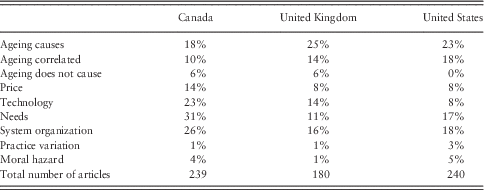
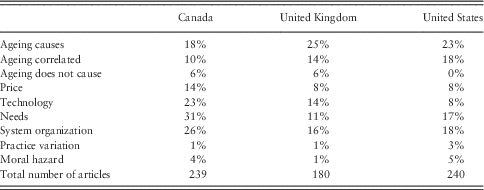
Although the evidence from the health policy and health services literature rejects the claim that population ageing is a primary cause of high health care spending, population ageing was frequently cited as the cause of high health care spending in the newspaper articles from all three countries. About 40% of the newspaper articles we coded in the United Kingdom and United States attributed high health care spending primarily to population ageing. In contrast, health spending was attributed to ageing in only 28% of the Canadian newspaper articles we coded. The Canadian articles were far more likely to attribute health care spending to health technology (mainly pharmaceuticals) and population health needs (that often relate to ageing, such as chronic diseases that increase with age) or the organizational features of the health care system, than the articles in either the United Kingdom or the United States.
Not only were a larger percentage of articles published in the United States likely to attribute health care spending to population ageing, it is important to note that almost no articles from our sample in the United States explicitly challenged the notion that ageing contributes in health care spending. In both Canada and the United Kingdom, 6% of the articles we coded refuted the claim that ageing was the primary cause of high health spending.
Health economist Robert Evans, of the University of B.C.’s Centre for Health Services and Policy Research, said governments and the media are wrong to demonize an aging population or unhealthy lifestyles for health care cost pressures. “When you add up inflation, population growth and aging, those things don’t begin to match the increase in costs,” he said (Hunter, Reference Hunter2010a).
While this is clearly the minority view in all three countries, it reflects a public challenge to the dominant assumption that is rarely articulated in the US press (Table 1).
Causes of high health care spending
Sources: Random sample of articles published between 2005 and 2010 identified with the keywords ‘health care costs’ or ‘health care spending’ in the following newspapers: Canada: The Globe and Mail, Toronto Star, La Presse, Le Devoir; United Kingdom: Daily Mail, Financial Times, Guardian; United States: Houston Chronicle, Los Angeles Times, New York Times, Wall Street Journal. Articles coded by authors.
We found no distinct patterns in between the percentage of articles claiming that ageing causes health care spending over time (Figure 1).
Population ageing causes high health care spending (by country and year). Sources: Random sample of articles published between 2005 and 2010 identified with the keywords ‘health care costs’ or ‘health care spending’ in the following newspapers: Canada: The Globe and Mail, Toronto Star, La Presse, Le Devoir; United Kingdom: Daily Mail, Financial Times, Guardian; United States: Houston Chronicle, Los Angeles Times, New York Times, Wall Street Journal. Articles coded by authors

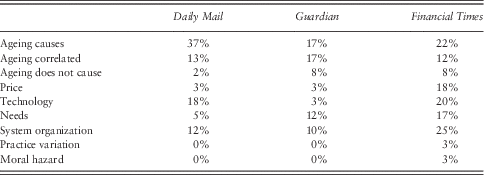
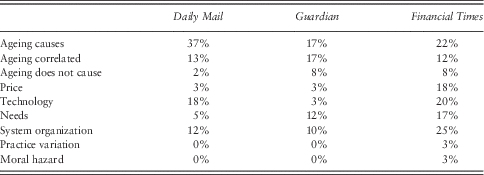
In both the United Kingdom and the United States, we found stark differences among newspapers with regard to the alleged causes of high health care spending. In the United Kingdom the Daily Mail, which is conservative, was more likely to attribute high health care spending to population ageing and technology while the Guardian, a left of centre newspaper, was more likely to attribute high health care spending to the need for care. The Financial Times, which is more neutral than the other papers from which we selected articles, was more likely to emphasize needs, price and health system organization (Table 2).
Causes of high health care spending by UK newspapers (2005–2010)
Sources: Articles published between 2005 and 2010 identified with the keywords ‘health care costs’ or ‘health care spending’. Articles coded by authors.
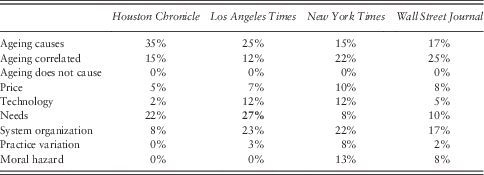
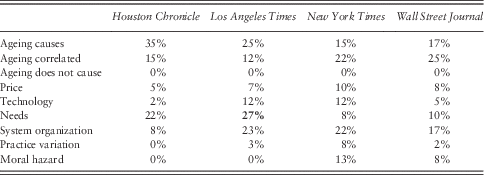
We found a number of interesting differences the newspapers we reviewed in the United States, but with regard to ageing and health spending, there are important similarities. The New York Times and Wall Street Journal are slightly less likely to attribute health care spending to population ageing than Houston Chronicle and the Los Angeles Times, but the association between ageing and health spending was cited more frequently than any other factor in all four of these papers. In contrast, the articles in both the New York Times and Wall Street Journal were more likely to mention practice variation and moral hazard than articles in the Houston Chronicle and Los Angeles Times, which were more likely to mention patient needs as a cause of health spending (Table 3).
Causes of high health care spending by US newspapers (2005–2010)
Sources: Articles published between 2005 and 2010 identified with the keywords ‘health care costs’ or ‘health spending’. Articles coded by authors.
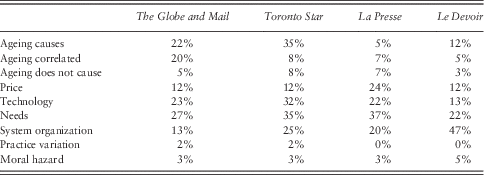
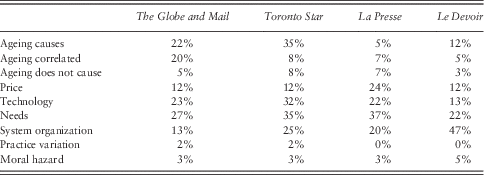
Like the United Kingdom and United States, we found interesting differences among newspaper articles published in Canada with regard to the causes of high health care spending. Among the newspapers we examined, the Toronto Star, the more left of centre newspaper, and La Presse from Quebec, placed the greatest emphasis on the role of technology and also included the highest percentage of articles claiming that ageing is not the main driver of health care spending (Table 4).
Causes of high health care spending by Canadian newspapers (2005–2010)
Sources: Articles published between 2005 and 2010 identified with the keywords ‘health care costs’ or ‘health spending’. Articles coded by authors.
Consequences of high health care spending
The US articles we coded were much more likely to focus on the negative consequences of high health care spending for older people than articles published in Canada and the United Kingdom This finding is similar to the one reported by Diane Rowland (Reference Rowland1992). In a five-country study, which included Canada, Western Germany, Japan, the United Kingdom and the United States, Rowland found that, “American elderly people were most likely to rate the fear of the financial consequences of serious illness as the most serious threat to well-being” (Rowland, Reference Rowland1992: 215). Neither our findings nor Rowland’s from a decade ago are surprising because while the Canadian and British health care systems make physician and hospital care free at the point of service, out of pocket spending by US Medicare beneficiaries now represents more than 16% of their income and is projected to increase (Shelton, Reference Shelton2010). Although the Patient Protection and Affordable Care Act (ACA) included provisions designed to improve coverage for Medicare beneficiaries, the failure of this law to fundamentally address rising health care costs suggests that it is unlikely to tackle the serious fiscal problems of Medicare or the large and growing health cost burden faced by older people. In 2010, a new retiree had to spend about 12% of his social security benefit to pay for Medicare Part B and D premiums. Even after accounting for changes included in the ACA, by 2030, Medicare trustees project that these premiums will cost 36% of the average Medicare beneficiary’s social security benefit (Kaiser Family Foundation, 2010). Cost shifting to Medicare beneficiaries creates a significant hardship for lower-income individuals and has led to greater inequalities among older people. One consequence of failing to reduce health care inflation may be even greater levels of inequality among older people, particularly since many baby boomers have failed to save and employer-based pensions have eroded significantly as well.
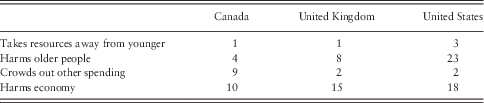
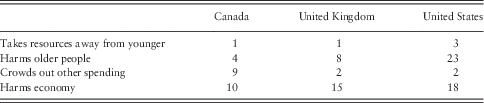
Although Canadian Medicare does not offer drug coverage at the national level, many provinces provide comprehensive drug coverage to their senior populations, with little or no cost sharing. While in British Columbia cost sharing increased for many seniors with the shift to an income-based from an age-based drug programme in 2003, other provinces such as Quebec and Saskatchewan reduced cost sharing for lower-income seniors in 2005 and 2007, respectively (Daw and Morgan, Reference Daw and Morgan2012). Therefore, it is not surprising that the economic and health consequences of high health care spending for older people did not receive as much attention in the Canadian newspaper articles we coded as those published in the United States. Many of the articles that did discuss the harms of rising health costs to older people in Canada focused on resource shortages, such as older people being discharged from hospital quicker and sicker, and without adequate home or long-term care (Table 5).
Instead, this government, like those before it, has focused on scrimping in areas where it faces the least political resistance – like providing diapers for incontinent residents of nursing homes. As the Star’s Moira Welsh revealed this summer, the government’s $1.20 a day allowance is so skimpy that some nursing homes make their elderly residents sit in urine-soaked diapers for hours in order to save pennies (Walkom, Reference Walkom2007).
The three-year spending plan tabled Tuesday puts more money into the system each year, but aims to slow the current rate of increase. But even a 6-per-cent increase in health care spending last year resulted in reduced surgeries, closed hospital beds, and service cuts for mental health, addictions and seniors (Hunter, Reference Hunter2010b).
Consequences of high health care spending
Sources: Articles published between 2005 and 2010 identified with the keywords ‘health care costs’ or ‘health care spending’ in the following newspapers: Canada: The Globe and Mail, Toronto Star, La Presse, Le Devoir; United Kingdom: Daily Mail, Financial Times, Guardian; United States: Houston Chronicle, Los Angeles Times, New York Times, Wall Street Journal. Articles coded by authors.
With regard to the question of intergenerational equity, only 1% of the articles in Canada and the United Kingdom identified this as a problem. In the United States, 3% of the articles identified this as a problem – far more in percentage terms than the other countries, but a small percentage, nonetheless.
There is no question that, in the years ahead, an ever increasing number of US will be retired and out of the work force, having to be cared for by the young folks, of whom there will be fewer and fewer, at least in percentage terms. (Mickleburgh, Reference Mickleburgh2007).
Mr Bernanke said growing fiscal imbalances and their consequences raised questions of “intergenerational fairness”. “The number of retirees each worker will have to support in the future – either directly or indirectly through taxes paid to support government programmes – will rise significantly,” he said. “Future generations will bear a growing burden of the debt and experience slower growth in per capita incomes than would otherwise have been the case” (Allen, Reference Allen2007).
In the first section of the paper we hypothesized that the issue of intergenerational equity may have become more salient after 2007 because the financial crisis in all three countries constrained public spending. As Figure 2 demonstrates, we did find a notable increase in such claims in Canada and United States during this time period, but we actually found a decrease in the number percentage of intergenerational equity claims in the United Kingdom since 2007.
High health care spending on older people takes resources away from younger people [by country and year (2005–2010)].
Sources: Articles published between 2005 and 2010 identified with the keywords ‘health care costs’ or ‘health spending’ in the following newspapers: Canada: The Globe and Mail, Toronto Star, La Presse, Le Devoir; United Kingdom: Daily Mail, Financial Times, Guardian; United States: Houston Chronicle, Los Angeles Times, New York Times, Wall Street Journal. Articles coded by authors
Although it appears that the issue of intergenerational equity is less salient in Canada and the United Kingdom than in the United States, articles published in Canada were much more likely to suggest that high health care spending reduces, or ‘crowds out’, spending on other things (Table 5). This could be a slightly more subtle way of discussing the issue of intergenerational equity. If we accept that interpretation, the intergenerational equity issue received far greater attention in Canada than the other two countries. About 9% of articles published in Canada claimed that high health care spending either takes resources away from younger people or crowds out other spending, compared with only 2% in the United Kingdom and the United States.
Given our aging population and continual advances in medical technology, it appears that health care will keep hoovering up government dollars that could be put to good use elsewhere, like education or infrastructure or the environment (Toronto Star, 2008).
For years now, the provinces have made health care their spending priority with negative repercussions for the quality of infrastructure and public services such as education (Maxwell, Reference Maxwell2008).
Summary and conclusions
This article compared how the problem of health care spending is defined in Canada, the United Kingdom and the United States. Among the articles we selected, we found that population ageing was one of the most frequently cited causes of health care spending increases in all the three countries. There is a long history of debates among policy elites and public intellectuals about the affordability of the US Medicare programme and the degree to which the ageing of the baby boomers threatens the federal budget and the performance of the economy. Consistent with this, we found that articles published in US newspapers were far more likely to cite population ageing as a primary cause of health care spending than were articles published in Canada and the United Kingdom.
Overt claims that health care spending on older people is taking resources away from younger people were relatively infrequent in all three countries. Newspaper articles in the United States were most likely to make such claims, but the rate was only slightly higher than articles published in UK newspapers. While direct claims about intergenerational equity were not prominent in the Canadian newspapers we reviewed, 9% of the newspaper articles in our Canadian sample either claimed that high health care spending is taking resources away from younger people or the more general claim that such spending is crowding out other types of government expenditure. This suggests that intergenerational equity may not be a concern unique to the United States.
Because Canada and the UK finance health care from general revenue, health care spending clearly competes with other government spending priorities in both countries. While this might make it a little surprising that there are such large differences in the degree to which their respective newspapers frame the issue of high health care spending in terms of opportunity costs, the news coverage we documented seems to reflect accurately the general direction of policy debates in the two countries. After a decline in real dollar health care spending during the 1990s, health costs in Canada rose steadily during the subsequent decade. During times when health care appears to be underfunded and waiting times increase, there is a call for increasing the Canadian Medicare budget (Tuohy, Reference Tuohy2002). Once health care spending is increased, there are concerns that it is crowding out other priorities (Booth and Carson, Reference Boothe and Carson2003; MacKinnon, Reference MacKinnon2004).
Finally, our finding that almost no articles in the United States challenged the view that population ageing is the primary cause of health care spending is significant and represents an important difference in the media’s framing of this issue among the three countries in our study. In both Canada and the United Kingdom a small but steady stream of articles challenged the idea that population ageing is to blame for health care spending increases. These articles, which often summarized research by leading academic health policy experts, explained why population ageing may not necessarily significantly increase health care spending. The regulation of health care prices, the growth of health care technology, improving efficiency in the organization and delivery of care and other factors are more important contributors to health care spending than population ageing. The absence of a dissenting voice in leading US newspapers is troubling because it undermines the hope for a rigorous public debate about this important issue.
Acknowledgement
The authors would like to thank Dr. Adam Oliver for organising the seminar at the London School of Economics and Political Science at which the first version of this paper was presented. We also thank Dr. Rudolf Klein and the members of the Columbia – LSE Health Policy Group for their comments on an earlier draft and Meriem Boudjarane for support with coding French language newspapers.
Appendix. Summary of studies informing the selection of newspapers for comparison
There have been several previous efforts to compare media coverage in two or more countries, which helped to inform our selection of newspapers in the United Kingdom, United States and Canada. Abelson and Collins (Reference Abelson and Collins2009) compared media coverage of Herceptin in three UK and four Canadian newspapers selected to represent a cross-section of national-level print media with different readerships (socio-economic status, age, gender), political orientations (left, centrist, right) and multiple targets of influence (policy elites, the general public). To do so, they coded articles in three UK newspapers (the Guardian, the Daily Mail and the Financial Times) and four Canadian newspapers (The Globe and Mail, the Toronto Star, La Presse and Le Devoir).
Vilella-Vila and Costa-Font (Reference Vilella-Vila and Costa-Font2008) analyze press media coverage and reporting to see whether it has an effect on the change in attitudes towards and risk perceptions of new genetically modified foods in Spain and the United Kingdom. They examine the frequency of media coverage and the framing of the selected print media, using classical press content analysis. They select two publications in each country, one that is a key publication likely to be an opinion-leading source for other papers, and one that is the most popular. In the United Kingdom their sources were the Guardian and the Sun. In Spain their sources were El Pais and El Mundo.
Huang and Priebe (Reference Huang and Priebe2003) compared the media coverage of mental health care in the United Kingdom, United States and Australia. They selected two broadsheet newspapers that represented the highest national circulation and that were available on the internet. In the United Kingdom these included the Guardian and the Daily Telegraph. In the United States they examined the Los Angeles Times and the New York Times.
Finally, Soroka (Reference Soroka2011) analyzed media coverage of health care in Canada and aimed to review a set of newspapers that are available online and that are regionally representative. Two national and seven regional newspapers included: Calgary Herald, Chronicle Herald (Halifax), Le Devoir, La Presse, The Globe and Mail, Montreal Gazette, Toronto Star, Vancouver Sun and Winnipeg Free Press. These newspapers are not all available in a single index or over the same period of time. Three separate indices were used: Nexis (Toronto Star, Globe and Mail), Factiva (Calgary Herald, Montreal Gazette, Vancouver Sun, Winnipeg Free Press) and NewsCan (Chronicle Herald, Le Devoir, La Presse). Only the Toronto Star is available, consistently and reliably, in full-text form from 1990 onwards; the The Globe and Mail is available reliably from 1996. All other newspapers become available sometime between 2003 and 2006.