Introduction
Even though an individual may be able to reduce their risk or modify the course of cognitive decline in later life with an active lifestyle and robust social life (Fratiglioni et al., Reference Fratiglioni, Paillard-Borg and Winblad2004), there is no definitive way to avoid cognitive decline or dementia altogether. With increased public awareness and better diagnostic approaches, people are finding out earlier that they have dementia or in the case of MCI that they have a very high risk of developing dementia. A diagnosis can be a life-altering event precipitating adjustment difficulties with concerns about the future and ongoing decline (Joosten-Weyn Banningh et al., Reference Joosten-Weyn Banningh, Vernooij-Dassen, Rikkert and Teunisse2008). Coping with difficulties associated with high level functional tasks such as writing, understanding complex information, e.g. legal and financial matters, coping in complex social scenarios, and maintaining a good quality relationship with a spouse may also prove challenging (Garand et al., Reference Garand, Dew, Urda, Lingler, Dekosky and Reynolds2007; Blieszner and Roberto, Reference Blieszner and Roberto2010). While there are many advantages associated with early diagnosis such as legal and financial planning whilst the person is capable of contributing, and the initiation of treatment and access to support at an early stage; there are concerns that poor adjustment to diagnosis and associated problems, if left unresolved, may lead to psychiatric symptoms such as depression and anxiety (e.g. Sholey and Woods, Reference Scholey and Woods2003; Waldorff et al., Reference Waldorff2012).
People with MCI and early dementia appear to have more severe psychiatric symptoms, than age-matched controls. In one recent large-scale community sample, 43% of people with MCI and 75% of people with dementia were reported to have psychiatric disturbance, with depression, irritability, and apathy the most common symptoms (Lyketsos et al., Reference Lyketsos, Lopez, Jones, Fitzpatrick, Breitner and DeKosky2002). Specifically, within their sample, Lyketsos et al. (Reference Lyketsos, Lopez, Jones, Fitzpatrick, Breitner and DeKosky2002) found that depression accounted for 20% of psychiatric disturbance in people with MCI and 32% in people with dementia. Their findings are consistent with earlier studies which use standardized criteria for “major depressive disorder” that report a prevalence between 10 and 20% in people with dementia (Loreck and Folstein, Reference Loreck, Folstein, Starkstein and Robinson1993). While adjustment to diagnosis may contribute to psychiatric symptoms in some cases, pre-existing or comorbid mental health problems may also play a role. Indeed, given the extent of psychiatric difficulties in this clinical group the possibility emerges that biological factors associated with dementia may also play a role in their etiology. Diagnostic challenges in the clinical setting, such as depressive symptoms which precede the presence of dementia like a “prodromal state,” lend weight to this possibility (Bains et al., Reference Bains, Birks and Dening2009).
Despite the possibility that biological factors or pre-existing psychiatric illness may contribute to mood changes, helping people with MCI and early dementia to make a successful adjustment and manage any comorbid depression and anxiety is clearly an important clinical objective (Cheston, Reference Cheston1998; Moniz-Cook et al., Reference Moniz-Cook, Gibson, Harrison, Wilkinson, Moniz Cook and Manthorpe2009). Evidence from large-scale clinico-pathological studies suggests avoiding mental illness and maintaining social connections can help to maintain an individual's level of function, even in the presence of significant Alzheimer's brain pathology (Bennett et al., Reference Bennett, Schneider, Tang, Arnold and Wilson2006; Wilson et al., Reference Wilson, Arnold, Schneider, Li and Bennett2007a; Reference Wilson2007b). Therefore, optimizing adjustment and minimizing symptoms of depression and anxiety may help some people modify the extent or rate of decline of their dementia.
Antidepressants are widely prescribed and there is evidence for their efficacy in patients with cognitive impairment and dementia, although the evidence base is small (Bains et al., Reference Bains, Birks and Dening2009). However, it may also be important to pursue psychological interventions (as well as other non-pharmaceutical options such as increased exercise that are not the subject of this review). These reasons include concerns about side effects and poly-pharmacy in this predominantly older group, as well as the emerging body of evidence that psychological approaches may be particularly effective for mild to moderate symptoms of depression and anxiety in this age bracket/population (Wilson et al., Reference Wilson, Mottram and Vassilas2009; Kiosses et al., Reference Kiosses, Leon and Areán2011).
The World Health Organization (WHO) defines four main psychotherapeutic treatment approaches (WHO, 2007): (1) cognitive behavior therapy (CBT) (aims to correct negative distorted cognitions and dysfunctional beliefs that maintain depressive symptoms); (2) psychodynamic therapy (focuses on gaining a greater understanding of each individual's unique internal dynamics); (3) interpersonal therapy (focuses on interpersonal issues including grief and loss); and (4) supportive counseling (Rogerian person-centered therapy). Of these, CBT is the most commonly practiced and has been most rigorously researched (WHO, 2007). A recent Cochrane review concluded that CBT in older adults without cognitive impairment was effective in reducing depressive symptoms compared with waiting list controls, albeit based on a relatively small sample of 153.patient (Wilson et al., Reference Wilson, Mottram and Vassilas2009). Other forms of psychotherapy with emerging evidence bases include problem solving therapy (teaching problem solving skills to deal with a variety of problems), reminiscence, and life review (Frazer et al., Reference Frazer, Christensen and Griffiths2005). To date, individual psychotherapy appears to be more beneficial than group therapy in this age group (Scogin et al., Reference Scogin, Welsh, Hanson, Stump and Coates2005). The evidence base for befriending schemes and other community-based approaches is less well-developed (Ryburn et al., Reference Ryburn, Wells and Foreman2009).
Challenges can emerge in the attempt to apply standard psychological therapies to people with cognitive impairment particularly where loss of insight or memory loss is apparent. There may be a need to modify the usual approach that is taken in order to ensure the effectiveness of therapy even for very mild levels of cognitive loss (Woods and Clare, Reference Woods and Clare2008). A range of modifications have been trialed including simplification of concepts, a focus on behavioral approaches, repetition, use of written materials, and the presence of a family supporter in sessions and were utilized will be mentioned in our review (Moniz-Cook et al., Reference Moniz-Cook, Gibson, Harrison, Wilkinson, Moniz Cook and Manthorpe2009).
This paper aims to build on an earlier narrative review of the literature (Cheston, Reference Cheston1998) with a systematic review of the subsequent period (1998–2013). When Cheston wrote his review in 1998, there were few quantitative pre–post studies investigating interventions and those that existed were inconclusive. In the fifteen year period since its publication, public awareness has grown and diagnostic approaches improved and as a consequence, there has been a much greater emphasis on the importance of early intervention in the community at a stage when a patient may benefit the most (Moniz-Cook and Woods, Reference Moniz-Cook and Woods1997). To reflect this emphasis, older people with MCI have been included in this review on the basis that in many cases they will progress to developing dementia (at a rate of approximately 15% per year, Panza et al. Reference Panza, Collaccico, Del Parigi, Pilotto, Scapicchio and Carpurso2005). A range of psychotherapeutic approaches will be investigated including support groups for adjustment to diagnosis, individual psychotherapy, group programs, life review, and intergenerational community schemes.
Methods
The review was guided by the University of York Centre for Reviews and Dissemination guidelines on conducting reviews in health care (Centre for Reviews and Dissemination, 2009) (CRD), as well as the Jadad et al. (Reference Jadad1996) scale. The review targeted intervention studies (experimental, quasi-experimental, and before-and-after studies) published in English between 1998 and 2011.
Inclusion criteria
Inclusion criteria for the purposes of the review were:
• That participants met published MCI criteria (Petersen and Negash, Reference Petersen and Negash2008) or were described as having mild cognitive impairment (MCI) or mild-moderate dementia or with cognitive impairment at one standard deviation or greater than normative samples in at least one domain, or had received a diagnosis of mild-moderate dementia (e.g. Clinical Dementia Rating Scale (CDR)<2) dementia while retaining relatively intact functional capacities.
• Studies used psychological and social interventions designed to improve mood, or adjustment and quality of life for participants diagnosed with dementia or MCI.
• Studies described interventions that were predominantly psychological in content with a focus on talking based psychological therapy (e.g. CBT) or social support (e.g. intergenerational studies) with a clear description of the methods used and theoretical approach.
• Study designs included experimental, quasi-experimental, and before-and-after studies.
• Studies were published in the English language.
• Studies were published from 1998 onward.
• Participants were living in the community.
Exclusion criteria
Exclusion criteria for the purposes of the review were:
• Participants had a diagnosis of severe dementia (MMSE scores less than 10 or CDR score of 3 or more).
• Participants were residents of residential facilities.
• Interventions had a primary focus on cognitive rehabilitation (e.g. a focus on improvement of memory or other cognitive functions with little or no reference to improvement in mood symptoms).
• Interventions had a primary focus on non-psychosocial or non-talking based therapies (e.g. physiotherapy, occupational therapy, and art and music therapy).
• Interventions used non-standardized outcome measures.
Literature search
Searches were conducted using electronic databases, including Google Scholar, Medline, Pubmed, PsycInfo, and the Cochrane Library. Searches in Google Scholar involved searching through the first three web pages of listed hits, due to large volume of results. Manual searches were also conducted on relevant books, journals, indexes, and abstracts and yielded 24 studies.
Search terms used were divided into three categories: (1) participant characteristics; (2) type of intervention; and (3) type of article. Each search involved combining terms from at least two of the three categories. Search terms used included combinations of: older people; MCI/early dementia/mild dementia; depression; community intervention/treatment/psychosocial/reminiscence/psycho-education/psychotherapy/counseling/support group/rehabilitation/social; intervention/review.
Study selection, data extraction, and quality analysis
Studies identified were included or excluded in two main stages. First, each abstract was scanned to make an initial judgment about its eligibility. At the second stage, each study was read more closely to decide on eligibility. Inclusion and exclusion criteria were applied to each study to decide whether or not to include the study in the review.
A data extraction procedure was used to summarize all relevant information from each of the studies that met inclusion criteria. Sixteen areas were covered including study design, recruitment procedures, participant withdrawals, measures used, and type of analysis conducted. Each author summarized half of the studies.
The summarized studies were then assessed for quality using criteria from the University of York Centre for Reviews and Dissemination Guidelines on Conducting Reviews in Health Care (Centre for Reviews and Dissemination, 2009). The CRD criteria allow for a maximum score of 9 and are as follows: (1) Was there adequate description of participants? (2) Was the sample size justified (sufficient power)? (3) Was there adequate description of an intervention and who received it? (4) Is measurement likely to be reliable and valid? (5) Were any biases operating that may have influenced the results (e.g. contamination, cointervention or drop out)? (6) Was the statistical analysis appropriate? (7) Is the duration enough to identify changes in the outcome of interest? (8) In studies where two groups were compared were the groups similar? Were they treated similarly? If not, were attempts made to control for those differences (matching or statistical control)? (9) Was outcome assessment blind to exposure status? Studies that met all criteria were rated as “good.” Studies that met half or more of the criteria were rated as “adequate” and studies that met fewer than half of the criteria were rated as “poor.”
For Randomized Controlled Trials (RCTs), the Jadad et al. (Reference Jadad1996) scale was used. Using this methodology, RCTs were scored according to performance in three domains: randomization, blinding, and withdrawals and dropouts. The Jadad scale was adapted slightly to capture that, while it is not feasible for most studies under review to perform double blinding, many of them used single blinding by masking researchers and data collectors to participant assignment. The minimum score was 0 and the maximum score 3. Jadad et al. (Reference Jadad1996) found that 99% of poor quality studies score 2 points or less and 71% score more than 2. Therefore, a study was designated adequate if it scored 2 or above and poor if it scored 1 or below.
To assess quality, reviewers independently applied the criteria to each study to arrive at an overall quality score. Reviewers later compared the scores they had given to each study. Minor disagreements were apparent in 63% of studies (2 points or less) and were resolved through review of the texts and discussion.
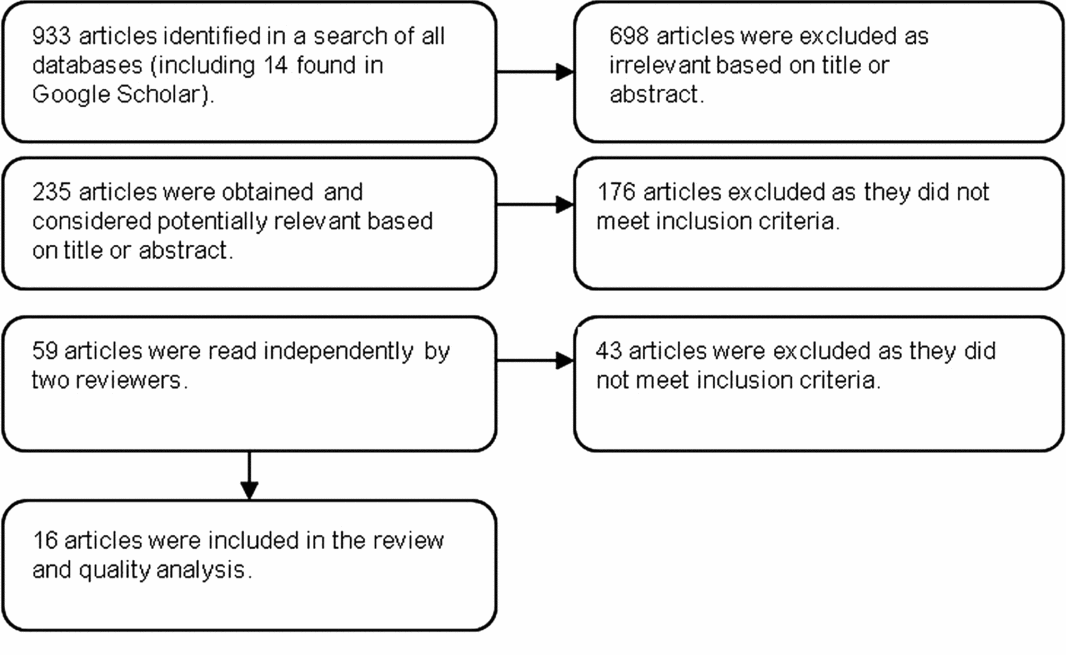
Stages in identifying and selecting relevant studies.

Results
Sixteen of 921 studies identified through literature databases and manual searches met the inclusion criteria. Studies were excluded on the basis that they were: unrelated to the topic; they were qualitative studies or reviews; they were case studies; or they did not meet all the inclusion criteria. Of the sixteen selected studies 15 were considered to be of “adequate or good quality.” These included seven randomized controlled trials and eight pre–post studies (i.e. four controlled and four uncontrolled pre–post studies). One remaining study was considered to be of “poor quality.” A diverse range of psychotherapeutic approaches, formats (individual or group), outcome measures, inclusion criteria, and cultural contexts were apparent, making comparisons between studies challenging.
Studies in this review are summarized in Table 1.
Description of the 16 studies included
Key for general terms: MMSE = Mini-Mental State Examination; CDR = Clinical Dementia Rating; GDS = Geriatric Depression Scale; STAI = State-Trait Anxiety Inventory
Key for study quality: RCTs: Jadad score 3 or above out of 5 = adequate; Jadad score 2 or less out of 5 = poor; Other study types: All York Centre criteria met = good; 5 or more out of 9 York Centre criteria met = adequate; 4 or less of York Centre criteria met = poor.
Intervention studies
A wide range of psychotherapeutic approaches (e.g. problem solving, cognitive behavior therapy, and volunteering), formats (e.g. individual or group-based programs), and outcome measures were utilized in the studies selected for this review. All sixteen studies included a specific measure of depressive symptoms whereas only three included a specific measure of anxiety symptoms. The majority of studies included at least one well-validated measure of depression or anxiety such as the Cornell Scale for Depression in Dementia (three studies) or the Geriatric Depression Scale (GDS) (seven studies). Other studies also measured aspects of wellbeing (e.g. sense of purpose), quality of life, behavioral disturbance, functional status, social status, or physical function. Sample sizes ranged from 7 to 93 cases, with a median of 25 and an average of 33.
Results were organized according to the focus of the study (e.g. to treat depressive or anxiety symptoms or to assist with adjustment and improve quality of life). In this respect, those studies that specifically included people with a comorbid diagnosis of depression or anxiety were included in the alleviation of depression section whereas those that did not select for depression or anxiety were included in the adjustment section. The studies were also categorized studies based on the format of the intervention (individual and group-based) and the type of psychotherapeutic approach utilized (e.g. CBT or multimodal).
Treatment of depression and anxiety
All of the studies that were included in this section utilized individual-based interventions in which therapy was provided from the therapist to the patient or the patient and the caregiver rather than a group format. Only two main therapeutic approaches were utilized; problem-solving therapy and cognitive behavioral therapy (CBT).
Problem-solving therapy
Problem-solving therapy is an approach to psychotherapy that attempts to teach patients skills for to deal with everyday life and to handle stressful situations (e.g. divorce). It has the advantage of being adaptable, to include elements such as calendars, checklists, pictures, and notebooks in order to tailor the intervention specifically for patients with cognitive impairment (Kiosses et al., Reference Kiosses, Arean, Teri and Alexopoulos2010). Perhaps for this reason, it is one of the most rigorously researched approaches of the studies included in this review. Three US-based studies using randomized controlled designs (Teri et al., Reference Teri, Logsdon, Uomoto and McCurry1997; Alexopoulos et al., Reference Alexopoulos, Raue and Arean2003; Kiosses et al., Reference Kiosses, Arean, Teri and Alexopoulos2010) involved a comparison between problem solving therapy and supportive therapy. Each study demonstrated significant positive treatment effects for depression, suggesting that this may be a promising approach to this patient group.
Teri et al. (Reference Teri, Logsdon, Uomoto and McCurry1997) focused on patients with mild-moderate Alzheimer's disease (n = 72) as well as a comorbid diagnosis of depression, and included four conditions. The two active therapy components were problem solving therapy (n = 19) and pleasant events behavior therapy (n = 23), compared to standard care (n = 10), and waiting list controls (n = 20). The emphasis of this study was on teaching caregivers the necessary skills to assist the person with dementia, although patients were also actively involved in each of the nine weekly one-hour intervention sessions. The authors found a significant treatment effect for depression as well as large effect sizes for both active behavior therapy conditions in comparison with controls. About 60% of patients in the active therapy conditions demonstrated an improvement in depression versus 20% in the control condition. An improvement in depressive symptoms was also found for caregivers. At the six-month follow-up, patients and caregivers had maintained improvements in mood.
Alexopoulos et al. (Reference Alexopoulos, Raue and Arean2003) and Kiosses et al. (Reference Kiosses, Arean, Teri and Alexopoulos2010) each focused on the challenging subgroup of patients with a DSM-IV diagnosis of major depression as well as prominent executive-type cognitive impairments – a group highly resistant to antidepressant medications. These participants had not received a clinical diagnosis of MCI or early dementia; however, the description provided by the researchers indicates it is likely participants would have fulfilled diagnostic criteria, albeit with lower proportion of amnestic cases than the majority of other studies. Both studies conducted interventions over 12 weekly one-hour sessions with patients and caregivers (whenever available). The intervention emphasized training in problem solving methods. In addition, Kiosses et al. (Reference Kiosses, Arean, Teri and Alexopoulos2010) adapted the therapy to the patient's level of cognitive function by including adaptation tools, such as calendars, and checklists. Both studies measured outcomes immediately posttherapy, although neither conducted a follow-up. Both studies were able to demonstrate statistically significant improvements in depressive symptoms and disability. Alexopoulos et al. (Reference Alexopoulos, Raue and Arean2003) reported the most promising findings with 75% of their patients displaying clinically significant remission in depressive symptoms in the problem-solving groups versus 22% in the supportive therapy group.
Cognitive behavior therapy
Somewhat surprisingly, given that it is the most well-utilized and researched therapeutic approach among cognitively intact older people, this review identified only two small pilot pre–post studies that used CBT with MCI and early dementia patients (Scholey and Woods, Reference Scholey and Woods2003; Paukert et al., Reference Paukert2010). Both studies found small but positive effects.
The pilot study by Paukert et al. (Reference Paukert2010) used CBT with eight participants who had mild to moderate dementia and some depressive and anxiety symptoms. Therapy provided up to 12 weekly sessions of between 30–60 minutes duration over a three-month period, followed by telephone booster sessions for a further three months. Each session was attended by a spouse or other caregiver to support the patient by reviewing sessions and undertaking homework tasks. Clinicians chose the most relevant content based on individual needs, including sleep skills, increasing activities, and calming thoughts. Modifications made to the traditional CBT approach included an emphasis on behavioral rather than cognitive interventions, use of visual cues (reminder cards), and greater time spent practicing during the session.
Scholey and Woods (Reference Scholey and Woods2003) provided CBT over eight weekly sessions to seven participants with a diagnosis of dementia and depression. They reported modifying the approach to allow for cognitive impairment by providing written summaries of sessions, allowance for more tangential discussions, and an explicit discussion of diagnosis. Scholey and Woods (Reference Scholey and Woods2003) reported a significant improvement in depression across pre- and postintervention (p = 0.007). However, when they applied the clinically conservative Reliable Change Index (Jacobson et al., Reference Jacobson, Follette and Revenstorf1984) to the data they found only two of seven participants showed a clinically reliable change. Using a more lenient method for assessing change (i.e. a 20% reduction in scores on depression and anxiety scales from baseline), Paukert et al. (Reference Paukert2010) showed only a modest level of improvement. According to Paukert et al. (Reference Paukert2010), 75% of participants showed an improvement in depression at three months and 57% at six months, and 25% of participants showed improvement in anxiety at three months and 57% at six months.
Interventions to improve adjustment and quality of life
The following section is divided into those studies that were predominantly “psychological” (including CBT, constructivist, exploratory psychotherapy, and brief psychodynamic therapy allowing for some cognitive rehabilitation/psycho-education), “multimodal” (i.e. included non-psychological approaches such as physical activity), and “intergenerational” (i.e. which utilized groups made up of patients and intergenerational volunteers from the community).
Psychological approaches:
Five different psychotherapeutic approaches were utilized; two with individual-based interventions including recovery oriented therapy and brief psychodynamic therapy; two with group-based interventions including CBT and exploratory psychotherapy and one with a mixed program including both individual and group aspects. Positive improvements in wellbeing and adjustment were found in the studies utilizing the recovery oriented and CBT approaches. There was no clear evidence of improvements for the other approaches utilized – constructivist, brief psychodynamic therapy and exploratory psychotherapy.
Constructivist approach
Waldorff (Reference Waldorff2012) undertook the largest and most methodologically rigorous study in the area to date with a total of 330 participants with a recent diagnosis of Alzheimer's disease who were randomly allocated into a treatment and active control groups regardless of depressive symptoms. Those in the treatment group undertook a “multifaceted and semi-tailored intervention” involving seven counseling sessions for patients and caregivers, separate educational courses for patients and caregivers on key issues of the disease, supported by handouts and telephone follow up. The counseling was based on constructivist principles in which each patient or caregiver was given the possibility of expressing their life story and its personal importance (some sessions were with the patients and some with the caregiver and some with both together). The counselor also offered guidance on decision making and activities that may help participants to focus on the positive factors and resources in their lives. At 12 months postintervention, participation in the intervention program did not appear to impact significantly on depression, quality of life or cognition. A small treatment effect for depression levels prior to adjustment for attrition may suggest that such a program may be particularly beneficial for patients with a comorbid diagnosis of depression or who were seeking out such an intervention. Sorry Bridget but I am not sure what you mean by this sentence: the authors speculated that the control condition of standardized follow up (which constituted a greater amount of follow up than most dementia cases) may have affected their ability to demonstrate a positive treatment effect.
Recovery oriented therapy
Jha et al. (Reference Jha, Jan, Gale and Newman2012) developed a wellbeing-based recovery oriented assessment and intervention for people when they first receive a diagnosis of MCI or dementia. Seventeen participants randomly allocated to the treatment group received treatment in three stages; (1) prediagnostic counseling and wellbeing assessment, (2) therapeutic diagnostic consultation and written feedback from specialized diagnostic clinic, and (3) ongoing monthly counseling sessions from research a nurse with a focus clarifying issues relating to the diagnosis and recovery. Instead of focusing on their illness, individuals were encouraged to think in terms of their positive ongoing roles as wife, mother, husband, etc. The seventeen participants in the control group were offered a fixed package of care post diagnosis in the community involving monthly hour long conversation about issues raised by family members. The recovery group demonstrated significant improvement in wellbeing (WHO Wellbeing Index) with trends in improvement in the other outcome measures including depression and caregiver burden. Problems with the study included its small sample size and high numbers of dropouts over the six-month period. In addition, the sample was heterogeneous, comprised of patients diagnosed with MCI and dementia, including those with relatively MCI (MMSE>24) through to more moderately impaired patients (MMSE10<20).Therefore, it remains difficult to determine if this approach was particularly suited to MCI or dementia patients.
Brief psychodynamic therapy
Psychodynamic therapy aims to identify interpersonal conflicts or beliefs that are causing or helping to maintain emotional distress. Burns et al. (Reference Burns2005) conducted a randomized control trial with a sample of 40 patients with a diagnosis of MCI or early dementia to investigate the impact of brief psychodynamic therapy on mood, global wellbeing and cognition. Burns et al. (Reference Burns2005) therapeutic approach was adapted for people with dementia via the use of home visits and involvement of the caregiver in the therapeutic sessions. Four main areas were explored with each patient: autobiographical narrative; important past conflicts; impact of diagnosis, and improving interpersonal relationships, including the relationship with the partner. Burns et al. (Reference Burns2005) did not find any significant difference in depression between treatment and control groups, nor did they find any change in the treatment group over pre- and postintervention. Nevertheless, caregivers (who had been involved in the sessions) demonstrated improved coping mechanisms and patients generally reported a positive experience in therapy.
Cognitive behavioral therapy
Joosten-Weyn Banningh et al. (Reference Joosten-Weyn Banningh, Prins, Vernooij-Dassen, Wijnen, Olde Rikkert and Kessels2010) conducted a waiting list controlled group trial of CBT with patients with MCI (carefully diagnosed via a multidisciplinary team using the Peterson criteria). Ninety-three patients who were accompanied by a close family supporter received treatment in groups of five to eight people. Ten two-hour weekly sessions were conducted with CBT as well as psycho-educational and memory rehabilitation elements. Topics included MCI as a clinical diagnosis, strategies to improve memory performance (such as errorless learning and using a memory book), strategies to recognize strain, learning to relax, and dealing with social conflicts and worrying. The authors were able to demonstrate that acceptance, as measured by the Illness Cognition Questionnaire (Evers et al., Reference Evers, Kraaimaat, van Lankveld, Jongen, Jacobs and Bijlsma2001), increased more in the intervention group than in the waiting list control group.
Exploratory psychotherapy
Cheston and colleagues, who pioneered the use of exploratory psychotherapy groups for patients with dementia in England, have published the results of two of their group therapy programs (Cheston et al., Reference Cheston, Jones and Gilliard2003; Cheston and Jones, Reference Cheston and Jones2009). Both studies utilized a therapeutic approach in which over 10 weekly 75-minute sessions patients were asked to discuss “what it is like when your memory is no longer as good as it used to be.” They were then encouraged to explore their experiences and reflect on their emotional significance. Primary outcome measures included changes in depression and anxiety symptoms post therapy even though their participants were not preselected for psychiatric diagnoses.
In the first study, rated “adequate,” which used a pre–post design without control group, Cheston et al. (Reference Cheston, Jones and Gilliard2003) were able to demonstrate that for 19 participants diagnosed with probable dementia (MMSE>18), levels of depression as measured by the Cornell scale fell significantly during a 10-week group intervention compared to baseline and follow-up periods. In their second study, Cheston et al. (Reference Cheston and Jones2009) undertook a group comparison study in which the outcomes from their exploratory psychotherapy approach were contrasted with a 10-week psycho-educational group. While they were able to demonstrate a trend towards decreasing depressive symptoms in the psychotherapy group, once differences in level of depression at preintervention were statistically controlled, there were no significant differences between the two approaches. Unfortunately, this study also had some other methodological limitations which led to a “poor” quality rating. These limitations included no specific selection for patients with depressive symptoms, differences in levels of depression, gender balance, and medication usage between the groups and high potential for cross-fertilization of knowledge between the two groups (i.e. each group contained some people who had previously undertaken a group program and some newcomers).
Multimodal approaches:
In this review, four multimodal studies with a more predominant “psychotherapeutic emphasis” have been included: a US study undertaken by Burgener et al. (Reference Burgener, Yang, Gilbert and Marsh-Yant2008), a German study undertaken by Kurz et al. (Reference Kurz, Pohl, Ramsenthaler and Sorg2009) and a Japanese study undertaken by Ishizaki et al. (Reference Ishizaki2002). Of the three studies included, Burgener et al. (Reference Burgener, Yang, Gilbert and Marsh-Yant2008) and Kurz et al. (Reference Kurz, Pohl, Ramsenthaler and Sorg2009) were able to demonstrate some positive improvements for participants in their treatment groups on primary outcome measures, including self-esteem and mood and activities of daily living (for MCI patients) compared to waitlist controls.
Burgener et al. (Reference Burgener, Yang, Gilbert and Marsh-Yant2008) undertook a randomized controlled trial with a total of 43 participants, including a waitlist control group. Although each participant had a diagnosis of mild or moderate dementia (CDR < 2), there was no specific selection for depressive symptoms (average of 2.9 on the GDS at baseline). The 40-week intervention consisted of three components: CBT (both, group-, and individual-based), a support group, and Tai-Chi classes. The CBT program and the support group were each conducted bi-weekly and Tai-Chi = classes were conducted three times a week. The CBT individual program consisted of standard CBT interventions (challenging dysfunctional thoughts, positive coping strategies, and behavioral strategies such as incorporating more pleasant events), as well as the teaching of some cognitive management strategies. A significant increase was observed in self-esteem in the treatment group at 20 weeks (Rosenberg Self-Esteem Scale), although improvements in depression scores (GDS) were less evident. No further gains in depression or self-esteem were evident after a further 20 weeks of treatment.
Kurz et al. (Reference Kurz, Pohl, Ramsenthaler and Sorg2009) compared the outcomes from an intensive multi-component structured group program (including elements from CBT, such as stress management, cognitive training, and physical exercise) versus a waitlist control with a total of 40 participants. Groups of ten participants with MCI or early dementia undertook four day sessions (22 hours per week) in a day care setting over a one-month period. Interestingly, they found that patients with MCI demonstrated a significant improvement in mood and activities of daily living whereas patients with early dementia did not.
Ishizaki et al. (Reference Ishizaki2002) conducted an intervention program with 2.5-hour weekly activity sessions including reality orientation, reminiscence, activities, and socialization over a six-month period with 11 patients with very mild Alzheimer's disease (CDR = 0.5). They were unable to demonstrate any changes in depression or anxiety scores although some improvements in cognitive measures and behavioral ratings by therapy staff were observed.
Intergenerational community-based approaches:
There is a growing movement in aged care generally towards the development of social rehabilitation or befriending programs that aim to encourage frail older adults to reengage socially in their community. It is hoped that an enriched social life may also lead to improvements in symptoms of depression and anxiety. To date, however, the evidence base for these types of approaches, often facilitated by volunteers, remains very limited (Ryburn et al., Reference Ryburn, Wells and Foreman2009). This review identified two recent intergenerational studies that have attempted to improve psychological wellbeing via community-based programs, with promising results.
George and Singer (Reference George and Singer2011) from the US examined the effect of intergenerational volunteering on psychological wellbeing in patients with mild-to-moderate dementia using a randomized control trial with 15 participants in total. Participants were required to become mentors for children in a kindergarten class and older elementary class and volunteered for one hour per week for five months (total of 20 hours). A control group met at the assisted living facility eight times for a peer education seminar. Although no benefit was observed on overall measures of depression, anxiety, or cognition, a large effect size was found for a specific item measuring stress reduction.
Chung (Reference Chung2009), based in Hong Kong, conducted a pre–post study with 49 participants examining the effect of a reminiscence facilitated by volunteers. Each of Chung's reminiscence groups consisted of a participant with early dementia (Clinical Dementia Rating Scale of 1) paired with two or three youth volunteers. Fifteen reminiscence topics focusing on positive and pleasurable experiences of life periods of adolescence and adulthood were suggested to the youth participants for their preparation of the 12-session reminiscence program. The authors were able to demonstrate statistical improvements in quality of life and depression symptoms following the program, albeit without a comparison with a control group, and there was no attempt to measure the clinical significance of this finding.
Discussion
Summary of findings
Interventions for the treatment of comorbid depression and anxiety
The findings from the studies included suggest that individual psychotherapy can lead to small improvements in mood in people with mild-moderate dementia and comorbid depression. This is less clear for people with MCI as no studies to date have focused on this subgroup. The evidence is best developed for the problem solving approach to treatment, for which three small randomized controlled trials have been conducted. Findings from the two pilot studies using CBT were promising, albeit with very small sample sizes. There is less evidence for the effectiveness of anxiety interventions – only the Paukert (Reference Paukert2010) pilot study included in this review specifically recruited and utilized a CBT intervention for anxiety symptoms in dementia.
Interventions to assist with adjustment or quality of life
The outcomes from intervention programs included in this review were not as uniformly positive as those that focused on alleviation of depression and anxiety and included a much wider variety interventions and outcome measures.
In terms of those that focused on “psychological” approaches, both CBT and the “recovery oriented” approach showed some promise with findings of improved wellbeing or quality of life in these studies. In comparison, findings were less positive for the traditionally more abstract therapeutic approaches, including psychodynamic psychotherapy, exploratory psychotherapy, and constructivist psychotherapy. It is possible that psychodynamic and exploratory therapy may be less effective for patients with cognitive impairment; however, this may depend on the goal outcome with a group not specifically selected for depression, and the emphasis on depression scores as outcome measures may have obscured the positive effects that may have occurred if they had included adjustment or quality of life outcome measures in these studies. While there was no evidence that the constructivist approach was beneficial to an unselected group of early dementia patients, the findings of this study suggested that there may be some benefits for patients who were actively seeking help.
Time-intensive multimodal approaches (including psychotherapy, cognitive rehabilitation, and other exercise components) show some promise, as demonstrated in one study for patients with MCI, although for patients with mild-moderate dementia the evidence is more equivocal with mixed findings across studies. Community-based approaches that utilize intergenerational volunteers show promise for patients with mild dementia with both the studies included demonstrating positive changes that included improvements in stress and depressive symptoms.
Limitations of the review
Methodological issues
The quality of the studies included varied considerably and many could be considered as pilot or feasibility studies rather than providing any definitive proof as to the efficacy of an approach. For this reason, some of the differences in outcomes between approaches may be due to the study quality rather than the approach per se. For instance, over half the studies included 25 or fewer participants, making it difficult to detect any statistical differences between treatment and control groups even for large effects. Also, many of the studies used the weaker “waitlist control” rather than an active control group. Of particular concern was that Waldorff (Reference Waldorff2012), the largest and most rigorous study, included in the review, and one of the few that included an “active control” was unable to demonstrate positive findings on a range of measures including quality of life measures. This raises the possibility that some of the positive findings in studies without active control groups may at least in part be due to the positive aspects of participating in a program rather that the specific therapeutic elements per se.
Diversity of psychotherapeutic approaches
Another major challenge in making any meaningful comparisons between studies included in this review was the diversity of intervention approaches that were utilized. Unlike with a healthy adult population, where a CBT approach currently dominates the literature, no one psychotherapeutic approach has yet emerged as the most appropriate and well-researched for patients with cognitive difficulties for either individual or group interventions. The majority of studies represented one-off attempts to evaluate a particular approach.
Some of the multimodal programs included a range of non-psychological interventions (such as exercise), which makes it difficult to determine which component is the effective one. The inclusion of non-psychological elements may have either diluted or increased the impact of the intervention on mood state. The duration of these group programs also varied widely, ranging between four weeks and ten months, with participants’ weekly time commitment ranging between 2 hours and 22 hours. Given the variable results obtained it remains unclear what the optimal length and intensity of interventions should be.
Diversity in modifications used for cognitive impairments
Another way in which the interventions differed substantially across studies was the extent to which adaptations were undertaken for patients with cognitive impairment. Some attempted to utilize more behaviorally based interventions and incorporate cognitive management strategies (e.g. use of notes and use of selective reminding), some simply included a caregiver or undertook home-based visits, and others did not mention any specific adaptations.
Differences in baseline characteristics
Differences between studies in diagnostic criteria used for mood symptoms and cognitive impairment were substantial. Therefore, it is possible that some of the differences in outcomes observed between studies, particularly amongst those interventions aiming to improve adjustment in this review may be due to differences in the groups of participants included rather than the nature of the interventions undertaken. In terms of mood states, variation across studies in terms of depression scores at baseline was apparent. For instance, Kurz et al. participants’ mean score on the GDS may be indicative of depression in the clinical range (MCI = 13; mild dementia = 8), while in contrast Ishizaki et al. (year) participants’ mean score on GDS (6) was borderline between normal and mild depression and Joosten-Weyn Banningh et al. (year) participants’ mean score on the GDS was in the normal range.
Measurement of mood and cognition
There could also be problems with the appropriateness of mood state measures utilized in some studies. Although the bulk of methodologically adequate studies included a measure of mood or anxiety that was specifically validated for an elderly or cognitively impaired group, several studies did not. In those studies, measures such as the Beck Depression Inventory or Hamilton Depression Rating scale were used. Such measures may be unsuitable for use in cognitively impaired groups due to overlap between the neuro-vegetative symptoms associated with depression (such as poor concentration or anhedonia) and cognitive and emotional changes associated with MCI and early dementia.
There was also considerable variation across studies in measures used for diagnosing the severity of cognitive impairment, which limits the comparability of studies in this review. This variation reflects broader controversies that currently exist about the best way to diagnose MCI or early dementia in research and clinical contexts (Richards et al., Reference Richards, Moniz-Cook, Duggan, Carr and Wang2003), Given the relatively early stage of evolution in this field of research, this review was quite lenient in its inclusion of studies although the bulk of the studies utilized standard diagnostic criteria (e.g. McKhann et al., Reference McKhann, Drachman, Folstein, Katzman, Price and Stadlan1984) to diagnose MCI or early dementia in conjunction with the Clinical Dementia Rating Scale or MMSE to assist in the determination of the level of severity. Also some studies utilized non-standard diagnostic criteria or included a broader range of patients than would usually be considered to have “mild” dementia. For instance, two US studies that utilized problem-solving therapy described non-standard diagnostic criteria and included an emphasis on patients with executive-type cognitive problems.
Limitations in outcome measures utilised beyond cognition and mood
Except for measures of cognition and mood, which were present in all of the included studies, the outcome measures selected varied considerably across studies. Adaptation or quality of life as an outcome measure may be particularly relevant to those studies in which participants are not specifically selected for depressive symptoms. This was apparent in some of the studies included in this review that were unable to demonstrate any changes in mood symptoms (e.g. Burns et al., Reference Burns2005 or Cheston and Jones, Reference Cheston and Jones2009) yet did not include any adjustment or quality of life measures. Indeed, several researchers in this field have suggested that the inclusion of quality of life measures in intervention studies in MCI and dementia may be of more relevance than measures of mood or cognition (e.g. Scholzel-Dorenbos et al., Reference Scholzel-Dorenbos, van der Steen, Engels and Olde Rikkert2007).
Generalisability of study outcomes
The studies included in this review encompass a very wide geographical region including Asia, Europe (UK and the Netherlands), and the US. Nevertheless, a practical limitation of this review is the exclusion of studies described in languages other than English, thereby excluding studies from some parts of Europe and Asia. As the field develops, it may be important to consider replication of promising programs across different geographical regions given the possible impact of cultural differences in the success of intervention programs.
Implications for future research and clinical practice
Research
The implications for the development of future research with MCI and early dementia patients are largely promising. Overall, the results demonstrate that it is possible to run psychotherapeutic programs with patients with MCI and early dementia that lead to positive outcomes in terms of adjustment and treatment of depression.
Although the use of a wide range of approaches may be appropriate for a field that remains at a relatively early stage in its evolution, there is a need for future researchers to undertake replication studies using more rigorous methodology for those approaches that have shown promise before definitive recommendations can be provided to clinicians. It may also be helpful for researchers to undertake more direct comparisons of different approaches including the extent to which different modifications may be of benefit to cognitively impaired patients. Novel psychotherapeutic approaches, such as intergenerational community-based studies, may also be important to pursue given the possibility that these approaches may benefit cognitively impaired “socially vulnerable” patients more than they do cognitively healthy populations.
Clearly, there is also a need to raise the methodological standard of studies in the field through the recruitment of larger, more appropriate sample sizes, consideration of what constitutes “a clinically significant improvement” and, if not a RCT, at least the inclusion of a control group. The use of “active control group” as opposed to waitlist controls would help to determine the extent to which a program benefits MCI or early dementia patients beyond the positive effect that may occur with participation in any program. There is also a need to consider the inclusion of a broader range of outcomes such as adjustment and quality of life as well as depression and anxiety, particularly as only a subset of patients with MCI or early dementia may fulfill the diagnostic criteria for a psychiatric illness.
It may also be useful for researchers to follow up outcomes over a longer period in order to assess stability of changes, the extent to which programs may prevent the emergence of psychiatric illness or indeed the delay in the progression of cognitive decline.
Clinical
An emerging evidence base suggests that MCI and early dementia patients may benefit from psychotherapeutic interventions suitably tailored for them, in so far as such interventions can provide opportunities to improve depression and adjustment to illness. In particular, individual-based interventions including problem solving therapy and CBT specifically designed for MCI and early dementia patients have shown promise as effective treatment approaches. Further research, however, is needed on interventions with the goal of improving adjustment and quality of life in order to determine their effectiveness and to identify the specific components of the programs that are most benefit to these.
Conflict of interest
None.
Description of authors’ roles
B.J. Regan formulated the research question, designed the study, undertook quality assessments and drafted the introduction, results, and discussion sections of the article. L. Varanelli undertook the literature search, data extraction, and also undertook quality assessments. She drafted the method, table, and reference sections and provided comments and input on successive drafts of the paper.
Acknowledgments
We thank Professor Yvonne Wells for her comments on the final draft.