


Introduction
Mental health services in the UK are under constant and growing pressure to increase access whilst sustaining quality, despite an ongoing demand–resource schism (Royal College of Psychiatrists, 2009). The Improving Access to Psychological Therapies (IAPT) programme was introduced to address the discrepancy between demand and availability in the NHS in England. IAPT delivers treatments for common mental health problems (depression and anxiety disorders) via the ‘stepped care’ model to increase service efficiency (Care Services and Improvement Partnership [CSIP] Choice and Access Team, 2008). Effective (and by definition non-restrictive) treatments are delivered first; only ‘stepping up’ to more intensive traditional therapies due to non-response or risk (Bower and Gilbody, Reference Bower and Gilbody2005). Stepped-care models have been evaluated and evidence suggests that stepped care is a more effective manner of organizing services than tradition service delivery designs (Firth et al., Reference Firth, Barkham and Kellett2015a ), producing a small average effect size of d + = 0.34 for depression (van Straten et al., Reference van Straten, Hill, Richards and Cuijpers2015).
In IAPT, patients with mild-to-moderate anxiety and/or depression are treated at ‘step two’ of the stepped care model by Psychological Wellbeing Practitioners (PWPs). Such work is defined as ‘low contact-high volume’ (Clark et al., Reference Clark, Layard, Smithies, Richards, Suckling and Wright2009), involving a limited number of brief sessions delivered via the telephone, internet, large-group or on a one-to-one basis. Guided self-help (GSH) at step 2 is defined by its structure and support; the patient works through a standardized treatment manual (based on cognitive behavioural principles; NICE, 2009, 2011) with regular support from a PWP. Where service users present with more severe anxiety and depression in IAPT, then face-to-face GSH out-performs telephone delivery at step 2 (Hammond et al., 2012). The support offered by PWPs during GSH is likened to the role of a ‘coach’ as opposed to a traditional ‘therapist’ (Turpin, Reference Turpin2010). The role of the PWP is based on meta-analyses and systematic reviews demonstrating the effectiveness of brief low-intensity interventions for anxiety and depression (Gregory et al., Reference Gregory, Canning, Lee and Wise2004; van Boeijen et al., Reference van Boeijen, van Balkom, van Oppen, Blankenstein, Cherpanath and van Dyck2005; Hirai and Clum, Reference Harai and Clum2006; Menchola et al., Reference Menchola, Arkowitz and Burke2007; Spek et al., Reference Spek, Cuijpers, Nyklíček, Riper, Keyzer and Pop2007; Gellatly et al., 2008; Cuijpers et al., Reference Cuijpers, Donker, Van Straten, Li and Andersson2010; Coull and Morris, Reference Coull and Morris2011; Lewis et al., Reference Lewis, Pearce and Bisson2012).
The vast majority of brief low-intensity interventions for anxiety and depression included in such meta-analyses and reviews are based upon the cognitive behavioural model, as that model has been seen to be easily adaptable and translatable into GSH formats (Turpin, Reference Turpin2010). Beyond effectiveness (i.e. the realm of meta-analyses and systematic reviews), the acceptability of an intervention is an important component of the evidence base for that intervention. The high drop-out rates recorded for PWP interventions at step 2 (Chan and Adams, Reference Chan and Adams2014) suggests that low treatment acceptability of cognitive behaviourally-based GSH may be responsible (Milosevic et al., Reference Milosevic, Levy, Alcolado and Radomsky2015). This raises the possibility that patients need to be offered a wider choice of GSH to ensure treatment retention and completion at step 2 of IAPT. Treatment completion consistently predicts better outcome (Cahill et al., Reference Cahill, Barkham, Hardy, Rees, Shapiro, Stiles and Macaskill2003). There is also recent evidence of a ‘therapist effect’ at step 2 with systematic differences apparent between PWPs (Green et al., Reference Green, Barkham, Kellett and Saxon2014; Firth et al., Reference Firth, Barkham, Kellett and Saxon2015b ; Poeria, Barkham, Saxon and Kellett, Reference Poeria, Barkham, Saxon and Kellett2016). This implies that GSH is not a purely ‘technical’ intervention, as some PWPs deliver GSH consistently more both effectively (Green et al., Reference Green, Barkham, Kellett and Saxon2014; Poeria et al., Reference Poeria, Barkham, Saxon and Kellett2016) and efficiently (Firth et al., Reference Firth, Barkham, Kellett and Saxon2015b).
Service guidelines advise offering a choice of treatments to patients experiencing anxiety and depression (CSIP, 2008; NICE, 2009). In terms of plurality of intervention at step 3 and based on randomized controlled trial (RCT) evidence, interpersonal psychotherapy (IPT), brief dynamic interpersonal psychotherapy (DIT), counselling for depression (CfD), and couple counselling for depression (CCfD) all have their own IAPT competency frameworks and are now delivered in services, usefully supplementing cognitive behaviour therapy (CBT). In terms of contemporary IAPT specific evidence of effectiveness, Wright and Abrahams (Reference Wright and Abrahams2015) found significant pre–post change on the PHQ-9 (medium effect size) and the GAD-7 (large effect size) for IPT (n = 24). Therefore, manualized humanistic and psychodynamically informed high-intensity therapies are available at step 3 in IAPT, whereas at step 2 the GSH available is limited to the cognitive behavioural ‘mono-model.’ In terms of adapting high-intensity models to suit the needs of step 2 provision, there has been some useful initial feasibility work conducted (Lemma and Fonagy, Reference Lemma and Fonagy2013) of an online version of group dynamic interpersonal therapy (DIT). Participants (n = 24) were randomly assigned to (a) an online DIT group with GSH facilitated by a therapist, (b) access to a closed virtual group space where participants could interact and were supplied with GSH, but there was no facilitation; and (c) access to an online mental wellbeing site where they could meet in a large, open, moderated virtual group space (but received no GSH or facilitation). When the arms were compared, decline in symptoms was superior to control only for the facilitated group. The response of the combined treated groups against control indicated that DIT-GSH was helpful and supported change.
Cognitive analytic therapy (CAT; Ryle, Reference Ryle1995) was developed as a short-term, researchable integrative psychotherapy, specifically to meet the typical demand characteristics of public sector mental health provision. CAT is time-limited (16 or 24 sessions), assimilating concepts and methods from cognitive and analytic theory (Ryle and Kerr, Reference Ryle and Kerr2002). CAT aims to collaboratively identify and change unhelpful patterns in relationships, which are seen as a result and enactment of early experiences (Ryle and Kerr, Reference Ryle and Kerr2002). CAT defines itself as a relational approach to mental health and has become a popular model in secondary care (Ryle et al., Reference Ryle, Kellett, Hepple and Calvert2014). CAT is included as a potential treatment option in the NICE guidelines for Eating Disorders (NICE, 2004) and Borderline Personality Disorder (NICE, 2009). Calvert and Kellett's (Reference Calvert and Kellett2014) systematic review found a small, but high-quality evidence base (typically in personality disorder populations) and Ryle et al. (Reference Ryle, Kellett, Hepple and Calvert2014) found a large overall effect size (d + = 0.83) across CAT outcome studies. Calvert and Kellett (Reference Calvert and Kellett2014), however, criticised the CAT evidence base for the lack of outcome studies with common mental health problems, and also called for briefer and low intensity versions of the model to be developed.
The dilemma of providing cost and resource-efficient interventions, whilst respecting patient choice, drove the following question: would an alternative to extant cognitive-behaviourally based GSH for patients with mild–moderate anxiety prove fit for purpose in IAPT? The current research aimed to answer this question by developing, piloting and evaluating a manualized GSH version of the CAT model suitable for delivery by PWPs at step 2 of IAPT services. The CAT-SH patient and PWP workbook was designed to dovetail with the PWP clinical method with six (30–35 min) sessions supporting the GSH. A two-phase approach to CAT-SH development was taken that was consistent with Medical Research Council guidelines (MRC, 2008). Phase I involved CAT-SH development (using CAT evidence and theoretical principals in combination with best practice guidelines for GSH development to guide manual design) and an associated initial feasibility test. Phase II involved more formal piloting of the next CAT-SH iteration using a small N design (Morley, Reference Morley, Lindsey and Powell1994). Phase II investigated four inter-related research questions: (a) is delivery of CAT-SH feasible for PWPs?; (b) what is the uptake and retention rate for CAT-SH?; (c) what are the clinical outcomes?; and (d) how do such outcomes benchmark against treatment as usual at step 2?
Method
Study phases are presented separately and in chronological order. Ethical approval for the study was granted (Integrated Research Application System [IRAS] reference number 125003).
Phase I: development and modelling (MRC, 2008)
Identifying evidence
Meta-analytic evidence has found a large overall uncontrolled effect size (d + = 0.83) for CAT, and concluded that CAT is an effective intervention for a range of mental health problems (Ryle et al., Reference Ryle, Kellett, Hepple and Calvert2014).
Identifying theory
The development of CAT-SH involved the identification and inclusion of key CAT concepts. The manual mirrored the three phases of CAT of reformulation, recognition and revision (Ryle and Kerr, Reference Ryle and Kerr2002). The first phase of reformulation involved the collaborative development of a sequential diagrammatic reformulation (SDR) of the patient's anxiety. Narrative reformulation was dropped, based on evidence of lack of efficacy in a deconstruction trial (Stockton, 2012). Instead, a CAT-informed ‘problem statement' was written at session three, which detailed the patient's current anxieties and the patterns (traps, snags and dilemmas in the language of CAT; Ryle and Kerr, Reference Ryle and Kerr2002) maintaining the anxiety and linked to their past experiences (reciprocal roles). In the manual, reciprocal roles were called relationship roles. The recognition phase was defined by patients (via self-monitoring and diary keeping) noticing relational patterns connected to their anxiety via diary keeping. During revision, change methods (i.e. ‘exits’ in the language of CAT; Ryle and Kerr, Reference Ryle and Kerr2002) were collaboratively devised, added to the SDR and practised (via between-session activities) over the remaining sessions. Manual development was initially structured using the Turpin (Reference Turpin2010) GSH good practice guidelines.
Modelling process and outcomes
The final stage of ‘modelling’ involved delivery of CAT-SH in an initial acceptability evaluation. This was to ensure a GSH peer-review process (Cape, Reference Cape2015). A task group was recruited and consisted of three qualified clinical psychologists. All members of the task group had received introductory-level CAT training and routinely delivered CAT-informed therapy in their clinical practice. Each task group member selected a patient with moderate anxiety to pilot the CAT-SH manual on and with, and then delivered CAT-SH to that patient. A focus group was held to review content and use of CAT-SH with the task group. The focus group considered and rated CAT-SH in terms of the Cape (Reference Cape2015) GSH quality indices: scope (i.e. targeted, relevant, clear, readable, complimentary), evidence (i.e. accurate, comprehensive, balanced, current), engagement (i.e. empathic, personal, positive, collaborative, interactive) and finally supportive of patient self-efficacy (i.e. self-monitoring, goal focused, progress oriented).
Focus group feedback was that CAT-SH met the four quality criteria, but also identified two problematic issues: time and process. Firstly, feasibility of CAT-SH was questioned in terms of time constraints. All therapists noted that delivering CAT-SH was a challenge and two of the three extended the number of sessions. In response, the CAT-SH manual was refined so that sessions were more concise, with the therapist manual shortened to include a single goal for each session. Secondly, the issue of when to analyse ‘enactments’ was raised. Enactments are when the patient's reciprocal roles are activated and apparent in the therapeutic relationship (Ryle and Kerr, Reference Ryle and Kerr2002). In response to this, CAT-SH was adapted to include specific prompts for both patients and PWPs to name how the patterns identified may arise, occur and be enacted during the delivery of the GSH. In the manual, these were represented as thought bubbles to prompt reflection on the dynamics of the therapeutic relationship.
Phase II: feasibility and clinical outcome (MRC, 2008)
Design
A prospective mixed methods small n design (Morley, Reference Morley, Lindsey and Powell1994) was used to evaluate feasibility of CAT-SH and evaluate associated clinical outcomes. PWPs were interviewed concerning their experience of delivering CAT-SH to investigate feasibility. Clinical outcome was investigated by taking measures of depression, anxiety and disability (see ‘Outcome measures’ section) on a session-by-session basis across three study phases: baseline, treatment and follow-up.
Treatment
CAT-SH required patients to attend a clinic for weekly face-to-face GSH sessions, to work through the manual with a PWP, review the between-session tasks and agree next steps. The treatment manual was supported by a therapist manual, which provided a description of the aims, tasks and desired outcomes of each session.
Patient sample
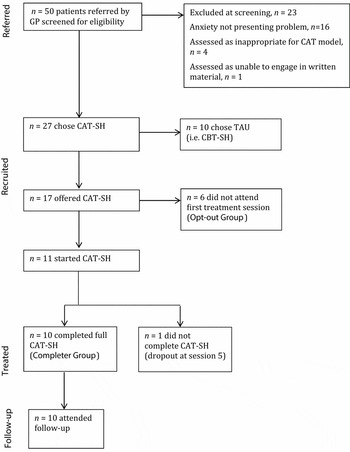
Inclusion and exclusion criteria was purposefully broad, in order to capture the typical clinical population treated at step two of IAPT. Participants were included if they scored above the clinical cut-off (>8) on the GAD-7 (Spitzer et al., Reference Spitzer, Kroenke, Williams and Löwe2006). Patients receiving any other therapies or who would normally be ‘stepped up’ in terms of complexity and risk (e.g. OCD, social phobia) were excluded. At screening, 27/50 (54%) met all inclusion criteria and were offered participation. For those choosing CAT-SH (n =17), ages ranged from 24 to 57 years (mean = 37; SD = 10.7), with ten (59%) female and seven (41%) male (88% were white-British). All participants had clinically significant anxiety (mean = 13, SD = 3.6) and 15/17 (88%) also scored within the clinical range (>10) for depression (mean = 13; SD = 3.5) at screening. Work and social functioning ranged from 0 to 30 (mean = 15; SD = 7), with 93% reporting significant functional impairment.
PWP training and supervision
All PWPs (n = 7) were in senior PWP roles (working across fifteen GP surgeries) and had a range of 3–11 years of experience (mean = 7, SD = 3). A one-day training event involved an introduction to the theoretical underpinnings of CAT, followed by training in delivery of the manual, involving role-play exercises and group discussion. Training evaluation questionnaires found that all PWPs agreed/strongly agreed that they: (a) felt more knowledgeable about the CAT intervention and (b) felt confident about using the manual. Satisfaction questionnaires are available on request from the authors. A monthly supervision group discussed cases and offered CAT-SH implementation guidance/support.
Outcome measures
Primary outcome measure: anxiety (GAD-7; Spitzer et al., 1999). The GAD-7 is a brief self-report measure of generalized anxiety disorder, designed for use in Primary Care settings. The seven items are based on the Diagnostic and Statistical Manual of Mental Disorders-IV (APA, 2000) symptom criteria for GAD. Total scores range from 0 to 21, and scores of 5, 10 and 15 represent clinical cut-offs for mild, moderate and severe anxiety. A score ≥10 has 89% sensitivity and 82% specificity for caseness (Spitzer et al., 1999), with the scale having good internal reliability (α = 0.92; Spitzer et al., Reference Spitzer, Kroenke, Williams and Löwe2006). A significant reliable change on the GAD-7 is a change score of ≥ 4 points (IAPT, 2014).
Depression (PHQ-9; Kroenke et al., Reference Kroenke, Spitzer and Williams2001). The PHQ-9 is a brief self-report measure designed for use in primary care to detect depression. The nine items are derived from DSM-IV (APA, 2000) symptom criteria for depression. Total scores range from 0 to 27, and scores of 5, 10, 15 and 20 represent clinical cut-offs for mild, moderate, moderate severe and severe depression. Sensitivity and specificity have been identified at 92% and 80%, respectively, at a caseness score >10, with the scale having good internal reliability (α = 0.87; Kroenke, et al. Reference Kroenke, Spitzer and Williams2001). A significant reliable change on the PHQ-9 is a change score of ≥ 6 points (IAPT, 2014).
Work and Social Adjustment Scale (WSAS; Mundt et al., Reference Mundt, Marks, Shear and Greist2002). The WSAS is an eight-item self-report measure of disability or functional impairment, attributable to a specific problem. The total score range is 0–40, with scores >10 associated with significant functional impairment. The WSAS has good internal consistency (α = 0.87) and test–retest stability (r = 0.73) and is sensitive to disorder severity and change.
Procedure
Screening sessions involved the standard PWP assessment (Richards and Whyte, Reference Richards and Whyte2009), completion of the IAPT minimum dataset (baseline measure 1: screening) and offering the choice of treatment as usual (CBT-SH) or CAT-SH. Participants opting to participate in CAT-SH were given (a) the psychotherapy file (Ryle, 1997) to complete as preparation for the first session, and (b) a dataset to complete at a mid-point interval between the screening session and the first intervention session (baseline measure 2). Prior to CAT-SH session 1, participants completed measures (baseline measure 3). Sessions 1–6 (30–35 min) constituted the ‘treatment phase’ involving delivery of CAT-SH. There was a 4-week follow-up. Following data collection, PWPs were invited to a focus group (50 min) to provide feasibility and acceptability feedback.
Analyses
Acceptability is reported via rates of patient choice for CAT-SH, subsequent session attendance and dropout rates. Group level analyses then report screening to termination and screening to follow-up, Mann–Whitney comparisons, and also Kruskall–Wallis comparisons of outcome measures across the three study phases. Effect sizes were calculated using Cohen's d (Cohen, Reference Cohen1992), defining d + = 0.20 as a ‘small’ effect, d + = 0.50 as a ‘medium’ effect, and d + = 0.80 as a ‘large’ effect. Change scores, effect sizes and dropout rates for CAT-SH are then benchmarked against the extant contemporary PWP outcome literature (i.e. studies that have assessed outcomes from GSH delivered on the one-to-one basis within an IAPT context). The PWP focus group data (n = 5) concerning feasibility was analysed using thematic analysis (Braun and Clark, Reference Braun and Clarke2006). A theme was labelled if it was mentioned by at least 3/5 PWPs. Following the identification of an initial set of themes, the data were coded by the second researcher to verify themes. The two sets of codes were compared, resulting in a 78% agreement.
Individual level analysis of CAT-SH outcomes was achieved on PHQ-9 and GAD-7 categorical outcomes via reliable change recovery rate analyses (RCI; Jacobson and Truax, Reference Jacobson and Truax1991) using the national IAPT metrics (IAPT, 2014). Reliable and clinical change rates were calculated on screening to termination and screening to follow-up scores. The following category definitions were used: (a) moving to recovery counted patients above the clinical cut-off on the PHQ-9 or GAD-7 at screening and then below on both measures following CAT-SH, (b) reliable improvement required that any improvement in outcome scores between screening and end of CAT-SH and follow-up exceeded measurement error of the PHQ-9 and GAD-7 using reliable change index (RCI; Jacobson and Truax, Reference Jacobson and Truax1991); conversely, reliable deterioration was an increase in scores exceeding measurement error; and (c) reliable recovery required reliable improvement in the PHQ-9 or GAD-7, and that the case had to additionally move below the clinical threshold on both the PHQ-9 and the GAD-7 at the end of CAT-SH (or follow-up in that analysis).
Results
Uptake and completion rates
Figure 1 illustrates patient progression through study stages. Of the 27/50 suitable patients at screening, 10/27 (37%) chose to receive treatment as usual (CBT-SH) and 17/27 (63%) chose CAT-SH. Subsequently, 6/17 did not attend the first CAT-SH treatment session (creating an ‘opt-out sample’), resulting in a final research sample of n = 11 entering treatment. CAT-SH starters did not differ from those that opted-out in terms of screening anxiety (U = 34, z = –0.098, P = n.s.), depression (U = 44, z = 0.884, P = n.s.), disability (U = 29, z = –0.109, P = n.s.) or age (U = 43.5, z = 0.831, P = n.s.). Ten out of eleven patients who attended the first treatment session then completed the full six-session treatment (creating a ‘completer group’); one patient dropped out at session 5. Within the completer group, 9/10 were discharged at follow-up; one patient was stepped up.
Patient flow through study stages

Clinical outcomes – group level analysis
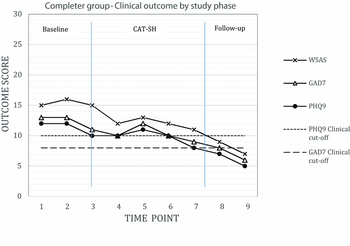
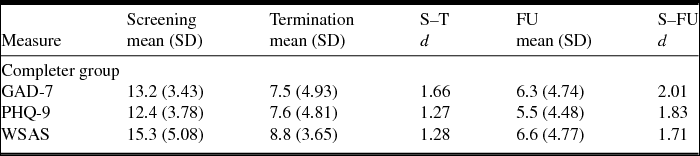
Figure 2 plots the sessional outcome data for CAT-SH completers. Vertical lines separate baseline (T1, T2 and T3), treatment (T4–T8) and follow-up (T9) phases. No significant change occurred between screening to CAT-SH session 1 in terms of anxiety (z = –1.368, P = 0.17), depression (z = –1.279, P = 0.20) or disability (z = 0.119, P = 0.91). This demonstrated stable baselines to evaluate treatment against. A group-level pattern of gradual reductions in anxiety, depression and disability during CAT-SH compared to baseline occurred (individual patient outcome graphs available on request from the authors). Both depression and anxiety scores had dropped into the non-clinical range by the end of CAT-SH and all measures demonstrate continued progress at follow-up. There was a significant session 1 to session 6 reduction in anxiety (z = –2.599, P = 0.009), with anxiety significantly reducing again over the follow-up (z = –2.803, P = 0.005). Patients also experienced a significant session 1 to session 6 reduction in disability (z = –2.497, P = 0.01), which again reduced over the follow-up period (z = –2.703, P = 0.001). There was no significant change in depression scores between session 1 and session 6 (z = –1.632, P = 0.10); however, change had become significant by follow-up (z = –2.397, P = 0.01). There was a significant phase reduction over time in anxiety (x²(6) = 27.99, P = 0.00), depression (x²(6) = 14.12, P = 0.03) and disability (x²(6) = 23.70, P = 0.001). Table 1 presents the CAT-SH completer group means for screening, termination and follow-up. Large treatment effects were found on screening-termination comparisons for anxiety (d+ = 1.66), depression (d+ = 1.27) and disability (d+ = 1.28). Effect sizes increased on screening to follow-up comparisons (anxiety, d+ = 2.01; depression, d+ = 1.83; disability, d+ = 1.71).
Sessional outcomes for CAT-SH completers

Means and effect sizes at screening (S) termination (T) and follow-up (FU)

Clinical outcomes – individual level analysis
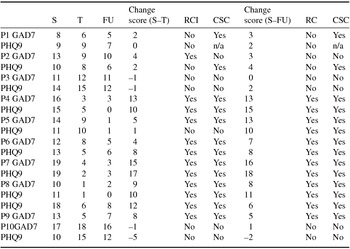
Table 2 presents reliable and clinical change rates for the CAT-SH completer group between screening (S), termination (T) and follow-up (FU). No patients experienced a reliable deterioration in anxiety or depression. Five out of ten patients were in reliable recovery by the end of CAT-SH, and 6/10 at the end of follow-up. Seven out of ten patients experienced a reliable reduction in GAD-7 scores on screening to termination comparisons and 6/10 on screening to follow-up comparisons.
Reliable (RCI) and clinical significance (CSC) of CAT-SH change scores

GAD: RCI significant if ≥4; PHQ: RCI significant if ≥6; CSC reached for GAD if pre-score > 8 and post-score < 8, and PHQ if pre-score >10 and post-score < 10.
Clinical outcomes – benchmarking level analysis
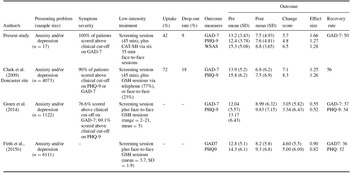
Table 3 contains benchmarking results comparing uptake, attrition and outcomes with three large-scale outcome comparators: the Clark et al. (Reference Clark, Layard, Smithies, Richards, Suckling and Wright2009) original IAPT demonstration sites (patient n = 4073), the Green et al. (2013) multi-site study (PWP n = 21; patient n = 1122), and the Firth et al. (Reference Firth, Barkham, Kellett and Saxon2015b) single site study (PWP n = 56; patient n = 6111). Effects sizes for CAT-SH were equivalent to the Clark et al. (Reference Clark, Layard, Smithies, Richards, Suckling and Wright2009) analysis, but larger than the Green et al. (Reference Green, Barkham, Kellett and Saxon2014) and Firth et al. (2015) comparators. The present study had a lower dropout rate (9%) than Clark et al.’s (Reference Clark, Layard, Smithies, Richards, Suckling and Wright2009) demonstration site study (18%) once the GSH had started. Recovery rates were equivalent with the Clark et al. (Reference Clark, Layard, Smithies, Richards, Suckling and Wright2009) evidence, but larger than the Green et al. (Reference Green, Barkham, Kellett and Saxon2014) and Firth et al. (2015) evidence. Clark et al. (Reference Clark, Layard, Smithies, Richards, Suckling and Wright2009) reported a notably greater uptake of intervention (72%) than the present study (42%).
Benchmarking outcomes for CAT-SH against three large-scale comparators

The reliable recovered rate has been calculated differently in each study. For the present study the most recent and recovered (2014) IAPT criteria have been applied.
CAT-SH feasibility – the PWP experience
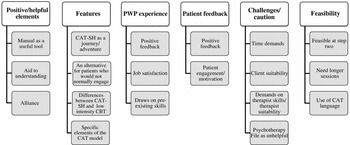
Figure 3 illustrates the thematic structure of the PWP focus group data, consisting of six superordinate themes and a range of associated subthemes. Themes are described below.
Themes and subthemes from the PWP focus group

Positive and helpful aspects
All PWPs described the CAT-SH therapist and patient manuals as useful clinical tools. Four out of five PWPs described CAT-SH as helping patients better understand themselves and their problems:
PWP3: ‘It's when you make that link it's such a leap for them in their understanding, when they realize this is the driver of this and they've never really known this is the driving focus of the anxiety.’
All PWPs described the positive impact of CAT-SH on the therapeutic alliance:
PWP5: ‘You can really feel the relationship developing when you're using this model.’
Features
There were several instances of PWPs (3/5) describing CAT-SH through the metaphor of being on a journey/adventure with a patient:
PWP5: ‘You feel like you're on a bit of a journey with them. People sort of discover themselves by doing all this thinking.’
Three out of five PWPs had been able to use CAT-SH with patients who they felt would usually have disengaged from low-intensity CBT or have been previously been stepped up to counselling.
PWP experience
All PWPs stated better job satisfaction through CAT-SH. PWPs spoke about being able to use their pre-existing knowledge, but having enjoyed learning new skills and being able to offer choice to their patients:
PWP4: ‘It was just so nice to be doing something new as well, for myself, as a therapist.’
Patient feedback
All PWPs received positive feedback from patients about CAT-SH and 4/5 described their patients as being engaged and motivated to do extra work outside sessions:
PWP4: ‘The two people I am seeing went off with the booklet and were keen. I found they were both so keen that they would come prepared for the sessions.’
Challenges/caution
Three out of five PWPs reported that CAT-SH initially required them to do more preparation before sessions (time demand), but that practitioner demands reduced with practice.
PWP4: ‘So I have offered my CAT patients just after lunch so I have time to prepare for the session, to go through my notes.’ (PWP1 and PWP5 also did this.)
All five PWPs agreed that it was important to consider which patients were appropriate for CAT-SH, due to its potential emotional impact. Three out of five considered CAT-SH demanding of PWPs and gave a note of caution about ensuring that only skilled/experienced PWPs deliver the intervention:
PWP3: ‘It's about the worker knowing their limits of how far they can take it. So I know how far I can go with this model, and not take it any further, because that makes it a little bit dangerous.’
Three out of five PWPs thought that the psychotherapy file was unhelpful and may have been overwhelming for patients so early in GSH.
Feasibility
One PWP felt CAT-SH was more suited to step 3. However, 3/5 PWPs felt that CAT-SH could be feasibly delivered at step 2:
PWP5: ‘We had our training and then we had the guide, so yeah and then there was group supervision too, so yeah it felt enough . . .I disagree, I really liked the model and I think it fits well at our level.’
Four out of five PWPs stated that they felt they needed to offer longer sessions in order to provide more containment:
PWP1: ‘I think realistically you needed that time, because you are talking about potentially quite distressing stuff for people.’
There was a high prevalence of the use of CAT language and ideas to describe the manner in which patients used the GSH to enable change, with all five PWPs giving examples of patients’ written work from the manual:
PWP4: ‘What I'm doing is repeating the same pattern as when I was a tiny little child, and things change, I'm not a child anymore. . . I don't need to feel rejected and criticized by everyone anymore, I can do things differently now.’
Discussion
This study has described a two-phase approach to the development and piloting of a CAT-informed GSH for anxiety (CAT-SH), bespoke for delivery at step 2 of IAPT services by PWPs. In phase 1, the manualized intervention was developed and tested in a small-scale modelling trial. CAT-SH was found to have sufficient scope, to be based on evidence, to be engaging to patients and also to promote their self-efficacy (Cape, 2014). Feedback resulted in modifications to the manual (in terms of time and process), but overall found CAT-SH as suitable for delivery in routine clinical practice (with indicated changes). Phase II then piloted CAT-SH to investigate feasibility, uptake and clinical outcome (MRC, 2008). High treatment compliance was found, with most patients completing the full 6-session intervention. It is acknowledged that the acceptability of anxiety interventions is increasingly important and so both treatment uptake and completion are a vital component of contemporary evidenced-based practice (Milosevic et al. Reference Milosevic, Levy, Alcolado and Radomsky2015). In the CAT-SH completer group, reliable recovery was achieved by 6/10 patients on the primary outcome measure of anxiety at follow-up. The establishment of a baseline phase prior to CAT-SH provided a sufficiently rigorous first test of CAT-SH effectiveness (Barlow and Hersen, Reference Barlow and Hersen1984). When benchmarked against extant CBT-SH evidence, then CAT-SH was largely comparable and on some indices (e.g. dropout) appeared superior. Individual patient outcomes found that no patients experienced significant deterioration during or following CAT-SH, indicating a safe GSH intervention.
When choice of intervention was offered at initial screening then fewer (37%) opted for treatment as usual (CBT-SH), 41% opted for CAT-SH and 22% opted for no treatment at all. The 41% uptake for CAT-SH is relatively low in comparison with figures from the IAPT demonstration sites (Clark et al. Reference Clark, Layard, Smithies, Richards, Suckling and Wright2009). However, it should be noted that Clark et al.’s (Reference Clark, Layard, Smithies, Richards, Suckling and Wright2009) figure includes patients receiving any low-intensity intervention (e.g. psychoeducational large-group classes). Findings suggest that offering an alternative to one-to-one CBT-SH at step 2 may improve treatment uptake. Indeed, PWP feedback suggests that CAT-SH provided treatment for patients identified as at risk of disengagement. Only one CAT-SH patient that completed treatment required stepping-up at follow-up, indicating cost effectiveness within stepped-care (Radhakrishnan et al., Reference Radhakrishnan, Hammond, Jones, Watson, McMillan-Shields and Lafortune2013). The rate (90%) of patients starting and completing full CAT-SH is evidence of a high treatment retention rate. This is in line with evidence that records low dropout rates across CAT outcome studies (albeit in high-intensity versions of the model; Calvert and Kellett, Reference Calvert and Kellett2014).
The study was also interested in the feasibility of introducing CAT-SH within step 2 of an IAPT service. Following a one-day training event all PWPs agreed or strongly agreed that they were more knowledgeable about the CAT model and also felt confident about using the CAT-SH manual. The training needs in relation to the manual do not therefore appear huge for senior PWPs. Qualitative feedback on completion of the study indicated that PWPs felt the training day, structure of the manual and monthly group supervision allowed them to effectively deliver CAT-SH. The feasibility of training PWPs in a novel intervention was further supported by a theme that emerged from the qualitative feedback: the development and use of ‘CAT language.’ PWPs quickly started to use CAT language (for example ‘repeating patterns’, ‘criticising role’ and ‘traps, snags and dilemmas’) to describe the dynamics of their patient's anxieties. This finding echoes previous research of CAT encouraging a ‘shared language’ to facilitate communication between professionals (Thompson et al., Reference Thompson, Donnison, Warnock‐Parkes, Turpin, Turner and Kerr2008). PWP feedback indicated that CAT-SH was an engaging intervention for both themselves and their patients; job satisfaction and supervision is vital in preventing burnout in low contact-high volume services (Rosario and Shepherd, Reference Shepherd and Rosairo2008). The theme of CAT being a shared journey/adventure also sheds further light on the collaborative and exploratory elements of the model (Ryle, Reference Ryle2004).
The present study suffers from the range of common methodological flaws associated with practice-based evidence (Barkham and Parry, Reference Barkham and Parry2008). The small sample size and lack of control condition compromises the validity of the findings. The follow-up period was short and therefore may have served more as a period of ‘no contact’ and was thus more likely to demonstrate further treatment gains (Michel et al., Reference Michel, Drapeau and Despland2003; Abbass, et al., 2012). Due to its reliance on voluntary recruitment of PWPs and patients, the present study may be subject to preference bias, as patients prefer novel interventions (Torgerson et al., Reference Torgerson, Klaber-Moffett and Russell1996). In the third stage of initial development, the manual was piloted on a sample of clinical psychologists (with some knowledge of the CAT model) and this early stage would have been better conducted with PWPs, considering the eventual target practitioner group.
Inclusion of a patient focus group following CAT-SH (including completers and non-completers) would provide useful further acceptability information. Indeed, guidelines for research into novel treatments do emphasize the need for public and patient involvement (NIHR, 2006), and this is a requirement in further CAT-SH research. Treatment acceptability is a multifaceted concept (Carter, Reference Carter2007) and in the current study was limited to uptake and retention rates, and so using treatment acceptability scales with CAT-SH would be useful in future research (Milosevic et al. Reference Milosevic, Levy, Alcolado and Radomsky2015). The established competency tool in CAT (CCAT; Bennett and Parry, Reference Bennett and Parry2004) would not be suitable for clinical or research purposes regarding CAT-SH, with established GSH competency scales more appropriate (Hague et al., Reference Hague, Hughes, Kellett, Millington, Simmonds-Buckley, Siviter and Stonebank2015). Future research is needed to demonstrate the efficacy of CAT-SH as a low-intensity treatment and a patient preference trial with long-term follow-up is indicated (Howard and Thornicroft, Reference Howard and Thornicroft2006). Future evaluations should also use a CAT-specific outcome measure such as the Personality Structure Questionnaire (PSQ; Pollock et al., Reference Pollock, Broadbent, Clarke, Dorrian and Ryle2001).
Several caveats emerged from the qualitative feedback, which should be considered in any future evaluation of CAT-SH. Firstly, PWP recruitment should be carefully considered and suggests being limited to senior PWPs. Feedback was unanimous that the ‘psychotherapy file’ was not useful. Future implementations of CAT-SH should consider developing an adapted shorter version more in keeping with good GSH practice (Turpin, Reference Turpin2010). Findings from phase I of this study demonstrate that the key theoretical elements of CAT of reformulation, recognition and revision and relational enactments (Ryle and Kerr, Reference Ryle and Kerr2002) can be successfully incorporated into a GSH version of the model. PWPs can use target problem procedures and reciprocal role identification (Ryle and Kerr, Reference Ryle and Kerr2002) to aid patient insight and form the basis of a diagrammatic reformulation (Ryle, Reference Ryle1995) within the structure of GSH.
In conclusion, this has been the first attempt to develop a GSH version of the CAT model, answering previous calls (Calvert and Kellett, Reference Calvert and Kellett2014) and suggesting that fit for purpose CAT-based GSH is possible. A relational approach to mental health can be translated into GSH and effectively manualized. CAT-SH appears appropriate and feasible for delivery by PWPs as a bona fide low-intensity intervention within a stepped care model (CSIP, 2008). Encouraging evidence concerning short-term clinical outcomes for CAT-SH has emerged. Clearly, further development and more demanding evaluation are now indicated.
Acknowledgements
The authors assert that all procedures contributing to this work comply with the ethical standards of NHS research and with the Helsinki Declaration of 1975, and its most recent revision.
Conflict of interest: The authors have no conflict of interest with respect to this publication.



Comments
No Comments have been published for this article.